City, University of London Institutional Repository
Citation
:
de Rooij, A. (2016). Hacking into the emotion-creativity link Two new approaches to interactive systems that influence the relationship between emotion and creativity. (Unpublished Doctoral thesis, City University London)This is the accepted version of the paper.
This version of the publication may differ from the final published
version.
Permanent repository link:
http://openaccess.city.ac.uk/15121/Link to published version
:
Copyright and reuse:
City Research Online aims to make research
outputs of City, University of London available to a wider audience.
Copyright and Moral Rights remain with the author(s) and/or copyright
holders. URLs from City Research Online may be freely distributed and
linked to.
Hacking into the emotion-creativity link
Two new approaches to interactive systems that
influence the relationship between emotion and
creativity
Alwin de Rooij
Submitted for the degree of Doctor of Philosophy in
Creativity Science
City University London
Centre for Human-Computer Interaction Design
Centre for Creativity in Professional Practice
2
Table of contents
Table of contents ... 2
List of figures ... 6
List of tables ... 9
Acknowledgements ... 11
Declaration ... 12
Abstract ... 13
1. Introduction ... 14
1.1 Research challenges ... 14
1.2 Research questions and objectives ... 20
1.3 Contribution ... 23
1.4 Scope of the thesis ... 23
1.5 Outline of the thesis ... 24
1.6 Published articles ... 26
2. Literature review ... 28
2.1 Introduction ... 28
2.2 Emotion and creativity ... 28
2.2.1 Emotion and the creative process ... 33
2.2.2 Emotion, motivation, and creativity ... 37
2.2.3 Summary ... 40
2.3 Interactive systems that influence emotion and augment creativity ... 45
2.3.1 Interactive systems that influence emotion ... 45
2.3.2 Interactive systems that augment creativity ... 48
2.3.3 Interactive systems that influence emotion to augment creativity ... 51
2.3.4 Summary ... 59
2.4 Summary of the literature review ... 60
3. Methods ... 64
3.1 Introduction ... 64
3.2 General methodological framework ... 64
3.2.1 Conception ... 64
3.2.2 Making ... 65
3.2.3 Experimental evaluation ... 66
3
3.3.1 Creative tasks ... 67
3.3.2 Assessment of creativity ... 69
3.3.3 Assessment of emotion ... 71
3.3.4 Manipulation checks... 73
3.4 Quantitative methods ... 73
3.5 Summary ... 74
3.6 Overview of the methods used in the individual studies ... 76
4. Study 1: Motor expressions as creativity support ... 78
4.1 Introduction ... 78
4.2 Motor expressions and emotion ... 79
4.3 Motor expressions and creativity ... 83
4.4 Task design ... 84
4.4.1 Motor expressions ... 85
4.4.2 Problem situations ... 85
4.5 Method ... 86
4.5.1 Participants ... 86
4.5.2 Materials and measurements ... 86
4.5.3 Procedure ... 89
4.6 Results ... 90
4.7 Discussion ... 95
5. Study 2: Hacking into the function of motor expressions in emotion regulation to augment creativity ... 104
5.1 Introduction ... 104
5.2 Regulating emotion ... 105
5.3 Regulating emotion to augment creativity ... 109
5.4 Interactive system ... 112
5.4.1 Arm gestures ... 112
5.4.2 Choreography of interaction ... 113
5.4.3 Recording ideas ... 113
5.4.4 Hypotheses ... 115
5.5 Method ... 116
5.5.1 Participants ... 116
5.5.2 Materials and measurements ... 116
5.5.3 Procedure ... 119
4
5.6.1 Task 1: Idea generation ... 122
5.6.2 Task 2: Insight problem solving ... 125
5.7 Discussion ... 128
6. Study 3: Hacking into cognitive appraisal processes to augment creativity during idea generation ... 135
6.1 Introduction ... 135
6.2 Causing emotion ... 136
6.3 Causing emotion to augment creativity... 140
6.4 Interactive system ... 144
6.4.1 Estimation of originality ... 145
6.4.2 Feedback manipulation ... 148
6.4.3 Presenting the feedback ... 149
6.4.4 Hypotheses ... 150
6.5 Method ... 151
6.5.1 Participants ... 151
6.5.2 Materials and measurements ... 152
6.5.3 Procedure ... 154
6.5.4 Analysis ... 156
6.6 Results ... 157
6.7 Discussion ... 161
7. Study 4: Hacking into cognitive appraisal processes to determine emotional intensity to augment creativity during idea generation ... 169
7.1 Introduction ... 169
7.2 Determining emotional intensity ... 170
7.3 Determining emotional intensity to augment creativity ... 176
7.4 Configuring the interactive system ... 178
7.4.1 Hypotheses ... 180
7.5 Method ... 180
7.5.1 Participants ... 181
7.5.2 Materials and measurements ... 182
7.5.3 Procedure ... 184
7.6 Results ... 186
7.7 Discussion ... 195
8. Discussion ... 203
8.1 Introduction ... 203
5
8.3 Contributions ... 210
8.3.1 Interactive systems that influence emotion to augment creativity ... 210
8.3.2 Interactive systems that augment creativity ... 212
8.3.3 Interactive systems that influence emotion ... 214
8.3.4 Theory about the emotion-creativity link ... 215
8.4 Limitations ... 218
8.4.1 Conception ... 218
8.4.2 Making ... 219
8.4.3 Experimental evaluation ... 221
8.4.4 Materials and measurement instruments ... 225
8.4.5 Effectiveness ... 229
8.5 Future work ... 232
8.5.1 The effectiveness of hacking into the function of motor expressions in emotion regulation ... 233
8.5.2 The effectiveness of hacking into cognitive appraisal processes ... 235
8.6 Conclusion ... 239
References ... 242
Appendices ... 268
Appendix A ... 269
Appendix B ... 274
Appendix C ... 281
Appendix D ... 285
Appendix E ... 294
6
List of figures
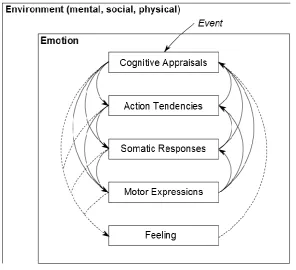
Figure 1 Schematic of emotion regulation and causation. An event in the environment causes emotion via cognitive appraisal processes, which feeds forward to drive changes in action tendencies, somatic and neuro-endocrine responses, motor expressions, and feelings. These emotion components feed back into each other, which enables regulation of an emotion. Feelings are an exception, which due to its dependency on awareness, influences cognitive appraisal processes only (after Moors, 2013; Scherer, 2009; Schwartz & Clore, 2007). ... 16 Figure 2 Schematic of part of the creative process. To enable creativity, people cycle back
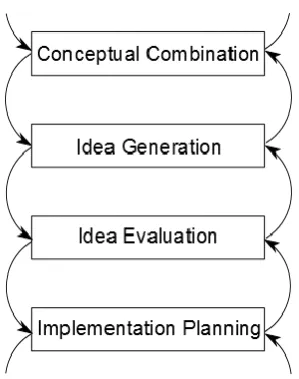
and forth through e.g. conceptual combination, idea generation, idea evaluation, and implementation planning. The way these steps in the creative process are executed determines creative task performance (after Mumford et al., 2012). ... 18 Figure 3 Schematic of the emotion components we focus on in the studies described in this
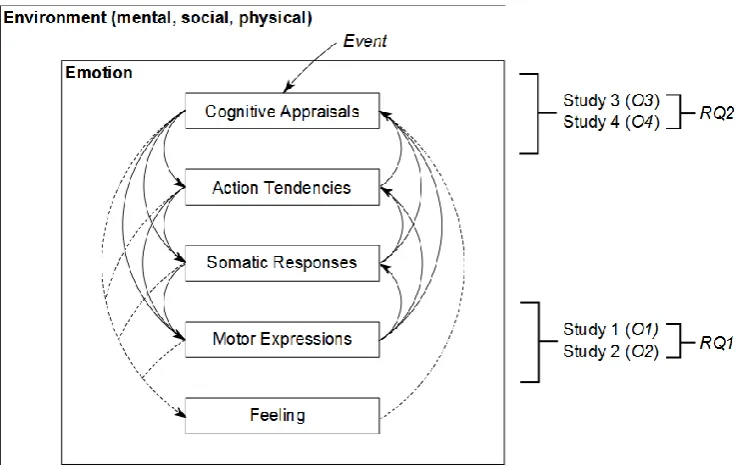
thesis. Studies 1 (O1) and 2 (O2) focus on motor expressions, which inform the first type of approach to interactive systems we develop (RQ1), whereas studies 3 (O3) and 4 (O4) focus on the cognitive appraisal processes, which inform the second type of approach to interactive systems that aim to hack into the emotion-creativity link (RQ2). ... 63 Figure 4 Schematic of the function of motor expression congruence in emotion regulation.
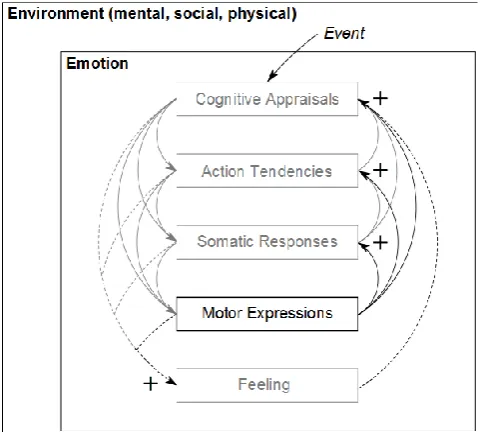
Congruence of a motor expression with an emotion feeds back into the somatic responses, action tendencies, and cognitive appraisals, which increases disposition towards, and increases the intensity of, congruent emotions, via positive feedback (+). Some aspects of motor expressions might feed forward into shaping an individual’s feelings, which then affects the way feelings can influence cognitive appraisal (dashed arrows). ... 80 Figure 5 Schematic of the function of motor expression incongruence in emotion
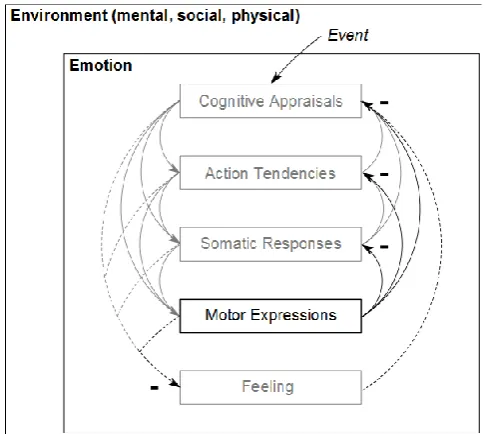
regulation. Incongruence between a motor expression and an emerging emotion can suppress the other emotion components by providing negative feedback (-), which decreases the disposition toward, and the intensity of, an emerging emotion. Some aspects of motor expressions might feed forward into suppressing individual’s feelings, which then affects the way feelings can influence cognitive appraisal (dashed arrows). If incongruence is sustained over time, a sense of incompatibility can emerge, which drives an adaptive response akin to an in emotion in its own right. ... 81 Figure 6 Graphic representation of the order and timing of information provided about the
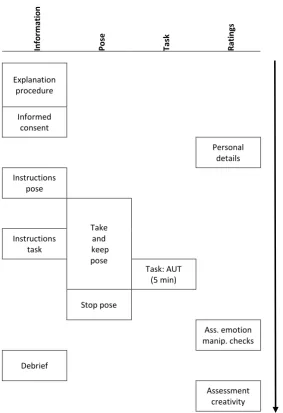
experiment, the moment the instructed pose was taken and thus when allegedly emotion should be influenced, the moment task was done, and ratings used in the procedure. ... 90 Figure 7 Scatterplot matrix of the dependent variables fluency, flexibility, originality, and
emotion. ... 92 Figure 8 Estimated marginal means of the motor expression x problem situation interaction
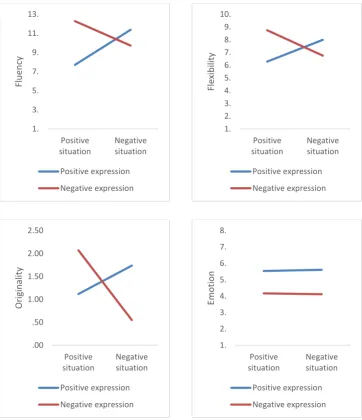
for the DVs fluency, flexibility, originality, and emotion... 94 Figure 9 Schematic (revised) of the function of motor expression congruence in emotion
7
into the emotion components, including motor expressions (left green arrow). Congruence of the motor expressions (e.g. a positive expression such as a smile or a positive gesture) with the emotion (e.g. a positive emotion) increases the intensity of that emotion via positive feedback (+). The motor expression also feeds forward into shaping an individual’s feelings (green dashed arrows). ... 107 Figure 10 A schematic of our use of the function of motor expressions in emotion
regulation to influence the emotion-creativity link. The figure shows the function of motor expression congruence (+) in regulating a positive emotion (left, green arrows), the influence of positive emotion on creativity during the idea generation step in the creative process (right), and the way the interactive system makes use of this relationship to influence the emotion-creativity link (bottom-left). ... 110 Figure 11 Illustration of the setup (left), and the end position of the A) positive approach
and B) negative avoidance gesture. ... 115 Figure 12 Graphic representation of the order and timing of information, activity related to
the use of the interactive system, use of the gestures and thus an indicator of when emotions may have been influenced, the tasks performed, and the ratings used in the procedure. ... 121 Figure 13 Scatterplot matrix of the dependent variables fluency, flexibility, originality, and
emotion. ... 123 Figure 14 Scatterplot matrix of the dependent variables correct (%) and emotion. ... 126 Figure 15 Schematic of the function of cognitive appraisal processes in emotion causation.
An event in the environment causes emotion (e.g. a positive emotion), via cognitive appraisal processes (e.g.an appraisal of an event that is perceived as goal-conducive, such as good performance), by feeding forward to drive changes (green arrows) in the other emotion components. ... 137 Figure 16 A schematic of our use of cognitive appraisal processes to influence the emotion-creativity link. The figure shows the function of cognitive appraisal processes in causing positive emotion (left, green arrows), the influence of positive emotion on creativity during idea generation (right), and the way the interactive system makes use of this relationship to influence the emotion-creativity link (bottom-left). Note that the event that causes positive emotion is now assumed to be the generation of original ideas... 143 Figure 17 A screenshot of the way feedback is presented showing text entry (left), and
feedback (right). The ideas and feedback shown here are responses to the brick as a subject, with the negative feedback manipulation. ... 150 Figure 18 Graphic representation of the order and timing of information, when the feedback
manipulations were used to influence the appraisals of the user’s own ideas, the tasks performed, and the ratings used in the procedure. ... 156 Figure 19 Scatterplot matrix of the dependent variables originality, satisfaction, and
frustration. These variables were person-mean centered ... 158 Figure 20 Schematic of the function of cognitive appraisal processes in determining
8
positive emotion than good performance when expectations are high), by determining not only the type of emotion (green arrows), but also the degree of change in the emotion’s components (+). ... 173 Figure 21 A schematic of our use of cognitive appraisal processes to influence the link
between emotional intensity and creativity. The figure shows the function of cognitive appraisal processes in determining the intensity of a positive emotion (left, green arrows, +), the influence of the intensity of positive emotion on creativity during idea generation (right), and the way this configuration of the interactive system developed in study 3 makes use of this relationship to influence the emotion-creativity link (bottom-left). ... 177 Figure 22 Graphic representation of the order and timing of information, when the feedback
manipulations were used to influence the appraisals of the user’s own ideas (and subsequently their expectations, emotions, and the intensity of their emotions), the tasks performed, and the ratings used in the procedure. ... 186 Figure 23 Scatterplot matrix of the dependent variables expectation, satisfaction,
frustration, and originality. ... 187 Figure 24 Estimated marginal means, 95% confidence intervals (error bars), and p-values
for pairwise comparisons (Fisher’s least significant difference – no correction applied for post-hoc testing) for expectation, satisfaction, frustration, and originality (DVs), for each of the feedback manipulations (IV). NN=negative feedback manipulation in both tasks, PN=positive followed by negative feedback manipulation, NP=negative followed by positive feedback manipulation, PP=positive feedback manipulation in both tasks. * p<.05, ** p<.001 ... 193 Figure 25 Emerging model of the relationship between positive emotion and creativity
9
List of tables
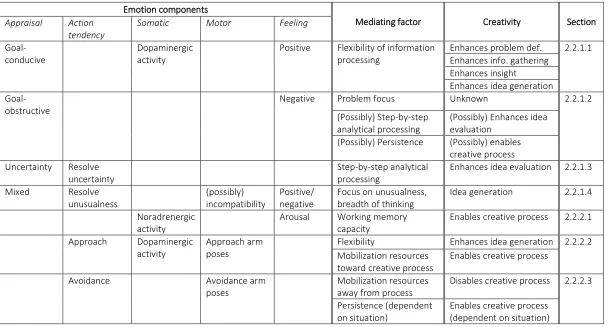
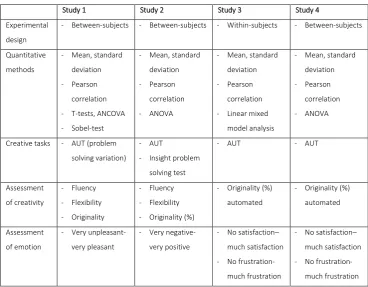
Table 1 Overview of the reviewed literature on the relationship between emotion and creativity taken from the perspective of the emotion components... 44 Table 2 Overview of the different methods used in the study designs. This includes the
experimental designs, quantitative analyses, creative tasks, and ways in which creativity and emotion were assessed. ... 77 Table 3 Means, standard deviations (between parentheses), and Pearson correlation
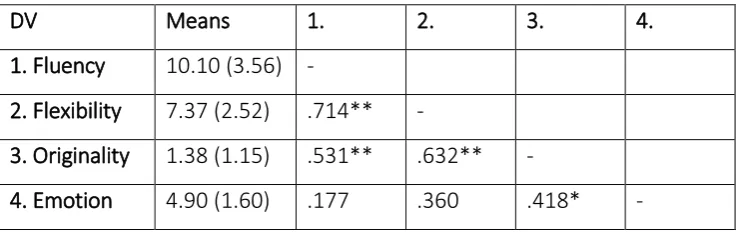
coefficients for the DVs fluency, flexibility, originality, and emotion. *p<.05, **p<.001. ... 92 Table 4 Hypotheses for study 2. ... 115 Table 5 Pearson correlation coefficient for the DVs fluency, flexibility, originality, and
emotion. ** is p<.005. ... 124 Table 6 Means and standard deviations (between parentheses) for fluency, flexibility,
originality, and emotion (DVs), for each of the arm gestures (IV). ... 124 Table 7 Means and standard deviations (between parentheses) for the percentage of
correctly answered insight problems and emotion (DVs), for each of the arm gestures (IV). ... 127 Table 8 Characteristics of the idea collections. ... 146 Table 9 Generated mapping functions for the negative, neutral, and positive feedback
manipulations... 149 Table 10 Hypotheses for study 3. ... 151 Table 11 Pearson correlation coefficients for originality, satisfaction, and frustration (DVs).
These variables were person-mean centered. *p<.05, **p<.001. ... 159 Table 12 Means and standard deviations (between parentheses) of originality, satisfaction,
and frustration (DVs) for the negative, neutral, and positive feedback manipulations (IV). ... 159 Table 13 Estimates of fixed effects of the feedback manipulations on satisfaction,
frustration, and originality. Unstandardized estimates, standard errors (between parentheses), 95% confidence intervals (between square brackets). *p<.05, **p<.001.
aData relative to the positive condition, as modelled by the intercept. ... 159
Table 14 Estimates of covariance for the LMMs for the DVs originality, satisfaction, and frustration. Unstandardized estimates, standard errors (between parentheses), 95% confidence intervals (between square brackets). *p<.05, **p<.001. ... 161 Table 15 Hypotheses for study 4. ... 180 Table 16 Pearson correlation coefficients for the DVs originality, satisfaction, frustration,
and expectation. *p<.05, **p<.001. ... 188 Table 17 Means and standard deviations (between parentheses) for expectation,
satisfaction, frustration, and originality (DVs), for each of the feedback manipulations (IV). ... 189 Table 18 Pairwise comparisons (Fisher's Least Significant Difference - no corrections
10
11
Acknowledgements
12
Declaration
The work described in this thesis is based on research carried out at the Centre for Creativity in Professional Practice, City University London, London, United Kingdom. No part of this thesis has been submitted elsewhere for any other degree or qualification. All work is my own, unless stated otherwise. Throughout this thesis I will refer to my work as our work, and to I as we, as a courtesy to the many people that helped shape the research presented in this thesis.
Alwin de Rooij Date
13
Abstract
Emotions can influence creative thinking. The ability of people to have the emotions that augment creativity can therefore help them to achieve higher creative task performance. How to design interactive systems that can effectively make use of this potential is, however, still an unanswered question. To explore possible answers to this question we have developed two novel approaches to interactive systems that can be used to effectively hack into the emotion-creativity link.
One approach we developed enables a system to hack into the function of motor expressions in emotion regulation, in order to regulate the emotions that happen spontaneously during a creative task. We demonstrate that embodied interactions designed based on motor expressions, while used to interact with a system, can influence an intended emotion, and thereby influence the relationship between emotion and creativity.
The second approach that we developed enables a system to hack into the cognitive appraisal processes that help cause emotion during a creative task. We demonstrate that believable computer generated feedback about the originality of a user’s own ideas, can be manipulated to help cause an intended emotion, determine its intensity, and thereby also influence the relationship between emotion and creativity.
14
1.
Introduction
Emotions can influence how people think and act in ways that augment or diminish creative thinking. For instance, when people experience positive emotions, the flexibility with which information is made available during the generation of ideas is increased, which can help people to come up with more original ideas. The ability to have the emotions that augment creativity during activities that can benefit from creative thinking, can therefore help people to achieve higher creative task performance. This presents an opportunity for designers of technologies that aim to augment creativity, to develop systems that influence emotion, and via emotion, augment creativity. Until now, however, research about ways in which interactive systems can be designed to make use of the emotion-creativity link, has been limited. This is surprising, because creativity is often seen as the new smart, a sought after skill that helps well-being, innovation, and culture thrive.
1.1
Research challenges
In this thesis we develop two new approaches to interactive systems that can make use of the emotion-creativity link, with the aim to help people to get more out of their own creative capabilities. In particular, we focus on explicating the mechanisms underlying the proposed approaches. The development of an interactive system that influences emotion to augment creativity requires solving two challenges.
15
Emotions have been defined as responses to events that help adapt the way
16
Figure 1 Schematic of emotion regulation and causation. An event in the environment causes emotion via cognitive appraisal processes, which feeds forward to drive changes in
action tendencies, somatic and neuro-endocrine responses, motor expressions, and feelings. These emotion components feed back into each other, which enables regulation
of an emotion. Feelings are an exception, which due to its dependency on awareness, influences cognitive appraisal processes only (after Moors, 2013; Scherer, 2009; Schwartz
& Clore, 2007).
Creativity has been defined as the development of ideas, insights, or
17
18
Figure 2 Schematic of part of the creative process. To enable creativity, people cycle back and forth through e.g. conceptual combination, idea generation, idea evaluation, and
implementation planning. The way these steps in the creative process are executed determines creative task performance (after Mumford et al., 2012).
The relationship between emotion and creativity depends on the influence of the adaptive changes that are caused by emotion on the way people think and act, on the execution of the creative process and the motivational factors that enable creativity (Baas et al., 2008; Davis, 2009). This information can be obtained by reviewing empirical research from psychology about the relationship between emotion and creativity. This informs what aspects of emotion such a system should attempt to influence in order to augment creativity. Thus, the literature review in this thesis is used to take on the first research challenge.
19
cause emotion during a creative task may cause positive emotions that are directed towards those pictures but do not carry over into the task (Chiew & Braver, 2014). It follows that the effectiveness of an interactive system that aims to influence emotion to augment creativity is restricted by whether the way the system influences emotion is meaningful within the context of a creative task (Gasper, 2003; Kaufmann & Vosburg, 2002).
Tasks that require creativity in particular may impose a particular set of restrictions on such interactive systems. For instance, an artificial social actor can help regulate students’ emotions on a learning task because it can be made meaningful within the context of a classical student-tutor relationship (Woolf, 2009). However, for many creative tasks it is not possible to find such a role for an interactive system. For example, because creative tasks are often performed alone. In such cases the only meaningful source of emotion is often the creator’s own appraisal of the mental events that occur during the task. For instance, during an idea generation task the cognitive act of combining different concepts can lead to the generation of a new idea (Mumford et al., 2012), which in turn can cause positive emotion in the person who has had that idea (cf. Akhbari Chermahini & Hommel, 2012a; Zenasni & Lubart, 2011). What here would be a meaningful way to influence emotion?
20
regulate the emotions that are caused by the creative task itself, in such a way as to augment creative task performance (Friedman & Förster, 2002). As a second possible solution, we suggest that an interactive system may be designed to manipulate the cognitive appraisals of the events that cause emotion during a creative task. Cognitive appraisals, the subjective evaluations of emotion-relevant events, largely determines if and how an emotional response unfolds (Moors, 2013). For instance, positive rather than negative emotions are typically caused when an event is appraised as conducive rather than obstructive to your goals (Scherer, 2009). The particular cognitive appraisals that help cause emotion during a creative task may therefore be used to cause the emotions that augment creative task performance (cf. Akhbari Chermahini & Hommel, 2012a; Zenasni & Lubart, 2011).
This is the basis of the way we address these research challenges in the work presented in this thesis.
1.2
Research questions and objectives
These challenges translate into two research questions about whether or not our two new approaches to interactive systems can effectively influence the emotion-creativity link. Each research question will be supported by two research objectives.
RQ1: Can the function of motor expressions in emotion regulation be used to
develop an effective approach to interactive systems that influence the
emotion-creativity link?
O1: Demonstrate that imposing motor expressions can help regulate
21
The objective here is to experimentally demonstrate that imposing motor expressions that associate with positive emotion and approaching action tendencies, rather than negative emotions and avoiding action tendencies, can augment creativity; and that incompatibility rather than congruence between a motor expression and an emotion can also augment creativity during idea generation. This is to justify using motor expressions to regulate emotion in further research in an interactive systems context. Study 1 is designed to achieve this research objective (chapter 4). Note that this study does not test the function of motor expressions within the context of interactive systems yet. Rather, the study is aimed at exploring ways in which motor expressions can influence the emotion-creativity link, which aims to justify further exploration in an interactive systems context, and which is the subject of later studies.
O2: Demonstrate that an interactive system can be designed to use
the function of motor expressions in emotion regulation to help
people perform better on idea generation and insight problem
solving tasks that require creativity.
22
RQ2: Can the cognitive appraisal processes that form part of positive and
negative emotions be used to develop an effective approach to interactive
systems that influence the emotion-creativity link?
O3: Demonstrate that an interactive system can be designed to use
the function of cognitive appraisal processes in positive and negative
emotion, to help people perform better on idea generation tasks that
require creativity.
The objective here is to experimentally demonstrate that manipulating computer generated feedback, about the originality of a person’s ideas, to be better or worse than people typically expect, can cause an intended positive or negative emotion accordingly, and thereby influence creativity during idea generation. Study 3 is designed to achieve this research objective (chapter 6).
O4: Demonstrate that an interactive system can be designed to use
the function of cognitive appraisal processes in determining the
intensity of positive and negative emotion, to influence the degree to
which creativity is augmented or diminished.
23
This summarizes the research questions that we will attempt to answer, and the research objectives we will attempt to achieve, in the research presented in this thesis.
1.3
Contribution
The contribution of the research presented in this thesis is the development
of two novel approaches to interactive systems, which are designed to influence the relationship between emotion and creativity, with the goal to help people to get more out of their own creative capabilities. The contribution focuses in particular on explicating the mechanisms underlying the proposed approaches. The contribution that we intend to make is to the creativity sciences, the scientific study of creativity and innovation; and to interactive systems research, the scientific study of the interaction between people and machines.
Our studies presented in this thesis contribute to research on interactive systems that aim to influence emotion to augment creativity. However, as a by-product of our studies, we also claim to make novel contributions to the more general areas of interactive systems that aim to augment creativity, interactive systems that aim to influence emotion, and to theory about the emotion-creativity link. This will be discussed in detail in chapter 8.
This summarizes the contributions of the research presented in this thesis.
1.4
Scope of the thesis
24
psychology about the relationship between emotion and creativity, which suggests that positive, rather than negative, emotions augment various aspects of the creative process. This is discussed in further detail in section 2.2.
The scope of our research is further restricted to creativity during idea generation. This is motivated by the observation that different aspects of emotion influence steps in the creative process differently. As a consequence, we will focus the capabilities of our two approaches on the relationship between positive and negative emotions and creativity during idea generation. This is discussed in further detail in section 3.3.
The way in which we will enable our interactive systems to influence this relationship, is by hacking into different emotion components. In theory, many emotion components exist that could be used for this purpose. However, as we already discussed in the above sections, in this thesis we will only focus on motor expressions and cognitive appraisal processes that form part of positive and negative emotions. This is discussed in further detail in chapters 4, 5, 6, and 7.
This delimits the scope of the research that will be presented in this thesis.
1.5
Outline of the thesis
This thesis is organised in the following chapters.
Chapter 2: Literature review. Reviews the relationship between emotion and
25
Chapter 3: Methods. This describes the general methodological approach
taken, and measurement instruments used in our studies.
Chapter 4: Study 1: Motor expressions as creativity support. This describes
the study designed to achieve research objective O1.
Chapter 5: Study 2: Hacking into the function of motor expressions in
emotion regulation to augment creativity. This describes the study designed
to achieve research objective O2.
Chapter 6: Study 3: Hacking into cognitive appraisal processes to augment
creativity during idea generation. This describes the study designed to
achieve research objective O3.
Chapter 7: Study 4: Hacking into cognitive appraisal processes to determine
emotional intensity to augment creativity during idea generation. This
describes the study designed to achieve research objective O4.
Chapter 8: Discussion. Discusses the studies with regard to the research
questions and research objectives, the contributions made, and limitations of the study results, based on which we recommend several directions for future work.
Appendices:
Appendices A-E: Published peer-reviewed articles
Appendix F: Technical report that details technical work relevant to
26
1.6
Published articles
The following articles based on the research undertaken in this thesis are published and peer reviewed.
Chapter 2
de Rooij, A. & Jones, S., 2013. Mood and Creativity: An Appraisal Tendency Perspective. In Proceedings of the 9th ACM Conference on Creativity &
Cognition. Sydney, 2013. ACM.
Chapter 4
de Rooij, A. & Jones, S., 2013. Motor Expressions as Creativity Support: Exploring the Potential for Physical Interaction. In Proceedings of the 27th International British Computer Society Human Computer Interaction
Conference. London, 2013. British Computer Society.
de Rooij, A., 2014. Toward Emotion Regulation via Physical Interaction. In
Companion volume of the Proceedings of the 19th International Conference
on Intelligent User Interfaces. Haifa, 2014. ACM.
Chapter 5
de Rooij, A. & Jones, S., 2015. (E)Motion and Creativity: Hacking the
Function of Motor Expressions in Emotion Regulation to Augment Creativity.
In Proceedings of the Ninth International Conference on Tangible,
27
Chapter 6
de Rooij, A., Corr, P., & Jones, S., 2015. Emotion and Creativity: Hacking into Cognitive Appraisal Processes to Augment Creative Ideation. In Proceedings
of the 2015 ACM SIGCHI Conference on Creativity and Cognition. Glasgow,
2015. ACM.
28
2.
Literature review
A paper that presents some early theoretical ideas about the emotion-creativity link was presented at the poster session of the 9th ACM
Conference on Creativity and Cognition, June 2013, Sydney, Australia. This paper is included in Appendix A.
2.1
Introduction
In this literature review we will present empirical research from psychology on the relationship between creativity and emotion. This informs what aspects of emotion should be influenced by an interactive system if it is to augment creativity. We also present an overview of interactive systems that are designed to influence emotion, augment creativity, and influence emotion to augment creativity. This serves the purpose of positioning the research we develop in this thesis within the context of interactive systems, but also of exposing possible limitations to the effectiveness of previous approaches.
2.2
Emotion and creativity
To inform the conception of an interactive system that aims to influence emotion with the goal of augmenting creativity, one needs to know what aspects of emotion influence creativity. These aspects of emotion then become the focus of the capabilities of such an interactive system, with which it aims to influence the emotion-creativity link.
29
emotion, and generally how emotion is conceptualised (Moors, 2009; 2013; Shuman & Scherer, 2015). In this thesis we wish to emphasise that the emotion model that is used as a basis for this review and our subsequent studies is the componential model (also referred to as the component process model (Scherer, 2009)). We will discuss how this model relates to the causation and regulation of emotion. We will emphasise the roles of appraisal processes and motor expressions in these because they embody the mechanisms that underlie the approaches developed in this thesis. Following the componential perspective on emotion as developed by Scherer (2009) we assume that there exists a reciprocal relationship among the emotion components. Here, a typical emotional response is assumed to be caused by events that are appraised in a manner that has some bearing on the individual’s or someone else’s wellbeing (Scherer, 2009). Appraisal processes feed forward into the (other) emotion components to drive changes in the way people think and act, in order to form an adaptive response toward the events that initially trigger the appraisal processes (e.g. a smile caused by the appraisal that an event is conducive to the individual’s goals). The componential model emphasises the importance of appraisals of events from the individual’s environment in the emergence of emotional responses. See Figure 1.
30
emotional response. For instance, regarding motor expressions, smiling increases the funniness people attribute to a comic (appraisal) (Strack et al., 1988); arm flexion increases positive feelings when it suggests pulling something towards you that you desire (action tendencies) (Centerbar et al., 2006); smiling is shown to activate dopaminergic pathways in the brain (somatic and neuroendocrine) (Wiswede et al., 2009); and mimicking emotion expressions increases the consciously experienced feelings of these same emotions (Flack, 2006; Flack et al., 1999). The componential model emphasises the role of individual emotion components in the regulation of an emerging response.
31
In this thesis we emphasise the importance of events in causing emotion, the role of appraisals therein (chapters 6 and 7) and the subsequent functioning of motor expressions as a way to regulate emotions (chapters 4 and 5). This is in part due to the large amount of evidence that exists on the role of events and appraisal processes in causing emotion (see for instance Moors; Roseman, 2004; Scherer, 2009; Siemer, 2007 for overviews); and due to the large amount of evidence that exists about the function of motor expressions (and other emotion components) in emotion regulation (see for instance Critchley & Nagai, 2012; Gross, 1998; Pfaf et al., 2014; Price & Harmon-Jones, 2015 for overviews). We will further elaborate theoretically on these emotion components in chapters 4, 5, 6, and 7.
The choices made also warrant a brief discussion on why there is less emphasis of possible bottom-up effects on emotion from for instance motor expressions in the emotion model used and studies based thereon. Note that we do not wish to downplay the importance of potential bottom-up effects of the emotion components on emotional responses (Carney et al., 2015). But there are some problems with the bottom-up thesis of emotion in relation to motor expressions specifically that suggest that caution is warranted (Pfaf, 2014; Price & Harmon-Jones, 2015; Roseman, 2004; Ranehill et al., 2015; Stanton, 2011). We will discuss the three main ones: 1. There is substantial evidence that emotions caused by events via
32
2. A recent meta-review on reaction time studies of approach and avoidance movements indicated that motor expressions are likely to only influence behaviour when they happen at the same time as an emotion-relevant event (Pfaf et al., 2014). For instance, approach and avoidance arm movements only influenced behaviour when people were asked to appraise the emotion on a face, rather than non-emotional aspects such as a face’s spatial properties (Rotteveel et al., 2004). This suggests explicitly that an event and its appraisal are required for motor expressions to influence emotion.
3. Recent replication issues of the Carney et al. (2010) study suggest that caution is warranted with claims about strong bottom-up effects of motor expressions on emotion (Price & Harmon-Jones, 2015). The replication showed no effects of power poses on cortisol and testosterone (neuroendocrine component), nor any effects on three behavioural tasks that were similar to the tasks used in Cuddy et al. studies (Ranehill et al., 2015). This despite a much larger sample, and treatment of previous issues in the measurement approach used in the Carney et al. study (Stanton, 2011). We follow Price & Harmon-Jones (2015) in their assessment that caution is warranted in basing any theory on the Carney et al. studies at this point.
33
With the componential perspective on emotion in mind, we will now review empirical findings on the relationships between emotion and creativity.
2.2.1
Emotion and the creative process
To arrive at a creative outcome people cycle back and forth through a range of information processing steps, which have been characterised as: 1) problem definition, 2) information gathering, 3) concept selection, 4) conceptual combination, 5) idea generation, 6) idea evaluation, 7) implementation planning, and 8) solution monitoring (Mumford et al., 2012). For instance, in the conceptual combination step in the creative process one might combine concepts related to jogging and music, from which the idea is generated to make running shoes with a built in music player, which is evaluated as original but not very effective, which prompts people to therefore cycle a few steps back in the creative process to generate more ideas. This process is typically referred to as the creative
process. SeeFigure 2.
34
developed into an effective outcome (Isaksen et al., 2011; Mumford et al., 2012).
The adaptive changes in the way people think and act that are associated with different emotions, and the influence of these changes on the way the creative process is executed, can therefore influence creativity (Baas et al., 2008; Davis, 2009). As such, emotions can diminish creativity when the adaptive response that constitutes an emotion works against the factors that determine an effective execution of an activity in the creative process. Conversely, emotions can augment creativity when they benefit the execution of activities in the creative process in a way that favours the emergence of original and effective outcomes (Baas et al., 2008; Davis, 2009).
2.2.1.1Positive emotion augments problem definition, information
gathering, and idea generation
35
2012b; Ashby et al., 1999), which plays a role in regulating the flexibility with which information is relayed to other brain areas (Dreisbach & Goschke, 2004; Dreisbach et al., 2005). In addition, self-reported positive feelings also associate with enhanced idea generation (Baas et al., 2008). Although the link between positive emotion and creativity is most apparent during idea generation (see Baas et al., 2008 for a meta-review), recent findings have also shown that the flexibility that is associated with positive emotions can benefit insight and creativity during the problem definition (Chen et al., 2014) and information gathering (Gasper & Zawadzki, 2012) steps in the creative process.
2.2.1.2Negative emotion may or may not have an influence on emotion
36
that are beneficial to creative thinking such as an increase in arousal in the case of for instance fear, or approach motivation in the case of for instance anger (section 2.2.2). Therefore it is not clear from the literature whether the adaptive changes that associate with the negative aspects of an emotion have an influence on other steps in the creative process (Baas et al., 2008).
2.2.1.3Emotions that associate with uncertainty augment idea evaluation
Emotions can also be thought of in terms of whether they associate with certainty or uncertainty. For instance, happiness and anger associate with certainty, whereas anxiety and some cases of sadness and fear associate with uncertainty (Baas et al., 2011; Scherer, 2009). Emotions that associate with uncertainty occur when it is difficult to predict the outcome of an emotion-relevant event. Certainty enables the use of heuristics (Tiedens & Linton, 2001), whereas uncertainty associates with a structured, step-by-step, and detail-oriented approach to information processing in order to increase the likelihood that more certainty can be obtained about the situation (Baas et al., 2012; Tiedens & Linton, 2001). The latter can inhibit performance during idea generation because it drives a focus on details, which limits generating many and diverse ideas. However, it can augment
idea evaluation, the deliberative and reflective kind, because systematic
information processing increases the likelihood that flaws in the details of a generated idea are discovered (cf. Sowden & Dawson, 2011).
2.2.1.4Mixed emotions, an open question.
37
simultaneous positive and negative feelings (cf. Larsen & McGraw, 2011). Others have suggested that mixed emotions can also be caused when different emotion components carry contrary emotional meaning (Huang & Galinsky, 2011). For instance, when frowning angrily while being in a situation that is evaluated as pleasant (Huang & Galinsky, 2011). Mixed emotions can potentially augment performance on idea generation because they drive the feeling that the situation an individual is in is an unusual one (Huang & Galinsky, 2011). Empirical findings suggest that mixed emotions can either drive an adaptive response that might resolve the situation quickly, for example by accepting an unusual solution to the situation (Huang & Galinsky, 2011), or may drive attention to seeking out what is unusual in the environment (Fong, 2006). For instance, a recent study showed that people categorize a broader range of exemplars as belonging to a particular category when emotion components are incompatible, for instance, by smiling in a sad situation, than when they experience a singular emotion (Huang & Galinsky, 2011). It follows that this might augment idea generation. This has however, not been tested explicitly yet.
2.2.2
Emotion, motivation, and creativity
Motivation can enable creativity through the arousal, direction, and
38
certain degree of motivation is often seen as a necessary condition for creativity to occur (Baas et al., 2008; Sternberg & Lubart, 1996).
Motivation can help ensure that people invest sufficient resources into a creative task, to persist throughout the creative process, despite the demands the creative process poses. For instance, arousal, the activation of the sympathetic nervous system, associates with attention to and maintenance of the goals relevant to a creative process (de Dreu et al., 2012); the direction of motivation, for instance, the tendency to avoid or approach, determines whether people invest their motivational resources in the creative process or elsewhere (Roskes et al., 2013); and persistence can enable people to compensate when the way they adapt to a situation is initially not conducive to performance (Baas et al., 2008).
Emotions influence the arousal, direction, and persistence of people’s behaviour in various ways (Elliott et al., 2013; Russell, 2003; Scherer, 2009). Emotion can therefore enable creativity via its link with the processes that associate with motivation.
2.2.2.1Emotional arousal enables creativity
39
attention to and maintenance of the goals relevant to a creative process (de Dreu et al., 2012). Therefore, emotions that associate with higher levels of arousal associate with creativity more those that associate with lower levels of arousal (de Dreu et al., 2008; Filipowicz, 2006; To et al., 2012).
2.2.2.2Approach action tendencies support motivation (and positive
emotion)
40
emotion (cf. Baas et al., 2008; Baas et al., 2011). Therefore, emotions that involve approach action tendencies can enable creativity.
2.2.2.3Avoidance action tendencies can enable persistence
Avoidance action tendencies, the activation of goals and tendencies that drive behaviour away from, that is to avoid, negative outcomes (Schacter et al., 2011, p. 300), typically emerge as part of an emotion when events are appraised as threatening, and people believe that they do not have the resources to cope with the situation (Milgram & Tenne, 2000). Avoidance tendencies associate with a relatively narrow and detail oriented manner of information processing (Friedman & Förster, 2005). Therefore, avoidance tendencies are typically not associated with creativity (cf. Baas et al, 2008; Sowden & Dawson, 2011). However, when a creative task is believed to facilitate avoiding something negative, people tend to direct more motivational resources to that creative task and persist longer at that task (Roskes et al., 2012; 2013). This in turn help enable creativity in that particular circumstance. Therefore, emotions that involve avoidance action tendencies can enable creativity when creativity can help facilitate the avoidance of negative outcomes.
2.2.3
Summary
We have reviewed empirical research from psychology on the relationship between emotion and creativity. This review provides knowledge about the aspects of emotion that an interactive system designed to influence emotion, can attempt to target when it is designed with the goal to augment creativity (see Table 1 for an overview).
41
during a creative process. Positive emotion can augment creativity during problem finding, information gathering, and idea generation. Negative emotion has no influence, or diminishes creativity during idea generation, but it is unclear whether negative emotions influence other steps in the creative process. Emotions that associate with uncertainty diminish creativity during idea generation, but augment idea evaluation. Finally, mixed emotions might be a way to target idea generation (section 2.2.1). The review also indicates that the link between emotion and creativity can be targeted by the influence of emotion on motivation. Emotional arousal increases attention to and maintenance of the goals relevant to a creative process, enabling creativity. Approach action tendencies direct motivational resources to the creative process, and support positive emotion. Finally, when creativity facilitates avoiding something negative, emotions that associate with avoidance action tendencies can increase the persistence necessary to enable creativity (section 2.2.2).
42
That is, positive and negative emotions are the targets for the interactive systems developed.
This is motivated by the following observations:
1. The differential effects of positive and negative emotions on creativity
during idea generation have the most solid base of empirical research to
support their relationship with creativity (Baas et al., 2008; Davis, 2009). A focus on positive and negative emotions within the context of idea generation is therefore a good way to investigate our developed approaches to interactive systems can be used to target the emotion-creativity link.
2. A focus on positive and negative emotion will also enable us to compare our own research to an extensive body of previous work. This can be used to support our focus on the mechanisms underlying the impact of the designed interactive systems on the emotion-creativity link. The latter, we feel will strengthen our contribution.
3. Positive and negative emotions can be self-reported by asking people about the feelings experienced during a creative task. Using self-report is a limitation imposed by the available resources for the studies in this thesis. From the literature it is unclear to what extent other (aspects of) emotion can be self-reported on reliably. This we will address in detail in the discussion section (section 3.3.3).
43
44
Emotion components
Mediating factor Creativity Section
Appraisal Action tendency
Somatic Motor Feeling
Goal-conducive
Dopaminergic activity
Positive Flexibility of information processing
Enhances problem def. 2.2.1.1 Enhances info. gathering
Enhances insight
Enhances idea generation
Goal-obstructive
Negative Problem focus Unknown 2.2.1.2
(Possibly) Step-by-step analytical processing
(Possibly) Enhances idea evaluation
(Possibly) Persistence (Possibly) enables creative process Uncertainty Resolve
uncertainty
Step-by-step analytical processing
Enhances idea evaluation 2.2.1.3
Mixed Resolve unusualness
(possibly) incompatibility
Positive/ negative
Focus on unusualness, breadth of thinking
Idea generation 2.2.1.4
Noradrenergic activity
Arousal Working memory capacity
Enables creative process 2.2.2.1
Approach Dopaminergic activity
Approach arm poses
Flexibility Enhances idea generation 2.2.2.2 Mobilization resources
toward creative process
Enables creative process
Avoidance Avoidance arm
poses
Mobilization resources away from process
Disables creative process 2.2.2.3
Persistence (dependent on situation)
[image:45.842.120.729.112.439.2]Enables creative process (dependent on situation)
45
2.3
Interactive systems that influence emotion and
augment creativity
To enable an interactive system to influence the relationship between emotion and creativity, to augment creativity, the system needs to be able to influence emotion in a manner that suits creativity. In this section we will review previous research on interactive systems that are designed to help influence emotion, interactive systems that augment creativity, and interactive systems that are designed to influence emotion in order to augment creativity. The goal of this review is to position the research that is presented in this thesis within the spectrum of these technological developments, to provide arguments for its novelty, and identify possible constraints that can inform the development of our own approach to such interactive systems.
2.3.1
Interactive systems that influence emotion
46
1997; Scherer et al., 2010). The research presented in this thesis is about the latter.
We distinguish between four common ways in which interactive systems influence emotion to help determine the way people think and act.
2.3.1.1Integration of techniques from psychology in interactive systems
Interactive systems often attempt to appropriate commonly used techniques to induce emotion that are developed in the psychological sciences for experimental research purposes, such as exposing users to pictures, music, movie scenes, or situations that have some bearing on emotion (cf. Lench et al., 2011). For instance, an adaptive music player was developed that can monitor peoples skin conductance responses to different songs, and, assuming a correlation between skin conductance and arousal, is then able to select and play the songs that calm people down or get them to be more excited (van der Zwaag et al., 2012). Other examples include interactive environments that convey images (Lewis et al., 2011), music (Morris et al., 2013), movie scenes (Giannoullis & Verbeek, 2009), smells (Giannoullis & Verbeek, 2009), and situations (Chittaro & Zangrando, 2010) that associate with emotion.
2.3.1.2Physiological techniques and biofeedback
47
patterns fit a predetermined pattern that associates with increased empathy, increases empathy in virtual environments (Cavazza et al., 2014). Other approaches use the communicative value of physiological signals to influence emotion. For instance, a ring that can be worn, and is designed to convey the heartbeat of another person, influences feelings of intimacy (Janssen et al., 2010).
2.3.1.3Mirrors and mirroring
The manipulation of facial expressions of people in a manner that influences emotion can also be used to develop interactive systems that influence emotion. Some manipulation techniques focus on humoristic manipulations of the user’s own face (Melder et al., 2007; Shahid et al., 2013). For instance, in analogy to the distorting mirror seen at carnivals, digital manipulations of one’s own face can be made, which can be used to cause positive emotions (Shahid et al., 2013). An alternative approach is to manipulate the face of other’s during interpersonal communication. Here, the tendency of people to mirror (mimic) each other’s facial expressions is used (Niedenthal, 2007). For instance, subtle manipulations of facial expressions using a video-conferencing tool, to make the person a user is talking to look more positive or negative, influences emotion in the user accordingly (Yoshida et al., 2013).
2.3.1.4Mimicking social interaction
48
emotions (de Rooij et al., 2013). This approach aims to develop computer generated social interactions. This may include mirroring as discussed in the section above, but generally involves a broad set of emotional behaviours that need to be mimicked, which can include mirroring. For instance, mimicking social interactions can mean that some expressions can be designed to generate mirroring behaviours in the user (e.g. confirming positivity and approval in a confederate) (Hatfield et al., 2014). This can be done by endowing an anthropomorphic robot with the ability to mimic facial expressions. Some expressions however may not cause mirroring, but lead to counter-mimicry as a way of coping or regulating another’s emotional response (e.g. in the case of anger from a peer or a superior). Therefore, emotion recognition systems and computational models of emotion are necessary to determine in situ the expression that is appropriate, and when it should be expressed (Broekens et al., 2009). This way, mimicking social interactions can be an effective way to influence a user’s emotions and influence any associated adaptive behaviours. For instance, virtual avatars endowed with these capabilities can make people feel encouraged when these avatars express empathy at appropriate moments (McQuiggan & Lester, 2007).
2.3.2
Interactive systems that augment creativity
49
We distinguish between three common ways in which interactive systems support and augment creativity when an individual engages in creative work (after Bonnardel & Zenasni, 2010; Lubart, 2005).
2.3.2.1Unburdening the creative process
Interactive systems can be designed to enable a user to effectively execute the creative process (Shneiderman, 2007). This can be done by designing environments that minimize the burden on a user’s cognitive resources by minimizing the resources needed to deal with any functionality of an interactive system that is not conducive to creativity (Bonnardel & Zenasni, 2010). For instance, Cycling ’74 Max/MSP is a visual programming environment for media creation which allows access to advanced signal processing algorithms, and lets users explore the results of their programming in real-time (cf. Shneiderman, 2007). This supports the creative process because it allows users to construct algorithms and explore the results without the need to wait for the software to compile. This makes it easier for a user to focus on the creative process. This in turn makes generating and evaluating ideas easier when compared to traditional programming languages, which require the user to compile the code before its result can be seen.
2.3.2.2Supporting the use of creativity techniques
50
developed for dementia carers supports idea generation by letting people find solutions to a problem from one domain by considering it in another, in order to support analogical reasoning (Zachos et al., 2013). The application allows a carer to input a situation that the carer encounters that requires a creative solution. Based on this input the application prompts the user with possible solutions that have been developed for similar situations that have occurred in a different domain. This can inspire the user to translate these ideas to their own situation and thereby helps the user to get more out of their own creative capabilities.
2.3.2.3Collaborating with intelligent machines
51
2.3.3
Interactive systems that influence emotion to
augment creativity
Interactive systems can be designed to influence emotion, and via emotion, augment creativity. Such an approach to interactive systems is different from the reviewed interactive systems that augment creativity (section 2.3.2), because it attempts to prepare the way the user thinks and acts, in a way that supports the execution of a creative process, and by supporting the motivation necessary to do a creative task (section 2.2). That is, it taps into the ability of people to adapt to different situations, and supports that process in a manner that is conducive to creativity. This in itself is a relatively novel approach to interactive systems that aim to augment creativity.
This is the approach we follow in the studies that are detailed in this thesis.
2.3.3.1Current attempts
Until now there have been relatively few attempts at designing such systems. There is some work on the integration of emotion induction methods from psychology in digital platforms (section 2.3.1.1).
52
extrinsically by paying them a small amount of money upon completing each task. In the verbal idea generation task participants were asked to generate many alternative uses for a common object (e.g. a brick). In this task, showing both positive and negative pictures led people to generate more original uses for a common object when compared to being presented with neutral pictures. Contrary to common findings in the literature no significant differences were found between the positive and negative conditions. In the visual idea generation tasks participants were asked to draw as many sketches as they could on the basis of a circle. Results of this task showed that presenting positive images rather than neutral or negative images led people to draw significantly more original sketches. Overall, this study confirms that the relationship between positive and negative emotion can be targeted by means of an interactive technology, which further justifies our own focus on positive and negative emotions during idea generation. However, this study also suggests that there may be differences in the effectiveness with which the way emotion is targeted (here with pictures that contain emotional content). The latter justifies our own studies which aim to investigate novel ways in which the link between emotion and creativity can be targeted.
53
54
whose face was manipulated to look more negative. These findings are in line with research on the link between positive and negative emotions and creativity during idea generation. Moreover, these findings again confirm that the emotion-creativity link can be targeted using an interactive system. The few existing research projects that have been developed until now indicate that:
1. The development of interactive systems that aim to target the emotion-creativity link is a relatively novel and unexplored field of research. That is, there are only three studies by others that address this relationship explicitly. This justifies our studies from an interactive systems perspective.
2. Positive and negative emotion can be targeted using an interactive system in a manner that is conducive to creativity during amongst others idea generation. This justifies further our own focus on the effects of positive and negative emotions on creativity during idea generation tasks.
3. Other aspects of emotion than its positivity or negativity are not explicitly focused on or were found ineffective in the research that is currently available. Although this is an opportunity for novel research, we focus on the mechanisms underlying new ways of targeting the emotion-creativity link.
55
novel ways in which interactive systems can target the emotion-creativity link.
The latter will be discussed in further detail in the next section.
2.3.3.2Limitations and a critique of current attempts
Since the field is new, little is yet known about how interactive systems should be designed to effectively influence emotion in a way that suits creativity. The studies discussed in the above section indicated that the way in which an interactive system targets the link between emotion and creativity matters. However, given the little amount of research on such interactive systems, we may turn to empirical research from psychology on the influence of emotion induction techniques on creativity for some further insight into this.
We believe that the main issue that such technologies need to overcome is that the adaptive influence of emotion on the way people think and act, depends on the nature of the events that cause emotion, and the situation in which these emotions are caused (Russell, 2003; Wilson-Mendenhall et al., 2013). For instance, fear in response to a threat, e.g. seeing a dangerous animal, consists of a somewhat different adaptive response than fear that is caused in a social situation, e.g. in anticipation of public speaking (Wilson-Mendenhall et al., 2013). Thus, one would expect that an emotion that is caused by an event that has nothing to do with a creative task, may influence creativity differently.
56
that emotion that is induced in a manner that is generally task irrelevant can lead to different effects than emotions that are caused in a manner that is relevant to the task. For instance, recent studies on working memory performance (which we have linked earlier to task performance during the creative process, section 2.2) showed that positive emotions that are induced via pictures displayed prior to a task-switching task can impair working memory performance, whereas performance contingent rewards enhanced working memory performance (Goschke & Bolte, 2014).
If we compare this to research on the emotion-creativity link (section 2.2) we could argue that there is a possibility that using task-irrelevant methods to influence emotion are likely to lack the needed arousal (de Dreu et al., 2011) or possible approach action tendencies (Roskes et al., 2013) to enable creativity. That is, pictures used to target emotion may muster insufficient motivational resources. The question then becomes whether this is because these studies did not control for differences in arousal and approach motivation for instance (section 2.2.2). So one conclusion could be that an interactive system that aims to target the link between positive and negative emotions and creativity should also explicitly target arousal and approach motivation, or at least make sure that possible different levels of arousal and different motivational directions are elicited by task irrelevant emotion.