City, University of London Institutional Repository
Citation
: Tokaranyaset, Chatmaporn (2013). Institution-Based Resource: Concept and
Cases. (Unpublished Doctoral thesis, City University London)This is the unspecified version of the paper.
This version of the publication may differ from the final published
version.
Permanent repository link:
http://openaccess.city.ac.uk/2416/Link to published version
:
Copyright and reuse:
City Research Online aims to make research
outputs of City, University of London available to a wider audience.
Copyright and Moral Rights remain with the author(s) and/or copyright
holders. URLs from City Research Online may be freely distributed and
linked to.
1
Institution-Based Resource:
Concept and Cases
Chatmaporn Tokaranyaset
A thesis submitted in partial fulfillment of the requirements
for the degree of
Doctor of Philosophy in Management
Cass Business School
City University
2
TABLE OF CONTENTS
LIST OF TABLE ... 5
LIST OF FIGURES ... 6
ACKNOWLEDGEMENTS ... 7
DECLARATION ... 8
ABSTRACT ... 9
CHAPTER 1: INTRODUCTION ... 10
1.1 Research Motivation ... 10
1.2 Research Approach, Construct, and Contribution ... 10
1.3 Research Outline ... 11
CHAPTER 2: LITERATURE REVIEW ... 13
2.1 Resource-Based Theory (RBT) ... 13
2.2 Institutional Theory (IT) ... 14
2.2.1 Definition: Institution ... 14
2.2.2 Conformity Is Necessary But Not Sufficient ... 17
2.2.3 Interpretive Flexibility and Innovation ... 18
2.3 Combining Resource-Based Theory and Institutional Theory... 20
2.4 Conclusion ... 21
CHAPTER 3: INSTITUTION-BASED RESOURCE CONCEPT (IBR) ... 23
3.1 Institution-Based Resource: Definition and Premises ... 23
3.2 How Do Institutions Consecrate An Institution-Based Resource? ... 26
3.2.1 The Consecrating Institution and its Cultural Consecration ‘Projects’ ... 26
3.2.2 Organizational and Cultural Legitimacy of the Consecrating Institution ... 29
3.2.3 Symbolic Capital of the Consecrating Institution ... 32
3.2.4 The Process of Consecration ... 33
3.3 Symbolic Value and Benefit of Institution-Base Resource ... 36
3.3.1 The Advantages of the Institution-Based Resource ... 38
3
3.4 What Erodes the Value of Institution-Based Resource? ... 45
3.4.1 How to Prevent an IBR from Losing its Value? ... 47
3.5 Conclusion ... 48
CHAPTER 4: THE ROLES OF COUTURIER AND CREATOR AS AN IBR ... 50
4.1 Introduction ... 50
4.2 The Fashion Industry Overview ... 50
4.2.1 Origin and Definition ... 51
4.2.2 A Cultural Product with Symbolic Meaning ... 52
4.2.3 Fashion Industry Structure ... 54
4.2.4 Fashion Trends, Shows, and Calendar ... 57
4.2.5 Gatekeepers in the Fashion Industry ... 58
4.3 Theoretical Overview ... 60
4.3.1 “The Federation”: History, Purpose, and Membership Rules ... 60
4.3.2 The Federation as Consecrating Institution ... 63
4.3.3 The Roles of Couturier and Creator as Institution-Based Resource ... 66
4.3.4 Fashion Week as Ritual and Field Configuring Events ... 71
4.4 Methodology ... 74
4.4.1 Data Collection and Analysis ... 74
4.4.2 Findings and Discussion ... 76
4.5 Conclusion ... 89
CHAPTER 5: MUSEUM CONSECRATION AS AN IBR FOR FASHION
DESIGNERS ... 91
5.1 Introduction ... 91
5.2 Theoretical Overview ... 92
5.2.1 Museum as Consecrating Institution ... 92
5.2.2 Museum Exhibition as Ritual and Field Configuring Event ... 93
5.2.3 Museum Fashion Exhibition and Consecration of Institution-Based Resource ... 96
5.3 Research Context ... 99
5.4 Methodology ... 101
4
5.4.2 Data Analysis ... 102
5.4.3 Findings ... 104
5.4.4 Discussion and Conclusion ... 119
CHAPTER 6: THE ROYAL WARRANT AS AN IBR ... 123
6.1 Introduction ... 123
6.2 Theoretical Overview ... 123
6.2.1 The British Monarchy as the Consecrating Institution... 123
6.2. 2 What is the Royal Warrant? ... 125
6.2.3 Royal Warrant as a Valuable Institution-Based Resource ... 130
6.2.4 Firms’ Strategic Use of the Royal Warrant ... 134
6.3 Methodology ... 138
6.3. 1 Data Collection ... 138
6.3.2 Data Analysis ... 139
6.3.4 Findings ... 143
6.3.5 Discussion and Conclusion ... 170
CHAPTER 7: CONCLUSION, CONTRIBUTION, AND DIRECTION FOR FUTURE
RESEARCH ... 175
REFERENCES ... 184
APPENDICES ... 195
Appendix 1: List of Members to the Federation in 2012 ... 196
5
LIST OF TABLE
Table 3.1: Summary of IBR Concept and Premises ……… 24
Table 3.2: Examples of the Various Forms of IBR ……… 28
Table 3.3: Prerequisites and Other Influential Factors for Successful Consecration Projects.… 34
Table 4.1: The Role of Couturier and Creator as IBRs .………..………. 66
Table 4.2: Product Line Extension and Diversification by Brands ………...……….. 79
Table 5.1: Selected Museum Exhibition and their Characteristics…………..………. 103
Table 5.2: Museum Consecration of Fashion Designers as Artists ………..……… 109-111
Table 5.3: Examples of Newspaper Exhibition Reviews………. 112-114
Table 6.1: Symbolic Capital Transfer from British Monarchy to the Royal Warrant &
its holders... 130
Table 6.2: Royal Warrant Hypotheses and their Measures ………..……… 142
Table 6.3: Comments on the Royal Warrant & its Advantages to the Firms ………….……… 150-153
Table 6.4: Correlation Matrix………..………..……….………….. 157
Table 6.5: Factor Analysis ………..………..……… 158
Table 6.6: ANOVA Analysis for H1.1………..……… 160
Table 6.7: ANOVA Analysis for H1.2………..……… 162-163
Table 6.8: ANOVA Analysis for H2.1………..………. 164
Table 6.9: ANOVA Analysis for H2.2………..……….………… 165
Table 6.10: Independent T-Test Analysis for H3.1 ..………..………….……… 166-167
6
LIST OF FIGURES
Figure 2.1: Theoretical Framework ………..……… 20
Figure 3.1: Typology of Legitimacy………. 30
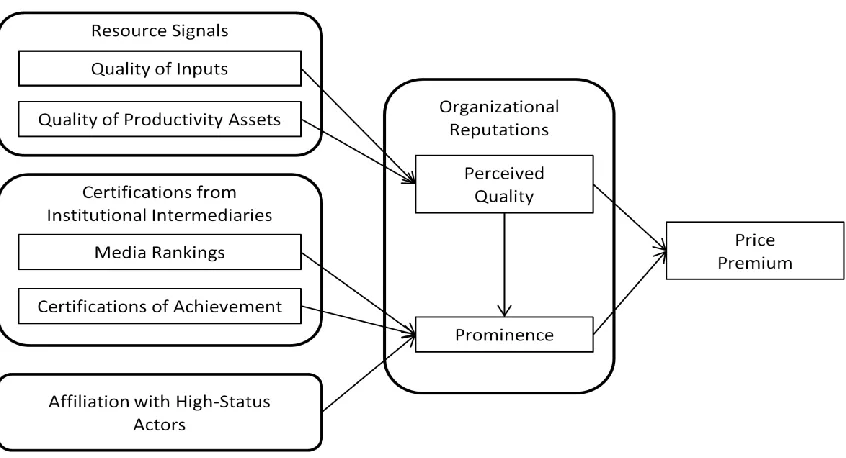
Figure 3.2: Antecedents & Consequences of Organizational Reputation……….. 40
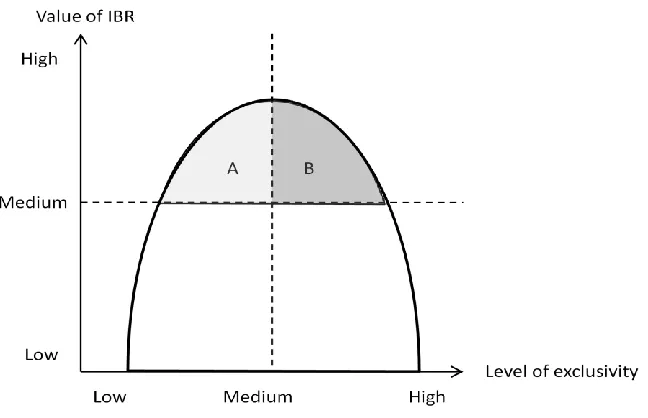
Figure 3.3: The Value of IBR as a Function of its Exclusivity………..…… 43
Figure 4.1: The Fashion Pyramid………. 54
Figure 4.2: Ngram Evolution of Haute Couture………..……… 56
Figure 4.3: The Federation’s Organizational Structure…..………..… 60
Figure 4.4: The Federation and its Relationship with Fashion Field Players…………..………63
Figure 4.5: Popularity of H&M Designer Collaboration Collections……… 80
Figure 4.6: Mixing Fashion with Art………..……… 82
Figure 4.7: Typical Catwalk Seating Arrangement………82
Figure 4.8: Symbiotic Relationship among Fashion Field Players………..83
Figure 4.9: PPR Group’s Share Prices after McQueen………84
Figure 4.10: Christian Dior’s Share Prices after Galliano.……… 85
Figure 5.1: V&A Exhibition Poster on Yamamoto Shop in Bond Street, London…..………117
Figure 6.1: Display of Royal Warrant on Advertisement, Packaging, Premises, & Website…….128
Figure 6.2: Specimen of Royal Arms……….………. 129
Figure 6.3: How the Royal Warrant is Used to Legitimize Claim………. 134
Figure 6.4: How the Royal Warrant is Used to Attract Stakeholder……… 135
Figure 6.5: Geographic Area Where Royal Warrant Firms Operate………. 143
Figure 6.6: Various Industries in which Royal Warrant Firms Operate ………. 143
Figure 6.7: Firm’s Perception of the Royal Warrant ………..…… 145
7
ACKNOWLEDGEMENTS
I would like to wholeheartedly thank my family and friends for the inspiration and support they have given me on this journey. I also would like to give a very special thank you to Mr. Paul Bergan who tirelessly proofread my dissertation with unfaltering enthusiasm.
I am truly grateful for the supervision and guidance of my two supervisors, Professor Joseph Lampel and Professor Ajay Bhalla. Thank you for sharing your wisdom and showing me your kindness and compassion throughout the years of my training.
8
DECLARATION
9
ABSTRACT
In this paper, we draw insights from resource-based theory, institutional theory, and Bourdieu’s concepts of cultural consecration and symbolic capital to propose a concept of Institution-Based Resource (IBR) as a novel source of sustainable competitive advantage. We define an IBR as a valuable and symbolic resource that is consecrated and institutionalized by legitimate consecrating institutions, granted to or attained by individuals and/or firms based on each institution’s merit system, and then used by individuals and firms as a means to achieve their objectives. We also specify three premises of the IBR, detail its benefits to individuals and firms, and explain how the value of IBR can be preserved over time. We regard the IBR as a strategic resource according to the resource-based tradition and argue that an IBR can be converted into different forms of capital, making it a unique source of competitive advantage for individuals and firms. We use a variety of primary and secondary data collection methods such as surveys, interviews, observations, and examinations of documentaries, printed materials, and archival records in order to illustrate our concept of the institution-based resource through three case studies: 1) The Role of Couturier and Creator as IBR in the Luxury Fashion Industry, 2) Art Museums’ Consecration of Fashion Designers as Artists, and 3) The Royal Warrant as an IBR. The findings from our research support and highlight the
10
CHAPTER 1: INTRODUCTION
1.1 Research Motivation
A common problem that most firms face in their market place is how to identify and acquire unique resources and then maintain their uniqueness over time. Often, firms invest much of
their time, effort, and capital into acquiring strategic resources only to find that they cannot reap the full benefits of their investments because the resources they have obtained can be easily replicated by their rivals. This dilemma poses an interesting topic for our research: How can firms strategically identify, obtain, and prolong the life of their strategic resources? How
can firms exploit their strategic resources and in the process gain sustainable competitive advantage?
1.2 Research Approach, Construct, and Contribution
We begin to tackle this dilemma by examining the resource-based theory and its concept of strategic resource. The resource-based theory advocates that a firm must focus on building its
capabilities to acquire and manage strategic resources so that it can gain competitive advantage over its rivals. However, the resource-based theory largely neglects institutional influence in its analysis of a firm’s behavior. Hence, we turn to institutional theory to provide us with an in-depth explanation of organizational behaviors in light of their environmental
settings. We also examine related literature on cultural consecration, symbolic capitals, intangible assets, institutional work, rituals, and field configuring events in order to gain a wider perspective and greater understanding of resources, their creation processes and their contribution to a firms’ performance.
We found that prior research has overlooked and under-exploited what we call
“Institution-Based Resource (IBR),” which can be a unique source of a firm’s sustainable competitive advantage. Consequently, in this research, we develop the concept of the IBR by combining knowledge from the literature we reviewed with insights from three different case studies. We gather data from primary and secondary sources, conduct statistical analysis on quantitative
11
collection and analysis in our research in order to ensure the validity and reliability of our findings.
We define the IBR as a valuable and symbolic resource that is consecrated and institutionalized
by legitimate consecrating institutions, granted to or attained by individuals and/or firms based on each institution’s merit system, and then used by individuals and firms as a means to achieve their objectives. We identify a consecrating institution as an institution that performs consecration, a process of valorizing cultural producers and products, and creating a symbolic
distinction between those producers and products that are noteworthy and those that are not. We consider the IBR to be a strategic resource as its symbolic value can be usefully converted into social, cultural, and economic capitals. We recognize that the symbolic value of an IBR is tied to the amount of symbolic capital and the competitive position of its consecrating institution. Consequently, institutional maintenance is essential to the preservation of the consecrating institution and the value of its IBR.
Accordingly, we believe that our IBR concept mainly contributes to the resource-based and institutional theories as well as to the studies that call for the integration of the two theories in a firm’s strategy formation. Through our theoretical arguments, we hope to encourage firms to find novel ways to conform to institutional requirements and accumulate IBRs and then
strategically use them to gain sustainable competitive advantage, to achieve leading market positions, and to increase their longevity. We believe that our IBR concept will be useful not only to firms, but also to individuals, as they face an increasingly challenging task of
differentiating themselves from competitors.
1.3 Research Outline
Our research is structured as follows: Chapter Two presents a review of the literature that contributes to the formation of our concept of IBR. We focus on the resource-based and institutional theories. We also point out that conformity is a necessary but not sufficient strategy for firms to succeed in the marketplace. Rather, a firm should take advantage of
12
three premises of the IBR concept and explain each in detail. Furthermore, we argue that the legitimacy and symbolic capital of the consecrating institutions influence the success of their consecration projects. We also detail how an IBR is valuable to firms. Additionally, we discuss
the value dilemma of the IBR, identify factors that erode its value, and point out how the consecrating institutions and the consecrated individuals and firms can try to preserve the value of their IBRs.
Chapters Four, Five, and Six provide illustrative case studies of how IBRs can be obtained and
used in different industries and settings. In Chapter Four, we will explore the field of luxury fashion and examine how a professional association consecrates roles of couturier and creator that are valuable IBRs for fashion designers. In Chapter Five, we will examine how art museums consecrate fashion designers as artists and analyze how the symbolic value of such
consecration is an IBR that designers and their fashion houses can convert into economic capital. In Chapter Six, we will study how the symbolic value of the royal warrant is a valuable
13
CHAPTER 2: LITERATURE REVIEW
In this chapter, we review the arguments and assumptions made by the resource-based and institutional theories about strategic resources and firms’ behaviors. These two theories
provide the framework of our analysis and lead to the development of our concept of the Institution-Based Resource (IBR) in Chapter 3. We conclude the chapter by encouraging firms to use the insights they gain from the two theories in their strategic planning, resource acquisition, and management processes.
2.1 Resource-Based Theory (RBT)
According to resource based theory, sustainable competitive advantage can be achieved by firms possessing 1) strategic resources and 2) the capabilities to manage and exploit these strategic resources to their fullest capacity (Barney, 1991). Firm resources are defined as “all assets, capabilities, organizational processes, firm attributes, information, knowledge, etc. controlled by the firm that enable the firm to conceive and implement strategies that improve
its efficiency and effectiveness” (Barney, 1991: 101). Barney divided these resources into three categories: physical capital, human capital, and organizational capital. Examples of these resources are, respectively, land and machines; employees and their individual skills; and a firm’s culture and communication system. It is important to note that not all of a firm’s resources are strategic. Any one of the three categories of resources can be considered
‘strategic’ resources when it is rare, durable, valuable, and hard to imitate or substitute (Barney, 1991). The resource-based view (RBV) of strategy argues that strategic resources are the key to a firm’s sustainable competitive advantage. Hence, a firm’s strategy should focus mainly on acquiring, building, and protecting its strategic resources and developing the
superior internal capabilities to manage them.
When formulating strategy, RBT argues that market factors can influence firms’ internal decisions to acquire, develop, and/or discard certain resources and capabilities in order to achieve their strategic objectives. These market factors are similar to Porter’s (1980) concept
14
compete in the market place. In the end, only firms with superior strategic resources and capabilities are able to gain competitive advantage and triumph over their rivals.
However, the RBT overlooks social and institutional influences in its organizational analysis.
The RBT assumes that firms are not influenced by social pressure to behave according to social values, norms, and traditions. Based on this assumption, RBT argues that firms’ actions are always rational and economically motivated (Oliver, 1997). In reality, a firm’s actions are not always purely rational and economical. Firms sometimes behave counterproductively, and the
resource based view does not have an adequate theory to explain why there is such a
phenomenon. RBT has not “…looked beyond the properties of resources and resource markets to explain enduring firm heterogeneity,…*or+ examined the social context within which
resource selection decision are embedded” (Oliver, 1997; 679). This lack of theoretical explanation leads us to look to institutional theory to help us explain and understand the relationship between the inner workings of an organization and its environment.
2.2 Institutional Theory (IT)
Institutional theory is a theory “concerned with the institutional pressures an organization faces in its environment, from other organizations and from the pressures of being an
organization” (Mintzberg, Ahlstrand and Lampel, 1998: 294). Institutional theory explains that
organizations’ decision making processes and actions are influenced by many factors, which are both internal and external to the organizations. Examples of internal factors are budget constraints, ineffective management, and high employee turnover. Examples of external factors are government regulations, local culture and work ethic, and environmental
protection laws and enforcement agencies. Because of these factors, organizations cannot always make economically rational decisions and are required to behave in ways that are normatively and socially accepted.
2.2.1 Definition: Institution
Before we go deeper into institutional theory, we must first define clearly what we mean by ‘institution.’ Institution is a word that is widely used and can refer to many different things.
15
regarded as an institution: law, money, marriage, religion, and university. As one can see, this broad definition of ‘institution’ and the many meanings it conveys makes it problematic for theorists across disciplines to develop a uniform definition of ‘institution.’ Hodgson (2006)
gives an account of different definitions of ‘institution’ from many disciplines and discusses them in details.
In this paper, we are concerned with institution as an “established organization.” Therefore, we have adopted sociologist Scott’s (2001) definition of institution because it provides us with
the most useful insights. Scott (2001:48) defines institutions as “…social structures that have attained a high degree of resilience. Institutions are composed of cultural-cognitive, normative, and regulative elements that, together with associated activities and resources, provide
stability and meaning to social life. Institutions are transmitted by various types of carriers, including symbolic systems, relational systems, routines and artifacts…” According to Scott (2001: 48), institutions “…connote stability but are subject to change processes, both
incremental and discontinuous.”
Furthermore, Scott (1995; 2001) argues that institutions are made of three supportive pillars: regulative, normative, and cognitive. Scott’s (1995; 2001) ideas of the three supportive pillars correspond with North’s (1990) typology of institutions: formal and informal. Scott’s (1995;
2001) regulative pillar is the equivalent of North’s (1990) formal institution, which refers to the rules, laws, and regulations put in place by governments. Scott’s (2001) normative and
cognitive pillars are equivalent to North’s (1990) informal institutions which refers to the social norms, cultures, and ethics of the people within which an institution is founded.
Institutions often engage in some forms of institutionalization activities in order to secure their future. Institutionalization is defined as a process in which a chosen entity, be it objects, ideas, or process, is infused with value (Selznick, 1957). Once institutionalized, that chosen entity becomes part of the fact or ‘objective reality’ that people take for granted (Zucker, 1977;
16
and Rowan, 1977; Zucker, 1977). Institutionalization, therefore, is an important process because entities that are institutionalized will enjoy the advantage of increased stability and survival compared with those that are not institutionalized.
Institutional theory provides us with a theoretical explanation of a firm’s behaviors in light of its environmental settings. Institutional theorists urge strategists to take into account the institutional context of firms when making strategic plans. Early institutional studies suggest that the path to a firm’s successful survival and sustainable competitive advantage is through
conforming to existing social systems and processes (DiMaggio and Powell, 1983). In their view, actor and agency have little power or choice but to comply with existing rules and regulations. More importantly, conforming to readily established systems can give a firm many benefits, such as legitimacy, stability, group membership, and access to network (Meyer and Rowan, 1977; DiMaggio and Powell, 1983; Baum and Oliver, 1991; Pfeffer and Salanik, 1978).
However, neo-institutional theorists have progressed from this initial viewpoint to account for
the fact that conformity is not the only pathway to success. They observe that there are many “institutional entrepreneurs,” or actors who often influence, shape, and manipulate existing institutional arrangements to pursue their own interests and achieve their own objectives (DiMaggio and Powell, 1983; Oliver, 1991; Lawrence, 1999; and Greenwood & Suddaby, 2006).
These neo-institutionalists believe that institutional entrepreneurs are capable actors that defy existing institutional arrangements and take steps to alter them by either “… leverag[ing] resources to create new institutions or … transform existing ones” (Maguire, Hardy and Lawrence, 2004: 657). Scholars who advocate this view often see the institutional
entrepreneurs as heroes and the institutions as villains and were thus criticized for downplaying the enduring institutional context and overemphasizing the ability of the institutional entrepreneurs (Lawrence, Suddaby and Leca, 2009).
Nonetheless, we do not believe that institutions and their demands are always obstructive to
firms’ success. Like two sides of a coin, institutional contexts can help or hinder firms’
17
…Regulation is not always the antithesis of freedom: it can be its ally” and even its facilitator. For this reason, we argue that strategic conformity to institutional requirement can be beneficial to firms.
2.2.2 Conformity Is Necessary But Not Sufficient
We believe that some level of conformity to institutional demands is a necessary but not sufficient condition for firms to succeed in the market place. Conformity is necessary because it allows firms to gain membership and support from the institution and rightfully compete with other institutional members. For example, athletic competitions usually have rules that
participants must adhere to in order for them to be able to enter the competition. If the athletes do not meet the minimum requirements, they will not be given the chance to
compete. Similarly, firms in many industries must conform to certain requirement thresholds in order for them to gain the legitimacy to compete in the market place. Scott (1995) theorizes
that there are three different types of institutional pressures that can command a firm’s conformity: regulative, normative, and cognitive. He explains that firms face and conform to regulative pressure from government’s rules, laws, and regulations; they also face and conform to normative and cognitive pressures from society as well as the institution in which they are embedded. It is not uncommon for firms to face all three types of institutional pressure at the same time.
There are many reasons for firms to conform to institutional pressure. Some firms follow a population ecology logic and conform so that they can avoid being selected out of the competitive sphere (Mintzberg, Ahlstrand and Lampel, 1998). Some firms conform to
institutional demands so as to “avoid legitimacy challenge[s] that hinder resource acquisition,
ceteris paribus” (Deephouse, 1999: 152). Some firms conform because “…they are rewarded for doing so through increased legitimacy, resources, and survival capabilities” (Scott, 1987: 498). Finally, institutional theorists observe that firms conform because they are similar to humans: they are motivated by social acceptance, are prone to social influences, are approval seeking, and often fall into old habits and traditions (Scott, 1995). Institutional theorists argue
18
The degree to which a firm conforms to institutional requirements will vary and depends on how strongly the requirements are institutionalized. Zucker (1977) believes that
institutionalization exists in a continuum, ranging in value from low to high, rather than a
binary occurrence, in which institutionalization is either present or absent. Highly
institutionalized ideas will almost automatically be obeyed; whereas, a less institutionalized concept needs to be convincing before a particular person acts upon it. For example, Zucker (1977) argues that the reason for cultural persistence is based on the degree of its
institutionalization. The more culture is institutionalized, the more people pass it on to the next generations, the more it is maintained, and the more strongly culture can resist change.
Unfortunately, as firms increasingly conform to institutionalized requirements, they become more similar to each other. This is a phenomenon called institutional isomorphism (DiMaggio and Powell, 1983). When firms become very similar to one another, they begin to think alike, act alike, and, consequently, lose their ability to innovate and compete effectively. Deephouse
(1999) sees isomorphic firms as having high levels of “strategic similarities” and, thus, low levels of differentiation. In this scenario, firms are just doing what every other firm does, and so they do not gain any additional advantages over their rivals (Deephouse, 1999; Porter, 1980). Deephouse (1999: 154) illustrates that this type of firm will yield low performance
because “…the costs of strong competition outweigh the benefits from being legitimate.” Subsequently, we believe that conformity in moderation is desirable but that conformity alone is not a sufficient or effective strategy for firms to gain sustainable competitive advantage and attain leading market position.
2.2.3 Interpretive Flexibility and Innovation
There are firms that innovatively conform to the minimum level of institutional requirement. These are the firms that can outperform their rivals and secure advantageous market positions. According to Deephouse (1999), firms that employ moderate levels of strategic similarity can benefit from lower competition for resources and at the same time maintain legitimacy, thus allowing the firms to achieve greater performance than firms that pursue either a high or low
19
the best performance, firms should aim to be “as differentiated as legitimately possible” (Deephouse, 1999: 162).
Similarly, we believe that firms can outperform their rivals by moderately conforming to
institutional requirements while being innovative about the way in which they conform and conduct their operations. Since the ways in which firms conform to institutional demands are often left ambiguous and open to interpretation, this ambiguity and openness to interpretation gives firms the “interpretive flexibility” necessary to infuse their strategies with creativity.
In their quest to meet institutional requirements, both existing and prospective institutional member firms can practice interpretive flexibility. For prospective firms, interpretive flexibility gives them the chance to find novel ways to conform to institutional requirements and gain membership to the institution. For existing institutional members, interpretive flexibility allows them to play, push, and even manipulate the rules and requirements set by the institution for their own advantages, and in this way, outperform others. In both cases, interpretive flexibility
requires creative thinking and problem-solving from existing and prospective member firms.
Interpretive flexibility also opens a space for competition in two ways. First, it calls for firms, existing and prospective members, to devise novel ways to conform to established institutional requirements and at the same time, find a new viable market position. In this race, a firm that
can invent the newest unique way to conform without losing its efficiency and identity wins the competition and gains attention and respect from customers, peers, and critics. Firms that simply conform without trying to differentiate or add a twist to their strategies and
product/service offerings will experience institutional isomorphism and become ‘just another
face in the crowd.’
Second, interpretive flexibility sometimes challenges firms to compete for institutional
legitimacy and recognition. Institutions award legitimacy and recognition to firms that conform to their requirements. Competition, thus, becomes more complex and intense as firms must
20
out-groups are the non-members that did not manage to attain institutional legitimacy and, therefore, are not given institutional recognition and support. In the luxury fashion industry, for example, Kawamura (2004) observes that when a designer is selected to become a member
of the “Federation,” an institution that governs the French fashion industry, his/her status is elevated such that he/she becomes the elite designer in comparison to the non-elite designers whose names are never publicized to consumers. As a member of “the Federation,” designers and their houses gain privilege, reputation, institutional support, global media attention, and
consumer awareness.
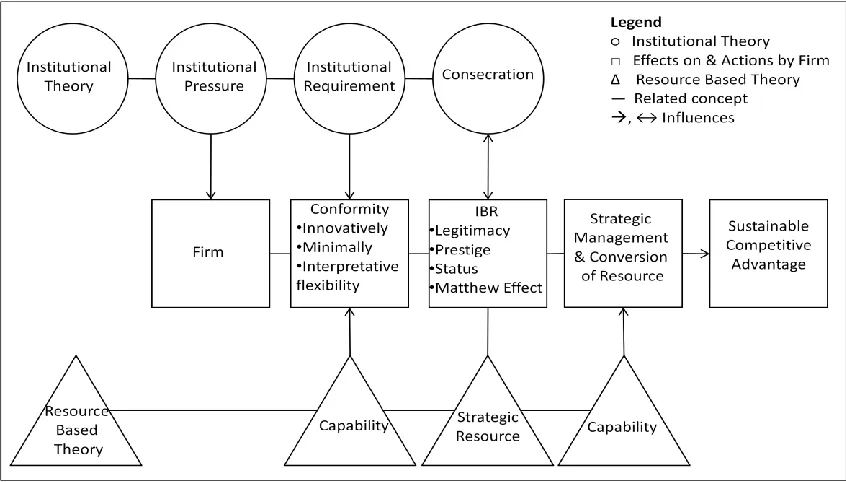
[image:21.612.115.538.301.542.2]2.3 Combining Resource-Based Theory and Institutional Theory
Figure 2.1: Theoretical Framework of Our Analysis of Firm’s Strategy to Achieve Sustainable Competitive Advantage
We believe that firms have much to gain by learning from resource-based theory and institutional theory. Resourced-based theory advocates that firms should seek out strategic
21
selection, accumulation, and deployment, which then causes firms to differ from one another (firm heterogeneity) and ultimately allows firms to gain sustainable competitive advantage. Peng (2002) and Peng et al. (2009) take a step further to develop and promote the concept of
an institution-based view of strategy as well as calling for such a view to be regarded as the third leading perspective in the field of strategic management after the industry-based view and resource-based view pioneered by Porter (1980) and Barney (1991) respectively.
By combining insights from both theories, we believe firms can devise more effective strategies
and develop better capabilities to manage external institutional influences on their
organizations. In Figure 2.1, we illustrate how the two theories form the basis of our analysis of firms and how they influenced us to develop a concept of institution-based resource (IBR) that can be a source of a firm’s sustainable competitive advantage. We show that institutions can exert pressure on firms but also that firms can develop innovative strategies to conform minimally to institutional requirements; build up capabilities to strategically manage valuable
IBRs that institutions consecrate on them, as a result of satisfying their requirements; and eventually gain sustainable competitive advantage. We further theorize that over time the consecrated firm will become more prominent, prestigious, and reputable within its field, and the magnitude of its success will allow it to reciprocally consecrate the institution that
consecrated it in the first place (as illustrated by the double headed arrows in figure 2.1). In the next chapter, we will discuss the concept of the IBR in great detail.
2.4 Conclusion
In sum, the resource-based view provides us with a useful framework for analyzing a firm’s internal resources and capabilities but fails to provide an adequate framework for analyzing a firm’s behavior in light of its institutional environment. Hence, we look to institutional theory to help guide our analysis. Institutional theory explains that institutional context can strongly influence a firm’s strategy and behavior. Firms are often required to conform to existing institutional arrangements and behave in a socially acceptable manner even though such
actions may or may not be economically rational because of the mounting institutional
22
to institutional requirements without inputting any creativity will not be able to gain
advantages over their rivals in the market place. Hence, we advocate that firms should try to conform to the minimum level of institutional requirements and use interpretive flexibility as
an opportunity to be innovative in the ways they conform and conduct their businesses. In this way, firms will gain institutional support and legitimacy to compete with their rivals. We believe that by combining the insights from the resource-based and institutional theories, firms will be able to form more effective strategies. Similarly, Oliver (1997) and Peng et al. (2009)
encourage firms to incorporate institutional context into their strategy formation.
We have also argued that institutions can be a valuable ally to firms. If firms learn to manage their relations with their surrounding institutions, then they can enjoy many advantages from such relationships. This argument has led us to propose a new concept of resource, an institution-based resource, which derives its value and importance from the consecrating institution and can be used by firms to gain competitive advantage over their rivals. In the next
23
CHAPTER 3: INSTITUTION-BASED RESOURCE CONCEPT (IBR)
In this chapter, we focus on developing the concept of the Institution-Based Resource (IBR). We will start by defining the IBR concept and its premises and provide an illustrative example.
We then examine the consecrating institution and discuss how its cultural consecration projects yield an IBR. We argue that the consecrating institution’s ability to confer symbolic value onto its IBR is based on the combination of its organizational and cultural legitimacy as well as the symbolic capital it accumulates over time. We outline the prerequisites and influential factors that can help a consecrating institution perform cultural consecration and confer symbolic value onto an IBR successfully. Next, we detail the main symbolic benefits of
an IBR, explain how it can be converted into economic capital, and point out why it can be a source of sustainable competitive advantage for individuals and firms. Afterward, we examine the factors that can erode the value of an IBR and suggest how the consecrating institution and the consecrated individuals and firms can preserve the value of their IBR. Finally, we will end
the chapter with a discussion of a few issues concerning the IBR, followed by a brief conclusion of our IBR concept.
3.1 Institution-Based Resource: Definition and Premises
There are many types of resources. According to Barney (1991), firms have three types of
resources: tangible, intangible, and human. Tangible resources are physical resources like machines, factories, and office buildings. Intangible resources are non-physical assets like reputation, brands, and patents. Human resources refer to the employees of the firm together with the skills they bring to the company.
Our concept of IBR falls into the intangible resource category mainly because of the symbolic
benefits it embodies. We define institution-based resource (IBR) as a valuable and symbolic resource that is consecrated by institutions, granted to or attained by individuals and/or firms based on each institution’s merit system, and then used by individuals and firms as a means to achieve their objectives. An IBR can take many different forms depending on different fields of production. Examples of IBRs include – but are not limited to –awards, prizes, honors, and
24
SUMMARY OF THE IBR CONCEPT
Definition of IBR:
A valuable and symbolic resource that is consecrated by an institution, granted to or
attained by individuals and firms based on each institution's merit system, and then used by individuals and firms as a means to achieve their objectives
Premise 1: Consecrating Institution Consecrates an IBR
Engage in Cultural Consecration (Bourdieu, 1984; Allen & Lincoln, 2004)
An act of valorization that instills value in persons or objects and imposes a discrete distinction between that which is consecrated as 'sacred' and worthy of admiration and
respect and that which is not. The latter is considered as 'profaned' and unworthy of recognition.
Hold Organizational and Cultural Legitimacy
Accumulate Symbolic Capital
Symbolic capital refers to the resource available to social actors based on the degree of accumulated prestige, honor, and recognition. It should be regarded as a kind of ‘credit’ that can guarantee ‘economic profits’ in the long run. (Bourdieu, 1993).
Premise 2: AN IBR Must Be Earned by Individuals and Firms
Fair Process of Consecration
Four Prerequisite (Allen & Parsons, 2006) Four Influential Factors (Allen & Parsons, 2006)
Premise 3: IBR is a Valuable Source of Competitive Advantage
Symbolic Benefit → Economic Capital → Competitive Advantage
Signaling Quality → Visibility
Establishing Legitimacy and Credibility → Longevity Lending Prestige and Status → Prominence
Enhancing Reputation → Market Domination
Accumulation of Advantages → Mathew Effect
The Symbolic Value of IBR:
Is Inherently Tied to the Consecrating Institution
- Preservation and Erosion of the IBR's Value is linked to Institutional Maintenance Is Convertible into Different Forms of Capital: Social, Cultural, & Economic
Is an Inverted Curvilinear Phenomenon
25
Based on our definition of an IBR above, there are three premises that warrant attention. First, an IBR is consecrated by a consecrating institution through a process of cultural consecration where the consecrating institution uses a ritual or a ceremony to confer its institutional values
and symbolic capital on an entity and sanctions it as superior to the others of its kind. Second, individuals and firms can acquire an IBR only by meeting the institution’s standards and going through the process set forth by each institution’s merit system. Third, the IBR is a valuable and symbolic resource that individuals and firms can use as means to further their objectives. In
Table 3.1, we provide a summary of the concept and premises of the IBR. We will elaborate on these points throughout the chapter.
Once consecrated, an IBR is endowed with symbolic values, which individuals and firms can convert to other forms of capital and use as resources to achieve their objectives. The Nobel Prize is a good example that we will use to illustrate our concept and premises of an IBR. The Nobel Prize is a prestigious and internationally recognized award. It is accredited by the Nobel
foundation, which has been administering the award for over a century in collaboration with such premier research and educational institutions as the Royal Swedish Academy of Sciences, the Karolinska Institute, the Swedish Academy, and the Norwegian Storting. The purpose of the Nobel Prize is to recognize individuals who “shall have conferred the greatest benefits on
mankind” (“Nobel Foundation”). The Nobel Prize is thus awarded to individuals in recognition of remarkable achievement in areas such as science, chemistry, physics, literature, medicine, and world peace. The Nobel Prize confers a great many advantages on its winners. In addition to receiving the Nobel Prize, which includes a medal, a personal diploma, and money, Nobel
laureates also enjoy heightened status, prestige, and respect from their peers and the general public. The prestige and honor of wining the Nobel prize also spills over from the laureates to the institutions or firms with which they are affiliated. Many have observed that universities and firms that employ Nobel laureates experience an increase in reputational advantages as
26
colleagues whom they may be able to recruit for their next research projects and to attract investors to fund such projects.
Based on the example above, we can see that the consecrating institution and its IBR can have
a significant influence on the success of the individuals and their firms. Thus, it is important that we examine the consecrating institution and its IBR more closely. In the next sections, we shall discover how the consecrating institution comes to have the authority and legitimacy to consecrate an IBR, what is entailed in the formal process of consecration of IBR, and why it is
that some IBRs consecrated by certain consecrating institutions are more valuable than others. What are the factors that enhance or erode the value of IBR? What are the strategies that individuals and firms should employ to maintain the value of their IBRs?
3.2 How Do Institutions Consecrate An Institution-Based Resource?
3.2.1 The Consecrating Institution and its Cultural Consecration ‘Projects’
The first premise of our concept of an IBR is that institutions consecrate the IBR. However,
before we can understand what a consecrating institution is, we must first define what we mean by ‘consecration.’ Consecration is a term widely used in religion, philosophy, and sociology. It generally means the act of instilling value and making something sacred. In this paper, we adopt the sociology’s definition of consecration, which sees consecration as a
distinct form of cultural valorization.
Allen & Lincoln (2004: 873) explain that “cultural valorization *is a process which] involves the use of aesthetic judgment to assign cultural value to cultural producers and products.” Cultural consecration is an extreme form of valorization in that not only does it assign cultural values to the cultural producers and products; it also “impose[s] discrete distinctions between those
cultural producers and products that deserve admiration and respect and those that do not”(Allen & Lincoln, 2004:873). Allen & Lincoln (2004:874) point out that “cultural
consecration is important because it involves granting cultural legitimacy to certain cultural producers and products, and by implication, denying it to other producers and their products.”
27
“discontinuity out of continuity” when it separates the great from the ordinary. Bourdieu (1984:6) describes cultural consecration as “…confer[ring] on the objects, persons, and situation it touches, a sort of ontological promotion akin to a transubstantiation.”
Based on the definition of consecration above, we define a consecrating institution as an institution that is responsible for valorizing cultural producers and products and consecrating a distinction between those producers and products that are noteworthy and those that are not. In Table 3.2 we provide a few examples of different consecration institutions and their
corresponding IBRs. It is important to note that there can be many consecrating institutions in a given field of cultural production. For example, within the film industry there are numerous consecrating institutions such as the Academy Award, the Cannes Film Festival, and the National Film Registry. Furthermore, different consecrating institutions can carry out different cultural consecration ‘projects’ (Allen & Lincoln, 2004), which result in different forms of IBR, such as prizes, awards, honors, and ‘top-hit’ lists (English, 2005).
Researchers have explored cultural consecration in many industry settings as varied as films, acting, popular music, wine, and baseball (Allen& Lincoln, 2004; Lampel &Nadavulakere, 2009; Lincoln, 2007; Schmutz, 2005; Allen & Germov, 2010; and Allen & Parsons, 2006). All of these studies have noted that cultural consecration in the form of awards and prizes can positively
affect the career mobility, remuneration, and sales revenue of the consecrated producers and their products, and is, therefore, highly sought after. They also recognized that cultural consecration is especially important in the field of cultural production where the subjective nature of the cultural products make their value and prices difficult to assess, hence, the need
to rely on ‘expert opinion’ to evaluate and legitimate the cultural producers and their products (Allen & Germov, 2010; Towse, 2003). Cultural consecration, such as awards and prizes, lessens the valuation difficulties by formally valorizing the consecrated producers and their products as culturally and economically valuable. As English (2005:31) points out “…prize functions as a
28
Consecrating Institution Institution-Based Resource Forms Industry
Baseball Writer’s
Association of America National Baseball Hall of Fame Honor List Sport Booker Prize Foundation Man Booker Prize Prize Literature
British Monarchy Royal Warrant Honor
Michelin Company Michelin Stars Honor Gastronomy
Monarchy Lords, Duke, and Count Peerage
Nobel Foundation Nobel Prize Prize
Chemistry, Physics, Medicine, Literature, and World Peace Pritzker Family's Hyaat
Foundation Pritzker Architecture Prize Prize Architecture Pulitzer Foundation Pulitzer Prize Prize Journalism RollingStone Magazine 100 Greatest List Honor List Music
The Academy Award Oscars Award Film
The Academy of Television Arts &
Sciences Emmy Award Television
The French Federation of Couturier and
Pret-a-Porter Designer Couturier, Creators Role Fashion
[image:29.612.113.549.70.388.2]UNESCO World Heritage Site Certificate Tourism
Table 3.2: Examples of the Various Forms of IBR
Furthermore, consecration is not always a one-way phenomenon in which the symbolic value
of a consecrating institution is conferred on individuals or firms. Often, consecration and the production and exchange of symbolic capital are a two-way or a mutual process between the parties involved. In two-way consecration, the consecrating institution gives and receives symbolic capital from those that it consecrates. In other words, the symbolic capital of the consecrated reciprocally consecrates symbolic capital for the consecrating institution. For example, the prestige of the Nobel Prize laureates like Albert Einstein consecrates prestige on
the Nobel Foundation. The more eminent the laureates become in their fields, the more prestigious is the Nobel Foundation and the more valuable its Prizes. Lampel (2011) points out that many studies have recognized the circularity of symbolic exchange and the mutual process of consecration. English (2005) observed in his study of awards and prizes that it is the prestige
29
Additionally, research suggests there are two main types of cultural consecration:
contemporaneous and retrospective. Contemporaneous consecration occurs just when cultural producers and products make their debut. In the film industry, for example, films are
consecrated on a yearly basis through many consecrating institutions such as the Academy Awards, the Cannes film festival, and the BAFTA Awards. Retrospective consecration, on the other hand, happens when entities are consecrated years after they were first introduced. For instance, the Rolling Stone’s 500 Greatest Album List is a retrospective consecration of music
albums and artists because it evaluates all the albums in the past and then consecrates only the selected few that have remained popular through the years (Schmutz, 2005).
There is a relationship between these two types of consecration. First, a contemporaneous consecration often leads to a retrospective consecration of an entity. Lampel & Nadavulakere (2009) observed, in their study of the British film industry, that films which were
contemporaneously consecrated have a greater chance of being retrospectively consecrated
than their unconsecrated counterpart. Second, retrospective consecration imparts more cultural legitimacy than contemporaneous consecration because retrospectively consecrated cultural producers and products ‘have survived the test of time’ (Allen & Lincoln, 2004). Third, either type of cultural consecration helps to increase the salability of a cultural product
(Lampel & Nadavulakere, 2009). Consequently, cultural consecration is an important process of value creation that can significantly affect the finances of the consecrated producers, be they individuals or firms. Nonetheless, cultural consecration is a delicate process that requires the consecrating institution to have organizational and cultural legitimacy as well as symbolic
capital in order to confer symbolic value onto the IBR and their producers successfully.
3.2.2 Organizational and Cultural Legitimacy of the Consecrating Institution
In order for the consecrating institution to culturally consecrate an IBR, it must have the organizational and cultural legitimacy to do so. Allen and Lincoln (2004:874) observe that “any formal consecration project entails an assertion on the part of an organization that it possesses the institutional legitimacy to consecrate certain cultural producers and their products as
30
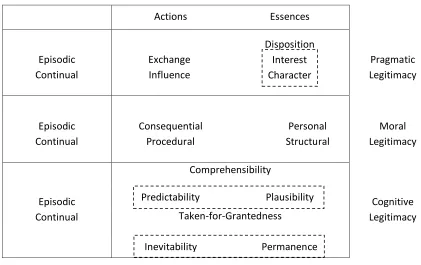
Legitimacy is defined as “… a generalized perception or assumption that the actions of an entity are desirable, proper, or appropriate within some socially constructed system of norms, values, beliefs and definition” (Suchman, 1995: 574; see also Higgins and Gulati, 2006).
According to Suchman (1995), there are three main types of organizational legitimacy: pragmatic, moral (normative) and cognitive. Each of these types of organizational legitimacy also has three subtypes, see Figure 3.1 below.
Actions Essences
Episodic Continual
Exchange Influence
Disposition Interest Character
Pragmatic Legitimacy
Episodic Continual
Consequential Procedural
Personal Structural
Moral Legitimacy
Episodic Continual
Comprehensibility
Cognitive Legitimacy Predictability Plausibility
Taken-for-Grantedness
[image:31.612.111.532.198.463.2]Inevitability Permanence
Figure 3.1: Typology of Legitimacy
Source: Suchman (1995)
We believe that a consecrating institution must hold at least one type of Suchman’s (1995) organizational legitimacy in order for it to have the authority to consecrate an IBR. Suchman (1995) argues that constituents will accord pragmatic legitimacy - exchange, influence, or
disposition - to organizations when they see that the organization’s policy is valuable to them. Hence, pragmatic legitimacy is seen as having to do with the constituents’ calculated self-interest in their exchange with the organization. Suchman (1995: 579) articulated that moral or normative legitimacy is based on the constituents’ “… positive normative evaluation of the organization and its activities.” Hence, constituents will accord moral legitimacy to
31
technique it used to achieve this accomplishment (procedural legitimacy); the structure and capacity of the organization to perform certain types of work (structural legitimacy); and the charisma of the leader of the organization (personal legitimacy). Finally, cognitive legitimacy is
based on constituents’ cognition about the organization as they try to make sense of their surroundings and the world. There are two subtypes of cognitive legitimacy: comprehensibility legitimacy and taken-for-granted legitimacy. Constituents will accord comprehensibility legitimacy when they can see plausible cultural explanations for the organization and their
actions and how they fit with the “… larger belief system, and with the experienced reality of the … *constituents’+ daily life” (Suchman, 1995: 582). Constituents will passively accord taken-for-granted legitimacy to organizations when they accept the organization as “… necessary or inevitable based on some taken-for-granted cultural account” (Suchman, 1995: 582).
Although there is no formal hierarchy amongst the different types of legitimacy, one can see that legitimacy grows stronger and becomes more ingrained in the constituent mentality as
one moves from pragmatic to moral to cognitive legitimacy. This is because pragmatic and moral legitimacy still require active evaluation and acceptance on the part of the constituents, whereas cognitive legitimacy does not. Cognitive legitimacy is so embedded in the way
constituents view the world that they passively accept the actions of the consecrating
institution without questioning their appropriateness (Suchman, 1995). For this reason, the taken-for-granted legitimacy is considered the most subtle and most powerful type of
legitimacy because it makes “alternatives become unthinkable, challenges become impossible, and the legitimate entity become unassailable by construction” (Suchman, 1995: 583).
Additionally, the consecrating institution must possess the cultural legitimacy to consecrate an IBR. Bourdieu (1993) identified three forms of cultural legitimacy: specific, bourgeois, and popular. The specific legitimacy of a consecrating institution stems from its members who are renowned professionals of their fields. The Academy Award, for example, is a consecrating
32
of a consecrating institution with bourgeois legitimacy to consecrate restaurants around the world with its Michelin Stars. Appraisal of a restaurant’s food and service quality by the Michelin Star food critics can have a tremendous impact on the success or failure of a
particular restaurant. Lastly, a consecrating institution can consecrate popular legitimacy by relying on public admiration and approval of cultural producers and products. Billboard Magazine, for example, created the Billboard Chart of top hit music by accounting for the popularity of the songs with the public.
3.2.3 Symbolic Capital of the Consecrating Institution
In addition to having organizational and cultural legitimacy, consecrating institutions must accumulate a considerable amount of symbolic capital in order to be able to consecrate a valuable and meaningful IBR. Symbolic capital is one of the four types of capital identified by Bourdieu (1993). Examples of the symbolic capital of a consecrating institution are prestige,
status, and public recognition. We believe that there are many ways by which a consecrating institution can accumulate symbolic capital. A consecrating institution can build up its symbolic capital through developing rigorous and fair selection procedures and consistently maintaining high standards of excellence over a long period of time. It can also accumulate symbolic capital by forming alliances and partnerships with other symbolically-rich institutions. For example, Harvard University is able to accumulate high symbolic capital through recruiting top tier
professors and researchers, accepting students with exceptional academic records, and forming alliances with other Ivy leagues universities and top colleges around the world.
We noticed that the amount of symbolic capital accumulated by consecrating institutions varies from one institution to the other and that the more symbolic capital a consecrating
institution accumulates, the greater the symbolic value of its IBR. For example, we recognized that there are numerous consecrating institutions and prizes in the field of literature. However, the most prestigious prize of all is the Nobel Prize in Literature. Compared to other
consecrating institutions, the Nobel Foundation is able to confer the greatest symbolic value on its prize because it has accumulated the greatest amount of symbolic capital. It is one of the
33
she can win the prize. Moreover, the judges of the Nobel Prize possess high cultural and symbolic capital. They include former Nobel laureates and prominent figures of the literary field. Furthermore, the competition for the prize is very intense as it is open to all writers
regardless of their nationalities. Additionally, the prize money for the Nobel Prize in Literature is about one million US dollars, the largest remuneration of all literary prizes in the world. Based on the examples above, we can see that legitimacy and the symbolic capital of consecrating institutions and the value of their IBRs are strongly linked to their consecration
processes. In the following section, we will examine this point in detail.
3.2.4 The Process of Consecration
The second premise of our concept of IBR is that individuals and firms must go through a rigorous selection process and earn themselves the IBR. Typically, individuals and firms are nominated either by others or self, into a competition-like setting. Then, the consecrating
institution will judge the contestants according to its merit system. Finally, the consecrating institution will formally perform the act of consecration through a ceremony, during which it confers symbolic capital such as recognition, legitimacy, prestige, and status in the form of an award and a prize to a limited number of cultural producers and products that entered the competition.
A fair process of consecration is important because it underpins the legitimacy of the
consecrating institution and the value its IBR. Allen and Lincoln (2004:875) observed that “… the legitimacy of both the organization and its consecration project is based on the perceived legitimacy of its procedures.” Bourdieu (1991:120) argues that “the distinctions that are the most efficacious socially are those which have the appearance of being based on objective
34
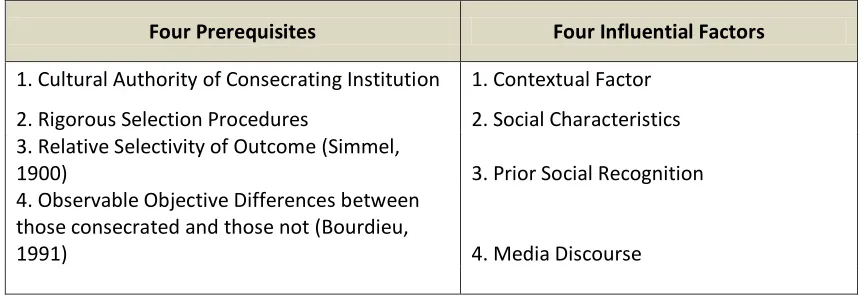
Four Prerequisites Four Influential Factors
1. Cultural Authority of Consecrating Institution 1. Contextual Factor 2. Rigorous Selection Procedures 2. Social Characteristics 3. Relative Selectivity of Outcome (Simmel,
1900) 3. Prior Social Recognition
4. Observable Objective Differences between those consecrated and those not (Bourdieu,
[image:35.612.110.541.72.222.2]1991) 4. Media Discourse
Table 3.3: Prerequisites and Other Influential Factor for Successful Consecration Projects
Source: Allen &Parsons (2006)
The first prerequisite, as we have explained in the previous section, is that the consecrating
institution must be legitimate so that it can exercise credible authority to consecrate cultural producers and their products. As Scott (1987; 502) points out “authority as legitimated power; legitimated power is normatively regulated power. When an organization’s power is
‘authorized,’ it is, presumptively, supported and constrained by the actions of officials superior to it and in a position to oversee its appropriate use.”
Second, the consecrating institution must use rigorous procedures to select recipients of an
award. Rigorous selection criteria help to validate the consecrated cultural producers and their products as the best in their class. Transparent selection procedures and evaluation processes legitimize institutional acts. As Lampel & Nadavulakere (2009: 242) point out, “institutions that are systematic and open about the processes used to select and evaluate cultural products
normally enjoy greater legitimacy than institutions that adopt ad hoc processes that are difficult to verify.”
Third, the consecrating institution must be selective when consecrating awards so that only a small number of potential recipients actually receive the honor (Simmel, 1900). By being highly
selective and consecrating only a handful of producers and their products, the consecrating institution is able to project two valuable perceptions of its institution and its IBR. First, the consecrating institution can project the image of maintaining high consecration standards; this allows it to be perceived as an eminent institution. Second, as a consequence of the first projection, cultural producers and products that are consecrated by a highly prestigious
35
were consecrated by a less selective consecrating institution. For example, a person who wins a prize over a hundred contestants is perceived to be more competent than a person who wins a prize over just ten opponents; and winners of national-level prizes are perceived to be much
more prestigious than winners of local-level prizes in the same category because they are selected from a pool of the best national-contestants, and are, therefore, considered “the best of the best.”
The last and most important of the four prerequisites is that the consecrating institution must
be able to demonstrate the objective differences between cultural producers and products that are consecrated and those that are not (Bourdieu, 1991; English, 2005; Allen & Parsons, 2006). Consecrating institutions that adhere to meritocratic principles will be perceived as legitimate consecrating bodies, and the objects of their consecration, whether they be
individuals or firms, will also be accepted by constituents as genuine and worthy of respect and admiration.
Furthermore, Allen & Parsons (2006) observed that influential factors like contextual factors, social characteristics, prior social recognition, and media discourse can affect constituents’ substantive rationality and, consequently, the success of cultural consecration projects. Research on collective memory and reputation formation provide insights into this particular
argument. Affiliation with well-known institutions is a kind of contextual factor that can help consecrated individuals or firms gain legitimacy and recognition in the wider community. For example, a professor from Harvard University is more likely to be remembered at a conference than a professor from a lesser known university. Prior social recognition also contributes to the
success of the consecration project. Merton (1968) observes that eminent scientists get more recognition for their contributions than their lesser known colleagues for comparable
contributions. Social characteristics such as race and environmental policies may also affect the success of the consecration projects. Lastly, media discourse about the cultural producers and
36
maintain their legitimacy and successfully consecrate valuable IBRs. In the following section, we will examine how the symbolic value of an IBR becomes a valuable and strategic resource to its holder.
3.3 Symbolic Value and Benefit of Institution-Base Resource
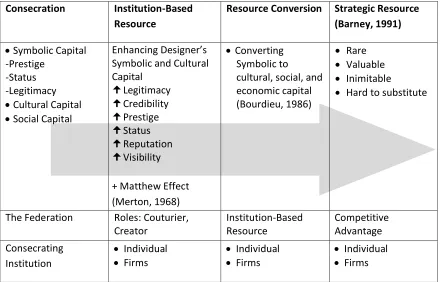
The third premise of our concept of the IBR is that it is a valuable and symbolic resource that can be strategically used to further individuals’ and firms’ objectives. An IBR is a valuable resource because it holds unique institution-specific symbolic values that individuals and firms can use to acquire or convert into Bourdieu’s (1986; 1993) other forms of capital. Specifically, it is the convertibility of our IBR into different forms of capital and the appropriation of such resources by individuals and firms that is central to our concept of the IBR.
According to Bourdieu (1986; 1993) there are four types of capital: economic, cultural, social and symbolic. Economic capital is money and anything that can be immediately converted into it. Property rights, for example, can be converted into money. Cultural capital refers to
individuals’ cultural knowledge and skills that are accumulated through formal and informal
education. Cultural capital exists in three states: embodied, objectified, and institutionalized. Bourdieu believes one’s ability to appreciate a work of art is an example of the embodied state of cultural capital. One’s ownership of an art piece represents the objectified state of cultural capital. One’s academic qualifications are an example of an institutionalized state of cultural capital. Cultural capital is predisposed to function as symbolic capital because its acquisition
and transmission are not readily apparent.
Social capital refers to the set of one’s networks or connections through personal relations and group membership. Bourdieu (1986: 51) defines social capital as “… the aggregate of the actual or potential resources which are linked to possession of a durable network of more or less
institutionalized relationships of mutual acquaintance and recognition – or in other words, to membership in a group – which provides each of its members with the backing of the
collectivity-owned capital, a ‘credential’.” Hence, the more connections one has, the more social capital one accumulates. Bourdieu (1986) reasoned that connections facilitate access to other forms of capital. For example, a person’s membership in a professional association gives
37
association; through them, he may develop more business opportunities that can result in the generation of economic capital.
Symbolic capital refers to “resources available to a social actor on the basis of prestige or
recognition, which function as an authoritative embodiment of cultural value” (“Symbolic Capital”). Like other forms of capital, symbolic capital can be converted into economic capital. Bourdieu (1993; 75) believes that symbolic capital should be understood as “ economic or political capital that is disavowed, misrecognized and thereby recognized, hence legitimate, a
‘credit’ which, under certain conditions, and always in the long run, guarantees ‘economic’ profits.”
Bourdieu (1986) believes that economic capital is at the root of all other forms of capital because it enables the acquisition of the social, cultural, and symbolic forms. Moreover, he argues that all forms of capital can be converted back into economic capital. For example, individuals invest money into obtaining an education (cultural capital), which in turns gives
them the qualifications and connections (social capital) to gain employment in exchange for salary (economic capital). Accordingly, we argue that the symbolic capital imbued in the IBR can be converted back into economic capital. For example, films that are nominated for or win an Oscar can use the symbolic capital of such nomination or prize to signal quality and boost
the sale of its theater tickets and related merchandise like DVDs, VDO games, and T-shirts. Nobel laureate scientists can use their prestigious prize and reputation to find investors to fund their future research projects. Restaurants that are awarded Michelin Stars can charge higher prices for their food and attract many talented trainees and sous-chefs to work at their
restaurants, thus furthering their ability to create novel menu and maintain high quality standards.
Based on these examples, we can see that there are a number of different ways in which the symbolic capital of an IBR confers intangible advantages that are convertible to economic