translations and boosts, and the role of mass
Alexander R. H. Smith,1, 2,∗ Marco Piani,3, 4 and Robert B. Mann1, 51Department of Physics & Astronomy, University of Waterloo, Waterloo, Ontario N2L 3G1 Canada
2Department of Physics & Astronomy, Macquarie University, New South Wales 2109, Australia 3
SUPA and Department of Physics, University of Strathclyde, Glasgow G4 0NG, UK 4
Institute for Quantum Computing and Department of Physics & Astronomy, University of Waterloo, Waterloo, Ontario N2L 3G1, Canada 5
Perimeter Institute for Theoretical Physics, 31 Caroline St. N., Waterloo, Ontario N2L 2Y5, Canada (Dated: March 26, 2016)
Quantum communication without a shared reference frame or the construction of a relational quantum theory requires the notion of a quantum reference frame. We analyze aspects of quantum reference frames associated with non-compact groups, specifically the group of spatial translations and Galilean boosts. We begin by demonstrating how the usually employed group average, used to dispense of the notion of an external reference frame, leads to unphysical states when applied to reference frames associated with non-compact groups. However, we show that this average does lead naturally to a reduced state on the relative degrees of freedom of a system, which was previously considered by Angeloet al.[1]. We then study in detail the informational properties of this reduced state for systems of two and three particles in Gaussian states.
I. INTRODUCTION
The central lesson of relativity is that all observable quantities are relational: length, time, and energy, which were once thought to be absolute, only have meaning with respect to an observer. The same is true of a quan-tum state. For example, when we write the quanquan-tum state |↑i, say up in z, what we mean is somebody in a laboratory with an appropriately aligned measuring ap-paratus will measure a specific outcome. This is the de-scription of a quantum state with respect to a classical object, in this example the macroscopic laboratory.
This state of affairs is not fully satisfactory, since a quantum system is being described with respect to a clas-sical system, that is, by mixing elements of conceptually different frameworks. If we believe that our world is com-pletely described by quantum mechanics, we should seek a theory in which quantum systems are described with respect to quantum systems. Much work has been done on this subject, known as quantum reference frames [2], and it has found applications in quantum interferometry [3], quantum communication [4], and cryptography [5], as well as offering an explanation of previously postulated superselction rules [6, 7].
Additionally, treating reference frames quantum me-chanically is a crucial step towards the goal of construct-ing a relational quantum theory [8, 9]. By relational it is meant a theory that does not make use of an exter-nal reference frame to specify its elements. The main motivation for this is general relativity, which does not use an external reference frame in its construction. It is believed that a theory of quantum gravity will inherent this property, and thus, a theory of quantum gravity will
necessarily include a theory of quantum reference frames [10, 11].
The natural language of reference frames is that of group theory, owing to the fact that the transformations that describe the act of changing reference frames form a group. Most discussion of quantum reference frames revolves around reference frames defined with respect to compact groups. For example, the relevant group used to describe a phase reference in quantum optics isU(1) or the group used to describe the transformation between orientations of a laboratory isSO(3).
However, if we would like to apply the established for-malism to more general groups, such as the Poincar´e group and more generally to systems in curved space-times, we will need to understand quantum reference frames that are associated with non-compact groups. The purpose of this paper is to embark on such an in-quiry.
will be useful for various communications tasks [12]. We conclude in Sec. IV with a discussion and summary of the results presented.
II. RELATIONAL DESCRIPTIONS
In constructing a relational quantum theory, one es-sential task will be the description of a quantum system with respect to another quantum system. We thus seek a way in which to remove any information contained in a quantum state that makes reference to an external refer-ence frame. This is accomplished by the G-twirl, which we introduce in Sec. II A and apply to the group of trans-lations and boosts1 in Sec. II B.
A. Relational description for compact groups
When the state of a system is described with respect to an external reference frame, such that the transfor-mations that generate a change of this reference frame form a compact group, the relational description is well studied [2].
Suppose we have a quantum system in the state ρ ∈ B(H), whereB(H) is the set of bounded linear operators on the Hilbert spaceH, described with respect to an ex-ternal reference frame. Changes of the orientation of the system with respect to the external frame are generated byU(g) acting onρ, whereU(g) is the unitary represen-tation of the group elementg∈G, andGis the compact group of all possible changes of the external reference frame. The relational description ofρ, that is the quan-tum state that does not contain any information about the external frame, is given by an average over all possi-ble orientations ofρwith respect to the external frame, with each possible orientation given an equal weight
G(ρ) := Z
dµ(g)U(g)ρU†(g), (1)
where dµ(g) is the Haar measure of the groupG; this av-eraging is referred to as theG-twirl. By averaging over all elements of the group, the G-twirl removes any relation to the external reference frame that was implicitly made use of in the description of ρ. What remains is only in-formation about the relational degrees of freedom within the system. For example, if ρ∈ B(H) describes a com-posite system of two particles such that H=H1⊗ H2, what remains inG(ρ) is information about the relational degrees of freedom between the two particles. Notice that theG-twirl is performed via the product representation U(g) =U1(g)⊗U2(g), whereU1 andU2 are representa-tions of the groupGfor system 1 and system 2, respec-tively.
1 By boost it is meant Galilean boost, as opposed to Lorentz boost.
This relational description is used extensively in the study of quantum reference frames involving compact groups [2–4, 13, 14]. However, when the G-twirl oper-ation is generalized to the case where the group G is non-compact, and thus does not admit a normalized Haar measure, it results in unnormalized states.
For example, let us consider theG-twirl of the stateρ∈ B(H), where H ∼= L2(R), over the non-compact group
of spatial translations T generated by the momentum operator ˆP. Expressing ρ in the momentum basis we find
GT(ρ) =
Z
dg e−igPˆ Z
dpdp0ρ(p, p0)|pihp0|
eigPˆ
= 2π Z
dp ρ(p, p)|pihp|, (2)
where dg is the Haar measure associated with T and in going from the first to the second line we have used the definition of the Dirac delta function 2πδ(p−p0) = R
dg eig(p−p0). Although the averaging operation is math-ematically well defined, the resulting state G(ρ) is not normalized, as the trace of GT(ρ) is infinite. This is a
result of the Haar measure associated withT not being normalized, i.e., the integralR
dgis infinite. This issue does not arise when twirling over a compact group for which there exists a normalized Haar measure. Thus the relational description constructed by averaging a system over all possible orientations of a reference frame fails when the group describing changes of the reference frame is non-compact.
One may try to remedy this problem by introducing a measure p(g) on the group, such that R dg p(g) = 1, and interpretingp(g) as representing a priori knowledge of how the average should be performed [15]. However, in general there is no objective way to choosep(g)—if we want a normalized measure it cannot be invariant.
B. Relational description for non-compact groups
We now construct a relational description of quantum states suitable for systems described with respect to ref-erence frames associated with the non-compact groups of boosts and translations. We begin by twirling the state of a system of particlesρ∈ B(H), over all possible boosts and translations of the external reference frameρis spec-ified with respect to. The result of this twirling is an un-normalized state proportional toICM⊗ρR, whereICM is
the identity on the center of mass degrees of freedom and ρR = trCMρis a normalized density matrix describing
Consider a composite system ofN particles each with massmn. We may partition the Hilbert space Hof the
entire system asH=N
nHn whereHn∼=L2(R
3) which spans the degrees of freedom defined with respect to an external frame associated with the nth particle; we will refer to this as the external partition of the Hilbert space. We may alternatively partition the Hilbert space asH= HCM ⊗ HR, where HCM ∼= L2(R3) is associated with
the degrees of freedom of the centre of mass defined with respect to an external frame, and HR ∼= L2(R3N−3) is
associated with the relative degrees of freedom of the system defined with respect to a chosen reference particle; we will refer to this partition as the center of mass and relational partition of the Hilbert space.
As was done in Sec. II A for reference frames associ-ated with compact groups, to obtain a relational state we will average the state of our system over all possible orientations—intended in a generic sense, meant here to be about translations and boosts—with respect to the external frame. Here we consider the system to be de-scribed with respect to an inertial external frame. Thus a change of the external frame corresponds to acting on the system with an element of the Galilean group, and the average over all possible orientations of the system with respect to the external frame will be an average over the Galilean group.
The Galilean group,Gal, is a semidirect product of the translation group T4, the group of boosts B3, and the rotation groupSO(3):
Gal∼=T4o
B3oSO(3)
. (3)
We will restrict our analysis to an average over spatial translationsT3, where T4 ∼=T1oT3, and boosts B3, as
averages over SO(3), the orientation of a system with respect to an external frame, have been well studied in literature [2], and we are primarily interested in issues associated with non-compact groups. Further, we do not average over time translations T1 as this would require us to introduce a Hamiltonian to generate time transla-tions, and for now we are interested only in a relative description of the state at one instant of time and not its dynamics. Suppose the state of a system was given with respect to an external reference frame with a specific po-sition and velocity. The operator that results from these restricted averages is related to the state as seen from an observer who is ignorant of both the position and velocity of the external reference frame.
The position and momentum operators associated with the centre of mass, ˆXCM and ˆPCM, and relational
de-grees of freedom, ˆXi|1 and ˆPi|1, may be expressed in terms of the operators ˆXn and ˆPn associated with the
position and momentum operators of each of theN par-ticles with respect to the external frame as
ˆ
XCM=
1 P
nmn
X
n
mnXˆn, (4a)
ˆ
PCM=
X
n
ˆ
Pn, (4b)
ˆ
Xi|1= ˆXi−Xˆ1 fori∈ {2, N}, (4c)
and the relative momentum operators, ˆPi|1, are con-structed as linear combinations of the momentum oper-ators ˆPn, such that they satisfy the canonical
commuta-tion relacommuta-tions [ ˆXi|1,Pˆj|1] =iδij and all other
commuta-tors vanish2. Without loss of generality we have chosen to define the relative degrees of freedom with respect to particle 1.
The action of a translationg∈R3∼=T3and boosth∈
R3 ∼=B3 of the external frame in the external partition H=N
nHn is given by
UT(g) =
O
n
e−ig·Pˆn, (5a)
UB(h) =
O
n
eimnh·Xˆn, (5b)
and in the center of mass and relational partitionHCM⊗
HR is given by
UT(g) =e−ig·
ˆ PCM⊗
IR, (6a)
UB(h) =eiMh·
ˆ XCM⊗
IR, (6b)
whereM =P
nmn is the total mass.
To carry out the average overT3andB3, let us express ρin theHCM⊗ HR partition in the momentum basis
ρ= Z
dpCMdp0CMdpRdp0Rρ(pCM,p0CM,pR,p0R)
|pCMihp0CM| ⊗ |pRihp0R|, (7)
where pCM and p0CM denote the momentum vector of
the center of mass and pR and p0R denote the N −1
relative momentum vectors. Making use of Eq. (6a), we may average over all possible spatial translations of the external frame
2 This choice of operators onH
GT(ρ) =
Z
dpCMdp0CMdpRdp0Rρ(pCM,p0CM,pR,p0R)
Z
dgUT(g)|pCMihp0CM|UT(g)†⊗ |pRihp0R|
= 2π Z
dpCMdpRdp0Rρ(pCM,pCM,pR,p0R)|pCMihpCM| ⊗ |pRihp0R|. (8)
The effect of averaging over all possible translations is to project ρ into a charge sector of definite center of mass momentum. Now averaging Eq. (8) over all boosts, using Eq. (6b), yields
GB◦ GT(ρ) = 2π
Z dh
Z
dpCMdpRdp0Rρ(pCM,pCM,pR,p0R)UB(h)|pCMihpCM|UB(h)†⊗ |pRihp0R|
= 2π Z
dh
Z
dpCMdpRdp0Rρ(pCM−Mh,pCM−Mh,pR,p0R)|pCMihpCM| ⊗ |pRihp0R|
=2π M Z
dh
Z
dpCMdpRdpR0 ρ(h,h,pR,p0R)|pCMihpCM| ⊗ |pRihp0R|
=2π M Z
dpCM|pCMihpCM| ⊗
Z
dpRdp0R
Z
dhρ(h,h,pR,p0R)
|pRihp0R|
=2π
MICM⊗ρR, (9)
where in the last line
ρR= trCMρ
= Z
dpRdp0R
Z
dhρ(h,h,pR,p0R)
|pRihp0R|,
(10)
and we have made use of the resolution of the identity
ICM =R dpCM |pCMihpCM|.
From the appearance of the identity ICM in Eq. (9),
we see thatGB◦ GT(ρ) contains no information about the
center of mass, and thus no information about the exter-nal frame. As discussed earlier, since we have averaged over a non-compact group, Eq. (9) is unnormalizable, and thusGB◦ GT(ρ) is not a physical state. However, all the
information about the relational degrees of freedom of the system is encoded inρR, which is normalized.
By twirling over all possible boosts and translations of the system, we see from Eq. (9) that the reduced state ρR naturally appears. We have thus connected the use
of ρR that is made in Angelo et al. [1] when analyzing
absolute and relative degrees of freedom, with the usual quantum reference formalism [2].
In general, when transforming from the external par-titionH=N
nHn, to the center of mass and relational
partitionH=HCM⊗ HR, entanglement will appear
be-tween the center of mass and relational degrees of free-dom, as well as within the relational Hilbert space HR.
Thus the stateρR will be mixed, reflecting the fact that
information about the external degrees of freedom has been lost. This is analogous to information about the external frame being lost in Eq. (1) when averaging over all elements of a compact group.
III. GAUSSIAN QUANTUM MECHANICS AND THE RELATIONAL DESCRIPTION
We now examine in detail the informational properties of the reduced stateρR of the relational degrees of
free-dom given in Eq. (10), by examining systems of two and three particles in one dimension distinguished by their masses. As mentioned earlier, in general, entan-glement will appear when moving from the external par-titionH=N
nHn, to the center of mass and relational
partition H = HCM ⊗ HR. This entanglement is
cru-cial in determining how to describe physics relative to a particle within the system [1]. For example, if there is entanglement between the centre of mass and the rela-tional degrees of freedom, an observer identified with the reference particle, particle 1 as chosen in Eq. (4), will describe the rest of the system as being in a mixed state. As a concrete example of the entanglement that can emerge when changing from the external partition to the center of mass and relational partition of the Hilbert space, we consider systems of two and three particles in Gaussian states in the external partition. The advantage of considering Gaussian states in the external partition is that the transformation which takes the state from being specified in the external partition to being specified in the centre of mass and relational partition is a Gaussian unitary, that is, a state which is Gaussian in the external partition will also be Gaussian in the center of mass and relational partition. Further, if we are interested in the reduced stateρRdefined in Eq. (10), and the state of the
of the extensive tools developed in the field of Gaussian quantum information. We begin here by briefly review-ing relevant aspects of Gaussian quantum information; for more detail the reader may consult one of the many good references on the topic [16–18].
A. The Wigner function and Gaussian states
Any density operator has an equivalent representation as a quasi-probability distribution over phase space. To see this, we introduce the Weyl operator
D(ξ) := exp ixˆTΩξ
, (11)
where ˆx:= (ˆq1,pˆ1, . . . ,qˆn,pˆn) is a vector of phase space
operators,ξ∈R2n, and Ω is the symplectic form defined
as
Ω =
n
M
i=1
ω, with ω=
0 1 −1 0
. (12)
A density operator ρ ∈ B(H) has an equivalent repre-sentation as a Wigner characteristic function χ(ξ) := tr[ρD(ξ)], or by its Fourier transform, known as the Wigner function
W(x) := Z
R2n d2nξ
(2π)2n exp −ix
T
Ωξχ(ξ). (13)
where x:= (q1, p1, . . . , qn, pn) is a vector of phase space
variables.
Ann-particle Gaussian state is a state whose Wigner function is Gaussian, that is
W(x; ¯x,V) =
exp−1
2(x−x¯)
T
V−1(x−x¯)
(2π)n√detV , (14)
where ¯x:= (¯q1,p¯1, . . . ,q¯n,p¯n) is given by a vector of
av-erages
¯
xi:=hxˆii= tr [ˆxiρ], (15)
and V is the real 2n×2n covariance matrix with com-ponents
Vij :=
1
2tr [{xˆi−x¯i,xˆj−x¯j}ρ], (16) where we have made use of the anticommutator {A, B}:=AB+BA.
B. Two particles
We begin our analysis by considering two particles with massesm1andm2to be in a tensor product of Gaussian statesρE=ρ1⊗ρ2, where ρ1 ∈ B(H1) andρ2 ∈ B(H2) in the external partitionH=H1⊗ H2. Due to the ten-sor product structure ofρE, the Wigner function of the
composite system is a product of the Wigner functions associated with particles 1 and 2
W(x; ¯xE,VE) =W(x; ¯x1,V1)W(x; ¯x2,V2). (17)
The reason for considering factorized states in the ex-ternal partition, apart from their common usage in the literature [4, 14], is that if we are to use the composite system for communication, the tensor product structure is easily prepared as it does not require an entangling op-eration. Further, if one party wishes to communicate a string of classical bits (or qubits), they can try to encode one bit (or qubit) per physical qubit, and this string can be decoded sequentially. The sender does not need to know at the outset the entire message they wish to com-municate, and the receiver does not need to store the entire message before decoding it [4].
As we will only be interested in the entanglement gen-erated in moving from the external partition to the center of mass and relational partition, we may, without loss of generality, set ¯x1= ¯x2= 0 as these averages can be ar-bitrarily adjusted via local unitary operations in either partition, and thus do not affect the entanglement prop-erties under consideration.
Making use of Eq. (14), we find the covariance matrix associated withρEis given byVE=V1⊕V2; the direct sum structure resulting from the fact the we chose ρE
to be a tensor product state in the external partition. Using Williamson’s theorem [19], one can show that the most general form of the covariance matricesV1andV2 is given by
Vi=
1 µi
R(θi)S(2ri)R(θi)T
= 1 µi
cosh 2ri−cos 2θisinh 2ri sin 2θisinh 2ri
sin 2θisinh 2ri cosh 2ri+cos 2θisinh 2ri
,
(18)
where the free parameterµi = 1/
√
detVi ∈(0,1] is the
purity, tr(ρ2
i), of the stateρi,R(θi) is a rotation matrix
specifying a phase rotation by an angle θi ∈ [0, π/4],
andS(2ri) is a diagonal symplectic matrix specifying a
squeezing of the Wigner function parameterized byri∈ R.
1. Transforming to the center of mass and relational partition
For two particles in one dimension the transfor-mation from the external degrees of freedom xE :=
(x1, p1, x2, p2), where xi andpi denote the position and
momentum of theith particle with respect to an external frame, to the center of mass and relational degrees of free-dom xCM R := (xcm, pcm, x2|1, p2|1), where xcm, pcm are
replaced by a single operator. Under this transforma-tion the external covariance matrix VE transforms to VCM R=M2VEMT2, where M2 is given by
M2:=
m1
m1+m2 0
m2
m1+m2 0
0 1 0 1
−1 0 1 0
0 − m2
m1+m2 0 1−
m2 m1+m2
.
(19)
As both the external and center of mass and relational position and momentum operators obey the canonical commutation relations, it follows thatM2 is a symplec-tic transformation, i.e. it preserves the symplecsymplec-tic form
M2ΩMT2 =Ω. Since M2 is symplectic, the associated transformation preserves the Gaussianity of the state, that is, if a state is Gaussian in the external partition, it will also be Gaussian in the center of mass and relational partition.
The relational state ρR given in Eq. (10), is a
Gaus-sian state whose covariance matrix V2|1 is obtained by deleting the first and second rows and columns ofVCM R;
taking the most general form ofV1 andV2 yields
V2|1= 1 µ1µ2
µ
2f1−+µ1f2− −µ2m˜2g1+µ1m˜1g2
−µ2m˜2g1+µ1m˜1g2µ2m˜22f + 1+µ1m˜21f
+ 2
, (20)
where
fi±:= cosh 2ri±cos 2θisinh 2ri,
gi:= sin 2θisinh 2ri,
and ˜mi:=mi/(m1+m2).
2. Entanglement between the center of mass and relational degrees of freedom
As a measure of entanglement we will employ the log-arithmic negativity [20]
EN(ρ) := log ρΓA
1, (21)
where ΓA is the partial transpose and k·k1 denotes the
trace norm, with log(·) denoting the natural logarithm. The logarithmic negativity is a measure of the failure of the partial transpose of a quantum state to be a valid quantum state and is a faithful measure of entanglement for 1×N mode Gaussian states [21].
For Gaussian states the logarithmic negativity is given by
EN :=−X
k
log ˜vk ∀˜vk<1, (22)
where {v˜k} is the symplectic spectrum of the partially
transposed covariance matrix ˜V, i.e. the eigenspectrum of|iΩV˜|. The partial transpose of a covariance matrix is
˜
V=θ1|2Vθ1|2, (23)
(a)θ= 0 (b)θ=π/32
(c)θ=π/8 (d)θ=π/4
[image:6.612.317.563.56.362.2]0 0.5 1.0 1.5 2.0
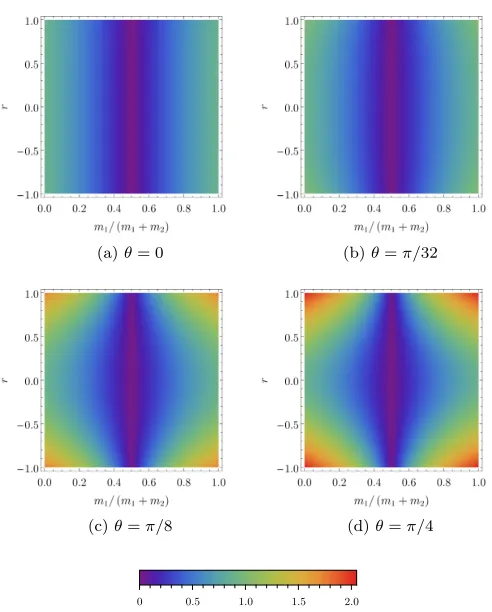
FIG. 1. (Colour online) The logarithmic negativity, as a measure of the entanglement between the center of mass and relation degrees of freedom, of the state associated with
VCM R, when V1 = V2 and both ρ1 and ρ2 are pure, i.e. detV1= detV2= 1, for different phase rotationsθ=θ1=θ2 as a function of the squeezing parameterr=r1=r2and the ratio of massesm1/(m1+m2).
whereθ1|2= diag(1,1,1,−1).
We will use the logarithmic negativity to quantify the entanglement between the center of mass and relational degrees of freedom in VCM R = M2VEMT2, for VE = V1⊕V2, which corresponds to the two particles being in a factorized stateρ1⊗ρ2in the external partition. V1 andV2 will necessarily be of the form given in Eq. (18). Plots of the logarithmic negativity of the state associ-ated withVCM R for different choices of V1 andV2 are given in Figs. 1 (identical state parameters), 2 (differ-ing purity), and 3 (differ(differ-ing squeez(differ-ing). Several trends emerge from a perusal of these figures.
(a)θ= 0 andµ1= 0.6 (b)θ= 0 andµ1= 0.2
(c)θ=π/4 andµ1= 0.6 (d)θ=π/4 andµ1= 0.2
0 0.5 1.0 1.5 2.0
FIG. 2. (Colour online) The logarithmic negativity, as a mea-sure of the entanglement between the center of mass and rela-tion degrees of freedom, of the state associated withVCM R, whenr=r1=r2,θ=θ1=θ2, and particle 2 is a pure state µ2 = 1 and particle 1 is not, for different purities of particle 1µ1 and phase rotationsθ. Plots for θ = 0 and µ= 1 and θ=π/4 andµ= 1 are shown in Figs. 1a and 1d respectively.
increases for any fixed value of the squeezing parame-terr.
The next trend we observe is that phase rotation, cor-responding to squeezing along a rotated axis in phase space, appears to play a more important role than squeez-ing. For a phase rotation θ = 0 we find that cen-ter of mass/relational entanglement is insensitive to the amount of squeezing. Asθincreases we see that squeez-ing plays an increassqueez-ingly important role, particularly as the ratio of the masses increasingly departs from unity. Not surprisingly, entanglement is greater for the pure case, shown in Fig. 1, than for the mixed case, shown in Fig. 2.
Asymmetric squeezing (r1> r2), illustrated in Fig. 3, modifies this situation somewhat. The zero-squeezing case in Figs. 3a and 3b, shows vanishing entanglement when the masses are equal. However there is increased center of mass/relational entanglement as the lighter par-ticle is more strongly squeezed (Fig. 3a), a trend that is less pronounced as the differential squeezing decreases (Fig. 3b). Vanishing center of mass/relational
entangle-(a)θ= 0 andα= 0 (b)θ= 0 andα= 0.5
(c)θ=π/4 andα= 0 (d)θ=π/4 andα= 0.5
0 0.5 1.0 1.5 2.0
FIG. 3. (Colour online) The logarithmic negativity, as a mea-sure of the entanglement between the center of mass and rela-tion degrees of freedom, of the state associated withVCM R, when detV1 = detV2 = 1 forr2 =αr1, for different phase rotations θ = θ1 = θ2 and values α. Plots for θ = 0 and α= 1 andθ=π/4 andα= 1 are shown in Figs. 1a and 1d respectively.
ment takes place for increasingly larger values of the mass of the particle which is most squeezed. Again we see that phase rotation plays a more significant role, restoring (in the maximalθ=π/4 case) the symmetry present in the equal mass case (Figs. 3c and 3d). Here we see that a suf-ficient amount of differential squeezing can eliminate cen-ter of mass/relational entanglement entirely (Fig. 3c).
Decreasing the purity of the states of the particles in the external partition, shown in Fig. 2, indicates the same trends as for the pure case (Fig. 1). The main effects of decreased purity are to decrease the overall center of mass/relational entanglement and to widen the range of ratio of masses for which this entanglement vanishes.
C. Three particles
[image:7.612.320.562.57.362.2] [image:7.612.53.298.61.363.2]partitionH=HCM⊗ HR, there will again be
entangle-ment generated between the center of mass and relational degrees of freedom. In addition, there will be entangle-ment generated among the relational degrees of freedom, a new feature not possible for the two particle system considered above.
The center of mass position and momentum operators, along with the relative position and momentum operators are again defined via Eq. (4). The transformed covariance matrix is given byVCM R=M3VEMT3, where
M3:=
m1
M 0
m2
M 0
m3
M 0
0 1 0 1 0 1
−1 0 1 0 0 0
0 −m2
M 0 1−
m2
M 0 −
m2 M
−1 0 0 0 1 0
0 −m3
M 0 −
m3
M 0 1−
m3 M
. (24)
The relational state V23|1 of particles 2 and 3 as de-scribed by particle 1 is obtained by deleting the first and second rows and columns ofVCM R. We observe that in
the limit when m3 vanishes and the columns and rows ofM3associated with particle 3 are deleted, that is the last two rows and columns,M2as defined in Eq. (19) is recovered.
We assume the state of the three-particle system in the external partition is a fully factorized Gaussian state with the covariance matrixVE=V1⊕V2⊕V3. For simplicity we restrict ourselves to the case whenV1=V2=V3and detVE= 1, in other words a pure state, with each of the
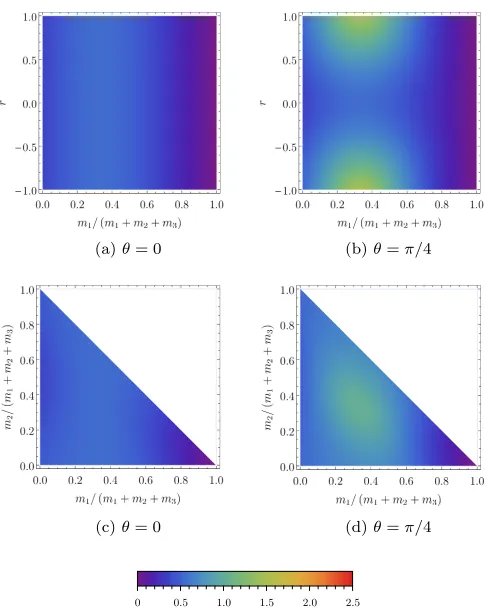
three particles identically squeezed in the same direction. In Fig. 4 the logarithmic negativity as a measure of en-tanglement between the center of mass and relational de-grees of freedom inVCM Ris plotted for different choices
ofVE. In Fig. 5 the logarithmic negativity between the
relational degrees of freedom inV23|1is plotted for differ-ent choices ofVE.
We see similar trends for the center of mass/relational entanglement as for the two-particle case, but qualita-tively different behaviour of the internal-relational en-tanglement, i.e., the entanglement generated among the relational degrees of freedom—in the case at hand, the entanglement between particle 2 and 3 as described by particle 1.
[image:8.612.319.563.60.361.2]The internal-relational entanglement, illustrated in Fig. 5, shows strikingly different behaviour. Such en-tanglement is maximized in the equal mass case, shown in Figs. 5b and 5d provided there is some phase rotation. In the absence of phase rotation, this effect vanishes. For all values of the (equal) phase rotation parameter, we observe that as the mass of the reference particle m1 becomes infinite, the entanglement between particles 2 and 3 vanishes. This is as expected, since this limit cor-responds to particle 1 behaving as a classical reference frame with a large mass. Indeed, we notice that in the limit m1 → ∞, the 4×4 lower-right submatrix of M3 becomes the identity matrix, and the only effect of the change of coordinates is that of redefining the origin in space for the coordinates of the second and third particle.
(a)θ= 0 (b)θ=π/4
(c)θ= 0 (d)θ=π/4
0 0.5 1.0 1.5 2.0 2.5
FIG. 4. (Colour online) The logarithmic negativity is plotted, as a measure of the entanglement between the center of mass and relation degrees of freedom, of the state associated with
VCM R describing three particles. In (a) and (b) the loga-rithmic negativity is plotted for the case whenm2 =m3, for various equal phase rotationsθ1 = θ2 = θ3 =θ, as a func-tion of the ratio m1/(m1 +m2+m3) and equal squeezing parameterr1 = r2 = r3 = r. In (c) and (d) the logarith-mic negativity is plotted as a function of the two mass ratios m1/(m1+m2+m3) andm2/(m1+m2+m3) for various equal phase rotationsθ, with the equal squeezing parameter fixed atr= 0.7.
IV. DISCUSSION AND OUTLOOK
[image:8.612.63.297.176.248.2](a)θ= 0 (b)θ=π/4
(c)θ= 0 (d)θ=π/4
[image:9.612.55.299.58.365.2]0 0.5 1.0 1.5 2.0 2.5
FIG. 5. (Colour online) The logarithmic negativity of the relative state of particles 2 and 3 described byV23|1is plotted, characterizing the entanglement among the relational degrees of freedom. In (a) and (b) the logarithmic negativity is plotted for the casem2=m3, for various equal phase rotationsθ1= θ2 =θ3 =θ, as a function of the ratiom1/(m1+m2+m3) and equal squeezing parameters r1 = r2 = r3 = r. In (c) and (d) logarithmic negativity is plotted as a function of the mass ratios m1/(m1+m2 +m3) and m2/(m1+m2+m3) for equal squeezing parameterr= 0.7 and for different equal phase rotationsθ.
when moving from a description of the quantum system entirely with respect to an external frame, to a descrip-tion in which only the center of mass is specified with respect to an external frame and all other degrees of free-dom are relational.
Two main observations emerged from studying the re-duced state ρR on the relational degrees of freedom,
in-troduced in Eq. (10), for systems of two and three par-ticles. First, for fully separable Gaussian states in the external partition with identical second moments, entan-glement between the center of mass degrees of freedom and relational degrees of freedom is minimized when the masses of the particles are the same. Second, again for fully separable Gaussian states in the external partition with identical second moments, in the limit when the mass of the reference particle, that is the particle for which the relational degrees of freedom are defined with respect to, becomes infinite, the entanglement among the
relational degrees of freedom vanishes. This second ob-servation suggests a meaningful way to interpret the ex-ternal reference frame, with which we usually describe a quantum state with respect to, as the limit of a physical system, say a particle, in which its mass is taken to in-finity [22]. The consequences of this second observation will be explored in future work.
The primary motivation for examining quantum ref-erence frames associated with non-compact groups is to apply the quantum reference frame formalism to rela-tivistic systems, in which the natural group associated with changes of a reference frame is the Poincar´e group. It will be fruitful to explore to what extent the tools de-veloped in this manuscript can be applied to the Poincar´e group; however, one immediate obstacle is the problem of defining a covariant definition of the center of mass [23].
Two other possible applications of the formalism in-troduced come to mind. The first is in constructing a relativity principle for quantum mechanics by studying changes of quantum reference frames, which was first sug-gested in Ref. [14]. The second is to construct a relational quantum theory, similar to what was done in Ref. [10], for the Galilean group using the relational description in Eq. (10), and examine how the usual “non-relational” theory emerges.
ACKNOWLEDGMENTS
The authors would like to thank Nick Menicucci, Jacques Pienaar, and Daniel Terno for useful discussions. This work was supported in part by the Natural Sci-ences and Engineering Research Council of Canada, by the European Union’s Horizon 2020 research, and innova-tion programme under the Marie Sklodowska-Curie grant agreement No. 661338. AS and MP acknowledge the hos-pitality of Macquarie University, where part of this work was conducted.
Appendix: Purity of the relational state
The covariance matrices considered in sections III B 1 and III B 2 were of the form VE = V1 ⊕V2, where both V1 and V2 were given by Eq. (18). The purity ofVCM R=M2VEMT2 is given by
µCM R=
1 √
detVCM R
=µ1µ2, (A.1)
whereµ1andµ2are the purities associated withV1and
V2respectively.
trace over the center of mass degrees of freedom, is
µ2|1= 1 pdetV
2|1
=µ1µ2 h
µ22m˜22f1−f1++µ1µ2 m˜21f − 1 f
+ 2 + ˜m
2 2f
+ 1f
− 2
µ21m˜21f2−f2+−µ22m˜22g12+ 2µ1µ2m˜1m˜2g1g2
−µ2 1m˜
2 1g
2 2
i−1/2
, (A.2)
where we have introduced the notation ˜mi =mi/(m1+ m2).
If VCM R is pure, which corresponds to both V1 and
V2 being pure, then µCM R = 1 and µ2|1 is a genuine measure of entanglement between the center of mass and relational degrees of freedom. In this case,µ−2|21simplifies to
µ−2|21= ( ˜m2−m˜1) h
sinh(2r1) cosh(2r2) cos(2θ1)
−sinh(2r2) cosh(2r1) cos(2θ2) i
+ (2 ˜m1m˜2+ 1) cosh(2r1) cosh(2r2)
−sinh(2r1) sinh(2r2) h
2 ˜m1m˜2cos(2(θ1+θ2))
+ cos(2θ1) cos(2θ2) i
+ ˜m21+ ˜m22. (A.3)
If the mass of the two particles are equal m1 = m2,
µ−2|21 further simplifies to
µ−2|21=1 4 h
−2 sinh(2r1) sinh(2r2) cos(2(θ1−θ2))
+ cosh(2(r1−r2)) + cosh(2(r1+r2)) + 2 i
.
(A.4)
For the case when m1 6=m2, r1 =r2 = r and θ1 = θ2=θ, corresponding to Fig. 1,µ−2|21becomes
µ−2|21=2 m 2 1+m
2 2 (m1+m2)
2 + sin 2(2θ)
× m
2 1+m22 (m1+m2)
2sinh
2(2r)−2 m1m2 (m1+m2)
2 !
.
(A.5)
From Eq. (A.5), we observe that when the masses of the two particles are identical m1 =m2, the reduced state
V2|1is pure, i.e,µ2|1= 1, which corresponds to vanishing entanglement between the center of mass and relational degrees of freedom inVCM R. This agrees with the plots
of the logarithmic negativity in Fig. 1.
When the mass of either particle becomes infinite we find
µ−2|21=2 + sinh2(2r) cos2(2θ). (A.6)
[1] R. M. Angelo, N. Brunner, S. Popescu, A. J. Short, and P. Skrzypczyk, J. Phys. A: Math. Theor. 44, 145304 (2011).
[2] S. D. Bartlett, T. Rudolph, and R. W. Spekkens, Rev. Mod. Phys.79, 555 (2007).
[3] M. Jarzyna and R. Demkowicz-Dobrza´nski, Phys. Rev. A85, 011801 (2012).
[4] S. D. Bartlett, T. Rudolph, R. W. Spekkens, and P. S. Turner, New J. Phys.11, 063013 (2009).
[5] A. Kitaev, D. Mayers, and J. Preskill, Phys. Rev. A69, 052326 (2004).
[6] Y. Aharonov and L. Susskind, Phys. Rev. 155, 1428 (1967).
[7] M. R. Dowling, S. D. Bartlett, T. Rudolph, and R. W. Spekkens, Phys. Rev. A74, 052113 (2006).
[8] C. Rovelli, Class. Quantum Grav.8, 317 (1991). [9] C. Rovelli, Int. J. of Theor. Phys.35, 1637 (1996). [10] D. Poulin, Int. J. Theor. Phys.45, 1189 (2006). [11] J. Pienaar, (2016), arXiv:1601.07320.
[12] A. Ch¸eci´nska and A. Dragan, Phys. Rev. A92, 012321 (2015).
[13] I. Marvian and R. B. Mann, Phys. Rev. A 78, 022304
(2008).
[14] M. C. Palmer, F. Girelli, and S. D. Bartlett, Phys. Rev. A89, 052121 (2014).
[15] M. Ahmadi, A. R. H. Smith, and A. Dragan, Phys. Rev. A92, 062319 (2015).
[16] G. Adesso and F. Illuminati, J. Phys. A: Math. Theor.
40, 7821 (2007).
[17] C. Weedbrook, S. Pirandola, R. l Garc a Patro n, N. J. Cerf, T. C. Ralph, J. H. Shapiro, and S. Lloyd, Rev. Mod. Phys.84, 621 (2012).
[18] G. Adesso, S. Ragy, and A. R. Lee, Open Syst. Inf. Dyn.
21, 1440001 (2014).
[19] J. Williamson, Amer. J. Math.58, 141 (1936).
[20] G. Vidal and R. F. Werner, Phys. Rev. A 65, 032314 (2002).
[21] G. Adesso, A. Serafini, and F. Illuminati, Phys. Rev. Lett.93, 220504 (2004).
[22] Y. Aharonov and T. Kaufherr, Physical Review D30, 368 (1984).