This paper reports on ongoing detailed studies of skills development in engineering students, focussing on the undergraduate chemical engineering cohort at the University of Strathclyde, Glasgow. Building on initial survey-based analysis of employability skills development and students’ and graduates’ perceptions of their own competence in a range of areas (Fletcher et al 2017), we report on further detailed investigation of learning developments throughout a key part of the UK chemical engineering degree, the so-called ‘capstone’ Design Project. Students work in design groups for a complete semester, following a project brief that requires a high degree of self-direction, project planning and management from the student teams. Our study is grounded theory-based (Glaser and Strauss, 1967), utilising extensive interviews and
observation of actual project team meetings to build hypotheses describing key determining features of the student experience and how they lead to skills development in this hands-on team project.
Foundations of the Study
The authors of this work conducted a survey of final year undergraduate students and recent graduates of the chemical engineering department at the University of Strathclyde in order to explore the transitional perceptions of various skills deemed relevant to employment (Fletcher, Sharif, & Haw, 2017). The skills surveyed were identified from a 2004 survey conducted by the World Chemical Engineering Council (WCEC), the results of which provided a larger dataset for comparison (World Chemical Engineering Council, 2004). Participants were also surveyed with respect to preference of delivery, fields of profession and whether, in the case of final year students, participants had undertaken any professional/industrial experience such as summer placements or internships.
The skills and preference for teaching format were evaluated on appropriate 5-point Likert scales. The skills were surveyed for both the participants’ perceptions of importance of the skill for employment (in the case of students anticipated importance) and perceptions of degree of development of the skills during their time at university. Data presented shows response averages.
94 participants were involved and demographics collected during the study indicated 72 students and 22 alumni participated; 72 males and 22 females.
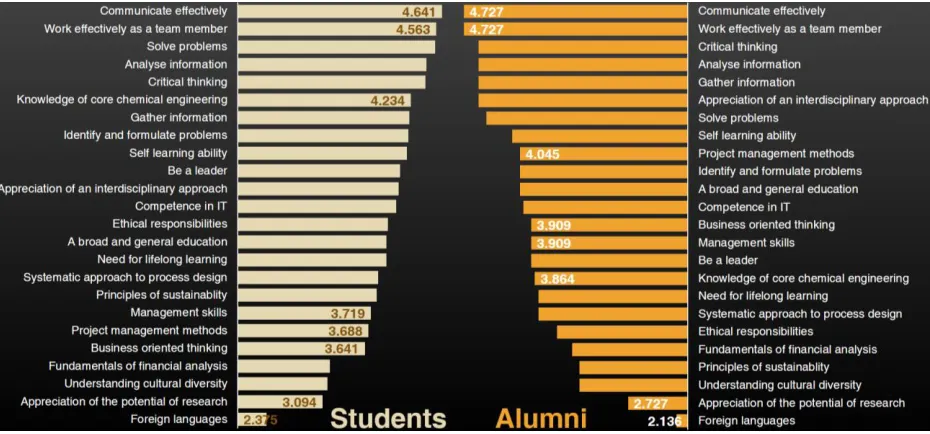
Figure 1 Ranked averages for skills' work importance for both students and alumni
A particularly telling finding was that students were more likely to assign greater importance to technical skills, represented by a significantly higher average in importance of “knowledge of core chemical engineering”. Other differences in importance were found in business skills, with alumni assigning more importance to such skills. These findings indicate changing perceptions of importance as students transition into the workplace and begin forming a professional identity. As part of this study, recommendations were made for explicit interventions to foster exposure and development of these professionally relevant skills.
The Chemical Engineering Group Design Project
Complimenting the two most important skills of “communicating effectively” and “working effectively as a team member” was the high degree of preference of learning group-orientated projects amongst both full-time students and alumni. Group project work in the form of a team design project is a signature component of chemical engineering undergraduate degrees, and is required for accreditation by the Institution of Chemical Engineers.
These findings warrant further exploration of these skills and the authors have begun investigating the group design project that takes place as the final module in the Honours programme and, hence, represents potentially the final pedagogical activity that students experience prior to professional work. Further, this module involves somewhat broad opportunity to communicate amongst peers and supervisors through a variety of media and contexts: meetings, emails, reports, and general working environments. Thus, the module presents itself as an ideal opportunity to explore both working effectively as a team member and communication skills in a pedagogical context. As such this study is qualitative in nature,
compared to the quantitative study and findings upon which it is founded.
feasibility study (4 weeks), individual detailed design (5 weeks) and a sensitivity analysis (2 weeks). Each group is assigned a supervisor for phases 1 and 3 and a phase-2 supervisor with 1 contact hour to meet formally each week. Phase 2, the detailed design, is essentially different to phases 1 and 3, as it is explicitly an individual task with some implicit group work and is assessed individually.
As part of the study thus far, 12 groups over two academic years (2015/2016, 2016/2017) have been observed during supervisory meetings, with 48 and 39 recorded observations in each year respectively. Each observation was audio recorded and written observational notes were
collected. Further data has been collected from 17 interview participants over 21 in-depth interviews.
Building a methodology
Prior work on these professionally relevant skills have primarily focused on perceptions of graduates towards preconceived skills. However, literature on qualitative research of how such skills are understood and their manifestation in the workplace remains sparse. Further,
educational research focusses on action research with interventions and measuring preconceived variables.
To understand the main concerns and issues raised by participants a traditional hypothetical approach can lead to forced ideas. A useful method that is rooted in socio-psychological qualitative health research is grounded theory (GT) which reverses the traditional developing theory-testing hypothesis by developing theory dependent on data that is collected (Glaser & Strauss, 1967). Theory is emergently developed as opposed to ‘forced’ on data. GT looks at social processes, action and meaning, with an aim to understand how social phenomena occur from the participants’ perspectives. GT necessitates a concurrent data collection and analysis, with each feeding into the other.
GT begins by staying close to data through coding techniques such as word-by-word, line-by-line and/or incident-by-incident to infer, patterns in social processes, concepts and properties. As the analysis progresses, selective coding raises those codes with rich conceptual density to categories that have substantial relevance to participants. To develop theory, memo-writing is used to refine and raise the abstractive quality of the emergent theory.
Qualitative research can take on a journalistic function which, due to its closeness to the
empirical data, limits GT to a substantive level – which can be beneficial to the substantive field of the research, in this case educational group project work. However, GT can be further used to develop formal theory which has a wider applicability – this requires testing and informing the theory from out-with the substantive area of development – for example in other group project settings such as the workplace.
To develop a rich theory, it is suggested to utilise theoretical sampling once theory becomes well developed – looking for “black swans” and cases that go against the theory. Examples of these include: in the case of group cohesion emerging as important, finding groups where there is significantly low cohesion, or, in the case of developing group cohesion, proximity and contact with the group may emerge as important – this may warrant sampling groups where members are geographically distant or maintain little contact. The aim of GT is to develop rich
greater understanding and participants’ perspectives taking centre-stage this can inform pedagogical changes in curricula.
Preliminary outcomes
Some social phenomena and theoretically-rich concepts that have emerged from the study thus far include comparing contributions, seeking guidance and seeking justice. Comparing
contributions is highlighted here to explicate the complexity of such processes and show integration of initial codes from line-by-line and incident-by-incident analysis are italicized to evidence the grounding of such codes with collected data.
Comparing contributions occurs throughout project work but manifests in different ways in different phases. A prerequisite to this takes place when students make first contact with a project task and begin aligning themselves to the task and one another. Aligning to the task can be facilitated by a brief which highlights anticipated outcomes. This orientation to the task leads into the process of dividing the labour amongst members - in different groups division is
achieved in different ways. For some groups assignment of the labour was achieved by working to strengths and preferences of members. This process of labour division is also a division of social responsibility (for each member to achieve the rights of the group – i.e. completing the task).
A possible corollary of group project tasks was building trust and understanding between members, however this is usually subject to the members interacting frequently, either through
meeting in physical working environment, group meetings or extracurricular socialising. This was adopted in some groups as a means for raising levels of social commitment amongst members, which gives access to benefits such as being able to raise issues with members and resolving issues early on. All groups were obliged to participate in supervisory meetings as a platform for monitoring progress of members and seeking guidance, however autonomous group meetings served a similar purpose (of monitoring progress) and potentially as a means of
gauging members working styles. Comparing contributions involves comparing perceived efforts and quality of work. In multiple instances observing a member as being present was enough effort to offset feelings of resentment and raising the issue further.
As interactions between members reaches low frequencies, social responsibility (and the potential of facing social consequences) diminishes and this can lead to a lessening of group cohesion. Comparing contributions takes place less frequently and hence members may become aware of social-loafing too late for raising the issue with the member involved.
Alternative routes for resolving the issue are sought such as appealing to authority or reviewing peers formally. Appealing to authority becomes obstructed as members anticipate being blamed
by authority (supervisors) for not resolving issues themselves, resulting in members feeling resentment and remaining silent.
Social loafing in this context has been researched through interventional studies such as those conducted by Zou & Ko (2012), yet the analysis presented here through GT methods provides insight for academic teaching staff regarding the conditions under which social loafing arises and often goes unreported.
The study continues with further analysis of results and examination of future cohorts, to be reported in future publications. Quasi-longitudinal tracking will also take place, as the first
to examine graduates ‘backward-looking’ perspective on their own development of competence through the group design project as well as other aspects of their degree experience, and to compare these new perspectives with the students’ previous perceptions of their experience in-situ during the project.
References
Fletcher, A. J., Sharif, A. W. A., & Haw, M. D. (2017). Using the perceptions of chemical
engineering students and graduates to develop employability skills. Education for Chemical Engineers, 18, 11–25. http://doi.org/10.1016/j.ece.2016.07.001
Glaser, B. G., & Strauss, A. L. (1967). The Discovery of Grounded Theory: Strategies for Qualitative Research. Observations (Vol. 1). AldineTransaction.
http://doi.org/10.2307/2575405
World Chemical Engineering Council. (2004). Survey: How Does Chemical Engineering Education Meet the Requirements of Employment [Online]. Retrieved May 1, 2017, from http://chemengworld.org/Education+Project.html