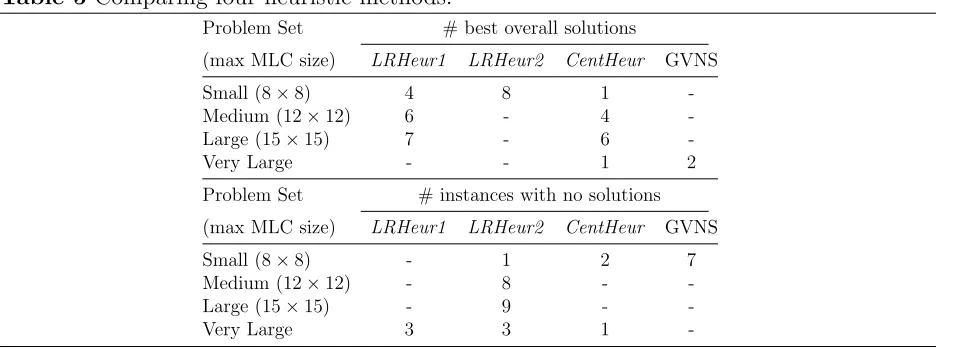
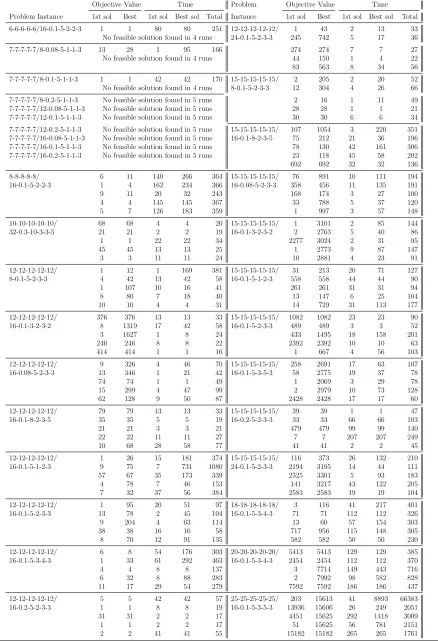
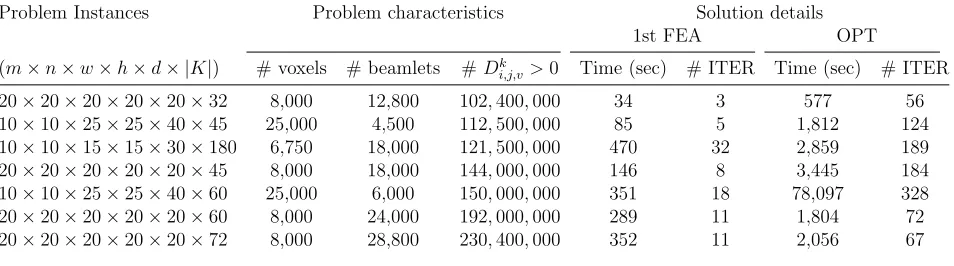
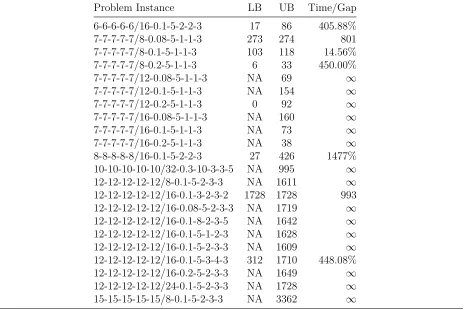
A Unified Mixed-Integer Programming Model for
Simultaneous Fluence Weight and Aperture
Optimization in VMAT, Tomotherapy, and CyberKnife
Kerem Akartunalı
Department of Management Science, University of Strathclyde, Glasgow, G1 1QE, United Kingdom, [email protected]
Vicky Mak-Hau
School of Information Technology, Deakin University, Burwood, Vic 3125, Australia, [email protected]
Thu Tran
Andrew Love Cancer Centre, Barwon Health, Geelong, Vic 3220, Australia, [email protected]
In this paper, we propose and study a unified mixed-integer programming model that
simul-taneously optimizes fluence weights and multi-leaf collimator (MLC) apertures in the
treat-ment planning optimization of VMAT, Tomotherapy, and CyberKnife. The contribution of
our model is threefold: i. Our model optimizes the fluence and MLC apertures
simultane-ously for a given set of control points. ii. Our model can incorporate all volume limits or
dose upper bounds for organs at risk (OAR) and dose lower bound limits for planning target
volumes (PTV) as hard constraints, but it can also relax either of these constraint sets in
a Lagrangian fashion and keep the other set as hard constraints. iii. For faster solutions,
we propose several heuristic methods based on the MIP model, as well as a meta-heuristic
approach. The meta-heuristic is very efficient in practice, being able to generate dose- and
machinery-feasible solutions for problem instances of clinical scale, e.g., obtaining feasible
treatment plans to cases with 180 control points, 6,750 sample voxels and 18,000 beamlets
in 470 seconds, or cases with 72 control points, 8,000 sample voxels and 28,800 beamlets
in 352 seconds. With discretization and down-sampling of voxels, our method is capable
of tackling a treatment field of 8000 cm3 ∼ 64000 cm3, depending on the ratio of critical structure versus unspecified tissues.
Key words: OR in medicine; Integer programming; Heuristics; Radiotherapy treatment
1.
Introduction
Radiation therapy or radiotherapy has become one of the most common treatment methods
for cancer, besides chemotherapy and surgery, with almost two-thirds of all cancer patients
expected to have radiotherapy at some stage in their treatment plan [11]. In this treatment,
high-energy radiation is used to shrink tumors and kill cancer cells, where radiation damages
the DNA of cancer cells [17]. The radiation can be delivered either by radioactive source(s)
placed in or near the tumor, called brachytherapy; or by a machine outside the body, called
external radiation therapy, the most common form of radiotherapy. Since our focus is external
[image:2.612.136.478.268.524.2]radiotherapy, we will refer to that simply as radiotherapy in the remainder of the paper.
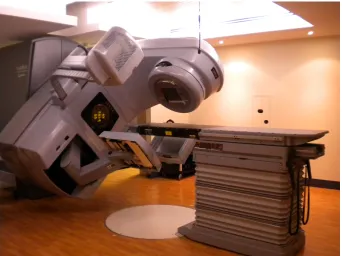
Figure 1: Gantry that can rotate by 360 degrees.
In radiotherapy, radiation beams are produced by a Linear Accelerator (LINAC), aimed
towards the tumor and its surrounding tissues where cancer may have spread. The LINAC is
mounted on a gantry, and the gantry rotates the source of radiation beams around the body
of a patient. Volumetric-modulated arc therapy (VMAT), Tomotherapy and CyberKnife are
recent major advances in external beam radiotherapy.
In VMAT, the gantry can rotate around a patient’s body by 360◦ in a co-planar manner
(see Figure 1). Co-planar treatments are possible through rotation of the LINAC couch.
or Varian’s RapidArc [32]). An “arc” does not necessarily have to be a full 360◦ rotation. In
Tomotherapy, the source of radiation will continuously rotate around the body of a patient
in a helical manner (see [2]), hence it is capable of delivering non-coplanar beams. In
CyberKnife, the source of radiation is mounted on a robotic arm, and therefore it can deliver
radiation beam from almost any point in space (see [1]). In addition to cancer treatment,
VMAT and Tomotherapy have also been used for Total Marrow Irradiation (TMI) in reducing
Leukemia relapse ratio (see [10] and [38]).
The modulation of the radiation beams is carried out using collimators. For VMAT, a
multi-leaf collimator (MLC) is mounted in the LINAC head. The MLC is made up of leaves,
which will block the radiation and are arranged parallel to each other in two sets of opposing
banks. These leaves can move independent from each other and can create customised beam
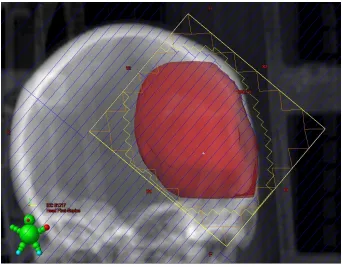
shape by positioning themselves in a planned position. The radiation field formed by the
MLCs are known as aperture (see Figure 2). For example, if an aperture is formed by 20
leaves, each 1cm thick, and we have 20 leaf positions, then the MLC is said to have 400
[image:3.612.135.477.375.642.2]bixels (or beamlets).
Figure 2: An MLC can form a shape that resembles the shape of the tumor.
On the other hand, TomoTherapy uses simply binary MLCs, i.e., each leaf has only two
eye view as per Figure 2. CyberKnife has various collimators, e.g., the M6 FI model uses
multiple circular collimators of different sizes (called IRIS collimators), whereas the M6 FM
model uses an MLC called InCise.
Since MLCs are common in all three machines, we focus our model on optimizing the
radiation intensity or fluence weight as well as the MLC aperture simultaneously. Some
MLCs do not allow interdigitation, that is, the left leaf of a row cannot collide with the right
leaf of the neighbouring rows, and vice versa. This is also known as the interleaf constraints
in the literature. Some MLCs allow full interdigitation, while some allow no interdigitation
or no interdigitation with a gap. There are also other machinery constraints for VMAT,
such as a limit to the speed a leaf can move in consecutive control points. Such a restriction
can be translated to the number of positions, or columns, a leaf is allowed to move between
control points before the MLC carriage shifts to enable further proximal/distal positions.
1.1
Recent developments in treatment planning optimization
To plan a radiotherapy treatment that involves the use of an MLC, one must decide from
where the radiation beams should be delivered, the intensity of radiation that should be
delivered from each location, and what apertures the MLC should form at those locations.
The general goals of a treatment is: i. for tumors to receive enough radiation so that they
can be eliminated, ii. for organs at risk (OARs) to be spared from radiation as much as
possible for minimal damage to healthy tissue, and iii. for the overall treatment time to be
as short as possible for patient’s comfort. The tumor area is usually given a margin that
will cover some surrounding tissues where cancer may have spread to and to compensate
for motion and setup. This area is called the Planning Target Volume (PTV). Before the
treatment planning optimization takes place, a radiation oncologist prescribes the dose limits
to the different structures: a lower bound on the dose to the PTVs (or a volume constraint
such as “at least 95% of the PTV must receive a dose of 73.7 Gray (Gy) or above”); and an
upper bound on the OARs (or volume limits such as “no more than 35% of the bladder can
receive more than 40 Gy of radiation”).
The question of where will be answered by a set of locations, commonly referred to as
the control points(CPs). The question of intensity at CP k is determined by the dose rate
(rk, in Monitor Unit (MU) per second), and the gantry speed (sk, also in MUsec). In recent
literature, e.g., [25] and [29, 30], a value calledfluence weightthat equals tork/sk is used for
what aperturethe MLC should form is where combinatorial optimization comes in. Further,
there is a limit in the maximum fluence weight that can be delivered from each control point.
For VMAT, the change in fluence weight is also limited in consecutive control points.
Notice that for all three treatment modalities, only one MLC aperture is considered
at each control point. On the other hand, in intensity-modulated radiotherapy (IMRT),
a widely used form of radiotherapy with machinery similar to VMAT, there are very few
control points (usually only 5-7) in each treatment, but multiple MLC apertures are used at
each control point.
Traditionally, fluence weights and MLC apertures are optimized separately. In IMRT,
three separate optimization problems are solved (see, e.g., [13], [8], and [7]). First, a
beam-angle optimization problem is decided. These angles are either predetermined by an
expe-rienced treatment planner or calculated by solving some optimization problems (see, e.g.,
[22, 35, 39]). The output is a number of angles (usually 5-7, at most around 10 for the most
complex cancer cases, i.e., head and neck) from where radiation is delivered. After that, a
fluence map optimization problem is solved [26], which will provide us with one intensity
matrix for each beam-angle (control point). Finally, a realization problem is solved to find
the right MLC apertures that will decompose the intensity matrices, and to find the most
time-efficient way to do so ([18]). The field of minimizing treatment times for the
step-and-shoot MLC radiotherapy practically began with the work of [36]. The most recent advances
in the minimizing of total treatment time can be found in [5, 18, 31].
Since the underlying mathematical problem for the VMAT is different, methods developed
for the IMRT cannot be directly applied to the VMAT. The difference mainly stems from
the interconnectivity between different control points and the computational complexity due
to higher degree of freedom in VMAT, as noted by [37]. To our knowledge, the treatment
planning optimization of the VMAT has rarely been studied in the field of mathematical
programming/operations research, although the problem offers interesting challenges. The
most recent treatment planning optimization algorithms can be found in [25] (a greedy
heuristic) and [29, 30] (a hybrid nested partitioning heuristic). On the other hand, recent
years have seen a growing interest from medical physicists: [6, 24, 20] propose various
heuris-tics for handling dose limits as soft constraints, whereas [34] propose a two-stage algorithm
using shortest paths and [23] extend a one-stage algorithm originally proposed for IMRT
problems. We refer the interested reader to [37] for an excellent review discussing detailed
an invaluable discussion comparing different therapies for different cancer cases.
In [25], a mixed-integer nonlinear programming model is presented. The method iterates
between two optimization problems: First, given a set of control points and their respective
MLC apertures, the fluence weights for all control points are optimized. Then, a column
generation approach is used to find the most promising control point and its associated MLC
aperture. The objective function used therein is to minimize the deviation of the calculated
dose from the prescribed dose. Hence, if the objective value of a solution is not zero, then it
means that there exist violations in dose limits. A down-sampled voxel grid is implemented–
one in every two voxels is sampled along each of the three dimensions in critical structures
and one in every four in unspecified tissues. The voxels are of size 4×4×2.5 mm3. Real clinical cases were tested using GPU computing and solution times are shown to be very
fast. Computational results indicated that the dose constraints for most structures could be
reasonably satisfied except for the case with the bladder.
The methods of [29, 30], on the other hand, present a mixed-integer programming model
similar to the model presented in this paper. The variable sets are adopted from [16] for the
IMRT, allowing interdigitation and only enforcing the dose lower bound for PTV as hard
constraints. When solving the MIP problem, however, these constraints are relaxed in a
Lagrangian fashion in the solution methodology, and a generalized Benders decomposition
and hybrid nested partition method is used as the solution methodology. The authors present
the consecutive control point leaf movement constraint in their model, however, for a problem
instance we have tested, there seems to be violations of these constraints present. Their
algorithm is tested on 10 randomly generated non-clinical instances.
In CyberKnife, [27] presents a multi-criteria optimization approach to optimize the
flu-ence weights, solving linear programming problems in each step of the multi-criteria
opti-mization procedure, with dose constraints dualized in the objective function and solved by
a one-step Lagrangian relaxation with pre-determined dual multipliers.
In TomoTherapy, while there are publications in the optimization of treatment planning
parameters such as field width, pitch factor, and modulation factor (see, e.g., [28] and [12]),
to the best of our knowledge, there is no integer programming/combinatorial optimization
methods specifically designed for TomoTherapy treatment planning. It is, however, possible
to apply a VMAT treatment planning optimization method to helical tomotherapy. There
will be many more control points to consider, however, the MLC apertures are much easier,
1.2
Contributions of our paper
Our paper makes the following contributions to the radiotherapy treatment optimization
literature.
1. Both our MIP model and the meta-heuristic method optimizes the fluent weights and
the MLC apertures simultaneously. Most methods in the present literature either
op-timize only the fluence weights (using beam-eye-view as MLC apertures) or opop-timize
the two iteratively. Furthermore, our models involve the no-interdigitation (interleaf)
constraints, which can simply be removed if the MLC considered allows interdigitation.
With a simple modification of the interleaf constraints, our model can also
accommo-date the case of no interdigitation with a gap.
2. Our MIP model can be used as a quality analysis tool for existing heuristic algorithms,
as well as to confirm infeasibility of a specific patient’s case. Most of the existing
algorithms dualize the dose limits, reducing the problem to minimizing deviation from
prescribed dose limits. With a heuristic solution, even though computation times are
typically short (e.g., [25]), when the objective value does not return a zero, one can
never know whether the dose prescription is simply infeasible, or that the heuristic
method failed to find a solution that is dose-feasible. Our approach, on the other
hand, indicates clearly when a given dose prescription is simply infeasible.
3. Although our MIP model can currently solve problems of moderate size, advances in
optimization software, computer hardware, and parallel computing are taking place
rapidly, increasing the size of problems that can be tackled every day. We also
inves-tigate customized exact methods with better computational performance for our MIP
model in a companion paper [4]. Moreover, treatment planning often happens 2-3
weeks before the actual treatment is carried out, allowing time to extensively search
for a solution that is dose-feasible, rather than to provide a quick solution in a few
sec-onds that does not necessarily comply all dose requirements. As noted by Dr. Robert
D. Timmerman, vice chair of radiation oncology at the University of Texas
Southwest-ern Medical Center, radiotherapy plans will be significantly improved in the future,
“simply because current outcomes are unsatisfactory to patients” [11]. Therefore our
4. For faster solutions, we also provide several heuristic methods based on the MIP model,
as well as a meta-heuristic approach. With the meta-heuristic, we were able to solve
problems with up to 180 control points for a treatment field with 6,750 sample voxels
and 18,000 beamlets; and, in another instance, 72 control points with 8,000 voxels
and 28,800 beamlets, for which the first dose- and machinery-feasible solutions were
returned after 470 seconds and 352 seconds, respectively. Note that the sizes of
prob-lems we have tackled are comparable to those found in the literature, see, e.g., [25].
Using the same discretization and down-sampling of voxels used by [25], our method
is capable of optimizing a treatment field of 8000cm3 ∼64000 cm3, depending on the ratio of critical structure versus unspecified tissues. Finally, any solution returned by
the heuristic will have neither violations to the prescribed dose nor violations to the
machinery restrictions.
1.3
Organization of the Paper
In Section 2, we will present an integer programming formulation of the problem, which
initially has non-linear terms but can be linearized with additional variables and constraints.
We will also discuss some valid inequalities that strengthen this formulation. In Section 3,
we will discuss the polyhedral properties of some key subproblems, and also the strength
of the inequalities presented in the previous section. We will present all proposed solution
methodologies in detail in Section 4, where we will also briefly discuss possible Lagrangian
relaxations of the problem. The empirical strength of these solution methods will be
in-vestigated extensively in Section 5. Finally, we will summarize our conclusions and address
potential future research areas in Section 6.
2.
A Mixed Integer Programming Formulation
In this section, we present a mixed integer programming formulation for the treatment
planning optimization of the VMAT.
2.1
Notation and Problem Description
In what follows, we consider a set of given control points. In the case of VMAT, one can
consider equally spaced partitions of the 360◦ coplanar space. For example, a 180 control
points can also be taken as equal partitions from the helical rotation. Even though there
will be more control points than VMAT if we are to consider fine partitions, there will be
significantly less leaf position combinations to consider. In the case of CyberKnife, one can
consider a given set of “promising” control points. In theory, one can have a large number
of such control points, but impose a limit in the number of control points with a non-zero
fluence weight. In this paper, we will consider only the case when a set of control points is
given. We now define some notation. Let:
- I ={1, . . . , m} be the index set of the MLC rows;
- J ={1, . . . , n} be the index set of the MLC columns;
- K ={1, . . . ,K} be the index set of control points;
- I×J be set of beamlets (or bixels), each cell (i, j) being a beamlet/bixel;
- J0 = {0, n+ 1} ∪J, with 0 and n+ 1 being the home positions of the MLC left and
right-leaves, respectively;
- δ be the maximum number of columns a MLC leaf is allowed to move in consecutive
control points;
- ∆ be the maximum amount of change in fluence weights that is allowed in consecutive
control points;
- V be the index set of all voxels;
- Vt be the set of voxels in the target volumes, i.e., tumor volumes;
- Vo be the set of voxels in the organs at risk (one can even define a set each for the
critical structures, e.g., VB for the set of voxels in the bladder(s));
- L={(`, r) | `, r∈J0, ` < r} be the set of feasible left- and right-leaf pairs;
- Dk
ijv be the beamlet-based dose deposition coefficient, i.e., the dose, at unit fluence
weight, received by voxelv from beamlet (i, j) in the interval defined by control point
k (this value can be pre-calculated in the manner as described in [25]);
- ¯d > Lv, for v ∈Vt be a desireddose for voxels in a PTV (e.g., we may have 73.7 Gy as
Lv and 79.2 as ¯d);
- Uv be the maximum dose allowed for any given voxel v ∈V;
- yk
i(`,r) ∈ {0,1} be a decision variable with yki(`,r) = 1 representing the bixels between, but not including, columns ` and r in row i in control point k are open;
- xv ∈ {0,1}be a decision variable with xv = 1 if voxelv ∈Vt receives a desired dose of
¯
d or above, and xv = 0 otherwise;
- dv be the dose that voxel v receives;
- zk be a continuous decision variable representing the fluence weight for control point
k; and
- ¯M be the maximum fluence weight that can be delivered from any control point.
2.2
The Formulation
There are some machinery constraints that are common among VMAT, TomoTherapy, and
CyberKnife, and some constraints that vary among the three treatment modalities. For
VMAT and CyberKnife, some MLCs allow interdigitation, whereas others do not. With
TomoTherapy, since there are only two leaf positions for each leaf, interdigitation is not an
issue. With VMAT, there will be a maximum travel distance for the leaves in consecutive
control points. Moreover, a maximum fluence weight change is also limited. There are also
dose lower limit and upper (or volume) limit constraints. Hence, we propose the following
formulation that will capture most of the machinery constraints. We emphasize here that
a feasible solution to our model is dose- and machinery-feasible, and is therefore an overall
Formulation 2.1
maxf(x, y, z) (1)
s.t. X (`,r)∈L
yki,(`,r) = 1 ∀i∈I, ∀k ∈K (2)
n+1
X
˜
r=`+1
yik(`,r˜)+
`
X
˜
r=1 ˜
r−1
X
˜
`=0
y(ki+1)(˜`,r˜) ≤1
∀i∈I\{m},∀`∈J0\{n+ 1},∀k ∈K (3)
r−1
X
˜
`=0
yik(˜`,r)+
n
X
˜
`=r n+1
X
˜
r=˜`+1
y(ki+1)(˜`,r˜) ≤1
∀i∈I\{m},∀r∈J0\{0},∀k ∈K (4)
r−δ−1
X
˜
r=0
r−1
X
˜
`=0 yk+1
i(˜`,r˜)+
n+1
X
˜
r=r+δ+1 ˜
r−1
X
˜
`=0 yk+1
i(˜`,r˜) ≤1−y
k i(`,r)
∀i∈I, ∀(`, r)∈ L, ∀k∈K (5)
`−δ−1
X ˜ `=0 n+1 X ˜
r=˜`+1 yk+1
i(˜`,˜r)+
n
X
˜ `=`
+δ+1
n+1 X ˜ r= ˜ `+1 yk+1
i(˜`,˜r)≤1−y
k i(`,r)
∀i∈I, ∀(`, r)∈ L, ∀k∈K (6)
zk−zk+1 ≤∆ ∀k∈K (7)
zk+1−zk ≤∆ ∀k∈K (8)
dv ≥Lv v ∈Vt (9)
dv ≤Uv v ∈V (10)
dv ≥dx¯ v v ∈Vt (11)
x∈ {0,1}|Vt|
;y∈ {0,1}|I|×|L|
; 0≤zk≤M¯ (12)
We first discuss three possible objective functions. The first objective function is suitable
for cases where the dose prescription is feasible to be carried out–cases that a solution that
satisfy all lower and upper dose limits dose indeed exist. In real-life cases, this is of course
not known in advance, in which case the model can be used to prove that no feasible solution
exists.
1. With all dose restrictions as hard constraints, we first consider f(x, y, z) = P
v∈Vtxv,
i.e., we maximize the number of voxels in the PTV that receive a desired radiation of ¯
provide an equal weight for each voxel in the target area to receive a good dose, which
will favor dose homogeneity as advised in [15].
We also note that the xv variables can be used to model volume requirements. For
example, a requirement such as “at least 95% of PTV must receive a minimum dose
of 79.2 Gy” can be written as:
dv ≥ 79.2xv, ∀v ∈Vt
P
v∈Vtxv ≥ 0.95|Vt|.
On the other hand, a volume constraint such as “no more than 17% of the bladder can
receive 65 Gy or above” can be achieved in the following way. Let VB be the set of
voxels in a bladder,M a large number, we replace the objective function by minv∈VB xv
and include the following constraints:
dv−65 ≤ M xv, ∀v ∈VB
P
v∈VB xv ≤ 0.17|VB|.
In this case, the xv will be a penalty counter of the number of bladder voxels being
delivered a dose over 65 Gy. The next two objective functions are suitable for difficult
cancer sites where prescribed doses are known to be typically very hard to be satisfied.
2. Keeping only the PTV dose lower limit constraints (50) as hard constraint, we can
minimize the dose delivered to the OARs in the objective function, i.e., minP
v∈Vodv.
Alternatively, we can minimize the dose upper limit violations for voxels in OARs,
either min{maxv∈Vo{(dv −Uv)
+}} (highest violations) or minP
v∈Vo(dv −Uv)
+ (total violation). Note that a simple dose lower limit feasibility check can be performed prior
to solving the optimization problem, where if there exists any v ∈ Vt such that Lv >
¯
MP
k
P
i∈I
P
j∈JDkijv, then the dose prescription does not have a feasible solution.
3. Keeping only the OAR dose upper limit constraints (51) as hard constraint, we can
maximize the dose delivered to the PTV in the objective function, i.e. maxP
v∈Vtdv.
Alternatively, we can minimize the dose lower limit violations for voxels in PTVs,
i.e. min{maxv∈Vt{(Lv −dv)
+}} (highest violations) or minP
v∈Vt{(Lv −dv)
+} (total violation).
We now explain the rest of the constraints. Constraint (2) ensures that only one shape
is used for each control point. This applies to all three treatment methods. Constraints (3)
Rowi+ 1 cannot overlap with the left (right) leaf in Rowi. Here we note that although some
MLCs allow interdigitation (i.e., no interleaf constraints needed), the interleaf constraints
in general make the problem computationally harder and they cover a more general set
of problems; hence we include them in the formulation. We can easily remove them for
TomoTherapy and for MLCs that do allow interdigitation.
Constraints (5) and (6) require that MLC leaves do not move faster than δ columns
between successive control points, which applies to VMAT only. Similarly, for VMAT (and
potentially for TomoTherapy too), we have the constraints (48) and (49) that limit the
difference between fluence weights for consecutive control points to be at most ∆.
Constraints (50) and (51) ensure that the dose lower and upper bounds be satisfied, and
(52) determines whether the binary variablexv can take a value of 1, i.e., the dose applied on
voxel v is at least the desired minimum of ¯d. Finally, (53) indicates bounds and integrality
requirements of the variables.
The dose that a voxel receives, denoted by dv for each v ∈ V and calculated as in (13),
depends on both the MU delivered and the shape of the MLC at each control point:
dv =
X
k∈K
X
i∈I
X
j∈J
zk×Dijvk × X
(`,r)∈L
`<j<r
yki(`,r)
(13)
In this form, the dose expression is nonlinear and not convex; therefore it would
compli-cate the problem significantly. Although some MINLP techniques could be used, it would
be more beneficial if an efficient linearization can be established. We first note that all the
nonlinear terms above are bilinear. Moreover, the zk×Dk ijv ×
X
(`,r)∈L,`<j<r
yik(`,r) terms are special that exactly one of the components is a binary variable and the other a continuous
variable. Therefore, we can define a new variable ¯zk
ij to indicate the MU amount for control
point k and beamlet (i, j) of the MLC, and hence redefine dv for each v ∈V linearly as
dv =
X
k∈K
X
i∈I
X
j∈J
¯
zkij×Dkijv (14)
Recall that ¯M is the maximum fluent weight that can be delivered from each control point.
(k, i, j) combination, that is, for all k ∈K, i∈I, j ∈J:
¯
zijk ≤M¯ X
(`,r)∈L
`<j<r
yik(`,r) (15)
¯
zijk ≤zk (16)
¯ zijk ≥M¯
−1 + X
(`,r)∈L
`<j<r
yik(`,r)
+zk (17)
¯
zijk ≥0 (18)
SinceP
(`,r)∈L,`<j<ryki(`,r)∈ {0,1}, the variable ¯zijk will be forced to zero when
P
(`,r)∈L,`<j<ryki(`,r)= 0, and to zk when P
(`,r)∈L,`<j<ry k
i(`,r) = 1. Note that this linearization corresponds to Mc-Cormick’s envelope [19] and is known to give the convex envelope for general bilinear terms.
Substituting the linear dose definition (54) into the constraints (50)-(52) and adding the
above constraints, the problem is defined as: zV M AT = max{(1)|(x, y, z,z¯) ∈ XV M AT},
where XV M AT ={(2)−(53),(55)−(58)}.
Given the variety of objective functions and constraints one can study, in this paper,
we have chosen to study the combinatorial optimization problem precisely as stated in
For-mulation 2.1, where the first objective function is used, i.e., maxP
v∈Vtxv. We also note
that we have developed and performed preliminary test on a formulation adopted from the
model of [16] for IMRT, wherein for each control point and each row, three sets of variables,
(tkij, `kij, rijk ∈ {0,1}n), are used to represent the aperture, withtk
ij = 1 if bixel (i, j) of control
point k is open, `kij = 1 if bixel (i, j) is occupied by the left leaf, and rijk = 1 if bixel (i, j)
is occupied by the right leaf. (In our model, we need (n+ 2)(n + 1) y-variables to do the
same job). The leaf logic constraints and the interleaf constraints are presented in [16]. We
derived our own consecutive control point leaf movement constraints. From our
prelimi-nary experiments on the MIP-based heuristics, however, the performance of the Langer-type
model is faster in some cases, but slower in others. It finds better objective values (P
vxv) in
some cases, but worse objective values in others. A table will be presented in the numerical
results section with further discussion. Based on these preliminary results, we decide to use
our own formulation presented in this section for further analysis and experiments. The full
2.3
Improving the Formulation: Valid Inequalities
In this subsection, we improve the above formulation by considering stronger inequalities
that would replace some of the original constraints, and present numerical results to show
the strengths of these inequalities. The number of tightened inequalities is equal to the
number of original constraints and therefore we will benefit from these inequalities without
any obvious additional computational cost. Moreover, as discussed in the upcoming sections,
these inequalities are facet-defining for some subproblems while providing computational
improvements.
Proposition 2.1 The following inequality is valid and dominates (52).
dv−Lv ≥( ¯d−Lv)xv (19)
Lv Uv
dv
xv
1
[image:15.612.182.389.303.461.2]𝒅
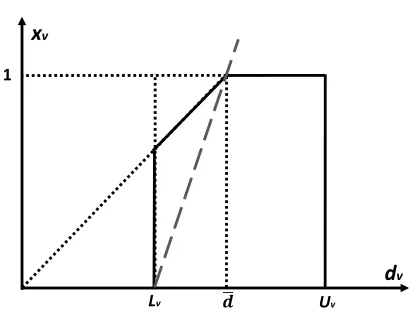
Figure 3: Geometric view of (19) (dashed line) vs. (52) (dotted line starting from the origin)
Note that if Lv = 0 holds for any v ∈ V, (19) becomes equivalent to (52). The effect of
these strengthened inequalities can be seen in Figure 3 with respect to original constraints
(52), when Lv > 0. The proof of this proposition is straightforward and is hence omitted
here. The following notation is used frequently in the rest of this section.
Definition 2.1 The cumulative demand from column ` to column r is given by: Dk i,`,r,v =
Pr
j=`D k ijv.
Proposition 2.2 For allk ∈K, i∈I, j ∈J, the inequality
zk−z¯ijk ≤ X
(`,r)∈L
`≥jW
r≤j
min{M ,¯ min
v∈V
Uv
Dk
i,`+1,r−1,v
}yki(`,r) (20)
Proof. First of all, note that due to constraint (2), we have:
X
(`,r)∈L
`≥jW
r≤j
yik(`,r)= 1− X
(`,r)∈L
`<j<r
yik(`,r), ∀k∈K, i∈I, j ∈J.
If, for any given (`, r) ∈ L such that ` ≥ j or r ≤ j, yk
i(`,r) = 1, then ¯z
k
ij = 0, and zk ≤ Uv
Dk
i,`+1,r−1,v
has to be satisfied due to (51). On the other hand, if for any given (`, r)∈ Lsuch
that ` < j < r, yik(`,r) = 1, then ¯zijk =zk. Therefore, (20) is valid. As min{M ,¯ Uv
Dk
i,`+1,r−1,v
} ≤
¯
M, (20) dominates (57). 2
Corollary 2.1 For all k ∈K, i∈I, j ∈J, the inequality
¯
zijk ≤ X
(`,r)∈L
`<j<r
min{M ,¯ min
v∈V
Uv
Dk
i,`+1,r−1,v
}yik(`,r) (21)
is valid for the VMAT problem and dominates (55).
The corollary can be proven similar to Proposition 2.2 and hence we omit the proof.
Proposition 2.3 The following are valid inequalities for the VMAT problem:
(a) For i∈I, j, j0 ∈J, k ∈K:
¯
zijk −z¯ijk0 ≤
X
(`,r)∈Ls.t. (`<j<r) V
(j0≥rW
j0≤`)
min{M ,¯ min
v∈V
Uv
Dk
i,`+1,r−1,v
}yki(`,r) (22)
(b) For i, i0 ∈I, j, j0 ∈J, k ∈K:
¯
zijk −z¯ik0j0 ≥
X
(`,r)∈L
`<j<r
min{M ,¯ min
v∈V
Uv
Dk
i,`+1,r−1,v
}yki(`,r)
−M¯ (23)
The proof of the second inequality is similar to the proof presented on p.82 of [33] and
hence omitted here. The proof of the first inequality is straight forward due to the fact
that ¯zijk ≤ min{M ,¯ minv∈V Dk Uv i,`+1,r−1,v
} and hence omitted here. Note that the first set of
We conclude this section with a remark: we run preliminary computational tests to see
if and how the inequalities discussed in this section would make a difference. We tested
the strengths of the inequalities (19)- (23) individually added to the LP relaxation of the
original formulation, as well as the effect of adding all these inequalities together. These
results indicated that constraints (19) provide by far the most significant improvement to
the LP relaxation bound. The improvements made by (21) and (22) were observed to be
mild, and ones made by constraint (20) and (23) were very insignificant. Therefore, we
simply replaced (52) with (19) and will use this formulation in the remainder of the paper
for all the methods that are based on MIP.
3.
Assumptions and Polyhedral Analysis
In this section, we study the polyhedral structure of the MIP. First, we list our assumptions
for the model that ensure the model to be both realistic and also non-trivial for the studied
cases:
• P
k∈K,i∈I,j∈JM D¯ k
ijv ≥ Uv, ∀v ∈ V. Otherwise, we can set Uv =
P
k∈K,i∈I,j∈JM D¯ k ijv.
Note also that from the practical point of view (with realistic number of control points
and size of MLC discretization matrix) P
k∈K,i∈I,j∈JM D¯ k
ijv >> Uv.
• d¯≤ Uv, ∀v ∈ Vt. Otherwise, xv = 0 and the variable can be eliminated from the
problem. To keep problem instances more interesting, we further assume ¯d < Uv.
• Lv < d¯, ∀v ∈ Vt. Otherwise, with the current objective function, xv = 1 will hold in
any feasible solution.
• Lv >0 and Dijvk >0, ∀k∈K, i ∈I, j ∈J.
Note that the last assumption is only necessary for the following discussion, in order to ensure
that the studied polytopes are non-trivial (e.g., when Dk
ijv = 0, one can simply eliminate
this bixel (i, j) from the problem; on the other hand, havingLv = 0 would allow the trivial
solution of “origin”).
Next, we will look at subproblems that can be analytically studied but can also be
extended to other crucial subproblems and hence provide important insight. We use the
points, and v voxels. We also note that we will omit any indices that have only a single
element for the sake of easier readability.
3.1
A Study of the
P
1×n×|K|×1Polytope
Using our notation, P1×n×|K|×1 represents the convex hull of the model with a single row, n columns, |K| control points, and a single voxel. In the following discussion, the indices
for rows and voxels will be omitted. For MLCs that allows interdigitation, the interleaf
constraints can be removed, resulting in single row subproblems. From an analytical point
of view, a model with a single voxel captures the basic settings for the optimization problem,
where one is to make decisions on MLC apertures and fluence weights for each control point.
Hence, our polyhedral study of the P1×n×|K|×1 polytope will provide us with insights on inequalities that are promising for the general model with multiple voxels. The notation
Dk `,r =
Pr
j=`D k
j for k ∈ K will be used throughout this section. Also, note that |L| =
(n+1)(n+2)
2 . In what follows, for simplicity, we use L to representLv, as there is only a single voxel.
Proposition 3.1 dim(P1×n×|K|×1) =|K||L|+n|K|+ 1, when M D¯ k1,n ≥L for each control
point k ∈K, and |K| ≥4.
Proof. First, note that there are |K||L|+n|K|+|K|+ 1 variables (the y/¯z/z/x variables,
respectively) and |K| equations, hence dim(P1×n×|K|×1) ≤ |K||L|+n|K|+ 1. In order to show dim(P1×n×|K|×1)≥ |K||L|+n|K|+ 1, we list the following |K||L|+n|K|+ 2 affinely
independent points, where > 0 is a sufficiently small number and ∃¯k,kˆ ∈ K with ¯k 6= ˆk.
We choose an arbitrary τ ∈ {0, . . . , n}. We have the following three cases.
Case 1 We have altogether|K|+2 points with: yk
(τ,τ+1) = 1, for allk ∈K\{kˆ}; andy ˆ
k
(0,n+1) = 1;
Case 1a 1 solution with: zkˆ = ¯zˆk j0 = L
Dˆk (1,n)
, for all j0 = 1, . . . , n; and 0 otherwise;
Case 1b 1 solution with: zkˆ = ¯zˆk j0 = U
Dˆk (1,n)
, for all j0 = 1, . . . , n; x= 1, and 0 otherwise;
Case 1c 1 solution with: zkˆ = ¯zˆk
j0 = L+
Dˆk (1,n)
, for all j0 = 1, . . . , n and 0 otherwise;
Case 1d |K| − 1 solutions, one for each k ∈ K \ {ˆk}, with: zˆk = ¯zjˆk0 = L
Dkˆ (1,n)
, for all
Case 2 There are |K|(|L| −1) points, one for each k ∈K and for each (`, r)∈ Lk
Lk =
L \ {(0, n+ 1)} if k= ˆk; and
L \ {(τ, τ + 1)} otherwise,
y(k`,r) = 1 holds for (`, r)∈ Lk; yk
0
(τ,τ+1) = 1, for allk
0 ∈K \ {k, β}, for β = ¯k if k = ˆk,
otherwiseβ = ˆk;y(0β,n+1) = 1, ¯zjβ0 = L
Dβ(1,n), for allj
0 = 1, . . . , n;zβ = L
Dβ(1,n), whereβ = ¯k
if k = ˆk, otherwise β = ˆk; and all other variables equal zero.
Case 3 We have n|K| points, one for each k ∈K and each j = 1, . . . , n, given as: yk
(j−1,j+1) = 1, z
k= ¯zk j =
L nDk
j
; yβ(0,n+1) = 1, for β = ¯k if k = ˆk, and β = ˆk otherwise; yk0
(τ,τ+1) = 1, for all k
0 ∈K \ {k, β} for β = ¯k if k = ˆk, and β = ˆk otherwise;
¯ zjβ0 =
(n−1)L
nD(1β,n), for all j
0 = 1, . . . , n; zβ = (n−1)L
nDβ(1,n), forβ = ¯k ifk = ˆk, andβ = ˆk otherwise,
and all other variables equal zero.
For k = ¯k, as we have ¯zk¯
j > 0, the only way to obtain this is through some linear
combination of other vectors with ¯z¯k
j >0. However, the only vectors with ¯z
¯
k
j >0 have
yˆk
(0,n+1) = 0, which will not give us y ˆ
k
(0,n+1) = 1 as needed. Hence these vectors are affinely independent to all of the previously introduced vectors. A similar justification
can also be made for the case ofk = ˆk. 2
Proposition 3.2 The following are the trivial facets ofP1×n×|K|×1, under the condition that
|K| ≥4 and other necessary conditions as indicated next to the constraints:
(a) x≥0;
(b) x≤1 when M D¯ k
(1,n)>d¯, ∀k∈K and d < U¯ ;
(c) y(k`,r) ≥0, for allk ∈K, and all (`, r)∈ L; (d) z¯k
j ≥0, for all k ∈K and all j ∈ {1, . . . , n};
(e) z¯jk ≤zk, for all k ∈K and all j ∈ {1, . . . , n}.
The proof for Proposition 3.2 is provided in the appendices for the sake of readability.
Next, we present key results regarding the inequalities presented in Section 2.3.
Proposition 3.3 The following are non-trivial facets of P1×n×|K|×1:
(b) zk−z¯k j ≤
X
(`,r)∈L
`≥jW
r≤j
min{M ,¯ Uv Dk
`+1,r−1
}y(k`,r).
Proof.
(a) As we need to satisfy that dv =Lv when xv = 0, and dv = ¯dwhen x= 1, we can reuse
the vectors presented in the proof of Proposition 3.1 with the following modifications:
We remove the vector presented in Case 1(c), and in Case 1(b), we replace U by ¯d.
(b) We use again the vectors presented in the proof of Proposition 3.1 as a starting point.
First, note that we need to construct vectors that satisfy:
zk−z¯jk = X
(`,r)∈L
`≥jW
r≤j
min{M ,¯ U Dk
`+1,r−1
}yki(`,r). (24)
Most of the vectors presented in Proposition 3.1 satisfies (24), unless noted in the list
of modifications presented below. Equation (24) is satisfied under three cases, which
we call as Case (α), Case (β), and Case (γ).
Case (α): We have yk
(`,r) = 1, for ` < j < r, in which case the right hand side of (24) equals zero. This means that either we have zk = ¯zk
j = 0 (which appear in Case 2 of
the proof of Proposition 3.1); or zk = ¯zkj =λ, for λ 6= 0, (which only happens in Case
3 of Proposition 3.1 withykj−1,j+1 = 1, and we have zk= ¯zjk = nDLk j
).
Case (β): We have yk
(`,r) = 1, for j ≤ ` or j ≥r, and r =`+ 1. In this case, ¯z
k j = 0,
and the right hand side also equals zero. In all but one case presented in the proof of
Proposition 3.1 that concern such yk
(`,r), we have z
k = ¯zk
j = 0. The only vector with
suchy(k`,r) and withzk6= ¯zjk appears in Case (1d) of the proof, where (`, r) = (τ, τ+ 1), zk 6= 0, but ¯zjk= 0. We simply remove this vector.
Case (γ): We have yk
(`,r) = 1, for j ≤ ` or j ≥ r, and r > `+ 1. Again, ¯z
k
j = 0. In
the proof of Proposition 3.1, these cases appeared twice, once in Case 2, and once in
Case 3 in the proof of Proposition 3.1. The vectors all have ¯zk
j = 0. We simply change
the value ofzk from their original value assigned in the respective cases in the proof of
Proposition 3.1 to zk = min{M ,¯ DkU `+1,r−1
}. 2
3.2
The Special Case of
P
1×n×1×1We now present our results on a number of non-trivial facet-defining constraints for the
unlikely to be an insightful subproblem for VMAT, but it is more insightful for IMRT, and
is therefore included in the paper for the sake of completeness. In the following discussion,
the indices for rows, control points and voxels will be omitted. For ensuring feasibility, we
simply exclude closed leaf positions from the following discussion, i.e.,L:=L\{(j, j+ 1)|j =
0, . . . , n}. Let D`,r =
Pr
j=`Dj. Note that the results presented in the previous section are
still valid and hence not repeated here.
Proposition 3.4 The inequality
z−z¯j ≥
X
(`,r)∈L
`≥jW
r≤j
L D`+1,r−1
y`,r (25)
is valid for P1×n×1×1 and dominates (56). Moreover, it is facet-defining for P1×n×1×1 under
the general condition of M D¯ j00 > L, ∀j 00
∈J.
The following proposition concerns constraints that involve two columns, any arbitrary
dis-tinct columns).
Proposition 3.5 The 2-column inequalities for P1×n×1×1:
1. The 2-column inequality with j <bj,
¯
zj+ ¯zbj −z ≤
X
(`,r)∈L
`<jV b
j<r
min{M ,¯ U D`+1,r−1
}y`,r
− X
(`,r)∈L
`≥bjW
r≤jW
(`≥jV
r≤bj) L D`+1,r−1
y`,r (26)
is valid for P1×n×1×1, and is facet-defining under the general condition M D¯ j00 > L,
∀j00 ∈J.
2. The 2-column inequality with j <bj,
¯
zj+ ¯zbj −z ≥
X
(`,r)∈L
`<jV b
j<r
L D`+1,r−1
y`,r
− X
(`,r)∈L
`≥bjW
r≤jW
(`≥jV
r≤bj)
min{M ,¯ U D`+1,r−1
}y`,r (27)
is valid for P1×n×1×1, and is facet-defining under the conditions that M D¯ j00 > L,
4.
Solution Methodologies
In this section, we introduce four heuristic solution methods. We first discuss three natural
ways to obtain Lagrangian relaxations to the original MIP. We then explain why only two
of them are implemented in Sections 4.2 and 4.3. The third heuristic is based on a different
MIP-formulation of the model, and the last heuristic is based on the metaheuristic idea
of Variable Neighborhood Search, where we derive some problem-specific features to guide
the search. We note that customized exact methods for our MIP model are studied in a
companion paper [4].
4.1
Lagrangian Relaxation (LR) for Upper Bounds
Here, we consider three variants:
1. Relax constraints (3),(4), (50)-(51), (55)-(58): As proven by Proposition 4.1, the subproblem is guaranteed to be solved in polynomial time.
2. Relax constraints (5)-(52): This creates K separate subproblems, one for each control point k (each subproblem being an IP problem).
3. Relax constraints (55) and (57): This relaxation generates two subproblems, one for y variables and one for z and xvariables.
Let LRi indicate the Lagrangian Relaxation and LDi be the optimal solution of the
Lagrangian dual for i= 1,2,3, i.e.,
LDi = min
u x,y,z,max¯zLRi(u, x, y, z,z¯),
where u is the vector of Lagrangian multipliers.
Proposition 4.1 LD1 = max{(1)|(2)−(52),(55)−(58),0≤x≤1|Vt|,0≤y≤1|I|×|L|}. In words, optimizing the Lagrangian dual for the first relaxation will generate a bound equal
to LP relaxation of the original problem.
Proof. For this subproblem, consider the following network: For each i∈I, draw a network
withK+ 2 levels as follows: Level 0 has a single, dummy source node with supply of 1, level
K+ 1 has a single dummy sink node with demand 1, and each of the otherK levels have L
draw arcs to all L nodes in level 1. From level 1, draw arcs to level 2 in the way that MLC
shape (`, r) in level 1 can be changed to (`0, r0) in level 2. Repeat this for all levels until level
K is reached. Then, connect all the nodes in that level to the dummy sink node. It is easy to
observe that solving a shortest path problem through this network, where arc costs will be
de-fined as a combination of original objective function coefficients and Lagrangian multipliers,
will generate integral solutions toyvariables that satisfy the constraints (2),(5),(6). Finally,
note that constraints (52) are independent from previous constraints and there is only a single
binary variable on each constraint related to linear variables; therefore all extreme point
solu-tions will be integral. Therefore, conv({(x, y, z)|(2),(5),(6),(48),(49),(52), x∈ {0,1}Vt, y ∈
{0,1}|I|×|L|}) = conv({(x, y, z)|(2),(5),(6),(48),(49),(52),0≤x≤1Vt,0≤y≤1|I|×|L|}). 2
Since the Lagrangian dual for this relaxation does not provide a bound better than the
LP relaxation bound of the original problem, we do not investigate this further. However,
we make this technical comment for the sake of completeness.
Corollary 4.1 LD3 ≤LD1.
On the other hand, forLD2 and LD3, the subproblems do not in general produce naturally integer solutions, hence the Lagrangian dual bounds they generate will be at least as strong
as (or probably lower than) the LP relaxation bounds. Although, this may involve more
computational effort. As we will see in numerical results, LR2 is computationally cheap, whereasLR3 requires significant effort.
4.2
LR-Based Heuristic I
Our first heuristic is based on the control point independence feature of LR2. We relax machinery constraints that link the adjacent control points, i.e., (5)- (52), and are thus able
to solve each control point subproblem independently. Instead of penalizing all the violated
constraints in the objective function like the usual LR methods do, we penalize only the dose
violations (i.e., (50)-(51)), but “fix” the neighboring control point machinery constraints
((5), (6)) as follows. Once a single-control point subproblem is solved and its MLC shape
is determined, i.e., y-variables are fixed, we can impose the machinery constraints for the
neighboring control points. This is done iteratively until all MLC shapes for all control points
are obtained. Then, the problem reduces to a simple IP without machinery constraints (it
would have been simply an LP if constraint (52) was not included). Algorithm 1 provides
Algorithm 1 A heuristic that exploits control points consecutively, generating |K| candidate solutions.
1: fork∈K do
2: Solve the problem P1: min{P
v∈Vt(Lv−dv)
++P
v∈V(dv−Uv)+|(y, z,z¯)∈Xrel}
3: where Xrel={(2)−(4),(53),(55)−(58)}, for onlyk;
4: Solutions are fixed y-variables =⇒ MLC-shape for control pointk;
5: for k0=k+ 1. . .|K|and k0 =k−1. . .1do
6: Solve the problem P1’: min{P
v∈Vt(Lv−dv)
++P
v∈V(dv−Uv)+|(y, z,z¯)∈Xrel0 }
7: whereXrel0 ={(2)−(49),(53),(55)−(58)}, for only k0;
8: Fix shapes for k0;
9: end for
10: Now all shapes fixed, solve the original problem;
11: end for
When we minimize the objective function in the inner loop, we involve all control
points that are fixed so far, in addition to k0, in order to minimize the error function
P
v∈Vt(Lv −dv)
+ +P
v∈V(dv −Uv)+ more accurately and to obtain more involved fixing
decisions. Also note that one can replace this objective function with a discrete function
that counts infeasibilities, i.e., minP
v∈Vtw −
v +
P
v∈V w
+
v such that w
−
v, wv+ ∈ {0,1} and
Lvw−v ≥Lv−dv; ( ¯MPk∈K
P
i∈I
P
j∈JD K
ijv)w+v ≥dv−Uv. This will simply provide an equal
weight for each voxel to satisfy their dosage lower and upper bound constraints; rather than
the “error”. We believe that in theory, such a counting objective is appropriate, at least
mathematically, and is based on a similar logic like the objective function of our problem.
However, in a number of preliminary tests we ran, we have observed that this discrete
count-ing function does not behave well computationally possibly due to symmetry, and therefore
we use the original error function in the final algorithm.
In the current implementation, once the problem P1 is solved for k, first the forward
(i.e., for k0 = k + 1 to k0 = |K|) and then the backward (i.e., for k0 = k −1 to k0 = 1)
subproblems are solved. Forward and backward subproblems can be solved separately in
parallel at the same time if needed for a faster result, although we consider in this paper
the sequential time for fair comparison purposes and leave parallelization to future research.
We also note that one can apply different running orders of subproblems in the inner loop to
obtain different solutions, e.g., in the alternating order (i.e., k0 =k+ 1, k0 =k−1, . . . , k0 =
K, k0 = 1) or in a randomized order (i.e., pick with probability p forward or probability
1−p backward subproblem). We ran some limited experiments on this aspect and did not
observe any significant difference. Hence we implemented the simple sequential order in this
computational performance of Algorithm 1 (in particular how often feasible solutions can be
found, solution qualities, and computation times) will be discussed in Section 5.
4.3
LR-Based Heuristic II
Our second LR-based heuristic is a combination of subgradient optimization and an
IP-heuristic, applied in an iterative fashion to the third Lagrangian relaxation (LR3). If we relax constraints (55) and (57) and assign multipliers αk
ij and βijk respectively to these two
sets of constraints, we obtain two separate subproblems as follows:
(P r.1) : max
x,z,¯z
X
v∈Vt xv +
X
k∈K
X
i∈I
X
j∈J
(βijk −αkij)¯zijk −βijkzk
s.t. (48)−(53),(56),(58); and
(P r.2) : max
y
X
k∈K
X
i∈I
X
j∈J
¯
M(αkij−βijk) X
(`,r)∈L
`<j<r
yik(`,r)
s.t. (2)−(6).
Once these independent subproblems are solved individually, we perform subgradient
optimization by updating the multipliers using a stepsize θ described as follows:
αkij ←αijk +θ
¯
zkij−M¯ X
(`,r)∈L
`<j<r
yik(`,r)
, and
βijk ←βijk +θ
( ¯M(−1 + X
(`,r)∈L
`<j<r
yik(`,r)) +zk)−z¯kij
.
Every time the multipliers are updated, the solution to (Pr.2) is used to fix ally-variables
and then a simplified version of the original problem is optimized to obtain a heuristic
solution. This algorithm then iterates back to solving the two subproblems with the new
multipliers. The computational performance (in particular how often feasible solutions can
be found, solution qualities, and computation times) will be discussed in Section 5.
4.4
A Centering-Based Heuristic
The challenge with the original formulation is the vast number of the y variables, as these
“center” of an opening in a row lies, then one could simply definen binary variables for this
row instead of n2 binary variables (hence a significant reduction of problem dimension and computational complexity), where these binary variables either indicate the left-leaf position
(if column position is smaller than center) or the right-leaf position (if column position is
bigger than center). In a heuristic fashion, one can extend this idea to the “center of an
opening” for a given control point, i.e., a column being chosen as the center column for all
rows (rather than defining a center column for each row). Such a intuitive approach has the
potential that one can solve this (probably easy) problem iteratively multiple times, e.g., by
using different centering schemes. The pseudocode for the proposed heuristic is presented in
Algorithm 2.
First, we define our notation and reformulate the problem for control point k. Let y` ij
(yijr) be binary variables for row i and column j, where yij` = 1 (yrij = 1) holds when the
left (right) leaf position is on column j. Let ˆck represent the predefined center column for
this control point k, i.e., it is taken as center column for all rows, and ˆ`i (ˆri) indicate the
processed control point). The reformulation is then as follows:
ˆ
ck
X
j=0
yij` = 1 ∀i∈I (28)
n+1
X
j=ˆck+1
yijr = 1 ∀i∈I (29)
dv =
X
i∈I
X
j∈J
¯
zijk ×Dkijv ∀v ∈V (30)
¯ zijk ≤M¯
j−1
X
j0=0
yij`0 ∀i∈I, ∀j ∈[1,ˆck] (31)
¯ zijk ≤M¯
n+1
X
j0=j+1
yijr0 ∀i∈I, ∀j ∈[ˆck+ 1, n] (32)
¯
zijk ≤zk ∀k ∈K, ∀i∈I, ∀j ∈J (33)
¯
zijk ≥M¯ −1 +
j−1
X
j0=0
yij`0
!
+zk
∀i∈I, ∀j ∈[1,ˆck] (34)
¯
zijk ≥M¯ −1 +
n+1
X
j0=j+1
yrij0
!
+zk
∀i∈I, ∀j ∈[ˆck+ 1, n] (35)
¯
zijk ≥0 ∀i∈I, ∀j ∈J (36)
y`ij = 0 ∀i∈I, ∀j ∈J0\{`ˆi−δ,`ˆi+δ} (37)
yrij = 0 ∀i∈I, ∀j ∈J0\{ˆri−δ,rˆi+δ} (38)
One important aspect that needs further elaboration is the selection of ˆck for each control
point k. We propose the following intuitive possibilities:
ˆ ck1 =
X
v∈Vt Lv
X
i∈I
X
j∈J
(j−0.5)Dkijv
X
i∈I
X
j∈J
Dijvk
X
Algorithm 2A centering-based heuristic, generating |K|candidate solutions.
1: Pre-solve to obtain ˆck for each control point k∈K;
2: fork∈K do
3: Using ˆck, solve the problem: min{P
v∈Vt(Lv−dv)
++P
v∈V(dv−Uv)+|(y`, yr, z,z¯)∈Xref}
4: where Xref ={(28)−(36)}, for only Control pointk;
5: Fix shapes for k, set ˆ`i and ˆri values;
6: for k0=k+ 1. . .|K|and k0 =k−1. . .1do
7: Using ˆck0, solve the problem: min{P
v∈Vt(Lv −dv)
++P
v∈V(dv −Uv)+|(y`, yr, z,z¯) ∈ Xref0 }
8: whereXref0 ={(28)−(38)}, for only k0;
9: Fix shapes for k0, set ˆ`i and ˆri values;
10: end for
11: Now all shapes fixed, solve the original problem;
12: end for
ˆ ck2 =
X
v∈Vo
1 Uv
X
i∈I
X
j∈J
(j−0.5)(1/Dkijv)
X
i∈I
X
j∈J
(1/Dkijv)
X
v∈Vo
1 Uv
ˆ
ck3 =w1cˆk1 +w2ˆc
k
2
The value ˆck
1 emphasizes higher dose and lower Lv, and depends on only tumor voxel
parameters whereas the value ˆck
2 emphasizes lower dose and higher Uv, and depends only on
sensitive tissue parameters. ˆck
3 simply combines these two with weightsw1, w2. We observed minimal differences on some preliminary computational tests using different weights, hence
we use ˆck3 with w1 = 0.5 = w2 in the final algorithm.
The main advantage of this framework is not only a significant reduction in the number of
variables but also in the elimination of inter-leaf constraints. On the other hand, this method
has the disadvantage that it limits the candidate opening patterns for a control point to only
“centered” patterns (e.g., the pattern cannot be diagonally-shaped) and infeasibilities are
more probable. We will discuss these aspects in detail in Section 5. We also note that
this heuristic is related to the first LR-based heuristic, where single-control point-problems
are solved consecutively for each control point, after the MLC apertures for the previous
control points are fixed. The main difference here is that the subproblem is even further
significantly. We will compare computational results for both of these methods in the next
section.
Finally, we also note that one might use this approach in an exact fashion, where the
pa-rameters ˆck will need to be redefined as variables. This will require a sophisticated approach
using a specialized branch-and-bound and column generation scheme, which is investigated
thoroughly in a companion paper [4].
4.5
A Guided Variable Neighborhood Scheme (GVNS)
Our Guided Variable Neighborhood Scheme (GVNS) aims to tackle problems of large scale,
and therefore, feasibility is the primary objective; the first attempt is to obtain solutions
that satisfy all machinery and dose constraints. When such a feasible solution is found,
a pre-determined number of attempts to improve the original objective function will be
triggered. This is done by keeping track of the current best feasible solution with the highest
original objective value. If there are no improvements to the original objective value after
a predetermined number of dose and machinery-feasible solutions are found, we return the
current feasible solution with the best original objective value as an output.
The method randomly generates fluence weights and MLC shapes that satisfy the
ma-chinery constraints for each control point. We define two main neighborhoods:
• Nµ is the neighborhood of solutions obtained by modifying the fluence weights. This
is further divided into N+µ (increase MU by ∆µ) and N−µ (decrease MU by ∆µ).
• Ns is the neighborhood of solutions obtained by modifying the MLC shapes.
For the former, we further define N±µ1 ⊂ N
µ
±2 ⊂ · · · ⊂ N
µ
±V N Smax, i.e., N
µ
±i is the
neigh-borhood defined by having i MUs increased (or decreased) while satisfying the machinery
constraints. (In our experiments, we used ∆µ = 1). V N Smax denotes the maximum number
of MUs that are allowed to be changed, calculated as a fraction of |K|.
Similarly, we also have N1s ⊂ N2s ⊂ · · · ⊂ NV N Ss max, with Nps representing the random selection of p control points and modifying the associated MLC shapes by moving each leaf
by a random selection from the feasible moves of the leaves. Our preliminary experiments
indicated that the result of implementing two different shape change schemes (enlarge shape
and reduce shape) does not differ significantly from that of the random shape change. With
the former, while fixing violations in underdosed voxels, overdose is often induced in other
• Method 1 - Random Descent Local Search
In this method, the neighbour search alternates between MU change (Nµ) and shape
change (Ns). The method randomly selects a control point and modifies its MU or
shape.
• Method 2 - A Guided Search
This is done in a way that the neighborhood search is “guided” by the current
solu-tion to improve machinery constraint satisfacsolu-tion. LetoCN T be the number of voxels
overdosed and uCN T be the number of voxels under-dosed. Then:
– if oCN ToCN T−uCN T ≥0.1, we search the neighborhood of N−µ1to decrease the MU; – if uCN TuCN T−oCN T ≥0.1, we search the neighborhood of N+1µ to increase the MU; – otherwise we search NS to change the shape.
• Method 3 - A Variable Neighborhood Search
In this method, we also alternate between MU change and shape change. First, we
calculate V N Smax =dγ|K|e, for 0< γ <1 a user-determined value (we used γ = 0.3 in our experiments). Initially, we set size V N S = d|oCN T|V−uCN T| | ×(V N Smax −1)e. If there is no improvement to the objective value, we increase size V N S by 1, until
V N Smax is reached.
Method 3 is executed in two different ways. In Method 3a, shape change is carried
out when the iteration count is even with size V N S control points changed at a time,
and MU change is carried out otherwise. In Method 3b, in each iteration of the
neighborhood search, MU change and shape change are executed iteratively.
• Method 4 - A Guided Variable Neighborhood Search
Our preliminary results showed that Method 4 outperformed Methods 1–3, hence we
will describe only this method in details. The VNS and its variations have been
around for many years (for general literature overview, see [14, 21]). In our
problem-specific implementation, we modified the VNS by integrating the “guided search” idea
of Method 2.
We begin with a randomly generated machinery feasible solution with leaf positions
delivered to each voxel to find out the dose violations, and perform a search guided in
the manner of promoting dose satisfaction.
The objective function is given by vCN T = oCN T +uCN T. If vCN T > 0, the
GVNS will proceed to search for “neighboring” solutions by using one of the two
neighborhood search schemesNµandNs. Our method attempts to increase or decrease
MUs in the first instance. We also perform MLC shape change on a regular basis, or
if no consecutive-control point-feasible MU change is possible. Should there be no
machinery feasible leaf movements available, we modify our shape change procedure
by first selecting i control points randomly, select the left- and right-leaf positions for
the first row of the MLC of each of these i control points, and generate leaf positions
for subsequent rows that satisfy the inter-leaf constraints. It is possible that some
consecutive control point leaf restrictions are violated, and these violations are added
into the cost function. Once in a while, a new MLC-feasible solution will be generated
for all |K| control points, allowing random starts for the search. See Algorithm 3 for
the pseudocode. We note the key notation, as follows:
– ItCN T a counter for number of iterations the GVNS has been performed.
– ItM AX a predetermined maximum number of iterations to be performed.
– ItN EW a new machinery feasible solution is generated everyItN EW iterations.
– κ a counter for the number of occurrences when a feasible solution is found and it does not improve the current best original objective function value.
– κmax the maximum value forκ allowed in the GVNS (in our experiments, κmax= 5).
– ω(x0) the value of the original objective function given by solution x0.