CHALLENGES ON IMPLEMENTATION OF VISA PAYWAVE
TOWARDS PUBLIC IN MALAYSIA
CHONG XIN YING
This report submitted in fulfillment of the requirement for the degree of Bachelor of Technopreneurship
Faculty of Technology Management and Technopreneurship Universiti Teknikal Malaysia Melaka
16th JUNE 2017
Supervisor’s Name: Pn. Adilah Binti Mohd Din
i
SUPERVISOR’s APPROVAL
I / We hereby declare that have read this work in my / our this works is sufficient in term of scope and quality for the submission Bachelor of Technopreneurship
Signature : ……….
Name of Main Supervisor : ……….
Date : ………
Signature : ……….
Name of Panel Supervisor : ……….
ii
DECLARATION
I declare that this project is the result of my own research except as cited in the references. The research project has not been for any degree and is not concurrently submitted in candidature of any other degree.
Signature : ……….
Name : ………
iii
DEDICATION
iv
ACKNOWLEDGEMENT
I would like to voice my deepest gratitude to my supervisor, Madam Adilah Bt. Mohd Din for her support, advice, supervision and assist me throughout the completion of my final year project. A simple “thank you” is not enough for her to express my appreciation for her contribution to my project.
Besides, I would also like to express my thankful to all my lecturers and faculty staffs that had been assisting and teaching me in this four-year university life. Their supervision, comments and knowledge had significantly directly or indirectly contributed to my final year project.
Finally, I must say thank you to my fellow course mates, which also play a supporting role in sharing knowledge to my project as well as their suggestion. Also, I would like to thank my family member as they always mentally support me all the time until the end.
A lot of thanks would like to deliver to all of you throughout this journey of my life and because of the contribution and the guideline has made a success of my project.
v
ABSTRACT
This study aims to discover the challenges on implementation of Visa payWave towards public in Malaysia. Visa payWave is a new payment features that introduced by Visa Inc. and it allows user to make purchases by simply waving the card in front of the Point-of-Sale (POS) Terminal. Government of Malaysia with the cooperation of Bank Negara Malaysia (BNM) had announced that all Malaysian need to change the Automated Teller Machine (ATM) cards in Visa payWave from card issuers. Hence, people are forced to accept this Pay Wave technology. In this study, researcher identify and discuss the most variable that contribute to the challenges on Visa payWave and the level of intention of people to use this Visa payWave. Literature Review indicated that challenges such as perceived trust, perceived usefulness, perceived ease of use, perceived security and privacy, self-efficacy and perceived risk on implementation of Visa payWave towards public in Malaysia. A set of questionnaires was developed and distributed to 400 respondents. Pearson correlation coefficient analysis had tested whether the hypothesis’s relationship is significant or not, multiple linear regression examines that how the multiple independent variables are related to the dependent variable and demographic analysis study the level of intention of Malaysian to use the Visa payWave. Result showed all six hypotheses are confirmed and positive relationship to dependent variable at highly significant level. Perceived ease of use was the most variable that contributed to the implementation of Visa payWave. There were 89% of respondents were intent to use Visa payWave to make transaction. Finally, researcher had recommended to future researchers to extend the research time, greater the number of valid respondents, focus on one determinant, study the least influence in detail. For bank institutions, focus and concern to the least factor to implementation of Visa payWave.
Keywords – Visa payWave, perceived trust, perceived usefulness, perceived ease of
vi
ABSTRAK
Kajian ini bertujuan untuk menemui cabaran dalam pelaksanaan Visa
payWave terhadap orang ramai di Malaysia. Visa payWave ialah pembayaran baru
yang diperkenalkan oleh Visa Inc. dan ia membolehkan pengguna untuk membuat
pembelian dengan melambai kad di hadapan Point-of-Sale (POS) Terminal.
Kerajaan Malaysia bekerjasama dengan Bank Negara Malaysia (BNM) dan telah
mengumumkan bahawa semua warga Malaysia harus menukar ATM kad kepada
Visa payWave. Oleh itu, rakyat terpaksa menerima teknologi Pay Wave ini. Dalam
kajian ini, pengkaji membincangkan pembolehubah yang paling menyumbang
kepada cabaran pelaksanaan Visa payWave dan tahap niat orang menggunakan
Visa payWave. Kajian Literatur menunjukkan bahawa cabaran seperti amanah,
kegunaan, kemudahan penggunaan, keselamatan dan privasi, efikasi kendiri serta
risiko pada pelaksanaan Visa payWave di Malaysia. Soal selidik telah dibangunkan
dan diedarkan kepada 400 responden. Pearson analisis pekali telah diuji sama ada
hubungan hipotesis adalah penting atau tidak, regresi linear mengkaji bahawa
bagaimana pembolehubah bebas adalah berkaitan dengan pembolehubah bersandar
dan kajian analisis demografi mengakaji tahap niat Malaysia untuk menggunakan
Visa payWave. Keputusan menunjukkan semua hipotesis disahkan dan hubungan
positif kepada pembolehubah bergantung pada tahap yang sangat ketara.
Kemudahan penggunaan adalah berubah yang paling menyumbang kepada
pelaksanaan Visa payWave. Terdapat 89% daripada responden niat untuk
menggunakan Visa payWave membuat urus niaga. Akhir sekali, penyelidik telah
mengesyorkan kepada pengkaji akan datang untuk melanjutkan masa penyelidikan,
memberi tumpuan kepada satu penentu, mengkaji pengaruh kurangnya secara
terperinci. Bagi institusi bank, fokus dan kebimbangan kepada pengaruh kurangnya
untuk pelaksanaan Visa payWave.
Kata kunci - Visa payWave, amanah, kegunaan, kemudahan penggunaan,
TABLE OF CONTENTS
CHAPTER CONTENTS PAGE
APPROVAL i
DECLARATION ii
DEDICATION iii
ACKNOWLEDGEMENT iv
ABSTRACT v
ABSTRAK vi
LIST OF TABLES vii
LIST OF FIGURES viii
LIST OF EQUATIONS ix
LIST OF APPENDICES x
CHAPTER 1 INTRODUCTION
1.1 Introduction 1
1.2 Background 2
1.2.1 Overview of Pay Wave Technology 2 1.2.2 Overview of Near Field Communication-
Aided Mobile Credit Card 3 1.2.3 Overview of Payment System in Malaysia 4
1.3 Problem Statement 10
1.5 Research Objective 12 1.6 Scope and Limitation of Study 12
1.7 Significant of Study 13
1.8 Summary 14
CHAPTER 2 LITERATURE REVIEW
2.1 Introduction 15
2.2 Theory Supply Chain Management (SCM) 15
2.3 Concept of Critical Mass 17
2.4 Technology Acceptance Model (TAM) 18 2.5 Unified Theory of Acceptance and Use of Technology
(UTAUT) and UTAUT2 19
2.6 Challenges 20
2.6.1 Perceived Trust (PT) 20 2.6.2 Perceived Usefulness (PU) 21 2.6.3 Perceived Ease of Use (PEU) 22 2.6.4 Perceived Security and Privacy (PSP) 23
2.6.5 Self-efficacy (SE) 24
2.6.6 Perceived Risk (PR) 25
2.7 Theoretical Framework 33
2.8 Hypothesis 35
2.9 Summary 36
CHAPTER 3 RESEARCH METHODOLOGY
3.1 Introduction 37
3.2 Research Design 37
3.3.1 Quantitative Research 39
3.4 Data Collection 40
3.5 Research Population and Sample 41
3.5.1 Population 41
3.5.2 Sample 44
3.6 Time Horizon 47
3.7 Pilot Test 48
3.8 Reliability of the Research Instrument 48 3.9 Validity of the Research Instrument 49
3.9.1 External Validity 49
3.9.2 Internal Validity 50
3.9.3 Construct Validity 50
3.10 Research Method of Analysis 52 3.10.1 Multiple Regression Analysis 52 3.10.2 Demographic Analysis 53 3.10.3 Pearson’s Correlation Coefficient 55
3.11 Ethical Considerations 56
3.12 Summary 57
CHAPTER 4 DATA ANALYSIS AND DISCUSSION
4.1 Introduction 58
4.2 Pilot Test 59
4.2.1 Validity Test 59
4.2.2 Reliability Test 60
4.3 Respondent Rate 61
4.4 Demographic Analysis 62
4.4.1 Gender 62
4.4.3 Age 64
4.4.4 States of Residence 65
4.4.5 Employment Status 66
4.4.6 Listed Card Issuer 67
4.4.7 Intention of Visa payWave 68
4.5 Descriptive Analysis 69
4.5.1 Normality Test 72
4.6 Inferential Analysis 75
4.6.1 Pearson’s Product Moment Correlation
Coefficient (PPMC) 76
4.6.2 Multiple Regression Analysis 78
4.7 Summary 81
CHAPTER 5 CONCLUSION AND RECOMMENDATION
5.1 Introduction 82
5.2 Conclusion 82
5.2.1 Objective 1: To determine the challenges on implementation of Visa payWave towards
public in Malaysia 83
5.2.2 Objective 2: To study the intention of people in Malaysia to Use Visa payWave to make
purchase 86
5.2.3 Objective 3: To identify the most variable that contribute to the challenges on implementation of Visa payWave in
Malaysia 87
5.3 Recommendation 88
5.3.2 Bank Institutions 90
5.4 Summary 91
BIBLIOGRAPHY 92
REFERENCES 93
vii
LIST OF TABLES
TABLE TITLE PAGE
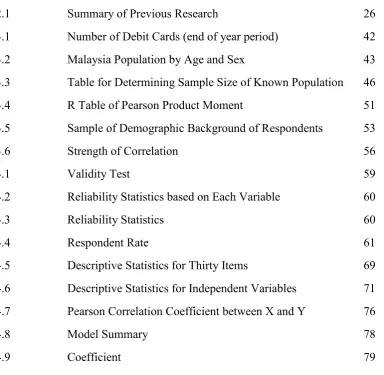
2.1 Summary of Previous Research 26
3.1 Number of Debit Cards (end of year period) 42
3.2 Malaysia Population by Age and Sex 43
3.3 Table for Determining Sample Size of Known Population 46
3.4 R Table of Pearson Product Moment 51
3.5 Sample of Demographic Background of Respondents 53
3.6 Strength of Correlation 56
4.1 Validity Test 59
4.2 Reliability Statistics based on Each Variable 60
4.3 Reliability Statistics 60
4.4 Respondent Rate 61
4.5 Descriptive Statistics for Thirty Items 69 4.6 Descriptive Statistics for Independent Variables 71 4.7 Pearson Correlation Coefficient between X and Y 76
4.8 Model Summary 78
[image:13.595.118.503.259.634.2]viii
LIST OF FIGURES
FIGURE TITLE PAGE
1.1 Overview of Payment System in Malaysia 5
2.1 A Simple Example of Supply Chain 16
2.2 Technology Acceptance Model (TAM) 18
2.3 Theoretical Framework Design 34
3.1 Negative, No and Positive Correlation 55
4.1 Gender 62
4.2 Race 63
4.3 Age 64
4.4 State of Residence 65
4.5 Employment Status 66
4.6 Listed Card Issuer 67
4.7 Intention of Visa payWave 68
ix
LIST OF EQUATIONS
EQUATION TITLE PAGE
3.1 Sample Size for Infinite Population
44
3.2 Required Sample Size 45
3.3 Multiple Regression Equation 52
x
LIST OF APPENDICES
APPENDIX TITLE PAGE
I Survey Questionnaire 98
II Gantt Chart for PSM 1 106
1
CHAPTER 1
INTRODUCTION
1.1Introduction
2 1.2 Background
The use of electronic media for making payments (e-payments) is a recent and remarkable phenomenon in most of the countries now. The growing usage of e-payments over the last few years foreshadows the replacement of cash, which is deemed is to be an inefficient and costly means of payment. This development is made by possible two main factors which are the availability of information and communication technology and the needs of consumers for more efficient and convenient payment instruments. The world had seen quantum leaps in the development of e-payments especially make payment with the Pay Wave.
1.2.1 Overview of Pay Wave Technology
Pay Wave refers to the technology which provides the contactless payment between the payWave card and the Point-of-Sale (POS) terminal (Raghav, 2015). Contactless payment system represents cashless payments that do not require physical contact between devices used in consumer payments (card, mobile, watch, and key rings) and POS terminals by merchant. These devices have embedded Radio Frequency Identification (RFID) and such payment devices support the three largest payment system card which are Visa (Visa Contactless), MasterCard (MasterCard PayPass) and American Express (ExpressPay). All these products are compliant with international ISO 14443 standards, which means that provides a unique system for payment globally.
3 merchant and bank). This technology uses Near Field Communication (NFC) which denotes wireless communication technology that operates at 13.56 MHz for all its data transfer and is very safe (Thomas et al., 2009).
ExxonMobile was one of the pioneers of contactless payments in the United States by having launched its SpeedPass product in 1997. Speedpass enabled ExxonMobile’s customers to pay at the pump with the wave of a key fob. SpeedPass also was piloted for use at other merchant locations such as McDonald’s. Today, more than 6 million active SpeedPass devices remain proprietary to ExxonMobile locations. On the other hand, in year 2003, American Express launched its ExpressPay “waveable” product and MasterCard introduced PayPass “tap and go” product. In the year 2004, Visa introduced VisaWave. Whether waved or tapped, all employ a standard and open technology that can be used for payment at any merchant and is able to accept it (The Philadelphia Inquirer, 2005).
1.2.2 Overview of Near Field Communication-Aided Mobile Credit Card
Near Field Communication (NFC) is a new and short-range wireless connectivity technology that leads to “touching paradigm” (Coskun et al, 2012) as well as need two NFC compatible devices, for instance NFC smart phone, NFC tags and NFC reader for information exchange and interaction to transfer data in more convenient way (Morosan & DeFranco, 2016). NFC-based mobile payment which Pay Wave can turn mobile device into e-wallet, and it had changed the traditional way of making payment by using cards (Tan et al., 2011). The emergence of this NFC-based mobile payment only requires users to simply wave their digital devices in front of the NFC reader (Xu & Liang, 2012).
4 their mobile device which is Nokia 6212 as a contactless card with existing payment services such as Touch’ N go, Visa payWave and other transit transaction (The Sun Daily, 2009). NFC-based mobile payment enables users to enjoy speedy transactions in a user-friendly way under a totally new and different shopping experience (Pal et al., 2015).
1.2.3 Overview of Payment System in Malaysia
Payment systems are a vital part of the financial infrastructure in a country. In Malaysia, the large value payment system, Real Time Electronics Transfer of Funds and Securities (RENTAS), which is operated by the Malaysian Electronic Clearing Corporation Sdn. Bhd. (MyClear), a payment subsidiary owned by Bank Negara Malaysia. This enables and enhances all the transfer and settlement of high-value interbank payments and securities. The efficient functioning of RENTAS allows transactions to be completed safely and in a timely manner contributing to overall economic performance. Safe and efficient payment systems are fundamental to promote financial stability, facilitating Bank Negara Malaysia in the conduct of its monetary policy by allowing greater use of market-based instruments to achieve its objectives while enhancing the efficiency of the financial system and the economy. Given its importance, the promotion of a secure, safe and efficient payment system is the main pillars and objectives of the Bank.
5 payment innovations and ensuring public confidence in the retail payment systems and the use of payment instruments. The Bank undertakes active consultation and cooperation with market players and stakeholders. Given the importance of e-payments in enhancing economic efficiency, accelerating the migration to electronic payments is one of the nine focus areas under the Financial Sector Blueprint 2011-2020 released by the Bank in Dec 2011.
[image:21.595.91.522.261.565.2](Source: www.bnm.gov.my)
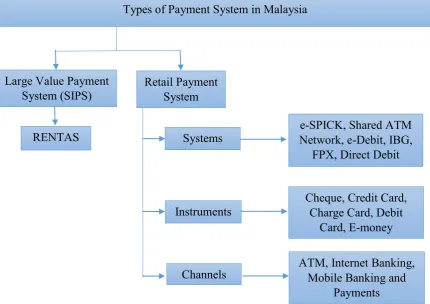
Figure 1.1: Overview of Payment System in Malaysia
Based on the Figure 1.1, Systematically Important Payment System or Large Value Payment System (LVPS) processes high-value and time-critical payments. It is a payment system that to ensure the smooth functioning of economy, financial system and markets, and its failure could trigger disruptions or transmit shocks within the economy and financial market.
Types of Payment System in Malaysia
Large Value Payment
System (SIPS) Retail Payment System
RENTAS
Channels Instruments
Systems
Cheque, Credit Card, Charge Card, Debit
Card, E-money
ATM, Internet Banking, Mobile Banking and
Payments e-SPICK, Shared ATM Network, e-Debit, IBG,
6 The objective of Real Time Electronics Transfer of Funds and Securities (RENTAS) is to improve the overall efficiency of the LVPS and reducing the interbank settlement risk. It enables the transfer and settlement of high value interbank funds and scripless securities transfer. There are two types of transactions in RENTAS which are Interbank Funds Transfer System (IFTS) and Scripless Securities Transfer System (SSTS). The following transactions are performed by RENTAS:
i. Scripless securities transfer ii. Interbank funds transfer
iii. Ringgit leg of foreign exchange iv. Cash withdrawal
v. Money market settlement vi. Statutory reserve adjustment
There are sixty-nine participants in RENTAS which includes banks, Islamic banks, investment banks, Development Financial Institutions and other institutions that are active players in the money market. There is no limit for the funds transfer between members but there is minimum transaction amount (set at RM 10,000) for third party payments (non-RENTAS member or beneficiary). This limit does not apply for payments to and from Bank Negara Malaysia and government agencies.
Generally, there are categorized into three groups in retail payment in Malaysia which are Retail Payment Systems, Retail Payment Instruments and Retail Payment Channels.
1) Types of Retail Payment Systems
i. National Electronic Cheque Information Clearing System (eSPICK) ii. Shared ATM Network
iii. Interbank GIRO iv. Direct Debit
v. Financial Process Exchange 2) Types of Retail Payment Instruments
7 iv. Debit Cards
v. E-money
3) Types of Retail Payment Channels i. Automated Teller Machine ii. Internet Banking
iii. Mobile Banking iv. Mobile Payment
National Electronic Cheque Information Clearing System (E-SPICK) implemented in 2008 to replace previous Sistem Penjelasan Imej Cek Kebangsaan (SPICK) cheque clearing system. The implementation of e-SPICK was fully rolled out nationwide and was part of bank’s effort in enhancing the efficiency of payment system. Banks in the banking industry have moved the cheque processing phase from sending cheques for clearing at the clearing centres into a fully image-based cheque clearing process.
Shared ATM Network (SAN) enables bank customers to access their funds from any of the participant banks’ Automated Teller Machine (ATM). There are two shared ATM networks which are MEPS SAN and HOUSe. MEPS SAN is operated by Malaysian Electronic Payment System Sdn Bhd (MEPS) which services offered includes cross-border cash withdrawal, interbank ATM funds transfer (IBTF), interbank mobile prepaid top-up and credit card and loan repayment. Whereas HOUSe is owned by four locally-incorporated foreign banks which are UOB Bank, Standard Chartered Bank, OCBC Bank, and HSBC Bank. Services offered includes cash withdrawal and balance enquiry.
8 For the part of retail payment instrument, there are include cheque, credit cards, charge cards, debit cards and e-money. Cheque is a paper based payment instrument and it is a form of written order directing a bank to pay money to the beneficial. The use of cheque has traditionally dominated Malaysian non-cash payments.
Credit card can let card holder to purchase goods and services with credit line given by credit card issuer and the amount will have settled at later. Card holder are billed on monthly and card holder need to alert the interest charges on the outstanding amount if payment is not made by the due date. Credit card also can be used for cash advances at Automated Teller Machines (ATMs). Examples of credit card brands are Visa and MasterCard. A tiered pricing structure for credit cards was implemented in July 2008 with the objectives to promote prudent financial management and inculcate good financial discipline among credit card users. The tiered pricing structure is based on the following tiers:
i. Tier 1 - Maximum of 15% per annum for those who promptly settle their minimum payment due for 12 consecutive months.
ii. Tier 2 - Maximum of 17% per annum for those who promptly settle their minimum payment amount due for at least 10 months in a 12-month cycle. iii. Tier 3 - Maximum of 18% per annum.
In 2011, bank had introduced new credit card guidelines to inculcate sound financial and debt management among credit card users. The new measures covers eligibility criteria, prudential requirements for non-bank issuers, risk management requirements, pricing and consumer protection.
The functionality of a charge card is similar to a credit card. However, charge card holders must settle their outstanding amount in full by the due date every month. Since charge cards are often associated with prestige, the fees are generally higher than credit cards. This is compensated by the differences in terms of benefits with charge cards generally offering more privileges.