1,40:it by
Ann Peut (B.A. Hans)
A
Submitted in fulfillment of the requirements for the degree of
Master of Arts (Sociology) University of Tasmania
November, 1982
List of tables & figures (i)
Signed statement (iv)
Acknowledgements (v)
Abstract (vi)
Chapter 1 INTRODUCTION 1
Ethnicity and Structures of
Inequality 1
Weber: Economic Class and Status
Group 3
The Objective-Subjective Distinction
in Stratification Analysis 6 Responses to the Secondary Status
of Ethnicity 15
Ethnicity as an Endogenous Factor
in Class Formation 21
Discussion of Thesis 24
2 SEGMENTED LABOUR MARKET THEORIES 27
Introduction 27
Segmentation by Race 33
Introduction 39
Employment Status 40
Industrial Concentration 43
Occupational Concentration 49
Conclusion 55
4 ETHNIC SEGMENTATION AND CLASS FORMATION 58
Ethnicity: Class Composition and Class
Formation 58
Ethnicity 67
Culture 69
Ethnicity as ajlass Generating Mechanism 71
The Supply of Labour 72
Allocation of Workers to Positions 76
Generation of Positions 82
Proposed Analytic Framework 85
5 THE VIETNAMESE IN HOBART 90
The Vietnamese Refugee Movement 90 Labour Market Position of Vietnamese in
Hobart 91
External Barriers: (i) Qualifications
and Skill 94
(ii) Language 97
Directing Factors: (i) Attitudes to
Family 102
(ii)Labour Market Structure 103 (iii)Job Seeking: Particularism and
Group Solidarity 105
Occupation and the Class Structure 111 Ethnicity in Class Formation , 113
Appendices
1 Employment of Males in Australia in Occupational
Groups by Birthplace, Census 1971, 1976 120
2 Occupational Distribution and Status.of Vietnamese
in Hobart - 1981 122
3 Previous Main Occupations and Qualifications of
Vietnamese in Hobart - 1981 123
4 Classification of Occupations into Skill Levels by
Dept. of Immigration and Ethnic Affairs 126
5 Classification of Vietnam Occupations into Skill
Levels 127
6 Assisted Vietnamese Refugees - Skill on Arrival in Australia and Queensland - 1975, 1976, 1979, - and
in Hobart, 1980-81: Age 15 years and over 128
7 Occupational Distribution in Vietnam and Hobart - 1981 129
TABLES AND FIGURES
TABLES
Table 3.1: Employment Status of Males in Australia
by Birthplace, Census 1947, 1976 41
Table 3.2: Industrial Employment of Males in Australia
by Birthplace, Census 1954, 1971 44
Table 3.3: Employment of Males in Tasmania in Selected
Industries by Birthplace, Census 1976 45
Table 3.4: Employment of Males in Tasmania in Selected
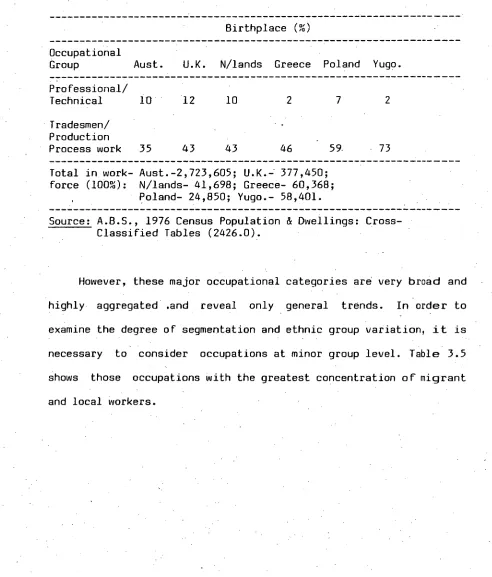
Occupational Groups by Birthplace, Census 1976 50
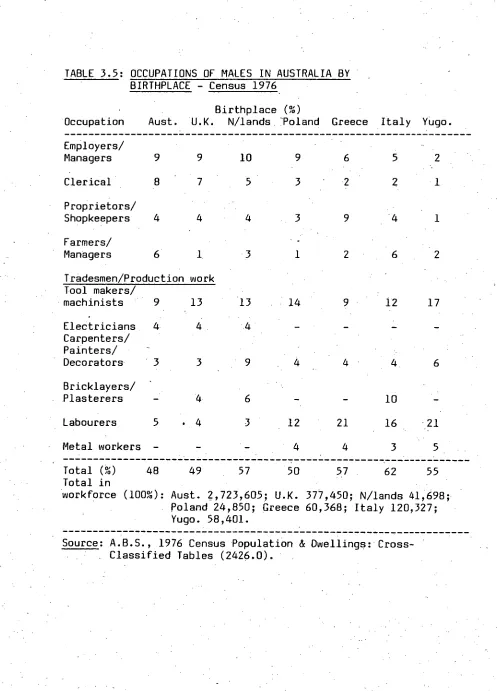
Table 3.5: Occupations of Males in Australia by Birthplace,
Census 1976 51
Table 3.6: Employment of Males in Tasmania in Selected
Occupational Groups by Birthplace, Census 1976 53
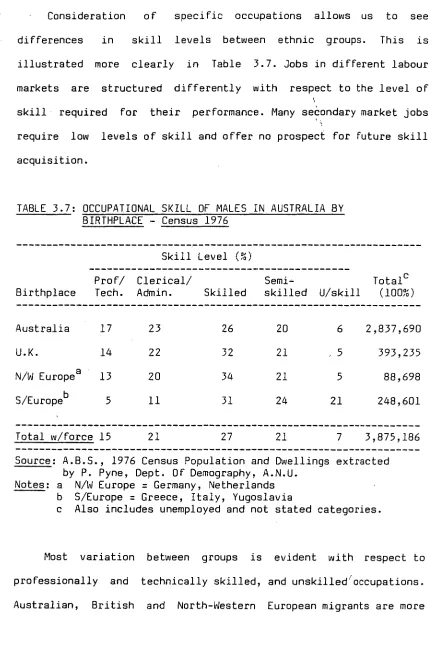
Table 3.7: Occupational Skill of Males in Australia by
Birthplace, Census 1976 54
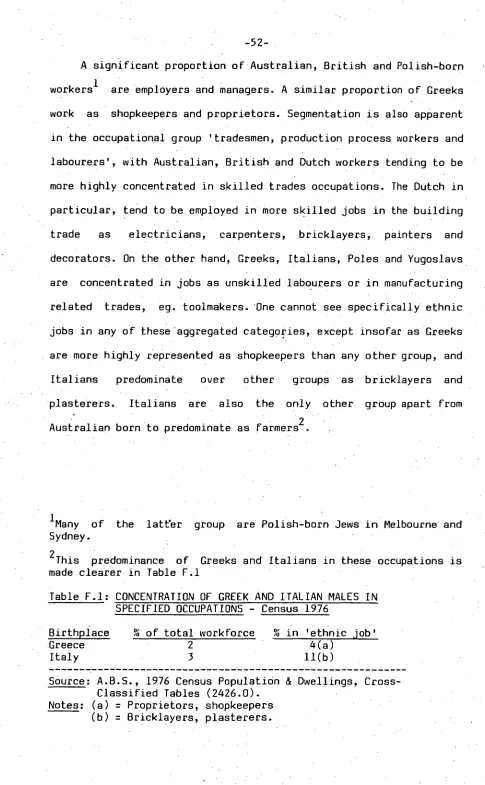
Table F.1: Concentration of Greek and Italian Males in
Table 4.1: Birthplace of Australian Population, Census
1901-1976 74
Table 5.1: Occupational Distribution of Vietnamese in
Hobart, 1981 92
Table 5.2: Job History of Vietnamese in Hobart who have
held more than one job 94
Table 5.3: Previous Main Occupation of Vietnamese in
Hobart, 1981 95
Table 5.4: Skill Level of Immigrants on Arrival in
Australia by Birthplace, 1976-81 96
Table 5.5: English Language Ability on Arrival, and Occupations of Vietnamese Labour Force in
Hobart - 1981 98
Table 5.6: Occupations in Vietnam and Employment in
Hobart of Vietnamese in Hobart - 1981 100
Table 5.7: Employment Status of Vietnamese in Hobart
by Age and Sex - 1981 101
Table 5.8: Method of Job Obtainment by Vietnamese in
Table A.1: Employment of Males in Australia in Occupational Groups by Birthplace,
Census 1971, 1976 120
Table A.2: Occupational Distribution and Status of
Vietnamese in Hobart - 1981 122
Table A.3: Previous Main Occupations and Qualifications
of Vietnamese in Hobart - 1981 123
Table A.4: Assisted Vietnamese Refugees - Skill on Arrival in Australia and Queensland (1975, 1976, 1979), and in Hobart (1980-81):
Age 15 yrs. and over 128
Table A.5: Occupational Distribution in Vietnam and
Hobart - 1981 129
FIGURES
This thesis contains no material which has been accepted for the
award of any other higher degree or graduate diploma in any
university. Further, to the best of my knowledge and belief, the
thesis contains no material previously published or written by
another person, except when due reference is made in the text of the
thesis.
ACKNOWLEDGEMENTS
In researching and writing this thesis, I am indebted firstly
to the staff and my fellow students in the Department of Sociology
at the University of Tasmania, who gave me every support and
assistance. In particular, I wish to thank those who supervised my
work at various stages, especially Dr. Jan Pakulski, Dr. Malcolm
Waters and Professor Rodney Crook. In addition Dr. Philip Eldridge
of the Dept. of Political Science was generous in his assistance.
The assistance and cooperation of various organisations is also
gratefully acknowledged. Among these are the Australian Bureau of
Statistics, the Department of Immigration and Ethnic Affairs, and
the Department of Social Security in Hobart, as well as the Centre
for the Study of Australian-Asian Relations at Griffith University,
and the Economic Affairs Research Services of the Victorian Chamber
of Manufactures. The thesis would not have been possible without the
generous cooperation of the Vietnamese settlers in Hobart and of
their various sponsors and.befrienders. My gratitude is due to them
for their help, and also to my relatives and friends, including the
staff and students at St. John Fisher College, for their
ABSTRACT
Theoretical analyses of social inequality often regard
ethnicity as a complicating factor, external to processes of class
structuration. This has frequently resulted from the attempt to
separately analyse various 'dimensions' of inequality, a tradition
deriving largely from Weber's distinction between economic classes
and status groups. Since ethnic groups are treated by sociologists
working within the Weberian tradition as a kind of status group,
they are viewed as a mode of group formation which competes with the
formation of classes as coherent social entities.
Ethnicity is viewed as a complicating factor precisely because
it is often significant in various structures of inequality. Its
importance in processes of labour market segmentation, which
produces jobs characterised by widely differing wages, conditions of
work and career paths, is supported by evidence of the concentration
of certain ethnic groups in specific occupations. The thesis argues
that these processes of segmentation affect class composition and
the internal structure of classes through the introduction of new
productive positions and the alteration of existing ones.
Consequently, ethnicity is empirically significant in some processes
forming the structure of class.
A suggested solution to this theoretical problem is the
integration of subjective and objective aspects of class. The view
consciousness is viewed not only as the product of objective social
location, but also as creating and changing objective structures.
This allows for the incorporation of ethnicity into explanatory
accounts, since ethnicity is referred to primarily with respect to
cultural attributes. This includes both the attitudes, norms and
values of ethnic group members, and assessments of ethnit groups by
others.
The thesis investigates the ways in which ethnicity has been
operative in historical processes whereby the labour force in
Australia has been supplied, especially in the post-war years. In
addition, the generation of new positions in the production process,
and the way in which workers have been allocated to them, have also
been processes in which ethnicity has been operative. These
considerations allow the development of a proposed analytical
framework which can be used to examine processes of class formation.
The way in which ethnic factors, interacting with various
structural mechanisms, are operative in the crucially important
stage of initial allocation of workers to positions, is illustrated
by an examination of the labour market experience of Vietnamese
migrants in Hobart. The study does not test the argument of the
thesis, but rather is concerned to illustrate the theoretical
position adopted. The limited evidence available in the study adds
weight to the concern to include ethnicity in accounts of processes
of class formation. Further research is required in order to more
fully test, modify and extend this argument, and proposals for this
CHAPTER 1: INTRODUCTION
Ethnicity and Structures of Inequality
In Australia, four out of ten workers employed in manufacturing
are migrants (Australia 1975 (I):2). In some industries, migrants
comprise 50% of the workforce. At the same time, the Jackson
Committee found that they faced more problems than native-born
Australians, and that these migrants on whom some parts of
manufacturing depended (mostly southern Europeans), were
disadvantaged and often exploited (Australia 1975 (I):87). This
situation is paralleled in many Western capitalist societies, where
migrants and/or ethnic minorities are often economically, (and at
times politically), disadvantaged.
This thesis examines the relationship between ethnicity and
structures of inequality, especially the class structure in the
industrialised capitalist societies. In spite of the significance of
political and economic divisions along ethnic lines in these
societies,
...there has been a tendency to analyse class relations within the context of an assumed cultural and ethnic homogeneity. As a result, there has been little if any attempt to incorporate within the framework of analysis those forms of internal cleavage that arise on the basis of religious, linguistic, racial and cultural differentiation.
(Parkin 1979: 31)
Lockwood (1970) claims that historically the concept of race or
generally. Not only were the founders of modern sociology not confronted with racial problems as a specific political issue, but they were also committed to precluding biological and other forms of non-social reductionism in their explanations. Consequently, sociological theory focused on universal, constitutive properties of societies in general, such that in stratification studies, ethnic and racial divisions in a population were treated as secondary factors complicating the analysis of social inequality'. Not only did ethnicity complicate the analysis of social inequality, but class theories came to regard ethnicity as an 'obstacle' to the
actual formation of classes as coherent entities (Giddens 1973: 111). Consequently ethnicity and class were treated as separate phenomena, and ethnicity viewed as an exogenous factor in the processes of social stratification.
Giddens (1973:112) suggests that this separation of class and ethnicity is explicitly built into Weber's separation of economic class and status group, where ethnic groups are treated as a kind of status group. Weber's distinction between class and status has frequently been interpreted as a separation between objective and subjective aspects of stratification. This misinterpretation gained wide acceptance among empirically oriented sociologists who maintained the separation and attempted to analyse the so-called
'dimensions' of stratification (eg. Runciman 1972). Since the root
of the separation of class and ethnicity is seen as located in the
differentiation between objective and subjective aspects of
stratification, it is in the integration of these dimensions that a
solution to our problem may be located.
Weber: Economic Class and Status Group
Weber (1976:184-185) viewed social inequality as a complex reality
and objected to
... that kind of pseudo-scientific operation with the concepts of 'class' and 'class interests' so frequently found these days, ... , that the individual may be in error concerning his interests but that the 'class' is
'infallible' about its interests.
For Weber (1976:181), classes are not communities and the link
between class and class consciousness is not direct and immediate.
Class is an objective reality that has an influence on the life
chances of men, and the factor that creates 'class' is
"unambiguously economic interest, and indeed only those interests
involved in the existence of the 'market' " (1976:183) 2.
His discussion of status groups on the other hand, emphasises
their communal nature, which although of an amorphous kind, requires
that people feel some sense of belonging to each other. Status
2
groups are established according to criteria of grouping other than those stemming from the market, criteria which enable status group members to make effective claims for social honour. Thus ethnic groups are regarded by Weber (1976:189) as a kind of status group.
While the distinction between classes and status groups may be portrayed in terms of the differentiation between objective and subjective aspects of inequality, this differentiation cannot be pushed too far. Weber insists that the distinction between a class in itself and a class for itself be maintained. Yet, he admits that the concept of 'class interest' is an ambiguous one.
The class situation and other circumstances remaining the same, the direction in which the individual worker, for instance, is likely to pursue his interests may vary widely, according to whether he is constitutionally qualified for the task at hand to a high, to an average, or to a low degree.
(Weber 1976:183)
Furthermore, Weber recognises that a "communal action" by those commonly affected by the class situation can emerge from that situation. The kind of communal action emerging may be amorphous and is dependent on certain conditions such as the general cultural conditions, the extent to which contrasts in life chances have evolved, and especially the "transparency of the connections between the causes and the consequences of the 'class situation'
"For however different life chances may be, this fact in itself, • according to all experience, by no means gives birth to 'class
However, since in Weber's (1976:183-184) terminology a "communal action" refers to that action which is oriented to the feeling of the actors that they belong together, it becomes obvious that he by no means restricts the notion of subjectivity to the concept of status groups. In 6,,ddition, Weber (1976:187) is very clearly aware that classes and status groups are closely related, primarily through property.
Class distinctions are linked in the most varied ways with status distinctions. Property as such is not always recognised as a status qualification, but in the long run it is, and with extraordinary regularity.
The Objective-Subjective Distinction in Stratification Analysis
It is possible to distinguish four different 'perspectives' in
stratification theory. These perspectives are distinguished by
reference to the differentiation between objective and subjective
aspects, but also vary according to the degree to which they aim to
be descriptive or explanatory. These differing perspectives have
developed as a result of ideological and theoretical divisions
primarily between Marxian and Weberian theorists of stratification.
In the following outline, these perspectives are presented in more
exaggerated form than they typically appear in the literature. While
there is no suggestion that one or more writers necessarily fits
neatly into one perspective, such exaggeration is useful in that it
enables us to see more clearly the roots of our problems.
(1) The first 'perspective' aims to identify empirically,
strata or classes in various societies, and to provide a 'map' of
the structure of inequality. The criteria used are typically
objective, such as occupational differentiation, inequalities in
income and differential access to formal education. An interest in
individual mobility frequently stimulates this theoretical concern
(Goldthorpe 1980). The stratification scheme that emerges in such
studies resembles a static graduated scale, in which more or less
arbitrary grading points represent the boundaries between strata
through which individuals move. Typical of these schemes is that of
Warner and his colleagues who claim to identify six classes in the
United States - Upper Upper, Lower Upper, Upper Middle, Lower
This perspective locates minority members among the various strata (usually based on occupational categories), and at times recognises that occupational segregation by ethnicity is a characteristic of industrial societies (see Broom & Jones 1976:40). However, in its concern to provide a comprehensive map of social inequality, this perspective separates various 'dimensions' of stratification, and regards them as different 'bases'. Consequently, there can be stratification by economic class, by age, by sex, or by ethnic origin. At the same time, writers recognise that these different bases are frequently connected, since any individual is located in each kind of stratum system. The separation of the dimensions of class and ethnicity, yet the recognition of their relatedness poses problems for this perspective, since each 'base' can prevent the identification of differently based strata. Broom & Jones (1976:116) claim, for example, that
...two cross-cutting factors may mask the existence of strata defined strictly in socio-economic terms: (1)immigration, which alters the meaning and acceptance of educational attainment and other social characteristics, interrupts (sometimes enhances) the flow of an occupational career, and results in a possible drop or increase in earnings compared with men who are similar in other respects; ... Ethnicity,... intersect(s) strictly socio-economic differences and mask(s) the clarity with which social strata can be distinguished.
(emphasis mine)
to explain the structure of inequality by referring to some 'deeper'
structural mechanisms rather than simpy describe it. The question
asked is not so much 'what does the structure of inequality look
like?', but rather 'how is this structure generated, why and how
does it continue over time, by what processes will the structure be
changed?'. The stress is placed not so much on the location of
people as on their activity in production and market exchange, and
classes are not seen so much as statistical categories, but rather
in relational terms.
This perspective recognises that ethnicity has implications for
class formation. At times, it is seen to promote class
structuration, as when class and ethnic cleavages coincide (Giddens
1973:112), and a specific class such as a sub-proletariat is formed.
But more frequently, it is thought that ethnicity cuts across
classes, fragmenting them and preventing the formation of classes as
coherent unities.
Furthermore, as Parkin notes, these internal class distinctions
based on ethnicity are not put on the same theoretical plane as
inter-class divisions. For example, inter-class relations are
usually conceived of as antagonistic and as an expression of certain
generic features of property rights, authority relations or the
division of labour. However, intra-class relations inspire a rather
more bland concern with "the niceties of social differentiation",
eg. variations in life style, and often appear to derive from
peculiarly national conditions rather than from universal systemic
These first two perspectives view inequality as an objective
structure which has an important influence on men's lives in
concrete material ways, regardless of men's recognition of this
structure (Westergaard & Resler 1975:27). The last two perspectives
however, emphasise subjective aspects of stratification.
(3) The subjectivity of individual class members concerns the
third 'perspective'. At its most extreme, this subjective dimension
is seen as defining class membership in psychological terms. This
position is represented by Centers (1949), who distinguishes between
a stratum and a class. Strata are objective social and economic
categories of people distinguished on the basis of occupation,
power, income, standard of living and education. However, class is
treated as a phenomenon of a different order altogether. For Centers
... classes are psycho-social groups, something that is essentially subjective in character, dependent upon class consciousness (ie. a feeling of group membership), and class lines of cleavage may or may not conform to what seems to social scientists to be logical lines of cleavage in the objective or stratification sense.
(Centers 1949:27)
He defines class as a psychological phenomenon. That is, a
man's class is "a feeling on his part of belongingness to something
and identification with something larger than himself" (Centers
1949:27). Classes do not have consciousness in all respects. Class
only has reality insofar as it is subjectively real to members.
In less extreme forms, some theories are concerned with the
individual class members4 . These writers are interested in the process •of development of class awareness to the point where the class engages in communal action (Mann 1973; Giddens 1973), as well as in actual perceptions of the class structure held by individuals
(Parkin 1972; Ossowski 1963).
This perspective recognises that ethnic individuals develop a sense of belonging to their ethnic group, and that their consciousness is also influenced by their ethnicity. However, this can prevent their identification with their class, especially if their ethnic group makes competing claims for loyalty, thereby hindering the possibilities for communal class action. Centers' conception of class parallels the above conception of an ethnic group. Consequently, class and ethnicity retain no distinctiveness, but are collapsed in to the same kind of psychological phenomena. An individual's ethnic group, according to Center's definition, can also be his class.
(4) The final 'perspective' considered is the Hegelian-Marxist one, represented especially by Luke'cs and also by Gramsci. While concerned with subjective aspects of class, interest is in the
4
consciousness of classes as historical wholes, which is not to be
indentified with the consciousness of individual members. Classes
are conceived as totalities, as actors in the historical process.
And class consciousness is viewed as having a holistic nature, with
a reality independent of the consciousness of individual members.
For Luka s, class consciousness is imputed ideology
... class consciousness consists in fact of the appropriate reactions 'imputed' to a particular typical position in the process of production. This consciousness is therefore, neither the sum nor the average of what is thought or felt by the single individuals who make up the class.
(Lukas 1968:51)
The importance of class consciousness derives from its decisive
role in historical change. Luka'cs argues that the transformation of
society requires the dialectical method of conceiving of totality,
which is only possible for classes, and more particularly for the
proletariat5 .
... for the proletariat the total knowledge of its class situation was a vital necessity, a matter of life and death; because its class situation becomes comprehensible .only if the whole of society can be understood; and
because this understanding is the inescapable precondition of its actions. Thus the unity of theory and practice is only the reverse side of the social and historical position of the proletariat. From its own point of view
5 .
Likewise, Gramsci (Cavalcanti et.al . 197521) views consciousness as essential in the process of change, since it allows one to understand one's own historical value and function in life. Consciousness is formed through intelligent reflection, first by a
self knowledge coincides with the knowledge of the whole so that the proletariat is at one and the same time the
• subject and object of its own knowledge.
(Lukgcs 1968:20)
Lukgcs claims that clarity in conceiving the totality, required for social transformation, is only possible when social groups have a fully economic articulation. This only occurs with the development of capitalism.
... for pre-capitalist epochs and for the behaviour of many strata within capitalism whose economic roots lie in precapitalism, class consciousness is unable to achieve complete clarity and to influence the course of history consciously.
It is true above all because class interests in pre-capitalist society never achieve full (economic) articulation. Hence the structuring of society into castes and estates means that economic interests are inextricably joined to political and religious factors.
(Lukacs 1968:55)
Consequently, status groups (including ethnic groups) cannot have the required view of the etotalitk.', and "status - consciousness a real historical factor - masks class consciousness; in fact it prevents it from emerging at all" (1968:58). Consequently, this perspective also views ethnicity as an obstacle to the formation of consciousness required for social transformation.
does not allow for a comprehensive understanding of real social
processes involved in class formation, just as a too rigid
distinction between the objective and subjective aspects of
stratification can neglect the empirical reality that social
inequality is a 'whole' experience which can defy dissection.
Furthermore, the treatment of ethnicity as a secondary, exogenous
factor in class formation introduces contortions into attempts to
explain conflicts and cleavage in countries such as South Africa6.
The complexity of social inequality demands a more integrated
theoretical approach in order to adequately explain it. Indeed, many
theoretical perspectives already exhibit strains towards the
'inclusion' and integration of ethnic divisions into the framework
of stratification theory. For example, some studies which are
primarily concerned with class as an objective reality recognise
subjective factors in the identification of class. Warner and his
associates (1963:xvi,36-38) distinguish between social class and
economic class in terms of general behaviour and social attitude.
Economic factors, though important, are insufficient to account for
all social class behaviour. They therefore define social class in
terms of being ranked or evaluated by people (subjective
assessment), although evaluation is often based on objective
and relational criteria. In a similar way, Broom and Jones
(1976:77) distinguish class and strata on the basis of subjective
aspects. A class in their terminology, is a special kind of stratum,
distinguished among other things by an awareness of and competition
with other social classes.
On the other hand, those studies whose primary focus is on
subjective aspects recognise that subjective awareness or
consciousness emerges from objective location. For example, Giddens
(1973:111) argues that if classes are to be defined as social
realities and not simply in terms of relationships that have no
content, then "this must be manifest in the formation of common
patterns of behaviour and attitude."
It is apparent from the preceding discussion that the problem
of incorporating ethnicity into class analysis such that it is seen
as an endogenous factor in formation processes, is part of this
problem of linking objective and subjective aspects of social class.
In view of this, we suggest that not only does subjective awareness
emerge from objective social location, but that subjective aspects -
values, attitudes, judgements and assessments - contribute to the
mechanisms that produce an objective class structure. That is, that
the generative mechanisms are not only economic, but also political
and cultural. This means that specifically ethnic cultural factors
can be regarded not as a complicating feature, but as an essential
part of any explanation of the particular formation of the class
structure in societies which are ethnically differentiated.
However, before discussing this suggestion further, it is
necessary and useful to outline and evaluate the major kinds of
responses to the traditional treatment of ethnicity in class
analysis, with respect to the contribution they make in resolving
Responses to the Secondary Status of Ethnicity
There have been three major kinds of response to the treatment of ethnicity as a secondary phenomenon in class analysis or in sociological theory generally. The first response tends toward a
'celebration' of ethnicity thereby denying the continuing social salience of class. Although Van den Berghe (1976:244), (a leading theorist of pluralism), claims that it is a distortion of reality to reduce class to ethnicity or ethnicity to class (1976:244), yet he also suggests that class and ethnicity is an either/or option. He claims that class and ethnic solidarity tend to be antithetical to each other, being logically incompatible principles of organising collectivities for political action (1976:249). Their incompatibility as bases for communal action means therefore that the appeal and salience of one is the inverse of the other. Van den Berghe tends toward giving the 'upper hand' to ethnicity when he claims that even class organisation hinges to some extent on ethnic symbolism.
... it may well be generally the case that class organisation being based on the rather abstract notion of interest, is intrinsically more difficult to achieve than ethnic organisation, based as it is on recognition of readily identifiable cultural symbols. It has not escaped many students of class that in well-defined class systems such as those of eighteenth and nineteenth century Europe, class groups acquired quasi - or sub-ethnic characteristics (of dress, dialect, and so on) and became in Weberian terminology Stande, or status groups.
(Van den Berghe 1976:251-252)
note what they interpret to be the continuing and growing salience
of ethnicity in the United States, and claim that there is a rise in
ethnic identification, because working class identities have lost
status and respect (Galzer and Moynihan 1970:xxxiv; Bell 1975:157).
Consequently, political interest is pursued as effectively now by
ethnic groups as it was by classes, and the issues for politics are
increasingly ethnic (Glazer & Moynihan 1975:5, 7; Bell 1975:68).
While recognising the interaction between class and ethnicity,
these authors nevertheless conclude that the major line of cleavage
which is socially salient in American society is ethnic. They claim
that changes in the class structure have reduced class sentiment and
ties, allowing ethnicity to virtually displace class as the major
basis of political identity (Glazer and Moynihan 1970:299; Bell
1975:168).
This position assumes also that a sense of identity with a
class or an ethnic group is an either/or event. The roots of this
are again to be found in Weber's separation of class and status
groups, where different economic and political conditions give rise
to class conflict or to status conflict. Furthermore, their claim
that ethnicity is the emerging principle of social organisation in
plural societies rests on the assumption that changes in the class
structure have meant a decline in class organisation, and a
reduction in the salience of class. Yet, as the Affluent Worker
study by Goldthorpe et.al . (1969) indicates, changes associated with
the embourgeoisement thesis such as increased earnings, improved
working conditions and enlightened employer policies, do not
basically alter the class situation of the industrial worker. "He
remains a man who gains his livelihood through placing his labour at
addition changes in worker attitudes or life style did not
necessarily indicate the disappearance or decline of the working
class, but rather its continuing existence in perhaps a new mode
(Lockwood et.al . 1969:163 ff). Consequently, careful empirical
examination of changes noted in the class structure is required
before the decline of class can be assumed.
A second set of responses comes from students of race and
ethnic relations,' who in order to make ethnicity more central to
sociological theory, have attempted to extend the language and
notions of stratification (especially conflict theories) into the
analysis of ethnic relations (Wilkie 1977; Dunning 1972; Lockwood
1970; Rex 1970; Zubaida 1970; Cohen 1976; Lieberson 1961).
Thus they examine different modes of ethnic contact in terms of
different outcomes with respect to the structure of inequality of
power and condition. For example, Wilkie (1977:75-87) examines three
types of ethnic situations where ethnic groups with differential
power meet. In the Colonial situation (exemplified by colonial Latin
America or British Africa), rigid stratification may ensue
characterised by perfect coincidence between ethnic group and class.
The Marginal situation, where the ecological base of an indigenous
society is undermined by new settlers, may result in the subsequent
exclusion of the indigenous group from the new society. The
Immigrant situation found in Australia and Canada for example,
eventually results in the assimilation of immigrant groups. Racial
or ethnic situations are therefore treated as types and instances of
social stratification which emerge out of conflict involving groups
However, both Rex (1970) and Lockwood (1970) argue that there are aspects of race or ethnic relations which cannot be fully explained by stratification theory. Rex claims that these aspects are to be found in the existence of deterministic belief systems, Whereby the fact that a particular ethnic group suffers discrimination is attributed to an incapacity of the group to perform a role, or a special capacity to behave in particular ways that is determined by genetic inheritance.
We suggest that, although the existence of some kind of stratificational problem is a necessary precondition of the emergence of a race relations problem, it is not by itself a sufficient condition. A further precondition is the existence of certain kinds of belief system. Moreover, it must further be recognised that once a deterministic belief system is used to justify a particular stratification situation, that situation is itself changed thereby and the belief system may set in motion wholly new social processes....
(Rex 1970:51)
However, the claim that this is distinctive to ethnic relations is undermined when Rex himself quoting George Orwell acknowledges that these same kind of belief systems have operated with respect to class;
... the essential thing is that middle class people
believe that the working class are dirty ... and what is worse, that they are somehow INHERENTLY dirty.
(Orwell 1937 :114)
is, the system of domination itself 7 . This is because the salient
'cause' of disaffection between ethnic groups inheres in the given
and unalterable properties of individual actors, such as colour, and
not in the contingent properties of social systems.
It is debateable whether systems of domination established
along ethnic lines are not also contingent and perceived as such by
participants. It is also arguable whether the salient 'cause' of
dissaffection inheres in given and unalterable properties as much as
in the evaluation and assessment of these properties - a social
definition which is not given nor unalterable.
These attempts to analyse ethnic relations as instances of
stratification are useful in pointing out the importance of the mode
of ethnic contact, the relations of inequality that are present in
the encounter, and the consequences this has for the subsequently
generated structures of inequality. The mode of ethnic contact can
be seen then, as one of the processes and mechanisms generating the
structure of inequality in societies which are ethnically
differentiated.
At the same time, there is nothing to suggest that contact
between two groups of the same ethnic origin (eg. resulting from
7
internal migration from rural to urban areas) could not also contribute to these generative mechanisms. In other words, although these writers want to maintain that there is something distinctive about ethnic relations that distinguish them from class relations, they do not make any suggestion that specifically ethnic factors have an impact on the resulting stratification systems. Their analysis rest:, on explanations in terms of differential political, military or economic power. They have either effectively ignored anything specifically 'ethnic' in these modes of encounter or their accounts are inadequate (see Rex, Lockwood). This leaves the problem of relating class and ethnicity much as it was.
Thirdly, there are those studies which attempt to examine the impact of immigration and the presence of migrants on the class structure of the host society (Moore 1977; BOhning 1972; Castles & Kosack 1973; Collins 1975a, 1975b). These studies generally point out the relatively powerless position of immigrants; politically because they often lack citizenship rights, and economically because they tend to be concentrated in the bottom strata of the occupational structure, doing the dirtiest work for low wages and in poor conditions. Typically, the writers argue that immigrants take on the role of an industrial reserve army, whereby they offer a mobile and disposable labour force which can be used to stabilise the capitalist system through cyclic fluctuations in the economy (Nikolinakos 1975:7; Gorz 1970).
structure, but also through the creation of a 'lower class', an 'underclass' or a 'sub-proletariat' (Giddens 1973; Castles & Kosack 1973; Nikolinakos 1975). In this, the very structuring of class is influenced.
However, it is not empirically the case that all members of a particular ethnic group can be considered as members of one class (Gabriel & Ben Tovim 1978; Birrell & Birrell 1981). Different ethnic groups are concentrated differently throughout the occupational structure (see Chapter 3). In addition, although there is a suggestion that being a member of an ethnic minority (or at least being an immigrant) has an impact on the process of class formation, yet the concepts of 'underclass' or 'sub-proletariat' are theoretically loose. As Gabriel and Ben Tovim (1978:135) point out, an analysis of exigencies within the economy which produce certain types of labour (such as the need to control cyclic fluctuations), does not of itself specify the mechanisms required to account for the coincidence of 'races' with real economic categories. There is nothing in the economy itself to establish the ethnic basis for differentiation. Capitalism's economic exigencies do not, as such, produce a black 'underclass' or a racially fragmented workforce (1978:138, 146). Consequently, the analysis of the relationship between class and ethnicity requires a consideration of other mechanisms as well as the economic ones which generate a class structure.
Ethnicity as an Endogenous Factor in Class Formation
segregation in the occupational and class structure, returns us to
the earlier mentioned suggestion of including subjective aspects as
part of the generative mechanisms of the class structure.
The generation and reproduction of social classes in capitalist
society depends on the continued production of (i) positions in the
productive process and (ii) agents of production as owners of
capital or as labourers (Carchedi 1975)8.
Capitalist production, therefore, under its aspect of a continuous connected process of reproduction produces not only commodities, not only surplus value, but it also produces and reproduces the capitalist relations; on the one side the capitalist, on the other the wage labourer.
(Marx 1976:724)
Economic, political and ideological factors all have a role to
play in the generation of positions and of agents. For example, the
production of positions may depend on economic factors such as the
fragmentation of job tasks, or the introduction of new techniques;
yet political and ideological factors may be operative if the
internal organisation of the productive process is changed in order
to strengthen control over employees (Carchedi 1975: 374).
8
E.P. Thompson is one of the major writers who claims that cultural and political factors are operative in class formation. He sees the historical creation of the English working class as an economic, political and cultural event.
The making of the working class is a fact of political and cultural, as much as economic history. It was not the spontaneous generation of the factory system. Nor should we think of an external force - the 'industrial revolution' - working upon some non-descript undifferentiated raw material of humanity, and turning it out the other end as a 'fresh race of being'. The changing productive relations and working conditions of the
Industrial Revolution were imposed ... upon the free born Englishman - and the free-born Englishman as Paine had left him or as the Methodists had moulded him. The factory hand or stockinger was also the inheritor of Bunyan, of remembered village rights, of notions of equality before the law, of craft traditions. He was the object of massive religious indoctrination and the creator of political traditions. The working class made itself as much as it was made.
(cited in Connell & Irving 1980:9)
Thus as Connell & Irving (1980:12) observe, it is necessary to go beyond the economic process in considering the generation of class relations. The reproduction of class relations has a political and cultural dimension of the first importance. Through their value systems, individuals attribute meaning to their class existence which guides their conduct, such that they reproduce its existence or attempt to modify and change it (Parkin 1972). By regarding cultural (subjective) factors as essential parts of the generative mechanisms of objective class structures, it is possible to view ethnicity as endogenous to processes of class formation, and no longer as a complicating factor9.
9
Discussion of Thesis
This chapter has attempted to indicate the existing
sociological problem of theoretically relating social class and
ethnicity - and has proposed that a solution to the problem
may be found in integrating subjective and objective aspects of
stratification. Since changes in the class structure occur through
the generation of new productive positions, including
ethnic-specific ones, the succeeding chapter examines segmented labour
market theories which offer hypotheses about such processes. Chapter
Three describes the labour market situation of ethnic minorities in
Australia. From this evidence, a degree of ethnic segmentation can
be inferred, and the following chapter explores the implications of
such segmentation for class formation processes. In addition Chapter
Four investigates the way in which ethnicity may be operative in the
production of agents and positions, and in the allocation of agents
to positions in the productive process. It also outlines the
elements of an analytical framework inclusive of ethnicity, which
can be used to examine processes of class formation.
These elements are present in an analysis of the labour market
entry of the Vietnamese in Hobart, outlined in Chapter 5. Vietnamese
are especially appropriate for the present study because they are a
distinct group both racially and culturally from the Anglo-Saxon
majority and European minorities. Such socio-cultural
distinctiveness should allow more scope for demonstrating the role
factors, expressed in the form of stereotypes and prejudice against Asian immigrants, have been historically manifest in selection policies and criteria in Australia. It could therefore be expected that they continue to operate to at least a limited extent.
Information and data was gained primarily through focussed interviews with the Vietnamese in Hobart and with people working closely with them, particularly sponsors and so-called "befrienders". In addition, Department of Immigration and Ethnic Affairs officials provided information and contact personnel, while further government literature and information as well as newspaper reports were also used. As well as being limited to Vietnamese settled in Hobart (where most have settled), the study also concerned only those who arrived before July 1981, excluding those who, at the time of interviewing, were still engaged in orientation courses and on-arrival English classes. The final sample included 23 sponsors/befrienders and 17 Vietnamese families containing 54 potential labour force participants. Language difficulties and difficulties in access prevented interviews with 6 Vietnamese families.
this process. (The significance of labour market entry is discussed in Chapter Two). There is also some evidence to suggest that cultural factors are operative in these processes. Consequently, the study is not a test of the argument of the thesis, but rather an illustration in a small-scale situation of the role of ethnicity in labour force recruitment and subsequent mobility.
CHAPTER 2: SEGMENTED LABOUR MARKET THEORIES
Introduction
Theories in the field of labour market economics offer a
possible framework for the analysis of the generative role of
ethnicity in the formation of class structures. The theories suggest
that historically there has been a growing segmentation of the
labour market which has led to marked discontinuities and restricted
mobility between sectors. These segmentation processes have been an
important factor forming and changing the class structure in modern
industrial societies (Wachtel 1973; Edwards 1973; Reich 1973; Gordon
1972, 1973). At the same time, the theories note the seeming
congruence of some racial or ethnic groups1 with particular labour
market segments, and they claim that there is in fact a process of
segmentation by race (Edwards 1973:xii; Reich, Gordon & Edwards
1973:360). In view of these observations and arguments, the theories
offer a potentially fruitful way of solving our problem.
Segmented labour market theories developed out of empirical
economic analyses which found that the characteristics usually
associated with productivity, eq. years of education and training,
had almost no influence on the employment prospects of large numbers
of' urban employees (Gordon 1972:44; Cain 1973:1218). These observations challenged orthodox human capital theory which focussed attention on the supply side of the labour market, ie. the individual worker and his labour force characteristics such as education, skills and job experience. These characteristics were regarded as the individual's stock of human capital which determined the worker's marginal productivity. In the short run, given assumptions of perfect competition and market equilibrium, this marginal productivity equalled the worker's wages. It was assumed that individual investment decisions were the crucial determinant of productivity and hence of earnings (Birnbaum 1973:151).
However, later studies pointed to the persistence of poverty and income inequality, which seemed to belie the orthodox claim that such inequalities were only temporary imperfections to be overcome in time (Reich, Gordon & Edwards 1973:359). Furthermore, statistically, the distribution of income was more unequal than the distribution of ability and educational attainment. Therefore many authors argued that education reflected only a screening device or a certificate of a set of attitudes and traits attractive to employers, and that these criteria were used by employers for making 'irrational' and 'discriminatory' hiring decisions (see Cain 1973:1217-1219).
blacks and whites, which indicated no convergence over the years
between World War II and 1970 (Cain 1973:1219).
These observations led to the development of theories which
focus on the demand side of the labour market; on job and firm
characteristics, and their interaction with the supply side of the
labour market (Cain 1973:1222; Gordon 1972:45; Birnbaum 1973:151).
On this basis two clearly differentiated labour markets were
identified.
Primary market jobs are characterised by relatively high wages,
security, good working conditions, chances of promotion, and equity
in the administration of work rules. Jobs in the secondary market,
by contrast, are generally low paying, characterised as well by poor
working conditions, little chance of advancement, and highly
personalised relations between worker and supervisor. The latter
allows harsh and capricious work discipline. Job instability and
therefore high labour force turnover are further characteristics of
secondary market jobs.
A further distinction within the primary, market between an
upper and a lower tier is also identified. The upper tier is
comprised of professional and managerial jobs, and is distinguished
by higher pay and status and greater promotion opportunities. It
resembles the secondary sector in having high mobility and turnover
patterns, but in the upper tier this mobility is associated with
advancement and promotion. Also like the secondary sector , there is
a relative absence of an elaborate set of work rules, and a
personalised relation between worker and supervisor, but in the
education constitutes an absolute barrier to job entry, and within the job there is greater room for creativity and intiative, as well as greater economic security (Piore 1973:126-127).
The most important distinguishing characteristic between the three sectors is chances of advancement and upward mobility. While the mobility chains of the primary segment constitute some kind of
career ladder (this is true for upper and lower tiers), secondary sector jobs are not connected in such an ordered progression, and different jobs can be held in haphazard order (Piore 1973:128-129). Since each sector is connected with distinctive mobility patterns, the likelihood of intersectoral mobility is low. This discontinuity between sectors is a crucial aspect of segmentation theories, and contrasts with the notions of continuity, fluidity and harmony invqked by orthodox theories (Clairmont & Wein 1974). The consequence of low intersectoral mobility is that career origins are very important, since entry into the labour market (the initial job station) sets the worker on a mobility path which is not easily reversed.
most fully insulated from other occupational groups, either because' of the qualifications barrier to entry or because of inheritance of family farms. About two-thirds of men interviewed who begin as professionals remained as such during the first decade of their working life, and were still so occupied when interviewed. For the skilled manual worker, the comparable figure is just over 50% (1980:98-115). Although immobility is particularly high in these occupational categories, it nevertheless remains a characteristic of all occupations.
In addition, Broom and Jones et. al. demonstrated that different entry points lead to distinctive mobility patterns. For example, none who begin their careers in semi-skilled or unskilled jobs moved subsequently into professional, managerial or clerical work. On the other hand, clerical work is a typical entry job, and career paths lead from it into every other non-farm category
(1980:102-108; also Stewart et.al . 1980:197ff). The focus of the empirical study on labour market entry presented in this thesis is based on these arguments concerning the critical importance of career origins2.
The development of multiple labour markets is partly due to growing industrial and market concentration. Large oligopolistic and monopolistic firms have developed capital intensive operations requiring sophisticated co-ordination methods. Their orientation to national and international markets, and the rise in substantial
2
product market concentration, gives them the market strength to maintain operations on a regularised basis, making possible the employment of a stable, reliable and committed workforce, and passing onto the consumer any extra costs this requires (Wachtel 1973:99; Birrell & Birrell 1981:35; .Sabel 1979:23). This is one source of primary market jobs.
At the same time, such firms also create some secondary market jobs. When large quantities of goods are produced for relatively stable markets, there is also a tendency to cut costs by sub-dividing tasks and differentiating jobs . This can mean that 3 although productivity may increase . ; the skill level required may decline (Sabel 1979:23; Edwards 1973; Gordon 1972). Secondary market jobs are also constructed by firms without the stability or certainty of product demand, for whom investment in good quality capital equipment is not an economic option. Consequently they set up production in such a way that a minimum capital outlay and a minimum investment in worker training is required (Sabel 1979:23; Oiore 1973:141-143). Therefore a consequence of this dualistic industrial structure is the corollary dualism in labour markets.
Segmentation by Race
The seeming congruence of racial or ethnic minority groups with certain labour market segments, which provided part of the empirical stimulus to the development of these theories, is claimed to occur through a process of "segmentation by race". This proposition contends that the dualistic industrial and labour market structures have interacted with pre-existing divisions by race to produce enduring divisions which are also rooted in objective economic structures (Edwards 1973:xii).
There is plenty of evidence from the United States that migrants are performing many of the secondary labour market jobs, and that native workers are reluctant to accept them even during periods of high unemployment. This has been noted especially for the predominantly black population of American northern inner city areas (Birrell •& Birrell 1981:36). However, the theories do not argue that ethnic workers will be dispersed throughout sectors, but argue that frequently they will be confined to ethnic specific jobs. Thus whites in South Africa and Dutch in Australia have often been channelled into primary market jobs. In addition, practices and procedures for the recruitment, hiring, training and promotion of workers may also differ for ethnic minorities (Baran 1973:201).
While minority workers are present in secondary, subordinate primary and independant primary segments they often face distinct segments within those submarkets. Certain jobs are 'race-typed', segregated by prejudice and by labour market institutions. Geographic separation plays an important role in maintaining divisions between race segments.
The processes of ethnic segmentation are also historically rooted. For instance, the labour market position of Blacks in America is partly the outgrowth of the old plantation based caste-like status of the Black worker (Baran 1973; Lieberson & Fuguitt 1967).
After abolition the labour constraints upon the Black agricultural caste were somewhat relaxed, but they continued to set the norms for the employment of Blacks in the cities. The freed men and women were largely confined to jobs that were servile, dirty and low paying. Frequently these positions became known as 'Negro jobs'.
(Baran 1973:200)
In addition, ethnic segmentation is related to processes of industrial concentration. The new concern for large industries was to capture control over production and marketing and this control was threatened by the upsurge of labour conflict.
It has been argued that employers turned to increasing differentiation of job tasks to break down unified worker interests. They also attempted to exploit race and ethnic antagonisms in order to undercut unionism; for example, Blacks or ethnic minority workers were often employed as strike breakers (Edwards 1973:xiv; Reich, Gordon & Edwards 1973:362).
One of the great strengths of the current work on labour market segmentation is that the theory is institutionally inclusive . The factors generating the segmentation can be explained in terms of economic dynamics ... However, a good thing can be carried too far. Those working on the theory of labour market segmentation would be well warned to pay great attention as to where they draw the limits to the endogenous features of their theories. Because there is a certain degree of congruence between the divisions of the primary and secondary labour markets and those of the racial structure , it cannot be assumed that the one can be collapsed into the other.
He argues for a theory in which the distinctiveness of specific
systems and the concreteness of their interaction is maintained.
... history does not unfold according to some laws of mechanics.
Within the potentialities inherent in existent circumstances and
relations ... 'man makes himself'." (1973:211).
What this suggests is that the position of ethnic minorities in
specific jobs in labour market segments, involves the operation of
labour market processes interacting with characteristics specific to
the ethnic minority, ie. ethnic cultural factors. Segmented labour
market theories provide some insights into this interaction through
their emphasis on the importance of workers' attitudes and habits.
Workers' Attitudes
The discussion of worker attitudes constitutes a recognition by
these theories that career paths and job structures are not
independent of the characteristics of the labour supply, but are
both created by the same process. The theories claim that one of the
important determining characteristics of the primary and secondary
sectors is the behavioural requirements which they impose on the
docility, stability and initiative (Piore 1970:55; 1973:130; Gordon 1972:46). These behavioural patterns, or worker traits, range from these relatively amorphous behaviour traits through to concrete skills, such as specific traits. Specific traits are pieces of behaviour produced as a direct response to the stimulus offered by the environment and are acquired through socialisation processes for new-comers in the work situation (automatic incidental learning). The speed with which an individual adjusts to the new environment depends on his/her traits, and whether or not they are congruent with it (Piore 1973:131-132).
On the other hand are general traits which consist of behaviour derived from a rule, enabling an individual to deduce from the environment and the stimulus what the correct response may be, although that particular combination of circumstances may never have been encountered before. General traits may be deduced from a series of specific traits or learnt through formal education (Piore 1973:131).
their associates developed through long years of experience of secondary type employment still affects them •and influences their attitudes and behaviour patterns. This therefore can mean that the job station eventually becomes detached from that particular mobility chain and becomes institutionalised or segmented as a
'black man's job' (1973:139).
CHAPTER 3: ETHNIC SEGMENTATION IN AUSTRALIA
Introduction
Tracy (1981:15) claims that the empirical evidence for a degree
of labour market segmentation between ethnic groups in Australia is
enormous:
... the line of segmentation seems to run through the middle of firms, even through the middle of particular factories and workshops, distinguishing as 'migrant jobs' those which have low pay or status or which involve dirt, noise, danger, excessive subdivision, night and shift work and above all, heavy physical effort.
The study of ethnic segmentation in the labour market, however,
requires more complex and detailed evidence than Tracy refers to.
Labour market segmentation theories do not simply state that jobs
differ with respect to income and working conditions. Segmentation
involves complex processes whereby jobs are structured over time, in
relation to the type of industry and/or firm and its market position
(both nationally and internationally). Furthermore, within the same
industry, firms structure jobs differently from other firms,
depending on factors such as location near raw materials or trading
outlets and the kinds of processes carried on in each plant. These
processes result in jobs distinguished on the basis of
characteristics such as skill, promotion and income. Consequently,
in-depth analysis of particular industries, firms and jobs is
However, such data are not available. Consequently, Census data
as well as studies which formed the basis of the Green Paper on Policies for Development of Manufacturing Industry (1975) - (The .Jackson Report) - provide the bases for this discussion. Census data
allow us to ascertain the degree to which ethnic minority workers
are concentrated in (i) employment status categories (le. as
employer, employee, unemployed); (ii) different industrial sectors
and (iii) occupations. The Jackson Report comments on
characteristics of jobs in the manufacturing sector, such as wages,
conditions and hours of work.
The evidence suggests important variations over time and in
different localities (eg. different States). It also highlights
differing patterns of concentration among ethnic groups. Migrants
cannot be treated as-a single category. Generally speaking, patterns
of segmentation, the mode of migration, and qualifications, skills
and capital possessed by migrants are different for each group. In
broad terms, English-speaking migrants provided professional and
skilled labour for the Australian labour market. North-Western
Europeans alleviated shortages of skilled tradesmen, while Southern
and Eastern Europeans constituted a cheap and unskilled labour
force.
(i) Employment Status
Quite dramatic changes in the employment status of some ethnic
TABLE 3.1: EMPLOYMENT STATUS OF MALES IN AUSTRALIA BY BIRTHPLACE Census 1947, 1976
Status (%) Employee/
Helper Unemployed Employment
Total (100%) Birthplace
Employer/ Self-employed
Australia 1947 22 78 3 2,127,797
1976 16 85 4 2,837,701
Bt. Isles 1947 21 79 3 227,967
1976 11 89 4 393,246
Germany 1947 41 59 3 6,422
- 1976 17 84 4 45,480
Poland 1947 63 37 3 3,131
1976 14 86 3 25,665
Greece 1947 58 42 6 8,728
1976 21 79 4 71,533
Source: C.A. Price, Dept. of Demography, A.N.U.: Census 1947, 1976
The earlier high proportions of employers and self-employed
workers reflects pre-war migration patterns. For example, many
Italians who migrated to Australia were part of the extended 'chain'
networks between family and village members already established in
Australia, and on arrival were able to go straight to work with
their sponsors as partners (Birrell & Birrell 1981:55). Many of them
came from the north of Italy, and were attracted by the prospect of
economic opportunity as presented by the friend or relative already
here. Thus many Italians who went to north Queensland did so with
the expectation that eventually they would buy their own farms
(Sherington 1980:115-117). Similarly among the Greeks, the
occupations of pioneers established a pattern for later settlers
through the sponsorship system. For example, in the 1870's, two
Greek immigrants from Kythera opened a fish shop in Sydney. By 1911,
there were 400 persons of Kytheran birth in N.S.W., almost
three-quarters of whom were working in oyster bars, fish shops and
restaurants (Sherington 1980:117).
The increasing movement of immigrants into employee status
since the War reflects not only changing migration patterns, but
also an enormous growth in employment opportunities provided by the
expanding manufacturing and tertiary sectors. Generally it is in
relation to the employment of ethnic minorities in the manufacturing
industry that segmentation arguments are advanced. Yet it should be
recognised that although such employment is more likely to have
secondary market characteristics, the earlier employer status
patterns of some groups such as Italians and Greeks also indicate a
degree of 'segmentation'. Although working as employers or self='
some extent isolated from employment with Anglo-Australians, thereby creating some relatively 'ethnic specific' jobs in certain areas.
(ii) Industrial Concentration
Employment by industry also varies between ethnic groups. For example, there was a relatively higher proportion of Australian and British born migrants, as well as Italians, employed in the primary industry sector. With the decline of the primary sector as an employer since the War, these groups have been dispersed throughout other industries in different ways. Australian and British born migrants are relatively more highly represented in the tertiary sector industries of public administration and commerce, while Italians have tended to move into the construction and commercial industries, with a significant prOportion still employed in manufacturing.
Despite some decline during the 1970s, it is this last industrial sector which remains a major employer of ethnic minority groups (see Table 3.2). Manufacturing has played a major role in providing jobs foz an expanding workforce in the post-war period. About 20% of the fotal increase in the workforce between 1947 and 1974 was taken up by manufacturing. Immigration was a substantial impetus to growth, and in 1975, 36% of migrants in the workforce were employed in manufacturing (Australia 1975 (I):72).
Census 1954, 1971a
Birthplace Primary Manufacturing
Industry Group (%)
Building &
Construction Commerce
Public
Admin. Other Total Total (100%)
Australia 1954 18 28 12 15 10 18
1971 11 21 10 23 11 22 2,643,700 c
Bt. Isles 1954 10 34 16 13 13 21
1971 3 31 12 22 10 21 380,200
Italy 1954 23 37 17 8 3 15
1971 8 34 21 15 5 16 127,200
Germany 1954
1971 2 35 15 19 8 19 45,500
Yugoslavia '54
1971 3 48 17 9 4 17 57,400
Source: 1954 Census cited in J. Zubryzcki, 1960. 1971 Census cited in J. Collins, 1975.
Notes: (a) 1976 Census used different industrial categories and so is not directly comparable with earlier figures.
(b) Other = Mining, Transport, Recreation, Communication, Community Service, Electricity, Gas & Water, Finance, Unemployed.
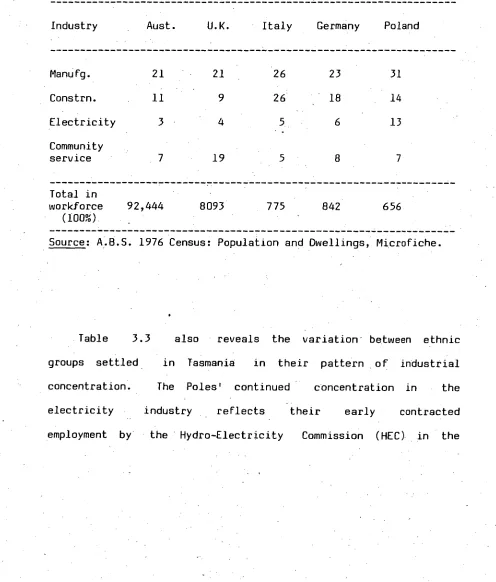
[image:56.807.94.697.88.405.2]service work and the electricity industry are also major employers of non-Anglophone ethnic groups (see Table 3.3).
TABLE 3.3: EMPLOYMENT OF MALES IN TASMANIA IN SELECTED INDUSTRIES BY BIRTHPLACE
Census 1976
Birthplace (%)
Industry Aust. U.K. Italy Germany Poland
Manufg. 21 21 26 23 31
Constrn. 11 9 26 18 14
Electricity 3 4 5 6 13
Community
service 7 19 5 8 7
Total in
workforce 92,444 8093 775 842 656 (100%)
Source: A.B.S. 1976 Census: Population and Dwellings, Microfiche.
[image:57.528.16.512.219.801.2]