The Middle Years of Schooling: A
Critical Time for Developing Mental
Computation
Annaliese Caney
B. A. (Hons)
Submitted in fulfilment of the requirements for the Degree of Doctor of Philosophy
Morc
■
s ifhe,1.5 CANG.■
AP
kb
aooq
THE UNIVERSITY OF TASMANIA
Declaration
This thesis contains no material that has been accepted for a degree or diploma by the University or any other institution. To the best of my knowledge no material has been previously published or written by another person except where due acknowledgement is made in the text of the thesis.
Authority of Access
This thesis may be made available for loan and limited copying in accordance with the Copyright Act 1968.
A-
Annaliese Caney
Acknowledgements
To Jane Watson for being such a fabulous research mentor.
I was encouraged, in some way, everyday by your own research pursuits and commitment to the field of mathematics education. The qualities that underpin your work have left a very strong impression on me and have influenced the way I conduct myself in my work. Thank you.
To Rosemary Callingham for unending support and enthusiasm.
I am so appreciative of your support and willingness to be involved in this study, first as part of the research team and later as a supervisor. Your feedback and enthusiasm (sent from a number of international locations) was just what I needed to reach the end. Thank you.
To my extended research group, particularly Denise Neal and Paul Tabart for their continued interest. The collaboration with the Department of Education Tasmania was really an open invitation to become involved in the larger mathematics community. Attending professional learning sessions, local conferences, and being part of other numeracy projects in Tasmania made my postgraduate experience all the more enriching.
To Alistair McIntosh for his advice in the early stages of the study and for generating such a positive teaching and learning environment for mental computation in Tasmania.
To Judith Deans for always helping and being such a good listener and whose work on the student interviews was invaluable.
To Kim Beswick, Markus Bucker, Pat Jeffery, and Sharon Lidster who read and provided comment on my questionnaire instruments.
To Frances Martin who thought that my experiences in the UK were a very good fit with a project that was getting underway at the Faculty of Education, and hence was the catalyst in this journey.
To the teachers for welcoming me into their classrooms. They always found the time in their incessantly busy schedules to communicate with me and to help me organise space around their schools for me to work with the students.
To the students for providing some really interesting data and generally entertaining conversation. Although many of the students will now just have a certificate of appreciate somewhere in their school records (or maybe under their beds), I have some lovely memories.
Abstract
In the field of mathematics education, this thesis is intended to make a contribution to the literature on the teaching and learning of mental
computation. The aim of the thesis is to explore the role and potential of mental computation in strengthening numeracy practices across the middle years of schooling by providing a detailed analysis of the mental computation
experiences of both middle years teachers and their students (Grades 5 to 8). A focus of the study is mental computation with part-whole numbers including fractions, decimals, and percents, extending previous research that has focused almost exclusively on mental computation with whole numbers. Given the emphasis of the middle years mathematics curriculum on part-whole numbers, it is argued that this period of schooling is a critical time for developing mental computation.
Table of Contents
Declaration
Authority of Access
Acknowledgements
Abstract
CHAPTER 1
INTRODUCTION 1
1.1 School Experience: Background to the Research 1 1.2 Mental Computation Research in Tasmania: A Collaborative 2
Environment
1.3 Aim and Objectives of the Study 3 1.4 Defining Mental Computation: The Case Against Mental Arithmetic 4 1.5 Numeracy — 50 Years Young 7
1.5.1 Numeracy and the Tasmanian curriculum 8 1.5.2 Situating mental computation 10 1.6 Numeracy in the Middle Years 10
1.7 Thesis Overview 12
CHAPTER 2
LITERATURE REVIEW 14
2.1 Introduction 14 2.2 Unpacking Mental Computation 14
2.2.1 The value of working mentally 15 2.2.2 Mental computation: Its place in the curriculum 17
2.2.2.1 National curriculum emphasis 17
2.2.2.2 International curriculum emphasis 18 2.2.3 A historical perspective 20 2.3 Pedagogical Issues: Mental Computation in the Classroom 22 2.3.1 A balancing act 22 2.3.2 Developing mental computation: Teacher-taught versus student-
invented 25
2.4 Mental Computation: The Research Domain 26 2.4.1 Levels of mental computation performance 27 2.4.2 Errors in mental computation 28 2.4.3 International student performance 29 2.4.4 Mental computation strategies 29
2.4.4.1 Whole number strategies: Addition and subtraction 31 2.4.4.2 Whole number strategies: Multiplication and division 35
2.4.5 Mental computation: Its associated links 39 2.5 Fractions, Decimals, and Percents 40
2.5.1 Fractions 43
2.5.2 Decimals 44
2.5.3 Percents 45
CHAPTER 3
RESEARCH METHODLOGY AND DESIGN 51
3.1 Introduction 51
3.2 Research Perspective and Methodology 51 3.2.1 Keeping the peace: The pragmatist position 52 3.2.2 Mixed methods research in the field of mathematics education 53
3.3 Research Design 56
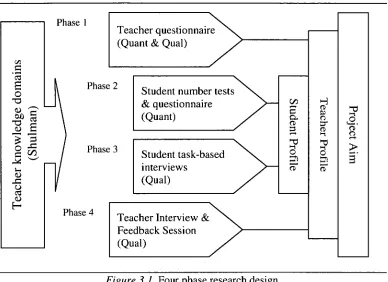
3.3.1 Teacher knowledge framework 56 3.3.2 Four phase research design 57
3.4 Methods of Inquiry 59
3.4.1 Profiling 59
3.4.2 Survey methods 59
3.4.3 Interviews 61
3.5 The Study 63
3.5.1 Participants: Sample and selection 63
3.5.1.1 Schools 63
3.5.1.2 Phases 1 and 4: Teacher questionnaire and interview 65 3.5.1.3 Phase 2: Student number tests and questionnaire 65 3.5.1.4 Phase 3: Student interviews 66
3.5.2 Data collection instruments 68
3.5.2.1 Phase 1: Teacher questionnaire 68 3.5.2.2 Phase 2: Student number tests and questionnaire 71 3.5.2.3 Phase 3: Student interviews 74 3.5.2.4 Phase 4: Teacher interviews 76
3.5.3 Procedures 76
3.5.3.1 Phase 1: Teacher questionnaire 78 3.5.3.2 Phase 2: Student number tests and questionnaire 78 3.5.3.3 Phase 3: Student interviews 79 3.5.3.4 Phase 4: Teacher interviews 80
3.5.4 Data analysis and presentation 80
3.5.4.1 Phase 1: Teacher questionnaire 80 3.5.4.2 Phase 2: Student number tests and questionnaire 81 3.5.4.3 Phase 3: Student interviews 82 3.5.4.4 Phase 4: Teacher interviews 83
3.6 Limitations of the Research 84
CHAPTER 4
RESULTS (PHASE 1): REPORTS FROM MIDDLE YEARS
TEACHERS 86
4.1 Introduction 86
4.5.1 Time devoted to developing written, mental, and calculator
computation in the classroom 95 4.5.2 Developing mental computation with whole numbers, part-whole numbers and related activities 97 4.6 Pedagogical Content Knowledge 100
4.6.1 Mental computation activities 100 4.6.2 Assessment of mental computation 106 4.6.3 Classroom organisation 107 4.6.4 Mental computation and associated mathematical competency 108 4.7 Knowledge of Learners' Characteristics 110
4.7.1 Students enjoyment of and challenges associated with mental
computation 110
4.7.2 Students attitudes towards mental computation 113 4.7.3 Mental computation strategy use 117
4.8 Chapter Summary 125
CHAPTER 5
RESULTS (PHASE 2): PROFILING MIDDLE YEARS STUDENTS 129
5.1 Introduction 129
5.2 Performance on the Mental Computation Test 130 5.3 Performance on the Comparison Tests 132 5.3.1 Performance on the fraction comparison test 133 5.3.2 Performance on the decimal comparison test 135 5.4 Student Mental Computation Questionnaire 137 5.4.1 Student beliefs: The importance of mental computation 137 5.4.2 Student self assessment 138 5.4.3 Attitudes towards mental computation 140 5.4.4 Students' use of written, calculator, and mental computation 141 5.4.5 Students' mental computation preferences 144 5.4.6 Students' use of mental computation with whole numbers, part-
whole numbers and related activities 147 5.4.7 Mathematical competencies associated with mental computation 149 5.5 Questions Related to Classroom Activity 151 5.5.1 Classroom organisation 151 5.5.2 Mental computation activities 151
5.6 Chapter Summary 153
CHAPTER 6
RESULTS (PHASE 3): STRATEGIES FOR WORKING MENTALLY
WITH PERCENTS, FRACTIONS, AND DECIMALS 158
6.1 Introduction 158
6.2 Mental Computation Strategies with Percents 159 6.3 Mental Computation Strategies with Fractions 168 6.4 Mental Computation Strategies with Decimals 176
6.5 Chapter Summary 186
CHAPTER 7
RESULTS (PHASE 4): KEY TEACHER INTERVIEWS 191
7.1 Introduction 191
7.3 Knowledge of Educational Contexts 193 7.4 Curriculum Knowledge 194 7.5 Pedagogical Content Knowledge 197 7.6 Knowledge of Learners' Characteristics 199
7.7 Chapter Summary 200
CHAPTER 8
DISCUSSION 202
8.1 Introduction 202
8.2 General Pedagogical Knowledge 204 8.3 Curriculum Knowledge 205 8.3.1 Time spent developing part-whole numbers 205 8.3.2 Developing mental computation with particular types of numbers 207 8.4 Pedagogical Content Knowledge 209 8.4.1 Mental computation activities and assessment 209 8.4.2 Classroom organisation 210 8.4.3 Associated mathematical competency 211 8.5 Knowledge of Learners' Characteristics 212 8.5.1 Teachers' knowledge of their students attitudes 212 8.5.2 Mental computation strategies 213 8.5.3 Working conceptually, working procedurally 214
8.6 Content Knowledge 217
8.7 Knowledge of Educational Ends, Purposes, and Values 218 8.8 Knowledge of Educational Contexts 219 8.9 Directions for Further Research 220 8.10 Recommendations for the Department of Education Tasmania... ... 221
8.11 Limitations 224
8.12 Conclusion 225
REFERENCES 228
Chapter 1
Introduction
1.1 School Experience: Background to the
Research
In September 1999 I started working at a school in South London. My position as a Learning Support Assistant involved working with two boys, one in Grade 5 and the other in Grade 6. My time with them was spent both in and out of the classroom; generally morning sessions were allocated to literacy and numeracy and afternoon sessions allocated to other areas of the curriculum. It was in these two classrooms, working closely with the teachers that I first became aware of some of the changes and new directions that mathematics education was embracing. Mathematics had not featured particularly on my life's radar, as the churning out of long, repetitious written computations at school had far from inspired me.
My return to Tasmania in 2001 proved timely. I visited my Honours supervisor in Psychology to share my experiences and discovered that a project on
developing mental computation was being advertised in the Faculty of Education. I soon discovered that there was much happening in the state in relation to the teaching and learning of mental computation.
1.2 Mental Computation Research in
Tasmania: A Collaborative Environment
In 1999 the Department of Education Tasmania (DoET) and the Tasmanian Catholic Education Office (CEO), together with the Department of Education and Training (DEAT) in the Australian Capital Territory (ACT) approached the University of Tasmania to develop a collaborative numeracy project. A priority for these three educational systems was the development and implementation of numeracy policy, with any new policies being founded on current and innovative research activities. In 2000 the pilot project Enhancing Numeracy OutcomeS (ENOS) was conducted in six primary schools (Grades K — 6) in Tasmania and the ACT. This project explored the development of numeracy through mental computation.
The positive outcomes of the ENOS project motivated the mathematics education research team at the University of Tasmania and the three
educational systems (now Industry Partners) to extend the research and develop a large-scale mental computation project to be conducted over a three-year period. In 2001 the project, Assessing and Improving the Mental Computation of School-Aged Students, was successful in receiving federal funding through Strategic Partnerships with Industry — Research and Training (SPIRT). With the completion of the project in 2004, the two main outcomes were:
1. Describing levels of achievement in mental computation by providing a theoretical framework of mental computation ability, including
descriptions of sequential competency levels for students; and
sequential approach for improving students' mental computation ability through Grades 3 to 10.
1.3 Aim and Objectives of the Study
This PhD was developed as a companion project to Assessing and Improving the Mental Computation of School-Aged Students. It was supported by one of the Industry Partners — the DoET — as an Australian Postgraduate Award Industry (APAI) scholarship. The DoET specified an area of concern within its educational system, namely the need to strengthen continuity of numeracy and approaches to teaching and learning mathematics at the point of transfer from primary school to secondary school. As this study is related to Assessing and Improving the Mental Computation of School-aged Students, it was proposed that mental computation would be the vehicle for exploring the development of numeracy at this level of schooling — the middle years — with both teachers and their students. Both mental computation projects were supported by the
Australian Research Council (Grant No. CO0107187).
The aim of the study is to explore the potential role of mental computation in strengthening numeracy across the middle years of schooling. Facility in working mentally with fractions, decimals, and percents is the avenue through which this aim is explored. Two objectives underpin the research activity:
• First, an educational objective, to provide the DoET with a set of recommendations to assist the on-going development and evaluation of numeracy targets for mental computation.
• Second, a research objective, to profile a number of aspects of mental computation at the middle years level, including the experiences of teachers and students, as well as students' mental computation skills and strategies.
The following set of research questions are posed for the study:
2. How is mental computation being experienced by middle years students?
3. What strategies do students use to solve mental computation problems with fractions, decimals, and percents?
4. How do teachers position the teaching and learning of fractions, decimals, and percents in relation to mental computation?
1.4 Defining Mental Computation: The
Case Against Mental Arithmetic
The definition of mental computation adopted for the study is provided by Reys, Reys, and Hope (1993): "the ability to derive exact numerical answers without the aid of calculating or recording devices" (p. 306). The use of the word exact in this definition effectively distinguishes mental computation from estimation — a skill closely related but involving approximation. Another common definition of mental computation is offered by Sowder (1988, p. 182): "the process of carrying out arithmetic calculations without the aid of external devices." The use of the word arithmetic, however, may draw attention away from the emphasis on students' individual thinking strategies suggested by McIntosh, Reys, and Reys (1997).
The meanings attached to the terms mental computation and mental arithmetic, are quite different in light of the agendas of the educational climates that they represent. The term mental computation appears to have been coined by Barbara and Robert Reys in the late 1970s in relation to their research on computational estimation. During the early 1980s the United States adopted the term mental computation as educators were encouraged to support new
importance of mental thinking strategies. Leading the way in Australia,
prominent researchers in the field, have embraced mental computation and this is now the term that is favoured in Australian curriculum standards and
documents.
In trying to encapsulate what mental computation is, one approach is to start by considering what mental computation is not. Anghileri (1999) offers a simple but powerful description of mental computation as not merely calculating in
the head but rather calculating with the head (p. 186). The message that permeates the curriculum is that mental computation is not mental arithmetic, at least not in the old sense. Morgan (2000, p. 2) characterises traditional mental arithmetic in five ways:
1. Answers are of paramount importance;
2. Answers are often obtained by applying memorised rules, with little concern for the mathematical processes involved;
3. Lessons are characterised by a series of short, low-level, unrelated questions;
4. Time is emphasised with answers being quickly calculated, recorded, and marked; and
5. Sessions are effectively focussed on testing and not teaching. Only remnants of this description of mental arithmetic are useful in constructing a picture of mental computation.
The mechanical application of rules is a feature Morgan associates with mental arithmetic. Anghileri (2000) agrees, maintaining that "the meaning of
arithmetic has over time become limited to performance of standard algorithms without an underlying understanding" (p. 1). Mental computation is also more than memorised number facts. The emphasis on understanding the workings of the number system, including the relationships between numbers and
operations, is now espoused as the foundation for developing mental computation skills.
Mental computation activities may take on almost any form that is appropriate at a given time in a classroom; they do not resemble the restrictive nature of mental arithmetic activities — Morgan's third point. With a focus on
understanding, mental computation has taken on a "less is more" approach. Mental computation might involve, for example, just one or two mathematical problems: the difference being the depth of investigation as facilitated by the teachers.
An emphasis on reasoning and justification as facilitated through investigation and discussion is central to mental computation. Morgan also equates time in mental arithmetic with speed. Emphasising speed in relation to computation is a practice that McIntosh (1998) strongly suggests must stop. He writes, "If children are given time, they try — often with success — to invent an algorithm. If we emphasise speed, we remove this possibility" (p. 47). It seems the emphasis on time should actually be to give students a chance to be creative, think deeply, and consider the strategies that others use or devise their own.
Morgan's final point is that mental arithmetic sessions are simply test
orientated. The focus of mental computation, however, can be quite different, with sessions being the basis for investigations of more depth to develop understanding of essential mathematical concepts. Importantly, the students' experience of mental computation should emphasise "supporting and
It could also be argued that mental arithmetic is a fairly isolated, individual activity, a feature that Morgan does not include in his discussion. Potentially mental computation investigations might involve one to one discussions between a teacher and a student, between the students themselves, or larger whole-class investigations. Mental computation is not a restrictive activity and this interpretation of mental computation is very much in alignment with the current understanding of numeracy in Australia.
1.5 Numeracy - 50 Years Young
Having first appeared in the United Kingdom in the Crowther Report (1959), the term numeracy is approaching its 50th birthday. The term may have evolved somewhat over the years but this does not necessarily mean it has aged.
Crowther imparted a sophisticated view of numeracy that encompassed both "understanding of the scientific approach to the study of phenomena — observation, hypothesis, experiment, verification" and the need "to think quantitatively" (quoted in Cockcroft, 1982). Over two decades later, the term numeracy reappeared in the Cockcroft Report (1982) representing a "culture of utility" (Noss, 1998). Cockcroft put forward a broader view of numeracy, stressing the practicalities of mathematics education in relation to the workplace and adult life, specifically including "appreciation and understanding of information which is presented in mathematical terms" (p. 11). Australia and New Zealand essentially inherited the term numeracy from the United Kingdom. Although Australia and the United Kingdom share a functional view of numeracy that emphasises the value of individuals having mathematical skills to cope with their everyday life experiences, Australia has moved away from a solely number-based conception of numeracy that
To be numerate is to use mathematics effectively to meet the general demands of life at home, in paid work, and for participation in
community and civic life. In school education, numeracy is a
fundamental component of learning, discourse and critique across all areas of the curriculum. It involves the disposition to use, in context, a combination of:
Underpinning mathematical concepts and skills from across the discipline (numerical, spatial, graphical, statistical, and algebraic); Mathematical thinking and strategies;
General thinking skills; and
Grounded appreciation of context. (p. 2)
Although there are variations in how numeracy is conceptualised, notably numeracy has forged an identity of its own having been overshadowed in education practice by literacy definitions and interventions (Luke, Elkins, Weir, Land, Carrington, Dole et al. 2003). How numeracy is conceptualised affects not only the school mathematics curriculum but also the relationship between mathematical content knowledge and pedagogy. Noss (1998) reinforces the view that new numeracies may continue to evolve to represent the ever changing social and economic needs of society.
1.5.1 Numeracy and the Tasmanian curriculum
In Tasmania the established definition of numeracy weaves together the five strands of the mathematics curriculum as outlined in the Mathematics Guidelines K - 8 (Department of Education and the Arts Tasmania (DEAT, 1992):
To be numerate is to have and be able to use appropriate mathematical knowledge, understanding, skills, intuition, and experience whenever they are needed in everyday life. Numeracy is more than just being able to manipulate numbers. The content of numeracy is derived from five strands of the mathematics curriculum - space, number,
described in the National Statement and Profile. (Numerate Students, Numerate Adults (DEAT, 1995, P. 6)
Tasmania is one of several of Australian states implementing curriculum reform founded on a values-based philosophy (e.g., Education Queensland, 2000; South Australia Curriculum Standards and Accountability (SACSA), 2001). In Tasmania, the Essential Learnings framework (DoET, 2002, 2003) details five curriculum organisers, which are considered the areas of essential learning for students Grades K — 10: Thinking, Communicating, Personal Futures, Social Responsibility and World Futures. These are guided by a core set of values and purposes and are followed by a set of principles to direct learning, teaching, and assessment. Although innovative, the Essential Learnings raises many questions and challenges for educators involved in the more traditional curriculum areas such as mathematics and science. Reference to being numerate is listed as a key element of one of the curriculum
organisers, communicating. The first part of the description associated with
being numerate links mathematical concepts and skills to "everyday problems" and the "demands of everyday life." It upholds that:
Being truly numerate requires the knowledge and disposition to think and act mathematically and the confidence and intuition to apply particular mathematical principles to everyday problems. (p. 21)
The second part of the being numerate description moves to a cross-curricular focus:
Being numerate not only includes numeracy skills and understandings, but it also involves the critical and life-related aspects of being able to interpret information thoughtfully and accurately when it is represented in numerical and graphic form. This aspect of numeracy is akin to critical literacy — being able to recognise that information can be constructed to influence the reader or viewer. (p. 21)
across the curriculum. The Essential Leamings message is "teaching for numeracy" as opposed to "teaching numeracy" (D. Neal, personal communication, March, 2003).
1.5.2 Situating mental computation
For those who favour a definition of numeracy that privileges number over other aspects of mathematics, mental computation is valued in terms of developing sound conceptual understanding of number properties, operations, and fostering number relationships. Yet within a broader definition of
numeracy that encompasses a wider range of skills, mental computation is valued as the means to engage in interpreting, communicating, and applying mathematical knowledge. Mental computation then, can be accommodated within either perspective and provides a foundation for exploring numeracy at the middle school level.
1.6 Numeracy in the Middle Years
For students the middle school years are marked by the transition from the final years of primary school to the early years of secondary school. In Australia this involves, for the most part, moving through Grade 5 to Grade 8, in some states incorporating Grade 9. Students moving through the middle years of schooling are typically between the ages of 10 to 15. Some schools cater for all
compulsory years of schooling including primary and secondary. Other schools offer a primary or secondary education only. Therefore, the experience of the middle years transition may involve remaining at the same school, or relocating to a new secondary school site. What drives the interest in this period of schooling for all educators is the "unique developmental and educational needs of young adolescent learners" (Barber, 1999). The perceived lack of alignment between the developmental characteristics of students in adolescence and the school organisation along with its programs continues to be the platform for the middle school reform agenda, particularly in the United States (Beane &
The advent of the new millennium has brought about fundamental social and economic changes worldwide. In Australia, educators are faced with the task of considering the learning needs of students and how best to prepare students to be competent, global citizens. The values-based curriculum reforms are one outcome of this preparation. In the report Beyond the Middle, Luke et al. (2003) write, "middle years education has become a clear motivational force for reform and for the framing and focusing of teachers' and students' work in schools and classrooms" (p. 12). Accordingly there are a number of significant issues of teaching and learning that challenge the area of numeracy.
The middle years are arguably a critical time in addressing the essential needs of numeracy. Willis (1998) identifies three critical aspects of numeracy: mathematical knowledge, contextual knowledge, and strategic knowledge. Balancing these three aspects becomes more challenging in the middle years as the dimensions of numeracy expand; contextual knowledge and strategic knowledge become more integrated in the actual experiences of the students (Siemon, Virgona, & Corneille, 2001). In the mathematics curriculum there is an explosion of key mathematical ideas associated with each of the curriculum strands, along with number, these include pattern and algebra, space,
measurement, and chance and data. Within the number strand alone, the
conceptual basis shifts from additive reasoning to multiplicative reasoning, and the number system expands to include part-whole numbers (or rational
numbers). An important contribution of this study is the bringing of fractions, decimals, and percents into the domain of mental computation, responding to the call of McIntosh (2002a) who advocated that it is a matter of urgency to "find effective ways to ensure that well developed approaches to number find their way particularly into the majority of middle school classrooms" (p. 463).
Quality School Project, Hill, Rowe, Holmes-Smith, and Russell (1996, P. 32)
report a "flattening out of the growth trajectory" beginning in Year 4 and continuing until Year 9. This pattern is described for three strands of the English profile but is not as marked for the mathematics strands. Similarly, in the document Middle Years Numeracy Research Project: 5 — 9 the authors report a "performance dip" in numeracy between Year 6 and Year 7 (Siemon et al. 2001). There are many challenges that impact on the teaching and learning of numeracy at the middle school level: some of these will be covered in the following chapter.
1.7 Thesis Overview
Following the Introduction, the thesis is divided into seven chapters. Chapter 2 contains a review of the literature in the field of mental computation, drawing on work from related fields to support the objectives and the set of research questions which are outlined at the close of the chapter. In Chapter 3, a discussion of mixed methodology research with an emphasis on mathematics education is presented. As well, the design of the study — which was conducted through four phases — is introduced along with the theoretical framework. The life of the project is also detailed in Chapter 3 including details on the
participants, instruments, procedures, ethical considerations, data analysis, and limitations related to the study.
The results of the study are presented over four chapters. In Chapter 4 the results of a questionnaire completed by 34 middle years teachers are analysed (Phase 1). Chapter 5 and Chapter 6 focus on the students' experiences of mental computation and comprise Phases 2 and 3 of the study respectively. In Chapter 5, data were collected from three instruments: a mental computation test, a comparison test (with pairs of fractions and decimals), and a
Chapter 2
Literature Review
2.1 Introduction
In this chapter, the review of the literature spans five main areas.
The review starts by unpacking mental computation in terms of its value as reflected in current national and international curriculum and in relation to theoretical thought, both historical and current. The second main area of the review considers some of the pedagogical issues for teachers with the current emphasis on mental computation and the impact on learning environments. The review then proceeds to examine the two fields of research that frame the study: a) mental computation and b) fractions, decimals, and percents. It argues that the links between the two fields have not been well established. In terms of mental computation, research activities have been conducted fairly
consistently since the 1980s. Methodological approaches have been situated both in the quantitative and qualitative domains, with valuable contributions from each discussed. In the fourth section on fractions, decimals, and percents, the three concepts are examined selectively, from a mental computation perspective. In the fifth section the concepts of working procedurally and working conceptually are briefly reviewed. The literature review then closes with the aim of the current study and the objectives and research questions proposed for the study.
2.2 Unpacking Mental Computation
solve 30% of 80, "point eight - I was thinking ten percent would make it into units, twenty percent would make it into tenths and then thirty percent would take it into the hundredths?"
If the answers — either correct or incorrect — were the only point of interest to a teacher or a researcher then much of above scenario would be superfluous. It is the value of unpacking a student response that underpins the current emphasis on mental computation.
2.2.1 The value of working mentally
The value of mental computation is evident in terms of its links to mathematics education reform efforts, particularly in emphasising sense-making and
conceptual understanding, which are two aspects that drive mathematics reform initiatives (Parker & Leinhardt, 1995). Mental computation is considered to facilitate and strengthen the development of understanding associated with the workings of the number system (Reys, 1984). This includes the properties of numbers and operations, and the relationships between them. Mental
computation is also considered to support the development of number sense (Markovits & Sowder, 1994; McIntosh, Reys, & Reys, 1992; Sowder, 1988). An important element of number sense according to McIntosh et al. (1992) is the motivation of the learner in developing and choosing computational strategies. Number sense then underpins mental computation in terms of making decisions about the effectiveness of particular mental strategies and also in determining the reasonableness of an answer. Working mentally assists students to develop problem solving skills as students develop a critical perspective as to why one strategy might be considered more efficient for a particular problem and how to use the mathematical knowledge they have to work through a problem. It is also purported that mental computation fosters creative and independent thinking around number concepts (Reys, 1984).
students relying solely on learned sets of rules and procedures (Kamii & Dominick, 1998). Additionally, mental computation is a basis for developing estimation skills (Reys, 1984). It is conceivable that success in mental
computation can be achieved without computational estimation skills, as learned procedures are carried out in a mechanistic manner (Sowder, 1992). The reverse, however, does not necessarily apply. Reys (1988) suggests that many students follow a misconceived idea that estimation is about finding an exact answer and then rounding it to produce an estimate. But really in terms of its value as a skill there are many situations in real life that only require an estimate. Sowder (1988) suggests that "researchers do not appreciate the potential power of estimation, particularly as a unifying theme throughout the study of rational numbers" (p. 189).
A key idea that supports numeracy is the application of mathematics both formally and informally in everyday contexts. Appropriately, mental
computation is highly valued for its practicality and immediate social utility (McIntosh, Nohda, Reys, & Reys, 1995). There is a strong case for the
utilitarian value of mental computation. Northcote and McIntosh (1999) argued that mental computation is a critical adult skill. The authors conducted survey research and found that for the most part, everyday calculations performed by adults were done mentally (85%). These calculations predominantly involved the calculation of time and calculations during shopping activities. Addition and subtraction featured as the most commonly used operations. Their research supports the earlier work of Wandt and Brown (1957) who reported that calculating mentally accounted for three quarters of the calculations completed by adults. It follows that being able to compute mentally is often the simplest way to calculate, particularly in everyday situations where applications of written techniques can be laborious and simply inappropriate (McIntosh,
1998). Mental computation is also a universally valued skill due to its
2.2.2 Mental computation: Its place in the
curriculum
A gauge of the value of mental computation is the level of recognition and emphasis it receives in current mathematics curriculum and policy documents. At a basic level, curriculum as subject matter provides answers to questions such as what to teach, how to teach, and when to teach (Print, 1993). For mental computation these questions need to be considered in relation to written computation and the use of calculators. Within the Australian mathematics curriculum, importance is generally placed on students being able to choose an appropriate calculative method — either mental, written, or calculator
(Curriculum Corporation, 2000). This reflects the more balanced approach to computation that has developed consistently during the 1980s as part of mathematics education reform efforts (Hope, 1987; McIntosh, 1990; Reys & Nohda, 1994).
2.2.2.1 National curriculum emphasis
Within Australian curriculum and standards documents, mental computation is embedded in the description of learning and outcomes associated with Number. Experiences in computation and estimation, along with experiences in number and numeration in the Number Strand, are detailed in A National Statement on Mathematics for Australian Schools (Australia Education Council (AEC),
1991). In choosing an appropriate method for either an exact or an approximate calculation, mental computation is described in the following fashion:
People need to carry out straightforward calculations mentally, and students should regard mental arithmetic as a first resort in many situations where a calculation is needed. Strategies associated with mental computation should be developed explicitly throughout the school years, and should not be restricted to the recall of basic facts. People who are competent in mental computation tend to use a range of personal methods which are adapted to suit the particular numbers and situation. Therefore, students should be encouraged to develop personal mental computation strategies, to experiment with and compare
strategies to suit their own strengths and the particular context. (ACE, 1991, p. 109)
Although the emphasis on mental computation is to be welcomed, the welcome appears to weaken beyond the whole number boundary. Mathematics — A Curriculum Profile for Australian Schools (AEC, 1994) allocates one of seven strand organisers within the Number Strand to mental computation. In the six level outcomes described specifically for mental computation, the first four levels are concerned solely with whole numbers. At the fifth level, "simple fractions" are mentioned and at level six, the following outcome is described for students: "Estimates and calculates mentally with whole and fractional numbers, including finding frequently used fractions and percentages of amounts" (AEC, 1994, p. 104). Of the individual states and territories in Australia some have placed a greater degree of emphasis on mental
computation than others. In Tasmania, for example, mental computation has featured in curriculum materials since early in the 1990s (DEAT, 1992). In contrast, it is only recently that curriculum review in Queensland has explicitly addressed mental computation, in particular the issue of how best to teach mental computation — juxtaposing teacher taught strategies with strategies invented by the students (Heirdsfield, 2003a).
2.2.2.2 International curriculum emphasis
At the lower levels of the New Zealand curriculum, facility with whole numbers is emphasised for mental computation. At Level 3, covering the middle school years, "mental methods" is one of three approaches to finding "fractions of whole numbers and decimal amounts (including money and measurements)" (Ministry of Education, 1992, p. 41). At Level 5, which covers the later secondary school years, mental strategies are to be developed for operations with "positive and negative numbers using a calculator, a variety of methods, and other approaches" (p. 49). A similar emphasis on mental
are mentioned in relation to choosing appropriate calculation methods. This is expanded with a rationale for mental computation and estimation.
Students should also develop and adapt procedures for mental
calculation and computational estimation with fractions, decimals, and integers. Mental computation and estimation are also useful in many calculations involving percents. Because these methods often require flexibility in moving from one representation to another, they are useful in deepening students' understanding of rational numbers and helping them think flexibly about these numbers. (NCTM, 2000, pp. 220-221)
In the United Kingdom mental calculation has assumed a place "at the heart of numeracy" and, as such, is one of the key principles underpinning the approach to teaching numeracy as recommended in the National Numeracy Strategy (DfEE, 1998, 1999). This strategy was introduced in 1998 as a government initiative to support higher numeracy performance for primary and secondary school students. The mathematics program in the United Kingdom is relatively prescriptive, with guidelines for expected student achievement outlined in terms of the types and size of numbers students should be able to work with mentally at different ages (Threlfall, 2000). Again, the British focus is largely based on whole numbers. There are sketchy directions in the Primary
Framework for Literacy and Mathematics: Year 6 progression to Year 7 outlining that students should be able to draw on their personal collections of strategies for solving whole number problems: "Consolidate and extend mental methods of calculation to include decimals, fractions and percentages" (DfES, 2006). Guidelines for working with whole numbers, however, are much more specific than those outlined for fractions, decimals, and percents, for example; "multiply a two-digit by a one-digit number."
number line (Beishuizen, 1997). Heirdsfield (2003a) suggests that an emphasis on developing mental representations is one of the main differences between the Dutch approach to mental computation and that of Australia, New Zealand, and the United States.
2.2.3 A historical perspective
The current emphasis on mental computation is not necessarily a new
phenomenon within the field of mathematics education. The "mental" aspect of mathematics has been a fundamental part of teaching number over the last century, although interest has periodically waxed and waned. Trends are described briefly by Reys (1984), Reys and Barger (1994), and Pepper (1997). Discussions tend to start at the end of 19th century: an era in education marked by the strong hold of the mentalist philosophy of education that was dominant in the United States and to a lesser extent in the United Kingdom (Thompson, 1999a). Mental discipline theory likened the human mind to a muscle, which by its very nature required exercise to promote development and increase strength (Stanic, 1986a). A basic premise of the mentalist view of learning was grounded in the physicality of strengthening the faculties of the mind,
particularly the intellect, the senses, and the will. Mathematical activity that involved the repetition and rehearsal of number facts, particularly
multiplication tables, was considered the "perfect technique for developing the faculties of the mind" (Reys, 1984, p. 549). The fundamental mentalist
argument for the inclusion of mental arithmetic was based upon the nature and perceived benefits of the activity, with little regard for the mathematical content.
Not surprisingly, mental computation has fluctuated with the impact of
2002, P. 437). The work of E. L. Thorndike (1874-1949) was extremely influential in matters of educational pedagogy, including instruction and assessment. His basic learning theory involved developing and strengthening the associations between stimuli and responses. In his discussion Schoenfeld (2002) uses the example of "5 x 3" and "15" to demonstrate the mental bond that exists between them. To Thorndike, bonds such as multiplication facts should be taught together to reinforce and strengthen the bonds between isolated instances of mathematical knowledge. This period marks the birth of "drill and practice" in mathematics.
Reys and Nohda (1994) argue that mental computation is a "higher-order thinking process" and that this position moves mental computation into the realm of "thinking strategies" (p. 12). Reys and Barger (1994) write, "Students are encouraged to generate thinking strategies based on their prior experience and knowledge" (p. 39). This view of mental computation is embedded in constructivist thought. From a constructivist perspective:
We construct our knowledge of our world from our perceptions and experiences, which are themselves mediated through our previous knowledge. Learning is the process by which human beings adapt to their experiential world." (Simon, 1995, p. 115)
For the learning of mathematics, students as learners construct their own knowledge both individually and collectively.
2.3 Pedagogical Issues: Mental Computation
in the Classroom
Advice to teachers on developing mental computation is generally embedded within pedagogy associated with teaching numeracy (Askew, Brown, Rhodes, Johnson & Wiliam, 1997; Askew, Denvir, Rhodes, & Brown, 2000) and also in developing number sense (Anghileri, 2000). Number sense and mental
computation are frequently paired in the literature in the manner of a
harmonious, symbiotic relationship. Number sense is less easy to define than mental computation, which suggests it is a multifaceted construct (Case 1989; Maclellan, 2001; Resnick, 1989). There is general acceptance that number sense is not about the numerical knowledge as such but rather it is about how mathematical knowledge is manipulated with the emphasis on flexibility, reasoning, and thoughtfulness (Maclellan, 2001). McIntosh, Reys, & Reys (1992) define number sense as:
...a person's general understanding of number and operations along with the ability and inclination to use this understanding in flexible ways to make mathematical judgements and to develop useful strategies for handling numbers and operations. It reflects an inclination and an ability to use numbers and quantitative methods as a means of communication, processing and interpreting information. (p. 3)
Heirdsfield (2003a) points out that, whereas many teachers readily acknowledge and support the emphasis on mental computation in the curriculum, they actually fail to see it as part of a larger picture in terms of developing number sense. This observation has pedagogical implications for classroom practice, including how mental computation is developed and what assessment practices are used by teachers. There is no research to date that considers the teachers' views on mental computation, including reports of how teachers are addressing mental computation in the classroom.
2.3.1 A balancing act
95% of time was spent in this manner. Advocates of mental computation, however, argue that mental computation should be the main form of
computation in schools (e.g., Willis, 1990, 1992). McIntosh (1990) painted a picture of three methods of computation and it is not hard to detect where his loyalties lie:
So there we have the picture: great amounts of time and energy
dedicated to written calculation which is little used or trusted by people out of school. Little or no time devoted to improving mental
computation which is used daily by everyone. Little or no time devoted to calculator use, though everyone would agree that the calculator could, indeed does, make everyone able to compute. (p. 25)
If mental computation were to overshadow written computation in the curriculum, the question still remains, when should written algorithms be introduced to students during their school years? There is growing support for the view that written algorithms should be introduced at a much later stage of schooling (from Grade 4) than is traditionally the case (from about Grade 2) (McIntosh, 2002b, 2005; Thompson, 1999b). This would mirror the approach to written algorithms espoused in both the Netherlands and Germany
(Beishuizen, 1997). Research has shown that vertical written algorithms for addition can interfere with the development of children's natural (or invented) strategies for solving problems (Cooper, Heirdsfield, & Irons, 1995; Ginsburg, Posner, & Russell, 1981). Heirdsfield, Cooper, and lions (1999) conducted a case study on a competent student and found that he could compute quite competently before written algorithms were introduced, thus demonstrating number sense and flexibility. The authors question what written algorithms can offer this student. Additionally, invented strategies — that often involve
calculating from left to right — are more accurately used than those mental strategies that move from right to left mirroring written algorithmic procedures (Carraher, Carraher, & Schliemann, 1987; Kamii, 1989; Kamii, Lewis, & Jones, 1991).
fundamentals of mental algorithms with written algorithms. This is summarised in Table 2.1.
Table 2.1
The Characteristics of Written and Mental Algorithms
Written as Mental as
Written: Calculation is permanent and correctible.
Standardised: Calculation procedure is always the same.
Contracted: Calculations consist of summarised lines of equations.
Efficient: Every column in a calculation (working from the right) is treated as ones.
Automatic: Calculation can be executed with little or no understanding.
Symbolic: Calculations are based on the manipulation of symbols.
General: A method will work for any combination of numbers for an appropriate operation.
Analytic: Numbers are broken up and digits are dealt with separately.
Not easily internalised: Generally do not reflect the ways people think naturally about numbers.
Encourage cognitive passivity:
Calculation requires limited decision making.
Fleeting: Calculations can be momentary and passing.
Variable: There are many different ways to calculate.
Flexible: Calculations are adapted to suit the numbers involved.
Active: Calculation choice is often controlled by the user.
Holistic: Calculations often involve working with complete numbers.
Constructive: Calculation follows a pathway from one part of the question to the answer.
Not designed for recording: Recording of calculations is generally not predicable.
Requiring understanding: Understanding demonstrated through the flexible construction of calculations.
Iconic: Calculation may be supported by a visual tool or image.
Early approximation to correct answer: as demonstrated through the practice of working left to right.
Limited: Do not always suit difficult calculations or every problem.
With the advent of the technological age there surfaced another compounding element that educators had to consider alongside mental and written
computation — the introduction of calculators in classrooms. Educators were forced to consider what might be needed to support students in using
technology effectively and efficiently. Those giving standing to mental
check calculator results (Cockcroft, 1982), so that students did not simply develop unquestionable faith in the = sign.
2.3.2 Developing mental computation:
Teacher-taught versus student-invented
For teachers, instructional emphasis in relation to mental computation is commonly presented as a dichotomous position: teacher-taught strategies versus student-invented strategies. Managing this tension is perhaps one of the biggest challenges teachers face in developing mental computation with their students. Traditional pedagogy suggests that teachers look for the best mental computation procedures and teach them. "Best" might be defined as "the most common" or the methods that appear to be most easily understood by the majority of students, or possibly methods best understood by the teacher. Threlfall (2000) expresses concern that explicit instruction from teachers compromises the strategic and flexible elements of students' own thinking processes. He writes, "in a structured teaching situation there is a decision about how to calculate, but it is made for the child by the teacher, in effect, through the teacher's intention to practise particular approaches" (p. 81). This model of teaching mental computation is aligned with behaviourist theory of learning — where students are given specific strategies to learn and their ability to incorporate the strategies in computation problem solving forms the basis of assessment. There is always the possibility that learning strategies and then executing them, directed solely by the teacher, will not be any more successful than written algorithms (McIntosh, 1991).
Callingham and McIntosh (2002) consider that in terms of documented
outcomes for mental computation, there are generally too few expectations for whole numbers other than for basic number facts. They also note that there is "none at all for decimals, percentages, and fractions" (p. 423). Some
expectations and outcomes are noted for the fraction, decimal, and percent content domains, yet specific goals are rarely addressed for mental
computation.
2.4 Mental Computation: The Research
Domain
There are two features of mental computation research that are of particular relevance to the current study. First, mental computation involving whole numbers has dominated the research field and this provides the focus for discussing the literature in this section. Second, qualitative research has rarely extended beyond the upper primary grades to incorporate the early years of secondary school. Quantitative studies that do incorporate the middle years do so within a range of grades, providing only snapshots of how students at this level of schooling perform (Caney, 2002).
2.4.1 Levels of mental computation performance
In the context of performing calculations mentally, how to monitor students' progress was the motivation for the work of Callingham and McIntosh (2001, 2002). The authors argued that, although there is an accepted hierarchy of development to support written computations, teachers are left largely to their own devices in developing, implementing, and assessing mental computation programs. Using Rasch modelling as the theoretical framework, the authors considered the mental computation performance of students across Grades 3 to
10
(N =
1452) and constructed a developmental scale of mental computation ability in which they described eight levels of performance. These levels represented an increasing complexity in the type of problems students could solve successfully according to the type of numbers, both whole numbers and part-whole numbers, and across the four operations (Callingham & McIntosh, 2001).In extending the research, Callingham and McIntosh (2002) used the levels of mental computation performance to report on two aspects of student
performance: patterns of student ability across the school years and growth for individual year groups. Grades 3 and 4, for example, were the grades where students exhibited the greatest period of growth in mental computation
competence. Across Grades 6 and 7, however, the growth rate plateaued before increasing again between Grades 7 and 8. Callingham and Watson (2004) considered the four operations with part-whole numbers only and further extended the work by identifying six levels of increasing complexity across fraction, decimal, and percent problems.
grades for basic number facts, but the work did not expand on types of computation problems that might be appropriate for students working at different levels. The work of Callingham and McIntosh (2002) has important implications for classroom teachers in providing a research base from which to sequence activities that develop mental computation and support assessment of ability. Resources developed from the work of Callingham and McIntosh (2001, 2002) support teachers in making decisions about their students learning and in confidently making judgements as to what types of problems might be appropriate and when (McIntosh, 2004).
2.4.2 Errors in mental computation
In investigating students' mathematical ideas, describing common errors that students make, the sources of these errors, and the associated underlying misunderstandings is a popular line of research (Even & Tirosh, 2002). In the field of mental computation, quantitative studies have contributed to research of this nature (Bana, Farrell, & McIntosh, 1995; McIntosh, 2002; Watson, Kelly, & Callingham, 2004). Generally, the errors that students make in mental computation appear to be different qualitatively from those described for written computation (McIntosh, 1998).
Bana et al. (1995) selected 12 non-contextual number problems from a mental computation test to investigate errors across Grades 3, 5, 7, and 9. The test items reflected key mathematical content areas and were chosen to illustrate interesting error patterns. They reported on specific error percentages
Building on these earlier studies McIntosh (2001) sought to increase the
sample sizes and number of questions, analysing the most common errors made at each grade level (3 — 10). Again, the incorrect responses from pencil and paper tests of mental computation were clustered and the most common incorrect responses for the different number types described. McIntosh suggested that in working mentally at the most basic level, errors can be identified as either procedural errors or conceptual errors. From the same data set Watson et al. (2004) adopted a developmental approach and completed a more fine-grained error analysis that focussed on items from one of the eight development levels previously described (Callingham & McIntosh, 2001, 2002).
2.4.3 International student performance
A third research area involves comparative studies of mental computation performance at an international level. During the 1990s Australia joined Japan and the United States to conduct research on mental computation performance that could be compared internationally. McIntosh et al. (1995) were able to present some general trends from data collected from Grades 2 to 9. For example, initially the performance of the Japanese students at Grades 2/3 was much higher than for students from Australia and the United States. The difference was minimised, however, by Grade 8/9 with the performance of the Australian students exceeding that of the Japanese students. The individual results for the Japanese students are reported in Reys, Reys, Nohda, and Emoir (1995). There has also been interest in the related field of number sense in relation to comparative performance on an international level (McIntosh, Bana, & Farrell, 1997; McIntosh, Reys, Reys, Bana, & Farrell, 1997). These
researchers also conducted an investigation into student attitudes to mental computation and the types of problems students would prefer to do mentally (McIntosh, Bana, & Farrell, 1995).
2.4.4 Mental computation strategies
students engage and investigate the development and use of mathematical concepts. Task-based interviews have been the main method of inquiry (Goldin, 2000; Heirdsfield, 2002b; Hunting, 1997). Several key findings associated with mental computation have emerged from qualitative studies. First, mental strategies that students report often do not reflect the algorithmic procedures that school mathematics has emphasised through written
computation. From the 1980s the literature is alive with quotes from students explaining the bizarre and wonderful ways that they solved problems.
Accordingly, many of the strategies were self developed or self taught and often with limited knowledge of formal algorithms (Carroll, 1997; Kamii, Lewis, & Livingston, 1993). The explanations provided by students were not ways of thinking that were explicitly taught or expected of students in the classroom.
A second important finding is that the introduction of written computation can have a negative effect on the continued development of mental computation strategies (Cooper, Heirdsfield, & Irons, 1996; Ginsburg, Posner, & Russel,
1981; Heirdsfield & Cooper, 1996; Kamii & Dominick, 1998). Heirdsfield and Cooper (1996) found that although young children were inventive in solving unfamiliar problems, they tended to make use of written algorithms for mental computation once taught them.
There is also evidence that mathematical computations embedded in a context tended to elicit invented strategies, whereas noncontextual computations tended to elicit mental versions of written algorithms (Carraher, Carraher, & Schliemann, 1987). Cooper et al. (1995) reported similar findings after comparing children's mental strategies for algorithmic exercises and word problems in Grades 2 and 3.
The literature includes a large assortment of descriptions of solution sequences or strategies employed by students for working with multi-digit whole
mentally beyond basic number facts, has predominantly involved the addition and subtraction of two-digit whole numbers, as either non-contextual problems or word problems. Threlfall (2000) suggests that this level of calculation is a reasonable expectation for all students to achieve and problems are unlikely to be solved solely by recall. It follows that the studies focus on students in the middle to upper years of primary school. Of the studies that describe the variety of mental strategies that students use, the underlying interest is in how these strategies initially develop.
2.4.4.1 Whole number strategies: Addition and
subtraction
In relation to mental computation, McIntosh, de Nardi, and Swan (1994) document two types of strategies: changing the operation and using commutativity. The former is likely to involve changing the operation of a subtraction problem to addition. The latter involves changing the order of the numbers in the problem. For addition this requires the student to understand that the order of the operands does not affect the final outcome, for example, 4 + 6 = 6 + 4, following the rule of commutativity. The strategy, however, is not mirrored for subtraction. These two strategies are called initial strategies, as this conceptual "rearrangement" of the problem appears to precede any
computational activity.
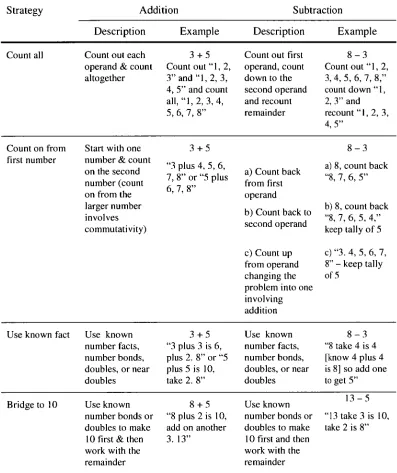
Table 2.2
Summary of Strategies for Basic Number Facts
Strategy Addition Subtraction
Description Example Description Example
Count all Count out each 3 + 5 operand & count Count out "1, 2, altogether 3" and "1, 2, 3,
4, 5" and count all, "1, 2, 3, 4, 5, 6, 7, 8"
Count out first operand, count down to the second operand and recount remainder
8 - 3 Count out "1, 2, 3, 4, 5, 6, 7, count down "1, 2, 3" and recount "1, 2, 3, 4, 5"
Count on from first number
Start with one number & count on the second number (count on from the larger number involves commutativity)
3 + 5 "3 plus 4, 5, 6, 7, 8" or "5 plus
6, 7, 8"
a) Count back from first operand
b) Count back to second operand c) Count up from operand changing the problem into one involving addition
8 - 3 a) 8, count back "8, 7, 6, 5" b) 8, count back "8, 7, 6, 5, keep tally of 5 c) "3. 4, 5, 6, 7, 8" - keep tally of 5
Use known fact Use known number facts, number bonds, doubles, or near doubles
3 + 5 "3 plus 3 is 6, plus 2. 8" or "5 plus 5 is 10, take 2. 8"
Use known number facts, number bonds, doubles, or near doubles
8 - 3 "8 take 4 is 4 [know 4 plus 4 is 8] so add one to get 5" Bridge to 10 Use known
number bonds or doubles to make
10 first & then work with the remainder
8 + 5 "8 plus 2 is 10, add on another 3. 13"
Use known number bonds or doubles to make
10 first and then work with the remainder
13-5 "13 take 3 is 10, take 2 is 8"
As students' mathematical thinking develops students move beyond basic counting strategies to strategies that are considered more efficient for working with numbers larger than 20 (McIntosh, 1998). Although the literature is replete with terminological variations, researchers appear to distinguish between three types of invented strategies. First, Fuson, Wearne, Hiebert, Murray, Human, Olivier, et al. (1997) discuss strategies that involve combining units separately, or collections-based solutions. Sequential strategies are a second category (Fuson et al. 1997) and are also referred to as counting-based solutions. The former involves separating and recombining the numbers. The latter involves keeping a running total during the calculation. A third type of strategy documented involves a wholistic approach (Cooper et al. 1996). In using this type of strategy, Carpenter, Franke, Jacobs, Fennema, and Empson (1997) report, "the numbers are adjusted to simplify the calculation" (p. 4). In the following summary, whole number strategies involving collections are considered first with a particular emphasis on the treatment of place value. The examples used to illustrate particular strategies are from the student interview data collected as part of the current study.
In Figure 2.1 the student separates both operands and then regroups the numbers according to place value. This calculation process can involve either working first from the left (with the tens) or from the right (with the units), the latter reflecting the formal written algorithm (Cooper et al. 1995). The strategy is known as regrouping (Ginsberg et al. 1981), separated place value (Cooper et al. 1996), 1010 (Beishuizen, 1993; Klein & Beishuizen, 1998), and the split-method (Thompson, 1999). McIntosh et al. (1994) simply refer to this strategy as used tens/hundreds.
58 + 34
"92. 50 plus 30 is 80 and then 8 plus 4 is 12, 80 plus 12 is 92" 50 + 30 = 80
8 +4 = 12 80 + 12 = 92
A different strategy for the same problem, 58 + 34, is presented in Figure 2.2 and in this case it still involves manipulation of the numbers based on place value. The difference is, however, that the student keeps or preserves one of the numbers (often the largest), but splits the second number by place value (or other quantity). The numbers are added progressively in parts as a mechanism for keeping track of the answer during the process. This is referred to as a counting (or sequence) based strategy (Carpenter et al., 1997). Again, in adding the second number, the calculation may involve working with the tens first or with the units first. This strategy is known as aggregation (Cooper et al. 1996),
NIO (Beishuizen, 1993; Klein & Beishuizen, 1998), jump-method (Thompson, 1999) and worked with parts of a second number (McIntosh et al. 1994). There is some evidence that working from the left using the tens is more natural for students in their early number development (Cooper et al. 1996).
58 + 34
"92. Well with the 58 I just added the 30 so ended up with 88 and then added the 4"
58 + 30 = 88 88 + 4 = 92
Figure 2.2. A Grade 7 student using a counting based strategy for two-digit addition.
The third category of strategies is broadly identified as wholistic strategies (Cooper et al. 1996). Carpenter et al. (1997) refer to compensating: an example using 58 + 34 is presented in Figure 2.3. The first operand, 58, is recognised by the student, as being close to 60, which transforms the problem into what is arguably an easier computation. This strategy is known as levelling or
compensation (Cooper et al. 1996), or over-jump (Thompson, 1999), and is also considered a form of bridging (McIntosh et al. 1994). Adjusting both operators in the same problem, for example, "60 + 32" is an example of