MICROCONTROLLER BASED SINGLE AXIS SOLAR RADIANT
TRACKING SYSTEM
This report is submitted in accordance with requirement of the University Teknikal Malaysia Melaka (UTeM) for Bachelor Degree of Manufacturing Engineering
(Engineering Robotic & Automation) (Hons.)
by
MUHAMMAD SANY BIN MUHAMMAD SYAMS BASKARAN B051410026
930327-01-5871
Disahkan oleh:
_____________________________ ______________________________ Alamat Tetap: Cop Rasmi:
NO 45, JALAN SASA 39, TAMAN GAYA,
81800 ULU TIRAM JOHOR
Tarikh: 19 June 2017 Tarikh: _______________________
*Jika Laporan PSM ini SULIT atau TERHAD, sila lampirkan surat daripada pihak berkuasa/organisasi berkenaan dengan menyatakan sekali sebab dan tempoh laporan PSM ini perlu dikelaskan sebagai SULIT atau TERHAD.
UNIVERSITI TEKNIKAL MALAYSIA MELAKA
BORANG PENGESAHAN STATUS LAPORAN PROJEK SARJANA MUDA
Tajuk: MICROCONTROLLER BASED SINGLE AXIS SOLAR RADIANT TRACKING SYSTEM
Sesi Pengajian: 2016/2017 Semester 2
Saya MUHAMMAD SANY BIN MUHAMMAD SYAMS BASKARAN (930327-01-5871)
mengaku membenarkan Laporan Projek Sarjana Muda (PSM) ini disimpan di Perpustakaan Universiti Teknikal Malaysia Melaka (UTeM) dengan syarat-syarat kegunaan seperti berikut:
1. Laporan PSM adalah hak milik Universiti Teknikal Malaysia Melaka dan penulis. 2. Perpustakaan Universiti Teknikal Malaysia Melaka dibenarkan membuat salinan
untuk tujuan pengajian sahaja dengan izin penulis.
3. Perpustakaan dibenarkan membuat salinan laporan PSM ini sebagai bahan pertukaran antara institusi pengajian tinggi.
4. *Sila tandakan (√)
(Mengandungi maklumat yang berdarjah keselamatan atau kepentingan Malaysiasebagaimana yang termaktub dalam AKTA RAHSIA RASMI 1972)
(Mengandungi maklumat TERHAD yang telah ditentukan oleh organisasi/ badan di mana penyelidikan dijalankan)
SULIT
TERHAD
DECLARATION
I hereby, declared this report entitled “Microcontroller Based Single Axis Solar Radiant Tracking System” is the result of my own research except as cited in reference.
Signature : ... Author’s Name : MUHAMMAD SANY BIN MUHAMMAD SYAMS
BASKARAN
APPROVAL
This report is submitted to the Faculty of Manufacturing Engineering of Universiti Teknikal Malaysia Melaka as a partial fulfilment of the requirements for the degree of Bachelor of Manufacturing Engineering (Engineering Robotics & Automation) (Hons.).
The members of the supervisory committee are as follow:
... Dr. Syamimi Binti Shamsuddin
i
ABSTRAK
ii
ABSTRACT
iii
DEDICATION
Only for
my beloved father, Muhammad Syams Baskaran Bin Abdullah my appreciated mother, Poonia Binti Abdul Rahman my adored sister, Nur Farhana Binti Muhammad Syams Baskaran
for giving me moral support, financial support, cooperation, encouragement and also understanding
iv
ACKNOWLEDGEMENT
In the name of ALLAH swt, the most gracious, the most merciful, with His blessed I manage to complete this Final Year Project (Projek Sarjana Muda) in time and successfully without facing any major difficulty.
I would like to extend my gratitude to my main supervisor Dr. Syamimi Binti Shamsuddin for her support and guide in helping me completing my project. Besides that, I also would like to express my gratitude to my co-supervisor, Encik Mahasan Bin Mat Ali for his generosity in sharing his knowledge and expertise throughout the study.
v
TABLE OF CONTENT
Abstrak i
Abstract ii
Dedication iii
Acknowledgement iv
Table of Contents v
List of Tables viii
List of Figures ix
List of Abbreviations xi
List of Symbols xii
CHAPTER 1: INTRODUCTION
1.1 Background of Project 1
1.1.1 Definition of Solar Energy 2
1.1.2 Solar Energy 3
1.1.3 History of Solar Energy 5
1.1.4 Implementation of Commercial Photovoltaic (PV) 6 Solar in Malaysia
1.2 Problem Statement 8
1.3 Objectives 8
1.4 Scope 9
1.5 Benefits of Project 10
1.6 Project Planning 11
CHAPTER 2: LITERATURE REVIEWS
2.1 Type of Solar Cells 12
2.1.1 First Generation of Solar Cells (Wafer Based) 12 2.1.2 Second Generation of Solar Cells (Thin Film Solar Cells) 13
2.1.3 Third Generation of Solar Cells 14
vi
2.3 Sensor for Solar Tracker 19
2.3.1 Light Dependent Resistor (LDR) 19
2.3.2 Phototransistor 20
2.3.3 Photodiode 21
2.4 Type of Controller Used In Solar Tracking System 22
2.4.1 Microcontroller 22
2.4.2 Programmable Logic Circuit (PLC) 23
2.5 Comparison of Significant Findings between Articles 24
2.6 Summary 26
CHAPTER 3: METHODOLOGY
3.1 Flowchart of Project Methodology 28
3.2 Details of Flow Chart 29
3.2.1 Literature Review 29
3.2.2 Design (Mechanical and Electrical) 29
3.2.2.1 Empathize 30
3.2.2.2 Define 30
3.2.2.3 Ideate 30
3.2.2.3.1 Design Concept 31
3.2.2.3.2 Screening 32
3.2.2.3.3 Detailed Design Using SolidWork 34
3.2.3 Development of Scaled Prototype 36
3.2.4 Development of Actual Prototype 36
3.2.5 Experimental Setup 37
3.2.5.1 Base Structure Installation and Alignment 37 3.2.5.2 Solar Pole and Solar Panel Installation with Alignment 38 3.2.5.3 Electrical Component and Wiring Installation 43
3.2.5.4 Testing 40
3.2.6 Perform Experiment for Both Type of Solar Panel
Simultaneously and Data Collection 41
3.2.7 Analyze and Documentation 42
vii CHAPTER 4: RESULTS AND DISCUSSION
4.1 Development and Testing of Scaled Prototype Results 44
4.1.1 Functional Testing 45
4.2 Development of Actual Prototype Results 46
4.3 Results of Data Collection 48
4.3.1 Data Collection of One Day Experiment 48
4.3.2 Overall Data Collection of Voltage (V) 53
4.3.3 Overall Data Collection of Current (I) 54
4.4 Efficiency Analysis 56
4.5 Summary 56
CHPATER 5: CONCLUSION
5.1 Conclusion 57
5.2 Recommendations for Future Works 58
5.3 Sustainability 59
REFERENCES 60
APPENDICES
A Gantt Chart for PSM 2 63
B Day 2 Data Collection 64
C Day 3 Data Collection 65
D Day 4 Data Collection 66
E Day 5 Data Collection 67
F Day 6 Data Collection 68
G Day 7 Data Collection 69
H Day 8 Data Collection 70
I Day 9 Data Collection 71
J Day 10 Data Collection 72
K Day 11 Data Collection 73
viii
LIST OF TABLES
1.1 Summary of scope 10
2.1 Comparison of various solar cells type 17
2.2 Table of comparison between single axis tracker and dual axis
tracker system 18
2.3 Table of comparison of significant finding between articles 24
3.1 Table of design concept 31
3.2 Details of criteria 32
3.3 Screening 33
3.4 Table of parameter 40
3.5 Data solar panel output of PV panel with tracking system 41 3.6 Data solar panel output of PV panel without tracking system 42
4.1 List of parts and component 47
4.2 Data Collection of Day 1 49
ix
LIST OF FIGURES
1.1 Solar radiation tracking system concept 2
1.2 Nuclear fusion process 3
1.3 Solar panels (Photovoltaic Cells) in Narita, Japan 4
1.4 Solar thermal electricity in Seville, Spain 4
1.5 Average BIPV price/kWp from 2005 to 2010 in Malaysia 7
2.1 Various type of solar cell technologies and current
trends of development 13
2.2 Schematic of concentrated solar cell 16
2.3 PV panel and LDR sensor positioning angle 20
2.4 Phototransistor with photodiode and a transistor 21
2.5 A standard type of photodiode 21
2.6 Microcontroller (Arduino UNO R3) 23
2.7 (a) OMROM (Syahrudin, 2007) , (b) MITSUBISHI 24
3.1 Flow chart of project methodology 28
3.2 Flow chart of designing stage 29
3.3 Flow chart of ideate 30
3.4 Isometric view 34
3.5 Orthographic view 35
3.6 Flow chart of experimental setup 37
3.7 Base structure of solar panel 38
3.8 Installation of solar panel and solar pole 38
3.9 Electrical control panel 39
4.1 First prototype of solar tracking system structure 44
4.2 Four LDR sensor 45
4.3 Solar cell sensor 45
x
4.5 Actual prototype 46
4.6 Graph of Time vs. Voltage for tracking and static mode 50 4.7 Graph of Time vs. Current for tracking and static mode 50
4.8 Solar panel tilt angle illustration 51
xi
LIST OF ABBREVIATIONS
PV - Photovoltaic
CSP - Concentrated Solar Power
MBPIV - Malaysia Building Integrated Photovoltaic
Isc - Current Short Circuit
Voc - Voltage Open Circuit
Si - Silicon
a-Si - Amorphous Silicon
CdTe - Cadium Telluride
CIGS - Copper Indium Galium di-Selenide
PSC - Polymer base Solar Cells
CPV - Concentrated Photovoltaic
LDR - Light Dependent Resistor
PLC - Programmable Logic Controller
MCU - Microcontroller Unit
ALU - Arithmetic-Logic Unit
I/O - Input/Output
xii
LIST OF SYMBOLS
cm - Centimetre
m - Metre
% - Percent
g/cm3 - Grams per centimetre cube
mm - Millimetre
MPa - Mega Pascal
GPa - Giga Pascal
°C - Degree Celsius
W/mK - Watt per metre per Kelvin
nm - Nanometre
kg.cm3 - Kilogram centimetre cube
kg - Kilograms
rpm - Revolution per minute
g - Gram
KB - Kilo Byte
mA - miliampere
V - Voltage
A - Ampere
1
CHAPTER 1
INTRODUCTION
1.1 Background of Project
One of the most important natural energy available in an abundant in this world is solar radiation. This is due to the fact it drives all environmental processes on earth. For example energy radiate from the sun is stored in the sea and will be disperse at night in order to maintain the balance of earth temperature. There are many ways that solar radiation can be exploited into producing electricity to fulfil society needs. The method is varies but it is not widely implement around the world. Despite the downfall of sun which is not constantly available during the day, there is ways can be done to overcome it (Foster,
et al., 2010).
In the past, solar energy has been long used by human, to power the area where normal power supplies unable to reach the area. For example, solar energy is used to heat water in home usage, drying agricultural product such as fruits and fishes. In 1830s, an astronomer named John Herschek used a solar collector box for cooking purpose during his expedition to Africa (Ghosh and Prelas, 2011).
2
Figure 1.1: Solar radiation tracking system concept (Taleb, 2016)
1.1.1 Definition of Solar Energy
3
Figure 1.2: Nuclear fusion process (Imamzai, Aghaei Hanum and Forouzanfar, 2012)
1.1.2 Solar Electricity
There are two ways of producing electricity by harnessing the power from the Sun which is:
(a) Photovoltaic Electricity
Photovoltaic words originated from the word photo, meaning light, and volt, a measurement of electricity. Photovoltaic is also known as PV cells or solar cells for short. Solar cells usually are made up of silicon whereby it is the most common substance on Earth (Kettani, 1977).
4
Figure 1.3: Solar panels (Photovoltaic Cells) in Narita, Japan
(b) Solar Thermal Electricity
Solar thermal systems, also known as concentrated solar power (CSP), use solar energy to produce electricity. Unlike photovoltaic panels, most solar thermal system used a solar collector with a mirrored surface to focus sunlight onto a receiver that heats a liquid. The super-heated liquid is used to make steam, which the drive a turbine to generate electricity. This method required a large area to be constructed (Kettani, 1977).
[image:20.595.184.427.476.649.2]5 1.1.3 History of Solar Energy
From the beginning of human modernization, the general idea of implementing Sun heat and radiation energy has become society generation of idea. This theory can be proven when the civilization such as Greeks, Romans, and Chinese harness the power of the Sun to provide light in the premises, and also heat and cool for agricultural purpose. Pliny the Younger built summer home in northern Italy that incorporated thin sheets of transparent mica as windows in one room. The room got warmer than others and saved on short supplies of wood. To converse firewood, the sixth century, sunrooms on private houses and public building were common that the Justinian Code introduced “sun rights” to ensure access to the Sun (Zumerchik, 2001).
Many further solar energy developments and demonstrations took place in the first half of the twentieth century and it is continually year by year. The invention of solar cell originated from a physicist named Antoine-Cesar Becquerel in 1839. He discovered the photovoltaic (PV) effect when conducting an experiment using solid electrode in an electrolyte. Approximately half a century later, Charles Fritts manage to create the first true solar cells using polarity is achieved by coating the semiconductor selenium with an ultra-thin, which is nearly a transparent layer of gold. Despite the new finding, the device found to be inefficient because it anly able to convert less than one percent of the absorbed solar radiation into electrical energy (Kolagirou, 2009)
6
1.1.4 Implementation of Commercial Photovoltaic (PV) Solar in Malaysia
Solar energy is the most potential renewable energy available today that enable us to solve the world lack of energy resource. In Malaysia, the climate conditions provide us with abundant sunshine around the year. The average daily solar radiation received is between 4.21 to 5.56 kWh/m². The highest solar radiation received is in August and November which is 6.8 kWh/m² whereby the lowest is in December which is 0.61 kWh/m². Currently in Malaysia, solar energy are mostly for domestic used such as hot water system, drying agricultural produce and water pumping. Estimated that are over 10,000 units of solar power domestically used in Malaysia while large scale are insignificant (Syahrul et al., 2012).
In Malaysia, solar energy always referred as an extremely expensive for mass power generation. Currently the market value of a PV panel system is about RM 28.00/Wp. This is due to the fact that Malaysia are not manufacturing solar cell locally and most of the solar cell used are imported from other countries such as Germany and Japan. This imported technology resulted in high cost thus reducing the interest of Malaysian society (Syahrul et al., 2012).
In 1995, the Ministry of Energy, Water and Communications in Marak Parak, Sabah implemented demonstration photovoltaic (PV) project with a 100-kilowatt peak (kWp) indirectly creating a good milestone for a more efficient and reliable transfer of PV power generation technology in Malaysia (Syahrul et al., 2012).
To reduce the cost of PV systems, Malaysian government had implemented a program called Malaysia Building Integrated Photovoltaic (MBIPV) project. The global environment facility was distributed using the United Nation development program (UNDP/GEF) and also many private investors. During the lifetime of the project, the energy generated will prevent 65,000 tons of CO₂ emission from the power sector. Using 2005 as a baseline, it is expected with increasing of BPIV up to 330%. This indirectly reduces the cost of BPIV compared to 2005 costs as shown in Figure 2.4 (Syahrul et al.,
7
Figure 1.5: Average BIPV price/kWp from 2005 to 2010 in Malaysia (Syahrul et al., 2012).
Other than BPIV program, there are also implementation of SURIA 1000 the program which the main objective is priorities on residential and commercial sectors that will combine the new BPIV market. This initiative was taken to create collaboration between public and industry in involvement of renewable energy and environmental awareness (Syahrul et al., 2012).
8 1.2 Problem Statement
A photovoltaic (PV) cell or commonly known as a solar cell, is a device that converts sunlight directly into electricity. Recently, there has been an increase solar harnessing activity and also the applications of PV solar energy. Thus, there is a need to improve the current methods and materials being used in harnessing this type of power source. Major influences on overall efficiency of PV solar energy are the solar cell efficiency (semiconductor material and PV cell technology) and the intensity of the source radiation (The Sun).
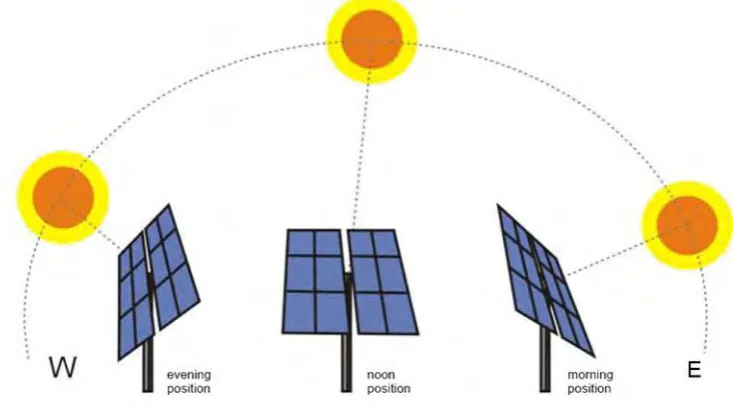
Conventional designs have limitation in maximizing the absorption of sunlight radiation due to the static orientation of the solar panel itself. The Sun rises from the east to the west, but some of the sunlight radiation is unable to be optimally captured by the solar panel. Blockage by surrounding buildings also influences the sunlight radiation absorption as well as the clouds.
1.3 Objectives
The objectives of this project are:-
a) To design and develop an automated solar radiation tracking system that is sustainable in Malaysia climate