AN APPROACH TO STRUCTURAL ANALYSIS by
Anthony R. Kjar B.E.(Hons.)
submitted in partial fulfilment of the requirements for the degree of
Doctor of Philosophy, in the Faculty of Engineering
UNIVERSITY OF TASMANIA AUSTRALIA.
INDEX
CHAPTER ONE Measuring geometry to obtain simple 1 mathematical models
CHAPTER TWO An outline of the instability problem 21
CHAPTER THREE A mathematical model for a through bridge 52
CHAPTER FOUR Refinements of the mathematical model of 96
the through bridge
CHAPTER FIVE The design of through bridges 119
CHAPTER SIX Torsion
154PREFACE
The purpose of this thesis is to present to the engineering profession a method of structural analysis which is peculiarly suited to the way engineers think. •The range and the power of structural analysis are extended by careful study of the actual deformations of structures, leading to the
formLulation of
simple mathematical models. The theme throughout this thesis is the deliberate effort to look for, and to describe characteristic shapes which define the deformed structure; general statements areobtained similar to the historically valuable models which
used "plane sections remain plane" or "radial lines remain radial". Once an appreciation of the deformations of the structure is gained, the forces to sustain these deformations are then found easily.
This is one of the oldest approaches of engineering analysis, and the most powerful methods of analysis of structures have been along these lines, Men like Galileo, Parent, Navier, Bernoulli, and Ooidoimb developed an appreciation of structural behaviour by looking for simple geometric characteristics which would describe the deformed shape of the structure. (We may note also that Kepler's purely geometric study of the motions of the planets paved the way for Newton's formulation of his laws). And today p when one tries to visualize and calculate the deformations of a bent beam, it is difficult to improve upon the first overall approximation that plane sections remain plane.
the stresses, and hence the overall statical equilibrium of the structure can be evaluated. With this basis on which thoughts can be focussed, the laboratory and mathematical models can be improved to be a closer
representation of the real problem. This approach reduces the need to test full—size structures, as the geometric functional form acts as the geometric scaling factor. When full size testing is carried out, model tests are still a valuable means of providing a quick overall picture. This picture can then be used to determine which important geometric deformations should be measured. At present, full—size testing, although expensive, is still necessary as the relationships between the strength
and the size of the material remain unanswered. Nevertheless, improve-
ments
in this field can be made; for example R.E. Rowe (Ref. 1) has shown that concrete mixtures can be scaled to produce the same geometric crack pattern as would be expected in the full—size structure.An engineer is frequently using approximate overall characteristics
of a simple model as a basis for obtaining further thoughts on the real problem. However, the inability to measure quickly the overall geometric deformations of a simple model has led to specialized full—size structural
tests, not by engineers, but by research workers. The aim of this thesis if to show how to use simple experimental studies to obtain simple,,.
mathematical models, and thus fulfil the sentiment expressed by Sir Alfred Pugsley (Ref. 2) that "Drawing and design office staffs can, and like to, play a part in the extension of their methods, and if they could do so directly, not only by theoretical but 1:y simple experiment, would welcome the opportunity".
The design of a through plate girder bridge is taken as the main
problem throughout this thesis in order to co—ordinate the whole. Existing mathematical models and methods of design are based on the ideas developed after the buckling failure of several through bridges
through bridges. An understanding of the problem is obtained from these model studies, and is used to develop a new mathematical model. The predictions of this new model are then compared with measurements
taken on a full—size bridge with strain gauge, spirit level, and rule,
and reasonable agreement is obtained. This new mathematical model is then used as the basis for recommendations concerning the design of through bridges made with light floors.
In Chapter One the author presents a case for measuring geometric
deformations as a means of obtaining a good functional form for the description of the structural problem. Simple and well known examples of stretched, bent, and twisted bars are chosen in order that the main features of the method are not lost in the process of mathematical manipulation.
Chapter Two begins with a detailed analysis of the structural
stability of a pin-ended column. This review is used as an introduction to the use of a characteristic geometric describing shape in the study of structures liable to buckling instability. It is shown that for many years engineers have recognized the values °fusing an infinite Fourier sine series (derived from the different: equation
describing the behaviour of the pin-ended column) to describe an arbitrary deformed shape. This method is useful when the structural behaviour can be represented by those differential equations for which sine functions are a solution. However, the existence of other
to generalize the well known plot, first developed by Sir Richard Southwell (Ref. 3)0 This generalization provides a link between the initial and final shape of the structure with the loadings on the structure for a large
range of structures liable to instability. With this sound analytical basis, reinforced with measurements taken on actual structures, the Southwell Plot becomes a more valuable experimental and design tool. The author believes that this generalization is original.
Chapter Three is the first of three chapters which are concerned with the design of a through bridge. In this chapter the measurements
taken on a simplified light through bridge are outlined. It is found
that the model through bridge is liable to lateral and torsional
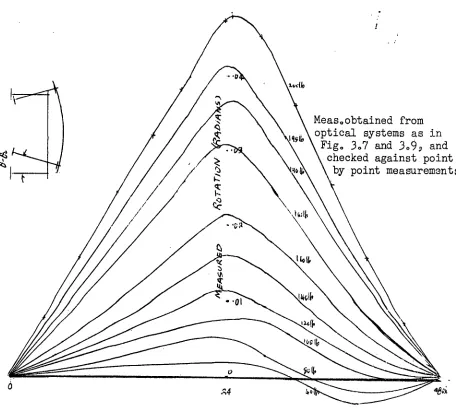
instability. A new mathematical model is developed to describe these lateral and torsional movements, and upper and lower bound solutions to the first buckling load are found. These loads and the corresponding buckling modes are shown to be a reasonable approximation to the measured results. Other original contributions outlined in the chapter include
Southwell Plots on
rotations and on strains suitable for use with the
new mathematical model for the bridge, a method for separating the first buckling mode from the measurements of the total deformed shape, and a method for finding lower bound solutions in some structural problems.
In Chapter Four the effects of minor additions to the laboratory and mathematical model are investigated. The first effect described is that resulting from the inclusion of web stiffeners inthelnodel through bridge. The inclusion of web stiffeners is shown to change only slightly the nature of the deformed shape, and to increase by only a small amount the buckling load. The second effect described is that of loadings
applied at points other than through the centroid of the I beam. It is shown that lateral and torsional loadings applied to the bridge can
In Chapter Five the author discusses the design of real through bridges. An examination of existing code recommendations indicates that there exists a large difference between these recbmmendations
and the measurements I,aken on the light through bridge (outlined in
Chapter Three). To gain a greater appreciation of these differences,
five additional model steel bridges are tested in the elastic and elasto-plastic ranges of deformation. A good fit to these model test results is shown to be the mathematical model developed in Chapter Three and, as a result of the understanding gained from these model test results a process for use in the design of
light through bridges is established. This design process is
then checked by comparing these predictions with measurements
taken on a full-size structure. In the light of these tests, design recommendations for light and heavy through bridges are
In Chapter Five the new mathematical model developed in Chapter Three is consolidated, and the limits of this model are found in relation to existing mathematical models for heavy through bridges. Also in the chapter a simple approximation to the buckling load is found, and the concept and use of a line of first yield using simple patterns of the deformed shape
of the bridge is presented.
In Chapter Six the range and the power of the method of functional form is illustrated by presentation of a description of torsion, as this problem of torsion arises naturally in the discussion of the deformations of the twisted and bent through bridge. It is shown that present methods to describe torsion depend on analogies (physical and mathematical), and at best describe shear stresses in terms of the slope on a thin film
membrane, or in terms of the solution of a high order differential equation.
twisted member.
Coidamb
(Ref. 4) used this approach and obtained the good approximation for a twisted circular bar that "plane sections, perpendicular to the longitudinal axis of the bar, remain plane". This approximation is a poor estimate of the deformations of a rectangular bar, and improving approximations could not be found. Later analysis of the torsion problem has therefore tended towards a more rigorous mathematiCal treatment. Nevertheless, further consideration of the deformations of the twisted section leads to the first approximation that for small angles of twist all straightlines originally parallel to the sides of the member remain straight
after the member has been twisted. The behaviour of many
twisted members with open and closed cross sections is investigated by using this basic approximation, and an original, complete, and simplepidture
of torsion is developed.
The research presented in this thesis is part of a continuing project in structural analysis being carried out under the direction
of Professor A.R. Oliver in the Civil Engineering Department, at the University of Tasmania, Australia. The author has been involved in this research from March 1965 to September 1967, and has been studying under a scholarship provided by Imperial Chemical Industries of Australia and New Zealand.
The author has published a number of papers and discussions concerning the research outlined in this thesis. A list is included at the end of the thesis.
Professor A.R. Oliver, the Professor of Civil and Mechanical
Engineering at the University of Tasmania, and
Dr. M.S. Gregory, Reader in Civil and Mechanical Engineering
at the University of Tasmania, and supervisor of this research.
The author has also had help in the form of correspondence, or
discussion from the following persons:
Mr. J.P. Hill, Chief Engineer, Maring BOard of Devonport, Tasmania Dr. M. Lay, State Electricity Commission, Victoria,
Mr. G. Sved,
University of Adelaide. Dr. N. Trahair, University of Sydney.Dr. C. O'Connor, University of Queensland, and Professor B. Johnston, University of Michigan, U.S.A.
I hereby declare that, except as stated herein, this thesis contains no material which has been accepted for the award of any other degree or diploma in any University, and that, to the
CHAPTER ONE
MEASURING GEOMETRY TO OBTAIN SIMPLE MATHEMATICAL MODELS
101 Introduction
The formulation of any engineering problem is very conveniently
thought of as containing
accythree phases, (Refs.
5
and 6), These
ares the real problem, the physical models, and the mathematical models. The real problem is initially a vague and undefined notion. It May be the "investigation, design, and construction of a bridge", while one of the physical models could be described as the bridge
structure itself ) or the simplification of it used for structural
design purposes. The bridge structure
may
have a certain type and
number of beams, columns and decking, and the physical model is often further defined and simplified in such a manner as to be more amenable to description. Any description of the behaviour of these physical models which depends on logical analysis is called a mathematical model. In engineering analysis the mathematical and physical models are gradually modified and used to formulate and describe the real problem and enable a reasonable mathematical model to be obtained.
All structural analysis is necessarily approximate, and to obtain a mathematical description a functional relationship must be used to connect some of the variables. A specific example is the stress-strain relationship used in structural analysis. It is rarely fruith4 for the structural analyst to question the nature of the mutual attraction of molecules or even to use the Newtonian functional description of the problem, that is that there are mutual forces of attraction between molecules which can be described approximately as varying in terms of the inverse of the square of th4 distance between the molecules. For most
structural analysts this description is far too specific and it is sufficient to try to describe the overall stress and
interpolation. Fortunately, the functional description of this relationship for some materials is sufficiently well described by
straight lines over part of the practical range of strains. Since all structural analysis is approximate, there exists a variety of ways in which the variables of the problem can be considered and manipulated. The method presented in this thesis
is one in which a pattern is_used to link the important deformations
of the problem. This pattern, obtained from detailed measurement of model structures is described in terms of an analytic function, or functional form. With this overall estimate of the deformations, the forces to sustain the prescribed shape are easily found.
This is one of the oldest approaches of engineering analysis and the most powerful methods of analysis of structures have been along these lines. However, the source of the power of the method is not generally recognized. To show that the source lies in the use of a functional form or pattern to describe the deformations of the
structure, a few historical estimates of the deformations of a
bent beam are outlined.
1.2 The Beginnings of Structural Analysis
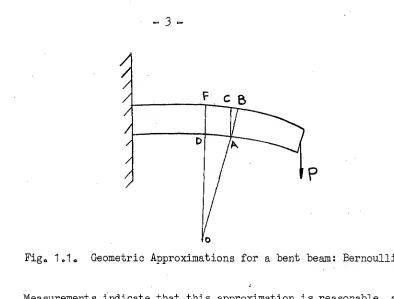
Structural analysis had its beginnings in the seventeenth century when mathematicians and geometricians like Mariotte and later Leibniz, Varignon and the Bernoulli brothers (Ref. 4) made approximations with regard to the displacements of bent bars. Jacob Bernoulli, when trying to calculate the deflections ofa loaded cantilever took the deflection curve as shown in Fig. 1.1.
Fig. 1.1. Geometric Approximations for a bent beam: Bernoulli.
Measurements indicate that this approximation is reasonable, as the cross section AB remains reasonably straight. However, we now know that a better approximation for the line of zero strain is obtained by assuming that the cross section rotates about some point inside the beam, the position of this point depending on the particular material and the way it deforms under load.
Bernoulli's approximations allowed advances in structural
analysis and the calculus was used to further the study, particularly the Euler column theory. A unified approach was made by Parent and later by Navier using the approximations that cross sections remained plane to describe the bending of plates and bars.
Later mathematicians developed more complicated models to describe the behaviour of structural elements, but they incorporated the smallest possible number of geometric approximations regarding the deformed shape. These developments have led to the mathematical approach involving stress function solutions, biharmonic solutions and high order differential equation solutions.
Improved mathematical models(using the mathematical approach) are obtained when a decrease is achieved in the number of
approximations needed to specify the geometrical deformations, or when further account is taken of the complexity of the functional dependence of stress and strain, or when further
The aim of a mathematical approach is then to make minimal assumptions or guesses of functional dependence, and to develop a complete description of a defined problem from a system of basic axioms, without the need for an appreciation of the deformations of the structure.
The mathematical approach is often useful in obtaining
numerical
solutions in particular cases, but because of their inherent generality, it can be remarked that
(a) often little understanding of geometric deformations, and load carrying meelanism of the problem is achieved, and hence methods of strengthening the structure are difficult
to visualize,
(b) a complete mathematical solution must frequently be obtained before useful information is available,
(c) allowance for second order geometric deformations is often not appreciated,
(d) as
regards teaching methods ) an engineering attitude is not
encouraged and a great deal of time is spent on merely illustrating a routine mathematical calculation.
As a means of overcoming these objections it is useful to look back in history and to glean a few ideas of how the advances and
simplifications in structural analysis have been made. When we do so we often find that these advances in analysis have been achieved by the use of approximate descriptions of displacements, and as a
result the mathematical complexity of the problem has been considerably
reduced.
Throughout this thesis it is shown that patterns or characteristics of the geometrical deformations of structures, (such as displacements and surface slopes)enable good descriptions for a range of structural problems. Analytical functions are used to describe these geometrical characteristics, and from these functions, strains are defined. Estimates for load
deformation relationships are used to define stresses and from an integration of these stress patterns the forces which must be applied
This inverse method has the advantages that the mathematics remains simple. At each stage of the computation the physical
significance of the geometrical approximations of functional
dependence is obtained very clearly, giving a deeper insight into
the effects of the geometrical deformations and the assumptions which have been made about them. This insight Tiables a good appreciation of the structural behaviour to be developed, and quick and reliable estimates of the effects of stiffening the structure 4e-ee-mErde., or of lightening if it is unnecessarily strong in some places, can be made.
1.3 Using Patterns in the geometric deformations to obtain simple Mathematical models
1.3.1 Measuring Devices.
In this chapter the use of geometric information obtained by moire techniques is discussed, particularly measurements showing the position of lines of constant displacement in the plane of the model
(Ref. 7) and the position of lines of constant slope on the surface of the model, (Ref. 8). Later in the thesis these ideas will be applied to measurements of an overall shape obtained from many point by point
measurements.
Overall detail of geometric deformations using the moire technique is a particularly suitable set of measurements for the -following reasons.
Geometrical effects are always separable from other considerations and a deformed shape can always be drawn without any consideration as to how this shape was obtained. Considerable information can thus be obtained before concepts of stress and statical action
are introduced, the reasoning being thus simpler and more
straightforward than that obtained by introducing stresses
too early. Variables of statics (force variables) are frequently not separable.(b) Lines of constant slope and lines of constant displacement are
easy to obtain. The patterns suggested by these contour lines
are usually simple, and suggest the nature of the functional
form. As they are direct measurement of deformations they can then be used to establish a simple mathematical model. The order of complexity of the model is then determined by the approximations made of the deformed shape of the structure. (c) The shape of the moire fringes (or contours), can be used
to suggest structural behaviour which is common to various structural models. When the same functional form is a good fit to different size models, then the functional form is
the scaling function.
(d) The whole outlook is concentrated on the production of simple descriptions of the load and deformation behaviour, and is thus suited to an engineering approach. With this outlook, simple models, suitable to be incorporated in codes of experience or practice, are always kept in mind. In the following sections very simple structural problems are investigated as a means of showing that the measurements of the geometrical deformations of displacements and deflections can be used to obtain simple structural models. Theearly problems are
-.7 —
manipulations involved in the process. It is well known that
the shape of an element of a stretched or bent bar, chosen with sides
parallel to the edges Of the undeformed bar, is approximately the same
as the deformed bar. These siiple problems are described in terms of a geometric functional form. The simple model for a twisted thin rectangular strip that specifies that the shape of the element is the same as that of the deformed bar is then an easy extension.
1.3.2 A Simple Model for a Stretched Bar.
A rectangular bar is stretched longitudinally. This problem is obvious to the structural analyst; however this simple problem is useful to illustrate the basic ideas*
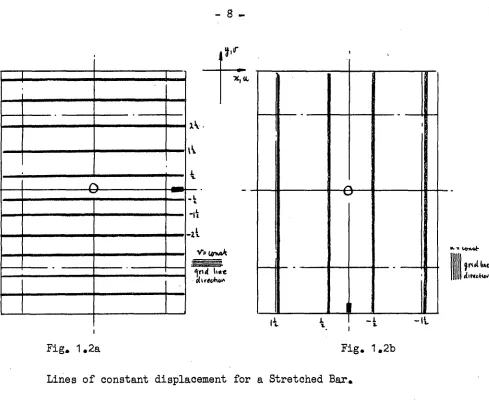
Measurements of lines of constant displacement (u 2 v) in the x 2 y directions are shown in Fig. 1.2a, and Fig. 1.2b 3 The
method used is the method developed in recent years -by Oliver, Jenkins L and Middleton at the University of Tasmania, and Outlined in Ref. 7. For completeness, the optical arrangement used to view the
interference pattern is shown in Fig. 1 0 3iland the interference fringes resulting from rotation 9 strains, and combined rotation and strain are shown in
Fig. 1.3b.
A good analytical description of the shape of these lines of constant displacement is given by the functionsu = y/a
and v = x/b 2
Fig. 1.2a Fig. 1.2b
0
MM. iricl
• Oliver-416A
tk.
0*. =
frtil kAL
Lines of constant displacement for a bent beam
Fig. 1.4a Irs1:1-,t1
Lines of constant displacement for a Stretched Bar.
1.3.3 A Simple Model for a Bent Beam.
Measurement of the surface deflections for the thin beam bent in a manner indicated in Fig. 1.4a indicate that the beam has single curvature in the longitudinal direction. Measurement of the lines of constant displacement u, v in the x, y directions Fig. 1.4a and 1.4b indicate that good approximations to the displacements are
U = a1 x5r (hyperbolic) and v = b1 x2 (parabolic).
(1.2)
collimator field
lens lens slit light
source
model reteren ce
screen
Fig. 1.3a Optical arrangement used to view interference patterns.
59 lines per inch
(a) ROTATION ALONE
(b) DIFFERENCE IN PITCH ALONE
(c) COMBINATION
OF ROTATION AND DIFFERENCE IN PITCH
51 lines per inch
-.9 -
.17
These estimates of U, v are particuldrly simple and as they have been expressed algebragially they may be said to express the functional dependence or the functional form of the displacements.
(-
The strains
E
x 3 ye
in the x, y directions respectively and the shear strain )( consistent with this function form, areu
xy
calculated from the approximations for small strain
e x = /ru/6 x
=
and = -ou,Aoy + -av/ax p
(1.3)
and are given by the equations
ex = ay
e = 0
(1.4)and oxy = (al + 2b1 )x,
For the bent beam, the stresses consistent with the
functional form (1.2) are
= (E/1- 2 ) al
y0**1 = (E/1-12) al y (1.5)
'try.
= G(al + 2b 1 )x •The forces necessary to sustain equilibrium are obtained by integration of these stress patterns and are given by the well known equations (using unit width of beam)
Axial load:
Vertical shear:
Bending Moment:
Px = (E/1-i2 )a1 y dy = 0 .41
Py = + 2b1 )x dy = 0
M = c(E/l -i2 )a1 y2 dy
the complete beam
- 10 -
where
= (E/1- 2 )a1 I 1 I = y2 dy.
-4.ot
If no total shear, P is applied, the relationship between constants a
1 and 2b1 can be found. Then, P = 0 gives a
l = -2b1 • (1 7)
The equation (1.7),when substituted into the last equation of (1.4) ) indicates that with the guessed functional form and the specification of no total shear we arrive at the obvious statement that the model is one for which no shear strains are present.
To sustain this deformed shape, a constant bending moment M given by the equation
M = (E/1 4) al I y (1.8)
must be applied to the beam, and the displacements of the section will be
u = (M/EI) (1 - 2 )XY
and
v
= -4(M/EI)(1-)2 ) x2
(1.9)
It can
be seen from Fig. 1.4(A) and equation (1.2) that thespecification defines that plane sections perpendicular to the longitudinal axis before deformation remain plane and perpendicular to the longitudinal axis after deformation, and thus the shape of a small element chosen with sides parallel to the beam deforms in a
similar shape to that of the whole beam (Fig. 1.5), as Bernoulli assumed.
Dkria,b i4r3k44., 1==ast ri 11 d foie
Fig. 1.6b 1.3.4 A Simple Model for a Twisted Strip.
Measurement of the surface slope of a -twisted strip was carried • out by using the Ligtenberg moire technique (Ref. 8). This technique is simple and inexpensive to use. A brief summary of the technique is given in section 3.2. The measurements indicate that lines of
constant slope in the x, z directions can be delcribed approximately
by
a seriesof
equallyspaced straight
lines, as shown inFig. 1.6..
Thus a good approximation to this surface shape is obtained by examining the form of .the vertical deformation w in the direction of the y axis, and is given by the equations
"bw/ax = kz, and 1!Jhz = kz
Fig. 1.6a
—1
kria,=u-mk
1101:41
hoe cliteotwetLines of constant slope on the surface of a twisted strip
Integration of equation (1.10) and choice of axes in the centre of the strip leads to the specification of the functional form defining the deflection of the surface as
— 12 —
, that is an anticlastic surface, with zero values for the curvatures
i
w/bx2 and 212w/z2 in directions perpendicular and parallel to the axes. However, rotation of axes by 450 to xl 1 z i gives the deflection as/k(4 —
and the curvatures of "w/a4 and iw/az2
1 as equal in magnitude
but opposite in sign. As the investigation of the effect of transforming the axes is carried out on the mddel, or with the model deformations in mind, a better appreciation of the geometrical deformation is obtained.
Measurement of the surface displacements in the x z plane on the top and bottom surfaces of the strip by the method of Ref. (7) indicates that both these surfaces are in approximately pure shear but with
opposite sense. A slight inclination of the v lines indicates that a small amount of longitudinal strain is present, (Fig. 1.7a, 1.7b). In this first model we take the lines to be straight and parallel, and thus not consider the shortening of the member.
Fig. 1.7a Fig. 1.7b
/
LIBRARY
— 13 —The functional form suggested by the lines of constant displacement
is
U = CZ
V = CX
and the only strains on the surface of the strip in the x, z plane are shear strains )1 given by equation (1.13) that is
u xz
(1.13)
The approximation that, straight lines .originally perpendicular
to the wide flat surface p of the strip through the thickness remain straights after deformation, indicates an element shape as shown in Fig. 1.$.
As all lines parallel and perpendicular to the sides of the strip have again remained straight after the twisting, our experience with examples 1.3.2 and
1.3.3
suggests that we try the estimate that the shapeof the element in Fig. 1.8 is similar to the shape of the strip ..' This estimate of the shape of the strip specifies the internal displacements. Each plane originally perpendicular or parallel to the longitudinal line of the strip warps into an anticlastic surface, (Fig. 1.9).F = Mxy/b = Myz/
0
(1.15)either F system or M system Fig. 1.10
— 14 -
The rotations da and d0 of one element relative to an xy yz
adjacent element or one warped cross section perpendicular and one warped cross section parallel to the longitudinal axis, relative to another
warped cross section is found from the element shape in Fig. 1.8. These rotations are given by
d9 xy 8 dz/it $
and dg yz =11 s dx/it )
and the geometric deformations are completely specified.
The only stresses needed to sustain the shape of this deformed
element are shear stresses, which can be specified bylr = G W • The
total forces required to sustain the guessed shape are two sets of twsiting moments M , M as shown in Fig. 1.10. Integration of
NY Yz
the stress patterns indicates that the magnitudes of these
twisting
moments are
M
xy
= [*b -t -2
5
t] G[t
3
b/6](d9,
y
/dz),
( 1 .14)and Myz
= t] =
G [t 3i/63 (dOxy/dz) .These twisting moments are statically equivalent to a balanced point load system, as the twisting moments per unit: length Mxy/b and M
yz dare equal. The applied force F, is given by the equation
— 15 —
Thus ., we obtain the well known relationship linking the end torque Fb with the twist of any element of the section,
Fb = [t 3b/31 (d9v/dz). (1016)
In Chapter Six, this simple model is extended to include the tapering off effects of shear strains at the corners,to describe the geometrical deformations of any rectangular bar
that has been twisted ) and to include the shortening effects
of twisted membersa
It can be seen that the examples chosen are particularly simple, but are basic. Examples, using the twisted strip as the basic element) are now considered to illustrate the power
and usefulness of simplg functional descriptions of the geometric
deformations.
1030,5 A Simple Model for a Twisted Member Built up. from Flat Strips.
Measurement of the' surface shape of an angle section
twisted by applying four balanced forces on one leg of the angle, indicate that the surfaces deform into shapes which are approximately anticlastic *. The angle between the legs in the plane of the cross section is almost preserved. .A simple model to describe this behaviour can be obtained as follows.
- 16 -
A cut is made in the joining corner as shown in Fig. 1.11, and the surface shape measured as before. It is found that each of the sides still deforms into a simple anticlastic surface, but that the angle between the legs increases slowly, as the slot length is increased.
The results summarized in Fig. 1.12 indicate that a proportion of the moment applied on one leg is transferred to the other leg within a very small region of width, approximately ten times the thickness of the
strip. Away from this region a good approximation is to consider the two strips as acted upon by separate sets of forces,the size of the forces
being in direct proportion to the width of the leg. The end torque
twist relationship is thus
Fb 4500] (delv/dz) • (1.17)
1.3.6 A
Simple Model for a Twisted Stiffener in a Twisted I Beam.
Repeating the tests of section 1.3.5 but using an I beam as the built up section,indicates that a similar model can be used, as all
surfaces on the I beam again deform in a manner which can be described
adequately by the simple anticlastic surface.
When a light transverse stiffener is placed between the flanges, as shown in Fig. 1.13, and the I beam twisted, it is found that the
I beam again deforms in approximately an Snticlastic manner. Measurement of the surface shape of the stiffener also indicates that the deformed shape of the stiffener can be described adequately by a simple
,•1 tU • G. ley
+10,ci4l■essi em% • GOY
Fovtes P Pi, a
0.4 cog 0°
Ca
— 17 —
•ow le.ok O. •„,embe,
Fig. 1011 Forces Applied to the
angle section.
Fig. 112, Plot of twist and slit length
light end stiffener
Fig. 1.13. Forces applied to I beam - stiffener arrangement
f
ES=
KAI,
Fig..1.14 Forces necessary to sustain the stiffener as an anticlasti.c surface
— 18 —
Application of the bimoment to the end of an I beam twists the entire I beam and bends the flanges of the I'beam. * When length
t
of the I beam is short and the width of the flanges b is largei a simple model describing the behaviour is obtained by application of the bimoment to an I beam built from three flat strips, and joined only at the corners Of the flange (Fig. 1.14).Measurement of the surface shape indicates that a reasonable approximation is again the anticlastic surface, with no cross sectional distortion. The forces 111cessary to sustain the anticlastic shape are shown in Fig. 1.15, and are statically equivalent to the bimoment.
Thus, the applied bimoment B and the twist of the I beam can be related by the equation
B K h b = G[t
3
b/3]
,
e (deridz) . (1.18)
A description of the effect of the stiffener can be found using this model. The stiffener slightly reduces the magnitude of the twist, but the overall characteristics of the deformed shape (that is the
shape can still be described in terms of anticlastic surfaces) are not altered. The end torque twist relationship for
the I beam and
stiffener is given by the equationFb = GJ/[1—t.jSTIFF° GJ)] d9,/dz.
- (1.19)
— 19 —
1.4 General
Comments.
In the very simple models discussed it has been shown that the
determination of scaling factors is inherent in the choice of the
geometric functional form used to describe the geometrical deformations. Thus the problem of scaling, that is of relating the behaviour of the small scale model to the behaviour of the full size structure reduces to the problem of choosing a satisfactory functional form. If, when a particular model is studied closely, doubt arises as to whether the geometric deformations measured are a property of that particular size of model or of that type of structure, the problem can be overcome easily by testing several models of different sizes.
The choice of a functional form is especially suitable in any analysis when linear, quadratic or sinusoidal dependence relationships can be established, and when searching for a describing characteristic it is important to measure variables which highlight these types of dependence.
Throughout the history of engineering analysis, functional forms have often been used to describe characteristic features of similar problems. For example, empirical rules have long been used in
engineering with considerable success but have usually been restricted to describing a final state, rather than a form or observable 7lattern that is obvious in the early stages of the description of a problem. However a notable example in structural analysis of using a functional form to describe geometric deformations is the "plane sections remain plane" rule for the bending of beams in metallic or concrete
- 20 -
to describe geometric displacements has been proposed by J.K. Wilkins (Ref. 10) who uses it as a means of describing and designing for the behaviour of the concrete or bitumen waterproofing layer on the upstream face of decked rock fill dams.
Energy methods of structural analysis are another important use of guessed and measured functional forms of the deformations of the structure. The energy process based on potential energy is merely an averaging device where certain averages of some of the equations of statics are satisfied and are used to obtain good estimates of the
variables within the functional form. However, in much modern analysis the functional form chosen is usually an infinite series of sinusoidal waves. Unfortunately, in many problems one or two sine waves are not a good functional description of the deformations, and thus when the infinite series (with no single term being dominant) is used, an
appreciation of the deformations is often lost within the mathematical manipulation.
*
Throughout this thesis a deliberate effort is made to look for and describe characteristic shapes which define the deformed structure. The method is used first to gain an understanding of the problem of
buckling instability, and a detailed study is made to show that the existence of characteristic shapes can be used to describe this
- 21 - CHAPTER TWO
AN OUTLINE OF THE INSTABILITY PROBLEM.
2.1 Introduction
The cabestion "Is an engineering structure Is stable under
the action of the applied loads?" is a question which is easily asked. However, to provide a satisfactory answer, a good appreciation of the possible deformations of the structure is necessary, as the stability of a structure is some measure of how the deformations of the structure increase as the loading of the structure is increased.
All structures deform under the action of loads, and the
actual form of the deformation is often the important criterion. Consider, for example, the determination of the stability of a dam. The dam is considered unsatisfactory, or unstable, if the loadings on the dam cause the dam to lift or to overturh. The problem still remains of how much to alter the dam design so that the new shape is stable, and engineers sometimes design the dam so that the joint between the dam and the foundation is everywhere in compression
over the complete range of design loads. However, this is not always a satisfactory criterion of stability, as we find when we try to estimate the stability of an axially-loaded slender column. When the column is loaded, points on the column deform in a direction approximately perpendicular to the applied load. One measure of the stability of this structure is by what amount the structure deforms when the load is increased.
This Chapter will be mainly concerned with the problem of the stability of fritme and plate structures. In these cases,
instability may be considered to be the phenomenon of the occurrence of large relative changes in the geometric deformations of the
- 22 -
The Chapter is designed to re-inforce and add to the existing work on structural stability as outlined by Euler (Ref, 4), Southwell (Ref. 3), Gregory (Ref. 11 and 12) Ariaratnam, (Ref. 13), Crandall (Ref. 1 4),
Courant and Hilbert (Ref. 15), and Miklin (Ref. 16). Particular attention is focussed on the description and measurement of deformed shapes and of buckling loads and the Southwell Plot, first used by Southwell (Ref. 3) to estimate the first buckling load of a pin ended column, is generalized
for a range of mathematical models. Although the mathematical manipulations
used are well known by mathematicians, engineers have not taken advantage . of the power of the methods used, and the author claims originality for this generalization of the Southwell Plot.
As a first step in the discussion of structural instability,
the well known and simple model of an axially loaded column
isconsidered. The description of the behaviour of the loaded column is similar to the approach developed by Gregory (Ref. 12) •to describe general buckling phenomena in terms of the simple example of rigid rods and lateral eprings. However, the column example has been chosen to emphasize that a continuous system can be thought of in the same manner
as a discrete system. Often it is easier to evaluate and find, properties
of the discrete system and then carry these properties over to the
continuum. Hence, the well known column
example is
outlined thoroughly
and the ideas obtained are then used to develop generalizations.
2.2 A Simple Model for the Axially Loaded Slender Column
The design of an axially-loaded slender column will be considered. The first step in this design process is to obtain a description of the deformations of the system. It is well known that
- 23 -
The simplest model chosen is shown in Fig. 2.1. This simple and well known model consists of two equal uniform rigid straight rods, joined by a spring which resists the jangle change between the rods. The rods are compressed by thrusts which remain axial, and the ends
of the rods are considered as pin-ended. This particular model
is such that all geometric deformations can be described by oneparameter, the central deflection of the rods.
Fig. 2.1. Rod and Single Spring Mechanism.
Examine the stability of the system when a small lateral perturbation y of the hinge is applied. The central lateral
deflection y is sufficient to describe the deformed system,
consisting of two straight lines and a central hinge. The change of angle
9
between the two straight lines at the hinge is, for small values of the lateral deflection0 = 4y/i
(2.1)The forces to sustain the deformed system are then found easily. Let us specify a linearly elastic rotational spring. The load deformation relationship is then a relationship(in this case called the spring constant k) between the change of angle at the hinge and the moment M developed by the hinge. The required relationship is
M = k
hinge deflection is undefined
d P= 414
- 24
The conditions for the system to be in statical equilibrium can then be found, as the moment M developed by the spring must be equal to the moment of the applied axial load P taken about the spring. Thus a we obtain the mathematical condition for statical equilibrium, namely,
M - py = 0, (20)
and using equation 2.2 1 we obtain an equation showing the relationship
between the deflection and the load, and
(44 ,
F)y = 0 . (2.4)A
mathematical solution to equation (2.4) is obtained from
inspection: either y = 0, that is the column remains straight, or,
at
a buckling load P given byP = 41cte
the deflection of the hinge is undefined (Fig. 2.2). Nevertheless the form of the deflected shape is defined and consists of the two straight lines with a central hinge (Fig. 2.2). This form is called the buckling mode.
load
— 4k/g deflection of the hinge is undefined, y = 0 but the shape of the
mechanism is defined
deflection of the hinge
deformed shape • at P = 414
Fig, 2.2 Behaviour of the Mathematical.Model
- 25 -
A
closer representation of the real problem is obtained by modifying the physical model shown in Fig. 2.1 to include thefollowing: initial crookedness of the column', an increasing number 0?
hinges, and allowance for second order geometric deformations,
non-linear load deformation relationshipsand a closer specification
of the loading and boundary conditions. In the following sections, methods which include each of these effects in a large range of mathematical models are examined, and it is shown that a close representation of the behaviour of many real structures subject to instability is obtained.
2.3 Initial Crookedness in the Mathematical Model
The inclusion of initial crookedness in the mathematical model is a worthwhile and well known improvement and adds to the
understanding of the real problem. Suppose the initial lateral
deflection of the rods is yo , and the rods between the spring remain straight.
The geometrical estimate of the deformations is again determined by the central lateral deflection. The initial rotation of the hinge
Goe ,
is given by the equation9
0
=
4
wv,1
The load deformation relationship is dependant on the change of angle between the two straight rods, and is
(2.5)
= (414)(Y - Yo) *
y = 0.025 ° 0.05
001
—26.
('
4
/2)(y y0) P Y =(2.6)
The deflection of the hinge is obtained in terms of the applied load and initial deflection, and we have
(2.7) = Yo/(1— Pir4k) 0
This mathematical model (equation 2.7) indicates a steadily increasing deflection of the hinge for loads ranging from zero to close to the load given by
P1 = 414 a
This load P
1 , called a buckling load in the previous model, is a good describing feature of the two physical models. In Fig. 2.3, a range of values of initial crookedness is plotted and it is seen that for very
small initial crookedness values the two mathematical models expressed by equations (2.4) and (2.7) are similar.
load
P = 414
CO 0.5 1.0
Deflection of the Hinge
Fig. 2.3. Equation 2.7, with a range of initial crookedness values.
= (_/o.4
andC
Z
t
2
1'40
-
C.Leand
(-1.5k/t)y1 that is in matrix notation
+ (3k4-1) )y2 o 9
— 27 —
2.4 An Increase in the Number of Hinges.
2.4.1 Two Hinges.
A closer representation of the behaviour of the column is obtained by increasing the number of hinges. When the number of
hinges and springs is increased by one, as shown in Fig. 2.4, the
geometrical relations between the angles
9
and9
and the corresponding2
deflections, yi and yz 1 (for small lateral deflections) are
(2.8)
Fig. 2.4 Rod and Two Springs.
The moments sustained by the linear elastic springs are
and
M
2 = kg2
The conditions for statical equilibrium are found by considering the equilibrium of the two rods separately, that is
M1 - PY1 = ° 9
and
M2 — PY2 = *
Combining equations (2.8), (2.9) and (2.10) gives the system of linear simultaneous equations that must be satisfied if the system is to remain in statical equilibrium
(3k/2— P)yi — (105k/Cy2 = 0
(2.11)
(2.9)
load or simply
-
28
-
.3
1
4-
P -1.5k/yi°
[1.51Ve 3kAt-P =
A ][y =
The solution of these two linear simultaneous equations is given either by the trivial solution that the hinges do not move, (y1 = yt= 0,)or
(34- p) 2
(105k/e)2 = 0 9 (2.14)that is the determinant of [A] is zero. The two non trivial values of load which are solutions of equations (2.14) are either P, = 1.5ka or
Pi = 4.5
kLe ,
and the corresponding buckling modes can be determined from the lateral deflection ratios of the hinges, = ;and = -(Fig. 2.5).
P =
1.5k/Deflection of a hinge
Fig. 2.5 Behaviour of the Mathematical Model 2.13.
2.4.2. Initial Crookedness and Two Hinges.
A method to describe the effects of initial crookedness may now be obtained by use of the buckling modes for the initially straight structure. When the initial crookedness consists only of initial lateral crookedness at the hinges, two variables are needed to specify the shape. A linear combination of the two buckling modes is used to describe this initial crookedness.
An initial crookedness of the form yip= 1.0 , 49= 0.5 is expressed as a linear combination of the buckling modes, and
,
Aitgasn't
Loom'
1 .
0 [1.0I
{ 1
.01
0.5
1
a
1.0
a 2
—1.0
(2.15)
— 29 —
initial first buckling second buckling crookedness mode: symmetric mode:antisymmetric.
The constants a and a are found easily by multiplying by the 1 2
transpose of the column vectors
ii-o
t. 01 and 1-0 respectively.
Then [1
0
0 1
0
01 1.0 = a
l
[00 1061 100 + a2t.]:80 100,„.6
2.16)
0.5 1.0
That is 1.5 = 2a, + 0 a lor a = + 0.75. Similarly, a l.= 0.25.
The initial shape, in terms of the buckling modes, is therefore
1.01 1.0 1.01
0.5 11.0] -1.0
= 0075 + 0.251 (2.17)
The separation of the initial crookedness into a combination of the buckling mode components is useful in the
solution of the mathematical model for the initially crooked
structure, as it indicates the way in which the structure deforms.The mathematical model for the initially crooked structure consisting of thrbe straight rods and two hingeA ie obtained in a manner similar to the one hinge case. The initial rotations
9
go to and 0 are linked to the initial deflectionsand yzo by equation (2.8). The load deformation relationships are then
14
1 =
1
091 —ai d= (44)(Y1 — Y10)
(2.18) and
M2 = (414)(Y2 — Y20) °
For the structure to be in statical equilibrium, the moment
resisted by the springs must balance the applied moments (equation 2.10). On substitution of equation (2.18) into (2.10) we obtain the equations
-.30 -
310,- P -1.5k/ZIyf - 3k/j. -1 14
°5 Y11 314 - y21 -1.5ka 1a 3,
20 .
(
2
019
)With values for the initial lateral crookedness of the hinge s(y lo and y20) as 100 and 0.5,, equation (2.19) becomes
P -1.51y1
[34
-1.511.0] -1.5k/11.01= 0.75 +0.25
1.54 -P y2 -1054 - 1.0 31cLi 1.0
The right hand side of equation (2.20) is simplified by using the two solutions of equation (2.12), which are
[-
34 .
-1.5k/1
[1.
0
1 =
1.5k/t
L.0]-1.5ka 3ka. ' 1.0] 1.0
[3
kte.
-1.5k11.0] =
4.5
k/e
and
{1
.0
The left hand side of equation (2.21) is simplified by separating the final shape into a linear combination of the buckling modes, and
1. Y2
1 [1.01 + b2
[ Y11
= b 1.0
[-1.0 1.0
Then; from err..-a".1 , (2.20), (2.21) and (2.22) we have the equation
+ [1.0
1.0
[1.0 I
VW* _1.5kze 3ka -100
b
1
[ 3kAt- P -1.5k1[1.0 1.0
..1.5k/€ 34-p
_ P -1.511.0] [
34 4
b2 • -1.5k/2
314 -P which simplifies to
P) 1
]
1.0
l.01.
1 0 .
0,75(1.5k/2) 0 . 25(4.54) 0.75(1.5ka) (2.21) (2.22) (2.23) (2024)
b2 (4.5k/I- p)
{
1.01 0.25(4.5k4) 1.0
-1.
0i
61.01,
Equating terms with the same buckling mode, we obtain the values of the•
two buckling modes, and
1 =0.75 (1.5k/e)/(1.54-P) (2.25)
and b2 = 0025 (4.5k4)/(4.54- P).
- 31 -
buckling modes of the structures, and
0075/(1-Pi/105k) 1.0 + 0.25/(1- 14/4.5k) 1.0
(2.26)
Y2 1.0 -1.0 •
final deflections first buckling mode second buckling mode of the hinges co-ordinates of the co-ordinates of the
hinges hinges
The predicted behaviour is shown in Fig. 2.6. For loads less than the first buckling load, the deflection always increases with load, and has the same sign as the first mode initial crookedness. However, because of its discontinuous nature the buckled shape is still not an adequate description of the shape of the deflected column, and thus
it is necessary to increase the number of hinges
)
deflection
Fig. 2.6. A Graph of Axial Load and hinge deflection, for the initially crooked column.
2.4.3 A Farther, increase in the Number of Hinges.
The number of hinges can be increased indefinitely. In the continuum, the change of angle per unit length along the bar is approximated by the lateral curvature (d 2y/dx2 ) of the bar, and the moment rotational deformation relationship is related by the flexural
-32-
El d2y/dx2 +
P
y = 0 . (2027)The behaviour of the mathematical model (2.27) near the end of the bar is obtained separately. To be of value these descriptions should be at the same level of approximation as the differential equation itself. For the differential equation model of the slender column, the boundary conditions are *
x = 0 and y = O. (2.28)
The solution of the differential equation (2.27) is
y = A sin- x /177ET +. B cos 4177EY (2.29)
and
with the boundary conditions (2.28), particular solutions are obtained.Use of the boundary condition x = 0, y = 0 gives B = 0, and the .boundary condition x , y= 0 .gives
0 = A
singl—P7E
9 (2.30)that is either A = 0, and the continuous system remains straight, or the
deformations of the system are sustained by a load given by the equation
0
= sin
/1771
(2.31)i.e. p = n272E142 . where n = 0, 1, 2, 3,
4, . 0 .
These discrete values of load are called eigen values, latent rqots, buckling loads or, as this particular family was found by Euler, Euler
buckling loads. To each buckling load there corresponds a buckling mode (which is found by substituting into the equation) and the eigen functions, latent vectors, or buckling mode are
buckling mode y: sinTrx/e sin
21iv2
sin31* )V.e
buckling load P:
72Eviz
2
9 41PEI/t2 9-11EIX,e2 9 o o
-33—
2.4.4 Describing Initial Crookedness in the Continuum..
A description of the effects of an initial crookedness of the continuous column can be obtained by using ideas obtained from the systems which had only a finite number of variables. For example,
including the initial crookedness in the mathematical model for the
continuous column, we obtain the differential equation
EId2(y— y o )/dx2 +
P
y = O. (2.32) Again the aim is to describe the initially crooked shape as a linear combination of the buckling modes. Southwell (Ref. 3) first developed this method for the pin ended column, but for completenessand to outline the method the solution is given below.
The existence of a unique linear expansion for the initial crookedness yo , is used, that is the initial crookedness is expressed as an infinite series expansion
ao y
o = n sin nrx/t (2.33)
,A=1
This exapnsion is the well known Fourier Series and the justification and properties have been investigated by many authors
(see for eianTle Miklin, Ref. 16).
The coefficients a w are found by multiplying both sides of equation (2.33) by the Ta buckling mode, and integrating over the length of the structure. Then
t 60
f
1
Yo sin mlix/t dx = Ian isin nWX/e sin mir x4 dx . (2.34)
0 rk71 0
As before, the product of two different buckling modes is zero. This property is called the orthogonal property of the buckling modes and enables a simplification of equation (2.34). The value of a is given by the ratio
a
m = ify sin miTxa dx o fn dx
—34—
The final shape, y and the initial shape ya are expressed as linear combinations of the buckling modes,
00 y =
n sin n7x/e (2.36)
n'■=1
and
00
Yo = an sin niTx/e e
(2.37)
Equation (2.32) is simplified using equations (2.36) and (2.37) and becomes
00 co
EI(bn-an )d2 (sin nwx4)/dx 2 + Pbn sin nrx/e = 0 But as
El d2 ( sin nirpa)/dx 2 + n2 ir2EI/t 2 sin nr)(49e = 0
then
22
(bn an)sin nr4 + Pbn sin mile= 0.N=I 117-1
(2.38)
(2.3
9)
(2.40)
Equating terms with the same buckling modes, we have on simplification
bn = an/(1-P/Pn ) 9 where Pn = n2 ir2EI/i2 (2.41)
The final shape, given in terms of an infinite series expansion of the
buckling modes of the initially straight system, is
y = [a1 )(1-P/P1 )] sinvrx/t + [an/(1-P/P2 )] sin 2Incje+
2.5 Comparisons between Experimental Readings and the
(2.42)
Mathematical Model
The mathematical model is now at the stage where comparisons can be made with experimental measurements. Southwell (Ref. 3) has presented a reliable method of comparison subject to the restrictions
P, load in .pounds
45511% pfo+e iine, in./Levi:wick p=
o oa4 •
4-1
3000
2000
1000 P
tc0
P= 0.8 x 10⁻⁵
P
crit= 2800 lb P
1 = 2800 lb a
o = 0.023
— 35 —
y [8.1 /(1- P/Pi ] sinlrx/e (2.43)
The mathematical model is easily manipulated into a form from which the measured results can be compared. The form is
(y-a1 )sin/x/.94 =ey-al)sinTrx46#1 +(al sinnx/WP/ 9 (2.44)
that is the mathematical model indicates that a plot of the ratio of the
measured deflection to applied load against the measured deflection is a straight line. The slope of this line is equal to the reciprocal of the first buckling load, with the intercept on the load axis determined by the initial crookedness and the first buckling load.
Experimental readings of the load P and of the change in
deflection (y - yo ) at the centre of the column are found to be approximately hyperbolic. (Fig. 2.7). A horizontal asymptote to the hyperbola, that is
P = P Olt
is found from the reciprocal of the slope of the line of best fit to the Southwell Plot of the ratio of measured deflections to load against measured deflection (Fig. 2.8). The value of the horizontal asymptote P oo. found by this device is then used as a measure of P
I ' the first buckling load of the structure. The experimental results do not in general give a linear Southwell Plot, and hence a constant value for the horizontal asymptote P un t is not obtained, but often the deviations from a straight line are sufficiently small to enable a correlation to be made between experimental results and the mathematical models. A few of these .clOrrelations are now outlined.
10 measured deflection/load x 105
0.1
central deflection (in)
Fig. 2.7 Experimental readings of the central deflection of a pin ended column.
0.1 0.2
-
36
-2.6 History of the use of the Southwell Plot.
Southwell (Ref.
3 )
was the first to observe that a plot of the load and corresponding mid point deflection of an axially loaded column was approximately hyperbolic in the neighbourhood of the smallest critical load of the mathematical model of the Euler column. He showed that the approximate position of the horizontal asymptote to this hyperbola could be obtained by a suitable transformation, namely plotting (y - yo )/P against y - yo where (3r 3r0 ) was the measured deflection and P the applied load, and drawing a line of best fit.Southwell used the reciprocal of the slope of the line of best fit
as a Measure of the first critical load of the Euler mathematical model, He
justified this comparison by showing that when an arbitrary initial crooked-ness is included in the mathematical model for the Euler column as clAlined in section 2.4.4) the resulting model is a reasonable description of the experimental behaviour.
Donnell (Ref. 17) suggested that the Southwell Straight line plot
was a good measure of the first critical load in all cases of budkling, provided that appreciable second order stresses were not introduced, (such stresses occur when a developable surface buckles into a non developable surface) and assumed the validity of the Southwell Plot method in all cases where the corresponding differential equations were linear. However, it is sh6wn in the following sections that to obtain reliable correlations between experimental results and mathematical models, the mathematical
model must satisfy several other conditions besides linearity.
Dumont and Hill (Ref. 18) tested some aluminium alloy 1-section beams loaded about the major axis by a uniform bending moment. They found that the beams were subject to latek instability,and to obtain an estimate of the critical bending moment they plotted the ratio of the measured central rotation to the bending moment against the measured rotations. The reciprocal of the slope of the line of best fit to
— 37 —
showed that the reciprocal of the slope of the line of best fit of a
plot
of measured rotation to the square of the bending moment against the measured rotation gave a better indication of the square of the critical bending moment.Galletly and Reynolds (Ref. 20) measured the elastic
circymferential strains and internal pressures for ring stiffened cylindrical shells subject to external hydrostatic pressure, and using Southwell's method were able to obtain the horizontal asymptote to the experimental readings. They were then able to
compare measured critical buckling loads with buckling loads
calculated from
a variety
of mathematical models.
Greogry (Ref. 21 and 22) showed that for structures bending in their plane and for triangular structure e bending and twisting out of their plane a correlation exists between the predicted first critical load and the asymptote obtained
from measured axial loads and curvatures by using the transformation as suggested by Southwell. Later, Ariaratnam (Ref. 13) justified mathematically the use of the Southwell Hot of measured
deflections, (and hence curvatures) and axial loads as a means of measuring critical loads in framed structures.
Thus, the Southwell Plot method has been of great benefit in the study of instability problems as reasonable estimates of initial crookedness and buckling loads have been obtained for a range of structures.
— 38 —
2.7.1 Extensions to the Southweil Plot
The ideas outlined in the orevious sections indicate
that
the Southwell Plot is a useful device for the comparison of some experimental results and some mathematical models. These ideas are based on the properties--„
of the differential equation
El d2 (yi. y0)/dx2 + P y.= 0. (2.45)
Many structures behave in a manner similar to that indicated by the experimental points shown in Fig. (2.8), but not all of these structures can be described adequately
by
the cne differential equation and set of boundary Conditions. A general test is proposed in the following section whereby anymathematical
model, consistiniof linear differential equations and boundary conditions can be examine, see if a basis exists to compare experimental readings. After this basis has been established, firm design rules can be made with confidence.
Wien the analysis developed by Southwell is examined closely, it
is seen that the power of Southwell's analysis lies in the specification of the arbitrary initial crookedness. Southwell uses the terms of an infinite Fourier series to define the crookedness, as each of these Fourier terms is a solution of the mathematical model for the initially
straight structure. The description of an arbitrary initial crookedness for a different m4thematical model, as an infinite series, with each term a solution of this new mathematical model is now investigated.
2.7.2 Mathematical conditions sufficient to justify the Southwell Plot as a method of comparison of mathematical models and experimental results.
— 39 —
= a142 1 + a2 a33 * . a4) r r a (2.46)
Expansion (2.46) is valid if the following conditions are satisfied:
(a) a means exists to find the constants a l , as (b) the expansion is unique, that is the expansion is
linear independent,
(c) there exists an infinite number of solutions el, ' and (d) the expansion will converge as a, increased.
It is shown in the following section that when the
mathematical model satisfies the well known mathematical conditions of Rule No. 1, then the conditions (a) to (d) are satisfied and
hence the validity of the expansion (2G46) is established.
Rule No. 10 When the mathematical model for the initially undeformed structure can be expressed as a linear
differential equation of the form
L(4)) - A N(+) = 9
(2.47)where L(e)? ) and N(4) are both self adjoint and positive definite differential operators and X is a load parameter, then the expansion 00 is valid.
Although the conditions required are readily available elsewhere (Ref. 16) for comple:teness an outline is now given of why the differential equation and boundary condition system satisfying Rule No. 1 satisfies the
properties (a) to (d).
Condition (a) is established when the operators L(11)) and N(4) are self adjoint. One definition of self adjointness is given in
i
[u L(v) - vL(u)] dz, andir
LUN(V)— vN(u)] dz are both zero.4
- 40 -
(The points a, b define the positions of the boundaries.)
The implications of this condition can be seen when two separate so4tions of the differential equation (2.46) are examined, i.e.
L(r) X r N(cF r) = 0 (2.48)
and
L(44) - X s N(i) s) = 0 0 (2.49)
Multiply (2.48) by ( ) and (2.49) by ( ir ), subtract, and then integrate between the boundaries; the expressions become
4
f'
POtr)
-k.1(+8)] dz 14146 N(+r) N(+)] dz = 0 . (2.50) When L(1), and N() are both self adjoint, equation (2.50) can be • reduced to the equationr 4 s)
N(ti)
r
) dz = 0
(2051)
k
t
rwhen )\s
(405
N(tr)dz = 0 (2.52)Similarly, the relationship
L() dz = 0 , (2.53)
can be established. Equations (2.52) and (2.53) are called the
orthogonality relationships *. These relationships enable a separation of the variables a, , a l . For example, to evaluate the constants a ir , multiply equation (2.47) On both sides by N(4r) and integrate.
* A self adjoint differential equation is really another way of stating that the equation obeys the Maxwell Reciprocal Theorem - that is the cross product of generalized deformation U A at the point A multiplied by the generalized force L(U ) at the point B is equal to the cross product of the generalized deformation Viet the point B multiplied by the generalized force L(U ) at the point A. This statement may be expressed in the form
A