åe^S^^sØ^^^i.
Commission of the European Communities
The Community's research and development programme
on radioactive waste management and storage
Shared cost action
ζ
Commission
of
the
European
Communities
nuclear science
and technology
The Community's research and development programme
on radioactive waste management and storage
Shared cost action
Annual
progress
report
1988
Volume
1
Directorate-General
Science,
Research
and
Development
1989
PA':".
ui.
Published by the
COMMISSION OF THE EUROPEAN COMMUNITIES Directorate-General
Telecommunications, Information Industries and Innovation L-2920 Luxembourg
LEGAL NOTICE
Neither the Commission of the European Communities nor any person acting on behalf of the Commission is responsible for the use which might be made of
the following information
Volume 2 ISBN 92-826-0604-X Volumes 1 + 2 ISBN 92-826-0602-3
Cataloguing data can be found at the end of this publication
Luxembourg: Office for Official Publications of the European Communities, 1989
ISBN 92-826-0603-1 Catalogue number: CD-NA-12141 -EN-C
© ECSC-EEC-EAEC, Brussels · Luxembourg, 1989
Foreword
The Council of the Ministers of the European Communities adopted through its decision on March 12, 1985 (1) a five year R&D programme on "Management and Storage of Radioactive Waste" for the period 1985-1989. This R&D programme is being carried out on the Commission's responsibility mainly through shared-cost contracts with competent public organisations and private firms within the Member States. At the end of 1988 over 200 contracts had been concluded with some 70 bodies within the European Community (43% national bodies and research centres, 36% private industries, 21% universities and institutes). The Commission's contribution to the cost of the programme amounts to 62 million ECU (for the five year period).
In the management of the programme, the Commission is being assisted by the Management and coordination advisory committee "Nuclear fission energy - Fuel cycle/processing and storage of waste" (see for list of members page.461, Vol. 2).
The launching of specific coordinated research projects within the programme has promoted the co-operation between various teams within the Member States. Half of the contracts concluded are dedicated to such projects. The exchange of fresh scientific information on the progress and results of the work carried out in the framework of the programme is assured at operational level by periodical progress meetings of working groups for the various projects. The final results of the research contracts are published in the EUR series which publication are e.g. listed in the six monthly news letter, EC FOCUS. In addition the Commission is publishing annual progress on the overall programme. This report, covering the year 1988, is the third of this type, the previous being published under no EUR 11089, for the year 1986 and EUR 11482 covering the year 1987. For each contract the objectives, working programme and a summary of progress and results obtained have been given as prepared by the contractor, under the responsibility of the project leader. The Commission wishes to express its gratitude to all scientists who have contributed to this report. The overall results of the five year programme will be presented, as usual, to the worldwide scientific community at the third European Conference on Radioactive Waste Management to be held September 24-28, 1990 in Luxembourg.
S. 0RL0WSKI
Head, Nuclear Fuel Cycle Division
C O N T E N T S VOLUME 1
PART A : WASTE MANAGEMENT STUDIES AND ASSOCIATED R & D ACTIONS
Page
1
TASK 1 : SYSTEM STUDIES
TASK 2 : IMPROVEMENT OF RADIOACTIVE WASTE TREATMENT AND CONDITIONING TECHNOLOGIES
2.A. Waste from light water reactors
2.B. Waste from reprocessing plants, plutonium fuel fabrication plants, and research centres
2.C. Optimization of waste management at source
81
85
113
185
TASK 3 : EVALUATION OF CONDITIONED WASTE AND QUALIFICATION OF ENGINEERED BARRIERS
3.1. Medium-active waste form characterization
3.2. High active and alpha waste form characterization
3.3. Other engineered barriers
3.4. Development of tests for quality'control and quality inpection purposes
189
193
275
323
377
PART A
WASTE MANAGEMENT STUDIES AND
TASK No 1
TASK No. 1: SYSTEM STUDIES
A. Objective
To characterise the various overall management schemes for some waste categories with a view to evaluating their feasibility and availability and optimising their radiological and economic features.
B. Research topics dealt with under the 1980-1984 programme
Studies on the evaluation and comparison of various management modes for two well defined categories of waste have been performed during the last programme:
- Solid plutonium contaminated waste
- Alcaline liquid wash waste, arising during spent fuel reprocessing operations.
C. 1985-1989 programme
The system studies carried out are related to three subjects: - Assessment of management alternatives for reactor waste
- Assessment of management alternatives for hulls
- Comparison of waste management implications of spent fuel disposal and reprocessing.
Additionally, in order to allow comparison of management options with large differences in cost and radiation exposure, procedures are being developed to provide a rational base for comparative evaluations. In particular, two subjects are treated:
- Comparative weightings for cost and radiological parameters in the assessment of radioactive waste management options
- Accounting method of radiation doses due to long-lived natural radio-nuclides and daughters.
D. Programme implementation
For the system studies, groups of contractors (six for reactor waste, five for hulls, and four for the reprocessing - direct disposal compari-son) cooperate closely in assessing different possible management routes.
-DRAWING-UP OF MANAGEMENT ROUTES FOR LWR HULLS, BASED ON THE COMPACTION/ PACKAGING AND EXHAUSTIVE DECONTAMINATION CONCEPTS
Contractor : S.C.K./C.E.N., Mol, Belgium Contract No. : FI1W-0123
Duration of contract : November 1987 - February 1990 Period covered : January 1988 - December 1988
Project Leader : L. Geens
A. OBJECTIVES AND SCOPE
This study makes part of a joint study, which aims at the assessment of different management routes for hulls and caps, generated during the reprocessing of spent fuel. The assessment will be based on economical and radiological criteria.
A management route is defined as each assembly of co-ordinated actions by which the management of hulls and caps, from their production to their disposal, is implemented. Usually, these actions comprise treatment, conditioning, packaging, interim storage, transport and disposal operations.
The methodology, to be applied for the evaluation of the management routes, consists of the following tasks :
1. Definition of a reference scenarion.
2. Definition of discharge limits and waste acceptance criteria. 3. Definition of amounts and characteristics of hulls and caps. 4. Drawing-up of the basic management routes.
5. Sensivity studies of each basic management route.
6. Development of computing programmes for itemising and evaluating the different management options.
7. Costing of the basic management routes, as well as the variants evolved from sensivity studies.
8. Assessment of the related occupational exposure.
9. Assessment of the related radiological impact to the public.
B. WORK PROGRAMME
2.1. Discussion of data concerning amounts and characteristics of hulls and caps, generated in the frame of the reference scenario.
2.2. Drawing-up of the following basic management routes :
No. 1 : hulls compaction/conditioning/packaging/interim storage; No. 2 : hulls decontamination/cementation/packaging/interim storage. 2.3. Sensivity studies to study the impact of some important parameters
on :
- waste product characteristics and arisings;
- the total volume of the treatment/conditioning facility buildings. 2.4. Calculation of the occupational exposure for routine operation and
maintenance : annual individual dose and collective dose for 30 years operation.
C. PROGRESS OF WORK AND OBTAINED RESULTS State of advancement
After the reference scenario was defined, the basic data concerning amounts of cladding waste generated and characteristics of the hulls and caps, provided by the CEA, have been discussed and confirmed.
Due to the different characteristics of hulls and caps, the original idea of compacting them together, before conditioning, has been abandoned
(Route No. 1). First, separate compaction was envisaged; later, compac-tion has only be retained for the hulls, while cementacompac-tion has to be considered as conditioning method for the caps. The compaction process has already been demonstrated earlier /I/. The cementation process is based on the French process /2/3/. A flow sheet, comprising these two processes, has been drawn up. This results in the production of 277 canisters with compacted hulls (255 Mg, 55 m3) and of 22 drums with
cementated caps (80 Mg, 38 m3) . The influence of several parameters on
the costs and radiological impact have been discussed. The most impor-tant parameters here are the size of the nuclear park, the size of the compaction press, and the compaction efficiency.
A second flow sheet has been drawn up which deals with the decon-tamination of the hulls and the cementation of both hulls and caps. The decontamination process used is the washing with cold HN03 3N, which mainly results in 95 % alpha decontamination of the hulls /4/. The French cementation process, mentioned earlier, has been chosen. The combined process results in the production of 231 cemented drums (924 Mg, 395 m3) . The activities of the conditioned product are on the
limit for acceptance for shallow land burial.
Progress and results
1. Discussion of data concerning amounts and characteristics of hulls and caps (2.1.)
A reference scenario has been defined in order to determine the amounts of hulls and caps produced. This reference scenario assumes a 20 GWe nuclear park of standard PWR's, which corresponds to a repro-cessing capacity of 600 MTHM per year. The characteristics of the cladding waste produced is based on standard PWR fuel which 3.5 %
enrichment and a burn-up of 33 GWd/MTHM. Reprocessing and conditioning are foreseen 3 years after reactor discharge.
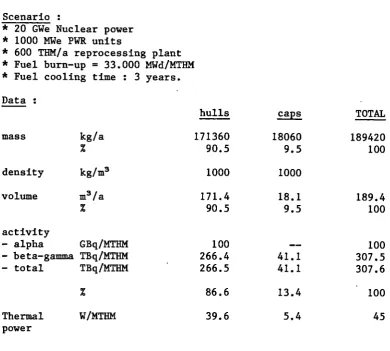
The corresponding annual cladding waste production and its charac-teristics are summarized in Table I.
2. Drawing-up of basic management routes (2.2.) Two basic management routes have been drawn up :
- Route No. 1 : hulls compaction/conditioning/packaging/interim storage; - Route No. 2 : hulls decontamination/cementation/packaging/interim
storage.
The original idea of compacting hulls and caps together was aban-doned due to the different characteristics, especially the alpha acti-vities. Since no experimental data were available concerning the press
HI. The cementation process is the process proposed by C.E.A. /2/3/. Application of both processes results in the production of the following amounts of conditioned waste :
- 277 canisters with compacted hulls, i.e. 255 Mg or 55.4 m3, with an
alpha activity of 217 MBq/kg and a beta-gamma activity of 628 GBq/kg; - 22 drums with cemented caps, i.e. 80 Mg or 38.1 m3.
Since the cemented caps do not contain alpha emitters and their beta-gamma activity is not too high, shallow land burial remains possible as final disposal.
The major steps of Route No. 2 are decontamination of the hulls and cementation of hulls and caps according to the French process. The aim of the decontamination is to lower the alpha content of the hulls to such an extent that shallow land burial will be allowed for final disposal. A flow diagram of Route No. 2 is given in Figure 2. The decontamination process retained consists of washing with cold HN03 3N, which results in a 95 % alpha decontamination /4/. This value is on
the limit to be allowed for shallow land burial. Application of decontamination/cementation results in the production of 231 drums of cemented hulls and caps, i.e. 395 m3 or 924 Mg.
3. Sensivity studies (2.3.)
The influence of a number of parameters on the characteristics and arisings of the conditioned waste product and on the total volume of the treatment and conditioning facility buildings has been studied. For Route No. 1, the following specific parameters are of importance : - the size of the compaction press;
- the compaction efficiency.
For Route No. 2, the decontamination performance is the most important parameter in view of final disposal. Of course, for both routes, the size of the nuclear park is the most relevant parameter.
REFERENCES
HI P. DE REGGE EUR-10824
/2/ C.E.A.
Joint study on management routes for LWRS hulls and ends FI1W-0131-F
Cementation description.
131 C.E.A.
Joint study on management routes for LWRS ulls and ends FI1W-0131-F
Process materials.
I hi "COCQUENSTOCK"
EUR-10923
Table I ; Annual cladding waste arisings
Scenario :
* 20 GWe Nuclear power * 1000 MWe PWR units
* 600 THM/a reprocessing plant * Fuel burn-up = 33.000 MWd/MTHM * Fuel cooling time : 3 years.
Data :
mass kg/a
density
volume
activity - alpha - beta-gamma - total
Thermal power
kg/m3
m3/a
%
GBq/MTHM TBq/MTHM TBq/MTHM
%
W/MTHM
hulls caps TOTAL
171360 90.5
1000
171.4 90.5
100
266.4 266.5
86.6
39.6
18060
9.5
1000
18.1
9.5
„
41.1 41.1
13.4
5.4
189420
100
189.4
100
100
307.5 307.6
100
DISSOLUTION
CHOPS
DRYING
HEAD-END
CAPS
'
PORTIONING
VIBRATION CHUTE
BUFFER
STORAGE
CEMENTATION
VIBRATION
PORTIONING
VIBRATION
CHUTE
DECONTAMI-NATION
H2O
SPRAY
CONDITIONING
WELDING
DECONT AMI-NATION
H2O
SPRAY
Figure 1
ENCAPSULATION TRANSPORT
STORAGE
COMPACTION
PRESS
COLLECTING LOADING
DRUM
ENCAPSULATION] TRANSPORT
STORAGE
INTERIM
STORAGE
SCK-CEN
HNOÎ 3M
Figure 2,
HjO
OECONTAMI-NATION
SPRAY
SYSTEM
RINSING
SPRAY
SYSTEM
CEMENTATION
VIBRATION
ENCAPSULATION TRANSPORT
STORAGE
INTERIM
STORAGE
SCK-CEN
ASSESSMENT OF MANAGEMENT ALTERNATIVES FOR REACTOR WASTES
CONTRACTOR : BELGATOM S.A., 75 Rue de la Loi, Β - 1040 BRUXELLES
CONTRAT N° :FI 1W-0124
DURATION OF CONTRACT :November 1987 - January 1990
PERIOD COVERED : November 1987 - December 1988
A. OBJECTIVES AND SCOPE.
The objective of the contract is to constitute a contribution to a joint study aiming at assessing management routes for Light Water Reactor Wastes ont the basis of economic and radiological criteria and by drawing up the basic options emphasizing the collect - treatment - conditioning
-packaging - storage and transport aspects.
The reference scenario considered is the following :
- Installed nuclear power : 20 GWe ;
- All P.W.R. - Grouping of reactor by 4 units ; - Lifetime : 30 years ;
- Location : Inland sites with stringent discharge limits.
A management route is defined as each set of coordinated actions by which the management of L.W.R. wastes from their production to their disposal is implemented.
B. WORK PROGRAMME.
The evaluation of the management routes for LWR-wastes is based in the frame of our contract, on the execution of the following sequence of tasks.
1. Definition of typical primary waste inventories resulting from normal operation of 900 MWe-PWR's (gaseous, liquid and solid wastes).
2. Definition of discharge limits, waste acceptance criteria and transport regulations.
3. Drawing up of basic management routes taking into account treatment and conditioning variants.
4. Sensitivity studies on each basic management route.
6. Costing of the basic management routes as well as the variants evolved from sensitivity studies.
7. Assessment of the related occupational exposure.
8. Assessment of the related radiological impact to the public (short and long term).
BELGATOM have to execute partly the tasks 1, 2 and 6 and wholly the tasks 3, 4, 7 and 8 for one basic management route based on the Belgian concepts and practices.
-C. PROGRESS OF WORK AND OBTAINED RESULTS.
.State of_advancement :
Point 1 : After several meetings with the French and German
representatives, an agreement was found concerning the primary waste inventories for liquids, gas and solids as well for the design values which have to be taken into account in the design of the treatment equipment, as for the real values which must be taken into account in the activity balances.
Point 2 : Concerning the discharge limits, a trade-off was agreed upon between all the representatives, for the fixation of two limits for each radionuclide category.
With respect to the transport regulations it was agreed upon the Commission's suggestion to draw up the basic management routes following the current national practices.
Point 3 : The description of management route followed in Belgium for the gaseous wastes is completed.
The general description of the management route for the liquid waste giving the activity balance is completed.
The corresponding Technical description giving more detailed explanations on flow sheet and équipement will be soon
available.
The same documents related to solid waste are also in preparation.
Point 6 : BELGATOM has already supplied TASK/KAH with the data related to the equipment cost of the off-gas treatment ;
of the ventilation air treatment ; of the liquid effluents treatment ; of the solid waste treatment.
With respect to operating costs, data are already supplied for the gaseous and liquid waste. The corresponding document for solid waste is in preparation.
Point 7 and 8 : The study begins in February 1989.
-Pr^gjrejşs_and_resulţs_:
Point 1 : The primary waste inventory for liquid waste of PWR's is based on the basic assumptions of a load follow and a maximum value of 0»1 % of cracked fuel elements and are given in Table I.
The primary waste inventory for gaseous waste is given in Table II, and in the concern for easiness, the same radionuclide composition was applied to ventilation gases as this for offgases.
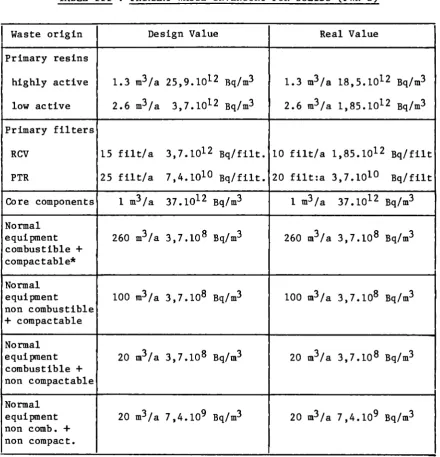
The primary waste inventory for solid waste is quoted in Table III ;a distinction was made between the most and least active fractions of primary resins as well as for the primary filters. The low levels solid waste is subdivised in four categories to enable its further processing by means of several variants.
Point 2 : The adoption of two discharge limits for each radionuclide category given in Table IV, corresponds to the following
objectives : the design values are discharge limits which should necessarily be met by the treatment and conditioning facilities whereas the objectives values are the goals to be reached during normal operation of the treatment chains.
Point 3 : The descriptions of the basic management routes used in Belgium for gaseous, liquid and solid wastes form the subject of two kinds of documents : firstly the socalled General Descriptions where are described the basic flow sheets of each treatment chain including mass and activity balances and secondly the socalled Technical Descriptions where are given the detailed flow sheets of all processes and the specific equipment
characteristics including instrumentation and control allowing the equipment cost evaluation. Informations is also supplied on applicable regulations.
The Technical Description of the gaseous waste treatment is splitted into offgas treatment and ventilation air treatment due to the specificity of each waste stream.
Point 6 : To allow the cost evaluation, two kinds of documents are also elaborated, one for the equipment costs, another for the operating cost and this related to the four waste streams : offgases ; ventilation air ; liquid effluents and solid waste.
The solid waste is therefore a particular case as far as the localisation of the treatment unit is concerned : I.E.R., filter cartridges, evaporators concentrates and flocculates are treated in the onsite installations, while the socalled technological waste are treated in a central treatment unit together with other solid waste coming from other waste sources than nuclear power plants. This situation imply a different way for
evaluation for the corresponding operating costs.
TABLE I : PRIMARY WASTE INVENTORY FOR LIQUIDS (PWR's) Waste origin Primary circuit effluents Secondary drain waste Laundry waste Decontamination operations Chemicals Building waste Design Value
3,7.1012 Bq/m3 (with gas)
3,7.1ο11 Bq/m3 (without gas)
24.000 m3/a
3,7.1010 Bq/m3 (peak value)*
3.7.109 Bq/m3 (on average)
4.000 m3/a
3,7.106 Bq/m3
4.000 m3/a
3,7.109 Bq/m3
500 m3/a
3,7.108 Bq/m3
1.500 m3/a
3,7.107 Bq/m3
6.000 m3/a
Real Value
3,7.1010 Bq/m3 (out of gas)
10.000 m3/a
3,7.108 Bq/m3
2.500 m3/a
3,7.106 Bq/m3 (peak value)
3,7.10-' Bq/m3 (on average)
4.000 m3/a
3,7.108 Bq/m3
10 m3/a
3,7.107 Bq/m3
1.500 m3/a
3.7.107 Bq/m3
3.000 m3/a
TABLE II :PRIMARY WASTE INVENTORY FOR GAS (PWR's)
Waste origin
Chem. & Volume Control system + Primary circuit degasing Ventilation Design Value
10.000 Nm3/a
7,4.1012 Bq/Nm3
150.000 Nm3/h
3,7.105 Bq/Nm3
Real Value
6.000 Nm3/a
<£ 2,4.1012 Bq/Nm3
150.000 Nm3/h
18,5.103 Bq/Nm3
-TABLE III : PRIMARY WASTE INVENTORY FOR SOLIDS (PWR's)
Waste origin
Primary resins
highly active
low active
Primary filters
RCV
PTR
Core components
Normal equipment combustible + compactable*
Normal equipment
non combustible + compactable
Normal equipment combustible + non compactable
Normal equipment non comb. + non compact.
Design Value
1.3 m3/a 25,9.1012 Bq/m3
2.6 m3/a 3.7.1012 Bq/m3
15 filt/a 3.7.1012 Bq/filt.
25 filt/a 7,4.1010 Bq/filt.
1 m3/a 37.1012 Bq/m3
260 m3/a 3.7.108 Bq/m3
100 m3/a 3.7.108 Bq/m3
20 m3/a 3,7.108 Bq/m3
20 m3/a 7.4.109 Bq/m3
Real Value
1.3 m3/a 18.5.1012 Bq/m3
2.6 m3/a 1,85.1012 Bq/m3
10 filt/a 1,85.1012 Bq/filt
20 filt:a 3.7.1010 Bq/filt
1 m3/a 37.1012 Bq/m3
260 m3/a 3.7.108 Bq/m3
100 m3/a 3.7.108 Bq/m3
20 m3/a 3,7.108 Bq/m3
20 m3/a 7.4.109 Bq/m3
* Density before compaction : 0.15.
[image:24.595.79.520.80.538.2]-TABLE IV : DISCHARGE LIMITS RELATED TO ONE PWR UNIT (900 MWe)
Waste origin
Liquid effluents
. Total (tø) (H-3 excluded)
. H-3
Airborne effluents . Noble gases
. Halogens
. Aerosols . Tritium
Objective
7.4.1010 2,8.IO13
7,4.IO13
7.4.108
7.4.108
3.7.1012
Value
Bq/a
Bq/a
Bq/a
Bq/a
Bq/a
Bq/a
Design Value
3,33.1ο11 Bq/a
3.5.1013 Bq/a
7.4.1014 Bq/a
Ι,ΙΙ.ΙΟ10 Bq/a
1.85.1010 Bq/a
7,4.1012 Bq/a
COST EVALUATION OF ALTERNATIVE MANAGEMENT SCHEMES FOR LWR WASTE
Contractors : Contract N" : Duration of Contract:
Period Covered : Project Leaders :
TASK Ricerca & Sviluppo S.r.l. - Kraftanlagen AG FI1W-0125
from 01.10.87 to 31.01.90 from 01.01.88 to 31.12.88
G. THIELS (TASK R&S), F. STENERSEN (KAH)
A. OBJECTIVES AND SCOPE
A joint strategy study is being performed to assess a number of schemes for the treatment, conditioning, packaging, interim storage, transport and disposal of LWR wastes on the basis of economic and radiological criteria. In this context, TASK R&S and KAH are contributing towards the costing of five basic management routes and their variants evolving from the sensitivity studies.
The scope of the work is to assess the capital and operating costs of the various unit operations incorporated into each basic management scheme on the basis of the detailed process descriptions provided by the other participating organisations. Moreover, the plant and transport costs will be actualised to the operational start-up date of the plant utilising the "Present Worth" method, finally yielding a cost per unit volume of primary waste treated. The costing of the waste disposal itself does not form part of the study.
During the second phase of the work, TASK R&S and KAH will contribute to the sensitivity studies. Their aim is to evaluate the impact of different basic parameters (e.g. discharge limits, process variables, duration of interim storage, plant capacity) on the overall management costs.
B. WORK PROGRAMME
2.1 Scope of the programme
2.2 Cost evaluation
2.2.1 List of possible intermediate management stages 2.2.2 Cost assessment procedure
2.2.3 Results
2.2.4 Sensitivity studies
-PROGRESS OF WORK AND OBTAINED RESULTS
State of advancement
TASK R&S and KAH are performing the cost evaluation of five management options for LWR waste. For this purpose, general procedures have been established for the cost assessment and cost scaling of the envisaged management schemes.
The implementation of these procedures has been limited due to the delays encountered in the programmes of the other partners of the joint strategy study, responsible for the engineering of the management routes. As a result, the cost assessment procedure has only partially been applied to one LWR route, whose engineering and process aspects have been elaborated by GNS-Framatome.
Progress and results
2.2.1 Management options to be costed
The engineering and process development of the basic management routes by the other partners of the joint strategy study have undergone delays, thereby also retarding the costing study.
2.2.2 Cost assessment procedure
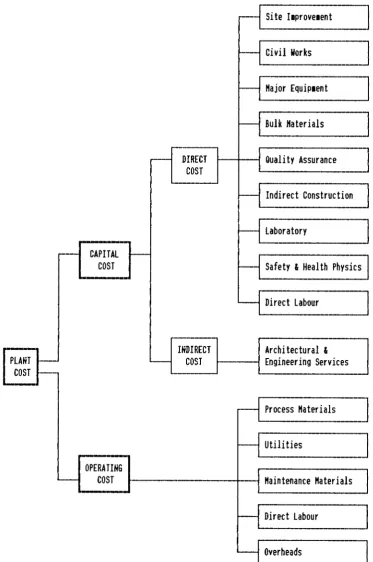
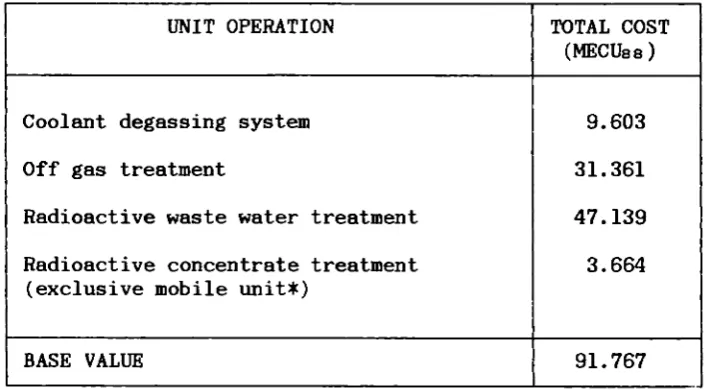
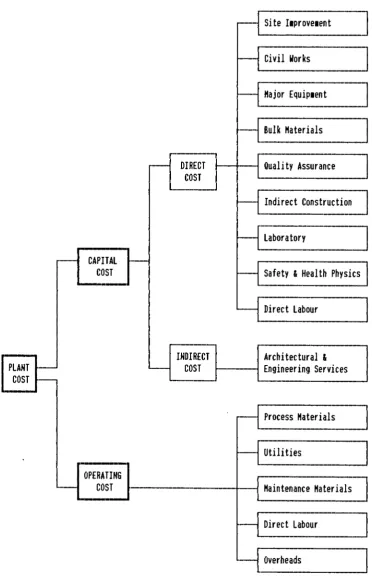
For the cost assessment of the various management options a number of cost elements have been defined as illustrated in Figure 1. Several assumptions concerning the plant siting and process technology have been established. Using this framework, the capital cost in 1988 is derived from the material cost of the Major Equipment or "Base Value"; all the other capital cost elements, except the Civil Works, are expressed as a fraction of this Base Value. For the operating cost the annual consumption of Process Materials, Utilities and Maintenance Materials and the costs associated with the Direct Labour and Overheads are taken into account to obtain the annual cost of the different cost elements in 1988.
Both the capital and annual operating costs are actualised to the start-up date of the plant using the "Present Worth" method. Finally, the actualised values are converted into an annual cost per unit volume of waste treated by employing the "Annual Value" method.
To evaluate the capital and annual operating costs related to the transport of the conditioned LWR waste, the type and amount of transport casks and the transport distance must be defined in collaboration with the other participating organisations. On the basis of these data, the transport costs in 1988 by either rail or road are elaborated. Subsequently, they are actualised employing the cost assessment procedure and transformed into an annual cost per unit of volume of waste treated.
2.2.3 Results
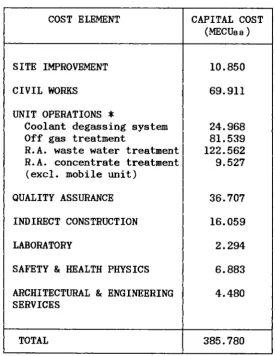
The cost determination procedure has partially been applied to the management route based on the German practice for PWR's (route LWR1-PWR). The costing is based on the process information provided by GNS-Framatome, with the exception of the off gas treatment, for which the data of Belgatom have been utilised. The preliminary results are given in Tables I and II.
2.2.4 Cost scaling
A general procedure has been developed to scale the costs with changing plant capacity. It is based on the "six-tenths rule" and derived formulas available in the literature, which are normally applied in the chemical industry. They have been adapted for the present study. This procedure takes into account the different behaviour of the various cost
-elements, thus reducing the associated error. The scaling can be carried out within the range of normal power production ( 6-60 GW(e)).
Figure 1 - Elements considered for the evaluation of the plant cost.
PLANT COST
CAPITAL COST
OPERATING COST
INDIRECT COST
Site Iiproveient
Civil Works
Kajor Equipment
Bulk Materials
Quality Assurance
Indirect Construction
Laboratory
Safety & Health Physics
Direct Labour
Architectural & Engineering Services
Process Haterials
Utilities
Maintenance Materials
Direct Labour
Overheads
-Table I Material cost of the Major Equipment for the different unit operations and Base Value of route LWR1-PWR (20 GW(e)). All the figures are quoted for 1988.
UNIT OPERATION
Coolant degassing system
Off gas treatment
Radioactive waste water treatment
Radioactive concentrate treatment (exclusive mobile unit*)
BASE VALUE
TOTAL COST (MECUss)
9.603
31.361
47.139
3.664
91.767
* In Germany, the mobile conditioning unit is rented.
[image:29.595.120.474.174.369.2]Table II - Capital cost for route LWR1-PWR (20 GW(e)). The capital cost is defined as the combined costs for material and labour of each cost element.
COST ELEMENT
SITE IMPROVEMENT
CIVIL WORKS
UNIT OPERATIONS *
Coolant degassing system Off gas treatment
R.A. waste water treatment R.A. concentrate treatment
(excl. mobile unit)
QUALITY ASSURANCE
INDIRECT CONSTRUCTION
LABORATORY
SAFETY & HEALTH PHYSICS
ARCHITECTURAL & ENGINEERING SERVICES
TOTAL
CAPITAL COST (MECUas)
10.850
69.911
24.968 81.539 122.562 9.527
36.707
16.059
2.294
6.883
4.480
385.780
* The capital cost of each unit operation includes the material cost of the Major Equipment and Bulk Materials and the labour cost for their installation.
COST EVALUATION OF ALTERNATIVE MANAGEMENT SCHEMES FOR ZIRCALOY HULLS
Contractors : TASK Ricerca & Sviluppo S.r.l. - Kraftanlagen AG Contract N" : FI1W-0126
Duration of Contract: from 01.10.87 to 31.01.90 Period Covered : from 01.01.88 to 31.12.88
Project Leaders : G. THIELS (TASK R&S), F. STENERSEN (KAH)
A. OBJECTIVES AND SCOPE
A joint strategy study is being performed to assess a number of schemes for the treatment, conditioning, packaging, interim storage, transport and disposal of LWR hulls and caps on the basis of economic and radiological criteria. In this context, TASK R&S and KAH are contributing towards the costing of five basic management routes.
The scope of the work is to assess the capital and operating costs of the various unit operations incorporated into each basic management scheme on the basis of the detailed process descriptions provided by the other participating organisations. Moreover, the plant and transport costs will be actualised to the operational start-up date of the plant utilising the "Present Worth" method, finally yielding a cost per unit volume of primary waste treated. The costing of the waste disposal itself does not form part of the study.
During the second phase of the work, TASK R&S and KAH will scale the costs for plant capacities ranging from 6 to 60 GW(e).
B. WORK PROGRAMME
2.1 Scope of the programme
2.2 Cost evaluation
2.2.1 Management options to be costed (provisional) 2.2.2 Cost assessment procedure
2.2.3 Results 2.2.4 Cost scaling
-PROGRESS OF WORK AND OBTAINED RESULTS
State of advancement
TASK R&S and KAH are performing the cost evaluation of five management options for Zircaloy hulls. For this purpose, general procedures have been established for the cost assessment and cost scaling of the envisaged management schemes.
The implementation of these procedures has been limited due to the delays encountered in the programmes of the other partners of the joint strategy study, responsible for the engineering of the management routes. As a result, the cost assessment procedure has only been applied to one Zircaloy hulls route, whose engineering and process aspects have been elaborated by NUKEM GmbH.
Progress and results
2.2.1 Management options to be costed
The engineering and process development of the basic management routes by the other partners of the joint strategy study have undergone delays, thereby also retarding the costing study.
2.2.2 Cost assessment procedure
For the cost assessment of the various management options a number of cost elements have been defined as illustrated in Figure 1. Several assumptions concerning the plant siting and process technology have been established. Using this framework, the capital cost in 1988 is derived from the material cost of the Major Equipment or "Base Value"; all the other capital cost elements, except the Civil Works, are expressed as a fraction of this Base Value. For the operating cost the annual consumption of Process Materials, Utilities and Maintenance Materials and the costs associated with the Direct Labour and Overheads are taken into account to obtain the annual cost of the different cost elements in 1988.
Both the capital and annual operating costs are actualised to the start-up date of the plant using the "Present Worth" method. Finally, the actualised values are converted into an annual cost per unit volume of waste treated by employing the "Annual Value" method.
To evaluate the capital and annual operating costs related to the transport of the treated Zircaloy hulls, the type and amount of transport casks and the transport distance must be defined in collaboration with the other participating organisations. On the basis of these data, the transport costs in 1988 by either rail or road are elaborated. Subsequently, they are actualised employing the cost assessment procedure and transformed into an annual cost per unit of volume of waste treated.
2.2.3 Results
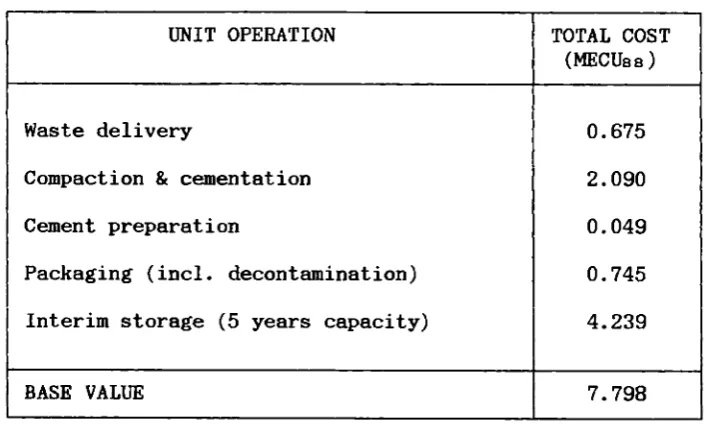
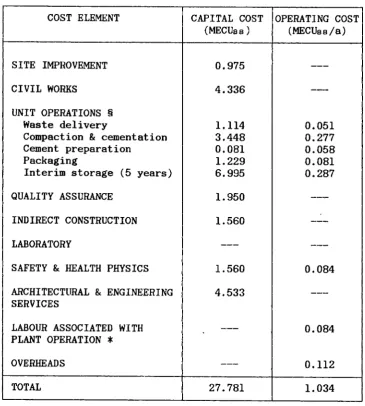
The cost assessment procedure has been applied to the management route developed by NUKEM, namely hull compaction/cementation/packaging/ interim storage (route ZH2). The preliminary results are shown in Tables I and II.
2.2.4 Cost scaling
A general procedure has been developed to scale the costs with changing plant capacity. It is based on the "six-tenths rule" and derived formulas available in the literature, which are normally applied in the chemical industry. They have been adapted for the present study. This procedure takes into account the different behaviour of the various cost elements, thus reducing the associated error. The scaling can be carried out within the range of normal power production ( 6-60 GW(e)).
-Figure 1 - Elements considered for the evaluation of the plant cost.
PLANT COST
CAPITAL COST
OPERATING COST
INDIRECT COST
Site Improvement
Civil Works
Major Equipment
Bulk Materials
Quality Assurance
Indirect Construction
Laboratory
Safety & Health Physics
Direct Labour
Architectural I Engineering Services
Process Materials
Utilities
Maintenance Materials
Direct Labour
Overheads
[image:33.595.116.489.140.719.2]-Table I - Material cost of the Major Equipment for the different unit operations and Base Value of route ZH2. All the figures are quoted for 1988.
UNIT OPERATION
Waste delivery
Compaction & cementation
Cement preparation
Packaging (incl. decontamination)
Interim storage (5 years capacity)
BASE VALUE
TOTAL COST (MECUse)
0.675
2.090
0.049
0.745
4.239
7.798
[image:34.595.121.475.168.380.2]-Table II - Capital and annual operating costs for route ZH2. The capital cost is defined as the combined costs for material and labour
of each cost element.
COST ELEMENT
SITE IMPROVEMENT
CIVIL WORKS
UNIT OPERATIONS § Waste delivery
Compaction & cementation Cement preparation
Packaging
Interim storage (5 years)
QUALITY ASSURANCE
INDIRECT CONSTRUCTION
LABORATORY
SAFETY & HEALTH PHYSICS
ARCHITECTURAL & ENGINEERING SERVICES
LABOUR ASSOCIATED WITH PLANT OPERATION *
OVERHEADS
TOTAL
CAPITAL COST (MECUas)
0.975
4.336
1.114 3.448 0.081 1.229 6.995
1.950
1.560
1.560
4.533
27.781
OPERATING COST (MECUss/a)
0.051 0.277 0.058 0.081 0.287
0.084
0.084
0.112
1.034
§ The capital cost of each unit operation includes the material cost of the Major Equipment and Bulk Materials and the labour cost for their installation. The annual operating cost represents the cost for Process Materials, Utilities and Maintenance Materials and the labour cost for the operators directly involved in the mentioned unit operations.
* The labour associated with plant operation represents the labour cost for shift leaders, maintenance crew and transport registrars.
[image:35.595.113.479.167.574.2]COST AND RADIOLOGICAL IMPACT OF REACTOR WASTE IN BELOW-GROUNDS VAULTS
Contractor: Initec S.A., Madrid, Spain Contract N°: FI1W-0127
Working Period: December 1987 - May 1989 Period Covered: January 1988 - December 1988 Project Leader: M. Sanchez Delgado
A. Objectives and Scope
As part of the joint study aiming at assessing management routes on the basis of economic and radiological criteria, INITEC will focus on the cost and radiological impact assessment for the final disposal phase of reactor wastes in below ground vaults.
The main goals of this project are:
- To determine the radiological impact both short-term and long-term associated to a storage facility of the below ground type for reactor wastes. The following main release pathways will be taken into acc-ount: ground water migration of radioactive elements, surface water releases and atmospheric releases. Three different stages will be considered in the life of the installation: operation of the facility, institutional control phase and free use of the land after termination of the license. Different scenarios will be assumed for each of the different stages, including normal operation scenarios as well as accidental scenarios.
- To determine the radiological burden to the facility operators.
- Cost assessment related to the disposal of LWR waste products in below ground vaults, including capital and operating costs.
B. Work Programme
2.2. Waste acceptance criteria will be established in terms of specific activity limits, matrix types, leaching rates, mechanical proper-ties, drum sizes etc. so as to accomplish protection goals for the public.
2.3. Drawing up of storage facility layout and description of the opera-tions to be carried out (sorting of the waste products, waste conditioning provisions, general layout etc. ...) as detailed as needed for the cost and radiological impact assessment.
2.5. The impact of the package type (retrievable or not) on the volumes of waste to be disposed of will be assessed, as well as the impact of varying both the volumes and categories of LWR wastes.
2.6. A cost assessment related to disposal of LWR waste products in below ground vaults will be carried out, including a relationship between disposal cost and quantities of various categories of waste pro-ducts, and scaling cost for variations of the nuclear park size. 2.7. The occupational exposure (annual individual dose and collective
dose) will be determined for normal and abnormal disposal opera-tions, for the latter case expressed as probability of occurrence, for each working place and 30 years of operation.
2.8. The radiological impact to the public will be assessed and indivi-dual and collective doses will be calculated. The disposal site environment will be defined as well as pathways and scenarios considered.
C. Progress of Work and Obtained Results 1. Introduction
Determination of waste acceptance criteria for below ground vaults required the performance of short and long-term radiological impact calculations to identify limiting values of beta-gamma emitters, since limiting values of alpha emitters are established in Spanish regulations. Beta-gamme activity limits identified correspond to USA 10CFR61 regula-tions. Disposal site capacity is based on an average waste production rate of 200 m3/reactor, which results in a total volume of wastes of
120,000 m3.
Regarding conceptual design of the disposal centre, buildings and equipment provided are essentially similar to shallow land disposal facilities. Main differences identified concern the disposal area site preparation works, both prior to constructing the disposal vaults (drain-age layers, see attached figure 1) and final preparation of the site
(earth movements, compactation and drainage layers).
Costs related to civil works in the disposal area (site preparation, earth movements, construction and final preparation of the site) appear to be significantly higher than those associated to shallow land burial and the main contributors to total cost (+ 90%).
Assessment of the radiological impact to individual members of the public was performed taking into consideration transuranics and long-lived isotopes to identified in waste streams provided by processists, due to their very low or untraceable concentrations. A theoretical concentration was estimated in order to figure out a theoretical long-term impact when these isotopes become dominant.
2. Progress and Results
2.1. Waste acceptance criteria
Radiological waste acceptance criteria have been developed, based on a distribution of 75% PWR and 25% BWR reactor wastes. The base spectrum adopted corresponds to reference /l/ and was normalised to radioactivity concentration limits of 10CFR61, except for alpha emitters which corres-pond to ENRESA limits.
A radiological impact assessment was performed to verify that such limits, both in concentration and in total activity, do not exceed dose limits. Various scenarios were considered:
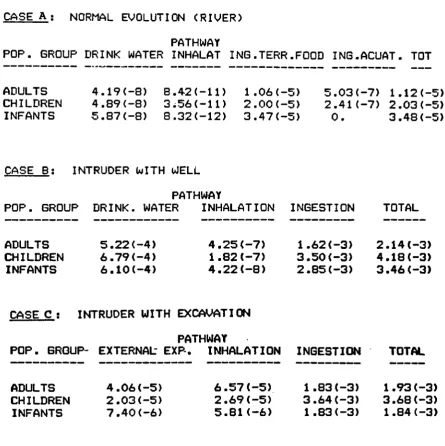
a) normal evolution scenario: calculation of doses received by an indivi-dual through the inhalation of resuspended activity from soil contami-nated by irrigation, and through the ingestion of contamicontami-nated drink-ing water and foodstuff, assumdrink-ing the infiltration of rain water through the site cover, which lixiviates waste packages and reaches the underlying aquifer, which in turn discharges into a river;
b) intruder excavating a well downstream in the site boundary: calcula-tion of doses due the ingescalcula-tion of contaminated drinking water and foodstuff and inhalation of resuspended soil contaminated by irriga-tion;
c) intruder constructing a home: calculation of doses due to external exposure, the ingestion of contaminated foodstuff and the inhalation of suspended particles.
Resulting doses are presented in attached table 1. As can be seen, maximum normal evolution doses are below 0.04 mSv/y, i.e. well within ICRP limits. For intrusion scenarios, maximum doses found are in the order of 4 mSv/y, which is also within applicable ICRP limits for this case (5 mSv/y). Non-radiological acceptance criteria were taken from Spanish requirements.
2.2. Drawing ug of management routes
Facility conceptual design for belowground vaults focused on the following items:
a) general site description and site preparation requirements, where main relevant requirements for the site have been put forward, mainly the water table level (5 meters below excavation level), aquifer permeabi lity (10 cm/s), homogeneous and isotopie media, the permeability of layer above aquifer (10 cm/s) and the slope of the layer(5%);
b) disposal area description, including vault characteristics and opera tion, volume of wastes to be disposed of etc. ...;
c) general description of the facility, including general design data, design criteria, storage procedures and facility organisation;
d) description of buildings and equipment housed in each building. Reference /2/contains detailed information on this item.
2.3. Cost assessment
Cost assessment was itemised as follows: Cost site preparation including acquisition costs, (pts χ 1,000)
permits, engineering, preparation works,vault
construction and site reclamation 21,722,400 (lowering water table if necessary) 22,322,400 buildings and general systems 2,288,000
Total cost 23,010,400
(lowering water table if necessary) 24,010,400 Operation costs need further development.
According to TASK/KAH comments, cost assessment will be revised taking into account different itemisations.
2.4. Radiological impact to individual members of the public
Radiological impact to individual members of the public will be performed assuming only normal evolution scenarios as described in paragraph 2.1.. Impact to intruder is not considered relevant, except for waste acceptance criteria. Nevertheless, in order to obtain longterm radiological impact, the spectrum to be used should include longlived isotopes. These longlived isotopes have not been provided by process designers, since they are only present as traces in fresh waste spectrum, and they can be estimated through calculations. INITEC proposes using a spectrum of longlived isotopes based on reference /If data.
References
7T7 Nureg CR1759,Data Base for Radioactive Waste Management, 1981.
HI INITEC, BelowGround Vaults, Facility conceptual Design and Cost Estimation, Nov. 1988.
TABLE I RESUME OF CALCULATED EFFECTIVE DOSES (SV/A)
(MAXIMUM VALUES)
CASE A ; NORMAL EVOLUTION (RIVER)
PATHWAY
POP. GROUP DRINK WATER INHALAT ING.TERR.FOOD ING.ACUAT. TOT
ADULTS
CHILDREN
INFANTS
4.19(-8)
4.89(-8)
5.87<-8)
8.42<-ll>
3¿56<-ll>
8.32(-12)
1.06<-5>
2.00(-5)
3.47(-5)
5.03(-7)
2.41(-7)
0.
1.12(-5)
2.03(-5)
3.48(-5)
CASE B: INTRUDER WITH WELL
PATHWAY
POP. GROUP DRINK. WATER INHALATION INGESTION TOTAL
ADULTS
CHILDREN
INFANTS
5.22(-4)
6.79(-4)
6.10C-4)
4.25<-7)
1.82(-7)
4.22
(-8)
1.62(-3)
3.50(-3)
2.85(-3)
2.14Í-3)
4.18(-3)
3.46(-3)
CASE C; INTRUDER WITH EXCAVATION
PATHWAY
POP. GROUP- EXTERNAL- EXP-. INHALATION INGESTION
TOTAL
ωro
\W)s
.EGEΝD
CO
(2)
®
®
®
00
SFLFCTION Of SITI «ITU DEEPWATERTâRLI LCVtL SOTHAT DISPOSAL VAULIS AREHOTAFFECTEDRY VATtR
LEVELS. •M0UL9 IF SMALL WATtR FLOWSSHOULOÍKItT IN
DIVERSION WORKS ANO IMPERMCARILUATION Κ IMPLEMENTED
OFF SITE FLOOD· DRAINARE
IN-SITE FLOODS ORAINASE
ORAINEOE OF POTENTIAL INFILTRATION « A T M SURFACE LAYER
INFILTRACTION WATER SYSTEM DRAINA« TOCONTROLROARN ·I
SITE EXCAVATION DRAINA« TOCONTROL ROARR * 1
Ι'ΓΕΡ DRAINAJE OFWATERTASLETO(RIT N»S WNCCfSSART OREl.SE EQUIVALENT FLOWCONTROL.
DERIVATION OF WEIGHTING FACTORS FOR COST AND RADIOLOGICAL IMPACT FOR USE IN COMPARISON OF WASTE MANAGEMENT METHODS
Contractor : National Radiological Protection Board, Chilton, Didcot, UK
Contract No. : FIlW-0128-00
Duration of contract : 1 August 1987 - 31 December 1989 Period covered : 1 January 1988 - 31 December 1988 Project leader : S.F. Mobbs
A. OBJECTIVES AND SCOPE
Mehods of assessing the radiological impact of waste management options have reached the stage where it is possible to make detailed estimates of the doses and risks to workers and the public and, in principle, to quantify the uncertainties in these estimates. It is also possible to quantify the direct financial costs of waste
management. However, much less progress has been made on devising ways of weighting financial costs, social costs and the various
components of radiological impact so that comparisons can be made between alternative waste management options, on a rational and well-defined basis.
The objectives are to develop a methodology for devising
weighting factors for the various components of radiological impact, financial costs and social costs of waste management methods and to demonstrate the methodology by applying it in an example comparison of waste management options.
The research is being carried out jointly by the National Radiological Protection Board (NRPB) and the University of Surrey Psychology Department, acting under sub-contract to NRPB.
Β. WORK PROGRAMME
2.1 Identification of the components of financial costs and radiological impact for which weighting factors are to be devised.
2.2 Identification of types of social costs which need to be considered via investigation of the criteria used by experts and decision makers, and of public attitudes, and review of methods of taking these social costs into account.
2.3 Development of a method for deriving weighting factors for the components of financial cost, radiological impact and social cost, and demonstration of the method.
-C. PROGRESS OF WORK AND OBTAINED RESULTS
State of advancement
A research fellow, Dr Ρ Τ Allen, has been appointed at the University of Surrey.
Stages 2.1 and 2.2 of the project have been carried out, that is, a set of components for which weighting factors are needed has been identified. (This does not rule out the identification of further components in the course of contact with respondents.)
In respect of stage 2.3, it has been assessed as unlikely that past waste management decisions and/or previous attitude surveys would provide sufficient information for our purposes. Therefore,
it has been decided to develop a methodology for deriving weighting factors, focusing around the use of specially designed
questionnaires for survey purposes. The background technical information for the questionnaire has been collected and this will be used to design the questionnaire early in 1989. The results of a number of pilot surveys will then be analysed to derive the
weighting factors.
Progress and results
2.1, 2.2 Identification of components for which weighting factors are to be devisee!
Radiological protection is concerned not just with compliance with dose limits set by regulatory authorities, but with choosing the best option to minimise radiation exposures, taking into account economic costs and social costs. Such costs may include items which are hard to cost in monetary terms such as deterioration of the environment and hence a structured approach is necessary for the decision process. This study works at such an approach in the context of decisions on radioactive waste management options.
Different people will have different perceptions of the costs associated with the various management options for radioactive waste. Some people will rate the health effects to be of paramount
importance whereas others will rate economic costs as equally important. These types of perception can be expressed in the form of numerical weighting factors which are then used in decision analysis to express difference preferences towards various consequences.
The factors to be weighted have been reviewed and a total of seven components have been identified. These are (i) attitudes to the various categories of health effects: fatal cancer, non fatal cancer and hereditary disease; (ii) the trade off of exposure to the public or to the workforce;
(iii) the relative acceptability of health effects occurring now or some time in the future by considering three time periods: within 100 years, between 100 and 1000 years in the future, and beyond 1000 years in the future; (iv) attitudes to the geographical spread of health effects by considering four geographical areas: local,
national, European Community and global; (v) the tradeoff between health effects and economic cost; (vi) attitudes to natural and artificial sources of radiation exposure; and (vii) attitudes to the different probabilities of developing cancer: these can be used to draw up a risk aversion curve.
2.3 Developing of a methodology
Four possible methods for establishing weighting factors have been considered. These are the analysis of past waste management decisions in the manner of revealed preference studies, the use of the results of previous attitude surveys, setting up a discussion group consisting of representatives of different sectors of society to argue the issues, and finally the use of a specially designed questionnaire to interview members of the public and representatives of interest groups. The last method was chosen as being that most appropriate for this work.
Considerable progress has been made on the design of the
questionnaire. Two different approaches will be tried in a pilot study and the results will be used to determine the form of the final questionnaire. The first approach is the direct approach in which respondents are asked to score the different attributes and
then these scores are built up into a valuation of a number of waste management options. The second approach is an indirect approach in which respondents are asked to score some specified waste management
options and then multiple regression techniques are used.to determine which attributes were important. In both cases it was felt that people would not be able to provide a meaningful response to questions unless they were placed into context. Therefore the fullest possible information would be provided in the form of background material, and in connection with each option.
In order to pursue the indirect approach it is necessary to
present a range of options, chosen to provide attributes that are as different as possible. The options that remain open in the UK for many waste types are fairly limited and therefore it was decided to present people with two different cases, the options for reactor decommissioning wastes and the options for vitrified high level waste. These waste types were chosen because they either already
exist or they will exist as a result of past electricity generation and hence the replies are less likely to be influenced by the
individuals perception of the future of nuclear power. Indicative costs and radiological impacts were calculated for six options for Magnox and AGR decommissioning wastes: seadumping, shallow land burial, deep geological burial inland, deep geological burial under the sea but accessed from land, disposal in an offshore borehole and storage for 100 years or more. For vitrified high level wastes the costs and radiological impacts were calculated for a different six options: deep geological burial inland, deep geological burial under the sea but accessed from land, disposal in an offshore borehole, disposal in the deep ocean floor using penetrators, disposal into a hole drilled into the deep ocean floor, and storage for 300 years or more. These results will be used to formulate analogues for use in the questionnaire.
COMPARISON OF WASTE MANAGEMENT ASPECTS OF DIRECT DISPOSAL OF SPENT FUEL AND REPROCESSING
Contractor: National Radiological Protection Board, Chilton, UK Contract No.; FIlW-0129
Working period :November 1987 - December 1989 Period covered :January 1988 - December 1988
Project Leaders :M. D. Hill, S.F. Mobbs (NRPB), and R. Dodds (BNFL)
A. OBJECTIVES AND SCOPE
The overall aim of the whole joint project is to compare, on the basis of the costs and radiological impact of the management and disposal of all the associated wastes, reprocessing of PWR fuel with its direct disposal by emplacement in a deep geological formation on land. For the reprocessing case, the wastes to be considered include gaseous and liquid effluents discharged routinely during reprocessing, solid low and intermediate level wastes arising at the reprocessing plant, and vitrified high level waste. The latter will also be assumed to be disposed of by emplacement in a deep geological
formation. The study will include an analysis of the sensitivity of the results to variations in key assumptions, such as the time for which spent fuel is stored prior to reprocessing.
Radionuclide inventories will be provided for all the wastes arising from reprocessing, and estimates will be made of the costs of management and disposal of these wastes based on UK experience and studies. Vitrified high level waste will be assumed to be emplaced in a granite formation and solid low and intermediate level wastes in an intermediate depth repository in a clay formation. The radiological impact on the public of the management and disposal of all
reprocessing wastes, and of direct disposal of spent fuel in a granite formation, will be assessed. The cost of direct disposal of spent fuel in a granite formation will also be estimated.
B. WORK PROGRAMME
B.l Agreement of detailed study assumptions with CEC and other contractors: NRPB and BNFL.
B.2 Provision of inventory data for discharges and solid wastes: BNFL
B.3 Estimation of costs for effluent treatment, vitrification, packaging, storage, transport and disposal: BNFL
B.4 Assessment of operational radiological impact on workers and the public: NRPB
Β.5 Assessment of post disposal radiological impact on the public: NRPB
Β.6 Sensitivity studies:NRPB and BNFL.
C. PROGRESS OF WORK AND OBTAINED RESULTS
State of advancement
Work on item B.l has been completed and work on items B.2, B.4 and B.5 has started. The radiological impacts of operational liquid discharges and shallow land burial of low level wastes on the public have been calculated. The radionuclide inventory for spent fuel has been derived and compared with that produced by CEA under another contract associated with this project. The waste inventories will be produced as soon as the few outstanding differences between these two inventories have been resolved. Work on B.3 and B.6 will start in mid 1989.
Progress and results
B.l Agreement of study assumptions
The quantity of fuel to be considered, the times at which
reprocessing and vitrification take place and the storage period for the vitrified high level waste were agreed in the previous reporting period. It was agreed that NRPB would calculate the radiological impact of disposal or release of unit activity of a series of
radionuclides in a form that could be used by the CODDAR code being developed by CAP Scientific under an associated contract. The components of radiological impact that will be calculated will be risks to individuals and collective doses to local, national, European and global populations as a function of time. A list of the most important radionuclides which should be included in the assessment of each disposal option has been agreed.
B.2 Provision of inventory data for discharges and solid wastes.
BNFL has compiled the radionuclide inventory for spent fuel using the FISPIN code. This was compared with the inventory produced by CEA using the APOLLO-EVOGENE code under a contract associated with this project since it was important to maintain consistency. A number of differences were noted between the inventories and although the majority of these differences concerned radionuclides that would not be expected to give significant radiological impacts there were a few that were expected to be more important and hence these were looked into further. The few remaining discrepancies will be resolved as soon as possible. It will then be straightforward to produce the waste inventories. Flow diagrams describing the reprocessing process and the origin of the various waste streams have been provided by BNFL.
B.4 Assessment of operational radiological impact
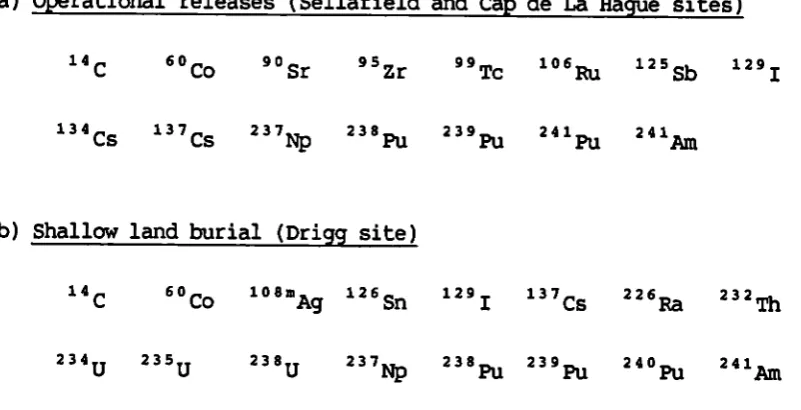
NRPB has calculated the radiological impact of unit discharges to the marine environment during reprocessing operations. A total of 15 radionuclides were studied (see Table I) and the results were obtained for releases from the reprocessing plant at Sellafield and from the reprocessing plant at Cap de La Hague. The assessment was performed using the regional marine model MARINI developed for the CEC MARINA project and the associated database of seafood catches for the
different ocean compartments. In both cases the releases were assumed
-to continue for 30 years. Peak individual doses and risks were
calculated using the generic critical group habits adopted by NRPB for biosphere calculations/1/ so that the same assumptions were used for the two sites. Integrated collective doses were calculated for the following times: 30, 50, 60, 100, 1000, 10 and 10 years and the results were presented for the four different populations. These collective doses were calculated from the seafood catch data provided for each country in the MARINA database. The peak individual doses for unit releases from the two sites were practically the same for all radionuclides except6 0Co and9 Zr. The dominant pathway for these
two radionuclides is external exposure from contaminated sediments and hence the predicted dose is dependent upon the local sedimentation
rate which differs for the two sites.
The integrated collective does from unit releases from the two sites also differed, sometimes by more than an order of magnitude, and this results from the different sizes of seafood catch that occur close to the two sites.
B.5 Assessment of post disposal radiological impact
NRPB has calculated the radiological impact of disposal of unit activity of low level waste to a shallow land burial trench at Drigg. A total of 14 radionuclides were studied, see Table I. The results were obtained by using the geosphere model GEOS and the biosphere model BIOS and the database was taken from a recent NRPB assessment of the Drigg site / 2 / . Peak individual doses and risks were calculated for the following 3 different pathways: leaching of the waste and migration of radionuclides through the groundwater leading to release to the Irish sea, leaching of waste and migration of radionuclides through the groundwater leading to release to a local stream, and intrusion into the site by drilling an exploratory borehole, by site occupancy or by abstracting water from a well. Other pathways has been found to give lower risks / 2 / . Integrated collective doses were calculated for the two leaching and migration pathways and were
presented for six integration periods (50,100, 1000, 104, 106 and 108
years) and the four different populations. The results were then summed over the different pathways in proportion to the probability of each pathway to give values of the total radiological impact. The peak individual doses and risks for the majority of the radionuclides were dominated by the first migration pathway (release to the Irish
Sea). The exceptions were1 3 Cs,2 8Pu,2 3 Pu and 1Am and the doses
and risks for these four radionuclides were dominated by the pathway describing water abstraction from a well. The integrated collective doses at all times and for all four populations were dominated by the first migration pathway (release to the IrishSea).
References
/ l / LAWSON, G and SMITH G M, BIOS: A model to predict radionuclide transfer and doses to man following releases from geological
repositories for radioactive wastes. NRPB-R169, Chilton (1985). (London, HMSO).
/ 2 / SMITH G M, FEARN, H S, SMITH Κ R, DAVIS J P, AND KLOS RA,
Assessment of the radiological impact of disposal of solid radioactive waste at Drigg. NRPB-M148, Chilton (1988).
Table I
Radionuclides studied
a) Operational releases (Sellafield and Cap de La Hague sites)
1 4C 60Co 90Sr 95zr " T c 1 0 6R U 1 2 5Sb 1 2 9I
1 3 4Cs 1 3 7Cs 2 3 7Np 2 3 8Pu 2 3 9Pu 2 4 1Pu 2 4 1Am
b) Shallow land burial (Drigg site)
1 4C 6 0C o 1 0 8 „A g 1 2 6S n 1 29 ]. 1 I 7& 2 2 6 ^ 2 3 2 ^
2 3 4U 2 3 5U 2 3 8U 2 3 7Np 2 3 8Pu 2 3 9PU 2 4 0PU 2 4 1Am
DRAWING UP OF MANAGEMENT ROUTES FOR REACTOR WASTE BASED ON INDUSTRIAL PRACTICES IN ITALY AND THE F.R.G.
Contractors : GNSf Essen, F.R.G. and FRAMATOME, Paris, France. Contract N° : FI1W - 0130
Duration of contract : from January 1988 to April 1990 Period covered : January 1988 to December 1988
Project Leaders: K. Janberg, Y. Huet
A. OBJECTIVES AND SCOPE
During the last few years, reactor waste management practices have taken advantage of many improvements as far as processes, organization and safety are concerned. Within the framework of the 3rd EC Waste Management programme, GNS and FRAMATOME are taking part in the present joint study, the purpose of which is to characterize various overall management schemes resulting from these new developments.The complete description and analysis of each scheme will consist in evaluating its . industrial feasability, costs and radiological impact on workers and public. The following sensitivity studies will point out the impact of some important parameters on processed waste product characteristics and quantities, costs and radiological impact.
The assessment of the different European management alternatives will make up basic data for the study. Each national scheme will be applied to a hypothetical site with 20GWe capacity consisting of light-water cooled reactors (PWR's and BWR's) and to low and intermediate radioactive waste generated during normal operation. After having analysed each basic case, sensitivity analysis will be carried out, varying the most important parameters such as waste characteristics, treatment methods, discharge limits and disposal criteria affecting both cost and radiological impact.
GNS and FRAMATOME have taken charge of providing the assessment of German and Italian approaches. Both of these management schemes will comprise regulations, waste inventories,regulations, treatment, conditioning, packaging, interim storage, transport and final disposal operations, cost evaluations and radiological impact on workers and public. Sensitivity studies will then be performed.
B. WORK PROGRAMME
2.2. Definition of typical primary waste inventories resulting from normal operation of PWR's and BWR's.
2.3. Definition of discharge limits,waste acceptance criteria and transport regulations.
2.4. Drawing up of basic management routes, taking into account treatment and conditioning variants.
2.5. Sensitivity studies for each basic management route. 2.6. Assessment of the related occupational exposure.
2.7. Assessment of the related radiological impact on the public (short and long term).
In this regard, FRAMATOME/GNS will be partly responsible for tasks 2.2., 2.3. and 2.7. and wholly responsible for tasks 2.4., 2.5. and 2.6. for two basic management schemes relying on the German and Italian
philosophy and practice.
-C. PROGRESS OF WORK AND RESULTS OBTAINED Work Status
Tasks 2.2.,"Definition of typical primary waste inventories resulting from normal operation of PWR's and BWR's" and 2.3., "Definition of discharge limits, waste acceptance criteria and transport regulations" have been completed.
A slight slippage has occured in the schedule for task 2.4. " Drawing up of basic management schemes " concerning BWR's. Work has started on PWR's with the agreement of the project management in order that the downstream final disposal, economic and radiological impact analysis can be started as soon as possible. This will enable a start to be made on the mathematical models straight away. The assessment of the German management scheme for PWR's is practically finished.
The BWR management scheme will be carried out along the same lines, once the data already supplied have been analysed.
The information required for cost evaluation has already been communicated and a cost calculation first draft for the German PWR waste management scheme has been made.
Progress and results
For the assessment of German practice in waste management,,both of the following assumptions have been made :
-the capacity of German power plants is approximately 1200 MWe. For the purposes of the study, a 900 MWe reactor has been chosen and the values must be adapted as a consequence,