^ « ^ • ä * ,^κ >¿ ,T- Î »
«-*?»-J? ¡Life „ " * ' * . ? » * * * * "
* . *
Commission
of
the
European
Communities
Community's
research
and
development
programme
on
radioactive
waste
management
and
storage
Shared-cost
action
(1990-94)
Annual
progress
report
1991
?
Commission
of
the
European
Communities
η
II
Β SSCommunity's
research
and
development
programme
on
radioactive
waste
management
and
storage
Shared-cost
action
(1990-94)
Annual
progress
report
1991
Directorate-General
Science, Research and Development
Published by the
COMMISSION OF THE EUROPEAN COMMUNITIES Directorate-General
Information Technologies and Industries, and Telecommunications L-2920 Luxembourg
LEGAL NOTICE
Neither the Commission of the European Communities nor any person acting on behalf of the Commission is responsible for the use which might be made of
the following information
Cataloguing data can be found at the end of this publication
Luxembourg: Office for Official Publications of the European Communities, 1992
ISBN 92-826-4398-0
© ECSC-EEC-EAEC, Brussels · Luxembourg, 1992
Abstract
In December 1989 the Council of Ministers of the European Communities adopted the fourth R&D programme on "Management and Storage of radioactive waste" for the period 1990-1994.
CONTENTS
FOREWORD
THE MANAGEMENT AND COORDINATION ADVISORY COMMITTEE
PROGRESS OF THE R&D WORK
PART A: WASTE MANAGEMENT AND ASSOCIATED R&D PROJECTS
Al: STUDIES OF MANAGEMENT SYSTEMS
Task 1 "Studies of Management Systems"
A2: WASTE TREATMENT
Task 2 "Treatment of Radioactive Waste"
A3: SAFETY OF THE MULTI-BARRIER SYSTEM OF GEOLOGICAL DISPOSAL
Task 3 "Characterisation and Qualification of Waste Forms, Packages and their Environment"
Task 4 "Disposal of Radioactive Waste : Research to Back-up the Development of Underground Repositories"
Task 5 "Method of Evaluating the Safety of Disposal Systems"
VII
1
3
5
111
113
179
185
337
521
PART B: CONSTRUCTION AND/OR OPERATION OF UNDERGROUND FACILITIES OPEN TO COMMUNITY JOINT ACTIVITIES
543
Project 1 "Pilot Underground Facility in the Asse Salt Mine in Germany"
Project 2 "Pilot Underground Facility in the Argillaceous Layer under the Mol Site in Belgium"
547
F O R E W O R D
This report covers the progress of research work and activities started and developed during 1991 in the framework of the five-year programme (1990-1994) of' the European Energy Community on "Management and Storage of Radioactive Waste". This R&D programme has been adopted by decision 89/664/EURATOM of the Council of the Ministers of the European Community on 15 December 1989.
The Council Decision, together with the technical content and the indicative Community financial contributions for the individual sections of the programme, has been published in the Official Journal of the E.C., Nr. L395, 30.12.1989, p. 28-32.
The programme is subdivided in :
Part A : Uaste management and associated R&D projects.
Part Β : Construction and/or operation of underground facilities open to Community joint activities.
A call for research proposals has been launched (O.J. of E.C. Nr. C55/A, 7 March 1990) to implement Part A of the programme through shared-cost research contracts with public organisations or private firms established in the Member States. Multipartner projects have been encouraged.
Contract negotiations for the selected research proposals lead to the signature in 1991 of 93 contracts including 7 contracts for the Part Β of the Programme.
The total amount of funding for the Community's contribution to the research cost is 79,6 million ECU over the five-year period.
The Commission is responsible for implementing and managing the programme and is assisted in this task by the Management and Coordination Advisory Committee "Nuclear fission energy - Fuel cycle/processing and storage of' toaste" (see the annexed list of the Members of the Committee).
In addition to shared-cost research contracts, the programme also includes study contracts, awards of training and mobility grants, as well as international co-operation agreements with states outside the Commmunity.
The co-operation among various teams within the Member States has considerably been promoted by the numerous multi-partner research projects.
In this report, the objectives, the working programme and a synopsis of progress and results obtained for each contract are presented as prepared by the contractors, under the responsability of the project leader(s).
The Commission wishes to express its gratitude to all scientists who have contributed to this report.
The previous annual progress reports of the programme are : EUR-11089 (for 1986); EUR-11482 (for 1987); EUR-12141 (for 1988) and EUR-12761/Vol. 1 and 2 (for 1989). The overall results achieved including the progress of work for 1990 during the programme 1985-1989 have been presented and discussed at the third European Community Conference on Radioactive Uaste Management and Disposal - Luxembourg, September 17-21, 1990 (Proceedings published under EUR-13389 - Elsevier Appi. Science Publisher).
S. ORLOWSKI
Head, Radioactive Uaste and Fuel Cycle Division
MEMBERS OF THE MANAGEMENT AND COORDINATION ADVISORY COMMITTEE NUCLEAR FISSION ENERGY
FUEL CYCLE/PROCESSING AND STORAGE OF UASTE (1)
(during 1991)
BELGIUM R. UAUTERS
G. DEDEURUAERDER
DENMARK K. BRODERSEN
S. HOE
FRANCE J. LEFEVRE
J.F. LECOMTE
GERMANY R. SCHMIDT
U. BUSCH
GREECE S. AMARANTOS
G. KOUTZARKOS
IRELAND C. HONE
F. TURVEY
ITALY G. GROSSI
F. MORSELLI
LUXEMBOURG
NETHERLANDS
P. KAYSER
H. CORNELISSEN J.U. VAN ENST
PORTUGAL H.J.P. CARREIRA PICH
C. RAMALHO CARLOS
SPAIN A. RODRIGUEZ BECEIRO
J. ARANA LANDA
M. RODRIGUEZ PARRA (Chairperson)
UNITED KINGDOM S. BROUN
J.T. BRITTON
COMMISSION S. FINZI
J. VAN GEEL
L. CECILLE (Secretary)
PARTA
WASTE MANAGEMENT AND ASSOCIATED R&D PROJECTS
Al: STUDIES OF MANAGEMENT SYSTEMS
A2: WASTE TREATMENT
Al: STUDIES OF MANAGEMENT SYSTEMS
Task 1
"Studies of Management Systems"
Topic 1 : System studies
Topic 2 : Harmonisation of radioactive waste management practices and policies
Topic 3 : Comparative assessment of disposal practices in various management schemes for toxic and radioactive waste
Topic 4 : Information of the public
Task 1
Topic 1 : System studies
Contract
FI2W/0037 Study on depleted uranium (tails) and on uranium residues from reprocessing with respect to quantities, characteristics, storage, possible disposal routes, and radiation exposure.
FI2W/0038 Systems analysis for a dual-purpose repository.
FI2W/0041 Waste management studies for large volumes of very low-level waste.
FI2W/0044 Treatment, disposal, re-use of building demolition and site cleaning wastes from nuclear facilities.
FI2W/0058 Study treatment of contaminated sodium with a view to decommissioning of FBR.
FI2W/0067 Studies of minimising transport of spent fuel.
Topic 2 : Harmonisation of radioactive waste management practices and policies
FI2W/0060 Assessment and proposal for activity limits for release of very low-level radioactive waste to landfills.
FI2W/0066 Definition of reference level for exemption of wastes, suitable for incineration.
Topic 3 : Comparative assessment of disposal practices in various management schemes for toxic and radioactive waste.
FI2W/0042 Comparison of safety assessment methods for toxic and radioactive wastes.
FI2W/0045 Study concerning the evaluation of toxic elements present in nuclear wastes.
FI2W/0061 Disposal of radioactive waste and toxic waste in underground repositories.
Topic 4 : Information of the public
FI2W/0036 Study of a communication strategy aimed at achieving a possible better understanding of the consequence of radioactive waste management in a well defined group of public.
FI2W/0043 Information of the public in the field of decommissioning waste. Study of strategies and means for specific information.
FI2W/0074 The evolution and implementation of a public information strategy on radioactive waste management.
Topic 5 : Transmutation studies
FI2W/0103 Transmutation of long-lived radionuclides by advanced converters.
FI2W/0104 Participation in a CEC strategy study on nuclear waste transmutation.
Task 1 - Studies of management systems
A. Objective
The system studies concern the evaluation of various scenarios for the management of different types of waste. Harmonisation work mainly involves the development of common waste management criteria and schemes. Waste from dismantling operations and spent fuel where these are considered as waste are included as well as the development of analytical models for minimising transport of waste. An additional topic is the evaluation of the possibilities offered by transmutation to reduce the inventory of long-lived radionuclides. Information of the public in all fields of radioactive waste management and disposal is a further topic.
B. Research performed under previous programmes
System studies have been performed by comparing various management schemes for particular categories of wastes or groups of waste streams; the comparisons were based on evaluation of costs and radiological consequences to workers and the public. The management alternatives were studied for :
solid plutonium contaminated waste,
alkaline liquid wash waste from fuel reprocessing and zircaloy-hulls, reactor waste (waste from normal operation of light-water reactors),
waste management implications of direct spent fuel disposal and disposal after reprocessing.
Activities in the field of harmonisation of practices covered a review on "Objectives, standards and criteria of radioactive waste disposal in the European Community", the development of criteria for exemption from regulatory control for radioactive waste not linked to the nuclear fuel cycle, and first approaches to waste equivalence.
C. Present programme (1990-1994)
Studies are performed under five headings corresponding to specific research topics.
Topic 1 : System studies
The system studies are based on the comparison of possible management schemes, with the definition of waste inventories at origin, an analysis of the subsequent steps in the possible management routes (treatment, transport, interim storage and disposal), evaluation of costs and determination of radiological consequences. The sensitivity of each scenario to modifications in waste quantities, release limits, and waste acceptance criteria is also evaluated.
Topic 2 : Harmonisation of radioactive waste management practices and policies
The main field of activity is the development of the scientific basis for developing criteria for exemption of particular waste streams from regulatory control. Particular disposal routes considered are incineration and disposal at industrial waste burial sites.
Topic 3 : Comparative assessment of disposal practices in various management schemes for toxic and radioactive waste
Studies are performed which compare radioactive waste management schemes to management practices for waste streams involving radioactive isotopes in material not linked to the nuclear fuel cycle and toxic waste mixed with radioactive elements. Particular attention is paid to disposal of toxic and mixed waste in salt formations.
Topic 4 : Information of the public
Studies on strategies allowing efficient information to be given to the public, and on how a good degree of penetration through various media may be reached are in progress. Development of information materials (booklets, visual aids, etc.) is also part of the activities.
Topic 5 : Transmutation studies
Title: Study on depleted uranium (tails) and on uranium resi-dues from reprocessing with respect to quantities, cha-racteristics, storage, possible disposal routes, and radiation exposure.
Contractors: NUKEM GmbH/Alzenau/FRG; WASTECHEM Ldt./Man-chester/UK
Contract N°: FI2W-CT90-0037
Duration of contract: from 1.3.91 to 31.10.92 Period covered: 1.3.91 - 31.12.91
Project Leader: Dr. H J Wingender (NUKEM); J Doran (WasteChem)
A. OBJECTIVES AND SCOPE
The objectives of the study are to:
- determine the quantities and rates of accumulation of
deple-ted uranium tails arisings from" enrichment of natural
uranium in the past and the foreseeable future (until about 2010 A.D.),
- allocate these data to the storages currently in existence, - characterise the substances with respect to their chemical,
physical, and radiological properties,
- identify and quantify possible ways to use and/or to dispose of these quantities.
Estimates of radiation and dose rate levels will be made for the different treatment steps. Similar investigations will be
performed for reprocessed uranium as it is and for the tails
generated by re-enrichment of the reprocessed uranium. Based on a predefined 20 GWe nuclear capacity scenario, the results for the three types of residues, ie. uranium tails, reproces-sed uranium, and tails from the re-enrichment of this will be compared and conclusions derived.
B. WORK PROGRAMME
1. Basic data evaluation
2. Investigation of use or disposal of the materials 3. Relating the data to a predefined scenario
C. PROGRESS OF WORK AND RESULTS OBTAINED STATE OF ADVANCEMENT
The study has proceeded generally in line with the expec-ted timescale, although delay was experienced in obtaining the major portion of the data from the main operational sources of such materials. Although estimates could have been done, it was agreed that source data were vital for the study to be realistic and acceptable. With the excep-tion of french facilities these data were finally ob-tained, and are now in the process of being collated and evaluated prior to investigation of the possible re-use or disposal of the materials.
Thus, task Bl - basic data collection and evaluation, is nearing completion, B2 - investigation of use or disposal of the materials, is now under consideration, B3 - rela-ting the data to the predefined scenario, will follow thereafter, as soon as possible.
Wether the delays mentioned above can be recovered within the contract timescales, remains doubtful.
C.l PROGRESS AND RESULTS
BASIC DATA EVALUATION
The objectives of the study concern nuclear fuel cycle facilities in the UK, Holland, Belgium, and F.R.G.
C.1.1 Reprocessed uranium (Urel
The reference facility in the UK for Ur e is the BNFL
reprocessing plant at Sellafield, UK which, inter alia, comprises a magnox reprocessing unit with a capacity of 1500 tonne/annum for magnox fuel, and the new Thermal
Oxide Reprocessing Plant (THORP), due to come on stream in late 1992 with a planned output of 700 tonne/annum within the first ten years.
The magnox plant handles fuel with a burn-up of 5-6 GWd/te U and a fuel cooling time of one year. THORP will reprocess AGR and LWR fuels with burn-ups of respectively, 20 GWd/te U, and 33-45 GWd/te U, both with cooling times of 5 years.
In Belgium the EUROCHEMIC plant was operated for 8 years (1966 - 1974) by an international board of thirteen menber countries. During this period the plant reprocessed 181 U tons of natural and low en riched uranium and about 31 tons of spent fuel elements from MTR, containing highly en-riched uranium.
The unique plant operating in Germany (WAK) with a nominal capacity of 35 t^/year has ceased operation in 1990. Since 1971 200 tons nuclear fuel also from power reactors has been reprocessed . Small amounts of the reprocessed uranium are now stored there.
Other basic data collected for the product Ur e comprise:
product specification, homogeneity, current inventories and accumulated arisings to 2010 A.D.. storage capacities, storage times. product characteristics. transport requirements.
Major composition differences exist between Ur e and
natu-ral uranium (Unat). Ur e can be contaminated with
nee-ding increased U235 enrichment to compensate, and finally
u234' a v e ry alpha active isotope, necessitating lower
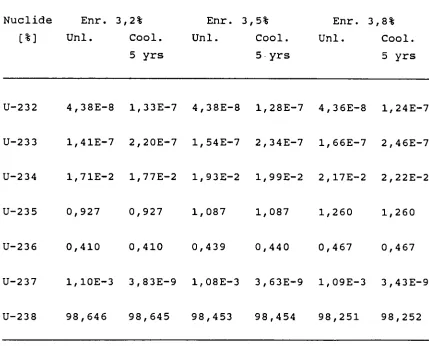
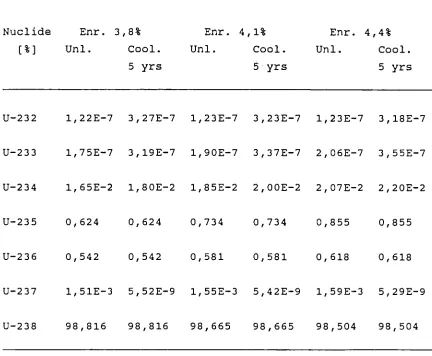
ingestion limits and stricter containment. Thus, decisions on prolonged storage and early re-cycle will be influenced by the above data. Tables I, II and III give detailed data on the uranium isotopes in fuel with varying enrichment, burn-ups and cooling times.
The effect of expected increased fuel burn-ups on the con-tent of U232 o n reprocessed uranium is shown in Figure 2.
All the data collected will be used in the consideration
of use and/or disposal of Ur e, on which subject much of
the available information has been assembled.
C.1.2 Uranium Tails
Uranium tails from both enrichment of natural U and
enrichment of Ur e are generated in the reference
enrichment plants in Holland, the former F.R.G. and the UK - all of which are operating under the international consortium Urenco Ldt.
The position of the tails in the nuclear fuel cycle is shown in Figure 1. Also the effect of the degree of enrichment, and storage times on the isotopic composition of uranium in the spent fuel as shown in Table I, II, and III; note particularly the concentrations of the two isotopes of concern, U232/ and U234, in relation to the
future use or disposal of Ur e tails. Little of the
transuranics, or fission products remain in the tails.
Although a diffusion plant operated in the UK at Capen-hurst from 1953 to 1982, this was replaced by a centrifuge plant operated by Urenco since 1976 in co-operation with
-two other plants, at Almelo in Holland and Gronau in Ger-many, all giving a combined output of 2,570,000 SWU/year.
Other relevant operating data for the plants have been collected, together with data on both types of tails, including, material specifications, inventories, annual arisinqs, accumulated stocks, storage capacities and transport requirements.
Additionally hazards are noted in dealing with both types of tails, which are fluorides, carrying the attendant
risks of chemical exposure, and, in the case of Ur e, the
added content of transuranics and fission products, albeit minimal.
Isotopie composition of Uranium as function of initial enrich-ment, nuclear burnup, after unloading (Uni.)/ and a five years cooling (Cool.) time after unloading
Table I: Burnup 3 3 GWd/tHM
Nuclide Enr. 3,2% Enr. 3,5% Enr. 3,8%
[%] Uni. Cool. Uni. Cool. Uni. Cool.
5 yrs 5 yrs 5 yrs
U-232 4 , 3 8 E - 8 l , 3 3 E - 7 4 , 3 8 E - 8 l , 2 8 E - 7 4 , 3 6 E - 8 l , 2 4 E - 7
U-233 l , 4 1 E - 7 2 , 2 0 E - 7 l , 5 4 E - 7 2 , 3 4 E - 7 l , 6 6 E - 7 2 , 4 6 E - 7
U-234 l , 7 1 E - 2 l , 7 7 E - 2 l , 9 3 E - 2 l , 9 9 E - 2 2 , 1 7 E - 2 2 , 2 2 E - 2
U - 2 3 5 0 , 9 2 7 0 , 9 2 7 1 , 0 8 7 1 , 0 8 7 1 , 2 6 0 1 , 2 6 0
U-236 0 , 4 1 0 0 , 4 1 0 0 , 4 3 9 0 , 4 4 0 0 , 4 6 7 0 , 4 6 7
U-237 l , 1 0 E - 3 3 , 8 3 E - 9 l , 0 8 E - 3 3 , 6 3 E - 9 l , 0 9 E - 3 3 , 4 3 E - 9
U-238 9 8 , 6 4 6 9 8 , 6 4 5 9 8 , 4 5 3 9 8 , 4 5 4 9 8 , 2 5 1 9 8 , 2 5 2
Isotopie composition of Uranium as function of initial enrich-ment, nuclear burnup, after unloading (Uni.), and a five years cooling (Cool.) time after unloading
Table II: Burnup 4 5 GWd/tHM
Nuclide Enr. 3,5% Enr. 3,8% Enr. 4,1%
[%] Uni. Cool. Uni. Cool. Uni. Cool. 5 yrs 5 yrs 5 yrs
U-232 9,34E-8 2,60E-7 9,41E-8 2,56E-7 9,42E-8 2,51E-7
U-233 l,59E-7 2,82E-7 l,77E-7 3,00E-7 l,89E-7 3,17E-7
U-234 l,59E-2 l,70E-2 l,80E-2 l,91E-2 2,01E-2 2,12E-2
U-235 0,656 0,656 0,775 0,775 0,905 0,905
U-236 0,491 0,491 0,528 0,529 0,564 0,564
U-237 l,41E-3 5,63E-9 l,45E-3 5,48E-9 l,49E-3 5,31E-9
Isotopie composition of Uranium as function of initial enrich-ment, nuclear burnup, after unloading (Uni.)/ and a five years cooling (Cool.) time after unloading
Table III: Burnup 50 GWd/tHM
Nuclide Enr. 3,8% Enr. 4,1% Enr. 4,4%
[%] Uni. Cool. Uni. Cool. Uni. Cool. 5 yrs 5 yrs 5 yrs
U - 2 3 2 l , 2 2 E - 7 3 , 2 7 E - 7 l , 2 3 E - 7 3 , 2 3 E - 7 l , 2 3 E - 7 3 , 1 8 E - 7
U - 2 3 3 l , 7 5 E - 7 3 , 1 9 E - 7 l , 9 0 E - 7 3 , 3 7 E - 7 2 , 0 6 E - 7 3 , 5 5 E - 7
U - 2 3 4 l , 6 5 E - 2 l , 8 0 E - 2 l , 8 5 E - 2 2 , 0 0 E - 2 2 , 0 7 E - 2 2 , 2 0 E - 2
U - 2 3 5 0 , 6 2 4 0 , 6 2 4 0 , 7 3 4 0 , 7 3 4 0 , 8 5 5 0 , 8 5 5
U - 2 3 6 0 , 5 4 2 0 , 5 4 2 0 , 5 8 1 0 , 5 8 1 0 , 6 1 8 0 , 6 1 8
U - 2 3 7 l , 5 1 E - 3 5 , 5 2 E - 9 l , 5 5 E - 3 5 , 4 2 E - 9 l , 5 9 E - 3 5 , 2 9 E - 9
U - 2 3 8 9 8 , 8 1 6 9 8 , 8 1 6 9 8 , 6 6 5 9 8 , 6 6 5 9 8 , 5 0 4 9 8 , 5 0 4
-Figure 1: Source of Arisings of Uranium Tails in the Nuclear Fuel Cycle
enrichnení ρ Ia n t
U n a t UF6
L ΝR ρ Ia n ts
U n a t ;e n UFé
r e p r o c e s sιng ΡIa nt
s p e n t f u e I eIe n e n ts
U n a t , »ai Is UF6
f is s ¡ o n p r o d u cts
s t o r a g e f in aI dis p o s aI
ΡΙυto n iu n
r e u s e / s tore
■f enrΡ1anichnent t
j
^
Ure UF6
UF6
conuers ion Ρ1ant
4
Figure 2: I n c r e a s i n g U2 3 2~Content as Function of Burn-up;
I n i t i a l Enrichment 3,8% U2 3 5j Cooling Time 5 y e a r s
LU
*
SL
-M C ω -M
c o υ
OJ m
ru Ζ)
4 50
4 00
3 50
3 00
2 50
2 00
1 50
1 ΟΩ
-I I I
— I
Title: Systems Analysis for a Dual-Purpose Repository Contractor: Kernforschungszentrum Karlsruhe GmbH
Contract No: FI2W - CT 90 - 0038
Duration of contract: February 1, 1991 - January 31, 1992 Period covered: 1991
Proiect Leader: R. Papp
A. Obiective and Scope
For a repository in rock salt accommodating both heat generating waste from reprocessing and spent fuel, the most favorable combination of waste/spent fuel conditioning technologies and disposal alternatives is sought. The annual arisings of spent fuel are subject to fuel reprocess-ing and direct disposal, respectively, whereby the extent of both paths is determined by the Entsorgung* ratio.This type of analysis gained of importance after the German government ruled in 1985 that the spent fuel disposal technology be developed so that it could be included in the Ger-man approach to spent fuel Ger-management.
This analysis focuses on the underground part of the entire system, i.e., the repository. Beside the effects of heat in the near- and the far-field, the consequences of release scenarios are analysed in order to assess the long-term performance of the underground system.
In addition, economical and radiological aspects are considered, al-lowing to eventually compare the alternatives on a broad basis. The re-sults will be included by the competent German authority submitting the licensing documents for the Gorleben exploratory mine.
B. Work Programme
1. Background: Fuel reprocessing is the German reference approach to spent fuel management but some sorts of spent fuel lend themselves to direct disposal.
2. Technical Concepts: Conditioning technologies for spent fuel and re-processing waste are main requisites for making best use of the room available in model repositories.
3. Individual Analyses: The thermal loading associated with various dis-posal concepts is key to thermal and thermomechanical effects in both the near- and the far-field.
4. Evaluation: Concepts are sought which score highest with respect to a series of evaluation criteria.
C. Progress of Work and Obtained Results State of Advancement
The situation in Germany resulting from the Atomic Energy Act is such that spent fuel reprocessing is mandatory as long as the underlying technology is economically sound. On the other hand the German government ruled in 1985 that direct disposal of spent fuel be developed as a back-up solution. This led, among other things, to the development of an ade-quate conditioning technology for spent LWR fuel. Based on this technical boundary condition, the effects on the host rock - salt - were evaluated for both reprocessing waste and spent fuel thereby anticipating a situa-tion which is, most likely, going to be encountered in the prospective German repository.
One main concern of repository design is to make best use of the space available in the repository. This is accomplished by varying the emplace-ment pattern of the waste/spent fuel packages considered, taking fully
into account a near-field design temperature of 2Q0°C. Far-field analysis is focused on the interface between the salt dome and the overlying stra-ta with special emphasis on possible tensile stress in this interface, thereby opening pathways to intrusion of brine. The possible consequences of such a scenario have been analysed.
Progress and Results 1 Background
The objective of the systems analysis is to establish a planning in-strument for the repository accommodating both heat-generating waste from reprocessing and spent fuel. The analysis is based on 700 tons of spent fuel discharged annually from LWRs and, with less emphasis, spent fuel from the German HTR program. An Entsorgung ratio - the ratio of the amount of spent fuel being reprocessed or disposed of directly - was var-ied within a wide range with emphasis on the ratio 500/200.
2 Technical Concepts
The reference cask for spent LW3 fuel disposal is dubbed POLLUX. It relies on a double-shell principle with the inner shell withstanding the lithostatic pressure at great depth (~1000 m) and the outer shell provid-ing radiation protection so that the cask can be handled hands-on. In this study the cask accommodates the rods of eight PWR assemblies and the accompanying structural material. Its length and diameter are 5.5 and 1.5 m, respectively, its weight is 65 tons. It is emplaced horizontally in drifts and backfilled with crushed salt.
As an alternative a POLLUX-canister has been developed which holds the fuel rods of half a PWR assembly, the rods being cut into 1-m-pieces. This canister is of the same size as the one for vitrified high-level waste (HLW) from reprocessing (length 1.34 m, diam 0.43 m) thereby en-abling it to be disposed of in deep vertical boreholes (300 m ) .
Heat-generating intermediate-level waste, ILW(Q), mainly stems from LWR fuel reprocessing and includes structural parts of the disassembling process, fuel cladding, and feed clarification sludge. The reference con-ditioning method consists in cementation and packaging in 400-1-drums,
its disposal occurs in vertical borehole. Cemented waste must not be heated up higher than 100°C. Advanced treatment of ILW focuses on tech-niques such as compaction etc. without employing water. This allows high-er thhigh-ermal loads for the ILW and its coemplacement with HLW or spent fuel.
Concerning disposal, various geometric arrangements have been considered which all belong to one of the following three types: Borehole concepts,
drift concepts, a combination of borehole and drift emplacement. The main design basis for repository planning was the near-field temperature in the package/salt interface (200°C) while the temperature of conventional-ly treated ILW(Q) was limited to 100°C.
3 Individual Analysis 3.1 Near-Field Analysis
One main assumption affecting the temperature in the repository near-field is dealing with the compaction of backfill material (crushed salt) surrounding the packages disposed of in drifts. The initial poros-ity of the backfill was assumed to be 30 percent; its decrease is gov-erned by an exponential law with a 5-year half-life which, in turn, makes the thermal conductivity of the backfill eventually reach the one of the ambient rock salt. The results of the area calculations for various dis-posal concepts and Entsorgung ratios can be summarized as follows: The space required in the repository can be made equal for spent fuel and re-processing waste; spacings between packages are dominated by short-term effects (< 100 yr) which result from the main fission products in both spent fuel and HLW. Secondly, the space required for HLW in vertical boreholes and spent LWR fuel in horizontal drifts, respectively, is about equal; it is assumed that boreholes are 300 m deep while drift emplace-ment occurs on three horizons.
Thermomechanical calculations for the three emplacement horizons (870, 1020, and 1170 m) exhibited a strong dependence of room closure rates on both depth and pillar width between adjacent drifts. Room clo-sure rates are of paramount importance for scenario analyses and associ-ated releases (compare Sec. 3-3).
3.2 Far-Field Analysis
The heat generated by the emplaced waste/spent fuel causes the lithostatic pressure to rise in the emplacement zone while it leads to a pressure relief the closer one gets to the interface between salt dome and overlying strata ("salt mirror"). This effect for different geometric layouts, i.e., repository concepts, was studied by relying on a simpli-fied model of the Gorleben salt dome with only four homogeneous zones. The resultant stress in the salt mirror does not differ significantly be-tween the different concepts but can turn into tensile stress (~2 MPa) if unfavorable assumptions are made for salt creep. Maximal stress in the salt mirror is attained after about 35-45 years, which is significantly earlier than the occurrence of the maximum temperature in the emplacement zone itself.
3-3 Long-Term Safety Analysis
The release scenario underlying the long-term safety analysis is a combination of two scenarios, the first being the unlimited intrusion of brine via the main anhydrite, the second the drainage of an undetected brine pocket.
region, a best-estimate value of about 85 years for the onset of brine intrusion via the main anhydrite was used in deterministic calculations. In probabilistic calculations, the earliest time for brine intrusion is assumed to be right after repository closure, the latest after about 1000 years just before all void space has disappeared and the backfill materi-al has reached the permeability of the ambient rock smateri-alt through consoli-dation .
The second scenario involves brine pockets with volumes ranging be-tween a few and about 1000 m3 that remained undetected during excavation work. A stress-induced drainage of brine into the emplacement zone may cause a mobilization of radionuclides at an early point in time. In addi-tion, the brine could inhibit the consolidation of crushed salt, thereby keeping pathways open to the emplacement sites for an extended period of time. It is in line with the conservative approach chosen in this study to assume the most adverse location for the occurrence of this brine pocket which is close to an emplacement site in the vicinity of the main access drift.
The computer code EM0S IM has been developed to calculate the long-term radiological consequences for individuals due to the occurrence of the aforementioned scenarios. All EMOS runs performed relied on both ac-cident scenarios combining the unlimited intrusion of brine into the in-frastructure via the main anhydrite with the drainage of undetected brine pockets. Provided the amount of brine from the pockets is sufficiently large, it may leach out radionuclides and move on into the access drifts where it can delay the consolidation process of the backfill material, thereby enabling a contact with external brine. In case the volume of the brine pocket is not large enough the external brine can only flood the access drifts connecting the infrastructure zone with the first emplace-ment panel if this panel is relatively cold, thereby delaying backfill consolidation in the access drifts.
EMOS calculations with best-estimate parameters yield radionuclide releases only for 3-level drift emplacement with ILW(Q) conditioned con-ventionally, i. e. , with cement and if the cold emplacement panel is next to the access drifts from the infrastructure zone.
Monte-Carlo sampling of the input parameters produced radionuclide releases for about 15% of the associated 5000 EMOS runs performed for two disposal concepts (pure borehole concept, borehole & drift concept). Dose rate maxima exceed the limit of the German radioation prodection or-dinance (3-10-^ Sv/yr) in about one out of 1000 runs.
Global sensitivity analysis in conjunction with Monte-Carlo simula-tions revealed six parameters to be overly important for the variability of dose rates associated with the borehole concept:
- reference room closure rate, temperature dependence of room clo-sure, reduced closure of ILW and HTR borehohles
- dam permeability, the exponent relating porosity with permeability - time of brine intrusion via the main anhydrite.
In the Monte-Carlo simulation for this concept relying exclusively on borehole emplacement the radionuclides U-233, Ra-226, 1-129, and U-234 provide the main contribution to the dose rates
Sensitivity analysis for the concept combining borehole and drift emplacement provided a clear result only for one parameter - volume of the brine pocket -, while the ranking of the other parameters is not as straightforward. But still the parameters dealing with room closure and permeability are among the eight highest ranking parameters. In addition, two parameters characterizing the overlying strata come into the picture. The radionuclides which mainly cause the dose burden are Np-237, 1-129,
Ra-226, and Cs-135; in some cases Ni-59, Se-79, and Tc-99 are of impor-tance. The differences stemming from the nuclide spectrum are due to their various origins, either HLW, ILW, or spent fuel. The presence of U-233 is an evidence for HTR-fuel to be the source.
Title : Waste Management Studies for Large Volumes of Very Low-Level Waste
Contractor : Intera Information Technologies, United Kingdom Contract N° : FI2W-CT90-0041
Duration of Contract: March 1991 - September 1992 Period Covered: March 1991 - December 1991 Project Leader: G M Smith
A. Objectives and Scope
A significant proportion of the radioactive material which arises on decommissioning of nuclear facilities contains only small amounts and low concentrations of radionuclides, either as surface contamination, or as activation products within the body of the material. The objective of this study is to investigate the i m p l i c a t i o n s for w a s t e m a n a g e m e n t s y s t e m s of various levels and forms of e x e m p t i o n c r i t e r i a and the corresponding implications for routing low-level waste materials arising from decommissioning. Following a review of the existing information on the volumes and radionuclide contents of the most significant low level materials which arise during decommissioning, and the current legislative b a c k g r o u n d r e l e v a n t to the d i s p o s a l , r e c y c l i n g or r e u s e of such m a t e r i a l s , the study will investigate the full range of r a d i o l o g i c a l i m p l i c a t i o n s of a d o p t i n g a l t e r n a t i v e c l e a r a n c e l e v e l s now u n d e r consideration. A number of related factors, such as volumes of materials which would require disposal as "radioactive" waste, the timing and the degree of dismantling, and the requirements for waste packaging are also addressed.
B. Work Programme
Β. 1. C h a r a c t e r i s a t i o n of the w a s t e a r i s i n g s , the o p t i o n s for the m a n a g e m e n t of the a r i s i n g s , and the e x e m p t i o n p r i n c i p l e s and criteria within which the options have to be applied.
Β . 2 . Ranging of parameters which characterise the system identified in B . l , p a r t i c u l a r l y t h o s e a s s o c i a t e d w i t h t h e f o r m u l a t i o n of exemption.
Β. 3. Evaluation of the radiological impacts following adoption of the relevant sets of parameter values characterising the system.
C. Progress of Work and Obtained Results
State of Advancement
The work carried out during the year 1991 has focussed mainly on the items Bl and B2 of the programme, and are now essentially complete. The various large volume, low level wastes from decommissioning of nuclear facilities have been identified, quantified and characterised. This has been accomplished by conducting a wide-ranging review of recent open literature, including that resulting from Community Programmes. A short review of the options for management of these arisings has been completed. These include unrestricted release, and various forms of controlled release via particular routes, such as the disposal of solid material to near surface and deep geologic facilities. The various forms of exemption principles and criteria under discussion internationally have been summarised and formulations relevant to the kinds of waste and release options described. A detailed progress report on the above has been produced ¡1/ .
Following on from the above, work has commenced on the quantification of the radiological and other implications of adopting different formulations and levels for exemption, taking into account the management options identified. This has involved the setting up of computer models and data for the quantification of the impact of the various routing options and exemption levels, and the use of previously published studies relevant to this work.
Progress and Results
1. Characterisation of the System (B.l. and B.2.)
Decommissioning of nuclear power reactors and other plant associated with the nuclear fuel cycle will give rise to large volumes of low level waste material (concrete, steel and other metals) and used components (such as motors and valves). Available information on low and very low level arisings contained in studies conducted by government agencies, international bodies and operators was reviewed. Of particular interest was the possibility that subsequent to a practical (ie. modest) monitoring programme or even the specification of the particular waste stream itself (such as contaminated concrete away from the main sources of activity in particular facility types) the characterisation of radionuclide content can be sufficiently known or adequately inferred as to justify appropriate routing of significant amounts of the waste. Such knowledge would be particularly useful in allowing efficient management of such wastes in the light of their large volumes and low radionuclide contents. In addition, very low level streams which appear to be the strongest candidates for exemption were identified.
It was discovered that the greatest research effort to date on the characterisation of decommissioning waste has been concentrated on research and power reactors. The total inventories and the specific concentrations of radionuclides are substantially dependent on both facility type (PWR, gas cooled reactors) and operating history. In particular, the specific activities of radionuclides in materials removed in stage 2 decommissioning for a particular facility are difficult to predict prior to dismantling, and due to the shortage of characterising measurements, are subject to the greatest uncertainty. Much of the information in detail was found to relate to single installations and therefore difficult to apply more generally owing to the variability
referred to above.
For a wide range of waste streams (eg. contaminated and activated concrete, contaminated metals, including mild and stainless steel) a significant fraction of the total radionuclide inventory, even at the very low levels, occupies only a small fraction of the total volume. In addition, much of the total waste volume was found to contain only natural concentrations of radionuclides. Many ways of presenting inventory data in the literature tend to obscure this. Semi-empirical estimates of radionuclide dispositions for generalised waste streams, together with theoretical considerations, suggest that underlying concentration distributions are relatively similar and can be justifiably applied to many waste streams not subject to detailed radionuclide monitoring.
Notwithstanding the inventory variations referred to above considerable agreement was found among the studied research findings on the relative importance of radionuclides in various waste streams and the fractions of the total mass of materials which may be candidates for some form of recycling or unrestricted disposal. Between about 30% and 80% of reactor steels which become contaminated away from the reactor core region can be recycled, wherea; much higher fractions of low level activated and contaminated concrete can be classified as "inactive" under existing legislative frameworks.
Depending on such factors as radionuclide content, physical and chemical form, volume, ease of dismantling and definitions of what comprises radioactive material, large volume waste streams may be considered for one or more of the following management options:
i) storage, temporary or indefinite ii) unrestricted recycle/reuse/disposal iii) restricted/controlled recycle/reuse
iv) processing and disposal as radioactive waste.
The features and relevance of these options for large volumes of low level materials arising during decommissioning were discussed in the context of the wastes arising (above), and the exemption principles and criteria reviewed below. It was noted that in general treatment of material as radioactive as distinct from "inactive" involves a greater financial overhead and that the potential for practical recycling certain very low active materials (such as steels) is considerable.
The final aspect of the characterisation of the decommissioning waste management system addressed comprised a review of exemption legislation within and outside the European Community. National and international provisions for the exemption of low level materials from the requirements of licensing and control were reviewed in the context of the types of waste materials arising during decommissioning and the options for disposal and recycling. Issues addressed included the various "clearance" levels in force or under consideration by various countries (these usually specify activity or radionuclide activity per unit area or mass), together with the broader considerations of the various definitions of the "practice" subject to any exemption, potential monitoring problems at low levels and the mass or area over which any numerical limit would apply. Notwithstanding the lack of firm international consensus in this area, considerable agreement in principle was found both in terms of the general approach to exemption and the numerical clearance limits proposed.
2. Radiological Evaluation and the Implications for Waste Management Systems ÍB.2, B.3. and B.4.)
Work is in progress to quantify the radiological implications of adoption of relevant sets of parameter values which can characterise the waste management system as a whole. The radiological impacts which arise at each stage of the management of decommissioning wastes (maximum and individual doses and collective dose commitments) will be estimated in the main using appropriately constructed assessment models and relevant available data. In this context pertinent previous research findings have been used. However, the need to ensure internal consistency in the present study, together with the necessary conciseness of the presentation of much of the previous numerical work precluded significant
savings in effort in this regard.
In order to be as comprehensive as possible regarding the management options considered, doses to operational personnel and to the general public were estimated for the widest possible range of identifiable practices associated with these options. These included the dismantling and decontamination processes, the transport of low level material to final disposal or processing (recycling) facilities, operational and long term impacts of disposal, and operational and long term impacts of the recycling. In most cases the exposures which arise from normal practices are of primary concern, although where possible, accidental occurrences, such as intrusion into completed waste disposal facilities, are addressed. Following the standardised characterisation carried out in tasks B.l. and B.2. of low level materials the calculational methodology will allow the radiological and other implications of the application of various exemption criteria applied to the numerous waste streams to be investigated.
References
/l/ Charles, D and Smith G M, Waste Management Study for Large Volumes of Very Low Level Waste from Decommissioning of Nuclear Installations, Intera Information Technologies Report IE2713-1 Version 1, CEC Progress Report on Task 1 under Contract
FI2W-CT90-0041 for the CEC, October 1991.
Title; Treatment, Disposal, Re-Use of Building Demolition and Site Cleaning Wastes from Nuclear Facilities
Contractors: NUKEM GmbH, FRG; WasteChem Limited, UK; SGN, F Contract No; FI2W-CT90-0044
Duration of contract: February 91 - October 92 Period covered: February 91 - December 91
Project Leaders: H.J. Wingender (NUKEM), J. Doran (WasteChem), H. Cadiou (SGN)
A. OBJECTIVES AND SCOPE
The study concerns waste materials arising from building demolition and from site cleaning activities associated with decommissioning of nuclear facilities. The study does not con-sider wastes such as dismantled and/or disassembled process equipment, radioactive process inventories, etc., as these wastes are assumed to have been removed from the facilities prior to building demolition and site cleaning.
The objectives are:
- Establish an overview of building demolition and site cleaning wastes arising from various types of fuel cycle facilities (enrichment, fuel manufacturing, power reactors, reprocessing, waste treatment, spent fuel encapsulation). - Consider sampling, monitoring and analysis tools enabling
the characterization and classification of these wastes.
- Classify these wastes according to a 3 class scheme (release for unrestricted use, release for restricted use only, radioactive waste) and describe possible ways of re-use or disposal.
Information from FRG, UK and France is to be used. Three partners contribute to the study (NUKEM GmbH-FRG: enrichment, fuel fabrication, reactors, fuel encapsulation; SGN-F: repro-cessing, waste treatment; WasteChem-UK enrichment, fuel fa-brication, reactors, reprocessing, waste treatment).
B. WORK PROGRAMME
The programme of the study is structured according to following tasks (see time schedule, Figure 1 ) :
Collection and compilation of waste data and characterization (3 partners)
Investigation of sampling, monitoring and analysis tools (NUKEM)
Material classification and investigation of re-use and disposal possibilities (3 partners)
C. PROGRESS OF WORK AND OBTAINED RESULTS
State of advancement
The study is currently in line with the initial time schedule, i.e., task B.l is approaching completion, tasks B.2 and B.3 are under investigation.
It has to be mentioned that considerable difficulties oc-curred during the data collection and compilation phase; dif-ficulties such as: data accessibility, completeness, interpre-tation, consistency and comparability. As result: the man power needed exceeds the initial ideas, the data handling and the re-arrangement procedures have become difficult and have
required the use of a computerized data bank and related
eva-luation codes. This tool has become even more important when
the classification task according to different national regu-lations was started.
Although the study has not suffered from any delay yet, it cannot be concluded that this situation will continue.
Progress and results
C.1 Determination of the waste arisings
The objectives of the study concern various facilities in the nuclear fuel cycle.
C.l.l Facilities in Federal Republic of Germany
For each reference nuclear facility in Germany - enrich-ment, fuel fabrication, nuclear power, and encapsulation plant
the following information is filed nearly completely on the data bank:
- general description of the operational characteristics - radionuclide content, distributions, concentrations in
the structure material and surface dose rate levels - compilation of waste arisings (see Table I)
According to the scope of the programme, the results from different countries and different facilities must be compiled in a unified scheme and parameters concerning the possible variations of radionuclide concentration limits and dose levels with corresponding uncertainties evaluated. The scheme produced forms a basis for comparisons. In this regard, a data bank was created and a computer programme development begun. For the data evaluation, at first, general premises and assumptions were necessary to establish which can be derived from the experiences of different decommissioning studies and on plant operational data.
The following decontamination procedure can be assumed: In the first stage, a dose level distribution of the surface is evaluated by monitoring. When the total surface is contami-nated a thin layer is removed. This procedure was repeated
til only hot spots are detected. Then this part of the wall is removed up to few centimeters depth. When no significant dose rate is detected the demolition is carried out. Based on this data, different methodologies of demolition procedures and waste treatments can be discussed. Different areas are fitted with stainless steel liners. In this instance, total removal of the liners has proven as more effective.
The data bank system created contains the following in-formation for each area with different dose rate levels, ra-dionuclide compositions and operational parameters:
- area description - surface dimensions
- dimension of the surface liner (thickness and material) - thickness of removal layer (concrete)
- part of the surface where hot spots are positioned - thickness of removal wall in the hot spot area
- expected release of radioactive material and/or activation products (content, distributions, concen-trations, dose levels)
- reduction factors of radioactive material by decontami-nation procedures before demolition phase
With this information, the waste arising and its charac-terization can be evaluated. The parameters may be varied in-cluding the time period between shutdown and the start of de-molition.
For determination of the radioactive content before demo-lition a classification of different areas is accomplished with regard to different dose rate levels and to different operating procedures during the operational phase. The conta-mination is caused by release of radioactive material, by ac-tivation and by transferring radioactive material out of the contaminated area to other areas. From the operating data the release rates of radioactive material, the activation rate of shielding materials, the possibilities for transfer of ra-dioactive material out of hot areas, and the remaining con-tamination was determined.
C.1.2 Facilities in the UK
This section reports on progress to date on this study for all the fuel cycle facilities in The UK, i.e., enrichment, fuel fabrication, reactors, reprocessing and waste treatment.
Waste arisings are calculated from construction volumes with the split of intermediate wastes/low level wastes (ILW/LLW) derived from incell/outcell proportions for ear lier plants, and from material types for later plants. Packing factors are then applied to these raw volumes.
Work has proceeded from the early 1980's in assessing the global decommissioning waste quantities, based on materials of construction and an ILW/LLW split, where, essentially, it is assumed all plant and equipment (P & E) in process cells are contaminated and therefore ILW; other materials are assumed to be non IWL. No trace or nonactive waste categories are assumed.
For later plants, waste arisings were similarly derived from construction volumes but the IWL/LLW split was based on estimates of IWL/LLW proportions for different types of ma terial, i.e., concrete, reinforcement, pipework, steelwork, Ρ & E, and for different categories of plant. Packing factors for the various materials were applied to the raw ILW volumes, assuming packaging into 12 m3 boxes for disposal.
A more detailed approach, as indicated above, was used for assessing the total volumes arising in the demolition of later plants.
a) First the respective volumes produced by the demolition of all fuel cycle plants including and excluding foundations removal were sought. Secondly, the closer categorization of IWL and LLW was investigated, in order to facilitate ILW segregation for ultimate deep disposal under todays regu latory requirements. The method used was to obtain all ma jor construction materials quantities from records or esti mates, for all later plants. Using these data, waste ari sings from demolition were converted to volumes (m3) and
then subjected to a conversion factor (CF) eg. the CF for concrete is 1 (packed volume as installed volume), and CF for ducting is 0.036 (using a typical cross section and re duction factor of 10).
b) Then for each waste type (concrete, ducts, etc.) and for each plant category, factors were produced using the pro jected level of IWL contamination and the degree of diffi culty in decontamination and dismantling of each plant.
Thus, to the total values derived for waste volumes, a) above, these factors were applied to give the volume of IWL for each plant. For disposal into 12 m3 boxes a packaging
factor for each type of waste had to be applied eg. con crete 2.1, ducting 6.8, etc.
c) Foundation volumes were calculated, assuming a 2 meter foundation for all plants, and using the available or cal-culated total plant surface areas.
The principal items of the above methodology are also applied to reactor decommissioning, much of the original data produced was for gas cooled graphite moderated reactors. This methodology is now being applied to the UK's first PWR Size-well "B", and volumes of waste arisings from demolition esti-mated.
The philosophy for reactor decommissioning in the UK has been changed recently to one known as the Deferred Safestore Strategy.
The revised strategy for reactor decommissioning using a delaying a safestore period until about 135 -150 years after shutdown has shown that the cost can be reduced by about 2 5 %. This is achieved by using the radioactive decay of reactor ac-tivated radionuclides, making safe dismantling a much safer task, and reducing the quantity of radwaste for disposal either to deep repository (IWL) or near surface repository
(LLW).
For all the nuclear fuel cycle facilities in UK, a vast amount of data has to be produced; although the work is well under way, it is not yet complete. When enough data have been produced, these will be evaluated, and then related to the 20 GWe scenario. Thereafter task B3, classification, re-use and disposal, considerations will be completed.
C.1.3 Reprocessing plants in France
To estimate the structure demolition wastes the data from decommissioning assessment studies of COGEMA reprocessing plants has been used. Cells of reprocessing plant have been classified in eight categories, in relation to the radiation level left after equipments have dismantled, and considering an alternate option of final cleaning of walls and floors. From the radiation level, surface contamination has been eva-luated in each category considering that 20% of the wall con-tamination have migrated into the wall thickness. Furthermore, there was considered that:
- the non-contaminated cells have been demolished separately as dismantling activity,
- steel frame has been dismounted,
- caped penetrations have been left into floors and walls, after decontamination,
- then, the building has been crashed down, concrete block crushed into parts of 15 to 20 cm, and wastes laid out.
Afterwards, there has been assumed that:
- methods of measuring activity of bulk materials would have been engineered (to try to classify the produced wastes), - residual contamination values will be part of regulations
- surface contamination sharing out keeps regularly during dismantling of eguipment,
- sharing out of the radionuclides is homogeneous which is not true as activity spectrum is not the same for any facility.
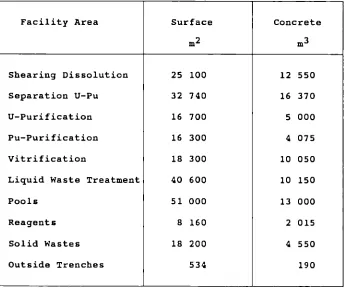
The waste arisings compilation is shown in Table II.
C.2 Sampling, Monitoring and Analysis Tools
The research programme has been concerned with a category of measuring techniques to detect localized areas of gamma emitting radionuclides, the radionuclide content in the remo-val structure material, probe sampling techniques and classi-fication of waste packages.
Using the sampling technique, the activity is determined at grid points up to a depth where the material is free of ra-dioactivity. The advantage of this method is the precise de-termination of the radionuclide content and its distribution. Furthermore, the radionuclides emitted beta, alpha and low energy gamma ray can be detected. The principal difficulty is that the activity is estimated at grid points. To estimate the activity at locations between the points it is necessary to make assumptions of the activity distributions. The ex-periences in this area show that a linear interpolation is in good agreement with the measurement data. More sophisticated models and using statistical analysis procedures should be useful for measurements with more efficiency.
To determine surface contaminations the adaptive moving
detector system /!/ seems to fulfill the criteria applicable
in this area. The detection limit of 105 Bq is attainable for
the 662 keV gamma ray of Cs-137 near surface using likelihood ratio techniques. This system uses a special analysis code for error determination. Thus, a complete data evaluation is ob-tained. More precise estimation of data is available accumula-ting a spectrum over a longer time period. However, a short measuring time is demanded. Thus, a special measuring pro-gramme has to be created to attain a reduction of waste quan-tities in an acceptable measuring time.
Measuring systems for the dose rate determination on the surface of waste packages are established and sufficiently precise for waste classification. In the case of detecting
fissile material and/or alpha emitters the passive and/or ac-tive neutron measurements are available. The detection limit is 100 mg Pueffective ^n a 2 0° ! drum. This limit is not
suf-ficient for waste disposal in land burial. Developments in this area could be successful to attain a detection limit of 1 m<3 Pueffective f °r w a st e before conditioning /2/.
In the case of non-destructive examination techniques for large radioactive waste packages, the experiments and the rou-tine measurements demonstrate the applicability of a moni-toring system /3/. The accuracy of these measurements depends
on: design of detectors and collimators, material distribution and probe location, shieldings. The detection limit for con tainers (cross section < 1.2 m χ 1.2 m) is IO3 Bq Co60 even
with steel shielding of 2 cm thickness.
Measurement systems are developed in the area of radioau tography. In this case a fairly high radionuclide content is necessary. These methods are not important for waste classifi cation and will be not considered in the study.
C.3 Material Classification
The classification of waste material governs the catego rization of the material as
radioactive waste
ready for restricted use ready for unrestricted use.
The limits are given by the respective national regula tions which differ from country to country.
C.3.1 Federal Republic of Germany
For classification of the wastes, the criteria are set down in the Radiation Protection Ordinance. The values of al lowance (A) are specified for each radiotoxic nuclide. The ma terial arising in the protected area can be classified as un restricted reuse if the mass related activity concentration is lower than a factor 10~4 of the value (A) . The limits on
surface contamination are 0.05 Bq/cm2 for most alpha emitters
(A<5*103 B q ) , 5 Bq/cm2 for beta/gamma (electron capture) emit
ters (A<5*106) and 0.5 Bq/cm2 for remaining radionuclides. No
mass or surface area restrictions apply to any of these values. Even if these limits will not be exceeded, a further demonstration of tolerability is to be performed by assessing the expected radiation exposure for realistic reuse scena rios. Unrestricted use or recycling is permissible if the spe cific activity of the material does not exceed 0.1 Bq/g.
C.3.2 France
Two targets are generally involved that lead to fix up rules and especially values of residual contamination:
one concerns the classification of industrial plants
the other concerns the reuse, indeed the exemption of radiological control, of materials which have been used in nuclear facilities.
In France classification of industrial plants in Nuclear Plants (INB) and in Installations Classified for Protection of Environments (ICPE) involve the following rules:
one INB can only contain 3.7*1014 Bq of total activity. Note
that a facility can be an INB, so the whole site can be. an authorized ICPE can contain 3.7*1010 Bq.
if activity is less than 3.7*108 Bq, access to the
Rules for reuse of materials are:
Rubbish drums must not receive any contaminated material. Present regulations apply to any waste the activity of which
is higher than 100 Bq/g.
Up to now no deminimus value has been fixed up; would this value reach a few Bq/g, monitoring and measuring low activity would have to be developed for controlling bulk materials.
At present, all projects of reusing decontaminated materials outside nuclear sites, must have the agreement of the National Authorities.
Values proposed by the French Safety Authorities:
a) 10 Bq/g and 50 Bq/cm2 whatever the radionuclide is.
b) 10 Bq/g and 0.5 Bq/cm2 for αemitter (U &P u ) .
c) 10 Bq/g and 10 Bq/cm2 for U and Pb210.
In fact, a considerable amount of man power is required and the extensive time necessary to make severe controls, few parts or materials leave the nuclear sites.
The calculation of average value of mass contamination in Bq/g was carried out from the following data:
the total surface activity is the activity measured after dismantling
the volume of concrete is the volume of the structure
Assuming that a homogeneity of the radioactive material can be made by crushing the wastes, the mass activity is less than 1 Bq/cm2; the hot parts, before demolition, have been
eliminated by sawing the pieces in small parts.
Uncertainties must be considered as to classification and as to eventual reuse of materials, although the mass activity of wastes, calculated as here above indicated, is much less than 1 Bq/g.
At present, in France, wastes with an average mass acti vity less than 1 Bq/cm2 would be stored in near surface dispo
sal.
REFERENCES
/l/ McMAHON, T.D., GRAY, P.W., D~Er, A.M., NABOULSI, A.H., KOUTSOYANNOPOULOS, C , EUR 13071 EN, 1990
/2/ SIMON, G.G, EYRICH, W.,Proceedings Spectrum '90, 1990
/3/ AULER, I., HELK, F., NEUKÄTER, E., Zimmermann, U., NIS report, Hanau (FRG), 1990
Table I: Radioactive and Non-radioactive Material (reference facilities, FRG)
Facility Enrichments-Fuel Fabrication^· PWR2 Encapsulâtion* Concrete Mg 190 000 58 000 150 000 85 000 Steel Mg 19 000 4 300 5 900 7 700
1) control and surveillance area
2) control area
Tabel II: Reinforced Concrete Quantities 600 t/year Plant, France
Facility Area Shearing Dissolution Separation U-Pu U-Purification Pu-Purification Vitrification
Liquid Waste Treatment
Figure 1: Time schedule for work programe.
Title: "Treatment, Disposal, Re-use of Building Demolition and Site Cleaning Waste from Nuclear Facilities"
to 00
Key tasks
1. W a s t e s o u r c e s , quantities and c h a r a c t e r i s t i c s
2. S a m p l i n g , monitoring and analysis tools
3. Classification R e c u s e and disposal
1991
FEB ) MAR
I
APR
I Í
I !
i
M A I J U N j J U L
I
AUG S E P O C T I NOV I ID E C
1992
J A N ¡ F E B MAR APR
L· L I J i ¡
!'
1
¡i
ί
ι
| ! i
ι
i ; I
I
l a o t a i i i i · ·
v . v . v . v . v . v
I ; ■KM*
!
I
!
! !'
M A I J U N
; !
ί
¡ I I
l a a a a a a a a a ·"■■aa■aaaa*a%.«■
I
!
I
κ·***;
J U L
'*Kv""¡
A U G S E P P a r t i c i
pants
N/W/S
Ν
N/W/S
Legend:
N: N U K E M G m b H F R G
W: W a s t e C h e m UK
Title : Study Treatment of Contaminated Sodium with a View to Decommissioning of FBR
Contractor : CEA - IA - FRAMATOME Contract No: FI2W-CT90-0058
Duration of contract : from April 1991 to April 1993 Period covered : March 1991 - December 1991 Project leader : CEA : Mr LATGE
IA : Mr HANEBECK
FRAMATOME : Mr de SEROUX
A. OBJECTIVE AND SCOPE
In the Fast Breeder Reactor (FBR) decommissioning studies, sodium management is a major problem. Sodium becomes an important waste which must be taken into account in the final process. To handle this specific topic, a cooperative working group has been formed, with the French "Commissariat à l'Energie Atomique" and FRAMATOME, and the German INTERATOM GmbH. CEA is the coordinator of the project.
The scope of work is based on a step by step approach, using available data and experimental results with regard to the sodium inventory, sodium purification and waste treatment.
The aim of this particular development program is to propose an optimized scenario for sodium destruction or recycling, employing a technical and an economic point of view. Moreover a Research & Development (R&D) orientation will be provided to improve the selected scenario and to allow a better understanding of fundamental processes.
B. WORK PROGRAMME
To perform the above scope of work, five main stages must be achieved :
1. Inventory of the sodium needs :
The sodium balance, based on sodium needs for future FBR programs and existing wastes to be treated, is the starting point from which the problem is tackled and from which to set the scenarios to be proposed later on are set.
2. Assessment of sodium behaviour and characteristics :
From an estimated contamination, provided by mathematical models which have been validated using experimental data, it is possible to predict the behavior and characteristics of the sodium to be treated.
3. Sodium purification :
Purification processes are examined with regard to the predicted quantities of contaminated sodium and the associated storage and transportation techniques. The R&D axes are defined, according to the required level of knowledge in the waste treatment domain.
4. Main scenarios :
the scenarios to be analysed.
5. Best available scenarios :
These processes, having been defined as suitable scenarios for sodium treatment, will be described. Further needs for R&D programs will be highlighted, to improve the processes efficiency.
C. PROGRESS OF WORK AND OBTAINED RESULTS
C.I. STATE OF ADVANCEMENT
The cooperative working group was assigned in April 1991 the task of sodium management in the decommissioning studies environment.
A first semestrial report was published on November 27th, 1991, III. It described the
sodium balance and the sodium pollution. The main findings of this report were presented during the "Radioactive Waste Management Task 1 - Progress Meeting", held in Brussels on October 22nd, 1991.
This annual report summarizes the main points of the ongoing studies and presents the planned actions for 1992.
The milestones with regard to the sodium treatment in a decommissioning framework presented on figure Fl.
CII. INVENTORY OF THE SODIUM NEEDS
The inventory of the sodium needs has been established using available data on existing FBRs, on a worldwide approach. The chart Tl summarizes the sodium quantities potentially contaminated, which will be considered as a waste to be reprocessed.
Some reactors are already shut down, either due to obsolescence or because the assigned objectives have been achieved.
In the ECC, two units are in this status : RAPSODIE (1983) and KNK (1991). The sodium of both plants is mainly used for laboratory tests and waste processing experimentation. These units are not integrated into the global waste account.
In the Commonwealth of Independent States (CIS), BOR 60 was shut down in 1988.
For the near future, the scheduled decommission of the FBRs would be the following: * ECC PFR : PHENIX : SUPERPHENIX : 1994 2003 2015 * OTHERS EBR-2 : BN 350 : FFTF : JOYO : BN 600 : FBTR : MONJU : 1993 2002 2010 2010 2010 2015 2023
To illustrate the sodium inventories, in a European context, the estimated balance has
been identified 111.
It is important to pinpoint the