o
o
GIx
'ffII
()r,
COl'l (E9)119
final
,
Brusse Is,
16
ita rch 1989ERASMUS PROGRAMME
ANNIJAL REPORT 1988
3.
ERASIIUS PROGRAI,II'IE 198E / 1989
ANIJUAL REPORT
---ffiFT-1988
has
beenthe
secondyear of
operarion
of the
ERASUUSProgranne.
It
has provedto
be
enoroously successful anong bothuniverslty
staff
and scudenEsallke,
thus
sustalnlngthe
alreadyvery
considerable
interest
engendereddurlng the inttial
launching phaseof the
Progrannein
1987.Universlties
havefor
the
first
tine
begunco
consider
lnter-universlty
cooperatlon atEuropean
level
as
an
Lnportant
eleroentln thelr
lnstltuttonal
developnent strategy.
2.
Actionln
1988 uas concentrated aboveall
oothe
lnplenentatlonof
ERASI{US Programe
operatlons
for the
acadcnlcyear
1988/89. Inconparlson
with the
academicyear
L987/88there
vas
a
dranatlc lncreaseln
boththe
nunberof
appllcatlons
for
support and thetotal
esountof
noney requested.lhis
meantthat
ln
splte
of
thelncreased budget
-
a
total of
I{ECU 30 vere arrallable-,
the
ratlo
of
supplyto
denand remalnedthe
sameat
approxlnatelyl:3.4.
Thus,
overall,
only
I
proJect
in
3 could be selected.Support
ls
betngprovlded
for
1091inrer-r:niverslty
cooperarionprogremes.
Of these 948 (87f)
lnclude
a
srudenr
noblllry
progreue, zlb a
teaching
staff nobllity
p?ogrnne, 79
aprogrril,e
for the jolnt
developnentof currlcula
and
12
anlntenslve
progrr@e.Thls
correspondsto r
successrete of
531overall,
althouglrthis dlffers
considerablyfor the
differenr
t)rpcsof
prograne (602for
studentnoblllty
programeo, 291for
teachlng
steff rcblllty
protramies, 141
for Jolnt
eurrlcultmdevelopuent
and lntensive progr'r'nes).
French
and
Brltlsh
unlvarsttles
conttnue
to be heavlly
lnvolved
ln
ERAsI{us. Ttrelncrease
ln the total
nunber
of
Lnvolvenentsof
Belglan, Portuguese, Dtrtch and Spanishunlverslcles also
standsout.
In
generaltertrs, the
overall
quallty
of
proposals washlgb
and theICPs selected represent
a
broad spectrxu!of
prograunes betrceenuniversltles in all
l{enber Scates
and a wlde
range
of
discipllnes.
As ues
the
casefor inter-university
cooperation prograrDmes,reguests
for
studentgrants
also
anouncedto
approxlnately threetines the
avallable
budget
(I{ECU13).
An
analysls
of
studentfloss
requesteduithin
accepted ICPs showsthat
only
the
UnltedKingdon can
be
regardedas a 'net lnporter' of
scudents andGreece
I
'net
exporter'.
Apart
fron
this,
a very
real
balanceis
to
be obsenred.It ls
estinated
that
around 12,000 studentsslll
receive an ERASHUS
student granr
for
L988/89. Withthe
exceprionof
Portugalall
llenber SEates have designateda
central
agency atnational
level
(National Grant AwardingAurhority
-
NCAA) co takeresponsibility
for
the adniniscration
of
ERASI{US srudenr granrs.L267 grants
for
short
sEudyor
teachingvisi.s
sere awardedin
theacadenic year 1988/89 and these
will
allor;
2511 personsro
carryout visits co universicies in other
yenber
Scates.
Ic
isencouraging
that
che big,gesc increasesin::plications
came fromMe::ber States hither:o unde:rerrFcpr-:i. in intef-university
4.
+
5.
awarded
to
candidat""i'ot
the
Connunity
tport.rgai,
Spaln,I-t"-lI
and Greece)' Sinilarly' visits
concern
ln
particular ihos" fle1ds
of
study
less
well
representedin
lnter-university
cooPerstion Progra$ne8 'Financlal suPPort has also been granted
to
23 proJects subnlstedby
assoclatlonsor
consortla
of unlversities
worklng
on
eEuropean
basls
andto
L2 publicaElonson
aspectsof
rrnlversltycooperatlon and
ioUffity,
iogegherwlth
other
uaJor publicatlonsprepared
.c Co-,liiii-f!"ef
fuch as
rhe
EC student handbook. The Conolssion.f"o i"al a
cgnslderableeffort in
1988, along wlththel{eoberstates,todi'sserninateinfotmatlononERAsl{usvl.a
lnfornatlon
naterlal
and
especlally a nunter of
intenslve semlnersrtrtch
;;;.
held
ln
-Belglun'
Dennark'
Francc'
Greece'Italy
rnd Portugal.1gg8
hae
seenthe
cornpletlonof
subsEantlal
PreParatorytglk
necessery
for
ttre launchof
the
Europeanconunlty
Goursecredit
Transfer Systen
-liCfSl
ritrlch
s111be
lntroduced
for a
6-year;il;;-phr"J
fro"
ihe
acadeolcyear
L989/9Oln flve
subJcct arees:Buslness
Adalnlstratlon,
H*tory, lledlclne., chenlstry
.tt9 t{echanlcafUnef*.iiii.
'Cfhighei
educatlon
lnstltutlons
and 3 consortlat r"
""l""tJa
to
takepart in the
'lnner
clrcle' of
thePllotScheme.Ttrelnstltutionsselectedwlllcooperateonabasls
of
.nutual
trust.
and n111 receLveflnancial
suPPort frou- thecomissloatofacllltatetheestabllshnentofttresystcn'Ttt:ll
work
wlll
be
ciiefulry
nonlroredby the
conisslon
nblcb
slll
also
awarda certalri
nuoberof tr"nts-
to
-the
prrtlclPsthg
srudcnts,
prorfi"l
tfrey
fulfll
chJ
us'el crlterle for
ERASIIUSgrints.
E.Aconsl&rableercuntofefforthasbcendGvotedlnthecourseof
lggg to r"fl""iiii
upon
rhe
destgn
en!
lrplonentstlon
of
approprlate Deasures
to
ensurethe
Jnttorlng
and evaluetlonof
the
frogt'"*".
-eo
atteEPt
has
been nade
to take
stock
of experlencewlth
thefunctitnlng
of
the
Prograoehicherto,
to
try
to
ascertai"
lo rhat
extenrth;
Programels
acblevlnglts
pollcy obJcctlves"r,l
ao deteldinethe naln problels rhleh
have arisensofar.ultrrregaratothefuturedevelopnentandpossible
a&ptatlon
of tht
Progranneln the
coning years
this ls
epartlcularly
inportant exerclse'9. In
the short
termefforts
nill
be
concentrated onthe
evaluationof
those."p"ia"
whlch nay be consideredas
relevant
vith
regardtothePreParatlonofadraftofposslble^adaptatlonstothe
ERAST{US Dectsion
text,
provldedfor ln
Arclcle 7
of
ttre Declslon'Ttre
aln of
the
Coronissionin
preparlng
luch
proposals---shlch
will
be subnittedto
the council
rrlthln
the
courseof
1989-
ls
co nake lmprovenentsin
the
iroplenentatlonof
the
ProgFn'r'e andsubstantiallylncreasethenumberofsEudentscakingpart.
Nonetheless,
lt
has already becomeclear
Ehat ERASMUS has sErucka
chord.=orf
bothuniv"tticy
studenEs and ceachersalike
and 1smaking
an
iro:portaotconcribution
to
Eheconstrtlction
of
Europe and the European educaEional cornmunity'7.
:
I
J
I
I I
L
i
;
l
I l
;
lf i
r
{
Lf
t ,
.'
ERASMUS PROGRAI.II{EANNUAL REPORT 1988
I.
INIRODUCTION AI{D GENERAL CONT.E(TII.
REPORT ON ERASUUS ACTIVITIES IN 1988III.
SVAUTATION OF TIIE ERASI{US PROGRAI'IMEIV.
FUTUR,B PERSPECTIVESI r"* -+JdrFl4'!Fr4'r*
Annex
Statistical
TablesPAGE
p.
1p.
3P.
18p.
211. Wlchln
the
frameworkof
the
completlonof
the Internal
Marketln
1992,the
comltmentto
achieve econonlc andsoclal
coheslonand
the
needto
further
develop and consolldatethe
conceptof
a
Peop1e's Europe, educatlonis
increaslngly being
seen ashavlng an lmportant
role to
play
and asbelng
llnked
to
otherspheres
ln
the
overall
strategy
for
the
conlng decade. Wlthinthls
gcneral context arlareness has grownln
recent yearsof
theneed to establlsh much stronger
cooPeratlon
betweenrrnlversltles
ln dlfferent
MenberStates
and morenobillty
of
students and
academLcstaff.
Increasedstudent
noblllty
hascone
to be
recognizedas e particularly effective
meansof
naklng
the best
possible use
of the lntelleccual
resourcesavallable
wlthln
the
Conntrnity by educating more and tnore youngpeople
to
beable
to
comunicatein
a
languageother
thanthelr
onn and, asa result
of their
experienceof
studylng andllvlng
in
another t{enberState,
to
beable
to
cooPeratewlth
partnersfron other
baekgroundsand cultures 1n thelr
subsequentcareers.
Ttrus,
rith a
view
not
only
to
nalntalning
and errtranclng theconpetltlvity of the
EC
on world narkets but also
toconeolldatlng
the
growlng lnterdependanceof
EC [ernber Statesthe
ERASMUS Progranne,or
the
European ConmunltyAction
Schenefor
the Moblltty
of
Universlty
Students, Itas
adoptedby
theCouncll on 15 June 1987 (1).
Ttre
speclfic
goals
of
the
Programmeas stated
ln
the
Councll Declston are asfollows
:-
to
achleve
a significant
increase
in the
numberof
students
from
universities (2)
spendlngan
integratedperiod
of
study
in
another MemberState,
i.n order
that
the
Comunlty may draw upon an adeguatepool
of
manpowerwith
first
hand experienceof
econonic andsocial
asPectsof other
l{enber
States, whlle
ensurlng
equallty
of
opportunity
for nale
and
fenale
students
as
regardsparticlpatton
ln
suchnobillty;
-
to
promotebroad
and
intensl.ve
cooperatlon
betweenuniversltles
ln all
Menber States;Declslon 87/227/EEC
of
L5 June 1987 (OJ No L165of
25.O6.L987,pp 20-24)
In
the
contextof
the
ERASMUS Progranme,the
term'universlty'
is
used
to
cover
all
types
of
Post-secondary education andtralning
establishments whichoffer,
where appropriatewithin
the
franeworkof
advancedtraining,
quallflcatlons
or
dlplornasof that level,
whatever such establlshments maybe
called
in
the
Menber States.2.
(1)
3.
to
harness
the full inteLlectual potentlal of
theuniversities ln the
Conrnunltyby
meansof
lncreasedmoblllty
of
teachingstaff,
therebylnprovlng the
quality
of
the
educaton andtralning
provldedby
the
unlversltles
wlth a view to
securing
the
conpetltiveness
of
theConrnunlty
ln
the
world narket;to
strengthen
the lnteractlon
between
cltizens
ln
dlfferent
llember Stateswith
a vlew
to
consolldatlng
theconcept
of
a
People's Europe;to
ensurethe
developnentof a
pool
of
graduates wlthdlrect
experienceof
incra-ComunLty cooperation, therebycreating
chebasis
upon whlchlntenslfied
cooperatlonin
the
econornic andsoclal
sectors can developat
Connunitylevel.
1988
has
beenthe
secondyear
of
operation
of the
ERASUUSPrograure and
lt
has provedto
be
enornously successful anongboth
universicy
staff
and studentsallke,
chussustaining
thealready
very
considerable
interest
engenderedduring
thelnitlal
launching phase
of the
Prograrmeln
L987.
'lhis
exceptlonal response
to
che Programne regLsteredat all
levelsmakes
it
clear
that in
overall
tenns ERASMUShas
succeededin
interesting the
universicy
rrorld directly.
andactively ln
theconstructlon
of
the
Conrnunity.Universitles
have,for
the
firsc
tine,
begun
to conslder inter-university
cooperatlon
acEuropean
level
as an
funportant,elenent
in their instltutional
developnent
strategy. By stlnulatlng the free
movenentof
students and teachlng
staf,f
within
the
Connuntty ERASMUS borhforeshadorrs
the
conpletlon
of
the
Slngle l{arket
whlle ac
thesane tl.me representlng
a
practlcal
lnstrunent
for
the
educationof
thoee
nen and
nomenwho
will constltute lts
futureoperators.
The ERASMUS Progr"n'ae should
not
be
consideredas
a
separateentit|, but
as
oneof a
series
of
Cornnunity neasuresin
thefield of
educatlon andtraining.
A commonfactor
characterLzlngall
these
prograrnmesis the high
level-
of
denandthey
haveengendered throughout
the
Comrnunity,in
general conparable tothe
responseregistered by the
ERASUUS Progranme. These includenotably
:the
COI.IETT Prograrnne (ConurunltyAction
Programrnefor
educatlon
and
tralning for
technology)whtch
provideslnter-alla support for
transnational
placements of
students and teachlngstaff in
industry
in fields
relatedto
technologythe
SCIENCE Programne(previously
known
as
rheSTIMUIATION Programne) which
alns
et
the stirnulatlon
of
cooperaElonand
interchange between European researchscientlsts.
DELTA (Developlng European Learnlng Through Technologlcal
Advance) which addresses
the
lssuesrelated
to
the
useof
new emerglng technologies
for trainlng, re-training
and5.
education, both
ln
che areaof
Informatlon Technology andTelecommunications and Broadcasting Technologles.
In
addition the
Conrnisslon has now proposedthe
introduction of
the
LINGUA Programmeto
pronotethe
ceaching andlearnlng
of
forelgn
languageswithln
the Communlty.In
vlew
of the
lmportanceof the
Prograrnmefor the
futuredevelopnent
of
the
Comrnunityic
becomesincreasingly
importantafter
twoyears'
operatlonal experienceto
atcenptto
ascertalnthe
extent
to
which
the
Progranmels
neetlng
its
aims
andpoLlcy obJectives. Horeover,
in the ltght of
experiencehitherto the future
development andpossible
adaptationof
the Progranmein
the years
to
come haveto be
eonsidered. Ttrus,alongslde
the
inpl-ementatLonof
the
actlvitles
provldedfor
in
the
CouncilDecision,
the
introductlon
and lnplenentatlon of
appropriate mechanlsms
to
ensurethe nonitoring
snd evaluationof
the
Progranme becomeslncreaslngly
inportant.The
following
report
onthe functioning
of
the
Programmein
theacadenic
year
L988/89,as
provided
for ln Artlcle 6 of
the Council- Declslon, w111 thus focusnot
only
ona
description
andanalysls
of
acttons
undertekenwlthin the
frarneworkof
thelnplementation
of
programme operatlonsfor
1988/89but also
ona
nrrmberof lnlclatlves related to the lntroduction
of
arrangements
for
the rnonitoring and evaluatlonof
che Progranneas a whole.
REPORT ON ERASMUS ACTIVITIES
IN
1988In
L988action nas
concentratedon the
following
areas of
activity:
-
the
implernentationof
ERASMUS progranmeoperations
for
the
academic year 1988/89,in
particular the
selection of
projects for
supporc
during this period and
thefinalization of
preparatory work necessaryfor
the
launchof the pilot
phaseof the
European Community CourseCredit
Transfer
System (ECTS)in the
academic yeart989/90;
-
che continuation
of efforts
undertakento
infonn
theacademic comnunity
and
national authorlties
about
theProgramme;
-
the
consoLidatlonof
the
organlzatlonal
and consulcativeinfrastructure
for
the
Programme.The
total
budgetavailable
amounted co ECU 30 nio(1)The Council Decision
provides
for a
budgetof
ECU 85 miofor
the
first
three
yearsof
the
Programme(1
July
1987-
30 June1990).
A
joint
declaration
by
the
Council
andthe
Commlssionstates
that this
totaL
budgetwill
be
distrlbuted
asfollows
:L987/88: ECU 10
mio;
L988/89: ECU 30mio;
L989/90: EcU 45 mio.I
t-6.
II.
7.
8.
Actlvitles ln
eachof
the
areas nentloned aboveare
sltrnmatLzedln the
paragraphswhlch
follow, the
rnain enphaslsbelng
onthose measures whlch were adopted
wlthin
the
frameworkof
thefour
"Actlons"
of the
ERASI{US Prograurneas
descrlbed
in
theAnnex
to
the
Council Decision,i.e.
Establlshrnenc
and operatlon
of a
European universicynetwork (,Acclon L)
ERASMUS student granEs schene
(Action
2)Measures
to
promote
nobiLlty
through
the
academicrecognition
of
diplonas and perlodsof
study (Action
3)Conplementary measures
to
promote studentnobility ln
theConmunity (Action 4).
Action
1
:
EuropeanUniversity
Network:
Supportfor
Inter-universiEy
Cooperatlon Progrannes (ICP) and StudyVlsirs
(SV)INTER.T'NIVERS
IlT
COOPERATION PROGRA}.TMESIn
order
to
achleve the mainain
of
che ERASMUS Prograune,i.e.
a
signlficanc
increase
in
student
rnoblllty, universities
of
dlfferenc
Membe:r Scatesare
eneouragedto
concLude agreenencs-usually at
departroentalor faculty level -
and nake
thenecessary
errangements
to
establlsh
lnter-university
cooperation progr.nr$es (ICPs) concernlng oneor
several
of
the folLowlngactlvttles
:-
studentnobility
progranmes;-
teachingstaff nobility
progratrmes;-
Joint
developmencof
newcurricula;
-
intensive
progranmes.Ttre
teaching s'Eaff and student
nobillty
progrannes togetherconstltute
whatis
known asthe
EuropeanUniverslty
Network(l).The obJective
is to
providea
solid fr'-esork for
the
exchangeof
students
on a regular basis whlle at the
s:rmetine
nininizing
che
organlzational
difficulttes often
encounteredwlth
regardto
study abroad.A
short
descriprtlonof
eachof
che above-mentioned progranne componentsis
followed
by
an
analysls
of the results of
theselectlon
procedurefor
the
academlc year L988/89.9.
Studentnobility
programmes: rhis
support
ls
intended
for
universities
which organize
progr:ilnnesproviding for
thestudents
of
oneuniversity the
chanceto
undertake,wlthin
auniversity
of
another MemberScate,
a
period
of
study
whlchwill
be
fully
recognizedby
the
honeunlversity
when awardlngthese students
their
diplomaor qualiflcatlon.
Student
mobllit'y
progranmeswhich
satlsfy this crlterion
of
recognitlon
are
eligible
regardlessof
the
field of
srudy and(1) In
cheofficial
text
development
is
partof
Actlon 4.of
the
Council DecisionJoint
curriculura10.
the
level"of
study
(upto
andincluding the
Ph.D., doctorate orequivalent). Priority is generally
granted
to
reciprocalexchange progranmes, though
the
needfor
exercLzLngflexibility
in
the
interpretation
of this
conceptis fully
recognized.The recognized
period
of
studyin
anocher l.{ember State must beof
substantlal
duracion (normallyat
least
one academic'tern',
and
in
no eeseless
than 3nonths),
andthe
aimls to
encouragelong
lastlng
cooperation betweenthe
universitles
concerned.Financlal
supportto
the participating unlversltles
nay
coverthe followlng
expensesentailed by a student nobllity
Progr:ilune:
-
the costs of the
developrnentand
operation
of
theprogranne
(essentially costs
of travelllng
and
staylng abroadfor unlversity staff
uembers whotake
parc
in
neeLings
to plan, develop,
lnplement,
monltor
andevaluate
the
prograrnme) ;-
expenditurerelating to
the
preparation
andtranslatlon
of
docurnentsand
teaching
rnaterial for the
studentmobility
ptogranne;expenses incurred
by
the
universities
for
the preparationof
students
:
informationprlor to
deParture,linguistlc
preparation provided
for
students, especially
ln
caseswhere such preparacion extends over
a
significant
periodof
tirneprior to
departure;-
expenditurefor
naking
infornatlon
about
the
progralnmemore
widely
available;-
other
expendituredireccly related to
carrying
ouc
ordevel,oping
the
progranme.For each student
rnobility
progranme,the
maximr.rn supPort vhlch maybe
awardedis
ECU25,000
per year per
partlcipating
universicy
(vith
the
average amountof
such support awardedln
L988/9 standing ac sone ECU 5,000).Scaff mobil-ity
progranmes
: support is intended
for
universltles
which organize progrsnmesproviding
an opportunityfor
the
teachingstaff of
oneuniversity
to
teachin
a
partnerunive::sity
in
another MemberState.
I.llth
regardto
the
long-termobjective
of
achievinga truly
significant
poolingof
theintellectual
resoureesof
the
Conmunlty'sunlversities
priority
is
given
to
programnesfor
reciprocal
exchangesin
shich
thevisiting
scaff
members makea
substantial contributlon
to
theregular
teaching progr{unmeof
thehost
universlty
over a periodof at
least
one month.Flnancial
support may be usedto
cover fol-lowing expenses :-
the costs of the
developmentand
operatlon
of
the prograrrune (rnaxinumof
ECU 5000per year per
university
t1
the nobll:Lty costs
of
teachlngstaff
(naxinunof
ECU 3500per
teaehi.ngstaff
nember);the
costs
of
replaclng
teachlng
staff
(naxlmunof
ECU2500 per rnonth
per
staff
menber).Jolnt
developnentof
newcurrLcula
:
supportof this klnd
ls
lncendedfor
unlversities
of dlfferent
Meuber States whlch areseeklng
to
sork out
jolncly
a
newcurrlculurn
with a
view
coIts
lncorporatl.onor
funplernentationin all the
universitles
taklng
parcin
t-heproject.
The Comnlsslon accords preference
to
proJects
involvlng
ttreJoint
preparation
of an entlre
currlculum
or at
least
substantlal
parltsof
a
currlculun.Speclal consideration
is given to
proJects which clearly
contrlbute
to the
progress
of
acadernicrecognitlon
betweenl{anber
States,
to
those whlchare
adaptedto
the
new technlguesof
nultl-nedia
or
dlstance teaching, aswell
as
to
those alnedat
buildlng
the
European dinensioninto
the
contentof
courses.the
maxlnumfinanclal
supporcavallable
fron
the
Gonnissionls
ECU 20,000
perproJect.
This
supporc nayonly
be usedto
coverexpenses
dlrectly llnked to the prep.ratlon of the
nescurrlculun,
suchas
:travel and
subsistence
eosts of
ceachingadministrative
staff
involved
ln
neetings
whlchneeessary
to
determineJointly the
organlzatloncontent
of
courses;costs of
produclng, necessary documents.translatlng and
clrcul-aEing
theIntensive
Prograrnmes:
This
is e
nelr elementof the
ERASMUSPrograrnne, introdueed
for
the
firsc tine ln
L988/89. Supportis
avallable
for
univergitles
of different
l{enberStates
whlchjolntly
organize i.ntensive teaching
progrannes
of
shortduratlon brlnglng
cogetherstudents and teaehlng
staff
fron
several countries
of
the
EuropeanComunltlr.
Progranmesnust
befuLl-tine
andhave
a
duratlon
of
betweenone
weekand
onenonth.
Partlcular attention is paid to the
nunber
of
studentspertlcipating and co the potentlel contribution of
theprograrntne as
a
meansof
stimulatlng
closer
cooperetion betweenthe
unlversitles
concerned. Preference1s
glven
to
teaching progranneswhlch
are
genuinely
"multinatlonal-"
ln
terms
of
students
and
teaching
staff partlcipatlon, and to
thosefocusslng on
a
specifle
thenenot
nonnallyavailable
at
any oneof
the participatlng universltles alone.
Programnes which cancontrlbute to the
dissemination
of
knowledgeln
rapidly
evolving
or
new areaswlll-
receivespeclal
conslderatlon.The
financlal
supportof
the
Commission rnay be usedto
cover
::or
are
and
-
the travel
and
subsisteneecosts entailed
by
meetlngsnecessary
to
plan the
courses;-
expenses
incurred in producing, translatlng
andcirculating
lnforrnatlonliterature
and teachingnaterial;
-
the
costs
of travelling
and scaylng abroadfor
teachingstaff
and students who haveto
gofron
one Member StaEeto
another.The maxlmun
support
whlchnay
be
granEedis
ECU 20,000 PerProgranne.
The
total
nurnberof
appllcations
for
supportof
ICPsin
L988/9was 2041 compared
with
898tn
L987/8(+
L27l').
The ECU 52 nlorequested represent almost
6 tines the
amount,avallable
(ECU 9mio). Of the
204j.applicatlons received,
L579 (77I> involved astudent
rnobility
progranme,745
a
teaching
staff nobillty
progr$mle,
575
a
prograrunefor the Joint
developnentof
curricula
and
52Lan
lntensive
programe.
In
termsof
thelr
distrlbutlon by the
MemberState of the
coordinatinginstltution,
Portugueseuniversitles
subnltted
5
times
moreappllcar.ions
than
in
1987/8,the
correspondlngracios
for
theother
Menber Statesbeing
as follows
:
Belglun,
2.7;
Denmark,2.3;
the
Federal Republicof
Germany,2.4;
Greece,3.5;
Spain,4.1;
France,2"3;
Ireland,
1.9; ItaLy, 2.7;
Netherlands, 1.9; UK,l-.8. In
terns
of the
involvementof
each MemberState
ln
all
applications,
Spain
increasedits participation rate
by7.6I of the total, while ltaly
(+4.77,) andPortugal
(+3.72)also
recorded considerableincreases.
Conversely,the Britlsh
universities'
particlpation
rate in all
applications
fell
by8.67",
the
other Member States remainlngrelatlvely
stable.These
figures
demonstratethat
the
roostsignificant
percentageinc::eases
in
applications
came from thosecountries
which hadbeerr
less
in
evidence Ln L987/8,
The conEinuing Low numberof
applications
from Derunarkis
an exceptionin this
regard.\tiewed
in
termsof the
academicdisciplines lnvolved,
a
verysirllar
Fectern eflergesto that
recordedin
L987/8,the
main *li f'terencesbeing substantial
increasesin the
proportion
ofapi:iications
in the fields of agriculture,
engineering andle.nguages, and
a very
substantial
fall in the
percentageof
overall
applications
in
businessstudles.
The low
numberof
appllcati.ons
in
teacher
educationand,
to a
lesser
extent, rnedlcal sciences, remainsa
causefor
concern.Applications received were referred to
Academic AdvisoryGroups(1)
which met in rnid-April to discuss requests for
supporE
in the social sciences,
humanitiesand natural
andapplied sciences respectively. The views
expressedby
theacademic advisors were
carefully
notedby the
Comrnission, whichdeeided
to discribute the
supportavallable
arnong 1091Inter-The
role of these
groups, madeup of
rePresentativesof
theacademic world appointed
by the
Commisslonacting
mainly on theadvice of the
ERASMUSAdvisory
Cornrnittee,is co give
theConrnission an
informal
opinion onthe
ICPsto
be supported.13.
14.
Universlty
Cooperation Programmes.Of these,
948 lnclude
asrudent
moblllty
progranme(871),
2L4a
teaehlngstaff noblllty
progranlle,
79 a
prograrunefor the Jotnt
developnent of
curricula
and 7':2an
lntensive prograslle.
(It
shouldbe
notedthat each ICP can
concain
varlous differenc
EJrpesof
cooperatlve
activlty.)
This
correspondsto a
successrate
of
53I
overalL,
although
the
successrates for the
lndividual
t1ryes
of
progrannedlffer
conslderably (60U
for
studentmobillty
progranmes,
29N for teachlng staff nobility
progranmes, 147
for
progra$lesfor the Joint
developrnentof
currieul.a and in.tensive programmes).
Thus,
ln
financial- terms,
the
supply/denandsltuatlon
wasparticuLarly
courpelitivein
the
caseof
currlculum developmentand
intenslve
progranules,for
which15 tlmes
andL7
tlnes
asnuch noney rras requested
respectively
than wasavallabLe.
Thlsls
due
to the fact
these
t)ryes
of
Progranneforrn
part
o,fActlons
3
and
4 of
ERASMUS,on which
the
Council
Decislonplaces
a
total
ceillng
of
102of
the
overall
ERASUUS budget.Table
1
of
the
Annex providesa
surveyof
the
ParticiPatlon
of
universl.ties
from the
various
MemberStates ln all
2O4Lappllcatlons
andln
the
1091projects
accepted. The continuinghtgh
involvementrates
of
French andBrltlsh universities
i.nthe
acadenicyear
t988/89is
notable.
However,the
lncrease t.nthe
total
nurnber:of
lnvolvenenLsof
Belgtan,
Portuguese, Dutchand Spanish
universltles
also
standsout
(+621, +441, +392 and+251
respectivel-y conparedwith
uhe academicyear
L987/88).Although
the
nurnberof
involvementsof ltallan
universlties
also
lncreasedby
251ln
the
academLcyear
L988/89,they
aresttlL
not partlcipatlng as
fully ln
ERASMUSas
the
country'spopulation
figures
or overall
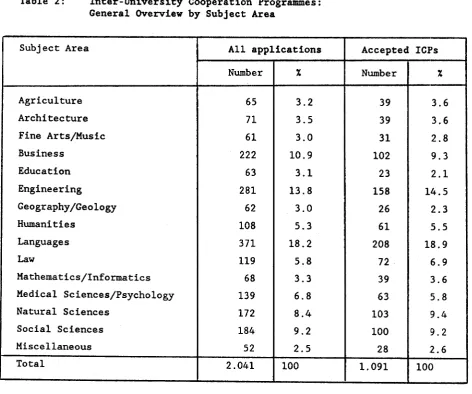
student nurnbers would merit.Tabl"e
2
shows chedistribution of
applications
and
acceptedprogramnes
over the
various subject areas.
The
nr:mber andquallty of the
appllcations
in
che
various
subJect
areasdlffered
considerably.In
certain
subJectareas,
goodquality
applications
accunulate, sothat
care hadto
be taken co ensurethat
the
Programe wasnot
floodedby
lndividual
subJects(in
particular
languages and businessstudies could be
nentlonedhere)
.
Within closely
drawnlimits, the
selectlon
hadto
setstrlcter
standardsfor
sone subjects thanfor
othersIn
comparisonwith the
academicyear
L987/88
the
maLndlfference
of note is the
decreaseln the
numberof
ICPsaccepted
in
businessstudies (9.31
conparedto
16.3Uof
thetotal
number).Thls
corresponds, however,ln
the naln
to
thefall in
the
nuurber andoverall
percentageof
appllcatlons in
chls
subject.In
general
terns,
however,it
canbe said that the
overall
quality of
proposals received washigh
andthe
ICPs selectedrepresent
a
broad spectrumof
cooperatlon progranmes betweenSTUDY VISITS
15.
Wlth
a
vlew
to
consolldatlng
the
developnentof
Ehe EuropeanUnlverslty
Networkgrants
are
awardedto staff
membersof
unlversities
in
the
Conrnunityto
enable themto
go on study or teachingvlsits to
universities
in
oneor
severaLother
MemberStates.
Grantsfor
studyvisits,
the totaL
duration
of
whlch mustnot
exceedthe
equivalentof
four
weeks, Day be awarded-
elther to
stsudythe possiblllty of
establlshlng
orextending
an
lnter-university
cooperatl-on progr:mme byentering
into
exploratory contaet
wlth
one
or
severaluniversitles
ln
ouher Henber States;-
or to
improvethe
content
of
lectures,
in llaison
withcolleagues responslble
for glving slnllar lectures
in
other
universitles;
-
or to
increasethe
grantholders' knovledge and experienceof certaln partlcular
aspectsof the
higher
educatlonsystem
of
the l{enber State(s)vlslted.
Grants
for
Eeachlngvlsits
may be usedto faciLltate
followingklnds
of
teaching perlods spents abroad :-
vislts
by
a
teaeherat
the
invitation
of
a
university for
the
purposeof
teachingits
own studencs;-
speclalized
lecture
series
givenby
onescaff
member (orby a tealtr of university teachers) in
different
unlversltles
of
oneor
severaL other Member States.For the
L988/89 academicyear,
teachers
and
adninlstrators
subnltted
35L0applicacions
for visit
grants (as
compared to2377
in
L987/88),
in
order
co visiu universities in
otherl.tenber States
of
the
Comrnunicy.Table
3
gives
Ehe numberof vlsit
grants
requestedfor
theL988/89 academic
year
broken
downby
MenberState of
theappllcant, as
well
as by
rate of
growthwith
respect
Eo theL987
/88
academlcyeer.
l.ltrat
is clear, and thls ls
bothencouraglng and promislng
for
the
future, is that
the
blggestincrease
ln
applications
for visit
grants
comesfrom
MernberStates
still
experiencing sonedifficulty in
pronotlng
inter-university
cooperatlon
progr{uDmes.The
comparatively
smallnumber
of
applicants
fron
Denmark renainsa
causefor
concern.Roughly
two
in
every
three
appllcations
are
concernedwith
avislt for
the
purposeof
preparing new cooperatlon agreemenEs,thereby
clearly
demonstratingthe
part that visic
grants
canplay
ln
the
developmentof
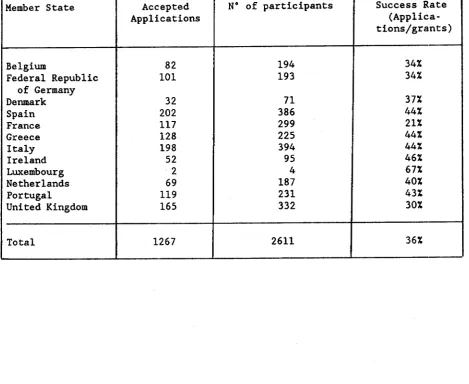
new ICPs.As TabLe 4 indicates, the
Conmisslon
accepted
L257applicatlons,
or
361of the total
(as
conparedwlth
487in
L987/88).
A
sumof
ECU2.1
rnio was avaLlablefor this
purposealthough
applicants
requesteda total
ECU8.5
nio.
Overhalf
the
L257 grants awardedare
for
groupvisits,
and noless
than26LL persons
altogether
will
be
abLeto carry
ouc
vlslts
touniverslties
ln'one
or
several other Menber States.As ln
L987/8,
but to an
even greacer
extent,
partlcular
attention
waspald
to
applications
concernlngthe
Menber States whlch arenot
yet
fully
lnvolvedln
the
ICP network.Table
4
also
docrrrnentsthls clearly.
Ttrus,ln total the
fourcountrles
of
the
Southof
the
Corutunlty (PortugaL, Spaln,Italy
and Greece) received, 647
vlstt
grants,
that is
511of
the
total
-
shlch representsexactly twlce
their
current
partlcipatlon in
the
ICPs(25.41).
2.5I
of
thevlsits
origlnate
in
Denrnark (2.31,of
the
ICPs).As for
MenberStace
involvement,
the vlsics
selected for
support concernin particular
thosefields of
study whlch areless
representedin
the
ICPs,i.e. in
partlcular
Agriculture,
Flne Arts,
Teachereducation, Hunanities,
Mathematics andMedical
sclences.
Onthe
other hand,
fields
already
closelyinvolved
ln the
ICPs
(Languages,Englneerlng,
Business) arecorrespondingly l-ess
well
representedin
the
vislts (cf
Table5).
Actlon
2 :
ERASilUS student grants scheme17. lloblllty
grants
of a
naximumof
ECU 5000per
personper
year nay be awardedto
students whocarry
out
a
recognizedpart
of
thelr
degree/dipl-oualn
another MemberState.
Ttrese grants, whlchln line wlth
the
provisions
of
the
Councll Declsion areadrnlnistered through
the
conpetentauthorlties
in
each MenberState, are
awardedsubJect
to the folloulng
conditions
of
eltgibility:
studentr; must be
citizens
of
oneof
the
EC Member States;the
sendinguniversity
must guaranteefull
recognition of
the
study abroadperiod
towards the hone degree/diploma;the
studentshall
not
berequired
to
paytultion
fees at
the host
unlversity;
the national
grant/loan
to
which
a
student
may
beentitled for
study
at hisfrer
honeunlversity
shall
beneither
dlscontinued,nor interrupted, nor
redueed whlle chacstudent
ls
studying
in
another MemberState
andis
receiving an ERASMUS grant;
grants are normally
awardedfor periods of study in
another
MemberState for a
rnininumof one term
orsemester and a maximurn
of
oneyear.
Theyare
not. norrnally be awardedfor the first
yearof
study.Grants
are
intendedto
coverthe
'rnobility costs'
of
students,i.e. the
supplementary expensesentailed
by a
study
period spentin
another HemberState,
asfollows
:-
expensesincurred
by the
student.1lnked
to
linguistic
preparation;-
extra
expensesarising
from
a
higher
general
cost
of
llving
indexin
the host Member State;-
addltlonal
expenseslndivldual
naterial
their
stay
abroad.related to the change ln
thecircumstances
of students
duringthe
aE
for
for
the the
l_8.
Preferentlal
treatmentis
given
to
student
nobility
which is
organizedwlthin the
franeworkof
anICp
(,network students').Students rsho
are
'free
movers, ma;r, however,also
apply
for
agrant,
provlded theysatisfy
all
the conditions
of eligibility.
For the
L988/89 academlcyear all
MenberStares
wlrh exceptl.onof
Portugal had
designatede central
agencynatlonal
level- (nNational Grant AwardingAuthoriry"
(NGAA))the
adninistration
of
ERASMUSstudent
grants.
Grantsstudents
ln
Portugal wishing
to study
elsewhere
ln
Connunlty
were therefore
admlnlstered
dlrectly
byConrnlssl.on
vla
the
ERASMUS Bureau.The NGAAs
adrnlnister
a
global
budget
earmarkedfor
ERASMUSstudent
grancs
for
each MenberState (cf. infra),
under
acontractual
arrangementwlth the
comrnlssion. Each NGAAis
responsiblefor
the
awardof
grantsto
studentsof
universities
in that
Menberstate
wishingto
spenda
recognizedperiod of
study
in
another llember State whetherwlthin
the
frameworkof
an ICPor
asa 'free
mover,.The
admlnlstration
of
grants
mayvary
in
accordancewith
the arrangements chosen bythe
authoritles
of
each MernberState.
In
theory,
NGAAs xnayalloeate grants either dlrecti.y
tograntholders,
or lndirectly via the
sendlnguniverslcy
(rhelatter
procedure beingcurrently
the rnost conmonpattern).
19.
948or
871of
the
1091 rcPs being supporredin
L988/9 involvean
exchangeof
students
for
integrated periods
of
study
in
another MenberState.
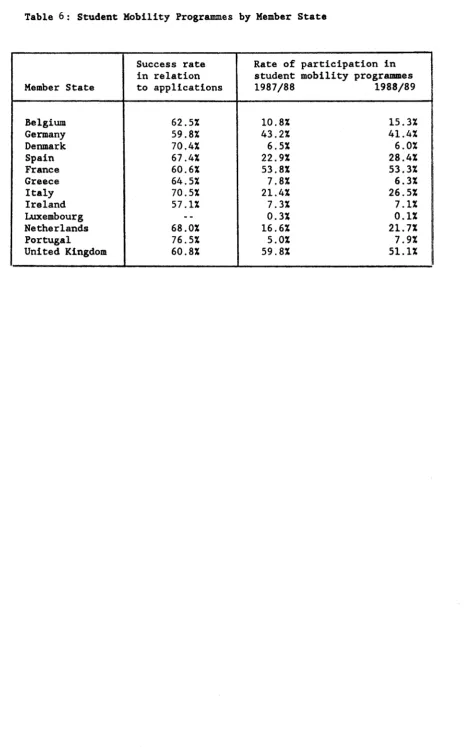
Table6
demonstratescertain
features of
these
programnesas
regards
the
involvementof
each MenberState.
In all,
studentgrant
requests amountedto
approximately ECU 39mio,
chree
times
the
available
budget
of
ECU13
mlo.
Thisbudget has been divi.ded
up
amongthe
12 t{enberstates
on
thebasis
of
the
criteria
providedfor by
the
CouncilDecision
:the
nunberof
young people aged between 18 and25 (inclusive)
and
the
numberof
studentsenrolled
in
the hlgher
educationAction
Belgiurn:
3.02
France:
17.13 Luxembourg:
0.7Germany:20.79
Greecer 2.58 Netherlands:
5.13Dennark:
L.64 ltaly:
L7.07
Portugal:
2.43Spain: L2.64 Ireland: 0.94
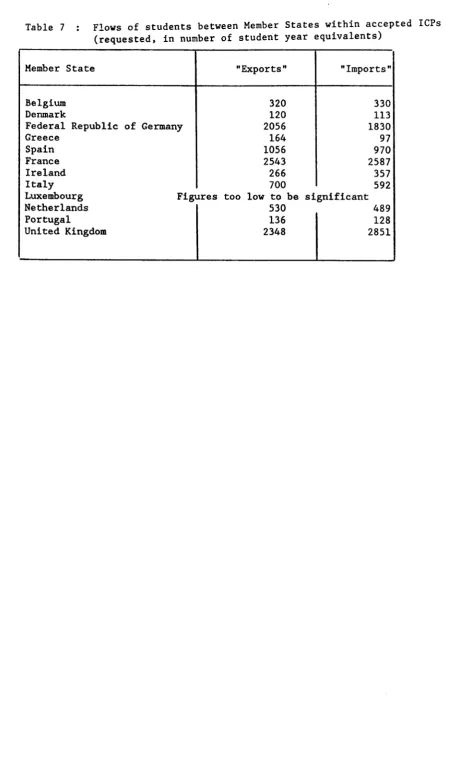
Unlted Kingdom: 15.88A
close analysls
of the flows,
between MemberStates,
of
students
for
whona
grant
was requestedin
1988/9wlthln
thefranework
of
accepted ICPs showsthat ln
mostcases,
a
veryreal
balance
ls to be
observedln terns of'exporc'and
'inport' of
students
for
each
MenberStace. Fron
thls
standpolnt, onLy the United Kingdorn can reall-y be consldered as
a
'net
importe:r' and Greecea
'net exporter'
(cf.
Table 7).Ttre number
of
students
estlnated
to be
reeelvlng
a
studenEgranc
ln
academicyear
L988/89ls
estimated
to be
around12 .000.
:Measures
to
promote
mobllity
through
the
academlcrecognltlon
of
dlplornas and perlodsof
scudy(l)Action
3.1-
of'
ERASUUSprovides
for the
establishmentof
aEuropean Conmunity Course
Credit
Transfer
Systen (ECTS)on
anexperimental and voluntary
basis
in
order
to
provldea
neans bywhich students may receive
credit for
perlods
of
study carriedout
andqualifications
obtalned aLuniversltles
ln
other
MenberStates.
The Systen
wil,l
be incroducedfor
a
6-yearpilot
phasefron
cheacademic
year
L989/90to
L994/95,
ln five
subJect
areas
:Business
Adniniscration,
History,
Medlclne,
Chemlstry
andllechanical Engineering. Hlgher education
inscicutlons
frornall
Member States
wlll
particlpate.
1988
has
seenthe
completionof
substantiaL preparacory worknecessary
for
Ehe launchof
the
pilot
scheme. An Expert Meetlngwas convened
by the
Comnlssion on4/5
February 1988,ln
orderto
advisethe
Conrnlssion on howto
proceedln
launching thePilot
Schene.Ttre
recornnendatlonsof the
experts
and
theCon'nlssion's proposals whlch were subsequently
fornulated
werethe
subject
of
intensive
discussion
in the
ERASMUS AdvisoryConrmittee
neeting
in
May 1988. The Committeefully
supportedthe
CommlssLon,'s proposaLs and agreementnas
reachedon
theprocedure
to
be followed.the
higher
educatloninstitutions
located
within
the
EuropeanCornrnunity
were then invited to
express
an interest
in
participation. A "Call for
expresslons
of lnterest
fromuniversities"
appearedin
the
Official
Journal
of
the
EuropeanCornnunlties No,, CI97/IL on 27.7.88 which aroused
a
conslderable amountof interest
amonguniversities
within the
Connunity.Support
for
ttre
curriculum
developmentprojects
provided
for
under
Action 3.3 is dealt with in the
sectLon
on
inter.
university
cooperation programme above.24.
2L,
22.
Full
docrlnentation on ECTS wasalso dlsfributed to the
highereducation institutlons
via the channels indicated by
the nembersof the
ERASMUSAdvisory
Comrnitteeduring
August andSeptenber 1988.
This
docurnentation lncludeda
questionnaire tobe
conpleted and returnedto the
ERASHUS Bureauby
31 October 1988 byall institutlons
wishlngto particlpare.
464 applicacions vrere received from 254 hlgher
educationinstltutlons.
On 30
Novenber1988, en
lndependent AcademicAdvlsory
Groupnet in Brussels to assist the
Cornmission,sservices in the
selecElonprocess. Taking into
account thevlews expressed
by the
academic advisors andthe
membersof
theERASMUS Advisory Conrniggss
the
Cornmissionselected 8t
highereducatlon
institutlons and 3 consortla to take parc in
the"inner circlen of the Pilot
Scheme.One
deparLmentper institution
has been seLected
toparticipate. Two institutions per subJect area have
beenadmltted
fron the larger
Member States and oneinstitutlon
per subJecc area fromthe
snalLer countries.Most applications were recelved
in
BusinessAdmlnlstratlon,
thesnallest ntrnber in medicine. This corresponds to
theparticipation rates of
these trdo subJect areasln
che ERASMUSprogranne
as a whole. Wlth regard to the distributlon of
applieations by
MemberState, the partlcularly high
nuraberof
applications
recelvedfrom the United
Kingdom(128) ls
worrhnoting,
followedby
Spain(57),
France(56),
Germany(50)
andItaly
(43).The 84
instltutions invited to
cooperate ona basis of
mutualtrust wilL receive financial aid from the
Conmission tofaeilitate the
establ-ishmentof rhe
system.Iheir
workwill
becarefully
monitoredby the
Commission whichwill also
award acertain ntrilber of grants to the participating
students,provlded they
fulfil
the usualcriteria for
EMSMUSgrants.
ThefirsC
plenary ureetingof
representativesof
thoseinstitutions
selected
to partlcipate is
plannedfor
January 1989.Institutions not
selectedfor the "inner
circl_e"will join
the"outer circlen
andwill be regularly
informedon the
progress nadeby "inner circte" institutions.
Actlon 3.2 of
ERASMUSprovides for the
developnentof
theEuropean Cornmunity Network
of National
Acadernic RecognitionInformatlon
Centres (NARICnetwork). Thls
Network was alreadyin
operation before Ehe ERASMUS Programme was adopted; however,its principal task
todayconsists not only in
ensuring optimuncooperation between
the
NARIC Centres,individual universities
and the
MenberState
goverrunentson questlons
concerning academicrecognition, but also in integratlng the
NARIC networkin the
ERASMUS Programme. The9th
meetingof the
NARIC networktook
place in
Leidenin
June,the
10rh washeld in
Brusselsin
October 1988. One
of the
main themesto be
dlscussedln
theOctober meeting
lras the possible inrpllcatlons for the
NARICnetwork
of Article 9.3 of the
ConnonPositlon on the
proposedHigher Education Dlplomas Awarded on Conpletlon
of
ProfessionalEducation
and Trainlng
of ac least
Three
Years'
Duration"(nGeneral
Directlve").
On adoptionof the
"GeneralDlrective"
sone NARICs may
be
involvedin
the
dlstribution of
informationregardlng professlonal recognitlon.
Actlon4:Cornplernentarymeasures
Connunlty(1)
to
promote
mobllity
ln
EheActlon
4.2
aimsaE
supportlngprovlsion
of
infonaation
and atthe dlfferenc hlgher
education Thereare
two main components :the
ERASUUS Progranme throughincreaslng rnucual awareness
of
systems
withln the
Connunlty.supporc
to
associations
or
consortla
of
unlversities
vorking on
a
Europeanbasis,
in
partlcular wlth
a vl.ew tonaking
innovative
initiatives in specific fields
better
known
throughout
the
EuropeanConnunlty.
A
financlal
contrlbution
of up to a
maximumof
20,000 ECUnay
beawarded
to facilitate
the
executionof
a speclfic
proJectof
special
interest ln
the
light of
che above-rnentionedobJectives.
The
grant
may
be
used
to
introduce
orrel.nforce Lhe European dimension
wlthin
the
activitles
of
an
association,
to
coordinatethe
scti.vlty of
dlfferent
national- assoctetlons
at
EuropeanLevel,
to inltiate
et
Connunity
level
a nerractivity of
interestswith
regard uothe stated objectives
of
Action
4.2 or to
creete
a
newassociation
at
Europeanlevel.
The European Foundationfor
Management Devel.opmentls, for
exanple, invol-ved i.nidentifying
key
areasin
whichtext
books aEa
Europeanlevel
for
studentsof
nanagementstudies
are most needed,whereas AESCO, Europton, an organisation
linking
SchooLsof
Optometryin a
nurnberof
countries,
is
involved in
extending
its
rnernbershipto all-
EC MenberStates
andharmonizing curricula ;
support
for certain
publications
designedto
enhancea\rareness
of
study
and teachingopportunitles
in
otherMenber
States or to draw
aCtention
to
inportanLdevelopments
and innovative
models
for
university
cooperation throughout
the
European Community. Ttrelevel
of
supporuis
determinedby the
Connisslonin
the
light
of
information
providedby the
applicant
on
the
basisthat
costs
are to be
shared.
For
examplethe
EuropeanSociety
for
Engineering Educationis
preparinga
completereeditlon
of
a
guideto
engineeringstudies
in
Europein
two
languages.Inforrnation
on the different
nationalsystems
of
educationrsill be
brought
up to
date
andcomplemented,
the
European dimension strengthened and aneffort
madeto identify
particular
centresof
exceLlencein
Europe.,The
Intensive
Programmesprovided for under Action 4.L
aredealt with in the sectlon on inter-unlversity
cooperatlonprogrannes above.
23.