Abstract: Using sensors in healthcare can greatly improve the quality of life, especially for elderly patients. The data from the sensors of the patients is constantly monitored for abnormalities at a server. Whenever this data crosses a threshold value, the information is notified to the corresponding doctor. The doctor can then take the necessary action. However an inspection of historical data has shown that some conditions of patients have cyclic patterns and the medications are often repeated. The proposed system is designed to assist the doctor in diagnosis by retrieving those patterns. We have compared the times taken for receiving responses from the two different systems and a significant amount of improvement was noticed. We have introduced a Dynamic Context Aware Technique (DCAT) which can improve the quality of 24 hour monitoring patient. This paper presents the design and implementation of a system based on DCAT using SAMSUNG GEAR S (Heart rate monitor sensor.The backend remote centralized computation and data storage can decreases the workload of the remote health care provider by avoiding of sending the identical and similar cases data to the doctors. This improves the processing speed and also gives solutions in case of the unavailability of doctors in some cases. Experimental results based on real datasets show that our system is highly efficient and scalable to a long time monitoring patients.
Index Terms: Context aware; Machine learning Technique; Continuous monitoring; DCAT; CQSS middleware
I. INTRODUCTION
The different health sensors and various intelligent services reduce the need of indoor and outdoor care taker for the elderly person. For example after heart surgery of an elderly person who is living alone can be reported to remote health care taker by using different sensors. These intelligent services include different new techniques to provide early health services. Ambient assisted living (AAL) technology [9, 13] help the elderly people to keep in touch and
communicate with their family members. Even though several applications have already been developed, still many new problems arise which suggesting new development of applications. We give emphasize in this system to increase the functional efficiency as well as to reduce time, cost and energy of the remote continuous monitoring architecture [1, 2]. In the case of continuous monitoring of a patient for 24 hours through the health sensor, we found many identical and similar cases. These cases may happen in different time within a day, week or month but it can be handled by previous same medications without reaching out to the doctors. Sometime it
Revised Manuscript Received on July 05, 2019.
Sushama Rani Dutta, SRF in ITRA project in the School of Computer Engineering, KIIT Deemed to be University, Bhubaneswar
Sujoy Datta, Assistant Professor in the School of Computer Engineering, KIIT Deemed University, Bhubaneswar
Monideepa Roy, Associate Professor at KIIT Deemed University, Bhubaneswar.
gives solutions to the unavailability of doctors. This type of cases can be handled in backend server by maintaining some security issue (correct identification). To significantly reduce time of service in case of identical and similar type of sensor data (critical case but identical or similar cases as previous), we propose a technique called Dynamic Context Aware Technique (DCAT). In which the backend server dynamically process, store and manipulate the health sensor data and medication data by using machine learning techniques. Our technique works only on those conditions when the sensor data crossed the limitation of the expected pattern (normal condition value) and comparing with the previous unexpected pattern (crossed threshold value). To determine the Dynamic Context Aware technique, we have implemented the Context aware Quick Sensor Service (CQSS) middleware on the backend server. CQSS machine learning engine runs on the server which manipulates receiving sensor data streams and medication from the doctors using machine rules, which is required for the current context. Using the CQSS middleware, we have collected the heart rate using SAMSUNG GEAR S (Heart rate monitor sensor) of a user with their context changed. We observed the time variations for different identical cases services. This system can be used and experimented by taking any health sensor data. This experiment concludes that using DCAT technique, context-aware matching can reduce the time of response in remote health services.
II.BACKGROUND WORK
In [1,2] architecture, the available personal digital assistance device (smart phone or PDA) is placed in between the wearable body sensors and the remote cloud server. The device (Smart phone) connects to the wearable sensors by a Body Area Network (BAN), short-distance technology like ZigBee or Bluetooth, and uses a Network interface like GPRS or 802.11 for sending the collected sensor data to the backend server and the backend server process data and connects to the remote doctor for medication. Many techniques used to compress the health sensor data for better communication [3].Remote health monitoring of energy efficient communication already described by xiaohui liang [4]. Disease selection is a technique from health sensor streaming data by data analysis and care monitoring [6, and 7].
Context Aware Quick Sensor Service (CQSS) to
Remote Patients
low-efficient, time consuming service and draining unnecessary energy of the doctor’s mobile device. As the above systems do not manage and manipulate the identical and similar cases of sensor data. Above systems directly handling all sensor data in a similar fashion, which can be managed and manipulated by our proposed system for getting quick services. The author [10] described about the data stream in clustering technique. It has two phases, one phase divides data stream into buckets. Within the bucket again it finds clusters and cluster centre. According to cluster centre it selected the data pattern and discards any other. It has low time and space and this cannot be applied to evaluate data pattern which are identical and similar patterns. The quantitative evaluation of complexity health data is described by Hongpu Hu , Yanli Wan , Quan Chen [11] which provides the data quality management of health data. In remote health monitoring system ,a big issue is to store, retrieve, analyze and compare the health sensor data is already described by Li Guo , Chao Wu , Chun-Hsiang Lee ,Yike Guo [12] . But they did not handle the identical sensor data cases. In this paper, we are going to handle the identical data pattern and also the similar kind of data pattern from the received health sensor data. This will provide quick service to the remote patients.
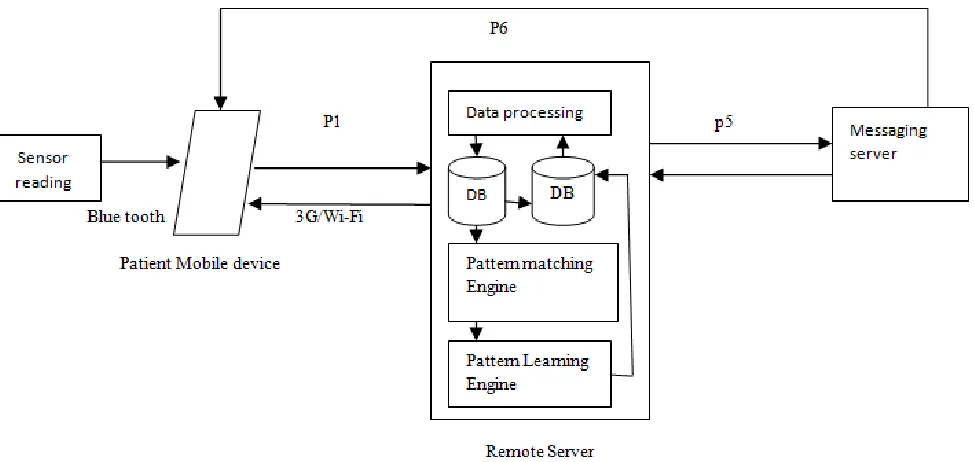
III. PROPOSED FRAMEWORK In case of health sensor environments, a large number of streaming data collected and conforms to expected patterns, and data should be transmitted only unexpected events to the doctor for medication [8]. The filtration of sensor streaming data (only unexpected data) reduces the volume of data for communication. From this system, we observed many cases that are identical and similar cases also communicating to the doctors for medication but the medications are same as earlier cases (carefully handling with same patient). But the issue is the patient is in critical condition and the system takes uncertain time (may be network problem) for sending data to the doctor for medication. There are many types of problems like doctor may be busy at that particular time to attend the patient request or there may be the network problem due to which the server unable to send the notification to the doctor or due to the network problem doctor’s medication may not reach to the patient. But the time factor is a big issue for an emergency patient with critical condition and waiting for medication. In order to solve this problem we have designed a system called CQSS middleware which used the Dynamic Context Aware technique, which can solve the above problems and can provide an efficient service to the emergency patient at an early possible time. Figure 1(a), shows the health sensor which is sending the body signal or health related data to the patient mobile device through blue tooth which is available in every health sensors. The sensor is sending data periodically to the mobile device which is further sending to the remote server [11] through the Wi-Fi or using 3G connectivity (p1). The server matches the threshold value and if the value is more than the threshold value then the server will be sending a notification to the doctor (p3) through the messaging server (p2). The doctor sends medication to the patient through p4, p5, p6.
We proposed a system shown in figure 1(b), this can avoid
Fig. 1(a) Architecture of the existing system with problem statement of Identical and Similar unexpected event
[image:3.612.102.505.86.287.2] [image:3.612.69.556.342.573.2]
Fig. 2 Sensor data pattern analysis using Dynamic Context Aware Technique
IV. IMPLEMENTATION
We have experimented with a health sensor, SAMSUNG GEAR S (heart rate monitor), the Sensor Activity mode is set to walking
mode, the person is walking and the heart rate values are noted (randomly within a day) shown in Figure 3.
Fig. 3 Manipulation schema for repetitive and similar value of Sensor
Threshold value is different for different activity level. The red marked values (8 times) crossed the threshold value (90) for the particular activity. The existing system server needs to send the alert for 8 times (without handling identical and similar cases), which can be reduced to 3 times alerts to the doctor for medication by handling identical cases. To satisfy the condition our system filtering the sensor data only that is crossing the threshold value. Taking that value as ‘n’ and calculating ‘n-i’ and ‘n+i’ value (it may be varying to detect similar case) for identifying the nearest value that is very close to the sensor data. The similar value selection can
the threshold value (D2 database) earlier by applying proposed Contextual matching detection algorithm given below. For all the case ‘n’,’n+i’,’n-i’ have the same matching medication can be provided to the particular patient (based on domain expert).
[image:4.595.106.495.398.587.2]In this section, we introduce a Contextual Matching Detection Algorithm (CMDA), which is used to solve the problem of identification of identical and similar data from a stream of health sensor data and match it with the corresponding medication from the previously stored medication database. Most of the available sensors for continuous health monitoring are activity based, so in our algorithm’ ’ is the type of activity, which is set as walking in our experiment in Samsung Gear S. The streaming data (periodic) which is taken as’ ’ and ‘ ’ is the threshold value (different for different activity). ’a[i]’ is the sensor value which has crossed the decided threshold value but this will not store the identical or any other similar pattern for which we are going to provide the same medications. This is because to avoid the continuous following the next and next value which may cause wrong matching medication for the patient. The corresponding medication to the sensor data a[i] will be stored in a database, which can be retrieved by following algorithm steps 7, 11, and 15.The similar cases medication cannot be further applied for next similar case to this previous similar cases, this may cause to identify all the sensors data as similar in long run. For this reason every time system should match with only first time entered value to a[i].
The matching case model for identical and similar type of data pattern is given below in Figure 4.
Fig. 4 Four cases have same medication (matching cases)
The matching case model describes how few data patterns given above (case-1, case-2, case-3, and case-4) are similar. The similar patterns are decided by the domain experts and it is also varying with different conditions of the patient. They can be allowed for same medication as referred in first time for case-1 and followed by other cases (period of following same medication based on domain expert).
V. RESULT & DISCUSSION
The observed Process time from the experiment (taken few instances randomly within a day) in system clock for medication in different Heart rates ( collected by “Samsung Gear S” Heart rate sensor and using back end server) for both the existing system and proposed system is shown in below . The Figure 7,given below is our server system developed by using Programming Languages: Python 2.7, JavaScript and Java. Frameworks:Django,SDK:Android ,Platforms: Redhat OpenShift (PaaS). The server was developed in an MVC pattern and with Android Devices acting as clients to the server. The server was deployed on Open Shift, a Platform as a Service provider by RedHat. The experiment tested by using two smart phone, one as a patient smart phone and other is as doctor’s smart phone. Because of applying our technique in the server ,we get immediate responses in identical cases without sending to the doctors.The activity of the patient is set as ‘walking’and the threshold value is set to 110 bpm (according to domain expert).
[image:5.595.320.543.65.179.2]Table 1. shows the time comparision between existing vs proposed system and the Figure 5, shows the Time Graph. Table I Time comparision between existing vs proposed
system Sensor Value
(Threshold-110 bpm)
Time taken in sec (Traditional System)
Time taken
in sec
(Proposed System)
120 230 220
121 230 55
180 210 210
179 210 46
119 240 40
187 230 232
188 230 45
129 240 200
129 235 40
Fig. 5 Time Graph Existing vs proposed system Following figures are tested for single event of identical sensor data (tested for 120bpm and121 bpm) .The time for different processes are noted in device clock according to the above given Figure 1(a), existing archtechture and Figure 1(b), proposed architechture are given in table 2. and the graph for this time comparision is given below in Figure 6, From this we can observe how much time can be saved in total if there is any identical or similar case to be handle.
Table II Process time comparison for single event
gear s”.
Fig. 7 Random heart rate SAMSUNG GEAR S data running in server
Figure 8, shows some of the cases which are exceeding the threshold value, which is fixed as 110 (according to domain expert)
Following Figure 9, shows the screenshot of the matching case medication (random collected data by putting query to the database) for identical and similar cases of sensor data.
[image:6.595.51.291.48.269.2]
Fig. 8 some cases with exceeding threshold value (110)
[image:6.595.48.280.398.756.2]Traditional sensor streaming data-based on clinical decision support systems are designed to be used in a clinical environment and to query a central database for the relevant data. In this paper, we have present the architecture of a mobile CQSS middleware that is intended for use by the patient in a free-living setting and is tailored towards the telemedicine domain and the processing of streaming data such as from a body sensor. The design of our CQSS was inspired by existing stream data management systems. This system is handling the most identical and similar cases in order to save time of the remote patient and can avoid the problem of unavailability of doctor in this type of conditions. But this work can extended to account for the different types of activities involved in the full disease management process, namely Monitoring, Analysis, Decision and Effectuation.
VII. FUTURE WORK
In future we plan to take into consideration other context factors based on health sensor data. This may find any other matching event in order to find out any outcomes which will help the remote patients to get an early health services and preventions. And also to provide more efficient and accurate service matching results.
ACKNOWLEDGEMENT
This work has been carried out with the support and funding of ITRA Media Lab Asia and DeitY through the project “Remote Health: A Framework for Healthcare Services using Mobile and Sensor-Cloud Technologies”.
REFERENCES
1. M. M. Kohli,Sahibnoor Singh, Asees .2015. Intelligent Remote Vital Health Parameter Monitoring System.International Conference on Signal Processing, Computing and Control, IEEE (2015 ISPCC). 2. N.R.Prakash, S. Sharma.2012. Body Area Network based Health
Monitoring of Critical Patients: a Brief Review. International Journal of Instrumentation and Control Systems, Vo\.2, July 2012.
3. Amitabh, and Dharma P. Agrawal.2015. Continuous health condition
monitoring by 24× 7 sensing and transmission of physiological data
over 5-G cellular channels. Computing, Networking and
Communications (ICNC), 2015 International Conference on. IEEE, 2015.
4. Et al, Liang, Xiaohui.2012. Enable pervasive healthcare through
continuous remote health monitoring. IEEE Wireless
Communications 19.6 (2012): 10-18.
5. A. Moreno and D. Isern.2008. Computer-based execution of clinical guidelines: A review. Int. J. Medical Informatics, vol. 77, pp. 787–808, 2008.
6. M. Peleg et al.2013. Architecture for a Ubiquitous Context-aware Clinical Guidance System for Patients and Care Providers. in Joint Int. Work- shop KR4HC/ProHealth Workshop, 2013.
7. Fung, Nick LS. 2014. Guideline-based decision support for the mobile
patient incorporating data streams from a body sensor
network. Wireless Mobile Communication and Healthcare
(Mobihealth), 2014 EAI 4th International Conference on. IEEE, 2014.
8. Ana, Ana M. Bernardos, Hristova, and Jose R. Casar. 2008.
Context-aware services for ambient assisted living: A case-study. First International Symposium on Applied Sciences on Biomedical and Communication Technologies. IEEE, 2008.
9. Liadan ,O'callaghan. 2002. Streaming-data algorithms for high-quality
clustering. icde. Vol. 2. 2002.
10. Antonio F. Skarmeta.,Antonio J., Jara and Miguel A.
Zamora-Izquierdo.2013. Interconnection framework for mHealth and remote monitoring based on the Internet of Things. IEEE Journal on Selected Areas in Communications31.9 (2013): 47-65.
11. Dai, Tao, et al. 2015.A data quality management and control
framework and model for health decision support. Fuzzy Systems and Knowledge Discovery (FSKD), 12th International Conference on. IEEE, 2015.
12. Li, Yang, et al. 2014.Building a cloud-based platform for personal
health sensor data management. IEEE-EMBS International
Conference on Biomedical and Health Informatics (BHI). IEEE, 2014. 13. Zhou, Feng, et al. "A case-driven ambient intelligence system for
elderly in-home assistance applications."IEEE Transactions on
Systems, Man, and Cybernetics, Part C (Applications and