International Journal of Innovative Technology and Exploring Engineering (IJITEE) ISSN: 2278-3075, Volume-8 Issue-9, July 2019
Execution of Internal Curing Method on Concrete
using Pre-Soaked Light Weight Aggregate
S. Sivaranjani, R. M. Saravana Kumar
Abstract Low water-cement proportion solid mixes have been progressively advanced for use in Civil Engineering foundation because of potential changes in quality and sturdiness. Notwithstanding their expanded quality and diminished porous nature, the structures are defenseless to early-age splitting. Techniques have been created to lessen the breaking in structures. One such strategy is interior curing. The utilization of internal curing operators can give an adequate volume of water by methods for light weight aggregates (LWA). Notwithstanding the volume of water gave by the LWA, the dispersion of the LWA assumes a fundamental part in the viability of interior curing. Recently, high-performance concrete (HPC) has been increasingly used in practice, with the development of concrete technology and the introduction of super plasticizer and silica fume. High performance concrete is a concrete, which has far super quality and sturdiness attributes when contrasted with regular cement. The present examination researches the quality related properties of HPC specimens like flexural quality utilizing silica fume, super plasticizer in the inward curing technique. The mix proportion of 1:1.76:2.52:0.36 is utilized to cast pillars (100mm X 150mm X 1700mm). The HPC specimens are thrown with supplanting of concrete with 12% of silica smoke and expansion of 6%,12%,20% LWA vermiculite. From the pressure test result, ideal rate substitution of LWA is discovered and utilized for throwing bar. The aftereffects of flexural tests directed on shaft specimens demonstrates that 6% substitution of vermiculite gives the higher quality in both water and inward curing conditions.
Index Terms: High execution solid, light weight aggregates, vermiculite, silica seethe, shrinkage
I. INTRODUCTION
Strategies For CURING: 1) Water-showering at appropriate interims – however there are challenges in guaranteeing that this type of curing is really completed 2)Maintaining a mugginess at least 80% – not generally a down to earth arrangement 3) Internal restoring by utilizing uncommon added substances 4)Internal relieving by utilizing lightweight aggregates. Internal CURING: "inward restoring refers to the procedure by which the hydration of cement happens as a result of the accessibility of extra interior water that isn't a piece of the mixing water." For some years, we have relieved cement from the outside in; interior restoring is for relieving concrete from the back to front. Inside water is by and large provided by means of internal stores, for example, lightweight aggregates (LWA), superabsorbent polymers, saturated wood fibres.
Revised Manuscript Received on July 05, 2019.
S. Sivaranjani, Assistant Professor, Department of Civil Engineering, Vel Tech Rangarajan Dr.Saguntala R&D Institute of Science and Technology Chennai - 600 062, Tamilnadu, India.
R. M. Saravana Kumar,Assistant Professor, Department of Civil
Engineering, Vel Tech Rangarajan Dr.Saguntala R&D Institute of
Science and Technology Chennai - 600 062, Tamilnadu, India.
II. MATERIALS USED Common Lwa – Vermiculite
Silica Fume
Superplasticizer – Conplast Sp430
Common LWA – Vermiculite is a sort of mica that will extraordinarily extend. It Produce lightweight protecting cement—250 to 1450 kg/m3 Vermiculite is a characteristic mineral that grows with the utilization of warmth. The development procedure is called shedding and it is routinely proficient in reason composed business heaters. Shed vermiculite is utilized as a part of both hand and splash connected general building mortars to enhance scope, simplicity of taking care of, and grip to a wide assortment of substrates, imperviousness to fire, and protection from chipping, splitting and shrinkage.
III. OBJECTIVE & METHODOLOGY
The following parameters are to be studied: › Deflection behavior › Initial crack load and its location › Load Vs deflection behavior › Stress VS strain characteristic.
Starter tests on cement, fine aggregates and coarse aggregates. 2. Mix Design for M40 concrete. 3. Mix extent for light-weight concrete by utilizing the vermiculite.4. Assurance of compressive quality of configuration mixes. 5. Throwing of pillars with light-weight concrete and typical cement. 6. Flexure test on specimens.
IV. MATERIALS AND MIX PROPORTIONS Concrete – Ordinary Portland cement of 43 review
Fine aggregates – Sand of particular gravity 2.65 Coarse aggregates – Gravel of particular gravity 2.76
Grade of concrete – M40
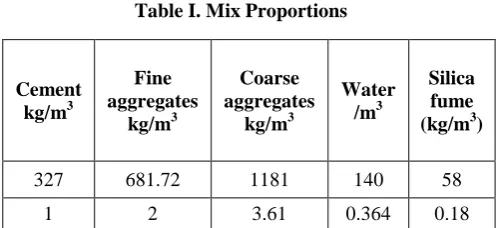
[image:1.595.306.557.565.679.2]Mix Design - 1: 2: 3.6 w\c ratio 0.36
Table I. Mix Proportions
Cement kg/m3
Fine aggregates
kg/m3
Coarse aggregates
kg/m3
Water /m3
Silica fume (kg/m3)
327 681.72 1181 140 58
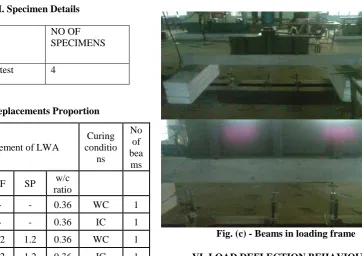
V. TESTS ON SPECIMENS Table II. Specimen Details
A.Beam Details:
Table III. Replacements Proportion
Specime n details
% replacement of LWA
Curing conditio
ns
No of bea ms vermic
ulite SF SP
w/c ratio
S1 - - - 0.36 WC 1
S2 - - - 0.36 IC 1
S3 6 12 1.2 0.36 WC 1
S4 6 12 1.2 0.36 IC 1
B.Reinforcement Details:
Provide 2 numbers of 10mm dia bars in main reinforcement at bottom of the beam.
Provide 2 numbers of 8mm dia bars in hanger reinforcement at top of the beam.
Provide 2-legged 6 mm stirrups at 100 mm throughout the beam.
Fig.(A) - reinforcement details
Experimental Set Up
Fig. (B) - Experimental Set up
Flexure Test
[image:2.595.145.508.65.321.2]Fig. (c) - Beams in loading frame VI. LOAD DEFLECTION BEHAVIOUR Load Vs deflection plot has been drawn for all test specimens from the trial information. The conduct of test specimens is analyzed the plots. The principal break and deflection cracks were recorded alongside the relating relocations and strains.
Table IV Experimental observations – specimen S1 control (example)
Load (KN) Deflection Remar
ks
L/2 L/3 L/4
0.00 0 0 0
2.08 0.01 0.04 0.07
4.92 0.94 0.92 0.89
6.58 1.03 1.61 1.48
8.01 1.35 2.14 1.93
10.00 1.91 2.62 2.33
12.91 2.51 3.15 2.78 First
crack
14.09 4.12 3.67 3.23
16.04 4.67 4.15 3.64
18.94 5.08 4.52 3.94
20.98 5.68 5.01 4.38
SI.NO TESTS NO OF
SPECIMENS
[image:2.595.305.522.73.307.2] [image:2.595.306.548.426.833.2]International Journal of Innovative Technology and Exploring Engineering (IJITEE) ISSN: 2278-3075, Volume-8 Issue-9, July 2019
24.11 6.85 6.03 5.21
26.06 7.41 6.51 5.61
28.00 7.98 7.01 6.05
30.00 8.72 7.65 6.58
32.04 9.21 8.09 6.97
34.03 9.84 8.63 7.42
36.08 10.73 9.38 8.04
38.07 12.21 10.61 9.01
40.97 14.72 12.67 10.62
42.01 17.55 15 12.44
46.92 20.88 21.08 17.29
48.96 22.52 25 20.46 failure
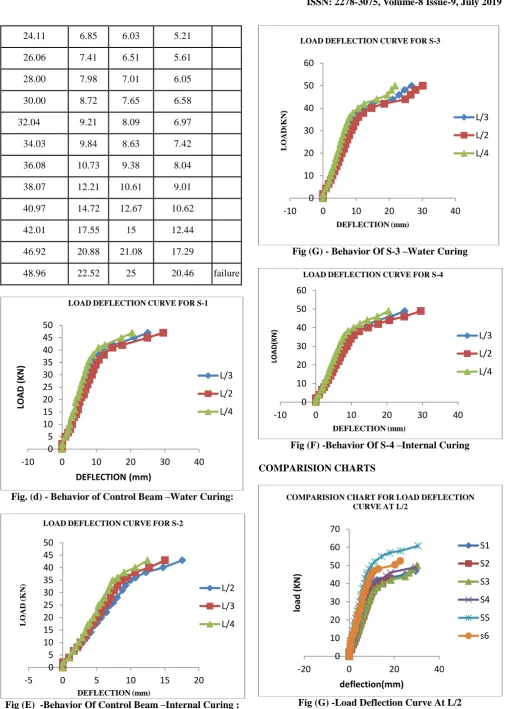
Fig. (d) -Behavior of Control Beam –Water Curing:
Fig (E) -Behavior Of Control Beam –Internal Curing :
Fig (G) - Behavior Of S-3 –Water Curing
Fig (F) -Behavior Of S-4 –Internal Curing COMPARISION CHARTS
Fig (G) -Load Deflection Curve At L/2 0 5 10 15 20 25 30 35 40 45 50
-10 0 10 20 30 40
LOA D ( K N ) DEFLECTION (mm)
LOAD DEFLECTION CURVE FOR S-1
L/3 L/2 L/4 0 5 10 15 20 25 30 35 40 45 50
-5 0 5 10 15 20
L OA D ( KN ) DEFLECTION (mm)
LOAD DEFLECTION CURVE FOR S-2
L/2 L/3 L/4 0 10 20 30 40 50 60
-10 0 10 20 30 40
L OA D (KN ) DEFLECTION (mm) LOAD DEFLECTION CURVE FOR S-3
L/3 L/2 L/4 0 10 20 30 40 50 60
-10 0 10 20 30 40
LO A D (K N) DEFLECTION (mm)
LOAD DEFLECTION CURVE FOR S-4
L/3 L/2 L/4 0 10 20 30 40 50 60 70
-20 0 20 40
lo ad (K N ) deflection(mm)
COMPARISION CHART FOR LOAD DEFLECTION CURVE AT L/2
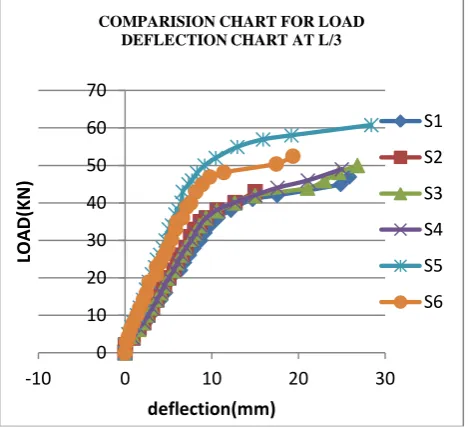
[image:3.595.46.555.25.735.2]Fig (G) - Deflection Curve At L/3
Fig (H) - Deflection Curve At L/4 VII. DISCUSSION A. Internal Curing with Water Curing
Contrasting the conduct of shafts subjected with the states of internal relieving and water restoring, the specimens S1& S3 subjected to water restoring, conveying high load and in the underlying stage itself going with high solidness and afterward achieves less esteem. On account of specimens S2 and S4 which were subjected to inside restoring condition display less quality contrasted with water relieving specimens, however there is a steady increment in solidness and they are said to be bendable in nature.
B. Breaking Behavior and Mode of Failure
Conduct of Flexural Failure:
The under strengthened area of bar, the part approaches
The region of cement in pressure zone is lacking to oppose the resultant compressive power; a definitive flexural deflection of the part happens through the devastating of cement.
Large redirection and wide splits demonstrate the qualities of the under fortified area at deflection. Cracks because of twisting minute are broadest at the
base and smaller at the best pressure side.
C. Crack Pattern
Fig (I) - Beams Kept Under Water
Fig (J) - Beams Kept for Internal Curing VIII. VCONCLUSION
The physical and mechanical properties of vermiculite and silica seethe have been observed to be positive for the utilization in cement concrete as demonstrates by the compressive quality of solid specimens tried.
The load relates to breaking is ostensibly more in all pillars contrasted with that of control shaft both as far as water relieving and as far as inward restoring.
The most extreme load opposed by 6% substitution of vermiculite is more than that of control example. The specimens of internal restoring contribute 90%
quality of pillars kept on the water.
REFERENCES
1. George C. Hoff, D.eng., P.E (2009) ―The Use Of Lightweight Fines
For the Internal Curing Of Concrete‖ Northeast Solite corporation,Richmond.
2. Hoa Lam (2007),―Effects Of Internal Curing Methods On Restrained
Shrinkage and Permeability‖, Department Of civil & Environmental Engineering, Toronto.
3. Pietro Lura (2008),―Internal Water Curing With Liapor
Aggregates‖,Department Civil Engineering,Technical University Of Denmark, Denmark.
4. Dale P. Bentz and Paul E. Stutzman (2010) ―Internal Curing and
Microstructure Of High-Performance Mortars‖,National Institute Of Standards and Technology, Gaithersburg
5. C.S. Suryawanshi (2007), ―Structural Significance Of High
Performance Concrete‖,The Indian Concrete Journal ,Govt Of Maharastra.
6. Daniel Cusson and Ted Hoogeveen (2006), ―Preventing Autogenous
0 10 20 30 40 50 60 70
-10 0 10 20 30
LOA
D
(K
N
)
deflection(mm)
COMPARISION CHART FOR LOAD DEFLECTION CHART AT L/3
S1
S2
S3
S4
S5
S6
0 10 20 30 40 50 60 70
-10 0 10 20 30
lo
ad
(K
N
)
deflection (mm) COMPARISION CHART FOR LOAD
DEFLECTION CURVE AT L/4
s1
s2
s3
s5
s6
[image:4.595.47.283.52.266.2] [image:4.595.46.285.96.525.2] [image:4.595.306.522.164.404.2]International Journal of Innovative Technology and Exploring Engineering (IJITEE) ISSN: 2278-3075, Volume-8 Issue-9, July 2019
7. Ryan Henkensiefken, December (2008), ―Internal Curing In
Cementitious Systems Made Using Saturated lightweight Aggregate", Purdue University.
AUTHOR PROFILE
Mrs. S. Sivaranjani, Completed M.E in structural Engineering field having 8 publications in scopus indexed journals and two publications in non Scopus indexed
journals. Membership recieved from ISTE, IAHS,
IAENG,IRED. The research area includes internal curing and infilled walls.