Abstract: This current work aims at determination of the best process parameter in electric discharge machining (EDM) of EN 8 alloy steel using Taguchi Technique. Experimental study was carried out as per L9 orthogonal array of design of experiment
with an intention of saving time and reduction of the experimental runs. Since this study involves the multiple-characteristics results such as material removal rate (MRR), electrode wear rate (EWR) and surface roughness. Results of Analysis of variance (ANOVA) reveal that MRR and EWR have significantly improved. Eventually authentication test was being done for better understanding the effectiveness of this planned method.
Keywords: Material removal rate, Electrode Wear Rate, Surface roughness, EN 8 Alloy Steel, Taguchi, Optimization, EDM.
I. INTRODUCTION
EN8 metal with its various types of alloys are being used in industries since it has lofty strength and good thermal resistivity and better mechanical properties at peak and low temperatures. The main outcome of this work is to find out the best levels to achieve improved metallurgical properties and at optimized process parameter levels. The paper by Senkathir [1] influences on the EDM machining by using Inconel 718 shows the reduction of machining time, circularity error and surface roughness. The paper by Suthan [2] demonstrates the machining by using wire EDM for SS316L using Taguchi’s orthogonal array for improving the output level machining and optimum response and surface roughness. The paper by Malak Soni [3] and Anjaneya Acharya describes the machining of EN8 alloy steel by using Taguchi’s L9 orthogonal array with a special rotary arrangement for machining solid or tubular electrodes and decrease of the tool wear rate (TWR) and optimum machining parameters. The paper by Suryawanshi [4] describes the special arrangement of a function generator and AISI D3 steel as a tool for EN24 alloy to find the optimum parameters by using an artificial neural network (ANN) model. The paper by Pradeep Singh [5] describes the EN8 alloy machining using
Revised Manuscript Received on May 06, 2019
L.Feroz Ali, Assistant Professor, Department of Mechatronics Engg, Sri
Krishna College of Engineering and Technology, Coimbatore, TN, India.
Dr.N.Kuppuswamy, Professor, Department of Mechanical Engg,
Kalaignar Karunanidhi Institute of Technology, Coimbatore, TN, India
Babu Narayanan, Assistant Professor, Department of Mechanical Engg,
Sri Krishna College of Engineering and Technology, Coimbatore, TN, India.
SreeHari, UG Student, Department of Mechatronics Engg, Sri Krishna
College of Engineering and Technology, Coimbatore, TN, India.
Swasthik Vellingiri, UG Student, Department of Mechatronics Engg, Sri
Krishna College of Engineering and Technology, Coimbatore, TN, India.
Taguchi’s L18 orthogonal array and finding the optimum parameters by using Minitab software
and using a mathematical formula. The paper by Kishan [6] describes the development of a mathematical model for EDM machining by using copper and brass electrodes with 5% level of significance by using analysis of variance. The paper by Anjaneya Acharya [7] describes the machining and achieving the best parameters with and without heat treatment of the EN8 alloy steel. The paper by Jeevanantham [8] describes the surface grinding of EN8 and EN31 alloys to achieve the best surface roughness. The paper by Chinmaya.P.Mohanty [9] describes the creation of a thermal based model using finite element method by using regression analysis.
II. MATERIALS AND METHODS
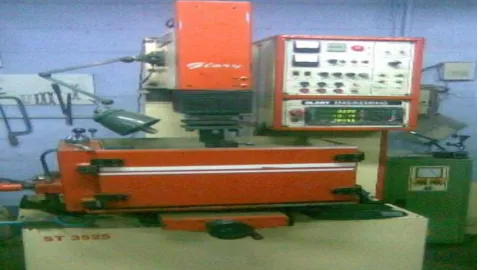
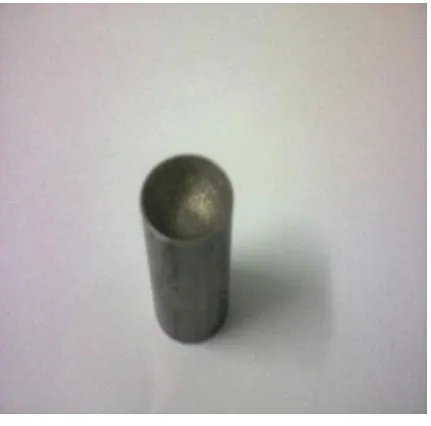
Work-piece material opted for the current investigation is EN 8 [7, 8, 9] alloy steel having the chemical composition as shown in Table 1. A cylindrical work-piece of dimension of 15mm diameter and 20 mm length is being used here. Electrode material chosen was Copper of diameter 15mm. Experimental work is being accomplished on an Electronica M2SEDM machine. The experimental setup along with work piece profile is diplayed in the Fig. 1 (a) and (b)
[image:1.595.307.548.485.620.2](b) Workpiece Sample
Table 1 Chemical composition of 080M40(EN8)
Sl. No MATERIALS CONTENTS
1 Carbon 0.36-0.44%
2 Silicon 0.10-0.40%
3 Manganese 0.60-1.00%
4 Sulphur 0.050 Max
5 Phosphorus 0.050 Max
6 Chromium 0.050 Max
7 Molybdenum 0.025 Max
8 Nickel 0.65-1.00%
III. DESIGN OF EXPERIMENTS
The process variables effects on the electric discharge machining is being investigated with the help of Taguchi’s technique. It is a smooth and powerful tool used for quality optimization of process variables while machining. After conducting the pilot test, it was decided to select the levels of experiments. For the present case, input parameters considered are pulse on time, pulse off time and current at three levels. The detail of process variable and their levels are shown in Table 2. Samples were machined in accordance to aforesaid experimental design and responses were measured as indicated in Table 3. Samples after EDM process is shown in the Fig. 2.
Fig. 2 (a) Machining Set Up
[image:2.595.46.263.48.228.2](b) Sample Specimen
Table 2 Control Variables and Their Levels
Expt. No LEVELS
1 2 3
A. Current (A) a b c
B. ON Time(s) d e f
C. OFF Time(s) g h i
A detailed study on the input parameters with respect to the response variables like MRR and EWR was observed. Several experiments were conducted and the average of three values has been examined for the eventual output of each response. With the support of L9 Taguchi’s orthogonal array, the
number of factors and their levels were chosen and it is displayed in Table 3 below.
[image:2.595.320.536.49.262.2]On the off chance that a capacity has be to standardized, at that point Taguchi's procedure yields great outcomes. "Motion to-clamor (S/N) proportion" will diminish the variety in the yield reactions that is being gotten from the test yield information by recognizing the characteristics as "higher the better (HB), bring down the better (LB), and ostensible the best (NB). The conditions showed underneath are utilized to figure the sort of finishing trademark utilizing S/N proportion: ) 2 ....( ... ... 1 log 10 ) / ( : ) 1 .( ... ... 1 log 10 ) / ( : 1 2 10 1 2 10
m i m i X m N S Ratio to Signal LB X m N S Ratio to Signal HB Where, X is the sample mean for the number of examinations in each trial by contract.Using the below expressions the material removal rate and electrode wear rate were calculated
1 5 7 3
[image:3.595.45.546.88.405.2]2 5 6 4
Table 4 Experimental Layout Using L9 Orthogonal Array with Factors and Responses
Sl. No Initial Weight of work piece
Final Weight of work piece
Initial Weight of Electrode
Final Weight of Electrode
Time (min)
MRR (g/min)
EWR (g/min)
1 41.218 38.684 38.232 38.218 56 .0452 .00025
2 41.268 38.710 38.537 38.430 45 .0568 .0023
3 41.424 39.054 40.211 40.188 39 .0602 .00058
4 41.460 39.268 40.211 40.188 32 .0685 .00017
5 41.068 39.181 38.322 38.306 33 .0571 .00048
6 41.725 39.665 39.154 39.138 26 .0792 .00061
7 41.088 39.318 38.209 38.185 10 .1775 .0024
8 41.243 38.613 39.975 39.946 19 .1382 .00152
9 41.598 37.843 39.842 39.795 20 .1875 .00235
The table 4 above shows the machining time and the electrode wear rate, material removal rate, electrode wear rate and the early and end weight of the work piece. From this table the best optimal parameters are obtained.
IV. RESULTS AND DISCUSSION Material Removal Rate
By the thought of material evacuation rate the productivity of the procedure can be resolved. The MRR is seen as the volumetric material evacuated every moment amid machining. Greatest estimation of MRR shows the quicker creation rate, which is truly necessary right now in the ventures. A higher MRR is attractive for EDM process. Because of the climb in pinnacle present and diminishing of heartbeat off time, the vitality of material evacuation increments, alongside upgrade in the release recurrence [18]. The release vitality centralization of the flash hole ventures up the liquescent and vaporization of liquid metal and
coasting metal hanging in the EDM which prompts increment of MRR. [16,17].
The present work uncovered that higher MRR can be accomplished at the lower sparkle gap voltage and heartbeat off time combined with higher pinnacle current..
Surface Roughness
Ra indicates the surface roughness, which is being measured
using the surface roughness. It is observed that the increase in peak current results hike in surface roughness. As the
discharge points in the cutting zone increases due to the
increase in pulse discharge energy. As the discharge energy increases, large amount of material is removed from the work piece. It tends to the generation of cavities on the outward
area, which in turn increases the surface roughness. Meanwhile, when we increase the feed rate the surface roughness is getting decreased. The spark produced between the tool and the work piece is stable, thereby generating constant discharge conditions which resulted in lower surface roughness.
SEM Analysis
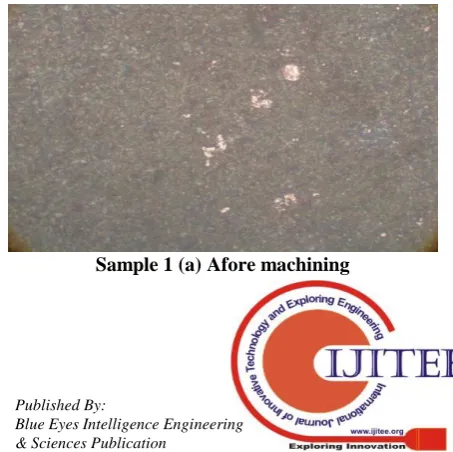
For knowing the spatial variations along with chemical characteristics, we have gone for scanning electron microscopy analysis, because of its wide spectrum of applications. Here we have collected the data over a selected area of the surface of the sample and we studied its surface, texture and orientation of materials over the area. We got the analysis of the selected point locations on the sample. By this we had the capacity to calculate out the subjective or semi-quantitative assurance of the synthetic syntheses, crystalline structure and crystal stone orientations.
[image:3.595.315.542.606.832.2](b) Later Machining
Sample 4 (a) Afore machining
(b)Later Machining
Sample 7 (a) Afore machining
(b) Later Machining
Figure 3 SEM Images of Machined Surfaces
V. CONCLUSION
Better surface is obtained and surface roughness is greatly reduced as shown in the figure above and the Tool Wear Rate (TWR) is considerably decreased after the experimentation process of first trail (0.00025). Material Removal Rate (MRR) is greatly increased during the 9th trail (20 minutes). From confirmation test it has been observed that the experimental values give better result as compare to predicted values. Thus we conclude that the Taguchi Method is best procedure for better arrangement of single target improvement process.
REFERENCES
1.Senkathir.S, Aravind.R, Manoj Samson.R and.Arun Raj.A.C. Optimization of machining parameters of Inconel 718 by WEDM using Response surface methodology. Springer nature Singapore pvt Ltd, Advances in Manufacturing Processes, India, 2019, 978-981. 2.Suthan S, Muralidharan K. Experimental analysis optimization of
process parameters of wire edm on stainless steel316, International Research Journal of Engineering and Technology. 2018. Vol: 05 Issue: 06 | June-2018, p-ISSN: 2395-0072.
3.MalakSoni, Ronak J Rana, and Prof. Alok B Choudhary. Comparative Study of Electro – Discharge Machining with the use of Additional Rotary Tool EDM Performance during Machining of EN-8 Material, International Journal of Scientific Research in Science and Tchnology.2018 Volume 4, Issue 8
4.Suryawanshi.M.V. and N.K.Kamble.N.K. Analysis of Effect of Cutting Parameter of Wire Electric DischargeMachining on Material Removal Rate and Surface Roughness: A Review, International Research Journal of Engineering and Technology.2018 e-ISSN: 2395-0056, Volume: 05 Issue: 06 | p-ISSN: 2395-0072.
5.Pradeep Singh, Arun Kumar Chaudhary, Tirat Singh and Amit Kumar Rana. “Experimental investigation of wire EDM to optimize dimensional deviation of EN8 Steel through Taguchi’s technique. International Research Journal of Engineering and Technology. 2018.Volume: 02 Issue: 03e-ISSN: 2395-0056, | p-ISSN: 2395-0072 6.Kishan.B, SudeerPrem Kumar, Gajanana.S, Buchaiah, Gaffar.M.
“Development of Mathematical Model for Metal Removal Rate on EDM using Copper and Brass Electrodes” Proceedings of 7th
Inernational Conference on Material Processing and Characterization, Elsevier Ltd.2018.
Photo
of Electrical Discharge Machining: A Review, International Journal of Engineering science and Technology,2010. Vol.2(6) India,2172-2191 12. Khalid Hussain SYED, Kuppan PALANIYANDI. Performance of
Electrical Discharge Machining using Aluminium Powder Suspended Distilled Water”, Turkish Journal of Engineering Environmental Science. 2012.Pg No:1-13.
13. Velmurugan. C, Subramanian.R, Thirugnanam.S and, Anandavel. B. Experimental Investigations on Machining Characteristics of Al 6061 Hybrid Metal Matrix Composites Processed by Electrical Discharge Machining. International Journal of Engineering science and Technology,2011. Vol.3 No.8 India,pp 87-101
14. Eduardo Weingartner, Raoul Roth, Friedrich Kuster, Marco Boccadoro and Frank Fiebelkorn. Electrical Discharge Dressing and its influence on Metal Bonded Diamond Wheels. 2012. Volume 61, Pages 183–186. 15. Jan Hosek. Thin Slits Manufacturing using Electro Discharge Technique, International Conference on Innovations, Recent Trends and Challenges in Mechanical, Mechatronics and New High-Tech Products Development-MECAHITECH’2011., Volume 3, Pages 107–111. 16. RaghuramanS, Thiruppathi.K, Panneerselvam.T, Santosh.S.
Optimization of EDM parameters using Taguchi method and grey relational analysis for mild steel IS 2026, international journal of innovative research in science, engineering and technology.2013 2(7) 3095-3104.
17. Singh, P. Singh. B, Tejpal, G. Singh, An experimental study of surface roughness of h11 steel in EDM process using copper tool electrode. International Journal of Advance Engineering Technology.2012 3(4) 130-133.
18. Azhiri R.B, Teimouri.R, Baboly.M.G, Leseman.Z, Application of Taguchi, ANFIS and grey relational analysis for studying, modeling and optimization of wire EDM process while using gaseous media, The International Journal of Advanced Manufacturing Technology.2014 71(1-4) 279-295 .
19. Varghese.V, Ramesh.M, Chakradhar.M, Experimental investigation and optimization of machining parameters for sustainable machining, Materials and Manufacturing Processes. 2018 1-10.
AUTHORSPROFILE
L.Feroz Ali, is currently working as an Assistant Professor in Department of Mechatronics Engineering. His area of research includes Welding technology and Optimization in EDM Process
Dr.N. Kuppuswamy, is currently working as an
Professor in Department of Mechanical Engineering at Kalaignar Karunanidhi Institute of Technology, Coimbatore. His research area includes Design and Analysis. He is a member of various professional bodies
Babu Narayanan, is currently working as an
Assistant Professor in Department of Mechanical Engineering. His area of research includes Friction Stir Welding technology.