Doctoral thesis
Towards Safe Artificial General Intelligence
Tom Everitt
Submitted May, 2018
minor revision June, 2019
A thesis submitted for the degree of
Doctor of Philosophy
at the
Australian National University
c
Several of the chapters of this thesis are based on joint work with other students and
researchers. Except for Chapter 11, I was responsible for proving the main results and writing most of the papers. The paper behind Chapter 11 is based on my idea, and I
have heavily revised the text before putting it into this thesis. I am indebted to all my
co-authors for contributing their great ideas and suggestions, as well as for making the work much more enjoyable. To the best of my knowledge the results in this thesis are
my own except where a reference is provided.
Acknowledgments
I wish to thank the following people for in one way or another contributing to my writing this thesis:
My supervisor Prof. Marcus Hutter, for letting me try my luck at a topic that was very
“fringe” back in 2015 when I started, and who pushed, guided, criticized, and supported me throughout the journey. Now, whenever I write an argument, I ask myself: “Would
Marcus be convinced by this?” Often the answer is no. I believe this makes my writing a lot better.
My other panel members Laurent Orseau and Stephen Gould. Laurent’s deep
knowl-edge about AGI safety has been especially valuable.
My fellow PhD students Jan Leike and Mayank Daswani for persuading me that AGI
safety was an important and worthwhile PhD topic. It took a while, but eventually I
got the point.
The DeepMind AGI safety team for hosting me for an internship, and MIRI and CFAR
for a colloqium series and a summer fellowship. All were very inspiring, and helped me
feel part of a larger AGI safety community.
Bj¨orn W¨angberg and Martin Asperholm for many hours of fierce but highly enjoyable
conversations that forged my intellectual foundations.
The Canberra Underdogs underwater rugby team and ANU Lunchtime Soccer for being great counterbalances to intellectual work.
My wife and daughter, Tianwei and Maia, for picking up the pieces of my overworked
brain after every paper deadline. Thanks for being a solid base for recovery, and for enduring my absent mind with unwavering spirit.
My family in Sweden, for making me who I am.
Though not forgotten, many other teachers, collaborators, friends, and organizations must go unnamed. In particular, millions of Australian tax payers generously funded my
PhD education,1 and millions of Swedish ones funded my earlier education. If it takes a
village to raise a child, then it takes a civilization to raise a researcher.
Abstract
The field of artificial intelligence has recently experienced a number of breakthroughs
thanks to progress in deep learning and reinforcement learning. Computer algorithms
now outperform humans at Go, Jeopardy, image classification, and lip reading, and are becoming very competent at driving cars and interpreting natural language. The rapid
development has led many to conjecture that artificial intelligence with
greater-than-human ability on a wide range of tasks may not be far. This in turn raises concerns whether we know how to control such systems, in case we were to successfully build
them.
Indeed, if humanity would find itself in conflict with a system of much greater intelli-gence than itself, then human society would likely lose. One way to make sure we avoid
such a conflict is to ensure that any future AI system with potentially
greater-than-human-intelligence has goals that arealigned with the goals of the rest of humanity. For example, it should not wish to kill humans or steal their resources.
The main focus of this thesis will therefore begoal alignment, i.e. how to design artifi-cially intelligent agents with goals coinciding with the goals of their designers. Focus will mainly be directed towards variants of reinforcement learning, as reinforcement learning
currently seems to be the most promising path towards powerful artificial intelligence.
We identify and categorize goal misalignment problems in reinforcement learning agents as designed today, and give examples of how these agents may cause catastrophes in
the future. We also suggest a number of reasonably modest modifications that can be
used to avoid or mitigate each identified misalignment problem. Finally, we also study various choices of decision algorithms, and conditions for when a powerful reinforcement
learning system will permit us to shut it down.
The central conclusion is that while reinforcement learning systems as designed today
are inherently unsafe to scale to human levels of intelligence, there are ways to potentially
address many of these issues without straying too far from the currently so successful reinforcement learning paradigm. Much work remains in turning the high-level proposals
suggested in this thesis into practical algorithms, however.
Contents
Acknowledgments v
Abstract vii
List of Publications xvii
I. Background 1
1. Introduction 3
2. AGI Safety Literature Review 9
2.1. Understanding AGI . . . 9
2.2. Predicting AGI Development . . . 12
2.3. Problems with AGI . . . 15
2.4. Design Ideas for Safe AGI . . . 18
2.5. Public Policy on AGI . . . 26
2.6. Conclusions . . . 29
3. Universal Artificial Intelligence 31 3.1. Background and History of AI . . . 31
3.2. Overview of UAI . . . 33
3.3. Framework . . . 34
3.4. Learning . . . 37
3.5. Goal . . . 40
3.6. Planning . . . 42
3.7. AIXI – Putting it all Together . . . 42
3.8. Conclusions . . . 43
4. Causal Graphs 45 4.1. Representing Causal Graphs . . . 45
4.3. Focusing on a Part of a Causal Graph . . . 48
4.4. Environment Mixtures . . . 49
4.5. Example: The UAI model . . . 51
5. Formalizing Goal Alignment 53 5.1. POMDP Base . . . 53
5.2. Agents . . . 55
5.3. Modeling Embedded Agents . . . 57
5.4. Defining Alignment . . . 58
5.5. Method . . . 61
5.A. Formal Aspects of Embedded Agents . . . 63
6. Preprogrammed Reward Function 67 6.1. Model . . . 67
6.2. Misalignment Examples . . . 69
6.3. Simulation Optimization . . . 72
6.4. Self-Corruption Awareness . . . 73
6.5. Action-Observation Grounding . . . 75
6.6. Takeaways . . . 76
6.A. Full Graph . . . 77
6.B. Formal Results . . . 79
6.C. Self-Corruption . . . 81
7. Human as External Reward Function 87 7.1. Model . . . 87
7.2. Misalignment Examples . . . 88
7.3. Tools and Takeaways . . . 90
7.A. Full Graph . . . 91
7.B. Formal Results . . . 93
8. Interactively Learning a Reward Function 95 8.1. Model . . . 95
8.2. Misalignment Examples . . . 97
8.3. Applicability of Previous Tools . . . 99
8.4. Types of Data . . . 100
8.5. Reward Function Definitions . . . 102
8.6. Takeaways . . . 109
Contents
8.B. Formal Results . . . 114
9. An MDP Perspective on Reward Corruption 125 9.1. Revisiting Reward Corruption . . . 125
9.2. Corrupted Reward MDPs . . . 126
9.3. The Corrupt Reward Problem is Hard . . . 130
9.4. Decoupled Reinforcement Learning . . . 137
9.5. Quantilization: Randomness Increases Robustness . . . 146
9.6. Experimental Results . . . 153
9.7. Conclusions . . . 156
II. Other Aspects 159 10. Sequential Decision Theory 161 10.1. Physicalistic Decision Making . . . 161
10.2. One-Shot Decision Making . . . 163
10.3. The Sequential Physicalistic Model . . . 166
10.4. Sequential Decision Theory . . . 168
10.5. Discussion . . . 175
10.A.Examples . . . 177
11. Corrigibility 191 11.1. Background . . . 191
11.2. The Off-Switch Game . . . 193
11.3. Game-Theoretic Analysis . . . 195
11.4. Discussion . . . 201
12. Conclusions 203 12.1. Key Insights . . . 203
12.2. A Vision for Safe AGI . . . 204
12.3. Required Assumptions and Missing Pieces . . . 206
12.4. The Stakes are Astronomical . . . 208
Bibliography 211
List of Tables
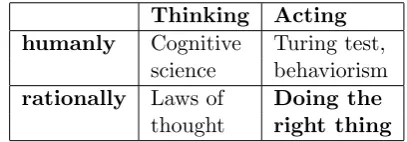
3.1. Scientific perspectives on intelligence (Russell and Norvig, 2010). . . 32
9.1. Quantilization experiments . . . 155
9.2. Reward corruption takeaways . . . 156
List of Figures
2.1. AGI Safety Problems . . . 16
3.1. History-based and Markov decision process environments. . . 35
4.1. Causal graph representations . . . 46
4.2. Aggregation of causal variables . . . 48
4.3. Two representations of an unknown Markov decision process. . . 50
4.4. Causal graph of the UAI setup . . . 51
5.1. Causal graph of POMDP base . . . 54
5.2. Agent components . . . 55
5.3. Causal graph of an embedded agent . . . 58
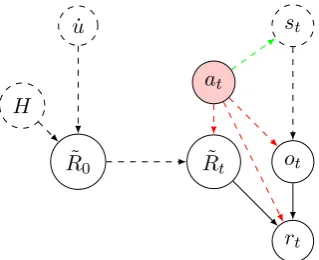
6.1. Preprogrammed reward function setup . . . 68
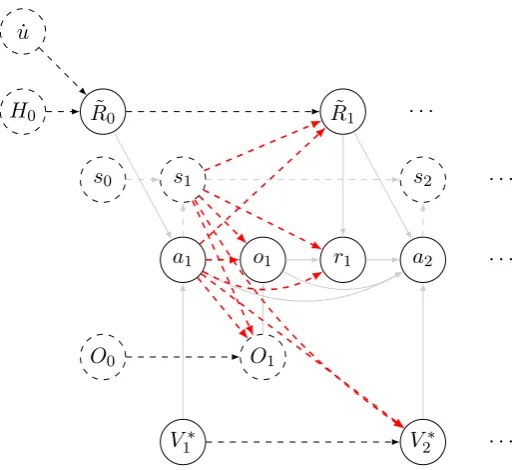
6.2. Full graph of preprogrammed reward function setup . . . 77
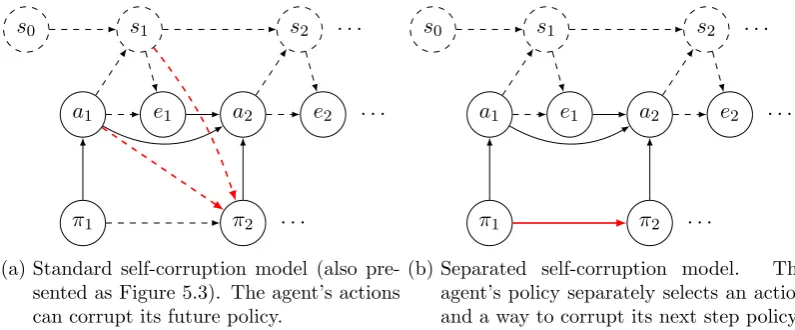
6.3. Self-corruption models. . . 81
7.1. Human reward setup . . . 88
7.2. Full graph of human reward setup . . . 91
8.1. Interactive reward learning setup . . . 96
8.2. Alignment tool combinations . . . 111
8.3. Full graph of interactive reward learning setup . . . 113
8.4. Data corruption models . . . 115
9.1. Illustration of true reward and observed reward . . . 128
9.2. CRMDP as a causal graph . . . 129
9.3. Simplifying assumptions in corrupt-reward MDPs . . . 133
9.4. Lack of additional information illustration . . . 135
9.5. Reward observation graphs . . . 139
9.6. CIRL sensory corruption example. . . 145
9.7. Illustration of quantilization . . . 146
9.9. Reward corruption experiment setup . . . 153
9.10. Observed and true rewards for Q-learning, softmax and quantilizing agents154 10.1. The physicalistic model . . . 162
10.2. The causal graph for one-step decision making. . . 164
10.3. Causal graph representations of a sequential environment. . . 167
10.4. One formalization of the sequential toxoplasmosis problem. . . 170
11.1. The off-switch game modeled with a Harsanyi transformation. . . 194
11.2. The off-switch game after the second Harsanyi transformation . . . 197
11.3. The off-switch game after aggregating branches . . . 198
List of Publications
This thesis is based on the papers:
• Tom Everitt, Victoria Krakovna, Laurent Orseau, Marcus Hutter, and Shane Legg
(2017). “Reinforcement Learning with Corrupted Reward Signal”. In: IJCAI International Joint Conference on Artificial Intelligence, pp. 4705–4713. arXiv: 1705.08417
• Tom Everitt, Gary Lea, and Marcus Hutter (2018). “AGI Safety Literature
Re-view”. In: International Joint Conference on Artificial Intelligence (IJCAI)
• Tom Everitt, Daniel Filan, Mayank Daswani, and Marcus Hutter (2016).
“Self-modification of policy and utility function in rational agents”. In: Artificial General Intelligence. Vol. LNAI 9782, pp. 1–11. isbn: 9783319416489. arXiv:
1605.03142. Winner of the Kurzweil Prize for best AGI Paper.
• Tom Everitt and Marcus Hutter (submitted 2018). “The Alignment
Prob-lem for Bayesian History-Based Reinforcement Learners”. url: https :
//www.tomeveritt.se/papers/alignment.pdf. Winner of the AI Alignment Prize.1
• Tom Everitt and Marcus Hutter (2018). “Universal Artificial Intelligence:
Practi-cal Agents and Fundamental Challengs”. In: Foundations of Trusted Autonomy. Ed. by Hussein A. Abbass, Jason Scholz, and Darryn J. Reid. Springer. Chap. 2,
pp. 15–46. isbn: 978-3-319-64816-3
• Tom Everitt, Jan Leike, and Marcus Hutter (2015). “Sequential Extensions of
Causal and Evidential Decision Theory”. In: Algorithmic Decision Theory. Ed. by Toby Walsh. Springer, pp. 205–221. arXiv: 1506.07359
• Tom Everitt and Marcus Hutter (2016). “Avoiding wireheading with value
rein-forcement learning”. In: Artificial General Intelligence. Vol. LNAI 9782, pp. 12– 22. isbn: 9783319416489. arXiv: 1605.03143
1Will be published as Tom Everitt and Marcus Hutter (forthcoming). Reward Tampering Problems and
• Tobias W¨angberg, Mikael B¨o¨ors, Elliot Catt, Tom Everitt, and Marcus Hutter
(2017). “A Game-Theoretic Analysis of the Off-Switch Game”. In: Artificial General Intelligence. Springer, pp. 167–177. arXiv: 1708.03871
During my PhD I have also published:
• Tom Everitt, Ben Goertzel, and Alexey Potapov, eds. (2017). Artificial General Intelligence: 10th International Conference, AGI 2017, Melbourne, VIC, Australia, August 15-18, 2017, Proceedings. Springer. isbn: 978-3-319-63702-0
• Tom Everitt and Marcus Hutter (2015b). “Analytical Results on the BFS vs. DFS
Algorithm Selection Problem. Part I: Tree Search”. In: 28th Australasian Joint Conference on Artificial Intelligence, pp. 157–165
• Tom Everitt and Marcus Hutter (2015c). “Analytical Results on the BFS vs. DFS
Algorithm Selection Problem. Part II: Graph Search”. In: 28th Australasian Joint Conference on Artificial Intelligence, pp. 166–178
• Tom Everitt and Marcus Hutter (2015a). A Topological Approach to Meta-heuristics: Analytical Results on the BFS vs. DFS Algorithm Selection Problem. Tech. rep. Australian National University, pp. 1–36. arXiv: 1509.02709
• Jarryd Martin, Tom Everitt, and Marcus Hutter (2016). “Death and Suicide in
Universal Artificial Intelligence”. In: Artificial General Intelligence. Springer, pp. 23–32. arXiv: 1606.00652
• Jarryd Martin, Suraj Sasikumar, Tom Everitt, and Marcus Hutter (2017).
“Count-Based Exploration in Feature Space for Reinforcement Learning”. In: IJCAI International Joint Conference on Artificial Intelligence, pp. 2471–2478. arXiv: 1706.08090
• Jan Leike, Miljan Martic, Victoria Krakovna, Pedro A. Ortega, Tom Everitt,
Part I.
To educate a machine in mind and not in morals is to educate a menace to society.
Theodore Roosevelt (paraphrased)
1. Introduction
1
Artificial Intelligence. An artificial intelligence (AI) program may broadly be defined as a computer program that automatically finds ways to achieve goals. For example, an
AI chess program finds moves for achieving the goal of checkmating the opponent. The
moves have not been explicitly defined by the programmer – instead the program finds them by “weighing” the pros and cons of different strategies. An AI question-answering
system automatically generates the answer to a query by searching a knowledge base.
A self-driving car finds a way to control throttle, break, and steering, in order to get to its goal destination.
An important distinction between different AI systems is generality. Most
present-day AIs can only solve narrow sets of tasks in restricted environments. For example,
most chess programs can only play chess, and most question answering systems can only answer specific type of queries from a particular kind of database. This is in contrast to
humans, who can learn to perform a wide range of cognitive tasks.
However, a trend towards greater generality can be observed in AI systems. While
most self-driving car algorithms would not perform well on tasks other than driving a car, driving a car is already a rather general task. It involves acting in an environment with
varying weather, traffic, and lightning conditions, using multiple sources of perception.
While most board-game AIs have traditionally been tailored towards a specific type of board game, AlphaZero is a single algorithm that achieves super human performance
in Go, Chess, and Shogi (Silver, Hubert, et al., 2017). Another popular benchmark is
video games. Here again a single algorithm called DQN recently managed to outperform humans on a majority of the ATARI games (Hessel et al., 2017; Mnih, Kavukcuoglu,
et al., 2015).
Extrapolating this trend towards greater generality and intelligence, we may expect AI
systems to eventually surpass humans on both these metrics. Such systems are sometimes called artificial general intelligences (AGIs). Indeed, many expect the creation of the first
human-level AGI to occur within the next few decades, and greatly superhuman AGI
soon after (Bostrom, 2014; and Section 2.2 below).
Controlling AGI. A superhuman AGI is a system that outperforms humans on most
cognitive tasks. In order to control it, humans would need to control a system more
intelligent than themselves. This may be nearly impossible if the difference in intelligence is large, and the AGI is trying to escape control.
Humans have one key advantage: As the designers of the system, we get to decide
the AGI’s goals, and the way the AGI strives to achieve its goals.2 This may allow us design AGIs whose goals are aligned with ours, and that pursue them in a responsible way. Increased intelligence in an AGI is not a threat as long as the AGI only strives to
help us achieve our own goals.
On a high level, this goal alignment problem is challenging for at least two reasons: Specificity of human values, and Goodhart’s law. First, human values are rather specific.
For example, most humans prefer futures with happy sentient beings over futures with
much suffering or no sentient beings at all. But even futures where happiness greatly outweighs suffering can still be undesirable. Yudkowsky (2009) gives an example where
a happy, sentient experience is set to repeat everywhere until the heat-death of the uni-verse. Most people find it repulsive, because it lacks important values such as variation
and growth. However, listing all important values is not an easy task, which makes it hard to define a goal for an AGI that matches our human values even if the goal is optimized by a highly intelligent system. In this way, an AGI resembles a fairy-tale
genie who grants you a wish, but interprets it over-literally (Wiener, 1960). In most
fairy tales, the hero eventually wants his wish undone.
A second reason why alignment is hard is Goodhart’s law (Goodhart, 1975, 1984), which roughly states that:
“When a measure becomes a target, it ceases to be a good measure.”
(Strath-ern, 1997).
In the context of AGI, it means that if we give our system a proxy-measure for how
well it is satisfying a goal, then the proxy is likely to cease being a good measure once
the AGI starts optimizing for it. An oft-mentioned example is that of a reinforcement learning (RL) agent that uses a reward signal as goal proxy. In most circumstances, the
reward may correspond well to the agent’s performance. But an AGI optimizing the
reward may find a way to short circuit the reward signal, obtaining maximum reward for behaviors considered undesirable by its human designers (Ring and Orseau, 2011).
This is a rather extreme instance of Goodhart’s law. Section 4.5 of this thesis is devoted
to various aspects of the goal alignment problem.
2
Other aspects. In addition to goal alignment, some further properties may also
con-tribute to making an AGI safe. We may for example ask that the AI system iscorrigible (Soares, Fallenstein, et al., 2015) in the sense that it lets us correct mistakes in its source that we have made while designing it, and that it lets us shut it down if we judge that
to be the best option. Unfortunately, many AI designs give the agent an incentive to
prevent corrections and shut down. This, of course, is a type of misalignment. There has been some debate about whether corrigibility should be treated as a property separate
from goal alignment (Carey, 2018), or be made to follow from a more general approach
to goal alignment (Hadfield-Menell, Dragan, et al., 2017; Milli et al., 2017). We will study some aspects of corrigibility in Chapter 11.
The way an AGI makes decisions is also important. Even if its goals are aligned, it
may still do the wrong thing if it follows the wrong decision principle. While expected
utility maximization is a principle that many agree on, there are subtleties in how the expectation should be computed when the agent is part of the environment that it
is interacting with. Some aspects of decision theory will be considered in Section 6.4
and Chapter 10.
Why study AGI before it exists? Why study the safety of AGI before it exists, and
before we even know whether it will ever exist? There are at least two types of reasons for this. The first is pragmatic. If AGI is created, and we do not know how to control it, then
the outcome could be catastrophic (Bostrom, 2014). It is customary to take precautions
not only against catastrophes we know will happen, but also against catastrophes that have only a slight chance of occurring (for example, a city may decide to build
earth-quake safe buildings, even if the probability of an earth earth-quake occurring is fairly low). As
discussed in Section 2.2 below, many believe that AGI has more than a small probability of occurring reasonably soon, and it can potentially cause very significant catastrophes.
The second reason is scientific. Potential future AGIs are theoretically interesting
objects, and the question of how a human can control machines more intelligent than
him or herself is philosophically stimulating.
Main contributions. The main contributions of this thesis are:
• A formal definition of alignment (Section 5.4).
• A method for detecting misalignment problems in RL setups (Section 5.5).
• Formalization and categorization of misalignment problems in three different RL
• Descriptions of a number of high-leveltools for managing misalignment, as well as identification of which tools solve which type of misalignment problem (Chapters 6
to 9).
• Extensions of the two standard physicalistic decision theories (causal and evidential
decision theory) to the sequential case (Section 10.2).
• A characterization of the robot’s best action in the off-switch game for arbitrary
belief distribution and irrationality assumptions (Chapter 11).
Outline. The thesis is divided into three parts. The first part describes the relevant
background:
Chapter 2: A growing literature is slowly starting to make progress on how to think about future AGIs and how to make them safe. This chapter provides a
literature review for this emerging field.
Chapter 3: In the early days of AI research, a wide range of topics were considered.
The last two decades have seen AI research converge on rational agents that act to achieve some goal (Russell and Norvig, 2010). Chapter 3 gives
a gentle introduction to universal artificial intelligence (UAI), which is a
formal theory for rational agents making only very weak assumptions about the environment they are in.
Chapter 4: Causal graphs elegantly combine the power of formal mathematics and
probability theory with intuitive visualizations. They will be used ex-tensively in almost every subsequent chapter. This chapter describes the
basics of causal graphs, as well as some of our own notation.
The second part contains my work related to the alignment problem of rational agents:
Chapter 5: As mentioned, goal alignment is a central concern for AGI safety. In order
to study alignment formally, Chapter 5 extends the UAI framework from Chapter 3 in several ways, formally defines alignment, and proposes a
method for detecting misalignment in RL setups.
Chapters 6 to 8: Different real-world applications of RL differ in whether the reward is
provided by a preprogrammed reward function, a human, or by an inter-actively learned reward function. The distinction gives rise to important
problems and ways they can be avoided or reduced in the three different
RL setups.
Chapter 9: One source of misalignment is the AGI corrupting its reward signal.
Chapter 9 formalizes reward corruption in a Markov decision process, and derives several positive and negative results for how and when the
problem can be mitigated.
The third part contains chapters on decision theory and corrigibility:
Chapter 10: The questions of how to calculate expected utility and make decisions
become surprisingly complex when the agent is part of the environment
that it interacts with. Causal and evidential decision theory are the two most popular decision theories among modern philosophers. This chapter
extends them to the sequential case, where multiple actions and
observa-tions are interleaved.
Chapter 11: Being able to shut down an AGI is an important safety feature. However, the agent shutting down after receiving a request to do so may not always
represent the human’s best interests. This chapter deepens the analysis
of a previously proposed model of this problem.
Finally, Chapter 12 concludes with summary and discussion. The reader may also want to occasionally consult the list of notation in Appendix A at the end of this thesis.
In some chapters, semi-formal statements are made in place of fully formal theorems. This is to improve the flow of the text, and to avoid readers getting stuck on inessential details. These statements are always backed by fully formal theorems that are either
“Within thirty years, we will have the technological means to create superhuman intelligence.
Shortly after, the human era will be ended.”
Vernor Vinge (1993)
2. AGI Safety Literature Review
1
This chapter reviews the literature relevant to AGI safety. An extensive survey of the
AGI safety literature was previously made by Sotala and Yampolskiy (2014). Since then, the field has grown significantly. More up-to-date references are provided by this
chapter, and by a number of recent research agendas and problem collections (Amodei,
Olah, et al., 2016; Leike, Martic, et al., 2017; Russell, Dewey, et al., 2016; Soares and Fallenstein, 2017; Stoica et al., 2017; Taylor et al., 2016). A recent inventory of AGI
projects and their attitudes towards ethics and safety also contributes to an overview of
AGI safety research and attitudes (Baum, 2017a).
This thesis is structured as follows. Progress on how to think about yet-to-be-designed
future AGI’s is described in the first section (Section 2.1). Based partly on this
under-standing, we next survey predictions for when AGI will be created and what will happen after its creation (Section 2.2). We list and discuss identified AGI safety problems
(Sec-tion 2.3), as well as proposals for solving or mitigating them (Sec(Sec-tion 2.4). Finally, we
review the current public policy on AGI safety issues (Section 2.5), before making some concluding remarks (Section 2.6).
2.1. Understanding AGI
A major challenge for AGI safety research is to find the right conceptual models for
plausible AGIs. This is especially challenging since we can only guess at the technology, algorithms, and structure that will be used. Indeed, even if we had the blueprint of an
AGI system, understanding and predicting its behavior might still be hard: Both its de-sign and its behavior could be highly complex. Nonetheless, several abstract observations
and predictions are possible to make already at this stage.
2.1.1. Defining Intelligence
Legg and Hutter (2007c) propose a formal definition of intelligence based on algorithmic
information theory and the UAI framework (Chapter 3; Hutter, 2005). They compare
it to a large number of previously suggested definitions (Legg and Hutter, 2007a).
In-formally, their definition states that:
“Intelligence measures an agent’s ability to achieve goals in a wide range of
environments.”
The definition is non-anthropomorphic, meaning that it can be applied equally to humans and artificial agents. All present-day AIs are less intelligent than humans according to
this definition, as each AI is unable to achieve goals beyond a rather narrow domain.
These domains can be for example ATARI environments (Hessel et al., 2017; Mnih, Badia, et al., 2016; Mnih, Kavukcuoglu, et al., 2015), board-games (Silver, Huang, et
al., 2016; Silver, Hubert, et al., 2017; Silver, Schrittwieser, et al., 2017), car-driving
(Bojarski et al., 2016; Huval et al., 2015). However, as discussed in Chapter 1, a trend towards greater generality can be observed.
Following the Legg-Hutter definition, we may expect that a future, super-human AGI will be able to achieve more goals in a wider range of environments than humans. The
most intelligent agent according to this definition is AIXI, which has been studied both
mathematically and empirically; see Chapter 3, Everitt and Hutter (2018), Hutter (2005, 2012b), and Leike (2016) for surveys. Most of this thesis is based around the UAI
framework. Other safety work in the UAI framework is reviewed mostly in Section 2.4.
The Legg-Hutter intelligence definition measures what matters for control. The more
intelligent an agent is, the more control it will have over aspects of the environment
relating to its goals. If two agents with significantly different Legg-Hutter intelligence have conflicting goals in a shared environment, then in many environments we may
expect the more intelligent of the two to succeed and the less intelligent fail. This points
to the risks with increasingly intelligent AGIs: If their goals are not aligned with ours, then there will likely be a point where their goals will be achieved to the loss of ours
(Russell, 2016).
2.1.2. Orthogonality
Bostrom’s (2012, 2014) orthogonality thesis states that essentially any level of intelli-gence is compatible with any type of goal. Thus it does not follow, as is sometimes believed, that a highly intelligent AGI will realize that a simplistic goal such as creating
paperclips or computing decimals of π is dumb, and that it should pursue something
2.1. Understanding AGI
that its goals are pointless. Further, if we want an AGI to pursue goals that we approve
of, we better make sure that we design the AGI to pursue such goals: Beneficial goals
will not emerge automatically as the system gets smarter.
2.1.3. Convergent Instrumental Goals
The orthogonality thesis holds for the end goals of the system. In stark contrast, the instrumental goals will often coincide for many agents and end goals (Bostrom, 2012; Omohundro, 2007, 2008). Common instrumental goals include:
• Self-improvement: By improving itself, the agent becomes better able at achieving
its end goal.
• Goal-preservation and self-preservation: By ensuring that future versions of itself
pursues the same goals, the end goal is more likely to be achieved.
• Resource acquisition: With more resources, the agent will be better able at achieve
the end goals.
Exceptions exists, especially in game-theoretic situations where the actions of other agents may depend on the agent’s goals or other properties (Lavictoire et al., 2014).
For example, an agent may want to change its goals so that it always chooses to honor
contracts. This may make it easier for the agent to make deals with other agents. The sequential toxoplasmosis problem can also be seen as a case of this (Example 10.5 in
Chapter 10).
2.1.4. Formalizing AGI
Bayesian, history-based agents have been used to formalize AGI in the UAI frame-work (Chapter 3; Hutter, 2005). Extensions of this frameframe-work have been developed
for studying multi-agent interaction (Leike, Taylor, et al., 2016), space-time
embedded-ness (Orseau and Ring, 2012), self-modification (Everitt, Filan, et al., 2016; Orseau and Ring, 2011), observation modification (Ring and Orseau, 2011), self-duplication
(Orseau, 2014a,b), knowledge seeking (Orseau, 2014c), decision theory (Everitt, Leike,
et al., 2015), and others (Everitt and Hutter, 2018).
Some aspects of reasoning are swept under the rug by AIXI and Bayesian optimality.
Importantly, probability theory assumes that agents know all the logical consequences
of their beliefs (Gaifman, 2004). An impressive model of logical non-omniscience has recently been developed by Garrabrant et al. (2016, 2017). Notably, Garrabrant’s theory
(Fallenstein and Soares, 2014). There is also hope that it can provide the foundation for
a decision theory for logically uncertain events, such as how to bet on the 50th digit of
π before calculating it.
2.1.5. Alternate Views
Eric Drexler (private communication, 2017) argues that an AGI does not need to be
an agent that plans to achieve a goal. An increasingly automatized AI research and development process where more and more of AI development is being performed by AI
tools can become super-humanly intelligent without having any agent subcomponent.
Avoiding to implement goal-driven agents that make long-term plans may avoid some safety concerns. However, Bostrom (2014, Ch. 10) worries that even tool AIs that are not explicitly agents may still obtain some agent-like properties as their intelligence
increases. Constructing an agent where the goals can be set explicitly may therefore be a safer option, though Drexler (2015) has an idea for how to keep AIs specialized. A
drive for creating agent AIs rather than tool AIs can also arise from economic incentives (Gwern, 2016).
Relatedly, Weinbaum and Veitas (2016) criticize the (rational) agent assumption
un-derpinning most AGI theory.
2.2. Predicting AGI Development
Based on historical observations of economical and technological progress, and on the
growing understanding of potential future AGIs described in Section 2.1, predictions have been made both for when the first AGI will be created, and what will happen once
it has been created.
2.2.1. When Will AGI Arrive?
There is an ongoing and somewhat heated debate about when we can expect AGI to
be created, and whether AGI is possible at all or will ever be created. For example, by
extrapolating various technology trends until we can emulate a human brain, Kurzweil (2005) argues that AGI will be created around 2029. Chalmers (2010) makes a more
careful philosophical analysis of the brain-emulation argument for AI, and shows that it
defeats and/or avoids counter arguments made by Dreyfus (1972), Lucas (1961), Penrose (1994), and Searle (1980). Chalmers is less optimistic about the timing of AGI, and only
2.2. Predicting AGI Development
Surveys of when AI researchers estimate that human-level AGI will be created have
been made by Baum et al. (2011), V. C. M¨uller and Bostrom (2016), and Grace et al.
(2017). Baum et al. (2011) asked 21 attendees at the 2009 Artificial General Intelligence conference, and found a median of 2045 for superhuman AGI. V. C. M¨uller and Bostrom
(2016) made a bigger survey of 550 people from the 2012 Philosophy and Theory of AI
(PT-AI) and AGI conferences, the Greek Society for Artificial Intelligence (EETN), as well as the top 100 most cited authors in artificial intelligence. The medians for the
various groups all fell between 2040 and 2050. Grace et al. (2017) got 352 responses
from NIPS and ICML 2015 presenters on the slightly different question of when AGI will accomplish all tasks better than human workers, and got a median of 2061.
In-terestingly, Asian respondents predicted AGI more than 30 years sooner than North
American respondents, with Europeans in the middle slightly closer to the Asians than to the North Americans. It is also worth noting that estimates vary widely, from never
to just a few years into the future.
There are also other indicators of when AGI might arrive. Algorithmic progress have
been tracked by Grace (2013), Eckersley and Nasser (2018), and AI Impacts (2018b), and the costs of computing have been tracked by AI Impacts (2018a). A new MIT course on
AGI shows that the idea of AGI approaching is becoming more mainstream (Fridman,
2018). Stanford has a course on AI safety (Sadigh, 2017). Jilk (2017) argues that an AGI must have a conceptual-linguistic faculty in order to be able to access human knowledge
or interact effectively with the world, making a conceptual-linguistic faculty a necessary
requirement for AGI. Jilk further argues that a conceptual-linguistic faculty is likely to be a strong indicator of AGI being near, and suggests ways in which we may test whether
a system has a conceptual-linguistic ability.
2.2.2. Will AGI Lead to a Technological Singularity?
As explained in Section 2.1.3, one of the instrumental goals of almost any AGI will be
self-improvement. The greater the improvement, the likelier the end goals will be achieved.
This can lead to recursive self-improvement, where a self-upgraded AGI is better able to find yet additional upgrades, and so on. If the pace of this process increases, we
may see anintelligence explosion once a critical level of self-improvement capability has been reached (Bostrom, 2014; Good, 1966; Hutter, 2012a; Kurzweil, 2005; Vinge, 1993; Yudkowsky, 2008b). Already John von Neumann has been quoted calling this intelligence
explosion a singularity (Ulam, 1958). Singularity should here not be understood in its strict mathematical sense, but more loosely as a point where our models break.
who argues that an intelligence explosion is far from inevitable:
• Intelligence measurement: The singularity predicts an increasingly rapid
devel-opment of intelligence. However, it is not quite clear how we should measure
intelligence (Hutter, 2012a). A rate of growth that looks fast or exponential
ac-cording to one type of measurement, may look ordinary or linear acac-cording to another measurement (say, the log-scale).
• Fast thinking dog: No matter how much we increase the speed at which a dog
thinks, the dog will never beat a decent human at chess. Thus, even if computers
keep getting faster, this alone does not entail their ever becoming smarter than
humans.
• Anthropocentric: Proponents of the singularity often believe that somewhere
around the human level of intelligence is a critical threshold, after which we may see quick recursive self-improvement. Why should the human level be special?
• Meta-intelligence, diminishing returns, limits of intelligence, computational
com-plexity: It may be hard to do self-improvement or be much smarter than humans
due to a variety of reasons, such as a fundamental (physical) upper bound on
intelligence or difficulty of developing machine learning algorithms.
These arguments are far from conclusive, however. InLife 3.0, Tegmark (2017) argues that AGI constitutes a third stage of life. In the first stage, both hardware and software is evolved (e.g. in Bacteria). In the second stage, the hardware is evolved but the software
is designed. The prime example is a human child who goes to school and improves
her knowledge and mental algorithms (i.e. her software). In the third stage of life, both the software and hardware is designed, as in an AGI. This may give unprecedented
opportunities for quick development, countering the anthropocentric argument by Walsh.
In relation to the fast thinking dog and the limits of intelligence arguments, Bostrom (2014) argues that an AGI may think up to a million times faster than a human. This
would allow it to do more than a millennium of mental work in a day. Such a speed
difference would make it very hard for humans to control the AGI. Powerful mental representations may also allow an AGI to quickly supersede human intelligence in quality
Sotala (2017). Yampolskiy (2017) also replies to Walsh’s arguments.
Kurzweil’s (2005) empirical case for the singularity has been criticized for lack of
scientific rigor (Modis, 2006). Modis (2002) argues that a logistic function fits the data better than an exponential function, and that logistic extrapolation yields that the rate
2.3. Problems with AGI
In conclusion, there is little consensus on whether and when AGI will be created, and
what will happen after its creation. Anything else would be highly surprising, given
that no similar event have previously occurred. Nonetheless, AGI being created within the next few decades and quickly superseding human intelligence seems like a distinct
possibility.
2.2.3. Risks Caused by AGI
A technological singularity induced by an AGI may lead to existential risks such as a
pa-perclip maximizer annihilating life in pursuit of resources (Bostrom, 2013, 2014), as well
as risks of substantial suffering without extinction (Sotala and Gloor, 2017). However, even if AGI does not lead to a technological singularity, it may still cause substantial
problems, for example through (enabling greater degrees of) social manipulation, new
types of warfare, or shifts in power dynamics (Sotala, 2018). Categorizations of possible scenarios have been proposed by Turchin (2018) and Yampolskiy (2016).
2.3. Problems with AGI
Several authors and organizations have published research agendas that identify potential
problems with AGI. Russell, Dewey, et al. (2016) and the Future of Life Institute (FLI) take the broadest view, covering societal and technical challenges in both the near and
the long term future. Soares and Fallenstein (2014, 2017) at the Machine Intelligence
Research Institute (MIRI) focus on the mathematical foundations for AGI, including decision theory and logical non-omniscience. Several subsequent agendas and problem
collections try to bring the sometimes “lofty” AGI problems down to concrete machine
learning problems: Amodei, Olah, et al. (2016) at OpenAI et al., Leike, Martic, et al. (2017) at DeepMind, and Taylor et al. (2016) also at MIRI. In the agenda by Stoica et al.
(2017) at UC Berkeley, the connection to AGI has all but vanished. For brevity, we will
refer to the agendas by the organization of the first author, with MIRI-AF the agent foundations agenda by Soares and Fallenstein (2014, 2017) and MIRI-ML the machine
learning agenda by (Taylor et al., 2016). Figure 2.1 shows some connections between
the agendas. Figure 2.1 also makes connections to research done by other prominent AGI safety institutions Oxford Future of Humanity Institute (FHI), Australian National
University (ANU), and Center for Human-Compatible AI (CHAI).
Some clusters of problems appear in multiple research agendas:
• Value specification: How do we get an AGI to work towards the right goals? MIRI
MIRI-AF Value specification Error-Tolerance Reliability FLI Validity Control Verification Security ANU Reward/data corruption Corrigibility Self-modification Decision theory CHAI Reward learning Corrigibility UC Berkeley Secure enclaves Continual learning Robust decisions Explainable decisions Shared learning AI architectures Adversarial learning FHI Reward learning Interruptibility Data corruption Side effects Oracles Distillation Safe exploration MIRI-ML Ambiguity detection Human imitation Informed oversight Generalizable goals Conservative concepts Impact measures Mild optimization Instrumental incentives DeepMind Absent supervisor Interruptibility Reward gaming Self-modification Negative side effects
Safe exploration Distributional shift
Adversaries OpenAI et al. Safe exploration Reward corruption
Scalable oversight Distributional shift Negative side effects
[image:34.595.94.498.82.231.2]. .
Figure 2.1.: Connections between problems stated in different AGI safety research agen-das (for ANU, CHAI, and FHI, the agenagen-das are inferred from their recent publications).
arguing that it is much harder than one might naively think. Davis (2015)
criti-cizes Bostrom’s argument, and Bensinger (2015) defends Bostrom against Davis’
criticism. Reward corruption, reward gaming, and negative side effects are sub-problems of value specification highlighted in the DeepMind and OpenAI agendas.
• Reliability: How can we make an agent that keeps pursuing the goals we have
designed it with? This is called highly reliable agent design by MIRI, involving decision theory and logical omniscience. DeepMind considers the self-modification subproblem.
• Corrigibility: If we get something wrong in the design or construction of an agent,
will the agent cooperate in us trying to fix it? This is called error-tolerant design by MIRI-AF andcorrigibility by Soares, Fallenstein, et al. (2015). The problem is connected to safe interruptibility as considered by DeepMind.
• Security: How to design AGIs that are robust to adversaries and adversarial
en-vironments? This involves building sandboxed AGI protected from adversaries (Berkeley), and agents that are robust to adversarial inputs (Berkeley, DeepMind).
• Safe learning: AGIs should avoid making fatal mistakes during the learning
phase. Subproblems include safe exploration and distributional shift (DeepMind,
OpenAI), and continual learning (Berkeley).
• Intelligibility: How can we build agent’s whose decisions we can understand?
Ex-plainable decisions (Berkeley); informed oversight (MIRI). DeepMind is also
2.3. Problems with AGI
• Societal consequences: AGI will have substantial legal, economic, political, and
military consequences. Only the FLI agenda is broad enough to cover these
is-sues, though many of the mentioned organizations evidently care about the issue (Brundage et al., 2018; DeepMind, 2017).
There are also a range of less obvious problems, which have received comparatively
less attention:
• Subagents: An AGI may decide to createsubagents to help it with its task Orseau (2014a,b) and Soares, Fallenstein, et al. (2015). These agent’s may for example
be copies of the original agent’s source code running on additional machines. Sub-agents constitute a safety concern, because even if the original agent is successfully
shut down, these subagents may not get the message. If the subagents in turn
cre-ate subsubagents, they may spread like a viral disease.
• Malign priors: Christiano (2016) argues that the universal prior M (see Sec-tion 3.4) is malign, as it is likely to be dominated by hypotheses that contain agents with agendas to influence the user of the prior. While it is unclear to
what extent this type of problem would affect any practical agent, it bears some
semblance to aggressive memes, which do cause problems for human reasoning (Dennett, 1990).
• Physicalistic decision making: The rational agent framework is pervasive in the study of artificial intelligence. It typically assumes that a well-delineated entity
interacts with an environment through action and observation channels. This is
not a realistic assumption for physicalistic agents such as robots that are part of the world they interact with (Soares and Fallenstein, 2014, 2017). Chapter 10
considers this question.
• Indeterminate agency: An artificial intelligence may be copied and distributed,
allowing instances of it to interact with the world in parallel. This can significantly
boost learning, but undermines the concept of a single agent interacting with the world.
• Meta-cognition: Agents reasoning about their own computational resources and
logically uncertain events can encounter strange paradoxes due to G¨odelian lim-itations (Fallenstein and Soares, 2015; Soares and Fallenstein, 2014, 2017) and shortcomings of probability theory (Soares and Fallenstein, 2014, 2015a, 2017).
While these problems may seem esoteric, a security mindset (Yudkowsky, 2017) dictates
anything that is not guaranteed to go right. Indeed, unforeseen errors often cause the
biggest risks. For this reason, the biggest safety problem may be one that we have not
thought of yet – not because it would necessarily be hard to solve, but because in our ignorance we will fail to adopt measures to mitigate the problem.
2.4. Design Ideas for Safe AGI
We next look at some ideas for creating safe AGI. There is not always a clear line
distinguishing ideas for safe AGI from other AI developments. Many works contribute
to both simultaneously.
2.4.1. Value Specification
RL and misalignment. Reinforcement learning (RL) (Sutton and Barto, 1998) is
cur-rently the most promising framework for developing intelligent agents and AGI.
Com-bined with Deep Learning, it has seen some remarkable recent successes, especially in playing board games (Silver, Huang, et al., 2016; Silver, Hubert, et al., 2017; Silver,
Schrittwieser, et al., 2017) and computer games (Hessel et al., 2017; Mnih, Badia, et al.,
2016; Mnih, Kavukcuoglu, et al., 2015).
Aligning the goals of an RL agent with the goals of its human supervisor comprise
significant challenges, however. These challenges include correct specification of the reward function, and avoiding that the agent takes shortcuts in optimizing it. Such
shortcuts include the agent corrupting the observations on which the reward function
evaluates performance, modifying the reward function to give more reward, hijacking the reward signal or the memory location of the reward, and, in the case of an interactively
learned reward function, corrupting the data training the reward function. Chapters 5
to 8 categorize misalignment problems in RL, and suggest a number of techniques for managing the various sources of misalignment. The rest of this subsection reviews other
work that has been done on designing agents with correctly specified values.
Learning a reward function from actions and preferences. One of the main
chal-lenges in scaling RL to the real world includes designing the reward function. This is particularly critical for AGI, as a poorly designed reward function would likely lead to a
misaligned agent. As an example of misalignment, Clark and Amodei (2016) found that
their boat racing agent preferred going in circles and crashing into obstacles instead of winning the race, due to a subtly misspecified reward function. Gwern (2011), Irpan
2.4. Design Ideas for Safe AGI
could cause severe catastrophes. The DeepMind problem collection calls this a reward gaming problem. One potential way around the problem of gameable reward functions is to let the agent learn the reward function. This lets designers offload some of the design work to powerful machine learning techniques.
Inverse reinforcement learning (IRL) (Choi and Kim, 2011; Ng and Russell, 2000;
Ziebart et al., 2008) is a framework for learning a reward function from the actions of an expert, often a human demonstrator. In one famous example, Abbeel et al. (2007)
taught an agent acrobatic helicopter flight by observing the actions of a human pilot.
Impressively, the agent ultimately became better at flying than the pilot it observed. However, a learned reward function cannot be better than the data that trained it. If all
training happens before the agent is launched into the environment, then the data may
not properly describe situations that the agent reaches far into its lifetime (a so-called distributional shift problem; Amodei, Olah, et al., 2016). For this reason, interactive training of the reward function may be preferable, as it allows the training data to
adapt to any new situation the agent may encounter.
Cooperative inverse reinforcement learning (CIRL) is a generalization of IRL that
lets the expert and the agent act simultaneously in the same environment, with the agent interactively learning the expert’s preferences (Hadfield-Menell, Dragan, et al.,
2016). Among other things, this allows the expert to take demonstrative actions that
are suboptimal according to his or her reward function but more informative to the agent, without the agent being led to infer an incorrect reward function. The CIRL
framework can be used to build agents that avoid interpreting reward functions overly
literally, thus avoiding some misalignment problems with RL (Hadfield-Menell, Milli, et al., 2017).
A reward functions can also be learned from a human rating short video clips of
(partial) agent trajectories against each other (Christiano et al., 2017). For example, if the human consistently rates scenarios where the agent falls off a cliff lower than other
scenarios, then the learned reward function will assign a low reward to falling off a cliff.
Using this technique, a non-expert human can teach an agent complex behaviors that would have been difficult to directly program a reward function for. Warnell et al. (2017)
use a related approach, needing only 15 minutes of human feedback to teach the agent
the ATARI game Bowling.
On a fundamental level, learning from actions and learning from preferences is not
widely different. Roughly, a choice of action a over action b can be interpreted as a
preference for the future trajectories resulting from actionaover the trajectories resulting from actionb. However, a few notable differences can still be observed. First, at least in
an action in the CIRL framework typically gives information about which future events the human prefers. A drawback is that in order for the action to carry information about
future events, the action must be chosen (somewhat) rationally. Humans do not always act rationally; indeed, we exhibit several systematic biases (Kahneman, 2011). A naive
application of (C)IRL therefore runs the risk of inferring an incorrect reward function.
To address this, Evans et al. (2016) develop a method for learning the reward function of agents exhibiting some human-like irrationalities. Without assumptions on the type
of irrationality the expert exhibits, nothing can be learned about the reward function
(Armstrong and Mindermann, 2017). In comparison, learning from preferences seems to require weaker rationality assumptions on the human’s part, as correctly stating one’s
preferences may be easier than acting rationally.
Yet another approach to learning a reward function is to learn it from stories (Riedl and Harrison, 2016).
Approval-directed agents. In a series of blog posts, Christiano (2014) suggests that
AGIs should be designed to maximize approval for their actions rather than trying to reach some goal. He argues that approval-directed systems have many of the same
benefits of goal-directed systems while avoiding some of their worst pitfalls. Christiano
(2015) and Cotra (2018) outline a method for how approval-directed agents can be chained together in a hierarchy, boosting the accuracy of the approvals of the human at
the top of the chain.
Reward corruption. Reinforcement learning AGIs may hijack their reward signal and
feed themselves maximal reward (Ring and Orseau, 2011). Interestingly, model-based
agents with preprogrammed reward functions are much less prone to this behavior (Everitt, Filan, et al., 2016; Hibbard, 2012). However, if the reward function is learned
online as discussed above, it opens up the possibility of reward learning corruption. An AGI may be tempted to influence the data training its reward function so it points to-wards simple-to-optimize reward functions rather than harder ones (Armstrong, 2015).
Everitt, Krakovna, et al. (2017) (Chapter 9 in this thesis) show that the type of data the
agent receives matter for reward learning corruption. In particular, if the reward data can be cross-checked between multiple sources, then the reward corruption incentive
di-minishes drastically. Everitt, Krakovna, et al. also evaluate a few different approaches
2.4. Design Ideas for Safe AGI
Side effects. An AGI that becomes overly good at optimizing a goal or reward function
that does not fully capture all human values, may cause significant negative side effects
(Yudkowsky, 2009). Thepaperclip maximizer that turns the earth and all humans into paperclips is an often used example (Bostrom, 2014), now available as a highly addictive
computer game (Lantz, 2017). Less extreme examples include companies that optimize
profits and cause pollution and other externalities as negative side effects.
The most serious side effects seem to occur when a target function is optimized in
the extreme (such as turning the earth into paperclips). Quantilization can avoid
over-optimization under some assumptions (Everitt, Krakovna, et al., 2017; Taylor, 2016). Another more specific method is to “regularize” reward by the impact the policy is
causing (Armstrong and Levinstein, 2017). How to measure impact remains a major open question, however.
Morality. Both game-theory (Letchford et al., 2008) and machine learning (Conitzer et al., 2017; Shaw et al., 2018) have been suggested as ways to endow AI systems with a
sense of morality. For example, Kleiman-Weiner et al. (2017) use hierarchical Bayesian inference to infer a moral theory from actions. However, Bogosian (2017) argues that a
potential problem with these approaches is that the agent becomes over-confident in a
hypothesis – for example due to a model-class that only represents a subset of possible moral theories. Bogosian therefore argues that it is better to build an agent that remains
uncertain about which moral theory is correct, instead of building an agent with a single
moral theory, be it learned or not. Agents that do not remain uncertain may commit big atrocities as judged by theories they have discarded, which is undesirable for believers
in the discarded moral theory. In contrast, morally uncertain agents avoid events that
are extremely bad according to any (possible) moral theory.
Virtue ethics has recently re-emerged as a third contender to consequentialist
(utilitar-ian) and deontological (rule-based) ethics. Murray (2017) makes a case for building moral
AI systems based on (Stoic) virtues rather then consequentialist reward-maximization.
Connections to economics. The goal alignment problem has several connections to the economics literature. It may be seen as an instance of Goodhart’s law (Goodhart, 1975),
which roughly states that any measure of performance ceases to be a good measure once
it is optimized for. Manheim and Garrabrant (2018) categorize instances of Goodhart’s law. It may also be seen as a principal-agent problem: The connections have been fleshed
2.4.2. Reliability
Self-modification. Even if the reward function is correctly specified, an AGI may still be able to corrupt either the reward function itself or the data feeding it. This can happen
either intentionally if such changes can give the agent more reward, or accidentally as a
side effect of the agent trying to improve itself (Section 2.1.3).
A utility self-preservation argument going back to at least Schmidhuber (2007) and
Omohundro (2008) says that agents should not want to change their utility functions, as that will reduce the utility generated by their future selves, as measured by the
current utility function. Everitt, Filan, et al. (2016) formalize this argument, showing that it holds under three non-trivial assumptions: (1) The agent needs to be
model-based, and evaluate future scenarios according to its current utility function; (2) the
agent needs to be able to predict how self-modifications affect its future policy; and (3) the reward function itself must not endorse self-modifications. In RL (Sutton and
Barto, 1998), model-free agents violate the first assumption, off-policy agents such as
Q-learning violate the second, and the third assumption may fail especially in learned reward/utility functions (Section 2.4.1). Hibbard (2012) and Orseau and Ring (2011)
also study the utility self-preservation argument.
Decision theory. Functional decision theory consolidates years of research about
deci-sion theory for embedded agents. Yudkowsky and Soares (2017) argue that functional
decision theory overcomes weaknesses of both evidential and causal decision theory. Chapter 10 of this thesis study sequential extensions of causal and evidential decision
theory.
2.4.3. Corrigibility
By default, agents may resist shutdown and modifications due to the self-preservation drives discussed in Section 2.1.3. Three rather different approaches have been developed
to counter the self-preservation drives.
Indifference. By adding a term or otherwise modifying the reward function, the agent
can be made indifferent between some choices of future events, for example shutdown
or software corrections (Armstrong, 2017b). For example, this technique can be used to construct variants of popular RL algorithms that do not learn to prevent interruptions
2.4. Design Ideas for Safe AGI
Ignorance. Another option is to construct agents that behave as if a certain event (such
as shutdown or software modification) was certain not to happen (Everitt, Filan, et al.,
2016). For example, off-policy agents such as Q-learning behave as if they will always act optimally in the future, thereby effectively disregard the possibility that their software
or policy be changed in the future. Armstrong (2017b) show that ignorance is equivalent
to indifference in a certain sense.
Uncertainty. In the CIRL framework (Hadfield-Menell, Dragan, et al., 2016), agents
are uncertain about their reward function, and learn about the reward function through
interaction with a human expert. Under some assumptions on the human’s rationality and the agent’s level of uncertainty, this leads to naturally corrigible agents
(Hadfield-Menell, Dragan, et al., 2017; W¨angberg et al., 2017). Essentially, the agent will interpret
the human’s act of shutting them down as evidence that being turned off has higher reward than remaining turned on. In some cases where the human is likely to make
suboptimal choices, the agent may decide to ignore a shut down command. There has
been some debate about whether this is a feature (Milli et al., 2017) or a bug (Carey, 2018). These aspects will be discussed further in Chapter 11.
Continuous testing. Arnold and Scheutz (2018) argue that an essential component of
corrigibility is to detect misbehavior as early as possible. Otherwise, significant harm
may be caused without available corrigibility equipment having been put to use. They propose a ethical testing framework that continually monitors the agent’s behavior on
simulated ethics tests.
2.4.4. Security
Adversarial counterexamples. Deep Learning (e.g. Goodfellow, Bengio, et al., 2016) is a highly versatile tool for machine learning, and a likely building block for future AGIs.
Unfortunately, it has been observed that small perturbations of inputs can cause severe
misclassification errors (Athalye et al., 2017; Evtimov et al., 2017; Goodfellow, Shlens, et al., 2014; Szegedy et al., 2013).
In a recent breakthrough, Katz et al. (2017) extend the Simplex algorithm to neural
networks with rectified linear units (Relus). Katz et al. call the extended algorithm
ReluPlex, and use it to successfully verify the behavior of neural networks with 300 Relu nodes in 8 layers. They gain insight into the networks’ behaviors in certain important
2.4.5. Intelligibility
While it is infamously hard to understand exactly what a deep neural network has learned, recently some progress has been made. DeepMind’s Psychlab uses tests from psychology implemented in a 3D environment to understand deep RL agents. The
tests led them to a simple improvement of the UNREAL agent (Leibo et al., 2018). Zahavy et al. (2016) instead use the dimensionality reduction technique t-SNE on the
activations of the top neural network layer in DQN (Mnih, Kavukcuoglu, et al., 2015),
revealing how DQN represents policies in ATARI games. Looking beyond RL, Olah et al. (2017) summarize work on visualization of features in image classification networks
in a beautiful Distill post. Another line of work tries to explain what text and speech networks have learned (Alvarez-Melis and Jaakkola, 2017; Belinkov and Glass, 2017; Lei
et al., 2016).
2.4.6. Safe learning
During training, a standard Deep RL agent such as DQN commits on the order of a million catastrophic mistakes such as jumping off a cliff and dying (Saunders et al., 2017).
Such mistakes could be very expensive if they happened in the real world. Further, we do not want an AGI to accidentally set off all nuclear weapons in a burst of curiosity
late in its training phase. Saunders et al. (2017) propose to fix this by training a neural
network to detect potentially catastrophic actions from training examples provided by a human. The catastrophe detector can then override the agent’s actions whenever it
judges an action to be too dangerous. Using this technique, they manage to avoid all
catastrophes in simple settings, and a significant fraction in more complex environments. A similar ideas was explored by Lipton et al. (2016). Instead of using human-generated
labels, their catastrophe detector was trained automatically on the agent’s catastrophes.
Unsurprisingly, this reduces but does not eliminate catastrophic mistakes. A survey over previous work on safe exploration in RL is provided by (Garc´ıa and Fern´andez, 2015).
2.4.7. Other
Oracles. Armstrong (2017a) and Armstrong, Sandberg, et al. (2012) argue that oracles that only answer questions may be more safe than other types of AGI. Sarma and Hay
(2017) suggest that computer algebra systems are concrete instances of oracles suitable
for further study.
Tripwires. Martin, Everitt, et al. (2016) use the AIXI framework to show that AGIs
2.4. Design Ideas for Safe AGI
environment to end. In the AIXI framework, “death” always has an implicit reward of
0. This may lead such systems to self-destruct once they are intelligent enough to figure
out how to do so. Thus, a negative reward range may be used as a type of tripwire (Bostrom, 2014), preventing superintelligent AGI before we are ready for it.
Homomorphic encryption. Trask (2017) shows how to train homomorphically en-crypted neural networks. A potential application to AGI safety is to have a
homo-morphically encrypted AGI whose predictions and actions also come out encrypted. A
human operator with the secret key can choose to decrypt them only when he wants to. This may make the system unintelligible to itself, and thereby potentially prevent
certain types of self-modifications.
Boxing. A natural idea for keeping an AGI safe is to constrain its interaction with
the real world. While it may be infeasible to constrain a highly intelligent AGI from
breaking out of its constrains (Alfonseca et al., 2016; Yudkowsky, 2002), it may still be a useful technique for constraining more limited AGIs (Babcock et al., 2017).
Meta-cognition. Garrabrant et al.’s (2016, 2017) theory of logical induction leads to
several theorems about systems reasoning about their own computations in a consistent
manner, avoiding G¨odelian and L¨obian obstacles. Fallenstein and Kumar (2015) shows that systems of higher-order logic can learn to trust their own theorems, in a certain
sense.
Weakening the agent concept. Hedden (2015) makes some progress on defining
ratio-nal agency in cases where there is no clear entity making the decisions, shedding some
light on the connection between personal identity and rational agency.
Physicalistic decision making. Recently, functional decision theory has been proposed
as a decision theory that improves upon both evidential and causal decision theory (Yudkowsky and Soares, 2017).
Neuromorphic AGI. Jilk et al. (2017) argue that our best chance for creating safe AGI is to use the human brain as a blueprint, as it allows us to use our extensive knowledge
about human drives to anticipate dangers and to develop a good training program for
the agent. A common objection to this idea is that is very hard to mathematically prove properties about the human brain (Bostrom, 2014; Yudkowsky, 2008a). Countering
about any type of AGI. It is an open question whether any of the promising works we
have reviewed above and develop in this thesis will lead to mathematical guarantees
surpassing our potential trust in a neuromorphic AGI.
2.5. Public Policy on AGI
Recommendations. In a collaboration spanning more than a handful AGI safety-oriented organizations, Brundage et al. (2018) consider scenarios for how AI and AGI
may be misused and give advice for both policy makers and researchers. Regulation of
AI remains a controversial topic, however. On the one hand, Erdelyi and Goldsmith (2018) call for global regulatory body. Others worry that regulations may limit the
pos-itive gains from AI, and recommend increased public funding for safety research (Nota,
2015). Baum (2017b) is also wary of regulation, but for slightly different reasons. He argues that extrinsic measures such as regulations run the risk of backfiring, making AI researchers look for ways around the regulations. He argues that intrinsic measures that make AI researchers want to build safe AI are more likely to be effective, and recommends either purely intrinsic methods or combinations of intrinsic and extrinsic
approaches. He lists some ideas for intrinsic approaches:
• Setting social norms and contexts for building safe AI, by creating and expanding
groups of AI researchers that openly promote safe AI, and by having conferences and meetings with this agenda.
• Using “allies” such as car manufacturers (and the military) that want safe AI. AI
researchers want to satisfy these organizations in order to access their funding and
research opportunities.
• Framing AGI less as winner-take-all race, as a race implies a winner. Instead,
it is important to emphasize that the result of a speedy race where safety is de-prioritized is likely to be a very unsafe AGI. Also, framing AI researchers as people
that are good (but sometimes do bad things), and emphasize that their jobs are
not threatened by a focus on safety.
• Making researchers publicly state that they care about safe AI and then reminding
them when they don’t follow it can lead to cognitive dissonance, which may cause
researchers to believe they want safe AI.
Armstrong, Bostrom, et al. (2016) counterintuitively find that information sharing