Theses
Thesis/Dissertation Collections
2012
An Evaluation of the application of partial
evaluation on color lookup table implementations
Jordan Hibbits
Follow this and additional works at:
http://scholarworks.rit.edu/theses
This Thesis is brought to you for free and open access by the Thesis/Dissertation Collections at RIT Scholar Works. It has been accepted for inclusion
in Theses by an authorized administrator of RIT Scholar Works. For more information, please [email protected].
Recommended Citation
Partial Evaluation on Color Lookup
Table Implementations
by
Jordan A. Hibbits
A Thesis Submitted in Partial Fulfillment of the Requirements for the
Degree of Master of Science
in
Electrical Engineering
Supervised by
Assistant Professor Dr. Dorin Patru
Department of Electrical and Microelectronic Engineering
Kate Gleason College of Engineering
Rochester Institute of Technology
Rochester, New York
January 2012
Approved by:
Dr. Dorin Patru, Assistant Professor
Thesis Advisor, Department of Electrical and Microelectronic Engineering
Dr. Eli Saber, Professor
Dr. Sohail Dianat, Professor
Committee Member, Department of Electrical and Microelectronic Engineering
Dr. Sohail Dianat, Department Head
Rochester Institute of Technology
Kate Gleason College of Engineering
Title:
An Evaluation of the Application of Partial Evaluation on Color Lookup
Table Implementations
I, Jordan A. Hibbits, hereby grant permission to the Wallace Memorial
Library to reproduce my thesis in whole or part.
Jordan A. Hibbits
Abstract
An Evaluation of the Application of Partial Evaluation on Color
Lookup Table Implementations
Jordan A. Hibbits
Supervising Professor: Dr. Dorin Patru
A number of SRAM-based
field-programmable gate arrays
(FPGAs) allow
for
partial reconfiguration
, allowing a part of the device to be
reconfig-ured while the rest of the device continues operating.
Partial evaluation
, or
instance-specific design, allows a design to be optimized to a specific set
of inputs. When combined with partial reconfiguration, the reconfigurable
module can be reinstantiated based on the inputs to be processed and
im-prove the performance of the design.
Contents
Abstract
. . . .
iv
1
Introduction
. . . .
1
2
Background
. . . .
3
3
Design of Experiment
. . . .
9
3.1
Tested Implementation Variants
. . . 10
3.1.1
Initialized Block RAMs . . . 10
3.1.2
Distributed RAMs . . . 11
3.1.3
Distributed ROMs . . . 11
3.2
Block ROMs
. . . 12
3.3
Test Bench Design
. . . 12
4
Results
. . . .
17
4.1
Distributed RAM . . . 17
4.2
Distributed ROM . . . 19
4.3
Initialized Block RAM . . . 19
4.4
Block ROM . . . 21
5
Conclusions
. . . .
24
Bibliography
. . . .
26
List of Tables
2.1
Device Summary . . . .
8
4.1
CSC engine implementation results (XC2VP30).
. . . 18
4.2
RAM resource requirements . . . 18
4.3
Distributed ROM PRR synthesis results . . . 20
4.4
Initialized BRAM results . . . 20
4.5
Virtex 6 Block ROM Resource Utilization . . . 22
List of Figures
2.1
Core of the CSC engine.
. . . .
5
3.1
CLUT interface changes. . . 13
3.2
Tool flow for testing the CSC.
. . . 15
Chapter 1
Introduction
Color space conversion modules are used in a variety of commercial
appli-cations, including printers, scanners, and digital cameras. These devices
typically implement color space conversion on
application-specific
inte-grated circuits
(ASICs), gaining performance compared to software at the
cost of flexibility. By utilizing
partial reconfiguration
(PR) that
SRAM-based FPGAs allow, it is possible to retain the flexibility of software while
achieving performance much nearer that of an ASIC implementation.
This thesis explores the effects of partial evaluation on an FPGA
im-plementation of a color space conversion (CSC) engine using color lookup
tables (CLUTs) as the element to test. The purpose of these tests was to
improve the performance of a partially reconfigurable CSC engine. In the
current PR CSC design, the
partially reconfigurable region
(PRR), or
re-configurable partition
(RP) in the new PR design flow, is reconfigured,
a number of partial evaluation variations to the CLUT design, including
distributed RAMs, distributed ROMs, block RAMs with initial values, and
block ROMs.
Chapter 2
Background
Typically, FPGAs are programmed in their entirety, causing the system to
wait while reconfiguration occurs. With
partial reconfiguration
(PR), a
re-gion of the device is reconfigured while the rest of the system can continue
processing data. Manet
et al.
have reported on the advantages of dynamic
partial reconfiguration in software defined radios and professional
electron-ics [6]. Blodget
et al.
described a
self reconfigurable platform
(SRP), where
specific circuits on the FPGA are used to reconfigure other regions of the
device [1].
Partial evaluation
, or
instance-specific design
, is an area of research in
multiple filters, each with a specific set of coefficients [4]. Previous uses of
partial evaluation on FPGAs have used dynamic run-time synthesis of the
circuit [7]. In the study of the CSC, the implementation of specific hardware
for each set of CLUTs is an example of partial evaluation.
The application focused on in this thesis is a
color space conversion
(CSC) engine. A
color space
is a method of describing color in a standard
way [3]. Several standardized color spaces exist, for example RGB, CMYK,
CIE LAB, etc., as well as color spaces specific to individual devices such
as printers or scanners. A typical application of a CSC engine is to convert
from the color space of the device to a standardized color space, in a
scan-ner or camera, or from a standardized color space to a device-specific color
space, as in a printer. The conversion calculations are usually non-linear and
complex in multiple dimensions [5].
The method of conversion of interest is using color look-up tables to
per-form arbitrary conversions. This is typically done in an
application-specific
integrated circuit
(ASIC), however, prior work [2, 8] has taken an ASIC
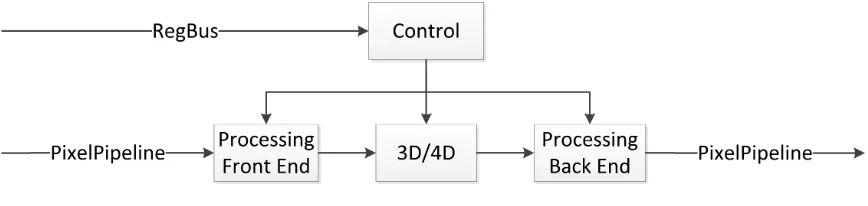
Figure 2.1: Core of the CSC engine.
in Figure 2.1. The ASIC also provides multiple write paths to the CLUTs.
Due to resource limitations of the XC2VP30, and the availability of partial
reconfiguration, the 3D and 4D modules were replaced with a single
mod-ule which, through PR, can be configured for either 3D or 4D conversions.
The FPGA implementation of [2] used block RAM resources to store the
CLUTs.
has an 8 bit interface on the Virtex-II Pro, with a 32 bit interface available
on Virtex 4, 5, and 6 devices, and a maximum frequency of 50 MHz to 100
MHz depending on the device.
This CSC application, due to its extensive use of CLUTs, is restricted by
the available memory resources on the target FPGA. Table 2.1 shows the
available memory resources of the various FPGAs used in the tests of this
thesis. Of particular interest is the relative increase in available BRAM
re-sources compared with the available distributed memory rere-sources; between
the Virtex 5 and Virtex 6, the available BRAM resources doubled, while the
available LUT-based memory increased by more than a factor of 3.6.
Testing of the CSC was done across four Xilinx devices, one Spartan
and three Virtex devices. In particular, the Spartan 3E XC3S1600E,
Virtex-II Pro XC2VP30, Virtex 5 XC5VLX110T, and Virtex 6 XC6VLX240T were
used. The Virtex-II Pro was originally chosen as the target device when
the CSC was implemented on an FPGA, as the Xilinx University Program
boards use the Virtex-II Pro. The Spartan 3E was chosen to investigate the
implementation of the CSC engine on a low-cost FPGA. The Virtex 5 was
explored as a potential upgrade route for newer testing. The Virtex 6 was
chosen when finally upgrading, to migrate to the latest PR-enabled FPGA.
the ICAP. This family of devices, in addition to the ICAP, featured
sev-eral multi-gigabit transceivers, hardware multipliers and block memory, and
larger devices in the family contained one or two IBM PowerPC 405
pro-cessor cores. ICAP is limited to 50 MHz on the Virtex-II Pro devices.
The Spartan 3E, on the other hand, was the first low-cost FPGA family
to feature the ICAP module; however, functionality of the ICAP was not
directly supported by the Xilinx design tools. The design tools supported
by the Xilinx tools (specifically PlanAhead) were oriented around
module-based partial reconfiguration. Due to the design of the Virtex family of
FPGAs, the rest of the reconfigurable fabric-including unused bits in a PR
frame-is capable of continuing to operate glitch-free during partial
reconfig-uration. However, when undergoing PR on the Spartan 3E, unused bits in
a frame are temporarily reset; a method of handling these glitches must be
added to any PR design. Both Virtex-II Pro and Spartan 3E frame sizes are
one column of CLBs or block memory.
Table 2.1: Device Summary
Family
BRAM (Kbits)
Distributed RAM (Kbits)
Multipliers/DSP Slices
Min
Tested
Max
Min
Tested
Max
Min
Tested
Max
Spartan 3E
72
648
648
15
231
231
4
36
36
Virtex II Pro
216
2448
7992
44
428
1378
12
136
444
Virtex 5
936
5328
18576
320
1120
2280
24
64
1056
Chapter 3
Design of Experiment
We have studied the effects of partial evaluation on the color look-up table
values in the HP color space conversion modules on Xilinx FPGAs. Four
implementations of storing the CLUT data are investigated in this thesis.
1. Initial values to (block) RAMs
2. Specifying memories as (block) ROMs - no write interface needs
im-plementing
3. Distributed RAMs
4. Distributed ROMs
ROMs would allow for the removal of hardware associated with writing
to the CLUTs, reducing resource utilization and potentially increasing the
clock rate.
3.1
Tested Implementation Variants
Since not every FPGA has an abundance of BRAMs, though as seen in
Table 2.1 the amount of available BRAMs is increasing with newer
genera-tions of FPGAs, we also looked into using the LUT resources of an FPGA to
implement the CLUTs, known in Xilinx tools as
distributed RAMs
and
dis-tributed ROMs
. A potential application of distributed memories could allow
for a combination of distributed and block memories based on the available
resources of the specific FPGA.
3.1.1
Initialized Block RAMs
convert from the transactional based CLUT data containing 32 bit values,
used to fill the CLUTs one location at a time at runtime, to the COE
for-mat containing 40 or 48 bit values. This tool reads in the CLUT hex data
and uses bit shifting to first separate each channel then writes them, in hex,
as a coefficient file. Scripts to generate the BRAM modules, as well as a
makefile to create the entire design, were created as well.
3.1.2
Distributed RAMs
The largest obstacle encountered while designing the distributed RAM
im-plementation was the resource limitation. Initial testing on the XC2VP30
led to the discovery that, even considering just the resource requirements of
the individual 3D or 4D conversion module of the PRR, the XC2VP30 did
not have sufficient resources for accurate testing of such a design. This led
to an evaluation of other devices and device families for a comparison of the
resources available on the FPGAs.
3.1.3
Distributed ROMs
wires, while complex CSC conversions use resources comparable to those
used by distributed RAMs, as little if any simplification can be done. With
this design the write interface to the CLUTs in the PRR was removed.
3.2
Block ROMs
Similarly, block ROMs also used specific block ROM instantiations for each
CLUT. While initial testing of block ROMs was done on the Virtex-II Pro
XC2VP30, the block ROM design was fully tested in simulation and
hard-ware on the Virtex 6 XC6VLX240T. The block ROM design removes the
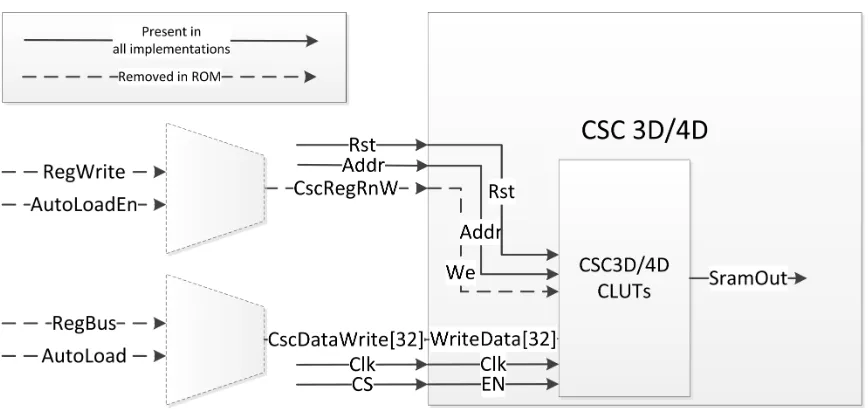
entire write mechanism to CLUTs in the CSC, including the pre- and
post-conversion modules (Figure 3.1). This allows for the removal of all
hard-ware involved in writing to the CLUTs, in particular the Autoload module,
responsible for loading the CLUTs from the pixel pipeline. While removing
all write access in the design is not entirely practical, as the pre- and
post-conversion CLUTs need to be writable, this implementation allows for the
greatest reduction in hardware.
3.3
Test Bench Design
Figure 3.1: CLUT interface changes.
hex2coe
csc
.coe
Source
Image
tiff2txt
.tif
.txt
Success or
Failure
.bit
Configuration
Register Data
LUT Data
cxf2fusion
.hex
Configuration
Data
.ini
LUT Data
.cxf
CSC Data
CSC
Application
.dat
Known Good
Output Image
.tif
Virtex 6
(hardware)
Provided by HP
[image:24.612.112.543.85.708.2]Custom Tool
Generated File
CLUT Data
(coe)
Partial
Bitstream (.bit)
mrprdata
Test
Vector(.txt)
Compare
(Matlab script)
Chapter 4
Results
As seen in Table 2.1, there is a wide range of available resources, even
within a given family of devices. In the driving example, the CSC, there is a
fairly large usage of memory, used for storing CLUTs. Given that
SRAM-based FPGAs store configuration data in SRAM memory cells, it’s possible
to use those same FPGA LUTs to serve as CLUTs in distributed memory,
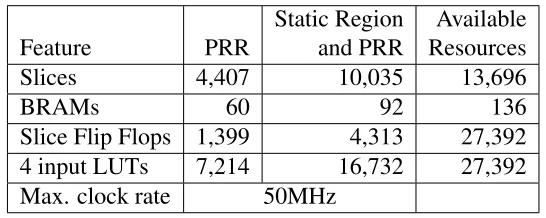
either RAM or ROM. Table 4.1 shows the initial resource requirements of
the PR-enabled CSC on the XC2VP30. Of particular note, the partially
reconfigurable region (PRR) uses 26.34% of the LUT resources in the block
RAM implementation.
4.1
Distributed RAM
Table 4.1: CSC engine implementation results (XC2VP30).
Static Region
Available
Feature
PRR
and PRR
Resources
Slices
4,407
10,035
13,696
BRAMs
60
92
136
Slice Flip Flops
1,399
4,313
27,392
4 input LUTs
7,214
16,732
27,392
Max. clock rate
50MHz
just the PRR, 383.8 Kbits are needed just for memory in the 3D module,
or 89.7% of the available distributed memory on the XC2VP30. As seen in
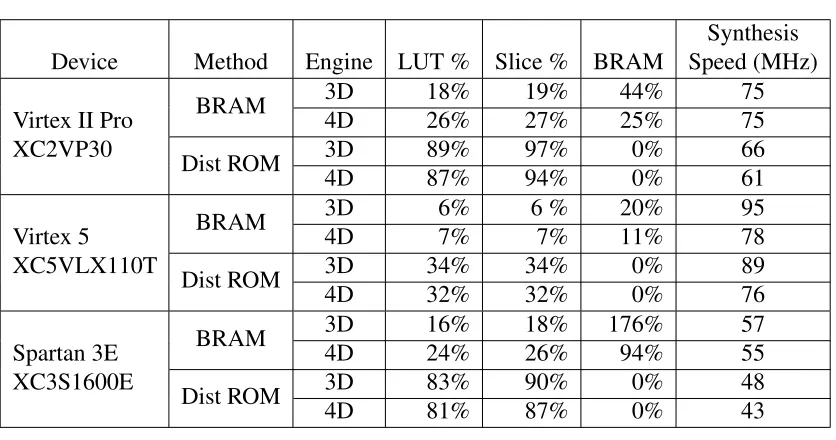
Table 4.3, the 3D PRR uses 18% of the available LUT resources, combining
for over 100% of the device for the PR alone, preventing the design from
synthesizing. While the 4D PRR requires fewer distributed RAM resources,
the PRR size is determined by the largest amount of resources required
be-tween the modules that can occupy it.
Table 4.2: RAM resource requirements
Module
Size (Kb)
3D
383.8
4D
256.3
4.2
Distributed ROM
Distributed ROM allows the synthesis tools to analyze the stored data for
places to optimize in synthesis; this can lead to smaller designs for any
collection of CLUTs that have a pattern in them. Also, by being a ROM,
write hardware can be removed, allowing further hardware reductions. In a
PR design, however, the distributed ROM in practicality will have limited
hardware reduction due to patterns, as the PRR needs to be large enough to
encompass any set of memories, CLUTs in the CSC. As Table 4.3 shows,
distributed ROM implementations, or more likely balanced hybrid
imple-mentations, can be useful in devices such as the Spartan 3E, where there is a
low amount of available BRAM and a surplus in LUT resources compared
to those needed by logic. However, the trend in newer families is to increase
the available BRAM resources, albeit at a lower rate than logic resources.
4.3
Initialized Block RAM
Table 4.3: Distributed ROM PRR synthesis results
Synthesis
Device
Method
Engine
LUT %
Slice %
BRAM
Speed (MHz)
Virtex II Pro
XC2VP30
BRAM
3D
18%
19%
44%
75
4D
26%
27%
25%
75
Dist ROM
3D
89%
97%
0%
66
4D
87%
94%
0%
61
Virtex 5
XC5VLX110T
BRAM
3D
6%
6 %
20%
95
4D
7%
7%
11%
78
Dist ROM
3D
34%
34%
0%
89
4D
32%
32%
0%
76
Spartan 3E
XC3S1600E
BRAM
3D
16%
18%
176%
57
4D
24%
26%
94%
55
Dist ROM
3D
83%
90%
0%
48
4D
81%
87%
0%
43
more than the BRAM size. This appears to be due to the additional BRAMs
in the frames used by the PRR, though the discrepancy between the 3D and
4D changes in bitstream sizes is not explained.
Table 4.4: Initialized BRAM results
Change in
Engine
Partial Bitstream Size (Bytes)
bitstream size
CLUT Size (Bytes)
(bytes)
No Initial Data
Initialized BRAMs
3D
476116
628156
152040
49130
[image:29.612.100.524.481.571.2]4.4
Block ROM
The final implementation analyzed was using block ROMs in place of block
RAMs. While the block ROM implementation suffers from the same
notice-able increase in bitstream size as block RAMs, this implementation allows
for the removal of write hardware from the design, potentially a significant
improvement in both resource utilization and clock rate.
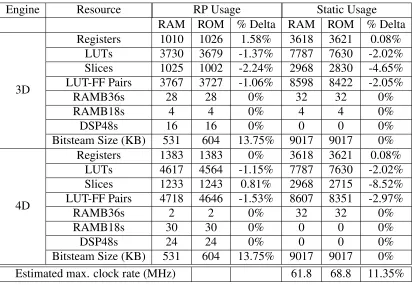
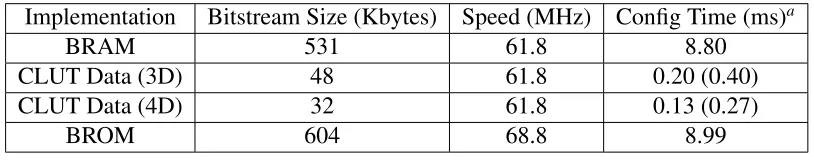
module increases by converting to the BROM implementation, during
com-pact mode configuration of the 3D CLUTs the total configuration times have
less than 0.1% variance, while under normal mode the BROM
implemen-tation proves to be faster. The BROM implemenimplemen-tation, however, forces the
entire RP reconfiguration even if just the CLUTs change, a less flexible
sys-tem.
Table 4.5: Virtex 6 Block ROM Resource Utilization
Engine
Resource
RP Usage
Static Usage
RAM
ROM
% Delta
RAM
ROM
% Delta
3D
Registers
1010
1026
1.58%
3618
3621
0.08%
LUTs
3730
3679
-1.37%
7787
7630
-2.02%
Slices
1025
1002
-2.24%
2968
2830
-4.65%
LUT-FF Pairs
3767
3727
-1.06%
8598
8422
-2.05%
RAMB36s
28
28
0%
32
32
0%
RAMB18s
4
4
0%
4
4
0%
DSP48s
16
16
0%
0
0
0%
Bitsteam Size (KB)
531
604
13.75%
9017
9017
0%
4D
Registers
1383
1383
0%
3618
3621
0.08%
LUTs
4617
4564
-1.15%
7787
7630
-2.02%
Slices
1233
1243
0.81%
2968
2715
-8.52%
LUT-FF Pairs
4718
4646
-1.53%
8607
8351
-2.97%
RAMB36s
2
2
0%
32
32
0%
RAMB18s
30
30
0%
0
0
0%
DSP48s
24
24
0%
0
0
0%
Bitsteam Size (KB)
531
604
13.75%
9017
9017
0%
Table 4.6: Estimated partial reconfiguration timings (XC6VLX240)
Implementation
Bitstream Size (Kbytes)
Speed (MHz)
Config Time (ms)
aBRAM
531
61.8
8.80
CLUT Data (3D)
48
61.8
0.20 (0.40)
CLUT Data (4D)
32
61.8
0.13 (0.27)
BROM
604
68.8
8.99
Chapter 5
Conclusions
We have presented the evaluation of four variations of storage as they apply
to a partially reconfigurable FPGA implementation of a color space
conver-sion module. With the initial design, when the CSC PRR is reconfigured,
the CLUT RAMs are loaded with the appropriate CLUT data. The four
variations of CLUT storage evaluated make trade-offs between resource
uti-lization and performance. For the size of storage needed for the CLUTs in
this design, distributed memories used too many LUT resources; however,
such an implementation could be used for smaller memories, or in a mixed
design with block and distributed memories, if the available block memory
resources of the desired device is too limiting. Block ROMs can provide the
greatest reduction in resources and increase in performance; in this design,
there are multiple write paths to the CLUTs, with the critical path of the
original design the write enable signal to one of the block RAM modules.
Bibliography
[1] Brandon Blodget, Philip James-Roxby, Eric Keller, Scott McMillan,
and Prasanna Sundararajan. A self-reconfiguring platform. In
Che-ung and George Constantinides, editors,
Field Programmable Logic and
Application
, volume 2778 of
Lecture Notes in Computer Science
,
chap-ter 55, pages 565–574. Springer Berlin / Heidelberg, Berlin, Heidelberg,
2003.
[2] J. Galindo, E. Peskin, B. Larson, and G. Roylance.
Leveraging
Firmware in Multichip Systems to Maximize FPGA Resources: An
Ap-plication of Self-Partial Reconfiguration.
Reconfigurable Computing
and FPGAs, 2008. ReConFig ’08. International Conference on
, pages
139–144, December 2008.
[3] P. Green and L.W. MacDonald.
Colour engineering: achieving device
independent colour
. Wiley SID series in display technology. Wiley,
2002.
[4] Scott Hauck and Andr´e DeHon.
Reconfigurable Computing: The
The-ory and Practice of FPGA-Based Computation
. Morgan Kaufmann,
November 2007.
[6] Philippe Manet, Daniel Maufroid, Leonardo Tosi, Gregory Gailliard,
Olivier Mulertt, Marco Di Ciano, Jean-Didier Legat, Denis Aulagnier,
Christian Gamrat, Raffaele Liberati, Vincenzo La Barba, Pol Cuvelier,
Bertrand Rousseau, and Paul Gelineau. An Evaluation of Dynamic
Par-tial Reconfiguration for Signal and Image Processing in Professional
Electronics Applications.
EURASIP Journal on Embedded Systems
,
2008, November 2008.
[7] N. McKay, T. Melham, and Kong W. Susanto. Dynamic specialisation
of XC6200 FPGAs by partial evaluation. pages 308–309, April 1998.
[8] Sreenivas Patil. Reconfigurable hardware for color space conversion.
Appendix A
Makefile
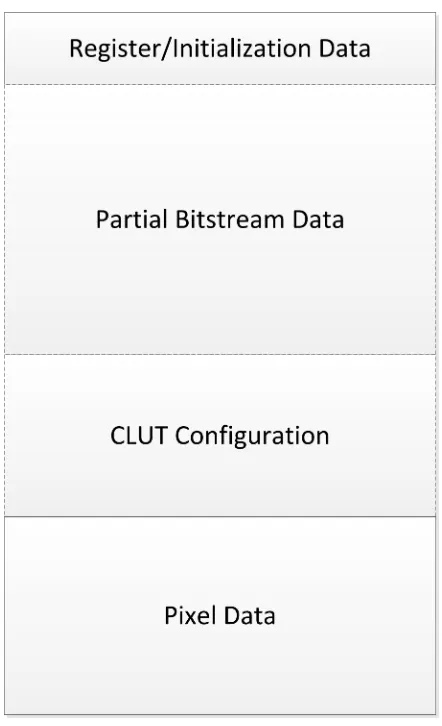
# M a k e f i l e f o r CSC PR # I n i t i a l i z e e n v i r o n m e n t
# G e n e r a t e n g c f i l e s f o r e a c h m o d u l e and c o p y t o d e s i r e d l o c a t i o n # C o n v e r t b i t s t r e a m s t o t e s t f i l e s
# T e s t f i l e s : CSC / CXF2FUSION / M e r g i n g r e g i o n s o f t e s t f i l e w i t h # h e a d e r , PRM b i t s t r e a m , CLUT d a t a , i m a g e
RMDIR = $ (RM) −R
STATIC DIR = s y n t h / S t a t i c MOD3D DIR = s y n t h / Mod 3d MOD4D DIR = s y n t h / Mod 4d TOP DIR = s y n t h / Top
STATIC PROJECTS = c s c a u t o l o a d / c s c a u t o l o a d . i s e c s c c o n t r o l / c s c c o n t r o l . i s e \
c s c i s o l a t i o n s t a g e / c s c i s o l a t i o n s t a g e 6 9 . i s e \
c s c i s o l a t i o n s t a g e / c s c i s o l a t i o n s t a g e 1 0 0 . i s e \
c s c k p l a n e m a g / c s c k p l a n e m a g . i s e c s c l u t 1 d / c s c l u t 1 d p r e . i s e \
c s c l u t 1 d / c s c l u t 1 d p o s t . i s e c s c p r e m a t c h / c s c p r e m a t c h . i s e \
c s c r e g / c s c r e g . i s e c s c w r a p p e r / c s c w r a p p e r . i s e i c a p e a i / i c a p e a i . i s e \
l u t c h k t o p / l u t c h k t o p . i s e \
p i p e l i n e h a n d s h a k e e n a b l e / p i p e l i n e h a n d s h a k e e n a b l e . i s e \
t e s t r i g 2 d u t i n t e r f a c e / t e s t r i g 2 d u t i n t e r f a c e . i s e STATIC HDL = $ ( n o t d i r $ ( STATIC PROJECTS : . i s e = . v ) )
SOURCES 1D SRAM : = $ ( w i l d c a r d $ ( STATIC DIR ) / s r a m∗w r a p p e r c o r e g e n 2 . v ) \
$ ( p a t s u b s t %. xco , % . ngc , $ ( w i l d c a r d $ ( MOD4D DIR ) / s r a m ∗. xco ) )
SOURCES STATIC = $ ( a d d p r e f i x $ ( STATIC DIR ) / , $ ( STATIC PROJECTS ) $ ( STATIC HDL ) \
$ ( STATIC PROJECTS : . i s e = . x s t ) )
TARGETS STATIC = $ ( a d d p r e f i x $ ( STATIC DIR ) / , $ ( STATIC PROJECTS : . i s e = . ngc ) ) PR 3D PROJECT = $ ( MOD3D DIR ) / Mod 3d . i s e
PR 4D PROJECT = $ ( MOD4D DIR ) / Mod 4d . i s e
PR PROJECTS = $ ( PR 3D PROJECT ) $ ( PR 4D PROJECT )
SOURCES PR 3D SRAM : = $ ( w i l d c a r d $ ( MOD3D DIR ) / s r a m 0∗. xco ) $ ( w i l d c a r d $ ( MOD3D DIR ) / s r a m 1∗. xco )
SOURCES PR 4D SRAM : = $ ( w i l d c a r d $ ( MOD4D DIR ) / s r a m ∗. xco ) SOURCES PR 3D SRAM COE : = $ ( w i l d c a r d $ ( MOD3D DIR ) /∗. c o e ) SOURCES PR 4D SRAM COE : = $ ( w i l d c a r d $ ( MOD4D DIR ) /∗. c o e ) TARGETS PR 3D SRAM : = $ ( SOURCES PR 3D SRAM : . xco = . edn ) TARGETS PR 4D SRAM : = $ ( SOURCES PR 4D SRAM : . xco = . edn )
SOURCES PR 3D = $ ( a d d p r e f i x $ ( MOD3D DIR ) / , c s c 3 d 4 d . v c s c 3 d . v c s c p h a s e 1 3 d . v \
c s c l u t w r a p p e r s 3 d . v c s c p h a s e 2 3 d . v c s c p h a s e 3 3 d . v c s c p h a s e 3 3 d c h a n n e l . v \
c s c d e f s . vh r b i s t d e f s . vh c s c 3 d 4 d . l s o ) \
$ ( w i l d c a r d $ ( MOD3D DIR ) / s r a m∗w r a p p e r c o r e g e n 2 . v )
c s c l u t w r a p p e r s 4 d . v c s c p h a s e 2 4 d . v c s c p h a s e 3 4 d . v c s c p h a s e 3 4 d c h a n n e l . v \
c s c d e f s . vh r b i s t d e f s . vh c s c 3 d 4 d . l s o ) \
$ ( w i l d c a r d $ ( MOD4D DIR ) / s r a m∗w r a p p e r c o r e g e n 2 . v ) TARGETS PR 3D = $ ( MOD3D DIR ) / c s c 3 d 4 d . ngc
TARGETS PR 4D = $ ( MOD4D DIR ) / c s c 3 d 4 d . ngc TARGETS PR = $ ( TARGETS PR 3D ) $ ( TARGETS PR 4D ) TOP PROJECT = $ ( TOP DIR ) / Top . i s e
SOURCES TOP = $ ( TOP DIR ) / c s c . v $ ( TOP DIR ) / c s c . l s o TARGETS TOP = $ ( TOP DIR ) / c s c . ngc
TARGETS = $ ( TARGETS PR ) $ ( TARGETS STATIC )
COPIES 3D = $ ( a d d p r e f i x $ ( NETLIST DIR ) / Mod 3d / , $ ( n o t d i r $ ( TARGETS PR 3D ) ) ) \
$ ( a d d p r e f i x $ ( NETLIST DIR ) / Mod 3d / , $ ( n o t d i r $ ( TARGETS PR 3D SRAM ) ) ) COPIES 4D = $ ( a d d p r e f i x $ ( NETLIST DIR ) / Mod 4d / , $ ( n o t d i r $ ( TARGETS PR 4D ) ) ) \
$ ( a d d p r e f i x $ ( NETLIST DIR ) / Mod 4d / , $ ( n o t d i r $ ( TARGETS PR 4D SRAM ) ) ) COPIES STATIC = $ ( a d d p r e f i x $ ( NETLIST DIR ) / S t a t i c / , $ ( n o t d i r $ ( TARGETS STATIC ) ) ) COPIES TOP = $ ( a d d p r e f i x $ ( NETLIST DIR ) / Top / , $ ( n o t d i r $ ( TARGETS TOP ) ) \
b u s m a c r o x c 2 v p l 2 r a s y n c n a r r o w . nmc b u s m a c r o x c 2 v p r 2 l a s y n c n a r r o w . nmc ) INTERMEDIATES = $ ( w i l d c a r d s y n t h /∗/ s r a m∗ch∗r e a d m e . t x t ) \
$ ( w i l d c a r d s y n t h /∗/ s r a m∗ch∗f l i s t . t x t ) \ $ ( w i l d c a r d s y n t h /∗/ s r a m∗ch∗. a s y ) \
$ ( w i l d c a r d s y n t h /∗/ s r a m∗ch∗. sym ) $ ( w i l d c a r d s y n t h /∗/ s r a m∗ch∗. v∗) \
$ ( w i l d c a r d s y n t h /∗/∗. edn ) $ ( w i l d c a r d s y n t h /∗/∗l o g ) \
$ ( w i l d c a r d s y n t h /∗/∗. ngo ) $ ( w i l d c a r d s y n t h /∗/∗. s t x ) \
$ ( w i l d c a r d s y n t h /∗/∗. s y r ) $ ( w i l d c a r d s y n t h /∗/∗. n g r ) \
$ ( w i l d c a r d s y n t h /∗/∗. h t m l ) $ ( w i l d c a r d s y n t h / S t a t i c /∗/∗. h t m l ) CVSIGNORED : = $ ( f i n d −name . c v s i g n o r e )
TEMPDIRS = $ ( w i l d c a r d $ ( STATIC DIR ) /∗/ x m s g s ) $ ( w i l d c a r d $ ( STATIC DIR ) /∗/ x s t ) \
$ ( w i l d c a r d s y n t h /∗/ c g ) $ ( w i l d c a r d s y n t h /∗/ x m s g s ) $ ( w i l d c a r d s y n t h /∗/ t e m p l a t e s ) \
$ ( w i l d c a r d s y n t h /∗/ tmp ) $ ( TOP DIR ) / x s t $ ( TOP DIR ) / x s t TOOLSDIR = t o o l s
MRPRDATA = $ ( TOOLSDIR ) / m r p r d a t a / m r p r d a t a HEX2COE = $ ( TOOLSDIR ) / h e x 2 c o e / h e x 2 c o e PRDATA2PG = $ ( TOOLSDIR ) / p r d a t a 2 p g . p l TOOLS = $ (MRPRDATA) $ (HEX2COE) SCRIPTSDIR = s c r i p t s
SCRIPT SETPR = $ ( SCRIPTSDIR )\\s e t t o x i l i n x p r . b a t EXPORT 3D DIR = P A P r o j e c t s / c s c p r v 2 p 3 d e x p o r t EXPORT 4D DIR = P A P r o j e c t s / c s c p r v 2 p 4 d e x p o r t NETLIST DIR = n e t l i s t s
a l l : t o o l s c o e s s y n t h n e t l i s t s p l a n a h e a d h e x f i l e s p r d a t a t e s t f i l e s t o o l s : $ ( TOOLS )
c o e s : $ (HEX2COE) mkcoe . / mkcoe
s y n t h : s t a t i c p r
s t a t i c : $ ( TARGETS STATIC ) p r : $ ( TARGETS PR )
# x s t p l a c e s f i l e s i n x s t / p r o j n a v . tmp and won ’ t r u n i f i t d o e s n ’ t e x i s t # x s t : −i s e p r o j e c t f i l e ( i s e / x i s e d e p e n d i n g on v e r s i o n ) f o r g u i mode # −i n t s t y l e : o u t p u t m e s s a g e f o r m a t
# −i f n : i n p u t f i l e name ( x s t ) # −o f n : o u t p u t ( l o g ) f i l e name # 3D m o d u l e
$ ( TARGETS PR 3D ) : $ ( PR 3D PROJECT ) $ ( SOURCES PR 3D ) c o r e g e n 3 d m k d i r −p $ (@D) / x s t / p r o j n a v . tmp
# 4D m o d u l e
$ ( TARGETS PR 4D ) : $ ( PR 4D PROJECT ) $ ( SOURCES PR 4D ) c o r e g e n 4 d m k d i r −p $ (@D) / x s t / p r o j n a v . tmp
cd $ (@D) && x s t −i s e $(<F ) −i n t s t y l e x f l o w −i f n c s c 3 d 4 d . x s t −o f n c s c 3 d 4 d . s y r
# Top m o d u l e
$ ( TARGETS TOP ) : $ ( TOP PROJECT ) $ ( SOURCES TOP ) m k d i r −p $ (@D) / x s t / p r o j n a v . tmp
cd $ (@D) && x s t −i s e $(<F ) −i n t s t y l e x f l o w −i f n c s c . x s t −o f n c s c . s y r c o r e g e n 3 d : $ ( TARGETS PR 3D SRAM ) $ ( SOURCES PR 3D SRAM COE )
c o r e g e n 4 d : $ ( TARGETS PR 4D SRAM ) $ ( SOURCES PR 4D SRAM COE )
# s r a m s
%. edn : %. xco
# b a c k u p SRAM xco ’ s s i n c e c o r e g e n r e w r i t e s t h e m w i t h same d a t a # a f t e r e d n i s c r e a t e d ; h e l p s p r e s e r v e f u n c t i o n a l i t y o f make . # Run c o r e g e n i n b a t c h ( command l i n e ) mode
# R e s t o r e a f t e r e d n g e n e r a t i o n , p r e s e r v i n g t h e o r i g i n a l m o d i f i e d d a t e
cd $ (@D) && cp $(<F ) $(<F ) . bak cd $ (@D) && c o r e g e n −b $(<F ) cd $ (@D) && mv $(<F ) . bak $(<F )
# s t a t i c n e t l i s t s
%. ngc : %. i s e %. l s o %. x s t
m k d i r −p $ (@D) / x s t / p r o j n a v . tmp
cd $ (@D) && x s t −i s e $(<F ) −i n t s t y l e x f l o w −i f n $ (∗F ) . x s t −o f n $ (∗F ) . s y r
# l s o f i l e d e f i n e s how t o s e a r c h l i b r a r i e s , i f n o t p r e s e n t t h e n # c r e a t e w i t h DEFAULT SEARCH ORDER k e y w o r d
%. l s o :
e c h o DEFAULT SEARCH ORDER> $@
# c o p i e s o f n e t l i s t s i n n e t l i s t s / d i r e c t o r y
# t h i s i s w h e r e t h e p l a n a h e a d p r o j e c t c h e c k s f o r n e t l i s t s
n e t l i s t s : $ ( COPIES 3D ) $ ( COPIES 4D ) $ ( COPIES STATIC ) $ ( COPIES TOP )
$ ( NETLIST DIR ) / S t a t i c / % . ngc : $ ( STATIC DIR ) /%/%. ngc cp $<$@
$ ( NETLIST DIR ) / Mod 3d/% : $ ( MOD3D DIR ) /% cp $<$@
$ ( NETLIST DIR ) / Mod 4d/% : $ ( MOD4D DIR ) /% cp $<$@
$ ( NETLIST DIR ) / S t a t i c / c s c i s o l a t i o n s t a g e /% : $ ( STATIC DIR ) / c s c i s o l a t i o n s t a g e /% cp $<$@
$ ( NETLIST DIR ) / S t a t i c / c s c l u t 1 d /% : $ ( STATIC DIR ) / c s c i s o l a t i o n s t a g e /% cp $<$@
$ ( NETLIST DIR ) / Top / % . ngc : $ ( TOP DIR ) / % . ngc cp $<$@
# G e n e r a t e s t h e b i t s t r e a m s f o r 3 d m o d u l e ( f u l l and p a r t i a l )
b u i l d 3 d : $ ( EXPORT 3D DIR ) / merge / s t a t i c f u l l . ncd
$ ( EXPORT 3D DIR ) / merge / R e c o n f i g M o d u l e s C V r o u t e d p a r t i a l . ncd
$ ( EXPORT 3D DIR ) / merge / s t a t i c f u l l . ncd
$ ( EXPORT 3D DIR ) / merge / R e c o n f i g M o d u l e s C V r o u t e d . ncd \
$ ( EXPORT 3D DIR ) / merge / r e c o n f i g m o d u l e s c v r o u t e d p a r t i a l . b i t : \
$ ( COPIES 3D ) $ ( COPIES STATIC ) $ ( COPIES TOP )
i f [ −e $ ( EXPORT 3D DIR ) ] ; t h e n $ (RM) −R $ ( EXPORT 3D DIR ) o l d ; \
mv $ ( EXPORT 3D DIR ) $ ( EXPORT 3D DIR ) o l d ; f i
$ (RM) P A p r o j e c t s / c s c p r v 2 p 3 d / c s c p r v 2 p 3 d . d a t a / n e t l i s t /∗. ngc
i f [ ! −e P A p r o j e c t s / c s c p r v 2 p 3 d / c s c p r v 2 p 3 d . d a t a / n e t l i s t / c s c . ngc ] ; t h e n \
m k d i r −p P A p r o j e c t s / c s c p r v 2 p 3 d / c s c p r v 2 p 3 d . d a t a / n e t l i s t / ; \
cp P A P r o j e c t s / c s c p r v 2 p 3 d / c s c p r v 2 p 3 d . d a t a / f l o o r p l a n 1 / c s c . e d f \
P A p r o j e c t s / c s c p r v 2 p 3 d / c s c p r v 2 p 3 d . d a t a / n e t l i s t / ;\
f i
m k d i r $ ( EXPORT 3D DIR )
cmd / c ” $ ( SCRIPT SETPR ) && p l a n A h e a d −s o u r c e $ ( SCRIPTSDIR ) / c s c 3 d p r P A . t c l ” cmd / c ” $ ( SCRIPT SETPR ) && cd $ ( EXPORT 3D DIR ) && i n i t M o d u l a r . b a t ”
cmd / c ” $ ( SCRIPT SETPR ) && cd $ ( EXPORT 3D DIR ) / s t a t i c && s t a t i c L o g i c I m p l . b a t ” cmd / c ” $ ( SCRIPT SETPR ) && cd $ ( EXPORT 3D DIR ) && p r o c e s s P b l o c k s . b a t ”
cmd / c ” $ ( SCRIPT SETPR ) && cd $ ( EXPORT 3D DIR ) / merge && a s s e m b l e P C f g . b a t ”
# G e n e r a t e s t h e b i t s t r e a m s f o r 4 d m o d u l e ( f u l l and p a r t i a l )
b u i l d 4 d : $ ( EXPORT 4D DIR ) / merge / s t a t i c f u l l . ncd
$ ( EXPORT 4D DIR ) / merge / R e c o n f i g M o d u l e s C V r o u t e d p a r t i a l . ncd
# Can ’ t e x e c u t e t h e f i r s t s t a g e s o f t h e PA f l o w o r you ’ l l s c r e w up t h e s t a t i c r e g i o n # So c o p y t h e 3D d i r e c t o r y , t h e n c o p y t h e 4D n e t l i s t s i n t o t h e new d i r e c t o r y
# Then r e r u n t h e l a s t 2 s t e p s w i t h t h e 4D m o d u l e s
$ ( EXPORT 4D DIR ) / merge / s t a t i c f u l l . ncd \
$ ( EXPORT 4D DIR ) / merge / r e c o n f i g m o d u l e s c v r o u t e d p a r t i a l . ncd \
$ ( EXPORT 4D DIR ) / merge / r e c o n f i g m o d u l e s c v r o u t e d p a r t i a l . b i t : \
$ ( COPIES 4D ) $ ( COPIES STATIC ) $ ( COPIES TOP )
i f [ −e $ ( EXPORT 4D DIR ) ] ; t h e n $ (RM) −R $ ( EXPORT 4D DIR ) o l d ; \
mv $ ( EXPORT 4D DIR ) $ ( EXPORT 4D DIR ) o l d ; f i cp −R $ ( EXPORT 3D DIR ) / $ ( EXPORT 4D DIR ) /
cp ‘ l s −d $ ( NETLIST DIR ) / Mod 4d /∗ | g r e p −v CVS‘ $ ( EXPORT 4D DIR ) / R e c o n f i g M o d u l e s C V /
cmd / c ” $ ( SCRIPT SETPR ) && cd $ ( EXPORT 4D DIR ) && p r o c e s s P b l o c k s . b a t ” cmd / c ” $ ( SCRIPT SETPR ) && cd $ ( EXPORT 4D DIR ) / merge && a s s e m b l e P C f g . b a t ”
h e x f i l e s : $ ( EXPORT 3D DIR ) / merge / c s c 3 d . hex $ ( EXPORT 4D DIR ) / merge / c s c 4 d . hex
$ ( EXPORT 3D DIR ) / merge / c s c 3 d . hex :
$ ( EXPORT 3D DIR ) / merge / r e c o n f i g m o d u l e s c v r o u t e d p a r t i a l . b i t cd $ ( EXPORT 3D DIR ) / merge / && promgen −w−p hex −u 0
r e c o n f i g m o d u l e s c v r o u t e d p a r t i a l . b i t −o c s c 3 d . hex $ ( EXPORT 4D DIR ) / merge / c s c 4 d . hex :
$ ( EXPORT 4D DIR ) / merge / r e c o n f i g m o d u l e s c v r o u t e d p a r t i a l . b i t cd $ ( EXPORT 4D DIR ) / merge / && promgen −w−p hex −u 0
r e c o n f i g m o d u l e s c v r o u t e d p a r t i a l . b i t −o c s c 4 d . hex
# C o n v e r t p a r t i a l b i t s t r e a m s i n t o t e s t v e c t o r s u s i n g MRPRDATA
p r d a t a : $ ( EXPORT 3D DIR ) / merge / c s c 3 d p r . t x t $ ( EXPORT 4D DIR ) / merge / c s c 4 d p r . t x t
$ (MRPRDATA) $ ( EXPORT 3D DIR ) / merge / c s c 3 d . hex $ ( EXPORT 3D DIR ) / merge / c s c 3 d p r . t x t
$ ( EXPORT 4D DIR ) / merge / c s c 4 d p r . t x t : $ ( EXPORT 4D DIR ) / merge / c s c 4 d . hex
$ (MRPRDATA) $ ( EXPORT 4D DIR ) / merge / c s c 4 d . hex $ ( EXPORT 4D DIR ) / merge / c s c 4 d p r . t x t
t e s t f i l e s : p r p l u s 3 d . t x t p r p l u s 4 d . t x t
# Combine p r e m a d e h e a d e r and i m a g e w i t h p a r t i a l b i t s t r e a m v e c t o r s t o make c o m p l e t e t e s t v e c t o r
p r p l u s 3 d . t x t : t e s t r i g / t e s t v e c t o r s / h e a d e r 3 d . t x t $ ( EXPORT 3D DIR ) / merge / c s c 3 d p r . t x t \
t e s t r i g / t e s t v e c t o r s / c l u t 3 d p r e 1 d p o s t 1 d . t x t t e s t r i g / t e s t v e c t o r s / img3d . t x t @echo $ ?
c a t $ ˆ >$@
$ ( PRDATA2PG ) p r p l u s 3 d . t x t pg3d . t x t
# Combine p r e m a d e h e a d e r and i m a g e w i t h p a r t i a l b i t s t r e a m v e c t o r s t o make c o m p l e t e t e s t v e c t o r
p r p l u s 4 d . t x t : t e s t r i g / t e s t v e c t o r s / h e a d e r 4 d . t x t $ ( EXPORT 4D DIR ) / merge / c s c 4 d p r . t x t \
t e s t r i g / t e s t v e c t o r s / c l u t 4 d p r e 1 d p o s t 1 d . t x t t e s t r i g / t e s t v e c t o r s / img4d . t x t c a t $ ˆ >$@
$ ( PRDATA2PG ) p r p l u s 4 d . t x t pg4d . t x t
c l e a n :
$ (RM) $ ( TARGETS ) $ ( COPIES ) $ ( INTERMEDIATES ) $ (RMDIR) $ ( TEMPDIRS )
# V e r i l o g d e p e n d e n c y f i l e s f o r e a c h s t a t i c p r o j e c t
$ ( TARGETS STATIC ) : $ ( STATIC DIR ) / c s c d e f s . vh
$ ( STATIC DIR ) / c s c a u t o l o a d / c s c a u t o l o a d . ngc : $ ( STATIC DIR ) / c s c a u t o l o a d . v $ ( STATIC DIR ) / c s c c o n t r o l / c s c c o n t r o l . ngc : $ ( STATIC DIR ) / c s c c o n t r o l . v $ ( STATIC DIR ) / c s c i s o l a t i o n s t a g e / c s c i s o l a t i o n s t a g e 6 9 . ngc :
$ ( STATIC DIR ) / c s c i s o l a t i o n s t a g e 6 9 . v
$ ( STATIC DIR ) / c s c i s o l a t i o n s t a g e / c s c i s o l a t i o n s t a g e 1 0 0 . ngc : $ ( STATIC DIR ) / c s c i s o l a t i o n s t a g e 1 0 0 . v
$ ( STATIC DIR ) / c s c k p l a n e m a g / c s c k p l a n e m a g . ngc : $ ( STATIC DIR ) / c s c k p l a n e m a g . v $ ( STATIC DIR ) / c s c l u t 1 d / c s c l u t 1 d p o s t . ngc : $ ( STATIC DIR ) / c s c l u t 1 d p o s t . v \
$ ( STATIC DIR ) / c s c p h a s e 1 1 d . v $ ( STATIC DIR ) / c s c p h a s e 2 1 d . v \
$ ( STATIC DIR ) / c s c l u t w r a p p e r s 1 d . v $ ( STATIC DIR ) / r b i s t d e f s . vh $ ( STATIC DIR ) / c s c l u t 1 d / c s c l u t 1 d p r e . ngc : $ ( STATIC DIR ) / c s c l u t 1 d p r e . v \
$ ( STATIC DIR ) / c s c p h a s e 1 1 d . v $ ( STATIC DIR ) / c s c p h a s e 2 1 d . v \
$ ( STATIC DIR ) / c s c l u t w r a p p e r s 1 d . v $ ( STATIC DIR ) / r b i s t d e f s . vh $ ( STATIC DIR ) / c s c p r e m a t c h / c s c p r e m a t c h . ngc : $ ( STATIC DIR ) / c s c p r e m a t c h . v $ ( STATIC DIR ) / c s c r e g / c s c r e g . ngc : $ ( STATIC DIR ) / c s c r e g . v
$ ( STATIC DIR ) / c s c w r a p p e r / c s c w r a p p e r . ngc : $ ( STATIC DIR ) / CS C wr ap pe r . vhd $ ( STATIC DIR ) / i c a p e a i / i c a p e a i . ngc : $ ( STATIC DIR ) / i c a p e a i . v
$ ( STATIC DIR ) / l u t c h k t o p / l u t c h k t o p . ngc : $ ( STATIC DIR ) / l u t c h k c t r l . v \
$ ( STATIC DIR ) / l u t c h k r e g s . v $ ( STATIC DIR ) / l u t c h k t i m e r . v $ ( STATIC DIR ) / l u t c h k t o p . v \
$ ( STATIC DIR ) / c s c l u t c h k c r c 1 6 p a r a l l e l n . v
$ ( STATIC DIR ) / p i p e l i n e h a n d s h a k e e n a b l e / p i p e l i n e h a n d s h a k e e n a b l e . ngc : \
$ ( STATIC DIR ) / p i p e l i n e h a n d s h a k e e n a b l e . v
$ ( STATIC DIR ) / T e s t R i g 2 D U T I n t e r f a c e / T e s t R i g 2 D U T I n t e r f a c e . ngc : \
$ ( STATIC DIR ) / T e s t R i g 2 D U T I n t e r f a c e . v
Appendix B
Hex2Coe
/ / T h i s u t i l i t y c o n v e r t s h e x f i l e s t o t h e c o e f o r m a t / / I n p u t : Hex f i l e
/ / O u t p u t : 2 c o e f i l e s ( f o r u p p e r , l o w e r )
/ / Usage : h e x 2 c o e [−c|−m] [−1|−3|−4] [−N|−C] −i <i n p u t> [−o <o u t p u t s t e m>] / / −c : s p e c i f i e s t h e o u t p u t s h o u l d be c o e f o r m a t ( d e f a u l t )
/ / −m: s p e c i f i e s t h e o u t p u t s h o u l d be m i f f o r m a t ( n o t y e t i m p l e m e n t e d ) / / −1: s p e c i f i e s t h e f i l e i s f o r a 1D memory ( 4 8 b i t s , 12 b i t s p e r c h a n n e l ) / / −3 −4: s p e c i f i e s t h e f i l e i s f o r a 3D/ 4D memory ( 4 0 b i t s , 10 b i t s p e r c h a n n e l ) / / −N : s p e c i f i e s t h e i n p u t i s i n n o r m a l mode ( 1 2 b i t s / c h a n n e l f o r 1D , 10
b i t s / c h a n n e l f o r 3D/ 4D)
/ / −C : s p e c i f i e s t h e i n p u t i s i n c o m p a c t mode ( 8 b i t s / c h a n n e l f o r 1D , 8 b i t s / c h a n n e l f o r 3D/ 4D)
/ / −f : O u t p u t s t h e f u l l 40 b i t c o e f i l e i n a d d i t i o n t o t h e d i v i d e d c h a n n e l s ( 3D/ 4D o n l y ) / / −h : d i s p l a y t h i s h e l p and e x i t
/ / I f n e i t h e r −N n o r −C i s g i v e n , w i l l a t t e m p t t o d e t e r m i n e t h e f o r m a t b a s e d on t h e c o n t e n t s .
# i n c l u d e <s t d i o . h>
# i n c l u d e <s t d l i b . h>
# i n c l u d e <s t r i n g . h>
# d e f i n e CH01 ” c h 0 1 ” # d e f i n e CH23 ” c h 2 3 ” # d e f i n e COEEXT ” . c o e ” # d e f i n e MIFEXT ” . m i f ” # d e f i n e EXTSIZE 4
# d e f i n e COEHEADERCOMMENTCH01 ” ; I n i t i a l i z a t i o n f i l e f o r c h 0 1 o f %s\n ” # d e f i n e COEHEADERCOMMENTCH23 ” ; I n i t i a l i z a t i o n f i l e f o r c h 2 3 o f %s\n ” # d e f i n e COEHEADERCOMMENTFULL ” ; I n i t i a l i z a t i o n f i l e f o r %s\n ”
# d e f i n e COERADIX ” m e m o r y i n i t i a l i z a t i o n r a d i x = 1 6 ;\n ” # d e f i n e COEVECTOR ” m e m o r y i n i t i a l i z a t i o n v e c t o r =\n ” # d e f i n e COEEND ” ; ”
t y p e d e f enum OUTFORMAT {COE , MIF} e o u t f o r m a t ; t y p e d e f enum MEMTYPE {D1 , D3 , D4} e memtype ; t y p e d e f enumMODE {NORMAL, COMPACT} e mode ; t y p e d e f s t r u c t MEM3D4D {
} s mem3d4d ;
t y p e d e f s t r u c t MEM1D {
u n s i g n e d i n t ch0 : 1 2 ; u n s i g n e d i n t ch1 : 1 2 ; u n s i g n e d i n t ch2 : 1 2 ; u n s i g n e d i n t ch3 : 1 2 ;
} s mem1d ; v o i d u s a g e ( ) ;
u n s i g n e d i n t a t o h (c h a r) ;
c h a r∗ d e c 2 b i n (i n t v a l , c h a r∗ s t r , i n t l e n ) ; i n t main (i n t a r g c , c h a r ∗a r g v [ ] ) {
c h a r ∗i n f i l e n a m e ; c h a r ∗o u t f i l e n a m e b a s e ; c h a r ∗o u t f i l e n a m e c h 0 1 ; c h a r ∗o u t f i l e n a m e c h 2 3 ; c h a r ∗o u t f i l e n a m e f u l l ; FILE ∗i n f i l e ;
FILE ∗o u t f i l e c h 0 1 ; FILE ∗o u t f i l e c h 2 3 ; FILE ∗o u t f i l e f u l l ;
i n t m o d e s e t = 0 ; / / was mode s p e c i f i e d by o p t i o n s
i n t m o d e d e t e r m i n e d = 0 ; / / i f mode n o t s p e c i f i e d , t r y t o d e t e r m i n e
i n t t y p e s e t = 0 ; / / was t y p e s p e c i f i e d by o p t i o n s
i n t o f o r m a t s e t = 0 ; / / was o u t p u t f o r m a t s p e c i f i e d by o p t i o n s
i n t i n n a m e s e t = 0 ; / / was i n p u t name p r o v i d e d
i n t f u l l o u t p u t = 0 ; / / s p e c i f i e s f o r 3 d / 4 d i f t h e f u l l 40 b i t c o e s h o u l d be w r i t t e n
i n t i ;
e o u t f o r m a t o f o r m a t = COE ; e memtype t y p e = D3 ; e mode mode = NORMAL; i n t o u t p u t n a m e p r o v i d e d = 0 ; s mem3d4d mem3d4d out ; s mem1d mem1d out ;
c h a r b u f f e r [ 1 0 ] ; / / h e x f i l e s h a v e 8 c h a r a c t e r s p e r l i n e (+1 f o r / n and +1 f o r / 0 )
c h a r m i f 1 d [ 1 3 ] ; / / 12 b i t s + / n
c h a r m i f 3 d 4 d [ 1 1 ] ; / / 10 b i t s + / n
c h a r∗ e x t = COEEXT ; / / d e f a u l t
m i f 1 d [ 1 2 ] = ’\0 ’ ; m i f 3 d 4 d [ 1 0 ] = ’\0 ’ ;
i f ( a r g c == 1 ) { / / no a r g u m e n t s
u s a g e ( ) ; e x i t ( 1 ) ;
}
e l s e
{
/ / p a r s e command l i n e
f o r( i = 1 ; i<a r g c ; i ++)
{
i f ( a r g v [ i ] [ 0 ] = = ’−’ ){
s w i t c h ( a r g v [ i ] [ 1 ] ){
c a s e ’ c ’ :
i f( o f o r m a t s e t == 0 ){
}
e l s e{
i f ( o f o r m a t ! = COE)
{
f p r i n t f ( s t d e r r , ”−c o p t i o n c o n f l i c t s w i t h p r e v i o u s −m o p t i o n . E x i t i n g .\n ” ) ;
e x i t ( 1 ) ;
} }
break; c a s e ’m’ :
i f( o f o r m a t s e t == 0 ){
o f o r m a t = MIF ; o f o r m a t s e t = 1 ;
}
e l s e{
i f ( o f o r m a t ! = MIF )
{
f p r i n t f ( s t d e r r , ”−m o p t i o n c o n f l i c t s w i t h p r e v i o u s −c o p t i o n . E x i t i n g .\n ” ) ;
e x i t ( 1 ) ;
} }
break; c a s e ’ 1 ’ :
i f( t y p e s e t == 0 )
{
t y p e = D1 ; t y p e s e t = 1 ;
}
e l s e{
i f ( t y p e ! = D1 )
{
f p r i n t f ( s t d e r r , ”−1 o p t i o n c o n f l i c t s w i t h p r e v i o u s −3 o r −4 o p t i o n . E x i t i n g .\n ” ) ;
e x i t ( 1 ) ;
} }
break; c a s e ’ 3 ’ :
i f( t y p e s e t == 0 )
{
t y p e = D3 ; t y p e s e t = 1 ;
}
e l s e{
i f ( t y p e ! = D3 )
{
f p r i n t f ( s t d e r r , ”−3 o p t i o n c o n f l i c t s w i t h p r e v i o u s −1 o r −4 o p t i o n . E x i t i n g .\n ” ) ;
e x i t ( 1 ) ;
} }
break; c a s e ’ 4 ’ :
i f( t y p e s e t == 0 )
{
t y p e s e t = 1 ;
}
e l s e{
i f ( t y p e ! = D4 )
{
f p r i n t f ( s t d e r r , ”−4 o p t i o n c o n f l i c t s w i t h p r e v i o u s −1 o r −3 o p t i o n . E x i t i n g .\n ” ) ;
e x i t ( 1 ) ;
} }
break; c a s e ’N ’ :
i f( m o d e s e t == 0 )
{
mode = NORMAL; m o d e s e t = 1 ;
}
e l s e{
i f ( mode ! = NORMAL)
{
f p r i n t f ( s t d e r r , ”−N o p t i o n c o n f l i c t s w i t h p r e v i o u s −C o p t i o n . E x i t i n g .\n ” ) ;
e x i t ( 1 ) ;
} }
break; c a s e ’C ’ :
i f( m o d e s e t == 0 )
{
mode = COMPACT; m o d e s e t = 1 ;
}
e l s e{
i f ( mode ! = COMPACT)
{
f p r i n t f ( s t d e r r , ”−C o p t i o n c o n f l i c t s w i t h p r e v i o u s −N o p t i o n . E x i t i n g .\n ” ) ;
e x i t ( 1 ) ;
} }
break; c a s e ’ i ’ :
i f( i n n a m e s e t == 0 )
{
i n f i l e n a m e = a r g v [ i + 1 ] ; i + + ;
i n n a m e s e t = 1 ;
}
e l s e{
f p r i n t f ( s t d e r r , ” M u l t i p l e s o u r c e s p r o v i d e d . E x i t i n g .\n ” ) ; e x i t ( 1 ) ;
}
break; c a s e ’ o ’ :
i f ( o u t p u t n a m e p r o v i d e d == 0 )
{
o u t p u t n a m e p r o v i d e d = 1 ;
}
e l s e{
f p r i n t f ( s t d e r r , ” M u l t i p l e t a r g e t s p r o v i d e d . E x i t i n g .\n ” ) ; e x i t ( 1 ) ;
}
break; c a s e ’ f ’ :
f u l l o u t p u t = 1 ; break;
c a s e ’ h ’ : u s a g e ( ) ; e x i t ( 0 ) ; break; d e f a u l t:
f p r i n t f ( s t d e r r , ” I n v a l i d o p t i o n %s\n ” , a r g v [ i ] ) ; u s a g e ( ) ;
e x i t ( 1 ) ; break;
} }
e l s e
{
u s a g e ( ) ; e x i t ( 1 ) ;
} } }
p r i n t f ( ” Done r e a d i n g o p t i o n s . . .\n ” ) ;
/ / G e n e r a t e t h e o u t p u t b a s e name i f n o n e was p r o v i d e d
i f( o u t p u t n a m e p r o v i d e d ==0){
o u t f i l e n a m e b a s e = (c h a r ∗) m a l l o c ( s t r l e n ( i n f i l e n a m e ) ) ; i f ( o u t f i l e n a m e b a s e ==NULL) {
f p r i n t f ( s t d e r r , ” C o u l d n o t a l l o c a t e memory f o r o u t p u t f i l e name ! ” ) ; e x i t ( 1 ) ;
}
s t r c p y ( o u t f i l e n a m e b a s e , i n f i l e n a m e ) ;
o u t f i l e n a m e b a s e = s t r t o k ( o u t f i l e n a m e b a s e , ” . ” ) ; / / t h i s f a i l s i f t h e i n p u t f i l e name i s o f t h e s o r t x . y . h e x
}
/ / DEBUG
i f( o f o r m a t s e t ==0){
p r i n t f ( ”No o u t p u t f o r m a t s e t . U s i n g d e f a u l t\n ” ) ;
}
i f( t y p e s e t ==0){
p r i n t f ( ”No memory t y p e s e t . U s i n g d e f a u l t\n ” ) ;
}
i f( m o d e s e t ==0){
p r i n t f ( ”No mode s e t . W i l l t r y t o d e t e r m i n e by c o n t e n t s\n ” ) ;
}
i f( o u t p u t n a m e p r o v i d e d ==0){
p r i n t f ( ”No o u t p u t name p r o v i d e d . U s i n g d e f a u l t\n ” ) ;
}
p r i n t f ( ”\n ” ) ;
p r i n t f ( ” O u t p u t F o r m a t : %s\n ” , ( o f o r m a t ==COE) ? ”COE” : ”MIF” ) ;
p r i n t f ( ” I n p u t f i l e : %s\n ” , i n f i l e n a m e ) ; p r i n t f ( ” O u t p u t f i l e : %s\n ” , o u t f i l e n a m e b a s e ) ; p r i n t f ( ”\n ” ) ;
/ / END DEBUG
i f( o f o r m a t ==MIF ) e x t =MIFEXT ;
/ / o p e n h e x f i l e
i f ( i n f i l e n a m e ! = NULL){
i n f i l e = f o p e n ( i n f i l e n a m e , ” r ” ) ; i f( i n f i l e ==NULL){
f p r i n t f ( s t d e r r , ” Can ’ t o p e n f i l e %s f o r r e a d i n g !\n ” , i n f i l e n a m e ) ; e x i t ( 1 ) ;
} }
/ / o p e n o u t p u t f i l e s
i f ( o u t f i l e n a m e b a s e ! = NULL){
o u t f i l e n a m e c h 0 1 = (c h a r∗) m a l l o c ( s t r l e n ( o u t f i l e n a m e b a s e ) + s t r l e n ( CH01 ) +EXTSIZE ) ; s t r c p y ( o u t f i l e n a m e c h 0 1 , o u t f i l e n a m e b a s e ) ;
s t r c a t ( o u t f i l e n a m e c h 0 1 , CH01 ) ; s t r c a t ( o u t f i l e n a m e c h 0 1 , e x t ) ;
o u t f i l e c h 0 1 = f o p e n ( o u t f i l e n a m e c h 0 1 , ”w” ) ; i f( o u t f i l e c h 0 1 == NULL){
f p r i n t f ( s t d e r r , ” Can ’ t o p e n f i l e %s f o r w r i t i n g !\n ” , o u t f i l e n a m e c h 0 1 ) ; e x i t ( 1 ) ;
}
o u t f i l e n a m e c h 2 3 = (c h a r∗) m a l l o c ( s t r l e n ( o u t f i l e n a m e b a s e ) + s t r l e n ( CH23 ) +EXTSIZE ) ; s t r c p y ( o u t f i l e n a m e c h 2 3 , o u t f i l e n a m e b a s e ) ;
s t r c a t ( o u t f i l e n a m e c h 2 3 , CH23 ) ; s t r c a t ( o u t f i l e n a m e c h 2 3 , e x t ) ;
o u t f i l e c h 2 3 = f o p e n ( o u t f i l e n a m e c h 2 3 , ”w” ) ; i f( o u t f i l e c h 2 3 == NULL){
f p r i n t f ( s t d e r r , ” Can ’ t o p e n f i l e %s f o r w r i t i n g !\n ” , o u t f i l e n a m e c h 2 3 ) ; e x i t ( 1 ) ;
}
o u t f i l e n a m e f u l l = (c h a r∗) m a l l o c ( s t r l e n ( o u t f i l e n a m e b a s e ) +EXTSIZE ) ; s t r c p y ( o u t f i l e n a m e f u l l , o u t f i l e n a m e b a s e ) ;
s t r c a t ( o u t f i l e n a m e f u l l , e x t ) ;
o u t f i l e f u l l = f o p e n ( o u t f i l e n a m e f u l l , ”w” ) ; i f( o u t f i l e f u l l == NULL){
f p r i n t f ( s t d e r r , ” Can ’ t o p e n f i l e %s f o r w r i t i n g !\n ” , o u t f i l e n a m e f u l l ) ; e x i t ( 1 ) ;
} }
/ / w r i t e h e a d e r s t o COE f i l e s
i f( o f o r m a t ==COE ){
f p r i n t f ( o u t f i l e c h 0 1 , COEHEADERCOMMENTCH01, i n f i l e n a m e ) ; f p r i n t f ( o u t f i l e c h 0 1 , COERADIX ) ;
f p r i n t f ( o u t f i l e c h 0 1 , COEVECTOR) ;
f p r i n t f ( o u t f i l e c h 2 3 , COEHEADERCOMMENTCH23, i n f i l e n a m e ) ; f p r i n t f ( o u t f i l e c h 2 3 , COERADIX ) ;
f p r i n t f ( o u t f i l e c h 2 3 , COEVECTOR) ;
f p r i n t f ( o u t f i l e f u l l , COERADIX ) ; f p r i n t f ( o u t f i l e f u l l , COEVECTOR) ;
}
/ / b u f f e r s i z e i s 10 f o r 8 c h a r a c t e r s + n e w l i n e + l i n e f e e d ( c h a n g e i f s y s t e m c h a n g e s )
w h i l e( f g e t s ( b u f f e r , 1 0 , i n f i l e ) ! =NULL){ / / Read a 32 b i t l i n e and d i v i d e i n t o c h a n n e l s
i f( m o d e s e t ==1 && mode==NORMAL){
/ / p r o c e s s t h e i n p u t f i l e a s i f i t ’ s a Normal mode ( i e , 1 2 / 1 0 b i t s f o r 1 / 3 / 4 D)
p r i n t f ( ” Normal mode s p e c i f i e d\n ” ) ;
i f( t y p e == D1 ){ / / 1d , 12 b i t s p e r c h a n n e l / / b u f f e r : 0WWW0XXX\n\0
p r i n t f ( ”1−D Memory\n ” ) ; p r i n t f ( ”HEX : %s ” , b u f f e r ) ;
mem1d out . ch0 = a t o h ( b u f f e r [ 1 ] ) ; mem1d out . ch0 = mem1d out . ch0 << 4 ; mem1d out . ch0 += a t o h ( b u f f e r [ 2 ] ) ; mem1d out . ch0 = mem1d out . ch0 << 4 ; mem1d out . ch0 += a t o h ( b u f f e r [ 3 ] ) ;
mem1d out . ch1 = a t o h ( b u f f e r [ 5 ] ) ; mem1d out . ch1 = mem1d out . ch1 << 4 ; mem1d out . ch1 += a t o h ( b u f f e r [ 6 ] ) ; mem1d out . ch1 = mem1d out . ch1 << 4 ; mem1d out . ch1 += a t o h ( b u f f e r [ 7 ] ) ; i f( f g e t s ( b u f f e r , 1 0 , i n f i l e ) ! =NULL){
p r i n t f ( ”HEX : %s ” , b u f f e r ) ;
mem1d out . ch2 = a t o h ( b u f f e r [ 1 ] ) ; mem1d out . ch2 = mem1d out . ch2 << 4 ; mem1d out . ch2 += a t o h ( b u f f e r [ 2 ] ) ; mem1d out . ch2 = mem1d out . ch2 << 4 ; mem1d out . ch2 += a t o h ( b u f f e r [ 3 ] ) ;
mem1d out . ch3 = a t o h ( b u f f e r [ 5 ] ) ; mem1d out . ch3 = mem1d out . ch3 << 4 ; mem1d out . ch3 += a t o h ( b u f f e r [ 6 ] ) ; mem1d out . ch3 = mem1d out . ch3 << 4 ; mem1d out . ch3 += a t o h ( b u f f e r [ 7 ] ) ;
}
p r i n t f ( ” C h a n n e l s : %x %x %x %x\n ” , mem1d out . ch0 , mem1d out . ch1 , mem1d out . ch2 , mem1d out . ch3 ) ;
p r i n t f ( ” C h a n n e l s ( merged ) : %x %x\n\n ” , ( mem1d out . ch0<<12)+ mem1d out . ch1 , ( mem1d out . ch2<<12)+ mem1d out . ch3 ) ;
/ / w r i t e c h a n n e l s t o f i l e s (COE o r MIF )
i f( o f o r m a t == COE ){
f p r i n t f ( o u t f i l e c h 0 1 , ”%x\n ” , ( mem1d out . ch0<<12)+ mem1d out . ch1 ) ; f p r i n t f ( o u t f i l e c h 2 3 , ”%x\n ” , ( mem1d out . ch2<<12)+ mem1d out . ch3 ) ;
}
e l s e{
d e c 2 b i n ( mem1d out . ch0 , m i f 1 d , 1 2 ) ; f p r i n t f ( o u t f i l e c h 0 1 , ”%s ” , m i f 1 d ) ; d e c 2 b i n ( mem1d out . ch1 , m i f 1 d , 1 2 ) ; f p r i n t f ( o u t f i l e c h 0 1 , ”%s\n ” , m i f 1 d ) ; d e c 2 b i n ( mem1d out . ch2 , m i f 1 d , 1 2 ) ; f p r i n t f ( o u t f i l e c h 2 3 , ”%s ” , m i f 1 d ) ; d e c 2 b i n ( mem1d out . ch3 , m i f 1 d , 1 2 ) ; f p r i n t f ( o u t f i l e c h 2 3 , ”%s\n ” , m i f 1 d ) ;
e l s e{ / / 3 d o r 4d , same f o r m a t , 10 b i t s p e r c h a n n e l / / b u f f e r : 0 [ 0 0ww]WW0[ 0 0 x x ] XX
p r i n t f ( ” 3D/ 4D Memory\n ” ) ; p r i n t f ( ”HEX : %s ” , b u f f e r ) ;
mem3d4d out . ch0 = a t o h ( b u f f e r [ 1 ] ) ; / / c h 0=ww
mem3d4d out . ch0 = mem3d4d out . ch0 << 4 ;
mem3d4d out . ch0 += a t o h ( b u f f e r [ 2 ] ) ; / / c h 0=wwW
mem3d4d out . ch0 = mem3d4d out . ch0 << 4 ;
mem3d4d out . ch0 += a t o h ( b u f f e r [ 3 ] ) ; / / c h 0=wwWW
mem3d4d out . ch1 = a t o h ( b u f f e r [ 5 ] ) ; mem3d4d out . ch1 = mem3d4d out . ch1 << 4 ; mem3d4d out . ch1 += a t o h ( b u f f e r [ 6 ] ) ; mem3d4d out . ch1 = mem3d4d out . ch1 << 4 ; mem3d4d out . ch1 += a t o h ( b u f f e r [ 7 ] ) ; i f( f g e t s ( b u f f e r , 1 0 , i n f i l e ) ! =NULL){
p r i n t f ( ”HEX : %s ” , b u f f e r ) ;
mem3d4d out . ch2 = a t o h ( b u f f e r [ 1 ] ) ; mem3d4d out . ch2 = mem3d4d out . ch2 << 4 ; mem3d4d out . ch2 += a t o h ( b u f f e r [ 2 ] ) ; mem3d4d out . ch2 = mem3d4d out . ch2 << 4 ; mem3d4d out . ch2 += a t o h ( b u f f e r [ 3 ] ) ;
mem3d4d out . ch3 = a t o h ( b u f f e r [ 5 ] ) ; mem3d4d out . ch3 = mem3d4d out . ch3 << 4 ; mem3d4d out . ch3 += a t o h ( b u f f e r [ 6 ] ) ; mem3d4d out . ch3 = mem3d4d out . ch3 << 4 ; mem3d4d out . ch3 += a t o h ( b u f f e r [ 7 ] ) ;
}
/ / d e b u g
p r i n t f ( ” C h a n n e l s : %x %x %x %x\n ” , mem3d4d out . ch0 , mem3d4d out . ch1 , mem3d4d out . ch2 , mem3d4d out . ch3 ) ;
p r i n t f ( ” C h a n n e l s ( merged ) : %x %x\n\n ” , ( mem3d4d out . ch0<<10)+ mem3d4d out . ch1 , ( mem3d4d out . ch2<<10)+ mem3d4d out . ch3 ) ;
/ / add o u t p u t c o d e h e r e
i f( o f o r m a t == COE ){
f p r i n t f ( o u t f i l e c h 0 1 , ”%x\n ” , ( mem3d4d out . ch0<<10)+ mem3d4d out . c h1 ) ; f p r i n t f ( o u t f i l e c h 2 3 , ”%x\n ” , ( mem3d4d out . ch2<<10)+ mem3d4d out . c h3 ) ; f p r i n t f ( o u t f i l e f u l l , ”%x%x\n ” , ( mem3d4d out . ch0<<10)+ mem3d4d out . ch1 ,
( mem3d4d out . ch2<<10)+ mem3d4d out . ch3 ) ;
}
e l s e{
/ / add c o d e f o r MIF o u t p u t ( b i n a r y )
d e c 2 b i n ( mem3d4d out . ch0 , m i f 3 d 4 d , 1 0 ) ; f p r i n t f ( o u t f i l e c h 0 1 , ”%s ” , m i f 3 d 4 d ) ; d e c 2 b i n ( mem3d4d out . ch1 , m i f 3 d 4 d , 1 0 ) ; f p r i n t f ( o u t f i l e c h 0 1 , ”%s\n ” , m i f 3 d 4 d ) ; d e c 2 b i n ( mem3d4d out . ch2 , m i f 3 d 4 d , 1 0 ) ; f p r i n t f ( o u t f i l e c h 2 3 , ”%s ” , m i f 3 d 4 d ) ; d e c 2 b i n ( mem3d4d out . ch3 , m i f 3 d 4 d , 1 0 ) ; f p r i n t f ( o u t f i l e c h 2 3 , ”%s\n ” , m i f 3 d 4 d ) ;
} } }
e l s e i f ( m o d e s e t ==1 && mode==COMPACT) { / / Compact mode ( 8 b i t s p e r c h a n n e l i n s o u r c e )
i f( t y p e == D1 ){ / / 1d , 12 b i t s p e r c h a n n e l / / b u f f e r : WWXXYYZZ\n\0
p r i n t f ( ” 1D memory\n ” ) ; p r i n t f ( ”HEX : %s ” , b u f f e r ) ;
mem1d out . ch0 = a t o h ( b u f f e r [ 0 ] ) ; mem1d out . ch0 = mem1d out . ch0 << 4 ; mem1d out . ch0 += a t o h ( b u f f e r [ 1 ] ) ; mem1d out . ch0 = mem1d out . ch0 << 4 ;
mem1d out . ch1 = a t o h ( b u f f e r [ 2 ] ) ; mem1d out . ch1 = mem1d out . ch1 << 4 ; mem1d out . ch1 += a t o h ( b u f f e r [ 3 ] ) ; mem1d out . ch1 = mem1d out . ch1 << 4 ;
mem1d out . ch2 = a t o h ( b u f f e r [ 4 ] ) ; mem1d out . ch2 = mem1d out . ch2 << 4 ; mem1d out . ch2 += a t o h ( b u f f e r [ 5 ] ) ; mem1d out . ch2 = mem1d out . ch2 << 4 ;
mem1d out . ch3 = a t o h ( b u f f e r [ 6 ] ) ; mem1d out . ch3 = mem1d out . ch3 << 4 ; mem1d out . ch3 += a t o h ( b u f f e r [ 7 ] ) ; mem1d out . ch3 = mem1d out . ch3 << 4 ;
p r i n t f ( ” C h a n n e l s : %x %x %x %x\n ” , mem1d out . ch0 , mem1d out . ch1 , mem1d out . ch2 , mem1d out . ch3 ) ;
p r i n t f ( ” C h a n n e l s ( merged ) : %x %x\n\n ” , ( mem1d out . ch0<<12)+ mem1d out . ch1 , ( mem1d out . ch2<<12)+ mem1d out . ch3 ) ;
/ / add o u t p u t c o d e h e r e
i f( o f o r m a t == COE ){
f p r i n t f ( o u t f i l e c h 0 1 , ”%x\n ” , ( mem1d out . ch0<<12)+ mem1d out . ch1 ) ; f p r i n t f ( o u t f i l e c h 2 3 , ”%x\n ” , ( mem1d out . ch2<<12)+ mem1d out . ch3 ) ;
}
e l s e{
/ / add c o d e f o r MIF o u t p u t ( b i n a r y )
d e c 2 b i n ( mem1d out . ch0 , m i f 1 d , 1 2 ) ; f p r i n t f ( o u t f i l e c h 0 1 , ”%s ” , m i f 1 d ) ; d e c 2 b i n ( mem1d out . ch1 , m i f 1 d , 1 2 ) ; f p r i n t f ( o u t f i l e c h 0 1 , ”%s\n ” , m i f 1 d ) ; d e c 2 b i n ( mem1d out . ch2 , m i f 1 d , 1 2 ) ; f p r i n t f ( o u t f i l e c h 2 3 , ”%s ” , m i f 1 d ) ; d e c 2 b i n ( mem1d out . ch3 , m i f 1 d , 1 2 ) ; f p r i n t f ( o u t f i l e c h 2 3 , ”%s\n ” , m i f 1 d ) ;
} }
e l s e{ / / 3 d o r 4d , same f o r m a t , 10 b i t s p e r c h a n n e l / / b u f f e r : WWXXYYZZ\n\0
p r i n t f ( ” 3D o r 4D memory\n ” ) ; p r i n t f ( ”HEX : %s ” , b u f f e r ) ;
mem3d4d out . ch0 = a t o h ( b u f f e r [ 0 ] ) ; / / c h 0=ww
mem3d4d out . ch0 = mem3d4d out . ch0 << 4 ;
mem3d4d out . ch0 += a t o h ( b u f f e r [ 1 ] ) ; / / c h 0=wwW
mem3d4d out . ch0 = mem3d4d out . ch0 << 2 ;
mem3d4d out . ch2 = a t o h ( b u f f e r [ 4 ] ) ; mem3d4d out . ch2 = mem3d4d out . ch2 << 4 ; mem3d4d out . ch2 += a t o h ( b u f f e r [ 5 ] ) ; mem3d4d out . ch2 = mem3d4d out . ch2 << 2 ;
mem3d4d out . ch3 = a t o h ( b u f f e r [ 6 ] ) ; mem3d4d out . ch3 = mem3d4d out . ch3 << 4 ; mem3d4d out . ch3 += a t o h ( b u f f e r [ 7 ] ) ; mem3d4d out . ch3 = mem3d4d out . ch3 << 2 ;
/ / d e b u g
p r i n t f ( ” C h a n n e l s : %x %x %x %x\n ” , mem3d4d out . ch0 , mem3d4d out . ch1 , mem3d4d out . ch2 , mem3d4d out . ch3 ) ;
p r i n t f ( ” C h a n n e l s ( merged ) : %x %x\n\n ” , ( mem3d4d out . ch0<<10)+ mem3d4d out . ch1 , ( mem3d4d out . ch2<<10)+ mem3d4d out . ch3 ) ;
/ / add o u t p u t c o d e h e r e
i f( o f o r m a t == COE ){
f p r i n t f ( o u t f i l e c h 0 1 , ”%x\n ” , ( mem3d4d out . ch0<<10)+ mem3d4d out . c h1 ) ; f p r i n t f ( o u t f i l e c h 2 3 , ”%x\n ” , ( mem3d4d out . ch2<<10)+ mem3d4d out . c h3 ) ; f p r i n t f ( o u t f i l e f u l l , ”%x%x\n ” , ( mem3d4d out . ch0<<10)+ mem3d4d out . ch1 ,
( mem3d4d out . ch2<<10)+ mem3d4d out . ch3 ) ;
}
e l s e{
/ / add c o d e f o r MIF o u t p u t ( b i n a r y )
d e c 2 b i n ( mem3d4d out . ch0 , m i f 3 d 4 d , 1 0 ) ; f p r i n t f ( o u t f i l e c h 0 1 , ”%s ” , m i f 3 d 4 d ) ; d e c 2 b i n ( mem3d4d out . ch1 , m i f 3 d 4 d , 1 0 ) ; f p r i n t f ( o u t f i l e c h 0 1 , ”%s\n ” , m i f 3 d 4 d ) ; d e c 2 b i n ( mem3d4d out . ch2 , m i f 3 d 4 d , 1 0 ) ; f p r i n t f ( o u t f i l e c h 2 3 , ”%s ” , m i f 3 d 4 d ) ; d e c 2 b i n ( mem3d4d out . ch3 , m i f 3 d 4 d , 1 0 ) ; f p r i n t f ( o u t f i l e c h 2 3 , ”%s\n ” , m i f 3 d 4 d ) ;
} } } }
i f( o f o r m a t ==COE ){
f p r i n t f ( o u t f i l e c h 0 1 , COEEND) ; f p r i n t f ( o u t f i l e c h 2 3 , COEEND) ;
}
i f( i n f i l e ! = NULL) f c l o s e ( i n f i l e ) ; i f( o u t f i l e c h 0 1 ! = NULL)
f c l o s e ( o u t f i l e c h 0 1 ) ; i f( o u t f i l e c h 2 3 ! = NULL)
f c l o s e ( o u t f i l e c h 2 3 ) ; r e t u r n 0 ;
}
v o i d u s a g e ( ){
p r i n t f ( ” Usage : h e x 2 c o e [−c|−m] [−1| −3| −4] [−N|−C ] −i <i n p u t>[−o <o u t p u t stem>]\n ” ) ; p r i n t f ( ” −c : s p e c i f i e s t h e o u t p u t s h o u l d be c o e f o r m a t ( d e f a u l t )\n ” ) ;
p r i n t f ( ” −m: s p e c i f i e s t h e o u t p u t s h o u l d be m i f f o r m a t ( n o t y e t i m p l e m e n t e d )\n ” ) ; p r i n t f ( ” −1: s p e c i f i e s t h e f i l e i s f o r a 1D memory ( 4 8 b i t s , 12 b i t s p e r c h a n n e l )\n ” ) ; p r i n t f ( ” −3 −4: s p e c i f i e s t h e f i l e i s f o r a 3D/ 4D memory ( 4 0 b i t s , 10 b i t s p e r
p r i n t f ( ” −N : s p e c i f i e s t h e i n p u t i s i n n o r m a l mode ( 1 2 b i t s / c h a n n e l f o r 1D , 10 b i t s / c h a n n e l f o r 3D/ 4D)\n ” ) ;
p r i n t f ( ” −C : s p e c i f i e s t h e i n p u t i s i n c o m p a c t mode ( 8 b i t s / c h a n n e l f o r 1D , 8 b i t s / c h a n n e l f o r 3D/ 4D)\n ” ) ;
p r i n t f ( ” −f : O u t p u t s t h e f u l l 40 b i t c o e f i l e i n a d d i t i o n t o t h e d i v i d e d c h a n n e l s ( 3D/ 4D o n l y )\n ” ) ;
p r i n t f ( ” −h : d i s p l a y t h i s h e l p and e x i t\n ” ) ;
p r i n t f ( ” I f n e i t h e r −N n o r −C i s g i v e n , w i l l a t t e m p t t o d e t e r m i n e t h e f o r m a t b a s e d on t h e c o n t e n t s .\n ” ) ;
r e t u r n;
}
/ / C o n v e r t s an a s c i i h e x s t r i n g 0−9A−F t o an i n t e g e r
u n s i g n e d i n t a t o h (c h a r s t r )
{
u n s i g n e d i n t V a l u e = 0 , D i g i t ; c h a r c ;
c = s t r ;
i f ( c >= ’ 0 ’ && c <= ’ 9 ’ ){
D i g i t = (u n s i g n e d i n t) ( c − ’ 0 ’ ) ;
}
e l s e i f ( c >= ’ a ’ && c <= ’ f ’ ){
D i g i t = (u n s i g n e d i n t) ( c − ’ a ’ ) + 1 0 ;
}
e l s e i f ( c >= ’A ’ && c <= ’ F ’ ){
D i g i t = (u n s i g n e d i n t) ( c − ’A ’ ) + 1 0 ;
}
e l s e{ }
V a l u e = ( V a l u e << 4 ) + D i g i t ; r e t u r n V a l u e ;
}
/ / C o n v e r t s an i n t e g e r t o a b i n a r y s t r i n g
c h a r∗ d e c 2 b i n (i n t v a l , c h a r∗ s t r , i n t l e n )
{
i n t i ;
f o r ( i = l e n−1; i>=0; i−−){
s t r [ i ] = ( v a l %2==0) ? ’ 0 ’ : ’ 1 ’ ; v a l = v a l>>1;
}
r e t u r n s t r ;