EMPLOYERS’ PERCEPTION ON INTERNSHIP
PROGRAMME
Nur Jannah Mohaidin*1, Masniza Supar1, Mohd Adha Ibrahim2, Morni Hayati Jaafar Sidik1
Universiti Kuala Lumpur Business School1 Universiti Sains Islam Malaysia2
ABSTRACT
Internship program is compulsory for Bachelor in Accounting (BIA) students in University Kuala Lumpur (UniKL). We believed internship program is useful to facilitate students learning opportunities outside classroom. These experiences provide the opportunity to apply classroom theory into real working environment thus enhancing students’ academic and career goals. Constructive comments from supervisor will give us indicator that we must prepare the students with all aspects of accounting wide knowledge. Employer’s feedback is important in preparing the students for the industry by developing a better programme structure and subjects offered. It is indirectly improves the lecturers’ teaching methods and skills. Therefore, this paper explores the employers’ perception towards internship programme for accounting students in Universiti Kuala Lumpur. Data was collected from employer’s feedback form using five point-likert scales distributed to employers of the participating companies from Semester January 2013 to Semester January 2015. The evaluation form is used to evaluate the students’ performance throughout their 6 months internship period. The statistical results found that student’s score is positively associated with employer’s feedback. The results also indicate that the employers’ perception is important for the students in preparing themselves for the industry and for the university in developing proper programme structure.
Keywords: Internship, Programme Structure, Employer’s Perception and Accounting Students
INTRODUCTION
Internship programme is introduced in order to furnish the undergraduate students with the opportunity to attain hands on experience and to provide students with a smooth transition from the academic world to the working environment. One of major rationale for internships is a transition experience from the university to the work environment, where interns learn job-related knowledge and skills, along with employer workplace skills (Maertz, Stoeberl and Marks, 2013). The classroom learning does not provide the practical experience students need upon leaving college. Some students may not fully understand the concepts that the lecturer is trying to illustrate through textbook exercises. Internship programme provides students with direct experience through which they can use analytical skills and reflection to apply new ideas gained from their working experience to classroom learning. Pernsteiner (2015) states employers felt that accounting interns develop significantly in both hard and soft skills over the course of their internship experience.
The internship is compulsory for students in their fourth year (semester 7) which carries eight (8) credit hours. The duration of the internship is 24 weeks (1 semester) and the students are compulsory to return to the university and complete their final semester (semester 8) before they graduated. Ebied (2004) claimed that students’ academic performance was improved significantly following an internship programme. Furthermore, employers are able to use internship training as a platform for identifying potential young graduates to be hired. Gault, Leach and Duey (2010) suggested that experiential education plays a vital role in enhancing the career preparation and marketability of undergraduates in the entry-level job market.
This programme is coordinated by International, Industrial, Institutional and Partnership Department (IIIP) through Accounting Section of UniKL Business School. The internship coordinators assisted them in preparing resume, interview skills and guidance on how to survive during internship. The students need to find internship placement on their own based on their preferred location. Students are allowed to choose any organisations that are related to their field of study. For students who are considering a professional career in accounting, it is advisable that they pursue an internship programme with a professional firm engaged in providing assurance services.
The first batch of students had completed their internship programme on semester January 2013. To date, there are 5 batches of students who have completed their internship at various organisations namely audit firms, government institution, private sectors, financial institution and multinational corporations. There are a small number of researches carried out to examine the employers’ perception on the internship programme. Most of prior research studies involving internship examined the perception of students. Thus the purpose of this research is to examine the employers’ perception on internship programme in UniKL Business School.
This study aims at examining the employers’ opinion and evaluation on internship programme. The research objectives are as follows:
1. To examine the employers’ perception towards accounting students during their internship programme.
2. To investigate whether there are any significant differences on employers’ perception for female students and male students (gender analysis).
The findings from this research give us an overview of the internship programme from the employers’ perspectives. The findings would give some information to UniKL Business School to prepare the students with adequate accounting knowledge and soft skills prior joining the internship programme.
LITERATURE REVIEW
internships, what employers feel about hiring candidates with experiences, what employer’s think the value is for the accounting students and the ability for accounting students to develop their hard and soft skills.
Taylor (1988) defined internships as “structured and career relevant work experiences obtained by students prior to graduation from an academic program”. The internship experience and learning gained throughout internship period before graduation can also be critical in the eyes of employers. Internship program is able to prepare the students to be more marketable after graduate by helping them develop soft skills such as communication skill and critical thinking skills that many employers seek for employment.
According to Gault, Redington and Schalger (2000), other than education area, little research has been discovered on the benefit can accrue for educator and their institution. Higher – education researches have continued to focus primarily in improving teaching skills and other pedagogical processes operating within classroom setting. Such learning is more difficult to deliver in classroom, thus internship programme offered to the students assumed to improve the classroom curriculum in preparing the students for a job in future. In addition, the university should build and maintain good relationship with the employer especially audit firms in the list of Big 4, so that they may be able to market themselves not only to the potential students but also to their parent when attracting new students to enrol with them. This shown that all motivated and qualified students can have internship opportunities at their chosen field with those companies. It is interesting if the university can promise the incoming students any possible full time jobs before graduation. In the students’ perspective, they will have the sense of loyalty to the university in helping them in job search and therefore promote the university to other prospective students.
Perception of Employers
Extra labor capacity and the opportunity to try out a potential future staff are the most common reason given by employer for using interns (HR Focus, 2005). Hiring interns as full time employee after they graduated can reduce recruitment and selection cost. Other than that it provides lower risk for employers as they already know the performance of the students during internship period. Once hired, the former interns also do not need same degree of training and need less time to adapt with working environment as required by most of new employees. Assuming the interns did well during internship, the interns may be knowledgeable enough to contribute to the company after they are being hired. Interns may also be more loyal to the company and stay longer than the average non-intern hire.
Kelley and Gaedeke (1990) investigate employers’ perception of the relevance importance among hiring criteria:
1. Oral communication skill 2. Written communication skill 3. Problem solving
4. Analytical skills
5. Computer applications, and 6. Leadership/ teamwork skills
information search and problem solving have been found to be important across a range of field area with the degree of importance varying by industry (Floyd and Gordon, 1998). This is consistent with research done by Andrews and Higson (2008), that employers felt communication skills were important in hiring the interns. Moreover, leadership and teamwork have been found to be the prime importance to recruiters (Boatwright and Stamps, 1988).
According to Gault et al. (2010), they found that the interns must have ten career preparation skills as follows:
1. Reliability
2. Consistency of performance 3. Eagerness to learn new skills 4. Timeliness
5. Effectively prioritising tasks
6. Demonstrating initiative/ self-motivation 7. Exhibiting ethical behaviour
8. Accepting criticism constructively
However, in our study we only focus on few aspects that covered in the questionnaire distributed to employers as below:
1. Written and oral communication skills.
2. Demonstrating initiative in performing work given. 3. Teamwork and leadership.
4. Analytical skills.
5. Accepting criticism constructively. 6. Timeliness.
RESEARCH METHODOLOGY
Questionnaire
Data for this study was collected using employer’s feedback form distributed to employers of the participating companies from Semester January 2013 to Semester January 2015. The evaluation form is used to evaluate the students’ performance throughout their 6 months internship period. The employer’s feedback form is divided into 2 parts. Part A is on the students’ performance that required the supervisors to evaluate based on five point Likert-scale and Part B consisted of an open-ended question. This was intended to elicit supervisor’s general comments and suggestions regarding students’ performance and capabilities.
Research Model
analysis were used to examine the relationship between the independent variables and the dependent variable.
Figure 1: Theoretical Framework
Data Analysis
[image:5.482.43.430.424.464.2]The survey population involved Semester January 2013 to Semester January 2015 accounting students from UniKL Business School who had completed their internship programme. The actual number of respondents is only 116 which consists about 74.1% female and 25.9% male as presented in Table 1 below.
Table 1: Background of respondent
Item Description Frequency Percentage
(%)
Gender Male 30 25.9
Female 86 74.1
The questionnaire needs to be completed by supervisor at the attachment place assessing the student’s performance throughout their internships period. The majority of interns did their internship attachment in auditing/accounting firms. Such places considered as favourite place among the students because they will be assigned tasks totally related to their study. Based on this research, 79.3% students did their intern in auditing/accounting firm the rest of 20.7% students did their intern at non-auditing firm (Table 2).
Table 2: Internship attachment
Item Description Frequency Percentage (%)
Firm Auditing/Accounting firm 92 79.3
Non-Auditing/Accounting firm 24 20.7
Demonstrating initiative in performing work given
Written and oral communication skills
Teamwork and leadership
Employers’ perception
towards UniKL accounting Analytical skills
Accepting criticism constructively
[image:5.482.43.445.573.619.2]Employers’ Perception
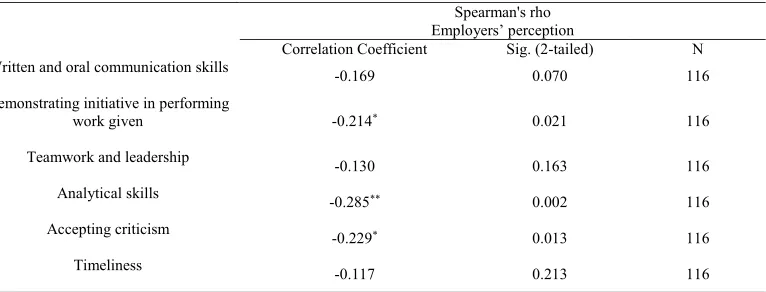
[image:6.482.57.440.203.349.2]Table 3 presented below is the results of the non-parametric correlations that meant to examine the employers’ perception towards accounting students during their internship programme. The results indicated that three variables, namely demonstrating initiative in performing work given, analytical skills and accepting criticism were found to be significant determinants of employers’ perception towards UniKL accounting students during their internship programme. The result suggests that demonstrating initiative in performing work given, analytical skills and accepting criticism were likely to be factors that will be influence the employers to recruit them as their employee in the future.
Table 3: Employers’ Perception towards UniKL Accounting Students
Spearman's rho
Employers’ perception
Correlation Coefficient Sig. (2-tailed) N
Written and oral communication skills -0.169 0.070 116
Demonstrating initiative in performing
work given -0.214* 0.021 116
Teamwork and leadership
-0.130 0.163 116
Analytical skills
-0.285** 0.002 116
Accepting criticism
-0.229* 0.013 116
Timeliness
-0.117 0.213 116
**. Correlation is significant at the 0.01 level (2-tailed). *. Correlation is significant at the 0.05 level (2-tailed).
Table 4 presented below is the results of the t-test analysis which used to investigate whether there are any significant differences on employers’ perception for female students and male tudents (gender analysis). The results indicated that there was no significant difference in scores for males (M= 3.9867, SD= 0.58765) and females [M= 3.9930, SD= 0.60309; t
[image:6.482.46.431.485.541.2](114) = -0.050, p= 0.960]. Based on the equation 1 below, the magnitude of the differences in the means also was very small (eta squared = 0.004).
Table 4: Independent samples T-test between Gender and Employers’ Perception
CONCLUSION
This study focuses on the employer’s perception on internship programme in the case of accounting students in UniKL. The findings of this research concerning employer’s perceptions are consistent with previous research suggesting intern must have a very good demonstrating initiative in performing work given, analytical skills and accepting criticism. However, there is no significant difference on the perception of employers towards gender. Therefore, the
t df Mean
Difference
Std. Error Difference
Employers’ Perception towards UniKL Accounting
gender factor will not influence employers’ decision on whether to recruit the students after completion of their study. Undergraduates with internship placement experience are perceived to be better prepared and more marketable to employers. There are a lot of benefit gained from internship programme, thus educators are wise to promote the advantages of internships to the students. Further research should be done on the students’ perception toward internship programme.
References
Andrews, J., Higson, H. (2008), Graduate Employability, Soft Skill Versus Hard Business Knowledge: A European Study, Higher Education in Europe, 33(4), 411-422.
Beck, J.E., Halim, H. (2008), Undergraduate Internships in Accounting: What and How Do Singapore Interns Learn from Experience?, Journal of Accounting Education, 17(2), 151-172
Carl P. Maertz Jr Philipp A. Stoeberl Jill Marks , (2014),"Building successful internships: lessons from the research for interns, schools, and employers", Career Development International, Vol. 19 Iss 1 pp. 123 – 142
Ebied, H. (2004). An Empirical Investigation of the Impact of the Student Accounting
Internships on Subsequent Academic Performance: The Case of UAE University.Journal of
Economic and Administrative Sciences,20(2), 33-44.
Floyd, C.J and Gordon M.E (1998), What skills are most important? A comparison of Employer, Student and Staff Perceptions, Journal of Marketing Education, Vol. 20, August, pp. 103-9
Gault, J., Leach, E., & Duey, M. (2010). Effects of business internships on job marketability:
the employers' perspective.Education+ Training,52(1), 76-88.
Gault, J., Redington, J., Schlager, T. (2000), Undergraduate Business Internships and Career Success: are they related?, Journal of Marketing Education, Vol. 22 No. 1., pp. 45-53.
HR Focus, (2005), Plan for the most Effective Internships Programs, pp. 7-11
P. Maertz Jr, C., A. Stoeberl, P., & Marks, J. (2014). Building successful internships: lessons
from the research for interns, schools, and employers.Career Development
International,19(1), 123-142.
Pernsteiner, A. J. (2015). The Value of an Accounting Internship: What Do Accounting
Students Really Gain?.Academy of Educational Leadership Journal,19(3), 223.