International Journal of Innovative Technology and Exploring Engineering (IJITEE) ISSN: 2278-3075,Volume-8, Issue-7S, May 2019
Abstract: Voice over Internet Protocol (VoIP) is one of the online streaming methods used in the organization's voice operation or conference call to provide voice communication. Researchers have developed several methods in recent years to improve voice quality; however, it still faces some problems of high jitter, delay, and low performance. This paper introduces a VoIP to enable Long Term Evolution (LTE-A) voice calls. To improve voice quality on the LTE-A network, the Enhanced Voice Service (EVS)-Transmission Control Protocol (TCP) Reno-VoIP (EVS-TCP Reno-Reno-VoIP) method has been introduced. The EVS codec is used to improve voice service, and the LTE-A network uses TCP Reno to prevent voice congestion. The voice-based skype testbed experiments are implemented for the LTE-A network. Using Jperf software, network traffic is calculated. VoIP over LTE-A's Quality of Service (QoS) is analyzed in Network Simulator 2 (NS2). Multiple scenarios were simulated to calculate and analyze performance in terms of end-to-end delay, performance, jitter, and loss of packets. The results of the simulation showed that the EVS-TCP Reno-VoIP method has increased network performance by 2-3.5% compared to existing methods such as EVS codec, G-11, G-723 and SDSS.
Keywords: Enhanced Voice Service (EVS), Long Term Evolution (LTE-A), Transmission Control Protocol (TCP).
I. INTRODUCTION
In the Wideband Code Division Multiple Access (WCDMA) cellular system, the growth of smartphone traffic has focused on performance improvements in an Enhanced-up-Link (EUL) schedule [1]. Subsequently, the analog cellular was replaced by digital cellular through a 2- Generation (2 G) network that provides better capacity, improved quality and improved security. Mobile networking is analyzed to accommodate web-based applications such as video, audio files and to transmit data rates of up to 384kbit/s via 3G [2, 3]. The LTE-A network is used by the 3rd Generation Partnership Project (3GPP) to generate an air interface. The 3 G WCDMA initially provided a high capacity and air interface including packet traffic transportation. The network of radio access is designed to be compatible with the Global System Mobile (GSM) second generation and the General Packet Radio Services (GPRS) network [4]. Due to 384kb/s data transfer rates, the 3 G and 4 G networks are more suitable for calling voice conferencing.
Revised Manuscript Received on May 05, 2019.
T.Padmapriya, Managing Director, Melange Technologies, Puducherry
S.V. Manikanthan, Director, Melange Technologies, Puducherry
The VoIP technique helps to transmit voice on a Packet Switched Networks (PSNs) in real time [5, 6]. The VoIP has improved communication as it provides a number of other facilities such as files, data, screen sharing, and video chats in particular [7, 8]. Developing a predictive model of VoIP quality for mobile users is essential for monitoring and planning networks for better QoS as well as improved customer management experience [9, 10]. In this research work, the EVS codec is used for better voice services. The TCP Reno protocol is used to stop network congestion, which uses the slow start threshold to distinguish between the slow start phase and the congestion avoidance phase. The data is collected on voice skype applications from test bed experiments. Using the Jperf software tool to determine network performance and measurement, network traffic is analyzed. The experimental result calculates the throughput, packet loss, jitter, and end-to-end delay performance of EVS-TCP Reno-VoIP.
II. LITERATURE SURVEY
This section analyzes some important research approaches suggested over the LTE-A network by the researchers on VoIP. It presents a brief assessment of some significant contributions to existing methods. S. Ansari and R. Gupta [11] suggested voice performance over LTE-A networks using voice codec. The LTE-A provides a natural and unique QoS-conscious method in this work. The LTE-A network provides a natural and unique QoS-conscious method for better end-to-end facility delivery. This research observed only the effects of voice codec based on end-to-end VoLTE performance. Here, the OPNET simulator used a number of voice codecs in a different section. However, for each block, this method requires different voice codec.R. C. Soothar, M. Pathan, P. K. Butt, B. Qureshi, G. Mujtaba[12] implemented the VoIP traffic service in the 4 G LTE-A network using three QoS parameters: latency, throughput and jitter by contracting the value with three G.711, G.729 and EVS voice codecs. The LTE-A was patched in this work with NS2 which was not supported in the NS2 by default. Compared to other voice code such as G.711, G.729, the EVS voice codec provided better performance in LTE-A. Due to the low bit rate codec, the G.729 codec provided less throughput than the EVS and G.711 codec.
In order to improve the performance of the LTE-A network, S. M. Abdullah, O. Younes, H. M. Mousa, and H. Abdul Kader [13] presented the TCP algorithm. The proposed method was to control the size of the receiver buffer in eNodeB.
LTE-A Intensified Voice Service Coder using
TCP for Efficient Coding Speech
It was done by partitioning the eNodeB memory size among active users. By controlling the TCP receiver size in the eNodeB, this method avoided congestion in the buffer. The congestion mechanisms created a dynamic change in the TCP flow window size depending on the smaller buffer size and number of users in the cell. This method has a high delay and a lot of data is lost.
A. Sengar [14] used the NS2 simulator to present a comparison between LTE-A and WiMAX on fixed and mobile networks for TCP and UDP traffic. The LTE-A and WiMAX performance computation was implemented on NS 2.34 in this paper. In real-life scenarios, both LTE-A and WiMAX were used to see how the various factors, such as distance, different modulation schemes, number of subscriber stations, packet size, affected LTE-A and WiMAX performance. The simulation was performed on both fixed and mobile networks for the user datagram protocol. The simulation result showed that the performance metrics (throughput, delay and jitter) were affected due to changes in features such as modulation scheme, number of nodes and distance between Base Station (BS) and Subscriber Section (SS).
In the third and fourth generation network, the existing research analyzed the jitter and latency of the VoIP using the traffic measurement Jperf.
The traffic measured is compared to the Standard Quality Management (SQM) major matrix. The measurements focused on the 2-QoS elements, such as latency and jitter, which have a significant impact on network quality. The VoIP voice through WiMAX network quality is used to overcome this problem and by using the proposed EVS-TCP Reno-VoIP method it meets better jitter and throughput. Four different types of elements such as throughput, jitter, delay and packet loss are calculated in this research to achieve an effective connection to both 3G and 4G network.
III. EVS-TCP-VOIP METHODOLOGY
This research discusses the characteristics of voice quality of the EVS, the recently standardized 3GPP codec voice. The EVS codec is used to improve voice service, and the LTE-A network uses TCP Reno to prevent voice congestion. In addition to wideband and super wideband audio bandwidths, the EVS also supports narrowband voice with an 8 kHz sampling frequency and full band voice with a 48 kHz higher sampling frequency than those CDs. The EVS codec covers a wide range of 5.9-128 kbps bit rates. The TCP Reno is a variant of the TCP used as a rapid recovery technique that allows the transmitter to avoid pipe congestion and transfer the cwnd to cwnd/2 in a solitary Round Trip Time (RTT) space. Analyzing performance can be done by NS2 and analyzing VoIP applications over the LTE-A network. VoIP's QoS over the LTE-A network and its performance are evaluated over a variety of distances and network loads by measuring throughput, jitter, end-to-end delay and packet loss. The architecture of the LTE-A network will be studied and then simulated. Single and multiple user scenarios are then compared over the LTE-A network using VoIP to monitor the effects on parameters. Long-term evolution architecture
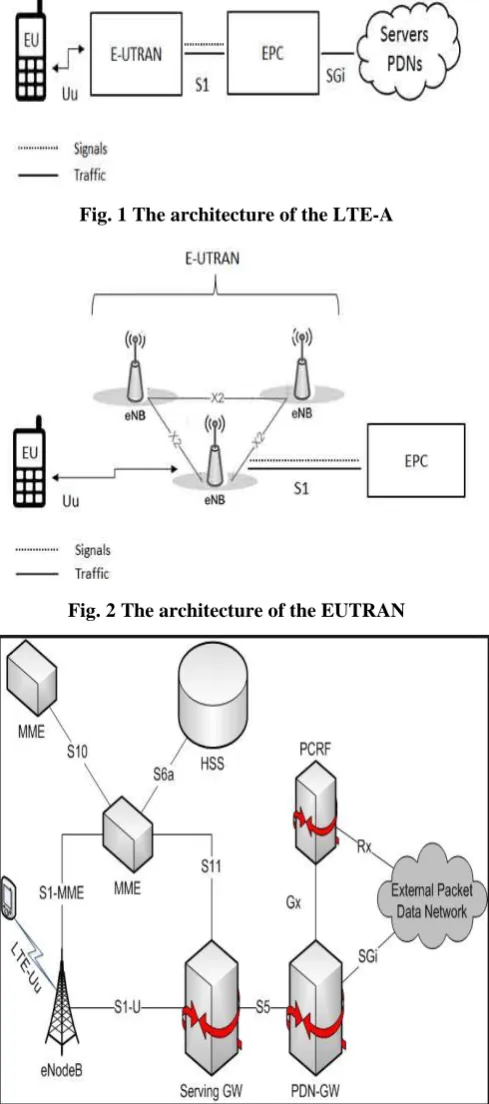
The LTE-A network architecture includes 3-major components such as User Equipment (UE), Evolved UMTS Terrestrial Radio Access Network (EUTRAN) and Evolved Packet Core (EPC). There is a smartphone / mobile device in the UE segment. The evolved UMTS terrestrial radio access network segments a BS-related mobile device to provide user equipment radio connection. The EPC segment is communicating with external packet data such as the internet or multimedia IP subsystem. The architecture of the LTE-A is shown in Fig. 1.
The UE is used directly by a user to communicate, which is associated with the evolved NodeB (eNodeB).
The EUTRAN connects each UE to the LTE-A network. The EUTRAN connects NodeB which serves several cells in the LTE-A network, which sends and receives radio signals to UEs and performs certain tasks when a handover occurs. The eNodeB reduces the latency of all radio interface operations. It is interconnected by the S1 interface via X2 and connects to the EPC. EUTRAN's architecture is shown in Fig. 2. The ECP segment consists of five major nodes, which are packet data network (PDN), gateway service, home subscriber station, and mobility management entity. The serving gateway serves as a router between NodeB and users to transfer data packets. When the inter-eNodeB handover occurs, it acts as an anchor.
The LTE-A is connected to the internet by the packet data network. The packet data network controls services such as traffic shaping, packet filtering and user charging policies, which are responsible for setting up, maintaining and deleting GPRS Tunneling Protocol (GTP) tunnels to the gateway serving. The home subscriber station is a database that contains user information such as user identification, user profile, and authentication. The mobility management entity manages EU contexts such as identity of the UE, security parameters and mobile state. The EPC's architecture is shown in Fig. 3.
Enhanced voice service codec
The quality of speech in the communication systems is very important. The EVS is one of the 3GPP standardized speech coders for LTE-A that provides a data rate with better voice services ranging from 5.9 -128kbps. The EVS codec supports audio bandwidth, providing high quality music and speech / voice mixed content. Several codecs depend on the Algebraic Codec Excited Linear Prediction (ACELP) concept that may be affected by the spoken language changes. The EVS codec is carried out using the coding technique of ACELP and Modified Discrete Cosine Transform (MDCT). Fig. 4 Displays the EVS encoder block diagram. The EVS codec is used in this research to improve voice services.
International Journal of Innovative Technology and Exploring Engineering (IJITEE) ISSN: 2278-3075,Volume-8, Issue-7S, May 2019
Fig. 1 The architecture of the LTE-A
Fig. 2 The architecture of the EUTRAN
Fig. 3 The architecture of the packet data network
Fig. 4 Block diagram of the EVS encoder process The second mode is the interoperable EVS AMR-WB mode with 9 bit rate types like 6.6 kbps, 8.85 kbps, 12.65 kbps, 14.25 kbps, 15.85 kbps, 18.25 kbps, 19.85 kbps, 23.05 kbps, 23.85 kbps. The EVS supports 4-sample frequencies, 8kHz narrowband, 16kHz wideband, 32 kHz super wideband, and 48kHz full band. The EVS coder switches between ACELP-based linear predictive coding and frequency domain coding for an active signal. In the case of inactive signal, the coding of Discontinuous Transmission (DTX)/Comfort Noise Generation (CNG) is used to reduce the use of bandwidth when non-voice periods occur. The EVS decoder is a jitter buffer management rather than encoder pre-processing.
The jitter buffer is one of the shared data area where voice packets can be composed, stored and sent in evenly spaced intervals to the voice processor. High frequency input signal elements and low frequency components are encoded with ACELP and this mixture is again encoded with bandwidth extension techniques where the higher spectrum's fine structure is partially denoted with a low spectrum. In addition to the EVS primary mode and interoperable Adaptive Multi-Rate Wide Band (AMR-WB) mode, a complete group of AMR-WB has bit stream decoded by existing AMR-WB codec offered in situations where EVS is not supported by the counterpart UE. The EVS decoder will not reverse the encoder procedure, but will apply a new procedure to improve the resilience of errors. The EVS codec produces high voice quality, resilience to packet errors, high efficiency compression compared to existing voice codecs. In addition, the introduction of super wideband and full band audio bandwidth will improve quality.
Transmission control protocol Reno
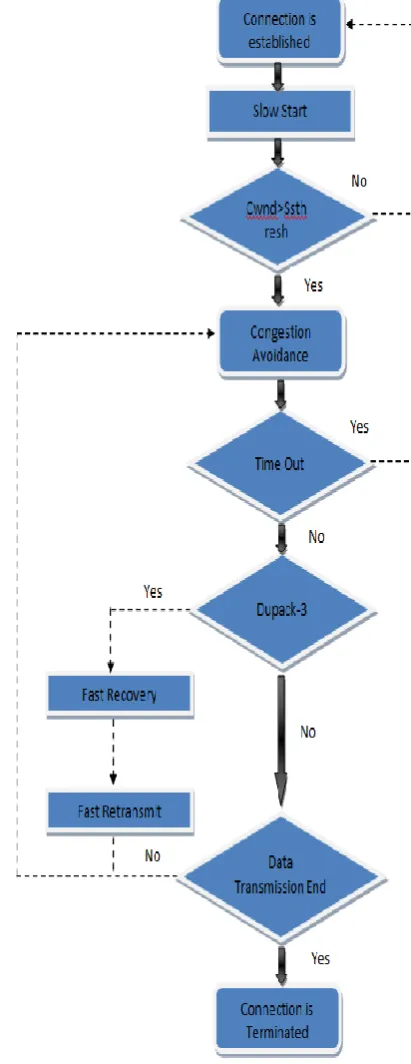
[image:3.595.50.295.71.624.2]Using the TCP Reno technique, the lost packets are easily detected. Every time you send the accurate data to the available bandwidth, the congestion window and window threshold information are determined. This method of congestion control is carried out by considering information on the congestion packet loss in the network. Then the variety of transmission rates, medium of transmission, routing path and network status will change depending on time. Figure 5 shows the TCP Reno congestion control flow chart. At the beginning of the transmission, a slow start method is used. After receiving, each response Acknowledgement (ACK) segment is used to obtain Congestion Window (Cwnd) by using Eq. (1) during slow start.
From a slow start when Cwnd exceeds Slow Start Threshold (Ssth resh), the sender steps into congestion avoidance. After each ACK segment has been received, Eq. (2) is used to update Cwnd while avoiding congestion.
The TCP sender uses the method of quick retransmission to find loss of repair based on incoming duplicate ACKs. The fast retransmission method uses the arrival of three duplicate ACKs as an indication of the loss of a segment. The TCP carries out a retransmission of what seems to be missing segment after receiving three duplicate ACKs and without waiting for the Retransmission Timer to Expire (RTO). A set of Cwnd and Ssthresh values is given in the Eq. (3) when the third duplicate ACK is received. Next, the fast retransmission method sends what appears to be missing segment. The fast recovery method governs the transmission of new data till the arrival of non-duplicate ACK. The transmitter steps into avoiding congestion but does not start again slowly, which is calculated using Eq. (4)
IV. EXPERIMENTAL RESULTS
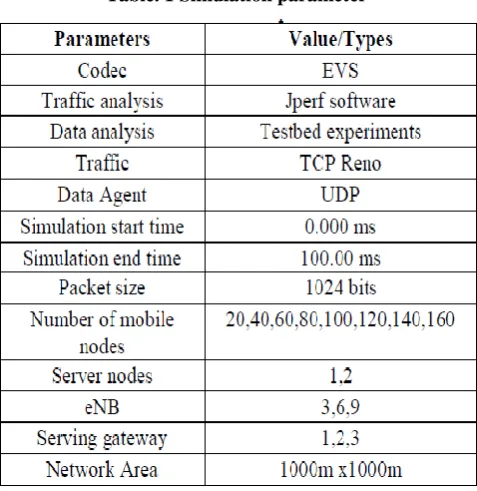
[image:4.595.342.548.58.591.2]The NS2 simulator used the EVS-TCP Reno-VoIP method. Table 1 shows the parameters of simulation used in the VoIP methodology of the TCP Reno. The EVS-TCP Reno-VoIP method's performance is measured in terms of end-to-end delay, jitter, throughput and loss of packets. The research work considered 160 nodes that are placed randomly in the section of the LTE-A network. These nodes are deployed in the 1000 m upper 1000 m area. As a data agent, the User Datagram Protocol (UDP) is used.
International Journal of Innovative Technology and Exploring Engineering (IJITEE) ISSN: 2278-3075,Volume-8, Issue-7S, May 2019
Table. 1 Simulation parameter
Throughput
Throughput calculates how much data is transferred in a certain amount of time from source to destination, which is usually calculated in Kbps. The result is calculated using Eq. (5)
Jitter
Jitter is a latency variation of the packet. In other words, jitter measures the inter-arrival time variation of the packet. There is an end-to-end delay variation between the packets when the packets are sent from the transmitter side to the receiver side. It is called that time difference as a jitter. Jitter is calculated using Eq. (6).
Here, T2 and T1 represent the time of leaving two consecutive packets from the source node, and T4 and T3 denote the time of arrival at the destination node of two consecutive packets.
End-to-end delay
End-to-end delay is represented as the reserved packet period to be transferred from sender to receiver between networks. End-to-end delay is calculated because the part of total delay in the entire communication has been associated with packet quality to offer end nodes to the receiver throughout the recursive run.
Packet loss
Packet loss is the percentage of packets lost from source to destination over the network during transmission. The loss of packets is calculated using Eq. (7).
This section provides the meanings of the EVS-TCP-VoIP method simulation results. The EVS codec is used in the LTE-A network to analyze and execute the VoIP traffic service. Fig. 6 shows the result of the comparison of the current and EVS-TCP Reno-VoIP performance. Compared to existing methods like EVS [12], G.711 [15] and SDSS [17], the performance of the EVS-TCP Reno-VoIP method provides high performance.
[image:5.595.308.547.153.321.2]Fig. 6 Comparative analysis of throughput performance for an existing and proposed method
Fig. 7 Comparative analysis of delay performance for an existing and proposed method
[image:5.595.307.552.359.534.2]This research analyzed the LTE-A network's delay performance from one to one communication. This analysis in a realistic environment is useful in computing the LTE-A's delay performance. In addition, this research analysis will help improve the Next Generation Mobile System (NGMS) delay performance. The EVS codec generated a lower data delay rate compared to the existing method in the EVS-TCP Reno-VoIP method. Therefore, from Fig. 7 It is concluded that delay performance is reduced by using the LTE-A network EVS-TCP Reno-VoIP method compared to existing methods.
[image:6.595.49.293.347.522.2]The delay is quite stable at 0.0001ms, as shown in the comparison graph in fig.7. Fig. 8 The jitter performance of existing and EVS-TCP Reno-VoIP methods is comparable. A growing jitter in existing [12], [15] and [17] shows that the packets arrive at the receiver with varying delay, reflecting adversely on the perceived quality. Each packet here contains a sample of voice sent from the sender. The packets that are not received at the receiver end with the same delay appear to be degrading the voice quality. Compared to existing methods, the proposed EVS-TCP Reno-VoIP method achieved less jitter in this research. This research used row operation in excellence to calculate jitter and plot the graph of jitter.
Fig . 8 Performance of jitter for an existing and proposed method
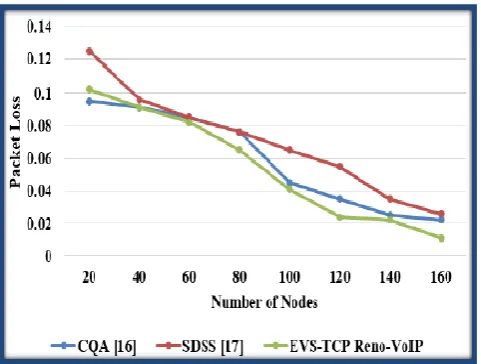
Fig . 9 Performance of packet loss for an existing and proposed method
In terms of tolerance and stability factor, the obtained jitter value improved the overall system performance. Fig.9 Displays packet loss performance of the existing Reno-VoIP method and EVS-TCP method. The packet loss performance is calculated based on the number of packets sent to the LTE-A cellular network not reaching their destination node. Because of the high speed of traffic identified in the network, packet loss is a major problem in the LTE-A cellular network. In this research, by using the TCP Reno technique, the EVS-TCP Reno-VoIP method achieved less packet loss. The TCP Reno can identify line speeds of up to 20 Mbps without loss of packets.
From the Figs. 6, 7, 8 and 9, the comparative analysis between the proposed EVS-TCP Reno-VoIP method and the existing EVS codec methods [12], G.723 [15], CQA [16] and SDSS [17] is carried out. In this case, the EVS-TCP Reno-VoIP method has improved by an average of 2,845 percent of the throughput, 0,0003% of the delay, 0,006% of the jitter and 0,011% of the packet loss compared to existing methods. The proposed EVS-TCP Reno-VoIP method is therefore well suited for one to one LTE-A network communication process.
V. CONCLUSION
The EVS-TCP Reno-VoIP method analyzed a VoIP's performance on the LTE-A network in this paper. Analyzing performance was done by evaluating VoIP's QoS parameter over the LTE-A network. In this research, the EVS codec was used in one-to-one communication for better voice services. In comparison with the existing methods, the TCP Reno algorithm effectively avoided voice congestion on the LTE-A network. Results of the simulation showed that the EVS-TCP Reno-VoIP method increased throughput and reduced network loss of delay, jitter and packet. From the results of the EVS-TCP Reno-VoIP method, therefore, it was concluded that the EVS codec and TCP Reno are the most appropriate algorithms for VoIP communication on the LTE-A network. The proposed EVS-TCP Reno-VoIP method can support environmental applications in real and non-real time. By using an efficient protocol with optimization techniques, the performance of the VoIP can be improved in future work.
REFERENCES
1. K. Lau, G. C. Goodwin, T. Wigren, and L. Brus, “Improving the performance of cellular uplinks via power overbooking”, IET Communications, Vol.11, No.9, pp.1512-1518, 2017.
2. P. Sharma, “Evolution of mobile wireless communication networks-1G to 5G as well as future prospective of next generation communication network”, International Journal of Computer Science and Mobile Computing, Vol.2, No.8, pp.47-53, 2013.
3. M. Kassim, R. A. Rahman, M. A. Aziz, A. Idris, and M. I. Yusof, “Performance analysis of VoIP over 3G and 4G LTE network”, In: Proc. of International Conf. On Electrical, Electronics and System Engineering, pp.37-41, 2017.
4. M. Rinne and O. Tirkkonen, “LTE, the radio technology path towards 4G”, Computer Communications, Vol.33, No.16, pp.1894-1906, 2010. 5. G. Epiphaniou, C. Maple, P. Sant, and G. A. Safdar, “Effects of
[image:6.595.51.292.571.753.2]International Journal of Innovative Technology and Exploring Engineering (IJITEE) ISSN: 2278-3075,Volume-8, Issue-7S, May 2019
Security enabled voice over IP calls”, IET Information Security, Vol.6, No.3, pp.141-148, 2012.
6. M. Z. Hasan and M. Z. Hussain, “Collective Study on Security Threats in VOIP Networks”, International Journal of Scientific & Technology Research, Vol.4, No.8, pp.20-23, 2015.
7. U. P. D. Ani, “VoIP Security: Improving Quality of Service through the Analysis of Secured Transmission”, International Journal of Computer Science and Business Informatics, Vol.15, No.1, 2015. 8. Q. Ibrahim and N. Abdulghani, “Security enhancement of voice over
Internet protocol using speaker recognition technique”, IET Communications, Vol.6, No.6, pp.604-612, 2012.
9. Y. Jung and C. Manzano, “Burst packet loss and enhanced packet loss-based quality model for mobile voice-over Internet protocol applications”, IET Communications, Vol.8, No.1, pp.41-49, 2014. 10. O. Çalik, U. Iricioğlu, G. K. Kurt, A. E. Pusane, A. S. Demiroglu, and
G. Kayik, “Impact of retransmissions on the quality of experience in VoIP systems”, In: Proc. of International Conf. On Electrical, Electronics and Biomedical Engineering, pp.617-621, 2016.
11. S. Ansari and R. Gupta, “Evaluate Performance of Voice over LTE Networks using Voice Codec’s”, International Journal of Science, Engineering and Technology Research, Vol.5, No.5, 2016.
12. R. C. Soothar, M. Pathan, B. Qureshi, P. K. Butt, and G. Mujtaba, “Analysis of VoIP Traffic Service in 4G LTE Cellular Networks”, Indian Journal of Science and Technology, Vol.8, No.1, 2018. 13. S. M. Abdullah, O. Younes, H. M. Mousa, and H. Abdul kader,
“Enhancing Performance of TCP Variants in LTE”, International Journal of Computer Applications, Vol.152, No.1, 2016.
14. A. Sengar, “Comparison of LTE (Long Term Evolution) and WiMax on fixed and mobile networks for TCP, UDP traffics using NS2 Simulator”, International Journal of Computer Science and Information Technologies, Vol.5, No.4, pp.5296-300, 2014.
15. Agarwal and K. Agarwal, “The next generation mobile wireless cellular networks–4G and beyond”, American Journal of Electrical and Electronic Engineering, Vol.2, No.3, pp.92-97, 2014.
16. N. M. Yusoff, D. M. Ali, and A. Idris, “Performance Analysis of Quality of Service and Energy Efficient Aware (QEEA) Scheduling Algorithm for Long Term Evolution (LTE)”, Journal of Engineering Science and Technology, Vol.13, No.5, pp.1190-1204, 2018.