PERMUTATIONS III
Sergey Kitaev
Department of Computer and Information Sciences, University of Strathclyde, Glasgow, United Kingdom
Jeffrey Remmel
Department of Mathematics, University of California, San Diego, California
Mark Tiefenbruck
Center for Communications Research, La Jolla, San Diego, California
Received: , Revised: , Accepted: , Published:
Abstract
Given a permutation σ = σ1. . . σn in the symmetric group Sn, we say that σi
matches the marked mesh pattern MMP(a, b, c, d) inσif there are at leastapoints to the right ofσiinσwhich are greater thanσi, at leastbpoints to the left ofσi in
σwhich are greater thanσi, at leastcpoints to the left ofσi inσwhich are smaller
thanσi, and at leastdpoints to the right ofσi in σwhich are smaller thanσi.
This paper is continuation of the systematic study of the distributions of quad-rant marked mesh patterns in 132-avoiding permutations started in [9] and [10] where we studied the distribution of the number of matches of MMP(a, b, c, d) in 132-avoiding permutations where at most two elements ofa, b, c, dare greater than zero and the remaining elements are zero. In this paper, we study the distribution of the number of matches of MMP(a, b, c, d) in 132-avoiding permutations where at least three ofa, b, c, dare greater than zero. We provide explicit recurrence relations to enumerate our objects which can be used to give closed forms for the generating functions associated with such distributions. In many cases, we provide combina-torial explanations of the coefficients that appear in our generating functions.
1. Introduction
combinations of (classical) permutation patterns. This notion was further studied in [1, 3, 5, 6, 9, 12].
Kitaev and Remmel [6] initiated the systematic study of the distributions of quadrant marked mesh patterns on permutations. The study was extended to 132-avoiding permutations by Kitaev, Remmel and Tiefenbruck in [9, 10], and the present paper continues this line of research. Kitaev and Remmel also studied the distributions of quadrant marked mesh patterns in up-down and down-up permu-tations [7, 8].
Let σ=σ1. . . σn be a permutation written in one-line notation. Then we will
consider the graph ofσ, G(σ), to be the set of points (i, σi) for i= 1, . . . , n. For
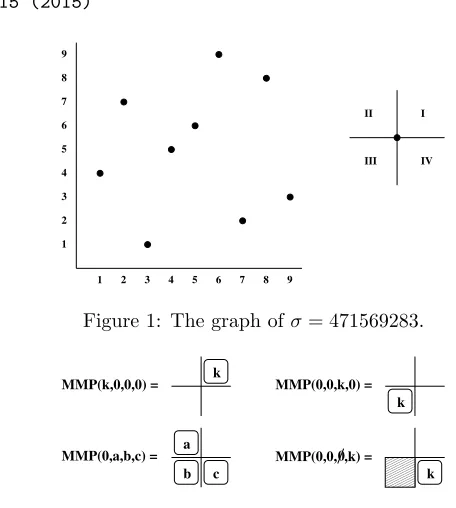
example, the graph of the permutationσ= 471569283 is pictured in Figure 1. Then if we draw a coordinate system centered at a point (i, σi), we will be interested in the points that lie in the four quadrants I, II, III, and IV of that coordinate system as pictured in Figure 1. Let N={1,2, . . .} denote the positive integers. For any
a, b, c, d∈ {0} ∪Nand anyσ=σ1. . . σn∈Sn, the set of all permutations of length n, we say that σi matches the quadrant marked mesh pattern MMP(a, b, c, d) in
σ if, in G(σ) relative to the coordinate system which has the point (i, σi) as its origin, there are at leastapoints in quadrant I, at leastb points in quadrant II, at leastcpoints in quadrant III, and at leastdpoints in quadrant IV. For example, if
σ= 471569283, the pointσ4= 5 matches the marked mesh pattern MMP(2,1,2,1) since, inG(σ) relative to the coordinate system with the origin at (4,5), there are 3 points in quadrant I, 1 point in quadrant II, 2 points in quadrant III, and 2 points in quadrant IV. Note that if a coordinate in MMP(a, b, c, d) is 0, then there is no condition imposed on the points in the corresponding quadrant.
In addition, we considered patterns MMP(a, b, c, d) wherea, b, c, d∈ {∅}∪{0}∪N.
Here when a coordinate of MMP(a, b, c, d) is the empty set, then forσi to match MMP(a, b, c, d) inσ=σ1. . . σn∈Sn, it must be the case that there are no points in G(σ) relative to the coordinate system with the origin at (i, σi) in the corresponding
quadrant. For example, if σ = 471569283, the pointσ3 = 1 matches the marked mesh pattern MMP(4,2,∅,∅) since inG(σ) relative to the coordinate system with the origin at (3,1), there are 6 points in quadrant I, 2 points in quadrant II, no points in quadrants III and IV. We let mmp(a,b,c,d)(σ) denote the number ofisuch
that σi matches MMP(a, b, c, d) inσ.
Note how the (two-dimensional) notation of ´Ulfarsson [12] formarked mesh pat-terns corresponds to our (one-line) notation for quadrant marked mesh patterns. For example,
Given a sequencew=w1. . . wnof distinct integers, let red(w) be the permutation found by replacing thei-th smallest integer that appears inσbyi. For example, if
III II I
IV
1 2 3 4 5 6 7 8 9 1
[image:3.612.180.408.110.364.2]2 3 4 5 6 7 8 9
Figure 1: The graph ofσ= 471569283.
k
a
b c k
0000 0000 0000 0000 0000 0000 0000
1111 1111 1111 1111 1111 1111 1111
0 0 0 0
1 1 1 1
0 MMP(k,0,0,0) = MMP(0,0,k,0) =
MMP(0,a,b,c) = MMP(0,0, ,k) = k
Figure 2: ´Ulfarsson notation for quadrant marked mesh patterns.
σ avoids the pattern τ if τ does not occur in σ. Let Sn(τ) denote the set of
permutations in Sn which avoid τ. In the theory of permutation patterns, τ is called a classical pattern. See [4] for a comprehensive introduction to patterns in permutations.
It has been a rather popular direction of research in the literature on permu-tation patterns to study permupermu-tations avoiding a 3-letter pattern subject to extra restrictions (see [4, Subsection 6.1.5]). In [9], we started the study of the generating functions
Q(a,b,c,d)132 (t, x) = 1 +X
n≥1
Q(a,b,c,d)n,132 (x)tn
where for any a, b, c, d∈ {∅} ∪N,
Q(a,b,c,d)n,132 (x) = X
σ∈Sn(132)
xmmp(a,b,c,d)(σ).
For anya, b, c, d, we will writeQ(a,b,c,d)n,132 (x)|xkfor the coefficient ofxk inQ
(a,b,c,d) n,132 (x).
For any fixed (a, b, c, d), we know thatQ(a,b,c,d)n,132 (1) is the number of 132-avoiding permutations in Sn which is the nth Catalan number Cn = n+11 2nn
. Thus the
[image:3.612.212.403.288.356.2]for the coefficients that appear inQ(a,b,c,d)n,132 (x) or (ii) whether such coefficients count other interesting classes of combinatorial objects. Of course, there is an obvious answer to question (ii). That is, if one has a bijection fromSn(132) to other classes of combinatorial objects which are counted by the Catalan numbers such as Dyck paths or binary trees, then one can use that bijection to give an interpretation of the pattern MMP(a, b, c, d) in the other setting. We shall see that in many cases, there are interesting connections with the coefficients that arise in our polynomials
Q(a,b,c,d)n,132 (x) and other sets of combinatorial objects that do not just arise by such bijections.
In particular, it is natural to try to understand Q(a,b,c,d)n,132 (0) which equals the number ofσ∈Sn(132) that have no occurrences of the pattern MMP(a, b, c, d) as well as the coefficient of the highest power of x that occurs in Q(a,b,c,d)n,132 (x) since that coefficient equals the number ofσ∈Sn(132) that have the maximum possible number of occurrences of the pattern MMP(a, b, c, d). We shall see that in many cases, Q(a,b,c,d)n,132 (x)|x and Q
(a,b,c,d)
n,132 (x)|x2, the number of σ ∈Sn(132) with exactly
one occurrence and two occurrences, respectively, of the pattern MMP(a, b, c, d) also have interesting combinatorics associated with them. There are many more inter-esting questions of this type that can be pursued, but due to space considerations, we shall mostly restrict ourselves to trying to understand the four coefficients in
Q(a,b,c,d)n,132 (x) described above. We should note, however, that there is a uniform way to compute generating functions of the form
Fk(a,b,c,d)(t) =X
n≥0
Q(a,b,c,d)n,132 (x)|xktn.
That is, Fk(a,b,c,d)(t) is just the result of setting x= 0 in the generating function 1
k!
∂k ∂xkQ
(a,b,c,d)
132 (t, x). Due to space considerations, we will not pursue the study of
the functionsFk(a,b,c,d)(t) fork≥2 in this paper.
There is one obvious symmetry for such generating functions which is induced by the fact that if σ∈Sn(132), thenσ−1∈Sn(132). That is, the following lemma
was proved in [9].
Lemma 1. ([9]) For anya, b, c, d∈N∪ {0} ∪ {∅}, Q(a,b,c,d)n,132 (x) =Q(a,d,c,b)n,132 (x).
In [9], we studied the generating functions Q(k,0,0,0)132 (t, x), Q(0,k,0,0)132 (t, x), and
Q(0,0,k,0)132 (t, x), wherek can be either the empty set or a positive integer, as well as the generating functions Q(k,0,132 ∅,0)(t, x) and Q(132∅,0,k,0)(t, x). In [10], we studied
Q(k,0,`,0)n,132 (t, x),Q(k,0,0,`)n,132 (t, x),Q(0,k,`,0)n,132 (t, x), andQ(0,k,0,`)n,132 (t, x), wherek, `≥1. We also showed that sequences of the form (Q(a,b,c,d)n,132 (x)|xr)n≥scount a variety of
(OEIS) [11]. Thus, our results gave new combinatorial interpretations of certain classical sequences such as the Fine numbers and the Fibonacci numbers as well as provided certain sequences that appear in the OEIS with a combinatorial interpre-tation where none had existed before. Another particular result of our studies in [9] is enumeration of permutations avoiding simultaneously the patterns 132 and 1234, while in [10], we made a link to thePell numbers.
The main goal of this paper is to continue the study ofQ(a,b,c,d)132 (t, x) and com-binatorial interpretations of sequences of the form (Q(a,b,c,d)n,132 (x)|xr)n≥sin the case
wherea, b, c, d∈Nand at least three of these parameters are non-zero.
Next we list the key results from [9] and [10] which we need in this paper.
Theorem 1. ([9, Theorem 3.1])
Q(0,0,0,0)132 (t, x) =C(xt) =1− √
1−4xt
2xt and, for k≥1,
Q(k,0,0,0)132 (t, x) = 1
1−tQ(k132−1,0,0,0)(t, x)
. Hence
Q(1,0,0,0)132 (t,0) = 1 1−t and, for k≥2,
Q(k,0,0,0)132 (t,0) = 1
1−tQ(k132−1,0,0,0)(t,0)
.
Theorem 2. ([9, Theorem 4.1]) Fork≥1,
Q(0,0,k,0)132 (t, x) =
1 + (tx−t)(Pk−1
j=0Cjtj)−
q
(1 + (tx−t)(Pk−1
j=0Cjtj))2−4tx
2tx
= 2
1 + (tx−t)(Pk−1
j=0Cjtj) +
q
(1 + (tx−t)(Pk−1
j=0Cjtj))2−4tx and
Q(0,0,k,0)132 (t,0) = 1
1−t(C0+C1t+· · ·+Ck−1tk−1)
. Theorem 3. ([10, Theorem 5]) For allk, `≥1,
Q(k,0,`,0)132 (t, x) = 1
1−tQ(k132−1,0,`,0)(t, x)
Theorem 4. ([10, Theorem 11]) For all k, `≥1, Q(k,0,0,`)132 (t, x) =
C`t`+
`−1
X
j=0
Cjtj1−tQ(k132−1,0,0,0)(t, x) +t(Q(k132−1,0,0,`−j)(t, x)−
`−j−1
X
s=0
Csts)) 1−tQ(k132−1,0,0,0)(t, x)
. (2)
Theorem 5. ([10, Theorem 14]) For all k, `≥1, Q(0,k,`,0)132 (t, x) =
Ck−1tk−1+ k−2
X
j=0
Cjtj(1−tQ (0,0,`,0)
132 (t, x) +t(Q
(0,k−i−1,`,0) 132 (t, x)−
k−i−2
X
s=0
Csts))
1−tQ(0,0,`,0)132 (t, x)
.
(3)
Theorem 6. ([10, Theorem 18]) For all k, `≥1,
Q(0,k,0,`)132 (t, x) = Φk,`(t, x)
1−t , (4)
where
Φk,`(t, x) = k+`−1
X
j=0
Cjtj−
k+`−2
X
j=0
Cjtj+1+
t
k−2
X
j=0
Cjtj Q(0,k132−j−1,0,`)(t, x)−
k+`−j−2
X
s=0 Csts
!
+
t Q(0,k,0,0)132 (t, x)−
k−2
X
u=0 Cutu
!
Q(0,0,0,`)132 (t, x)−
`−1
X
v=0 Cvtv
!
+
t
`−1
X
j=1
Cjtj Q(0,k,0,`132 −j)(t, x)−
k+`−j−2
X
w=0
Cwtw
!
.
2. Q(k,0,m,`)n,132 (x) =Q(k,`,m,0)n,132 (x) wherek, `, m≥1
By Lemma 1, we know that Q(k,0,m,`)n,132 (x) = Q(k,`,m,0)n,132 (x). Thus, we will only con-siderQ(k,`,m,0)n,132 (x) in this section.
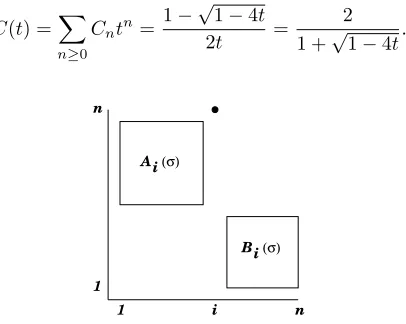
Throughout this paper, we shall classify the 132-avoiding permutations σ =
σ1. . . σn by the position of n in σ. That is, let S (i)
n (132) denote the set of σ ∈ Sn(132) such that σi =n. Clearly each σ ∈ S
(i)
n (132) has the structure pictured
in Figure 3. That is, in the graph of σ, the elements to the left of n, Ai(σ), have the structure of a 132-avoiding permutation, the elements to the right of n,
Bi(σ), have the structure of a 132-avoiding permutation, and all the elements in
Ai(σ) lie above all the elements in Bi(σ). It is well-known that the number of
132-avoiding permutations in Sn is the Catalan number Cn = n+11 2nn
and the generating function for theCn’s is given by
C(t) =X
n≥0
Cntn= 1− √
1−4t
2t =
2
1 +√1−4t.
Ai(σ)
(σ) B
i
i n
n 1
[image:7.612.207.410.310.472.2]1
Figure 3: The structure of 132-avoiding permutations.
Suppose thatn≥`. It is clear thatncannot match the pattern MMP(k, `, m,0) for k ≥ 1 in any σ ∈ Sn(132). For 1 ≤ i ≤ n, it is easy to see that as we sum over all the permutations σ in S(i)n (132), our choices for the structure for Ai(σ)
will contribute a factor ofQ(ki−−1,1321,`,m,0)(x) toQ(k,`,m,0)n,132 (x). Similarly, our choices for the structure for Bi(σ) will contribute a factor of Qn(k,`−i,132−i,m,0)(x) to Q(k,`,m,0)n,132 (x) ifi < `sinceσ1. . . σi will automatically be in the second quadrant relative to the
coordinate system with the origin at (s, σs) for any s > i. However if i≥`, then
our choices for the structure for Bi(σ) will contribute a factor of Q (k,0,m,0) n−i,132 (x) to Q(k,`,m,0)n,132 (x). It follows that forn≥`,
Q(k,`,m,0)n,132 (x) =
`−1
X
i=1
Q(ki−−1,1321,`,m,0)(x)Q(k,`n−i,132−i,m,0)(x) +
n
X
i=`
Note that for i < `,Q(ki−−1,1321,`,m,0)(x) =Ci−1. Thus, forn≥`,
Q(k,`,m,0)n,132 (x) =
`−1
X
i=1 Ci−1Q
(k,`−i,m,0) n−i,132 (x) +
n
X
i=`
Q(ki−−1,1321,`,m,0)(x)Q(k,0,m,0)n−i,132 (x). (5)
Multiplying both sides of (5) by tn and summing for n ≥ `, we see that for k, `≥1,
Q(k,`,m,0)132 (t, x) =
`−1
X
j=0 Cjtj+
`−1
X
i=1 Ci−1ti
X
u≥`−i
Q(k,`u,132−i,m,0)(x)tu+
tX n≥`
n
X
i=1
Q(ki−−1,1321,`,m,0)(x)ti−1Q(k,0,m,0)n−i,132 (x)tn−i
=
`−1
X
j=0 Cjtj+
`−1
X
i=1
Ci−1ti(Q
(k,`−i,m,0) 132 (t, x)−
`−i−1
X
j=0
Cjtj)+
tQ(k,0,m,0)132 (t, x)(Q(k132−1,`,m,0)(t, x)−
`−2
X
s=0 Csts) =C`−1t`−1+tQ
(k,0,m,0) 132 (t, x)Q
(k−1,`,m,0) 132 (t, x)+ `−2
X
s=0
Csts(1 +tQ
(k,`−1−s,m,0)
132 (t, x)−tQ (k,0,m,0)
132 (t, x)−t `−2−s
X
j=0 Cjtj).
Thus, we have the following theorem.
Theorem 7.
Q(k,`,m,0)132 (t, x) =C`−1t`−1+tQ
(k,0,m,0) 132 (t, x)Q
(k−1,`,m,0) 132 (t, x)+ `−2
X
s=0
Csts(1 +tQ(k,`132−1−s,m,0)(t, x)−tQ(k,0,m,0)132 (t, x)−t `−2−s
X
j=0
Cjtj). (6)
Note that since we can computeQ(k,0,m,0)132 (t, x) by Theorem 3 andQ(0,`,m,0)132 (t, x) by Theorem 5, we can use (6) to computeQ(k,`,m,0)132 (t, x) for anyk, `, m≥1.
2.1. Explicit formulas forQ(k,`,m,0)n,132 (x)|xr
It follows from Theorem 7 that
Q(k,1,m,0)132 (t, x) = 1 +tQ(k,0,m,0)132 (t, x)Q(k132−1,1,m,0)(t, x) and (7)
Note that it follows from Theorems 3 and 5 that
Q(1,1,1,0)132 (t,0) =1 +tQ(1,0,1,0)132 (t,0)Q(0,1,1,0)132 (t,0) =1 +t 1−t
1−2t·
1−t
1−2t =
1−3t+ 2t2+t3
(1−2t)2 .
Thus, the generating function of the sequence{Q(1,1,1,0)n,132 (0)}n≥1is
1−t 1−2t
2
which is
the generating function of the sequence A045623 in the OEIS. Then-th terman of this sequence has many combinatorial interpretations including the number of 1s in all partitions ofn+ 1 and the number of 132-avoiding permutations ofSn+2which
contain exactly one occurrence of the pattern 213. We note that for a permutation
σ to avoid the pattern MMP(1,1,1,0), it must simultaneously avoid the patterns 3124, 4123, 1324, and 1423. Thus, the number of permutationsσ∈Sn(132) which avoid MMP(1,1,1,0) is the number of permutations inSnthat simultaneously avoid
the patterns 132, 3124, and 4123.
Problem 1. Find simple bijections between the set of permutations σ ∈ Sn(132)
which avoid MMP(1,1,1,0) and the other combinatorial interpretations of the se-quence A045623 in the OEIS.
Note that it follows from Theorem 3 and our previous results that
Q(2,1,1,0)132 (t,0) =1 +tQ(2,0,1,0)132 (t,0)Q(1,1,1,0)132 (t,0) =1 +t 1−2t
1−3t+t2·
1−3t+ 2t2+t3
(1−2t)2
=1−4t+ 4t
2+t4
1−5t+ 7t2−2t3.
The sequence (Q(2,1,1,0)n,132 (0))n≥1is the sequence A142586 in the OIES which has the
generating function (11−−3t+t3t+2t2)(12+t−32t). That is,
1−4t+4t2+t4
1−5t+7t2−2t3−1 =
t(1−3t+2t2+t3) (1−3t+t2)(1−2t). This
sequence has no listed combinatorial interpretation so we have found a combinatorial interpretation of this sequence.
Similarly,
Q(3,1,1,0)132 (t,0) =1 +tQ(3,0,1,0)132 (t,0)Q(2,1,1,0)132 (t,0) =1 +t 1−3t+t
2
1−4t+ 3t2 ·
1−4t+ 4t2+t4
1−5t+ 7t2−2t3
=1−5t+ 7t
2−2t3+t5
Q(1,1,2,0)132 (t,0) =1 +tQ(1,0,2,0)132 (t,0)Q(0,1,2,0)132 (t,0) =1 +t 1−t−t
2
1−2t−t2·
1−t−t2
1−2t−t2
=1−3t+ 3t
3+ 3t4+t5
(1−2t−t2)2 .
Q(2,1,2,0)132 (t,0) =1 +tQ(2,0,2,0)132 (t,0)Q(1,1,2,0)132 (t,0) =1 +t1−2t−t
2
1−3t+t3·
1−3t+ 3t3+ 3t4+t5
(1−2t−t2)2
=1−4t+ 2t
2+ 4t3+t4+ 2t5+t6
(1−2t−t2)(1−3t+t3) .
Using (7) and Theorem 3, we have computed the following.
Q(1,1,1,0)132 (t, x) = 1 +t+ 2t2+ 5t3+ (12 + 2x)t4+ 28 + 12x+ 2x2t5+ 64 + 48x+ 18x2+ 2x3
t6+ 144 + 160x+ 97x2+ 26x3+ 2x4
t7+ 320 + 480x+ 408x2+ 184x3+ 36x4+ 2x5
t8+
704 + 1344x+ 1479x2+ 958x3+ 327x4+ 48x5+ 2x6t9+· · · .
Q(1,1,2,0)132 (t, x) = 1 +t+ 2t2+ 5t3+ 14t4+ (38 + 4x)t5+ 102 + 26x+ 4x2
t6+ 271 + 120x+ 34x2+ 4x3
t7+ 714 + 470x+ 200x2+ 42x3+ 4x4
t8+ 1868 + 1672x+ 964x2+ 304x3+ 50x4+ 4x5
t9+· · ·.
Q(1,1,3,0)132 (t, x) = 1 +t+ 2t2+ 5t3+ 14t4+ 42t5+ (122 + 10x)t6+ 351 + 68x+ 10x2
t7+ 1006 + 326x+ 88x2+ 10x3
t8+ 2868 + 1364x+ 512x2+ 108x3+ 10x4
t9+· · ·.
We can explain the highest and second highest coefficients ofx in these series. That is, we have the following theorem.
Theorem 8.
(i) For allm≥1andn≥3+m, the highest power ofxthat occurs inQ(1,1,m,0)n,132 (x)
isxn−2−m which appears with a coefficient of 2Cm. (ii) Forn≥5,Q(1,1,1,0)n,132 (x)|xn−4 = 6 + 2 n−22
.
(iii) For m≥2 andn≥4 +m,Q(1,1,m,0)n,132 (x)|xn−3−m = 2Cm+1+ 8Cm+ 4Cm(n−
Proof. It is easy to see that for the maximum number of MMP(1,1, m,0)-matches in aσ∈Sn(132), the permutation must be of the form (n−1)τ(m+ 1). . .(n−2)n
or nτ(m+ 1). . .(n−2)(n−1) whereτ ∈Sm(132). Thus, the highest power of x
occurring inQ(1,1,m,0)n,132 (x) isxn−2−m which occurs with a coefficient of 2Cm.
For parts (ii) and (iii), by (5) we have the recursion that
Q(1,1,m,0)n,132 (x) =
n
X
i=1
Q(0,1,m,0)i−1,132 (x)Q(1,0,m,0)n−i,132 (x). (8) We proved in [10, Theorem 15] and [10, Theorem 6] that for n ≥ m+ 2 the highest power ofx which occurs in eitherQ(0,1,m,0)n,132 (x) or Q(1,0,m,0)n,132 (x) is xn−1−m
and
Q(0,1,m,0)n,132 (x)|xn−1−m=Q
(1,0,m,0)
n,132 (x)|xn−1−m =Cm.
It is then easy to check that the highest power of xin Q(0,1,m,0)i−1,132 (x)Q(1,0,m,0)n−i,132 (x) is less than xn−3−m fori= 3, . . . , n−2.
We also proved in [10, Theorems 9,10, and 15] that
Q(1,0,1,0)n,132 (x)|xn−3 =Q
(0,1,1,0)
n,132 (x)|xn−3 = 2 +
n−1
2
forn≥4 and
Q(1,0,m,0)n,132 (x)|xn−m−2 =Q
(0,1,m,0)
n,132 (x)|xn−m−2
=Cm+1+Cm+ 2Cm(n−2−m) forn≥3 +mandm≥2.
Form= 1, we are left with 4 cases to consider in the recursion (8).
Case 1. i= 1. In this case,Q(0,1,1,0)i−1,132(x)Q(1,0,1,0)n−i,132(x)|xn−4 =Q
(1,0,1,0)
n−1,132(x)|xn−4 and
Q(1,0,1,0)n−1,132(x)|xn−4= 2 +
n−2
2
forn≥5.
Case 2. i= 2. In this case,Q(0,1,1,0)i−1,132(x)Q(1,0,1,0)n−i,132(x)|xn−4 =Q
(1,0,1,0)
n−2,132(x)|xn−4 and
Q(1,0,1,0)n−2,132(x)|xn−4 = 1 forn≥5.
Case 3. i=n−1. In this case,Q(0,1,1,0)i−1,132(x)Q(1,0,1,0)n−i,132(x)|xn−4 =Q
(0,1,1,0)
n−2,132(x)|xn−4
and
Q(0,1,1,0)n−2,132(x)|xn−4 = 1 forn≥5.
Case 4. i=n. In this case, Q(0,1,1,0)i−1,132(x)Q(1,0,1,0)n−i,132(x)|xn−4 =Q(0,1,1,0)n−1,132(x)|xn−4 and
Q(0,1,1,0)n−1,132(x)|xn−4= 2 +
n−2 2
forn≥5.
Next we consider the case whenm≥2. Again we have 4 cases.
Case 1. i= 1. We have Q(0,1,m,0)i−1,132 (x)Qn(1,0,m,0)−i,132 (x)|xn−3−m =Q
(1,0,m,0)
n−1,132(x)|xn−3−m,
and
Q(1,0,m,0)n−1,132(x)|xn−3−` =Cm+1+ 3Cm+ 2Cm(n−4−m) forn≥4 +m.
Case 2. i= 2. We have Q(0,1,m,0)i−1,132 (x)Q(1,0,m,0)n−i,132 (x)|xn−3−m =Q(1,0,m,0)n−2,132(x)|xn−3−m,
and
Q(1,0,m,0)n−2,132(x)|xn−3−m =Cm forn≥4 +m.
Case 3. i=n−1. Here,Q(0,1,m,0)i−1,132 (x)Q(1,0,m,0)n−i,132 (x)|xn−3−m =Q
(0,1,m,0)
n−2,132(x)|xn−3−m,
and
Q(0,1,m,0)n−2,132(x)|xn−3−m =Cm forn≥4 +m.
Case 4. i=n. We haveQ(0,1,m,0)i−1,132 (x)Q(1,0,m,0)n−i,132 (x)|xn−3−m =Q(0,1,m,0)n−1,132(x)|xn−3−m,
and
Q(0,1,m,0)n−1,132(x)|xn−3−m =Cm+1+ 3Cm+ 2Cm(n−4−m) forn≥4 +m.
Thus, forn≥4 +m,
Q(1,1,m,0)n,132 (x)|xn−3−m = 2Cm+1+ 8Cm+ 4Cm(n−4−m).
Thus, whenm= 2, we obtain that
Q(1,1,2,0)n,132 (x)|xn−5 = 26 + 8(n−6) forn≥6
and, form= 3, we obtain that
Q(1,1,3,0)n,132 (x)|xn−6 = 68 + 20(n−7)forn≥7
which agrees with our computed series.
One can also find the coefficient of the highest power of x in Q(k,1,1,0)n (x) for k≥2 andQ(1,`,1,0)n (x) for`≥2.
Theorem 9.
(i) For allk≥1andn≥3 +k, the highest power ofxthat occurs inQ(k,1,1,0)n,132 (x)
isxn−2−k which appears with a coefficient of k+ 1.
(ii) For all`≥1 andn≥3 +`, the highest power ofxthat occurs inQ(1,`,1,0)n,132 (x)
Proof. For (i), it is easy to see that the permutations in Sn(132) which have the most occurrences of MMP(k,1,1,0) start withn−jfor some 0≤j≤kfollowed by an increasing sequence which will haven−2−kelements matching MMP(k,1,1,0). For (ii), it is easy to see that the way to construct a permutation σof Sn(132)
which has the maximum number of occurrences of MMP(1, `,1,0) is to start with a rearrangementτ =τ1. . . τ`+1of{n−`, n−`+1, . . . , n}such that red(τ)∈S`+1(132) and then letσ=τ1. . . τ`1 2. . .(n−`−1)τ`+1, which will have n−2−`elements that match MMP(1, `,1,0).
One can also find a formula for the second highest coefficient ofxinQ(k,1,1,0)n (x)
for anyk≥1.
Theorem 10. For anyk≥1 andn≥4 +k, Q(k,1,1,0)n,132 (x)|xn−k−3 = 3
k+ 1
2
+k+ 2 + (k+ 1)
n−k−1
2
. (9)
Proof. We proceed by induction onk. Note that our formula reduces to part (ii) of Theorem 8 whenk= 1.
Thus assume thatk >1 and our formula holds for k−1. By recursion (5), we see that
Q(k,1,1,0)n,132 (x) =
n
X
i=1
Q(ki−−1,1321,1,1,0)(x)Q(k,0,1,0)n−i,132(x). (10)
From [10, Theorem 6], the highest power of x that can occur in Q(k,0,1,0)n,132 (x) is
xn−k−1, which occurs with a coefficient of 1 forn≥k+ 3. Similarly, from Theorem
9, we know that the highest power of xthat can occur in Q(k,1,1,0)n,132 (x) is xn−k−2
which occurs with a coefficient ofk+1. One can then easily check that forn≥k+4, there are only four terms on the right-hand side of (10) that can contribute to the coefficient ofQ(k,1,1,0)n,132 (x)|xn−k−3.
Case 1. i= 1. In this case,Q(ki−−1,1321,1,1,0)(x)Q(k,0,1,0)n−i,132(x)|xn−k−3 =Q
(k,0,1,0)
n−1,132(x)|xn−k−3
and by [10, Theorem 9], we know that
Q(k,0,1,0)n−1,132(x)|xn−k−3 = 2k+
n−1−k
2
forn≥k+ 4.
Case 2. i= 2. In this case,Q(ki−−1,1321,1,1,0)(x)Q(k,0,1,0)n−i,132(x)|xn−k−3 =Q
(k,0,1,0)
n−2,132(x)|xn−k−3
and by [10, Theorem 6], we know that
Q(k,0,1,0)n−2,132(x)|xn−k−3 = 1 forn≥k+ 4.
Case 3. i=n−1. Here,Q(ki−−1,1321,1,1,0)(x)Q(k,0,1,0)n−i,132(x)|xn−4 =Q
(k−1,1,1,0)
n−2,132 (x)|xn−k−3,
and by Theorem 9, we know that
Case 4. i=n. We have Q(ki−−1,1321,1,1,0)(x)Q(k,0,1,0)n−i,132(x)|xn−4 =Q(kn−−1,1321,1,1,0)(x)|xn−k−3,
and by induction,
Q(0,1,1,0)n−1,132(x)|xn−4 = 3
k
2
+ (k−1) + 2 +k
n−1−k
2
forn≥k+ 4.
Summing up these four cases, we find that forn≥k+ 4,
Q(k,1,1,0)n,132 (x)|xn−k−3 = 3
k+ 1
2
+k+ 2 + (k+ 1)
n−k−1
2
.
For example, fork= 2 andk= 3, we obtain that
Q(2,1,1,0)n,132 (x)|xn−5 = 13 + 3
n−3 2
forn≥6 and
Q(3,1,1,0)n,132 (x)|xn−6 = 23 + 4
n−4
2
forn≥7,
which agrees with the expansions of the series forQ(2,1,1,0)132 (t, x) andQ(3,1,1,0)132 (t, x) given below.
One can ask whether there is a similar formula for the second highest coefficient ofxinQ(1,`,1,0)n,132 (x) as a function of`. We conjecture that it is possible to find such a formula but it will be more complicated because it is no longer the case that a fixed number of terms in the recursion (5) contribute to the coefficient of the second highest power of xthat occurs inQ(1,`,1,0)n,132 (x). That is, as`grows, the number of terms in the recursion (5) that contribute to the coefficient of the second highest power of x that occurs in Q(1,`,1,0)n,132 (x) grows. We can, however, give an explicit formula in the case where`= 2.
Theorem 11. Forn≥6,
Q(1,2,1,0)n,132 (x)|xn−5 = 18 + 5
n−3 2
. (11)
Proof. In this case, the recursion (5) becomes
Q(1,2,1,0)n,132 (x) =Q(1,1,1,0)n−1,132(x) +
n
X
i=2
Q(0,2,1,0)i−1,132(x)Q(1,0,1,0)n−i,132(x). (12)
One can then easily check that forn≥6, there are only five terms on the right-hand side of (12) that can contribute to the coefficient ofQ(1,2,1,0)n,132 (x)|xn−5.
Case 1. In part (ii) of Theorem 8, we proved that
Q(1,1,1,0)n−1,132(x)|xn−5 = 6 + 2
n−3
2
Case 2. i= 2. In this case, Q(0,2,1,0)i−1,132(x)Q(1,0,1,0)n−i,132(x)|xn−5 =Q(1,0,1,0)n−2,132(x)|xn−5 and
by [10, Theorem 9], we know that
Q(1,0,1,0)n−2,132(x)|xn−5= 2 +
n−3
2
forn≥6.
Case 3. i= 3. In this case,Q(0,2,1,0)i−1,132(x)Q(1,0,1,0)n−i,132(x)|xn−5 = 2Q
(1,0,1,0)
n−3,132(x)|xn−5 and
by [10, Theorem 6], we know that
2Q(1,0,1,0)n−2,132(x)|xn−5 = 2 forn≥6.
Case 4. i=n−1. In this case,Q(0,2,1,0)i−1,132(x)Q(1,0,1,0)n−i,132(x)|xn−5 =Q
(0,2,1,0)
n−2,132(x)|xn−5
and by[10, Theorem 16 (i)], we know that
Q(0,2,1,0)n−2,132(x)|xn−5 = 2 forn≥6.
Case 5. i=n. In this case, Q(0,2,1,0)i−1,132(x)Q(1,0,1,0)n−i,132(x)|xn−5 =Q
(0,2,1,0)
n−1,132(x)|xn−5 and
by [10, Theorem 16 (ii)],
Q(0,2,1,0)n−1,132(x)|xn−5 = 6 + 2
n−3
2
forn≥6.
Thus, forn≥6,
Q(1,2,1,0)n,132 (x)|xn−5 = 18 + 5
n−3
2
.
The formulas for the seriesQ(k,`,m,0)132 (t, x) become increasingly complicated. For example, we have computed that
Q(1,1,1,0)132 (t, x) = 1 + 4tx
2
−1 +t+ 2x−tx+p(1 +t(−1 +x))2−4tx2 ,
Q(2,1,1,0)132 (t, x) = 1 +
t 1 + 4tx2
−1+t+2x−tx+√(1+t(−1+x))2−4tx2
!
1− 2tx
−1+t+2x−tx+√(1+t(−1+x))2−4tx
,
Q(3,1,1,0)132 (t, x) = 1 +
t
1 +
t 1+ 4tx2
(−1+t+2x−tx+ √
(1+t(−1+x))2−4tx)2
!
1− 2tx
−1+t+2x−tx+ √
(1+t(−1+x))2−4tx
1− t
1− 2tx
−1+t+2x−tx+ √
(1+t(−1+x))2−4tx
,
Q(1,1,2,0)132 (t, x) = 1 + t
1−1+t(1+t)(−1+x)− √
(1+t(1+t)(−1+x))2−4tx
2x
Q(1,1,3,0)132 (t, x) = 1 + t
1−1+t(1+t+2t2)(−1+x)− √
(1+t(1+t+2t2)(−1+x))2−4tx
2x
2, and
Q(1,2,1,0)132 (t, x) = 1 +t−4t
2x2(1−t+tx−4x−p
1 +t2(−1 +x)2−2t(1 +x))
(−1 +t+ 2x−tx+p1 +t2(−1 +x)2−2t(1 +x))3 .
We also have computed the following.
Q(2,1,1,0)132 (t, x) = 1 +t+ 2t2+ 5t3+ 14t4+ (39 + 3x)t5+ 107 + 22x+ 3x2
t6+ 290 + 105x+ 31x2+ 3x3
t7+ 779 + 415x+ 190x2+ 43x3+ 3x4
t8+ 2079 + 1477x+ 909x2+ 336x3+ 58x4+ 3x5t9+
5522 + 4922x+ 3765x2+ 1938x3+ 570x4+ 76x5+ 3x6t10+· · · .
Q(3,1,1,0)132 (t, x) = 1 +t+ 2t2+ 5t3+ 14t4+ 42t5+ (128 + 4x)t6+ 390 + 35x+ 4x2
t7+ 1184 + 195x+ 47x2+ 4x3
t8+ 3582 + 888x+ 325x2+ 63x3+ 4x4t9+
19808 + 3616x+ 1743x2+ 542x3+ 83x4+ 4x5
t10+· · · .
Q(2,1,2,0)132 (t, x) = 1 +t+ 2t2+ 5t3+ 14t4+ 42t5+ (126 + 6x)t6+ 376 + 47x+ 6x2t7+ 1115 + 250x+ 59x2+ 6x3t8+
3289 + 1110x+ 386x2+ 71x3+ 6x4t9+ 9660 + 4444x+ 2045x2+ 558x3+ 83x4+ 6x5
t10+· · ·.
Q(2,1,3,0)132 (t, x) = 1 +t+ 2t2+ 5t3+ 14t4+ 42t5+ 132t6+ (414 + 15x)t7+ 1293 + 122x+ 15x2t8+ 4025 + 670x+ 152x2+ 15x3t9+
12486 + 3124x+ 989x2+ 182x3+ 15x4
t10+· · ·.
Again one can easily explain the highest coefficient in Q(2,1,m,0)n,132 (x). That is, to have the maximum number of MMP(2,1, m,0)-matches in a σ ∈ Sn(132), the permutation must be of the form
(n−2)τ(m+ 1). . .(n−3)(n−1)n,
(n−1)τ(m+ 1). . .(n−3)(n−2)n,or
nτ(m+ 1). . .(n−3)(n−2)(n−1)
where τ ∈ Sm(132). Thus, the highest power of x occurring in Q(2,1,m,0)n,132 (x) is
We have computed the following.
Q(1,2,1,0)132 (t, x) = 1 +t+ 2t2+ 5t3+ 14t4+ (37 + 5x)t5+ 94 + 33x+ 5x2t6+ 232 + 144x+ 48x2+ 5x3t7+ 560 + 520x+ 277x2+ 68x3+ 5x4t8+ 1328 + 1680x+ 1248x2+ 508x3+ 93x4+ 5x5
t9+· · ·.
Q(1,2,2,0)132 (t, x) = 1 +t+ 2t2+ 5t3+ 14t4+ 42t5+ (122 + 10x)t6+ 348 + 71x+ 10x2t7+ 978 + 351x+ 91x2+ 10x3t8+
2715 + 1463x+ 563x2+ 111x3+ 10x4
t9+· · · .
Q(1,2,3,0)132 (t, x) = 1 +t+ 2t2+ 5t3+ 14t4+ 42t5+ 132t6+ (404 + 25x)t7+ 1220 + 185x+ 25x2t8+ 3655 + 947x+ 235x2+ 25x3t9+· · ·.
Again, one can easily explain the highest coefficient inQ(1,2,m,0)n,132 (x). That is, to have the maximum number of MMP(1,2, m,0)-matches in aσ∈Sn(132), one must be of the form
(n−2)(n−1)τ(m+ 1). . .(n−3)n,
(n−1)(n−2)τ(m+ 1). . .(n−3)n, n(n−2)τ(m+ 1). . .(n−3)(n−1), n(n−1)τ(m+ 1). . .(n−3)(n−2), or (n−1)nτ(m+ 1). . .(n−3)(n−2)
where τ ∈ Sm(132). Thus, the highest power of x occurring in Q(1,2,m,0)n,132 (x) is
xn−3−mwhich occurs with a coefficient of 5Cm.
Finally, we have computed the following.
Q(2,2,1,0)132 (t, x) = 1 +t+ 2t2+ 5t3+ 14t4+ 42t5+ (123 + 9x)t6+ (351 + 69x+ 9x2)t7+ (982 + 343x+ 96x2+ 9x3)t8+
(2707 + 1405x+ 609x2+ 132x3+ 9x4)t9+· · · .
Q(2,2,2,0)132 (t, x) = 1 +t+ 2t2+ 5t3+ 14t4+ 42t5+ 132t6+ (411 + 18x)t7+ (1265 + 147x+ 18x2)t8+ (3852 + 809x+ 183x2+ 18x3)t9+
(11626 + 3704x+ 1229x2+ 219x3+ 18x4)t10+· · ·.
Q(2,2,3,0)132 (t, x) = 1 +t+ 2t2+ 5t3+ 14t4+ 42t5+ 132t6+ 429t7+ (1385 + 45x)t8+ (4436 + 381x+ 45x2)t9+ (14118 + 2162x+ 471x2+ 45x3)t10+
Again, one can easily explain the highest coefficient inQ(2,2,m,0)n,132 (x). That is, to have the maximum number of MMP(2,2, m,0)-matches in aσ∈Sn(132), one must be of the form
n(n−1)τ(m+ 1). . .(n−4)(n−3)(n−2),
(n−1)nτ(m+ 1). . .(n−4)(n−3)(n−2), n(n−2)τ(m+ 1). . .(n−4)(n−3)(n−1), n(n−3)τ(m+ 1). . .(n−4)(n−2)(n−1),
(n−1)(n−2)τ(m+ 1). . .(n−4)(n−3)n,
(n−2)(n−1)τ(m+ 1). . .(n−4)(n−3)n,
(n−1)(n−3)τ(m+ 1). . .(n−4)(n−2)n,
(n−2)(n−3)τ(m+ 1). . .(n−4)(n−1)n, or (n−3)(n−2)τ(m+ 1). . .(n−4)(n−1)n
where τ ∈ Sm(132). Thus, the highest power of x occurring in Q(2,2,m,0)n,132 (x) is
xn−4−mwhich occurs with a coefficient of 9Cm.
3. Q(0,k,`,m)n,132 (x) wherek, `, m≥1
Suppose thatk, `, m≥1 andn≥k+m. It is clear thatncannot match the pattern MMP(0, k, `, m) fork, `, m≥1 in anyσ∈Sn(132). Ifσ=σ1. . . σn∈Sn(132) and σi=n, then we have three cases, depending on the value ofi.
Case 1. i < k. It is easy to see that as we sum over all the permutations σ in
Sn(i)(132), our choices for the structure forAi(σ) will contribute a factor of Ci−1
toQ(0,k,`,m)n,132 (x) since none of the elementsσj forj≤kcan match MMP(0, k, `, m) in σ. Similarly, our choices for the structure forBi(σ) will contribute a factor of
Q(0,kn−i,132−i,`,m)(x) to Q(0,k,`,m)n,132 (x) since σ1. . . σi will automatically be in the second quadrant relative to the coordinate system with the origin at (s, σs) for anys > i. Thus, the permutations in Case 1 will contribute
k−1
X
i=1 Ci−1Q
(0,k−i,`,m) n−i,132 (x)
toQ(0,k,`,m)n,132 (x).
Case 2. k ≤ i ≤ n−m. It is easy to see that as we sum over all the per-mutations σ in Sn(i)(132), our choices for the structure for Ai(σ) will contribute
the fourth quadrant relative to a coordinate system centered at (r, σr) forr≤i in this case. Similarly, our choices for the structure forBi(σ) will contribute a factor of Q(0,0,`,m)n−i,132(x) to Q(0,k,`,m)n,132 (x) since σ1. . . σi will automatically be in the second quadrant relative to the coordinate system with the origin at (s, σs) for anys > i. Thus, the permutations in Case 2 will contribute
n−m
X
i=k
Q(0,k,`,0)i−1,132(x)Q(0,0,`,m)n−i,132 (x)
toQ(0,k,`,m)n,132 (x).
Case 3. i≥n−m+ 1. It is easy to see that as we sum over all the permutations
σ in S(i)n (132), our choices for the structure for Ai(σ) will contribute a factor of Q(0,k,`,mi−1,132−(n−i))(x) to Q(0,k,`,m)n,132 (x) since the elements in Bi(σ) will all be in the fourth quadrant relative to a coordinate system centered at (r, σr) forr≤iin this
case. Similarly, our choices for the structure for Bi(σ) will contribute a factor of
Cn−i to Q (0,k,`,m)
n,132 (x) since the elements in Bi(σ) do not have enough elements to
the right to match MMP(0, k, `, m) in σ. Thus, the permutations in Case 3 will contribute
n
X
i=n−m+1
Q(0,k,`,mi−1,132−(n−i))(x)Cn−i
toQ(0,k,`,m)n,132 (x). Hence, forn≥k+m,
Q(0,k,`,m)n,132 (x) =
k−1
X
i=1 Ci−1Q
(0,k−i,`,m) n−i,132 (x) +
n−m
X
i=k
Q(0,k,`,0)i−1,132(x)Q(0,0,`,m)n−i,132 (x)+
n
X
i=n−m+1
Q(0,k,`,mi−1,132−(n−i))(x)Cn−i. (13)
Multiplying (13) bytn and summing, it is easy to compute that
Q(0,k,`,m)132 (t, x) =
k+m−1
X
p=0
Cptp+ k−2
X
i=0
Citi tQ(0,k132−1−i,`,m)(t, x)−t
k−i+m−2
X
r=0 Crtr
!
+
t Q(0,k,`,0)132 (t, x)−
k−2
X
a=0 Cata
!
Q(0,0,`,m)132 (t, x)−
m−1
X
b=0 Cbtb
!
+
m−1
X
j=0
Cjtj tQ(0,k,`,m132 −j)(t, x)−t
k+m−j−2
X
s=0 Csts
!
Note that the j = 0 term in the last sum is tQ(0,k,`,m)132 (t, x)−tPk+m−2
s=0 Csts.
Thus, taking the term tQ(0,k,`,m)132 (t, x) over to the other side and combining the sum−tPk+m−2
s=0 Cstswith the sumP k+m−1
p=0 Cptp to obtainCk+m−1tk+m−1+ (1− t)Pk+m−2
p=0 Cpt
pand then dividing both sides by 1−twill yield the following
theo-rem.
Theorem 12. Q(0,k,`,m)132 (t, x) =
k+m−2
X
p=0
Cptp+Ck+m−1t
k+m−1
1−t +
t
1−t k−2
X
i=0
Citi Q
(0,k−1−i,`,m) 132 (t, x)−
k−i+m−2
X
r=0 Crtr
!
+
t
1−t Q (0,k,`,0) 132 (t, x)−
k−2
X
a=0 Cata
!
Q(0,0,`,m)132 (t, x)−
m−1
X b=0 Cbtb ! + t
1−t m−1
X
j=1
Cjtj Q(0,k,`,m132 −j)(t, x)−
k+m−j−2
X
s=0 Csts
!
. (15)
Note that since we can compute Q(0,k,`,0)132 (t, x) =Q(0,0,`,k)132 (t, x) by Theorem 5, we can computeQ(0,k,`,m)132 (t, x) for all k, `, m≥1.
3.1. Explicit formulas forQ(0,k,`,m)n,132 (x)|xr
It follows from Theorem 12 that
Q(0,1,`,1)132 (t, x) =1 + t 1−t+
t
1−tQ (0,1,`,0) 132 (t, x)(Q
(0,0,`,1)
132 (t, x)−1)
= 1
1−t + t
1−tQ (0,1,`,0)
132 (t, x)(Q (0,0,`,1)
132 (t, x)−1),
Q(0,1,`,2)132 (t, x) =1 +t+ 2t
2
1−t+ t
1−tQ (0,1,`,0) 132 (t, x)(Q
(0,0,`,2)
132 (t, x)−(1 +t))+ t2
1−t(Q (0,1,`,1)
132 (t, x)−1), and
Q(0,2,`,2)132 (t, x) =1 +t+ 2t2+ 5t
3
1−t + t
1−t(Q (0,1,`,2)
132 (t, x)−(1 +t+ 2t 2))+
t
1−t(Q (0,2,`,0)
132 (t, x)−1)(Q (0,0,`,2)
132 (t, x)−(1 +t))+ t2
1−t(Q (0,2,`,1)
Again the formula for Q(0,k,`,m)132 (t, x) quickly become quite complicated. For example,
Q(0,1,1,1)132 (t, x) =
1 + 2tx
1−t+tx−√(1+t(−1+x))2−4tx
−1+t+2x−tx+√(1+t(−1+x))2−4tx2
1−t ,
Q(0,1,2,1)132 (t, x) =
1 + 2tx
1−t−t2+tx+t2x−√(1+t(1+t)(−1+x))2−4tx
−1+t+t2+2x−tx−t2x+√(1+t(1+t)(−1+x))2−4tx2
1−t , and
Q(0,1,3,1)132 (t, x) = 1 +
t
−1+
1 1−1+t(1+t+2t
2)(−1+x)−
√
(1+t(1+t+2t2)(−1+x))2−4tx 2x
1−1+t(1+t+2t2)(−1+x)− √
(1+t(1+t+2t2)(−1+x))2−4tx 2x
1−t .
We used these formulas to compute the following.
Q(0,1,1,1)132 (t, x) = 1 +t+ 2t2+ 5t3+ (13 +x)t4+ (33 + 8x+x2)t5+ (81 + 39x+ 11x2+x3)t6+ (193 + 150x+ 70x2+ 15x3+x4)t7+ (449 + 501x+ 337x2+ 122x3+ 20x4+x5)t8+
(1025 + 1524x+ 1363x2+ 719x3+ 204x4+ 26x5+x6)t9+
(2305 + 4339x+ 4891x2+ 3450x3+ 1450x4+ 327x5+ 33x6+x7)t10+· · ·.
Q(0,1,2,1)132 (t, x) = 1 +t+ 2t2+ 5t3+ 14t4+ 2(20 +x)t5+ (113 + 17x+ 2x2)t6+ (314 + 92x+ 21x2+ 2x3)t7+ (859 + 404x+ 140x2+ 25x3+ 2x4)t8+
(2319 + 1567x+ 745x2+ 200x3+ 29x4+ 2x5)t9+
(6192 + 5597x+ 3438x2+ 1262x3+ 272x4+ 33x5+ 2x6)t10+· · ·.
Q(0,1,3,1)132 (t, x) = 1 +t+ 2t2+ 5t3+ 14t4+ 42t5+ (127 + 5x)t6+ (380 + 44x+ 5x2)t7+ (1125 + 246x+ 54x2+ 5x3)t8+
(3299 + 1135x+ 359x2+ 64x3+ 5x4)t9+
(9592 + 4691x+ 1942x2+ 492x3+ 74x4+ 5x5)t10+· · · .
Our next theorem will explain the coefficient of the highest and second highest powers ofxthat appear in Q(0,1,`,1)n,132 (x) in these series.
Theorem 13.
(ii) Forn≥5,Q(0,1,1,1)n,132 (x)|xn−4 = 5 + n−2
2
.
(iii) For all`≥2andn≥4 +`,Q(0,1,`,1)n,132 (x)|xn−3−` =C`+1+ 6C`+ 2C`(n−4−`).
Proof. It is easy to see that the maximum number of matches of MMP(0, k, `, m) that are possible in a 132-avoiding permutation is a permutation of the form αβγδ
whereαis a rearrangement of{n−k+ 1, . . . , n}such that red(α)∈Sk(132),β is a rearrangement of{m+ 1, . . . , m+`}such that red(β)∈S`(132),γis the increasing
sequencem+`+ 1, m+`+ 2, . . . , n−k, andδ∈Sm(132). Thus, the highest power in Q(0,k,`,m)n isxn−k−`−mwhich has a coefficient ofCkC`Cm.
For parts (ii) and (iii), we note that it follows from (13) that
Q(0,1,`,1)n,132 (x) =Q(0,1,`,1)n−1,132(x) +
n−1
X
i=1
Q(0,1,`,0)i−1,132(x)Q(0,0,`,1)n−i,132(x).
We proved in [10, Theorems 6 and 15] that the highest power ofxthat appears in
Q(0,1,`,0)n,132 (x) =Q(0,0,`,1)n,132 (x) isxn−`−1 which appears with a coefficient ofC
` forn≥ `+ 2. This implies that the highest power ofxappearing inQ(0,1,`,0)i−1,132(x)Q(0,0,`,1)n−i,132(x) is less than xn−`−3 fori= 3, . . . , n−2.
Hence we have four cases to consider when we are computingQ(0,1,1,1)n,132 (x)|xn−4.
Case 1. i= 1. In this case, Q(0,1,1,0)i−1,132(x)Q(0,0,1,1)n−i,132(x)|xn−4 =Q(0,0,1,1)n−1,132(x)|xn−4 and
we proved in [10, Theorems 9 and 15] that
Q(0,0,1,1)n−1,132(x)|xn−4 =Q(0,1,1,0)n−1,132(x)|xn−4 = 2 +
n−2
2
forn≥5.
Case 2. i= 2. In this case, Q(0,1,1,0)i−1,132(x)Q(0,0,1,1)n−i,132(x)|xn−4 =Q
(0,0,1,1)
n−2,132(x)|xn−4 and
we proved in [10, Theorems 6 and 15] that
Q(0,0,1,1)n−2,132(x)|xn−4=Q
(0,1,1,0)
n−2,132(x)|xn−4= 1 for n≥5.
Case 3. i=n−1. In this case,Q(0,1,1,0)i−1,132(x)Q(0,0,1,1)n−i,132(x)|xn−4 =Qn(0,1,1,0)−2,132(x)|xn−4
and we proved in [10, Theorems 6 and 15] that
Q(0,1,1,0)n−2,132(x)|xn−4 = 1 forn≥5.
Case 4. Q(0,1,1,1)n−1,132(x)|xn−4. By part (i), we know thatQ
(0,1,1,1)
n−1,132(x)|xn−4 = 1 forn≥
5.
Thus,Q(0,1,1,1)n,132 (x)|xn−4 = 5 + n−22forn≥5.
Again there are four cases to consider when computing Q(0,1,`,1)n,132 (x)|xn−3−` for
Case 1. i = 1. In this case, Q(0,1,`,0)i−1,132(x)Qn(0,0,`,1)−i,132(x)|xn−3−` = Q
(0,0,`,1)
n−1,132(x)|xn−3−`
and we proved in [10, Theorems 10 and 15] that
Q(0,0,`,1)n−1,132(x)|xn−3−` =Q
(0,1,`,0)
n−1,132(x)|xn−3−`
=C`+1+ 3C`+ 2C`(n−4−`) forn≥4 +`.
Case 2. i = 2. In this case, Q(0,1,`,0)i−1,132(x)Q(0,0,`,1)n−i,132(x)|xn−3−` = Q(0,0,`,1)n−2,132(x)|xn−3−`
and we proved in [10, Theorems 6 and 15] that
Q(0,0,`,1)n−2,132(x)|xn−3−` =Q
(0,1,`,0)
n−2,132(x)|xn−3−` =C`forn≥4 +`. Case 3. i=n−1. In this case,Q(0,1,`,0)i−1,132(x)Q(0,0,`,1)n−i,132(x)|xn−3−` =Q
(0,1,`,0)
n−2,132(x)|xn−3−`
and we proved in [10, Theorems 6 and 15] that
Q(0,1,`,0)n−2,132(x)|xn−3−` =C` forn≥4 +`. Case 4. Q(0,1,`,1)n−1,132(x)|xn−3−`. By part (i), we know that
Q(0,1,`,1)n−1,132(x)|xn−3−` =C` forn≥4 +`.
Thus,
Q(0,1,`,1)n,132 (x)|xn−3−` =C`+1+ 6C`+ 2C`(n−4−`) forn≥4 +`.
For example, when`= 2, we have that
Q(0,1,2,1)n,132 (x)|xn−5 = 17 + 4(n−6) forn≥6
and, for`= 3, we have that
Q(0,1,3,1)n,132 (x)|xn−6= 44 + 10(n−7) forn≥7,
which agrees with the series we computed.
We can also find the formulas forQ(0,1,1,1)n,132 (0) andQ(0,1,1,1)n,132 (x)|x. Theorem 14.
(i) Q(0,1,1,1)n,132 (0) = (n−1)2n−2+ 1forn≥1.
Proof. In this case, the recursion (13) becomes
Q(0,1,1,1)n,132 (x) =Q(0,1,1,1)n−1,132(x) +
n−1
X
i=1
Q(0,1,1,0)i−1,132(x)Q(0,0,1,1)n−i,132(x).
It was proved in [10, Theorem 15] thatQ(0,1,1,0)132 (t, x) =Q(1,0,1,0)132 (t, x) so that
Q(0,0,1,1)n,132 (x) =Q(0,1,1,0)n,132 (x) =Q(1,0,1,0)n,132 (x) for alln. Thus we have that
Q(0,1,1,1)n,132 (x) =Q(0,1,1,1)n−1,132(x) +
n−1
X
i=1
Q(1,0,1,0)i−1,132(x)Q(1,0,1,0)n−i,132(x). (16)
By [10, Theorems 7 and 8], we know thatQ(1,0,1,0)n,132 (0) = 2n−1forn≥1 and that Q(1,0,1,0)n,132 (x)|x= (n−3)2n−2+ 1 forn≥3. Our calculations show that our formulas
hold forn≤5. Then forn≥6, we have by induction that
Q(0,1,1,1)n,132 (0) =Q(0,1,1,1)n−1,132(0) +Q(1,0,1,0)n−1,132(0) +
n−1
X
i=2
Q(1,0,1,0)i−1,132(0)Q(1,0,1,0)n−i,132(0)
=(n−2)2n−3+ 1 + 2n−2+
n−1
X
i=2
2i−22n−i−1
=(n−2)2n−3+ 1 + 2n−2+ (n−2)2n−3 =(n−1)2n−2+ 1.
Similarly, if we separate out thei = 1,2,3, n−2, n−1 terms from the sum in recursion (16), we find by induction that
Q(0,1,1,1)n,132 (x)|x=Q (0,1,1,1)
n−1,132(x)|x+Q (1,0,1,0)
n−1,132(x)|x+Q (1,0,1,0)
n−2,132(x)|x+ 2Q (1,0,1,0) n−3,132(x)|x+ Q(1,0,1,0)n−2,132(x)|x+ 2Q
(1,0,1,0) n−3,132(x)|x+ n−3
X
i=4
Q(1,0,1,0)i−1,132(x)|xQ (1,0,1,0) n−i,132(0) +
n−3
X
i=4
Q(1,0,1,0)i−1,132(0)Q(1,0,1,0)n−i,132(x)|x
=((n−1)2−9(n−1) + 24)2n−4−3−(n−1) + ((n−4)2n−3+ 1)+ 2((n−5)2n−4+ 1) + 4((n−6)2n−5+ 1)+
n−3
X
i=4
((i−4)2i−3+ 1)2n−i−1+
n−3
X
i=4
2i−2((n−i−3)2n−i−2+ 1) =((n−1)2−9(n−1) + 24)2n−4−3−(n−1) + (6n−30)2n−4+
7 + 2n−4
n−3
X
i=4
(i−4) +
n−3
X
i=4
(n−i−3)
!
+
n−3
X
i=4
2n−i−1+
n−3
X
i=4
=2n−4
(n−1)2−9(n−1) + 24 + 6n−30 + 2
n
−6 2
+
−3−(n−1) + 7 + 2(2n−4−4) =(n2−9n+ 24)2n−3−3−n.
The sequence (Q(0,1,1,1)n,132 (0))n≥1 starts out 1,2,5,13,33,81,193,449, . . .. This is
the sequence A005183 in OEIS and it counts the number of permutations of length
n which avoids the patterns 132 and 4312. We obtain the interpretation that this sequence also counts the number of permutations of lengthnwhich avoid the pat-terns 132 and 4231 (which are precisely the permutations counted by Q(0,1,1,1)n,132 (0), since an occurrence of the pattern MMP(0,1,1,1) in a 132-avoiding permutation implies an occurrence of the pattern 4231, and vice versa).
Problem 2. Find a bijection between permutations of lengthnavoiding the patterns 132 and 4312, and permutations of lengthn avoiding the patterns 132 and 4231.
The sequence (Q(0,1,1,1)n,132 (x)|x)n≥4starts out 1,8,39,150,501,1524. . .is sequence
A055581 which counts the number of directed column-convex polyominoes of area
n+ 5 having along the lower contour exactly 2reentrant corners.
Problem 3. Find a bijective correspondence between the number of permutations inSn(132)which have exactly one occurrence of the patternMMP(0,1,1,1)and the polyominoes described in A055581 in the OEIS.
We have computed the following.
Q(0,1,1,2)132 (t, x) = 1 +t+ 2t2+ 5t3+ 14t4+ 2(20 +x)t5+ 111 + 19x+ 2x2t6+ 296 + 106x+ 25x2+ 2x3
t7+ 761 + 456x+ 178x2+ 33x3+ 2x4
t8+ 1898 + 1677x+ 947x2+ 295x3+ 43x4+ 2x5
t9+
4619 + 5553x+ 4191x2+ 1901x3+ 475x4+ 55x5+ 2x6t10+· · ·.
Q(0,1,2,2)132 (t, x) = 1 +t+ 2t2+ 5t3+ 14t4+ 42t5+ 4(32 +x)t6+ 385 + 40x+ 4x2
t7+ 1135 + 243x+ 48x2+ 4x3
t8+ 3281 + 117x+ 351x2+ 56x3+ 4x4t9+
Q(0,1,3,2)132 (t, x) = 1 +t+ 2t2+ 5t3+ 14t4+ 42t5+ 132t6+ (419 + 10x)t7+ 1317 + 103x+ 10x2
t8+ 4085 + 644x+ 123x2+ 10x3
t9+ 12514 + 3229x+ 900x2+ 143x3+ 10x4
t10+
37913 + 14282x+ 5222x2+ 1196x3+ 163x4+ 10x5t11+· · ·.
Q(0,2,1,2)132 (t, x) = 1 +t+ 2t2+ 5t3+ 14t4+ 42t5+ 4t6(32 +x)+ 380 + 45x+ 4x2
t7+ 1083 + 286x+ 57x2+ 4x3
t8+ 2964 + 1368x+ 453x2+ 73x3+ 4x4t9+
7831 + 5501x+ 2650x2+ 717x3+ 93x4+ 4x5
t10+
20092 + 19675x+ 12749x2+ 5035x3+ 1114x4+ 117x5+ 4x6
t11+· · · .
Q(0,2,2,2)132 (t, x) = 1 +t+ 2t2+ 5t3+ 14t4+ 42t5+ 132t6+ (421 + 8x)t7+ 1328 + 94x+ 4x2t8+ 4103 + 641x+ 110x2+ 8x3t9+
12401 + 3376x+ 885x2+ 126x3+ 8x4
t10+ 36740 + 15235x+ 5484x2+ 1177x3+ 142x4+ 8x5
t11+
106993 + 62012x+ 28872x2+ 8452x3+ 1517x4+ 158x5+ 8x6t12+· · ·.
Q(0,2,3,2)132 (t, x) = 1 +t+ 2t2+ 5t3+ 14t4+ 42t5+ 132t6+ 429t7+ (1410 + 20x)t8+ 4601 + 241x+ 20x2
t9+ 14809 + 1686x+ 281x2+ 20x3
t10+ 46990 + 9187x+ 2268x2+ 321x3+ 20x4
t11+
147163 + 43394x+ 14144x2+ 2930x3+ 361x4+ 20x5t12+· · ·.
We can explain the coefficient of the highest power ofxin Q(0,k,`,m)n,132 (x) for large enough n.
Theorem 15. For n ≥ `+k+m+ 1, the highest power of x that appears in Q(0,k,`,m)n,132 (x)isxn−k−`−m, which occurs with a coefficient of C
kC`Cm.
Proof. It is easy to see the maximum number of matches of M M P(0, k, `, m) for
n > k+`+mthat are possible in a 132-avoiding permutation occur in a permutation of the form αβγ where αis a permutation of n−k+ 1, . . . , n such that red(α)∈
Sk(132),γ∈Sm(132), andβ is some permutation ofk+ 1, k+ 2, . . . , n−m, which has the maximum number of matches ofM M P(0,0, `,0). Such aβ must be of the formα(`+a)(`+a+1)(`+a+2). . .(n−m) whereαis a pemutation ofk+1, . . . , k+`
such that red(α)∈S`(132). Thus the highest power ofxthat occurs inQ (0,k,`,m) n (x)
has a coefficient of 2C`and forn > n−`−4, the highest power ofxinQ (0,2,`,2) n,132 (x)
isxn−`−4 which has a coefficient of 4C`. This agrees with our computations. For sufficiently large n, we can also explain the coefficient of the second highest term inQ(0,1,`,2)n,132 (x).
Theorem 16.
(i) Forn≥6,Q(0,1,1,2)n,132 (x)|xn−5 = 13 + 2
n−3
2
.
(ii) For all`≥2andn≥5+`,Q(0,1,`,2)n,132 (x)|xn−4−` = 2C`+1+15C`+4C`(n−5−`). Proof. For (i) and (ii), we note that the recursion forQ(0,1,`,2)n,132 (x) is
Q(0,1,`,2)n,132 (x) =Q(0,1,`,2)n−1,132(x) +Q(0,1,`,1)n−2,132(x) +
n−2
X
i=1
Q(0,1,`,0)i−1,132(x)Q(0,0,`,2)n−i,132(x).
By [10, Theorems 6 and 15], the highest power ofxthat occurs inQ(0,1,`,0)n,132 (x) is
xn−1−`, and by [10, Theorem 17], the highest power ofxthat occurs inQ(0,0,`,2)n,132 (x) is
n−2−`. It follows that the highest power ofxthat occurs inQ(0,1,`,0)i−1,132(x)Q(0,0,`,2)n−i,132(x) is less than xn−4−` fori= 3, . . . , n−3.
Thus, we have to consider five cases when computingQ(0,1,`,2)n,132 (x)|xn−4−`.
Case 1. Q(0,1,`,2)n−1,132(x)|xn−4−`. By part Theorem 15,
Q(0,1,`,2)n−1,132(x)|xn−4−` = 2C`forn≥`+ 5.
Case 2. Q(0,1,`,1)n−2,132(x)|xn−4−`. We have shown in Theorem 13 that
Q(0,1,`,1)n−2,132(x)|xn−4−` =C` forn≥`+ 5.
Case 3. i=n−2. In this case,Q(0,1,`,0)i−1,132(x)Q(0,0,`,2)n−i,132(x) equals 2Q(0,1,`,0)n−3,132(x). We have shown in [10, Theorems 6 and 15] thatQ(0,1,`,0)n−3,132(x)|xn−4−` =C` forn≥`+ 5
so that we get a contribution of 2C`in this case.
Case 4. i= 2. In this case, Q(0,1,`,0)i−1,132(x)Qn(0,0,`,2)−i,132(x) equalsQ(0,0,`,2)n−2,132(x). We have shown in [10, Theorem 17] that
Q(0,0,`,2)n−2,132(x)|xn−4−` = 2C`forn≥`+ 5.
Case 5. i= 1. In this case, Q(0,1,`,0)i−1,132(x)Qn(0,0,`,2)−i,132(x) equalsQ(0,0,`,2)n−1,132(x). We have shown in [10, Theorem 17] that for n≥`+ 5,
Q(0,0,`,2)n−1,132(x)|xn−4−` =
(
6 + 2 n−23 if`= 1,
Thus, for`= 1, we get
Q(0,1,1,2)n,132 (x)|xn−5 = 13 + 2
n−3
2
forn≥6 and, for`≥2,
Q(0,1,`,2)n,132 (x)|xn−4−` = 2C`+1+ 15C`+ 4C`(n−5−`) forn≥5 +`.
For example, when`= 2, we get
Q(0,1,2,2)n,132 (x)|xn−6 = 40 + 8(n−7) forn≥7
and, for`= 3, we get
Q(0,1,3,2)n,132 (x)|xn−7 = 103 + 20(n−8) forn≥8,
which agrees with the series that we computed.
4. Q(`,k,0,m)n,132 (x) wherek, `, m≥1
Suppose that k, `, m ≥ 1 and n ≥ k +m. It is clear that n cannot match MMP(`, k,0, m) for k, `, m ≥ 1 in any σ ∈ Sn(132). If σ = σ1. . . σn ∈ Sn(132) andσi=n, then we have three cases, depending on the value ofi.
Case 1. i < k. It is easy to see that as we sum over all the permutations σ in
Sn(i)(132), our choices for the structure forAi(σ) will contribute a factor of Ci−1
to Q(`,k,0,m)n,132 (x) since the elements in Ai(σ) do not have enough elements to the
left to match MMP(`, k,0, m) in σ. Similarly, our choices for the structure for
Bi(σ) will contribute a factor of Q
(`,k−i,0,m)
n−i,132 (x) to Q (`,k,0,m)
n,132 (x) sinceσ1. . . σi will
automatically be in the second quadrant relative to the coordinate system with the origin at (s, σs) for anys > i. Thus, the permutations in Case 1 will contribute
k−1
X
i=1 Ci−1Q
(`,k−i,0,m) n−i,132 (x)
toQ(`,k,0,m)n,132 (x).
Case 2. k≤i≤n−m. It is easy to see that as we sum over all the permutations
quadrant andσi =nis in the first quadrant relative to a coordinate system centered at (r, σr) forr < iin this case. Similarly, our choices for the structure forBi(σ) will contribute a factor ofQ(`,0,0,m)n−i,132 (x) toQ(`,k,0,m)n,132 (x) sinceσ1. . . σiwill automatically be in the second quadrant relative to the coordinate system with the origin at (s, σs) for anys > i. Thus, the permutations in Case 2 will contribute
n−m
X
i=k
Q(`i−−1,1321,k,0,0)(x)Q(`,0,0,m)n−i,132 (x)
toQ(`,k,0,m)n,132 (x).
Case 3. i≥n−m+ 1. It is easy to see that as we sum over all the permutations
σ in S(i)n (132), our choices for the structure for Ai(σ) will contribute a factor of Q(`i−−1,1321,k,0,m−(n−i))(x) toQ(`,k,0,m)n,132 (x) since σi =nwill be in the first quadrant and the elements in Bi(σ) will all be in the fourth quadrant relative to a coordinate system centered at (r, σr) for r < i in this case. Similarly, our choices for the
structure for Bi(σ) will contribute a factor ofCn−i toQ (`,k,0,m)
n,132 (x) sinceσj where j > i does not have enough elements to its right to match MMP(`, k,0, m) in σ. Thus, the permutations in Case 3 will contribute
n
X
i=n−m+1
Q(`i−−1,1321,k,0,m−(n−i))(x)Cn−i
toQ(`,k,0,m)n,132 (x). Thus, we have the following. Forn≥k+m,
Q(`,k,0,m)n,132 (x) =
k−1
X
i=1 Ci−1Q
(`,k−i,0,m) n−i,132 (x) +
n−m
X
i=k
Q(`i−−1,1321,k,0,0)(x)Q(`,0,0,m)n−i,132 (x)+
n
X
i=n−m+1
Qi(`−−1,1321,k,0,m−(n−i))(x)Cn−i. (17)
Multiplying (17) bytn and summing overnwill yield the following theorem. Theorem 17. For all`, k, m≥1,
Q(`,k,0,m)132 (t, x) =
k+m−1
X
p=0
Cptp+
t k−2
X
i=0
Citi Q
(`,k−1−i,0,m) 132 (t, x)−
k−i+m−2
X
r=0 Crtr
!
+
t Q(`132−1,k,0,0)(t, x)−
k−2
X
a=0 Cata
!
Q(`,0,0,m)132 (t, x)−
m−1
X
b=0 Cbtb
!
t m−1
X
j=0
Cjtj Q(`132−1,k,0,m−j)(t, x)−
k+m−j−2
X
s=0 Csts
!
. (18)
Note that we can computeQ(`,k,0,0)132 (t, x) =Q(`,0,0,k)132 (t, x) by Theorem 4 so that (18) allows us to computeQ(`,k,0,m)132 (t, x) for anyk, `, m≥0.
4.1. Explicit formulas forQ(`,k,0,m)n,132 (x)|xr
In general, the formulas for Q(`,k,0,m)132 (t, x) are quite complicated. For example, in the simplest case,
Q(1,1,0,1)132 (t, x) = R(t, x) +S(t, x) √
1−4xt
(1−t)(1−2t+√1−4xt)3
where
R(t, x) =4(1−3t+ 4t2−2t3−t4−3xt+ 6xt2−3xt3+xt4) and
S(t, x) =4(1−3t+ 4t2−t4−xt−xt3+xt4).
It follows from Theorem 17 that
Q(`,1,0,1)132 (t, x) =1 +t+tQ132(`−1,1,0,0)(t, x)(Q(`,0,0,1)132 (t, x)−1)+
t(Q(`132−1,1,0,1)(t, x)−1), (19)
Q132(`,1,0,2)(t, x) =1 +t+ 2t2+tQ132(`−1,1,0,0)(t, x)(Q(`,0,0,2)132 (t, x)−(1 +t))+
t(Q(`132−1,1,0,2)(t, x)−(1 +t) +t(Q(`132−1,1,0,1)(t, x)−1)), and
Q(`,2,0,2)132 (t, x) =1 +t+ 2t2+ 5t3+t(Q(`,1,0,2)132 (t, x)−(1 +t+ 2t2))+
t(Q(`132−1,2,0,0)(t, x)−1)(Q(`,0,0,2)132 (t, x)−(1 +t))+
t(Q(`132−1,2,0,2)(t, x)−(1 +t+ 2t2) +t(Q(`132−1,2,0,1)(t, x)−(1 +t))).
One can use these formulas to compute the following.
Q(1,1,0,1)132 (t, x) = 1 +t+ 2t2+ 5t3+ 2(5 + 2x)t4+ (17 + 17x+ 8x2)t5+ (26 + 44x+ 42x2+ 20x3)t6+ (37 + 90x+ 129x2+ 117x3+ 56x4)t7+ (50 + 160x+ 305x2+ 397x3+ 350x4+ 168x5)t8+
(65 + 259x+ 615x2+ 1029x3+ 1268x4+ 1098x5+ 528x6)t9+
(82 + 392x+ 1113x2+ 2259x3+ 3503x4+ 4167x5+ 3564x6+ 1716x7)t10+· · · .
Theorem 18. Forn≥3 +k, the highest power of xthat occurs in Q(1,k,0,1)n,132 (x)is xn−2−k which occurs with a coefficient of 2Ck+1Cn−k−2.
Proof. It is easy to see that the maximum number of MMP(1, k,0,1) matches occurs in σ ∈ Sn(132) when σ is of the form α1. . . αkβαk+11 or α1. . . αkβ1αk+1 where
α=α1. . . αk+1 is a rearrangement of {n−k, n−k+ 1, . . . , n}such that red(α)∈
Sk+1(132) andβis a 132-avoiding permutation on 2, . . . , n−k−1. Thus, the highest
power of xinQ(1,k,0,1)n,132 (x) forn≥k+ 3 is xn−2−k which occurs with a coefficient
of 2Ck+1Cn−k−2.
We can also explain the second highest coefficient inQ(1,1,0,1)n,132 (x).
Theorem 19. Forn≥5,
Q(1,1,0,1)n,132 (x)|xn−4 = 8Cn−3+Cn−4.
Proof. In this case, the recursion forQ(1,1,0,1)n,132 (x) is
Q(1,1,0,1)n,132 (x) =Q(0,1,0,1)n−1,132(x) +
n−1
X
i=1
Q(0,1,0,0)i−1,132(x)Q(1,0,0,1)n−i,132(x).
It was proved in [9, Theorem 5.1] that forn≥1, the highest power ofxthat occurs in Q(0,1,0,0)n,132 (x) is xn−1 which occurs with a coefficient of Cn−1. It was proved in
[10, Theorem 12] that forn≥3, the highest power ofxthat occurs inQ(1,0,0,1)n,132 (x) isxn−2 which occurs with a coefficient of 2Cn
−2. It follows that
Q(1,1,0,1)n,132 (x)|xn−4 =Q(0,1,0,1)n−1,132(x)|xn−4+Q(1,0,0,1)n−1,132(x)|xn−4+Q(0,1,0,0)n−2,132(x)|xn−4+
n−2
X
i=2
Q(0,1,0,0)i−1,132(x)|xi−2Q(1,0,0,1)n−i,132(x)|xn−i−2.
The following three equations follow from [10, Theorem 19], [10, Theorem 12] and [9, Theorem 5.1], respectively.
Thus, forn≥5,
Q(1,1,0,1)n,132 (x)|xn−4 =2Cn−3+Cn−4+ 3Cn−3+Cn−3+ n−2
X
i=2
Ci−2·2Cn−i−2
=6Cn−3+Cn−4+ 2 n−2
X
i=2
Ci−2Cn−i−2
=6Cn−3+Cn−4+ 2Cn−3
=8Cn−3+Cn−4.
The sequence (Q(1,1,0,1)n,132 (0))n≥1starts out 1,2,5,10,17,26,37,50,65,82, . . .which
is the sequence A002522 in the OEIS. The n-th element of the sequence has the formula (n−1)2+ 1. This can be verified by computing the generating function Q(1,1,0,1)132 (t,0). That is, we proved in [9] and [10] that
Q(0,1,0,0)132 (t,0) = 1 1−t, Q(1,0,0,1)132 (t,0) =1−2t+ 2t
2
(1−t)3 ,and Q(0,1,0,1)132 (t,0) = 1
1−t + t2
(1−t)2.
Plugging these formulas into (19), one can compute that
Q(1,1,0,1)132 (t,0) = 1−2t+ 2t
2+t3
(1−t)3 .
It was pointed out to us by the anonymous referee how to prove directly that
Q(1,1,0,1)n,132 (0) = (n−1)2+ 1 for n ≥1. It can be shown by an easy case analysis
according to for which i we have σi =n in a 132-avoiding permutation σ1. . . σn. For i= nwe get permutations avoiding both of the patterns 321 and 132, which are counted byQ(0,1,0,1)n−1,132(0) = 1 + n−21by Theorem 21 of [10]. For i < n, we have only increasing permutation on the left and a concatenation of a decreasing (β) and an increasing (γ) permutation on the right, where all elements ofβ are larger than all elements ofγ giving usPn−1
i=1(n−i) = n 2
choices. Thus
Q(1,1,0,1)n,132 (0) = 1 +
n−1 2
+
n
2