What’s in a Bug Report?
Steven Davies
Dept. Computer and Information Sciences University of Strathclyde
Glasgow, U.K.
[email protected]
Marc Roper
∗Dept. Computer and Information Sciences University of Strathclyde
Glasgow, U.K.
[email protected]
ABSTRACT
Context: Bug reports are the primary means by which users of a system are able to communicate a problem to the developers, and their contents are important - not only to support developers in maintaining the system, but also as the basis of automated tools to assist in the challenging tasks of finding and fixing bugs.
Goal:This paper aims to investigate how users report bugs in systems: what information is provided, how frequently, and the consequences of this.
Method: The study examined the quality and quantity of information provided in 1600 bugs reports drawn from four open-source projects (Eclipse, Firefox, Apache HTTP, and Facebook API), recorded what information users actually provide, how and when users provide the information, and how this affects the outcome of the bug.
Results: Of the recorded sources of information, only
ob-served behaviourandexpected resultsappeared in more than
50% of reports. Those sources deemed highly useful by de-velopers and tools such asstack traces and test cases ap-peared very infrequently. However, no strong relationship was observed between the provided information and the out-come of the bug.
Conclusions: The paper demonstrates a clear mismatch between the information that developers would wish to pear in a bug report, and the information that actually ap-pears. Furthermore, the quality of bug reports has an im-portant impact on research which might rely on extracting this information automatically.
Categories and Subject Descriptors
D.2.5 [Software Engineering]: Testing and Debugging—
debugging aids; D.2.6 [Software Engineering]:
Program-ming Environments—integrated environments; D.2.7 [Software Engineering]: Distribution, Maintenance, and Enhance-ment—documentation
∗Corresponding author.
Permission to make digital or hard copies of all or part of this work for personal or classroom use is granted without fee provided that copies are not made or distributed for profit or commercial advantage and that copies bear this notice and the full citation on the first page. To copy otherwise, to republish, to post on servers or to redistribute to lists, requires prior specific permission and/or a fee.
ESEM’14September 18–19, 2014, Torino, Italy
[image:1.595.318.555.119.478.2]Copyright 2014 ACM 978-1-4503-2774-9/14/09 ...$15.00.
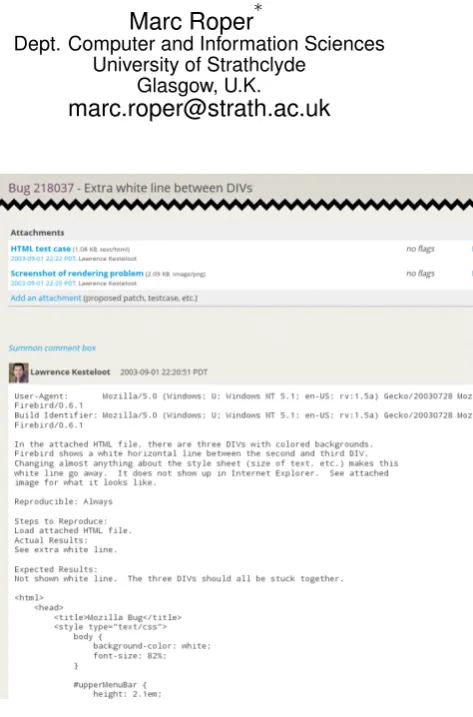
Figure 1: Mozilla Bug 218037 (Cropped)
1.
INTRODUCTION
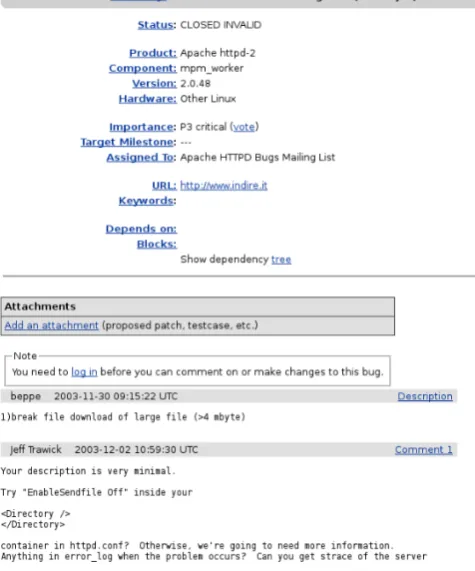
Figure 2: Apache Bug 25091
light of no response, they prompt the user again for this in-formation, but to no avail. Finally the developer chooses to close the bug as invalid - all effort associated with this bug has been wasted.
The way in which a bug is reported is clearly of impor-tance to the developer charged with fixing the bug, as it can have a big impact on the ease with which they may be able to fix the bug. However, this information is also of wider in-terest and impacts on a number of important activities from mining bug repositories for information, through developing tools to support activities such as bug localisation, to build-ing the next generation of bug trackbuild-ing systems. Knowledge of what information that is reported, the way in which it is reported and how frequently it appears will have a sig-nificant influence on all these activities. Unfortunately, this information - particularly the last point - seems very hard to come by.
This paper reports on an empirical investigation of 1600 bugs in 4 open-source projects, examining the quantity and quality of information provided by users when they are re-porting bugs. In particular, it looks at what information developers want in bug reports (as identified by Bettenburg et al. [3]) compared to what information users actually pro-vide, how and when users provide the information, how this affects the outcome of the bug, and how this information can be used to improve the bug fixing process. The main findings from this investigation are that in many cases, bug reports are neither complete nor accurate, and often do not provide all the information that developers find useful when fixing bugs. Furthermore, it reveals that there would be a number of difficulties in automatically extracting relevant
information from bug reports.
2.
WHAT INFORMATION IS USEFUL TO
DEVELOPERS WHEN FIXING BUGS?
One of the overall aims of examining the information pro-vided in bug reports is to identify ways in which the bug fixing process can be improved. One potential first step in doing so is to examine what information developers them-selves want when fixing bugs. Bettenburg et al. [3] surveyed 156 developers of Apache, Eclipse [13] and Mozilla about what sections of a bug report they found most useful when fixing bugs. In order, the ten most important features (from a total of 16 options) were reported as:1. Steps to reproduce: A clear set of instructions that the developer can use to reproduce the bug on their own machine
2. Stack traces: A stack trace produced by the applica-tion, most often when the bug is reporting a crash in the application
3. Test cases: One or more test cases that the developer can use to determine when they have fixed the bug
4. Observed behaviour: What the user saw happen in the application as a result of the bug
5. Screenshots: A screenshot of the application while the bug is occurring
6. Expected behaviour: What the user expected to hap-pen, usually contrasted withObserved behaviour
7. Code examples: An example of some code which can cause the bug
8. Summary: A short (usually one-sentence) summary of the bug
9. Version: What version of the application the user was using at the time of the error
10. Error reports: An error report produced by the ap-plication as the bug occurred
Similar results were found in a survey of Microsoft de-velopers which was carried out to determine which features most influenced whether or not a bug would eventually be fixed [17].
Unfortunately, the information developers want is not al-ways provided by users, and various research has reported
that Screenshots and Stack traces [4], patches (which are
by normal users of the Mozilla bug tracking system (BTS) contributed no useful information.
Some studies have investigated which attributes can be used to help predict the fix time of the bug [18], or the developers who should be responsible for fixing it [9]. There have also been attempts at determining how relevantStack traces are to fixing bugs [23], and to whetherError reports
can be used to identify the causes of bugs [28]. However, no study has attempted to show how commonly these various features occur in bug reports.
3.
INVESTIGATION
To investigate how often the features desired by develop-ers were actually provided in bug reports, 1600 bugs across 4 projects were examined to determine how often users pro-vide each part of a bug report. The study also examined various issues surrounding the relationships between differ-ent aspects of a bug report, the variance between projects and the potential for automatic extraction of data from bug reports.
3.1
Subjects
The four projects involved in the investigation were:
Eclipse: An open-source integrated development environ-ment (IDE) and application framework, written in Java
Firefox[15]: An open-source browser, written mainly in C++
Apache HTTP: An open-source HTTP server, written in C
Facebook[14] Application Programming Interface (API): Proprietary APIs for a social network, available in sev-eral languages1
A number of scripts were developed to extract a random subset of 400 bugs from each of the repositories. These projects represent a variety of different uses and languages and attract user populations of differing size and technical experience. Whilst three of the projects are open-source and one is closed-source, each of the projects in question makes use of an open bug repository. Anyone can report and comment on bugs about the project, and take part in conversations about the bugs with developers.
3.2
Features
While the exact implementation varies between systems, bug reports usually consist of a number of fields. Some of these fields, such as the severity or version, can only take a limited number of values. Information can be extracted from these fields in a relatively straightforward manner us-ing automated techniques. However, there are a number of other pieces of information which are desirable in a bug re-port that are not contained within these fields, such as the
Expected behaviour or Steps to reproduce. Unfortunately,
in general BTSs have no specific support for any of these features, and they are usually provided (if indeed they are provided at all) as part of the title, description or comments, all of which are unstructured plain text, or as generic attach-ments. As such, identifying how often they are provided is
1Note that this is intended for developers of Facebook
ap-plications, not everyday users of the site
not straightforward; there are no simple techniques for au-tomatically extracting them.
For each bug in the sample, the basic structured infor-mation available was recorded. The unstructured informa-tion for each bug report was then manually examined by the first author to identify whether any of the following features, based on those listed in Section 2, were present in the bug report, and how they were reported. While amongst some projects it was common to explicitly label some features, e.g. “Expected results: . . . ”, the investigation did not rely on these. A description of what the reporter expected to happen was sufficient, and similar procedures were followed for other features. Since this obviously leads to the eval-uation being somewhat subjective, a number of judgement calls had to be made. The most common and important decisions are detailed alongside the relevant feature below, but this is not a complete list.
The features examined (based on the top ten identified by [3]) were:
Observed behaviour (Obs): In general, a statement which simply says a particular feature ‘does not work’ or something similar was not sufficient to consider
Ob-served behaviour as present. Users had to provide at
least a minimal amount of detail about what happened or what they saw.
Expected behaviour (Exp): Similarly, while a statement such as ‘I received the following error’ is sufficient for
Observed behaviour, it was not sufficient for Expected
behaviour. The user had to make clear that they
ex-pected not to receive any error (or indeed, that they were expecting an error but that the error they re-ceived was incorrect). However, feature requests or patch descriptions were often made in an imperative form and this was considered as sufficient forExpected behaviour.
Steps to reproduce (Rep): Enough detail had to be pro-vided to allow the bug to be reproduced on another machine, although this did not have to be explicitly given as a numbered sequence of instructions.
Error reports (Err): Error reports included stack traces, and any time when a quoted error message was pro-vided, as well as more detailed logs or Java core dumps. Apache logs with error or critical notices were consid-eredError reports as were other levels of logs if they clearly contained an error message.Error reports were counted even if the text appeared only in a screenshot.
Stack traces (Sta): Stack traces did not have to be from an exception. For example, backtraces obtained through gdb [16] were sufficient. The output from strace [25], truss [26] and similar tools were not considered to be
Stack traces, as these only contained the system calls being made, not the application code itself. In many ways,Stack traces is a more specific form ofError re-ports, which is itself a more specific form ofObserved behaviour.
Code examples (Cod): Code examples were not required to be either complete or minimal. In many cases, users provided links to webpages or Facebook applica-tions which reproduced the bug in quesapplica-tions. These were considered Code examples. Apache configura-tion directives and files were considered Code exam-ples. Many features of Facebook could be exercised by simple one-line RESTful URLs. These were also consideredCode examples.
Test cases (Tes): Test caseshad to be self-contained and automatic. No manual action should be needed af-ter setup, but some inaf-terpretation of results was con-sidered acceptable e.g. a test that prints ‘Success’ or ‘Failure’.
Build information (Bui): This field records not just the release version of code being used, but also records if the user was using a ‘between-release’ version of the code, as well as what options were set when they built the software. Build information is specified differently for each project.
Application Code (App): This was used to record any time when particular lines or methods of the project were identified as being the source or solution of a problem, including patches. Note that this is code from the source of the applicable project, as opposed
toCode examples which is code written by users that
is a client of the project code.
The assessment did not take into consideration whether the information for given features was accurate, nor deter-mine its quality. For example, if a bug report contained instructions to reproduce an issue, then this was marked as containingSteps to reproduce, even if a developer pointed out that these steps were not sufficient or correct.
4.
WHAT INFORMATION DO USERS
PRO-VIDE?
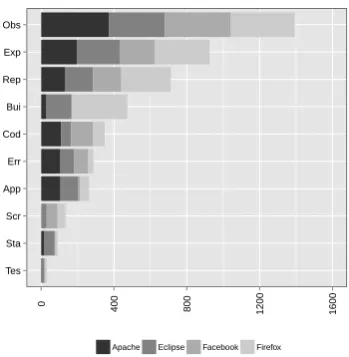
Figure 3 shows the number of bugs that contain each fea-ture at some point in the bug report. As shown, Observed behaviour is found in the vast majority of reports, with
Ex-pected behaviour in more than half and Steps to reproduce
in slightly less. Barring some highly unusual bugs, itshould
be possible to provide all these fields in any bug report, so the fact that they are not provided more often could be seen as disappointing. This is especially true forSteps to repro-duce, as developers consider this the single most important feature needed when handling a bug report.
The other features are found in far fewer reports, with
Screenshots,Stack traces andTest cases all being found in less than 10% of bug reports. This is in line with results found by other researchers [3, 4]. These features are not necessarily appropriate for all bug reports however. For ex-ample, we do not know how many bugs withoutStack traces
did not generate a stack trace, and how many did generate a stack trace but the user chose not to report it. The low numbers of these features suggest however that bug fixing tools or techniques that rely on the presence of the features are not likely to be widely applicable.
4.1
Differences between projects
Tes Sta Scr App Err Cod Bui Rep Exp Obs
0 400 800
[image:4.595.347.528.49.228.2]1200 1600
Figure 3: Number of bugs in which each feature was present
Tes Sta Scr App Err Cod Bui Rep Exp Obs
0 400 800
1200 1600
Apache Eclipse Facebook Firefox
Figure 4: Number of bugs in which each feature was present, by project
As with many other measures in software engineering, it seems likely that the information provided in bug reports will vary between projects. Figure 4 shows the number of bug reports with each feature by project. It is clear from this that for some features, they are more common for some projects than for others. χ2-tests for independence were
carried out to test whether the presence or non-presence of each feature is dependent on the project. For each feature,
p-values for theχ2-tests were all less than 0.01, suggesting
that there is indeed a relationship between the project and the presence of each feature.
[image:4.595.352.527.284.463.2](al-though they may have documentation which tells reporters that all of them are expected). This suggests that such an interface could boost the numbers of bug reports which con-tain these fields if a similar interface was adopted by other projects.
Unsurprisingly given the nature of the application, Apache bugs contained virtually noScreenshots and very few Test cases,Stack traces orBuild information. Error reports, and in particular error logs, are common however.
As no build identifiers are available to users, Facebook bugs contain noBuild information. Also, likely due to the fact that the source code is not available to users, very few bug reports contain information about where in the code the bug is likely to be, and automatedTest cases and
Stack tracesare also rare. Perhaps as a consequence of this,
Screenshots and Code examples, often in the form of links
to Facebook applications, are more common.
There are perhaps surprisingly few Code examples pro-vided in Eclipse, given that it is after all an IDE. However
Stack traces are more common than in other projects. This
is likely due to the fact that they are more prominent within the application. Most errors within Eclipse will produce stack traces either in a dialog to users, in the error log, or in the Java core dump that may be produced by a crash. This is in contrast to Apache or Firefox, where the user must usually go to some manual effort, for example using gdb, to produce a stack trace for an error.
4.2
Amount of features
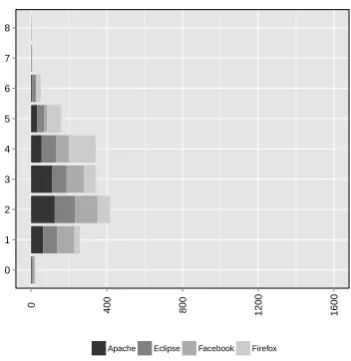
As well as the individual features, it is interesting to look at the overall number of features provided in each bug re-port, and how this differs by project. Figure 5 shows the number of features (out of the possible ten) contained in each bug report. As shown here, very few bugs have more than five features, and the majority have three or fewer. It appears that Facebook users appear to contribute less in-formation on average, while Firefox users contribute more. The reasons for this are unclear, although it may be that bug reports on Facebook are less technically savvy, and a small minority of the bugs reported on Facebook were not bugs with the platform, but were instead with the website, and by users who are not likely to be used to BTSs.
As also shown in Fig. 5, a number of bug reports ac-tually contained no useful information at all. Often, this was because the BTS was being entirely misused by users. Examples included: Firefox Bug 333204, Facebook Bugs 11460 and 13181, and Eclipse Bugs 157392 and 229028, all of which contained no or meaningless content; Firefox Bug 577566 and Facebook Bug 9843 which were in a for-eign language, and so are less likely to be understood by the developers; Firefox Bug 643736 which was actually a bug in a specific website, and which had ‘Chrome/IE’ (i.e. two other browsers) listed as the build identifier; Facebook Bug 5718 which contained a job application; and Facebook Bug 3551 which simply contained a picture of some flow-ers. These types of bugs are the minority however, which should be somewhat encouraging for application developers. However, handling these bugs still incurs some cost for de-velopers. Whilst some are relatively harmless and can be closed swiftly, others may require the developer to engage in a reasonable level of investigation before concluding that the bug is not valid.
0 1 2 3 4 5 6 7 8
0 400 800
1200 1600
[image:5.595.351.527.49.230.2]Apache Eclipse Facebook Firefox
Figure 5: Total number of features contained in each bug report
4.3
Relationship between features
As well as examining the individual features, it is inter-esting to look at how many are provided together with one another. Table 1 shows for each feature the correlation be-tween it and each other feature. Not all of the correlations shown are significant (p<0.01); those that are significant are highlighted in bold. While many of the correlations are in-deed significant, none are particularly strong. There is a medium level of correlation between Stack traces and Er-ror reports, as would be expected as one often contains the other. The same is true for Code examples and Steps to
reproduce, as code samples are often the means of
provid-ing the necessary steps. Of some interest too is the slight negative correlation between Observed behaviour and Ex-pected behaviour. This is due to almost all of the bugs which do not provide Observed behaviour providingExpected
be-haviour. Indeed, only 35 bugs did not contain at least one
of the two features, which is encouraging as a bug report without either would be nearly impossible for a developer to resolve.
5.
HOW DO USERS PROVIDE
INFORMA-TION?
Obs Exp Rep Bui Cod Err App Scr Sta Tes Obs - -0.2 0.3 0.13 0.16 0.17 -0.1 0.1 0.09 0.01 Exp - - 0.09 0.08 -0.04 -0.23 0.16 -0.04 -0.14 0.03 Rep - - - 0.37 0.38 0.05 -0.12 0.03 0.05 0.06
Bui - - - - -0.04 0 -0.07 0.05 0.13 0
Cod - - - 0.08 -0.07 -0.04 0.03 0.11
Err - - - -0.01 0.05 0.41 0.04
App - - - -0.04 0.04 0.21
Scr - - - -0.03 -0.01
Sta - - - 0.02
Tes - - -
-Table 1: Correlations between items (significant correlations in bold)
Tes Sta Scr App Err Cod Bui Rep Exp Obs
0 400 800
1200 1600
[image:6.595.139.473.51.172.2]Report Attachment Linked
Figure 6: Number of bug reports where feature is provided, by location of provision
provide the same functionality. This was also true ofCode
examples, where in particular Firefox or Facebook bug
re-ports would contain links to external websites or Facebook applications. This has implications for both developers and researchers wishing to make use of the information. Firstly, the sample code linked to was often more complex, consist-ing of an entire workconsist-ing site which may contain many irrel-evant factors for developers, rather than a minimal working example that would be sufficient for them to reproduce the bug. In addition, the content found at external sites is not fixed, and may have changed since the bug was reported, or may in fact no longer exist at all. In Facebook Bug 3427 for example, even theSteps to reproducewas provided as an external link, but this link was now no longer active.
There are also a reasonable number of bugs which pro-vide eitherCode examples,Application Code,Error reports
orStack traceswithin the main body of the report. This has important implications when parsing the contents of bug re-ports automatically. Although written in natural language, the bug description and comments cannot simply be treated as unstructured text. Instead, it will often contain a mix-ture of strucmix-tured and unstrucmix-tured content, and any system which wishes to handle these features will have to be able to extract them from the description body – they cannot rely on the information being provided as an attachment.
Tes Sta Scr App Err Cod Bui Rep Exp Obs
0 400 800
1200 1600
Initial Comments
Figure 7: Number of bug reports where feature is provided, by time of provision
6.
WHEN DO USERS PROVIDE
INFORMA-TION?
Information from users can either be provided when the bug is initially reported, or in the comments section of the bug at a later time. For a developer, it would of course be most useful if all the information was included when the bug is first reported. This is because having to ask for com-ments, and waiting on responses, has a large effect on how long it takes for the bug to be fixed. Figure 7 shows when the various information was provided: when the bug is first reported, or at a later time.
Including the information when a bug is first reported is by far the most common occurrence. Overall, only 12% of the total amount of information is first provided in comments. This could be considered an encouraging result, suggesting that the original information provided in bugs is mostly suf-ficient. However, what is not measured is whether the infor-mation provided for each feature iscomplete. For example, a user may have provided someSteps to reproduce, but these may by incomplete or unclear, and a developer is still re-quired to make additional follow-up queries. As in previous sections, no attempt has been made to verify whether the information provided in the description is complete or accu-rate.
[image:6.595.92.263.205.386.2] [image:6.595.355.526.206.385.2]com-mon for information to not be provided until the comments, rather than in the initial description. In particular,
Appli-cation CodeandTest cases are far more likely to have been
added later. This is largely due to the fact that these are usually added by developers working to fix the issue, rather than by the original reporter. Often in fact the code pro-vided may be the exact patch that was applied to fix or test the issue. Any automated system which wished to assist developers in fixing bugs could therefore not rely on this be-ing available, since by this point the developers have largely solved the issue, and the system would be redundant.
Screenshots are often also provided in a later comment,
but not for this reason. Often these are provided as an at-tachment to the very first comment of the bug report, made by the reporter. The reasons for this are unclear, as Bugzilla allows the user to attach a file while describing the issues. This is also true to a lesser extent of other attachments such
asError reportsorCode examples. In consequence, any
au-tomated system which examined only the description may well be missing valuable information.
For almost all features, there are some bugs in which the information is not provided initially. For some, such asStack traces andError reports, this may be because users have to be specifically prompted for such information, and are not aware of either how to retrieve it or of its importance. Unfor-tunately, the investigation has not captured the number of times developers ask for such information but do not receive it. This is particularly interesting for the fields mentioned because these two features are often highly accurate indica-tors of where in the project source code a bug is likely to be.
7.
HOW DOES THE INFORMATION
PRO-VIDED AFFECT THE OUTCOME OF THE
BUG?
Sadly, not all bugs end up getting fixed by the developers – bugs can also end up being closed as invalid, duplicate or for a number of other reasons. Furthermore, the sample in this paper also included bugs that were currently being worked upon. There are two fields in Bugzilla [7] which detail the overall outcome of the bug, resolution and status. In the default Bugzilla life cycle these can take on a number of values which can in turn be customised for each project, and so in the sampled bugs a larger variety of values were present. To simplify things, all the observed values were mapped to the following smaller number of possibles outcomes:
• Fixed
• Duplicate
• Incomplete
• Invalid
• In Progress
• New
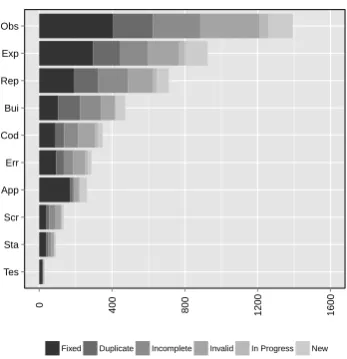
For information, the number of bugs for each bug out-come are shown in Table 2. It is interesting to note here the differences between some of the projects. Facebook in par-ticular has a high number ofIncomplete and Invalid bugs, which may reflect the behaviour stated earlier: non-technical
Tes Sta Scr App Err Cod Bui Rep Exp Obs
0 400 800
1200 1600
[image:7.595.353.527.49.229.2]Fixed Duplicate Incomplete Invalid In Progress New
Figure 8: Number of bug reports where feature is provided, by outcome of bug
users of Facebook using the BTS to report problems with the website, not the API. The high number ofInvalid bugs for Apache is more surprising however, and the reasons are not clear.
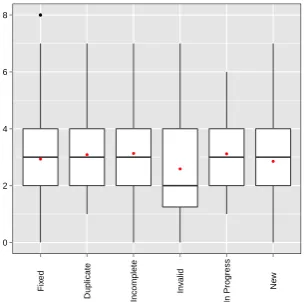
Figure 8 shows for each feature the distribution of even-tual outcomes of the bugs. At first glance, there does not appear to be any strong relationship between individual fea-tures and whether or not the bug is eventually fixed. This can be confirmed by examining the correlations between the presence of each feature and the bug outcome, the signifi-cant values of which (p<0.01) are shown in Table 3. The only exception to this of any note is the Application Code, which has a correlation coefficient of around 0.33 with the outcome ofFixed, but this is still not especially strong. In addition since, as discussed in Section 6,Application Codeis more likely to be provided later on, and often by the devel-oper fixing the bug, this is hardly a useful result. It is also very surprising to note that there is in fact a very weak nega-tivecorrelation between providingSteps to reproduce,Build information, orObserved behaviourand the bug being fixed. There also does not appear to be any evidence for a rela-tionship between the overall amount of information provided and the outcome of the bug. This can be seen by examin-ing Fig. 9 – the range of values seen forFixed bugs does not appear noticeably different to that of other bugs. It does ap-pear that bugs which provide fewer features are more likely to be marked asInvalid, but again this result should not be surprising.
8.
HOW COULD THIS INFORMATION BE
EXTRACTED?
The sample of bugs used in this paper is of a reasonable size, but a much larger number of bugs from a wider range of projects would have to be analysed in order to even approach results which can be generalised. Given the time-consuming nature of the work, this would be tedious to perform man-ually, and it had been initially hoped during the study that much of the work could be automated.
examin-Fixed Duplicate Incomplete Invalid In Progress New
Apache 121 51 23 143 13 49
Eclipse 228 39 21 59 12 41
Facebook 89 43 122 100 23 23
[image:8.595.149.463.52.109.2]Firefox 56 110 115 64 3 52
Table 2: Bug outcomes by project
Fixed Duplicate Incomplete Invalid In Progress New
Obs -0.09 0.03 0.08 0.02 0.05 -0.05
Exp 0.03 0.02 -0.03 -0.12 0.03 0.11
Rep -0.08 0.09 0.13 -0.07 -0.01 -0.03
Bui -0.12 0.18 0.11 -0.1 -0.06 0.01
Cod -0.06 -0.02 0.06 0.05 0.04 -0.06
Err 0.02 -0.01 0 0.01 0.04 -0.05
App 0.33 -0.13 -0.16 -0.15 0 0.06
Scr -0.02 -0.01 0.07 0 0.02 -0.04
Sta 0.07 -0.01 -0.01 -0.02 0 -0.04
[image:8.595.160.452.136.253.2]Tes 0.09 -0.03 -0.05 -0.04 0.05 0
Table 3: Correlation between features and bug outcomes
● ●
● ●
● ●
● ●
0 2 4 6 8
Fix
ed
Duplicate Incomplete In
v
alid
In Progress
Ne
w
Figure 9: Range of number of features for each bug outcome
ing the type of attachments or linked files. This would not be entirely accurate however; Firefox Bug 372163 contains a screenshot of how the application looks after the user’s proposed patch has been applied, so is essentially a mockup. For Firefox Bug 321832, screenshots were provided, but they were embedded within a word-processing document. This may not present much of an issue for a developer, but would vastly overcomplicate automated image processing.
Previous techniques have also been developed to identify
Stack traces [5] but these are not entirely accurate. Similar approaches may be possible for other structured features, such asCode examples or Application Code, but these are likely to be very challenging. As was shown earlier, these structured pieces of text are usually mixed liberally in with unstructured information.
Three of the most important features however –Observed
behaviour,Expected behaviour andSteps to reproduce – are
even more difficult to obtain automatically. These are un-structured features, and may or may not be explicitly marked by the user providing information. One proposal is to search
Rep Exp Obs
0
400 800 1200 1600
[image:8.595.100.253.289.440.2]True positives False positives False negatives
Figure 10: Automatically extracted features
for instances where the user does explicitly say they are pro-viding a particular feature. To test this, the bug descriptions were processed by a Python script which searched for likely alternative terms or phrases, or possible abbreviations for
Observed behaviour,Expected behaviour andSteps to
repro-duce. This script also ignored differences in case, spacing and minor spelling variations.
[image:8.595.342.538.290.387.2]9.
HOW COULD THIS INFORMATION BE
USED BY AUTOMATED TOOLS?
One of the key motivations behind this study was to try and address the problem of bug localisation [27, 12]. Devel-opers are known to spend a high proportion of their time on bug fixing and maintenance - often reported to be in excess of 50% - which represents a significant cost to the software industry [21, 24]. Even before they can start working on a fix, developers often need to spend a substantial amount of time just determining where in the code the problem ac-tually lies [8]. Bug localisation techniques aim to support developers by providing them with clues as to the where-abouts in a system of the source of a bug. For example, previous work by the authors has explored how the similar-ity between bug reports can be used towards this end [11], and more recently has explored how a wider range of infor-mation (such as the various sources identified in this paper) can be combined to provide the developer with a ranked list of methods, ordered by the probability that they are the source of a particular bug [10]. A key requirement of such approaches is that not only the extent to which such infor-mation is available, but, as this section explores, also the degree to which it can be automatically extracted by tools.
Steps to reproduce
,
Expected behaviour,
Observed behaviour.
These features are all provided relatively often, and usu-ally within the main bug description. However, the majority of the time they cannot be automatically separated from one another, or from the remainder of the bug description. As such, the most appropriate way to use these features is likely to mean keeping the description as a whole, and using in-formation retrieval (IR) techniques to relate the bug to the source code or to find similar bugs.
Stack traces
,
Error reports.
These features may be simpler to extract from bug reports than many other features, although they are not entirely straightforward. However, they are not present in a large number of bugs. While they could therefore be an appro-priate source of additional information to use in automated tools, they are not applicable for many bugs, and may be of most use only when used in conjunction with other sources of information.
Screenshots
.
A combination of the difficulty of extracting information
fromScreenshots along with their relative scarcity mean it
would be quite challenging to produce any significant bug fixing tools utilisingScreenshots, with little applicability.
Code examples
.
Code examples are not common. In addition, the
lan-guage of the code is often not the same as the lanlan-guage of the application itself. For example, Eclipse is written in Java, and while the majority of its usage is also for Java programs, plug-ins exist for a myriad of different languages, and sample code could be in any of them. Similar issues ex-ist for the other applications investigated in this study. Like
Screenshots then, it may be difficult to take advantage of
information fromCode examples for automated bug fixing, and it is likely to be applicable only to a few bugs, since very
few bugs provide the appropriate information.
Application Code
.
Application Codewas not particularly common in the given
bug reports. Additionally, as the provision of such code usu-ally indicates that the reporter has already performed some investigation of the bug on their own, utilising this informa-tion for bug fixing may not provide any significant benefit to the developers.
Test cases
.
Much research has already been done on using failing test cases to determine bug locations. This work shows however that it is very rare for such tests to be provided by the user. Furthermore, many of the tests will not be provided in the same form as any existing test suite. Developers will therefore usually still be required to construct new test cases themselves in order to utilise such techniques.
Version
,
Build information.
The limited amount of information in these fields mean they are unlikely to provide much assistance with bug fixing on their own, but they could be used as part of a larger system.
10.
THREATS TO VALIDITY
The following threats to validity were identified in relation to this work.
The choice of projects is limited and restricted to open
(and therefore public) BTSs. Although we have tried to select a diverse set of systems, this small set cannot be re-garded as representative. Furthermore, it is possible that different behaviour might be observed in a closed BTS.
The types of information submitted may be related to
the type of user submitting the bug. For example, a stack
trace or a test case may be more likely to be submitted by a developer than a less technically aware user and may have skewed the results.
Theanalysis of information provided is performed
man-ually and by necessity is limited in depth. For example, if the report contained “Steps to Reproduce” then these were considered as present but the steps themselves were not ac-tually validated. This introduces an element of subjectivity and may also influence the findings regarding the relation-ship between the presence of features and the outcome (for example, just because a piece of information is present does not mean it is particularly relevant or useful).
11.
CONCLUSIONS
This paper has examined 1600 bugs across 4 projects and detailed how often users provide each part of a bug report. Admittedly this is from a small sample of projects, and repli-cations and extensions of this work are necessary2, but these are substantial and mature projects with an active user base and experienced developer teams.
From this information, it is clear that in many cases, bug reports are not complete or accurate, and often do not pro-vide all the information that developers would wish to find,
2
or could use, to fix bugs. The quality of bug reports is im-portant for developers as it impacts upon the time they take to resolve and issue, but it also has important implications for research investigating other points of the bug life cycle.
The findings from this paper also have significant implica-tions for techniques which aim to provide some form of au-tomated support for the problem of bug localisation. Some of the most successful techniques rely on the presence of test cases or stack traces, and these are two of the least fre-quently occurring items. Even if they are present in a bug report there is the additional challenge of automatically ex-tract this information – it is also clear that most bug track-ing systems were not designed with automation in mind and preponderance of free text, and variety of mechanisms for providing additional information provide yet further obsta-cles for any form of automated support. Finally, even though they could not be argued to be representative of all projects, another factor that any automated tool would need to take into account is how both the type of information provided and manner in which it is recorded is likely to vary between systems.
12.
REFERENCES
[1] Apache HTTP.http://httpd.apache.org. [2] J. Aranda and G. Venolia. The secret life of bugs:
Going past the errors and omissions in software repositories. InProceedings of the International
Conference on Software Engineering, 2009.
[3] N. Bettenburg, S. Just, A. Schr¨oter, C. Weiß,
R. Premraj, and T. Zimmermann. What makes a good bug report? Foundations of Software Engineering, 2008.
[4] N. Bettenburg, R. Premraj, and T. Zimmermann. Duplicate bug reports considered harmful . . . really?
InProceedings of the International Conference on
Software Maintenance, 2008.
[5] N. Bettenburg, R. Premraj, T. Zimmermann, and S. Kim. Extracting structural information from bug reports. InProceedings of the Working Conference on Mining Software Repositories, 2008.
[6] S. Breu, R. Premraj, J. Sillito, and T. Zimmermann. Information needs in bug reports: improving cooperation between developers and users. In
Proceedings of the Conference on Computer Supported
Cooperative Work, 2010.
[7] Bugzilla.http://www.bugzilla.org.
[8] S. Bugde, N. Nagappan, S. K. Rajamani, and G. Ramalingam. Global Software Servicing: Observational Experiences at Microsoft. In
Proceedings of the International Conference on Global
Software Engineering, August 2008.
[9] D. ˇCubrani´c and G. C. Murphy. Automatic bug triage using text categorization. InProceedings of the International Conference on Software Engineering and
Knowledge Engineering, 2004.
[10] S. Davies and M. Roper. Bug localisation through diverse sources of information. InISSRE
(Supplemental Proceedings), pages 126–131, 2013.
[11] S. Davies, M. Roper, and M. Wood. Using bug report similarity to enhance bug localisation. InProceedings
of the Working Conference on Reverse Engineering,
2012.
[12] B. Dit, M. Revelle, M. Gethers, and D. Poshyvanyk. Feature location in source code: a taxonomy and survey.Journal of Software Maintenance and
Evolution, November 2011.
[13] Eclipse.http://www.eclipse.org.
[14] Facebook.https://developers.facebook.com. [15] Mozilla Firefox.http://www.mozilla.org/firefox. [16] GDB.http://www.gnu.org/software/gdb/. [17] P. J. Guo, T. Zimmermann, N. Nagappan, and
B. Murphy. Characterizing and predicting which bugs get fixed: an empirical study of Microsoft Windows. In
Proceedings of the International Conference on Software Engineering, 2010.
[18] P. Hooimeijer and W. Weimer. Modeling bug report quality. InProceedings of the International Conference
on Automated Software Engineering, 2007.
[19] A. J. Ko and P. K. Chilana. How power users help and hinder open bug reporting. InProceedings of the CHI
Conference on Human Factors in Computing Systems,
2010.
[20] A. G. Koru and J. Tian. Defect handling in medium and large open source projects.IEEE Software, 21(4), 2004.
[21] T. D. LaToza, G. Venolia, and R. DeLine. Maintaining Mental Models : A Study of Developer Work Habits.
InProceedings of the International Conference on
Software Engineering, 2006. [22] Mozilla.http://www.mozilla.org.
[23] A. Schr¨oter, N. Bettenburg, and R. Premraj. Do stack traces help developers fix bugs? InProceedings of the
Working Conference on Mining Software Repositories,
May 2010.
[24] J. Singer, T. C. Lethbridge, N. Vinson, and
N. Anquetil. An examination of software engineering work practices. InProceedings of the Centre for
Advanced Studies Conference, November 1997.
[25] strace.http://sourceforge.net/projects/strace. [26] truss.http://docs.oracle.com/cd/E19082-01/
819-2239/truss-1/index.html.
[27] W. E. Wong and V. Debroy. A Survey of Software Fault Localization. Technical Report UTDCS-45-09, 2009.
[28] D. Yuan, H. Mai, W. Xiong, L. Tan, Y. Zhou, and S. Pasupathy. SherLog : Error Diagnosis by