Department of Marketing
Value Co-Creation: Exploring the effects of
collaborating with a proactive generation of
customers.
by
Matthew James Alexander
A thesis presented in fulfilment of the requirements
for the degree of Doctor of Philosophy
ii
Copyright Statement
This thesis is the result of the author’s original research. It has been composed by the
author and has not been previously submiteed for examination which has led to the
award of a degree.
The copyright for this thesis belongs to the author under the terms of the United
Kingdom Copyright Acts as qualified by University of Strathclyde Regulation 3.50.
Due acknowledgement must always be made of the use of any material contained in,
or derived from, this thesis.
Signed: _________________________________
iii
Acknowledgments
Completing this thesis has been a challenging, but at all times rewarding, journey
of self-discovery for someone who never thought that it would be possible. All good
journeys require companions and I am extremely fortunate in having had some of the
best.
Firstly, to Professor Heiner Evanschitzky I have the deepest debt of gratitude
possible to someone who is quite probably the perfect supervisor. When I first met
Heiner I was both in awe and slightly terrified of him but at all times he has been
patient, encouraging and inspirational in equal measure. In particular his soothing
replies to panicky emails about statistics at 10 o’clock at night have kept me sane. I
am extremely relieved and flattered that he kept me on despite moving Universities
and I look forward to many nice coffees and meals in the future!
Dr Rowena Murray taught me how to write. Probably the best accolade I can
come up with. After coaching me through my MPhil, Rowena was parachuted in to
the PhD at a critical stage as 2nd supervisor and once again had a huge impact in
helping me to get it done. Thanks for all the time, strategic carrot and stick and
access to Tunnock’s Caramel Wafers. I am very proud to have been supervised by
you – thankfully I didn’t change the game plan.
I need to offer a great deal of thanks to everyone who has contributed to making
this PhD possible. To everyone who has been interviewed or filled out a survey I
could not have done it without you. Thanks to Lucy Taylor for getting up very early
in the morning to distribute surveys on station platforms and to all my other station
raters Dominic, Sara, Lisa, Ross and Joanna. Heartfelt thanks go to John Yellowlees
at First ScotRail, I am extremely glad to have met you and very much in your debt
for all the support.
It has not always been the easiest or smoothest career ride for me over the last few
years and I would like to thank various colleagues at Strathclyde Business School
and beyond for their help, advice, support and friendship. To Dr Jillian Gordon, my
writing buddy, thanks for the listening ear and many hours of typing comradeship, I
iv
support, well-aimed kicks and constant nagging – it might just have worked! To Dr
Elina Jaakkola from the Turku School of Economics in Finland, thank you for your
critical eye, Nordic scepticism and willingness to engage in debate about words
beginning with co-!
Special thanks go to my generous colleagues who have always been there when
needed and have given of their time (and mostly their ears) when I have been
stressed. In particular thanks go to Dr Derek Bryce and Dr Kathy Hamilton for
flicking through the final version and not being too critical. Finally, in no particular
order, other colleagues who have been there for me at various times for supportive
tea breaks, advice and encouragement (in no particular order): Dr Beverly Wagner,
Andrea Tonner, Dr Kathryn Thory, Dr Morag Findlay, Dr Janis McIntyre, Andrew
MacLaren, Dr Morag Thow, Dr Juliette Wilson.
I would like to thank my parents Stephen and Stephanie Alexander and ‘in-laws’
Harry and Lorna Crawford who have contributed a lot by supporting the family
particularly when I needed to be away. To my daughters Sophie and Megan, thanks
for your constant reminders that there is life outside of a PhD; you have kept my feet
on the ground at all times. To Harry, thanks for coming along at precisely the right
time; just the right amount of motivation I needed to finish.
Finally, to my wife Jane; thank you for being a constant source of support,
patience and motivation. You have kept me going through the many tough times and
have dealt with the anxiety, elation, stress, panic and all the other emotions with the
same love, assurance and tolerance – this is all for you.
He gives power to the weak, and to those who have no strength He increases might. Even the youths shall faint and be weary, and young men shall utterly fall. But those who wait on the Lord shall renew their strength; they shall mount up with wings like eagles, they shall run and not be weary, they shall walk and not faint.
v
Table of Contents
ABSTRACT ...XIV
CHAPTER 1.INTRODUCTION ... 1
1.1THESIS AIM ... 4
1.1.1 Research Objectives ... 5
1.2RESEARCH APPROACH ... 5
1.3THESIS OVERVIEW ... 6
CHAPTER 2.LITERATURE REVIEW ... 10
2.1BACKGROUND TO AND PRECURSORS OF CO-CREATION ... 10
2.1.1 The changing nature of ‘Value’ and the role of the customer ... 11
2.1.2 Customer Participation ... 13
2.1.3 Relationship Marketing ... 14
2.1.4 Mass Customization ... 16
2.1.5 Customers as Co-producers ... 18
2.2SERVICE-DOMINANT LOGIC ... 20
2.2.1 Roots ... 20
2.2.2 S-D Logic Foundational Premises ... 24
2.2.3 Co-Creation and the customer within Service Dominant Logic ... 30
2.3VALUE CO-CREATION ... 34
2.3.1 Defining Co-Creation ... 34
2.3.2 Co-Creation Design ... 44
2.3.3 Co-Creation Processes ... 48
2.3.4 Contexts for Co-Creation ... 51
2.3.5 Appropriate Conditions and Benefits ... 52
2.3.6 Challenging Conditions and Drawbacks ... 56
2.4CONCLUSIONS ... 63
CHAPTER 3.RESEARCH METHODOLOGY ... 66
3.1INTRODUCTION ... 66
3.1.1 Aims and Research objectives ... 66
vi
3.1.3 Positivist and Constructivist Worldviews ... 70
3.1.4 Pragmatist Worldview ... 74
3.2RESEARCH DESIGN... 79
3.2.1 Mixed Methods ... 79
3.2.2 Chosen Research Design ... 83
3.3INTEGRATING QUALITATIVE AND QUANTITATIVE RESEARCH ... 89
3.3.1 Approaches to Analysis ... 89
CHAPTER 4. ... STUDY 1: EXPLORING CO-CREATION CONTEXTS AND CONDITIONS ... 92
4.1INTERRATER RELIABILITY EXERCISE ... 93
4.1.1 Results ... 95
4.2INTERVIEWS ... 97
4.2.1 Sampling ... 98
4.2.2 Reflexivity/Bias ... 99
4.2.3 Ethical Considerations ... 100
4.2.4 Data Collection ... 102
4.2.5 Data Analysis ... 104
4.3RESULTS ... 105
4.3.1 Pre-Purchase Stage ... 105
4.3.2 Purchase/Consumption Stage ... 107
4.3.3 Post-Purchase/Service Stage ... 109
4.4DISCUSSION ... 112
4.5LIMITATIONS ... 118
CHAPTER 5.STUDY 2: CONSUMER EFFECTS OF CO-CREATION ... 120
5.1THE ROLE OF TRUST IN VALUE CO-CREATION ... 121
5.1.1 Design and Hypotheses for Trust Experiment ... 122
5.2VALUE CO-CREATION AND EQUITY THEORY ... 124
5.2.1 Design and Hypothesis for Equity Experiment ... 126
5.3EXPERIMENTAL RESEARCH ... 129
5.3.1 Design of Experiments ... 130
vii
5.3.3 Sampling ... 132
5.3.4 Bias ... 133
5.3.5 Experiment Validity ... 135
5.3.6 Pre-test and Manipulation Check ... 137
5.3.7 Experimental Procedures (data collection)... 138
5.4EXPERIMENT 1–VALUE CO-CREATION AND TRUST ... 140
5.4.1 Factor Development and Pre-tests ... 140
Pre-test 1 ... 141
Pre-test 2 ... 141
Pre-test 3 ... 142
5.4.2 Participants and Procedures ... 145
5.4.3 Data Analysis Experiment 1 - Trust ... 146
5.5EXPERIMENT 2–VALUE CO-CREATION AND EQUITY ... 148
5.5.1 Factor Development and Pre-tests ... 149
Pre-test 1 ... 149
Pre-test 2 ... 150
Pre-test 3 ... 150
5.5.2 Participants and Procedures ... 153
5.5.3 Data Analysis Experiment 2 - Equity ... 153
5.6DISCUSSION ... 155
5.6.1 Value Co-Creation and Trust ... 155
5.6.2 Value Co-Creation and Equity ... 157
5.6.3 Limitations ... 158
CHAPTER 6.STUDY 3: THE INDIRECT EFFECTS OF CO-CREATION . 160 6.1INTRODUCTION AND THEORETICAL APPROACH ... 160
6.1.1 Research Context ... 161
6.2QUALITATIVE PHASE –CASE STUDY RESEARCH... 162
6.2.1 Selection of Methods ... 162
6.2.2 Determining Validity of Case Study Research ... 164
6.2.3 Sample ... 166
6.2.4 Data Collection & Analysis ... 167
viii
6.3GENERALISED EXCHANGE THEORY ... 178
6.3.1 Derivation of Hypotheses ... 179
6.4QUANTITATIVE PHASE -MULTI-LEVEL STUDY ... 187
6.4.1 Hierarchical Linear Modelling ... 187
6.4.2 Level 1 –Survey Development and Testing ... 191
6.4.3 Level 1 - Data Collection ... 197
6.4.4 Level 1 - Data Analysis ... 199
6.4.5 Level 2 – Station Rating ... 205
6.4.6 Level 2 - Data Collection ... 205
6.4.7 Level 2 - Data Analysis ... 207
6.5FINDINGS ... 208
6.5.1 Cognitive/Affective Relationship ... 208
6.5.2 Affective Conative Relationship ... 211
6.5.3 Conative Action Relationship ... 214
6.6DISCUSSION ... 214
6.6.1 Community Engagement: Implications ... 215
6.6.2 Indirect benefits for ScotRail Customers ... 217
6.6.3 Conclusion ... 219
6.6.4 Limitations and Future Research ... 220
CHAPTER 7 -GENERAL DISCUSSION ... 221
7.1VALUE CO-CREATION 1(CONTEXTS AND CONDITIONS) ... 221
7.1.1 The nature of the product/service ... 221
7.1.2 The role of the customer ... 226
7.2VALUE CO-CREATION 2(CONSUMER EFFECTS) ... 229
7.2.1 Co-Creation and Consumer Behaviour ... 230
7.2.2 Co-Creation and Consumer Liberation ... 233
7.2.3 Resource Integration ... 236
7.3VALUE CO-CREATION 3(FIRM EFFECTS) ... 240
7.3.1 Value Co-creation: the benefits of engaging customers ... 240
7.3.2 Value Co-Creation: the costs of engaging customers ... 242
ix
CHAPTER 8 - CONCLUSIONS... 247
8.1VALUE CO-CREATION:REFLECTIONS ... 247
8.2METHODOLOGICAL IMPLICATIONS ... 248
8.3CONTRIBUTION 1–THE CONTEXTUAL NATURE OF VALUE CO-CREATION ... 250
8.3.1 Theoretical Implications ... 250
8.3.2 Managerial Implications ... 252
8.3.3 Future Research ... 253
8.4CONTRIBUTION 2–THE EFFECTS OF CO-CREATION ON THE CONSUMER ... 253
8.4.1 Theoretical Implications ... 254
8.4.2 Managerial Implications ... 254
8.4.3 Future Research ... 255
8.5CONTRIBUTION 3–THE WIDER EFFECTS OF VALUE CO-CREATION ... 256
8.5.1 Theoretical Implications ... 256
8.5.2 Managerial Implications ... 258
8.5.3 Future Research ... 258
9.LIST OF REFERENCES ... 261
APPENDIX 1:MIXED METHODS NOTATION ... 289
APPENDIX 2:STUDY 1RATING FORM ... 290
APPENDIX 3:STUDY 1PARTICIPANT INFORMATION SHEET ... 292
APPENDIX 4:STUDY 1INTERVIEW PROTOCOL ... 294
APPENDIX 5:STUDY 2PRE-TEST SCENARIOS ... 296
APPENDIX 6:STUDY 3PASSENGER SURVEY (ADAPTED TO FIT PAGE) ... 300
APPENDIX 7:STUDY 3DATA COLLECTION SPREAD SHEET ... 305
APPENDIX 8:MISSING VALUE ANALYSIS STATISTICS (HAIRMYRES STATION) ... 308
APPENDIX 9:STUDY 3MISSING VALUES,LITTLE’S MCARTEST RESULTS ... 311
APPENDIX 10:STATION RATING FORM (ADAPTED TO FIT PAGE) ... 313
x
List of Tables
Table 2-1 Schools of Thought Influencing Marketing based on (Vargo & Lusch,
2004a, p. 3) ... 21
Table 2-2 Role of operand and operant resources in distinguishing goods-dominant from service-dominant logic (based on (Vargo & Lusch, 2004a, p. 7) ... 22
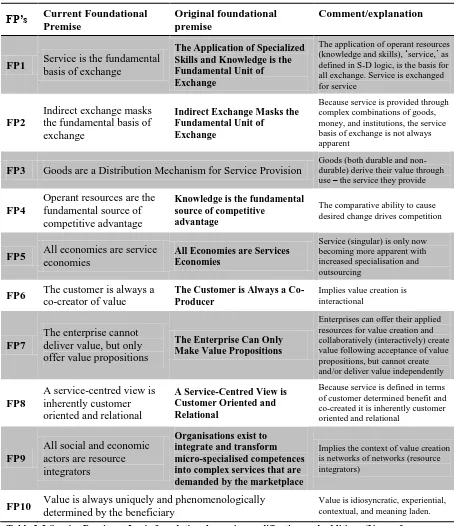
Table 2-3 Service Dominant Logic foundational premise modification and additions (Vargo & Lusch, 2008b) ... 24
Table 2-4 Types of CKM based on (Gibbert, et al., 2002, pp. 464-466) ... 35
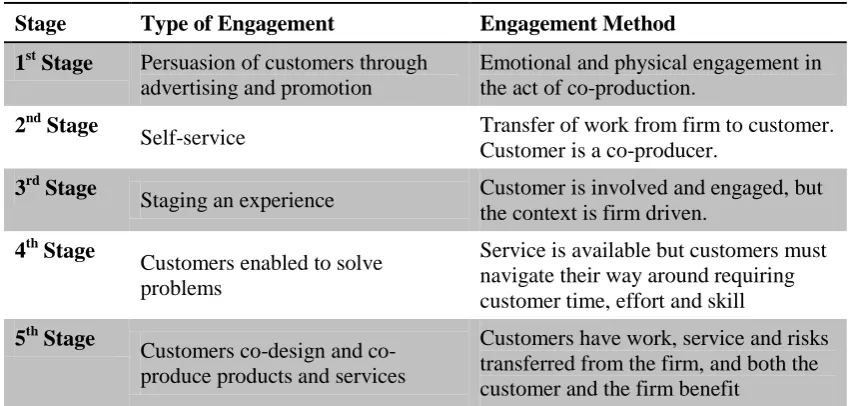
Table 2-5 Co-creation Stages (based on Prahalad, 2004, p. 23) ... 39
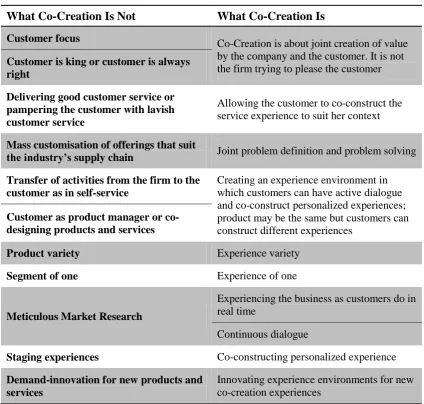
Table 2-6 What Co-Creation is (and is not) (Prahalad & Ramaswamy, 2004b)... 40
Table 2-7 DART Dimensions (Prahalad & Ramaswamy, 2004a, 2004b) ... 46
Table 2-8 Customer Competences (Prahalad & Ramaswamy, 2000) ... 47
Table 2-9 Typology of encounters (Payne, et al., 2008, p. 90) ... 51
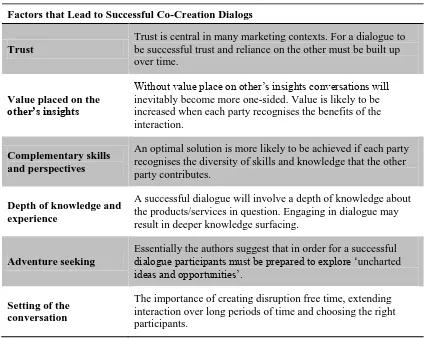
Table 2-10 Factors leading to successful co-creation dialogue (Jaworski & Kohli, 2006, pp. 114-115) ... 56
Table 2-11 When not to co-create the voice of the customer - based on (Jaworski & Kohli, 2006, pp. 115-116) ... 58
Table 3-1 Ontology, epistemology, methodology and method (Guba, 1994; Easterby-Smith, et al., 2008, p. 60) ... 69
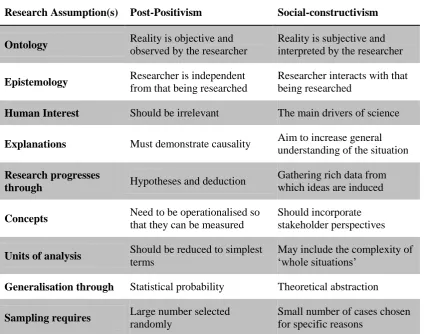
Table 3-2 Contrasting Positivist and Constructivist Approaches ... 72
Table 3-3 A pragmatic alternative to the key issues in social science research methodology (Morgan , 2007, p. 71) ... 77
Table 3-4 Comparison of Philosophical Worldviews (based on Creswell, 2009, pp. 7-11) ... 79
Table 3-5 Mixed Methods Research, Stages of Development (Creswell & Plano Clark, 2011, pp. 23-25) ... 81
Table 3-6 Strengths and Weaknesses of Mixed Methods Research (Davis, et al., 2011; and Johnson & Onwuegbuzie, 2004, p. 21) ... 82
xi
Table 3-8 Strength and Challenges of multi-phase research designs (Creswell &
Plano Clark, 2011) ... 87
Table 4-1 Service Firms Used for Interrater Exercise ... 93
Table 4-2 Revised standards for interpreting IRA estimates (LeBreton & Senter, 2008, p. 836) ... 96
Table 4-3 IRA and Mean Scores for Firm Sample ... 96
Table 4-4 non-probability sampling methods (Jankowicz, 2005; Teddlie & Tashakkori, 2009) ... 98
Table 4-5 Interviewee details and codes used during analysis ... 99
Table 4-6 Ethical Issues in Qualitative Research (Miles & Huberman, 1994) ... 101
Table 4-7 Value co-creation dimensions for interview questions ... 103
Table 5-1 Types of Random Assignment Experiments (Keppel, 1991;Shadish et al 2002) ... 131
Table 5-2 Sources of experimenter bias ... 134
Table 5-3 Approaches to experimental studies (Calder, et al., 1981; Winer, 1999) 137 Table 5-4 Value Co-Creation Indicators ... 140
Table 5-5 Scenario's for Trust Experiment ... 143
Table 5-6 Dependent Variables and Scales for Trust Experiment ... 145
Table 5-7 Cell Means of the Dependent Variables (Exp. 1) ... 147
Table 5-8 Scenarios for Equity Experiment ... 151
Table 5-9 Intervening, Confounding & Dependent Variables for Equity Experiment ... 152
Table 5-10 MANOVA Results for Equity Experiment *= <0.1, ** = <0.05, *** = <0.01 ... 154
Table 5-11 Pairwise Mean Comparison (Exp. 2) ... 155
Table 6-1 Sources of Evidence in Case Studies, p. Strengths and Weaknesses (Yin, 2003, p. 86) ... 163
Table 6-2 Establishing Validity in Constructivist Research (Easterby-Smith et al, 2004, p.53) ... 164
Table 6-3 Case study tactics for Four Design Tests (Yin, 2003, p. 34) ... 165
Table 6-4 Cases and Interviewees for the study... 166
xii
Table 6-6 Types of Missing Values ... 200
Table 6-7 Discriminant Validity and CFA criteria for Level 1 ... 203
Table 6-8 Construct Validity for Level 1 Data ... 204
Table 6-9 Final Estimation of Variance Components (Cognitive-Affective) ... 209
Table 6-10 Estimates for Two Level Model (Cognitive Affective) ... 210
Table 6-11 Final Estimation of Variance Components (Affective Conative) ... 212
Table 6-12 Estimates for Two Level Model (Affective Conative) ... 213
Table 6-13 Final Estimation of Variance Components (Conative Action) ... 214
Table 7-1 Summary co-creation scores from chapter 4 ... 222
xiii
List of Figures
Figure 1-1 Research Approach... 6
Figure 2-1 Precursory Concepts to Value Co-Creation ... 13
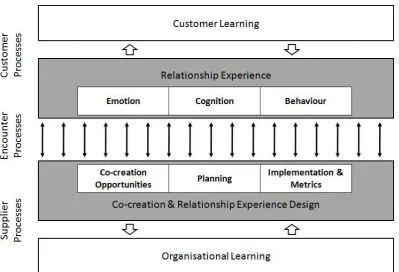
Figure 2-2 A conceptual framework for value creation (Payne, et al., 2008, p. 86) .. 50
Figure 3-1 Sequential Exploratory Design (Creswell, 2009, p. 209) ... 84
Figure 3-2 Multiphase design (Creswell & Plano Clark, 2011, p. 102) ... 86
Figure 3-3 Sequential Exploratory Multiphase design (Creswell, 2009; Creswell & Plano Clark, 2011) ... 88
Figure 4-1 The continuum model for interviews (Punch, 2005) ... 97
Figure 4-2 Conditions for Mutually Beneficial Co-Creation ... 114
Figure 5-1 Model for Trust Experiment ... 123
Figure 5-2 Model for Equity Experiment... 126
Figure 5-3 Interaction effects for Dependent Variables ... 154
Figure 6-1 Gardening at Uddingston Station ... 169
Figure 6-2 Refurbished Exterior at Wemyss Bay ... 170
Figure 6-3 Bookshop at Pitlochry ... 171
Figure 6-4 Customising the Station at North Berwick ... 172
Figure 6-5 The Four Stage Loyalty Model ... 181
Figure 6-6 Multi-Level Model ... 191
Figure 6-7 Rail Network Map ... 192
xiv
Abstract
Value Co-Creation plays a central role within the Service-Dominant Logic of
marketing. However, value co-creation is largely conceptual and lacks empirical
evidence around both the appropriate contexts and conditions for collaborative
co-creation and effects on firms and customers. Using a mixed methods research design
this thesis explores value co-creation through a sequential-exploratory, multi-phase
approach. The first study is exploratory and qualitative with results influencing two
further empirical studies, one quantitative and the other mixed method.
This first study used expert ratings and in-depth interviews to explore value
co-creation within a three-stage purchasing cycle. The results indicated differing
approaches and a conceptual model is presented highlighting conditions under which
firms might take advantage of opportunities for value co-creation.
The second study used experiments to test the effect of co-creating on consumers;
in particular, the role of trust and equity in co-created exchanges. The results showed
how in co-created exchanges, trust and relationship investment are key in improving
customer intentions, and how co-creating can reduce the negative impact of
perceived inequity.
The third study used a mixed methods approach to consider the indirect effect of
co-creating on other customers. A case study approach with a public transport
provider revealed how co-creation at railway stations might affect passenger
behaviour. A hierarchical linear modelling study shows how co-creation at station
level has an indirect effect on affective and conative loyalty.
The thesis contributes to our understanding of value co-creation by reinforcing the
contexts and conditions where collaborative forms of co-creation might be best
employed. The thesis also shows how co-creating affects the consumers involved and
the implications of this for firms. Finally, the thesis contributes by revealing how
co-creating with a relatively small group can have a positive effect on a wider group of
customers.
xv
‘Today the customer is in charge and whoever is best at putting the
customer in charge makes all the money’
Stephen F. Quinn, Senior Vice President for Marketing, Wal-Mart
This thesis is dedicated to my father Stephen James Alexander, a man who works
1
Chapter 1.
Introduction
Service delivery is an interactive and dynamic process where the customer has
always played an important, participative role (Auh, Bell, McLeod, & Shih, 2007;
Baker, Cronin Jr, & Hopkins, 2009; Berry, 1995; Claycomb, Lengnick-Hall, & Inks,
2001; Dong, Evans, & Zou, 2008; Gummesson, 1995; Toffler, 1980). Conceptually,
this role is usually played out within a traditional exchange process with customers
‘outside the firm’ within a ‘value chain’ epitomizing the ‘unilateral role of the firm in
creating value’ (Prahalad & Ramaswamy, 2004b, p. 6). However, the customer
process element of service delivery is more than a passive exchange of money for
goods or services. Services marketing identifies how customers are inseparable to the
service encounter (Bateson, 1985; Zeithaml, Parasuraman, & Berry, 1985) i.e.
actively involved in the creation of service value manifested by: undertaking duties
normally associated with service employees (Mills & Morris, 1986; Schneider &
Bowen, 1995); increasingly by engaging with self-service technology (Dabholkar &
Bagozzi, 2002; Meuter, Bitner, Ostrom, & Brown, 2005; Meuter, Ostrom,
Roundtree, & Bitner, 2000); or by cooperating and working collaboratively with
service personnel (Prahalad & Ramaswamy, 2000; Rowley, Kupiec-Teahan, &
Leeming, 2007).
Our understanding of the role of consumers in recent years has evolved from
passive recipients of goods and services to proactive collaborators in the activities of
an organisation (Fournier & Avery, 2011; Prahalad & Ramaswamy, 2000, 2004a;
Schau, Muñiz Jr, & Arnould, 2009; Sheth & Uslay, 2007; Zwick, Bonsu, &
Darmody, 2008); an evolution triggered by the increased complexity, global presence
and knowledge intensity that firms are exposed to requiring a more effective use of
resources (Rowley, et al., 2007) including those brought by customers (Claycomb, et
al., 2001; Lengnick-Hall , Claycomb, & Inks, 2000). Firms are redefining their
perspectives of the resources available to include customers as participants in, not
merely recipients of, service delivery (Claycomb, et al., 2001; Lengnick-Hall , et al.,
2
Organisations that treat their customers as only end user consumers of their services will lose the service game to organizations that involve their customers in a variety of other roles that deepen the customer service provider relationship (Schneider & Bowen, 1995, p. 84).
It is the context of changing roles (as proactive participants in the service process)
and changing perspectives of the customer (as a valued resource) that has
precipitated the concept of Value Co-Creation.
Value Co-Creation has gained considerable prominence through its inclusion
within Service-Dominant Logic (S-D logic), a radical new perspective on marketing
that forms the conceptual grounding for this thesis (Vargo & Lusch, 2004a, 2006,
2008b, 2010). This pre-theory of marketing (Vargo, 2007) suggests a paradigmatic
shift in our understanding of how value is created and one of the ten foundational
premises of S-D logic is that ‘the customer is always a co-creator of value’ (Vargo &
Lusch 2008b, p.8). S-D logic suggests that value is not created by the firm but by the
customer in use as a co-creator of value and resource integrator. Crucially for this thesis the term within S-D logic does not have to represent direct interaction or
collaboration but occurs within all forms of exchange. The premise is largely
conceptual and is relates more to our fundamental understanding of value creation
with the changing nature of firm and customer collaboration only included as a
subordinate element (Lusch & Vargo, 2006c). Many other authors, however, use the
term co-creation as representative of the growing role that customers play in
organisations and the blurring of the boundaries between firm and customer activity
(Prahalad & Ramaswamy, 2004a; Zwick et al 2008; Schau et al 2009). It is suggested
that firms should endeavour to develop more innovative ways to involve customers
as interactive participants of the Value Co-Creation process (Prahalad &
Ramaswamy, 2004c). This thesis focuses on value co-creation that occurs through
direct interaction and collaboration.
It has been suggested that S-D Logic does not go far enough in recognising the shift
in the way that organisations ‘elicit value from customers’ (Macdonald, Wilson,
Martinez, & Toossi, 2011, p. 672) and a universal definition is elusive (Minkiewicz,
Evans, & Bridson, 2010; Ostrom et al., 2010; Schau, et al., 2009). Conceptualisations
are scattered and fragmented with Schau et al (2009) observing that co-creative
3
Have not been clearly identified and categorized in a uniform or generalizable way, nor has the nature of their value creation been revealed. In essence, we know that value is cocreated, but we do not know how, which makes replicating successful cocreation strategies within a product category and even within the firm difficult and transferring successful practices from one product domain to another nearly
impossible (Schau, et al., 2009, p. 31).
It seems that, under certain conditions, some firms might derive success from a
cocreation strategy (Jaworski & Kohli, 2006; Prahalad & Ramaswamy, 2004a). But
it is less clear if collaborative forms of value co-creation would be universally
beneficial with many authors highlighting pitfalls and risks associated with closer
collaboration with customers (Gray, et al., 2007; Kalaignanam & Varadarajan, 2006;
Oliver, 2006; Rust & Thompson, 2006). Consideration is needed on how the
enhanced role played by customers within service encounters impacts on both
consumer and firm, something largely missing from S-D logic (Sweeney, 2007) but
which could impact consumer welfare and ultimately firm performance (Rust &
Thompson, 2006).
The speed in which academics are advocating a paradigmatic shift within the
marketing discipline (Arnould, 2006; Lovelock & Gummesson, 2004; Vargo, 2007)
and the desire to set value co-creation up as a foundation of marketing (Sheth &
Uslay, 2007) is somewhat in juxtaposition with the lack of clarity over the concept
and how it impacts both firm and customer (Hoyer, Chandy, Dorotic, Krafft, &
Singh, 2010; Ostrom, et al., 2010; Schau, et al., 2009; Zwick, et al., 2008). The need
to co-create, refine and advance S-D logic through empirical study is encouraged
(Brown , 2007). Vargo and Lusch (2011) (custodians of S-D logic) present it as
open-source requiring input from a community of scholars to generate, test,
transform or, if appropriate, abandon the theory (Gummesson, Lusch and Vargo,
2010). The following sections of this chapter outline the aims of the thesis and
research objectives aim to address this knowledge gap through a literature review
and three related empirical studies. The chapter concludes with an overview of the
4
1.1 Thesis Aim
The overall aim of the research was to:
Investigate the value co-creation concept and its impact on consumer behaviour and firm performance.
This broader aim was designed to explore both the nature of value co-creation,
(considering how environmental and operating conditions may influence the way
firms engage customers as collaborators) and also to explore how value co-creation
might affect both firms and customers. This aim was influenced by recent texts
relating to value co-creation which highlight many unexplored issues. There is
consensus among authors that many aspects of value co-creation are not well
understood (Hoyer, et al., 2010; Schau, et al., 2009). In particular authors highlight a
need to understand the conditions for value co-creation (Gustafsson, A. in Ostrom, et
al., 2010) and build understanding in how to ‘manage co-created services because the
underlying mechanisms that link consumers and organizations are not well
understood’ (Bolton, R. in Ostrom, et al., 2010, p. 24). The debate of issues such as
these is seen as fundamental to the development of marketing to prevent the field
‘playing catch-up with the dynamics of a structural real-world shift taking place in
front of our eyes, one that is fundamentally altering the very nature of relationships
among individuals and institutions (Ramaswamy, 2011, p. 195).
Value co-creation is a hypernym (or superordinate term (Lusch & Vargo, 2006c))
encompassing activity from the phenomenological determination of value by an
individual when creating value-in-use to the highly interactive areas of co-design and
co-innovation. The thesis was designed to provide some explanation of both the
conditions under which collaborative co-creation practices might best be utilised but
also consider the effects of these on firms and customers. The research aim is
5
1.1.1 Research Objectives
It is the knowledge gap relating to conditions under which value co-creation might
be best utilised that leads to the first research objective:
Objective 1: To consider the operating contexts and conditions that influence approaches to value co-creation within the service encounter.
This research objective is initially explored through study 1 and relates to the need
to better understand how different firm and environmental conditions might
influence how firms attempt to engage with customers more closely as collaborators
and the prerequisites needed to ensure that such exchanges are mutually beneficial.
Objective 2: To investigate the impacts of value co-creation on the consumer.
The second research objective considers how consumer collaboration in
co-creation might have direct effects on consumer behaviour under certain conditions.
Specifically, in study 2 the effect of trust firstly and then equitable (and inequitable)
situations on consumer behaviour are explored.
Question 3: To explore the extent to which firms benefit from collaborating with customers through value co-creation.
The final research objective is explored through all studies but principally in study
3 exploring how successful relationships between a firm and customer groups can
result in indirect benefits for a firm.
1.2 Research Approach
After an initial period of immersion in the literature surrounding S-D Logic and
Value Co-Creation it was decided that a multi-study approach to the PhD which
would enable both the broad exploration of this relatively (at the time) unexplored
concept but also that each study would be able to ‘stand-alone’ for submission to
appropriate journals. The data collection for study 1 (see below) was conducted in
summer 2009 and submitted to an academic journal in 2010 and then, subsequently,
resubmitted to another journal in early 2011 where it is currently in the review
6
conference in early 2010. Study 3 was undertaken in summer 2010 and there is a
planned submission to an academic journal in early 2012. As a result studies 2 and 3
relate to the broad research aim but were initially designed to address different
research objectives. The broad approach is a holistic, mixed methods study (Caracelli
& Greene, 1993) where multiple studies, using a range of qualitative and quantitative
methods, explore different facets of a common conceptual framework – value
co-creation. The research design approach is displayed in Figure 1-1. This approach
suggested that an alternative approach to thesis structure and writing was required.
As a result chapters 4 – 6 are standalone in that they contain elements of literature
review and all feature methodology, findings and a brief discussion. The thesis is
overviewed in the following section.
Figure 1-1 Research Approach
1.3 Thesis Overview
The thesis structure meets the needs of the subject area, the philosophical
approach and research design. An initial literature review (Ch.2) is followed by a
chapter addressing the philosophical underpinning of the thesis and the research
design (Ch.3). The next chapter (Ch.4) is empirical and presents the methodology
and results of an exploratory, qualitative study (Study1) investigating the value
co-creation context. The findings of study 1 suggested that existing theories could be
used as lenses to understand the value co-creation concept and these theories are
explored by further empirical study. The following two chapters introduce two
further studies, with an experimental research study (Ch.5) testing the effect of
7
exploring the indirect effects of value co-creation activity (Ch.6). All studies explore
different impacts of value co-creation on customers and firms. A discussion chapter
follows (Ch.7) which considers the broad contribution of the three empirical studies
against the research objectives and considers the impacts on our understanding of
value co-creation. The concluding chapter (Ch.8) outlines the main contribution of
the thesis. A summary of each chapter is as follows:
Chapter 2 reviews the literature associated with value co-creation. Initially the
chapter explores the changing role of the customer through concepts which pre-date
value co-creation but nevertheless have influenced the concept, namely, customer
participation, co-production, mass customisation, and relationship marketing. The
chapter continues by introducing S-D Logic as an alternative ‘worldview’ of
marketing presented by Vargo and Lusch (2006b, 2006c, 2011; 2004a, 2004b, 2006,
2008a, 2008b, 2008c; 2010; 2010). S-D Logic suggests that marketing has, or is at
least in the process of, a paradigm shift away from a goods-dominant logic (where
firms embed goods with value which is then passed on to customers) to a
service-dominant logic (where firms offer value propositions converted to value in use by
customers, phenomenologically, through co-creation and resource integration). One
foundational premise of S-D Logic is that ‘the customer is always a co-creator of
value’ and the final section of the chapter specifically addresses value co-creation
and how it has been conceptualised in the literature. A definition is presented and
discussed and the benefits and drawbacks associated with engaging customers as
collaborators in particular contexts are explored.
Chapter 3 introduces the research design strategy for the PhD. Initially, the
post-positivist and constructivist worldviews are discussed and critiqued. The worldview
adopted by the thesis is pragmatism offering an alternative to the other, dualistic,
research philosophies. The research objectives suggest a mixed methods approach
and the pragmatist worldview supports this by allowing researchers the use of both
narrative and numerical forms of data (Creswell, 2009; Creswell & Plano Clark,
2011; Morgan, 2007; Teddlie & Tashakkori, 2009); a pluralistic approach allowing
researchers in the social sciences to focus attention on the research problem and
adopt the most appropriate methods (Creswell, 2009; Morgan , 2007; Teddlie &
8
methods data and argues for an adaptation of mixed methods designs resulting in the
use of a sequential exploratory, multi-phase design where an initial qualitative study (Ch.4) is followed by two quantitative studies (Ch.5/6).
Chapter 4 presents the results of the exploratory qualitative study (Study 1)
which investigated how co-creation occurs within the service encounter in a range of
service firms. Using a combination of expert ratings and in-depth interviews the
concept was explored within a three stage purchasing cycle. The results indicated
how firms differ in their approach to value co-creation and a conceptual model is
presented highlighting the conditions under which firms can take best advantage of
opportunities for value co-creation explored before, during and after the point of
direct exchange. The study highlights the conditional nature of some forms of value
co-creation requiring more in-depth understanding at a conceptual, empirical and
practical level.
Chapter 5 investigates the effects of value co-creation using theory suggested in
chapter 4. This second study introduces two experiments; the first exploring the
moderating effect of trust on consumer willingness to pay a price premium and
continue purchasing with a firm under conditions where trust and value co-creation
are manipulated. The second experiment used equity theory to explore the extent to
which increased customer inputs to the service exchanges could be affected by
perceived inequity.
Chapter 6 explores the extent to which co-created exchanges might have indirect
benefits for other customers. This chapter uses Generalised Exchange Theory as the basis for exploring these effects. The study explores the indirect effects of value
co-creation between a rail company and community groups at local railway stations on a
wider customer base. A series of case studies and other extant literature are used to
develop hypotheses which are tested using a multi-level study where 1381 surveys
collected at 60 railway stations forms the first level of data, and a set of independent
ratings of each railway station along with objective data on the stations forms the
second level.
Chapter 7 presents an overarching synthesis of the results of all three studies and
9
data for all three studies is used, where appropriate, with all three objectives. The
chapter discusses the operating conditions that facilitate value co-creation; the role of
the customer in value co-creation introducing a co-creation consumer impact matrix;
and finally the effects of value co-creation on the firms including both direct and
indirect outcomes.
Chapter 8 reflects on the value co-creation concept and presents the three main
contributions of the thesis which relate to: the contextual nature of value co-creation,
effect on the consumer, and the wider, indirect benefits that can result from firm
engagement in value co-creation activity. Theoretical and managerial implications
are presented along with suggestions for future research.
The following chapter presents a review of literature relating to S-D Logic, value
co-creation and other related concepts. Conditions under which co-creation might be
fostered and the benefits and challenges of engaging customers as collaborators in
10
Chapter 2.
Literature Review
This chapter reviews the literature associated with value co-creation accounting
for the background, development and debate surrounding the concept. The first
section explores precursors to co-creation highlighting how changing views of
consumer roles have been precipitated through concepts such as relationship
marketing and mass customisation.
The second section introduces and explores Service-Dominant Logic (Vargo &
Lusch, 2004a) a proposed new ‘worldview’ of marketing centring on a shift in focus
from dyadic exchanges of ‘goods’ to ‘service for service’ exchanges within and
between networks and service systems (Vargo & Lusch, 2008b). Key to
service-dominant logic and this thesis is the foundational premise that ‘the customer is
always a co-creator of value’ (Vargo & Lusch, 2008b, p. 9) a statement with
implications for the way in which customers derive value from purchases but which
also hint at a change in the fundamental nature of interactions between customer and
firm. The logic will be discussed alongside reactions and its implications for
research.
The third section of the chapter presents a discussion of value co-creation
focussing on the plurality of conceptualizations and perspectives within the literature.
The section attempts to draw together both complementary and divergent viewpoints
and presents the definition adopted within this thesis. Despite the widespread
adoption of value co-creation (or related concepts) by the academic community there
is little understanding of the conditions within it would be most successfully adopted
as a normative strategy for engaging customers as collaborators. The chapter
concludes by exploring conditions under which co-creation might have both a
positive and negative impact on firms and customers.
2.1 Background to and Precursors of Co-Creation
Co-creation is more than simply a label to place on contemporary firm/customer
11
precursory ideas and concepts can be identified which have contributed to a
significant shift in our perspectives on, and management of, customer/firm
interactions; changes which have, in part, led to the paradigm-like shift suggested by
Service-Dominant logic, challenging existing marketing logic and the way
businesses understand and interpret the roles of firm and customer. The first step is to
consider how changing perspectives of customers has led to new ways of
understanding value and value creation.
2.1.1 The changing nature of ‘Value’ and the role of the customer
Ramírez (1999) argues that in the 20th century, value was firmly embedded in the
production process of the value chain and value creation was essentially sequential
and ‘value-adding’. The customer, far from being a co-creator was viewed more as a
destroyer of the value created for them by producers (Ramírez, 1999) this is captured
by accounting systems that steadily right off the value of assets over a period of
depreciation. Value equalled the price the customer paid for the product or service
they were provided. In opposition to this view, Ramírez presented an argument,
going back some 300 years, for a system where customers create value or ‘more
exactly co-create and even co-invent it both with their suppliers and their own
customers’ (Ramírez, 1999, p. 51). Ramírez argued that terminology surrounding the
customer has become steadily misunderstood. Terms such as value (which
semantically cannot reside in a good), customer consumption (which paradoxically
can mean both to destroy and to accomplish/complete) and service (recast from
vertical to horizontal relationships allowing for greater co-creation) are all examples
of a flawed understanding of service interaction, relationships and the roles played by
the various actors (Ramírez, 1999). This role shift is already underway in business to
business relationships. Prahalad (2000, p. 1) recognises that ‘major business
discontinuities such as deregulation, globalization, technological convergence, and
the rapid evolution of the internet have blurred the role that companies play in their
dealings with other businesses’. Despite widespread debate over the role of the firm
in the changing competitive environment Prahalad and Ramaswamy (2000, p. 1)
argue that the role of the customer ‘the agent that is most dramatically transforming
12
attention grabbing but not strictly accurate. Wikström (1996) observed that interest is
gradually moving away from products and factories and is concentrated more on
processes surrounding the customer. This orientation, Wikström (1996) observes, is
not exactly new and concepts such as ‘‘customer orientation’, ‘close to the
customer’, ‘customer segmentation’ and ‘niche marketing’ are well known and
tested, alongside ‘direct marketing’, ‘database marketing’ etc. These concepts
(whatever their underlying goals) are united by one common denominator - a focus
on the customer. Value is no longer created ‘for’ the customer but ‘with’ the customer and by ‘incorporating the customer’s value creation into the system’
(Wikström, 1996, p. 9).
The understanding of how ‘value’ is generated is central to the understanding of
co-creation and the development of new ways of understanding the marketing
process. Normann and Ramírez (1993) talk of successful companies moving away
from simply adding value to reinventing it1 within a ‘value-creating system ... within which different economic actors, suppliers, business partners, allies, customers –
work together to co-produce value’ (Normann & Ramirez, 1993, p. 66). The concept
of a value-creating system recognises that products and services are the result of a
complex series of activities, economic transactions and arrangements among
stakeholders along with technical and organisational specialists (Normann &
Ramirez, 1993). Rather than thinking of products and services in 2-dimensional and
tangible terms Normann and Ramírez (1993, p. 68) reconceptualise them as ‘frozen
activities, concrete manifestations of the relationships among actors in a
value-creating system’. Value can no longer be conceived as occurring in sequential chains but in ‘complex constellations, the goal of business is not so much to make or do
something of value for customers as it is to mobilize customers to take advantage of
proffered density and create value for themselves’ (Normann & Ramirez, 1993, p. 69). The focus of activity is therefore shifting from the thing exchanged to one on the
process of exchange. Competition is no longer centred on companies but the
offerings that these companies can ‘co-create’ with customers (Ramírez, 1999), and,
as these offerings increase in complexity, the relationships that are required to
produce them do also (Normann & Ramirez, 1993). Customers now have a much
1
13
more ‘prominent role in the final value realisation’ and traditional roles of firm and
customers are ‘becoming more complex and intertwined, and where the players have
to be able to develop new collaborative competencies’ (Möller, 2006, p. 914). The
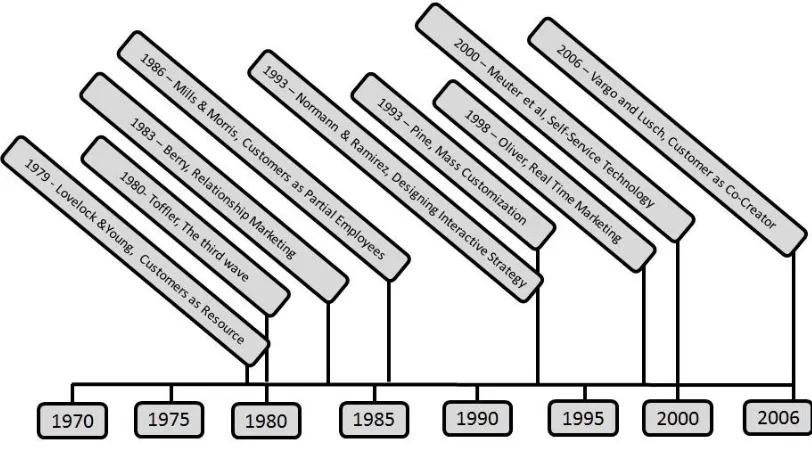
shift in understanding outlined above is related to several related, but distinct
concepts which have emerged over the last 30 years (see Figure 2-1) beginning with
the recognition in the late 1970’s that customers could play a more participative role,
developed through the 1980s with customers considered surrogate labour. The
1990’s saw the growth of technology allowing customers to further contribute to firm
[image:28.595.135.541.256.482.2]activities.
Figure 2-1 Precursory Concepts to Value Co-Creation
2.1.2 Customer Participation
The potential for customers to play a participative role was conceived in the
1970’s by authors such as Lovelock (1979) and developed throughout the 1980’s and 90’s in conjunction with the growth of the services marketing field (Bettencourt,
1997; Bowen & Jones, 1986; Czepiel, Solomon, & Surprenant, 1985; Larsson &
Bowen, 1989; C. A. Lengnick-Hall, 1996; Schneider & Bowen, 1995). Customer
participation research is largely represented by three streams (Dong, et al., 2008).
14
potentially economic benefits by co-opting customers as labour substitutes (Larsson
& Bowen, 1989; Lovelock & Young, 1979; Mills & Morris, 1986), an approach
criticised by Bendapudi and Leone (2003) who identify a need to explore the impact
of participation on customer satisfaction.
The second stream focuses on the management of customers, the use of employee
management-like techniques (Bendapudi & Leone, 2003) and the potential benefits
of this on perceived service quality through enhanced socialization (Claycomb, et al.,
2001). Schneider and Bowen (1995) observe how businesses that involve customers
consider them ‘to be a part of the firm’s human resources’ (Schneider & Bowen,
1995, p. 85). In cases such as these customers adopt both customer and producer
roles and firms adopt an alternative perspective of customers as an additional
productive human resource available to the firm – partial employees - and manage
performance on that basis (Bettencourt, 1997; Schneider & Bowen, 1995).
The last theme is concerned with motivation to co-create. Much of this theme
centres on self-service technologies (Dabholkar & Bagozzi, 2002; Meuter, et al.,
2005; Meuter, et al., 2000; Reinders, Dabholkar, & Frambach, 2008) and the
importance of customer readiness variables and other motivational traits that
stimulate trial.
Importantly, literature on customer participation suggests that as the level of
participation increases, customer may become proportionally more committed to the
co-creation process (Dong, et al., 2008; Wilson, Zeithaml, Bitner, & Gremler, 2008)
and perceive higher service quality. So, the first step to understanding how
perspectives have changed is recognising how the customer role has changed. In
conjunction with this change was the growth of relationship marketing, essentially
concerned with how, and more importantly how often, firms and customers interact
and how these interactions might be best exploited.
2.1.3 Relationship Marketing
The roots of relationship marketing (RM) lie in moves to shift marketing from a
transactionary approach focussed on customer attraction to a relational approach
15
and maintaining successful relationship exchange (Berry , 1983; Morgan & Hunt,
1994). Berry (1983, p. 25) defined RM as ‘attracting, maintaining and – in multi
service organisations – enhancing customer relationships’, the core of RM was in
interpersonal interaction between buyer and seller and that relationships grow over
time through repeated exchange, building competitive advantage through the
development of bonds and increased retention (Berry & Parasuraman, 1991). RM
aims to build (and where appropriate terminate) relationships at a profit ‘so that the
objectives of all parties involved are met; and this is done by mutual exchange and
the fulfilment of promises’ (Grönroos, 1994, p. 9). Relationship marketing is
normally operationalized through frequent contact with customers throughout the
relationship through surveys and mail shots; formal feedback such as focus groups
and other, informal methods such as comments and complaints (Oliver, Rust, &
Varki, 1998)
Problems with relationship marketing stem perhaps from a lack of a common
understanding, Harker (1999) points to 26 different definitions of the concept and
Harker and Egan (2006) observe that there is no common lingua franca for RM. It is also argued that relationship marketing ‘relationships’ are in fact unidirectional with
information largely flowing from customer to firm for use in databases (Oliver, et al.,
1998):
RM is often comprehended as a firmer grip on the customer, much like the fisherman’s relationship to the fish; more sophisticated equipment and techniques make it less probable that the fish will get off the hook (Gummesson, 1994b, p. 9).
The relationship marketing process is, therefore, largely firm driven and therefore
differs from value co-creation which requires greater input from consumers.
Relationship marketing is enabled by the increased ‘functionality of electronic
information services and their corresponding rapid decrease in costs’ (Oliver, et al.,
1998, p. 31). Technological growth underpins a general shift from RM to CRM
(Customer relationship management) which has blurred the boundaries of RM
(Vargo & Lusch , 2010). Relationship marketing is criticised from several other
quarters, including questions over RM being justified in terms of the bottom line
making the relationship analogy less believable, in short ‘firms are more interested in
16
(Harker & Egan, 2006, p. 232) and relationships are more about improving
‘marketing productivity through efficiency and effectiveness’ (Mattson, 1997, p.
449). This has led to some academics advocating an alternative perspective where
RM is viewed in the context of networks, and interactions (Gummesson, 1994a,
2004a).
Grönroos (2006, p. 299) recognises that through ‘creating interactive contacts with
customers during their use of goods and services, the firm develops opportunities to
co-create value with them and for them’. This implies a stronger, more customer
focussed, and relational approach. Service-centred models of marketing imply a need
to ‘develop close and trusting relationships to increase customer perceived value’
(Matthing, Sanden, & Edvardsson, 2004, p. 480), when services are complex and
have customised elements delivered over a series of encounters ‘the relationship
between the service provider and consumer is key’ (Crosby, Evans, & Cowles, 1990;
Dellande, Gilly, & Graham, 2004, pp. 78-79). Relationship marketing, therefore,
adds a further dimension by recognising the benefits of creating longer term
relationships with customers but criticised for a focus on ensuring repeat transactions
as opposed to meaningful relationships and an underlying focus on performance
enhancement (Palmatier, 2008). Other precursors to co-creation focus on
technological developments namely mass customization and real-time marketing.
2.1.4 Mass Customization
The provision of individualized products (without associated cost and complexity)
is made possible through technological breakthroughs and new management
approaches encompassed in mass customization (Pine II, 1993):
Mass customization ... [permits] the production of individual physical products at costs relatively consistent with the earlier production of mass products at scale (Oliver, et al., 1998, p. 30).
By combining technological improvements and making better use of feedback
loops, products can be improved over time (Oliver, et al., 1998) and customers
benefit from more choice in their purchases. A combination of the low unit costs of
17
the potential for considerable operational and customer benefits such as increased
loyalty, market leadership, productivity and profitability (Hart, 1995).
Gilmore and Pine (1997) developed four variations on mass-customization. One
of these is referred to as ‘collaborative customization’ which sees firm and customer
working together to satisfy the needs of the customer via a system that allows an
efficient operationalisation of exact wants. The idea of collaborative processes was
identified by Udwadia and Kumar (1991) who use the term co-constructors to
describe the process of development where customer ideas could be transformed into
products and services through collaboration.
Technological developments enable firms to customise easily and without a large
reduction in efficiency as a result the ‘transition of manufacturing from
mass-production to mass-customisation and the transition of customers from service
recipients to service co-producers are closely intertwined’ (Kalaignanam &
Varadarajan, 2006, p. 170). Other authors highlight the relevance of
mass-customization to firm-customer collaboration (Meuter, et al., 2000; Normann &
Ramirez, 1993, p. 68) and Ramirez (1999) observes that the growth of technological
innovation makes value creation more interactive and synchronous.
Mass-customization allows customers to be more involved in the purchase of both goods
and services through technological advances but centres on choosing amongst
predetermined options (choosing the colour of a car or the technical specifications of
a laptop) and therefore has limitations. Real-time marketing offers an ‘entirely new
and revolutionary paradigm in marketing’ and merges relationship marketing and mass customization with goods and services generated ‘uniquely suited to individual customers and their evolving needs’ (Oliver, et al., 1998, p. 36). Real-time marketing provides a sequential link ‘from mass marketing to large segment marketing, niche
marketing, relationship marketing, and marketing to segments of one’ (Oliver, et al.,
1998, p. 30). Real-time marketing offers a broad hint in the direction of co-creation
as it facilitates the creation of ‘the ultimate customer solution: products that uniquely
fit individual needs and constantly and dynamically change to meet the on-going
evolution of those needs’ (Oliver, et al., 1998, p. 30). Mass customisation and
18
both a precursor and a component of value creation (see section 2.3) is that of
co-production.
2.1.5 Customers as Co-producers
Co-production and customer participation have similarities in that both are
concerned with mobilizing customers to undertake altered roles within the
transaction process. Co-production has been the subject of a considerable amount of
conceptual and empirical study (see Auh, et al., 2007; Bendapudi & Leone, 2003;
Etgar, 2006, 2008; Kalaignanam & Varadarajan, 2006; Lusch , Brown, & Brunswick,
1992; Oliver, 2006; Prahalad & Ramaswamy, 2000; Sweeney, 2007) which
highlights how customers are increasingly socialized into acting as co-producers
everyday whether it be through self-service (e.g. an ATM machine) or by
cooperating with service providers in the production and consumption process (e.g.
healthcare). Co-production benefits customers who by their nature prefer the
‘do-it-yourself’ option even when an interpersonal option is available and time-saving and
monetary incentives are controlled for (Bateson, 1985). Meuter et al (2000) observed
that more than half of all bank transactions were now conducted online (this figure
will no doubt be much higher today). This can be compared with the growth in
online shopping, petrol pay at pump, travel purchases, airline self-check-in, and
supermarket self-scanning. All these activities have Self-service technologies (SST)
in common and require customers to take a participative role, independent of direct
firm input (Meuter, et al., 2005; Meuter, et al., 2000). Meuter et al’s (2000, p. 69)
studies identified that SSTs had the ability to ‘delight’ customers giving them the
ability to solve problems and co-create services resulting in customers ‘being amazed
at what they can accomplish by themselves’ suggesting that value for customers is
enhanced through co-production.
Alongside mainly ‘customer participation’ forms of co-production are other forms
where customers co-produce the core offering itself. Normann and Ramirez (1993)
cite Swedish based, global furniture giant IKEA whose business success cannot
simply be attributed to a lower cost base and low prices. Instead IKEA is able to:
19
system that invents value by matching the various capabilities of participants more efficiently and effectively than was ever the case in the past (Normann & Ramirez, 1993, p. 67).
By mobilizing customers to adopt enhanced roles (product assembly, delivery);
through the absorption of a ‘script’; the provision of tools (pencils, tape, and
notepaper) and a carefully designed store layout IKEA ‘wants its customers to
understand that their role is not to consume value but to create it’ (Normann & Ramirez, 1993, p. 67). This approach differs from customer participation in that
co-production becomes central to the success of the organisation not simply an
opportunity to co-opt customers.
Co-production studies play an important role in building understanding of value
co-creation by challenging the fundamental nature of value creation and ‘from a
management and research perspective...requires that we consider a multiplicity of
values, held in relations with multiple actors’ (Ramírez, 1999, p. 55). Co-production,
in both individual and community contexts, can serve to improve business
performance and support innovation (Gibbert, Leibold, & Probst, 2002; Rowley, et
al., 2007) and, with customers also acting as partial employees (Evans, Stan, &
Murray, 2008), reduces operational costs by undertaking tasks normally associated
with service employees. The limitations of the concept lie in its focus on engagement
within a production process, in other words during the service encounter and this
limits its viability as a universal term for understanding the changing nature of
interactions between a firm and its customers. The final section considers the impact
of these concepts on the firm and its customers.
Despite close association between the precursory concepts (such as that between
relationship marketing, mass customisation and real-time marketing) none of the
concepts are unified by one conceptual frame of reference. However, all concepts
emerge against a backdrop of change within the marketing discipline and calls for
new perspectives on the marketing economy. Shostack (1977) made an early call for
the ‘breaking free’ of services marketing from product marketing this was soon added to by other authors critical of marketing’s reliance on a microeconomic
maximisation paradigm (Webster, 1992) or the ‘four P’s’ which Day and
20
attempted to redefine the role of services by suggesting the services research is not a
niche field but the dominant and defining part of the business environment. Other
authors suggested the need for a paradigm shift (Gummesson, 1995; Achrol &
Kotler, 1999; Sheth &Parvatiyar, 2000) and it is from this movement for change and
the various antecedents discussed above that a new dominant logic for marketing
(Vargo & Lusch, 2004a) emerges. Service Dominant Logic (S-D Logic) presents a
paradigm-like shift away from conventional marketing theory concerned with the
marketing of goods and services (Gummesson, et al., 2010; Vargo & Lusch, 2004a).
S-D Logic was introduced with the purpose of ‘illuminating the evolution of
marketing thought toward a new dominant logic’ and is represented by: a move from
a goods dominant view in which tangible output and discrete transactions were
central, to a service dominant view, in which intangibility, exchange processes, and
relationships are central (Vargo & Lusch, 2004a, p. 2).
2.2 Service-Dominant Logic
2.2.1 Roots
Service-Dominant Logic (S-D logic) is, by and large, the product of a Journal of
Marketing paper (Vargo & Lusch, 2004a) a subsequent book (Lusch & Vargo,
2006b) and further development in a special issue of the Journal of the Academy of
Marketing Science (Vargo & Lusch, 2008b). The essence of service-dominant logic
is that:
Service provision is the fundamental purpose of economic exchange and marketing – that is, service is exchanged for service. We believe this logic is applicable not only to markets and marketing, but also to society (Lusch & Vargo, 2006a, p. xvii).
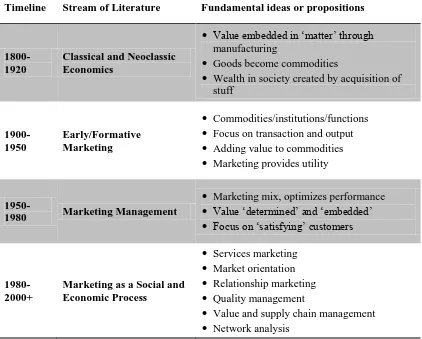
Vargo and Lusch (2004a) outline the various schools of thought that have
influenced marketing (see Table 2-1) and demonstrate how marketing has evolved
from economic roots to encompass more social elements. S-D Logic represents an
21
Timeline Stream of Literature Fundamental ideas or propositions
1800-1920
Classical and Neoclassic Economics
Value embedded in ‘matter’ through manufacturing
Goods become commodities
Wealth in society created by acquisition of stuff
1900-1950
Early/Formative Marketing
Commodities/institutions/functions
Focus on transaction and output
Adding value to commodities
Marketing provides utility
1950-1980 Marketing Management
Marketing mix, optimizes performance
Value ‘determined’ and ‘embedded’
Focus on ‘satisfying’ customers
1980-2000+
Marketing as a Social and Economic Process
Services marketing
Market orientation
Relationship marketing
Quality management
Value and supply chain management
[image:36.595.109.531.66.405.2] Network analysis
Table 2-1 Schools of Thought Influencing Marketing based on (Vargo & Lusch, 2004a, p. 3)
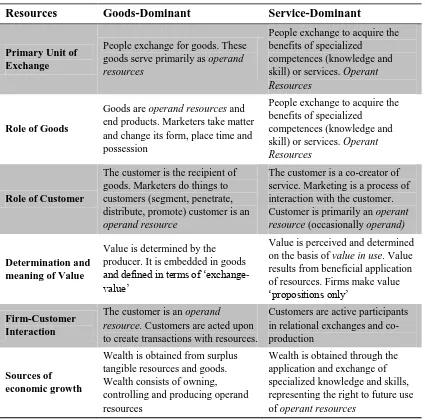
Of fundamental importance to S-D Logic, therefore, is a shift from what is termed
a ‘goods-dominant’ to a service-dominant logic (Vargo & Lusch, 2008b). This is
underpinned by six differences between the approaches (see Table 2-2). Some key
highlights of the change in approach are: the change from exchanging for goods to
exchanging service for service; the role of goods as transmitters of operant resources
rather than an end product; the role of the customer in the process as a co-creator of
value and as an operant resource (active participant) rather than operand resource (to
be segmented, targeted etc.) (Lusch , Vargo, & O’Brien, 2007; Merz, He, & Vargo,
2009); and the determination of value by the end user in use, not the firm in
production and; wealth being the result of gaining operant rather than operand
22
Resources Goods-Dominant Service-Dominant
Primary Unit of Exchange
People exchange for goods. These goods serve primarily as operand resources
People exchange to acquire the benefits of specialized
competences (knowledge and skill) or services. Operant Resources
Role of Goods
Goods are operand resources and end products. Marketers take matter and change its form, place time and possession
People exchange to acquire the benefits of specialized
competences (knowledge and skill) or services. Operant Resources
Role of Customer
The customer is the recipient of goods. Marketers do things to customers (segment, penetrate, distribute, promote) customer is an operand resource
The customer is a co-creator of service. Marketing is a process of interaction with the customer. Customer is primarily an operant resource (occasionally operand)
Determination and meaning of Value
Value is determined by the producer. It is embedded in goods and defined in terms of ‘exchange-value’
Value is perceived and determined on the basis of value in use. Value results from beneficial application of resources. Firms make value ‘propositions only’
Firm-Customer Interaction
The customer is an operand resource. Customers are acted upon to create transactions with resources.
Customers are active participants in relational exchanges and co-production
Sources of economic growth
Wealth is obtained from surplus tangible resources and goods. Wealth consists of owning, controlling and producing operand resources
[image:37.595.108.533.80.500.2]Wealth is obtained through the application and exchange of specialized knowledge and skills, representing the right to future use of operant resources
Table 2-2 Role of operand and operant resources in distinguishing goods-dominant from service-dominant logic based on (Vargo & Lusch, 2004a, p. 7)
S-D Logic challenges marketing to become a core competency of a firm not just a
management function (Vargo & Lusch, 2004a) where firm aims should not be to sell
units of output but provide customised services measured by units of satisfaction
(Vargo & Lusch, 2004a). S-D Logic suggests that production and consumption are
parts of continuous process rather than discrete activities and ‘superordinates service
(the process of providing benefit) to products (units of output that are sometimes
23
Customers are not recipients of value but heavily involved in the value creation
process (Etgar, 2006) as operant resources (i.e. those that act upon operand resources
– principally employees and customers) and operand resources themselves (resources
that are acted upon to produce an effect – products, technology etc.) (Vargo & Lusch,
2004a). The logic or ‘pre-theory’ as it has also been termed (and how it will be
discussed in this chapter) (Vargo, 2007) was illustrated in the original S-D Logic
paper (Vargo & Lusch, 2004a) through eight foundational premises (FPs) which
form the cornerstones of the pre-theory. The FPs were subject to further development
in the 2006 text-book on S-D Logic (Lusch & Vargo, 2006b) and one more FP was
added (Lusch & Vargo, 2006c), in 2008 a special issue of the Journal of the
Academy of Marketing Science was published in which Vargo and Lusch (2008b)
provide further elaboration and add a final FP. These foundational premises are