City, University of London Institutional Repository
Citation
:
Reynolds, L. M. (2010). Risk and the regulation of communication in relation to service users and providers experiences of forensic mental health care. (Unpublished Doctoral thesis, City University London)This is the accepted version of the paper.
This version of the publication may differ from the final published
version.
Permanent repository link:
http://openaccess.city.ac.uk/7783/Link to published version
:
Copyright and reuse:
City Research Online aims to make research
outputs of City, University of London available to a wider audience.
Copyright and Moral Rights remain with the author(s) and/or copyright
holders. URLs from City Research Online may be freely distributed and
linked to.
1
Risk and the regulation of
communication in relation to
service users’ and providers’
experiences of forensic mental
health care
Volume 2
Lisa Marie Reynolds
PhD
City University London
School of Community and Health Sciences
Department of Mental Health and Learning
Disability and the Department of
Interdisciplinary and Professional Practice.
2
Contents
Appendix 1: The characteristics of research participants who were formally interviewed 3 Appendix 3 (a): Initial interview topic guide: Service provider interviews 9 Appendix 3 (b): Interview topic guide, as developed through theoretical sampling.
Service provider interviews 11 Appendix 3 (c): Interview topic guide. Service user interviews 13 Appendix 4 (a): Initial observation prompt sheet. 14 Appendix 4 (b): Observation prompt sheet as developed through theoretical sampling. 16 Appendix 5: An example of coding and concept building 18 Appendix 6: An example of a coded observation 21 Appendix 7: Sample of coded interview using Atlas-ti. 22
References 23
List of Tables and Illustrations
3
Appendix 1: The characteristics of research participants who
were formally interviewed
[image:4.595.108.317.223.373.2]
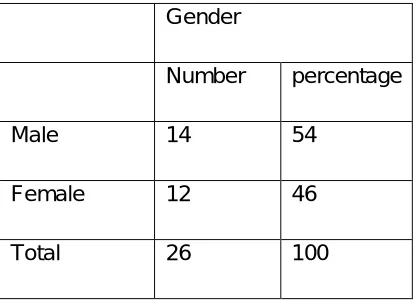
Table 2. Gender of participants interviewed
Gender
Number percentage
Male 14 54
Female 12 46
4
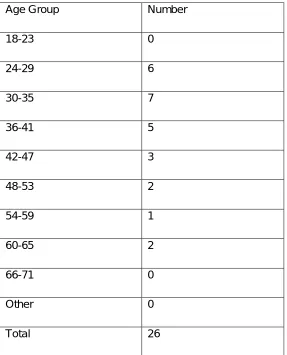
Table 3. The age range of participants who were interviewed
Age Group Number
18-23 0
24-29 6
30-35 7
36-41 5
42-47 3
48-53 2
54-59 1
60-65 2
66-71 0
Other 0
5
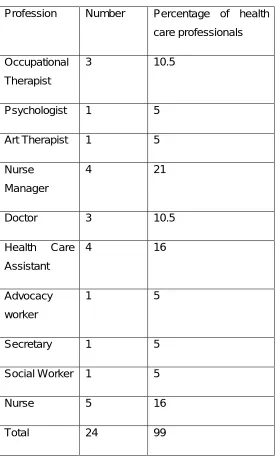
Table 4. Professions of service providers interviewed
Profession Number Percentage of health care professionals
Occupational Therapist
3 10.5
Psychologist 1 5
Art Therapist 1 5
Nurse Manager
4 21
Doctor 3 10.5
Health Care Assistant
4 16
Advocacy worker
1 5
Secretary 1 5
Social Worker 1 5
Nurse 5 16
6
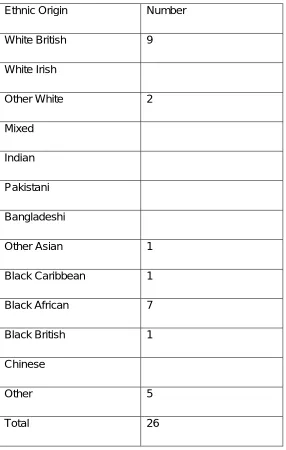
Table 5. The ethnicity of research participants interviewed
Ethnic Origin Number
White British 9
White Irish
Other White 2
Mixed
Indian
Pakistani
Bangladeshi
Other Asian 1
Black Caribbean 1
Black African 7
Black British 1
Chinese
Other 5
7
8
9
Appendix 3 (a): Initial interview topic guide: Service provider
interviews
Role
What is your role in the forensic service?
o What is your interest / contribution to the service? What areas of the service have you been involved with?
What do you find particularly challenging or rewarding about your role?
What do you believe to be the main aim of the service?
o How did you learn about the service aims?
o Are the service aims consistent with your professional goals and beliefs?
How do you know if the aims of the service are being achieved?
Have the aims always been the same? If not how have they changed?
o Over what time frame?
o What has influenced this process?
In your opinion what influences how the service functions?
Do you feel you influence how the organisation works?
o If so then how?
Who do you believe to be the key stakeholders in the organisation?
o What makes them key stakeholders?
Care Pathways
What would be the ideal service user progress through the service?
10
Can you give some examples of when the forensic mental health service works well / not so well?
What helps the service to work well?
What hinders service functioning?
What happens on a day to day basis in the service?
What do you see as being the main risks in the/ to the service?
o How are they controlled?
o What happens if they are not controlled / managed?
Can you describe a situation / scenario where risk has been managed well / not so well?
Service User Involvement
How is the service user involved -in their care, in the development of the service?
o Can you give some examples?
o How well has this worked?
What happens when a service user is admitted to or discharged from the service?
Is there anything else that you want to say about the role that you do or the service that you have not been asked about?
11
Appendix 3 (b): Interview topic guide, as developed through
theoretical sampling. Service provider interviews
Service
Please tell me about the [name of unit]?
o How does it function?
What are the service aims?
o have the aims always been the same? If not how have they changed?
o over what time frame?
o what has influenced this process?
In your opinion what influences how the service functions?
o What helps the service to work well?
o What hinders service functioning?
Do you feel you influence how the organisation works?
o If so then how?
Role
What is your role in the forensic service?
o what is your interest / contribution to the service? What areas of the service have you been involved with?
What do you find particularly challenging / rewarding about your role?
Who supports you in your work?
o How do they support you?
o Are they part of your team? If not, what caused you to work together?
What do you find hinders your work?
12
Care Pathways
What would be the ideal service user progress through the service?
How are decisions made to move a service user through the service?
How would you describe the typical progress through the service?
Can you give some examples of when the forensic mental health service works well / not so well?
Risk
What do you see as being the main risks in the/ to the service?
o How are they controlled?
o What happens if they are not controlled / managed?
Can you describe a situation / scenario where risk has been managed well / not so well?
Service User Involvement
How is the service user involved -in their care, in the development of the service?
o Can you give some examples?
o How well has this worked?
What happens when a service user is admitted to or discharged from the service?
13
Appendix 3 (c): Interview topic guide. Service user interviews
What happens day to day in the service?
o What do you do in a typical day / what is your daily routine?
o What is good about your day, what is not so good?
Have been on other wards in the service?
o If so what are the similarities and differences between them?
How do you progress through the service to be discharged?
o What do you feel helps or hinders your progress?
o What would you like to achieve? (eg: discharge or continued detention)
What do you believe to be the main purpose of the service?
o How did you learn about what the service does?
o What is good about the service / your stay in the unit? What is not so good?
In your opinion what influences how the service functions?
o Do you feel you influence what happens in the service / your ward?
o If so then how?
Who do you believe to be the key stakeholders in the organisation?
o What makes them key stakeholders?
14
Appendix 4 (a): Initial observation prompt sheet.
Activities to observe: Ward based:
Ward round / MDT meetings
CPA meetings
Ward business meetings
Ward community meetings
Nursing hand over
Unit based:
Advocacy meetings
Bed management meetings
Management meetings
Observe:
Risk assessment and management:
Strategies for managing the balance between autonomy and safety
The assessment and management of individual or reputational risk eg: in ward meetings and MDT discussions
Risk assessment activities including the use of risk assessment tools
Decision making
Decisions making regarding the balance of security and therapy
How decisions are made
Identify the decision makers are
Team processes
Risk escalator / care pathways
Risk assessments concerning service users moving up or down the risk escalator
Management strategies.
Service user response
Service users’ views of risk management plans and risk assessments.
Service users’ views of the service
Service users’ activities, organised by staff and by the users.
Enacting of risk management plans
15
Ask the participants for their view of meetings / activities and reasons for their actions.
Explore risk assessment and management strategies that take place within the meetings
16
Appendix 4 (b): Observation prompt sheet as developed
through theoretical sampling.
Activities to observe: Ward based:
Ward round / MDT meetings
CPA meetings
Ward business meetings
Ward community meetings
Nursing hand over
Service user down time
Service user self directed activities
Informal conversations - gossip
Unit based:
Advocacy meetings
Bed management meetings
Management meetings
Observe:
Risk assessment and management:
Strategies for managing the balance between autonomy and safety
The assessment and management of individual or reputational risk eg: in ward meetings and MDT discussions
Informal and formal risk assessment activities including the use of risk assessment tools
Communication of risks eg: security breaches
Decision making
Decision making regarding the balance of security and therapy
Influences on decision making
How decisions are made
Identify the decision makers are
Team processes
Impact of homicide inquiry
Risk escalator / care pathways
Risk assessments concerning service users moving up or down the risk escalator
Risk management strategies associated with moving service users through the system
17
Service user response
Service users’ views of risk management plans and risk assessments.
Service users’ views of the service, and clinicians
Service users’ activities, organised by staff and by the users.
Service user strategies for managing and assessing risk
Enacting of risk management plans
Nursing / ward staff undertaking risk management activities – how do these activities relate to the planned care and MDT discussions?
Explore any disparities – can the participant explain why there are differences between their activities and the plan of care?
Social groups
Which service users / providers work together, or have social connections?
Is there a social hierarchy, how is this determined, displayed?
How do social groups function?
How are boundaries articulated?
Ask the participants for their view of meetings / activities and reasons for their actions.
Explore risk assessment and management strategies that take place within the meetings
18
Appendix 5: An example of coding and concept building
Data analysis is a dynamic process in which the different types of coding, using
analytic techniques and procedures freely and in response to the analytic task (Strauss and Corbin 2000). The example given below will illustrate how analysis proceeded through overlapping stages of open, axial and selective coding to develop the theory of the regulation of communication.
Extracts from interview and observational data, rather than full transcripts are used in order to preserve the anonymity of the participants.
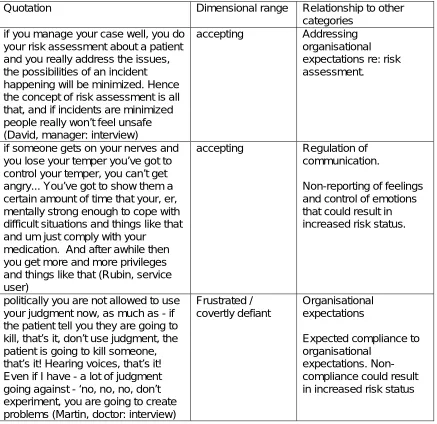
Axial coding
[image:19.595.110.547.340.764.2]Axial coding requires that the properties of categories, their dimensional range, and relationships with other categories are explored.
Table 7: The dimensions of the “management of own risk status”:
Quotation Dimensional range Relationship to other categories
if you manage your case well, you do your risk assessment about a patient and you really address the issues, the possibilities of an incident happening will be minimized. Hence the concept of risk assessment is all that, and if incidents are minimized people really won’t feel unsafe (David, manager: interview)
accepting Addressing organisational expectations re: risk assessment.
if someone gets on your nerves and you lose your temper you’ve got to control your temper, you can’t get angry... You’ve got to show them a certain amount of time that your, er, mentally strong enough to cope with difficult situations and things like that and um just comply with your
medication. And after awhile then you get more and more privileges and things like that (Rubin, service user)
accepting Regulation of communication.
Non-reporting of feelings and control of emotions that could result in increased risk status.
politically you are not allowed to use your judgment now, as much as - if the patient tell you they are going to kill, that’s it, don’t use judgment, the patient is going to kill someone, that’s it! Hearing voices, that’s it! Even if I have - a lot of judgment going against - ‘no, no, no, don’t experiment, you are going to create problems (Martin, doctor: interview)
Frustrated / covertly defiant
Organisational expectations
Expected compliance to organisational
19 you have been over the top and
harsh. There’s no animosity from me or him. I’ve kept my mouth shut and engaged. I have been on the shop floor so you can write notes about me. Now you are going to be
analysing me tomorrow and give me my leave back if I am good (Jason, service user: observation)
Overtly defiant Regulation of communication & Organisational expectations
Self censorship to meet organisational
expectations and so manage risk status the Unite union rep, said Well I think
this is interesting that members don’t feel safe enough to raise things directly through the line
management. Because they’re afraid that they’re going to be penalised if they do. It says something about the way the management is perceived here (Max, therapist: interview)
Perceived coercion Regulation of communication.
Suppression of dissent to avoid censure.
Selective Coding
During selective coding concepts are integrated around one core category. The quotation below illustrates the interrelationships between the regulation of communication, the operation of self-forming groups and risk management.
Barbara (HCA): No I am not doing that anymore. I spoke to [Jean] about putting seven and a half hours on [her] time sheet. Now it’s [Barbara] know everything! So now I am going to keep my mouth shut! [Jean] was very angry with me, I had to get on my knees and beg her to forgive me. We normally laugh and joke. All I said was not that lock, the other one and she was saying that I thought I knew it all.
Barbara regulates her communication in an attempt to manage her risk status in the context of fulfilling her role requirement as a health care assistant and member of a self forming group. Barbara gives two examples of when she had been socially ostracised for reminding others to follow unit procedures in order to justify her decision not to intervene in future breaches. In one incident she intervened when a member of staff (Jean) put seven and a half hours on her timesheet, when she should only claimed for five and a half hours. I n response Jean withdrew her friendship. Later when Barbara has reminded Jean to follow the correct security procedure, Jean responded in a hostile manner.
20
21
22
23
References
Aflague, J.M. and Ferszt, G.G. (2010) Suicide Assessment by Psychiatric Nurses: A Phenomenographic Study. Issues in Mental Health Nursing. 31:248-256.
Alaszewski, A. and Burgess, A. (2007) Risk time and reason. Health Risk and Society. 9(4): 349-358
Allbutt, H. and Masters, H. (2010) Ethnography and the ethics of undertaking research in different mental healthcare settings. Journal of psychiatric and mental health nursing. 17: 210-215.
Bartlett, A.; Johns, A.; Fiander, M. and Jhawer, H. (2007) London secure forensic units benchmarking study. Unpublished report.
Bateman, A.W. and Fonagy, P. (2000) Effectiveness of psychotherapeutic treatment of personality disorder. British Journal of Psychiatry. 177:138-143.
Baumann, Z. (2003) Liquid Fear. Cambridge. Polity Press.
Beauchamp, D.L and Childress, J.F. (2001) Principles of biomedical ethics. New York. Oxford University Press.
Becker, G.S. (1957) The Economics of discrimination. Chicago. The University of Chicago Press.
24
Blackman, D. And Sadler-Smith, E. (2009) The Silent and the Silenced in Organisational knowing and Learning. Management Learning. 40:569-585.
Blumer, H. (1969) Symbolic Interactionism. Perspective and Method. London. University of California Press LTD.
Borbasi, S.; Jackson, D. and Wilkes, L. (2003) Field work in nursing research: positionality, practicalities and predicaments. Journal of Advanced Nursing. 51(5): 493-501.
Bowen, F. And Blackmon, K. (2003) Spirals of Silence: The Dynamic Effects of Diversity on Voice. Journal of Management Studies. 40(6): 1393-1417.
Buckingham, C.D.; Adams, A. and Mace. C. (2008) Cues and knowledge structures used by mental health professionals when making risk assessments. Journal of Mental Health. 17(3): 299-314.
Buchanan, A. (2008) Risk of Violence by Psychiatric Patients: Beyond the “Actuarial Versus Clinical” Assessment Debate. Psychiatric Services. 59 (2): 184-190
Burrows, S. (1991) The special hospital nurse and the dilemma of therapeutic custody.
Journal of Advances in Health and Nursing Care. 1 (3): 21-38
Burrows, S. (1993) The treatment and security needs of special hospital patients: a nursing perspective. Journal of Advanced Nursing. 18(8): 1267-1278
25
Cant, R. and Standen, P. (2007) What Professionals Think About Offenders with Learning Disabilities in the Criminal Justice System. British Journal of Learning Disabilities. 35: 174-180
Carroll, A. (2007) Are Violence Risk Assessment Tools Clinically Useful? The Royal Australian and New Zealand Journal of Psychiatry. 41:301-307.
Cashin, A.; Newman,C.; Eason,M.; Thorpe, A. and O’Driscoll, C. (2010) An Ethnographic Study of Forensic Nursing Culture in an Australian Prison Hospital.
Journal of Psychiatric and Mental Health Nursing. 17: 39-45.
Castel, R. (1991) From Dangerousness to Risk. In: Burchell,G.; Gordon, C. And and Miller, P. (eds) The Foucault Effect: Studies in Governmentality. Hemel Hempstead. Harvester Wheatsheaf.
Charmaz, K. (2006) Constructing grounded theory. A practical guide through qualitative analysis. London. Sage.
Charmatz, K. and Mitchell, R.G. (1996) The myth of silent authorship: self, substance and style in ethnographic writing. Symbolic Interaction. 19 (4): 285-302.
Charon, J.M. (1979) Symbolic Interactionism. An introduction and interpretation and integration. USA. Prentice Hall, Inc. Englewood Cliffs.
26
Clarke, L. (1996) Covert participant observation in a secure forensic unit. Nursing Times. 92 (48): 37-40.
Corbin, J. and Strauss, A. (2008) Basics of Qualitative Research. Third edition. London. Sage.
Corbin, J. and Strauss, A. (1990) Grounded theory research: procedures, canons and evaluative criteria. Qualitative sociology. 13(1):3-21.
Covello, V.; and Sandman, P. (2001) Risk Communication: Evolution and Revolution.
In: Wolbarst, A. (2001) Solutions to an Environment in Peril. Baltimore. John Hopkins University Press.
Cox Edmondson, V.; and Munchus, G. (2007). Managing the unwanted truth: A framework for dissent strategy. Journal of Organizational Change Management, 20:747-760.
Crowe, J. and Carlyle, D. (2003) Deconstructing Risk Assessment and Management in Mental Health Nursing. Journal of Advanced Nursing 43(1):19-27
Davies, J. Heyman, B. Godin, P., Shaw, M. and Reynolds, L. (2006) The problems of offenders with mental disorders: A plurality of perspectives within a single mental health care organization. Social Science & Medicine. 63: 1097-1108. (Citations: 3)
De Gouveia, C.M.; Van Vuuren, L.J. and Crafford, A. (2005) Towards a typology of gossip in the workplace. Journal of Human Resource Management. 3(2): 56-68
27
Dennis, A. and Martin, P.J. (2005) Symbolic Interactionism and the Concept of Power.
The British Journal of Sociology. 56 (2):191-213
Denzin, N.K. and Lincoln, Y.S. (2003) Strategies of Qualitative Inquiry. London. Sage Publications LTD.
Department of Health (2009) New Horizons a Shared Vision for Mental Health. London. Department of Health.
Department of Health (2007) Best Practice Guidance. Specification for adult medium-secure services. London. Department of health
Department of Health (2007b) World class commissioning: vision. London. Department of Health.
Department of Health (2004) The Ten Essential Shared Capabilities – a framework for the whole of the mental health workforce. London. Department of Health.
Department of Health (2007) Best Practice in Managing Risk. Principles and evidence for best practice in the assessment and management of risk to self and others in mental health services. London. Department of Health.
Department of Health (2006) Essence of Care: bench marks for promoting health
28
Department of Health (2000) An organisational with a memory. http://www.dh.gov.uk/en/Publicationsandstatistics/Publications/PublicationsPolicyAndG uidance/DH_4065083 [accessed 4/1/10]
Department of Health (1998) A first class service: Quality within the new NHS.
Department of Health
http://www.dh.gov.uk/en/Publicationsandstatistics/Publications/PublicationsPolicyAndG uidance/DH_4006902 [accessed 4/1/10]
Department of Health and Home Office (1992) Review of health and social services for mentally disordered offenders and others requiring similar services (Reed report). Vol 1: final summary report. London. HMSO.
Dey, I. (1999) Grounding The Grounded Theory. Guidelines for Qualitative Inquiry. San Diego California. Academic Press.
Dhondea, R. (1995) An ethnographic study of nurses in a forensic psychiatric setting: Education and training implications. Australian and New Zealand Journal of Mental Health Nursing. (4): 77-82.
Dolan, M. and Doyle, M. (2000) Violence risk prediction: Clinical and actuarial measures and the role of the psychopathy checklist. The British Journal of Psychiatry. 177: 303-311
Douglas, M. (1992) Risk and Blame: Essays in Cultural Theory. London. Routlege.
29
Douglas (1966) Purity and Danger. Oxford. Routledge Classics.
Dowie, J. (1999) Communication for Better Decisions: Not About Risk. Health Risk and Society. 1(1): 41-53.
Doyle, M. and Dolan, M. (2006) Predicting community violence from patients discharged from mental health services. British Journal of Psychiatry. 189: 520-526.
Fagermoen, M.S. (1997) Professional identity: values embedded in meaningful nursing practice. Journal of Advanced Nursing. 25 (3): 434-441.
Faulkner, A. and Morris, B. (2003) Expert paper: User involvement in forensic mental health research and development. NHS national programme on forensic mental health research and development. Liverpool. Department of Health.
Fineman, S.; Gabriel, Y. And Sims. (2010) Organizing and Organizations. London. Sage publications LTD.
Fortune, Z.; Rose, R.; Crawford, M.; Slade, M.; Spence, R.; Mudd, D.; Barrett, B. Coid, J.W.; Tyrer, P. and Moran P.(2010) An evaluation of new services for personality disordered offenders: staff and service user perspectives. International Journal of Social Psychiatry. 56: 186-195.
Friere, P. (1972) Pedagogy of the Oppressed. London. Penguin Books.
30
Geertz, C. (2006) Thick Description: Toward an Interpretive Theory of Culture. In: Moore and Sanders (2006).
Gigerenzer, G. (2002) Reckoning With Risk. London. Penguin Books LTD.
Glasby, J. and Beresford, P. (2006) Commentary and issues: Who knows best? Evidence based practice and the service user contribution. Critical Social Policy. 26: 268-284.
Gluckman, M. (1963) Gossip and Scandal. Current Anthropology. 4: 307-315.
Godin, P.;Davies, J.; Heyman, B.; Reynolds, L.; Simpson, A. and Floyd, M. (2007) Opening communicative space: A Habermasian understanding of a service user led participatory research project. The Journal of Forensic Psychiatry and Psychology. 18(4): 452-469.
Goffman, E. (1961) Asylums. Essays on the social situation of mental patients and other inmates. London. Penguin social sciences.
Goffman, E. (1959) The Presentation of Self in Everyday Life. London. Penguin Books LTD.
Golafshani, N. (2003) Understanding reliability and validity in qualitative research. The qualitative report. 8(4): 597-607.
31
Green, J. (1999) From Accidents to Risk: Public Health and Preventable Injury. Health Risk and Society. 1: 25-39.
Grosser, T.J.; Lopez-Kidwell, V.; and Labianca, G. (2010) A Social Network Analysis of Positive and Negative Gossip in Organisational Life. Group and Organization Management. 35 (2): 177-212.
Gunn, J. (2000) Future directions for treatment in forensic psychiatry. British Journal of Psychiatry. 176(4):332 - 338
Hamersley, M. and Atkinson, P. (1995) Ethnography, principles in practice. London. Routledge.
Hardy, C.; Lawrence, T.B. and Grant, D. (2005) Discourse and collaboration: the role of conversations and collective identity. Academy of Management Review. 30(1): 58-77.
Hare, R. (1991) HARE PCL-R. Technical manual. Second edition. USA. Multi-Health Systems.
Hart, E. And Hazelgrove, J. (2001) Understanding the organisational context for adverse events in the health services: the role of cultural censorship. Quality Health Care. 10:257-262.
32
Health Care Commission (2008) Learning from investigations. London. Commission for health care audit and inspection.
Henriksen, K. and Dayton, E. (2006) Organisational Silence and Hidden Threats to Patient Safety. Health Services Research. 41 (4): 1539 – 1554
Herzog, H. (2005) On Home Turf: Interview location and its social meaning. Qualitative Sociology. 28 (1): 25-47.
Heyman, B. (2010) The concept of risk. In: Heyman et al 2010.
Heyman, B. (2010)b Time and Health Risks. In: Heyman et al 2010.
Heyman, B.; Shaw, M.; Alaszewski, A. and Titterton, M. (2010) Risk safety and clinical practice. Health care through the lens of risk. Oxon. Oxford University Press.
Heyman, B., Shaw, M.P., Davies, J.P., Godin, P. and Reynolds, L. (2004) Forensic mental health services as a risk escalator: A Case Study of Ideals and Practice. Health Risk & Society. Special Edition on Risk and Mental Health. 6: 307-325
Heyman, B.; Henriksen, M. and Maughan, K. (1998) Probabilities and health risks: A qualitative approach. Social Science and Medicine. 47(9): 1295-1306
33
Hodgins, S. (2002) Research priorities in forensic mental health. International Journal of Forensic Mental Health. 1 (1): 7-23
Holdsworth, N. and Dodgson, G. (2003) Could a new Mental Health Act distort clinical judgement? A Bayesian justification of naturalistic reasoning about risk. Journal of Mental Health. 12 (5): 451-462.
Holmes, D. (2005) Governing the captives: forensic psychiatric nursing in corrections.
Perspectives in Psychiatric Care. 41(1): 3-13.
Home Office (2007) Re-offending of adults: results from the 2004 cohort. Home Office Statistical Bulletin. http://rds.homeoffice.gov.uk/rds/pdfs07/hosb0607.pdf [accessed 25.8.10]
Home Office (1975) Report of the Committee on Mentally Abnormal Offenders (Butler report). London. HMSO.
Home Office (1974) Revised report of the working party on security in NHS psychiatric hospitals (Glancy report). London. HMSO.
Hood, C., Rothstein, H., and Baldwin, R. (2001) The Government of Risk. Understanding Risk Regulation Regimes. Oxford. Oxford University Press.
34
Jacob, J.D; Gognon, M. and Holmes, D. (2009) Nursing so-called monsters: on the importance of abjection and fear in forensic psychiatric nursing. Journal of Forensic Nursing. 5(3): 153-61.
Janesick, V.J. (2003) The choreography of qualitative research design: minuets, improvisations and crystallisation. In: Denzin, N.K. and Lincoln, Y.S. (2003) Strategies of qualitative inquiry. Thousand Oaks C.A. Sage.
Japp, K.P. and Kusche,I. (2008) Systems Theory and Risk. In Zinn (2008).
Jenkins, E. and Coffey, M. (2002) Compelled to interact: forensic community mental health nurses’ and service users’ relationships. Journal of Psychiatric and Mental Health Nursing. 9: 553-562.
Johansson, I.M.; Skarsater, I. and Danielsen, E. (2006) The health care environment on a locked psychiatric ward: An ethnographic study. International Journal of Mental Health Nursing. 15: 242-250.
Joolz (1990) Emotional Terrorism. Newcastle upon Tyne. Bloodaxe Books LTD.
Kemshall, H. (2008) Understanding the Community Management of High Risk Offenders. Berks. Open university Press.
Kemshall, H. and Maguire, M. (2001) Public Protection, Partnership and Risk Penality.
35
Laithwaite, H. and Gumley, A. (2009) Sense of Self, Adaptation and Recovery in Patients with Psychosis in a Forensic NHS Setting. Clinical Psychology and Psychotherapy 14: 302-316
Lampe, A.C. (2002) The Silencing of Voices: The Corporate “Darkness” Nobody Hears.
Culture and Organisation. 8 (2): 129-144.
Langan, J. (2008) Involving mental health service users considered to pose a risk to other people in risk assessment. Journal of Mental Health. 17 (5): 471-481.
Langan, J. and Lindow, V. (2004) Mental health service users and their involvement in risk assessment and management. York. Joseph Rowntree Foundation.
Langton, C.; Hogue, T.E.; Daffern, M.; Mannion, A. ; and Howells, K. (2009) Prediction of institutional aggression among personality disordered forensic patients using actuarial and structured clinical risk assessment tools: prospective evaluation of the HCR-20, VRS, Static 99 and Risk Matrix 2000. Psychology Crime and Law. 15(7): 635-659.
Lichtenstein, S.; Solvic, P.; Fishoff, B.; Layman, M. and Coombs, B. (1978) Judged Frequency of Lethal Events. Journal of Experimental Psychology Human Learning and Memory. 4: 551-78.
Lincoln, Y.S. and Guba, E. (1985) Naturalistic Inquiry. California, USA. Sage.
36
Low, G.; Jones, D.; Duggan, C.; Power, M. and MacLeod, A. (2001) The treatment of deliberate self-harm in borderline personality disorder using dialectical behaviour therapy: A pilot study in a high security hospital. Behavioural and Cognitive Psychotherapy. 29(1): 85-92.
Lupton, D. (1999) Risk. London. Routledge.
Luhmann, N. (2005) Risk A Sociological Theory. New Jersey. Transaction Publishers.
Martens, W and Kahn, W. (2008) The Problem with Hare’s psychopathy checklist: incorrect conclusions, high risk of misuse, and lack of reliability. Medicine and Law. 27(2): 449-462
Marvasti, A B. (2004) Qualitative Research Methodology. Thousand Oaks, California. Sage.
Mason, T. and Coyle, D. (2008) Forensic psychiatric nursing: skills and competencies: I role dimensions. Journal of Psychiatric and Mental Health Nursing. 15: 118-130.
Mason, T. (2002) Forensic psychiatric nursing: a literature review and thematic analysis of role tensions. Journal of Psychiatric and Mental Health Nursing. 9: 511-520.
Mason, T; Williams, R; and Vivian-Byrne, S. (2002) Multidisciplinary working in a forensic mental health setting: ethnical codes of reference. Journal of Psychiatric and Mental Health Nursing. 9: 563-572.
Mead, G.H. (1934) Mind Self and Society from the Standpoint of a Social Behaviorist
37
Meltzer,B.N.; Petras, J.W. and Reynolds, L.T. (1975) Symbolic Interactionism. Genesis, Varieties and Criticism. Monographs in Social theory. London. Routledge and Kegan Paul.
Michelson, G. and Mouly, V.S. (2004) So loose lips sink ships? The meaning antecedents and consequences of rumour and gossip in organisations. Corporate Communications International Journal. 9(3): 189-201.
Moore, H.L. and Sanders, T. (2006) Anthropology in Theory. Issues in Epistemology. Oxford. Blackwell Publishing.
Muedeking, G.D. (2009) Authentic/inauthentic identities in the prison waiting room.
Symbolic interaction 15(2): 227-236
Mulhall, A. (2003) In the field: notes on observation in qualitative research. Journal of Advanced Nursing. 41(3): 306-313.
Murphy, E and Dingwall, R. (2007) Informed consent, anticipatory regulation and ethnographic practice. Social Science & Medicine. 65: 2223–223
National Health Service (2010) Patient Advice and Liaison Services. PALS Online. http://www.pals.nhs.uk/ [accessed 28.8.10]
38
National Health Service London (NHSL) (2008) A review of 26 mental health homicides in London committed between January 2002 and December 2006. http://www.london.nhs.uk/webfiles/Independent%20inquiries/Review_of_26_mental_he alth_homicides_March_2008.pdf [accessed 17.9.10]
National Patient Safety Agency (2008) Independent Homicide Investigations. The National Inquiry into Suicide and Homicide by People with Mental Illness. http://www.medicine.manchester.ac.uk/psychiatry/research/suicide/prevention/nci/repor ts/HomicideInvestigationsReportApr2008.pdf [accessed 4/1/10]
Noelle-Neumann, E. (1993) The Spiral of Silence. Chicago, USA. Chicago Press.
Noon, M. and Delbridge, R. (1993) News from behind my hand: Gossip in organisations. Organisation Studies. 14 (1): 23-36.
O’Malley, P. (2008) Governmentality and Risk. In: Zinn (2008).
O’Malley, P. (2004) Risk Uncertainty and Government. London. The Glasshouse Press.
Paine, R. (1967) What is gossip about? An alternative hypothesis. Management New Series. 2(2): 278-285.
Passmore,K. and Leung, W.C. (2002) Defensive practice among psychiatrists: a questionnaire survey. Postgraduate medical Journal. 78: 671-673.
39
Perinbanyagam, R.S. (1991) Discursive Acts. New York. Aldine De Gruyter.
Peternelji-Taylor, C. (1999) Forensic psychiatric nursing. The paradox of custody and caring. Journal of Psychosocial and Mental Health Services. 37(9): 9-11.
Petersen, A. and Wilkinson, I. (2008) Health Risk and Vulnerability. Oxon. Routledge.
Peterson, A. (1997) Risk Governance and the New Public Health. In: Peterson,A. and Bunton,R. (1997) Foucault Health and Medicine. London. Routledge
Power, M (1997) Expertise and the Construction of Relevance: Accountants and Environmental Audit. Accounting, Organisations and Society. 22 (2): 123-146.
Power, M. (2007) Organized Uncertainty: Designing a World of Risk Management. Oxford. Oxford University Press.
Power, M. (2000) The Audit Society – Second Thoughts. International Journal of Auditing. 4: 111-119.
Prins, H. (1995) Offenders, Deviants or Patients? London. Routledge
40
Quirke, A.; Lelliott, P. and Seale, C. (2006) The permeable institution: An ethnographic study of three acute psychiatric wards in London. Social Science and Medicine. 63: 2105-2117.
Quirk, A.; Lelliot, P.; and Seale, C. (2005) Risk management by patients on psychiatric wards in London: An ethnographic study. Health Risk and Society. 7(1): 85-91
Quirke, A.; Lelliott, P. and Seale. C. (2004) Service users strategies for managing risk in the volatile environment of an acute psychiatric ward. Social Science and Medicine. 59: 2573-2583
Rennie, D.L. (2000) Grounded Theory Methodology as Methodical Hermeneutics: Reconciling Realism and Relativism. Theory and Psychology. 10: 481-502.
Reynolds, K.; and Miles, L.H. (2009) The effect of training on the quality of HCR-20 violence risk assessments in forensic secure services. Journal of Forensic Psychiatry and Psychology. 20(3): 473-480.
Rhodes, L. (2004) Total confinement. Madness and reason in the maximum security prison. London. University of California Press LTD.
Ritchie,J.H.; Dick, D. and Lingham, R. (1994) The report of the inquiry into the care and treatment of Christopher Clunis. London. HMSO.
Ritzer, G. and Goodman, D.J. (2003) Sociological Theory. New York. McGraw-Hill.
41
Rose, N. (2000) Government and Control. British Journal of Criminology. 40: 321-339.
Rose, N. (1998) Living Dangerously: risk thinking and risk management in mental health care. Mental Health Care 1(8): 263-266
Rosenhan, D. L. (1973) On being sane in insane places. Science.179(70): 250-8
Royal College of Psychiatrists (2007) Standards for medium secure units. London. The Royal College of Psychiatrists.
Royal Society (1983) Risk assessment: report of a Royal Society study group. London. Royal Society.
Rutherford, M. (2010) Blurring the Boundaries. The convergence of mental health and criminal justice policy, legislation, systems and practice. London. Sainsbury Centre for Mental Health.
Rutherford, M. and Duggan, S. (2007) Forensic Mental Health Services. Facts and figures on current provision. London. Sainsbury Centre for Mental Health.
Ryan, T. (2000) Exploring the risk management strategies of mental health service users. Health Risk and Society. 2(3): 267-281.
42
Saunders, G. (1985) Silence and Noise as Emotion Management Styles: An Italian Case. In: Tannen, D. And Saville-Toike, M. (eds) (1985) Perspectives on Silence. Norwood. Ablex publishing Corp.
Scally G and Donaldson LJ (1998) Clinical governance and the drive for quality improvement in the new NHS in England. British Medical Journal. 317(7150): 61-65
Schafer, P. and Peternelji-Taylor (2003) Therapeutic Relationships and Boundary Maintenance: The Perspective of Forensic Patients Enrolled in a Treatment Program for Violent Offenders. Issues in Mental Health Nursing. 24: 605-625.
Schubert, H-J (2006) The Foundation of Pragmatic Sociology: Charles Horton Cooley and George Herbert Mead. Journal of Classical Sociology. 6: 51-74.
Shaw, M. (2010) The regulation of health risks. Chapter 8 in: Heyman et al 2010.
Shaw, M.; Heyman, B.; Reynolds,L.; Davies, J. and Godin.P. (2007) Multidisciplinary Team Work in a UK Regional Secure Mental Health Unit a Matter for Negotiation?
Social Theory and Health. 5: 356-377.
Sheriff, R. E. (2000). Exposing silence as cultural censorship: a Brazilian case.
American Anthropologist. 102: 114–32
Silverman, D. (2000) Doing qualitative research: a practical handbook. London. Sage.
43
Skolbekken, J-A. (1995) The Risk Epidemic in Medical Journals. Social Science and Medicine. 40(3): 291-305
Stake. R.E (2003) Case Studies. Chapter 5 in: Denzin and Lincoln (2003).
Stein, W.M. (2002) The use of discharge risk assessment tools in general psychiatric services in the UK. Journal of Psychiatric and Mental Health Nursing. 9: 713-724.
Strauss, A. and Corbin, J. (1998) Basics of qualitative research. London. Sage Publications.
Stryker, S. (2000) Identity Competition. Key to Differential Social Movement Participation? Chapter one in: Stryker, Owens and White (2000).
Stryker, S,;Owens, T.J. and White, R.W (2000). Self, Identity and Social Movements. Minneapolis, USA. University of Minnesota Press
Tversky, A. and Kahneman, D. (1974) Judgement under uncertainty: heuristics and biases. Science. 185: 1124-31.
Van Maanen, J. (1988) Tales of the Field. On Writing Ethnography. Chicago USA. The University of Chicago Press.
Szmukler, G. (2000) Homicide Inquiries. What sense do they make? The Psychiatrist.
44
Tait, L. and Lester, H. (2005) Encouraging User Involvement in Mental Health Services.
Advances in Psychiatric Treatment. 11: 168-175
Titterton, M. (2005) Risk and Risk Taking in Health and Social Welfare. London. Jessica Kingsley.
Tourish, D. and Robson, P. (2006) Sensemaking and the distortion of critical upward communication in organisations. Journal of Management Studies. 43(4): 711-730.
Trenoweth, S. (2003) Percieving risk in dangerous situations: risks of violence among mental health in-patients. Journal of Advanced Nursing. 42(3): 278-287
Tversky, A. And Kahneman, D. (1974) Judgement under uncertainty: heuristics and biases. Science. 185: 1124-31.
Vakola, M. and Bouradas, D. (2005) Antecedents and consequences of silence: an empirical investigation. Employee Relations. 27(5): 441-458.
Van Den Hoonard. W.C. (2003) Is Anonymity an Artifact in Ethnographic Research?
Journal of Academic Ethics. 1: 141-151.
Van Loon, J. (2002) Risk and Technological Culture. Towards a Society of Virulence. London. Routledge.
45
Waddington, K. (2005) Behind closed doors – the role of gossip in the emotional labour of nursing work. International Journal of Work Organisation and Emotion. 1(1): 35-47.
Walsh, E. (2009) The Emotional Labour of Nurses Working in her Majesty’s (HM) Prison Service. Journal of Forensic Nursing. 5(3): 143-52
Warner, J. (2006) Inquiry reports as active texts and their function in relation to professional practice in mental health. Health Risk and Society. 8(3): 223-237
Webster, C.; Douglas, K.; Eaves, D. et al (1997) HCR-20: Assessing Risk for Violence. Vancouver, Canada. Simon Fraser University.
Weick, K.E. and Sutcliffe, K.M. (2007) Managing the unexpected. San Francisco. John Wiley and sons inc.
Whitehead, E. and Mason, T. (2006) Assessment of risk and special observations in mental health practice: A comparison of forensic and non-forensic settings.
International Journal of Mental Health Nursing. 15: 235-241.
Whyte, L. and Brooker, C. (2001) Working with a multidisciplinary team in secure psychiatric environments. Journal of Psychosocial Nursing. 39 (9): 27-31.
Woods, P.; Reed, V. And Collins, M. (2003) The relationships between risk and insight in a high-security forensic setting. Journal of Psychiatric and Mental Health Nursing. 10: 510-517.
Yun-Hee, J. (2004) The Application of Grounded Theory and Symbolic Interactionism.
46