Theses Thesis/Dissertation Collections
2-1-2009
Direct occlusion handling for high level image
processing algorithms
Carl Ryan Kelso
Follow this and additional works at:http://scholarworks.rit.edu/theses
This Thesis is brought to you for free and open access by the Thesis/Dissertation Collections at RIT Scholar Works. It has been accepted for inclusion in Theses by an authorized administrator of RIT Scholar Works. For more information, please [email protected].
Recommended Citation
Level Image Processing Algorithms
by
Carl Ryan Kelso
A Thesis Submitted in Partial Fulfillment of the Requirements for the Degree of
Master of Science in
Computer Engineering
Supervised by
Associate Professor Dr. Juan C. Cockburn Department of Computer Engineering
Kate Gleason College of Engineering Rochester Institute of Technology
Rochester, New York February 2009
Approved by:
Dr. Juan C. Cockburn, Associate Professor
Thesis Advisor, Department of Computer Engineering
Dr. Shanchieh Yang, Associate Professor
Committee Member, Department of Computer Engineering
Dr. Joseph Geigel, Associate Professor
Rochester Institute of Technology Kate Gleason College of Engineering
Title:
Direct Occlusion Handling for High Level Image Processing Algorithms
I, Carl Ryan Kelso, hereby grant permission to the Wallace Memorial Library to reproduce my thesis in whole or part.
Carl Ryan Kelso
Dedication
To my parents and my advisors.
Acknowledgments
I am grateful for the help my sister Catherine provided in the process of writing this work. Her tireless assistance provided not only a connection to the vast body of work in the field of neural science, but also provided much of the polish my document needed. She, and her professors, have proven to
Abstract
Direct Occlusion Handling for High Level Image Processing Algorithms
Carl Ryan Kelso
Supervising Professor: Dr. Juan C. Cockburn
Contents
Dedication . . . iii
Acknowledgments . . . iv
Abstract . . . v
Glossary . . . xiv
1 Introduction. . . 1
1.1 Motivation . . . 5
1.2 System Overview . . . 8
2 Background . . . 12
2.1 Biological Foundations . . . 12
2.2 Edges . . . 20
2.3 Point Features . . . 26
2.4 Vectorization . . . 31
2.5 Object Completion . . . 36
3 System Design . . . 42
3.1 The Language . . . 42
3.2 The Edge Detector Stage . . . 44
3.3 The Vectorization Stage . . . 50
3.4 The Completion Stage . . . 54
4 Test Cases . . . 60
4.1 Edge Detector . . . 60
4.1.1 The Gaussian Step Test . . . 61
4.1.2 Subsystem Effects . . . 62
4.1.3 Adjusted Variance, Fixed Blurs per Sub-Sample . . . 64
4.1.4 Fixed Variance, Adjusted Blur Count Per Sub-Sample 65 4.1.5 Matched Variance and Blurs per Sub-Sample . . . . 66
4.1.6 Rotational Versus Separable Kernels . . . 66
4.1.7 Differential Kernel Selection . . . 67
4.2 Polynomial Edge Fitting . . . 69
4.2.1 Approximating Simple Shapes . . . 70
4.2.2 Junction Extraction In Polygons . . . 71
4.2.3 Fitting To Extracted Edges . . . 73
4.2.4 The Thresholds . . . 74
4.2.5 The M-Estimator . . . 77
4.3 Curve Completion . . . 79
4.3.1 Polygonal Curve Closure . . . 80
4.3.2 Edge Closure Limits . . . 80
4.3.3 Fusors . . . 81
4.3.4 Splitters . . . 82
4.4 Complex Test Images . . . 83
4.5 Comparison to Prior Work . . . 86
5 Conclusions . . . 89
Bibliography . . . 95
A The Chord to Arc-length Relation . . . 101
List of Tables
2.1 A variety of derivative kernels . . . 20
2.2 The fundamental derivative kernels used by Lindeberg . . . 25
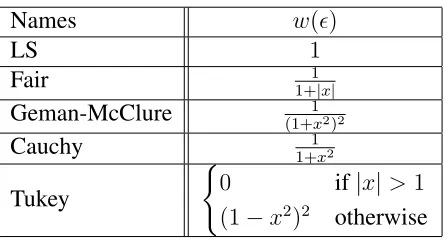
3.1 A variety of M-Estimators . . . 51
4.1 Effect of varying the X-threshold on polygon edge segments. 75
List of Figures
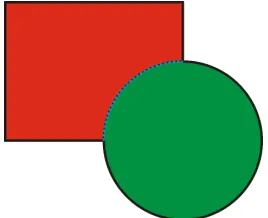
1.1 In the figure above, a green circle is visually in front of a
red rectangle. The dotted edge bordering both is intrinsic to
the circle, but extrinsic to the rectangle. . . 2
1.2 A piece of paper, a hand over it, and the resulting paper
with the simplest shape prediction. Final image modified in
Corel Photopaint 8. . . 4
1.3 A red ball rolls behind a blue pillar. The visible region on
the left shrinks until vanishing completely. In every frame,
the ball is partially visible. Images created in Corel Bryce 5. 7
1.4 A flow chart depicting the system. . . 9
2.1 Demonstration of the presence of a blind spot in human vision. 17
2.2 Demonstration of edge completion in the presence of a blind
spot. . . 18
2.3 Demonstration of curve completion in the presence of a
blind spot. . . 18
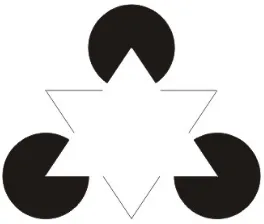
2.4 Kanizsa’s triangle. This figure produces the appearance of
a white triangle over three circles. Note the appearance of a
white on white edge at the border of the triangle. There is
no local gradient to hint at its presence. . . 19
2.5 An image illustrating many of the different possible types
of junctions. From left to right, these are the typical L, T,
Y, followed by a concave Y, A reflective X, and a clear X.
2.6 A well known optical illusion demonstrating the three
di-mensional bistability of Y-junctions. Are the red regions
squares on top of boxes, below the boxes, or are they
dia-monds? . . . 29
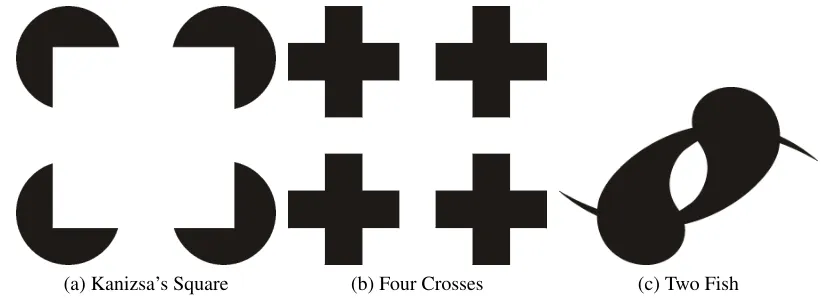
2.7 Images of Kanizsa’s Square (a), the four crosses image (b),
and the spontaneous splitting two fish image (c) described
by Geiger et al.[9]. . . 29
2.8 The relationship between an edge and its detected points. . . 32
3.1 Demonstration of fit sensitivity across gaps without
cumu-lative minimum thresholding . . . 53
3.2 A small sample BSP space. The green vector is a local root
node. It splits the space into two hemi-planes. In the front
hemi-plane is the blue vector, which has a fit length that
passes the hemi-plane border. The red vector in the back
hemi-plane, on the other hand can safely ignore things in
the front hemi-plane since its fit is shorter than the distance
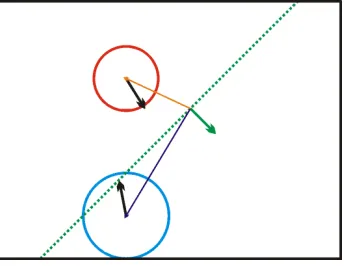
to the border. . . 56
4.1 The Gaussian test images. Each image varies in standard
deviation of blur from 1 px to 128 px as the image is
tra-versed from top to bottom respectively. . . 61
4.2 Each image is processed using a blur filter with a variance
of 12 px. The process without sub-sampling used 16 blurs, while the process with sub-sampling used 8 per sub-sample.
The lower images are vectorized versions of the outputs for
clarity . . . 63
4.3 Each image in this set was blurred 8 times per sub-sample
4.4 Each image in this set was blurred with a 3 × 3 Gaussian
filter with variance of 12px2, and sub-sampled with
re-up-sampling enabled. . . 65
4.5 This looks at the variance around the ideal blur per
sub-sample described by Eaton et al.[7]. The base image is the
quadratically increasing Gaussian step to highlight smaller
scales. . . 66
4.6 This test bank blurs each image to a standard deviation of
2pxbefore sub-sampling with a blur kernel of the specified
variance. . . 67
4.7 A comparison of the edge detector output using
rotation-ally symmetric versus separable blur kernels. Each image is
blurred to a standard deviation of 2 px before sub-sampling . 68
4.8 A comparison of the output produced by three common
tive kernels (and their convolution for second order
deriva-tives) . . . 69
4.9 Five simple convex shapes. From left to right: A square,
pentagon, octagon, dodecagon and circle. From top to
bot-tom: The generated edge with a single vertex (at top for
all except the circle, which is at right), polynomial fits, and
junction closures. . . 71
4.10 A demonstration of the limit of junction detectability in the
estimator. The polygons from left to right are 24, 25, and 26
sided. All junctions are found on the 24 sided figure. The
top right corner is lost on the 25 sided figure. Only seven
junctions are detected in the 26 sided figure, one of which
4.11 Four simple convex shapes. From left to right: A square,
pentagon, octagon and dodecagon. From top to bottom: The
original image, the extracted edge, the polynomial fits, and
resulting junction closures. . . 73
4.12 A trefoil: a three dimensional knot. Rendered in Corel Bryce 5. . . 74
4.13 The result of varying the X-threshold on fits. . . 75
4.14 The result of varying the W-threshold on fits. . . 76
4.15 The result of varying the G-threshold on fits. . . 76
4.16 The test edge for comparing various M-Estimators. . . 77
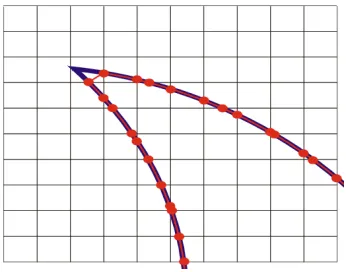
4.17 The results of applying each M-Estimator to the test image. The columns from left to right are the results from the Least Squares, Fair, Geman-McClure, Cauchy, and Tukey estima-tors respectively. From top to bottom are the progressive fits to the system, followed by the final fits, and the result-ing completions. . . 78
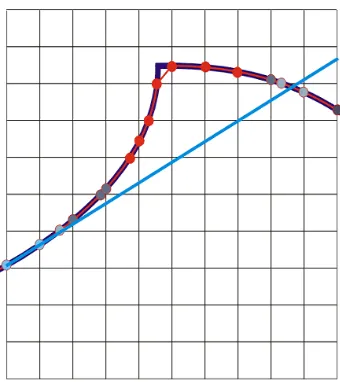
4.18 The result of varying the W-threshold on fits. The distance between each pair is measured in the length of the side of a square. . . 81
4.19 The result of varying the W-threshold on fits. . . 82
4.20 A demonstration of the system processing splitting figures. . 83
4.21 A demonstration of the system processing complex figures. . 84
4.22 Additional complex figure examples. . . 85
B.1 Three Gaussian step images used to test the edge detector’s
responsiveness at different scales. The images are designed
to produce a vertical edge down the center of the image. An
ideal edge detector will return an uninterrupted edge at this
location. Two additional edges are expected at the border
Glossary
A
amodal completions (amodal) When the human visual system com-pletes objects, it may not necessarily create the sensation of a vis-ible edge. If the completion occurs in the behind an occluder, it is referred to as an amodal completion. An example is the percep-tion of completed circles in a Kaniza’s Square. While the edge is not visible, it can be traced., p. 11.
articulated An object composed of many components connected via joints. An example of an articulated object is a skeleton.
B
Binary Spatial Partitioning (BSP) A specific type of spatial indexing system. Binary Spatial Partitioning organizes spatially correlated information by recursively splitting the data in to convex subsets based on an easily calculated metric. Through careful choice of the splitting metric, and balancing, it is possible to reduce search-ing in the space from O(n2) toO(nlogn), p. 39.
blob A localized region of pixels or features derived from an image with similar properties. If these properties are easy to calculate then tracking blobs can be a fast an efficient means of following objects without high level processing., p. 3.
blue-noise Noise which is dominant in high spatial frequencies, but not present in low spatial frequencies., p. 20.
to tackle the issue. This may take longer than a top down strategy, but can yield better results., p. 1.
C
Canny’s edge detector An edge detector developed in the 1980s which takes raw input data from a typical linear filter based derivative op-erator and performs several non-linear operations to refine edges down to a width of a single pixel., p. 10.
center-surround A receptive field pattern for a neuron. This pattern is typically recognizable by a cluster of inputs surrounded by a second cluster with opposite polarity. This structure is able to recognize the presence of details, which stimulate the inner field without affecting the outer field. The same structure in the eye may connect different colors to the center and the surround re-spectively, allowing most humans to distinguish betwen adjacent hues., p. 15.
Cesaro Equation An equation which relates a curve’s curvature to its arc-length.
Charge Coupled Devices (CCD) A capacitive array originally designed for use as a memory device. They have found application as the image sensors in digital cameras. See also Complementary Metal Oxide Semiconductors., p. 13.
chiasma The point in the brain where information from both eyes is sorted by hemisphere so information from a persons left and right hemispheres of vision can be processed for stereo correlations., p. 15.
Complementary Metal Oxide Semiconductor (CMOS) A class of digital circuits which uses a capacitive barrier to control the active state of a gate. CMOS circuits tend to be very low power, and have found application as the light sensitive components in certain image sensors. See also Charge Coupled Devices., p. 13.
Compute Unified Device Architecture (CUDA) A C-like program-ming language developed by NVIDIA to extend access to the functionality of their highly parallelized floating point GPU hard-ware., p. 9.
D
Difference of Gaussian (DoG) The difference of two gaussian kernels with different variances. The DoG operator can be used as an approximation of the LoG operator. It is the basis for the SIFT scale-space., p. 15.
Difference of Offset Gaussian (DoOG) A generalization of the DoG function, the DOOG function allows for an offset between the peaks of the gaussian functions. This offset allows the result-ing functions to have similar structural appearance to the Gabor wavelet., p. 15.
Discrete Fourier Transform (DFT) A transformation designed to rep-resent a sampled periodic window of data as a sum of sinusoids of various frequencies and orientations. The inverse of this transform is the IDFT.
E
edge The interface between distinct regions. In an image, an edge is usually treated as bands of locally maximal gradients. Edges are one-dimensional., p. 1.
by the border of another object’s physical geometry. If an object has extrinsic edges, portions of it are hidden from view., p. 2.
F
feature Two definitions for image features exist in modern literature. They may either consist of all recognizable aspects of an image, including, but not limited to edges, blobs, corners, and interest points. The alternate definition limits the term exclusively to zero-dimensional locations of significance. In this paper, the second definition is used., p. 1.
G
gradient A transition in color, brightness, or another image metric. In mathematics, the gradient is a vector which points in the local direction of greatest change in a function., p. 1.
H
high-level Algorithms which benefit from a structural understanding of a scene. High-level algorithms include tracking algorithms, motion capture, 3D extraction and image registration techniques. These algorithms are only as stable as their underlying structural inter-pretation of the scene is, and suffer directly from assumptions made in the mid-level., p. 1.
I
intrinsic An edge is intrinsic to an object if the visible edge is defined by the border of the object’s physical geometry., p. 2.
Inverse Discrete Fourier Transform (IDFT) A transformation designed to revert a frequency domain image back to the spatial domain. This transform is the inverse operation of the Discrete Fourier Transform.
Iteratively Re-weighted Least Squares (IRLS) A process by which an approximation for an overdetermined system is fit to a model by evaluating the quality of each point in the fit and weighting the influence of that point in the final output respectively., p. 34.
J
Joint Photographic Experts Group (JPG) The common name for a lossy image file format developed by the Joint Photographic Ex-perts Group. The actual format is the JPEG File Interchange For-mat (JFIF), which was designed to compress images by transform-ing them in a fashion which makes it simple to preserve image data preferred by the human brain when interpreting an image., p. 58.
junction The intersection of edges in a view.
K
Kanizsa’s Square Similar to a Kanizsa’s Triangle, except four pacmen are arranged at the corners of an illusory square.
of the pacmen to circles is an example of amodal completion, while the completion of edges to the triangle demonstrates modal completion. The figure may further be accompanied by the cor-ners of a hollow triangle, similar to the configuration of a Koch’s snowflake.
L
L-junction The intersection of two edge segments at their endpoints. This may be formed by an actual physical corner, or by simi-larly colored objects occluding one another. Since the presence of this type of junction may indicate the presence of an occlu-sion, it can be used to launch an attempted completion process. A successful completion hints that the inside of the L is in the background, while a failed completion hints that it is in the fore-ground. Counter examples include the lack of an illusory square in the Four Plusses image, and the percieved object ordering when looking at the crook of an arm., p. 10.
Laplacian of Gaussian (LoG) The Laplacian of Gaussian in cartesian coordinates is the sum of all second order derivatives of the gaus-sian function., p. 15.
Lateral Geniculate Nucleus (LGN) A region of the brain between the chiasma and the visual cortex dedicated to the processing of infor-mation from one hemifield of both eyes. the later regions of the LGN perform the first stereo integration of this data., p. 15.
M
mid-level Algorithms designed to convert a raster image to a structural image. This provides high-level algorithms with a means of op-erating on objects, rather than raw image data. An example of a mid-level algorithm would be one which finds lines represented as peaks in a Hough transform. The Hough transform simplifies the task of the mid-level algorithm by presenting raw pixel data in an alternative form. The output of the clustering algorithm is a line or group of lines present in the image., p. 21.
modal completions (modal) When the human visual system completes objects, it may do so assuming that the completed portion lies ei-ther in front of or behind a secondary surface. If the completion occurs in the front, it is referred to as a modal completion. An example is the appearance of a white on white edge on the border of Kanizsa’s Triangle or Square., p. 11.
motion capture The process of extracting the motion of an entity. This may be performed mechanically, optically, or through the use of inertia or acceleration sensitive sensors., p. 1.
O
occlusion An occlusion is when one object partially or fully hides a sec-ond object from view., p. 2.
optical axis The axis of rotational symmetry in an optical system., p. 13.
P
R
recognition The act of determining what an object is based on its visible structure., p. 1.
Rochester Institute of Technology (RIT) Rochester Institute of Tech-nology - The red-brick technical institute in Rochester NY notable for it’s fast paced quarter system and co-op program.
S
Scale-Invariant Feature Transform (SIFT) Scale Invariant Feature Trans-form - An algorithm designed to locate stable feature points in images. SIFT points are invariant against rotations, translations, and a limited amount of affine transformation. They are notable for two features. First, they require the image be broken down into a DoG scale space, which is systematically searched for fea-tures. Second, the points have a complex descriptor incorporating information from the region local to the point in its given scale., p. 7.
scale-space A volume of information derived from an image where pixels at successively coarser scales encompass information from wide regions of an image. Scale-space levels are generated through gaussian blurring, and provide a means for algorithms to behave in a scale invariant fashion without requiring convolutions with progressively larger kernels., p. v.
T
T-junction The intersection of two edges, one at an endpoint. While not always easy to distinguish from a Y-Junction, T junctions provide the strongest occlusion ordering and edge completion hint. They are often formed when three objects overlap in a small region. The head of the T, in the general case, is intrinsic to the object closest to the viewer. The stem hints at a completion under the object at the head of the T. A counter example is a barber’s pole. The red and white stripes painted around the pole form T junctions between each other and the background., p. 11.
top-down A methodology of solving a complex problem which attempts to break down the original problem into gradual sub problems. This methodology may yield faster results than bottom up solu-tions, but typically yield less information about the underlying data-set, and suffer from problems where assumptions about the underlying structures which differ from reality., p. 1.
tracking Following an entity through an image sequence., p. 1.
trancendental function Any function which is not expressible as a ra-tio of polynomials. Examples of transcendental funcra-tions include the exponential function, sinusoids, hyperbolic sinusoids, and log-arithms., p. 37.
W
white-noise Noise spread evenly across all spatial frequencies.
X
this ambiguity. Specialized processing for X-Junctions is beyond the scope of this paper.
Y
Chapter 1
Introduction
Since its conception, computer vision as a field has evolved rapidly. Through
its evolution it has enabled the development of systems which have found
use in medicine, automation, navigation, and special-effects. Some of these
systems can extract the 3D geometry of viewed objects [25]; others focus
on the extraction of local motion [2]. With so many potential applications,
the field has seen developments from both a top-down and a bottom-up
ap-proach simultaneously.
The top-down approach has yielded high-level algorithms which deal with
complex tasks including motion capture, tracking, and recognition. The
bottom-up approach has resulted in the development of low-level algorithms
which provide means for detecting gradients [36], edges ([17], [19], [4]),
and features ([14], [21], [26]). While these developments have come a long
way, the high-level algorithms suffer from assumptions made by earlier
pro-cessing stages.
Some of these issues can be dealt with by selecting alternative low-level
al-gorithms. For instance, adjusting color-spaces can improve the detection of
edges in an image [36] or reduce the search space in tracking algorithms [6].
the entropy in an image so that relevant information is easier to find [16].
The use of scale-space can make an algorithm robust against changes in
scale ([37], [38],[19],[20], [7]). Each of these techniques contributes to the
field by introducing new assumptions about the nature of image structures;
the benefits arise in areas where current predictions typically fail.
The structural issue which seems to cause the most systemic problems in
the industry is a stable means of handling occlusions. An occlusion occurs
when an object in an image is partially or fully hidden by a second entity.
The edges of the occluding object modify the shape of the visible portions
of the occluded object. Edges in an image which are formed by an object
are said to be intrinsic to that object. If those edges are adjacent to regions
belonging to another object, they are extrinsic to that other object (Figure
1.1).
The lack of a strong occlusion handling algorithm has severe implications.
Since the appearance of the visible portions of an object can be changed by
the presence of an occluder, tracking and recognition algorithms which do
not attempt to predict the original shape can prematurely lose track of or
[image:26.612.243.377.513.622.2]falsely identify the objects they are attempting to interpret.
Figure 1.1: In the figure above, a green circle is visually in front of a red rectangle. The dotted edge bordering both is intrinsic to the circle, but extrinsic to the rectangle.
algorithm presented by Yamamoto et al.[41] make poor predictions about
occlusions caused by secondary objects in a scene. The PFinder algorithm
finds image regions which are likely to belong to a person. Once these
regions are found, their configuration is used to recover the location and
stance of the person. This technique allows the algorithm to ignore objects
which occlude the subjects in a predictable fashion.
Shirts and pants on a person leave regions (blobs) of visible skin which
are likely to correspond to certain body parts. However, if multiple people
are in a scene, the blobs are not sorted by individual. Attempting to fit the
regions extracted from multiple people to the model of one person will cause
the algorithm to fail. This problem might be solved if the blobs could be
grouped and stitched together into individuals before attempting to recover
the person’s stance.
Problems caused by scenes with occlusions arise from naive assumptions
about the objects in the scene being analyzed. One common approach
to interpreting a scene is to use the figure-ground paradigm [27]
(Figure-ground is synonymous with the object-back(Figure-ground paradigm used by
Gon-zalez et al.[11]). The paradigm treats all edges in a scene as intrinsic to the
figures next to them. The background layer is treated as the exception to
this, and is allowed no intrinsic edges.
This simple assumption has resulted in the development of high-level
al-gorithms which work with considerable success on simple scenes, in stable,
controlled environments. With time saved not solving for the occlusions, the
algorithms are quick, supporting visually distinct objects over stable
back-grounds. However, when using this method, if one object overlaps a second,
1.2). The fact that the figure-ground paradigm is a special case of a broader
[image:28.612.107.513.150.246.2]perceptual condition is highlighted by Rubin’s work [27].
Figure 1.2: A piece of paper, a hand over it, and the resulting paper with the simplest shape prediction. Final image modified in Corel Photopaint 8.
Several approaches to dealing with the occlusion problem have been taken.
A common technique is to use blobs to analyze a scene. The generic blob
approach groups regions in an image with similar local pixel properties [6].
These groups are rarely more complex than color histograms, brightness,
or texture. Structures can be built up out of clouds of blobs which may be
spatially or visually related. These clouds have been used successfully in
laboratory motion capture techniques [40].
Blob based systems like this can be more stable than edge detectors in the
presence of noise. Blob grouping suffers when unrelated objects have
sim-ilar properties. For example, if a person is wearing a white shirt and
writ-ing on a white piece of paper, regions from both the shirt and paper may
be joined into a single cloud. Alternatively, if the properties of an object
change over time, due to lighting, shadows, or incandescence, the object
may be split into pieces. This method is unable to predict the shape of
par-tially obscured objects without knowledge of the occluded object itself.
The weakness of these algorithms rest in their dependency on raw low-level
More robust motion capture techniques ([31], [5], [40], [39]) use a model
of a person to supplement the information extracted from a scene. Data
from broad regions in the image is accumulated to support a given model,
reducing the effects of local noise in the raw data. With this additional
a-priori information, the techniques are able to overcome self-occlusions.
While this is significant, the human visual system is able to correctly
inter-pret the geometry of any convex object. It supports arbitrary curves as an
input, allowing it to dynamically model objects in the scene. This allows it
to generate models of objects which have never been seen before. A model
based system provides stability, but is limited to interpreting only what it
ex-pects to see. The existence of optical illusions shows that the human visual
system does use models to interpret the objects being viewed. The types
of illusions that human vision is subject to shows that the models used are
generic enough to apply to most items seen on a daily basis.
This work attempts to use research from both the computer vision and
neu-roscience communities to develop a system for extracting the structure of
a scene. Included is a description of the steps involved in the creation of
a system capable of partitioning a generic image. This is intended as a
pre-processing step for higher-level algorithms. The work also attempts to
identify directions for further research to improve upon the described
tech-nique.
1.1
Motivation
This research was originally motivated by the study of marker-less
of the video game and movie industries, allowing the movements of actors
to be recorded and, later, mapped to articulated models of the characters.
This technology has been used in games like God of War, and movies like
Beowulf, The Polar Express, and for the character Gollum in The Lord of
the Rings trilogy. Typical modern commercial systems require markers,
small reflective spheres or lights on a skin tight suit, to recover the position
and movements of actors. These appear in a video sequence as bright points
which are simple to detect. Removing the constraints of a marker based
sys-tem extends the functionality of motion capture to navigation and medicine,
as well as many other fields.
Analysis of existing marker-less human motion capture systems revealed a
number of weaknesses. A further review of the literature showed these same
problems were present across a wide range of high-level algorithms. Only
rarely do algorithms attempt to predict geometry in the presence of
occlu-sions, and when they do, they usually are limited to solving self occlusions.
The key concept which is overlooked in these systems is the distinction
be-tween intrinsic and extrinsic edges. Edges are intrinsic to an object if their
appearance is determined by the object’s physical geometry. Extrinsic edges
are determined by a second object. Extrinsic edges caused by shadows or
occluding objects can cause objects to be split or deformed.
Some systems attempt to resolve the structural issue by grouping blobs, or
similar image regions. These systems suffer from problems which arise
when independent blob sources are in a scene. If a blob based capture or
tracking system partitions an image based on skin tone, and multiple people
are in the scene, the tracking system must be able to distinguish between
are guaranteed to never overlap, but outside of clean-room scenes, this
con-straint is difficult to guarantee. Tracked objects moving toward or away
from the camera can be lost if the algorithm is not scale invariant [6]. Scale
invariance can be achieved through the use of a scale-space volume. This
technique uses successive Gaussian blurs and sub-samples to allow
analy-sis of coarse and fine features with the same technique. An implementation
of Collin’s Mean-Shift in Scale-space algorithm revealed several types of
problems caused by occlusions. As illustrated in Figure 1.3, as an object
passes behind an occluder, the shape of its visible regions may change
be-yond recognition. Shadows can cause color changes and the blobs
compos-ing the object may split. Sometimes they may vanish completely.
Figure 1.3: A red ball rolls behind a blue pillar. The visible region on the left shrinks until vanishing completely. In every frame, the ball is partially visible. Images created in Corel Bryce 5.
Feature based high-level algorithms like the one presented by Foo et al.[8],
and those suggested by Lowe [21], take a shotgun approach to the object
matching needed for object recognition, tracking, and 3D reconstruction.
SIFT points [21] are located at places where the gradient forms a local
maxi-mum or minimaxi-mum in scale-space. The immediate region around these points
is used to calculate a rotationally aligned descriptor. Data for some of these
descriptors may come from multiple objects. These points can still be used
with a great deal of success to identify a scene [8]. However, using these
features to perform operations dependent on their location can result in
Through evolution, the human visual system has been able to overcome
these problems for the general case. Human vision is not perfect. Through
reverse-engineering of its visual flaws, it should be possible to achieve or
surpass some of its successes. The places where the human visual model
fails to properly interpret a scene are better known as optical illusions; they
have been studied by the neuroscience and perception communities for as
long as they have been known to exist. The illusions of particular interest to
this problem are those which either split or fuse visual regions to form new
shapes ([29],[34],[28],[27]).
The correlations between problems across many types of structurally
de-pendent high-level algorithms point in a common direction to search for
a solution. The differences between intrinsic and extrinsic edges must be
handled. This requires object completion techniques which attempt to
in-terpret edges in this fashion. A system which handles this difference should
be able to recover surface ordering, make predictions of hidden edges, and
simultaneously use this information to select edge ownership.
1.2
System Overview
It is possible to create a system capable of determining the geometric
struc-ture of a scene by solving for edge ownership. The process involved in
analyzing a scene in this fashion can be broken into several distinct stages.
Due both to the modular nature of the algorithm and the nature of image
data, the computational processes involved are conducive to acceleration
through parallelization. Each stage may be processed independently,
lend itself well to modern massively parallel architectures and languages
such as Erlang or CUDA. The following is a brief description of each of the
stages necessary to extract a 2.5 Dimensional (multi-layered 2D) structural
description of a scene.
Figure 1.4: A flow chart depicting the system.
1. Source - The system starts with raw pixel data. This may be partially
compressed depending on the capture device used. Cheap,
off-the-shelf cameras do not always provide lossless imagery. JPEG
compres-sion is frequently the comprescompres-sion scheme of choice.
2. Preprocessing - This data is refined with low-level image processing
techniques to improve edge and feature detection. Possible uses for
this stage include contrast adjustments to improve the correspondence
between system output and expected human perception, reduction of
a vector color space to gray scale, or conversion to a model of local
energy which better identifies textures.
3. Scale-space Construction - This stage is a preprocessing step that
al-lows the algorithm to be scale invariant. This stage may be merged
overhead of computation. Implementation should be based of the
the-ory presented by Witkin [38], modified to normalize the information
between scale layers as described Lindeberg [19]. A solid overview of
scale-space theory is presented by Eaton et al.[7].
4. Edge Detection - The output of the preprocessing stage is searched for
edges. These may be based on any of a number of algorithms, but
should produce poly-line connected edges, preferably with junctions.
Algorithms which utilize non-maximal suppression are recommended.
If scale-space is not used, the Canny’s edge detector is recommended.
If scale-space is used, then the algorithms described by Lindeberg [19]
or Georgeson et al.[10] are decent candidates.
5. Vectorization - The edges produced by the edge detection stage are
seg-mented through the use of polynomial fits. Higher order splines should
be avoided because the system needs to be able to detect jump, crease,
and bend discontinuities in a given edge. A robust estimation technique
should be used to smooth over noise in the data while still
recogniz-ing discontinuities. The resultrecogniz-ing L-junctions will be preserved for the
next step. Fits should be to curves with constant concavity for use in
later stages [23]. Gaps caused by noise and ill-supported edges are
cleaned up at this stage.
6. Junction Analysis - Junctions between edges are processed at this stage.
They are not only found, but classified into one of several types. The
most important of these are L, T, and Y-junctions. The differences
be-tween varieties of junction types will be explained in detail out in a
later section. This processing simplifies the more complex search in
7. Edge Completion and Ordering - This section searches the known set
of edges to find potential completion candidates. Edges connected to
L or T-junctions are allowed to launch modal and amodal completions,
but any unmatched edge may complete them. Edge curves detected
from the original image data are considered visual. Edges generated
by completion processes will be considered modal or amodal. For
in-formation on modal and amodal edges, see Section 2.1. Edge curves
may be associated with either the surface on their right, their left, or
marked ambiguous.
8. Surface Completion - At this final stage, all edges bordering a surface
are linked and associated with a surface number. Ambiguous edges are
paired off with their neighbors in an attempt to remove any ambiguity.
The final results of this stage are a purely structural edge/surface
rep-resentation. This stage finalizes the ownership of edges, determining
which objects they are intrinsic to implicitly.
This work discusses the considerations associated with each stage of this
process. Chapter 2 looks at the history of each of the stages in the system,
including a section on biological and perceptually driven research. This
leads to the design choices outlined in Chapter 3, which are used in the
system. Chapter 4 focuses on the datasets being used to evaluate the
sys-tem. This section will include qualitative explanations for why each image
was chosen for testing. Finally, Chapter 5 will look at the design choices,
challenges with implementation, results, and directions for further
Chapter 2
Background
The creation of a system which mimics human vision’s ability to interpret
the geometry of overlapping shapes requires the integration of research from
the fields of computer science, computer vision, neural science, perception,
psychology, as well as robust statistics. There are many options available
for each stage of the system, each with their own history of pros and cons.
This chapter explores the biological foundations of vision in Section 2.1. It
then continues with a consideration of edge and feature detection algorithms
in Sections 2.2 and 2.3. Vectorization techniques, and a brief introduction to
robust statistics are provided in Section 2.4, followed by a brief discussion
of object completions in Section 2.5.
2.1
Biological Foundations
Structurally, the inner workings of the human vision system are fascinating.
The human eye is a spherical pouch of transparent fluid. At the front are
the cornea and the lens. These focus light through the inner medium to the
back of the eye on the retina, a light sensitive patch of tissue. The pupil, a
By adjusting the shape of the lens, the eye is able to adjust the focus in the
scene; by changing the size of the pupil, it is able to control the depth of
field in focus. The retina is composed of layers of neurons. The layer of
the retina furthest from the pupil is photo-sensitive. The neurons and blood
vessels within the eye connect through a hole in the retina to the brain.
A camera is a similar system consisting of lenses and stops. Lenses, like the
cornea and lens of the eye, control the focus of light. Adjusting the relative
positions of camera lenses and stops along the optical axis (the center of
radial symmetry in an optical system) in the camera determine what parts
of the objects in a scene are in focus. The stops, like the pupil, restrict
the light the image sensor is exposed to. Cameras use a variety of image
sensors. Originally, analog cameras used films coated in silver nitrate or
other light sensitive chemicals. Modern digital cameras have replaced the
film with Charge Coupled Devices (CCD)s or Complementary Metal Oxide
Semiconductor (CMOS) Sensors. Both CMOS sensors and CCDs consist
of grid-like arrays of light sensitive circuitry.
Major differences between eyes and cameras exist. Cameras use a shutter to
control the exposure length. When the shutter opens, light strikes the image
sensor. Once the shutter closes, data can be safely stored without risk of
corruption. This process resets the sensor in preparation for the next frame.
Eyes, on the other hand, are continuous input analog devices. They never
require a strict reset, quickly respond to the presence of light, and gradually
adapts to the current light level if the image stops changing. Furthermore,
the eye supports high dynamic ranges of inputs. Encoding up to nine
or-ders of magnitude variation in input strength requires only two oror-ders of
The light sensors in a camera are typically laid out in rectangular grids.
Eyes, however, have several distinct types of sensors (rods, cones, and some
neurons themselves) and are laid out in spirals similar to how seeds sit in
a sunflower. Rods are quickly oversaturated by bright light, operating best
in low light conditions. They have a peak sensitivity to light with a
wave-length around 500 nm (blue-green). Cones are responsible for color vision,
and work only in well lit conditions. Three varieties of cones exist.
Long-wave(L), mid-wave(M), and short-wave(S) cones show peak response to
560 nm(red-yellow), 530 nm(yellow-green), and 430 nm (blue-violet) light
with some overlap [1]. Differences in the responses of neighboring cones to
the same light result perception of colored light. If an L cone is responding
to light, but M cones adjacent to it are not, the light is red [33].
A feature of eyes that is of considerable importance is the fovea. This is a
dimple near the center of the retina which is almost exclusively cones.
Hu-mans align this region of the eye to areas of visual interest. The fovea
pro-vides high resolution color information to aid in distinguishing local edges,
textures, and patterns. The dimple shape allows more light to strike the
photoreceptors in the eye unimpeded by the layers of neurons which line
the inner surface of the retina. Cameras record data uniformly across the
sensor. If the camera is stationary, each pixel is equally likely to be
impor-tant.
The retina is responsible for responding to local changes in image contrast.
It is more sensitive to small changes in intensity if the actual intensity of
the region that is changing is low. The smallest noticeable differences in
brightness are often assumed to be logarithmic with a linear change in the
reflectance of a surface. Research associated with the development of the
cubic root (specifically −1.324 + 2.217∗R0.3520 whereR is the reflectance
of the surface in question) [18]. This means an object with approximately
18% the luminance of a second object will appear to be half as bright as the
second.
A concept well known in the neuroscience community is the center-surround
receptive field structure typical of neurons in the visual system [1]. This
structure consists of a large outer region and small inner region with
oppo-site responses to stimuli. The center-surround structures in the retina are
responsible for compressing information before sending it down the optic
nerve to the chiasma, Lateral Geniculate Nucleus (LGN), and the visual
cor-tex. These same structures are used to compare outputs from neighboring
cone cells to distinguish the full visible spectrum of colors.
Research by Young et al.[42] demonstrates these neurons behave similarly
to the Difference of Offset Gaussian (DoOG) function, a generalization of
the Difference of Gaussian (DoG) function. Both the DoOG and DoG
func-tions are linear combinafunc-tions of Gaussian funcfunc-tions. It is for this reason
that these functions have strong connections with scale-space, a technique
for reducing the sensitivity of algorithms to changes in size. The DoG
func-tion has been used by Lowe [21] as an estimate of the Laplacian of Gaussian
(LoG) operator to extract scale invariant features. A brief overview of
scale-space is presented in Section 2.2.
The human eye uses the center-surround receptive fields to compress
in-formation from approximately 125 million neurons, to be passed down the
optic nerve, a channel of about 10 million neurons. This information then
whether it originated from the central or peripheral visual field. This
pre-pares the data for stereo rectification. The regrouped data is passed back to
the LGN, which continues the analysis performed in the retina. The LGN
also starts to integrate the stereo data. The process is lossy, throwing away
the true brightness levels in favor of preserving the changes in perceived
brightness. Luminance information is localized better than chromaticity
(colors). The types of data ignored during these stages are the driving
prin-ciple behind lossy image compression techniques.
Eyes are also robust against cell death and lost information. If a pixel in
a camera fails, no attempt is made to compensate for the damage. The
eye actively attempts to detect and recover from these problems. The eye
jitters constantly to detect the presence of bad data. If a chain of neurons
receives a constant input, they will gradually develop a tolerance to it. This
is likely to happen when a cell is oversaturated, undersaturated, damaged, or
dies. The chains of cells interpreting the damaged cell’s output will learn to
ignore it and fill in the gap. To understand how vital this process is to daily
vision, a significant structural difference between cameras and eyes must be
considered.
Film is developed in a lengthy post process to the actual image capture.
CCDs have external hardware for reading their data, which is sequentially
extracted from the sensor. CMOS sensors have local hardware for counting
and interpreting the amount of light captured. Eyes use neurons to process
visual data. In humans, those neurons are in the path light takes to be
cap-tured by photosensitive tissue in the retina.
in the back of the eye. In addition, these neurons require nutrients to
func-tion. The blood vessels which feed neurons in the eye also lie in the light
path. To enter the eye, they must pass through the optic disc, forming a
blind spot in the retina. Through interpolation, the gap in the visual field
created by the optic disc is hidden. Typically, the interpolation is so clean
that the blind spot is not noticeable. The blood vessels themselves also cause
smaller blind spots in a thin web across the retina.
There is a way to demonstrate the presence of the blind spot. In Figures 2.1,
2.2, and 2.3, there are three sets of completable objects. To demonstrate the
presence of the blind spot, one eye is closed while the other focuses on the
plus in the middle of one of the three figures. Holding the page level with
your head, very gradually move the page toward and away from your face.
On Figure 2.1, at the proper distance, one of the dots will disappear. If
your right eye is open, it will be the right one. If your left eye is open, the
left one will vanish. The size of the gap that the brain compensates for is
striking. The human brain performs much more complicated stitching than
simply filling in a region with border color. If an object is split by the blind
spot, the brain will attempt fill in the gap appropriately, using the contour
information from the border. Figure 2.2 demonstrates this using an object
with straight edges, while Figure 2.3 demonstrates completions with curves.
The first two examples can be found in Bear et al., page 282 [1].
Figure 2.2: Demonstration of edge completion in the presence of a blind spot.
Figure 2.3: Demonstration of curve completion in the presence of a blind spot.
The brain performs interpolations like these in the presence of overlapping
objects as well. The types of border interpolations the brain performs can
be divided into two varieties. Modal completions are those which produce a
visible response, while amodal completions can be traced and predicted, but
are not visually perceived. Figure 2.4 demonstrates the difference between
these types of completions by creating the illusion of a white triangle over a
white background. The white triangle is bordered by well defined white on
white edges, demonstrating modal completion. The shapes surrounding the
triangle look like circles. The completed portions of the circles are examples
of amodal completions.
The human visual system is capable of both completions and spontaneous
Figure 2.4: Kanizsa’s triangle. This figure produces the appearance of a white triangle over three circles. Note the appearance of a white on white edge at the border of the triangle. There is no local gradient to hint at its presence.
of junctions in the edge map [28]. In Rubin’s work, she demonstrates that
completion processes may be launched by first-order locations where edges
form L (crease) and T-junctions. These junction types do not have to contain
orthogonal edges. Second-order (bend) junctions have been demonstrated
to create the appearance of inter-object penetration [34].
There are strong correlations between the strength of edges completed modally
and amodally, suggesting that a single mechanism is used to determine
whether a pair of junctions should form a completion [29]. Perceived
com-pletions themselves seem to vary depending on whether they are modal or
amodal. Amodal completions produce sharper curves than the
correspond-ing modal completions [30]. It has been suggested that one method of
de-termining the quality of completions is to minimize the change in curvature
over the arc length [15].
As noted above, there is a plethora of research demonstrating that maps of
edges are a primary feature used in human visual processing. Recognizing
the significance of this may be key to solving the occlusion problem. The
2.2
Edges
A fundamental image analysis technique is edge detection. Edges typically
are defined as places in an image where the intensity changes drastically.
Bars or ridges are locations where the image intensity is at its peak or
trough. Edge detection schemes have suffered from many issues,
evolv-ing gradually in response. Many schemes are based off a convolution with
a gradient kernel ([4],[19]); others attempt to find edges using
transforma-tions into alternative domains [17]. Each of these methods has advantages
and disadvantages.
Most edge detection schemes begin processing through gradient analysis.
In the spatial domain this is performed through a convolution of the
im-age with a kernel. The limited nature of quantized kernels presents several
problems. Smaller kernels allow for rapid image analysis, limiting the types
of multi-object interactions possible within the kernel’s region of support.
Kernels which are too small produce aliasing effects when used. This can
be attributed to the differences between sampling rates along image
diago-nals and the main grid axes. Larger kernels improve rotational invariance of
the gradients detected and can reduce spurious edges caused by blue-noise.
Table 2.1 demonstrates several common image gradient kernels. The Scharr
kernel produces results similar to the Sobel edge detector, but with improved
rotational invariance.
Table 2.1: A variety of derivative kernels
Names Differences Central Differences Sobel Scharr
Kernels −1 1 −1 0 1
−1 0 1
−2 0 2
−1 0 1
−3 0 3
−10 0 10
The earliest edge detection techniques used thresholds to find the strongest
edge candidates in the image. This created a strong dependency on the
con-trast and brightness of the image being analyzed. If a threshold was too low,
it found spurious edge information, while thresholds which were too high
missed major edges in the scene. One of the most famous and successful
responses to this problem was proposed by Canny [4]. This paper presented
the concepts of hysteresis thresholding and non-maximal suppression. In
hysteresis thresholding, a high threshold is used to detect candidate edges.
These edges are traced until their strength drops below the low threshold.
At this point the edges are terminated.
Non-maximal suppression uses a quadratic fit along the gradient direction
to localize the edges at their peak gradient. This system can theoretically
find edges with sub-pixel accuracy at fine scales, providing improved
sta-bility over pure thresholding across a range of lighting conditions. Between
the implicit edge tracing and the sub-pixel accuracy of the output edges,
Canny’s edge detector could be considered an early mid-level algorithm.
The output of the algorithm is no longer raster (pixelated) data, but a
vec-torized (mathematical) interpretation of the image.
Canny’s non-maximal suppression technique can be mimicked by tracing
zero crossings in the second and third derivative of the image for edges
and bars respectively. The LoG kernel can be used to detect these
cross-ings. As mentioned in Section 2.1, this kernel has a close relationship to the
center-surround layout of neurons in the human retina. Depth of field, soft
shadows, and interactions between light and the volume of a material can
produce blurry edges. The gradients of these edges can be so low that high
edges in an image points to the need for scale-space analysis. The close
as-sociation between the LoG kernel and scale-space further points to the value
of the kernel’s use [21].
Scale-space is a method of introducing scale invariance into the analysis of
vast grids of data. The technique takes an input, in this case the 2D image
I(x), which is successively blurred via convolution with the 2D Gaussian
function, G2(x;t) (Equation 2.1). The Gaussian function is uniquely able
to shift between scales without introducing new features [38]. The volume
formed by the stack of each of the successive blurs is the scale-space
vol-ume, L(x;t). This technique on its own has found powerful applications in
feature detection [21] and improved blob tracking [6]. A strong foundation
for scale-space techniques is presented by Eaton et al.[7].
Scale-space analysis of images is enhanced by research done by Lindeberg
in his research on scale-space edges [19]. In this work, he presents a means
of normalizing scale-space so edges form natural maxima in the generated
volume. The original scale-space volume, Equation 2.2, is modified by
mul-tiplying each layer by a power of the variance, Equation 2.3, resulting in the
normalized scale-space pyramid, Ln(x;t). This technique effectively
cor-rects the contrast sensitivity issues caused by thresholding by comparing
edge strength exclusively to the local image data. It adds further support for
edges which are not in focus, such as those produced by soft shadows or
G2(x;t) =
1 2πte
−x2
2t (2.1)
L(x;t) =I(x)∗G2(x;t) (2.2)
Ln(x;t) =tα(I(x)∗G2(x;t)) (2.3)
While the threshold problem has been corrected, there is still a
normaliza-tion factor present in Equanormaliza-tion 2.3. The value of α is constrained to the
range {0,1}, and can be empirically selected. Lindeberg found that
choos-ing a value of t14, where t is the variance, allows the center of Gaussian
step edges to be detected at the location of symmetry in the gradient [19].
In a study by Georgeson et al., the perceived blur of different edges and
edge detectors is considered [10]. Sinusoidal edges have a local maxima in
scale-space regardless of the value ofα. The study also states that the use of
t14 produces correlations between sinusoidal edges and Gaussian steps that
match perceptive experimentation.
cosα
sinα !
= q 1
∂2
x+∂y2 ∂x
∂y !
(2.4)
∂u = sin(α)∂x−cos(α)∂y (2.5)
∂v = cos(α)∂x+ sin(α)∂y (2.6)
The algorithm for detecting edges, as presented by Lindeberg [19], takes a
oriented gradient approach. For each pixel in an image, it is possible to
de-termine the local gradient based on the derivatives in the xandy directions.
Lindeberg defines a local (u, v) coordinate system where v is in the
then defines scale-space derivatives along the v axis, Lvv and Lvvv
(Equa-tions 2.7 and 2.8). Since the sign information is most important, Lindeberg
expands Lvv and Lvvv in terms of their partial derivatives and uses only the
numeratorsL˜vvandL˜vvvof the resulting expressions. In addition, Lindeberg
defines several partial derivatives with respect to scale. The edge detection
technique searches for edges in locations where the following conditions are
met:
˜
Lvv = L2xLxx+ 2LxLyLxy +L2yLyy = 0 (2.7)
˜
Lvvv = L3xLxxx+ 3L2xLyLxxy + 3LxL2yLxyy+ L3yLyyy < 0 (2.8)
∂t(Gγ−normL) = γtγ−1(L2x+ L2y)
+tγ(Lx(Lxxx+Lxyy) +Ly(Lxxy +Lyyy) = 0 (2.9)
∂tt(Gγ−normL) = γ(γ −1)tγ−2(L2x+L
2
y)
+ 2γtγ−1(Lx(Lxxx+ Lxyy) +Ly(Lxxy +Lyyy)
+ t
γ
2((Lxxx +Lxyy)
2 + (L
xxy +Lyyy)2
+Lx(Lxxxxx + 2Lxxxyy +Lxyyyy)
+Ly(Lxxxxy + 2Lxxyyy +Lyyyyy)) < 0
(2.10)
Equation 2.7 has zero crossings at locations where edges are located in a
given scale. The maxima and minima are distinguished by Equation 2.8.
With the derivatives gradient aligned, local minima are thrown away.
Equa-tions 2.9 and 2.10 perform the same funcEqua-tions across scales. Therefore, the
intersection of the zero surfaces formed by Equations 2.7 and 2.9, where
While the benefits of using [19] to detect edges are significant, the technique
is computationally intensive. The complex derivatives of the image require
cascades of the kernels presented in Table 2.2. The fifth order derivatives
require 7x7 filters. These may be interlaced to a limited degree, but are
still expensive; they also introduce instability into the system. Lindeberg’s
technique requires a progressive voxel search for edges through the entire
scale-space volume. A voxel is the volumetric cell of data containing
infor-mation from each of the four neighboring pixels on a given scale level, and
the one coarser. The topology used by Lindeberg consists of 40 blur layers
ranging in variance from 0.1 to 256 px2. To detect edges, the system must generate this volume; the derivatives for each layer must be calculated, and
zero crossings traced. Without sub-sampling, using Lindeberg’s suggested
topology and four derivative models requires the processing of 160 times
the original image data.
Table 2.2: The fundamental derivative kernels used by Lindeberg
1st Order 2nd Order Second Order Cross
−1 2 0 1 2 1 4 − 1 2 1 4 1
4 0 −
1 4
0 0 0
−1
4 0
1 4
Lindeberg further extends his discussion of scale-space in a later work [20].
In it, he proposes a method of generating a hybrid scale-space pyramid.
This blends sub-sample stages with the standard blur stages found in typical
scale-space volume generation. By limiting sub-sampling stages to scales
where the high frequency information lost is negligible, the algorithm
pre-serves most of the value of the full scale-space volume. There is one catch:
different resolutions must be possible. This step is vital to the
preserva-tion of edge data, and failure to implement it results in prematurely severed
edges.
Border effects pose a second problem. Lindeberg’s edge detector effectively
searches scale-space for local maxima. It does not, however, appear to be
conducive to predicting edges which extend beyond the tested scales.
In-corporating the border maxima into the detected edges may resolve gaps in
superfine edges, as well as resolve issues at coarser scales caused by low
resolution. The border effect problem is particularly prevalent at sharp
cor-ners in pixelated images. These locations are significant if the importance
of L and T-junctions as described in Section 2.1 are considered.
2.3
Point Features
Point features are locations in an image with distinguishing characteristics
that separate them from the surrounding regions. The types of features
in-clude corners, line ends, discontinuities in edge curvature, impulses, local
extrema, and positions of peak luminance variation. Many more varieties
exist, each providing dense contextual clues about the visual structures
cre-ating them. Proper clustering of extracted features can help resolve edge
ownership, surface curvature, and illusory borders.
Research on these features was driven in part by 3D reconstruction through
image registration techniques. Harris points [14] provided a scale
depen-dent feature point that was robust in the presence of noise and motion. The
Scale-Invariant Feature Transform (SIFT) [21] detector attempts to detect
well. Feature descriptors are introduced by Lowe to improve the success of
junction matching algorithms by adding localized support.
The feature descriptors gather information from the local region around the
feature point. In SIFT points, the information is oriented to the sharpest
gradient to add rotational invariance. This descriptor provides
distinguish-ing information about the type of feature the point represents. It also
con-tains hints which may be used to reconstruct the surface layering. The
neu-roscience community has studied the implications of the local region
sur-rounding feature points. In particular, a class of point features known as
junctions have been used to solve a number of geometric problems in
ras-terized frameworks.
Junctions are locations in an image where edges intersect. If a feature point
has no incoming edges, it is an impulse. Distributions of impulses can
pro-vide clues to the locations of illusory contours as well as to the orientation
of surface geometry. Junctions with one incoming gradient are line endings.
Junctions with two incoming edges may be classified in one of two ways:
continuous or discontinuous. If the edges leading into the junction are
smooth across it, the junction can be considered an edge point. Edge points
are less significant junctions than 2-way junctions with a discontinuous
derivative. Junctions at locations where two incoming edges do not smoothly
complete are referred to as L-junctions. The incoming edges at an L-junction
need not be orthogonal to each other. Tse and Albert discuss the existence
of 2-way junctions with curvature discontinuities [34]. They note that these
junction types demonstrate surface penetration.
Figure 2.5: An image illustrating many of the different possible types of junctions. From left to right, these are the typical L, T, Y, followed by a concave Y, A reflective X, and a clear X. Image created in Corel Bryce 5.0.
the incoming edges smoothly complete each other are referred to as
Y-junctions. These tend to be indicative of three dimensional corners and
visually project or recede into the image (Figure 2.6). If an edge can
com-plete across the junction, then the 3-way junction becomes a T-junction. If
two edges can complete with one other, the classification is dependent on
the respective curvatures of the incoming edges. If the incoming curves are
nested, the point seems to indicate an object being sliced. The inner curve
Figure 2.6: A well known optical illusion demonstrating the three dimensional bistability of Y-junctions. Are the red regions squares on top of boxes, below the boxes, or are they diamonds?
The significance of L and T-junctions is explored by Rubin [28]. In her
work, she proposes that these junction types launch completion search
pro-cesses. Geiger et al.use L and T-junctions detected in a raster image to
reproduce the fusing results seen in Kanizsa’s Square and the four crosses
image, as well as the spontaneous fission demonstrated by the two fish
im-age [9]. Beyond the strict surface isolation and generation, they also succeed
at layering surfaces based on this information.
(a) Kanizsa’s Square (b) Four Crosses (c) Two Fish
Figure 2.7: Images of Kanizsa’s Square (a), the four crosses image (b), and the spontaneous splitting two fish image (c) described by Geigeret al.[9].
In the presence of a completion, T-junctions hint that the object at the head
[image:53.612.101.512.438.587.2]does not form a completion, the object at the head of the ’T’ is treated as
if it were in the background. If L-junctions do not complete, they are
typi-cally treated as foreground. If L-junctions complete one edge, they become
T-junctions, where the stem has not completed. If both edges complete,
ad-ditional information about the surfaces is needed to finalize the completion
order.
4-way junctions are related to reflections, refraction, and transparency. Higher
order junctions exist, but are less common. While junctions of four or more
edges are potentially significant, they will not be considered in this work.
It is clear from the works by Rubin, Geiger, and Pao ([28], [9]) that using L
and T-junctions to predict completions has a considerable amount of
poten-tial. They are not, however, readily detected. There are several approaches
that may be taken to find junctions. One possible approach is to modify
an existing point detector to improve it’s ability to distinguish of this
na-ture. The FAST feature detector designed by Rosten and Drummond shows
potential as a starting point. The algorithm performs a search along a
Bre-senham’s circle around each test point. If enough points can be grouped in
a row, the algorithm will mark the location as a corner.
A modification of this approach searching for the number of peaks in the
gradient along the circle may viably provide the information needed to
clas-sify the junction types rapidly. Work by Parida et al.[24] does just this. The
algorithm creates an energy model and tests a scale dependent torus around
a feature point. The local region descriptor is analyzed and the junction type
is classified.
While using an independent detector to find junctions is an option, there is
junctions may be located through a nearest neighbor search at the
end-points. The scale of the end-points themselves provides a natural search
range. Junctions located in the middle of edges require the edges be
pro-gressively fit to a model edge. Junctions are locations where the model
cannot be fit. This progressive model fitting is known as vectorization.
2.4
Vectorization
Vectorization is a compressive process, which reduce the complexity of a
rasterized image by replacing collections of data samples with a simpler set
of equations. In the case of edges, vectorization allows for the conversion
of an ordered set of points into a simple curve. The process also improves
estimations based on the data by building up a data-sensitive region of
sup-port.
Early research on vectorization focused on fitting parametric polynomials to
raw data. This gradually evolved into the development of splines. Splines
are curves built up through the progressive concatenation of piecewise
poly-nomial pieces of order n. The (n−1)st derivative of a typical spline is an
impulse train. Splines therefore can be expressed using a very small amount
of data [35]. Research into splines has searched for ways to minimize the
amount of data needed to express complex curves. Through careful
selec-tion of knot locaselec-tions (impulses in the derivatives), splines can be fit to a
broad selection of sh