City, University of London Institutional Repository
Citation: Sherif, M.A.J. (1984). The impact of database systems on organisations : A survey with special reference to the evolution of the database administration function. (Unpublished Doctoral thesis, City University London)
This is the accepted version of the paper.
This version of the publication may differ from the final published version.
Permanent repository link: http://openaccess.city.ac.uk/8239/
Link to published version:
Copyright and reuse: City Research Online aims to make research outputs of City, University of London available to a wider audience. Copyright and Moral Rights remain with the author(s) and/or copyright holders. URLs from City Research Online may be freely distributed and linked to.
City Research Online: http://openaccess.city.ac.uk/ [email protected]
THE IMPACT OF DATABASE SYSTEMS ON ORGANISATIONS -A SURVEY WITH SPECI-AL REFERENCE TO THE EVOLUTION
OF THE DATABASE ADMINISTRATION FUNCTION
A thesis presented by
MOHAMED ALI JAMIL SHERIF
In partial fulfilment of the requirements for the degree of Doctor of Philosophy
In the name of God, the Beneficent, the Merciful
1. 1.1 1.1.1 1.1.2 1.2 1.2.1 1.2.2 1.2.3 1.3 1.3.1 1.3.2 2. 2.1 2.2 3. 3.1 3.2 3.2.1 3.2.2 3.2.3 3.3 4. 4.1 4.1.1 4.1.2
TABLE OF CONTENTS
Introduction
Key concepts & objectives of research Key concepts
Objectives of research
Overview of empirical studies Organisational - general
Organisational - DBA specific DBMS experience
The need for further research & the research questions
The need for research and the City University database project
The research questions & structure of the thesis
Research Design Survey procedures
Methodological considerations
Organisational implications of database
development - evidence from a preliminary survey Survey features
Analysis of results
Database project characteristics
Organisational context of database development Comparison with other studies
Conclusions
The database approach Survey data
Notion of database Database objectives 4.2 • Analysis & discussion
4.2.1 Classification of database objectives 4.2.2 Comparison with other studies
4.3 Conclusions
5. 5.1 5.1.1 5.1.2 5.1.3 5.2 5.2.1 5.2.2 5.2.3 5.3 6. 6.1 6.1.1 6.1.2 6.1.3 6.2 6.2.1 6.2.2 6.2.3 6.2.4 6.3 7. 7.1 7.2 7.2.1 7.2.2 7.2.3 7.2.4 7.3
Database approach & DP environment Survey data
Proposer of the idea Planning activity User involvement
Analysis & discussion
Database approach & DP environment Conceptual framework
Comparison with other studies
Conclusions
Approaches to database administration Survey data
DBA approach
DBA organisational placement DBA background
Analysis & discussion
Maturity of the DBA function Analysis of DBA characteristics Conceptual framework extended Comparison with other studies
Conclusions
DBA approach & political problems
Survey data
Analysis & discussion
Analysis of political problems & responses Implications of DBA approach
Conceptual framework extended Comparison with other studies
8. Case study accounts: the organisational dimension of database development
Oil Company-I: Change in DBA approach
8.1
8.2
8.3
Chemicals Company: Information systems planning
8.4
8.5
Electronics Components Company: Emergence of a DBA function
Oil Company-2: Administration of a shared Database
Conclusions
9. The future of the DBA function 9.1 9.1.1 9.1.2 9.1.3 9.2 9.2.1 9.2.2 9.3 10. 10.1 10.1.1 10.1.2
Survey findings The survey
Task emphasis
Sources of DBA power & authority DBA as data resource manager
Historical expressions of the DBA
Scenarios for change Future of the DBA Conclusions
Summary of findings Empirical concepts
role
Practical guidelines for information systems management
Organisational change & DBA evolution
-,
-.
10.1.3
10.2 Assessment of the research project & areas of further investigation
Appendices
A
B
Survey data on 212 U.K. organisations Organisation charts
List of references Selected bibliography
LIST OF FIGURES
The leading figure number incorporates the number of the chapter.
2.1 2.2 2.3 2.4 2.5 3.1 3.2 3.3 3.4 3.5 3.6 3.7 3.8 3.9 3.10 3.11 4.1 4.2 4.3 4.4 4.5 4.6 4.7
Postal survey questionnaire Interview guide
Postal survey classificatory variables
Interview survey Models of enquiry Survey features
Staffing of database projects Factors motivating development Views on database objectives Organisations' comments
Database organisational
characteristics
Organisational contexts & approaches to staffing
Organisational contexts & views on cost saving
Organisational contexts & views on management information
Or g ani sat ion a l e 0 n t ext 3 & po l i t i cal problems
Comparison of survey findings on use of consultants
Database concept
Reasons 'very important' for interest in database
Organisations' clarification of database objectives
Database objectives strategic & functional categories
Database approach classification
Classification of organisations by database approach &database notion Reasons/objectives for adopting the database approach
6 after page·: 51 Sl Sl 57 61
6 r)
5.1 5.2 5.3 5.4 5.5 5.6 5.7 5.8 5.9 5.10 5.11 6.1 6.2 6.3a 6.3b 6.4 6.5 6.6 6.7 6.8 6.9 6.10 6.11 6.12
Staff responsible for first proposing idea of database
Classification of DP planning
procedu res
Comments & terms of reference
systems planning activities
Classification of user involvement
Comments user involvement
Classification of organisations by
database approach & type of staff
proposing development
Classification of organisations by
database approach & type of systems planning
Classification of organisations by
database approach & type of user
involvement
Conceptual framework
Nolan's Stage Hypothesis
Comparison of survey findings
-Initiators of the database approach
Job titles of staff
Classification of DBA approaches
DBA approach organisations at
feasibility & implementation stages of database development
DBA approach organisations at
operational stage of database
development
Organisations categorised by DBA
approach
DBA organisational placement DBA background
DBA roles
Classification of organisations by
DBA approach & placement
Classification of organisations by
database approach & placement
Classification of organisations by
DBA approach & DBA staff background
Conceptual framework - extension of
Figure 5.9
6.13 Classification of organisations by stage of database development & DBA
organisational placement
6.14 Classification of organisations by stage of database development & DBA
approach
6.15 Comparison of survey findings
-
DBA tasks7.1 Classification of political problems 7.2 Data policy-related problems &
responses
7.3 DBA structure-related problems &
responses
7.4 DBA role-reLated problems & responses
7.5 DP environment-related problems & 7.6 7.7 7.8 7.9 7.10 8.1 8.2 8.3 8.4 8.5 8.6 8.7 8.8 8.9 • 8.10 responses
Evidence of organisational learning Classification of organisations by DBA approach & occurrence of oata policy-related type of problems
Classification of organisations DBA approach & occurrence of structure/role-related type problems
by DBA
of Conceptual framework (extension of Figure 6.11)
Classification of organisations by
stage of database development & type of political problems
Re-organisation to implement an information systems strategy
Terms of reference for Data Administration
Extracts from memo from Data Administrator
DBA organisational placement
A Controller's perceptions of the information systems planning process DBA placements
Data administration organisation Product subject database
ACKNOWLEDGEMENTS
This research study could not have been conducted without
the co-operation received from industry OP
professionals who cared suff iciently about issues affecting practice to find time for questionnaires and interviews. In particular, the researcher would like to thank those managers who volunteered detailed information about their projects and were open about the difficulties faced and the lessons learned. The encouragement offered by many was of significant personal importance to the researcher.
The study has been sustained by the interest and encouragement the
and Norman Revell Systems Analysis.
researcher recei ved from Owen Hanson of The City University's Centre for He is indebted to both for their sound advice. In particular, he would like to thank Norman, not only for acting as the research supervisor, but for the particular support, encouragement and friendship
offered over the duration of this protracted research exercise. Jock Schofield of CUBS made valuable suggestions at the early stages of the project - this contribution is also acknowledged with gratitude.
Finally, for her thesis. system.
the researcher is grateful to Doreen Pettifer skill and diligence in the production of th'2 CAC! is thanked for access to a word processing
I grant powers to the University Librarian to
allow this thesis to be copied in whole or in part without further reference to me. This permission covers only single copies made for study purposes, subject to normal conditions of acknowledgement.
ABSTRACT
Implementation of the database concept has organisational implications, the most widely recognised being the emergence of the specialist function of data or database administration (DBA) 'usually in data processing departments. This research study is an investigation of U.K. database projects, undertaken to obtain a view of the managerial issues and organisational consequences which arise in practice.
The findings are based on the completion of a simple postal
~uestionnaire by 212 organisations with databas~ projects and in-depth
interviews in 21 of these organisations with the staff member bearing overall responsibility for the development. The surveys were conducted in 1976-1981.
The study employs qualitative methods to explore the inter-dependencies between organisations' objectives for embarking on a database project, features of the proj ect environment, approaches to staffing including characteristics of the DBA function and the nature of the problems faced.
The major finding is that organisations experience more serious 'political ~ problems than technical ones. The predominant type of political problem is not resistance to data sharing, but rather related to the emergence of a DBA function-dissatisfaction over organisational placemen.t and the working relationship with data processing functions such as systems development. Moreover these organisational problems occur from the earliest phase of database proj ects - the feasibility stage.
The study concludes that with management backing, analysis and design skills and control over database usage, the DBA function has been able to acquire technical and political weight in organisations in a
relatively short period of time. The current data processing
environment however contains unique opportunities for the function - in
the areas of systems planning, systems development and the
administration of shared data - which suggests that the notion of the DBA as the organisation's overall data resource manager is still a viable one.
1. INTRODUCTION
This study is a survey of the organisational and managerial aspects of database projects in the U.K., undertaken in orde~
to identify common approaches and principles which may serve as a guide for information systems managemplanning such a venture for the first time.
Data was obtained from over 200 organisations. The study embraced a variety of industry types and was not restricted to one computer manufacturer's or software vendor's clienln. The findings reflect actual practice in largely mainframe environments in the period 1976-1981.
There is a widespread and growing interest in database systems. An indication of this trend is provided by the une of database management systems (DBMSs), software packages which have provided the technical basis for the impetus towards database systems: over 60 such products are commercially available (Datapro, 1983) excluding developments in the microcomputer
surveys and other studies confirm the trend: realm •
• •
Market
in 1979, 55% of IBM installations in the USA were expected to be DBMS users in 1976 the figure was 20% (Nolan, 1979)
• there were nearly 300 database implementations in th~
U.K. in 1979, with numbers doubling approximately
every year (Drafton & Poole, 1980)
• 11,000 DBMSs had been installed worldwide by the end
•
of 1979, with a compounded 30% growth the 1980s (Krass & Weiner, 1981)
forecast for
of 100 mainframe installations surveyed in the
Greater London area, 38 were DBMS users .(Patel, 1982)
Irrespective of the scope of the project,
is a venture which will tie up
database development
resources skilled
personnel and computers. In the researcher's experience it
is not uncommon to find large organisations in which data
processing budgets make provision for 5-10 man-years' effort
- in the first year of the project. Research which seeks
to improve the management of the database development process
is, therefore, well justified.
The scope of
organisational
wider audience.
database systems - their promise and
implications - is also being appreciated by a
An account, which appeared in the national
press, conveys the essential features:
"With Leyland Vehicles' vast product range, the problem is in supplying the spares quickly while ensuring that stocks are complete and easily locatable. The company keeps 170,000 different parts numbers, despatches 6,000 orders each day, receives into stock 800 goods receipts a day, has 2,000 customers and employs 950 people. Controlling inventory, productivity, cash flow and ultimately profitability, sterns from Leyland Vehicles ' development of an integrated management information system... The system aims to hold information on every aspect of a £30m inventory on the database, so that everybody has the same view of the data. It is never necessary to re-check on any part; the database is completely common to all users and is the absolute authority. Access to the database was achieved by
on-line network." 1
expanding company's
The approach of developing information systems utilising the database concept is one which every organisation sooner or
1. The Times 28.9.82 I ~Iow BL keeps the trucks roll ing I
later will have to evaluate. For the information syste~s
manager i t raises such questions as:
What does a database approach for our organisation mean? Will it benefit us?
How can we best implement database?
Do we need structural changes within the DP department? Systematic investigations of the practical aspects of database projects are , therefore, urgently needed. Subsequent section~
of this chapter present:
Key concepts and objectives of research Overview of previous empirical studies
The need for further research and the research questions
1.1 KEY CONCEPTS AND OBJECTIVES OF RESEARCH
The problem being addressed in this study is not one with precise and unambiguous boundaries. The objectives of this section are to clarify basic terms and propose a research strategy.
1.1.1 Key Concepts
Three key concepts are considered - database, datae;ase administration and organisational impact of database systems. Rigid definitions are not offered - instead, attention is dra~n
to the background of these concepts and the notions held by database practitioners and information system specialists.
Database
The origin of the term database has been traced to a computer conference organised by the U.S. military in 1963 (Olle, 1978). The early 1960s is also the period when direct access storage devices came into use (Ashany & Adamowicz, 1976) :
organisations' expectations of information systems both 3hape, and are shaped by, innovations in computer tc~hnology.
From the earliest stages, the term has implied a store of data with a special significance. For example, Charles Bachman, one of the pioneers in the developme~t of DBMS software, could in 1969 foresee the scope of this store and some of the manageme~t
issues:
liThe effectiveness of a large corporation and
the ultimate limit to its size depend on how
well it can store and process the data relevant
to its operations and hCM well it can corrmunicate between its components.
.organisation is large.
The real database of an
I don't know what large really means, but it is not 10 million or 20
million characters; 10 billion characters is more
like it. This quantity at the moment is almost
incomprehensible, yet we have the technical
capability today to process that amount of data
and we have the hardware to support it. But I
am not sure whether we have the management
.organisation capability to collect the data, support it .or train the people to use it proper ly ." 1
Organisational theor ists were attracted to the ooncept of the
corporate database as a f.oundation on which to build their schemes .of the t.otal management information system (Zani, 1970 i
Beer, 1972). Though in further research the notion.of the
t.otal MIS was discredited (Mintzberg, 1972) ,the c::mtroversy
served t.o draw attention t.o the difference bet~~n information
and data: inf.ormation was a process, data a resource (Tricker,
1. Ba c hma n (1 969) ,p. 37
197 S) • This idea of data as a resource has been much explored
by Nolan 1n the management literature (1973a, 1974, 1977,
1979). Nolan views the development of a database as an
~rtant stage 1n the evolution of an organisation's DF function :
"Thus the concept of a corrpany database has
emerged. It has two key aspects:
1. The data that computer program.~ use
are considered an imPortant resource
in themselves, separate fram computer
prograrns.
2. There is an art and approach to managing
and structuring a company's computer
readable data as a \vhole, so that they
constitute a resource available to the
organisation for broadrange applications
- especially on an ad hoc basis." 1
While James Martin considers the corporate database feasible in
smaller organisations, he has proposed the notion of subject
databases for the larger corporation:
"Centrally controlled and authoratitive
repositories on the major types of data
1. Nolan (1973a) ,p.101
of interest to the organisation - for
example, custaners, products, employees
-capable of supporting both operational
and management information systems." 1
Definitions of database given by leading practitioners also
indicate that the emphasis is on the management and sharing of
a pool of data, though not necessar ily encOl11passing all of an
organisation's data:
"Database approach - an approach to the management
of data which is oriented towards the sharing of
data by multiple users; Database - a collection of
data which is managed according to a database approach." 2
A database can be shared between users because it models
reality: it models sane portion of the real YX>rld. As Kent
(1978) has explained, this is very much a shorthand way of
speaking:
"I am convinced, at bottom, that no two people have
a perception of reality which is identical in every
1. Personal notes from a J.Martin seminar. 29 October 1975 London
2. Tagg(1978) ,p.lO
detail ••. VievlS can be reconciled with different
degrees of success to serve different purposes. By reconciliation I mean a state in which the parties
involved have negligible differences in that portion
of their world views which IS relevant to tile
purpose at hand ••• If the purpose is to maintain the
inventory records for a warehouse, the. chances of
rec~nciliation are again high (how high?). High
enough to make the system workably acceptable to
certain decision makers in management ..• In an
absolute sense, there is no singular objective
reality. But we can share a common enough view of
it for most of our working purposes, so that reality
does appear to be objective and stable." 1
The ~lementation of a database system requires specialised software with facilities for:
data structuring, to model the natural data relationships
which exist in the real world
data independence, so that changes in the data may not
require changes in the progran~, hence allowing different
programs to share the same data.
1. Kent (1978), p.202-203
The software packages with these capabilities are described as database management systems - DBMSs. The technology has evolved from developments in the 1950s (Fry & Sibley, 1976)
though a major influence in shaping the design of modern DB~lSs
has been the specifications proposed under the aegis of the Conference for Data System Languages (CODASYL). The first CODASYL proposals were published in 1968 (CODASYL, 1968). DBMSs today are sophisticated products, serving as heavy-duty
application development tools (Holsapple & Whinston, 1981).
The widespread availability of DBMSs has promoted database projects and also made the term "database" commonplace:
"When an organisation talks of moving to database, it frequently means installing and adopting one of these products in place of their existing file and data management techniques, a not unreasonaole shorthand way of speaking." 1
A further semantic confusion arises because the scope of one database is defined differently by different proprietary DBMSs. For example, in IBM's IMS package, a database includes all the
1.King (1977),p.14
data in a given physical (or logical) hierarchy. In systems based on the CODASYL proposals, i t includes data of any of the types defined within a 'schema' description.
A distinction should be drawn between DBMSs and stand-alone file management systems (SFMSs):
While
"Although these (SFMS) are often marketed as 'database management systems', they are nevertheless merely systems for defining disjoint files, extracting data from a file, and lsometimes) merging two files on the basis of a redundant field... the
masquerading of SFMS as DBMS is especially common in the micro and mini computer realms. Such systems did not evolve in response to the data handlins limitations of file management systems such as COBOL. II 1
DBMS packages have provided an impetus to the implementation of database systems, it is clear their usage does not necessarily imply a shared database. The 'genuine' database consists of lIan integrated collection of
(interconnected) records of many types that are organised according to a logical structure in which redundancy can be minimisedll (Holsapple & Whinston, 1981; p.176).
1. Holsapple & Whinston (1981}, p.lS3
Database Administration (DBA)
Sibley has remarked that:
"Although the generalised database management
system - as it is being developed in the past
few years has same technological
improvements over the operating systems of
the past, it provides only one new concept:
that of data administration." 1
The srope and implications of this new function have been well
expressed by Scott:
"
• • • Another problem to be brought to the attention of general managers is that of data admanistration.When data from different applications are integrated
into the files of a database, the departments or
individual~ that previously controlled the data are
no longer able to control it effectively. For
example, the data will be accessible by many more
programs than previously, render ing access control
IIOre difficult. The function of data and program
control previously exercised by the individual
departments or deoentralised among many data
processing personnel will now need to be centralised.
1. Sibley (l974), p.84
A central authority must police the data to ensure
that the data needed are captured; database
standards are maintained; data are accessible to
users who need the information and not accessible
to others; data that should be in the database are
not retained instead by an indi vidual user; and
database updating is controlled. Beyond these
policing and control functions, this authority
should also act as liaison and consultant to users,
maintain database indexes and documentation,
control program changes, develop and monitor
charge-out systems for users, and so forth. n
However, on reviewing the normative literature available in
the early 1970s on the DBA function, Everest concluded:
"Recent literature in the field indicates that
the role of database ~nistration has became
widely accepted today, in theory if not in
practice. Nevertheless, considerable diversity
of opinion exists concerning the functions to
be performed in that role and how the role should be incorporated into the organisation.
Sane define the role broadly, encompassing
1. Scott (1976), p.77
everything that pertains to data processing.
The role of database adrrUnistrator has become
a convenient rug under which to sweep any of
the troublesome issues relating to database
management and the use of database ma.'1agement
sys tems." 1
The management problem has also been highlighted by 'rurner:
•
"In reading the literature on information
systems, one is struck by the frequency of
the use of the term "database administration."
It seerrs that most of the difficulties of past
information system developments have been
conveniently transferred to this new function,
including the control of a major corporate
resource and the resolution of numerous
internal conflicts. It is no wonder that
several writers in the field have described
the ideal candidate for this position as
someone with superhuman abilities. Management
must be careful not to create a role which
is inp::>ssible to perform or staff." 2
1. Everest (1974), p.172 2. Turner (1976), p.3
The perspective which emerges is of DBA as a new organisational
function which is fundamental and instrumental in database
implementation and, in spite of the controversy in the
literature, intuitive notions suggest must have certain
responsibilities which make it a distinct specialisation.
In the literature, the terms "data administratioo" and
"database administration" are often used interchangeably.
There have been suggestions that strategic aspects of data
related issues ~hould be allocated to the fonner· function wbile retaining the tactical ana technical res]?Ol1sibilities for
database with the latter (Minami, 1976; Robinson, 1977a; 1977b).
Organisational Il[pact of Database Systems
The adoption of a new technology inevitably affects the
organisation - technology is not neutral. Joan W<xrlward, for
example, established a relationship between production systens
and organisation structure (WOOdward, 1965). In the area of
information systems, Whisler's classic study "The Impact of
Computers in Organisations" (1970) was an in-depth study of 19
organisations in one industry - Insurance - in the USA. The
bmpact of computers was considered in four areas:
organisational structure,
control, job content.
decision-making,
27
Management writers with a sociological perspective have
examined the impact of information systems on the distriootion
of intra-organisational paNer and authority (Tricker, 1977;
Bariff & Galbraith,1978) and orga~isational values (M~~ord,
1979a; 1979b). The concept of the organisational impact of
database systems is vague, but unavoidable. A number of
practitioners have drawn attention to the reality of projects:
"The decisions associated with the implementation
of a database management system are usually very
complex, because they involve political and
organisational, as well as normal technical
considerations." 1
"Planning for the database environment involves
as many management issues as tec~~ical ones. Al though nost of the attention is focused on
technical considerations, management issues are
more difficult to resolve and require more
careful planning and co-ordination." 2
1. Sibley & Merten (1973), p.26 2. MinarrU & Craig (1976), p.3
"The central principle of the database approach
is of shar ing da ta; a political as much as a technical issue. Organisational and people
problems can cause the failure of database
systems, in spite of all the design and
performance problems having been overccme." 1
The views above refer to , political' , 'organisational',
'management' and 'people' related considerations, issues and problems - the organisational aspects of database systems. The
visible, observable effect on orgill1isations is referred to as
the organisational ~act of database systems - the most
obvious ln the present context is the emergence of the oa~
function.
1.1.2 Objectives of Research
A proposition of this study is that database implementation not
only requires technical competence but also management
preparedness. While there are numerous methodologies to guide
the technician (a comprehensive review is to be found in Olle,
1982), the manager requires a framework which can make the
strategic choices explicit and draw attention to the
consequences of action.
1. Pal~mer (1980), p.IS
The objectives of research should, therefore, be:
• to create concepts and a terminology to describe the
richness and subtlety of actual practice
• to seek out common themes in current practice so that
information systems management embarking on a database
project can have an insight into the industry exper ience,
rather than adopting the expensive process of learning by
trial and error in every case
• to establish the possibilities of org@lisational cha~ge
arising from database systems developw.ent, with particular
emphasis on the evolution of the DBA function
The approach of the research has to be empirical - to develop a descriptive theory of what actually is rather than expound
prescr iptions of w'hat should be. The research should set out to
seek the facts, and opinions based upon direct experience of
database projects. Analytical \\Urk should then be done on the
data, enabling concepts to be developed which address known
problems and have practical relevance. The outocme would be a
theory which assists information systems management in
understanding the world of database devclopnent.
1.2 OVERVIEW OF EMPIRICAL STUDIES
The objective of this section is to present a brief description
of the major empirical investigations that have been conducted
on database-related issues. About a dozen surveys have been
identified in a literature search, spanning the period
1973-1982. The surveys have been classified into three categories:
orga'1isational, general
organisational, DBA-specific
DBMS experience-related
1.2.1 Organisational (General)
The first survey to examine the wider implications of database
systems was conducted in the USA, under the sponsorship of the
Harvard Business School (Nolan, 1973a) • Views of data
processing managers were sought on:
•
•
•
•
•
•
current impressions of what a database should be and do
approaches to structuring and organising a database
strategies for building a database system
database adfidnistration
access and security
organisational and technical problems associated with the
database concept
The study reported that:
• respondents were generally puzzled by the term "database"
• the shared database strategy marked the next natural
milestone in the evolution of DP applications
•
•
•
•
in organisations with DBAs, in no instance had their exact
responsibilities and authority been delineated
users did not access the data directly
the maJor organisational issues were the recruitment of
personnel to handle the technical issues, funding and
developing suitable charge-out systems and setting and
enforcing standards
organisations should acquire DBMS packages raG,er than
build complex software in-house
1.2.2 Organisational (DBA-Specific)
Five surveys have focused on the organisational characteristics
of the DBA or data adrrUnistration function.
GUIDE
GUIDE EuroI.:€, an IPl-1 user group, undertook an investigation in
1974 of DBA practice in IBM installations outside the USA and
Canada (GUIDE, 1975). About 20% of the respondents ~~re
U.K.-based. The main issues considered were:
•
•
•
DBA organisational placement and the functic:1's internal
structure
duties
skills and experiences
The results indicated that:
•
•
•
more than half of DBMS users had yet to formally appoi:1c a DBA, though the trend was towards creating such a function
most of the DBAs were located in system suprx>rt and placed
two or more levels belo.v the head of DP
the most frequently' cited responsibilities were in
physical database design - data organisation method and
search techniques - and maintaining database
documentation. Knowledge of DJ3r.1S software was regarded as
the most valued DBA skill
Whar ton School
Conducted in 1976 under the sponsorship of the Wharto:1 School
of the University of Pennsylvannia, this was the first in-dep~,
investigation of the DBA function in organisations in the USA
(De Blasis & Johnson, 1977; 1978). It£ objectives were to establish:
•
•
whether the DBA rx:>rtrayed in current lit.erature existed 1n
practice
a practical definition of the DBA tasks
The survey conclusions were that:
•
•
•
the DBA in current practice was not the rx:>licy-~aker
envisaged in the literature. However, the DBA was an
entity with a future - a training ground for managers who
need a brOad view of the company's infonnation system
problems yet who need to have technical capabilities
most DBAs were placed one or more levels below the head of
DP. Their formal education was mainly in Computer Science
rather than Management
sane DBAs spent 25-30% of their time 'marketing' the
database concept. The activity included convincing
senior management, users and development groups
• administrative problems or organisational issues surfaced
as the JOC)st important problems in the great majority of
groups studied. However, further research in this area
was a must.
New York University
This study, carried out in the USA in 1978 (Weldon, 1979), was
similar to the Wharton School survey but more restricted in
scope. Its objective was to establish the factors In the
DBA's envirop~ent which influenced job content.
conclusions drawn were:
The tv.u main
•
•
the length of time a DBA group had been in existence
influenced several organisational characteristics. While
rrost of the groups were placed tv.u or rrore levels bela.;
the head of DP, many had changed their organisational
position for the better
DBAs in different technical environmP~ts rank-ordered a
list of tasks differently. H~vever, further research was
required to develop task profiles for the several
~different types of DBA functions that exist in practice.
University of British Columbia
This survey,
administration,
based in Canada, was the first to focus on data
rather than database administration. In the
terminology of this survey (McCririck & Goldstein, 1980), the
former had a greater oo-ordination role and responsibility over
data as a corporate resource. The survey's conclusions do not
suggest that holders of the 'data administrator' job title
possessed characteristics very different to staff described as
DBAs.
•
•
•
For example, most of the data adrrUnistrators were:
staff functions within DP departments
formally educated as computer scientists
concerned with the database itself rather than rrore global
matters such as policies for data collection
The survey found that the data administration function was more
likely to have been established by orga~isations with high
profits in recent years •
•
IBM
During the first quarter of 1981, the IBM Systems Research
Institute conducted a survey in the USh among Iff~ TI1S account
system engineers and personnel In IB~internal L~ user
organisations (Gillenson, 1982). Though termed a ' data
adrrdnistration' survey, most of the respondents were ~~. The
objectives were to investigate the state of data
adrrdnistration practice and the state of data dictionary usage.
Specific issues examined included:
•
•
•
data adrrrrnistration organisational placement
responsibilities
and
the effect of installation characteristics on data
administration organisational character isticsi
installations were classified as large or mediwn on the
basis of the operating and communications (teleprocessing
driver) systems in use
organisational problems
The main fiooings were that:
•
•
the majority of organisations using IMS had formally
created such a function. The afP)intrnent was usually made
after the system was installed and running
the majority of organisations had oruy one data
adrndnistration group within the over~ll enterprise
• data administration responsibilities were unaffected by
installation type; however, larger installations were more
likely to have made a formal appointment than G~e medium
installations
• in general, responsibilities weighted more heavily towards
'database administration' functions plus liaison work
rather than to 'data adrnJnistration ' fQnctions like
long-range planning
•
most existed as staff functions two or rrore levels belON
the head of DP
organisational problems arose because of too heavy a
workload, responsibilities without the corresponding power
and resistance to others by changing job responsibilities
1.2.3
DBMS ExperienceIn six surveys, the main emphasis of the investigation has been
on organisations' experiences with DBMS software. However, in
same of these studies, wider issues were also addressed.
N~
The UK National Computing Centre conducted a survey in the USA
in 1973 (Davis, 1975). The objectives were to establish:
• reasons for initialling DBMS software
• selection methods
• cost-benefits achieved
• problems encountered
The main conclusions reached were that:
•
•
•
•
the basic decision facing all organisations was whether to
use a DBMS package or build a system in-house
DBMS selection only involved DP staff
formal cost-justifications were rarely undertaken
the politics of shared information would become a maJor
problem in the future as database systems become more
integrated. The existing problem was nainly use of
building up the necessary expertise.
As part of a brief set by the Corrrnission of European
Oarnmunities, the UK National Complting Centre surveyed DBMS
users in the UK in 1978-1979 (EEC-Na::, 1979). Its objective was to know more about the true state-of-the-art in DBMS usage
and user experience, though some issues of wider interest were
also pursued. The scope of the survey was to investigate:
•
•
•
•
•
•
•
reasons for interest in a database approach and staff
initiating the idea
the DBMS evaluation and selection process, wi~~ particular reference to management and user involvement and the use
of consultants
views on tl1e advantages and disadvantages of using a ~~
operational features of applications using a DBMS
-design, development and database accesses
DBA organisatior~ placement ~,a tasks
costs of the database approach
problems faced 1n pursuing a database awroach aI~
installing the DBMS
The key findings were that:
• there was a confusion in the field between 'adopting the
database approach' and I using a DBMS. I No single reason
emerged as mainly responsible for interest 1n a database
approach. The idea was proposed by DP staff in the
majority of cases
•
•
•
•
there was seldom non-DP involvement in DBMS evaluation and
selection decisions. Consultants were co~sidered
useful in DBMS eValuation
it was difficult to divorce the effect of the database
approach from that of on-line processing as the two are
frequently ~lemented together. The main advantage of DBMS usage was availability of data. The maln
disadvantage was in the use of hardware resources
a DBA function had been set up in the majority of
organisations. There was a tendency for the DBA to act
mainly as technical suw:>rt to the DP department
aoo
tohave little or no contact with users of applications> The
DBA was invariably located in the DP department
few respondents could indicate how development,
maintenance and operating costs had been affected by the
introduction of database systems, or the costs involved in
database administration or DBMS support
• both organisational and technical problems were
anticipated in adopting a database approach. Z,bst
organisations faced no problems in installing the ~~.
MSSI
This was a DBMS market research survey conducted in the USh
(Leavitt, 1976). The findings were mainly on operational
experiences. DP managers using DBMSs indicated that if they
were to repeat the process, they \'1Ould devote more time and
attention to:
• determining the potential impact on t.heir operating environment
• preparation of a detailed proposal to DBMS vendors
• use of bench-mark tests
WiorkCMski
This survey was also carried out in the u&~ and examined the
advantages and disadvantages of using a DBMS (Wiorkowski &
WiorkCMski, 1978). The conclusion reached was that the overall
cost-benefit favoured use of a DBMS, particularly if it was
accanpanied by
• introduction of on-line working
• re-design of applications to promote integration
Butler-Gox Foundation
In late 1978, the Butler-Gox Foundation surveyed the reaction
of a sample of D~~ users in the UK and other European
countries to their experience witl1 database management systems
(Butler, 1980). The survey posed four questions:
• reason for adopting a DBMS
• factors influencing choice
• benefits actually achieved
• satisfaction with the package
The findings indicated that
• no single
• prog r arnmi ng
m::>tivator
reason appeared to daninate, though reduced
effort in development was not as strong a
as the ability to respond faster to new
requirements
• ease of use was an Dmportant criteria in selection
• users of DBMSs claimed that it had resulted in reduced
programming, less duplication and more consistency of data
and a quicker response to new and changing needs
QED Information Sciences
A specialised aspect of DBMS usage has been ex~ined in this
study conducted in the U&~ (Hoffer, 1980). User experiences
with select DBMSs were compared to establish responsibilities
for key selection. The survey concluded that:
•
•
the most likely team for identifying secondary indices
-alternative means for accessing the database - was the
system analyst-DBA pair
the database re-designprocess needs to be recognised. In
most cases, new indices were created after the database
came into operation, in response to originally
unanticipated data selection requirements
1.3 THE NEED FOR FURI'HER RESEARCH AND THE RFSEARCH
WEsrroos
This section establishes the need for further empirical
research and introduces the City University database project.
The research questions addressed in this thesis and the thesis
structure are also presented.
1.3.1 The Need for Research and the City University Database Project
The Need for Research
• The most comprehensive survey of U.K. database projects
to date has been the NCC study (EEC-NOC, 1979). However,
this survey was pr imar i1y concerned wi th exper iences 1n
the use of DBMS software. Though some wider organisational
issues were addressed, its scope 1n this area \~as l~ited:
for example it established the occurrence of
organisational problems, but its objective was not to seek out a classification or probe into their nature.
r-t:>reover, a study of database 1n its organisational
context, of the type conducted by Nolan in the USA, has
never been undertaken in the U.K. Understanding of
the organisational aspects of database systems in the U.K.
context is incomplete.
• Previous researchers have identified practical problems
faced in the field: in drawing the distinction between
DBMS usage and the database approach (EEC-NO:, 1979); the
different types of DBA (Weldon, 1979); the need for
further research into the orgm1isational problems (De
Blasis & Johnson, 1978). Research work is needed to
provide ~~swers to very real and practical issues
concerned with the implementation of a database project.
The City University Database Project
• This is an errpirical study of UK organisations who are,
or claim to be, involved in database projects. Its terms of reference are as outlined in Section 1.2
The project commenced in 1976 and is based on surveys and
in-depth interviews, mainly with database administrators.
This thesis draws on the findings obtained in the period
1976-1981.
• The research project has inevitably been influenced by
previous empirical studies, particularly that of the
Harvard Business School (Nolan, 1973a). Its findings have
been made available to practitioners and the research
community through the following refereed papers:
Sherif (1977) - an initial picture was built up of
U.K. organisations' approaches to database project3:
staffing, factors motivating interest, the nature of
the problems faced and the strategy in DBMS
Sherif & Hanson (1978) - an update on the above
paper, together with findings obtained on DBAs '
perceptions of their job
Sherif & Revell (1981) - a further update, together
with a more detailed consideration of the
implications of differing views of the database
concept and the decision-making processes gone
through when putting the concepts into practice
Sherif & Revell (1982) - a comparision of the
fiooings of database surveys in three areas: the
processes by which organisations became drawn inbo
database implementation; G1eir response to the
requirB~ents of, and for, new tasks and skills; vie~~ on the advantages, disadvantages and problems once
database systems are in operation.
1.3.2 The Research Questions and Structure of the Thesis
Although this thesis draws together and develops many of the
notions first proposed In the above papers, and concepts
suggested by Revell (1977; 1981; 1982), its analysis and conclusions in the main represents unp...1blished material.
The thesis is structured around four groups of questions:
What is understood by the term 'database' and why is it
sought-after?
When is database development appropriate?
What is the DBA role, where in the organisation is the function placed and who is appointed to this posi tior!?
Why do poli tical problems occur and how can management cope?
Structure of b,is Thesis
This chapter has outlined the basic terminology of the thesis
and the research objectives. The research project has been
placed in the context of previous work in the field. The
remaining nine chapters fall into five logical groups:
a description of the research methodology (Chapter 2)
findings of
dimension of
a preliminary survey on
database projects:
investigation identified (Chapter 3)
the organisational
lines of further
the research questions addressed (Chapters 4-7) and
concepts clarified in case study accounts (Chapter 8)
historical expressions of the DBA role and speculations on
its future (Chapter 9)
conclusions: the reseqrch objectives re-ex~ned (Chapter
10)
49
2. RESEARCH DESIGN
It was noted in the introductory chapter that the
objective of this research project was to describe
the organisational dimension of database
development as it exists in reality. This chapter
describes the strategy adopted to capture this
reality and the conceptual framework which has
guided analysis of the findings.
The area of investigation is one in 't:hich it is
difficult to draw precise and unambig~ous
boundar ies a t the outset. The strategy for the
field-work was therefore to commence with a
preliminary survey, to confirm intuitively held
notions and identify lines of investigation which
could be further explored in a detailed survey.
The research questions addressed in this thesis
have evolved through a process of experiential
learning.
This chapter consists of two sections:
- survey procedures
- methodological considerations.
2.1 SURVEY PROCEDURES
Data was collected by postal questior.naire in the
preliminary survey and through semi-structured
in te r views in the de t ail ed sur v e 7 • Th e po s tal survey form and interview guide are presented in
Figures 2.1 and 2.2 respectively. The surveys'
design and sampling bases are described below.
Postal Survey
The postal
consisted of
survey form was
multiple choice
very simple ~nd
and short fill-in
questions.
variables,
It provided for
listed in Figure 2.3.
7 classificatory
Two additional
variables were obtained separately for the
surveyed organisations: industry type, derived
from the Standard Industrial Classification (HMSO,
1980) and per iod of survey data collection, by reference to the project's memorandum information.
The following conventions were used in coding
returns:
Postal Survey 0.1: In organisations with
database projects at more than one stage of
development, the more advanced phase of
completion was the basis of classification.
&0. _ _ _ _ _
Please tick a bo:z L'1 each row. or mako an entry where approprl:1te.
FEASThILITY mmrn IMPLE- IN
OPER-STOrY ONLY l"lFT.TATION ATION 0T!IElt
1. At what stage is data
0
0
0
-
~-
-
.-baGe dev€lop:nent in your organisation?
TRAINED
2. '«hat staff have you OUTSI])E !CQ'JIRED E'US1'l1:G O'.,:.?.~t .
assigned (or will assign) CONSUL'!'ANTS m;" S7Ai? ST..U?
to data baae studi~B and
0
0
0
implementation?
- -
-TOO EARLY POSSIBLY DEFINITELY
3. Does the da ta base approach TO SAY resul t in cost-saving?
0
0
0
4. Docs the data baoe approach improve the ?rovi~ion of
0
0
management information?
BUILD OW BUY ?ACKAGF. UNDreIDED
5· \'hat strategy have you DBMS (Please ;)tate)
adopted for devuloping
0
0
the data base?
- - - - -
--
-
-n~HNICAL 'POLITICAL'
6. What difficultip.o have you MINaI: srnmus MINOR SERIOUS
encountered pureuing '.he
0
0
0
0
data base approach?
Please return the oompleted que&tioonaire in ~e enclosed self-addressed envelope.
Interview Check-list
Q.l What is the interviewee's impression of what a. database should be and do?
Q.2 What factors prompted your organisation to undertake a database study?
to improve the provision of management information; to reduce maintenance cost/ effort; to reduce development cost/effort; to promote data sharing; OTHER
Q.3 At what management level was the proposal for a database study first initiated?
Q.4 What were the terms of reference/objectives of the feasibility study?
Q.5 What activities have been, or will be undertaken as part of the database feasibility study?
Q.6 What staff have been involved in the study?
Q.7 What strategy was adopted to obtain user involvement? Q.B What form did user involvement take?
Q.9 Is it important to obtain user involvement? What problems were faced in obtaining it?
Q.I0 If database administration staff have been appointed, how do they view their responsibilities?
Q.l1 How does the DBA fit in the reporting structure? Q.12 What are the expected organisational problems?
STAGE
STAFFING
VIEW ON
COST-SAVING
VIEW ON MANAGEMENT
INFORMATION
SOFTWARE STRATEGY
TECHNICAL PROBLEMS
POLITICAL PROBLEMS
FIGURE 2.3
- Feasibility
- Implementation
- Operational
- Existing staff only
- Existing staff & new staff
- Consultants used
- Too early to say
- Possibly
- Definitely
- Too early to say
- Possibly
- Definitely
- Build own
- Package
- Minor
- Serious
- Minor
- Serious
Postal Survey
•
Survey forms not indicating any stage, or with only a tick in the 'other' entry, were
rejected as invalid responses included in the analysis.
and not
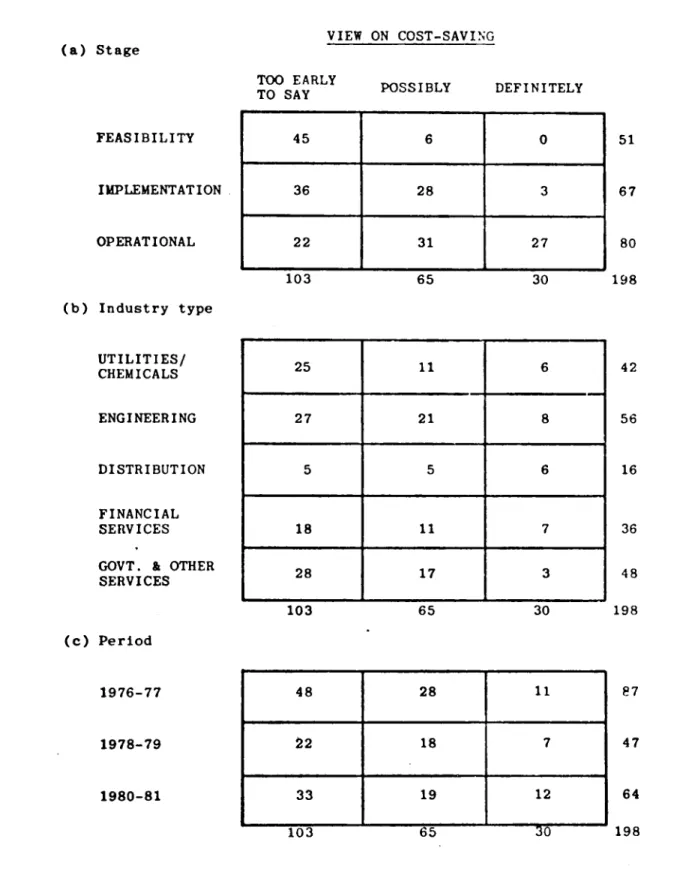
Postal Survey 0.2: The 'Consul tan ts used' category reflects projects in which consultants were utilised, irrespective of
the use of existing or new staff.
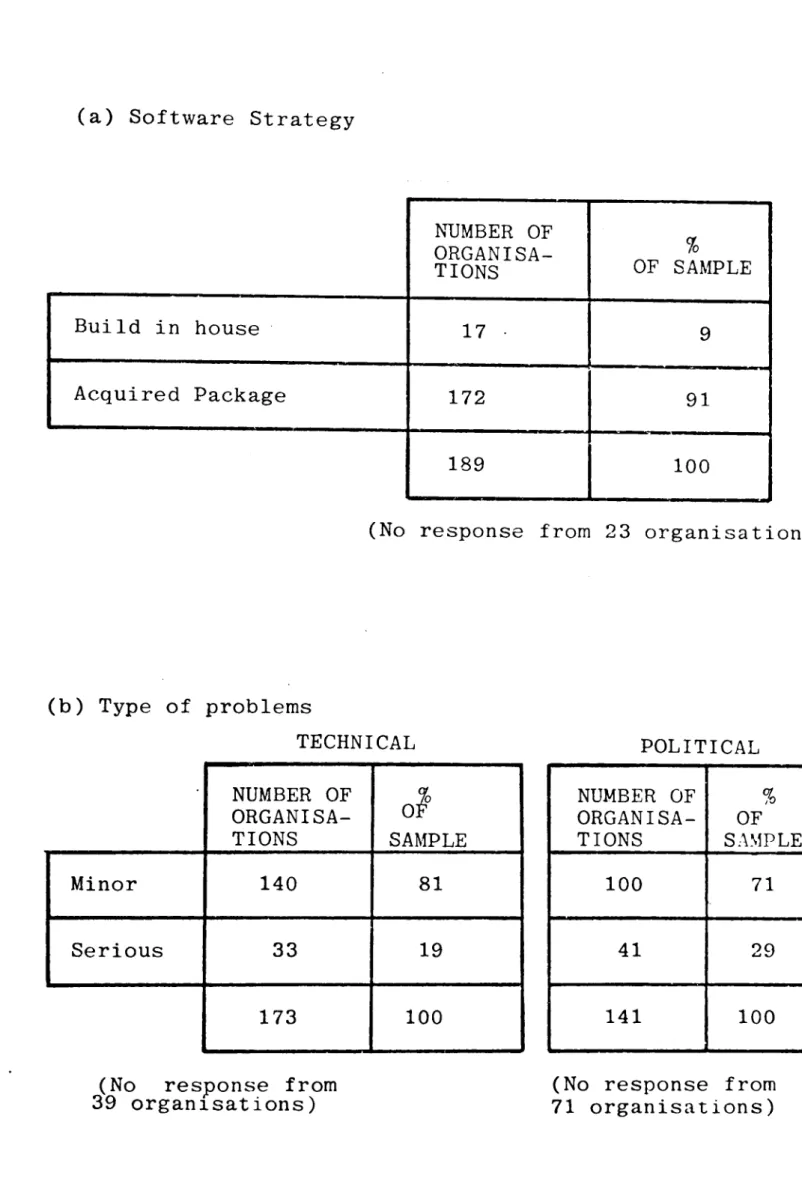
Postal Survey Q.4: a DBMS as well
In organisations building as using a package, the Software .Strategy classification assigned was
'Build own'.
The questionnaire was usually addressed to organisations' DP managers. The cover ing letter assured respondents of confidentiality (Figure AI, Appendix A). UK organisations ONere identified by cross-referencing several different sources:
• the technical press and journals, eg •
advertisements for database staff, reports of database projects
• professional sources, eg • database conference delegate lists
• contacts with other researchers, eg. the
National Computer Centre's list of DBMS
users.
A small number of organisations also voll!nteered
to participate after reading accounts of the
project in the technical press (Sher if 1 Hanson &
Revell, 1977; 1978).
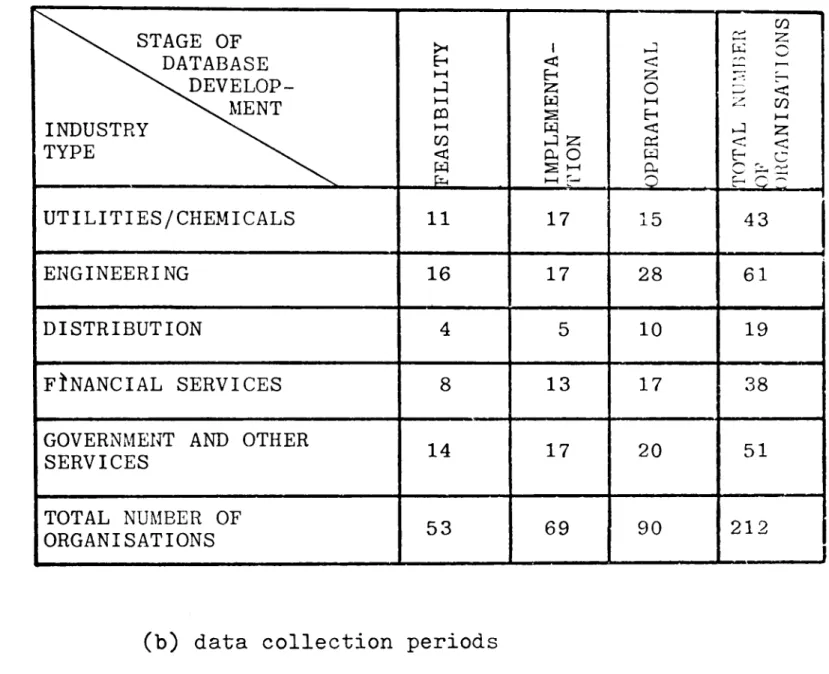
In the period 1976-1981 the questionnaire was sent
to 285 organisations. Valid returns were
obtained from 212 - a response rate of 74%.
The sampling basis was one of availability. A
genuine randomised selection was not appropr iate
for three reasons:
• given the ambiguity in the term
'database', the imposition of a rigid
def ini tion in order to establ ish a
samp1 i ng frame - would have led to the
exclusion of projects possibly
containing vital information
• database systems as an organisation~l
phenomenon are little understood organisations willing to volunteer
information could not be rejected as the priority was to obtain as much
•
information experiences
as possible on real
the issues of interest, for example, the political problems of database development, are of a sensitive nature
-random selectees could not always be induced to relate their experiences.
None of the previous database surveys identified in a literature search employed random sampling to select organisations.
The survey design differs from recent surveys as it was not restricted to one computer manufacturer's installations (Gil1enson, 1982), or to users of DBMSs (Wiorkowski, 1978; Butler, 1980) or members of one computer services association
(EEC-NCC, 1979). The survey was also the most extensive involving UK organisations:
• the National Computer Centre's ini tial database postal survey obtained responses from 126 organisations out of 400 - a response rate of 32% (EEC-NCC, 1979; p.l9)
• the Butler Cox Foundation's DBMS postal survey obtained responses from 100 organisations out of 500 - a response rate of 20% (Butler, 1980; p.20).
The scope of both the above surveys was similar to the present study's, ie. one page questionnaires. While the postal survey was clearly not exhaustive
for the U.K., the participation of over 200 organisations made it sufficiently large so as to be representative.
Interview Survey
The interview survey was an in-depth study of U.K. database projects. The questions were constructed
to permit open-ended responses. The interviewees' responses were recorded
analysis and not coded
verbatim for according to defined classification schemes.
55
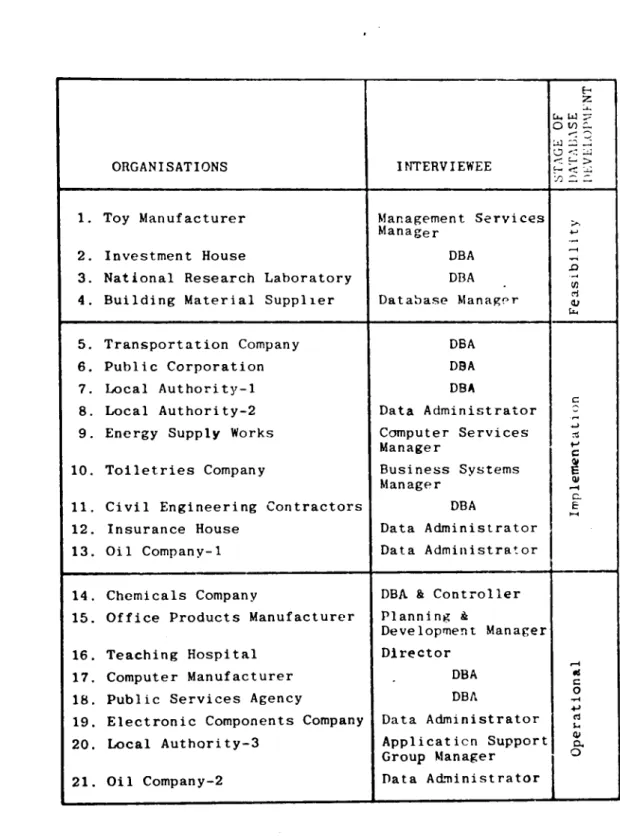
Interviews were conducted in organisations which
had participated in the postal survey. The
arrangements were made in a telephone conversation
wi th the OP manager. Reference was made to the
postal survey, the objectives of the follow-up
interview were
requested with
responsibility for
organisation. A requested.
The interviews
explained and an interview
the staff member with
database developmen ts in the
period of 30-45 minutes was
were semi-structured:
interview check-list was to
the
the
interviewee at the outset
presented
though the order in
which questions were addressed was left flexible.
It was not always possible to adhere to the
interview plan and not all questions were always
answered. The check-list was useful in
controlling the discussion and the individual
questions provided openings to probe the issues of
interest. An overriding concern at the interviews
was to obtain some understanding of the
organisational and political problems, because
this was information only available through
face-to-face discussion and persistent questioning.