City, University of London Institutional Repository
Citation
:
Gashi, I. and Popov, P. T. (2006). Rephrasing rules for off-the-shelf SQL
database servers. Paper presented at the Sixth European Dependable Computing
Conference, 2006 (EDCC '06), 18 - 20 Oct 2006, Coimbra, Portugal.
This is the unspecified version of the paper.
This version of the publication may differ from the final published
version.
Permanent repository link:
http://openaccess.city.ac.uk/521/
Link to published version
:
Copyright and reuse:
City Research Online aims to make research
outputs of City, University of London available to a wider audience.
Copyright and Moral Rights remain with the author(s) and/or copyright
holders. URLs from City Research Online may be freely distributed and
linked to.
Rephrasing Rules for Off-The-Shelf SQL Database Servers
Ilir Gashi, Peter Popov
Centre for Software Reliability, City University,
Northampton Square, London, EC1V 0HB
[email protected]
,
[email protected]
Abstract
We have reported previously [1] results of a study with a sample of bug reports from four off-the-shelf SQL servers. We checked whether these bugs caused failures in more than one server. We found that very few bugs caused failures in two servers and none caused failures in more than two. This would suggest a fault-tolerant server built with diverse off-the-shelf servers would be a prudent choice for improving failure detection. To study other aspects of fault tol-erance, namely failure diagnosis and state recovery, we have studied the “data diversity” mechanism and we defined a number of SQL rephrasing rules. These rules transform a client sent statement to an addi-tional logically equivalent statement, leading to more results being returned to an adjudicator. These rules therefore help to increase the probability of a correct response being returned to a client and maintain a correct state in the database.
1. Introduction
Fault tolerance is frequently the only viable ap-proach of obtaining the required system dependability from systems built out of “off-the-shelf” (OTS) prod-ucts [2]. There are various methods in which this fault tolerance can be achieved ranging from simple error detection and recovery add-ons (e.g. wrappers [3]) to diverse redundancy replication using diverse versions of the components.
These design solutions are well known. Questions remain, however, about the dependability gains and implementation difficulties for a specific system.
We have studied some of these issues in SQL da-tabase servers, a very complex category of off-the-shelf products. We have previously reported [1] re-sults from a study with a sample of bug reports from four off-the-shelf SQL servers so as to assess the pos-sible advantages of software fault tolerance - in the
form of modular redundancy with diversity - in com-plex off-the-shelf software. We found that very few bugs cause failures in two servers and none cause failures in more than two, which would indicate that significant dependability improvements can be ex-pected from the deployment of a fault-tolerant server built out of diverse off-the-shelf servers in compari-son with individual servers or the non-diverse repli-cated configurations.
Data diversity is applicable to SQL servers be-cause of the inherent redundancy that exists in the SQL language: statements can be “rephrased” into different, but logically equivalent [sequences of] statements. While working with the bug reports we found examples where a particular statement causes a failure in a server but a rephrased version of the same statement does not. Examples of such statements of-ten appear in bug reports as “workarounds”.
In this paper we provide details of how SQL re-phrasing can be employed systematically in a fault-tolerant server and provide examples of useful re-phrasing rules. We also report on performance meas-urements using the TPC-C [5] benchmark client im-plementation to get some initial estimates of the de-lays introduced by rephrasing.
The paper is structured as follows: in section 2 we give details of the architecture of a fault-tolerant server employing rephrasing. In section 3 we give details of the data diversity study we have conducted for defining SQL rephrasing rules and illustrate how one of these rules has been used as a workaround for two known bugs of two SQL servers. In section 4 we give some empirical results of experiments we have conducted to measure the performance penalty due to rephrasing. In section 5 we discuss some general im-plications of our results and finally in section 6 some conclusions are presented with possibilities for fur-ther work.
2. Architecture of a Fault-Tolerant Server
2.1 General Scheme
Data replication is a well-understood subject [6], [18], [7]. The main problem replication protocols deal with is guaranteeing consistency between copies of a database without imposing a strict synchronisa-tion regime between them. A study which compared various replication protocols in terms of their per-formance and the feasibility of their implementation can be found in [8]. Existing protocols implement efficient solutions for this problem, but depend on running copies of the same (non-diverse) server.
These schemes would not tolerate non-self-evident1
failures that cause incorrect writes to the database or
1 In [1] we classified the failures according to their
detect-ability by a client of the database servers into: Self-Evident failures - engine crash failures, cases in which the server signals an internal failure as an exception (error message) and performance failures; Non-Self-Evident failures: incor-rect result failures, without server exceptions within an accepted time delay.
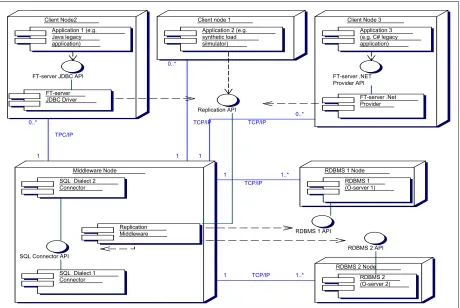
that return incorrect results from read statements. For the former, incorrect writes would be propagated to the other replicas and for the latter, incorrect results would be returned to the client. This deficiency can be overcome by building a fault-tolerant server node (“FT-node”) from two or more diverse SQL servers, wrapped together with a “middleware” layer to ap-pear to each client as a single SQL server. An illustra-tion of this architecture with two diverse Off-The-Shelf servers (“O-servers”) is shown in Fig. 1. A brief explanation of the figure follows. Several nodes (computers) are depicted which run client applica-tions (Client node 1, Client node 2 and Client node 3) or server applications (Middleware node, RDBMS 1 node and RDBMS 2 node). The bottom three nodes together form the FT-server. Components may share a node: e.g. Replication Middleware, and the two SQL connectors for dialects 1 and 2 are deployed on the Middleware node. The SQL connectors additionally contain the SQL rephrasing rules. The diagram as-sumes that the Off-The-Shelf servers (O-servers) run on separate nodes, RDBMS 1 node and RDBMS 2 node. The circles represent the interfaces through which the components interact. Each SQL connector, implements the SQL Connector API interface used by the Replication Middleware component. This, in turn implements the Middleware API interface via which the client applications access the FT-server, either directly or via a driver for the FT-server in a specific run-time environment, e.g. JDBC driver or .NET Provider.
Further improvements to this architecture would be to also run diverse replicas of the middleware component. We have described elsewhere [9], [2] in more detail the FT-node architecture. Here we will only elaborate on the parts relevant to the discussion of rephrasing.
2.2 SQL Connectors
The O-servers are not fully compatible: they “speak different dialects” of SQL, despite being com-pliant at various levels with SQL standards. Therefore the FT-server includes a translator between these dia-lects, defined for a subset of SQL (e.g. “SQL-92 entry level”) plus some more advanced features important for enterprise applications (such as TRIGGERs and
STORED PROCEDUREs). The translators are depicted
as “SQL Dialect Connector’s” in Fig 1.
Client Node 3
FT-server .NET Provider API
FT-server .Net Provider Application 3 (e.g. C# legacy application) Client node 1
Application 2 (e.g. synthetic load silmulator)
RDBMS 2 Node RDBMS 2 (O-server 2) RDBMS 2 API Client Node2
FT-server JDBC Driver FT-server JDBC API
Application 1 (e.g. Java legacy application)
Middleware Node
Replication Middleware SQL Dialect 2
Connector
SQL Connector API
SQL Dialect 1 Connector
Replication API
RDBMS 1 API
RDBMS 1 Node RDBMS 1 (O-server 1)
1 TCP/IP 1..*
1 1..*
TCP/IP 0..*
1
0..*
1 TCP/IP
0..*
1
TCP/IP
[image:4.612.77.537.94.402.2]TPC/IP
Fig. 1 - UML Deployment diagram of the FT-server.
2.3 Failure Detection, Masking, Recovery
The middleware of the FT-server includes extensive functionality for failure detection, masking and state recovery. Self-evident server failures are detected as in a non-diverse server, via server error messages (i.e. via the existing error detection mechanisms inside the servers), and time-outs for crash and performance fail-ures. Diversity gives the additional capability of detect-ing non-self-evident failures by compardetect-ing the outputs2
of the different O-servers. In a FT-node with 3 or more diverse O-servers, majority voting can be used to choose a result and thus mask the failure to the clients, and identify the failed O-server which may need a re-covery action to correct its state. With a 2-diverse FT-node, if the two O-servers give different results, the middleware cannot decide which O-server is in error.
2 An “output” may be the results from a SELECT statement
or the number of rows affected for a write (INSERT, UPDATE and DELETE) statement. For INSERT and UPADTE statements a more refined way would be to read back the affected rows and use those for comparison.
This is where “data diversity” can help by providing additional results to break the tie (more in the next sub-section). State recovery of the database can be obtained in the following ways:
• via standard backward error recovery, which will be
effective if the failures are due to transient failures (caused by so called “Heisenbugs” [12]). To com-mand backward error recovery, the middleware may use the standard database transaction mechanisms: aborting the failed transaction and replaying its statements may produce a correct execution. With “data diversity” a finer granularity level of recovery is possible using SAVEPOINTs and ROLLBACKs;
• additionally, diversity offers ways of recovering
would be expensive, perhaps to be completed off-line, but a designer can use multi-level recovery, in which the first step is to correct only those records that have been found erroneous on read statements.
2.4 Data Diversity Extensions
Even with just two diverse O-servers, many of the O-server failures may be masked by using “data diver-sity” (rephrasing an SQL statement into a different, but semantically equivalent one) to solicit “second opin-ions” from the O-servers and if possible outvote the incorrect response.
Data diversity could be implemented via an algo-rithm in the “Middleware Node” that rephrases state-ments according to predefined rules. We can define these rules for each type of SQL statement defined by the SQL grammar implemented by the server. These rules therefore may form part of the “SQL Dialect Con-nectors“. Upon receiving a statement from a client ap-plication the middleware can look up a rule from the list of available rules and rephrase the statement. The middleware must allow for new rules to be defined as and when necessary. If the middleware exhausts the list of rules that it can apply to a certain statement but no “correct result”3 can be established by applying the
closed adjudication mechanism then an error message is returned to the client.
Data diversity can be used with or without design
diversity. Architectural schemes using data diversity are similar to those using design diversity. For instance, Amman and Knight in [4] describe two schemes, which they call “retry block” and “n-copy programming”, which can also be used for SQL servers. The “retry block” is based on backward recovery. A statement is only rephrased if either the server “fail-stops” or its output fails an acceptance test. In “n-copy program-ming”, a copy of the statement as issued by the client is sent to one of the O-servers and rephrased variant(s) are sent to the others; their results are voted to mask failures.
Data diversity allows for a finer-granularity of state recovery, which is facilitated by the implementation of “SAVEPOINT” and “ROLLBACK” within transactions.
The procedure (written in pseudocode), for a statement within a transaction, is given at the end of this subsec-tion.
A performance optimization could be to perform ad-judication at an intermediate step of the WHILE loop
execution rather than at the end (e.g. for a “majority
3 Depending on the setup used a correct result could be either
the majority result or one that passes an acceptance test.
voting” adjudication, if there are five rules for a par-ticular statement then could check after the execution of the first three rephrased versions of the statement whether results returned by each of them are identical; if yes then majority result is already obtained and there-fore no need for the last two rephrased versions of the statement to be executed).
The SAVEPOINT and ROLLBACK approach is the
cor-rect way of ensuring the “isolation” property of an
ACID transaction.4 Otherwise, if we “ABORTed” the
transaction and started a new one to perform the re-phrased version of the statement, a concurrent transac-tion may have updated rows in the target table. This would lead to different results being returned by the O-server for the rephrased statement even though the be-havior is not faulty.
WHILE more rephrasing rules available for the statement DO
IF WRITE (i.e. DML (INSERT, UPDATE or DELETE) or DDL (e.g.
CREATE VIEW etc.)) statement THEN
SAVEPOINT;
Execute WRITE statement[s] produced by the current
re-phrasing rule;
READ the rows amended by the WRITE statement;
Store the results produced by the preceding READ
state-ment;
ROLLBACK TO last SAVEPOINT;
ELSE IF READ (i.e. SELECT) statement THEN
Execute READ statement[s] produced by the current
re-phrasing rule;
Store the results produced by the READ statement;
END IF
END WHILE
Adjudicate from the stored results produced by each rephrased version
of the statement;
IF adjudication succeeds (e.g. “majority voting” produced a result) THEN
Execute the statement which was adjudicated to be correct;
ELSE
ABORT current Transaction
Raise an exception; END IF
3. SQL Rephrasing Rules
As explained in section 2, the support for data di-versity can be implemented in the middleware in the form of rephrasing rules. The initial step is defining the rules that are to be implemented. The rules can be de-fined by studying in depth the SQL language itself to identify the parts of the language which are synony-mous and therefore enable the definition of logically equivalent rephrasing rules. We took a different more
4 This is under the assumption that the ACID property of the
direct approach to defining these rules: we studied the known bugs reported for 4 open-source servers, namely Interbase 6.0, Firebird 1.05, PostgreSQL 7.0 and
Post-greSQL 7.2 (abbreviated IB 6.0, PG 7.0, FB 1.0 and PG 7.2 respectively). However our intention was not to simply define workaround rules which are highly bug specific, but instead to define generic rephrasing rules, which can be used in a broader setting. As a result we found that some of the generic rules that we defined could be applied to multiple bugs in our study. We provide examples next.
3.1 Generic Rules
The “generic rules” are rephrasing rules, which can be applied to a range of ‘similar’ statements, be it DML (data manipulation language: SELECT, INSERT, UPDATE and DELETE) or DDL (data definition
lan-guage e.g. CREATE TABLE etc.) statements. We have
defined a total of 14 generic rephrasing rules. Full de-tails of these rules are in [15]. We will provide dede-tails of Rule 8 and how it proved to be a useful workaround
for two different bugs reported for two different serv-ers.
Rule 8:
An SQL
VIEWcan be rephrased as an
SQL
STORED PROCEDUREor SQL
TEMPORARYTABLE
This rule proved to be a useful workaround for FB 1.0 Bug 488343 [16]. To observe the failure the bug report details the following setup:
CREATE TABLE CUSTOMERS (ID INT, NAME, VARCHAR(10) );
CREATE TABLE INVOICES (ID INT, CUST_ID INT, CODE
VARCHAR(10), QUANTITY INT);
INSERT INTO CUSTOMERS VALUES (1, 'ME');
INSERT INTO INVOICES VALUES (1, 1, 'INV.1', 5);
INSERT INTO INVOICES VALUES (2, 1, 'INV.2', 10);
INSERT INTO INVOICES VALUES (3, 1, 'INV.3', 15);
INSERT INTO INVOICES VALUES (4, 1, 'INV.4', 20);
The following VIEW is faulty (specifically, the use of the SQL DISTINCT keyword to filter the results of a SELECT statement is faulty in SQL VIEWs of the FB 1.0 server):
CREATE VIEW V_CUSTOMERS AS SELECT DISTINCT ID, NAME
FROM CUSTOMERS;
The failure can be observed by issuing the follow-ing statement:
SELECT SUM(INV.QUANTITY) FROM INVOICES INV INNER JOIN
V_CUSTOMERS CUST ON INV.CUST_ID = CUST.ID;
SUM 20
5 Firebird is the open-source descendant of Interbase 6.0. The
later releases of Interbase are issued as closed-development by Borland.
The expected result is 50 not 20. If we use a
STORED PROCEDURE instead of the VIEW then the
correct results is returned6:
SET TERM !!;
CREATE PROCEDURE V_CUSTOMERS RETURNS (ID INT, NAME
VARCHAR(10)) AS
BEGIN
FOR SELECT DISTINCT ID, NAME FROM CUSTOMERS
INTO :ID, :NAME DO
BEGIN
SUSPEND;
END
END!!
SET TERM; !!
Issuing the same SELECT statement as before we
obtain the expected result (50):
SELECT SUM(INV.QUANTITY) FROM INVOICES INV INNER JOIN V_CUSTOMERS CUST ON INV.CUST_ID = CUST.ID;
SUM
50
The same rule was a useful workaround for another bug, this time the PG 7.0 bug 23 [17]. To observe the failure the bug report details the following setup: CREATE TABLE L (PID INT NOT NULL, SEARCH BOOL, SERVICE
BOOL);
INSERT INTO L VALUES (1,'T','F'); INSERT INTO L VALUES (1,'T','F');
INSERT INTO L VALUES (1,'T','F'); INSERT INTO L VALUES (1,'T','F');
INSERT INTO L VALUES (1,'T','F'); INSERT INTO L VALUES (1,'F','F');
INSERT INTO L VALUES (1,'F','F'); INSERT INTO L VALUES (2,'F','F');
INSERT INTO L VALUES (3,'F','F'); INSERT INTO L VALUES (3,'T','F'); The following VIEWs are then defined (notice the
use of the GROUP BY clause):
CREATE VIEW CURRENT AS SELECT PID, COUNT(PID), SEARCH,
SERVICE FROM L GROUP BY PID, SEARCH, SERVICE;
CREATE VIEW CURRENT2 AS SELECT PID, COUNT (PID),
SEARCH, SERVICE FROM L GROUP BY PID, SEARCH, SERVICE; By issuing the following SELECT statement
incor-rect results are obtained (this is due to the GROUP BY
clause used in the VIEWs and the COUNT used on a
column from a VIEW):
SELECT CURRENT.PID, CURRENT.COUNT AS SEARCHTRUE,
CURRENT2.COUNT AS
SEARCHFALSE FROM CURRENT,CURRENT2 WHERE
CURRENT.PID =CURRENT2.PID AND CURRENT.SEARCH='T'
AND CURRENT2.SEARCH='F' AND CURRENT.SERVICE='F' AND
CURRENT2.SERVICE='F';
-- pid | searchtrue | searchfalse -- 1 | 10 | 10 -- 3 | 1 | 1
The expected results are:
-- pid | searchtrue | searchfalse -- 1 | 5 | 2 -- 3 | 1 | 1
By using TEMPORARY TABLEs instead of VIEWs the
correct result is obtained:
SELECT PID, COUNT(PID), SEARCH, SERVICE INTO TEMP
CURRENT FROM L GROUP BY PID, SEARCH, SERVICE;
SELECT PID, COUNT(PID), SEARCH, SERVICE INTO TEMP
CURRENT2 FROM L GROUP BY PID, SEARCH, SERVICE;
SELECT CURRENT.PID,CURRENT.COUNT AS SEARCHTRUE,
CURRENT2.COUNT AS SEARCHFALSE FROMCURRENT,
CURRENT2 WHERE CURRENT.PID=CURRENT2.PID AND
CURRENT.SEARCH='T' AND CURRENT2.SEARCH='F' AND
CURRENT.SERVICE='F' AND CURRENT2.SERVICE='F';
-- pid | searchtrue | searchfalse -- 1 | 5 | 2 -- 3 | 1 | 1
We used TEMPORARY TABLEs in PG 7.0 and not
STORED PROCEDUREs since PG 7.0 does not support
functions (procedures) that return multiple rows. Details of the other generic rephrasing rules and how they can be used as workarounds for other re-ported bugs are given here [15].
We looked at how many of the generic rules can be applied to the bugs reported for the open-source servers in our bugs study. The results are shown in Table 1. The leftmost three columns of the table show the re-sults for the non-self-evident failures caused by read (i.e. SELECT) statements. Clearly, a number of these are also classified as a “user error”, i.e. the user issues an incorrect statement, which the server incorrectly executes without raising an exception. For example IB 6.0 incorrectly executes a statement such as SELECT X FROM A, B even though the column X is defined in
both tables A and B, which can lead to ambiguous re-sults. PG 7.0 / PG 7.2, correctly, raise an exception.
If we take away the “user error” bugs then we can see that in all the server pairs the generic rules can be used as workarounds for at least 80% of the non-self-evident failures caused by read statements.
The right-most 4 columns of the table are for the bugs that cause state-changing failures, which have been further subdivided into bugs in DDL and write statements. We can see that generic rules can be used as workarounds for at least 60% of failures caused by the state-changing statements.
3.2 Specific Rules
The generic rephrasing rules that we have defined do not provide workarounds for all the failures caused by the bugs collected in our study. For these failures specific workaround rules need to be defined. For ex-ample recursive BEFORE UPDATE TRIGGERS can
re-turn error messages in FB 1.0/IB 6.0 which means the table for which the trigger is defined becomes unusable (FB 1.0 bug 625899 [16]). A generic rule could not be defined for this bug. A specific workaround (and a ge-neric recovery procedure) upon encountering this error message would be to:
• disable the trigger in FB 1.0 / IB 6.0
• read the log of the other server to check the
se-quence of the write statements that have been issued as a result of the trigger
• send this sequence of statements explicitly to the
FB 1.0 / IB 6.0 server
The workaround above would work in a diverse server-type configuration if the other server[s] works correctly (the other server[s] in our study do not con-tain this bug) while without design diversity a fault, clearly, cannot be dealt with this way.
We have found that a large number of bugs, if server diversity is not employed, would require very specific rules to be defined to workaround the failures that they cause. In many cases these rules require sub-stantial new implementation in the form of “wrapping” of the results returned to the client (or for write state-ments before they are stored in the database) or re-implementing parts of the functionality of the database that are found to be faulty and no workaround exists in SQL. Although possible such an approach is clearly limited because the newly developed code can itself be faulty which may diminish the gains in reliability that can be obtained from its use. This reiterates that design diversity is desirable.
4. Performance Implications of Rephrasing
To measure the performance implications of re-phrasing, we conducted a number of experiments based
Table 1. A summary of applying the generic rephrasing rules for non-self evident and state-changing bugs of IB 6.0 and PG 7.0 and the later releases FB 1.0 and PG 7.2
State-changing failures
Server pair Non-self evident non-state-changing
fail-ures (SELECT statements) DDL statement failures Write statement failures
Total Total covered
by generic rules
Total user
errors * Total
Total covered
by generic rules Total
Total covered by generic rules
IB 6.0 + PG 7.0 21 12 6 21 13 9 7
IB 6.0 + PG 7.2 26 18 6 19 13 7 5
FB 1.0 + PG 7.0 16 11 2 19 13 8 6
on the industry standard benchmark for databases - TPC-C [5]7. The factors which degrade performance
when rephrasing is employed are:
1. delays enforced by the middleware for comparison of results
2. delays from using the following mechanisms within transactions:
• Transaction SAVEPOINTs
• Transaction ROLLBACKs
• Execution of SELECT statements after WRITE
statements (INSERT, UPDATE, DELETE)
• Rephrasing
The additional delay introduced by the use of re-phrasing is delay 2. We have performed an experimen-tal study to estimate delay 2. Delay 1 would exist also in a diverse setup with or without rephrasing. Studies that have reported measures of other delays which are not specific to rephrasing (such as enforcing 1-copy serialisability) can be found in [18], [6] 8. There are other factors that can influence the degradation of per-formance that we have not measured in our experimen-tal setup (e.g. rephrasing delays when more than one rephrasing rule is used etc.). The experiments that we have conducted aim to provide an initial estimate of the delays due to rephrasing. A more thorough perform-ance evaluation should also take into account concur-rent execution of transactions. As was also noted by one of the anonymous reviewers, for some concurrency control mechanisms, the increase in transaction execu-tion times due to the use of rephrasing, the probability of conflicts due to concurrency may also increase which may further degrade performance.
The experimental setup consisted of three com-puters. All three computers ran on Microsoft’s Win-dows 2000 operating system, they had 384 MB RAM, and Intel Pentium 4 1.5GHz processors. One machine hosted the client implementation of the TPC-C bench-mark. The other two machines hosted the servers (PostgreSQL 8.0 and Firebird 1.5). We used later re-leases of the servers than the ones used in our bugs study since these earlier releases do not support
SAVE-POINTs and ROLLBACKs within transactions. We have
not used any commercial servers in our experiments since the license agreements are very restrictive with regard to publishing performance data.
We ran experiments on both diverse and non-diverse setups. In the non-diverse experiments we always wait for the slowest server response before we can start
7 The TPC-C experiments were carried out with 1 emulated
client and 1 warehouse with client think times set to 0.
8 These studies also provide some optimisation procedures
for 1-copy serialisability.
the next transaction. Therefore the diverse setups here are always slower (other configurations are possible and we have discussed some of these in [9]).
Figure 2 illustrates the sequence of executions within a transaction for the different non-diverse set-ups. The grey boxes represent the fault tolerance mechanism used whereas the dotted lines represent the added delay from the use of the respective mechanism. Setup a) is the baseline, against which we will measure the added delays. Setups b), c), and d) measure the delays of using the fault tolerance mechanisms when no failures are observed (i.e. the cost of being cautious)9.
Setups e) and f), measure the cost of re-execution of a statement10. These experiments measure delays for a
number of situations:
• re-execution of an unchanged statement as a
possi-ble protection against transient failures (caused by the so called “Heisenbugs” [12])
• re-execution of a logically equivalent rephrased
statement in case the first one has failed self-evidently (i.e. a crash or other exceptional failures)
• re-execution of a logically equivalent rephrased
statement to get additional results for comparison on the middleware to increase the likelihood of failure detection for non-self-evident failures In our experiments we did not use rephrased state-ments. Instead, the same statement was executed twice. This is a simplification due to the absence of a proper implementation of rephrasing. In the absence of any other data, we wanted to get an initial estimate of the delays that the various fault tolerance mechanisms will produce with the database servers.
The diverse setups have a similar structure. The only difference is that in diverse setups we only use 1
SAVEPOINT (at the beginning of the transaction) rather
than before each write statement and therefore we may also have only one ROLLBACK (at the end of
transac-tion). For setups e) and f), this means that we first exe-cute every statement once then we ROLLBACK to the
beginning and execute all the statement again. So the difference between the diverse and non-diverse setups is a different level of granularity of using SAVE-POINTs/ROLLBACKs.
9 b) detection of erroneous writes; c) SAVEPOINT are used
before write statements for finer grained recovery; d) both SAVEPOINTs are used and the modified rows are read back (combination of b) and c));
10 e) optimistic (on writes) rephrasing: each statement is
Fig. 2. A transaction execution sequence in the experimental setups. The shaded boxes represent the fault tolerant mechanism used and the dotted lines represent the additional delays from their use. The second executions of the statements are proxies for rephrased versions of statements.
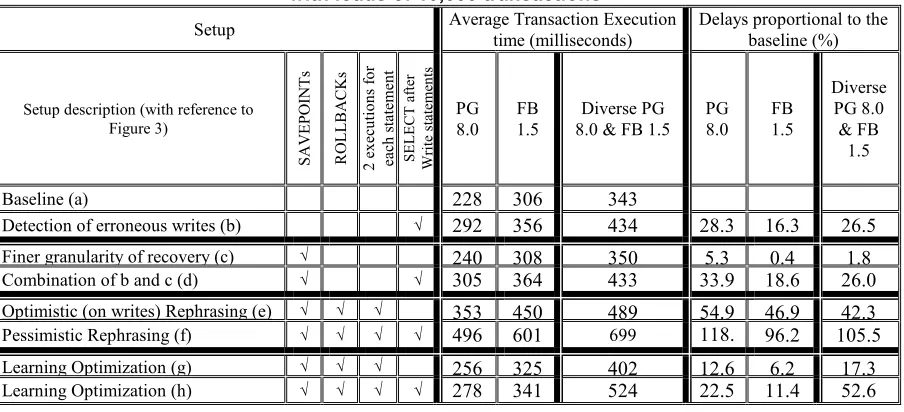
The full results of these experiments are given in Table 2. The first column explains the setup under which the experiment was run. The following 4 col-umns spell out which fault tolerance mechanisms were used (if the cell is blank then the respective mechanism was not used). The following 3 columns show the aver-age execution time of a transaction, and the last 3 col-umns show the added delay (in percentages) propor-tional to the baseline of each setup. The first six rows contain the results for each of the setups we explained earlier (and illustrated in Figure 2).
The last two rows are structurally the same as setups (e) and (f) respectively. However in these experiments we have tried to simulated the effect of a simple learn-ing rule: if after 1000 executions a statement has been found to be correct then we stop rephrasing (in our simulation it means we stop executing the statement twice for both setups and additionally stop executing
the SELECT statement that read the modifications of the
write statements for setup (h)).
The delays seem to be higher proportionally in PostgreSQL than in Firebird. This is because the exe-cution time of COMMITs is smaller in Firebird for the
experiments with larger number of SELECT statements.
The number of write statements to be COMMITed
al-ways remains the same in all experiments (even in the ones with 2 executions of statements, since the first execution of a write statement is always ROLLBACKed).
Comparing the setups a) with e) we can see that even though in setup e) every statement is being executed twice the average execution times of the transactions are not simply twice the execution time of transactions in setup a). This is explained by the fact that the num-ber of transactions remains the same (i.e. we still have the same number of COMMITs) and also the data may
be stored already in the RAM which reduces the
execu-Table 2 Performance effects of the various fault-tolerance schemes. Each experiment is run with loads of 10,000 transactions
Setup Average Transaction Execution time (milliseconds) Delays proportional to the baseline (%)
Setup description (with reference to Figure 3)
SA
V
E
PO
IN
T
s
R
O
L
L
B
A
C
K
s
2
ex
ec
ut
io
ns
f
or
ea
ch
s
ta
te
m
en
t
SE
L
E
C
T
a
ft
er
W
ri
te
s
ta
te
m
en
ts
PG 8.0
FB 1.5
Diverse PG 8.0 & FB 1.5
PG 8.0
FB 1.5
Diverse PG 8.0 & FB
1.5
Baseline (a) 228 306 343
Detection of erroneous writes (b) √ 292 356 434 28.3 16.3 26.5
Finer granularity of recovery (c) √ 240 308 350 5.3 0.4 1.8
Combination of b and c (d) √ √ 305 364 433 33.9 18.6 26.0
Optimistic (on writes) Rephrasing (e) √ √ √ 353 450 489 54.9 46.9 42.3
Pessimistic Rephrasing (f) √ √ √ √ 496 601 699 118.
1 96.2 105.5
Learning Optimization (g) √ √ √ 256 325 402 12.6 6.2 17.3
[image:9.612.85.537.503.709.2]tion time of the second statement. The same holds when comparing results of setups b) with f).
Since the numbers in Table 2 represent point estimates (i.e. they are single runs of an experiment per setup) we have repeated the experiments for setup a) and f) to measure the non-deterministic variation that may exist between the different runs. We observed a very small difference (less than 1% for 5 out of six of the experi-ments and less than 3% for all). Hence we can trust with a higher degree of confidence that the observa-tions documented in table 2 represent closely the ‘true’ differences between different setups.
5. Discussion
We presented in section 2 the architecture we pro-pose for a fault-tolerant server employing rephrasing. The middleware used would make use of a rephrasing algorithm. Any fault-tolerant solution, which makes use of server diversity would need to have “connectors” developed as part of the middleware to translate a cli-ent scli-ent statemcli-ent to the dialect of the respective server. This is because each server ‘speaks’ its own dialect of SQL. The rephrasing algorithms can also be part of these connectors. A related point is that data-base servers offer features that are extensions to the SQL standard, and these features may differ between the servers. Therefore for applications which require a richer set of functionality data diversity would be at-tractive alone as it would for instance allow applica-tions to use the full set of features. A complex
state-ment, which can be directly executed with some servers but not others, may need to be rephrased as a logically equivalent sequence of simpler statements for the latter.
For example, the TRUNCATE command is a
Post-greSQL specific feature (and is buggy in version 7.0; see bug 20 [17] for details). In its stead the DELETE
command can be used to workaround the problem. The
DELETE command is also implemented in Firebird and
all the other SQL compliant servers.
Since most of these rules are transformations of the SQL grammar, they are amenable to formal analysis. Thus, despite the additional implementation, high reli-ability can be achieved with a combination of formal analysis and testing of the new code.
The results presented in section 3 demonstrate that a small number of rephrasing rules can help with server diagnosis and state recovery. We observed that a lim-ited set of generic rephrasing rules that we have defined (14 in total) can be used as workarounds for at least 80% of the non-self-evident failures caused by read statements and at least 60 % of failures caused by write or DDL statements in any of the open-source 2-diverse
setups in our study. We have also observed that using data diversity without design diversity would lead to a large number of specific rephrasing rules to
work-around certain failures. Implementing such rules might require a substantial amount of new implementation, which itself may be faulty, thus, reducing the possible reliability gains that can be obtained from their use.
Rephrasing has been proposed as a possibility to de-tect failures that would otherwise be un-dede-tectable in some replication settings. The possible benefits of this approach could be its relatively low cost in comparison with design diversity, and also that it can be used with or without design diversity allowing for various cost-dependability trade-offs. Possible setups include:
• In non-diverse redundant replication settings, if
high dependability assurances are required, the only option available would be to rephrase all the state-ments sent to the server. This can lead to high per-formance penalties. To reduce the perper-formance penalty some form of learning strategy can be ap-plied, e.g. keep track of all the statements that have been rephrased. If the rephrased statement keeps giving the same results as the original statement then confidence is gained that the original statement is giving the correct result and the statement does not have to be rephrased in future occurrences (what we did in setups g) and h) of the TPC-C ex-periments). The other dimension is to stop sending the client-version of the statement to a server if it always gives an incorrect result. In this case the middleware can flag each occurrence of this state-ment and use the rephrased version of it without sending the original statement to the server [2]. This reduces the time taken to respond to the client.
• In a diverse server configuration a less
rephrasing-intensive approach may be used where only the read statements (i.e. SELECTs) that return different
re-sults are rephrased (assuming that at least two serv-ers are running in parallel so that a mismatch is de-tected). The rephrasing is also done for all the write statements (to ensure that the state of the database is not corrupted). Since a smaller set of statements needs to be rephrased the performance is enhanced. The non-self-evident identical failures, however, (we observed 4 of these in the study with known bugs of SQL servers [1]) will not be detected. To further enhance the performance the same learning strategies can be used as in the previous setup.
6. Conclusions
deploy-ing a fault-tolerant SQL server, which makes use of diverse off-the-shelf SQL servers. From studying bugs reported for four off-the-shelf servers we reported that failure detection rates in 1-out-of-2 configurations was at least 94% and this increased to 100% in configura-tions which employed more than two servers. However fault tolerance is more than just failure detection. In this paper we reported on the mechanism of data diver-sity and its application with SQL servers in aiding with failure diagnosis and state recovery. We have defined 14 generic ‘workaround rules’ to be implemented in a ‘rephrasing’ algorithm which when applied to a certain SQL statement will generate logically equivalent statements. We have also argued that since these rules are transformations of the SQL language syntax, they are amenable to formal analysis and dependability gains from employing rephrasing are achievable de-spite the development of a bespoke new code.
We also outlined a possible architecture of a fault tolerant server employing diverse SQL servers and detailed how the middleware used in it can be extended to also handle rephrasing of SQL statements.
We also presented some performance measurements from experiments we have run with an implementation of the TPC-C benchmark [5], which gave initial esti-mates of the likely delays due to employing rephrasing.
Further work that is desirable includes:
• demonstrating the feasibility of automatic
transla-tion of SQL statements from, say ANSI/ISO SQL syntax to the SQL dialect implemented by the de-ployed SQL servers. We have completed some pre-liminary work on implementing translators between MSSQL and Oracle dialects for SELECTs, and
be-tween Oracle and PostgreSQL dialects for SELECT, INSERT and DELETE statements;
• developing the necessary components so that users
can try out diversity in their own installations, since the main obstacle now is the lack of popular off-the-shelf “middleware” packages for data replica-tion with diverse SQL servers. This would also in-clude implementing a mechanism of maintaining (adding/removing) rephrasing rules as add-on com-ponents in the middleware.
Acknowledgment
This work has been supported in part by the Inter-disciplinary Research Collaboration in Dependability (DIRC) project funded by the U.K. Engineering and Physical Sciences Research Council (EPSRC). Authors would like to acknowledge the anonymous reviewers for the thoughtful comments and useful suggestions.
Bibliography
1. Gashi, I., Popov, P., Strigini, L. Fault diversity among off-the-shelf SQL database servers in DSN'04, 2004, Florence, Italy, IEEE Computer Society Press p. 389-398.
2. Popov, P., et al. Software Fault-Tolerance with Off-the-Shelf SQL Servers in ICCBSS'04, 2004, Redondo Beach, CA USA, Springer p. 117-126.
3. Popov, P., et al. Protective Wrapping of OTS Components in 4th ICSE Workshop on Component-Based Software En-gineering: Component Certification and System Predic-tion, 2001, Toronto
4. Ammann, P.E. and J.C. Knight, Data Diversity: An Ap-proach to Software Fault Tolerance, IEEE Transactions on Computers, 1988, C-37(4), p. 418-425.
5. TPC, TPC Benchmark C, Standard Specification, Version 5.0. 2002 http://www.tpc.org/tpcc/.
6. Patiño-Martinez, M., Jiménez-Peris, R., Kemme, B., and Alonso, G., MIDDLE-R: Consistent database replication at the middleware level, ACM Transactions on Computing Systems, 2005, 23(4), p. 375-423.
7. Bernstein, P.A., V. Hadzilacos, and N. Goodman, Concur-rency Control and Recovery in Database Systems. 1987, Reading, Mass.: Addison-Wesley. 370.
8. Jimenez-Peris, R., M. Patino-Martinez, G. Alonso, and B. Kemme, Are Quorums an Alternative for Data Replica-tion?, ACM Transactions on Database Systems, 2003, 28(3), p. 257-294.
9. Gashi, I., Popov, P., Stankovic, V., Strigini, L., On De-signing Dependable Services with Diverse Off-The-Shelf SQL Servers, in Architecting Dependable Systems II, R. de Lemos, C. Gacek, A. Romanovsky (Eds). 2004, Springer-Verlag. p. 191-214.
10. EnterpriseDB, EnterpriseDB. 2006 http://www.enterprisedb.com/.
11. Janus-Software, Fyracle. 2006 http://www.janus-software.com/fb_fyracle.html.
12. Gray, J. Why do computers stop and what can be done about it? in 6th International Conference on Reliability and Distributed Databases, 1987
13. Tso, K.S. and A. and Avizienis. Community Error Re-covery in N-Version Software: A Design Study with Ex-perimentation in FTCS-17, Pittsburgh, Pennsylvania, July 6-8, 1987 p. 127-133.
14. Sutter, H., SQL/Replication Scope and Requirements document, in ISO/IEC JTC 1/SC 32 Data Management and Interchange WG3 Database Languages. 2000. p. 7 15. Gashi, I., Rephrasing Rules for SQL servers. 2006
http://www.csr.city.ac.uk/people/ilir.gashi/Bugs/.
16. Gashi, I., Tables containing known bug scripts of Fire-bird 1.0 and PostgreSQL 7.2. 2005 http://www.csr.city.ac.uk/people/ilir.gashi/Bugs/.
17. Gashi, I., Tables containing known bug scripts of Inter-base, PostgreSQL, Oracle and MSSQL. 2003 http://www.csr.city.ac.uk/people/ilir.gashi/DSN/.