City, University of London Institutional Repository
Citation:
Hebel, Maria (1998). Exploring the Impact of Human Value Systems on Performance Measurement. (Unpublished Doctoral thesis, City, University of London)This is the accepted version of the paper.
This version of the publication may differ from the final published
version.
Permanent repository link:
http://openaccess.city.ac.uk/20125/Link to published version:
Copyright and reuse: City Research Online aims to make research
outputs of City, University of London available to a wider audience.
Copyright and Moral Rights remain with the author(s) and/or copyright
holders. URLs from City Research Online may be freely distributed and
linked to.
City Research Online: http://openaccess.city.ac.uk/ [email protected]
EXPLORING THE IMPACT OF
HUMAN VALUE SYSTEMS ON
PERFORMANCE MEASUREMENT
Maria Hebel
Ph.D. Thesis
City University
Northampton Square
London
Department of Management Systems and Information
Thesis submitted to City University in accordance with senate regulations
per~aining
to the fulfilment of requirements for the degree of Philosophy
· .
IMAGING SERVICES NORTH
Boston Spa, WetherbyWest Yorkshire, LS23 7BQ
www.bl.uk
BEST COpy AVAILABLE.
IMAGING SERVICES NORTH
Boston Spa, WetherbyWest Yorkshire, lS23 7BQ www.bl,uk
. APPENDIX I,
J,
K, LAND M
REDACTED AT REQUEST
OF UNIVERSITY, SEE
TABLE OF CONTENTS
Page
Title Page 1
Table of Contents 2
Table of Dlustrations 5
Table of Appendices 7
Acknowledgements 8
Declaration 9
Abstract 10
List of Abbreviations 11
Chapter 1 Introduction to Performance Measurement and 12 Human Values in Organisations
Summary 12
1.1 Introduction 12
1.2 Origins of Enquiry 13
1.3 Further Chapters 18
1.4 Conclusion 25
Chapter 2 Taking a Soft Systems Approach to 26
Further Investigation
Summary 26
2.1 Introduction 26
2.2 The Action Research or Action Science Paradigm 27
2.3 Application of Methodology and Paradigm 29
2.4 Means of Data Gathering 32
2.5 Interview 33
2.6 Questionnaire 34
2.7 ObseIVation 34
2.8 Introduction to Performance Measurement Scenario 35
2.9 Applying SSM - Analysis 1 37
2.10 Analysis 2 33
2.11 Analysis 3 42
2.12 Root Definition and CATWOE 44
2.13 The 5 E's 47
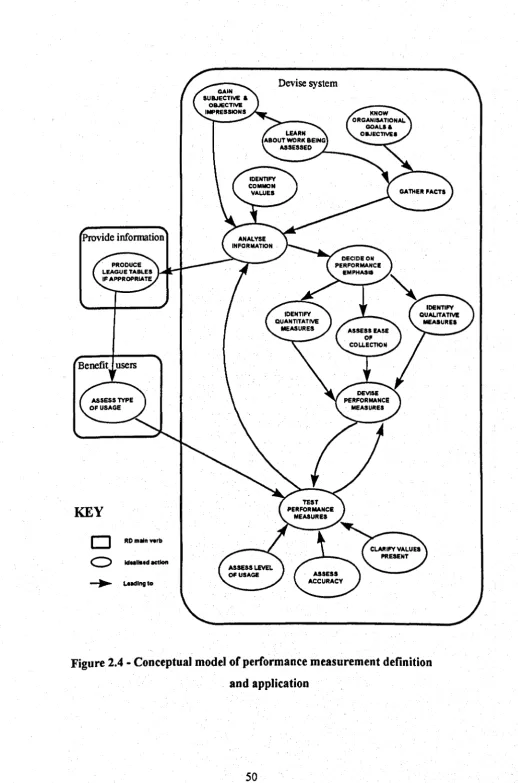
2.14 Conceptual Model 48
2.15 Overview 53
2.16 Conclusion 55
Chapter 3 Performance Measurement: A Fad or Useful Activity? 56
Summary 56
3.1 Short Chronicle of Performance Measurement 56 3.2 General Attributes of Performance Measurement 60
3.3 Features of Numeric Data 64
3.4 Features ofInformation • 66
3.5 Levels of Focus for Performance Measurement 68
TABLE OF CONTENTS
(continued) Page
Chapter 3 Performance Measurement: A Fad or Useful Activity? (continued)
3.7 The Influence of the Perfonnance Measurement Designer 73
3.8 The People Being Measured 75
3.9 World-views ofPerfonnance Measurement 76
3.10 Conclusion 81
Chapter 4 Performance Measurement in the Context of the 82 Case Studies
Summary 82
4.1 Introduction 82
4.1.2
Limehouse Crimina/Investigation Department
83 4.1.3Mark Richardson
&Company Limited
84 4.1.4The Quakers - Wandsworth Preparative Meeting
86
4.1.5
Stonyhurst College. Lancashire
884.2 Questionnaire Results 89
4.3 Interview Outcomes 96
4.4 Summary of Case Study Attitudes to PM 99
4.5 Benefits and Problems Associated with Existing Measures 103
4.6 A Comment on UK League Tables 107
4.7 Pseudocommunity 109
4.8 Family Analogy 110
4.9 Choice of Solution 113
4.10 Defences 114
4.11 Conclusion 117
Chapter 5 Looking for Clues in Human Values Theory 118
Summary 118
5.1 A Brief History of Human Values Theory 118
5.2 Philosophy 119
5.3 Psychology and Sociology 121
5.4 Systems, Management and Organisation Theory 127
5.S
Values and Communication 1355.6 Values Narrative in Organisations 140
5.7 Changing Values 144
5.8 Conclusion 147
Chapter 6 A Review of Contemporary Questionnaires 148 That Assess Values and Roles in Organisations
Summary 148
6.1 Introduction 148
6.2 Belbin Self-Perception Inventory 150
6.3 Myers Brigg Type Indicator 153
6.4 Hall-Tonna Values Inventory 156
6.S Other Surveys 161
6.6 Critique 163
TABLE OF CONTENTS
(continued) Page
Chapter 7 The Systemic Nature of Values 166
Summary 166
7.1 Values as System Components 166
7.2 Value Systems 168
7.3 Soft Systems Methodology 176
7.4 Interacting Value Systems 180
7.5 Emergence 185
7.6 Performance Measurement and Value Systems 189
7.7 Conclusion 193
Chapter 8 Values Theory and Systems in Action 194
Summary 194
8.1 Introduction 194
8.2 Reflections on the Original Survey 195
8.3 Rationale for Second Survey 199
8.4 The Survey Design and Distribution 204
8.5 Findings and Discussion 208
8.6 Reflection on Second Survey 214
8.7 Turning Value Systems Theory into Performance 218 Measurement Action
8.8 Conclusion 222
Chapter 9 Lessons for Systems Thinking and Developing 223 Value Systems Concepts
Summary 223
9.1 Lessons for Systems Thinking 223
9.2 Values Awareness and Clarification 226
9.3 Further Research 230
9.4 Conclusion 233
Chapter 10 Conclusion 234
Summary 234
10.1 Introduction 234
10.2 Performance Measurement 235
10.3 Human Value Systems 236
10.4 The Impact of Value Systems on Performance Measurement 239
10.5 Conclusion 241
TABLE OF ILLUSTRATIONS
Page
CHAPTER 1
1.1 Summary of thesis structure 17
1.2 Multiple-cause diagram of concerns about 20
performance measurement
CHAPTER 2
2.1 Case study criteria satisfied 30
2.2 Examples of performance measures 39
2.3 Examples of roles, values and norms 41
in performance measurement
2.4 Conceptual model of performance measurement definition 50 and application
2.5 Table of conceptual model comparison with the 'real world' 52
2.6 Overview of SSM process applied to problems with 54
performance measurement
CHAPTER 3
3.1 Influences on the success of performance measurement 61 in the workplace
3.2 Multiple-cause diagram of the causes of successful performance 63 measurement and its impact on the workplace
3.3 Focus for performance measurement 69
3.4 Summary of purpose, advantages and disadvantages of 71 performance measurement
3.5 Influences on work performance and the importance of 78 values and perception
CHAPTER 4
4.1 Summary of case study data 83
4.2 Table of responses rating the importance of 91
certain values at work
4.3 Job characteristics rated by agreement 93
4.4 Groupings of work characteristics assessed in survey 95
4.5 Types of performance measurement 97
4.6 Summary of ideals 98
4.7 Rich picture of attitudes to performance measurement 100
4.8 Examples of performance measures 102
4.9 Summary of problems 105
4.10 The interweaving of defences - a possible pattern 115
CHAPTER 5
5.1 Hall-Tonna Inventory of Values 125
5.2 Social system model 129
CHAPTER 6
TABLE OF ILLUSTRATIONS
(continued)Page
6.1 Table of survey characteristics 149
6.2 Belbin's categories of ' useful people to have in teams' 151 6.3 Brief description of the sixteen (MBTI) types 154 ·6.4 World-view of surveys and their application 159 6.5 Advantages, disadvantages and developments of surveys 160
6.6 Table of survey characteristics 162
CHAPTER 7
7.1 System map of one possible arrangement of value systems 169
7.2 Fourlayers of values 172
7.3 Half full or half empty glass analogy of attitudes 174 towards change
7.4 World-view subjects in case studies and examples of 178 the values that support them
7.5 The transformation process of building value systems 179
7.6 Kite flying analogy 184
CHAPTER 8
8.1 Job characteristics receiving highest importance rating 197 8.2 Table of distribution base for second survey 205 8.3 SPSS table of case study distribution breakdown 206
8.4 List of high level agreement responses 210
8.5 List of high level disagreement responses 211
8.6 List of equal agreement statements 211
CHAPTER 9
9.1 Developed model of bow values are formed and reinforced 229
CHAPTER 10
CHAPTER 2
A
B C D
CHAPTER 4 E F G H
CHAPTER 6 I
J
·K
L M
CHAPTER 8 N
o
p
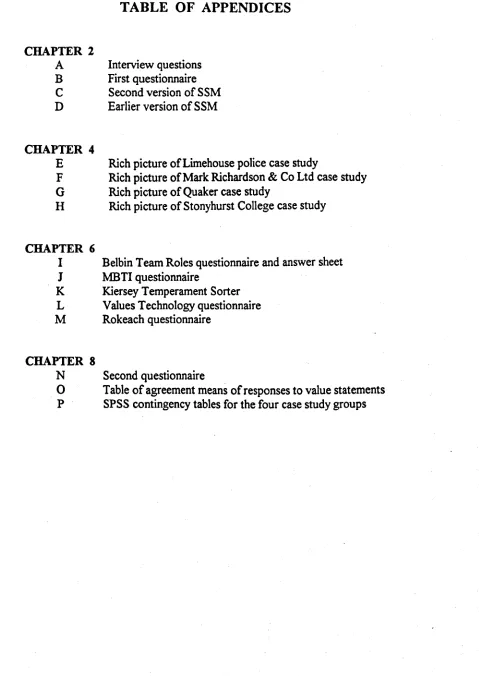
TABLE OF APPENDICES
Interview questions
First questionnaire
Second version of SSM
Earlier version of SSM
Rich picture of Limehouse police case study
Rich picture of Mark Richardson
&Co Ltd case study
Rich picture of Quaker case study
Rich picture of Stonyhurst College case study
Belbin T earn Roles questionnaire and answer sheet
MBTI questionnaire
Kiersey Temperament Sorter
Values Technology questionnaire
Rokeach questionnaire
[image:10.552.59.538.59.735.2]Second questionnaire
[image:10.552.45.535.72.806.2]ACKNOWLEDGEMENTS
Firstly I would like offer my thanks to my Supervisor, Dr Sionade Robinson who has been supportive, constructive and inspirational throughout my studies. Secondly I must acknowledge the debt lowe my husband Chris for his proof-reading and endurance of my singularity in conversation. My appreciation also goes out to my friends, especially Laura Jay, Chris Jeffery, Alan Crerar and Martin Hall, who have sustained me and sensitively offered comment without damaging my ego too much.
I would also like to acknowledge all those involved in the research case studies, but particularly Divisional Commander, Jeffrey Gardner at Limehouse Police Station, London; PC Neil Howarth of the Lancashire Constabulary A.S.v.; Insp. Alan Perrier and his staff at the Metropolitan Police Anti-Terrorist Branch Specialist Search Wing; Dr Giles Mercer and Stephen Crowther of Stonyhurst College; Richard Hartley of The King John School, Benfleet; John Dorling, project manager of Mark Richardson & Co. Ltd, Kent; Adam Muggleton, co-director of JPS Environmental Services, Basildon; the members of the Women's Institute, Halfway, Kent and the members and attenders of Kingston and Wandsworth Monthly Meeting of the Religious Society of Friends, London.
Last but by no means least I'd like to thank my parents. I am specially grateful to my mother Pauline as without her prompting some years ago I would never have begun this voyage of academic discovery.
DECLARATION
ABSTRACT
This thesis explores how peiformance measurement in organisations is effected by the human value systems of those concerned with measurement. Its origins lie in the observation that despite many efforts to devise useful measures of peiformance, problems continued to exist. It was subsequently hypothesised that problems are generic rather than job specific. This led to research in four very different organisations and the consequent exploration of human values theory in a systemiC context.
For the purpose of this thesis peiformance measurement is taken to be any form of assessment of organisation or individual accomplishment. Such measures may stand alone, be combined with others or checked against a pre-set standard When combined they are often referred to as peiformance indicators or league tables.
Values are beliefs about what seems right and important; they are not necessarily virtues. People, families, societal and work organisations all possess value systems. Values are inculcated early in the life of both humans and organisations and are reinforced over time and experience. Both individuals and groups typically hold more than one value, usually they have combinations that form value systems.
Human values theory is linked to systems science by investigating the behaviour of groups of values. It is argued that value systems have the emergent properties of attitudes and behaviours. These are essentially a response to other values and value systems. This emergence is likely to be unpredictable when faced with unfamiliar, cogent or inflexible norms. Consequently it is not only important to be clear about the value systems embodied in peiformance measurement but also those rated highly by those being measured
This thesis concludes that peiformance measurement needs to be more
closely matched to the values of the people being measured
if
it is to besuccessful. It is argued that singling out individual values is not the most
useful way of applying values theory as changes occur
swiftly
andLIST OF ABBREVIATIONS
CATWOE
Customers, Actors, Transformation, Weltanschauung,
Owner, Environmental Constraints
CST
Critical Systems Theory
DCI
Detective Chief Inspector
KPIs
key performance indicators
MIS
management information systems
MBTI
Myers-Briggs Type Indicator
NHS
National Health Service
PAPI
P A Preference Inventory
PIs
performance indicators
PM
performance measurement
PRP
performance related pay
RD
root definition
SPI
self-perception inventory
SSM
soft systems methodology
TA
transactional analysis
TQM
total quality management
VSM
viable system model
CHAPTER 1
INTRODUCTION TO PERFORMANCE MEASUREMENT
AND HUMAN VALUES IN ORGANISATIONS
SUMMARY
This chapter describes the origins of this thesis. It introduces the' topiC of
performance measurement in organisations and clarifies what is meant by
the term. It goes on to outline the format of the consequent chapters which
are based on the conjecture that the issues and problems surrounding
performance measurement have broader implications for change
management. The key link is the significance of values systems in the
acceptance of organisational change - an area which appears to have been
neglected in systems literature.
1.1 INTRODUCTION
1.1.1 The research described in this thesis began as a exploration of the
issues surrounding performance measurement. It developed over time
into a more detailed study of the impact of value systems on the
success or failure performance measurement. The outcome of this
journey is the suggestion that a range of value systems underlie
performance measurement design and application and that they
exhibit systemic qualities which may have wider consequences than
performance measurement. This is developed into a description of
how values are formed and behave in individuals and groups that may
offer an insight into reoccurring issues encountered by organisations.
1.1.2 This chapter revisits the origins of this enquiry by describing
responses to performance measures. It goes on to describe the
exploration of value systems as well as performance measurement.
This is followed by a brief description of consequent chapters leading
to the conclusion.
1.2 ORIGINS OF ENQUIRY
1.2.1 The original hypothesis speculated that the problems with performance measurement were generic rather than job specific. Consequently the focus of the research was on the performance of
different types of organisations. The variety of organisations allowed the opportunity to' identify patterns of responses and it was from these patterns that the common theme of human values emerged
(Hebel 1995a).
1.2.2 As a consequence the research focus shifted to developing an
improved understanding of the mechanisms and influence of values.
This was felt to be necessary because although 'value systems' is a
frequently used tenn there appeared to be no exploration of values in systemic terms. The hypothesis became 'Human value systems dictate
the response to and success of performance measurement in organisations' .
1.2.3 The tenn
performance measurement
is used to cover a broad spectrum of statistics, performance indicators (PIs).key
performanceindicators (KPls), performance management assessment criteria,
league tables and a
key
component of management informationsystems (MIS). Given the different terminology used for performance
measurement this thesis defines performance measurement as III
assessment of attainment within
an
organisation. This attainmentcould be by an individual or group and be quantitative or qualitative.
customers satisfied, profit made, numbers of arrests, exam pass
scores, and membership.
1.2.4 Performance measurement is essentially a way of gaining information
to monitor performance with the intention of maintaining or
improving. It seems however the information rather than performance
appears to have become the centre of attention. This is exemplified in
headlines such as
'Lies, damned lies and league tables'(Guardian
20/11192).
At the time of writing this is especially so for public sector
or service organisations, such as schools, the police and the National
Health Service (NHS). Many now produce performance tables that
are published in the national media. These in tum often prompt
complaints by disgruntled managers, employees or unions.
1.2.5 Both tables and complaints often form substantial news items with
headlines such as
'The fairest cop of all'a comparison of community
policing measures (Independent
19110/94)~ 'Grammar schools miss target'claimed selective schools fail to deliver the high results
expected (Independent 20111196) and
'Famous hospitals ratedamong worst performers'
prompted a plea for quality rather than
quantity to be considered (Telegraph 6/7/95). The interest seems to
indicate that.there is more to improving performance than gathering
information and measurement.
1.2.6 The dissatisfaction with performance measurement is also often
linked to league tables comparing apparently similar groups, for
example police force crime statistics prompted the headline
'Fourpolice forces 'fall' over crimes of violence'
(Telegraph
26110/95).The article containing a comparison of the 'best' and 'worst' force
records for solving violent crimes. The force classified as worst
consequently defending their figures by highlighting demographic
tables experience a similar fate with low 'scoring' schools jumping to defend their record.
1.2.7 Alternatively issues concerning perfonnance related pay (PRP) become highlighted, such as the inequity of nurses' pay across health authorities. This can lead to difficulties such as those experienced in the advertising world where measuring creative quality and linking it to PRP raised some complicated issues about measuring qualitative work (Telegraph City News 18/6/96).
1.2.8 It can also lead to strikes such as those voted for by the staff at Kew Royal Botanic Gardens in March 1996 when plans to introduce PRP were proposed. The Times and Telegraph (2/3/97) made much of the dispute - it being the
first
at Kew Gardens for more than 200 years -asking if performance should be measured by the number of weeds pulled.1.2.9 The author's experience in the public sector! also suggested that a closer look at the measures themselves might provide an answer. It was observed that performance was often broken down into easily calculated output measures. These were usually based on
financial
or quantitative data e.g. money spent, budgets overspent, arrests made, crimes cleared up or numbers of V AT assessments completed (Hebel 1991, 1994a & 1994b).1.2.11 These observations and the findings of preliminary research (Hebel,
1995a) led to a number of questions and these in tum became chapter
themes and objectives summarised in Figure 1.1. The themes focus on
firstly ascertaining what both theorists and practitioners have to say
on performance measurement. The findings are then explored in more
depth by investigating the origins and impact of values on the
situations studied.
1.2.12 The themes were developed into a research programme which also
includes speculation into the wider effect of values and the
implications for systems thinking. This programme continues but its
origins are summarised in the subsequent section and detailed in the
What is the problem with
performance measurement (PM) in organisations?
How might this be explored and
related to the real world?
What does the literature have
to say on performance measurement?
Brief description of experience, complaints and media interes~ outline plan of research
Case study methodology - soft systems measurement (SSM) and action research, literature review, content analysis, case study
outline
Origins and multi-disciplinary review of PM as management tool
How can these ideas be Initial application of ideas to case studies - own
applied to real world situations? survey, interviews observations and outcomes
What are values systems?
Can we measure values?
Review of literature on human values including philosophical, psychology, sociology, systems and
organisational theories
Review of values related surveys - comment on characteristics
Exploring values and impact on As a result of earlier work a conceptual look as the
PM further systemic nature of values and value systems
emergence
Reflection on practicality of identifying values emergence
What are the lessons for
systems thinking?
Words meant different things to different individuals and groups
Concluding -can't measure values only level of
diversity
Style of change needs to match existing dominant
Weltanschauung (W) - can't pretend to hold a W
we don't
Provisional means of gauging workplace W using
colloquial phrases
Greater systemic understanding of values and how th interact
PM will not work without appropriate values Describe more realistic setting for PM
1.3 FURTHER CHAPTERS
1.3.1 Chapter 2 describes the methodological approach which combined
action research with soft systems methodology in order to
acknowledge human activity and the impact of the analyst. It
describes the hypothesis that problems with performance
measurement are generic and not job specific. As a consequence the
initial research focused on four very different case studies and how
they assessed their organisation's achievements.
1.3.2 These studies were; a Metropolitan Police Criminal Investigation
Department (CID); a 400 year old independent school; a building
contractor; and a Quaker (Religious Society of Friends) business
meeting. In summary they all use at least one performance measure;
come from both public and private sector; are profit and non-profit
making; organisationally they are both large and small, complex and
relatively simple.
1.3.3 This study does not attempt to cover the entire work of the
organisations involved. Furthermore it is not intended as a criticism
of any individual or group.
It
is primarily interested in theperformance measures identified as important and reaction to them
once implemented. The findings from the case studies are presented
and then used as illustration in further chapters.
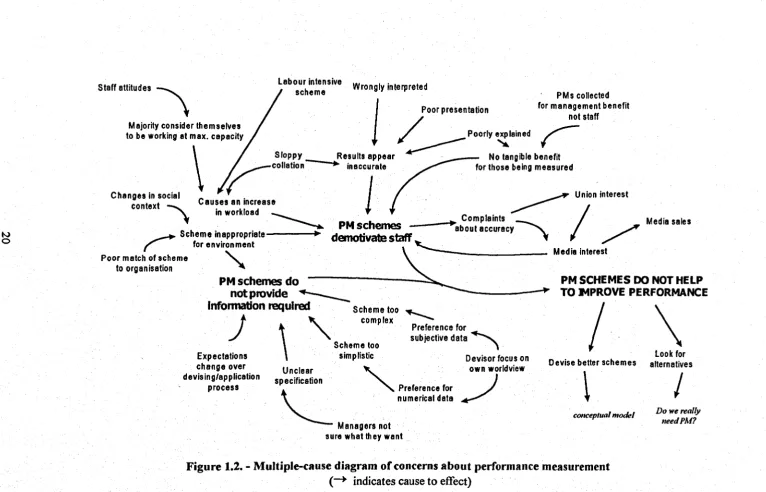
1.3.4 Chapter 3 is based on Figure 1.2 which summarises the drawbacks,
rather than advantages, of performance measurement based on the
author's experience (Hebel I992a, 1 992b, 1993 & I994b). It
comprises many of the concerns expressed about performance
measurement. The research attempts to establish whether the three
statements - shown in bold in Figure 1.2 - about performance
1.3.5 The chapter covers a review of performance information systems to
see if they experienced similar problems or offered potential
solutions. It was concluded that much of the disruption to such
information systems is due to subtle layers of value judgements and
expectations. These act as noise in a communication model making
apparent agreements open to much wider interpretation.
1.3.6 There appeared to be a strong link between values and world-views
or Weltanschauung as used in soft systems theories. Many writers acknowledge the importance of appreciating others world-views. It
seemed however that actually describing how a world-view is formed
had been neglected. It also became apparent that the impact of our
values and Weltanschauung reached wider than performance
measurement and that this was an area insufficiently covered by
I'.) o
. Labour intensive .
Staff attitudes \ h Wrongly Interpreted
sc eme PMs collected
1
/ Poor presentation for management benefit not staff Majority consider themselvesto be working at max. capacity Poorly
~Iained
(\
Results appear
~
No tangible benefit . . inaccurate ~ for those being measuredCh":::,!::.~
1. /
___
junion interest, ~ PM h • Complaints ~
~
Scheme in.appropriate~ d~~=taff
about accuracy, /r
for enVIronment ~Media sales
to organisation ~
Poor match of scheme ' -
~==---.---
Media interestPM schemes do PM SCHEMES DO NOT HELP
not provide ~ ~ TO :MPROVE PERFORMANCE
Information required Scheme too
I
. ) " c o m P l e x
~
S subjective data ... \
Preference for cheme too " Expectations simplistic
change over devising/application
process
Unclear " specification
\ . Prefer~nce for " - numerical data
Managers not sure what they want
Devisor focus on own worldview
J
Devise better schemes
~
[image:23.823.15.782.30.522.2]conceptual model
Figure 1.2. - Multiple-cause diagram of concerns about performance measurement (-+ indicates cause to effect)
\
Look for alternatives
/
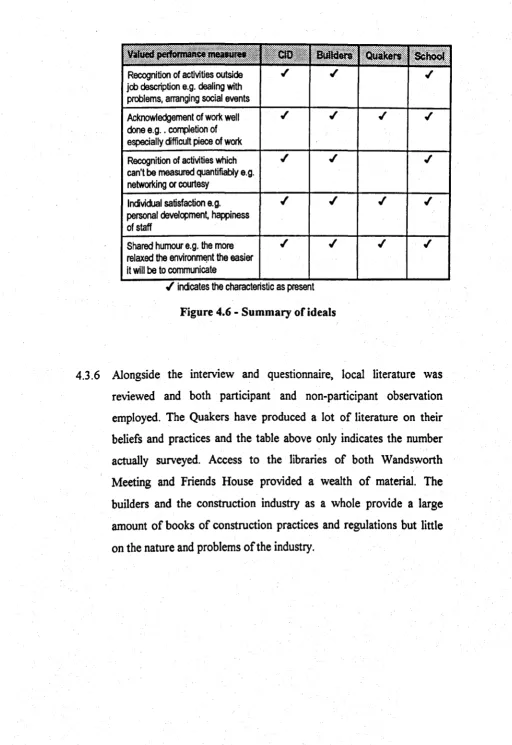
1.3.7 Chapter 4 summarises the outcome of the soft systems case study analysis. It is based on the method used to gather information from the case studies and includes observations and possible interpretation (Hebel 1995a). A primary observation of the case studies has been that despite many attempts to monitor, understand and control what goes on within an organisation, there will always be that which is unreachable within the cognitive processes of those who comprise the organisation.
1.3.8 An example is that which is valued by one manager may seem irrelevant to another employee and what seems important to one religious group is insignificant to another apparently similar one. This prioritisation of beliefs and values supported the notions on the nature of value systems and their impact on performance measurement described in the following Chapters.
1.3.9 Chapter 5 accordingly investigates further the impact of values on the receipt and use of performance measurement information. A multi-disciplinary literature review looked first at philosophical theories on human values and virtues. This was followed by gaining a sociological and psychological perspective, concluding with a further review of systems literature on world-views and values.
1.3.11 It was deduced that attitudes and expectations arise out of human
value systems and appear to have a significant impact on the way we
measure what we do. These systems affect the composition of
measures and also the way they are implemented. Differences
between the values of those who design measure and those who are
measured appear considerable in some cases. This creates resistance
to successful implementation and undermines the overall goal.
1.3.12 One outcome of the literature search was the identification of a
number of surveys that either measured values explicitly or were
used as the basis for describing team roles. Some surveys were in
common use and others were less popular. Chapter 6 summarises the
critique of the three most widely used values oriented surveys, the
Hall-Tonna Inventory, the Belbin team roles and Myers-Briggs Type
Indicator (MBTI). This is followed by a brief description of other
questionnaires considered.
1.3.13 The surveys may all act as a guide to organisational behaviour and in
particular team building. The values survey looked at a very detailed
level of description that made the overall analysis of people and
organisation, suggested by the devisor, lengthy and potentially very
costly. The team roles surveys varied in depth, the earlier version of
Belbin being relatively easy to use and interpret, but relied heavily on
honesty from the respondents and the team retaining key personnel.
1.3.14 All surveys shared the risk nevertheless of stereotyping and seemed
unable to cope with changes in circumstances or mood. In order to
maximise their usefulness they would need to be conducted on a
regular basis to cope with change but the impracticality of doing this
prohibited regular application. Alternatively the team would have to
1.3.15 Chapter 7 explores further the
main
themes arising from a review ofvalue systems. It scrutinises in more depth the influence of value
systems and world-views on performance measurement and on
change initiatives in general. In particular the way groups of values
behave holistically, shifting and changing according to values
priorities and their interaction with other value systems and the
environment.
1.3.16 Whilst investigating groups of values, it also appeared that they behave in a very organised, if not conscious, way and exhibit the
systemic qualities of purpose emergence. In an individual values
organise themselves to fulfil a life-script or an overall purpose
developed in the early years of life. Within organisations our values
are prioritised to enable our 'best fit' and therefore most appropriate
strategy for success according to our own lights.
1.3 .17 This means that the same set of values may be rearranged to correspond to the environment and a different emergence or set of
behaviours will then occur. This is particularly evident in the creation
of norms, which represent the emergence of a majority view.
1.3. 18 Chapter 8 reflects on the findings of the case study research and
investigation into the behaviour of value systems. It describes the
rationale behind a second survey conducted and the results. The purpose of the survey was in part to validate initial research (Hebel
1995a) but also to demonstrate the diversity of opinion held within
similar organisations.
1.3. 19 The second survey confirmed some of the original broad statements
about organisations however it was clear that the variety of opinion
non-close-knit teams viewpoints varied and discomfort was expressed
about holding one world-view for all situations (Hebel 1997a).
1.3.20 From the survey it was concluded that at best a few key world-views
out of a large range could be guaranteed as strong enough to build
upon. In a real world situation where performance measurement was
required these key world-views would need to be gauged at all levels
of an organisation if successful implementation was to be achieved.
1.3.21 Chapter 9 draws together the lessons for systems thinking,
suggesting value systems models and concepts that might be
explored further. In particular it is noted that the emergent properties
of value systems rather than the values themselves take priority in an
organisational context. The way values might be modelled and
impact on wider information systems are also considered worthwhile
areas of further research. Given the reinforcing nature of values it is
also suggested that starting from a viewpoint that change is possible
is not a useful position but that developing what already exists is
better.
1.3.22 The thesis concludes in Chapter 10 that a performance measurement
scheme can only succeed if it matches the values of the majority of
those concerned and not only those in management positions.
Obtaining a realistic assessment of the environment into which
change is introduced is of paramount importance as it is the
intervention and not the method that is important. The success of
intervention is dependent on the organisation's attitude and the
1.4
CONCLUSION
This chapter introduces the themes of performance measurement and
human value systems explored in this thesis. It describes the research
framework on which work progressed investigating the problems
experienced when measuring performance and their possible
explanations. Both theoretical and practical areas are broached and
the process by which value systems come to have a significant effect
CHAPTER 2
TAKING A SOFT SYSTEMS APPROACH
TO INVESTIGATION
SUMMARY
This chapter describes the means of analysing the issues surrounding
performance measurement using a framework of soft systems methodology (SSM) and action research. It also provides a brief description of why the
four case studies were chosen to investigate further performance
measurement and organisational change.
2.1
INTRODUCTION
2.1.1 As a result of the initial analysis (Hebel 1995a) and in view of the need to research further within a real world context SSM was applied within an action research or action science paradigm. This acknowledged that the analyst will inevitably have some impact on the situation and helped identify case studies that might best test the areas of interest.
2.1.3 The size of these groups also varied in order to test its impact on the
organisational requirement for performance measurement. The very
different groups were deliberately chosen in order to provide as much
variation in background as possible. The following sections describe
succinctly the advantages and disadvantages of the approach taken, the methods of gathering data and a preliminary analysis.
2.2 THE ACTION RESEARCH OR
ACTION SCIENCE PARADIGM
2.2.1 Action research owes much to the work of Lewin (Robson 1993)
who saw this type of research as based on spirals of circles of
planning, acting, observing and reflecting. Definitions of action
research vary considerably however but the later developments
drawn together by Bell (1993) emphasise the practitioner-researcher
who continues to review, evaluate and improve practice. This infers
a permanent position of the researcher in the organisations involved.
As this was not the case and in view of a desire to produce sound academic research within a real world context, an action science
paradigm appeared to be a better approach.
2.2.2 The term action science is used rather than action research as preferred by Argyris et al. (1985) and Gummesson (1991), who
observe the pitfalls of action research being a lack of academic
content and a closer resemblance to journalism. The use of the word
science rather than research nevertheless implies an empirical,
positivistic bias that did not appear compatible with the human
activity emphasis. Nevertheless Gummesson's summary of action
definition is based on work by Hult and Lennung (1978) and later
Argyris.
1) Action science always involves two goals: solve a problem for the client and contribute to science. That means that you must be both a management consultant and an academic researcher at the same time.
2) . During an action science project those involved - the researcherlconsultant and client personnel - should leamfrom each other and develop their competence. 3) The understanding developed during an action science
project is holistic.
4) Action science requires co-operation between the researcher and the client personnel. feedback to the parties involved, and continuous adjustment to new information and new events.
5) Action science is primarily applicable to the understanding and planning of change in social systems. 6) There must be a mutually acceptable ethical framework
within which action science is used
(Gummesson (1991). p.p. 103-104)
2.2.3 The advantages seem to outweigh the disadvantages in adopting this
method. One advantage is the stress on practical as well as academic
researcher involvement. Another advantage is the focus on social
systems and the need to take an holistic approach, which ties in with
the soft systems methodology used to analyse data.
2.2.4 Difficulties can occur in the contrasting needs of a consultant and a
researcher. As a consultant the focus is the client. As a researcher, one is principally required to be theoretically sound and contribute to
a wider academic audience. An action scientist or researcher must
satisfy both and it is failure to achieve this that has led to major
criticisms of action research. Travers, quoted by Robson (1993) for
contributed almost nothing to our knowledge of the factors that
influence the learning process in the classroom" .
2.2.5 In this case however, the combination of SSM and other analytical methods, backed up by cross validation should provide data of
sufficient robustness. The results were presented to the case study
participants in two forms. Firstly, regular verbal feedback and
secondly a report or reports to the participants, written in a style
suitable for those unfamiliar with systems theory and research.
2.3
APPUCATION OF METHODOLOGY AND PARADIGM
2.3.1 As already stated, the origin of this study of performance measurement grew out of an observation that whilst the measures
themselves developed or grew more complex, performance remained
static or improved imperceptibly. This appeared to occur in both the
public services, businesses and other organised groups.
2.3.2 In addition, measurement schemes frequently seemed to engender
discontent among those being measured or were ignored by managers
when the results did not conform with their perception of success.
Uncomplicated measures incurred complaints of over simplification
and complex groups of measures were considered too
time-consuming to collate.
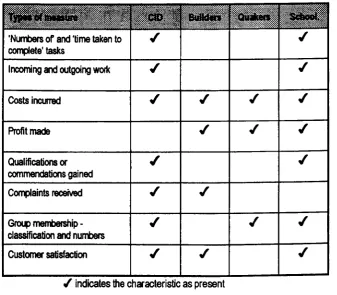
2.3.3 From this observation the four case studies were identified in order to
compare and contrast measures used by each group. The comparison
is based on the hypothesis that the problems are generic and not job
specific and consequently that solutions may also be generic. Hence a
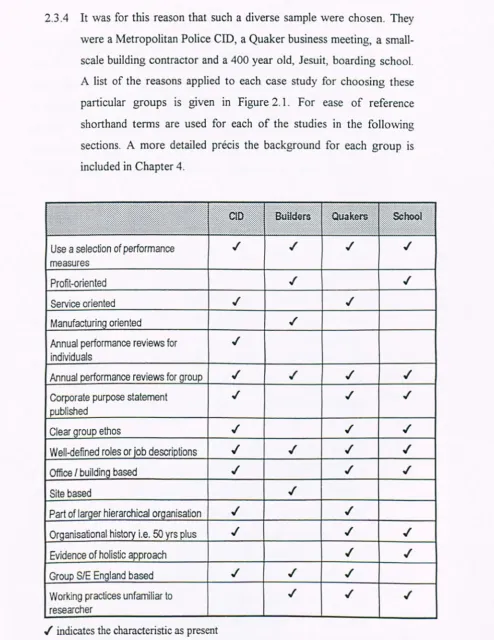
2.3.4 It was for this reason that such a diverse sample were chosen. They
were a Metropolitan Police
em,
a Quaker business meeting, a small-scale building contractor and a 400 year old, Jesuit, boarding school.A list of the reasons applied to each case study for choosing these
particular groups is given in Figure 2.1. For ease of reference
shorthand terms are used for each of the studies in the following
sections. A more detailed precis the background for each group is
included in Chapter 4.
Use a selection of performance ./ ./ ./ ./ measures
Profit-oriented ./ ./
Service oriented ./
Man oriented
Annual performance reviews for ./
individuals
Annual reviews for ./ ./ ./ ./
Corporate purpose statement ./ ./ ./
Clear ethos ./ ./ ./
./ ./ ./
Office I ./ ./ ./
Site based ./
./ ./
./ ./ ./
./ ./ ./ ./ ./
Working practices unfamiliar to ./ ./
researcher
[image:33.544.31.526.57.698.2]./ indicates the characteristic as present
2.3.5 Although not a conventional work group Quakers are included as a
case study because in addition to worship. business meetings are also
held on a regular basis at a local, district and national level (Hubbard
1985). It is these meetings - in particular those held at Wandsworth
Preparative Meeting, Kingston Monthly Meeting and Yearly
Meeting - that are the focus of this study. The underlying principles
of both worship and business are inextricable and so both are referred
to later.
2.3.6 Both research and analysis were rooted in pragmatic and humanist
ideas. Soft systems methodology (SSM) provided the basis of
gathering the information and presenting the results as it was
considered the most appropriate method for the case studies. Use of
SSM was not exclusive though and psycho-sociological and systems
concepts were drawn on throughout. Critical Systems Theory (CST),
the Viable System Model (VSM) and other relatively rigid
methodologies were taken into account but not adopted in entirety as
they appeared to restrict the consideration of softer issues.
2.3.7 An action research paradigm suited the practical focus required by
the author who wished to test that certain theoretical concepts were
applicable to the workplace by a continual process of observation.
The paradigm also acknowledged the effect of the analyst's presence
on the situation. In particular the effect of a female researcher in the mostly male environment of school, police and building site and the
differences in communication style adopted by adults and children
and manual workers. As many of the research participants were unfamiliar with systems theory frequent requests for clarification and
the resulting response helped to build a rapport between those
2.4 MEANS OF DATA GArnERING
2.4.1 The data gathered for this thesis has been collected by observation,
interviews, a questionnaire and literature searches. In order to
cross-validate the findings multiple data collection approaches were chosen
and undertaken in parallel.
2.4.2 The research was undertaken on the basis of an information
interchange. The analysis of a problem situation chosen by the case
study owner - using systems concepts - was offered in exchange for
free access to personnel and records. This mutual agreement relieved
some of the pressure normally associated with the consultant role and
resulted in many enquiries into systems theory.
2.4.3 Information was gathered on the each organisation's history and any
problem situations they were currently experiencing. Content analysis
provided much of the background for the cases, drawing on published
league tables, newsletters, annual reports, papers, books, web pages,
other publications and media reports. The police, school and Quakers
background and current practice were well documented. Information
on the construction industry, especially on management, proved much
harder to obtain.
2.4.4 A multi-disciplinary literature review was conducted in parallel. The
initial searches were focused on performance measurement literature.
The emphasis was on published literature widely available to
managers and consultants rather than specialist journal articles. This
was because it was felt that this might be the source of some of the
problems. It mostly comprised management theory books and
2.4.5 The literature search soon broadened to include material on systems theory, human values and organisational behaviour. As well as widely available books, specialist publications and journals were included. In particular, surveys aimed at gaining an insight into personal and team attitudes or behaviour, were reviewed to assess their practicality and usefulness.
2.4.6 The following sections describe the means by which information was gathered directly from case study participants. These include structured interviews and questionnaires. This is followed by a brief description of each of the four groups studied.
2.5 INTERVIEW
2.5.1 The structured interviews included questions on background, team work, current difficulties and performance measurement (Appendix A). All interviewees were asked the same questions in order to best compare the responses. Every attempt was made to ask a balance of questions in order to put performance measurement in the context of the organisation.
2.5.2 Those interviewed were asked what official performance measures were currently used within their organisation and how they viewed their accuracy and usefulness. They were also asked how they would most like their personal and group performance to be measured.
comparison between organisational levels as well as providing as
holistic a view as possible.
2.6 QUESTIONNAIRE
2.6.1 Each interview was followed up by a detailed questionnaire,
(Appendix B) which covered in more detail the perceptions of how
they viewed and perceived their work.
2.6.2 The purpose of the questionnaire was to enable a companson
between the case studies. It identified demographic information, listed
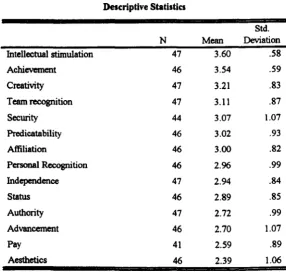
49 group attributes and 14 personal values applied to the workplace
that each interviewee was asked to prioritise. They were moreover
asked to state any tenet they felt strongly influenced the way they
worked.
2.6.3 It was initially analysed using coded responses on the spreadsheet
package, Excel and later by the statistical package, SPSS for Windows. The total number of questionnaires completed was not
sufficiently large to provide statistically significant data, however the
findings endorsed observation and interview findings as well as
highlighting further areas that might be of interest.
2.7 OBSERVA nON
2.7.1 A range of activities from everyday site and office tasks, daily and
annual meetings and sometimes a response to a crisis were all
observed. Much of the information was collated as rich pictures that
2.7.2 All comments on the observations were fed back to those involved in order to verify the infonnation and to rectify if required. Perfonnance measurement was the focus for the observations, however much of
the time was spent gathering infonnation on the organisational
context within which they operated.
2.8 INTRODUCTION TO PERFORMANCE MEASUREMENT
SCENARIO
2.8.1 One of the original research aims (Chapter 1) was to identify
perfonnance measures and explore the issues surrounding them. This
meant taking account of qualitative as well as quantitative aspects of
performance thus providing a holistic picture of any working
environment. It was conjectured that a systemic measurement system
might be what was required to address the complaints of over
simplification however it soon became evident that it was not that straightforward.
2.8.2 A review of literature suggested that perfonnance measures were
more likely to replicate the values of those compiling them,
than
those of the people being measured within an organisation or its
customers. This mismatch appeared to seriously threaten the
effectiveness of performance !11easurement schemes and so it was felt
that it warranted further investigation.
2.8.3 In addition, after conducting a number of interviews it became evident that many considered the measures by which they were
assessed to be unsatisfactory or perceived them as unnecessary
improvements were made to the scheme, resistance would often
continue to exist.
2.8.4 Consequently this thesis is not concerned with constructing a specific
performance measurement system. The aim is not direct intervention
but primarily greater understanding of what happens when
performance measurement are introduced. It looks at possible ways
of gathering information on and interpreting organisational processes
and relationships with regards to performance measurement.
2.8.5 The entire thesis is based on the assumption that if the obstacles are
better understood then solutions will be easier to identify. It may also
be possible to extend the findings beyond performance measurement
to other change initiatives introduced to organisations.
2.8.6 In view of the apparent influence of values and human activity on
performance measurement, SSM was considered the most relevant
methodology to supplement action research and explore such issues.
The initial analysis however is not based on the traditional problem
scenario or problem owner but on the generic situation which asks
the question 'why do so many performance measurement schemes
. experience problems?'.
2.8.7 The risks of adopting a single methodology included a restriction on
the sort of analysis possible, a closing down of avenues of
opportunity, a limitation on perspectives and the risk of reinforcing
previous solutions. Consequently other systems theories and models
are drawn upon as appropriate within a framework of action research.
This framework includes application of systems ideas to four case
2.9 APPLYING SSM - ANALYSIS 1
2.9.1 SSM was initially used to gather the perspectives and views
expressed of performance measurement schemes in organisations.
Appendix C shows the version of SSM on which the analysis is based
(Checkland & Scholes 1990, Patching 1990). The methodology was
applied initially to the general problems experienced with
performance measurement described in Chapter 1.
2.9.2 A summary of the initial analysis follows but it is important to stress
that SSM was not followed linearly, it is merely presented that way
for ease of demonstration. This version of SSM - rather than the
earlier seven-stage model (Appendix D) - takes more account of the
culture and context of a situation. It enables greater freedom in accounting for world-views in greater depth and encourages the
analyst to take into account the history of any situation.
2.9.3 This stage required a more abstract stance than is usually applied to
SSM as generic problems with performance measurement were the
focus of enquiry. Consequently, though the client and problem solver
are quite precise the owners seem many and varied. This summary is
based on prior experience (Hebel 1992a & b, 1993, 1994a & b) and
early research (Hebel 1995a-d).
2.9.4 The Client is taken to be a generic manager or administrator, anyone in fact who might collect or utilise organisational performance
measurement. The Problem Solver or analyst in this case is the
author, but it might also
be
a consultant or senior manager. TheOwner could be a range of system participants~ Administrators
-managing using performance measurements~ Actors - those being
such as customers, senior personnel in large corporations, the media
or governments.
2.10
ANALYSIS 2
2.10.1 Analysis 2 examines the social characteristics of the situation via the
interaction between roles, norms and values. These are described
below in terms of management and performance measurement.
2.10.2 Roles are the social positions held within an organisation where
performance is being measured. There are the traditional ones of
manager, employee and customer. There are also those such as
information provider (those manufacturing or providing a service) or
information controller which may not be held by those in traditional
roles.
2.10.3 Norms are the expected behaviour of those in roles. This is a more
difficult area to identify as we are often not altogether clear what we
expect from those in traditional roles. With regards to performance
measurement the explicit expectations appear to revolve primarily
around managers in their various roles. The employee also has a key
part to play as their expectations of management and measurement
Competitive advantage Items/paperwork processed Products made
Quality assurance rates Customer satisfaction Scores achieved Personnel issues
Membership (e.g. of voluntary organisations)
Objectives met
market share
crime reports made, patients
examined
cars produced, books published
number of goods classed as seconds
number of complaints, repeat
business, media representation goals scored, exams passed,
arrests made
pay scales, appraisal marks, staff retention rates, training
number or type of members,
changes over time,
[image:42.509.14.496.26.620.2]number of specific goals achieved
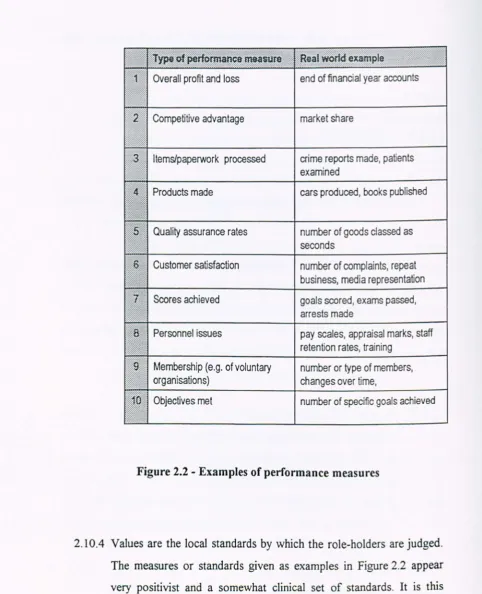
Figure 2.2 - Examples of performance measures
2.10.4 Values are the local standards by which the role-holders are judged.
The measures or standards given as examples in Figure 2.2 appear
very positivist and a somewhat clinical set of standards. It is this perhaps that gives the first clue as to the cause of repeated problems
with performance measurement schemes. Up to this point the focus
has been very much on human-activity systems, conceptual but
people oriented nonetheless. Here the emphasis becomes more
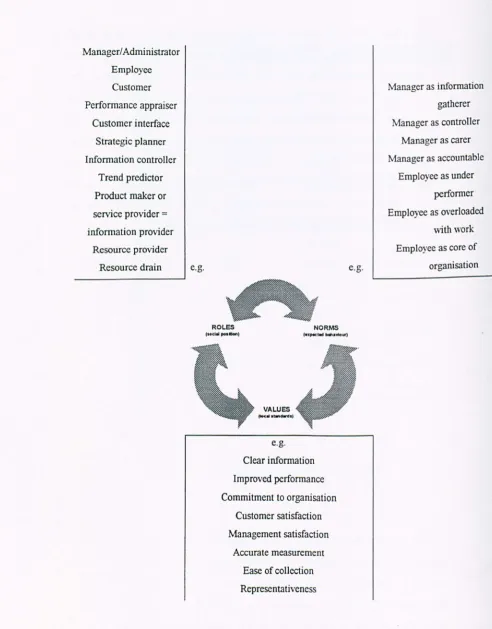
2.10.5 Figure 2.3 pulls together the three aspects of the social system model
in terms of generic performance measurement in the workplace. It is
by no means exhaustive but gives examples of each aspect. For
instance a range of different norms are given from both management
and employee perspectives. These could be taken as summarised
worldviews of the workplace. Likewise the values will vary according
to local conditions. The roles are more traditional and list the
different types of person or role affected by measurement. These can
be someone in a general management position or somebody who has
Manager/Administrator
Employee
Customer
Performance appraiser
Customer interface
Strategic planner
Information controller
Trend predictor
Product maker or
service provider =
information provider
Resource provider
Resource drain e.g.
VALUES
fIM·.undMI.)
e.g.
NORMS
(expected 1MtI .... W1
Clear information
Improved performance
Commitment to organisation
Customer satisfaction
Management satisfaction
Accurate measurement
Ease of collection
Representativeness
e.g.
Manager as information
gatherer
Manager as controller
Manager as carer
Manager as accountable
Employee as under
performer
Employee as overloaded
with work
Employee as core of
[image:44.508.7.499.30.659.2]organisation
Figure 2.3 -Examples of roles, values and norms in
l.ll ANALYSIS 3
2.11.1 This is an examination of power-related or political aspects of the
problem situation. The 'commodities' of power concerned revolve
around information and control but not
itseems around performance.
The following sections summarise the disposition, nature and process
of demonstrating power. There are six main manifestations.
2.11.2 Information is power - This traditional model holds as much sway
now as it ever has. The idea that information is important and
necessary is endorsed by the use of the term Information Technology
to refer to the many developments in computing. Simply the
appearance of possessing large amounts of information can be
considered an indication of status. The person or group on the
receiving end of the performance measurements have the power to
reward or punish on the information as they see fit.
2.11.3 Management is control - or possession of information demonstrates
control. The collection and publication of information on
performance implies an organisation is being managed otherwise how
could it be done. This control relationship may also cause problems
as the overemphasis on control rather than co-operation may prove
inappropriate and more like organisational blackmail.
2.11.4 Information supports confidence -
Itcould be argued that most
managers know what needs to be done and measurement information
only helps to endorse their decisions. It gives them the power to say
"I'm right because ... ". With appropriate back-up managers should feel
more confident. The information does not even have to be accurate
2.11.5 Information restates position and role - it reminds groups of power
structure and in particular the extent of power held by those being
measured. They may either develop resentments at what is perceived
to be a lack of power on their part resulting in a drop in morale or
perfonnance or they may also realise that they have considerable
power to disrupt the performance measurement process by
working-to-rule or falsifying the figures for instance.
2.11.6 Perfonnance measurement stresses the rational/positivist world-view.
In tum management of an organisation is about the maintenance of a
corporate world-view. Ensuring that the reason for the groups
inception is maintained unless of course there is no longer a market.
Perfonnance measurement appears to occur in organisations that are
hierarchical and structured. It seems to help to endorse a belief that
rational and objective behaviour is possible. The power of a
convinced or strong world-view has maintained many an entrepreneur
and dictator.
2.11. 7 Following the trend - This normative power represents an
organisational herd instinct where management trends and theories
gain a momentum through being new and promising a better future.
Performance measurement doesn't strictly come under this category
but the trend for publishing public sector performance indicators in
the national press appears to have prompted an interest in measures
2.12 ROOT DEFINITION AND CA TWOE
2.12.1 From the analysis, based on the method taught by The Open
University
(1984),five primary relevant systems associated with
performance measurement were identified:
• to provide information on organisations
• to measure success or failure
• to keep track of the performance oftarge organisations
• to exert some control
• to aid the setting of standards
2.12.2 These were accordingly refined into root definitions (RDs). The
following brings together the key aspects and attempts to define
performance measurement within the context of this study and the
case studies involved. The definition is followed by its comparison
with CATWOE.
ROOT DEFINITION
A system deliberately devised by somebody to provide meaningful
information on the performance of an organisation and the people
involved in it. The system is devised for the benefit of those who
administer it and is potentially beneficial for those who receive the
output of the organisation, whether it be a product, service or wage
packet. The information is based on the outcomes of the organisation
employees performance and is often an analysis or interpretation of
core or quantifiable activities.
Itdepends on a mutual understanding
of the importance of performance information and the nature of
measurement and abstraction. If such an appreciation does not exist
then the system is unlikely to provide useful or actionable information
2.12.2 The application of CATWOE - even to a much revised root
definition - consistently highlighted certain difficulties. It could be
argued that further revisions and options are thus required, however
the issues raised do not appear compatible with redefinition. Instead
they are a point to be considered
in
further stages ofconceptualisation and debate.
2. 12.3 The Customers are primarily the administrators who were likely to
collate and act upon the information provided by the measures. The
employees and customers may also be on the receiving end of the
system to measure performance however they appeared low priority
for this particular system. If performance is measured and problems
with sales or product quality are detected then there should be some
benefit. The system focus however is on gathering information and
analysing it. Action on the findings requires a further root definition
for the role of administrator that may well depend far more on the
type of organisation being considered, public or private sector, or
social/secular group.
2.12.4 There was little difficulty in describing the Actors in this system.
They are those who carry out the activities of the system and
theoretically they would
be
everyone involved in an organisation,either being measured, analysing the data or using it as an overview.
Users of the organisation's output may also be included here as
providers of feedback on the product or service.
2.12.5 The Transformation consisted of collecting raw data inputs such as
production figures or tasks completed. These are then analysed,
weighted or presented in such a way that the outputs indicate any
changes in performance. Although many different means of
transforming the data were available the principle remains that some