arXiv:1207.3011v1 [quant-ph] 12 Jul 2012
Daniel K. L. Oi,1,∗ V´aclav Potoˇcek,2 and John Jeffers1 1
SUPA Department of Physics, University of Strathclyde, Glasgow G4 0NG, United Kingdom 2
Czech Technical University in Prague, Faculty of Nuclear Sciences and Physical Engineering, Department of Physics, Bˇrehov´a 7, 115 19 Praha 1, Czech Republic
(Dated: July 13, 2012)
Measurement is integral to quantum information processing and communication; it is how in-formation encoded in the state of a system is transformed into classical signals for further use. In quantum optics, measurements are typically destructive, so that the state is not available afterwards for further steps. Here we show how to measure the presence or absence of the vacuum in a quantum optical field without destroying the state, implementing the ideal projections onto the respective subspaces. This not only enables sequential measurements, useful for quantum communication, but it can also be adapted to create novel states of light via bare raising and lowering operators.
I. INTRODUCTION
At first glance, measuring the vacuum is trivial, a per-fect photodetector will reveal the vacuum state upon the non-occurrence of a click. However, the converse result, i.e. not measuring the vacuum, ideally should preserve the information in the non-vacuum sector for further interrogation - something which is difficult to achieve with direct photodetection. Formally, we would like to implement the following measurement projectors, {|0ih0|,I− |0ih0|}, where the latter non-vacuum outcome removes the vacuum component without affecting the rel-ative amplitudes or coherences of the other Fock states. This is crucial for sequential measurement schemes, such as in [1–3], and rules out other projective schemes such as quantum nondemolition measurements of photon num-ber [6, 7]. The development of practical methods for non-destructive measurements on optical fields [4, 5] is therefore an important topic for future practical quan-tum information processing systems.
Measurement is also a key element in performing non-Gaussian operations, e.g. for entanglement purification of continuous variable states. Recent examples include the implementation of the quantum optical creation and annihilation operators, both of which rely on postselec-tion [8–10]. Extending the type of possible operapostselec-tions is crucial for the production of tailored states in quan-tum information systems. Our method can be simply extended to provide a first realization of the bare photon addition and subtraction operators.
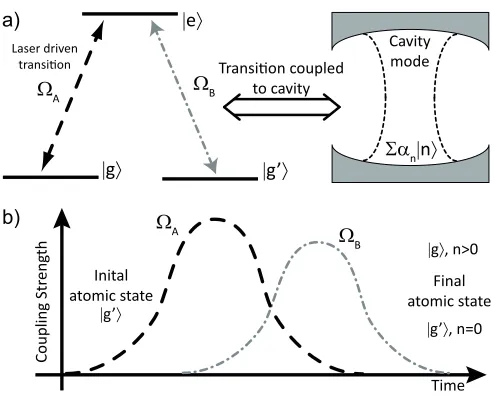
We consider a single mode of an optical cavity in an ar-bitrary quantum state,ρ, as our system to be measured. To perform the measurement, we introduce a probe which consists of a three level atom in the Λ-configuration (See Fig. 1a). The cavity mode can be controllably coupled to transition B whereas transition A interacts with an externally applied laser field [11, 12]. In these papers the general adiabatic mapping of atomic levels to cavities was
∗Electronic address: [email protected]
introduced. Our particularly simple configuration is in-sensitive to all field amplitudes other than the vacuum.
The Hamiltonian of the combined system can be writ-ten in the rotating wave approximation as
HRWA=~∆|eihe|+~γA(t)(|eihg|+|gihe|) +~γB(t)(|eihg′|a+|g′ihe|a†), (1)
where the coupling constants γA and γB between the atom and the two fields depend on the strength of the respective fields at the point where the atom is located. An optional detuning ∆ can be applied to both fields in order to suppress single-photon resonance effects as long as we maintain the two-photon resonance condition,
E′
g−Eg=~(ωB−ωA). (2)
The situation is similar to the V-STIRAP scheme for producing single photons [13] where a cavity evolves from |0i → |1ithrough a dark state adiabatic evolution of an atom|gi → |g′i.
In our measurement procedure, we run the V-STIRAP sequence in reverse: the initial state of the atom is|g′i, and the order of the A and B couplings is switched (see Fig. 1b). If the cavity field initially contains at least one photon, at the end of the sequence the atom is left in |giand the field has one photon subtracted. However, if the cavity was originally in the vacuum state, the atom stays in|g′iand the cavity is left unchanged. An initial superposition of the cavity evolves as
|g′i ∞
X
n=0
αn|ni → |g′iα0|0i − |gi
∞
X
n=1
αn|n−1i. (3)
|g |g’
|e〉
ΩA ΩB
Cavity mode
Laser driven
transi!on Transi!on coupled
to cavity
Coupling Str
eng
th
Time
a)
b)
|g’
|g’, n=0
Σαn|n〉
Inital
atomic state atomic stateFinal |g, n>0
ΩA
ΩB
FIG. 1: a) Lambda atomic system coupled to cavity. A three level atom with two ground states (|gi,|g′i) and a single ex-cited level (|ei) can be used to probe for the vacuum com-ponent of an optical field with annihilation operatora. The A transition is driven by a STIRAP laser and the B tran-sition can be controllably coupled to the cavity mode to be measured. Initially, the atom is in the state |g′i. The fi-nal state of the atom |gi or |g′i depends on the presence or absence of photons in the field respectively. b) Counter-intuitive pulse sequence for the couplings. Consider the case where there are n ≥ 1 photons in the field. With the ini-tial state of the combined atom-mode system|g′, ni, coupling A is turned on first. As coupling B is slowly increased, the atom-cavity state adiabatically follows the dark-state mani-fold sinθ|g, n−1i −cosθ|g′, ni,θ= 0→π/2. Coupling A is now turned off, followed by coupling B, leaving the final state of the system as|g, n−1i. If the cavity was originally vacuum (n= 0), the final state of the atom remains as|g′i.
achieved by running the V-STIRAP procedure forwards. Note that this does not require the initial cavity state to be vacuum, we can add a photon to an arbitrary state of the field. As discussed later, the shifting property of the procedure can be exploited to perform novel operations and generate non-classical states of light.
The key aspect of the adiabatic process is that the evo-lution of the system does not rely on the dynamics of the Hamiltonian, provided that the conditions of adiabatic transition are satisfied. In this way, the state of the an-cilla atom can be made asymptotically insensitive to the cavity photon number, except for the critical case of the vacuum. In the usual Jaynes-Cummings scenario, the dy-namics in each of the combined Fock subspaces proceeds at a rate proportional to the square root of photon num-ber, leading in general to different states of the atom. In our scheme, the atom does not distinguish between dif-ferent photon numbersn= 1,2,3, . . ., which allows us to perform the ideal projection onto the complement of the vacuum, in contrast to previous proposals for quantum non-demolition measurements of the optical field [6, 7].
We can extend the method to project onto the joint
n-mode vacuum state or complement, as required in the decoding scheme of [2]. This requires a probe atom with
n+ 2 levels in an (n+ 1)-pod configuration. Let|g0i de-note the initial state of the atom, the remaining ground states be denoted|gni for n = 1, . . . , n, and |ei be the excited level. The|ei−|gni(n >0) transitions are driven by lasers with strength Γj and the|ei − |g0itransition is selectively coupled to each of the n-modes in turn with strength γj. In real atoms, this may be difficult but it may be simpler in engineered systems, e.g. supercon-ducting qudits coupled to transmission lines. We ap-ply in turn the same procedure as for the single mode measurement by sequential pairwise adiabatic variation of {Γj, γj}, j = 1, . . . , n, after which the population of |g0iis determined. If the atom is detected in|g0i, then the n-modes are projected onto the joint vacuum state |00. . .0i, otherwise the atom and n-modes are left in a (generally entangled) state where the|g0i|00. . .0istate has been truncated. To disentangle the atom and add back subtracted photons, running the sequence of cou-plings backwards and in reverse order returns the atom to|g0iwhich erases any information of the photon num-ber distribution of then-modes.
II. IMPLEMENTATION
The experimental setup for V-STIRAP [13] can be adapted to perform our vacuum measurement (Fig.2). We use a cavity with a long storage time to reduce leak-age and decoherence. We also introduce preparation and readout zones for the atom. The motion of the atom is reversed in the case of measuring the atom in|giin or-der to replace a subtracted photon. There are several experimental challenges, mainly the lifetime of the field compared to the time required to implement the mea-surement. The cavity field must last long enough for the atom to be adiabatically transported, measured, and re-turned. The damping rate of the cavity and atom-cavity coupling are both highly dependent upon the effective mode volume of the cavity and balancing these factors will be system dependent. To give an indication of the performance of the protocol under non-ideal condition, we have simulated the measurement of a lossy cavity with finite sweep times, the results displayed in Fig.3.
III. APPLICATIONS
A straightforward application of this measurement is in sequential decoder schemes as discussed in [3]. In the protocol of [2], the state of an-mode system has to be identified. The state is taken from an ensemble of prod-ucts of coherent states,{|αk
1, αk2, . . . , αkni}. A sequence of
[image:2.595.53.300.48.246.2]&DYLW\PLUURU &DYLW\PRGH
/DVHU
$WRPLQRSWLFDO FRQYH\HU $WRPLF SUHSDUDWLRQ
[image:3.595.56.297.55.217.2]$WRPLF PHDVXUHPHQW
FIG. 2: Cavity QED vacuum measurement. The configura-tion of the cavity mode, driving laser and trajectory of the atom are similar to the V-STIRAP scheme, except that the laser beam is encountered before the cavity mode. An opti-cal lattice traps and controls the position, hence coupling, of the atom with both the driving laser and cavity mode. State preparation in|g′iis performed before the atom is transported into the cavity. After the atom has crossed the cavity and adiabatically interacted with laser and mode, it is measured, e.g. by fluorescence shelving [14] or cavity enhanced detec-tion [15], to discover which ground state it is in. To perform the ideal (I− |0ih0|) operation in the case of the|giresult, the motion of the atom is reversed in order to replace the photon extracted from the cavity.
We can also use the photon number altering properties of our procedure to enact bare raising and lowering op-erations, in contrast to the creationa† and annihilation operatorsaas usually considered. The non-Hermitiana† and a operators represent non-Gaussian operations and have been realized probabilistically in experiments [8–10]. “Subtracting” a photon from squeezed light can produce an approximate Schr¨odinger cat state [16–19], and both processes have been used in super-optimal optical ampli-fication protocols [20–23].
However, the a† and a operators do not simply add and subtract photons, but also Bose condition the state. Pure addition and subtraction of photons are represented by bare raising and lowering operators [24] (sometimes known as photon number shifting operators [25])
E+= ∞
X
n=0
|n+ 1ihn|, E− = ∞
X
n=1
|n−1ihn|. (4)
These can produce nonclassical states of light; for exam-ple any state which hasE+applied to it must violate the Klyshko criterion [25]. ApplyingE+ to a coherent state produces a state with subpoissonian statistics, whereas applying ˆE− makes it superpoissonian.
There has been little study of the bare operators and their effects, mainly because they have not been realized experimentally [26]. ImplementingE+ andE− requires cancellation of the √n Bose enhancement factors inher-ent in ˆaand ˆa†. The nature of the (I− |0ih0|) projection
FIG. 3: Fidelity of the full measurement procedure, condi-tioned on the detection of the atom in|gi. The initial cavity field is in a coherent state of amplitude αini. The coupling
constantsγA andγB were modulated as cos2tand sin2t,
re-spectively, and their amplitudes were in a 2 : 1 ratio. The detuning ∆ was zero and the decay rate of the|eistate was 1% of the maximum cavity couplingg= maxγB. The
cav-ity loss parameterκ is also plotted relative tog. Assuming the knowledge of the cavity properties, the fidelity optimizing time of transition was chosen in each data point. We note that assuming an educated guess for the initial mean pho-ton number of the state, the point of maximum fidelity at a constant loss may be shifted along theαaxis by altering the intensity of the laser field.
and the adiabatic process that we have described does not alter the relative weights of the amplitudes corresponding to different photon numbers, in contrast to other schemes which rely on a†. The V-STIRAP process implements E+ and the reverse process realisesE−. In addressing the problem of quantum optical phase the measurement of moments of bare operators was proposed using a basic scheme similar to that considered here, without a detailed analysis of the effect of reachable experimental parame-ters [27]. We will explore the detailed consequences of this elsewhere.
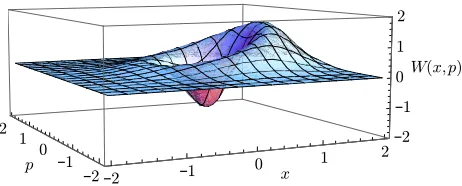
We can further exploit the conditional dynamics pre-serving the relative amplitudes for all non-zero number states to implement a reverse quantum scissors [28]. In the original quantum scissors scheme a general superposi-tion of photon numbers has photon numbers higher than 1 removed, without altering the zero and one photon am-plitudes. The scheme has been theoretically extended to make the cut at higher photon numbers [29, 30]. By suc-cessive application of the measurement without photon replacementn times, we can truncate the firstn ampli-tudes of a state, conditioned on not observing the vac-uum. By adding n photons, we return the state to its original form but without the firstnterms (Fig.4). The probability that this will occur is 1−Pn−1
[image:3.595.317.558.61.174.2]FIG. 4: Wigner function of a vacuum-stripped|α= 1i coher-ent state. In the protocol a loss rate ofκ= 0.005gand other parameters as specified in Fig. 3 were used. It shares all the features of the idealised output state, including negativity. This state is obtained from|α= 1iwith a probability of 0.61. The probability of measuring the vacuum|h1|0i|2is 0.37, and a 2% error is caused by photon loss during the process. The fidelity is 96% compared with (I− |0ih0|)|α= 1i.
IV. CONCLUSION
The ability to implement ideal projections on a field opens up new possibilities for quantum communication and computation. Adiabatic evolution in our method avoids the√nfactors in dynamical schemes and achieves the unusual nonlinearity required. Though it will be challenging to engineer systems with the requisite long storage times with strong coupling, recent advances in microcavities as well as microwave and nanomechanical systems give grounds for optimism. The simplicity and utility of the system described here for implementing sev-eral quantum optical information protocols should be sig-nificant drivers towards this goal.
Appendix A: Technical Details
To see why the methods works, we examine the form of the rotating-wave Hamiltonian for the atom-field system,
HRW A=~∆|eihe|+~γA(t)(|eihg|+|gihe|)
+~γB(t)(|eihg′|a+|g′ihe|a†), (A1)
Firstly, we note that for any n ∈ N, the subspace { |g, n−1i,|e, n−1i,|g′, ni}is coupled together byHRWA
. Other states are not coupled to this triplet, and this sim-plifies the dynamics significantly. Together with the lin-ear span of the vector|g′,0i, which itself is an eigenspace corresponding to the eigenvalue 0, these subspaces al-low for a decomposition of the whole Hilbert space de-scribing the coupled system of the atom and the cav-ity. Within each of the three-dimensional subspaces, we can identify three nondegenerate eigenenergies: 0 and
~
2(∆± p
∆2+ 4γ2
A(t) + 4nγB2(t)). The eigenstates
cor-responding to zero energy are, up to normalisation and phase factors,√nγB(t)|g, n−1i−γA(t)|g′, ni, along with the special case of|g′,0i, noted above.
In order to study the deviations from an ideal adia-batic transition, we solve the time-dependent Schr¨odinger equation. For a givenn, we denote
θ(t) = arctan √
nγB(t)
γA(t) (A2)
and
ν(t) = q
γ2
A(t) +nγB2(t). (A3)
In this notation, the dark state can be expressed as
|a(t)i= sinθ(t)|g, n−1i −cosθ(t)|g′, ni. (A4)
We rewrite the equation of motion in an orthonormal basis consisting of the vectors|a(t)i,
|b(t)i= cosθ(t)|g, n−1i+ sinθ(t)|g′, ni, (A5)
and|ei.
Resolving the instantaneous state as
|ψ(t)i=αa(t)|a(t)i+αb(t)|b(t)i+αe(t)|ei, (A6)
we substitute this into the Schr¨odinger equation to find the equations of motion forαi(t),
˙
αa = ˙θαb,
˙
αb=−θαa˙ −iναe,
˙
αe=−iναb−i∆αe.
(A7)
If the system begins in the dark state the initial condi-tions are αa(0) = 1, αb(0) = αe(0) = 0. The equations are best solved in terms of the projective space coordi-natesκb=αb/αa andκe=αe/αa, where they become
˙
κb=−θ˙−iνκe−θκ˙ 2b,
˙
κe=−iνκb−i∆κe−θκbκe.˙ (A8)
The last pair of equations can be solved asymptotically. For this purpose, we denote the complete time of transi-tionT, such that all of ˙θ, ¨θ/θ˙and ˙ν/νare upper bounded by a constant multiple of T−1. Also, we denote ν
0 the minimum modulus of the lower of the nonzero eigenval-ues ofHRWA
(restricted to the given subspace) reached during the transition. This value is also a lower bound for both ofν(t) andν2(t)/∆. We use these inequalities to find that
κb(t) =−iθ˙(t)∆
ν2(t) +O((ν0T)
−2),
κe(t) =iθ˙(t)
ν(t)+O((ν0T) −2).
(A9)
These formulas allow us to express
αa(t) = exp −i∆ Z t
0 ˙
θ2(t)
ν2(t)dt !
If the spatial distributions of intensity of the two light modes are smooth functions of coordinates, the time derivative of θ(t) for both t = 0 and T = 0 is zero. It immediately follows that the relative contributions of the states orthogonal to the desired final state, as given by Eq. (A9), vanish at the end of the transition, leaving only the asymptotic term. The probability of the dia-batic transition is in turnO((ν0T)−4) and can be pushed arbitrarily close to zero by choosing a sufficiently long timeT. The resulting state obtains a phase shift of
φ=−∆ Z T
0 ˙
θ2(t)
ν2(t)dt+O((ν0T)
−2), (A11)
which itself scales asO((ν0T)−1) and also has a limit of zero for T→ ∞.
The dependence of the results on the photon number
nmanifests itself through the constant
ν0= min
t∈(0,T)
s
∆ 2
2 +γ2
A(t) +nγB2(t)−
∆ 2
.
(A12) This formula suggests that the scalings of both the prob-ability of error and the phase φ are actually the more favourable the higher n one operates in. Studying the worst case, i.e.,n= 1, we find that the transition is op-timal if the two light modes overlap in such a way that the effective beginning or end of either one coincides with the point of maximal intensity of the other one.
We finish the analysis by noting that the state |g′,0i remains unchanged during the whole transition and ob-tains no phase shift due to the fact that it corresponds to exactly zero energy.
As a result, any linear superposition
∞
X
n=0
αn|g, ni (A13)
evolves under “forward” STIRAP to ∞
X
n=0
αn|g′, n+ 1i, (A14)
in a deterministic manner, up to correction terms of order (ν0(min)T)−1. Similarly, letting the atom encounter the laser field A first, any state of the form
∞
X
n=0
αn|g′, ni (A15)
evolves into
α0|g′,0i+
∞
X
n=1
αn|g, n−1i. (A16)
In the case of a cavity in a mixed state, the correspond-ing operation is performed on each element of its Schmidt decomposition.
Appendix B: Experimental Considerations
For the implementation of the measurement, this re-quires that the system being measured does not signif-icantly evolve over the timescale required to perform the adiabatic evolutions and atomic measurement. This will be a considerable experimental challenge, though ad-vances in cavity QED have led to high coupling strengths compared to loss rates which are the dominant sources of decoherence.
1. Cavity lifetime
Very high Q-factors have been achieved in optical res-onators, of the order of 3.5×10¹² for large supermirror cavities [31], and approaching 1011 for Fabry-Perot cav-ities [32]. In addition, the atom must couple strongly with the cavity mode as this will limit the speed of the atomic transport at which adiabaticity can be main-tained. Together with the low damping rate, we require that the atom-cavity system is within the strong cou-pling regime. Large coucou-pling will be favoured by small mode volumes but this may conflict with the required storage time. Ringdown measurements for QED experi-ments have shown a decay time of 12.4 microseconds for a 1cm long cavity [33].
a. Cavity-atom coupling
The coupling γB limits the rate at which the atom can traverse the cavity. Coupling rates of the order of 10 MHz have been achieved in cavity QED [34], which leads to an adiabatic-safe interaction time on the order of∼1 microsecond. For a proof of principle experiment, the measurement of the atom can take far longer than the decay time of the cavity if one is not interested in restor-ing the subtracted photon. Much higher couplrestor-ings have been reported for atoms interacting with evanescent field of a toroidal microresonator, of the order of 40 MHz [35].
b. Detection
A standard method of state detection is shelving fluo-rescence. A long cavity storage time is essential for the measurement as shelving fluorescence takes a finite time, of the order of 100 microseconds for 99.9% fidelity [14] due to the need for the atom to absorb and spontaneously emit photons and for these to be detected. This time could be reduced by increasing the collection solid angle and the probe power.
be used for detection. A detection time of 10 microsec-onds at 97% efficiency has been reported for fibre-coupled cavity detection [37]. Even faster detection has been achieved by combine both fluorescence and cavity cou-pling, 99.7% in less than 1 microsecond [15]. Detection of atoms coupled to cavities in 250 nanoseconds has also been reported [35].
c. Other physical systems
Photonic cavities may also be a possibility to tune the mode volumes, coupling strengths and system geome-try. Whispering gallery modes in microspheres or mi-crotoroids are also possibilities though the required ge-ometry is more complex. Controlling the atomic position and shining the STIRAP laser may be issues. Projected
γB = several 100 MHz, κ < 1 MHz [38] for such mi-crotoroid cavities. Coupled ion-cavity QED experiments may also be a viable system. The progress on segmented traps and in shuttling [39] allows controlled ion transport
through a cavity field [40].
We note that the same technique can be applied to su-perconducting systems of artificial three-level atoms [41] and stripline resonators using adjustable couplings [42, 43]. In these systems, very large couplings have been ob-served (200 MHz [44]). It is calculated that couplings of up to 360 MHz could be achieved in optimized ge-ometries [45]. Cavity loss of κ = 250 kHz has been achieved in other experiments [46]. Tunable couplings between superconducting elements have been developed ((0−100) MHz) [42, 43]. Measurement of three level sys-tems have been reported in [41].
Acknowledgments
DKLO acknowledges discussions with Si-Hui Tan. The au-thors acknowledge support from: Quantum Information Scotland (QUISCO), DKLO, JJ; the UK EPSRC (EP/G009570/1), JJ, VP; Czech Science Foundation (GA ˇCR 202/08/H072), VP.
[1] Andersson, E. & Oi, D. K. L. Binary search trees for gen-eralized measurements.Phys. Rev. A77, 052104 (2008) [2] Guha, S., Tan, S-H., Wilde, M. M. Explicit capacity-achieving receivers for optical com-munication and quantum reading. Pre-print at http://arXiv.org/abs/1202.0518 (2012)
[3] Sen, P. Achieving the Han-Kobayashi inner bound for the quantum interference channel by sequential decoding. Pre-print at http://arXiv.org/abs/1109.0802
[4] Paris, M. Optimized QND measurement of a field quadra-ture.Phys. Rev. A65, 012110 (2002)
[5] Kok, P., Lee, H. & Dowling, J. P. Single-photon quantum nondemolition detectors constructed with linear optics and projective measurements. Phys. Rev. A 6, 063814 (2002)
[6] Guerlin, C. et al. Progressive field-state collapse and quantum non-demolition photon counting.Nature 448, 889–893 (2007)
[7] Grangier, P., Levenson J. A. & Poizat, J. P. Quan-tum non-demolition measurements in optics.Nature396, 537–542 (1998)
[8] Parigi, V., Zavatta, A., Kim, M. S. & Bellini, M. Prob-ing quantum commutation rules by addition and subtrac-tion of single photons to/from a light field.Science 317, 18901893 (2007).
[9] Zavatta, A., Parigi, V., Kim, M. S., Jeong, H. & Bellini, M. Experimental demonstration of the bosonic commuta-tion relacommuta-tion via superposicommuta-tions of quantum operacommuta-tions on thermal light fields.Phys. Rev. Lett.103, 140406 (2009). [10] Fiur´aˇsek, J. Engineering quantum operations on travel-ing light beams by multiple photon addition and subtrac-tion.Phys. Rev. A80, 053822 (2009).
[11] Parkins, A. S., Marte, P., Zoller, P. & Kimble, H. J. Syn-thesis of arbitrary quantum states via adiabatic trans-fer of Zeeman coherence.Phys. Rev. Lett.71, 3095–3098 (1993)
[12] Parkins, A. S., Marte, P., Zoller, P., Carnal O. & Kimble, H. J. Quantum-state mapping between multilevel atoms and cavity light fields.Phys. Rev. A51, 1578–1596 (1995) [13] Kuhn, A., Hennrich, M., Bondo, T. & Rempe, G. Con-trolled generation of single photons from a strongly cou-pled atom-cavity system.Appl. Phys. B: Lasers and Op-tics 69, 373–377 (1999)
[14] Myerson, A. H.et al., High-fidelity readout of trapped-ion qubits.Phys. Rev. Lett.100, 200502 (2008)
[15] Terraciano, M. L.et al., Photon burst detection of sin-gle atoms in an optical cavity.Nature Phys. 5, 480–484 (2009)
[16] Dakna, M., Anhut, T., Opatrn´y, T., Kn¨oll, L. & Welsch, D.-G. Generating Schr¨odinger-cat-like states by means of conditional measurements on a beam splitter.Phys. Rev. A55, 3184–3194 (1997).
[17] Ourjoumtsev, A., Tualle-Brouri, R., Laurat, J. & Grang-ier, P. Generating Optical Schr¨odinger Kittens for Quan-tum Information Processing.Science 312, 83–86 (2006). [18] Neergaard-Nielsen, J. S., Nielsen, B. M., Hettich, C., Molmer, K. & Polzik, E. S. Generation of a superposition of odd photon number states for quantum information networks.Phys. Rev. Lett.97, 083604(2006).
[19] Wakui, K., Takahashi, H., Furusawa, A. & Sasaki, M. Photon subtracted squeezed states generated with peri-odically poled KTiOPO4.Optics Express 15, 3568–3574 (2007).
[20] Marek, P. & Filip, R. Coherent-state phase concentration by quantum probabilistic amplification.Phys. Rev. A81, 022302 (2010).
[21] Fiur´aˇsek, J. Engineering quantum operations on travel-ing light beams by multiple photon addition and subtrac-tion.Phys. Rev. A80, 053822 (2009).
[23] Usuga, M. A.et al.Noise-Powered Probabilistic Concen-tration of Phase Information. Nature Phys. 6, 767–771 (2010).
[24] Susskind, L. & Glogower, J. Quantum mechanical phase and time operator.Physics 1, 49–61 (1964).
[25] Lee, C. T. Application of Klyshko’s criterion for non-classical states to the micromaser pumped by ultracold atoms.Phys. Rev A55, 4449–4453 (1997).
[26] Ben-Aryeh, Y. & Brif, C. Discrete photodetection and Susskind-Glogower ladder operators. Pre-print at http://arXiv.org/abs/quant-ph/9504009.
[27] Zou, X., Shu, J. & Guo, G., Simple scheme for direct measurement of exponential phase moments of cavity fields by adiabatic passage.Physics Letters A 359117– 121 (2006).
[28] Pegg, D. T., Phillips, L. S. & Barnett, S. M. Optical State Truncation by Projection Synthesis.Phys. Rev. Lett.81, 1604–1606 (1998)
[29] Koniorczyk, M., Kurucz, Z., G´abris, A. & Janszky, J. General optical state truncation and its teleportation. Phys. Rev. A62, 013802 (2000).
[30] Jeffers, J. Optical amplifier-powered quantum optical amplification.Phys. Rev. A82, 063828 (2010).
[31] K. U. Schreiber, K. U., Gebauer, A. & Well, J.-P. R. Long-term frequency stabilization of a 16m2 ring laser gyroscope.Opt. Lett.37, 1925–1927 (2012)
[32] S. Kuhr et al, Ultrahigh finesse Fabry-Perot supercon-ducting resonator, Applied Physics Letters 90, 164101 (2007).
[33] Dotsenko, I. Single atoms on demand for cavity QED experiments. PhD Thesis, University of Bonn (2007) [34] Schuster, I. et al., Nonlinear spectroscopy of photons
bound to one atom.Nature Physics4, 382–385 (2008) [35] Alton, D. J. et al. Strong interactions of single atoms
and photons near a dielectric boundary.Nature Phys.7, 159–165 (2010)
[36] Poldy, R., Buchler, B. C. & Close, J. D. Single-atom detection with optical cavities.Phys. Rev. A78, 013640 (2008)
[37] Goldwin, J., Trupke, M., Kenner, J., Ratnapala, A. & Hinds, E. A. Fast cavity-enhanced atom detection with low noise and high fidelity.Nature Comms.2, 418 (2011) [38] Spillane, S. M. et al. Ultrahigh-Q toroidal microres-onators for cavity quantum electrodynamics.Phys. Rev. A71, 013817 (2005)
[39] Amini, J. M.et al.Toward scalable ion traps for quantum information processing.New J. Phys.12, 033031 (2010) [40] Keller, K., Lange, B., Hayasaka, K., Lange, W. & Walther, H. Stable long-term coupling of a single ion to a cavity mode.J. Mod. Opt.54, 1607–1617 (2007) [41] Bianchetti, R.et al.Control and Tomography of a Three
Level Superconducting Artificial Atom.Phys. Rev. Lett.
105, 223601 (2010)
[42] Bialczak, R. C. et al.Fast Tunable Coupler for Super-conducting Qubits.Phys. Rev. Lett.106, 060501 (2011) [43] Gambetta, J. M., Houck, A. A. Blais, A.
Superconduct-ing Qubit with Purcell Protection and Tunable CouplSuperconduct-ing, Phys. Rev. Lett.106, 030502 (2011)
[44] DiCarlo, L.et al.Demonstration of two-qubit algorithms with a superconducting quantum processor.Nature460, 240–244 (2009)
[45] Bourassa, J.et al.Ultrastrong coupling regime of cavity QED with phase-biased flux qubits. Phys. Rev. A 80, 032109 (2009)