Automated Reasoning with Boolean ABoxes
Bernadette Mart´ınez Hern´
andez
Supervisors
Maarten Marx
Carlos Areces
Members of the committee
Dick de Jongh
Acknowledgements
Contents
1 Introduction 4
2 Description logics and Boolean ABoxes 6
2.1 The language . . . 6
2.2 Boolean ABoxes . . . 9
3 Transforming Boolean ABoxes 11 3.1 Translation . . . 11
3.1.1 The original idea . . . 12
3.1.2 The implementation . . . 12
3.2 Disjunction of knowledge bases . . . 17
3.2.1 The implementations . . . 17
3.2.2 Role assertion erasing . . . 19
3.3 Optimizations . . . 25
3.3.1 Propositional reductions . . . 26
4 Implementation and testing 28 4.1 The input format and the programs . . . 28
4.2 Handcrafted cases . . . 31
4.2.1 TPTP puzzles . . . 31
4.2.2 Mistakes in RACER . . . 36
4.3 Random generated cases . . . 39
4.3.1 The random generator . . . 39
4.3.2 The testing . . . 44
A The Code 58 A.1 ba2racer . . . 58
A.2 ba2racerdpll . . . 75
A.3 genBABox . . . 82
Chapter 1
Introduction
Description Logics (DL) is a family of knowledge representation (KR) for-malisms tailored to represent the knowledge of an application domain by first defining the basic and derived concepts of the domain, and then using these concepts to specify properties of objects and individuals in the domain. There-fore a DL knowledge base (KB) is made up of two parts, the terminological part (TBox) where the definitions of the basic and derived notions are stored, and the assertional part (ABox), which records facts about individuals.
A common property of a group of individuals is described by a concept. Con-cepts can be considered as unary predicates and interpreted as sets of objects. Roles are interpreted as binary relations between objects. Thus, an ABox re-sembles superficially a relational database with only unary and binary relations. However a database represents only one interpretation, while an ABox encodes a set of interpretations, namely all its models. The ABox does not assume its information to be complete, but in a database the absence of information is regarded as negative information. The partial knowledge of an ABox comes out not only from lack of information, but also from disjunctive assertions like
i:CtD.
Such possibility of partial knowledge is very restricted, it only allows con-junction of assertions. A less restricted representation is usually needed to deal with interesting problems as planning and diagnosis. To be useful it would have to have good expressivity to describe partial knowledge by means of disjunctions or boolean constraints.
One way to tackle this problem is to use the Boolean ABoxes (BABoxes), in which boolean combinations of ABox assertions are permitted. Given a TBoxT
and a BABoxB, to find whether (T, B) has a model we treat all the assertions of the BABox as propositions. Then, all the propositional models, which are ABoxes, can be obtained. If one of these models A, together with T has a model; then (T, B) has a model. This process may be expensive because of the exhaustive search. Therefore, a suitable translation from BABox to a regular KB could make it better.
this translation is really more efficient than an optimized method which tries out all propositional models. The research reported in this thesis was done in order to clarify this issue.
Our main results are that the translation approach is an adequate option for BABoxes containing propositionally non trivial information, specifically when the BABoxes are modally constrained. We give examples of DL’s in which the translation approach is always needed.
Our work has several important consequences. We created a number of examples which turned out to be revealing. They showed several mistakes in RACER. We developed several optimizations to both the translation and the model generation approach. Furthermore we created a random generator of test examples.
Chapter 2
Description logics and
Boolean ABoxes
This chapter provides a brief introduction to Description Logics as a formal language for representing knowledge and reasoning about it. It introduces the syntax and semantics of the language and elements needed to build a knowledge base as well as the standard inference problems. Finally it defines our main object of study, Boolean ABoxes.
2.1
The language
Definition 1 Let C={C1, C2, . . .} be a countable set of atomic concepts, R=
{R1, R2, . . .}be a countable set of atomic rolesandI={i1, i2, . . .}be a countable
set of individuals. For C,R,I pairwise disjoint, S =hC,R,Ii is a signature. An
interpretation for a fixed signatureS is a tuple I=h∆I,·Ii, where
• ∆I is a nonempty set, called the domainof I.
• ·I is a function assigning an element iI
j ∈ ∆
I to each individual i
j; a
subsetCI
j ⊆∆
I to each atomic conceptC
j; and a relation RIj ⊆∆
I×∆I
to each atomic role Rj
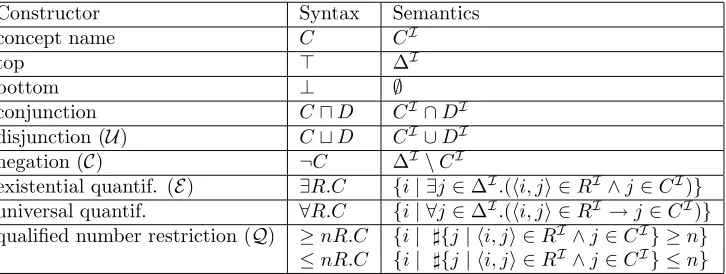
Complex concepts and roles can be built inductively from atomic symbols by means ofconstructors. Table 2.1 and 2.2 show some of them.
A language L is characterized by the constructors it allows. For a given languageL,C(L) denotes the set of complex concept expressions andR(L) the set of complex role expressions which can be formed using the constructors ofL. We are particularly interested in the languageALC and its extensions. ALC al-lows the universal concept (top), negation, disjunction, conjunction, existential and universal quantification constructors.
To give an example of what can we express in ALC, we suppose that
Then Accountantu ¬Employee, ∃Boss of.Employeet ∀Boss of.Accountant
are concepts describing intuitively, the set of individuals that are accountants and not employees, and the set of individuals who are the boss of an employee or the boss of only accountants, respectively.
Adding constructors to ALC we form more expressive logics. One of the extensions of ALC is SHIQ, that is ALC plus qualified number restrictions, role hierarchies, transitive and inverse roles. Following the previous examples, theSHIQ concept≤1Boss of.Employeeexpress the set of individuals which are the boss of at most one employee. The exact meaning of the role hierarchy and the transitive and inverse roles constructors are detailed below. From now on, we will assume the language we are working with isSHIQ.
Definition 2 (Knowledge base) Fix a description language L. A knowledge
base(KB)is a pairK= (T, A)where T is a TBox, and A is an ABox. A TBox
is a finite, possibly empty set of axioms of the forms CvD orR vS, where
C,D are in C(L)and R,S are in R(L). They are called general concept inclusion
axioms(GCI) and role inclusion axiomsrespectively. Arole hierarchy Ris a set
of role inclusion axioms. AterminologyT is a set of GCIs. An ABoxis a finite,
possibly empty, set of assertions of the forms i:C or R(i, j), where C ∈ C(L),
R∈ R(L), and i, j are individuals.
The available knowledge of a KB is split into two parts. The information of the TBox, aims to express the definitions of the basic and derived notions and the way they are inter-related. This information is “generic” or “global,” being true in every model of the situation and of every individual of the situation. The ABox records “specific” or “local” information, being true for certain particular individuals in the situation.
To illustrate the definitions above, consider the next example. Suppose we are working in the specification of an office work environment, and we have the conceptsSecretary andEmployeewhich represent the set of all secretaries in the modelled domain and the set of employees respectively. We also have the rolesBoss ofandColleaguewhich identify the binary relations in the modelled domain between boss and subordinates and fellow workers respectively.
We can express with a GCI in the TBox that all the secretaries are employees,
Secretary vEmployee
and with a role inclusion axiom that the relation between a boss and a subor-dinate is a subset of the fellowship relation.
Boss of vColleague
The statements saying that Pedro, a particular individual is an employee,
pedro:Employee
and is related to Pancho as his boss
Constructor Syntax Semantics
concept name C CI
top > ∆I
bottom ⊥ ∅
conjunction CuD CI∩DI
disjunction (U) CtD CI∪DI
negation (C) ¬C ∆I\CI
existential quantif. (E) ∃R.C {i| ∃j∈∆I.(hi, ji ∈RI∧j∈CI)}
universal quantif. ∀R.C {i| ∀j∈∆I.(hi, ji ∈RI→j ∈CI)}
qualified number restriction (Q) ≥nR.C {i| ]{j| hi, ji ∈RI∧j ∈CI} ≥n}
[image:9.595.142.505.125.262.2]≤nR.C {i| ]{j| hi, ji ∈RI∧j ∈CI} ≤n}
Table 2.1: Concept constructors.
C, Ddenote concepts,R, S roles, i, jindividuals, na non-negative integer,]M
the cardinality ofM and (RI)+
the transitive closure ofRI.
Constructor Syntax Semantics
inverse role (I) R− {hi, ji | hj, ii ∈RI}
transitive role R∈R+ RI= (RI)+
Table 2.2: Role constructors
Definition 3 Let R+, R+⊆ R, be the set of transitive atomic roles, meaning
with this, the set of atomic roles whose interpretation will be forced to be a
transitive relation. We define the function Inv on roles to avoid considering
roles such as R−−; this function returns Inv(R) =R− if R is an atomic role,
and Inv(R) = S if R =S−. We also define the function Trans which returns
true iff R is a transitive role. More precisely, Trans(R)= true iff R ∈ R+ or
Inv(R)∈R+. We define the relation v∗ as the transitive-reflexive closure of v
over R ∪ {Inv(S)vInv(R)|S vR∈ R}.
Continuing our example of KB, we can specify that the relation between fellow workers is transitive, by stating
Trans(Colleague) =T rue
and that the subordinate relation is the inverse of the boss relation as
Inv(Boss of) =Subordinate of.
Definition 4 LetI be an interpretation,K a knowledge base, C, D concepts,
• I |=CvD ifCI⊆D.I
• I |=i:C if iI ∈CI.
• I |=R(i, j)if (iI, jI)∈RI.
• I |=T if for eachCvD∈ T, CI⊆DI.
• I |=Rif for each RvS ∈ R, RI ⊆SI.
• I |=K if for everyφ∈K, I |=φ. We call I a modelof the knowledge
baseK.
• K|=φ, if for all models I of K we haveI |=φ.
All roles in R+ should be assigned to a transitive relation overI for I to be
an acceptable model, that is, for allR∈R+, RI is transitively closed:
if (i, j)∈RI and (j, k)∈RI, then (i, k)∈RI
2.2
Boolean ABoxes
The format imposed by ABoxes is something too restrictive. For instance, in planning and diagnosis one often needs to describe the partial knowledge of the world using disjunctions or boolean constraints. In particular consider the logical puzzle PUZ003-1 from TPTP [SS]:
There is a barbers’ club that obeys the following three conditions: (1) If any member A has shaved any other member B - whether himself or another - then all members have shaved A, though not necessarily at the same time.
(2) Four of the members are named Guido, Lorenzo, Petrucio, and Cesare.
(3) Guido has shaved Cesare. Prove Petrucio has shaved Lorenzo
We can express in FOL statement(1):
∀x∀y∀z(member(x)∧member(y)∧shaved(x, y)∧member(z)→shaved(z, x)) If we want to formalize this example in DL we find in statement(1) a role assertion conditioned by other assertions. An informal notation to express such conditioning would be:
Definition 5 An ABox literal is an ABox assertion or its negation. An ABox
clauseis a set of ABox literals. Let Pi, Qj be ABox assertions, n, m≥0. An ABox sequenthas the form
P1, . . . , Pn→Q1, . . . , Qm
and it is interpreted as the ABox clause
{¬P1, . . . ,¬Pn, Q1, . . . , Qm}.
ABoolean ABox(BABox)is a set of ABox sequents. Aunit clauseis a singleton.
Let us define formally the semantics of BABoxes.
Definition 6 LetI be an interpretation and l1 a literal. I satisfiesl1 if l1 is
positive andI |=l1, or if l1=¬l2 andI 6|=l2.
I |={l1, l2, ..., ln}, ifI |=li for somei.
I satisfies a BABox if it satisfies all its sequents.
Traditional ABoxes are BABoxes with only unit clauses of positive literals. Every further KB will be considered boolean unless a different remark is made.
Chapter 3
Transforming Boolean
ABoxes
Boolean ABoxes provide an extended flexibility to formulate interesting prob-lems. But, we want more than that, we also want to make inferences about the information in the BABox, and we do not want to make these inferences by hand. The expressive power of the language is sufficiently high to make this unfeasible even for very small KBs. The solution is to use an automatic prover. RACER is the first DL system for TBox and ABox reasoning inALCQHIR+(D−) (SHIQ
plus a restricted form of concrete domains) [HM01a, HM], giving us the support for the language we are dealing with and a high performance in the reasoning tasks [HM01b]. However, the input format of RACER does not support boolean assertions. What we need is a way to solve the problem of finding whether a BABox is consistent without losing the facility to express and read easily the BABox statements. The most obvious approach comes from the definition of a BABox. A BABox can be seen as a propositional set. If we use a complete propositional model generator, each propositional model represents a list of lit-erals which in principle (with some modifications as we will see in Section 3.2) can be fed into RACER to test if it is modally consistent. But this exhaustive search may be time consuming. Another option could be the translation of the whole BABox into an equisatisfiable KB in a format RACER can work with. Such rewriting has already been proposed in [ABM02]. The details of this trans-lation, the model search method and their implementations will be specified in the first two sections of this chapter. Section 3.3 describes some optimizations for these implementations.
3.1
Translation
pre-processor for RACER. It is fully described in [ABM02], and in this section only the algorithm and some highlights are shown. Finally our version of the algorithm and some modifications are explained.
3.1.1
The original idea
The algorithm to translate anALC Boolean KB into a traditional KB proposed in [ABM02] is:
input: a Boolean KB (T, A) whose BABoxAis in clausal form.
• ifR(i, j) occurs negatively or in non unit clauses, then uniformly replace
R(i, j) in Abyi:∃R.IamJ, and add the (∗) formulas described below to the KB using a new atomic roleFakeR and a new atomic conceptIamJ
every time.
Define the KB (∗) as:
(∗1) RvFakeR
(∗2) FakeR(i, j)
(∗3) j:IamJ
(∗4) i:≤1FakeR.IamJ.
The (∗i) give names to the KB elements. Notice that (∗1) is a TBox statement and the other elements belong to the ABox.
intermediate result: a BABox without negated role assertions or role assertions in non unit clauses.
• push negations inside using the validity¬i:C≡i:¬C. intermediate result: a BABox without negative literals.
• collect disjunctions concerning the same individuals using the validityi:C∨
i:D≡i:CtD.
intermediate result: a BABox in which every clause contains at most one literali:C for eachi.
• repeatedly transform disjunctions concerning different individuals. From KB∪{{L1, . . . , Ln, i:C, j:D}}to KB∪{{R(i, j)},{L1, . . . , Ln, i:(Ct∀R.D)}};
using a new symbolR every time.
output: a knowledge base (T0, A0) in RACER format.
The algorithm is proved to preserve satisfiability in [ABM02], but no imple-mentation is presented. This is the motivation for the following section.
3.1.2
The implementation
We assume that we have a function substwith parametersA,B,C, where A
andBare literals andCa set of clauses, such function returns the result of re-placing any occurrence ofAinCbyB. We also assume the existence of a function
substClwith parametersA,B,C, whereAis a list of literals[l1,l2,...,ln],Bis a literal andCis a clause,substClreturns the result of replacing the occurrence of all the literals ofAinCbyB. The functionspreadImpreturns the transforma-tion of a set of sequents into a set of clauses. We also take account of functransforma-tions to generate new concepts and role names, they are callednewConceptSymbol
andnewRoleSymbolrespectively. For the case of the generation of FakeR, the functionFakeRoleOfreturns the specific ‘fake’ role name predefined for any role
R. This role name is unique for every R. This aspect differs from the original algorithm. Another difference in our implementation is that the input can be more expressive, accepting SHIQ Boolean KBs. The justifications for these changes are made after the pseudocode.
input: A Boolean KB (T, A), where Ais a set of ABox sequents. output: A traditional KB (T0, A0)
ba2racer(T,A) {
B := spreadImp(A) \* Step 1 *\
for every R(i,j) in B negated or in non unit clauses {
FakeR := FakeRoleOf R; IamJ := newConceptSymbol;
B := subst(R(i,j),i:∃ R.IamJ,B); T := T ∪ { {R v FakeR} };
B := B ∪ { {FakeR(i,j)}, {j:IamJ}, {i:≤1FakeR.IamJ} }; }
\* Now B is a BABox without problematic relational assertions *\
\* Step 2 *\
for every clause C in B {
while¬i:D in C
C = substCl([¬i:D],i:¬D,C); }
\* Now B has no negative literals *\ \* Step 3 *\
{
while i:D1,...,i:Dn in C and n > 1
C = substCl([i:D1,...,i:Dn],i:(D1t...tDn),C); }
\* Now every clause in B has one literal i:D for each i *\ \* Step 4 *\
for every clause C in B {
while C has two members i:D,j:E; {
R = newRoleSymbol;
C = substCl([i:D,j:E],i:D t ∀ R.E,C); B = B ∪ {R(i,j)};
} }
\* Now B has only unit clauses, is an ABox *\ return(T,B)
}
We need to check that this implementation is “equivalent” to the intuitive rewriting process we introduced in the first part of this section. We will provide an explanation for every step marked in the pseudocode.
Step 1 differs from the original algorithm. In [ABM02] a newFakeR atom is generated every time a¬R(i, j) is found. Our approach considers for every roleRin aSHIQKB only a new fixed unique role atomFakeR.
We define A[φ/θ] as the result of uniformly replacing φ with θ in A and
A[φ/θ][δ/ρ] as (A[φ/θ])[δ/ρ].
Let (T, A) be a SHIQ Boolean KB with the role assertions R(i1, j1), . . . ,
R(in, jn) negated or in non unit clauses over the same roleR. Then, the KB∗n
denotes the following:
• RvF akeR (axiom)
• F akeR(i1, j1)
.. .
• F akeR(in, jn)
• j1:IamJ1
.. .
• i1:≤1FakeR.IamJ1
.. .
• in:≤1FakeR.IamJn
whereF akeRis a new role atom andIamJi, 1≤i≤n, are new atomic concepts.
We want to substitute the problematic role assertions similarly to the way the original algorithm does it. Thus, it is necessary to prove the following statement to support the substitution:
For aR(i, j)∈ {R(i1, j1), . . . , R(in, jn)}
(∗n
)|=R(i, j)≡i:∃R.IamJ. (3.1)
Proof.
(3.1) is most easily proved by a (semi-formal) tableau argument1.
⇒
1) R(i, j) 2) ¬i:∃R.IamJ
3) ¬j:IamJ (∀rule on 1 and 2) 4) j:IamJ (∗n element)
⊥ ⇐
1) i:∃R.IamJ
2) ¬R(i, j)
3) R(i, k) (∃rule on 1) 4) k:IamJ
5) FakeR(i, k) (by 3 and axiom)
6) FakeR(i, j) (∗n element)
7) j:IamJ (∗n element)
8) k=j (by 4,5,6,7 and∗n element)
⊥ (by 2,3,8)
qed
Now, we are ready to prove the corrections of our modified version of the role assertion handling.
Claim 1 Let (T, A) a be a Boolean KB withR(i1, j1), . . . , R(in, jn) occurring
negatively or in non unit clauses in A. (T, A) is satisfiable iff ∗n∪T∪A[R(i
1, j1)/i:∃R.IamJ1]. . .[R(in, jn)/i:∃R.IamJn]
is satisfiable.
1
Proof.
⇒
LetI |= (T, A). ExpandI to I0 by setting
(IamJk)I
0
={jkI}for allIamJk such that 1≤k≤n
F akeRI0
=RI[{(iI
k, j
I
k)}1≤k≤n
andI0 is equal toI for all other symbols.
I0 |=∗n and stillI0|= (T, A). Whence, by (3.1),
I0 |=A[R(i
1, j1)/i:∃R.IamJ1]. . .[R(in, jn)/i:∃R.IamJk]
⇐
Let I |= ∗n ∪T ∪A[R(i
1, j1)/i:∃R.IamJ1]. . .[R(in, jn)/i:∃R.IamJn] then
I |=T and by (3.1) I |=A, whenceI |= (T, A) qed
This proof justifies the process of continuously replacing the negated or non unit role assertions by concept assertions, followed by the addition of the corre-sponding elements of∗n to the TBox. This is achieved in the first step as can
be observed in the pseudocode. After finishing, our BABox does not contain negated role assertions or role assertions in non unit clauses, just like in the original algorithm.
The further steps are devoted to the handling of concept assertions in order to transform the BABox obtained of the first step into an ABox.
Step 2 andStep 3 follow from:
I |=¬i:C ⇐⇒ I |=i:¬C (3.2) I |={i:C, i:D} ⇐⇒ I |=i:CtD. (3.3) for any modelI.
They realize exactly the same labor as in the original algorithm; that is, they introduce the negations in the concept, and join in a single concept all the concept assertions of a clause related to the same individual.
Step 4 At this point where we have either unit clauses with role assertions or clauses with at most one positive concept assertion per individual. The last step reduces the disjunction of concept assertions to the point we only have unit clauses. It is justified by the following claim, explained in [ABM02]:
For any Boolean KBB,B∪ {{L1, . . . , Ln, i:C, j:D}}is satisfiable if
and only ifB∪{{R(i, j)},{L1, . . . , Ln, i:(Ct∀R.D)}}is satisfiable. (3.4)
As in [ABM02] we use a new role atomRevery time.
can be fed with this KB to execute inferences. This implementation fullfill the idea of the original translation algorithm of [ABM02] and improves the handling of role assertions. The technical details of the implementation of the pseudocode showed in this section can be consulted in Appendix A.
There is another way to handle a BABox. This second approach is more related to the semantics of BABoxes and is described in the next section.
3.2
Disjunction of knowledge bases
The translation approach focuses on transforming clauses into traditional as-sertions. There is another way of solving the problem without initially using reductions. The intuition is to regard assertions as propositions and test the modal consistency of every propositional model.
Suppose we have a Boolean KB (T, A). By definition, a BABox is satisfiable if at least one literal of every clause is satisfiable. If we take every assertion as a proposition, we can generate all the propositional modelsAi for the clause set.
EveryAiis a BABox with only unit clauses and (T, A) is consistent if and only
if (T, Ai) is consistent for somei.
In order to prove the consistency of any KB (T, Ai), we want to feed RACER
with it and test it. However, we need first to eliminate the negated role asser-tions. One possibility is to use the translation of the previous section for negated role assertions in aSHIQKB. However, under certain conditions, it is possible to erase the negated role assertions and preserve the validity.
We explain in this section these two approaches for the knowledge base con-sistency checking based on the disjunction of KBs. We use the Davis-Putnam-Logemann-Loveland (DPLL) method [DLL62] to search for the propositional models and then we test them in RACER. The pseudocode for both procedures is shown in the next subsection. We called the two procedures DPLL-RACER procedures.
3.2.1
The implementations
The first DPLL-RACER procedure,dpllRacerTransallows a SHIQBoolean KB as input. The second one,dpllRacer, is restricted to SHQBoolean KBs.
We adapt the standard DPLL procedure to turn it in to an exhaustive model generator. We use two variables; Sigma a BABox where all the clausal and propositional handlings of DPLL are done; andGammaa Boolean KB with only unit clauses where the propositional truth assignments of every assertion are saved. Thus, for an input Boolean KB (T, A), the initial call to any DPLL-RACER procedure assignsSigmato the set of ABox sequentsAtranslated into clauses, andGammato the KB (T,{}).
Sigma {l = val}is the result of applying the unit propagation of the literal
output of our DPLL-RACER procedures is Trueif the KB is consistent, and
Falseotherwise.
dpllRacerTransapplies our translation of negated role assertions explained in Section 3.1 to the propositional model stored in Gamma with the function
transformRAfterwards, Gammais passed to the function TestRacerwhich re-turns the result of testing the consistency ofGammain RACER.
dpllRacerTrans(Sigma,Gamma) {
if Sigma == {} then {
Gamma := transformR Gamma; if (TestRacer Gamma) then True; else return False;
}
if Sigma contains the empty clause then return False;
if Sigma has a unit clause {l} then
dpllRacerTrans (Sigma {l = true}, Gamma + {l}); if dpllRacerTrans (Sigma {l = true}, Gamma + {l}) then
return True;
else dpllRacerTrans (Sigma {l = false}, Gamma + {~l}); }
dpllRaceruses a different approach to handle the negated role assertions. First of all, it can only be used with aSHQKB. dpllRaceruses the function
eraseRwhich applies to the input KB the role deletion procedure explained at the end of this section. The output of this function is the modified KB without any¬R(i, j) or a KB with only the empty clause. We assume we have this func-tioneraseR. We also assume the existence of the functionemptyClausewhich returns True if a KB contains the empty clause and False otherwise. Notice that
dpllRaceralso uses the functionTestRacerto check the consistency ofGamma.
dpllRacer(Sigma,Gamma) {
if Sigma == {} then {
Gamma := eraseR Gamma; if (emptyClause Gamma) then
return False; else
if (TestRacer Gamma) then True else return False;
}
if Sigma has a unit clause {l} then
dpllRacer (Sigma {l = true}, Gamma + {l}); if dpllRacer (Sigma {l = true}, Gamma + {l}) then
return True;
else dpllRacer (Sigma {l = false}, Gamma + {~l}); }
In both cases the DPLL method ensures the generation of all propositional models of A. As it can be seen, if RACER returns thatGamma is consistent, the process is done, otherwise the search continues. If no propositional model is left, the inconsistency of (T, A) will be stated.
We have described two general algorithms to search a model of a Boolean KBs. The difference between these algorithms is the way they handle the negated role assertions when a propositional model is found. Both procedures can be implemented as functions used in the same program, they only need to be called according to whether the KB isSHQorSHIQ.
In the next subsection we explain how the function eraseR works, and we justify the deletion of the negated role assertions forSHQ. The code of these procedures and the implementation of the disjunction of KBs approach can be found in Appendix A.
3.2.2
Role assertion erasing
The previous section requires a function to erase the negated role assertions of BABoxes with only unit clauses. In this section we describe this function and prove that it preserves satisfiability.
Let (T, A) be a Boolean KB with only unit clauses and no unit clauses{P} and{Q}such that,Q=¬P. Notice that a Boolean KB produced by the DPLL-RACER procedures before being tested with DPLL-RACER satisfies this condition. Definition 7 (T, A){¬R(i, j)}is defined as
T ∪(A− {{¬R(i, j)}})∪ {{i:>},{j:>}}
and(T, A){{¬R1(i1, j1)}, . . . ,{¬Rn(in, jn)}}as
(. . .((T, A){¬R1(i1, j1)}){¬R2(i2, j2)}). . .{¬Rn(in, jn)}).
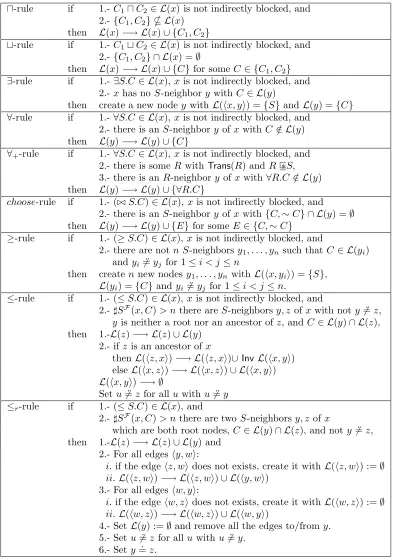
To prove the validity of the deletion we will make use of the tableau algorithm for SHIQ described in [HST00]. The expansion rules of this tableau can be seen in Table 3.1. We need first to state some definitions.
u-rule if 1.-C1uC2∈ L(x) is not indirectly blocked, and
2.-{C1, C2}*L(x)
then L(x)−→ L(x)∪ {C1, C2}
t-rule if 1.-C1tC2∈ L(x) is not indirectly blocked, and
2.-{C1, C2} ∩ L(x) =∅
then L(x)−→ L(x)∪ {C}for some C∈ {C1, C2}
∃-rule if 1.-∃S.C∈ L(x),xis not indirectly blocked, and 2.-xhas no S-neighbory withC∈ L(y)
then create a new nodey withL(hx, yi) ={S}andL(y) ={C} ∀-rule if 1.-∀S.C∈ L(x),xis not indirectly blocked, and
2.- there is anS-neighbory ofxwithC /∈ L(y) then L(y)−→ L(y)∪ {C}
∀+-rule if 1.-∀S.C∈ L(x),xis not indirectly blocked, and
2.- there is someR withTrans(R) andRv∗S,
3.- there is anR-neighbory ofx with∀R.C /∈ L(y) then L(y)−→ L(y)∪ {∀R.C}
choose-rule if 1.- (./ S.C)∈ L(x), xis not indirectly blocked, and 2.- there is anS-neighbory ofxwith{C,∼C} ∩ L(y) =∅ then L(y)−→ L(y)∪ {E}for someE∈ {C,∼C}
≥-rule if 1.- (≥S.C)∈ L(x),xis not indirectly blocked, and
2.- there are notn S-neighborsy1, . . . , yn such thatC∈ L(yi)
andyi6=. yj for 1≤i < j≤n
then creatennew nodesy1, . . . , yn withL(hx, yii) ={S},
L(yi) ={C}andyi=6. yj for 1≤i < j≤n.
≤-rule if 1.- (≤S.C)∈ L(x),xis not indirectly blocked, and
2.-]SF(x, C)> nthere areS-neighborsy, zofxwith noty6=. z,
y is neither a root nor an ancestor ofz, andC∈ L(y)∩ L(z), then 1.-L(z)−→ L(z)∪ L(y)
2.- ifz is an ancestor ofx
thenL(hz, xi)−→ L(hz, xi)∪InvL(hx, yi) elseL(hx, zi)−→ L(hx, zi)∪ L(hx, yi) L(hx, yi)−→ ∅
Setu6=. z for alluwithu6=. y
≤r-rule if 1.- (≤S.C)∈ L(x), and
2.-]SF(x, C)> nthere are twoS-neighborsy, zofx
which are both root nodes,C∈ L(y)∩ L(z), and not y6=. z, then 1.-L(z)−→ L(z)∪ L(y) and
2.- For all edgeshy, wi:
i.if the edgehz, widoes not exists, create it withL(hz, wi) :=∅
ii.L(hz, wi)−→ L(hz, wi)∪ L(hy, wi) 3.- For all edgeshw, yi:
i.if the edgehw, zidoes not exists, create it withL(hw, zi) :=∅
ii.L(hw, zi)−→ L(hw, zi)∪ L(hw, yi)
4.- SetL(y) :=∅and remove all the edges to/fromy. 5.- Setu6=. zfor alluwithu6=. y.
[image:21.595.133.527.122.682.2]CT :=u(¬CitDi)for CivDi∈ T
Let U be a transitive role that does not occur inA, RorT.
RU :=R ∪ {RvU,Inv(R)vU|R occurs in T,Aor R}
Definition 9 Let B be a Boolean KB,R(B)be the role hierarchy of B,R−(B)
the set of inverse statements of B, R+(B)the set of transitive role statements
of B, Rel(B) the set of relational assertions of B.
In order to preserve the validity during the deletion we will make use of the following condition.
Assumption 1 (Weak) Let B be a Boolean KB. If {R(B), R−(B), R
+(B),
Rel(B)} |=R(i, j)then{R(i, j)} ∈B.
Theorem 2 Let(T, A) be a SHQ Boolean KB with only unit clauses, {{P},
{¬P}} 6⊆ A for any assertion P, and (T, A) satisfies Assumption 1. Let
{{¬R1(i1, j1)}, . . . ,{¬Rn(in, jn)}}be the set of clauses ofAcontaining a negated
role assertion. (T, A)is satisfiable iff(T, A){{¬R1(i1, j1)}, . . . ,{¬Rn(in, jn)}}
is satisfiable.
Proof.
⇒
Straightforward.
⇐
LetB= (T, A){{¬R1(i1, j1)}, . . . ,{¬Rn(in, jn)}}. B is a traditional KB,
then if B is consistent we can build a model using a tableau T expanding a forestF with the algorithm described in [HST00]. We will prove by induction over the length of the forest, that the expansion of this forest never produces
R∈ L(hxi
0, x
j
0i) for anyR(i, j)6∈B,i, j individuals inB.
First, we apply toB theinternalization of the GCIs according to [HST00], and we obtain the KBB0. B0 =A0∪ {a:C
T u ∀U.CT |a occurs in B} ∪ RU,
whereA0 is the ABox of B.
Then we initialize the forest based onB0 as follows:
L(xa
0) :={C|C(a)∈B0},
L(hxa
0, xb0i) :={S |S(a, b)∈B
0},
xa
0 6
.
=xb
0 for all the individuals inB
0.
The initialization of6= was made in that way because we make the unique name. assumption as RACER does it.
In this stage noR∈ L(hxi
0, x
j
0i) for anyR(i, j)6∈B.
Suppose that at level n of the expansion of F, R 6∈ L(hxi
0, x
j
0i) for any
R(i, j)6∈B. We will try to use the rules of expansion of Table 3.1 to produce
R∈ L(hxi
0, x
j
• If∃R.C ∈ L(xi
0), then if xi0 is not blocked, and has noR-neighbory with
C ∈ L(y); the tableaux creates a new node y withL(hxi
0, yi) ={R}and
L(y) ={C}. Butj is an individual inB0, thenxj
0 is noty.
• If ≥ nR.C ∈ L(xi
0), then if x
i
0 is not blocked, and there are not p R
-neighborsy1, . . . , ypofxi0withC∈ L(ym) andym6=. yrfor 1≤m≤r≤p.
The algorithm creates p new nodes y1, . . . , yp with L(hxi0, ymi) = {R},
L(ym) = {C}, and ym 6=. yr for 1 ≤ m ≤ r ≤ n. However j is an
individual in B0, soxj
0 can not be used as a new node ym for everyym,
1≤ym≤p.
• ≤ −rule in this presentation of the tableau does not add new edges between root nodes.
• ≤r-rule is designed to be complete when the unique name assumption is
not assumed. But RACER works under the unique name assumption and hence the rule will never fire (see initialization).
If the expansion rules yield a complete and clash-free completion forest, the tableauTbased onF can be used to build a modelI, such that I |=B.
In the construction of the model I we need to verify that I 6|= R(i, j) if
R(i, j)6∈B andi, j individuals in B. The transitivity closure can not be used because Assumption 1 restrain the roles with individuals that can be formed; and if we attempt to useR(i, k),R(k, j) with k not an individual of B (a new node), we know that the forest never produced edges to supportR(k, j). In the case of the definition of everyRI according to the role hierarchy we only add
roles between instances already connected. Because of the Assumption 1, no new roles connecting individuals of B will be added. The roles added in this construction are between individuals an non individuals (new nodes).
Therefore if the expansion rules yield a complete and clash-free comple-tion forest, the tableau T based on F can be used to build a model I, such thatI |= (T, A){{¬R1(i1, j1)}, . . . ,{¬Rn(in, jn)}}and I 6|=R(i, j), R(i, j)∈
{Ri(i1, j1), . . . , Rn(in, jn)}; henceI |= (T, A) qed
We wanted to extend the deletion toSHIQ KBs, however we found coun-terexamples. The next two SHIQ Boolean KBs satisfy Assumption 1, they have only unit clauses and do not contain{P}and{¬P}for any assertionP; but the application of the deletion of negated role assertions as in Theorem 2 produces KBs that are not equisatisfiable.
LetB1 the following unsatisfiable Boolean KB in clausal form:
1. R− vS
2. {j:∃R−.C}
5. {i:C} 6. {¬R(i, j)} ThenB1{¬R(i, j)}is:
1. R− vS
2. {j:∃R−.C}
3. {j:≤1S.C} 4. {S(j, i)} 5. {i:C} 6. {i:>} 7. {j:>}
The construction of a model for B1{¬R(i, j)} is shown in the following
figures. First we use the∃−rule to expandj:∃R−.C and create a new nodey.
y
j S i
R−,S
C C
Then, with the≤ −rule we have:
j S i
R
C
This counterexample shows that in SHIQ our deletion does not produce an equisatisfiable KB. If C = >, the counterexample applies also for SHIN. We did not make use of the transitive roles inB1. The following KB shows a
counterexample with transitive roles, and no number restriction.
LetB2 be the next unsatisfiable Boolean KB :
1. Trans(R) =T rue
2. P vR
3. P−vR
B2{¬R(i, i)}is:
1. Trans(R) =T rue
2. P vR
3. P vR−
4. {i:∃P.C} 5. {i:>}
We expandi:∃P.C to construct a model ofB2{¬R(i, i)}represented by:
i P,R y
R R
C
These two cases show that we can not use the deletion as in Theorem 2 with aSHIQBoolean KB. As we saw at the beginning of this section, we use instead the translation to handle the negated role assertions.
From Theorem 2 we can say that our problem in the case of aSHQBoolean KB has been reduced to find a way to satisfy Assumption 1. The following operator is designed to achieve this condition.
Definition 10 Let B be a Boolean KB with only unit clauses and no unit
clauses {P} and {Q}such that, P = ¬Q. The operator ∗ over B is defined
as:
Initialize ∗B={R(B), R+(B), Rel(B)}, then repeat until stabilization
(a) if RvS∈B and {R(i, j)} ∈ ∗B, then∗B=∗B∪ {{S(i, j)}}
(b) if Trans(R)= True and{R(i, j)} ∈ ∗Bthen, for every{R(j, k)}appearing
in∗B, ∗B =∗B∪ {{R(i, k)}}
IfB has a finite number of elements, then a finite number of iterations are needed to obtain∗B.
∗Bhas only unit clauses, whence∗Bis propositionally consistent if{P}and {¬P}are not clauses in∗B. The following claim relates∗B to Assumption 1. Claim 3 Let Φ = {R(B), R−(B), R
+(B), Rel(B)}. If Φ |= R(i, j) then
R(i, j)∈ ∗B.
Proof.
Let M |= Φ, then M |= R(i, j) by definition. Assume R(i, j) 6∈ ∗B. We will construct a modelM0 such that M0 |= Φ and M0 6|=R(i, j) and we will
prove the claim by contraposition. LetM0 = (∆M0
,·M0
) where ∆M0
={i, j |
R(i, j)∈ ∗B}and (a, b)∈SM0
AsR(i, j)6∈ ∗B thenM06|=R(i, j). We want to prove thatM0 |= Φ.
We discard the inverse constructor because we are working withSHQ. Let
S(a, b)∈Rel(B), thenS(a, b)∈ ∗B henceM0|=S(a, b).
To verify M0 |=R
+(B) letS ∈ R+(B), thenSM
0
should be transitive. Let (a, b)∈SM0
iffS(a, b)∈ ∗B and (b, c)∈SM0
iffS(b, c)∈ ∗B, we want to prove (a, c)∈SM0
. By the definition of ∗B we haveS(a, c)∈ ∗B iff (a, c)∈SM0
. In the case ofRvS∈ R(B) we need to proveRM0
⊆SM0
. We know that (a, b)∈RM0
iffR(a, b)∈ ∗B then by the definition of∗B we haveS(a, b)∈ ∗B
iff (a, c)∈SM0
.
We can conclude that ifM0 |= Φ andM0 6|=R(i, j) thenR(i, j)6∈ ∗Bwhence
we prove the claim. qed
Now we are ready to explain how the deletion is made. The functioneraseR
with a Boolean KBB uses the next algorithm: 1 Obtain∗B, and set B=∗B∪B
2 Set B0 = B. Apply unit propagation to B0, if B0 has an empty clause
return a Boolean KB with only one empty clause, otherwise return
B{{¬R1(i1, j1)}, . . . ,{¬Rn(in, jn)}}
where{¬Rk(ik, jk)} ∈B and 1≤k≤n.
For Theorem 2 and Claim 3 we know this deletion is correct.
We have proved in this subsection that the deletion executed by the func-tioneraseR in dpllRaceris valid. We also showed some counterexamples to explain why the deletion procedure is not used withSHIQBoolean KBs. This way we justify the division of methods made at the beginning of this section where we explained the handling of Boolean KBs based on the disjunction of KBs. We showed there two methods to transform a propositional model of a Boolean KB in a format RACER can use. One of them uses partially the trans-lation described in Section 3.1, changing the signature of the KB, and works for SHIQKBs. The other approach deletes the negated role assertions after some handlings and keep the signature of the KB, but only works withSHQKBs.
The next section explains some optimizations we use in the implementation of the two approaches.
3.3
Optimizations
Our main aim in this section is to show some propositional reductions that can improve the performance of the search of a model and facilitate the work to RACER.
3.3.1
Propositional reductions
There are several ways to optimize the process of satisfiability checking. The simplest strategies to preprocess the input KB work in the propositional level. They depend of what we want to reduce, number of clauses, number of dis-junctions or number of expensive things to translate. What we try to minimize with the procedures of this section is the size of the Boolean KB. A Boolean KB of a smaller size is easier to translate, specially if we reduce the number of elements difficult to translate, like role assertions. In the case of the DPLL-RACER search, if we deal with small Boolean KB it takes less time to find a model, and of course in a small traditional KB RACER will take less time to check consistency.
First, we prepare the KB reducing the negations in the concept assertions, afterwards we apply some propositional optimizations.
The negation of concept assertions
A strategy to improve the propositional reductions, and the DPLL-RACER search is pulling out the negations. This process is better described with the following pseudocode.
pullOutNot(C) {
if C == Not(i:(Not C1)) then pullOutNot(i:C1);
else if C == i:(Not C1) then pullOutNot(Not(i:C1)); else
return C; }
pullOutNot receives an assertion as parameter, and when this parameter is a concept assertions it tries to eliminate the redundant negations. It does not spread the negation to find the negation normal form of the concept, but a procedure that obtains the NNF is not difficult to build. We did not create it because the BABoxes used in the testing were already in NNF.
Three propositional reductions
The following reductions are implemented in both methods of handling Boolean KBs. They work before the translation in one case and before the DPLL-RACER procedure in the other case. The proofs for these reductions are straightforward from the definition of a model for a BABox.
Reduction 1 (Duplicate Deletion) A Boolean KB (T, A)∪ {{P, P, L1, . . . ,
Ln}}is satisfiable iff (T, A)∪{{P, L1, . . . , Ln}}is satisfiable.
This reduction minimize the number of assertions in a clause erasing dupli-cates.
Reduction 2 (Tautology deletion) A Boolean KB(T, A)∪ {{P,¬P, L1, . . . ,
Ln}}is satisfiable iff (T, A)is satisfiable.
Reduction 2 points to the minimization of the set of clauses deleting trivially satisfiable clauses that do not add valuable information to the model search, and in the case of the translation, they add unnecessary elements to the KB. Reduction 3 (Unit propagation) A Boolean KB(T, A)∪{{P},{¬P, L1, . . . ,
Ln}}is satisfiable iff (T, A)∪ {{P},{L1, . . . , Ln}} is satisfiable.
This reduction is a step in de DPLL-RACER procedures, notwithstanding, it is used before the translation and the DPLL search. The main idea of this reduction is to find a propositional inconsistency. If such inconsistency is found there is no need to translate or search for a model, and as it can be seen in Section 4.1, the implementation of both approaches indicate if the inconsistency is propositional and not related to the information in the KB.
As we can see, the reductions shown here help to reduce the size of a Boolean KB deleting the unnecessary information. They are specially important because they can reduce the number of difficult items to translate, specially in the case of the unit propagation, when we have a unit clause withR(i, j), and the same role assertion only appears negated in some non unit clauses. There are more reductions that can be constructed; an example is the transformation in NNF of all the concept assertions. Another idea related to the negated role assertions, is to recognize the cases ofSHIQ where we can apply the role deletion. Such optimizations are left for further investigation.
In this chapter two ways to deal with a Boolean KB were explained. One of them generates a new KB from the original input KB. Such KB has different signature and can be tested in RACER to know the consistency of the input KB. The other way generates many KBs and test them to return the KB consistency; according to the DL used in the input KB, the KBs generated may or may not have the same signature.
Chapter 4
Implementation and testing
In the previous chapters we discussed two ways of handling BABoxes and some optimizations for each case. We implemented both approaches in Haskell. The first program, namedba2racer, executes our translation described in Section 3.1 over an input Boolean KB.ba2racerdoes not execute the ABox consistency checking by itself. It returns a file with a traditional KB that can be used as an input for RACER to check the consistency of the ABox. The second program,ba2racerdpllimplements the algorithm based on the disjunction of knowledge bases of Section 3.2. Contrary to the first approach,ba2racerdpll
calls internally to RACER to check the consistency of the ABox. As output, this program returns whether the input KB is consistent or not. If yes it generates a file with the first consistent traditional KB produced by the algorithm. The code of both programs can be found in Appendix A.
In this chapter we give technical details and preliminary testing of the two programs mentioned. We describe the input format and how the programs operate in the next section. Afterwards, we show the tests with hand crafted cases taken from the TPTP database and comments on some mistakes found in RACER. Finally we show the tests over random generated BABoxes. A description of the random generator and the results of this testing can be found in the last section of this chapter.
4.1
The input format and the programs
input →
| kbelem input
kbelem → tbox statement
| sequent
tbox statement → (impl concept concept)
| (equivalent concept concept)
| (disjoint lconcepts)
| (define-role name transitive inverse parents)
transitive →
| :transitive t
inverse →
| :inverse name
parents →
| :parents (lnames)
sequent → latoms ->latoms .
latoms →
| atom latoms2
latoms2 →
| ,atom latoms2
atom → (insname concept)
| (relname name name)
lconcepts → concept
| concept lconcepts
concept → name
| *top*
| *bottom*
| (andlconcepts)
| (orlconcepts)
| (notconcept)
| (somename concept)
| (allname concept)
| (somename concept)
| (at-mostnum name concept)
| (at-leastnum name concept)
lnames →
| name lnames
name → [a,..,z,A,..,Z][a,..,z,A,..,Z,0,..,9, ,−]∗
[image:30.595.133.470.163.617.2]num → [0,..,9]+
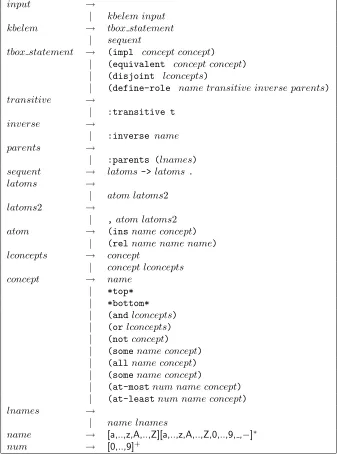
The input format allows us to use the DLSHIQ, that is, a logic supported by RACER. Notice that the declaration of a concept assertion is made with the word ins instead of the RACER keyword instance and we use rel instead ofrelatedfor the role assertions. We use these abbreviations to facilitate the writing and reading of the BABox.
The programsba2racerandba2racerdpllcan have the same file as input but the output they produce is different. Let us explain the peculiarities of each one.
An example of a typical run forba2raceris:
bash-2.04$ ./ba2racer test.txt
test.txt is a file containing a Boolean KB in the format described in Table 4.1. ba2racertransforms the Boolean KB of the filetest.txtin a traditional KB and places it in the filetest.txt.racerin RACER format. It adds the line (abox-consistent?)at the end of the file, to indicate RACER that the ABox consistency must be checked. Afterwards, we need to feed RACER with
test.txt.racerto know if the Boolean KB in test.txt is ABox consistent. Let us show now the call to RACER for the example.
bash-2.04$ racer -f test.txt.racer ;;; RACER Version 1.7
;;; RACER: Reasoner for Aboxes and Concept Expressions Renamed ;;; Supported description logic:
ALCQHIr+(D)-;;; Copyright (C) 1998-2002, Volker Haarslev and Ralf Moeller. ;;; RACER comes with ABSOLUTELY NO WARRANTY; use at your own risk. ;;; Commercial use is prohibited; contact the authors for licensing. ;;; RACER is running on unknown computer as node Unknown
;;; The XML/RDF/RDFS/DAML parser is implemented with Wilbur developed ;;; by Ora Lassila. For more information on Wilbur see
;;; http://wilbur-rdf.sourceforge.net/.
;;; The HTTP interface based on DIG is implemented with CL-HTTP developed ;;; and owned by John C. Mallery. For more information on CL-HTTP see ;;; http://www.ai.mit.edu/projects/iiip/doc/cl-http/home-page.html.
(IN-KNOWLEDGE-BASE TEST.TXTABOX TEST.TXTTBOX) --> (TEST.TXTABOX TEST.TXTTBOX)
(ABOX-CONSISTENT?) --> T
The output of RACER(ABOX-CONSISTENT?) --> Tindicates that the KB oftest.txt.raceris consistent, and as a consequence of the claims of Section 3.1 the Boolean KB oftest.txtis consistent too. An output(ABOX-CONSISTENT ?) --> NILwill imply that both KBs are inconsistent.
For the case ofba2racerdpll, an example of a typical run is:
bash-2.04$ ./ba2racerdpll test.txt ABox consistent, file .racer created
Similarly to the example ofba2racer, the input file test.txthas a Boolean KB in our described format. The output of ba2racerdpllindicates whether
test.txtis ABox consistent or not displaying ABox consistentor ABox not consistentrespectively. There is no need to run RACER becauseba2racerdpll
has already run it internally.
Every time ba2racerdpllfinds a propositional model, it places the gen-erated KB in a file and calls RACER with it as parameter. The file used to store the generated KB is called <input file>.racer. The file is rewritten every time a new consistency check is made in that run. Thus, for our exam-ple, the KB generated byba2racerdpllcontaining the model that satisfy the disjunction of KBs in test.txt can be found in test.txt.racer. The last line of this file is (abox-consistent?) like in the case of ba2racer. If the response of ba2racerdpll is only ABox not consistent without the phrase
racer result, it means that the input Boolean KB was propositionally incon-sistent and RACER was not called. The outputted KB will be empty in this case.
After showing how the two programs can be run and their outputs, we are ready to show in the next section examples of formulations of logical puzzles and the description of some mistakes found in RACER.
4.2
Handcrafted cases
In order to get the examples to testba2racerandba2racerdpll, we formalized in DL some puzzles of the TPTP Problem Library [SS]. These puzzles contain situations where a representation of partial knowledge and conditioning of asser-tions is required. Sequents allow us to express such things. The examples were written using the grammar described in Table 4.1. We present in the following subsection some of these formalized puzzles. After the examples, we describe some problems found in RACER during their formulation.
4.2.1
TPTP puzzles
We outline some interesting formalizations for each problem in this section. The complete examples can be found in Appendix B.
consistent KBs. We checked the inconsistency of the ABox in every new KB to show the entailment of the conjecture by the initial KB.
The Dreadbury Mansion
The first example is the formalization of the well known puzzle of the Dreadbury mansion. This problem can be found in the TPTP library under the name PUZ001-1.p
Someone who lives in Dreadbury Mansion killed Aunt Agatha. Agatha, the butler, and Charles live in Dreadbury Mansion, and are the only people who live therein. A killer always hates his victim, and is never richer than his victim. Charles hates no one that Aunt Agatha hates. Agatha hates everyone except the butler. The butler hates everyone not richer than Aunt Agatha. The butler hates everyone Aunt Agatha hates. No one hates everyone. Agatha is not the butler. Therefore: Agatha killed herself.
We explain below some of the formulations that we use for this puzzle. We use the symbolsagatha, butlerandcharlesto represent Agatha, the butter and Charles respectively. The role assertion (rel a b killed)states that a
killed b; (rel a b richer) states that a is richer than b; (rel a b hates)
states thatahatesb.
In our formalization of the sentence‘Someone who lives in Dreadbury
Man-sion killed Aunt Agatha’ we use a disjunction of positive role assertions, because
we know there are only three possible killers of Aunt Agatha.
->(rel charles agatha killed), (rel agatha agatha killed), (rel butler agatha killed).
To express the phrase‘A killer is never richer than his victim’, we can say that if an individual killed Agatha then such individual is not richer than her. Sequents only use positive literals, so we express the previous statement with a disjunction of negative role assertions with the rolericher. In the specific possibility of Charles being the killer we state:
(rel charles agatha killed),(rel charles agatha richer)->.
To express the full phrase we also state the cases of the butler and aunt Agatha being the killer.
The declaration‘The butler hates everyone Aunt Agatha hates’can be rewrit-ten as‘If Agatha hates a person then the butler hates this person’, and it is easily described with a sequent expressing an implications of role assertions.
We can state‘No one hates everyone’ using theat-mostconstructor saying that everyone can hate at most 2 people.
->(ins agatha (at-most 2 hates *top* )). ->(ins charles (at-most 2 hates *top* )). ->(ins butler (at-most 2 hates *top* )).
The conjecture of the problem is‘Agatha killed herself ’. We represent the negated conjecture with a negated role assertion.
(rel agatha agatha killed)->.
When we tested the KB with the formulation of this puzzle without the conjecture, ba2racer created a file with 53 assertions, and RACER replied the consistency of the translated KB in 0.071 seconds.
ba2racerdpll pro-duced a consistent KB in 0.24 seconds. The number of calls to RACER from
ba2racerdpllwas 4, and the average size of the produced ABoxes was 12. We added to the previous KB the negated conjecture and the two pro-grams replied that the new KB was inconsistent, hence we proved the fact that aunt Agatha killed herself. ba2racercreated a file with 49 assertions, and
ba2racerdpllhad an average of ABox size of 13 assertions. The call of RACER after runningba2racerlast for 0.06 seconds. ba2racerdpllanswered in 0.12 seconds after 4 calls to RACER.
The Barber Puzzle
The puzzle PUZ003-1.p of the TPTP library was already introduced in Section 2.2 and is shown again below.
There is a barbers’ club that obeys the following three conditions: (1) If any member A has shaved any other member B - whether himself or another - then all members have shaved A, though not necessarily at the same time.
(2) Four of the members are named Guido, Lorenzo, Petrucio, and Cesare.
(3) Guido has shaved Cesare. Prove Petrucio has shaved Lorenzo
We also mentioned in that section an idea for a formalization. Let us be clearer now. guido,lorenzo,petrucioand cesareare the individual names representing Guido, Lorenzo, Petrucio, and Cesare respectively. memberis the concept name indicating the members of the barber’s club. shavedis the role expressing the relation between barbers and shaved people.
1All the time values where obtained in a Linux Readhat 7.0, release 2.4.18-ict4, CPU:
Statement(1)express under what conditions a new role assertion ofshaved
can be stated. We make the formalization of this phrase with the same idea of Section 2.2. For all A, B, Celements of {guido, lorenzo,petrucio,cesare}, we add to the KB the following sequent:
(ins A member), (ins B member), (rel A B shaved),(ins C member) -> (rel C A shaved).
Notice that whenA, Bare the same, it is not necessary to state twice (ins A member)in the left side of the sequent.
To express statement (2), we use positive concept assertions ofmember.
-> (ins cesare member). -> (ins lorenzo member). -> (ins petruchio member). -> (ins cesare member).
Sentence(3)is represented as a positive role assertion.
-> (rel guido cesare shaved).
The conjecture‘Petrucio has shaved Lorenzo’ can be represented with a role assertion. The negated conjecture is shown below.
(rel petrucio lorenzo shaved)->.
We run the two programs with the file containing the formalization of this problem without the conjecture. We obtained thatba2racergenerated a RACER file with 61 assertions. When we feed RACER with the output file, it answered that the translated KB was ABox consistent in 0.04 seconds. The file pro-duced byba2racerdpllhad 11 assertions and RACER was called only once.
ba2racerdpllreplied in 0.06 seconds.
In the case of the KB with the conjecture ba2racer and ba2racerdpll
detected that it was propositionally inconsistent, so no call to RACER was needed in both cases.
The Mislabelled Boxes
The puzzle of the mislabelled boxes can be found in the TPTP library as PUZ012-1.p. The problem states:
We use in this formalization the individual namesapples,oranges,bananas
to represent apples, oranges and bananas respectively. boxa,boxb,boxcare the individual names representing the box a, box b and box c respectively. We use two roles,containsandlabelwhich establish the relation between a box and its contents, and a box and its label.
For the phrase‘Each box contains apples or bananas or oranges’ we have to state a disjunction of the things each box can contain. For example for the box a we have:
->(rel boxa apples contains),(rel boxa oranges contains), (rel boxa bananas contains).
We add the same statement for the box b and the box c into the KB to express the whole sentence.
The sentence‘No box contains what it says on its label’ can be rewritten as: if a box has a labell then the box does not containl. The formalization for the particular case of apples is shown as follows.
(rel boxa apples label),(rel boxa apples contains)->. (rel boxb apples label),(rel boxb apples contains)->. (rel boxc apples label),(rel boxc apples contains)->.
A similar idea is used to express that‘No two boxes contain the same thing.’.
We want to prove that the box a contains bananas and the box c contains oranges. We express the negated conjecture as follows:
(rel boxa bananas contains),(rel boxc oranges contains)->.
When we tested the KB containing the formalization without the conjec-ture,ba2racergenerates 42 assertions andba2racerdpll12 assertions for the only call to RACER. When RACER is called after generating the translated file withba2racer, it replied in 0.04 seconds that the KB is ABox consistent.
ba2racerdpllanswers after 0.04 seconds the same thing.
The KB with the conjecture is propositionally inconsistent and is detected in both cases.
4.2.2
Mistakes in RACER
In the initial faces of the formalization of the puzzles of the TPTP we ran into problems with RACER. In some cases RACER returned unsound answers and in others RACER broke down in an unexpected stack overflow. These things hap-pened when we used the translation approach to check the consistency problem. We illustrate in this section examples of the BABoxes with the problems.
Unsound behavior
The first problem was that RACER answered that a KB was not consistent when in fact there was a model for the KB. The following example represents one of the cases where RACER gave an incorrect answer.
The example was found in the formulation of the problem PUZ001-12 in
a consistent Boolean KB. It was rewritten using our algorithm of Section 3.1. The translation was tested in RACER Version 1-6r1a, in a Pentium III Linux Readhat 7.0, cpu Mhz 800, Memory 250 Mb. RACER Version 1-6r1a declared the produced KB inconsistent.
To identify where did the mistake exactly lay, we reduced the BABox to the smallest set of consistent sequents whose translation was still reported as inconsistent by RACER. The result was the following BABox whose consistency is trivially verified.
(rel a c h), (rel c c h) ->. (rel a b h), (rel c b h) ->. -> (rel a c h).
(rel a b h) ->.
To restrict even further we applied the same procedure to the translated BABox, obtaining the KB shown below. If any element of the final file is erased, RACER Version 1-6r1a answers that the ABox is consistent.
(in-knowledge-base PUZ001-1.pabox PUZ001-1.ptbox ) (signature
:atomic-concepts(iamj1 iamj3) :roles(fakeh)
:individuals(a b c))
(define-primitive-role h :parents (fakeh)) (related a c fakeh)
(related a b fakeh)
(instance a (some h iamj1))
(instance a (at-most 1 fakeh iamj1)) (instance a (at-most 1 fakeh iamj3)) (instance c iamj1)
A model for the previous KB is represented in the following graph:
a
c b
fakeh,h fakeh
iamj1
When we tested the previous KB in RACER, it returned
;;; RACER Version 1-6r1a
;;; RACER: Reasoner for Aboxes and Concept Expressions Renamed ;;; Supported description logic:
ALCQHIr+(D)-;;; Copyright (C) 1998-2001, Volker Haarslev and Ralf Moeller. ;;; RACER comes with ABSOLUTELY NO WARRANTY; use at your own risk. ;;; Commercial use is prohibited; contact the authors for licensing.
(IN-KNOWLEDGE-BASE PUZ001-1.PABOX PUZ001-1.PTBOX) --> (PUZ001-1.PABOX PUZ001-1.PTBOX) (ABOX-CONSISTENT?) --> NIL
This mistake was found in other similar KBs. RACER is widely used, and it was important to provide this information to the RACER team.
The next problem was also sent to the RACER team. It does not have to do with the soundness of RACER. In this case RACER reaches a stack overflow with a small KB.
Stack overflow
The second problem appeared when RACER did not report the consistency of a small KB. The information of the output pointed to a stack overflow, but as we mentioned before the KBs where the problem was found were too small to produce such stack overflow. The following example of this error is part of the specification in a Boolean KB of puzzle PUZ0019-13of the TPTP. It was tested
and reduced under the same conditions of the first one. The resulting Boolean KB was:
->(rel b r h),(rel b th h),(rel b pe h),(rel b s h).
This BABox was rewritten using the translation of [ABM02]. The translation was also reduced to obtain the minimal KB where the problem existed.
(in-knowledge-base PUZ019-1.pabox PUZ019-1.ptbox ) (signature
:atomic-concepts(iamj2 iamj3 iamj4) :roles(fake2 fake3 fake4)
3
:individuals(b pe))
(define-primitive-role h :parents (fake2 fake3 fake4)) (instance b (some h iamj4))
(instance b (at-most 1 fake2 iamj2)) (instance b (at-most 1 fake3 iamj3)) (instance b (at-most 1 fake4 iamj4)) (related b pe fake3)
(abox-consistent?)
We also show in this case a model of the KB in the following graph.
b
pe y
fakeh3 h,fakeh2,fakeh3,fakeh4 iamj4
The output of RACER when we feed it with the KB was:
;;; RACER Version 1-6r1a
;;; RACER: Reasoner for Aboxes and Concept Expressions Renamed ;;; Supported description logic:
ALCQHIr+(D)-;;; Copyright (C) 1998-2001, Volker Haarslev and Ralf Moeller. ;;; RACER comes with ABSOLUTELY NO WARRANTY; use at your own risk. ;;; Commercial use is prohibited; contact the authors for licensing.
(IN-KNOWLEDGE-BASE PUZ019-1.PABOX PUZ019-1.PTBOX) --> (PUZ019-1.PABOX PUZ019-1.PTBOX)
Error: An error of typeCONDITIONS:STACK-OVERFLOW occured, arguments : COMMON-LISP:NIL
The RACER team received the details of the problems we found and they promptly released the version 1.7 of RACER where the previous problems were not present.
4.3
Random generated cases
The problem with handcrafted tests is that they are hardly ‘exhaustive’. For more intensive testing we need automatic generation of BABoxes. As our re-search is novel there was no random generator of BABoxes previously avail-able, so we implemented in Haskell a random generator ofALCBABoxes called
genBABox. We used this generator to test both programs over large sets of BABoxes. Such tests are explained in the second part of this section.
4.3.1
The random generator
In this subsection we explain how the BABoxes generator,genBABox, operates. First we show some samples of typical runs of the generator.
The run showed below exemplify how to obtain help about the desired input parameters for the generator. Every time the program finds that the parameters are insufficient or they have an incorrect type this output will be produced.
bash-2.04$ ./genBABox
genBABox filename #role-atoms #concept-atoms #instances #role-assertions #concept-assertions #prob-of-modality(0..100) depth #clauses length-clause numfiles
The following run fulfill the parameters required.
bash-2.04$ ./genBABox filename.txt 1 2 3 4 5 50 2 10 3 6 Finalized
WhengenBABoxfinishes we obtain the following files:
bash-2.04$ ls filename.txt.*
filename.txt.1 filename.txt.3 filename.txt.5
filename.txt.2 filename.txt.4 filename.txt.6
These files contain the generated BABoxes. Notice that the output files have the same name of the value infilenamebut the extension is a number between one and the value innumfiles.
We detail now the parameters taken bygenBABox. The following explanation shows the abbreviations that appeared above in the first run ofgenBABoxand the meaning and importance of each one. The values for the numeric parameters are expected to be positive integers. Only in some cases a parameter can take the value of 0.
• #role-atoms,#concept-atoms,#instances. These parameters indicate the number of atomic roles, number of atomic concepts and number of individuals that are used in the creation of the BABox. They define the signature, which is the same for every BABox generated in the run. The value of#instancescan not be 0.
• #role-assertions and #concept-assertions. With these parameters we set the number of role assertions and number of concept assertions. They establish how many assertions are created every time a new BABox is generated.
• #prob-of-modality. This number goes from 0 to 100 and sets the proba-bility that a generated concept has∀or∃ as its main connective equal to
#prob-of-modality/100. The probability of modality is discarded when thedepthis set to 1.
• depth. This parameter defines the depth of the produced concepts. The depth cannot be set to 0. If the depth is 1 the concepts produced can be of four types: atomic concepts, negated atomic concepts, disjunction or conjunction of possibly negated atomic concepts. Disjunctions and con-junctions are in RACER format, whence they take a list of arguments. The length of the requested list is bounded by the value of #concept-atoms. When the depth isn, the concepts that can be generated are: the concepts generated with depthn-1, and the concepts produced by the application of the constructors (t, u, ∃, ∀) to the concepts generated with depth
n-1. The constructors∃ and ∀ are used only when #prob-of-modality
is bigger than 0.
The detailed explanation of the creation of a concept, and the use of the probability of modality and the depth is given below underThe creation of assertions.
• #clauses. Initially the generator works with clauses and then it writes them as sequents. The value in the parameter #clauses indicates the number of clauses (sequents) that every BABox generated in the run will have.
• length-clause. The clauses have always the same length and this is set with this parameter. The length of clause can not be set to 0.
• numfiles. The generator can output several BABoxes in a run. This number declares how many BABoxes are going to be generated. This parameter can not be set to 0.
The process of generation of BABoxes runs a generator of ONE BABox
numfilestimes. This generator of one BABox recieves all the parameters of