REAL-TIME DISCRIMINATIVE CORRELATION FILTER BASED
SHORT-TERM VISUAL OBJECT TRACKING
TENG PIN CHENG
PERFORMANCE EVALUATION OF GPU ACCELERATED
REAL-TIME DISCRIMINATIVE CORRELATION FILTER BASED
SHORT-TERM VISUAL OBJECT TRACKING
TENG PIN CHENG
This report is submitted in partial fulfilment of the requirements
for the degree of Bachelor of Electronic Engineering with Honours
Faculty of Electronic and Computer Engineering
Universiti Teknikal Malaysia Melaka
DEDICATION
Special dedication to my parents,
Teng Kok Heng & Sui Ai Keow
To my supervisor,
Associate Professor Dr. Lim Kim Chuan
My friends and fellow lecturers,
ABSTRACT
Computer vision has brought a lot of benefits and performance in various applications
thanks to the recent advancement of technology. Discriminative Correlation Filter
based visual object tracking method has shown state-of-the art tracking performance
and robustness. Since DCF based visual object tracker uses convolutional feature for
model representation requires huge computing resources and has caused the real-time
performance to drop significantly. Due to this reason, real-time application such as
DCF-based drone visual object tracking cannot be realised. After the implementation
of selected DCF-based tracker (Channel and Spatial Reliability DCF, CSR-DCF)
using OpenCV library in embedded systems, the hardware performance of selected
DCF-based tracker is profiled and analysed by using Intel VTune Amplifier. The
computational heavy image processing operation is then offloaded from CPU host to
GPU device in attempting to accelerate the CSR-DCF tracking performance in
OpenCV using OpenCL framework. Although some of the image processing operation
such as colour conversion from RGB color space to HSV color space is accelerated
by a significant amount from 10.467ms to 3.03ms, the benefit of offloading cannot be
enjoyed due to the data transfer overhead between the CPU host and GPU device.
Thus, to accelerate the CSR-DCF tracker, OpenVX framework provided by Intel
OpenVINO toolkit is used. OpenVX acceleration has shown significant speed up of
27.14% for image processing operation such as image resize which is used in the first
ii
ABSTRAK
Penglihatan komputer telah membawa banyak manfaat dan prestasi dalam pelbagai
aplikasi terima kasih kepada kemajuan teknologi terkini. Kaedah pengesanan objek
visual yang berasaskan Penapis Corak Diskriminasi telah menunjukkan prestasi
penjejakan dan prestasi yang terkini. Pengesan objek visual berasaskan DCF
menggunakan ciri convolutional untuk perwakilan model memerlukan sumber
pengkomputeran yang besar, telah menyebabkan prestasi masa nyata jatuh dengan
ketara. Oleh sebab itu, aplikasi masa nyata seperti pengesanan objek visual dron
berdasarkan DCF tidak dapat direalisasikan. Selepas pelaksanaan tracker berdasarkan
DCF (Channel and Spatial Reliability DCF, CSR-DCF) menggunakan OpenCV dalam
sistem tertanam, Intel VTune Amplifier telah digunakan untuk membuat analisis.
Operasi pemprosesan imej yang berat kemudian dilepaskan dari hos CPU ke peranti
GPU dalam usaha untuk mempercepat kinerja penjejakan CSR-DCF dalam OpenCV
menggunakan kerangka OpenCL. Walaupun beberapa operasi pemprosesan imej
seperti penukaran warna dari ruang warna RGB ke ruang warna HSV dipercepat oleh
jumlah yang signifikan dari 10.467ms hingga 3.03ms, faedah offloading tidak dapat
dinikmati kerana overhead pemindahan data antara hos CPU dan peranti GPU. Oleh
itu, untuk mempercepat pelacak CSR-DCF, rangka kerja OpenVX yang disediakan
oleh toolkit Intel OpenVINO digunakan. Percepatan OpenVX telah memperlihatkan
kelajuan yang signifikan sebanyak 27.14% untuk operasi pemprosesan imej seperti
ACKNOWLEDGEMENTS
First, I would like to thank my supervisor, Associate Professor Dr. Lim Kim Chuan
for giving me an opportunity to work on this project. I am indebted to him for all his
guidance and help in writing this thesis. His kind motivation and encouragement
during the implementation of the project are highly appreciated. I also express my
gratitude to my friends who carefully went through this project and gave valuable
suggestions. Last but not the least, I express my appreciation to my family for their
iv
TABLE OF CONTENTS
Declaration i
Approval i
Dedication i
Abstract i
Abstrak ii
Acknowledgements iii
Table of Contents iv
List of Figures vii
List of Tables ix
List of Symbols and Abbreviations x
List of Appendices xi
CHAPTER 1 INTRODUCTION 12
1.1 Introduction 12
1.2 Problem Statement 16
1.3 Research Objectives 16
1.5 Chapter Summary 18
CHAPTER 2 BACKGROUND STUDY 20
2.1 Visual Object Tracking 20
2.2 Discriminative based visual object tracking 27
2.3 Computing hardware 32
2.4 Parallel Computing and OpenCL 34
2.5 OpenVX 35
CHAPTER 3 METHODOLOGY 38
3.1 Implementation of CSR-DCF tracker in Intel Aero RTF Drone 40
3.2 Hardware Performance Evaluation of CSR-DCF visual object tracker 42
3.3 Hardware Performance Evaluation of CSR-DCF tracker running on CPU and
GPU 43
3.4 OpenVX acceleration of Image Resize 45
CHAPTER 4 RESULT AND DISCUSSION 46
4.1 Implementation of CSR-DCF in Intel Aero RTF Drone 46
4.1.1 CSR-DCF tracking performance on three different scenarios from datasets 47
4.2 Intel VTune Amplifier Analysis of CSR-DCF Tracker running on only CPU
49
4.3 Intel VTune Amplifier Analysis of CSR-DCF Tracker running on CPU &
GPU 53
vi
CHAPTER 5 61
5.1 Conclusion 61
5.2 Future Work 64
REFERENCES 65
LIST OF FIGURES
Figure 1.1: Map of route from Ayer Keroh to Jasin and east coast highway pass
through UTeM 13
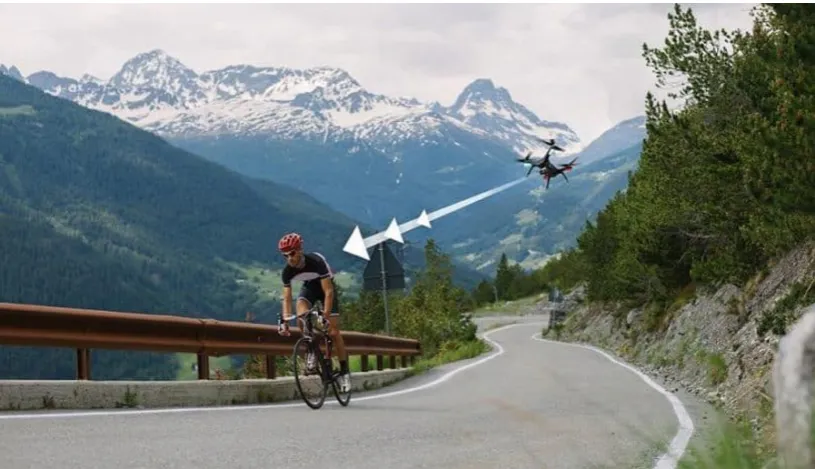
Figure 1.2: A drone tracking a vehicle 14
Figure 1.3: A drone tracking a cyclist 14
Figure 2.1: Top performance tracker in OTB2015 STRUCK is DCF-based tracker on dataset with different attributes: background cluttered (BC), deformation (DEF), fast motion (FM), in-plane rotation (IPR), illumination variation (IV), low resolution (LR), motion blur (MB), occlusion (OCC), out-of-plane rotation (OPR), out-of-view (OV)
and scale variation (SV) [13] 28
Figure 2.2: Top performance tracker in VOT2016 challenge C-COT is also a
DCF-based tracker [14] 28
Figure 2.3: CSR-DCR Tracker Spatial Reliability 29
Figure 2.4: CSR-DCF Tracker Channel Reliability 29
Figure 2.5: CSR-DCF tracker code for Tracking Phase and Learning Phase 30
Figure 2.6: Workflow of Tracking phase 31
Figure 2.7: Workflow of learning phase 32
Figure 2.8: Comparison of processing speed between CPU compute time and GPU
compute time 33
Figure 2.9: Overheads time in process 34
Figure 2.10: Example of OpenVX graph 36
viii
Figure 3.1: Project Flow Chart 39
Figure 3.2: FlytOS Architecture Diagram 41
Figure 3.3: Tracking phase and learning phase 43
Figure 3.4: RGB to HSV color conversion operation 44
Figure 3.5: RGB to HSV color conversion in VTune Amplifier 44
Figure 3.6: OpenVX Acceleration graph and nodes 45
Figure 4.1: Full tracking process 49
Figure 4.2: One of the image process from 251 images 50
Figure 4.3: Tracking phase (zoomed in) 50
Figure 4.4: Performance summary of tracking phase 51
Figure 4.5: Learning phase (zoomed in) 52
Figure 4.6: Summary of learning phase 53
Figure 4.7: Tracking Phase 54
Figure 4.8: Tracking phase zoomed in 54
Figure 4.9: Summary of tracking phase 56
Figure 4.10: Learning Phase 56
Figure 4.11: Detail of learning phase 57
Figure 4.12: Summary of Learning Phase 58
LIST OF TABLES
Table 1.1: Summary for scope of work 17
Table 2.1: Related work to the three main important modules for object tracking
(Representation Scheme) 22
Table 2.2: Related work to the three main important modules for object tracking
(Search Mechanism) 26
Table 2.3: Related work to the three main important modules for object tracking
(Model Update) 26
Table 4.1: CSR-DCF tracking performance on size change 47
Table 4.2: CSR-DCF tracking performance on motion change 48
Table 4.3: CSR-DCF tracking performance on camera motion 48
Table 4.4: Time taken for getting different features 51
Table 4.5: Time taken for getting different features 55
Table 4.6: Comparison of performance evaluation 58
Table 4.7: Result for example of process acceleration using OpenVX 60
x
LIST OF SYMBOLS AND ABBREVIATIONS
DCF : Discriminative Correlation Filter
LIST OF APPENDICES
12
CHAPTER 1
INTRODUCTION
1.1 Introduction
The field of artificial intelligence (AI) has been booming thanks to the technology
advancement in recent years. Applications of AI in the field of medicine, education,
data analysis, engineering and more has enhanced the quality of living and enables
people to be more productive. For example, machine learning is used in image
recognition, speech recognition and various applications. In this project, we will focus
on applying artificial intelligence technology to assist security guard in their duty.
Visual object tracking is used for user object verification and recording purpose in
real-time with camera on drone will act as a security guard patrol assistant in
strengthening the security in Universiti Teknikal Malaysia Melaka (UTeM). Every day
their traveling time. This is because UTeM has a path that act as a shortcut that allows
public to travel from Ayer Keroh to Jasin and east coast highway as shown in the map
[image:19.595.127.531.163.533.2]in Figure 1.1.
Figure 1.1: Map of route from Ayer Keroh to Jasin and east coast highway pass through UTeM
Instead of solely relying on security guards to guide and monitor both the UTeM
students/staffs and publics/visitors, the drone will track and lead the publics/visitor
according to their planned routes. If the visitor is suspicious, the security guard will
deploy the drone to select and track the target vehicle and make sure the target does
not deviate from the route and immediately alert the security control center if deviation
is detected.
14
Figure 1.2: A drone tracking a vehicle
[image:20.595.115.523.502.736.2]In this project, Intel GPU accelerated Discriminative Correlation Filter (DCF) based
state-of-the-art visual tracking method, running right in the Intel embedded board of
drone controller, will be used to track the target.
Besides, short-term visual object tracking method is used. Short-term visual object
tracking is the problem of continuously localizing a target in a video-sequence given
a single example of its appearance. There are many challenges or short-term tracking.
Factors such as illumination change, occlusion, fast object or camera motion will make
object tracking with drone very challenging. In recent short-term tracking evaluations,
it has consistently confirmed the advantages of semi-supervised discriminative
tracking approaches. Among all the methods, Discriminative Correlation Filter (DCF)
have shown state-of-the-art tracking accuracy and robustness in all the standard
benchmarks.
Discriminative Correlation Filter (DCF) utilizes multi-dimensional features that
produced by convoluting the input image frame with the learned kernels to formulate
a set of filters to represent the target object. Thus, it will require huge computational
resources to accelerate the DCF operations. Discriminative Correlation Filter with
Channel and Spatial Reliability (CSR-DCF) [1] tracking method is chosen to
implement in this project.
With this, the safety of the people and property are protected from day-to-day
operations. The drone will follow its target and make sure people or vehicle is going
16
Since drone and object tracker is used, the cost of man power can be reduced
drastically in the open campus. Besides that, the safety of the compound can be ensured
by preventing people wandering around the compound freely.
1.2 Problem Statement
Visual tracking is evolving very fast which has increasingly attracting the attention
of the vision community. Due to this, many new tracking algorithms has appeared
presented in journals and conferences.
Recent tracking method such as Discriminative Correlation Filter (DCF) based
tracker [1], [2], [3], [4] and [5] requires huge computational resources and hence the
real-time frame per second (FPS) performance has dropped significantly despite of
high accuracy and robustness.
Therefore, server grade graphics processing unit (GPU) is used to perform the
complex calculation but it consumes a lot of power. Because of this problem, many
battery-powered applications that requires huge computational resources cannot be
done. Thus, low powered embedded system GPU is more suitable to be run on
battery-powered applications such as object tracking using drone. Besides that, there are no
report on the performance study of implementing and optimization of DCF tracker
running on embedded system GPU.
1.3 Research Objectives
This section presents the objectives for this project. The research objectives are as
follows:
• To implement Discriminative Correlation Filter (DCF) based visual tracker
• To accelerate and analyze Discriminative Correlation Filter (DCF) based
visual tracker with embedded GPU.
• To optimize the performance of the DCF object tracker with the insight
provided by Intel VTune Amplifier.
1.4 Scope of Work
The scope of work of this project is divided into two parts.
Firstly, the tracking method. The tracking method used in this project is short-term
tracking method. Short-term tracking means redetection of the target object will not be
reinitialized after the tracking target is lost. In contrast, long-term object tracking
means there will be a redetection of the target object where the object tracker will be
reinitialized to continue the tracking process.
Next, discriminative Correlation Filter (DCF) based tracker is used. Discriminative
Correlation Filter (DCF) is one of the state-of-the-art object tracking methods which
gives robust performance and high accuracy.
Tools and software used in this project are list in Table 1.1 which is the summary
for the scope of work for this project.
Table 1.1: Summary for scope of work
Subject Content
Tracking method • Short-term
• Discriminative Correlation
18
Tools / Software • GNU Compiler Collection 5.2
• CMake 3.11
• Intel OpenCL SDK
• OpenCV
• Intel VTune Amplifier
• Linux Ubuntu 16.04 and Centos
7.4
• UP Squared board
• Intel Aero RTF drone
1.5 Chapter Summary
Chapter 1 describes the general overview of this project. The background of this
project, problem statement, objectives and scope of work will be discussed in the
beginning of the chapter. Chapter 2 discusses the previous work of established visual
object trackers and the video dataset challenge used to benchmark the performance of
the tracker. The method of discriminative correlation filter visual object tracking,
computing hardware, parallel computing, OpenCL framework and OpenVX are also
discussed in this chapter.
Chapter 3 discusses about the implementation of discriminative correlation filter
based visual object tracker (CSR-DCF) in Intel Aero RTF drone embedded board, the
hardware performance of CSR-DCF tracker running only in CPU. Besides, the
hardware performance of CSR-DCF tracker with some image processing tasks offload
from CPU host to GPU device is also presented. The possibility of using OpenVX to
accelerate the CSR-DCF tracker is discussed in the last part of Chapter 3.
Chapter 4 presents the performance result of speed, hardware performance of