Milky Way Halo Objects, IC 4499
and the Large Magellanic Cloud
Warren Hankey
Submitted in total fulfilment of the requirements of the degree of Doctor of Philosophy
October 24, 2014
The work described in this thesis is that of the candidate alone, except where otherwise acknowledged in the text. The observations of IC 4499 at the AAT were carried out by my supervisor Dr. An-drew A. Cole but the candidate was responsible for the reduction process and all subsequent analysis. The IC 4499 material in this thesis was published in theMonthly Notices of the Royal Astronom-ical Society, volume 411, pages 1536 to 1546, March 2011, with the candidate as first author and with Dr. Cole as co-author contribut-ing part of the discussion. MNRAS hold the copyright for that content, and access to the material should be sought from the jour-nal. The remaining non published content of the thesis may be made available for loan and limited copying and communication in accor-dance with the Copyright Act 1968. The Monte Carlo Markov Chain program to estimate the velocity dispersion and mass in IC 4499 was scripted inR by Dr. Simon Wotherspoon. The candidate substan-tially adapted the code and methodology to the larger problem of estimation of LMC rotation model parameters. LMC target selec-tion, field plate setup, sky-fibre, and guide star placement were all carried out by the candidate, Dr. Cole travelled to the AAT to as-sist with the final LMC observations. Reduction and analysis of the LMC data is that of the candidate alone. Dr. Cole performed a calibration check of the LMC metallicity results and Appendix D is entirely his work. Thanks to Dr. Cole for encouragement, dis-cussions and assistance. Observations at the Mount Pleasant radio telescope supporting the JAXA Selene Moon mission resulted in a co-author credit inRadio Science, volume 45, number 2, April 2010. Travel support for observing was provided by the Anglo-Australian Observatory (AAO). The AAO was funded by the British and Aus-tralian governments. Thanks to AAT support astronomer Dr. Rob Sharp and night assistant Winston Campbell for their assistance during the observing run.
Abstract
Two Galactic halo objects are studied spectroscopically, the far-Southern Galactic globular cluster IC 4499 and the Large Magellanic Cloud. Radial velocity and metallicity measurements from the near-infrared calcium triplet obtained with the AAOmega spectrograph are analysed and discussed in the context of Milky Way and halo evolution.
Several hundred red giant stars were observed in and around IC 4499. 43 targets were identified as cluster members based on velocity and abundance, by far the largest spectroscopic sample of IC 4499 giants ever studied. The mean heliocentric radial velocity of the cluster was determined to be 31.5±0.4 km s−1, and the most likely central velocity dispersion found to be 2.5±0.5 km s−1. This gave a dynamical mass estimate for the cluster of 93±37×103M. No evidence for cluster rotation was seen down to a sensitivity am-plitude of≈1 km s−1. The cluster metallicity was found to be [Fe/H] =−1.52±0.12 on the Carretta-Gratton scale; this is in agreement with some earlier estimates but carries significantly higher preci-sion. The radial velocity of the cluster, previously highly uncertain, is consistent with membership in the Monoceros tidal stream but also with a halo origin. The horizontal branch morphology of the cluster is slightly redder than average for its metallicity, but it is not unusually young compared to other clusters of the halo.
Radial velocities were obtained for 585 giant stars in the Large Magellanic Cloud central bar region, the most extensive, high quality spectroscopic sample to date of late-type stars in the crowded central galaxy. Metallicity has also been estimated for 240 stars. The data were calibrated by contemporary radial velocity results from the same instrument. The velocity sample is Gaussian distributed about 259 km s−1 with a dispersion of 24 km s−1. A systemic velocity for the LMC of 255±5 km s−1is estimated which is lower than previous estimates. Disk plane velocities are consistent with a rotating disk galaxy. Monte Carlo simulations are made of parameters for a disk rotation model having a maximum velocity of 79±18 km s−1 before
Contents
1 Constructing Galaxies 3
1.1 Laying Foundations . . . 3
1.2 Building Blocks in a ΛCDM Universe . . . 4
1.3 The Magellanic System . . . 7
1.3.1 Bars in Disks . . . 14
1.3.2 Star Formation History of the Magellanic Clouds . . . 18
1.4 Globular Clusters in the Milky Way Halo . . . 21
1.4.1 Abundances and the Origins of GCs . . . 22
1.4.2 Multiple Populations in Globular Clusters . . . 24
1.4.3 IC 4499, A Special Globular Cluster? . . . 26
2 Spectroscopy of Red Giant Atmospheres 45 2.1 Stellar Nucleosynthesis, Evolution and Abundances . . . 47
2.2 Spectral classes . . . 49
2.3 Stellar Physics and Calcium Triplet Spectroscopy . . . 50
2.4 AAOmega Spectrograph . . . 55
3 Radial Velocity and Metallicity of the Globular Cluster IC4499 Obtained with AAOmega 63 3.1 Introduction . . . 63
3.2 Methodology . . . 65
3.2.1 Observations . . . 65
3.2.2 Data Reduction and Analysis . . . 68
3.2.3 Radial Velocities . . . 69
3.2.4 Cluster Rotation . . . 70
3.2.5 Virial Mass and Mass to Light Ratio . . . 73
3.2.6 Equivalent Widths and Metallicities . . . 76
3.3 The Velocity and Metallicity of IC 4499 . . . 78
3.3.1 Is IC 4499 Unusual? . . . 80
4 Large Magellanic Cloud Bar Kinematics and Metallicity with AAOmega 93 4.1 LMC Structure . . . 93
4.1.1 Building a Bar . . . 96
4.2 Observations . . . 98
4.2.1 Target Selection . . . 98
4.2.2 Data . . . 102
4.2.3 Velocity Templates . . . 103
4.3 Results . . . 105
4.3.1 Comparison with Zhao . . . 111
4.3.2 Disk Rotation Model . . . 117
4.3.3 Outer field sample . . . 122
4.3.4 Simulating Model Parameters . . . 125
4.4 Discussion . . . 150
4.4.1 Rotation Curve . . . 150
4.4.2 Abundances . . . 152
4.4.3 The Zhao Sample . . . 153
4.4.4 Systemic Velocity . . . 154
4.4.5 Velocity Dispersion . . . 155
5 Building Blocks 165 5.1 IC 4499 . . . 165
5.2 Large Magellanic Cloud . . . 170
5.3 Making a Milky Way . . . 174
Appendices 187 A Stellar Dynamics in Potentials 189 A.1 Potentials . . . 189
A.2 Plummer Globular Model . . . 192
B Statistical Tools 199 B.1 Maximum Likelihood Estimation . . . 200
B.2 Bayesian Estimation . . . 202
B.3 MCMC Algorithm . . . 209
C Programming 215 C.1 Programming tasks and tools . . . 215
D Calibration 221 D.1 Ca II Triplet Metallicities From NIR Magnitudes (Andrew A. Cole) . . . 221
E LMC data tables 227
List of Figures
1.1 21cm emmission . . . 9
1.2 HI envelope . . . 10
1.3 Magellanic Stream . . . 13
1.4 HI map Kim . . . 15
3.1 2MASS selection . . . 66
3.2 Observed targets . . . 67
3.3 CaII spectrum . . . 69
3.4 Cluster velocities . . . 71
3.5 Cluster members . . . 72
3.6 Cluster rotation . . . 73
3.7 MCMC distribution of IC 4499 mass . . . 75
3.8 Line width ratios . . . 77
3.9 Surface gravity correction . . . 79
4.1 CMD from IRSF . . . 99
4.2 CMD of sample . . . 101
4.3 Sky fibre placement . . . 102
4.4 Velocity errors . . . 103
4.5 Velocity template residuals . . . 104
4.6 Radial velocities in sample . . . 106
4.7 Velocity gradient . . . 107
4.8 Velocity and colour . . . 108
4.9 Velocity and magnitude . . . 109
4.10 Stellar populations . . . 110
4.11 Zhao data . . . 112
4.12 Quantiles . . . 113
4.13 Comparison of Zhao and our sample. . . 114
4.14 Comparison of data sets . . . 115
4.15 Simple solid body rotation curve . . . 116
4.16 Geometric subset of data . . . 119
4.17 Rotation curve and systemic velocity. . . 120
4.18 Systemic velocity . . . 121
4.19 Model and individual points . . . 122
4.20 Location of literature data . . . 123
4.21 Warped disk rotation model . . . 124
4.22 PNE disk velocities . . . 126
4.23 Causal relations . . . 127
4.24 Markov chains . . . 128
4.25 Distributions of model parameters . . . 129
4.26 Complete sample data location . . . 131
4.27 Model parameter distributions. . . 132
4.29 Velocity residuals from our data . . . 136
4.30 Velocity residuals from all data except PNE . . . 137
4.31 Model residuals . . . 138
4.32 Residuals boxplots . . . 138
4.33 Velocity residuals planetary nebulae . . . 139
4.34 Ratio of line widths . . . 142
4.35 Calibration theoretical . . . 144
4.37 Distribution of metallicity . . . 146
4.38 Low metallicity sample . . . 147
4.39 Low metal spatial arrangement . . . 148
4.40 Colour-magnitude low metallicity . . . 148
4.41 Metallicity disk velocity distribution and simulation. . . 149
4.42 Velocity field . . . 151
5.1 Dwarfs and giants IC 4499 . . . 168
5.2 Follow up observations IC 4499 . . . 169
B.1 Good prior . . . 208
B.2 Bad prior . . . 208
C.1 Spectrum zero line . . . 217
C.2 Spectrum zero line fixed . . . 217
C.3 Spectrum zero line inside . . . 218
C.4 Spectrum zero line inside fixed . . . 218
List of Tables
3.1 Log of Observations . . . 84
3.2 Summary of results. . . 84
3.3 IC 4499 Members. . . 85
4.1 Log of Observations . . . 98
4.2 Disk Models . . . 123
4.3 Model Parameters . . . 130
4.4 Disk Parameters . . . 133
4.5 PNe Model Parameters . . . 133
4.6 planetary nebulae (PNe) Disk Parameters . . . 134
Some velvet morning when I’m straight I’m gonna open up your gate
And maybe tell you ’bout Phaedra And how she gave me life And how she made it in
Lee Hazlewood (1929-2007)
1
Constructing Galaxies
1.1 Laying Foundations
The problem of galaxy construction is one of the most important challenges facing astronomy. The modern paradigm of hierarchical structure formation around dark matter (DM) needs to be reconciled with observations. While sim-ulations of a DM dominated universe recreate large scale structure very well, they fail to reproduce structure on galactic scales, the so-called “missing satel-lites“ problem (Klypin et al. 1999; Moore et al. 1999). Clues to the formation of the Galaxy are to be found in the stellar populations of Milky Way (MW) halo objects.
Stellar populations retain chemical traces and dynamical imprints of their formation environment. Detailed views of stellar populations are only possible in the MW and nearby Local Group (LG). The oldest stars in the MW halo are early universe fossils whose age is equivalent to the look back time of the furthest visible galactic objects. Near-infrared calcium triplet spectroscopy of red giant branch (RGB) stars allows detailed kinematic and abundance measurements of these distant stellar populations. They represent a detailed local archaeological record of the evolution of the Galaxy.
The easily observable MW and halo objects naturally inform our under-standing of the cosmos. This study of the halo objects globular cluster (GC) IC 4499 and the Large Magellanic Cloud (LMC) galaxy, observes locations of structure building at scales where DM simulations fail. Universal galactic struc-tural evolution in the context of a Λ cold dark matter (ΛCDM) cosmology can be illuminated by observing the interactions between satellites and their host MW Galaxy. In this thesis stellar populations within these halo objects were searched for dynamical and chemical clues to the construction of the MW Galaxy and halo.
2013). The gravity of DM appears necessary to fill these seeds with baryonic matter and sustain galactic structure.
Ancient halo GCs with homogenous populations were created in conditions that existed at the birth of the Galaxy. Along with the halo dwarf galaxies they show structural evolution and devolution by accretion at a variety of scales. This evolution of smaller objects has occurred within the sphere of influence of the massive MW. IC 4499 was an understudied member of the halo GC population, whose odd characteristics promised new insights into halo history.
The Magellanic system is a disk galaxy with a substantial dwarf satellite and attendant globular clusters, almost a scale model of the MW, but with important differences, such as the lack of a halo and bulge. The LMC is in a state of disturbance with hierarchical structure formation occurring through accretion, as well as star formation driven by close range interactions with the Small Magellanic Cloud (SMC) or MW. In this thesis stellar velocity information from spectroscopy was used to analyse the internal dynamics of two MW halo objects, IC 4499 and the LMC. Internal effects on stellar tracers give clues to the larger scale causal interactions. Spectroscopic metallicity reveals ages and evolutionary patterns in halo objects. Implications for LG dynamic evolution and structural feedback were examined in light of our findings.
ΛCDM models have successfully described the structure of the large scale universe, but fail on the galaxy and dwarf galaxy scale (Klypin et al. 1999; Moore et al. 1999; Klypin et al. 2002; Moore et al. 2006). Disk galaxies need smooth gas flows to form and the excess of small structures predicted by ΛCDM tend to disrupt the smooth conditions (Moore et al. 1999). In fact the excess of small structure is not observed (Klypin et al. 1999; Boylan-Kolchin et al. 2010). The study of halo objects can address cosmological questions of structural evolution at the galactic scale.
The outer regions of the MW and the halo are where kinematic traces of accretion and remnants of hierarchical structure formation are easier to find (Johnston et al. 1996; Helmi 2008). In the Galactic bulge for example, time would have erased most evidence where the dynamical timescales are short. Velocity dispersion in Baade’s window is∼120 km s−1 (Morrison and Harding
1993). The outer MW potential is where evidence of ancient structures can still be observed. Multi-object Ca II spectroscopy can provide large samples of stellar tracers in these populations. In this study statistical techniques applied to observed samples allowed estimation of global parameters for IC 4499 and the LMC galaxy.
1.2 Building Blocks in a
Λ
CDM Universe
1.2. BUILDING BLOCKS IN AΛCDM UNIVERSE
inner MW disk (Searle and Zinn 1978). The complicated nature of kinematics and abundances in the Galactic halo pointed to a more convoluted formation history involving accretion (Freeman and Bland-Hawthorn 2002). The concept arose of the construction of the galaxy from a variety of objects and sources, the bottom-up formation of the Searle-Zinn paradigm.
There are problems with the hierarchical formation theory. Only a fraction of the Galactic halo can be attributed to fragments (Geisler et al. 2007). There remains a general uniformity of age, dynamics and abundance amongst an old halo population which contrasts with a younger halo population (Mackey and van den Bergh 2005). The old halo objects also display the Oosterhoff dichotomy in RR Lyrae periodicity, whereas the dwarf population, the LMC and young halo do not (Catelan 2009a). This indicates that not all the halo is accreted from fragments, as the old halo seems to share some kind of common heritage. Many young halo GCs are associated with accretion sites (Mackey and van den Bergh 2005) If age is the second parameter of horizontal branch (HB) morphology, then an age gradient is evident from the halo down to the central bulge (Lee 1992).
We propose that the formation of the Galaxy may well be described jointly by both the top-down and bottom-up paradigms. Some of the Galaxy followed the Eggen et al. (1962) top-down scenario becoming the bottom layer for a com-plex and evolving hierarchical accretion process. A relatively rapid homogenous collapse of a proto-cloud or collision of proto-clouds formed the bulge at the same time as the old halo including the GCs. This structure was to be later supplemented by a long accretion and amalgamation process of the satellite dwarf galaxy substructure.
The hierarchical bottom-up structure building process can be observed con-tinuing now at z = 0 in the LG. The Magellanic clouds are interacting with themselves, driving tidal star formation and accretion processes (Harris and Zaritsky 2009). In addition the MW itself is somehow affecting the LMC-SMC as they in turn are accreted onto an even larger structure (Weinberg 1995, 2000). Many other dwarf galaxy objects are only just now accreting on the MW, oth-ers have long since been disrupted beyond recognition, leaving streams of stars wrapped around the MW disk (Morrison et al. 2000).
Detailed metallicity analysis ofα-elements show the Sagittarius (Sgr) dwarf and other dwarfs along with the LMC and SMC form a group distinct from the MW halo (Chou et al. 2009). They exhibit a range of metallicities showing a history of slow star formation throughout their history and early enrichment . None of the satellites share a common star formation history (SFH) (Mateo 1998; Geisler et al. 2007), which shows that there was no homogenous single galactic formation event for these objects. Their uniqueness suggests the satel-lites formed in isolation from the more homogenous metal-poor MW old halo objects such as the globular clusters (McConnachie 2012). The dwarf galaxies show complex, unique and on-going sporadic star formation histories, indicating once again that the MW halo is in a constant state of interaction, accretion and disruption.
Unlike other dwarf galaxies in the MW halo, the LMC at about 1010M
(Besla et al. 2010; van der Marel et al. 2002), it is a substantial fraction, near 1%, of the MW mass. It represents a category midway between dwarf galaxies and large spirals. There is active star formation in the LMC, more so than other dwarf satellite galaxies in the MW halo (Harris and Zaritsky 2009). The LMC appears more metal rich than the rest of the MW halo and probably formed in isolation from the MW. Modern proper motion studies suggest the LMC-SMC have only recently interacted with the MW, perhaps on their first orbit of the MW (Besla et al. 2011).
The number of large LMC type satellites observed around MW L∗ type galaxies agree with simulations of galaxy formation based on ΛCDM models of the universe (Tollerud et al. 2011; Robotham et al. 2012) While Magellanic-type satellites are commonly observed, the LMC is bluer than most satellite galaxies which tend to be redder for their luminosity (Tollerud et al. 2011).. This may indicate that the LMC is just beginning to interact with the MW, triggering current star formation, while halo quenching of star formation has not yet occurred.
Simulations of formation in a ΛCDM universe show many more DM sub-haloes around the central DM galaxy potential than are observed and amount to 5-10% of the virial mass of the central potential (Macci`o et al. 2006). This is referred to as the missing satellites problem (Klypin et al. 1999). ΛCDM simu-lations appear to mimic sub-structure of galaxy clusters, but fail at the galactic level. Re-ionisation in the early universe stopping condensation of baryons in the DM sub-haloes has been proposed as a method of suppressing the formation of satellite galaxies (Macci`o et al. 2006; Moore et al. 2006).
The LMC formed a little later than the earliest objects and didn’t experience the re-ionisation suppression. The lack of a LMC halo is an analogue of the MW missing satellite problem. If there were LMC sub-haloes they too would have been suppressed and if any did survive they have been accreted. The number of satellites looks to be a function of host mass size which rapidly goes towards zero for a LMC size galaxy, as there may be cut-off mass for baryon accretion in DM sub-haloes (Klypin et al. 1999).
Old stars in the halo contain a fossil record of accretion processes in the MW halo and at least 10% are remnants of a satellite population that has been accreted (Starkenburg et al. 2009). The Sgr dwarf spheroidal (dSph) galaxy is the best demonstrated example of accretion by the MW of a satellite (Ibata et al. 1994). High resolution spectroscopy has been able to identify the disparate elements of the accretion process. M54, Terzan 7, Terzan 8 and Arp 2 have been identified as members of the remnant tidal stream by chemical tagging (Da Costa and Armandroff 1995). Other GC Sgr stream candidates include Whiting 1 (Carraro et al. 2007) and Palomar 12 (Cohen 2004).
1.3. THE MAGELLANIC SYSTEM
mass to light ration of 2.5. The inner DM clumps have probably now been accreted on to the MW and only the outer sub-haloes remain.
The stream from the Sgr galaxy has been confirmed by several studies (Vivas et al. 2001; Newberg et al. 2002; Da Costa and Armandroff 1995). But the Sgr dSph is probably not the only accreted object. Many satellites are expected to have coplanar obits with the MW disk and be accreted as ring like structures in the outer disk (Helmi et al. 2003). Their location makes them hard to detect.
The Monoceros tidal stream, or the Galactic anti-centre stellar structure (GASS) was first detected in the Sloan Digital Sky Survey (SDSS) (Yanny et al. 2000). This stream of stars with metallicites distinct from the metal-poor halo population is also thought to be the remnant of a dwarf galaxy, but its progenitor has not been identified. The Sextans dwarf and the cluster Pal 5 are in the right locations to be associated with the stream. Another possible Monoceros stream candidate is the Canis Major dwarf irregular (dIrr) (Pe˜narrubia et al. 2005). Our location in the MW disk makes it difficult to observe circum-planar accretion structure like the Monoceros tidal stream.
The discovery of SMC stars in the bridge and LMC disk (Nidever et al. 2011; Olsen et al. 2011) show that the SMC is being accreted onto the LMC. The LMC-SMC system is a case study of accretion processes that can inform our knowledge of the MW accretion of satellites.
Understanding of the formation and evolution of the Galaxy will require the chemical tagging of individual stellar populations (Freeman and Bland-Hawthorn 2002). The tagging will allow identification of the progenitor struc-tures that gave rise to these scattered remnants in the disk and halo. This is the grand project of Galactic archeology towards which this study contributes. This study considered the role of the GC IC 4499 in the context of accretion struc-tures in the MW halo. Accretion processes within the Magellanic system, as well as the global interactions of the system within the MW halo are constrained by the chemical and dynamical evidence from observations.
1.3 The Magellanic System
The LMC is about one hundredth the size of the MW and is the fourth largest object in the LG after the M31, MW, and M33 galaxies. It is the largest object in the MW halo. Originally classified as an irregular galaxy, subtle spiral structure became apparent in the 1960’s with two spiral arms seen most clearly in HI maps of the galaxy (McGee and Milton 1966; Hindman 1967). Irregular and patchy regions seen in HII images correspond strongly to extreme Population I star formation. The most striking example is the 30 Doradus complex of newly formed stars, supernova shells and star forming gas clouds, the Tarantula nebula. The most obvious visible feature of the galaxy is the strong stellar bar, which does not appear in H1 images.
1927; van den Bergh 1998). The other tine of the tuning fork is the barred spiral galaxies SBa, SBb, SBc...SBm, ordered in the same sense as the spirals but with the addition of a bar feature. Sometimes a third, intermediate, tine is invoked for weaker bars, S(B)a, S(B)b, S(B)c...S(B)m.
The classification of the LMC by various authors has been varied with some early authors classifying it as irregular, Im. The LMC was classified by de Vau-couleurs and Freeman (1972) as an SB(s)m, spiral barred, with loose arms and weak or no bulge, with the (s) denoting the bar and spiral arms emerge from the centre of the galaxy, rather than an SB(r)m where the bar and arms emerge from an annulus around the centre. The SMC is classified similarly but is SB(s)m peculiar. The Magellanic cloud then represents an intermediate type galaxy between grand design spiral disks and the irregulars. Representing a natural progression of spiral types it is not necessary to invoke MW interaction to explain its morphology.
The integrated colours of galaxies reveal the stellar populations within the galaxy. There does not appear to be any colour difference between spiral and barred spiral galaxies (de Vaucouleurs 1961). This indicates the nature of the bar is dynamical; the similar stellar populations implied by colour in both spiral types mean the bar features are not based on primordial abundance nor on age. It is less than 100 years since nearby LG galaxies were shown to lie outside the MW (Hubble 1929). The LG contains two massive∼1012M
disk galaxies, the MW (MW) and M31, the Great Andromeda Nebula, each at the centre of a subgroup of the LG. The total LG is a collection of at least 35 galaxies of different types (Grebel 2001; Mateo 1998; van den Bergh 1999) and as many as 100 within 3 Mpc most of which are associated to some degree, (McConnachie 2012). Two thirds of the LG galaxies are found within 600 kpc of the two subgroups (Grebel 2001). These two subgroups are remarkably similar in scale and scope each with two substantial disk galaxies, and a similar number of dwarf satellites. In the MW subgroup the LMC is the most massive satellite at
∼1010M
, in the Andromeda subgroup the satellite galaxy M33, Triangulum is also of the same order ∼1010M
. The SMC is a dwarf irregular (dIrr), the remaining galaxies in the MW subgroup are dIrr or dwarf spheroidal/elliptical dSph/d/E.
The Magellanic system comprises the SMC and the LMC along with HI fea-tures associated with the two galaxies, the Magellanic Bridge, the leading arm and the remarkable 150◦long Magellanic stream (MgS). First discovered at the Parkes radio telescope Mathewson et al. (1974) the HI features showed the uni-fied nature of the Magellanic system. The disturbed nature of the system means we are witness to a local Galactic group scale hierarchical structure formation event. In addition the system is at such proximity that we are able to observe individual stars as detailed tracers of Galactic scale interactions.
1.3. THE MAGELLANIC SYSTEM
[image:19.612.106.441.106.324.2]1954AuJPh...7..297K
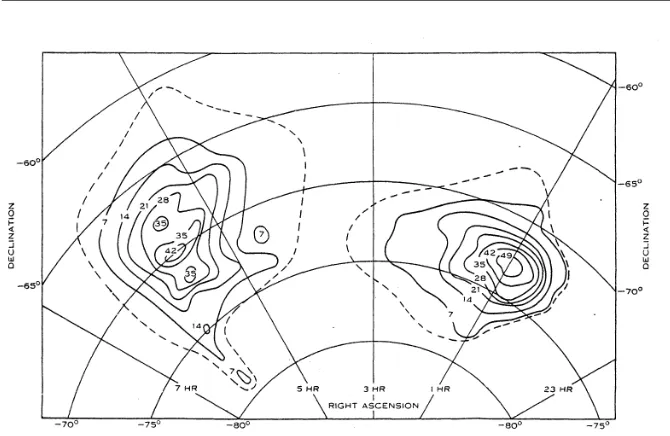
Figure 1.1: Figure 1 from Kerr et al. (1954) showing the integrated 21cm emis-sion at low resolution of about 1◦.0
line around the clouds. The narrow line emission allowed velocity information to be explored. The map is of the integrated flux from the different velocity components along the line of sight. A major finding was that the HI distribution is offset from the stellar light distribution by as much as 1.◦2 (Marel and Cioni 2001), a phenomena confirmed by subsequent studies, (e.g. Kim et al. 1998; Staveley-Smith et al. 2003). The first hint of galactic rotation is also noted by the authors. However as shown by later studies, and in this thesis, they are detecting the projection of the proper motion into the radial line of sight. The transverse proper motion effect dwarfs the actual rotation signature of the LMC galaxy.
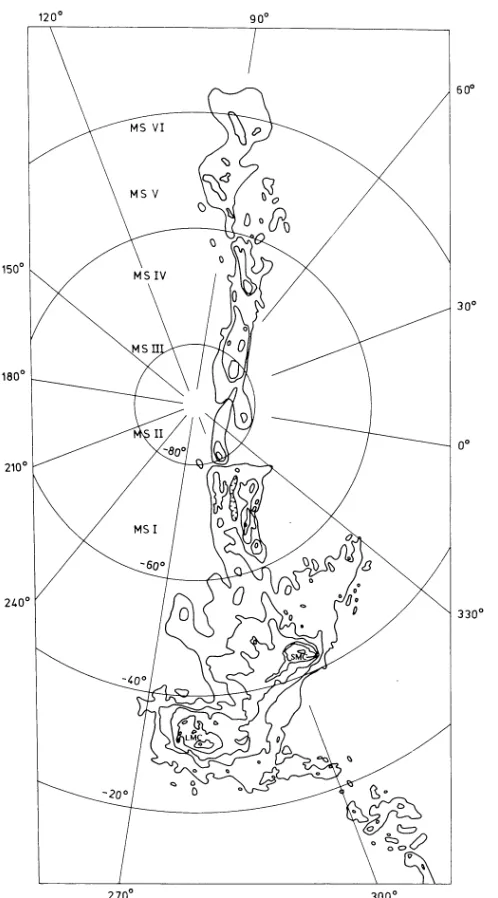
The MgS feature was first observed by Mathewson et al. (1974) and is shown in Figure 1.2. The 150◦ MgS feature runs from the clouds, passes through the south galactic pole and crosses the plane of the MW, over 150 kpc. Unlike the many streams associated with dwarf galaxy accretion on to the MW, the MgS feature is only seen in HI with no conclusive stellar counterpart yet discovered. Most models in the literature have emphasised the role of the MW in creating the stream (Gardiner and Noguchi 1996).
The existence of a bridge was first proposed by de Vaucouleurs (1954) from observations of star counts between the clouds. Unlike the bridge the MgS has no stellar counterpart. The peculiar negative velocityVGSR≈-216 km s−1at the tip of the MgS at l= 90◦,b=−30◦ was attributed originally to hydrodynamic pressure braking the gas (Mathewson et al. 1974). The implication was that there must exist an intergalactic medium density at least 2×10⁻⁴atom cm−3
1984IAUS..108..125M
1.3. THE MAGELLANIC SYSTEM
explained by a gas braking model. Leading arm features suggest a tidal origin such as the leading feature in the Sgr tidal stream (Majewski et al. 2003).
The extent of the HI envelope was later revealed by the much larger Parkes radio telescope. Figure 1.2 shows the result of twenty years worth of studies at the Parkes radio telescope, (McGee and Milton 1966; Hindman 1967; Mathewson et al. 1979; Mathewson and Ford 1984). A similar map from the latest large scale Parkes survey with the multi-beam receiver, the HI Parkes All-Sky Survey (HIPASS) (Putman et al. 2003) is shown in Figure 1.3. With higher sensitivity, the spatial resolution is still defined by the 64 metre aperture at 21cm of 150 with a velocity resolution of 26 km s−1.
The MgS in particular illustrates most clearly the extremely disturbed nature of the common HI envelope of the Magellanic system. The stream at first appears to be indicative of ram pressure of the MW halo medium on the HI envelope, (Mathewson and Schwarz 1976). But later studies seem to indicate that the density in the halo is insufficient to create the required pressure (Murali 2000). Mastropietro et al. (2005) ran an hydrodynamic simulation of several orbits of the LMC through the halo which not only produced the observed MgS feature, but also a stellar halo, which is not observed. The interaction of the LMC-SMC system can alone create the MgS phenomenon through tidal mechanisms, (Besla et al. 2010; Diaz and Bekki 2011). If this is the case then there is no need for multiple orbits through through the MW halo to explain the morphologies.
Spatially separate but near the stream are a population of high velocity clouds detected in HIPASS. They are at a similar velocity to the nearby stream at around−200 km s−1Galactocentric radial velocity, with a very low dispersion of 45 km s−1 indicating a common origin (Westmeier and Koribalski 2008). It is proposed they are filamentary remnants of a once larger stream. The clouds may correspond to the kind of tail feature seen in numerical simulations of the Magellanic system Gardiner and Noguchi (1996).
Hertzsprung (1920) first noted the LMC and SMC were co-moving and the extent to which proper motion would affect the projected radial velocity com-ponent of LMC disk plane circular velocities. With only 18 planetary nebula velocities he estimates a proper motion component perpendicular to the line of sight of 560 km s−1 to 600 km s−1. This estimate is higher than contemporary
HST proper motion estimates, but correctly presages the large modern value 476 km s−1 Piatek et al. (2008). Wilson (1944) also estimated 471 km s−1 to
649 km s−1, and both these values seemed odd at the time given the velocity
dispersion of the MW sub-group. In hindsight these early studies pointed to-ward the modern view of the Magellanic Clouds as interlopers into the Galactic halo with velocities too large to be gravitationally bound to the MW. While sub-sequent studies have taken the projection effects into account, it is only recently that the magnitude of the proper motion has been appreciated (Kallivayalil et al. 2006; Piatek et al. 2008; Vieira et al. 2010).
proper motion data implies that the Magellanic system is on its first approach to the MW, (Kallivayalil et al. 2006; Vieira et al. 2010), and may even be on an unbound hyperbolic orbit (Besla et al. 2007). If the Magellanic system has made at least one orbit of the MW then the MW mass implied by its velocity is higher than most estimates. Modellers are now looking at SMC-LMC self interactions to explain the stream. These new models have implications for the other morphologies of the system.
New explanations for the morphology of the LMC-SMC are required in the absence of multiple MW orbits for the system. Nidever et al. (2008) suggest gas ejected from the supergiant shells in the HI are the source for the stream and leading arm, which drift away from the clouds at 49 km s−1. Subsequently a low metallicity has been found in the gas in the tip of the MgS (Fox et al. 2010) which is more suggestive of a SMC origin for the stream HI, although the metallicity is poor even for the SMC. The suggestion is the gas is from the periphery of the SMC galaxy and is less enriched as a consequence. This SMC origin is more consistent with the gas being stripped by LMC-SMC interaction, from the SMC periphery.
Sinusoidal patterns in the MgS are suggestive of periodicity and may possibly be the result of LMC disk rotation (Nidever et al. 2008). A problem with this hypothesis is the different velocities imparted to the stream would tend to scatter the stream, when what we witness is a very extended coherent structure. The stream distance is as yet uncertain. While the head is probably about the same distance as the clouds themselves between 50 kpc to 60 kpc the distance to the tail is uncertain, due in part to a lack of stellar tracers.
Simulations of LMC formation from an early accretion of DM sub-haloes predict a small halo of stars at large radii that originally formed in the sub-haloes (Brook et al. 2013). Borissova et al. (2004, 2006) detect some evidence for a halo in an old metal-poor population of RR Lyrae stars with a velocity dispersion of about 50 km s−1, larger than the disk value of about 25 km s−1
(Cole et al. 2005) in the inner LMC. 43 RR Lyrae with a large dispersion of 53 km s−1were also observed by Minniti (2003). The presence of a potential halo
population in the inner LMC is also noted by (Subramaniam and Subramanian 2009). Mu˜noz et al. (2006) also find a small number of stars with LMC-like metallicities at large radii, but a substantial MW-style halo is not observed around the LMC.
The mass of the LMC has been estimated as high as 1.5×10¹⁰M
(Schom-mer et al. 1992) and as low as 6×10⁹ M
(Meatheringham et al. 1988). The tidal effect of the Magellanic sytem on the MW disk may be responsible for the large scale warp noted in the MW disk. The mass of the Magellanic system alone is too small to affect the spiral structure of the MW, unless the impact on the MW dark matter halo is strong enough to affect the MW disk (Weinberg 1995) .
1.3. THE MAGELLANIC SYSTEM
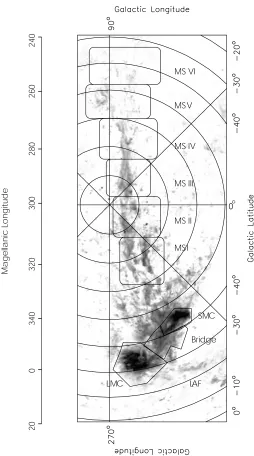
the HIPASS data clearly show a more complex structure primarily made up of two distinct and parallel filaments. This bifurcation has previously been noted by Cohen (1982)
each other for the length of the Stream, but appear to merge three or more times. At these points, for example (l,bÞ ¼ ð40$,%82$) (MS III) and (74$,%68$) (MS IV), there
Fig.5.—Annotated Hicolumn density image of the Magellanic Clouds, Bridge, Stream, and the beginning of the Leading Arm feature (LAF). Velocities
from%450 to 400 km s%1are included, excluding&20 km s%1due to confusion with Galactic emission. The boxes represent the regions used for the mass
deter-minations in Table 2. Magellanic longitudes for positions along the Stream are also labeled. The intensity values are on a logarithmic scale with black
corre-sponding toNHi>6'1020cm%2, and the faintest levels corresponding to(2'1018cm%2. Galactic longitude increases in a counterclockwise direction.
No. 1, 2003 MAGELLANIC STREAM 175
[image:23.612.137.391.145.601.2]simulations of dark matter halos. It is likely the clouds have not arrived until recently.
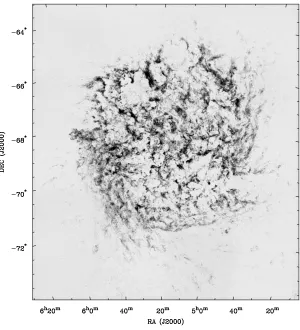
The nature of the HI within the LMC is revealed in detail in the Australia Telescope Compact Array aperture synthesis mosaic image from Kim et al. (1998) (Figure 1.4). Here the spatial resolution is 100. The most striking features are the flocculent spiral structure and the voids in the interstellar medium. The voids are thought to be cleared by supernovae (SNe), stellar winds and UV from young clusters. Molecular cloud formation is enhanced within the walls of these voids (Dawson et al. 2013) .
Shock compression of the interstellar medium along with the turbulence of colliding flows create density conditions conducive to star formation. Under-standing these feedback processes is increasingly recognised as important for star formation history and galactic evolution. Exactly how super-shells con-tribute to star formation rates is not yet well understood. The study of this phenomenon in the nearby LMC may illustrate the role of stellar feedback on the molecular fraction of entire galaxies.
Of the nine major H I holes in the LMC, six are associated with Hαshells ionised by young stars (Staveley-Smith et al. 2003), and at least two of these are associated with non-MW high velocity clouds (HVC). Bekki and Chiba (2007c) suggest that the HVCs could be associated with in-falling SMC material. The presence of young clusters that are strangely metal-poor (Grocholski et al. 2006), hints at accreted SMC material as raw material for LMC star formation.
The HI envelope around the Magellanic system is the main diagnostic of the large scale inter-galactic interactions between the SMC, LMC and MW. The galactic scale of the features, especially the MgS, indicate Gigayear timescales. The question which now faces researchers is whether the Magellanic system is an intact example of SMC-LMC interaction, or whether the disturbed morphology is a result of LMC-SMC interaction with the MW galaxy. Both interactions have probably left their mark on the Magellanic system in but in differing proportions. The bar itself could be an example of such a morphology. The bar may have been induced as a result of interaction with the SMC, or perhaps induced by tidal interaction with the MW. It could also be an internal dynamic resonance within its own spiral structure. This study undertook to sample the chemical and dynamical tracers in the LMC bar to shed some light on the bar feature.
1.3.1
Bars in Disks
The phenomenon of spiral arms and bars is a manifestation of resonances within the disk structure as formulated in the classic paper by Lynden-Bell and Kalnajs (1972). Spiral features and bars are essentially a wave phenomenon, transferred through the response of the orbits of stars to the gravity of the density pertur-bation. These waves can grow, decay and reflect, forming standing patterns in the velocity field.
1.3. THE MAGELLANIC SYSTEM
676 KIM ET AL. Vol. 503
FIG. 1.ÈPeak HIsurface brightness map for the LMC. This map is sensitive to the HIcloud with the highest surface density lying along the line of sight,
and it emphasizes theÐlamentary, bubbly, and Ñocculent structure of the ISM in the LMC.
The median pitch angle of the spiral features in the outer parts (at radiiD3 kpc) isD25¡. With a Ñat rotation curve (v\70 km s~1), this implies an average lifetime ofD90 Myr, or about a third of a galactic rotation period. The spiral arms are trailing only if the LMC is rotating clock-wise on the sky.Hipparcosproper-motion studies (Kroupa & Bastian1997)indicate a similar, though more tentative,
[image:25.612.120.420.216.546.2]result. Since the northern part of the disk is rotating away from us, this geometry implies that the closest part of the LMC is in the east. In this region we expect the outskirts of the disk (at radiusD3.6 kpc) to be some 2.7^1.0 kpc closer on the eastern edge than on the western edge. This result is in good agreement with direct determinations through Cepheid distances, which give position angles for
wave pattern moves at the circular velocity of disk orbits. The angular momen-tum density is the distribution of masses with a particular angular momenmomen-tum. Inside this co-rotation the angular momentum density is negative and outside the angular momentum density ispositiverelative to the co-rotation wave. The stars with lower angular momentum than the wave pattern are emitters of an-gular momentum, and stars with higher anan-gular momentum than the wave are absorbers. The emitter stars do work against the gravitational force of the wave and lose energy, and that energy is picked up by the wave. The wave then does work on the absorbers, and transfers energy to them.
Another way of looking at the energy transfer is that the stars inside or outside co-rotation have the bar density wave pass by them more often, at a frequency greater than at co-rotation. For inner stars the bar pattern density is dragging on their orbital speed, and for outer stars the bar density gives an orbital impetus. At co-rotation the density moves with the stars. The pattern itself feeds on the energy transfer and grows. It grows especially given an anti-axisymmetric disturbance.
The kinetic energy of the galaxy is a combination of its rotational and its random, or thermal motions. To increase random motions requires the rota-tional energy to decrease. To decrease the angular momentum of the fraction of mass with a givenGM/R2 is accomplished by increasingRin the denominator
(Lynden-Bell and Kalnajs 1972). Masses at larger radii can pick up angular momentum from the inner regions. Gravitational torques from the inner to the outer masses via the wave density transfer angular momentum outwards.
The wave resonances are energy minimisation points which form the patterns of bars and spirals. The pattern arises due to the virialization of the disk as the angular momentum is transferred outwards, increasing the random motions and the entropy of the galaxy. One pattern that minimises the energy is a trailing spiral structure. The gravitational torque from the inner to the outer is a leading torque, as the potential leads from the inner disk. The masses exterior are accelerated with respect to the inner mass. In order to lower the rotational energy the spiral minimisation pattern trails the forcing torque. A bar is another common pattern of density resonance that can transfer angular momentum.
Disks are unstable to bar resonances, which appear observationally to occur in both isolated disks and disks with companions. About 70% of disks show bar features (Eskridge et al. 2000). Disks with companions are more likely to show a bar feature (Gerin et al. 1990). In models companions speed up the formation of already present disk bar instabilities. It seems most disks are ready to form bars and that interactions speed up the process. The companions seem to accomplish this by absorbing angular momentum from the bar resonance. The transference of bar angular momentum to the outer disk and halo is also seen in models (Athanassoula and Bosma 2003). The satellite interaction is an extreme example of this angular momentum transfer process. The bar actually represents
1.3. THE MAGELLANIC SYSTEM
Models of a disk galaxy with a 1/4 mass small companion galaxy find that a bar can be easily created (Berentzen et al. 2004). The SMC is about 3/5 of the mass of the LMC (Bekki and Stanimirovi´c 2009; van der Marel et al. 2002). While the last SMC interaction is estimated to have been only 200 MYr ago, these bars are expected to be long lived (Gerin et al. 1990). Previous passages of the SMC would have triggered the bar and subsequent fly-bys would serve to strengthen the bar, unless the SMC were to pass through the disk then the entire LMC could be disturbed (Berentzen et al. 2003).
Bars can tend to push gas toward the centre of the disk galaxy. The bar’s gravitational torque on the gas at the leading edge of the bar robs the gas of angular momentum, slowing its orbit, and it falls inwards (Bournaud et al. 2005). The ends of the bar are regions of high gas density and low shear so star formation may be possible (Athanassoula 2000). Casetti-Dinescu et al. (2012) find two prominent clumps of young OB stars at either end of the LMC bar.
A cool disk will be susceptible to bar instabilities, whereas a warm disk with large velocity dispersion is stable to bars (Das et al. 2008). The existence of a bar in the LMC suggests there may be inflowing gas which can cool a disk, and the bar itself help to drive gas inwards. The Magellanic type SBm barred spirals have quite thick disks with the mean axial ratio being 0.35 (Odewahn 1996).
Bosma (1996) find that a sample of barred and unbarred galaxies show no statistical difference in rotation curves, in shape or maximum velocities. Just like spiral galaxies they exhibit typical rotation curves. Odewahn (1996) shows that for Magellanic type barred galaxies, the presence of a nearby companion is more probable.
Bars may become thick and box-like in profile. The vertical scale height of some inner orbits increases due to resonance with the bar speed (Combes et al. 1990). The increased velocity dispersion that might be expected in a boxy profile is not detected in this study. Subramaniam and Subramanian (2009) find some evidence for a flared LMC bar, thinner at the centre, from red clump depth estimation techniques.
Two types of bar evolution have been proposed, spontaneous bars and tidally driven bars (Miwa and Noguchi 1998). The spontaneous bar being triggered by light perturbations, and the tidal bar by strong interactions. But Berentzen et al. (2004) find this distinction is hard to unravel in simulations, and the dichotomy is more of a continuum of types.
RR Lyrae stars in the LMC show an increased scale height in the bar region (Borissova et al. 2004, 2006; Haschke et al. 2012a). The question is whether these old population tracers are part of an old halo with higher dispersion, or a bar that stands out from the disk. They may be consistent with an old bar population with extended vertical orbital components, making the bar box-like if viewed edge on.
2009), which is a typical evolutionary effect. The SMC has either made the LMC disk unstable during recent fly-bys in the last 5 billion years, or has amplified an existing instability.
Star formation may be induced by tidal and hydrodynamic shocks and gas in-falls induced by galaxy-galaxy interaction. Star formation histories can provide clues to past dynamical events if they can be correlated with interactions. Large Magellanic morphological features such as the Inter Cloud Region (ICR) or bridge and the MgS are indicative of interactions. The bar of the LMC is of particular interest, as the strongest feature of the galaxy it must be one of the keys to the the history of the Magellanic Clouds. The LMC bar has been the object of much speculation as stellar data in the central regions has been sparse in comparison to the periphery of the galaxy. In this thesis observations in the crowding limited centre of the galaxy reveal the history of the LMC through chemical and dynamical properties of the stellar population of the bar.
1.3.2
Star Formation History of the Magellanic Clouds
Before recent proper motion estimates in the last ten years, interaction with the MW over several orbits was the paradigm for understanding the Magellanic Clouds’ history and morphology. Models by Gardiner and Noguchi (1996) and Connors et al. (2006) were based on several Magellanic orbits of the MW in order to create some of the observed HI features.
MW tidal or ram pressure models for the Magellanic morphology rely on several orbits over 4 Gyr (Mastropietro et al. 2005). These scenarios are ruled out by higher proper motion. There does appear to be ram compression of cold HI and molecular gas on the leading eastern edge of the LMC (Marx-Zimmer et al. 2000). But invoking ram pressure and tides from the MW has failed to explain the leading arm feature in particular.
The stream, the leading arm, and bridge can all be recreated by models of SMC-LMC self interactions (Nidever et al. 2010; Diaz and Bekki 2012). The split nature of the stream is indicative of the interplay and exchanges of material between the two galaxies (Diaz and Bekki 2011). The leading arm fails to fit the notion of MW tidal or ram pressure and only SMC-LMC interactions can reproduce this feature in models.
There are new observations that support the notion of interactions between the clouds. Olsen et al. (2011) find a minor population of stars in the LMC that seem to have SMC metallicities. Stars have been found in line with the HI bridge that seem to connect a wing of material from the SMC to the periphery of the LMC (Casetti-Dinescu et al. 2012). This may be early evidence of tidal accretion of material from the SMC to the LMC during close fly-bys.
1.3. THE MAGELLANIC SYSTEM
clouds are headed for an interaction with each other in the near future, rather than the recent past, which is what star formation evidence suggests (Harris and Zaritsky 2009; Glatt et al. 2010).
The SFH of the clouds gives us clues to the dynamical interactions that may have induced stellar birth. Spatially the star formation rate (SFR) seems largely consistent across the LMC disk with a slightly higher SFR for the bar region in the last 4 Gyr. Metallicities in RR Lyraes, a tracer of old populations, are very smooth across the LMC (Haschke et al. 2012b). Stellar metallicity in general doesn’t show much variation (Cole et al. 2009; Grocholski et al. 2006), but once again there is a slight metal increase in the bar region. The SMC, which is much smaller, has seen star formation suppressed in the outer regions and move toward the centre in the last 3.5 Gyr. Similarly the very youngest objects in the the LMC are found preferentially towards the centre (Gallart et al. 2008) and the H II regions.
Weisz et al. (2013) have been able to go deeper, to fainter magnitudes, further down the LMC main sequence (MS) with the Hubble Space Telescope. They show that the clouds shared a common slow and constant SFR at>12 Gyr. The slow SFR suggests they formed in isolation from the MW. The LMC had a faster rate from 10 Gyr to 12 Gyr, suggestive of self enrichment and enhancement of star formation, as the SMC inhabited similar environs. There are no periodic SFR peaks which might be expected if the Magellanic system had been orbiting the MW. There are peaks in the SMC at 9 Gyr and 4.5 Gyr which may indicate interaction with the LMC. From 3.5 Gyr there is a rise in the SFR across the Magellanic system which may mark the beginning of the MW interaction.
That the Magellanic binary system formed in isolation would not be sur-prising. A binary system lasting more than 5 Gyr is itself unusual , to have a triple galactic system SMC-LMC-MW stable over many orbits would be highly unlikely (Liu et al. 2011). In addition simulations on cosmological scales show that Magellanic type satellites are often accreted late onto host MW size galax-ies (Boylan-Kolchin et al. 2011). If the Magellanic Clouds were accreted earlier they would be expected to lie on more circular orbits. It is likely too that they are marginally bound rather than unbound (Vieira et al. 2010; Kallivayalil et al. 2013), and their fast and eccentric orbit argues for late accretion.
Recent slight downward adjustments on the proper motion of the clouds suggest that they are bound to the MW (Vieira et al. 2010; Costa et al. 2009). Models based on the revised proper motions from SPM (Vieira et al. 2010) of about 466 km s−1 place the clouds on a highly eccentric bound orbit, not
much less than the value for an unbound orbit 476 km s−1 (Besla et al. 2007;
Piatek et al. 2008). Bound or unbound, the implication is that the SMC-LMC interactions are just as important to their history as recent MW interactions.
(Vieira et al. 2010; Costa et al. 2009) can reproduce a SMC-LMC interaction at about 200 Myr (Diaz and Bekki 2012). Models with a first infall scenario and SMC-LMC iteractions can also reproduce star forming close encounters at 150 Myr and 2 Gyr (R˚uˇziˇcka et al. 2010).
Numerical simulations of recent Magellanic histories show that LMC-SMC close encounters over the last 2 Gyr, in addition to an approaching MW, can trigger patchy star formation in the LMC along the bar and regions like 30 Do-radus (Bekki 2007). Another clue to the cause of the extreme Population I stars in the LMC is the existence of clusters like NGC 1718 which at intermediate age of about 2 Gyr have very low metallicity (Grocholski et al. 2006). In the case of this cluster -0.8 [Fe/H] where the other LMC clusters are spread very tightly around -0.4 [Fe/H]. SMC metal poor gas could have been accreted into the LMC during these close interactions, inducing increased star formation, in-cluding many other metal poor objects (Bekki and Chiba 2007c, , and references therein). In addition some LMC HI morphology like giant HI bubbles and holes could be the result of high velocity SMC gas flows into the disk (Staveley-Smith et al. 2003).
There is a big gap in the cluster SFH of the LMC (Smecker-Hane et al. 2002; Harris and Zaritsky 2009). Only a handful of clusters are found with ages 4-12 Gyr (Cole et al. 2000). There are many clusters with ages greater than 12 Gyr (Suntzeff et al. 1992). These old clusters have metallicities of around -1.8 dex (Da Costa 1991; Olszewski et al. 1991) and the young clusters have [Fe/H]
≈-0.5 dex. There appears to have been a long period of quiescence when no clusters were formed. The cluster age gap is much more pronounced than the field star formation gap (Carrera et al. 2008). While there has been an increase in field star formation in the last 2-5 Gyr it is not as dramatic as the cluster increase (Cole et al. 2009; Baumgardt et al. 2013).
Cioni (2009) find a metallicity gradient in AGB stars decreasing from the centre to the outer disk, which they hypothesise could be the result of two major star formation events which created an old halo and thick disk, then an additional younger thin disk and bar. A reanalysis of the same data, allowing for different age populations, shows that there is little evidence for a metallicity gradient (Feast et al. 2010). The bar does demonstrate a dominant younger population from a brighter main-sequence turnoff (TO) in colour-magnitude diagram (CMD) studies(Smecker-Hane et al. 2002). The inferred age of this population depends on stellar evolution models (Skillman and Gallart 2002). The intermediate age population in the bar thus contains clues to the SFH of the LMC.
1.4. GLOBULAR CLUSTERS IN THE MILKY WAY HALO
found an handful of RR Lyrae that appear to be in the foreground of the LMC according to radial velocity estimates.
There have been proposals that the bar may be a spatially separate feature from the disk (Zhao and Evans 2000; Zaritsky 2004). The suggestion is that it lies in front of, or above the disk. It has also been hypothesised that the bar has serious warps (Subramaniam 2003), or contains a counter-rotating population (Subramaniam and Prabhu 2005). While it has been established that the bar is not a separate feature (Subramaniam and Subramanian 2009) there still remain many questions.
An aim of this thesis was to compare a large sample of LMC disk field and bar field stars to establish the nature of those two primary morphologies, disk and bar. While only a limited subset of the planned observations was obtained some of the fundamental questions regarding this closest disk galaxy have been addressed. Uncertainties in the proper motion of the LMC are now due mostly to lack of knowledge of the internal kinematics and geometry of the LMC (Kalli-vayalil et al. 2013). This study takes the largest sample set of spectroscopic velocities in the central LMC and puts constraints on important disk parame-ters. The robust statistical technique of Markov chain Monte Carlo (MCMC) is employed to take account of errors in our observations, and incorporate knowl-edge of disk geometry as clearly defined prior distributions with uncertainties. A new systemic velocity value is estimated giving the radial component of the critical space motion of the LMC. Metallicity estimates obtained constrain the SFH of the galaxy.
1.4 Globular Clusters in the Milky Way Halo
The MW halo contains about 160 GCs, a few of which at least may represent the core remnants of ancient dwarf galaxies. Globulars usually represent a single coeval population but multiple populations have been detected in some large globulars such asωCentauri, M22 and NGC 1851 (Gratton et al. 2012; Joo and Lee 2013a). The conception of some globulars as dwarf galaxies with complex SFH has been proposed for M54,ωCentauri and NGC 2419 (Mackey and van den Bergh 2005, and references therein).
GCs are an excellent laboratory for stellar studies as their populations are coeval, for the most part . A common main sequence turn-off (TO) point, a distinct HB, along with other evolutionary features indicate a common age for the stars in these systems. These oldest objects in the halo are remnants of the earliest ages of the universe. We can look back in time to the most distant visible galaxies in the universe or study these fossil objects within easy reach in the MW halo.
the enrichment of the primordial interstellar medium (ISM), the role of SNe and Population III nucleosynthesis.
Given a population synthesis model of the stars in a cluster or galaxy, artifi-cial colour-magnitude diagrams can be generated. These models can be gener-ated for different ages and metallicities. Isochrone models are fitted to observed CMDs from photometric studies to enable ages of objects to be estimated. A spectroscopic metallicity estimate allows an age and SFH to be determined with much more accuracy (Cole et al. 2009). Population modelling is easiest where a single stellar population is present, as in most globular clusters, making glob-ulars an important test bed for understanding stellar evolution.
The research in this thesis provides insight into some of the above questions. We can estimate an age from the metallicity of the globular cluster. The equiv-alent width of the Ca II triplet absorption lines in the spectra of late life red giant stars is a proxy for the amount of non-hydrogen elements in the stars. This measure is well calibrated for metal poor populations. The sample of stars measured gives a statistical estimate for the metallicity of the globular cluster population.
This study provides detailed physical parameters for just one of the existing sample of 157 known MW globular clusters, (Harris 1996). Estimates of the bulk properties of the cluster provide information for researchers on the mass-luminosity function for the Galaxy and ultimately the universe. The abundance and mass of IC 4499 also has a bearing on the initial mass function (IMF) for halo objects at the low mass scale.
1.4.1
Abundances and the Origins of GCs
Observations of the numbers of stars within populations generally show agree-ment with theory of star formation at intermediate mass, but there is an excess of low mass objects being created in the MW at the present time, and some evidence of excess high mass numbers in some cluster environments (Kroupa 2002). There are difficulties with bias in observations that need to be taken into account when estimating the IMF. High mass, high luminosity objects are easier to detect, but very high mass stars only live 106−107 years. There are biases in observing short lived stages in stellar evolution such as the HB, (Cate-lan 2009b). Samples in the MW are full of long lived, low mass stars. In GCs we are biased toward giant stars when it comes to spectroscopic abundances as these luminous stars are the easiest to measure. Salpeter (1955) found this relation between the number of stars as a function of mass and the the mass of the object,
∂N ∂M ∝M
Γ
1.1
WhereΓ is -1.35 for a sample of MW stars with stellar mass range,
0.1M< M <100M
1.4. GLOBULAR CLUSTERS IN THE MILKY WAY HALO
and the average mass is only about 0.5M. For very low mass objects the Salpeter (1955) universal relation does not hold. Kroupa (2002) Γ appears to be about -0.3 for stars less than 0.5Modot and greater than 0.08M , and 0.7 for less than 0.08M. Chabrier (2005) estimate a linear drop inΓ for stars less than a M.
It appears the underlying IMF first identified by Salpeter (1955) has a large scatter caused by factors such as stellar dynamical processes, binaries, star formation feedback and environment (Kroupa 2002). More massive stars are thought to have formed in the past Chabrier (2003), when lower metallic-ity meant the rate of cooling of clouds was slower, so the clouds had time to get bigger before they cooled and condensed. However the MW and LMC do not show dramatically different IMFs despite the metallicity difference (Kroupa 2002) indicating the IMF has only a weak [Fe/H] dependance. Large clusters >106Mwould seem to favour a top heavy IMF (Murray 2009). These systems become heated and optically thick to infrared radiation driving the Jean’s mass larger than oneM.
Observations provide the evidence to constrain the IMF in our Galaxy and other systems. Modern multi-object fibre spectrometers now enable studies of large samples, (e.g Lane et al. 2011; Sz´ekely et al. 2007). Most stars form in systems rather than in isolation and this complicates the estimation of the IMF. The IMF estimation for systems contain assumptions such as constant birth rate over the system’s history, which are unlikely to be true. The SFH links the Present Day Mass Function (PDMF) with the IMF.
As part of their bottom-up Galaxy formation hypothesis Searle and Zinn (1978) postulated that the halo globular cluster population formed in isolation from the MW proto-disk, as no radial gradient in metallicity is seen referenced to the MW centre. The gas from which they formed fell into the forming MW disk taking kinetic energy with it and leaving the globulars in isolated orbits in the MW gravitational field.
It is in the horizontal branch that the variation in metallicity appears most evident in GC studies. For a given metallicity, the position of a star along the red-blue dimension of the HB is attributable to variation in mass primarily (Faulkner 1966). Mass variation in a single stellar population in a GC is prob-ably due to variation in mass loss on the RGB ascent. Mass loss is observed to occur near the top of the RGB while the mechanisms are not well understood (Origlia et al. 2002). The mass loss occurs before the helium flash, in which the He core and outer shell do not appear to mix.
energy to radiate out of the star, without forcing the atmosphere outward by radiation pressure, again keeping them compact. This makes them bluer at the same energy flux than a more metal rich object.
There is another effect, the second parameter effect (Lee et al. 1990), where the HB morphology seems to depend on age. Age estimates from CMD studies using the TO seem to show redder HB types with increasing age. This is also reflected in the radial distribution of halo objects (Lee 1992). While the second parameter effect remains controversial, it does appear to be a real effect. Age is perhaps not the only effect, with mass loss, environment, stellar rotation and other parameters playing some role, but age seems to be the main second parameter.
The effect of binaries is hard to model in single stellar population models. At least 60% of MS stars are in binary or multiple systems, (Duquennoy and Mayor 1991). Mass transfer in binary systems explains blue-stragglers lagging on the blue side of the MS turn-off. Most IMF models ignore such details and take a broad brush approach. While the concept of a single stellar population is a vital theoretical tool, it may not be a realistic description of globular clusters. The single stellar population remains however the foundation of our understanding of stellar evolution in groups. Multiple populations within GCs are considered in the next section.
Where there is variation in Fe abundances it is informative to compare abun-dances of other fusion products as a function of Fe. Comparison of [C/Fe] , [N/Fe] and [O/Fe] abundances where the sum C+N+O = constant, shows that the CNO stellar nucleosynthesis cycle has been at work. Similarly evi-dence of Mg-Al cycling in abundances implies extremely high temperatures (> 70×106K) which requires massive stars. Imbalances in CNO ratios indicate
pollution from stellar feedback or primordial contamination.
Some GCs have been shown to be associated with stellar streams and linked to their host galaxies by chemical tagging. Other GCs are ancient relics of the first formation episode of the MW. Yet others are uniquely associated with extant galaxies like the LMC. This study looks at the little studied GC IC 4499 in order to understand its place in the MW halo.
1.4.2
Multiple Populations in Globular Clusters
1.4. GLOBULAR CLUSTERS IN THE MILKY WAY HALO
Liight element Li, C, N abundance variations in GCs have been known for a long time (Kraft 1979; Hesser and Harris 1979; Da Costa 1997). Abundance variations have been seen seen in evolved RGB and un-evolved MS stars (Can-non et al. 1998; Gratton et al. 2001). MS stars do not have the convective mechanisms to bring advanced nucleosynthesis products from the core to the surface. This points to fundamental differences in populations that are hard to ascribe to factors such as self-enrichment, fast rotating stars, poor mixing of primordial gas or cluster merging. While there are valid hypotheses con-cerning the role of peculiar environmental effects and self-pollution (Bekki and Chiba 2007a), the consensus is moving toward multiple generations being the explanation for imhomogeneities (Milone et al. 2013).
While light element variations are common, heavy iron peak element varia-tions are not seen except in massive cluster environments (Cohen 1981; Joo and Lee 2013b). Heavy element Ca and Si enhancements seen in all cluster stars, show that supernovae Type II (SNe II) have been the dominant polluters in the GC environment (Gratton et al. 2004). Massive clusters like M4 (Marino et al. 2008), M22 (Marino et al. 2013) show clear evidence of multiple populations and indicate higher star forming efficiency goes with higher mass.. MW GCs have a single [Fe/H] except for ω Centauri (Sollima et al. 2007) which leads some to think this extremely massive cluster may contain accreted populations or be the remnant core of a dwarf galaxy (Bekki and Norris 2006).
Examples of triple MS have been found within the narrow colour spread MS of NGC 2808 MS (Piotto et al. 2007) and NGC 6752 (Milone et al. 2013). Multiple populations were first noticed in massive clusters but now it appears true for most GCs (Gratton et al. 2012). Those in the Magellanic system show the some extreme multiple populations with several MS TO (Glatt et al. 2008; Milone et al. 2009), where a gas rich environment and tidal interactions may have triggered several episodes of star formation.
Gratton et al. (2012) propose three generations to explain light element abundances within a typical GC; an extreme primordial precursor generation in the very early universe which are no longer extant; a first generation of “polluters” which enriched the cluster to the present day level, of which a per-centage are still visible today; and thirdly a second generation of Population II stars which now form the bulk of stars in GCs at typical low metallicity. The extreme progenitor Population III were massive and quickly pre-enriched the cluster molecular cloud with SNe II iron-peak and αelements, raising the metallicity to the present level (Bekki and Chiba 2007b). Then the first gen-eration “polluters” gave rise to the light element abundance anomalies in the second generation. The first generation represent typically around 30% of the GC populations today (Carretta et al. 2010).
elements (Carretta et al. 2010). This means either the IMF was more top heavy for the first generation or the GCs were more massive (Prantzos and Charbonnel 2006), which would imply that GCs have been “evaporating”, losing stars to the tides of the MW. Carretta et al. (2010) estimate clusters must have been twenty times larger than at present. Evaporation has removed most of the “polluter” generation, while the Population II stars reside in what was once the dense core of the cluster. Mackey and van den Bergh (2005) estimate the present GC population may represent only two-thirds of the original.
The metal-poor halo stars may be the evaporated remnant “polluters” of the once extremely massive GCs (Helmi 2008). The gas as well as the first generation stars evaporated into the halo ending star formation within GCs. The question of dark matter and the “missing satellites” is still a problem for ΛCDM models (Klypin et al. 1999; Moore 1996; Moore et al. 2006). More massive early GCs could represent at least part of the the “missing satellites”. These multiple generations within GCs occurred within a short cosmological time in the early universe. Detailed archaeology of multiple star formation episodes in GCs will reveal important clues as to the role of effects like stellar feedback and mass loss in suppressing the formation of more satellite galaxies in dark matter haloes.
The Na-O anti-correlation is not seen in galactic or halo field stars (Gratton et al. 2012). Only stars in GCs exhibit the O-Na anti-correlation abundance anomaly (Gratton et al. 2001) indicating some peculiar GC environmental effect which remains unexplained. The Na-O abundance signature is proposed as a definition of GC populations by Carretta et al. (2010).
IC 4499, one subject of this thesis, does not show photometric colour spreads that would multiple generations (Sarajedini 1993; Ferraro et al. 1995; Walker and Nemec 1996; Walker et al. 2011). A high resolution spectroscopic study that might identify abundance anomalies in IC 4499 has not yet been undertaken.
1.4.3
IC 4499, A Special Globular Cluster?
IC 4499 is noteworthy in having an extremely high specific frequency of RR Lyrae variables; its value of SRR= 113.41is second only to the smaller Fornax 1 glob-ular cluster (Mackey and Gilmore 2003) and the tiny outer halo cluster Pal 13 (Harris 1996). About 100 RR Lyrae stars have been identified and represent
≈68% of the the total HB population (Sarajedini 1993). Most of the RR Lyrae have P ≤0.6 d, making it an Oosterhoff Type I (OoI) cluster (Clement et al. 2001; Walker and Nemec 1996). Metallicity may be an important factor in de-termining the Oosterhoff classification of a cluster, as most OoI clusters tend to be more metal-rich than [Fe/H] = −1.8 on the ZW84 scale, while Ooster-hoff Type II (OoII) clusters more metal-poor (Sandage 1993). It is thought that shorter-period RR Lyrae stars have not evolved off of the zero-age hori-zontal branch (ZAHB), while the longer-period variables are evolving through the RR Lyrae instability strip on the way to the asymptotic giant branch. The measurement of accurate cluster parameters in this study therefore has the
po-1S