Ruling the Blocks World:
Towards a Game Change Framework for
Norm Implementation
∗
Davide Grossi
1, Dov Gabbay
2, Leendert van der Torre
31
ILLC, University of Amsterdam
[email protected]
2
King’s College London
[email protected]
3
ICR, University of Luxembourg
[email protected]
Abstract
The norm implementation problem concerns how a ‘social designer’ can see to it that the agents comply with a given set of norms in a given multiagent system. In this paper we discuss how various ways to im-plement norms in a multiagent system can be distinguished in a formal game-theoretic framework. In particular, we show how different types of norm implementation can all be uniformly understood as types of trans-formations of extensive games. We introduce the notion of retarded pre-conditions to implement norms, and we illustrate the framework and the various ways to implement norms in the blocks world environment.
1
Introduction
Normative multi-agent systems (NMAS) [10] study the specification, design, and programming of systems of agents by means of systems of norms. Norms allow for the explicit specification of the standards of behavior the agents in the systems are supposed to comply with. Once such a set of norms is settled, the question arises of how to organize the agents’ interactions in the system, in such a way that those norms do not remain—so to say—dead letter, but they are actually followed by the agents. In other words, designing a NMAS does
∗
not only mean to state a number of standards of behavior in the form of a set of norms, but also to organize the system in such a way that those standards of behavior are met by the agents participating in the system.
The paper moves the first steps towards a formal understanding of the norm implementation problem, defined as follows.
The norm implementation problem. How can a given set of norms be made complied with by the agents in a given system?
The norm implementation problem is part of the more general problem of norm creation. Norm creation distinguishes between the creation of the obligation or prohibition, and the creation of the associated sanction. For example, the obligation may be to return books to the library within three weeks, and the sanction associated with its violation is that a penalty has to be paid, and no other books can be borrowed. The creation of the obligation is often called the norm design problem [43], and the creation of the sanction is an example of what we call the norm implementation problem. Thus, in the library exam-ple, the norm implementation problem is that given that we want people to return their books within three weeks, how can we build a system such that they will actually do so? However, introducing sanctions is not the only way to implement norms. In other cases, the norm can be regimented, or instead of penalties, rewards can be introduced. In this paper we introduce a formal framework that can represent these various solutions to the norm implementa-tion problem, which can be used to analyze them, or to make a choice among them.
The assumption underlying our research problem is that the norm imple-mentation problem can be studied in isolation. We thus argue against the common idea that norm implementation can be studied only together with the norm design problem, in the context of norm creation. For example, when a system designer has to choose between various kinds of norms, at the same time he has to take into account how the norm can be implemented. If a norm is chosen which cannot be implemented, such that it will not be complied with, then the norm may even be counterproductive, undermining the belief or faith into the normative system (in particular, this holds for legal systems). Though we agree that a choice among norms also has to take the available implemen-tations into account, we believe that this is not an argument against studying norm implementation in isolation.
The reader may be surprised that the norm implementation problem has not been dealt with thus far, given the high number of publications on social, organizational and deontic theories recently. Ideas we discuss can be found scattered over this literature, but they have not been presented systematically and in a uniform framework. Our aim in this paper is to unify these ideas and present them in a more abstract way.
1. Which formal model to study the norm implementation problem?
2. How to model regimentation?
3. How to model enforcing?
4. How to model norm change?
The perspective assumed on the problem is based on formal logic and the primary aim of the paper is to present a simple class of logical models, and of transformations on them, as salient representations of the implementation problem. Moreover, we use a game-theoretic approach. We use the simplest approach possible, so we can focus on one same framework for many kinds of norm implementation, and are not lost in technical details about individual approaches. As in classical game theory, our actions are abstract and we do not consider issues like causality, or the composition of actions in plans. We consider only perfect information games, and we thus do not consider the problem how norm are distributed and communicated to a society. Moreover, we do not consider concurrent actions of the agents, although this feature could be easily added. However, we do represent the order of actions, that is, we use extensive form, because we need to do so to distinguish some of the norm implementation methods, and thus we do not use the more abstract strategic form used in most related work (such as Tennenholtz and Shoham’s artificial social systems [43]). We do not go into details of solution concepts of game theory, and we thus basically use a kind of state automata or process models. Within a game-theoretic approach, we need to represent four things: the game without the implemented norm, the game together with the implemented norm, the procedure to go from the former to the latter, and the compliance criterion. We test our model by introducing retarded preconditions. For example, assume that in the tax regime of a country, for people who leave the country there is a period of three years after which it is checked whether someone has really left the country. In this example, the precondition is checked only after three years, and if the person has returned to the country, the consequences of leaving the country are retracted. Likewise, with actions with nondeterministic effects, we can say that the precondition depends on the effect. For example, if there are no concurrent updates in the database, then the update will be accepted, otherwise it will be rolled back. In the blocks world, assume that a block may not be puton another block if it stays there for three minutes. If it stayed there for three minutes, then we can undo the action (alternatively, one can sanction it, of course). We distinguish norm regimentation from automatic enforcement and enforcement agents, assuming actions can be taken only if preconditions hold. Some of such actions are forbidden, so all actions in order to be taken must satisfy the precondition. For regimentation we consider violation conditions as retarded preconditions of actions. In this action model, assumed actions can be taken in some cases even though the preconditions do not hold. When a violation occurs, i.e. when the retarded precondition does not hold, the various strategies to implement norms follow as a consequence.
of single agents. Such an issue was recognized as central for the NMAS com-munity during the NorMAS’07 Dagstuhl Seminar [13], and it was raised in the following incisive form:
BDI : Agent Programming = ? : NMAS Programming.
This equation represents two issues. First, it raises the question about which concepts should be used for programming normative multiagent sys-tems, given that cognitive concepts like beliefs, desires and intentions are used to program individual agents. There is some consensus that instead of cognitive concepts, for normative multiagent systems social and organizational concepts are needed, such as trust, norms and roles. Second, from a logical perspective, it raises the question which logical languages used for specification and verifi-cation can be used for NMAS, like BDI-CTL is used for single agents. Thus far, only partial answers have been given to this question. For example, deontic logic can be used to represent norms, but it cannot be used to say how agents make decisions in normative systems, and about the multiagent structure of normative systems.
We illustrate the framework and the various ways to implement norms in the blocks world environment, because the well-known planning environment explains the use of normative reasoning and the challenges of norm implemen-tation for a large AI audience. There are many variants of the blocks world around, we use a relatively simple one with deterministic actions and without concurrent actions. Alternative well known examples we could have picked is Wumpus from Russel and Norvig textbook [41].
We assume that all norms and their implementations are known once they are created, and we thus do not study the norm distribution problem. Moreover, we assume that everyone accepts the existence of a new norm, even when he does not comply with it. Thus, we do not consider the norm acceptance problem. We do not consider cognitive aspects of agents, and we thus do not consider the bridge between our framework for MAS and existing BDI frameworks for cognitive agents (see, e.g., [11]).
The paper follows the research questions and proceeds as follows. In Sec-tion2 we start with the game-theoretic framework for norm implementation and a logic for representing extensive games, and we introduce a running ex-ample. Sections3,4,6provide formal semantics to the three implementation strategies of regimentation, enforcement and, respectively, normative change. The finding of each section will be illustrated by means of the running example. In Section7related work at the intersection of norms and multiagent systems is discussed. Conclusions follow in Section8.
2
Formal framework and running example
The present section is devoted to setting the stage of our investigations.
2.1
Norms and logic
[2,31,35] representing the content of norms as labeling of a transition systems in legal and illegal states, which we will callviolation states. In this view, the content of a normative system can be represented by a set of statements of the form:
pre→[a]viol (1)
that is, under the conditions expressed inpre, the execution of actiona
neces-sarily leads to a violation state. Such statements can be viewed as constraints on the labeling of transition systems. Restating Formula (1), all states which are labelledpreare states such that by executing ana-transition, states which are labelledviolare always reached.1
It follows that a set of formulae as Formula (1) defines a set of labelled transition systems (i.e., the set of transition systems satisfying the labeling constraints stated in the formulae), and such a set of transition systems can be viewed as representing the content of the normative system specified by those formulae.
Now, within a set of transition systems modeling a set of labeling constraints, transition systems may make violation states possibly reachable by transitions in the systems, and others possibly not. So, from a formal semantics perspective, we can think of the implementation problem as the problem of selecting those transition systems which:
1. Model a given normative system specification in terms of labeling con-straints like Formula (1);
2. Make some violation states unreachable within the transition system, henceregimenting[30] the corresponding norms;
3. Make other violation states reachable but, at the same time, disincen-tivizing the agents to execute the transitions leading to those states, for instance by triggering appropriate systems reactions such as sanctioning, thusenforcingthe corresponding norms [24].
To sum up, normative systems can be studied as sets of labeling constraints on the systems’ transitions generated by agents’ interaction, and the implemen-tation problem amounts to designing the NMAS according to those transition systems which, on the one hand, model the labeling constraints and, on the other hand, make the agents’ access to violation states either impossible (regi-mentation), or irrational (enforcement). What we mean by the term “irrational”, is precisely what is studied by game theory [38]. The next section moves to the fundamental role that —we think— game theory can play for the analysis of the norm implementation problem.
2.2
Norm implementation and games
In a social setting, like the one presupposed by NMAS, action essentially means interaction. Agents’ actions have repercussions on other agents which react ac-cordingly. Norm enforcement takes care that agents’ actions leading to violation states happen to be successfully deterred, either by a direct system reaction or, as we will see, by means of other agents’ actions. The readily available formal
framework to investigate this type of social interaction is, needless to say, game theory. In fact , the present paper uses the term implementation in the tech-nical sense of implementation theory, i.e., that branch of game theory which, together with mechanism design [27,29,34,28], is concerned with the design of the interaction rules—the “rules of the game” [36] ormechanisms—to be put into place in a society of autonomous self-interested agents in order to guarantee that the interactions in the society always result in outcomes which, from the point of view of the society as a whole (or from the point of view of a social designer), are considered most desirable (e.g., outcomes in which social welfare is realized).2
In this paper we are going to work with games in extensive forms [38]. Games in extensive form have recently obtained wide attention as suitable tools for the representation of social processes [3]. However, the key advantage for us of choosing games in extensive form is that such games are nothing but tree-like transition systems. This allows us to directly apply the logic-based representation of norms exposed in Section2.1, thus obtaining a uniform formal background for talking about both norms and games and, hence, for formulating the norm implementation problem in an exact fashion. To ease such exact formulation, we will make use of a simple running example.
2.3
Running example: ruling the Blocks World
We assume a multiagent variant of the blocks world, where agents cannot do concurrent actions (so we do not consider the issue of lifting a block simulta-neously). Therefore we assume that the agents have to take actions in turn.
In the standard blocks world scenario [41], the pre- and postcondition spec-ification of the actionmove(a,b,c) (“move blockafrom the top ofbto the top of blockc) runs as follows:
(on(b,a)∧clear(c)∧clear(b)∧turn(i)) ↔ hmove(b,a,c)(i)i> (2)
(on(b,a)∧clear(c)∧clear(b)∧turn(i)) → [move(b,a,c)(i)]((on(b,c) (3)
∧clear(b)∧clear(a)) (4) that is to say: the robotic armican execute actionmove(b,a,c) iffit is the case that both blocksbandcare clear, and it is its ‘turn’ to move;and the effect of
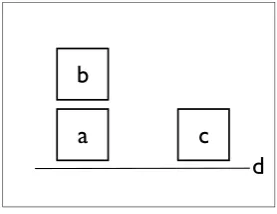
such action is that blockbends up to the top of blockcwhile blockabecomes clear. By permutation of the block identifiers, it follows that actionmove(a,d,c) cannot be executed in the state depicted in Figure1, in which blockbrepresents the floor.
Suppose now the robotic arm to be in state of executing actionmove(a,d,c) also if blocka is not clear, thus possibly moving a whole stack of blocks at one time. Suppose also that the system designer considers such actions as undesirable. In this case the robotic arm can be considered as an autonomous agent, and the designer as a legislator or policymaker. In order to keep the example perspicuous, the scenario is limited to one agent, but we can express multiple agents analogously. The actionmove(a,d,c) would get the following specification. Formula (5) does no longer demandclear(a), but Formula (5)
2Therefore, when we talk about norm implementation we are not referring to the term
a
c
b
[image:7.595.227.366.133.240.2]d
Figure 1: Initial state.
does not specify the effect when this is the case, i.e., when two or more blocks are moved simultaneously.
(on(a,d)∧clear(c)∧turn(i)) ↔ hmove(a,d,c)(i)i> (5)
(on(a,d)∧clear(c)∧clear(a)∧turn(i)) → [move(a,d,c)(i)](on(a,c)
∧clear(a)∧ ¬clear(c)) (6) (on(a,d)∧clear(c)∧ ¬clear(a)∧turn(i)) → [move(a,d,c)(i)](on(a,c)
∧¬clear(a)∧ ¬clear(c)
∧viol(i)) (7)
where viol(i) intuitively denotes a state brought about by agenti which is undesirable from the point of view of the system designer.
Suppose also that the system designer wants to implement the norm ex-pressed by Formula (7)?3 The paper tackles this question displaying a number
of strategies for norm implementation (Sections3,4and6).
2.4
Talking about norms and extensive games in the Blocks
World
In this section we bring together the logic-based perspective on norms sketched in Section2.1with the game-theoretic setting argued for in Section2.2. This will be done in the context of the Blocks World scenario of the previous section. As a result we obtain a very simple modal logic language4 which suffices to
express the properties of extensive games relevant for the purpose of the norm implementation analysis of the Blocks World.
2.4.1 Language.
The language is the standard propositional modal logic language withnmodal operators, where n = |Act|, that is, one modal operator for each available
transition label. In addition, the non-logical alphabet of the language, consisting of the set of atomic propositionsPrand of atomic actionsAct, contains at least:
3Notice that Formula (7) is an instance of Formula (1).
␐ Atoms inPrdenoting game structure: for all agentsi∈I,turn(i),payoff(i,x), labeling those states where it is player’siturn, and where the payofffor playeriisx, wherexis taken from a finite set of integers.
␐ Atoms inPrdenoting Blocks World states-of-affairs: for all blocksa,b∈
B,on(a,b),clear(a), labeling those states where blockais on blockb, and where blockahas no block on it.
␐ Atoms in Pr denoting normative states-of-affairs: for all agents i ∈ I,
viol(i), labeling those states where playerihas committed a violation.
␐ Atoms inActdenoting deterministic transitions: for all agentsi∈ Iand
blocksa,b,c ∈ B: move(a,b,c)(i), labeling those state transitions where playerimoves blockafrom the top of blockbto the top of blockc. The inductive definition of the set of formulae obtained from compounding via the set of Boolean connectives{⊥,¬,∧}and the modal connectives{hai}a∈Act
is the standard one.
2.4.2 Semantics.
Models are labelled transition systemsm=hW,{Ra}a∈Act,Iisuch that:
␐ Wis a non-empty set of system states;
␐ {Ra}a∈Actis a family of labelled transitions forming a tree;
␐ I:Pr−→2Wis the state labeling function.
The standard satisfaction relation|=between pointed models (m,w) and modal
formulae is assumed [6]. In addition, the models are assumed to satisfy the determinism condition, for alla∈Act:
haiϕ→[a]ϕ.
Please note that such a condition is typical of the representation of actions within games in extensive form.5
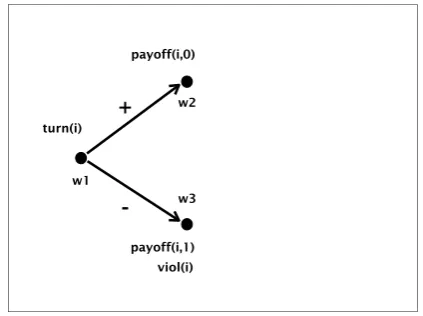
Now everything is put into place to formulate with exactness the question that will be addressed in the next sections. Consider a modelmas represented in Figure2. Statew1is assumed to satisfy the relevant Blocks World description
of Figure1: (m,w1)|=on(a,d)∧clear(c)∧clear(b)∧ ¬clear(a).6 Notice that
in the model it is also assumed that agentileans towards executing the action “−” leading to theviol(i)-state which has got a higher payoff.
Consider now a normative specification as represented by formulae like Formula (7), together with an initial model (such as the one in Figure2). What are the transformations of the modelm, which guarantee the normative speci-fication to be complied with by the agents in the system? This is, in a nutshell, what we are going to investigate in the remainder of the paper.
5The reader is referred, for more details, to [4].
6To avoid clutter in figures and notation, in what follows forbidden actions (e.g.move(a,d,c)(i)
atw1) are denoted by “−”, and allowed actions (e.g.move(b,a,c)(i) atw1) are denoted by “+”. We
w1
w3 w2
payoff(i,1)
payoff(j,0)
payoff(i,0)
viol(i) turn(i)
+
-Figure 2: Initial model.
2.5
Two important caveats
Before starting off with our analysis, we find it worth stating explicitly also what this work is not about.
The issue of norm implementation as intended here has already received attention in the literature on MAS in the form of the quest for formal languages able to specify sanctioning and rewarding mechanisms to be coupled with nor-mative systems specifications. An example in this sense—but not the unique one—is [33], where authors are concerned with the development of a whole framework for the formal specification of NMAS. Such a framework is able to capture also norm-implementation mechanisms such as sanctioning and re-warding systems. As our research question discussed in Section1shows, our aim in this paper differs from all such studies which can be found in the litera-ture. The purpose of the paper is not to develop a formalism for the specification of one or another mechanism which could be effectively used for implement-ing norms in MAS. Rather, the paper aims at movimplement-ing a first step towards the development of a comprehensive formal theory of norm implementation. Such a theory should be able to capture all forms of norm implementation mech-anisms highlighting their common features and understanding them all as system transformations.
[image:9.595.190.402.136.294.2]w1
w2
[image:10.595.210.384.134.270.2]payoff(j,0) turn(i) +
Figure 3: Regimentation.
3
Making violations impossible
The present sections studies two simple ways of making illegal states unreach-able within the system.
3.1
Regimentation
Regimentation [30] is the most simple among the forms of implementation. Consider our running example, and suppose the social designer wants to avoid the execution ofmove(a,d,c) by (i) in the case blockais not clear, as expressed in Formula (7).
The implementation via regimentation for a transitionacan be represented by a transformation (or update) m7−→ m0
of the modelminto the model m0
such that:
Rma0 :=Rma− {(w,w0)|(m,w)|=prea& (m,w0)|=viol(i)}
wherepreaare the preconditions of the execution ofawhich lead to a violation. In other words, it becomes inm0
impossible to execute a transition with labela
inprea-states which lead to a violation state. Notice that ifpre(a)=>then the
update results inRm0
a =∅.
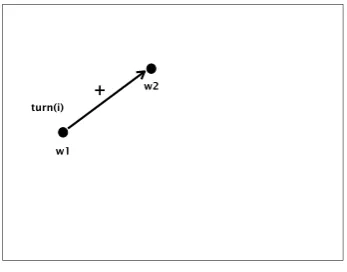
In the running example, wherea = move(a,d,c)(i), such update results in pruning away the edges labeled by “−” (i.e.,move(a,d,c)(i) form the frame of m(Figure3). The regimentation of the prohibition expressed in Formula (7) corresponds therefore to the validity of the following property:
on(a,d)∧clear(c)∧ ¬clear(a)∧turn(i)→[move(a,d,c)(i)]⊥
and hence, by modal logic and some additional background knowledge on the Blocks World:
on(a,d)∧clear(c)∧ ¬clear(a)∧turn(i)↔ hmove(a,d,c)(i)i>
a c b
[image:11.595.245.349.129.210.2]d e
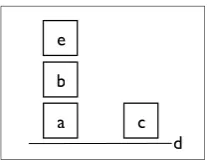
Figure 4: Retarded preconditions. Initial state.
them exactly to the ones generating legal states. It is instructive to notice that the standard Blocks World scenario can be viewed precisely as a result of the regimentation of the normative variant of the scenario which we are considering here.
3.2
Retarded preconditions
Ordinary action logic describes the actions using preconditions and postcondi-tions. Ifais an action with preconditionpreaand postconditionpostathen
prea ↔ hai> (8)
prea → [a]posta (9)
express that actionacan be executed if and only ifpreahold (Formula (8)) and with the effect expressed byposta(Formula (9)). So in the standard account of the blocks world, if the world is in the situation as depicted in Figure1,bcan be moved on top ofcbutacannot be moved.
According to the normative perspective we have assumed in the running example, instead of imposing logically strong preconditions, we state logi-cally weak preconditions for action, which means allow their execution in a wider range of states and assuming indeterminacy. In addition, we label states reached by performing actions as violation states when they are executed un-der undesirable conditions (see Section2.3). In short, actions are allowed to be executed under circumstances which can possibly lead to violations, but only if the effects are still acceptable. If they are not, then nothing has happened.
These intuitions lead us to introduce, within the framework exposed in Section2.4, two new modal operators:hϕ|aiψand [ϕ|a]ψ. The semantics of
these new operators is defined as follows:
m,w|=[ϕ|a]ψ iff ∀w0∈WifwRa|
~ϕw
0
thenm,w0|=ψ
m,w|=hϕ|aiψ iff ∃w0∈
Wsuch thatwRa|
~ϕw
0
andm,w0|=ψ
where~ϕdenotes, as usual, the truth-set ofϕandRa|~ϕis the subset ofRa containing those state pairs (w,w0
) such that the second elementw0
of the pair satisfiesϕ.7 Notice, therefore, that the new modal operators take an action (e.g.,
7It might be instructive to notice that such operators are definable within standard dynamic logic
a
c b
[image:12.595.139.473.129.236.2]d e
Figure 5: Situation A
a
c b
d e
Figure 6: Situation B
a
c b
d e
Figure 7: Situation C
a) and a formula (e.g.,ϕ) yielding a new complex action type (e.g.,ϕ|a). Such
action type correspond, semantically, to those state transitions which are of the given action type (a) and which end up in the given states (ϕ).
By means of this newly introduced operators, we can express that the exe-cution of a given actionais possible only under the condition that it has certain precise effectsϕ(Formula (10)), and that each time it is executed having such effectsϕ, it also guarantees thatψholds (Formula (11)):
prea → hret prea|ai> (10)
prea → [ret prea|a]posta (11)
whereprearepresents the precondition ofawhere the execution ofapossibly
leads to a violation; ret prea the postcondition of prea which are tolerated, i.e., itsretarded preconditions; andpostathe postconditions ofret prea|a.
Let us now give an example. Suppose we have the situation depicted in Figure 4. We move a, and we might end up with one of the three options in Figures 5-7. Suppose also that only the situation depicted in Figure 5 is tolerable to us. That is,acan be moved onconly if it is slid out carefully from the tower composed bya,b,e. Such tolerance can be expressed by means of retarded precondition, that is, a precondition which is evaluated as a result of the action performed. In the example at hand, the execution of actionmove(a,d,c) is tolerated in the caseais moved from within a tower only if the result of the action yields the situation depicted in Figure5:8
on(a,d)∧on(e,b)∧clear(c)→ hon(e,b)|move(a,d,c)i> (12)
on(a,d)∧on(e,b)∧clear(c)→[¬on(e,b)|move(a,d,c)]⊥ (13)
on(a,d)∧on(e,b)∧clear(c)→[on(e,b)|move(a,d,c)]on(a,c). (14) Blockacan be moved also in the case it is not clear, provided that this does not change the respective disposition of other blocksbande(Formula12). If that is not the case, than it will not be possible to move it (Formula13). The effect
of the execution ofaunder the retarded precondition that the stack ofbande
is left intact results inabeing placed onc(Formula14).
The specification of retarded preconditions for actions can be viewed as a smoothening of regimentation requirements. As shown in the example above, instead of regimenting the non-execution of actionmove(a,d,c) in case blocka
as positioned within a tower, we can express that the execution can be tolerated, provided it gives rise to specific results (Figure5).
In a nutshell, the use of retarded preconditions is typical of situations where the execution of a given actiona under certain circumstancesϕcan possibly lead to a violation state:
ϕ∧ haiviol.
In such cases, we might not want to impose a regimentation, requiring that:
ϕ→[a]⊥
but we would rather still allow the agent to perform the action, provided that it does not end up in violation states, that is, we allow the execution of the action under the potentially problematic conditions ϕbut only by assuming the retarded precondition¬viol:
ϕ→ h¬viol|ai> ϕ→[viol|a]⊥
We conclude spending a few more words on the notion of retarded precon-dition. Such notion of retarded precondition is implicit in our culture. The saying “you can’t argue with success” illustrates that way of thinking. An agent can take action without following the rules and if he is successful then we have to accept it. A major example is Admiral Nelson defying command and defeating the Spanish fleet. He is a hero. Had he failed, he would have been court marshalled.
4
Perfect enforcement
Perfect enforcement takes place when the execution of an action leading to a violation state is directly deterred by modifying the payoffs that the agent would obtain from such an execution. The following condition says that the best action does not imply a violation of the norm. It covers both penalties and rewards, or combinations of them.
LetPrpaydenote the set of payoffatoms and letRm Act=
S
a∈ActRa, that is,RmAct
labels the whole transition tree of modelm. The implementation via perfect enforcement w.r.t. a transitionais a model updatem7−→ m0
which does not modify the frame (W,{Ra}a∈Act) of the model, and only modifies the evaluation
of payoffatoms9so that∀w∈W:
If wRma0w0& (m0,w0)|=viol(i))∧payoff(i,x)
then ∃w00∈Wsuch thatwRm0 Actw
00
& (m0,w00)|=¬viol(i))∧payoff(i,y) withx<y. Recall that the update does not modify the interpretation of atoms which are not payoffatoms nor the frames of the model (so,Rm0
a =Rma for all a ∈ Act). Intuitively, such an update guarantees that each agent faced with a decision between executing a transitiona leading to a violation state, and one leading to a legal one, will—if they act rationally from a decision-theoretic perspective—chose for the latter.
9That is to say:ImdPr−Prpay=Im0dPr−Prpay
A number of different implementation practices can be viewed as falling under this class such as, for instance, fines or side payments. However, the common feature consists in viewing the change in payoffs as infallibly deter-mined by the enforcement, thereby giving rise to perfect deterrence. The next section will show what happens if such an assumption is dropped.
Getting back to our running example, the perfect enforcement of the prohi-bition expressed in Formula (7) results, therefore, in the validity of the following property:
on(a,d)∧clear(c)∧on(b,a)∧turn(i)→([+]payoff(i,1)∧[−]payoff(i,0)) where+ =move(b,a,c)(i) and−=move(a,d,c)(i).
We deem worth stressing again the subtle difference between perfect en-forcement and regimentation. While regimentation makes it impossible for the agents to reach a violation state, automatic enforcement makes it just irrational in a decision-theoretic sense. In other words, it is still possible to violate the norm, but doing that would be the result of an irrational choice. As such, perfect enforcement is the most simple form of implementation which leaves the game form (i.e., the frame of the modal logic models) intact. Although the extensive game considered is a trivial one-player game, it should be clear that taking more player into consideration would not be a problem. In such case, the application of solution concepts such as sub-game perfect Nash [38] would become relevant.
5
Enforcers
Commonly, perfect deterrence is hard to realize as each form of sanctioning requires the action of some third-party agent whose role consists precisely in making the sanctions happen. Enforcement via agents (the enforcers) corre-sponds to the update of modelm to a modelm0
defining a new game form between a playeriand enforcer j. The actions of enforcerjarepunish(i) and
reward(i). As a result of such an update, the original model mresults in a sub-model ofm0
.
Letrma :W −→2W be the function associating to each state inW the states
reachable bya-transitions.
Ifw∈rmAct& (m0,w)|=turn(j)∧payoff(i,x)
then∃w0∈Wsuch thatwRm0 reward(i)w
0
& (m0,w0)|=payoff(i,y) withx≤y
and∃w00∈Wsuch thatwRm0 punish(i)w
0
& (m0,w00)|=payoff(i,y) withy<z wherezis such that ∃w ∈ w ∈ rm
Act(m,w) |= viol(i))∧payoff(i,x). What the
payoff(i,0)
payoff(i,1) payoff(i,0)
payoff(i,1)
w1
w4
w3 w2
w7 w6 w5
payoff(i,1)
payoff(j,0)
payoff(i,0)
viol(i) turn(j) turn(j)
turn(i)
viol(j)
+
-+
+
[image:15.595.210.384.137.266.2]
-viol(j)
Figure 8: Enforcement norms.
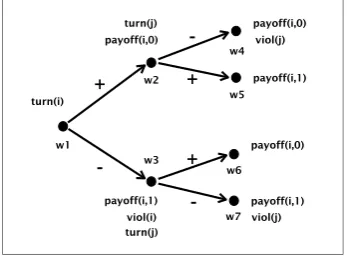
However, the use of agents as enforcers implies the introduction of a further normative level, since the enforcer can choose whether to comply or not with its role, that is, punish ifidefects, and reward ificomplies:
(turn(j)∧viol(i)) → [reward(i)]viol(j) (15) (turn(j)∧ ¬viol(i)) → [punish(i)]viol(j) (16) Whether the enforcement works or not, depends on the payoffs of the enforcer j. We are, somehow, back to the original problem of guaranteeing the behavior of an agent (the enforcer in this case) to comply with the wishes of the so-cial designer. The implementation of norms calls for more norms (Figure 8). Enforcement via enforcing agents lifts the implementation problem from the primary norms addressed to the agents in the system, to norms addressed to special agents with ‘institutionalized’ roles.
5.1
Regimenting enforcement norms.
At this point, the norms expressed in Formulae (15) and (16need implemen-tation. Again, regimentation can be chosen. The result of regimentation of enforcement norms in the running example is depicted in Figure9. Formally, this corresponds to an updatem7−→m0
ofmwhere: Rm0
punish(i) = R m
punish(i)∪ {(w,w 0
)|m,w|=turn(j)∧viol(i) &m,w0|=
viol(j)}
Rmreward(i)0 = R m
reward(i)∪ {(w,w 0
)|m,w|=turn(j)∧ ¬viol(i) &m,w0|=viol(j)}
As a result, the enforcer jalways complies with what expected from its role. In a way, regimented enforcement can be viewed as an equivalent variant of perfect enforcement since its result is an adjustment of the payoffs of agenti w.r.t. to the system’s norms.
5.2
Enforcing enforcement norms.
payoff(i,0) payoff(i,1)
w1
w3 w2
w6 w5
payoff(i,1)
payoff(j,0)
payoff(i,0)
viol(i) turn(j) turn(j)
turn(i) +
-+
[image:16.595.209.386.136.266.2]+
Figure 9: Regimentation of enforcement norms.
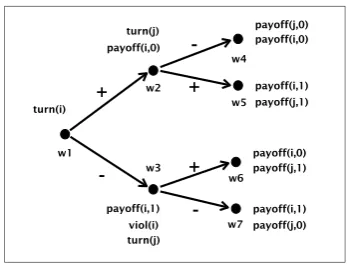
autonomously complies with the enforcement norms expressed in Formulae (15) and (16), punishing player iwhen icommits a violation and rewarding i wheni complies (Figure10). In the running example, perfect enforcement
payoff(i,0)
payoff(i,1) payoff(i,0)
payoff(i,1)
w1
w4
w3 w2
w7 w6 w5
payoff(i,1)
payoff(j,0)
payoff(i,0)
viol(i) turn(j) turn(j)
turn(i) +
-+
+
-payoff(j,1)
payoff(j,0) payoff(j,0)
[image:16.595.209.383.384.518.2]payoff(j,1)
Figure 10: Perfect enforcement.
of enforcement norms can be defined by a simple update m 7−→ m0 of the
interpretation functions of the two models such that:
Im0(payoff(j,0)) = Im(viol(j))
Im0
(payoff(j,1)) = W− Im(viol(j))
which results in a perfect match between higher payoffs and legal behavior. Figure11represents, in strategic form, the extensive game depicted in Figure
Mechanism Design and Implementation Theory [27,29,34,28] to the formal theory of NMAS.
5.3
Who controls the enforcers?
Our analysis clearly shows the paradox hiding behind norm implementation. In order to implement norms, it is likely to need more norms.
The implementation of a set of norms can be obtained either via regimen-tation or via automatic enforcement or by the specification of an enforcement activity to be carried out by an enforcer. Enforcement specification happens at a normative level, i.e., via adding more norms to the prior set which, in turn, also require implementation. Schematically, supposeXto be the non-empty set of to-be-implemented norms,Regiment(X) to denote the set of norms fromX which are regimented or automatically enforced, andEnforce(X) to denote the set of norms containingXtogether with all the norms specifying the enforce-ment ofX(X⊆Enforce(X)). The implementation ofSis the enforcement of the
norms inSwhich are not regimented:Implement(X)=Enforce(X\Regiment(X)).
In other words, to implement a set of norms amounts to implement the set of unregimented norms together with their enforcement. These observations clearly suggest that the implementation of a set of norms yields a set of norms. Somehow, it is very difficult to get rid of norms when trying to implement them. The only possibility is via full regimentation or automatic enforcement. IfRegiment(X) = Xthen there is no norm left to be implemented. Instead if Regiment(X)⊂Xthen∅ ⊂Implement(S), which means that the implementation
operation should be iterated on Implement(X). In principle, such iteration is endless, unless there exists a final implementation level whose norms are all regimented or automatically enforced.
6
Implementation via norm change
This section concerns the ways of obtaining desired social outcomes by just modifying the set of norms of the system. The formal analysis of such phenom-ena, which is pervasive in human normative systems, is strictly related with the formal study of counts-as [23] and intermediate concepts [32].
As an example, consider the modelm0
obtained via the update of the initial modelmcorresponding to perfect enforcement (Figure10). Suppose now the social designers wants to punish playerino matter what it does. One way for doing this would be to go back to the initial modelm, to replace the enforcer
H H
H H
H i
j
- +
- (1,0) (0,1)
[image:17.595.238.354.608.682.2]+ (0,0) (1,1)
norms expressed in Formulae (15) and (16) by the following norm:
turn(j)→[reward(i)]viol(j) (17) and then updatemtom” in order to implement the norm expressed in Formula (17), for instance via perfect enforcement.
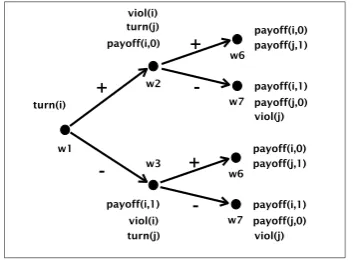
A much quicker procedure would consist in updating modelm0
trying to inherit its implementation mechanism. This can be done by simply modifying the extension of atom viol(i) in order for it to include statew3, thereby
au-tomatically triggering the enforcement norms expressed in Formulae (15) and (16). As a result, the enforcement mechanism in place in modelm0are imported “for free” bym” via simply changing the meaning ofviol(i) (Figure12). As
you can see, the payoffs for enforcerjare different from Figure10.
payoff(i,0)
payoff(i,1) w1
w3 w2
w7 w6
payoff(i,1) payoff(i,0)
viol(i) turn(j) turn(j)
turn(i) +
- +
-payoff(j,1)
payoff(j,0) viol(i)
payoff(i,0)
payoff(i,1) w7 w6
+
-payoff(j,1)
payoff(j,0)
[image:18.595.209.386.299.430.2]viol(j) viol(j)
Figure 12: Implementation via norm change.
The update of the extension of viol(i) can be obtained, for instance, by adding the following norm to the system:
on(b,a)∧clear(b)∧clear(c)∧turn(i) → [move(b,a,c)(i)]viol(i) (18) To put it otherwise, such procedure exploits the nature ofviol(i) as an interme-diate concept occurring as precondition of other norms. In this case the norms involved are the enforcement norms expressed in Formulae (15) and (16).
7
Related work
In this section we consider whether existing work in normative multiagent systems is able to answer the equation discussed in the introduction.
BDI : Agent Programming = ? : NMAS Programming.
of an agent logic and a modal deontic logic. The drawback of this approach is that the norms are nor represented explicitly.
Another obvious candidate for the question mark is a theory of normative systems [1]. Whereas deontic logic assumes a normative system such as a legal code in the background which is not made explicit, a normative system makes the norms themselves explicit, such that we can say that a norm is active, in force, violated, and so on [47]. See [25] for an up to date review on the distinction between a theory of norative systems and deontic logic, and the challenge to bridge the two. A theory of normative systems is useful for norm representation and reasoning, but not for the representation of aspects such as the multiagent structure of a normative system.
The first candidate for the question mark is Tennenholtz and Shoham’s game-theoretic approach to artificial social systems. However, the central re-search question of their work [43,44,45] consists in studying the emergence of desirable social properties under the assumption that a given social law is followed by the agents in the society at hands. The problem of how a social law can be implemented in the society is not discussed.
The second candidate is Boella and van der Torre’s game-theoretic approach to normative multiagent systems, which studies the more general problem of norm creation [7,12,11]. For example, the introduction of a new norm with sanctions is modeled as enforceable norms in artificial social systems as the choice among various strategic games [8]. They focus in particular on the enforcement of norms using enforcers, and discuss the role of procedural norms to motivate the enforcers [9]. They consider the creation of a new norm into a system of norms, whereas in this paper we do not consider the effect of norm implementation on existing norms. They argue that the infinite regression of enforcers can be broken if we assume that enforcers control each other and do not cooperate [8]. Since they use strategic rather than extensive games they cannot distinguish some subtle features of implementation such as retarded preconditions. Moreover, they do not give a procedure to go from a norm to its implemented system. Finally, they do not consider other methods than sanctioning and rewarding to implement their norms. They do consider also cognitive extensions of their model, which we do not consider in this paper. See [11] for a detailed discussion on their approach.
There are many organizational and institutional theories, such as the ones proposed in [23], and there is a lot of work on coordination and the environment [20,40]. Institutions are built using constitutive norms defining intermediate concepts. However, this work is orthogonal to the work presented in this paper in as much as, although sporadically addressing one or another form of implementation, it never aims at laying the ground of an overarching formal framework.
8
Conclusions
en-forcers, and implementation via norm change. The logical analysis (e.g., in a dynamic logic setting) of the update operations sketched here is future work. Such an analysis will make some intricacies of implementation explicit, such as, for instance the fact that by implementing new norms, the implementation of other norms might end up being disrupted.
Moreover, we introduce two views on representing forbidden actions, the classical one in which the precondition has to be satisfied before the action can be executed, and one based on so-called retarded preconditions. The two views coincide if the language allows for action names, and we can include as part of the state a list of which actions are allowed in this state. This can be formalised by the predicate allowed(X), where X are names for actions. The allowed(X) predicate can be part of the preconditions ofX. We can use the feedback arrows of retarded preconditions in Kripke models to change accessibility. This will implement the severed connections in the diagrams, and the semantics would then bereactive Kripke models.Consider for example the restriction ”you should not take any action three times in a row.” With retarded preconditions, we can do a “roll-back” when the action occurs three times in a row, whereas with regimentation we have to predict whether the action is going to be executed three times rather than two or four times. A further comparison of the two views is topic for further research.
Finally, topics for further research are also the development of a more de-tailed classification of norm implementation methods, the application of re-tarded preconditions to the analysis of ambiguous norms.
Acknowledgments.
Davide Grossi is supported by: Nederlandse Organisatie voor Wetenschappelijk Onderzoek(VENI grant 639.021.816).
References
[1] C. E. Alchourr ´on and E. Bulygin.Normative Systems. Springer Verlag, 1971. [2] A.R. Anderson. A reduction of deontic logic to alethic modal logic.Mind,
22:100–103, 1958.
[3] J. van Benthem. Extensive games as process models. Journal of Logic, Language and Information, 11:289–313, 2002.
[4] J. van Benthem. Logic in games. Lecture Notes of the ILLC graduate course on Logic, Language and Information, Universiteit van Amsterdam, Amsterdam, The Netherlands, 2005.
[5] J. van Benthem, J. van Eijck, and V. Stebletsova. Modal logic, transition systems and processes.Journal of Logic and Computation, 4(5):811–855, 1994. [6] P. Blackburn, M. de Rijke, and Y. Venema. Modal Logic. Cambridge
Uni-versity Press, Cambridge, 2001.
[8] G. Boella and L. van der Torre. Enforceable social laws. InProcs. of 4th International Joint Conference on Autonomous Agents and Multiagent Systems (AAMAS’05), pages 682–689, New York (NJ), 2005. ACM Press.
[9] G. Boella and L. van der Torre. Substantive and procedural norms in normative multiagent systems.Journal of Applied Logic, in press.
[10] G. Boella, L. van der Torre, and H. Verhagen. Introduction to normative multi-agent systems.Computational and Mathematical Organization Theory, 12(2-3):71–79, 2006.
[11] Guido Boella and Leendert van der Torre. A game-theoretic approach to normative multi-agent systems. In Guido Boella, Leon van der Torre, and Harko Verhagen, editors, Normative Multi-agent Systems, number 07122 in Dagstuhl Seminar Proceedings. Internationales Begegnungs- und Forschungszentrum fuer Informatik (IBFI), Schloss Dagstuhl, Germany, 2007.
[12] Guido Boella and Leendert van der Torre. A game-theoretic approach to normative multi-agent systems. InNormative Multi-agent Systems (Nor-MAS’07), in press.
[13] Guido Boella, Leon van der Torre, and Harko Verhagen, editors. Norma-tive Multi-Agent Systems, number 07122 in Dagstuhl Seminar Proceed-ings. Internationales Begegnungs- und Forschungszentrum fuer Infor-matik (IBFI), Schloss Dagstuhl, Germany, 2007.
[14] W. Briggs and D. Cook. Flexible social laws. InProceedings 14th International Joint Conference on Artificial Intelligence, pages 688–693, 1995.
[15] J. Broersen, M. Dastani, J. Hulstijn, and L. van der Torre. Goal generation in the BOID architecture.Cognitive Science Quarterly, 2(3-4):428–447, 2002. [16] Jan Broersen, Mehdi Dastani, and Leendert van der Torre. Bdioctl: Obli-gations and the specification of agent behavior. InProceedings of IJCAI’03, pages 1389–1390, 2003.
[17] P. R. Cohen and H. J. Levesque. Intention is choice with commitment. Artificial Intelligence, 42(2-3):213–261, 1990.
[18] Rosaria Conte, Cristiano Castelfranchi, and Frank Dignum. Autonomous norm acceptance. In J ¨org M ¨uller, Munindar P. Singh, and Anand S. Rao, editors,Proceedings of the 5th International Workshop on Intelligent Agents V : Agent Theories, Architectures, and Languages (ATAL-98), volume 1555, pages 99–112. Springer-Verlag: Heidelberg, Germany, 1999.
[21] D. Fitoussi and M. Tennenholtz. Choosing social laws for multi-agent systems: Minimality and simplicity. Artificial Intel ligence, 119:61–101, 2000.
[22] A. Garcia-Camino, P. Noriega, and J. A. Rodriguez-Aguilar. Implementing norms in electronic institutions. InAAMAS ’05: Proceedings of the fourth international joint conference on Autonomous agents and multiagent systems, pages 667–673. ACM Press, 2005.
[23] D. Grossi.Designing Invisible Handcuffs. Formal Investigations in Institutions and Organizations for Multi-agent Systems. PhD thesis, Utrecht University, SIKS, 2007.
[24] D. Grossi, H. Aldewereld, and F. Dignum. Ubi lex ibi poena. designing norm enforcement in electronic institutions. In V. Dignum, N. Fornara, P. Noriega, G. Boella, O. Boissier, E. Matson, and J. V´azquez-Salceda, J.zquez-Salceda, editors,Proceedings of COIN@AAMAS’06, volume 4386 of LNCS, pages 101–114. Springer, 2006.
[25] Joerg Hansen.Imperatives and Deontic Logic: On the Semantic Foundations of Deontic Logic. University of Leipzig, 2008.
[26] W. van der Hoek, M. Roberts, and M. Wooldridge. Social laws in alternat-ing time: Effectiveness, feasibility, and synthesis. Synthese, 156(1), 2007. [27] L. Hurwicz. Optimality and informational efficiency in resource allocation
processes. In K. Arrow, S. Karlin, and P. Suppes, editors, Mathematical Methods in the Social Sciences. Stanford University Press, 1960.
[28] M. O. Jackson. A crash course in implementation theory. Social Choice and Welfare, 18:655–708, 2001.
[29] M. O. Jackson. Mechanism theory. In U. Derigs, editor,Encyclopedia of Life Support Systems. EOLSS Publishers, 2003.
[30] A. J. I. Jones and M. Sergot. On the characterization of law and computer systems.Deontic Logic in Computer Science, pages 275–307, 1993.
[31] S. Kanger. New fondations for ethical theory. In R. Hilpinen, editor,Deontic Logic: Introductory and Systematic Readings, pages 36–58. Reidel Publishing Company, 1971.
[32] L. Lindahl and J. Odelstad. Open and closed intermediaries in normative systems. In T.M. van Engers, editor,Proceedings of the Nineteenth JURIX Conference on Legal Knowledge and Information Systems (JURIX 2006), pages 91–100, 2006.
[33] F. Lopez, M. Luck, and M. d’Inverno. A normative framework for agent-based systems.Computational and Mathematical Organization Theory, 12:227– 250, 2006.
[35] J.-J.Ch Meyer. A different approach to deontic logic: Deontic logic viewed as a variant of dynamic logic.Notre Dame Journal of Formal Logic, 29(1):109– 136, 1988.
[36] D. C. North. Institutions, Institutional Change and Economic Performance. Cambridge University Press, Cambridge, 1990.
[37] S. Onn and M. Tennenholtz. Determination of social laws for multi-agent mobilization.Artificial Intel ligence, 95:155–167, 1997.
[38] M. J. Osborne and A. Rubinstein. A Course in Game Theory. MIT Press, 1994.
[39] Anand S. Rao and Michael P. Georgeff. Modeling rational agents within a BDI-architecture. In James Allen, Richard Fikes, and Erik Sandewall, edi-tors,Proceedings of the 2nd International Conference on Principles of Knowledge Representation and Reasoning (KR’91), pages 473–484. Morgan Kaufmann publishers Inc.: San Mateo, CA, USA, 1991.
[40] A. Ricci, A. Omicini, and E. Denti. Activity theory as a framework for mas coordination. InProcs. of ESAW’02, pages 96–110, 2002.
[41] S. Russell and P. Norvig.Artificial Intelligence. A Modern Approach. Prentice Hall International, 2001.
[42] Y. Shoham and M. Tennenholtz. On the synthesis of useful social laws for artificial agent societies. InProceedings of the 10th National Conference on Artificial Intelligence, pages 276–281, 1992.
[43] Y. Shoham and M. Tennenholtz. On social laws for artificial agent societies: Off-line design. Artificial Intelligence, 73(1-2):231–252, 1995.
[44] Y. Shoham and M. Tennenholtz. On the emergence of social conventions: Modeling, analysis and simulations.Artificial Intelligence, 94(1–2):139–166, 1997.
[45] M. Tennenholtz. On stable social laws and qualitative equilibria.Artificial Intelligence, 102(1):1–20, 1998.
[46] M. Tennenholtz. On social constraints for rational agents. Computational Intelligence, 15(4), 1999.