Children’s Social Care Innovation Programme Evaluation Report 17
Firstline
Evaluation Report
January 2017
Lisa Holmes, Caroline Thomas,
Georgia Hyde-Dryden and Alison
2
Contents
List of figures 5
List of tables 6
Executive summary 7
The evaluation 7
Main findings 8
Findings related to the programme’s core components 9
Implications and recommendations for policy and practice 10
Overview of the project 12
Part 1: Research and analysis 13
Part 2: Raising partner local authorities’ awareness of actions to support
outstanding leadership 14
Part 3: Development and delivery of the prototype of the Firstline leadership
programme 14
Context within which the programme was delivered 15
Overview of the evaluation 16
Methods 16
Key findings 18
How far has the innovation achieved its intended outcomes? 18 The experience and effectiveness of the prototype programme 19
Residential modules 19
Leadership Development Advisors (LDAs) 20
Action Learning Sets (ALSs) 21
Projects 22
Diagnostics of Leadership Styles and Organisational Climates 24
Simulated supervision sessions 26
Verbal Reasoning Assessments 26
Continuing learning post programme-delivery 27
Effectiveness of the recruitment process 28
3
FLLs’ social work teams’ perceptions of the overall impact of the Firstline
programme 30
The effect of partner local authorities on the FLLs’ learning and development from
the programme 32
Praxis 33
Kick-Off meetings 34
The effect of FLLs’ participation in the programme on the partner authorities 36 Evidence of the innovation’s impact on the Innovation Programme’s objectives and
areas of focus 37
Professional practice and methods of social care 37
Organisational and workforce culture in social care 38
National systemic conditions 38
What lessons have been learned about the barriers to this programme? 39 What lessons have been learned about the facilitators to this programme? 39
Limitations of the evaluation and future evaluation 41
How appropriate was the evaluative approach for this programme? 41
Limitations of the evaluation 41
Outline any capacity building for future evaluation and the sustainability of the
evaluation 42
Further evaluation 42
Measuring impact 42
Value for money 43
Implications and recommendations for policy and practice 45 Evaluative evidence, or lack of, for capacity and sustainability of the programme 45
Capacity 45
Sustainability 45
Conditions necessary for the programme to be embedded 48
Recommendations for the future development of the programme 48
Action Learning Sets 49
Projects 50
Conclusion 51
4
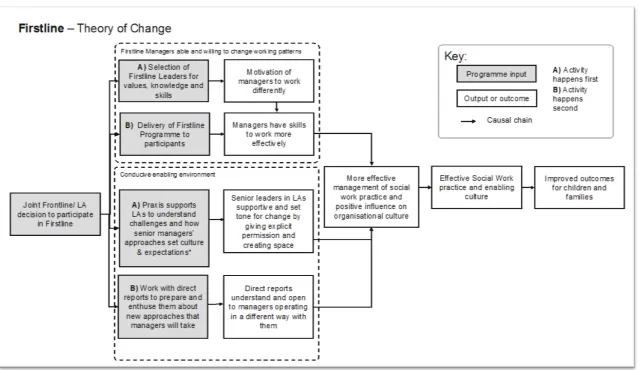
Appendix 1: Firstline Theory of Change Model 54
Appendix 2: Firstline capability framework 55
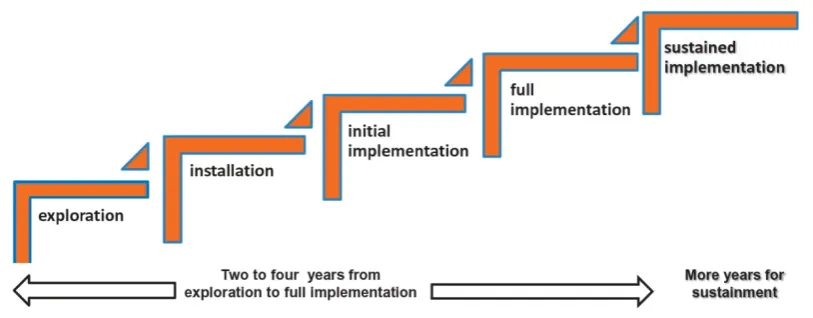
Appendix 3: Stages of implementation 70
Appendix 4: Firstline in the marketplace 71
Introduction 71
Data sources 71
Other available provision 71
Key and distinct features of the Firstline programme 72
5
List of figures
Figure 1: Programme timeline 15
Figure 2: Firstline Theory of Change Model 54
6
List of tables
7
Executive summary
Firstline designed and delivered a prototype leadership development programme for first line managers working in children and families social work. It aimed to enable good managers to become high-performing and influential leaders in social work and wider society. The project was led by the Firstline team within The Frontline
Organisation.
The evaluation
The evaluation’s key questions related to the experiences of those involved in the prototype; the effectiveness of the prototype in developing the Firstline Leaders (FLLs) as leaders; the effect of the prototype on local authorities, and the effect of local authorities on their FLLs’ participation.
The prototype programme was delivered between September 2015 and March 2016. Forty FLLs were recruited from 8 local authorities. Thirty-seven completed the
programme. They participated in a Kick-Off meeting; 3 2-day residential modules; 6 2-hour individual meetings with a Leadership Development Adviser (LDA); 3 on-site Action Learning Sets (ALSs) with other FLLs in their local authorities and a Wrap-Up meeting. The FLLs undertook a project, and assessments of their leadership styles and organisational climate. They also had the option to participate in simulated supervision sessions and verbal reasoning assessments.
A process evaluation was undertaken using a range of research methods between October 2015 and July 2016. An action learning approach was applied. The
evaluation design evolved during the prototype. Qualitative data were collected from:
• observations of 8 Kick-Off and 8 Wrap-Up meetings; one LDAs debriefing meetings, and 3 2-day residential modules
• in-depth semi-structured telephone interviews with 27 of 37 FLLs, one month post-programme; 22 of 27 previously interviewed FLLs, 4 months post programme; all 6 residential Facilitators; all 10 LDAs; 3 of 4 members of the Technical Advisory Group; and 2 of 3 Reference Group members. • in-depth semi-structured face-to-face interviews with the Firstline team • focus Groups with the social work teams of 8 FLLs
8
Main findings
The FLLs gave overwhelmingly positive feedback about the programme. They were hungry for the opportunities it offered for their professional development. The
majority considered that it represented the best training and professional development that they had received as managers and leaders.
Most of the FLLs suggested that their participation had been quite a shock to their systems. They acknowledged that the programme demanded that they examine and explore themselves in unexpectedly personal ways. They viewed the experience as challenging.
Unsurprisingly, given the short timescale for the evaluation, most of the findings relate to the implementation of the programme. Nevertheless, there were signs of the prototype having had a positive impact on the FLLs’ leadership capabilities and social work practice.
The FLLs reported that the programme helped them to think more about other people’s perspectives and be more reflexive. They learned to reframe issues, act differently, and view difficult situations more positively, and had become more mindful and self-aware.
The FLLs described their improved professional practice being applied to methods for supervision, and the leadership of team meetings, to encourage case discussion (rather than simply the agreement of next actions), and to influence change in their local authorities’ policies and systems.
Social workers reported perceived improvements in their FLLs’ capabilities for:
• learning and developing others (majority in all 8 focus groups). For example, social workers in 1 focus group described their FLL giving more specific and detailed feedback on practice observations
• holding to account (6 of 8 groups)
• analysis and decision making (4 of 8 groups) • decision making (4 of 8 groups)
In relation to staff retention, since the completion of the programme, 4 leaders who had been planning to leave their posts had decided to stay. About a third (33%) had secured, or were considering applying for, more senior or new leadership positions.
9
working in similar positions within their authorities. A minority also gave examples of influencing senior managers. They described approaching challenging people and difficult conversations in new ways by looking at situations differently and being more aware of other people’s perspectives.
Most senior managers had difficulties distinguishing between the Firstline
programme’s wider impact on their organisations and that of other developments within their authorities, for instance, the restructuring of services. Nevertheless, they reported that they intended to use FLLs’ projects to spread the FLLs’ learning from the programme across their authorities and, in some instances, for FLLs to
contribute to the development of policy and practice beyond their immediate teams.
The recruitment process for the programme was effective in selecting FLLs who were able to respond positively and well to a range of opportunities the programme offered for their learning and development. (The FLLs reacted differently to different parts of the programme according to their different learning styles.) A small minority struggled to respond positively to their LDAs’ challenge and feedback, and may not have had the required capacity to change.
Findings related to the programme’s core components
The programme was viewed as a whole package. All the core components – the individual sessions with a LDA, residential events, ALSs and project – enabled FLLs to trial new or different leadership skills. All the FLLs particularly valued support and challenge from their LDAs. The LDAs were highly skilled and experienced. The FLLs also appreciated the opportunity that the Firstline programme provided to focus on their learning away from the demands of their usual work and home environments during the residential modules. The opportunities the residential modules offered for FLLs to learn from other FLLs in other local authorities were also universally valued. The Facilitators were judged to be of high calibre.
The experiences of the ALSs were more mixed, with 2 of the 9 groups working well. In future the leadership of ALSs needs to be more consistent, and issues of
confidentiality and trust need more careful attention. Nevertheless, most FLLs were inspired by learning within a peer group at a local level to try to continue to meet in local and/or regional group ALSs. The interviews with FLLs at 4 months after the completion of the programme suggested that they may need more local support to do so.
10
project should be on the FLLs’ personal development as a leader or effecting changes within their authorities.
The majority of the FLLs were positive about the diagnostic exercises, even if they had not enjoyed the process of completing the related surveys. Most felt that their reports and verbal feedback had provided them with welcome new knowledge about themselves. They particularly appreciated the insight they gained from the feedback from their social work teams, some of which challenged their self-perceptions. The small number (6) of FLLs who were interviewed and participated in the
simulated supervision sessions welcomed an extra opportunity to learn something about themselves and/or their leadership skills as supervisors of social workers.
All the 22 FLLs who were interviewed for a second time reported that they had been able to sustain their learning to varying degrees following completion of the
programme. About two-thirds (67%) of them had continued to progress their projects. They acknowledged it was difficult for them to maintain momentum and contact with other FLLs, and required more support to do so. Limitations on the FLLs’ time and heavy workloads were cited by half (50%) of them as hindering their continued learning.
Implications and recommendations for policy and practice
The evidence gathered about the experience and effectiveness of the prototype programme suggests that the Firstline programmes should be encouraged and expanded with continuing evaluation. All those who participated in the evaluation agreed that there was a continuing need for leadership development programmes within children and families social work. Within the field, the Firstline programme is targeted at good managers to enable them to become high-performing and influential leaders in social work and wider society. A minority of senior managers from the local authorities expressed concerns that the programme was elitist. The Firstline team, therefore, needs to continue to emphasise its rationale for investing in the already good managers in relation to its mission. The evaluation highlighted the need for a national strategy for leadership development in social work to ensure that the development needs of other first line managers in children and families social work are also met.11
authorities, and the size of the budgets available for supporting workforce
12
Overview of the project
The Firstline team designed and delivered a prototype leadership development programme for first line managers working in children and families social care. It aimed to enable good managers to become high-performing and influential leaders in social work and wider society. It was not designed for all first-line managers.
The Firstline team views first-line managers as agents for ‘transformational practice in social work’, with significant power to affect the quality of service delivery. Linked to this vision, the Firstline team’s broader and longer-term aim was to change the culture within the participating local authorities to be more supportive to, and
challenging of, the management of social work practice. It sought to redirect more of the managers’ skills and expertise towards the development of excellent practice, rather than the management of processes.
The Firstline team explains:
The Firstline programme is tailored specifically to social work managers, already in post and operating at a good level. The decision to do so was taken after much calculated deliberation which focussed wholly on how to ensure the programme had the greatest possible impact on:
• individual development - by ensuring the cohort is at a similar point in their development and the content is pitched high - so that individuals are driven and challenged
• system wide improvement by:
o focussing on those already operating within, and therefore
maximising the existing knowledge of, the local authority practice system
o targeting those in the profession that can have the most, and most immediate, impact, thus driving the upward movement of the workforce
13
The initial concept for the Firstline programme and its theory of change1 was
generated by The Frontline Organisation’s leadership team, and the funding for the prototype was secured by The Frontline Organisation2. The project was then
developed and implemented by a dedicated Firstline team based at The Frontline Organisation’s head office. The Firstline team created the structure of the prototype programme, and the content subsequently evolved as findings emerged from the research. In the early stages of the programme’s development, the team was also advised by a Technical Advisory Group and a Reference Group. The development of the prototype and the implementation process were overseen by The Frontline
Organisation’s Board.
To achieve its aims, the project was divided into 3 parts:
• research and analysis
• a method to raise partner local authorities’ awareness of actions needed to improve and sustain the working environments required for outstanding leadership in children and families social work
• the development and delivery of the prototype of the Firstline leadership programme
Part 1: Research and analysis
To ensure the Firstline programme focused on the factors that have an effect on first line managers, research was undertaken to:
• define outstanding first-line management in a children’s social care context • identify the factors in a local authority context that help or hinder first line
leaders
• define what organisations can do to improve effective first line leadership
The research was a collaboration between the Firstline teamand the Hay Group3.
1 See Appendix 1.
2 The Frontline Organisation is a charity which provides a new practice-based training route into social
work. See: The Frontline.
3 The Hay Group is a long-established global management consulting firm which works with the
14
Part 2: Raising partner local authorities’ awareness of
actions to support outstanding leadership
The Praxis tools and exercises were designed to help Firstline to work collaboratively with each of its partner local authorities to identify any actions that were needed to improve and sustain the working environments required for outstanding leadership in children and families social work.
Part 3: Development and delivery of the prototype of the
Firstline leadership programme
Forty FirstlineLeaders (FLLs) were recruited to the prototype from 8 partner local authorities. To be eligible for the programme they were required to be spending the majority of their time managing social workers. The group included a mix of team managers, assistant team managers, senior social workers, and consultant social workers.4 They came from different parts of the children’s social care system, including referral and assessment, child protection and fostering teams.
The FLLs participated in the programme between September 2015 and March 2016 and during this 7-month period, FLLs participated in:
• a Kick-Off meeting
• 3 2-day residential modules
• 6 2-hour 1-to-1 meetings with a Leadership Development Adviser (LDA) • 3 on-site Action Learning Sets (ALSs) with other FLLs in their local authorities • a Wrap-Up meeting
The FLLs also undertook a project, and assessments of the leadership styles and the climate they experienced and created within their teams. They were also offered an opportunity to participate in simulated supervision sessions and verbal reasoning assessments.
4 A ‘consultant social worker’ is an experienced social worker leading and/or supervising a small
15
[image:15.595.77.525.182.268.2]The timeline below (reproduced from the Firstline leadership programme handbook) illustrates the sequence of individual elements that made up the prototype Firstline Leadership Programme.
Figure 1: Programme timeline
16
Overview of the evaluation
The evaluation focused on aspects of the third part of the project, as detailed above. The overarching aims of the evaluation were to explore the implementation and effectiveness of the prototype programme in the 8 participating local authorities at:
• a Firstline Leader level, by examining the extent to which the Firstline
development programme enabled good managers to become high-performing and influential leaders
• a systems level, by considering the FLLs’ organisational climate
The key evaluation questions were:
• how did the FLLs and those involved in the development and delivery of the programme experience the prototype programme?
• how effective was the prototype in developing the FLLs as leaders, and enabling and supporting them to put their learning into practice?
• what effect did the partner local authorities’ have on the FLLs’ learning and development from the prototype, and what effect did the FLLs’ participation in the prototype have on the partner local authorities?
Methods
A process evaluation was undertaken using a range of qualitative research methods. An action learning approach was applied to support the Firstline team’s reflective learning approach to their work, and to allow for the ongoing and future development of the Firstline programme to be informed by emerging findings. There was an open dialogue and exchange of information between the Firstline and the evaluation team. Furthermore, the design of the evaluation evolved over the course of the delivery of the prototype programme to ensure that the data collection and analysis remained appropriate. A mixed methods approach was used for the data collection and analysis between October 2015 and July 2016. This included the collection of
primary data, a series of observations, and the secondary analysis of data that were collected by the Firstline team. The following data were collected during and after the delivery of the programme between October 2015 and February 2016:
• observation of a Kick Off and Wrap-Up meeting in each of the 8 local authorities
• observation of 3 2-day residential events in York
17
• observation of a large group debriefing meeting in London of the 10 LDAs with the Firstline team at the end of the programme
• in-depth semi-structured telephone interviews with:
• 27 of the 37 FLLs who completed the programme, 1 month after the completion of the programme5
• 22 of the 27 FLLs who had been interviewed previously, 4 months after the completion of the programme
• All 6 of the Facilitators of the residential modules • All 10 of the LDAs
• 10 of 14 Senior Managers in partner local authorities • 3 of 4 members of the Technical Advisory Group • 2 of 3 members of the Reference Group
• in-depth semi-structured face-to-face interviews with 4 members of the Firstline team
• focus groups with the social work teams of 8 FLLs6
The evaluators also analysed data collected by Firstline, including film from a sample of LDA sessions and FLLs’ brief descriptions of their projects, and examined the Evidence Capture Reports from the 8 Praxis exercises7.
5 The evaluation team knows from discussions with FLLs immediately after Wrap-Up meetings that
those who did not participate in interviews felt too busy and/or that they had already provided sufficient feedback on the programme directly to the Firstline team. The evaluation team is confident that the overall views and experiences of the programme of the FLLs who were interviewed were similar to those who were not from their contributions to the Wrap-Up meetings.
6 Twenty-seven FLLs were asked at the end of their first interview if, in principle, they would be willing
to ask their teams to participate in a focus group. The majority agreed to do so. The minority who did not agree explained that they were working with new teams who would not have observed changes in their leadership since the start of the programme. One social work team was then selected for a focus group in each of 7 of the 8 local authorities. Two social work teams were selected from the authority with the largest number of FLLs. The selection ensured the evaluation included a range of teams who were led by Senior Social Workers, Team Managers or Consultant Social Workers. Subsequently, it was not possible to arrange a group in 1 of the local authorities because of staff turnover.
18
Key findings
How far has the innovation achieved its intended
outcomes?
The 3 parts of the Firstline project have been completed:
• the research and analysis has been published (Firstline, 2015) • the Praxis method has been developed and implemented
• the prototype of the Firstline leadership development programme has been developed and delivered
This process evaluation has focused on the outcomes of the third part of the project: that is, the experiences and effectiveness of the leadership development
programme, and addressed the key evaluation questions referred to above.
The key findings are that the FLLs were overwhelmingly positive about participating in the programme, and experienced it as thought-provoking, challenging and
rewarding. They reported that it had been quite a shock to their systems and acknowledged that the programme demanded that they examine and explore
themselves in unexpectedly personal ways. The Leaders provided examples of ways in which the programme had had a positive impact on their professional leadership. Social workers in the FLLs’ teams and their senior managers also reported that they had perceived changes in the FLLs’ leadership capabilities. The evaluation found particular evidence of improved professional practice being applied to the FLLs’ methods for supervision, team meetings and influencing change in policies and systems within their authorities.
These key findings relate to both the experiences and effectiveness of the
19
The experience and effectiveness of the prototype
programme
8The FLLs regarded the programme as a whole package with the components – the residential modules, LDA individual development sessions, ALSs and projects – complementing each other:
It’s almost like a tiered triangle, if you like, that builds from the residential modules. They were the bottom layer. The ALSs were the middle layer for me that brought in lots of learning from the residential - lots of the subject matter and group discussion. The top of the triangle, if you like, were the 1-to-1 sessions with the LDA - they just made sense of it … It’s a piece of learning that has 3 different elements - that build and build - which are quite distinctive but intrinsically linked. (FLL).
Residential modules
It was evident that the FLLs enjoyed, and were energised by, the buzz of the
residential modules. They relished time away from the demands of their usual work and home environments to commit to learning and development. There was a high rate of FLL attendance at all sessions – 1 FLL missed 2 days and 2 others missed 1 of the 6 days. The FLLs were highly engaged, and very rarely used their mobile phones to take calls or check their emails during sessions or in their breaks.
Furthermore, Firstline had carefully considered how to reach people in different ways in its curriculum development. The FLLs valued different elements of the residential
8The analysis of the data from the observations of large group meetings did not involve the
quantifying of individual participants’ views and experiences. Therefore, where the data analysis from these meetings has been combined with that from the interview datasets, proportions rather than specific figures have been provided to indicate the weight of the evidence.
FLLs attended 3 2-day residential modules in York, which took place at intervals of approximately 6 to 8 weeks throughout the Firstline leadership programme. Each residential focused on a different theme: creating my personal vision; enabling change, and making it happen; and involved a mixture of formats including presentations, group exercises, role play, and paired and group
20
modules according to their learning styles. The facilitators were of high calibre, and reflexive and exceptionally responsive to feedback between sessions and the residential days. They had good preparation and support from the Firstline team.
The residential modules also gave FLLs opportunities to meet and learn from other FLLs in their own and other local authorities. These large group experiences gave the FLLs a strong sense of belonging, which should help to strengthen their identities as leaders in social work and wider society. The Firstline team operated as a well-oiled machine for its organisation of the residential modules. The majority of the FLLs and Facilitators, and the Firstline team, were positive about them and the York location was considered by FLLs to be just the right distance from their homes and offices in the north and south. The hotels were experienced as comfortable with good catering, and the FLLs consequently reported that they felt valued and well looked after.
Leadership Development Advisors (LDAs)
Ten LDAs were recruited to work closely on an individual basis with FLLs to help them develop their leadership styles and skills through a combination of support, challenge and coaching. The LDAs were required to have at least one of the following:
• extensive experience managing social workers and an understanding of children’s social work
• a qualification and experience of working with systemic approaches • a qualification and experience of coaching
To assist the Firstline team in identifying the most appropriate LDA for each FLL, FLLs were asked to complete a short online survey. FLLs were then provided with biographies for at least 2 LDAs and asked to confirm their preference. The
21
The individual development sessions with their LDAs were the most well received part of the programme and it was evident that the FLLs had good relationships with their LDAs following careful matching by Firstline.9 The LDAs were perceived as
highly skilled and experienced:
She ‘got us’ after working with us for just 20 minutes. I don’t have that with my supervisor. It was such a privilege to work with someone with her intellectual capacity. (FLL).
The FLLs appreciated the LDAs’ focus on their learning, and/or constructive challenge, and/or encouragement to reframe information and reflect on others’ perspectives.
The LDAs indicated that they were attracted to the Firstlineteam’s clear mission, ethos and values, and were excited by their role, and had good training, preparation and support from the Firstline team.
It was an exciting way to effect change in an organisation – not supervision and not teaching. It wasn’t management but helping leaders on a journey. The structure and support and good organisation of the programme helped make it a positive experience for me. And I felt contained in what was challenging, hard and difficult work. (LDA).
The programme was effective in encouraging 19 of the 27 FLLs to use, or plan to use, at the time of the first interview, elements of the LDAs’ approaches to their one-to-one sessions in their supervision of their individual team members.
Action Learning Sets (ALSs)
9 Only 1 FLL changed their LDA during the course of the programme.
22
The majority of FLLs reported that theoretically the ALSs should have provided a good model for group working and reflection which should have allowed for the discussion of professional dilemmas and action planning. Just over half the FLLs questioned the effectiveness of the ALSs that were delivered during the prototype. The majority of these FLLs would have appreciated more clarity and focus about their purpose. Other challenges with the ALSs were raised, including inconsistencies in the timing of sessions and LDA facilitation10; difficulties with confidentiality and
trust between participants; and tensions created by the inclusion of FLLs from different management levels within the same groups.
The ALSs in 2 of the 8 local authorities worked well, and were experienced as supportive and helped the FLLs to build confidence:
…We worked well together. We had a shared goal or view of what we wanted from it and we had two LDAs that were supportive, challenged, modelled, and focused. The sessions were fun, interesting, challenging, to us all… (FLL).
These positively experienced ALSs were characterised by:
• consistency in the participation of the LDAs
• issues of trust and confidentiality being dealt with well if they arose • a shared understanding within the group about its purpose
Projects
The FLLs reported that the projects provided an opportunity to do something within their professional lives that they wanted to do. The FLLs used the projects in the following ways:
23
• to develop their own skills together with developing their team (25 FLLs) • to develop their own skills to have an impact on the wider organisation (10
FLLs)
• to develop an individual within their team (2 FLLs)
Some projects focused on practice, such as introducing feedback from children and families into a quality assurance process to improve the service, and changing team cultures to improve relationships between teams. Others focused more on
management, for example, facilitating systems of peer support for social workers or management groups, and developing supportive models of working with social workers who were struggling with particular aspects of their practice by offering a period of coaching and mentoring.
It was evident that the projects did not work as well as the Firstline team would have liked during the prototype. The FLLs had mixed experiences: some were able to identify quickly a project aim, which aligned with their personal goals for the programme and consequently gained a lot of learning from it. Others struggled to understand the concept and what was required of them. The FLLs wanted more clarity about whether the focus of the project should be on their own personal development as a leader or effecting changes within their local authorities. More clarity was also needed about its links, if any, to the development exercises in the recruitment process and the reports on their areas of development, the diagnostic exercises and the FLLs’ wider development of their leadership skills. The timing (the length of time and the fact that the project spanned the Christmas holidays) was a challenge, particularly for those who were trying to have a positive impact on the wider organisation as they developed their own skills and completed the written element of the project, despite the briefest of written reports being required. It was also suggested that the project be renamed.
24
Diagnostics of Leadership Styles and Organisational Climates
The majority of the FLLs were positive about the externally administered diagnostic exercises. They valued the individual feedback they received from the Hay Group. Most of the FLLs felt that their reports and verbal feedback had provided them with welcome new knowledge about themselves. They particularly appreciated the insight they gained from the feedback from their social work teams, some of which
challenged their perceptions of themselves.
It showed me I was practising more styles than I thought. I didn’t realise I was coaching and pace-setting as much as I was. (FLL).
The diagnostics were undertaken by the Hay Group and provided the FLLs with assessments of their leadership styles, the climate they experienced and the climate they created for others, and their personal motives and values. They involved FLLs and their team members completing online surveys. The data were used to create reports for each FLL. The Hay Group discussed the report
feedback with FLLs individually.
The Leadership Styles Feedback Report provided FLLs with feedback on the measurement of their use of 6 leadership styles (Directive, Visionary, Affiliative, Participative, Pacesetting, and Coaching). It compared their own perception of their leadership styles with their behaviour as experienced by their teams. The feedback included quantitative scores which compared the FLLs’ performance with a representative sample from the Hay Group’s global database and
comments from FLLs and their teams. Depending on the scores, the report then suggested actions that could be taken to improve their performance in each leadership-style category.
The Organisational Climate Feedback Report used 6 climate dimensions
(Flexibility, Responsibility, Standards, Rewards, Clarity, and Team Commitment) to measure and compare participants' own perception of the organisational climate they create with that experienced by their teams. The feedback included quantitative scores (in figures and diagrams) which compared performance with a representative sample from the Hay Group’s global database and comments about the scores attained in each dimension. Depending on the scores, the report then detailed the next steps that could be taken to improve the participant's
25
Two-thirds (67%) of the 27 FLLs who were interviewed one month after the completion of the programme identified positive changes that they had made in their practice, or were planning to make, which they directly linked to the feedback on their leadership styles.
It increased my confidence. I’ve been a manager for 5 or 6 years and only been on a generic management course. I was feeling in the dark and trying to balance things. But it said there were things I was doing well and my style was effective, and helped me to develop new and different styles. (FLL).
Two-thirds (67%) of 24 FLLs11 reported that they had used, or were planning to use,
the feedback on their climates in discussions with their managers and/or senior managers, and/or in team meetings.
The process of completing the surveys that underpinned the diagnostic exercise was experienced by half (50%) of the 27 FLLs as challenging, with people using words such as ‘tedious’, ‘laborious’ and ‘time consuming’ to describe the process. This may in part have been related to the exercise being undertaken in the run up to the
Christmas holiday when FLLs reported that they were feeling particularly pressured. A minority of FLLs wanted more guidance about whom in their teams to ask to complete the surveys. They also found their written feedback, particularly the diagrams relating to their climate, difficult to make sense of without seeing them in advance of their individual feedback session. A minority indicated that they had wanted more time to try to digest the content of the report before the feedback session.
There were mixed views on the most appropriate timing for the diagnostic. One LDA suggested that it had been useful to receive the diagnostic feedback at the end of the programme, as it reassured FLLs about their own understanding from their reflexive thinking. Another would have liked the report findings to have been available earlier, to use in individual development sessions. There was also a suggestion that, in the future, completing the diagnostic at the start and end of the programme would provide a useful form of benchmarking. In considering their own role in relation to the diagnostic, there was a suggestion that in the future, LDAs could be provided with more advanced information to enable them to better understand and discuss the report with FLLs.
11 24 of the 27 FLLs who were interviewed 1 month after the completion of the programme responded
26
Simulated supervision sessions
The 6 FLLs who were interviewed one month after completion of the programme, and had also chosen to participate in the simulated supervision sessions, welcomed an extra opportunity to learn something about themselves and/or their leadership skills as supervisors of social workers, in particular:
…To actually have someone external give you feedback on your supervision, it is something which is a bit of a privilege and something which you don't often get the chance to do, so I thought it to be useful. (FLL).
Those that declined the offer reported that they did so for a range of reasons including anxiety about the nature of the assessment, uncertainty about what they would learn, and competing demands on their time.
The sessions were offered at a point in the programme when the FLLs had recently completed their verbal reasoning assessment; and leadership styles and climate surveys, and received feedback from the diagnostics. The timing was unavoidable, given the overall timescale for the delivery of the programme.
Verbal Reasoning Assessments
About four-fifths (80%) of the 27 FLLs who participated in the interviews a month after the completion of the programme had chosen to be assessed. About a quarter
The simulated supervision sessions were an optional element of the programme. The FLLs were invited to take part in them during the second residential event. They were facilitated by the University of Bedfordshire. The FLLs and actors, who played the role of social workers, discussed case scenarios within a simulated supervision environment. The sessions were filmed and then assessed by the team at Bedfordshire. Personalised written feedback was then provided to the FLLs. The sessions and feedback were intended to provide FLLs with
opportunities to reflect on, and review, their leadership skills as supervisors of social workers.
27
(25%) of them thought it was a compulsory part of the programme. The FLLs did not receive feedback from the assessment.12
The Firstline team’s internal analysis of the verbal reasoning scores for FLLs who were assessed found no link between the verbal reasoning results and the FLLs’ scores in the development exercises. Analysis indicated that there was no link between the FLLs’ scores in the selection process and the LDAs’ assessment of their learning and development during the programme.
Continuing learning post programme-delivery
All but one of the 27 FLLs who were interviewed one month after the completion of the programme had considered how to continue their learning and development as a leader without the support of their LDA, and most had taken measures to do so. Just 3 FLLs mentioned in their first interviews being worried or concerned about the future of their learning and development without the support of their LDAs.
All the 22 FLLs who were interviewed for a second time13 reported that they had
been able to sustain their learning to varying degrees following completion of the course. About two-thirds (67%) of them were able to identify progress with their projects since the end of the programme. They said it was difficult for them to maintain momentum and contact with other FLLs. Limitations on the FLLs’ time and heavy workloads were cited by half (50%) of them as hindering their continued learning:
Because at the moment it's so busy and it doesn't seem to get any better. It’s quite impossible to even sit and have time to reflect, let alone consider the learning. (FLL).
FLLs reported mixed experiences of continuing ALS sessions with colleagues after the prototype. Regular sessions had continued in one authority where the prototype ALS had worked well, and the Assistant Director had made systemic changes to allow time for FLLs to attend. There appeared to have been less success in continuing ALSs in other authorities. The FLLs explained this in terms of other
12 The Firstline team was trialling the usefulness of the verbal reasoning assessments as a measure
of leadership, and found that they offered no additional valuable insights. Without any qualitative feedback being available and/or any obvious benefits, the provision of comparable scores was judged to be potentially demotivating.
28
demands on their time rather than of the challenges involved with the prototype ALSs. FLLs in 2 of the 8 authorities were intending to run sessions in future.
Two FLLs, in their follow-up interviews, described having had contact with FLLs from other local authorities. The FLLs interviewed for a second time had found little use for the email group or online platform, which appeared to be due in part to technical issues14, which had prevented them from using it.
Effectiveness of the recruitment process
The Firstline team’s standardised recruitment process was fair and transparent, and thorough and rigorous. It was effective in selecting FLLs who were able to respond positively and well to a range of opportunities which the programme offered for their learning and development. The FLLs reacted differently to different parts of the programme according to their different learning styles.
The process was generally effective in selecting FLLs who could use the support of their LDAs to put their learning into practice. The LDAs interviews and analysis of filmed LDA sessions suggested that a small minority struggled to respond positively
14 The FLLs’ access to the email group was blocked by some local authorities’ computer systems so
they could only access the group via their home computers. Consequently, Firstline set up an online platform, and encountered similar problems to a lesser degree. Subsequent work has taken place via Frontline’s Fellowship (alumni) and in the future the team will maintain contact with those who have completed the Firstline programme via this network.
29
to their LDAs’ challenge and feedback, and may not have had the required capacity to change (Kegan and Lahey, 2009)15.
The use of a scoring system during the development exercises the FLLs undertook, related to the capability framework16, worked well to determine who should be invited
to take part. The evaluation did not include any comparison groups of FLLs. It was therefore unable to assess whether the FLLs invited to take part in the programme were more able to put their learning into practice than a randomly selected group. Nevertheless, there was a clear and consistent gap in the average scores between the FLLs who were invited and those who were not. Analysis of the FLLs’ group scores showed that their mean average scores were higher for some capabilities (‘professional authority’ and ‘analysing and decision making’) than others (‘impact and influence’ and ‘learning and developing others’).
The group scores for future cohorts of FLLs could be used to inform the curriculum development of future programmes. The FLLs’ individual scores could also be used to inform the focus of their individual sessions with LDAs.
A minority of senior managers from the local authorities expressed concerns that the programme was offered exclusively to those FLLs who had been assessed as being good to enable them to become outstanding. As a result, they were concerned that the programme might be viewed as elitist. This highlighted the need for the Firstline team to continue to emphasise its rationale for investing in the already good in relation to its mission.17 It also drew attention to the need for a national strategy for
the provision of leadership development programmes to ensure that the
development needs of other first line managers in children and families social work are also met.
Further findings on the effectiveness of the programme
The effectiveness of the programme in developing the FLLs as leaders within their local authority was also considered by exploring the FLLs’ social work teams’ perceptions of the impact of the prototype programme and the impact on the FLLs’ local authorities
15 Robert Kegan and Lisa Lahey have developed a framework for thinking about the adaptability and
ability of the workforce to respond to challenge and feedback, and embrace change within complex contexts. The framework categorises individuals into three categories of ‘mindsets’.
30
FLLs’ social work teams’ perceptions of the overall impact
of the Firstline programme
The Firstline team and evaluators agreed that it was unlikely that all the changes in the FLLs’ capabilities were going to be visible to others within the timeframe of the evaluation, and in respect of the development of the prototype. There was
agreement that changes were likely to take at least 6 months to begin to embed. It was also agreed the FLLs were only likely to change in relation to some of the Firstline team’sleadership capabilities, and that some changes were likely to have been small and/or subtle given that the FLLs recruited to the programme were already good. Social workers from the FLLs’ teams were, nevertheless, able to identify a number of positive changes in relation to 6 of the 8 capabilities as part of the focus group discussions.18 19 They did not identify any negative changes.
Impact and influence: Social workers in 2 of the 8 focus groups reported that their FLLs had become markedly more confident since completing the Firstline
Programme: for instance, in influencing working relationships with other teams. Social workers in another authority, which was experiencing a period of significant change, noticed that since the prototype programme, their FLL had spoken to the Head of Service on behalf of the team:
She’s really championed us and some of the things that we’ve been anxious about … (FLL).
Others described a FLL returning from the programme with an increased
understanding of the standards in other teams; and a FLL being more open in their approach and better able to reframe critical information positively.
Learning and developing others: The majority of social workers in the 8 focus groups were positive about the ways in which their learning and development were
supported by their FLLs, although unable to identify any specific changes in how their FLL supported their learning and development. Social workers in one focus group described their FLL giving more specific and detailed feedback on practice observations. This FLL had also introduced regular meetings to provide social workers with a safe space to discuss their team, which has had a positive impact:
18 Further information about the leadership capabilities is available in Appendix 2.
19 The evaluation team suggests two possible explanations for changes not being observed in the
31
This is what we’re doing well; this is what we want to sustain but actually this isn’t working so well for us’. I suppose we never had that space before and I think we really appreciated it. (Social worker).
The same FLL promoted new ways of thinking about and exploring cases. Social workers in a different authority described their FLL stepping up to drive forward the use of research following the departure of a Consultant Social Worker, earning the respect of social workers. Another FLL was described as increasingly allocating cases to help social workers develop their skills, sometimes suggesting someone else in the team with more experience who could provide support.
Holding to account: Social workers in 6 of the 8 focus groups were able to identify changes in the way their FLLs communicated their expectations to ensure staff met their goals. Social workers in 4 authorities described FLLs becoming clearer about their expectations of staff: for example, in creating deadlines. One social worker described liking their FLL’s clearer approach:
I think it creates a better working relationship between you and your manager so it just makes everything a lot more organised and a lot less stressful. (Social worker).
These social workers found that their FLLs could strike a balance between adopting a more directive style and being open to discussion and negotiation with social workers.
Professional authority: In 3 focus groups social workers had detected some change in how their FLLs carried their professional power and authority following completion of the Firstline programme. For example, one FLL appeared to be more confident and less confrontational in their approach. Another focus group suggested their FLL worked with social workers to encourage and support them to make decisions, recognising that social workers had the most detailed knowledge about families. Staff in a third (33%) suggested that their FLL had found a new and better balance between their use of power and authority, with use of the former reducing and the latter increasing.
Resilience and self-reflexivity: It was possible for social workers in most of the focus groups to identify some examples of FLLs becoming more reflexive in their
32
One FLL had specifically introduced the idea of reflexivity during supervision and team meetings and would employ certain words or techniques to enable social workers to find solutions to dilemmas for themselves.
Analysis and decision making: Social workers in 4 focus groups suggested that they had seen some changes in their FLLs’ decision making since the Firstline
programme. In 2 authorities, social workers thought their FLLs had become more open to discussion and challenge as part of the decision making process, although there was some uncertainty in one focus group about whether this was due to social workers putting forward better plans as they themselves became more experienced. In one authority increased clarity around thresholds for providing services and the FLL’s ability to make quick decisions was viewed positively both for the team and when working with other agencies. A social worker in another focus group described their FLL’s increased ability to commit to a decision as making them feel more secure.
In 3 authorities social workers reported receiving some form of feedback in relation to the leadership styles and climate surveys they had completed, and subsequently noticed some changes in their FLLs: for instance, being more supportive and less directive or abrupt in their approach.
The effect of partner local authorities on the FLLs’ learning
and development from the programme
33
Praxis
Very few of the 10 senior managers who were interviewed were able to express views about their experiences of completing the Praxis because they had arrived in post after it had been completed. One senior manager described the process as being really helpful and a further 3 reported that they found it satisfactory. The
Firstline team reflected that they would have liked more time for the process in some authorities and have adapted their approach to ensure sufficient time in the future.
The evaluators’ examination of the 8 Praxis Evidence Capture Reports suggested that the exercises effectively enabled the Firstline team to work closely with their partner authorities to identify the what enabled the relationships (for example, clear lines of communication between staff at all levels) and what blocked them (for example, frequent changes of managers at all levels) for outstanding first line leadership within each local authority. The reports clearly communicated to senior managers the various ways in which each local authority could enable and support their FLLs to put their learning into practice.
The reports showed that the exercises were generally informed by a good range of perspectives, including front line staff, children’s social work teams, first line
managers, senior managers, and Assistant Directors. In some local authorities the online survey was completed by a very small number of frontline staff which limited the reliability and usefulness of this data.
The Praxis tools and exercises were designed to give Firstline an overview of the context within which FLLs were operating. Their development was informed by the research project undertaken by the Firstline team in collaboration with the Hay Group in spring 2015 (Firstline, 2015). The Firstline team piloted them with the Hay Group, and subsequently adapted and streamlined them to suit their own approach. The diagnostic tools and exercises helped the Firstline team to work collaboratively with each of its partner local authorities to identify any actions that were needed to improve and sustain the working environments required for outstanding leadership in children and families social work. They enabled the collection of qualitative and quantative data using online staff surveys, interviews with key stakeholders, focus groups with front line practitioners, and team
observations. Outputs from the Praxis included Evidence Capture Reports which the Firstline team shared with the local authorities. The reports addressed 5 conditions within the local authorities relating to leadership, learning, autonomy and decision making, clarity and capability, and continuous improvement. Local authorities were encouraged by the Firstline team to take ownership of the Praxis and had a choice of research activities to help them understand their local
34
Senior managers who participated in the interviews generally considered that the Praxis Evidence Capture Reports had helpfully confirmed what they already knew to be enabling and preventive to outstanding first line leadership as a result of their working experiences, other evaluations and feedback processes. The managers did suggest that the reports offered little new information to the local authorities, but those who took part in the process were clear that they valued highly the process of working collaboratively and closely with the Firstline team on the Praxis exercises. The senior managers also reported that the outputs from the Praxis exercises had had to fight for priority within local authorities with other evaluations and sources of feedback. The evaluators found little evidence from the interviews with the senior managers of the Evidence Capture Reports effecting organisational change, which may be related to the turnover of managers at this level within the timeframe of the evaluation.
Kick-Off meetings
All 8 meetings were well attended by the FLLs who had been invited to join the programme and their senior managers, despite the competing demands on their time. There were only 2 FLLs in 2 different partner local authorities who were unable to attend due to annual or maternity leave. The high attendance may reflect the FLLs’, and their senior managers’, hunger for, and commitment to, the programme.
Six of the 10 senior managers who were interviewed had attended and were therefore able to comment on the meetings. They experienced them as having offered clear and thorough information about what was expected of the FLLs and themselves during the delivery of the prototype, and particularly recalled being alerted to the issue of covering FLLs’ posts during the residential modules.
The evaluators observed that the FLLs used the opportunities within the meetings well, to express directly to the Firstline team and their senior managers any concerns they had about their participation. They noted that the other concerns most
frequently related to:
35
• the coordination of room bookings for their individual development LDA sessions
• the sustaining of their learning beyond the end of the programme
Senior managers were often not immediately able to suggest ways in which the FLLs’ concerns could be addressed, particularly in relation to covering their posts while they attended the residential modules, but expressed their commitment to do so. They tended to respond to the issues raised by drawing on the authorities’ existing and general policies for arranging cover for leave, and the administrative arrangements for booking travel and making room bookings. The evaluators were unsure whether these would have covered the unusual circumstances of several FLLs within each authority, some of whom were from the same team, being on leave for Firstlineteam’s residential modules concurrently, or whether additional,
discretionary, support measures were needed.20
20 The cover arrangements were judged by a senior manager in 1 authority to be inadequate after the
36
The effect of FLLs’ participation in the programme on the
partner authorities
The evaluation’s main source of evidence for the effect of the FLLs’ participation in the programme on the partner authorities was the Wrap-Up meetings and interviews with local authority senior managers.
The first parts of the meetings were well attended by FLLs. The Firstline team encouraged the FLLs to be open and honest in their feedback. The FLLs were overwhelmingly positive about their overall experience of the programme. The
evaluators observed that they also appeared very comfortable in sharing directly with the Firstline team their reflections on the aspects of the prototype programme that had not worked well, and giving constructive suggestions for its future development. They also observed that, generally, the senior managers present simply listened to the FLLs’ feedback. If they did say anything, they were cautious and restrained in their responses to the FLLs’ enthusiasm for the programme.
During interviews, a small number of senior managers gave feedback on the second part of the meeting and expressed varying views. For instance, one welcomed the way in which the Firstline team had ‘quietly challenged and gave us another window on to our services and culture’. Another had wanted more specific and detailed feedback.
At the time of interviews, most senior managers had difficulties distinguishing between the Firstline programme’s wider impact on their organisations from that of other developments within their local authorities, for instance, restructuring or other reviews of services. Nevertheless, one reported that their local authority had used the Praxis process to develop a workforce plan, which the authority regarded as beginning to have a positive impact on staff retention. Another has subsequently introduced elements of the Firstline team’s selection process into their recruitment of team managers. The senior managers reported that they intended to use FLLs’ projects to spread the FLLs’ learning from the programme across their local authorities and, in some instances, for FLLs to contribute to the development of
The Wrap-Up meetings marked the end of the formal delivery of the programme but also explicitly encouraged FLLs to continue with their leadership learning and development. The first part of the meetings provided FLLs with opportunities to provide additional feedback on their views and experiences of the programme directly to the Firstline team and their senior managers. The second part allowed the Firstline team to give senior managers feedback related to the Praxis
37
policy and practice beyond their immediate social work teams. Almost all the senior managers recognised the positive impact of the programme on FLLs’ personal and practice development.21
In relation to staff retention, since the completion of the programme, 4 leaders who had been planning to leave their posts have decided to stay. About a third (33%) had secured more senior or new leadership positions. These figures are difficult to
interpret because there are no national data available on the career progression of FLLs. The FLLs, however, reported that the programme had given them valuable opportunities to develop their leadership and decision-making skills, and reflect on their careers, which had informed their decisions either to remain in their current posts or apply for new positions.
Evidence of the innovation’s impact on the Innovation
Programme’s objectives and areas of focus
Professional practice and methods of social care
Within the timeframe of the evaluation, as noted above, the Firstline prototype
programme began to show signs of having a positive impact on the FLLs’ capabilities and practice. There was descriptive evidence from the FLLs themselves and a small number of their teams, that the programme had helped FLLs to think more about other people’s perspectives and be more reflexive. There was similar evidence that they had learned to reframe issues and view difficult situations more positively, and had become more mindful and self-aware. The evaluation also gathered particular evidence of improved professional practice being applied to their methods for supervision and the leadership of team meetings to encourage case discussion, rather than simply the agreement of next actions, and to influencing change in policies and systems within their authorities.
21 At the point of their interviews, they were less certain about its impact on the organisations’
38
Organisational and workforce culture in social care
The Firstline programme’s curriculum offered FLLs opportunities to reflect on, and share, their values and the motivation for their work, and included a session at the last residential on Public Narrative22. It also encouraged the FLLs to draw on their
own creativity, and promote a culture that valued creativity within their teams. It similarly demonstrated the importance of fostering a learning culture for themselves and within their organisations. As noted above, there was evidence from the FLLs themselves and a small number of their teams, that this in turn had a positive impact on learning cultures within the FLLs’ teams and the FLLs’ approach to supervision of the teams’ practice.
National systemic conditions
The Firstline team recognises the importance of ‘understanding performance in context’ (Munro and Hubbard, 2011), and aims to address the national systemic conditions of over-bureaucratisation and managerialism within children and families social work. It aims to do so by promoting a systemic approach to the delivery and management of services and direct work with children and families. It emphasises the importance self-reflexivity23 and relationships24. The evaluation found evidence that the prototype programme had promoted these aspects of the FLLs’ social work practice by increasing the FLLs’ awareness of their own personal strengths, potential and areas for future growth; understanding of how their behaviour impacts on others, and practising difficult conversations. The diagnostics also confirmed or increased the FLLs’ awareness of their systemic conditions, and stimulated FLLs to discuss them with their managers.
22 Public Narrative is a tool which uses stories to motivate others to action. FLLs explored their own
stories, considering what it was that motivated them to enter the profession; what was happening within their organisations and teams; and what it was that they wanted to change. FLLs then shared their Public Narrative with the group.
23 Self-reflexivity enables focus and tenacity when faced with increasingly challenging circumstances.
It involves the ability to respond appropriately, manage uncertainty and bounce back even in the most trying situations (see Appendix 2).
24 Ruch (2011) also stresses the importance of equipping social work managers to respond effectively
39
What lessons have been learned about the barriers to this
programme?
The evaluation of the prototype suggests seven main barriers to the programme. The Firstline team will need to continue to address, compensate for and/or overcome these barriers as the programme scales and grows:
• turnover of senior managers in the partner authorities meant that senior managers in authorities who led the introduction of the programme had left their posts.25 With them went early messages from the Praxis exercises and
Kick-Off meetings about the need for organisational changes within their authorities and the support needs of the FLLs26
• restructuring processes within partner authorities meant that there were uncertainties about the future of FLLs’ and senior managers’ posts. Such uncertainties diverted some of the energy FLLs’ gained from the programme away from their efforts to embed their learning into their practice
• timing of the programme in relation to Christmas and other holidays put additional competing pressures and demands on FLLs’ time
• challenges with the ALSs affected the FLLs’ efforts to sustain their learning and implement changes within their local authorities
• challenges with the projects affected the FLLs’ efforts to link their projects to other aspects of the development of their leadership skills
• short length of the prototype programme limited the length of time the FLLs were supported to embed changes in their practice
• FLLs’ heavy workloads, and the competing demands on FLLs’ time, inhibited their continuing learning beyond the end of the programme
What lessons have been learned about the facilitators to
this programme?
• implementation of a systematic and rigorous recruitment procedure ensured that generally those FLLs who were selected could benefit from the
programme
25 There are no national data currently available which capture the movement of senior managers
between local authorities to enable the evaluation team to assess whether the turnover was higher than average in Firstline’s 8 partner authorities.
26 In response, the Firstline team is providing additional briefing for senior managers to keep them
updated and inform any new managers to the partner local authorities about Praxis and the
40
• recruitment of highly-skilled and experienced residential Facilitators and LDAs meant they had the skills to quickly earn the trust and respect of, and inspire, the FLLs
• preparation and support of Facilitators and LDAs meant they were clear about their roles and the Firstline team’s expectations
• rapid and positive responses to feedback by the Firstline team during the programme delivery improved the FLLs’ experience of, and the effectiveness of, the prototype
• use of good and comfortable venues allowed participants to focus on their learning and gave them a sense of being valued
41
Limitations of the evaluation and future evaluation
How appropriate was the evaluative approach for this
programme?
The action learning and process approaches were appropriate for this evaluation of Firstline’s prototype programme. They allowed the evaluators to support the Firstline team’s reflective learning approach to their work, and the sharing of findings as they emerged, informed the team’s plans for future programme delivery. As noted above, the Firstline team also conducted its own very detailed and thorough internal data collection throughout, and after, the delivery of the prototype programme. The evaluators’ access to this data for secondary analysis also helped to minimise the burden of participating in the evaluation on the FLLs and those involved in the delivery of the programme.
Limitations of the evaluation
• the anticipated outcomes for children and families fell outside the scope of the evaluation
• there were no before-and-after measurements of the FLLs’ capabilities: we have ‘before’ but not ‘after’ scores relating to the capability framework, and ‘after’ but not ‘before’ social worker teams’ views of their FLLs’ capabilities • the timeline for the evaluation did not allow FLLs’ much time to embed their
improved practice and to influence their social work teams’ practice. The research report (Firstline, 2015) identified and anticipated that these changes would be likely to be evident approximately 6 months after the completion of the programme. The focus groups with the FLLs’ social work teams were conducted about 4 months after the end of the programme
• the prototype cohort, and consequently the evaluation samples, were small, which limited the comparisons that could be made between the Firstline team’s partner local authorities
• a detailed comparison with other leadership development programmes was not included
42
Outline any capacity building for future evaluation and the
sustainability of the evaluation
For internal monitoring of future programmes, the Firstline team includes a member with skills and expertise in data management, both to collate new data and carry out secondary analysis of existing national and local datasets. The Team can also draw on similar expertise embedded within The Frontline Organisation.
Further evaluation
As the design of the Firstlineprogramme is firmed up, and new cohorts of FLLs are identified, potential sample sizes for evaluation purposes will increase. It will be important for future evaluations (internal and/or external) to focus on quantifying changes in the FLLs’ actions and behaviours, and measuring the impact of the programme on the FLLs’ organisational context.
It is evident from the evaluation of the prototype that many of the FLLs valued the contact with colleagues from other local authorities. To strengthen this aspect of the programme, the Firstline team could consider drawing on, and linking to, existing regional or sub-regional working relationships and partnerships. In parti