Rochester Institute of Technology
RIT Scholar Works
Theses Thesis/Dissertation Collections
2007
An image processing technique for the
improvement of Sign2 using a dual camera
approach
Kanthi Sarella
Follow this and additional works at:http://scholarworks.rit.edu/theses
This Thesis is brought to you for free and open access by the Thesis/Dissertation Collections at RIT Scholar Works. It has been accepted for inclusion in Theses by an authorized administrator of RIT Scholar Works. For more information, please [email protected].
Recommended Citation
AN IMAGE PROCESSING TECHNIQUE FOR THE
IMPROVEMENT OF SIGN2 USING A DUAL CAMERA APPROACH
BY
K
ANTHIS
ARELLAA THESIS SUBMITTED IN PARTIAL FULFILLMENT OF THE REQUIREMENTS FOR THE DEGREE OF
M
ASTER OFS
CIENCEIN
T
ELECOMMUNICATIONSE
NGINEERINGT
ECHNOLOGYR
OCHESTERI
NSTITUTE OFT
ECHNOLOGYLibrary Rights Statement
In presenting the thesis “Formulation of an Image Processing Technique for the Improvement of Sign2 Performance using a Dual Camera Approach” in partial fulfillment of the requirements for an advanced degree at the Rochester Institute of Technology, I agree that the Library shall make it freely available for inspection. I further agree that permission for copying as provided for by the Copyright Law of the U.S. (Title 17, U.S. Code) of this thesis for scholarly purposes may be granted by the Librarian. It is understood that any copying or publication of this thesis for financial gain shall not be allowed without my written permission.
I hereby grant permission to the RIT Library to copy my thesis for scholarly purposes.
Mani Kanthi Sarella
R
OCHESTERI
NSTITUTE OFT
ECHNOLOGYA THESIS SUBMITTED IN PARTIAL FULFILLMENT OF THE REQUIREMENTS FOR THE DEGREE OF
M
ASTER OFS
CIENCEIN
T
ELECOMMUNICATIONSE
NGINEERINGT
ECHNOLOGYTHESIS TITLE:
AN IMAGE PROCESSING TECHNIQUE FOR THE IMPROVEMENT OF SIGN2 USING A DUAL CAMERA APPROACH
AUTHOR: M.KANTHI SARELLA
THE THESIS HAS BEEN ACCEPTED BY THE THESIS COMMITTEE IN PARTIAL FULFILLMENT OF THE REQUIREMENTS FOR THE DEGREE OF MASTER OF
SCIENCE IN TELECOMMUNICATIONS ENGINEERING TECHNOLOGY
Dr. Chance M. Glenn, Sr. _______________________________ _________
THESIS COMMITTEE CHAIR SIGNATURE DATE
Dr. Warren Koontz _______________________________ _________
GRADUATE PROGRAM CHAIR SIGNATURE DATE
Prof. Mark Indelicato _______________________________ _________
Abstract
A non-intrusive translation system to transform American Sign Language to digital text forms the pivotal point of discussion in the following thesis. With so many techniques which are being introduced for the same purpose in the present technological arena, this study lays claim to that relatively less trodden path of developing an unobtrusive, user-friendly and straightforward solution.
The phase 1 of the Sign2 Project dealt with a single camera approach to achieve the same end of creating a translation system and my present investigation endeavors to develop a solution to improve the accuracy of results employing the methodology pursued in the Phase1 of the project. The present study is restricted to spelling out the American Sign Language alphabet and hence the only area of concentration would be the hand of the subject. This is as opposed to considering the entire ASL vocabulary which involves a
more complex range of physical movement and intricate gesticulation.
This investigation involved 3 subjects signing the ASL alphabet repetitively which were later used as a reference to recognize the letters in the words signed by the same subjects. Though the subject matter of this study does not differ by much from the Phase 1, the employment of an additional camera as a means to achieve better accuracy in results has been employed. The reasoning behind this approach is to attempt a closer imitation of the human depth perception. The best and most convincing information about the three dimensional world is attained by binocular vision and this theory is exploited in the current approach. For the purpose of this study, a humble attempt to come closer to the concept of binocular vision is made and only one aspect, that of the binocular disparity, is attempted to be emulated.
Contents
Abstract………...iv
Acknowledgements………..xiii
1. Introduction and Objectives ……….………1
1.1: Introduction……….………...1
1.2: Research Problem………..2
1.3: Objectives………..3
1.4: Steps involved………....3
1.5: Thesis Road map………3
2. Background……….5
2.1: ASL………5
2.1.1. Brief History of American Sign Language……….5
2.1.2. Role of ASL in the deaf community………...6
2.1.3. Hand posture and gesture recognition……….6
2.1.3.1. ASL Finger spelling……….7
2.2: Current Technologies………...10
2.2.1: Collection of raw data for hand posture and gesture recognition……….11
2.2.2. Data Collection using instrumented gloves and tracking devices………11
2.2.2.1. Tracking Techniques………..11
2.2.2.2 Glove-based techniques………..13
3. Approach and Equipment………...……….18
3.1: Introduction………..18
3.2: Choice of Approach……….18
3.3: Choice of Resources………19
3.3.1: Hardware………...19
3.3.2: Software………20
4. Work done so far ..Sign2 – Phase1………..22
4.1. Introduction………..22
4.2. Goals of Phase1………22
4.3. Approach...…...23
4.3.1. Data Collection – Video capture and storage………...23
4.3.2. Data Processing……….24
4.3.2.1: Video Processing and Image Extraction………24
4.3.2.2: Image Processing………...………25
4.3.2.3: Image Storage (Statistical Database)……….27
4.3.3. Image comparison and Letter Recognition………...28
4.3.3.1: Image Comparison……….28
5. Results of phase 1………31
5.1. Alphabet recognition………..31
5.2. Word recognition………33
6. Discussion of results, limitations and possible recommendations………...36
6.1. Introduction……….36
6.2. Discussion of results………36
6.3. Possible reasons for the procurement of moderate accuracy in the results……..39
6.4. Recommendations………40
6.4.1. Dual Camera Approach……….41
7. Phase 2………46
7.1: Goals………...……….46
7.2: Dual Camera Approach………...46
7.2.1: Data Collection –Video Capture and storage………...……47
7.2.2: Data Processing……….47
7.2.2.1: Frame extraction and Image processing………48
7.2.2.2: Image storage……….48
7.2.3: Image comparison and Letter Recognition………...49
8. Results of Phase 2………..53
8.1: Alphabet recognition………53
8.2: Word recognition……….55
8.3: Results and Recommendations………56
8.3.1: Discussion of results……….56
8.3.2: Recommendations……….59
9. Future goals of the project and further scope………61
10. Conclusion………...63
List of References...…....64
List of Figures
Fig1. The seven basic hand shapes of the passive hand……….8
Fig 2: Lane, Boyes-Braem, and Bellugi’s Distinctive Feature System………...9
Fig 3: Functional block diagram of Sign2……….23
Fig 4: Frame extraction from a video clip……….25
Fig 5: Image processing procedure………26
Fig 6: Frame Extraction GUI……….27
Fig 7: Diagram of the statistical database showing images for each letter and each subject resulting in an error matrix………28
Fig 8: Frame to Frame error calculation and letter recognition……….30
Fig 9: Alphabet Recognition Percentage Chart……….33
Fig 10: Word Recognition Chart………35
Fig 11: Letters making unique hand shapes………...38
Fig 12: Fist letters – Letters making hand shaped like a fist……….38
Fig 13: Fist letters – Easily recognizable in the RGB format………39
Fig 14: Dual camera approach setup………..41
Fig 15: Letter ‘C’ as viewed from Left Camera………42
Fig 16: Letter ‘C’ as viewed from Right Camera……….42
Fig 17: Image extraction process for images shot from C1 and the corresponding statistical database……….43
Fig 18: Image extraction process for images shot from C2 and the corresponding statistical database……….43
Fig 19: Feature extraction process of an image………44
Fig 20: Error calculation between consecutive frames with unwanted spikes………….51
Fig 21: Statistical representation of Letter recognition ratios in Phase 2……….55
Fig 22: Error graph showing unwanted spikes resulting from bad conversion tools……57
Fig 23: The frame denoting the letter C in Phase 1………...57
List of tables
Table 1: Minimal features based on Kelg and Wilbur’s distinctive feature system……..10
Table 2: Reliability ratio for alphabet………32
Table 3: Estimated and Experimental reliability ratio of words………34
Table 4: Categorizing recognition ratios………37
Table 5: Recognition ratio of the Letters with Dual Camera Approach………54
Table 6: Comparative recognition ratios of fist letters with improved accuracy in Phase 2………..58
Psalm 34
I will extol the Lord at all times;
His praise will always be on my lips. My soul will boast in the Lord;
Let the afflicted hear and rejoice. Glorify the Lord with me;
Let us exalt His name together.
I sought the Lord, and He answered me; He delivered me from all my fears Those who look to him are radiant;
Their faces are never covered with shame. This poor man called, and the Lord heard him; He saved him out of all his troubles.
To
Acknowledgments
To merely acknowledge the people involved in the completion of this thesis, I believe, is an easy task; but to convey the depth of my gratitude to each individual who was involved in bringing me to this point, is something that words can only attempt to accomplish. I will try nonetheless..
My first and most humble expressions of gratitude belong to my Lord and savior Jesus Christ for loving me in spite of me and for His unfailing presence through each circumstance of my life.
I would also like to take this opportunity to thank my advisor and mentor, Dr. Chance Glenn. I have encountered few who brought more grace or did more justice to these terms in their entirety. For his constant guidance and untiring encouragement throughout the research work, I shall always be thankful; and for the generosity of his spirit, forever indebted. The Sign2 Project is more than just a project. It is a mission and I am humbled and honored in equal measure for the opportunity given me to work on it. For this, I am particularly grateful to him.
I have also to thank my friends and research partners, Divya Mandloi and Muhammed Jamal, who spent many an hour in the confines of a laboratory contributing to this work in the form of intellectual input and wild fun. They have come to be important ingredients in this study.
My special thanks to each individual staff member of the Streaming Media Lab belonging to the Golisano College of Computing and Information Sciences for putting up with my constant pestering for equipment and other resources and for even condescending to be my subjects a few times. At the same time and with equal spirit, I would like to thank all my friends who were amenable to bribery and blackmail and who sat through numerous recording sessions. I cannot mention all the names here but each one of them is very special to me and I will always treasure and cherish the camaraderie. I also think all those people across the campus worthy of a mention here for their fervent, undying and unconcealed interest in the progress of this research work. If it were possible, I would do the same for you, as a sign of my gratitude.
Towards both my brothers, for coaxing and threatening me by turns to bring this thesis to a completion, I might not be truly grateful, but would like to assure them that I still love them in spite of everything.
Chapter 1
Introduction and objectives
1.1.
Introduction
“A summary of estimates for the size of deaf population in the United States of America based on Available Federal Data and published research:
• 2 to 4 of every 1000 people in the US are ‘functionally deaf’.
• Less than 1 out of every 1000 people in the US become deaf before 18 years of
age.
• Anywhere from 37 to 140 out of every 1,000 people in the United States have
some kind of hearing loss.1”
This is the statistical data based upon two national household surveys conducted by the federal government namely the National Health Interview Survey (NHIS) and the Survey of Income and Program Participation (SIPP) and published by the Gallaudet Research Institute.
The primary means of communication in a society with such a large deaf community in the United States is primarily through a sign language for the American deaf. Though the American Sign Language or the ASL forms the basic means of communication among the members of the non-hearing community, communication between the hearing and
The present investigation is an attempt to improve the vision-based translation system, the creation of which had been the object of a previous endeavor, the Phase 1 on the Sign2 Project. The translation system was chiefly designed to establish a convenient bridge of communication between the hearing and non-hearing communities. With multiple such translation systems burgeoning in the technological arena right now, some of which we are going to discuss in more detail further into this paper, the challenge of
this project lies in developing a system which is user-friendly, cost effective and with an ability to reflect the results in real-time.
With the help of the present investigation, I endeavor to press forward the work that we have started out in the Phase 1 of the Sign2 Project, to strive and improve the accuracy of the system and to take another step towards bridging the great gap.
1.2. Research Problem
1.3.
Objectives
The main objectives of this analysis are to
• Investigate the prospect of creating a translation system capable of recognizing
ASL alphabet in a controlled environment.
• To implement a visual-based technology so as to make the translation system
non-intrusive for the signer.
• To obtain a high degree of accuracy while realizing this translation system.
• To investigate the possibility of the extension of Sign2 project into real time
systems.
1.4.
Steps involved
The steps pursued towards accomplishing the above mentioned goals are
• Extensively reviewed the currently available material relevant to the field.
• Experimented with a variety of equipment to help make an informed decision for
the purpose of this project.
• Researched the various tools provided by Matlab so as to make an educated
choice for their implementation to achieve better results along with lower processing times.
1.5.
Thesis Roadmap
This thesis write-up has been organized into 8 individual chapters which delineates the methodical approach taken towards this study. The phase 1 of the Sign2 project is dealt with in detail along with its approach and results and how they compare to the Phase 2 of
the project. Here is a roadmap which highlights each of the chapter’s individual scope:
Chapter 2 discusses the significance of the American Sign Language in today’s
Chapter 3 refers to the choices in the availability of the resources and the subsequent choices made which would best cater to the present study.
Chapter 4 talks about the approach taken in the Phase 1 of the Sign2 Project along with
the methodology pursued.
Chapter 5 is the section where the results obtained from the Phase 1 of the Sign2 project
are listed and summarized.
Chapter 6 paves the way to the dual camera approach discussed in later chapters by
analyzing the results of Phase 1 and discussing the limitation and future recommendations.
Chapter 7 deals with the Phase 2 of the project with the dual camera approach along
with the techniques employed in realizing a translation system consisting of a wider database.
Chapter 8 discusses the results obtained from the Phase 2 of the project with future
recommendations.
Chapter 2
2. The Background
2.1.
American Sign Language (ASL)
American Sign Language, also called ASL or Ameslan is a visual-gestural language created by deaf people and is one of the numerous ways which are employed to communicate between the hearing and the non-hearing communities. It is one of the most widely used and most popular way of communication between the above mentioned communities in the United States of America. ASL is termed as a visual-gestural
language as it is composed of specific movements and shapes of the hands and arms, eyes, face, head, and body posture. These movements and shapes serve as the ‘words’ and ‘intonation’ of the language.
It is termed as a visual language as the signers are required to use body movements instead of sound, and the ‘listeners’ (or the ‘audience’) use their eyes instead of their ears to understand what is being said. Since all the linguistic information is received through the eyes, the sign language is structured so as to fit the needs and capabilities of the eyes. It is also termed as a gestural language as the entire ambit of the ASL involves various hand gestures and facial expressions like eyebrow movement and lip-mouth movement. It also utilizes the space around the signer to specify places and people2. In the past, the body movements of ASL were considered imprecise and irregular. In reality, the gestures found in ASL are a special set of rule-governed behaviors, which are called signs.
2.1.1.
A brief history of American Sign Language
USA have brought along knowledge of the signed language used in their respective countries. Thomas Hopkins Gallaudet, considered the father of American Sign Language, brought in an influence of the French Sign Language (FSL) to the already existing rudimentary techniques of the Sign Language used in America to give birth to the now existing American Sign Language2.
2.1.2.
Role of ASL in the Deaf Community
Statistically, around 90% of the deaf people have hearing parents and since the parents use a spoken language which their children are unable to comprehend, communication within the family becomes a major hurdle. Hence it is at schools, where personal and social information is shared with peers and where close relationships are established – all through a language specially designed for the eyes, rather than the ears. As Baker and Cokely put it: “At the heart of every community, is its language. This language embodies the thoughts and experiences of its users and they, in turn, learn about their culture and share it together through their language. Thus, most deaf people learn about their culture and share their experiences with each other through American Sign Language.3”
Hence ASL is a language in its own right with an extensive range of syntax and grammar. It is not merely a formalized set of symbols, signs and gestures to convey thought and
emotion. It is a system of relatively arbitrary symbols and grammatical signals that change across time much like any other language and which, members of the community share and use for interacting with each other, to communicate intentions, emotions and ideas and to transmit their culture from generation to generation.
2.1.3.
Hand Posture and Gesture Recognition
Hand postures are categorized into Simple postures and Complex postures. Simple postures consist of a hand position where the fingers are either completely extended or flexed in a static state. Complex postures consist of the fingers being bent at different angles other than zero or ninety degrees.
Similarly, gestures can be classified into simple gestures and complex gestures. A simple
gesture consists of a simple or complex posture of the hand including a change in the position or orientation of the hand. A fine example for a simple gesture would be waving a “goodbye”. It consists of a simple posture (fully extended fingers) and a variation in position of the hand (shift in position from side to side). Another example of a simple gesture can be a simple signaling with a finger to call a person. This involves movement of the index finger with a static hand posture. A complex gesture, on the other hand (pun not intended), consists of finger movements, wrist movement and a change in the hand’s position and orientation. Most of the gestures in the American Sign Language fall under this category. Since the scope of this investigation is restricted to finger spelling in the ASL, we will be dealing only with the posture recognition.
2.1.3.1. ASL Finger spelling
Along with employing signs in a sign language as a means to express thoughts and convey ideas in the visual medium, fingerspelling is also customarily used. Signed languages often incorporate a manual alphabet called fingerspelling for the verbatim representation of English words, phrases and sometimes, even sentences. It is also employed to communicate names, places, names of months and all the other words for which conventional signs do not yet exist. Another area where fingerspelling is employed is where there is a need to convey slang expressions and acronyms or other abbreviations (N-M ‘New Mexico’). Some signers who are particular about following the English
syntax in their signing may fingerspell English function words like propositions (O-F), participles (B-E-E-N) and pronouns (H-E, S-H-E).
ASL signs. He stated that the rule-governed nature of ASL can be explained in part by examining the condition on the formation of ASL signs.
Scholars have studied and analyzed the rules governing the structure of the ASL signs over the past few years. They have come up with varying techniques to classify and render structure to this seemingly random mode of communication. Battison categorized
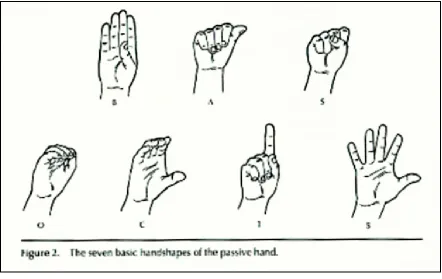
[image:23.612.90.532.257.536.2]the signs made by the passive hand (in the instance of two-handed sign), into seven basic handshapes. (ref: Fig)
Fig 1. The seven basic hand shapes of the passive hand
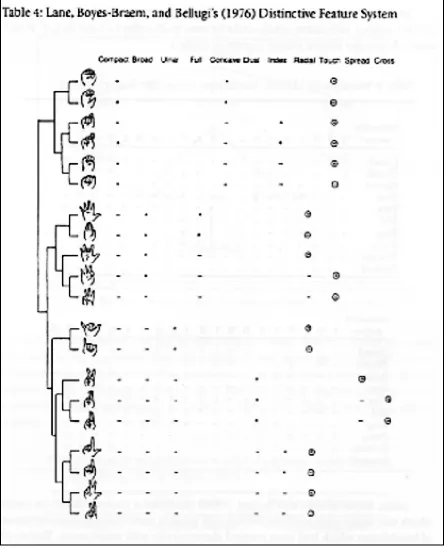
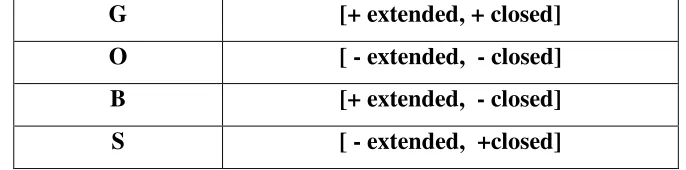
Using the Lane system, Kelg and Wilbur (1976) devised a set of distinctive features based on articulation, perception and theoretical descriptive utility. They considered only two features, extended and closed, to describe maximally opposed handshapes.
Table 1: Minimal features based on Kelg and Wilbur’s distinctive feature system.
G [+ extended, + closed]
O [ - extended, - closed]
B [+ extended, - closed]
S [ - extended, +closed]
Clustering and classification of hand signs serves the purpose of understanding the linguistics of the sign language better. There have been various studies which have been carried out with this assumption as their center point. It has been concluded after extensive study that “the same process of complex pattern recognition seems to extend across the linguistic experience of subjects and the sensory modality of stimuli.”
2.2.
Current Technologies
There has been a continual resurgence of attempts to successfully recognize hand gestures over the past many years. Hand gesture and posture recognition constitute the chief aspect while attempting to create a translation system for the American Sign
2.2.1.
Collection of raw data for hand posture and gesture recognition
Data collection is the first step towards implementing a translation system of this sort. The data is basically collected in three distinct ways. The first approach involves input
devices worn by the subject. It might require the subject to wear one or more instrumented gloves which measure the various joint angles of the hand and a six degree of freedom (6DOF) device that gathers the hand posture and orientation data. The second popularly used method involves using a vision-based approach in which the user’s gestural images are collected as raw data by one or more cameras. These images are later relayed to an image processing algorithm which processes the data and consequently recognizes the hand position in space. The third method includes merging the above two methods to give rise to a hybrid approach which involves both the instrumented glove and the vision-based approach in an endeavor to obtain better accuracy while recognizing the hand positions and gestures.
2.2.2. Data Collection using instrumented gloves and tracking devices
Data collection with instrumented gloves or other tracking devices require the subject to attach the computer input devices to their hands. In this particular approach, the user is required to wear one or two data gloves that measure the angles which are created by the joints of the hand and a six degree of freedom tracking device that helps extract hand position and orientation data. The data gloves measure the finger movement of the wearer
using sensors which are embedded in the data glove. This raw data is then relayed to a computer for further analysis. The tracking device methods follow a different pattern depending on the type of tracking device implemented. The following sub-section discusses the various tracking techniques which are currently in use at an experimental level.
2.2.2.1. Tracking Techniques
tracking. The magnetic tracking involves a tracking device, worn by the signer, which emits a low-frequency magnetic field. This magnetic field is recognized by the sensor or receiver which in turn determines the position and orientation of the hand relative to the magnetic source. This approach is advantageous as it has a good range (15 to 30 feet) and was proved to produce accurate results (accurate within 0.1 inches in position and 0.1 degrees in orientation) but the presence of ferromagnetic and conductive objects distorted
the magnetic field thereby negatively impacting the results. Introducing filtering algorithms would help deal with the noise introduced but would also involve more complex computational procedures. Commonly used magnetic trackers presently used are from Polhemus and Ascension Technology Corporation.
The other tracking techniques used are the acoustic and ultrasonic tracking systems which use high-frequency sound emitted from a source located on the signer’s hand. Microphones places in the vicinity of the signer would pick ultrasonic pings from the source components to determine the hand location and orientation. This technology had the edge for being light-weight and inexpensive but required highly controlled environment and any acoustically reflective surfaces in the vicinity affected the results negatively. Logitech’s acoustic tracking devices are most commonly used. Acoustic tracking is being incorporated in glove-based devices to increase the accuracy of the results.
The third tracking technology which was attempted to recognize hand gestures was the inertial tracking systems. This approach used inertial measurement devices like gyroscopes, servo-accelerometers and micro machined quartz tuning forks which sense angular velocity. This disadvantage of this technology was that it could track only three degrees of freedom along with suffering from gyroscopic drift. [6]
The most common problem encountered by all the tracking techniques was inaccuracy and the obtrusiveness it provided to the subject. Though the accuracy could be improved
2.2.2.2 Glove-based techniques
Another hand posture and gesture recognition technique used is the glove-based technology. The glove based technology incorporates sensor technology to determine the hand orientation and finger position of the subject. Sensors are either embedded in the
glove or are placed external to the glove to measure the angles made by the fingers at the joints to go about the hand posture and gesture recognition.
One of the first instrumented glove prototypes was the Sayre Glove developed by Thomas Defanti and Daniel Sandin in 1977. The glove employed light based sensors with a light source at one end and a photo cell at the other end. The amount of light to hit the photocell varied depending on the flexion of the fingers. This provided a measure of how much the fingers were bent. It could measure the metacarpophalangeal joints of the four fingers and thumb along with the proximal interphalangeal joints of the index and middle fingers, for a total of 7 DOF. Though this technique provided as an excellent precursor for the data gloves which followed, it suffered from lack of sophistication and accuracy to handle hand posture and gesture recognition.
The other glove-based devices which entered the scenario were the Digital Data Entry Glove designed by Gary Grimes at the Bell Telephone Labs in 1981, the DataGlove and the Z-Glove developed by VPL research, the Dexterous HandMaster developed in 1987, etc. The Digital Data Entry Glove designed by Gary Grimes was specifically designed to manually enter data using Single-Hand Manual Alphabet. It employed proximity sensors, knuckle-bend sensors, tilt sensors and inertial sensors to replace the keyboard. The disadvantage of this device is that it was designed to perform specific tasks was strictly done in hardware and hence did not possess a broader scope to handle hand posture recognition. The DataGlove and the Z-Glove developed by VPL research were designed to be general purpose interface device applications. They were equipped with 5 to 15
sensors to measure the various angles made by the finger joints to measure a total of 10 DOF. It employed an optical goniometer sensor technology where the sensors were made
consequently was dependent on the flexion of the fingers. The Dexterous HandMaster developed in 1987 was an exoskeleton which is worn over the hand which used a total of 20 Hall-effect sensors as potentiometers that measured the flexion of the three joints in each finger and four degrees of freedom for the thumb. This device was competent enough to handle complex hand posture and gesture recognition but was not suited for quick movements because of its instability. There were many other glove-based devices
which followed in the footsteps of these former devices like the 5DT Data Glove developed by the Fifth Dimension Technologies, Pinch Gloves, Nissho Electronics SuperGlove input device, etc which are not being dealt with in detail but for more information, you can refer to “A survey of Hand Posture and Gesture Recognition Techniques and Technology” by Joseph J. LaViola Jr.
2.2.3. Vision-based Technology
In the second approach, which is a vision-based approach, one or more cameras are used to collect the images of the signer. The cameras might collect a random number of frames and subject the chosen frames to image processing algorithms to recognize the demonstrated gestures. The image processing algorithms can vary from approaches using Hidden Markov Models [4] to Gray-scale based algorithms [5]. This approach is
noninvasive and has more scope for implementation in real time devices.
Some of the important aspects which need attention while collecting data using a vision-based approach are placement and number of the cameras being used, the placement of the hand itself to make it easier for data extraction, feature extraction techniques used and the image processing algorithm being used to recognize the hand posture and gesture recognition.
Though introducing an extra camera complicates the algorithm further, it provides more visibility and is critical in virtual environment applications which require depth information. Rehag and Kanade have shown that 27 DOF of the hand can be recovered by using two cameras4.
Placement of the subject’s hand also plays a very important role in the effective
extraction of hand posture data. Occlusion of background information which is unimportant for the experiment is important. In some approaches, LEDs placed on various points of the hand make the hand more visible for the camera. Other approaches including wearing colored gloves but such gloves make it difficult for the algorithm to determine the contours of the hand and the finger movement. In order to allow silhouette extraction and finger movement, Dorner developed a technique where colored rings are worn by the subject to make the fingers conspicuous while gesticulating. All these approaches still require the subject to wear an external appurtenance in order to efficiently collect the raw data. Even though these techniques are relatively less cumbersome when compared to the glove-based approach where gloves embedded with sensor devices ought to be worn by the subject, they still do not provide an ideal solution.
Various feature extraction methods and recognition algorithms are used depending on the kind of approach being pursued. Some recognition algorithms currently in use will be dealt with further into this investigation.
2.2.4. Advantages and disadvantages of glove-based and vision-based
approaches
This section discusses the advantages and disadvantages of the glove-based and vision-based approaches during data collection. Aspects like cost, user comfort, feasibility, processing times will be considered while discussing the pros and cons of each.
Cost: Though the cost of data gloves has come down in the recent past, the sensor
relatively inexpensive solution considering the widespread use of cameras in modern-day workstations and devices like cell-phones, etc.
User comfort: User comfort is an important aspect which needs to be considered as it
determines the real-time application feasibility of the technology. Data gloves are relatively less inconvenient to work with as they tend to be intrusive and require the
subject to wear cumbersome external equipment. Some of the vision-based approaches do require the subject to wear external devices but these are relatively manageable as they are not physically connected to the computer and serve the lone purpose of making the subject’s hand more conspicuous for the algorithm to work on. Some of the vision-based approaches do not require the subject to wear any external equipment and hence provide a cleaner approach to collecting data and consequently bring the approach closer to realizing a real-time system.
Processing time: This aspect strictly depends on the kind of algorithm being used to
process the raw data. Generally the vision-based approach requires more computing power due to large amount of image-processing that is necessary. The glove-based approach has an edge over the vision-based technology in this aspect as the data sent by the glove to the computer can be easily transformed into records that are suitable for recognition. The problem of processing times is dependant on the efficiency of the algorithm used to process the data and hence isn’t really an issue.
Hand size and shape: Glove-based approach faces a setback when this aspect is
considered. Hand shape and size varies from person to person and hence glove-based approach suffers a minor hitch. The range of users is considerably reduced as subjects with relatively larger or smaller hands cannot use the glove. It can also adversely affect
Background noise: Some amount of noise is bound to appear when collecting the data. Occurrence of noise is more noted in the case of a glove-based approach depending on the tracking technology used (acoustic, magnetic and inertial tracking mentioned earlier). Incidence of noise is lesser in the case of a vision-based approach and it is relatively easier to negate its effects with the help of an efficient algorithm.
Chapter 3
Approach and Equipment
3.1.
Introduction
The previous section discussed the various approaches that have been and are still being explored in the area of Sign Language translation with the help of Human-Computer Interaction. This particular analysis is in all the sense of the word, an HCI based system but which was started out with a few fundamental objectives in mind such as:
• Simplicity in approach
• User comfort
• Feasibility for extension into real-time devices
With all these aspects in mind, combined with the extensive review of information on
work done so far in the field of hand posture and gesture recognition, resources for this particular investigation were chosen. In this particular section, I would like to discuss the
software being implemented to realize this translation system along with the specifications of the hardware which was employed to carry out this analysis.
3.2.
Choice of Approach
As mentioned above, some aspects formed the backbone for the choices which were made for this investigation. The vision-based approach has been chosen for the following reasons:
User comfort: As mentioned in the previous section, a vision-based approach does not
movement that is permitted by the vision-based approach while collecting data, we have chosen it as the methodology of this investigation.
Cost: Though the glove-based technology has become relative inexpensive over the
years, (under $500 for the 5DT glove), a glove-based translation system which can produce accurate results would work out to be expensive. A visual-based approach, on
the other hand, would require one or two cameras depending upon the methodology and would comparatively be a lot more inexpensive.
Feasibility for extension into real-time devices: Since a commercially viable device
which can operate on a real-time basis is foreseen in the future, the vision-based approach seemed to be the better of the alternatives due to the advantages it offers in terms of unobtrusiveness to the signer, fast processing times, portability, ready availability of image compression and processing techniques and the possible implementation of this technology in everyday electronic devices like cell-phones, smart phones and high-tech kiosks.
3.3.
Choice of resources
3.3.1.
Hardware
The hardware used for the experimentation and execution of this project is relatively very modest when compared to the equipment employed by the other techniques we had been discussing hitherto. The equipment used is as follows:
• 2 XL1s cameras for the purpose of taking shots of the subject from two different
angles.
• 2 Tripods to support the cameras.
• 2 Mini DV cassettes for each of the cameras.
The choice of this camera had largely to do with its availability. The XL1s cameras are slightly on the higher price scale offering great features which were never fully exploited for this project. Examples include a 16x optical zoom lens whose services we were unable to employ owing to the necessarily close proximity of the subjects, interchangeable lens systems which the execution of this project has never necessitated, WL-D32000 wireless controller, etc. One of the chief attractions that helped in opting for
this camera was ironically the low resolution it offered. This feature helped in capturing images of lower resolution which consequently translated into lesser information to deal with and consequently lower processing times. The tripods and the cassettes were chiefly to do with the cameras and are worthy of mention as the XL1s camera is not compatible with any other cassettes besides the Mini DVs. To sum it up, any digital camera with a relatively lower resolution can be substituted in the stead of the XL1s, though I believe that a camera with more mass would present higher stability while shooting the videos. I had the chance to try it out with Canon Powershot series but owing to the light nature of the camera, there had been incidents of shaking while turning the camera on and off during the shoot.
The computer which was used in this study constituted a pretty basic configuration running a Microsoft Windows XP Operating System with a measly 256 MB RAM and a Pentium III processor. The one set back with this approach on the count of hardware was the huge space occupied by the video samples. Each 3 letter word in its uncompressed AVI format amounted to an average of 100MB of data. This, in a real system should not be a setback as such a huge amount of video seldom needs to be stored on this system. This I state, merely for the sake of information, for the benefit of a future researcher so he/she might bulk up on memory if and when a design on further study is meditated upon.
3.3.2.
Software
set of reference-standard algorithms and graphical tools for image processing, analysis, visualization, and algorithm development. The Mapping Toolbox provides a comprehensive set of functions and graphical user interfaces for building map displays, graphical and statistical layouts and performing geospatial data analysis in MATLAB. It provides a user-friendly Graphical User Interface and a very interactive environment.
Besides the above mention image processing tool, Quick Time and Fx Video Converter were employed to transform the video samples in an MVI format to an AVI format with the assistance of the Quick Time converter and to further convert the resulting video to an uncompressed AVI format with the Fx Video Converter. As a word of caution, Fx Video Converter seems to be the only tool so far which has done a satisfactory job in the conversion of the AVI files. The other tools which had been experimented with had turned out to be sore disappointments, some of which chose to take the form of unwanted spikes in the video samples.
Chapter 4
Work done so far…. Sign2 – Phase 1
4.1. Introduction
The phase1 of the Sign2 project had a very straight forward approach to the problem. The approach taken to cater to the study was formulated into three basic steps.
1. Establishing a standardized set of physical measurements for ASL finger spelling.
2. Generalizing the measurements for different statistical range of subjects. 3. Correlation of measurements with statistical range of subjects for letter
recognition.
This analysis strictly deals with the conversion of ASL alphabet to digital text and the
scope of this project does not include a translation system which attempts to encompass the entire ASL vocabulary.
4.2. Goals of Phase 1
The goals set out for the analysis of Phase 1 were as follows:
• To create a translation system that can successfully convert the ASL alphabet into
digital English text.
• To collect the raw data required for this investigation employing one camera.
• To implement a visual-based technology so as to make the translation system
non-intrusive for the signer.
• To obtain a high degree of accuracy while realizing this translation system.
• To investigate the possibility of the extension of Sign2 project into real time
4.3. Approach
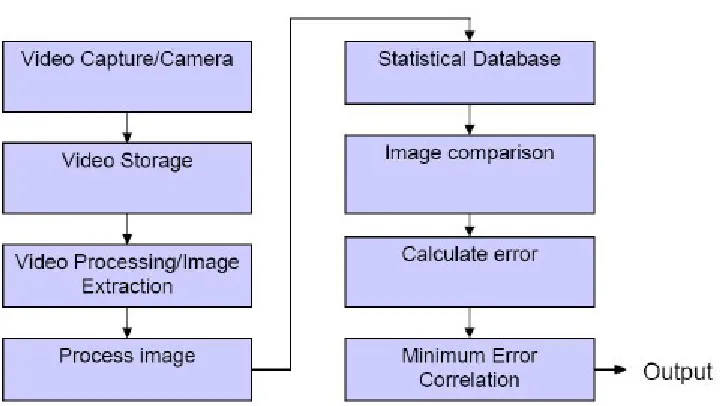
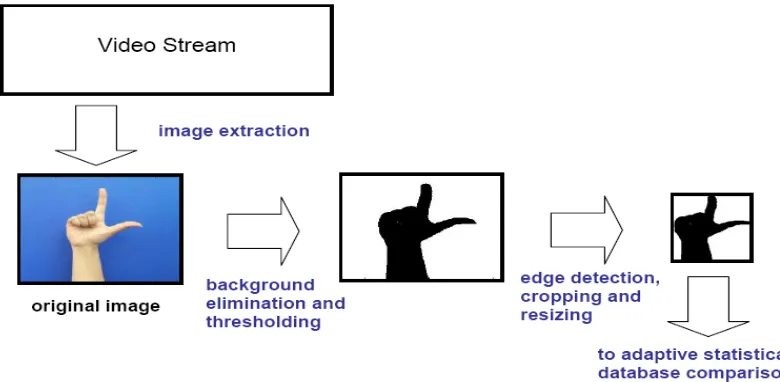
[image:38.612.126.486.342.545.2]As mentioned in the introductory statement of the Chapter 4, the approach taken to cater to this study was systematized into three steps. First, we established a standardized set of physical measurements for ASL finger spelling. Second, we formulated a generalized set of measurements for the broad statistical range of subjects we would encounter. Finally we correlated these measurements with statistical range of subjects for letter recognition. We processed static images of the subject considered and then matched them to a statistical database of pre-processed images to ultimately recognize the specific set of signed letters using the mean square error (MSE) and the peak signal-to-noise ratio (PSNR). Fig 3 shows the block diagram of the approach undertaken.
Fig 3: Functional block diagram of Sign2
4.3.1. Data Collection – Video capture and storage
repeatedly. The purpose of iteratively recording the videos was to build up an extensive database. During the first phase of recordings, the videos were captured in an uncontrolled environment due to which a lot of background noise was introduced into the data collected. Due to uneven lighting, unwanted effects like excessive reflection off the lighter areas of the hand were encountered. These effects in turn corrupted the black and white version of the image and consequently distorted the end results. During the second
phase of the video recording, certain precautions were taken to avoid the unnecessary background noise and to form a sturdier and a more reliable database5. The images were later converted to the AVI format as the Matlab image processing tools are compatible only with the AVI format. The dimensions of the captured videos were 720 x 480 pixels. These videos were compressed to a size of 320 x 240 pixels and to later uncompress the videos an Fx Video Converter Demo 6.3.0 was employed.
4.3.2. Data Processing
The aim of the data analysis phase of the investigation is to mould the raw data into ingestible pieces of information that the computer can decipher and work on. The data analysis phase mainly consists of
1. Extracting frames containing the signed ASL letters from the recorded video. 2. Subjecting the extracted frames to an image processing algorithm to convert them
into information that the algorithm can work on.
3. Storing the information derived from the previous step into a statistical database.
4.3.2.1. Video Processing and Image Extraction
statistical database but also to extract the frames from the test video for further comparison with the already built statistical database. Figure 2 shows the extraction of a frame from a video.
Fig 4: Frame extraction from a video clip
4.3.2.2. Image Processing
The frames extracted by the image extraction technique undergo an image processing procedure wherein they are converted to a logical, black and white image. There are a couple of methods to convert the color images into black and white. One of them being, employing an image processing toolbox command im2BW6. In the phase 1, the black and white conversion of the color image in this algorithm involved the extraction of the red,
Fig 5: Image processing procedure
Fig 6: Frame Extraction GUI
4.3.2.3. Image Storage (Statistical Database)
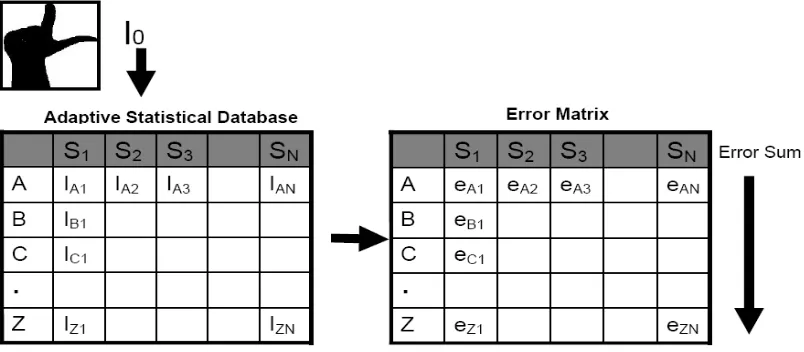
The statistical database forms the heart of this investigation. Quite literally. The more populated the database, the more reliable and sturdier is the approach. The database was created by storing the processed images of each of the ASL alphabet signed by the subjects. The iterations in spell-signing the alphabet employed by each of the subjects is to ensure a complete and reliable database against which fresh images can be compared. It is essential to capture as many hand structures as possible for the generalization of this methodology and hence each subject was asked to sign the alphabet from A to Y
Fig 7: Diagram of the statistical database showing images for each letter and each
subject resulting in an error matrix
4.3.3. Image Comparison and Letter Recognition
The image comparison and letter recognition phase of the project does exactly what it says. It compares test images to the images in the statistical database and tries to recognize the letters. In this phase of the project, test videos were recorded wherein the subjects spell-signed 3 letter words and 5 letter words. The steps followed in this phase are as follows:
• Extraction of frames containing a signed letter from the test video.
• Subjecting the extracted frames to the image processing algorithm to convert
them into cropped and resized black and white logical images.
• Compare each of the images to the ones in the statistical database.
4.3.3.1. Image Comparison
The cropped and resized test image is compared individually with all the images in the
statistical database images based on the definition of Mean Square Error (MSE) and
The Mean Square Error is given by
(1)
The Peak Signal to Noise Ratio is given by
(2)
An error matrix is thus created having error values for each of the corresponding images in the database. The set of images in the database that corresponds to a given letter and has the lowest cumulative error, reveals the highest priority of the correct letter being returned.
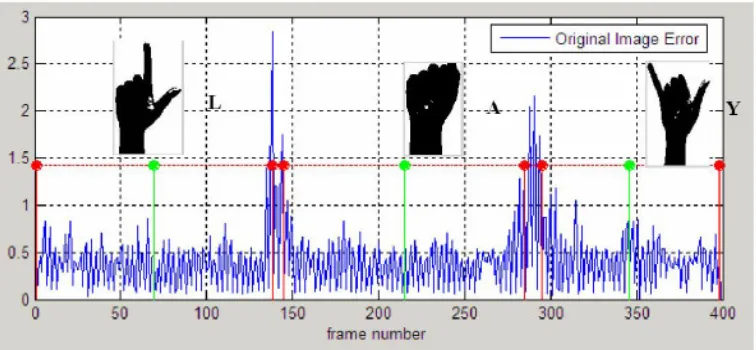
To further understand the concept of the letter recognition phase of this investigation, a video where the word LAY is being spelled was considered as an example. It is assumed that the subject holds each signed letter for a small period of time (just long enough for the addressee to register what is being signed) before signing the next letter. The differential error between the consecutive frames remains almost constant which consequently marks the presence of a letter being spelled. Rapid fluctuations in the differential errors between frames imply a transition from one letter to another. Figure 8
indicates the error between the consecutive processed frames. A window size of 10
frames falling below the error threshold
e
thresh is considered to be a letter being spelled.e
thresh is given by(3)
Fig 8: Frame to Frame error calculation and letter recognition
Once the error threshold is calculated, all the frames lying below the
e
thresh are considered.Assuming the window size for the incidence of a letter to be 10, any cluster of 10 or more
consecutive frames lying below
e
thresh are subjected to analysis. The incidence of the startingChapter 5
Results of Phase 1
5.1. Alphabet recognition
Results are recorded based on the data gathered by capturing the videos of multiple subjects sign-spelling out the entire ASL alphabet and words. The videos consist of letters from A to Y and three, four and five letter words.
The recognition ratios were calculated in two phases. The first phase of the analysis is based on the calculation of Recognition Ratio (γ) of English alphabet. An accurate recognition is given a value of ‘1’ for each iteration, and an incorrect recognition is assigned a value ‘0’.
We define the recognition ratio as,
n n
i i
∑
=
= 1
α
γ
, where α is the is total number of successfulrecognitions of an alphabet and n is the total number of events (number of time the letter was signed).
For example, if the letter A was recognized accurately 14 times out of 15 attempts, the recognition ratio would be γ = 14/15
i.e., γ = 0.9333 or
Fig 9: Alphabet Recognition Percentage Chart
The above chart gives the statistical representation of the ratio of letter recognition for each of the ASL Alphabet.
5.2. Word recognition
This section discusses the recognition ratio of words. The recognition ratio of words is calculated with the help of the recognition ratio of each of the letters. It is given by
nc c
c
j n
i ij c
j
j
∑∑
∑
= =
=
= 1 1
α γ
ω (4)
Table 3: Estimated and Experimental reliability ratio of words.
The estimated word recognition ratio i.e., ω is calculated with the help of the formula mentioned above. The experimental recognition ratio ωexpis calculated with weight ratio
assignment for the word. Weight ratio for each of the words was calculated with the formula
c Ncr
Wtr= (5)
where Wtr is the Weight ratio of the word, Ncr is the number of correctly recognized
Consequently, the experimental word recognition ratio is given by
ωexp
Ni
Wtr Wtr
Wtr1+ 2+ 3
= (6)
where Ni is the number of iterations performed.
[image:50.612.92.558.253.528.2]The figure below displays the statistical representation comparing the estimated and experimental recognition ratios of each of the words signed.
Chapter 6
Discussion of results, limitations and possible
recommendations
6.1. Introduction
In this section, we shall analyze the results of Phase 1 of the project, detect limitations and come up with possible recommendations to improve the accuracy and efficiency of the translation system.
6.2. Discussion of results
Let’s consider the table 4 showing the recognition ratios of each of the letters. It is evident that some of the letters have a high accuracy and the accuracy in recognizing the other letters vary from moderate to poor. The reason behind the varying accuracy ranges for the letters need to be analyzed so as to improve the recognition ratio of each of the letters. The table 4 could be further classified depending on the results yielded by the system. Shown below is a table categorizing the letters according to the recognition ration
Recognition % range Letters
100% - 90% B, D, G, H,I, L, Q, V, Y
90% - 80% K,U,W
80% - 70% A,E,J,P,X
70% - 60% F,O
60% - 50% N,S
50% - 40% C,M,T
[image:52.612.84.561.72.240.2]40% - 30% R
Table 4: Categorizing recognition ratios
Analyzing the recognition ratios of each of the letters, we have come to the conclusion
that the letters which demonstrate a high recognition ratio are those which are distinct in shape when compared to the other signed letters. Shapes of the signed letters become a critical issue as it is the basic parameter that the algorithm reads when trying to compare and recognize images.
Fig 11: Letters making unique hand shapes
On the other hand, the letters whose percentage recognition ratio is poor (lying between 30% - 60%) do not make unique shapes. When a subject spell signs each of the letters, he makes unique gestures for each letter but when the frames are extracted and the images converted into logical images, the information bearing data is obliterated and hence the
depth and features of the hand sign are lost. In the figure below, some of the letters which fall in the poor recognition ratio range, A, C, E, M, N, O, S and T are considered.
[image:53.612.89.522.453.677.2]It is clear that the letters which fall in the low recognition ratio range have shapes which are not clearly distinguishable from the rest of the letters. As we can see in the figure above, that the letter C and E are almost indistinguishable even for a naked eye, when the images are converted into logical images. The same letters could be easily identified
[image:54.612.107.524.196.405.2]when they are in their original RGB format.
Fig 13: Fist letters – Easily recognizable in the RGB format
6.3. Possible reasons for the procurement of moderate
accuracy in the results
There are different theories on why the approach which was pursued initially in the Phase
1 of the Sign2 project failed to yield the intended accuracy in the results. Explained below are the assumed causes and minor challenges faced in Phase 1.
single-camera approach does not provide any depth to the image and the conversion of the RGB image to a logical image wipes out the features of the image.
The images in the Fig 12 are indistinguishable from each other when the images of the
hand signing for these letters are converted into logical images.
Another reason for the inaccurate results could be due to the lack of a prediction/correction facility in the algorithm. The presence of such learning tools like neural networks, symbolic learning tools or Hidden Markov Models would be helpful in ameliorating the precision of the recognition algorithm. However, the scope of this study strictly deals with the video capture aspect and hence we are going to discuss the possible recommendations from that aspect alone.
6.4. Recommendations
There are currently two propositions for the procurement of better results as far as the data collection phase is considered.
The first proposition is to effectively use the existing silhouette approach and to use a dual camera approach wherein two sets of data could be gleaned instead of the single-camera approach which has been used in the Phase 1 of the project. The dual single-camera approach is dwelt upon with more detail later on in this write-up.
Another proposition to improve the accuracy of the results is to take into consideration all
the data that the image of a hand sign could offer. This process would include converting the original image into a gray scale image as opposed to a logical image. Features in the
6.4.1. Dual Camera Approach
The following section gives a brief description of the dual-camera approach. The setup
[image:56.612.198.389.270.551.2]includes two cameras placed at a fixed distance of ‘D’ from each other. The distance between the subject and the line of which the cameras stand should be a fixed ‘L’. The distances ‘L’ and ‘D’ should be maintained constant. The dual camera approach follows the same methodology as that of the image processing technique illustrated in the previous sections. In the dual-camera approach we employ two cameras which result in obtaining two set of databases and hence creating twice the amount of data availability. The setup for the dual-camera approach is shown in the Fig 14.
Shots taken from Camera 1 and Camera 2 are shown in the following figures.
Fig 15 Fig 16
Process:
Database 1
D1 1 2 3 … … … 9
A1 A11 A12 A13 … … … A19
B1 B11
… …
… …
[image:58.612.89.523.81.342.2]Z1 Z11
Fig 17: Image extraction process for images shot from C1 and the corresponding
statistical database.
Database 2
D2 1 2 3 … … … 9
A2 A21 A22 A23 … … … A29
B2 B21
… …
… …
Z2 Z21
Fig 18: Image extraction process for images shot from C2 and the corresponding
[image:58.612.91.518.411.654.2]The Mean Square Error is calculated for each of the images and stored in the error matrix. The set of images in the database that correspond to a given letter and have the lowest cumulative error reveals the highest probability of the correct letter being
returned.
This approach presents a sturdier database which provides more information and hence
increases the probability of recognizing a correct letter for a signed hand signal.
6.4.2. Feature Extraction Method
[image:59.612.102.498.448.675.2]The second approach which is proposed to improve the accuracy of the results is the feature extraction method. In this approach, the images are converted into gray scale images as opposed to the black and white images in the previous methods. The aim of this approach is to retain the features of the image and to work on them as they provide more data than the black and white images. The features can be extracted in this approach using one of the existing feature extraction techniques. The coordinates are chosen in a way to cover all the crucial areas of the image where there is the highest likeliness of change in features for each letter.
The algorithm for recognition of newly fed images follows the same algorithm used for the feature extraction of the original images. The feature information extracted from the fresh input image is compared to the information in the database to obtain an appropriate
recognition of the letter signed. Neural networks are trained to recognize the patterns formed by each of the signed letters so as to improve the probability of identification.
Chapter 7
Phase 2
7.1. Goals
The goals set out for the analysis of Phase 2 were as follows:
• To create a translation system that can successfully convert the ASL alphabet into
digital English text with a higher accuracy than was obtained in the Phase 1.
• To collect the raw data required for this investigation employing two cameras.
• To implement a visual-based technology so as to make the translation system
non-intrusive for the signer.
7.2. Dual Camera Approach
The chief design behind the dual-camera approach proposition is to lend depth to the captured image and consequently extract more information from the sign as compared to the single camera approach. The backbone of this approach follows the same lines as that of the Phase1. Extraction of relevant frames from the video samples and comparison of the same to a statistical database consisting of pre-processed images to eventually
identify the signed letters is being adopted in this approach. The only variation being, an implementation of two cameras as opposed to one, to gather more information for the
accomplishment of better accuracy. This chapter deals with the three basic steps towards realizing the translation system.
7.2.1. Data Collection – Video Capture and storage
The data collection phase of this approach is the only variation from the previous
approach. In this approach, two cameras are employed to record the subject taking the same shot of the signed letter from two different angles. This is as opposed to the single camera approach that was pursued in the Phase 1.
The cameras were placed at a distance of 3 ft from each other and a perpendicular distance of 1½ ft from the subject. The subject signing the letters is shot simultaneously from different angles in this particular setup. The figure below is an illustration of views from the two cameras.
Once again, the subjects were made to spell out the complete ASL alphabet repeatedly in order to build up two sets of database, D1 and D2. These two sets consist of a large number of logically converted images of signed alphabets from the two different angles and have been named ‘database_L’ and ‘database_R’ simply for the sake of simplicity. The process of populating the database is explained in the Data Processing section. The captured data is later converted to the AVI format for the reason that Matlab image processing tools are compatible only with the AVI format. The dimensions of the captured videos were 720 x 480 pixels but are later compressed to a size of 320 x 240 pixels. A video converter ‘Fx Video Converter Demo 6.3.0’ was employed for the purpose.
7.2.2. Data Processing
The video samples collected during the data phase are subjected to a video processing algorithm very much like the data analysis carried out in the phase 1 of the project.
The process once again consists of three essential steps:
4. Extracting frames containing the signed ASL letters from the recorded video. 5. Subjecting the extracted frames to an image processing algorithm to convert them
into information that the algorithm can work on.
7.2.2.1. Frame extraction and Image processing
This being the continuation of the Phase 1, the same GUI for extracting frames in the previous phase had been employed here. The video sample is read by the GUI designed with the Matlab tool and relevant frames are extracted from the video. The GUI offers the
facility of specifying the start and end frames of the video. The algorithm maps an error graph of the frames lying between the specified frame numbers and the relevant frame
where an alphabet is calculated to be and stored in a statistical database. As mentioned before, the image extraction algorithm is applied later on in the project for extracting the frames with the desired letters when the test video is run.
Once the relevant frames are extracted, they are subjected to a processing algorithm which converts the image in each frame into a logical black and white image. The conversion process employed is similar to what had been used in the Phase 1 of the project. These logical images extracted are subjected to an edge detection algorithm after which they are cropped and resized to a consistent dimension of 150 x 80 pixels. This is to bring regularity to all the frames stored in the statistical database.
7.2.2.2. Image Storage
Once again, the same image storage technique employed in the Phase 1 is applied in this phase. The frames extracted and processed in the previous section are stored in a statistical database