Rochester Institute of Technology
RIT Scholar Works
Theses
Thesis/Dissertation Collections
11-20-1997
A Room with a bath
Joel Urruty
Follow this and additional works at:
http://scholarworks.rit.edu/theses
This Thesis is brought to you for free and open access by the Thesis/Dissertation Collections at RIT Scholar Works. It has been accepted for inclusion
in Theses by an authorized administrator of RIT Scholar Works. For more information, please contact
Recommended Citation
ROCHESTER
INSTITUTE
OF
TECHNOLOGY
A Thesis Submitted
to the
Faculty
ofThe College
ofFine
andApplied Arts
in
Candidacy
for
the
Degree
ofMASTER
OF
FINE
ARTS
A
Room
With
a
Bath
by
Joel
Urruty
College of Imaging Arts
&
Sciences
School of American Crafts
Approvals
Chief Advisor:
Richard Tannen
Associate Advisor:
Doug Sigler
Date
(
Z
I
z/9v
I
Associate Advisor:
Robert Leverich
Date
n/iJ-L-9=-B-Associate Advisor:
Robert Heischmann
Date
/.?-
-7'-
20
IChairperson:
Richard Tannen
Date
---+--¥-_I---J.-_ _
I, Joel Urruty, hereby grant permission to the Wallace Library of RIT to reproduce my
thesis
in
whole or
in
part.
Any reproduction will not be for commercial use or profit.
Signature
pate-ll
rr
/°
CONTENTS
LIST OF PLATES
1
I
INTRODUCTION
2
II
HISTORY
4
III
ORNAMENT
9
IV DESIGN
12
-AESTHETIC
CONSIDERATIONS
14
-TECHNICAL
CONSIDERATIONS
19
V
CONCLUSION
24
ENDNOTES
32
LIST OF PLATES
1.
Sink
p.26
2.
Medicine Cabinet
p.27
3.
Medicine Cabinet
(detail)
p.28
4.
Hamper
p.29
5.
Toilet
p.30
INTRODUCTION
This
thesis
is
a responseto
a personal problemI
have
with modernday
bathrooms.
The bathroom is
a room wefrequent
daily,
yetit is
oftentimes the
room withthe
least
visual
interest.
The
design
of abathroom is
no smalltask; it has
many
parametersthat
need
to
be
addressed.One
must considerthe
functional
aspects as well asthe
practicality
of
the
bathroom.
Yet
its
aesthetics must notbe
overlooked.As
afurniture designer
anda craftsman
I
decided
to
challenge myself withthe
task
ofdesigning
abathroom.
The
goalwas
to
create a uniquesetting
for
abathroom,
that
evoked a positive emotional responsefrom
the
userThe
sterile environment oftenfound in
today's
bathrooms
is
not welcoming.Most
rooms
in
ahome
aredecorated
to
expressthe
inhabitant's
personal style.When
decorating
ahouse,
close attentionis
paidto
rooms such asliving
rooms anddining
rooms,
yetthe
bathroom,
whichis frequented
more oftenthan
either ofthese rooms,
tends to
have
a genericlook.
In
The
Essential
Home
Book,
Getting
Back
To
Basics,
Terence
Conran
states,
"Until
the
movetowards
morehygienic
surfaces atthe turn
ofthe
century,
peopletended
to
furnish
their
bathrooms
muchlike
other roomsin
the
house,
with
bathroom fixtures
treated
like
pieces offurniture,
often encasedin fine dark
woodssuch as mahogany.
With
the
drive
againstdirt,
the
bathroom became
ratherless
hospitable,
withhard
tiled
surfaces andfree-standing
white cast-iron bathtubs."1Through my
extensive researchI've
come across severaldesigners
and architects whowith
this
thesis,
to
challengethe
conventional concept of what abathroom
is
supposeto
look like.
The designs I've
come acrossthrough
my
research rangefrom
the
exoticto
the
minimalist.It
seemseverybody has
their
own view on whatthe
ideal bathroom
shouldlook like.
My
ideal bathroom
wouldbe
one whichI
could spendtime
in,
forgetting
the
everyday
worries and pressures ofthe
outside world.A
place of contemplation andprivacy,
where one can collect one'sthoughts
before
starting
their
day
and recapitulatethem
atthe
end ofthe
day.
The
visual statementI
choseto
communicatein
my
design
is
one of
comfort,
elegance and serenity.Before
delving
into
the
design
ofthis
bathroom,
it is important
to take
alook
atthe
history
ofthe
bathroom
andits
rolein human history.
In
view ofthe
fact
that
whatwe consider a
bathroom has
only
been in
existence sincethe
early 19th
century.This
willI
HISTORY
Man has
alwayshad
to
deal
withbathroom issues.
It
is
thought that
prehistoricman
learned
to
relievehimself downstream
keeping
his
living
environmentreasonably
clean.When
man movedaway
from
the
rivers and streamsfor better
hunting
orfarming
conditions
he had
to
find
other ways ofdealing
withhis
waste.Archeologists have
uncovered what
they
believe
to
be
the
earliest attempt at anindoor latrine
onthe
Orkney
Islands
nearScotland.
This
sitedates back
to the
neolithic period5000
years ago.The
latrine
consisted of ahollowed-out
area with a crudedrain
dug
into
a stone wall.They
suspect
this
hole
enabledthe
occupantsto
relievethemselves
withouthaving
to
gooutdoors.
We find
early
evidence ofbathrooms in
the
Ancient World
(2500-550
BC).
Here
tribes
and groupsbuilt
towns
populatedby
hundreds
ofthousands
of people.These
towns
are
found in
Mesopotamia,
nowIraq, Egypt,
Greece
andthe
Indus
Valley,
nowPakistan.
The
Sumarian
people,
built
acity
calledBabylon,
aMesopotamian city,
with a population of200,000.
In
this
city
remains of"Eastern-style
toilets"were
found in many
ofthe
wealthier people's
homes.
These
toilets
consisted of ahole in
the
floor
above a cesspoolwhich collected all
the
waste matter.Eastern
toilets
are stillwidely
usedtoday
all aroundthe
world.Modern
scientistsbelieve
that
the
squatting
position usedfor
this
toilet
is
more natural and comfortable
than
our western-styletoilets.
The
poor people ofBabylon,
were
then
thrown
outinto
the
streets.Needless
to
say
the
streets ofBabylon
werefar
from
clean.The
Babylonians
remediedthis
situationby
covering
the
filth
with alayer
ofclay.
When
the
streets were againfilled
with sewagethey
would put on morelayers
ofclay.
The
streets ofBabylon
grewhigher
andhigher,
andthe
people ofBabylon
wereforced
to
build
newlevels
onto their
homes
orbuild
passagewaysdown
to
the
entrances.In
anotherMesopotamian
city
calledMari,
archeologistshave
uncoveredbathtubs
andwestern-style
toilets.
The
toilets
consisted of a seat placed above a cess pool.By
the
seatstood a
jar
of waterto
be
poureddown
the
latrine
to
washaway
the
waste.Many
greatfindings
were uncoveredin
the
ancientcity
ofTel
elAmarna in
Egypt.
Sinks
carved out of stone with metalfaucets
andlead drain
plugs werefound in
tombs.
A
limestone
seat with ahole in
the
center wasthought to
have been
placed above asandbox,
similar
to today's
catlitter.Also
found
was alarge
slab oflimestone
surroundedby
low
walls covered
in
stone.Most
likely
used as ashower,
the
bather
would stand onthe
slabwhile a servant poured water over
their
body.
It
is believed
that
keeping
clean was animportant
part ofthe
Egyptian
lifestyle
because it
played animportant
rolein
their
religion.
One
ofthe
earliest cities everto
be
uncovered wasMohenjo-Daro,
found
along
the
Indus
river.The
city
wasvery
advanced,
withbrick
lined
sewersrunning
beneath
the
city
streets and
drains inside homes
to
carry bathroom
andkitchen
wasteto these
sewers.The
sewer system
then
carriedthe
sewageinto
a maincesspool,
which was emptiedregularly
by
city
employees.Both Eastern-style
andWestern-style
toilets
were presentin
Mohenjo-Daro.
A large
publicbath
wasfound
by
atemple,
leading
to the
assumptionthat,
asin
Egypt,
bathing
was a part of religious ceremonies.One
ofthe
innovations
pioneeredin
Egypt
andBabylon
whichhelped
pavethe
way
for future
innovations
in
bathrooms
wasthe
under ground aquaduct.These
aquaductswere
long
channels which carried water collectedin
cisternto
areas whichdid
not get muchThe Romans
werefamous
for
their
complex aquaduct systems.They
had both
underground and above ground aquaducts
channeling 92
million gallons of water aday
into
Rome.
Rome's
generoussupply
of water enabledthe
city
to
build
elaborate publicbaths
where people came
to
relax,
exercise and socialize.Public
latrines
were alsobuilt in
the
city
ofRome.
Stone
seats withholes in
the
center were placed over a channel ofrunning
waterallowing
the
wasteto
wash away.Placed
by
the
seats was abucket
of salt waterwith a
long
stick with a spongetied to the
end.This
tool
was used astoilet
paper.It
is
believed
that the
expression"grabbing
the
wrong
end ofthe
stick"
originated
in
Rome.
The
wealthy
had
constant waterrunning
out of nozzlesthrough their
homes for
usein
cooking
and cleaning.Although it
was againstthe
law
to throw
human
waste ontothe
street
this
was common practice.The Romans brought
their
advancedplumbing
systemto
every
land
they
conquered.The
Roman Empire
crumbled after severalhundred
years of peaceful reign.Tribes
from
north eastern and western
Europe
destroyed
much of what wasleft
ofthe
magnificentpublic
baths
and aquaducts.With
the
destruction
ofthe
Roman
Empire,
sanitation andbathing
ceasedin
Europe
for
the
next1000
years.In Asia
andMuslim
countriesbathing
continuedto
be
a part oflife,
but in
Europe
with
the
birth
ofearly
Christianity
bathing
was considered sinful.People lived in
filth;
dirtiness
was a sign ofholiness.
In
her
book, Toilets, Baths,
Sinks
andSewers,
Penny
Coleman
Gives
an example of anearly
christian whobragged
of notwashing
herself
for
eighteen years after
her
baptism.
Until
the
late
18th
century,bathing
wasonly
usedfor
medicinal purposes.Religious
belief
taught that
it
brought
aboutunhealthy
sexualdesires,
which were prevalentin
the
Roman baths.
The
streets and rivers werefilled
withhuman
waste,
and asthe
citiesgot
to
be
morepopulated,
the
conditions got even worse.It
wasn't until1832,
whenthe
Cholera
epidemicarrived,
that
peoplein Europe
realizedliving
in
suchfilthy
conditions wasAmerica developed
withunsanitary
habits,
brought
by
the
first
settlersin
the
1600s.
Coleman
also saysthat "A
law
was passedin Boston in
1845
that
forbade
taking
abath
unless adoctor
prescribed it."2American
cities andtowns
werebuilt
without sewersor septic systems.
It
was common practiceto
dispose
of one's waste ontothe
street.Soon
the
streets werefilled
withfilth
and sewage.To
give anidea
ofhow bad
the
situationwas,
Coleman
notesthat
in
1840
thousands
of pigs roamed
the
filthy
streets ofNew York
City,
andCincinnati,
Ohio.
Cincinnati
had
so
many
pigsit
wasknown
as "Porkopolis."Disease
flourished in
these
filthy
conditions.In
the
mid1800's
people startedto
changetheir
hygiene habits.
In 1899
agroup
of women came
together to
form The
Women
's League for
Sewage
andDrainage
to
remedy
the
problem of watersupply
anddrainage in American homes.
After
World
War I
bathtubs,
sinks andtoilets
werebeing
producedin
mass quantities andinstalled in
houses,
schools,
factories,
hospitals
andhotels.
Sanitary
conditions werebeing
improved,
andpeople started
to
changetheir
filthy
habits.
Now
that
clean water waseasily
accessible andpolluted water piped
away,
disease
was nolonger
the
problemit
once was.The first bathrooms
manufacturedin America
were adorned with painted motifs andornamental
detail.
But
these
bathrooms
soon gaveway
to the
sleek modernlook.
In
The
Bed
andBath
Book,
Terence
Conran
talks
aboutthe
extravagance ofearly
bathrooms.
"In
upper-class
bathrooms
ofthe
1880s,
which wereusually
convertedbedrooms,
the
imposing
hooded bath had
a carvedmahogany
shower cabinet withhinged doors.
The
shower ranhot
orcold,
astrong
jet
or afine
spray."3These
type
of showers were soon replacedwith
less
expensivemodels,
thus
becoming
accessibleto
a greater market.The
oncehighly- ornamented
bathrooms
reservedexclusively
for
the
very wealthy
werebeing
strippedof
their
decorative frills
andthen
mass-produced with cheaper materialsfor
saleto the
general public.
The
bathroom
cameto
be
avery
functional
room with easy-to-cleansurfaces.
By
eliminating
the
welcoming
qualities ofhand
madefurnishings,
such asIn
the
past20
yearsdesigners
and architectshave been
looking
atthe
bathroom
asa potential space
for
personal expression.Today
wefind
distinctive bathrooms
whichpossess
many
different
styles and motifs.A
style canbe
representative ofthe
owner'sown personal
tastes
such ascountry
cottage, colonial,
orientalsimplicity,
Mediterranean,
high tech.,
orany
other stylethat
best
suitstheir
needs anddesires.
What
mightbe
comfortable and
pleasing
to
one person canbe just
the
oppositeto
another.That is
why
II
ORNAMENT
Ornament is defined in
the
Webster's
seventh collegiatedictionary
assomething
that
lends
grace orbeauty;
a manner orquality
that
adorns.The
art ofdecor
andornamentation
has
existedthroughout the
history
ofthe
architeceture.The
embellishmentof a
setting
such as abathroom
canbe
referredto
as architectural ornamentalismbecause
it deals
with an entiresetting
withbuilt in
components such asthe shower, tub
and sink.These
elements although notstructural,
are vital and mustbe
consideredin
the
overalllayout
ofthe
room.Architectural
ornamentalismis
not a newconcept,
it has been
aroundsince
the
beginning
of civilization.Though
the
bathroom
as weknow it has
only
been
around
less
than
acentury,
architecturaldetailing
has been
ever presentthroughout
the
history
of civilization.Maybe
the
first
sign ofdecor
in
abathroom
setting
wasfound
withthe
Romans.
Roman
baths
werefamous for
their
use of architectural ornamentation.Only
the
wealthy
had
any
semblance of what we consider now abathroom.
Roman
baths
werehighly
decorated
but
they
can notbe
consideredbathrooms.
They
have
morein
common withour
modern-day
spas orhealth
centers.Two
ofthe
greatestbaths,
those
ofthe
Emperors
Caracalla
andDiodetian,
weredecorated
withbeautiful
marble,
statues,
bronze doors
andmosaics.
These baths
wereluxurious
places where people congregated and spenthours
exercising
andpampering
themselves.A
lot
ofthe
architecturaldetails
usedby
the
Romans
are emulated today.From
the
16th
to the
18th century
wefind
items
usedfor
period
royalty
andthe
very
wealthy had
closet stools concealed chamberpots,
usually
found in
the
corner of aroom,
and oftenexuding
a pungent stench.These
closet stoolswere gilded and wrapped
in
velvet.Skilled
cabinetmakers werehired
to
build furniture
that
concealedwashbasins,
bidets
and chamber pots.These
items
weredesigned in
the
latest
styles with embellished surfaces and extravagant ornamentation.They
weregenerally
found in bedrooms
orliving
rooms,
andhad
to
blend in
withthe
rest ofthe
furniture.
Not
untilthe
19th
and20th century
was real progress made withthe
modernizationof
the
bathroom.
Inventors
startedto
devise
ways ofpiping
running
waterinto
homes,
improving
drainage
and alsoheating
water.This
led
to
great advancesin indoor
bathrooms.
The
industrial
revolutionbrought
many
great advancesto the
bathroom.
Inexpensive,
durable
materials,
werebeing
fabricated
that
were resistantto
dirt
and waterstains.
Bathrooms
became
more accessible and affordableto the
public.The designs
focused
more onutility
and neglectedthe
aestheticissues.
It
couldvery
possibly
have
been
the
intent
ofthe
designers,
for
atthat time
Modernism
wasin
full
swing, the
Modernist
designers looked down
onany
type
of ornamentation.It
concealed whatthey
revered most: structure.
It
wasbelieved
that
by disguising
structure and material withdecorative detail
one washiding
the
necessity
for
perfection.This
would explainwhy
somany
bathrooms
andfixtures lack
any
type
of ornamentation.This philosophy
resultedin
stale,
cold environments whichhad
few,
if
any,
welcoming
qualities.This
thesis
is
a reactionto
Modernist
bathrooms
which are stillbeing
producedtoday
Though
highly
functional
andhygienic
they
lack
the
charm andsensitivity
of otherspaces
in
the
home.
The fact
that
a whole roomis
being
designed for
this thesis
meansthat
the
interior design is
of greatimportance.
Stanley
Abercrombie,
author ofthe
book
A
Philosophy
ofInterior
Design,
stressesthe
importance
ofthe
designer's
objectivefor
aspace when
he
notesthat "An
interior design
mustbe
guidedby
a certain goal- a clearvision of what
is
to
be
expressed-if
it is
to
speakto
its
users withoutambiguity
ormuddle"4
The
visionI
had for
my
bathroom
was one of aluxurious,
warm atmospherewith a
handcrafted
quality.My
goal wasto
create a unique environment which was at oncewelcoming, elegant, contemporary,
andtimeless.
When I
set outto
design
my
bathroom
there
wasn't a cleardesign
but
rather adesired
emotional effectI
wasstriving
to
evokefrom
the
user.A
place where one canescape
the
stresses and pressures ofthe
everyday
world,
like
the
Japanese
andKoreans
who sought spiritual peace and
purity
by bathing
in
remote mountainsprings,
I
wantedthis
bathroom
to
serve as a quiet retreatfor
daily
cleansing
habits.
Throughout
history,
cleanliness and
the
act ofcleansing
one'sbody
has been linked
to
religious and spiritualhealing,
as well asenergizing
the
mind and soul.In
designing
the
bathroom I
wasn'ttrying
to
create aholy
space,
but
rather a peacefulsetting
with a meditative quality.As
a craftsmanI
believe
I
had
something
moreto
offerthan the
otherwise massproduced manufactured
fixtures
commonly
found in bathrooms.
As Pat
Conway
mentionsin
the
preface ofher book Art for
Everyday,
"Well-designed
spacestake
on a warmth andpersonality
that
eventhe
best
commercialfinishes
andfurnishings
seldom achieve.Large
building
projects provide opportunitiesfor
craft artiststo
work at a monumental scale andthey, in turn,
bring
to these
projects a special liveliness- a sense of animation andthe
presence of
human
spirit."^The handmade
objecthas
much moreto
offerthan
anitem
which came off an
assembly
line,
it has
the
quality
ofthe
human
touch.
Although
today's
manufacturedbathrooms
comein
avariety
of styles andcolors,
they
do
not expressthe
thoughts, feelings
andbeliefs
ofthe maker,
or arouse anintellectual,
emotional,
and spiritual responsein
the
user.The
Arts
andCrafts
movementbelieved
that
the
craftsman possessed a reverencefor
the
material and process ofhis
craftand
that
this
appreciationis
translated
into
the
work.The
work conveysthe
sensitivity
an commitment of
the
maker.The quality
that
the
craftsmanbrings
to
a project can notbe
found
or reproducedin
the
impersonal,
anonymous and mechanized mid20th
century
American
modernistic products.Ill
DESIGN
The
method usedin
designing
this
bathroom
was notthe typical
process usedto
design
a room.The
pieces which comprisethe
bathroom
were not alldesigned
priorto
construction,
ratherthe
design
of one piecelead
to the
design
ofthe
next.Each
piecein
this
progressionderived
maximumbenefit from
my continuing
research and evaluation ofthe
preceding
piece.My
first
step
wasto
decide
whichfixtures
to
have in
my bathroom.
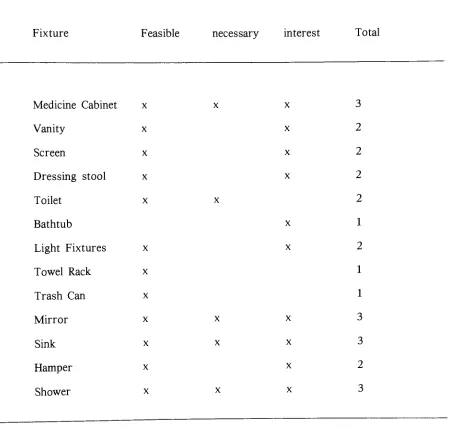
I
made alist
of
different fixtures
normally
found in
abathroom,
andthen
evaluated each oneby
using
three
criteria(Table
1).
The
three
criteriaby
whichI
rated each project were1.,
the
necessity
ofthe
piecein
abathroom, 2.,
the
feasibility
ofmy completing
the
piece withinthe time
allottedfor
my
thesis,
and3.,
the
interest
I
had in
building
the
piece.Since
there
aremany
different
types
ofbathrooms,
this
list
allowed meto
focus
my
attention onwhat
I
thought
wouldbest
represent a completesetting
for
abathroom.
The
items
that
ranked
highest
onmy
list
weresink, mirror,
shower,
toilet,
medicine cabinet andhamper.
I
included
the
hamper
not out ofnecessity,
but
because it
seemedlike
a goodstarting
point.
When
I began
designing
the
variousfixtures
I
found
that
my
designs
wereeclectic,
I
had
adifficult
time
narrowing my
focus
on a cohesive aestheticfor
my
bathroom.
I
knew
whattype
of atmosphereI
wantedto create,
but I had
adifficult
time
generating
aunified
relationship among
the
separatefixtures. I
decided
to
leave
the
design
process andstart
constructing
my
first
piece.I
pickedthe
design I felt
wasthe
mostdeveloped
andbegan
building.
Table
1.
Project
evaluationFixture
Feasible
necessary
interest
Total
Medicine Cabinet
X X X3
Vanity
X X2
Screen
X X2
Dressing
stool X X2
Toilet
X X2
Bathtub
X1
Light Fixtures
X X2
Towel Rack
X1
Trash
Can
X1
Mirror
X X X3
Sink
X X X3
Hamper
X X2
Shower
X X X3
I
considermy
first
piece,
the
hamper,
to
be
the
beginning
ofthe
aestheticdirection
I
wantedthe
bathroom
to
take.By
examining
andevaluating
the
hamper,
I
was ableto
[image:17.560.50.500.173.602.2]find
whatit
was aboutthe
hamper
that
I originally found
so appealing.I introduced
these
elements
into
the
design
ofthe
otherfixtures.
Unity
prevails when aharmonious
interrelationship
ofdesign
elementsis
present within allthe
fixtures in
the
setting.Line,
shape, texture
and color arethe
four basic
elementsin
the
design
language
I
worked withto
attainthe
desired
results.AESTHETIC CONSIDERATIONS
LINE
Wood,
as amaterial,
canbe
usedin
many
fashions.
An
constructivist style canbe
achieved with
the
use ofhard
angles andplanes,
or a more animated style canbe
arrivedat
by introducing
soft curves andfluid
lines.
I
decided
that the
welcoming
atmosphereI
wished
to
convey
in
the
bathroom
couldbest be brought
about withthe
use offluid line.
Wood
as a materialis
receptiveto this
type
oftreatment,
being
easily
shaped and carved.Curved
lines
can sometimes express a gentle and quiet statement.When
curveshave
adirect
relationship
withgravity
they
take
on an active role.This
fact is
presentin
the
design
ofthe
hamper
and sink.The hamper
and sinkhave four
riblike
membersthat
are connected at
the
base
andblossom
upwardlike
atulip.
The
use ofline in
these
piecessuggest growth and can
be
associated withthe
lines found in
certain plants andflowers.
The
consistent use ofthis
detail
generates a sense ofunity
in
the
pieces andtheir
surroundings.
Arcs
are anothertype
of curvedline
I
usedin
my
design.
The
arc's softinviting
quality
helped
evokethe
moodI
wanted.The
archas
the
quality
offormal
balance
due
to
symmetry.
Symmetry
plays astrong
rolein
the
design
ofevery
piecein
the
bathroom.
The
vertical axisis
the
centralfulcrum
whichdivides
the
pieceinto
two
equal counterparts.
The
repetition ofthe
mirrorimage found
on each side ofthe
central axisdistributes
the
visual weight ofthe
elementsin
a perfectbalance.
This
perfect physical andvisual
balance
known
assymmetry is
aformal balance.
The
equilibriumfound in formal
balance
gives us afeeling
ofstability
and serenity.The
straightlines in
the
design
ofthe
bathroom
were placedin
a verticaldirection
to
add adynamic
property.Robert
C.
Wilson,
author ofAn Alphabet
ofVisual Experience
writesthat the
verticalline
"expresses
qualities of spiritualuplift,
emotionalecstasy,
poise,
balance, honesty,
anddignity.''7
The fact
that
the
verticallines
employedin
the
designs
aretall
and slenderenhances
their
spiritual uplift anddignity.
SHAPE
Robert C. Wilson defines
shape as an"element
ofdesign
having
atwo
dimensional
quality
andrepresenting
a mass."^He
then
goes onto
explainthat
form
canbe
considered a shape with a
three
dimensional
quality.Since
the
bathroom is
three
dimensional I
willtalk
aboutform
whenreferring
to the
shapes ofthe
various piecesin
the
bathroom.
There
are several similarforms
repeatedin
the
design
ofthe
pieces.Certain
shapes produce certain emotional responses.
These
responses can coercethe
viewerinto
feeling
a certain way.It
wasmy
goalto
manipulatethese
elementsin
the
design
to
achievethe
intended
emotional response ofthe
audience.A
cuppedshape,
like
that
of asmiling
mouth,
tends
to
evoke a positive and cheerful reaction.This
shapeis
reccurentin
the
design
ofthe
bathroom.
The form
canbe
found in
the
copperbasin,
the
pedestalsupporting
the
basin,
the
bottom
ofthe
medicinecabinet, the
hamper's
woodenribs,
the
sack
hanging
from
the
ribs andthe
negative space perched abovethe
mirror.The
shapecan
be
perceivedin
the
arcfound
atthe
foot
ofthe
shower.Shapes
that turn
downward lead
the
eyedown
andbring
forth
afeeling
ofmelancholy.
This
shapeis
also presentamong
the
various piecesin
the
bathroom.
In
certain
fixtures,
such asthe
medicinecabinet,
shower andmirror, the
cupped shapeis
reflected
in
a mirrorimage
onthe
top
andbottom
ofthe
piece.The
mirror effectachieved with
the
combination ofthese two
shapes creates abalance
and a sense ofenclosure within
the
piece.The
eyeis
coercedinto
focusing
onthe
piece as a unit.The
eye
is lead
up
anddown
without everstraying
away
from
the
piece.In
The Essential Home Book Terence Conran
notesthat
"A
room without afocal
point
is
astrangely
disconcerting
one.There
may
be
warmth,
light
and a comfortableplace
to
sit,
but
without afeature
to
which all eyesinstinctively
turn
in
moments of reposeit
will neverbe
a room which peoplefeel
really
at ease."9.I
considerthe
sinkto
be
the
focal
point ofmy
bathroom because it
embodies so much visualinformation.
The
verticalshapes
lead
your eye upwardto the
heavens
above.This
is
especially
true
ofthe
wall unitbehind
the
sink.The
eyefollows
the
two
long
slats and endsin
afinal
arc shapefacing
the
sky.The
copperbasin draws
alot of attention withits
simplicity
and naturalbeauty
One
ofthe
distinctive
characteristics presentin
the
bathroom is
the
hand-crafted
details found in
every
one ofthe
pieces.The
rib-like members ofthe
hamper
andthe
sink's pedestal were shaped
by
hand
to
produce gracefulfluid forms.
The
shaping,
done
with a spoke
shave,
add awelcoming
aspectthat
is difficult
to
acquire withhard lines.
A
slight subtle curve was
introduced
to
the
edge of allthe
pieces.This
minordetail
has
many
positive effectsin
the
way
weinteract
withthe
pieces.It
welcomesthe touch
andsoftens
the
visuallines
ofthe structures,
making
the
overall atmosphere more approachableand comforting.
This detail
also relatesto
the
arcs and curves presentthroughout
the
bathroom.
The
presence ofthe
human
touch
is
also apparentin
the
shaping
ofthe
riblike
prongs ofthe
hamper
and sinkpedestal, the
hand
gougedtexture
found in
allthe
pieces and
the
hammer
marks ofthe
copper.I
attemptedto treat
every
detail
with regardto
the
material andthe
effectit
wouldhave
onthe
bathroom
as a whole.COLOR
In
orderto
successfully
controlthe
moodin
my
bathroom
I
had
to take
into
consideration
the
color scheme.Color,
is
an element which can evokemany
sensations,
mainly
warmth or coolness.My
goal wasto
create awarm,
welcoming
atmosphere.Reds,
oranges and yellows reign as warm colors
due
to their
association withfire.
I
introduced
these
colorsinto
my
bathroom
by
manipulating
the
materials.To
acquirethe
dark
reddishbrown hue in
the
mahogany I treated
the
wood achemical called potassium
dichromte
Potassium dichromate (potassium
bichromate)
is
amordant chemical which comes
in
abright
orange crystallineform.
Mordants
can alterthe
color of
fibers
by
chemically reacting
with certain substancesfound in
the
wood.This
extremely
poisonous chemicalis
diluted
with water and appliedto
mahogany
to
darken
the
natural color.
The
hue
canbe
modifiedby
mixing
ahigher
orlower
concentration ofmordant.
Mordants
producevery
natural and clear colorsbecause,
unlikedyes
andstains,
there
are no pigmentsintroduced in
to the
finish.
A
heat
patinatechnique
described in
Tim
Mc
Creight's,
The Complete
Metalsmith,
enabled me
to
getthe
warm reds and orangesI
desired in
the
copper. "Along
withits
malleability
andlow
cost,
one ofthe
features
that
makes copper so popularis its
ability
to
turn
beautiful
colors.Chemicals in
the
air and earth will achievethese
giventime, but
most metalsmiths prefer
to
controlthe
processthemselves.
Be
warnedthat the
metal willtake
an active rolein
the process,
oftenbehaving
in
waysthat
defy
explanation.Those
who undertake patinas
in
the
spirit of adventure are morelikely
to
enjoy
the
processthan
those
who wantto
dictate
every
nuance ofthe
color."10The
process was one oftrial
and error.
I
wouldtake
the
copper pieces andintroduce
them to
high
levels
ofheat
untilthey
glowedto
abright
redcolor,
than
I quickly
quenchthem
into
a container of coldwater.
The
result was aninstantaneous,
durable
patina.If I
was unsatisfied withthe
coloror pattern of
the
patinaI
would repeatthe
process untilI
gotsomething I
washappy
with..
Once
the
metalhad been
exposedto
such ahigh
degree
of
heat
it
returnedto
its
annealed
state,
making it
soft andmalleable,
which meantI
had
to
workharden
it
to
restore
it's rigidity
and shape.This
wasdone
by delicately hammering
the
metalback
to
its
workhardened
state.The unpredictability
ofthe
heat
process produced colors andpatterns
that
added a certain charmto the
pieces.The
charmbeing
a sense of primitivenessand
spontaneity,
like
the
dotted
deep
purplesfound
onthe
inside
ofthe
medicine cabinet.These
were one ofthose
hidden
surprises whichoccasionally
occur withthis
process ofheat
patinaing.The
colorsfound in
the
copper andthe
dark
reddishbrown
ofthe
mahogany
compliment each other.
They
create a warm and elegant atmosphere withtheir
richdeep
hues.
TEXTURE
Texture
is
presentin
many
forms in
the
bathroom,
andis
usedto
addinterest
to
the
pieces.It
expresses a visual statement as well as atactile
one.Some
surfaces weresanded and polished
to
a smooth glassfinish,
while others were carved orbeaten
to
reveala rougher
finish. The
main reasonI
choseto
introduce
the two
very
different
textures
in
my
design
wasto
create an element of contrast within each piece.The
visual andtactile
contrast realized with
texture
is
subtle yet effective.The
carvedtexture
is particularly
effective
in
bringing
out certain elements within each piece.Frank Lloyd
Wright,
wrotein
An
Autobiography
of1932
that "expressive
changes ofsurface,
emphasis ofline,
especially
textures
of materials orimaginative
patternmay
goto
makefacts
more eloquent-formmore significant."11.
The
texture
presentin
both
the
mahogany
andthe
copperintroduces
a
dialogue between
the two
materials.The
textures
carvedinto
the
wood andhammered
into
the
copper reveal a primitivequality
found in both
materials.This
texture
notonly
creates a
relationship between
the two
materialsbut
alsoinitiates
aninteresting dichotomy
with
the
polished wood surfaces.Both
the materials,
wood andmetal,
have
aninherent beauty.
The bathroom
wasspecifically
designed
with subtledetails
to
allowthe
inherent decorative
qualities ofthese
materials
to
be
evident.Design details
were approached with caution.Ornamentation
has
to
be
suitableto the
material,
it
was usedsparingly
in
order notto
coverup
the
structure and natural
beauty
ofthe
material.An
excess of ornamentation canhide
the
inherent
qualities ofthe
materials andleave
the
user confused and unsettled.DESIGN: TECHNICAL
When
designing
fixtures for
abathroom
one mustpay
close attentionto the
activity
that
one performs withthese
fixtures,
thus the
study
and examination ofthe
physical posture used whenperforming
these tasks
mustbe
taken
into
consideration.The
habitual
hygienic
tasks
performedin bathrooms
were studiedin Alexander
Kira's
book,
The
Bathroom.
The study
ofhuman
proportion and ergonomicslead
to
newfindings in
appropriate
dimensions for bathroom fixtures.
The dimensions
usedfor
the
design
ofthis
thesis
weretaken
from
Alexander Kira's
findings
andTerence
Conran's
recommendations.SINK
(TABLE
1)
The
sinkis
useddaily
for different
tasks.
The
most commonbeing
hand
andface
washing.
These
two
activitieshave distinctive
ergonomicfactors
to
be
considered.Ideal
dimensions found for
ahand
washing
sink aredifferent from
those
of aface washing
sink.Since it is impractical
to
have
a special sinkfor
hand
washing
and anotherfor
face
washing,
the
two
recommendeddimensions
were usedto
find
ahappy
medium.These
newdimension
would allowthe
userto
both
washtheir
face
andhands
comfortably.Lever
handles
werefashioned
from
those
commonly
found in
hospitals.
They
areelongated
making
them
easy
to
operate.Forged
out of solid copperthis type
ofhandle
is
refered
to
as spreadfit
control.The
cold andhot
water areseparately
controlled andthe
faucet is
placedin
the
centerto
retainthe
balance
ofthe
overallbathroom.
The faucet
wascopper
leafed
to
matchthe
rest ofthe
decor.
Sink
Dimensions:
basin
height:
depth
ofbasin:
water source
height:
MEDICINE CABINET (TABLE 2
and3)
Many
people usethe
medicine cabinetto
store a myriad of products and oftenend
up
having
this
space cluttered withunnecessary
items. This
particular medicine cabinetwas
designed
to
hold just
afew
ofthe
necessary
items
commonly
found in
abathroom.
The
dimensions
for
the
cabinet weredetermined
by
measuring
items I deemed
asnecessary
in
a medicine cabinet.The list
of variousitems
to
be
storedin
this
cabinet are asfollowed:
peroxide,
band-aids,
aspirin,
rubbing
alcohol,
lotions,
deodorant
and toothpaste.The
largest
ofthese
items
wasthe
peroxide containermeasuring
7"in height
and2Vi
in
diameter
andthe
smallest wasthe
aspirin containermeasuring
3Vi"in height. The interior
of
the
cabinetis divided
into
four
levels,
the
largest
having
a clearance of 11"and
the
smallest
AVi"
The depth
ofthe
cabinet,
IVi"
,
is
ample enoughto
allowfor items
to
be
shelved one
in
front
ofthe
other.The
width measure 8" atthe
front
ofthe
cabinet andtapers
to
6" atthe
back
ofthe
cabinet.The
overallheight is
32".
HAMPER
(TABLE
4)
The hamper is designed
to
be filled
withdirty
clothing
which caneasily
be
transported
by
the
user.A
natural cotton canvas sashis
cradled within a wooden case.When
the
sashis filled it
canbe
unhooked andeasily
carriedaway
leaving
the
woodensupport
behind.
Cotton
canvas wasthe
material chosenfor
the
sashfor
two
reasons:The
natural colorblends
well withthe
rest ofthe
setting
andthe
sashitself
caneasily
be
cleaned
by
simply
tossing
it in
the
washer withthe
rest ofthe
cloths.The
hamper
wasdesigned
notto
be
solarge
that
it
wouldbe
obtrusive ortoo
heavy
to
handle
whenit
wasfull
andready
to
be
emptied,
yet not so smallthat
it
would notbe
ableto
accommodate anaverage
load
oflaundry.
Hamper Dimensions:
32"x24"x24"TOILET
(TABLE
5)
Although it has been
provenin Alexander Kira's
medical anddesign
researchthat
squatting is
the
best
positionfor
defecating,
the
Eastern
styletoilet
is
simply
not acceptedby
the
western public.One
ofthe
solutions recommendedby
Kira
is
to
lower
the
westerntoilet
from
a standard16"
to
12"This
would enablethe
userto
assume a morecomfortable and natural position.
There
are several problems which ariseby lowering
the
toilet.
The elderly
anddisabled have
adifficult
time
using
the
facility
andthe
tendency
ofmen
to
splash urine whenurinating
from
an upright position.Because
ofthese
reasonsand
the
various codes and standards requiredfor
water conservationI
did
not redesignthe
basic
structure ofthe toilet
The
way I
choseto
go aboutintroducing
atoilet
in
the
design
of
the
bathroom
wasto
take
anexisting
toilet
and maskit
with appropriate ornamentaldetails
that
would suitthe
overall mood ofthe
bathroom.
I
found
acompany
in California
called
the
Sunshine Co.
that
manufactureshigh
boy
toilets.
The
high
boy
toilet
was chosenbecause it's design
possesslong
verticallines
which went well withthe
rest ofthe
bathroom.
The
originaltank,
whichhangs
onthe
wallis
concealed within adecorative
wooden carcass.
The
brass
pipesfound between
the tank
andbowl
areincased
withinpatinaed copper pipes.
The
seat was copperleafed
andthen
patinaedto
matchthe
rest ofthe
copperin
the
bathroom.
Originally
I
had
plannedto
reglazethe toilet
bowl
to
acquirean
individualized
color,
but
my
attempts atglazing
adurable finish
were unsuccessful.The
vitreous china used
for
toilets
now comesin
avariety
of colors and shades andis
strong,
durable,
and resistantto
acids and stains.I
now realizethat
I
wasfoolish
to tamper
withthis
part ofthe
toilet, for
whateverI
wouldhave done
wouldhave lessened
these
qualities.Toilet Dimension (standard):
16"xl4"x26"
1.6
gallontank:
7'SHOWER (TABLE
6)
The
shower was placedin
the
corner ofthe
bathroom.
This
allowed meto
introduce
arcs withthe
shower as well as use a corner spaceto
it's full
advantage.The
wooden slats and arcs
in
the
showerhave been finished
with a marineepoxy
used onboats.
Three
coats of west systemepoxy
wereapplied,
sealing
allthe
wooden parts.For
the
purpose ofdisplaying
the
showerin
the
graduateshow,
sheet rocked walls painted acharcoal
grey
were used.Ideally
these
walls wouldbe
waterproofed withtiles,
the
sametreatment
woulbe
appliedto
the
floor
and ceiling.The
fixtures
usedin
the
shower weremade
by
Kholer.
I
modifiedthe
fixtures
by
copperleafing
them
andreplacing
the
plastichandle
with one made of mahogany.After
receiving
afew
commentsfrom
tall
peopleabout
the
inconveniences
oflow
showerheads
I
decided
to
place minehigh
enoughto
suittall
people yet stillkept
it low
enough soit
canbe
reachedby
a person of averageheight.
The
shower curtain rings are made of solid copper.Shower Dimensions:
8'x
4'x4'CONCLUSION
Advances
madein plumbing
and sanitationhave
madethe
modernday
bathroom
possible.
The bathroom is
a room where we can spendtime cleaning
andpampering
ourselves.
In
orderto
makethis
room morehospitable,
architects,
interior designers
andcraftspeople
have
taken
the
bathroom
to
newlimits.
In
this thesis
I
have
learned
that the
concept of a
bathroom is
opento
interpretation.
There
are no set rules one mustfollow,
everybody has different
needs and expectations.One
person mightfind
practicality
high
onhis list
ofpriorities,
while another willhave luxury.
As
innovations in bathroom fixtures
progress
it is
up
to the
architects,
interior designers
and craftspeopleto
usethese
newproducts
to
help
in
the
evolution ofbathroom design.
The
thesis topic
forced
meto
look
at all aspects ofdesign:
architecturaldetails,
practicality
of materials andefficiency
ofdesign.
The
materials andthe
details
usedwere
designed
to
create an elegant and sophisticated ambiancein
the
room.The
undertaking
ofthis thesis
placed mein
the
role ofdesigner,
builder
andengineer;
quite aheavy
load for
acocky young
fellow like
myself.I
don't
meanto
say
that
I
bit
off morethan
I
couldchew,
but
my
mouth wasdefinitely
full
and on occasionsI
had
ahard
time
swallowing.The
thesis
wasdefinitely
challenging.If I
were askedto
do
it
all over againI
don't
think
I
would andif I had
to than
I
would go aboutit in
adifferent
way.First
of allI
wouldtake
advantage ofthe
wide range oftoilets,
sinks andshowers available on
the
markettoday
and usethose that
wouldbest
work withthe
design
scheme of
the
bathroom.
Trying
to
design
andbuild
suchitems is like reinventing
the
wheel.
I've learned
that
I
canbe
a more efficientdesigner/craftsperson if I
allow myselfto
make use of
the
servicesthat
arereadily
availableto
me.The plumbing
aspect ofthe
bathroom
wasby
far
the
mostdifficult
obstaclein
this
thesis.
I
began
this thesis
with abasic knowledge
ofplumbing,
thinking
that
I
could workmy
way
aroundthe
plumbing
issues
asthey
arose.In
reality,
I
found
outthat
plumbing
is
much more complexthan
I
had originally
thought.
There
are endless amounts ofvalves,
fixtures,
washers,
adapters,
rings and other gadget
that
mademy life
miserable.In
the
endI
never was ableto
find
avalve
that
would work withthe
handles
I
had forged
out of copper.I'm
notsaying
that
it
cannot
be
done,
but
there
is just
so much one person cando in
a given period oftime.
In
short, I
had
atendency
to
complicatethings
for
myself.I
found
the
actual woodworking
part ofthe
thesis
to
be
quiteenjoyable,
and amhappy
withthe
end results.The
integration
of wood and metal worked well and was quiteeffective.
Overall
I
amhappy
withthe thesis
I
can nowlook back
onit
and seemy
strengths and
limitations.
During
the
summer whenthinking
of a possiblethesis
projectI
realized
I
wanted onethat
waschallenging,
interesting
and unusual.One
that
I
wouldnever
forget.
This
thesis
was all ofthe
above andI
know
that
I
will neverforget
that
bathroom
I
built
as a graduate student atR.I.T.
Plate
1
Plate
2
Plate
3
Plate
5
Plate
6
ENDNOTES
1
Terence
Conran,
The Essential House
Book,
(New
York: Crown
Publishers,
1994),
p.172.
2
Penny
Coleman,
Toilets, Bathtubs, Sinks,
andSewers,
(New
York:
Atheneum
Macmillan
Co., 1994),
p.49.
3
Terence
Conran,
The Bed
andBath
Book,
(New
York: Crown
Publishers, 1978),
p.
205.
4
Stanley
Abercrombie,
A
Philosophy
ofInterior
Design,
(New
York:
Harper
&
Row, 1990),
p.149.
5
Patricia
Conway,
Art for
Everyday,
(New York: Clarkso
Potter, 1990),
7
Robert C.
Wilson,
An Alphabet
ofVisual
Experience,
(Scranton:
International
textbook
Co., 1966),
p.153.
8
Robert C.
Wilson,
p.45
9
Terence
Conran,
The Essential
House
Book,
p.156.
10
Tim Mc
Creight,
The Complete
Metalsmith,
(Worcester:
Davis
Publications,
Inc.)
p.
35
11 Frank
LLoyd
Wright,
An Autobiography.
(New
York: Farrar
Straus
&
Giroux,
1984)
Bibliography
Abercrombie, Stanley,
A
Philosophy
ofInterior
Design,
(New
York: Harper & Row
Publishers, Inc.,
1990).
Colman, Penny, Toilets, Bathtubs, Sinks,
andSewers,
A
History
ofthe
Bathroom,
(New
York: Atheneum Macmillan
Co.,
1994).
Conran, Terence,
The Bed
andBath
Book,
(New
York:
Crown
Publishers
Inc.,
1978)
,
The Essential House
Book,
Getting
Back
to
Basics,
(New
York,
Crown
Publishers,
1994).
Cowan, Thomas,
Beyond The
Bath,
A Dreamer's
Guide,
(Philadelphia:
Running
Press,
1983)
Conway, Patricia,
Art for
Everyday,
The
New
Craft
Movement,
(New
York:
Clarkso
Potter,
1990).
Kemp, Jim,
Architectural
Ornamentalism,
(New
York:
Watson-Guptill,
1987).
Du
Vail, Nell,
Domestic
Technology,
(Boston:
G.K.
Hall,
1988)
Frank,
George,
Old Fashioned
Wood-Coloring,
(Connecticut:
Taunton,
1986
)
Fogle, Cornelia,
Sunset Bathrooms
,Planning
andRemodeling,
(California:
Lane,
1985)
Kerr, Daisy,
Keeping
Clean,
A
Very
Peculiar
History,
(
New York: Franklin
Watts,
1995)
Wilson,
Robert
C,
An
Alphabet
ofVisual
Experience,
(Scranton:
International
Textbook
Co.,
1966).
Wright,
Frank
Lloyd,
An
Autobiography,
(New
York:
Farrar,
Straus
&
Giroux,
1984)
Wilson,
Richard
Guy,
From
Architecture
to
Object,
(New
York:
Dutton,
1989)