Predicting adaptive responses - simulating occupied environments
Clarke JA1, Macdonald IA1 and Nicol JF21) Energy Systems Research Unit
University of Strathclyde, Glasgow, UK, G1 1XJ 2) Oxford Institute for Sustainable Development, Oxford Brookes University, Oxford OX3 0BP
Abstract
Simulation of building performance is increasingly being used in design practice to predict comfort of occupants in finished buildings. This is an area of great uncertainty: what actions does a person take when too warm or suffering from glare; how is comfort measured; how do groups of people interact to control environmental conditions, etc? An increasing attention to model these issues is evident in current research.
Two issues are covered in this paper: how comfort can be assessed and what actions occupants are likely to make to achieve and maintain a comfortable status. The former issue describes the implementation of existing codes within a computational framework. This is non-trivial as information on local air velocities, radiant temperature and air temperature and relative humidity have to be predicted as they evolve over time in response to changing environmental conditions.
This paper also presents a nascent algorithm for modelling occupant behaviour with respect to operable windows. The algorithm is based on results of several field studies which show the influence of internal and external temperatures on decision making in this respect. The derivation and implementation of the algorithm is discussed, highlighting areas where further effort could be of benefit.
Introduction
Building simulation has developed over the last three decades to allow the simultaneous solution of the thermal and mass flow paths within buildings. This allows practitioners to quantify the environment to which occupants are exposed during the design phase (Macdonald et al 2005). When considering comfort modelling local conditions are of interest and in particular for thermal comfort properties of air are of specific interest, for instance temperature, moisture content and velocity.
Although well adapted for building energy application, the nodal network method is limited when it comes to consideration of indoor comfort and air quality: because momentum effects are neglected, intra-room air movement cannot be studied and, as a result of the low modelling resolution, local surface convection heat transfer is poorly represented. To overcome these limitations, it is necessary to conflate CFD and building simulation. This paper describes the approach taken within the ESP-r system (Clarke 2001) and demonstrates the system’s ability to determine the temporal and spatial variation of parameters relating to comfort and air quality.
CFD Modelling
ESP-r's CFD model comprises seven coupled partial differential equations. Each target room is subdivided into orthogonal control volumes (typically between 30,000 and 100,000 in number) and the velocity distribution of the room flow is obtained from the three momentum equations corresponding to the three spatial axes. The continuity equation is then modified to yield a pressure correction equation, which is employed to obtain the pressure distribution by utilising the well-known SIMPLEC algorithm (Van Doormal and Raithby 1984).
Turbulence is accounted for by the standard version of the k-ε
turbulence model (Launder and Spalding 1974) but then configured to account for the time dependent conditions prevailing at solid boundaries (Beausoleil-Morrison 2000). A separate transport equation for temperature distribution is then introduced and is coupled with the velocity field by means of the Boussinesq approximation.
The basic mathematical model has been refined in order to account for a number of practical problems relating to room indoor air quality and thermal comfort. A concentration equation, governing the distribution of water vapour in the room, has been added to determine the spatial variation of relative humidity as a function of specified humidity sources. A further concentration equation has been established to represent the distribution of carbon dioxide and is equipped to model the effect of occupant respiration under different metabolic rates. Finally, an explicit representation of furnishings and ventilation openings has been added.
Since it is important to calculate the temperature gradient in stratified flows (arising, for example, in rooms with displacement ventilation), and because the basic mathematical model has difficulty in accounting for the interaction between buoyancy and turbulence, the Generalized Gradient Diffusion Hypothesis (GGDH) model is used as introduced by Daly and Harlow (1970). This requires the introduction of a new production term for buoyancy, Pb, of the turbulent kinetic energy, k:
where u, v and w are velocity components in the x, y and z orthogonal directions, ρ the air density, µt the turbulent viscosity, g the gravity acceleration acting along the z-axis, T
the air temperature and ε
the kinetic energy dissipation.
Integrating CFD and Building Simulation
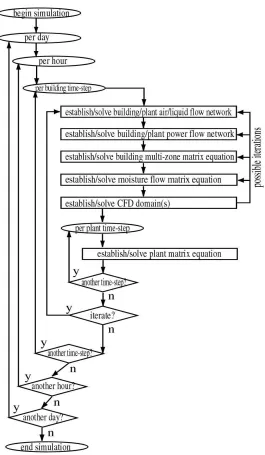
[image:3.595.167.432.249.704.2]The solvers corresponding to the building thermal, HVAC, electrical power, network air flow and CFD conservation equation-sets are arranged to act co-operatively as illustrated in figure 1. To ensure that the CFD turbulence model is appropriately configured at each time-step, a conflation controller (Beausoleil-Morrison 2000) is employed. This serves to further improve the simulation accuracy (Beausoleil-Morrison and Clarke 1998).
At the start of a time-step, the zero-equation turbulence model developed by Chen and Xu (1998) is employed in investigative mode to determine the likely flow regime at each boundary surface. The eddy viscosity distribution to result is then used to initialise the k
and ε
fields and a second simulation performed for the time-step. This process repeats at each computational time-step with the conflation controller determining the appropriate boundary condition for each surface: Dirichlet, Neumann or Robin. Where the flow regime is such that empirically derived convection coefficients are suitable, these are used in the building model and the surface heat flux is then imposed on the CFD solution. Where such correlations are not suitable, the CFD-derived convection coefficients are inserted into the building model's surface energy balance equations.
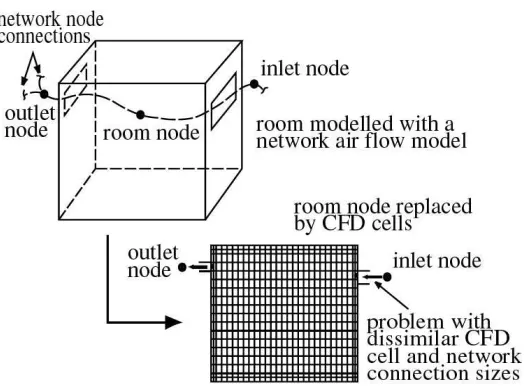
[image:4.595.168.432.426.619.2]Where an air flow network is active, the network node representing the room is removed and new network connections are added to enable a coupling with the appropriate domain cell(s) (Samuel 2006) as shown in figure 2. A special device has been established to ensure the accurate representation of both mass and momentum exchange in the case where domain cells and network flow components are of dissimilar size (Denev 1995). The appropriate network connection's area is increased or reduced to achieve a match with the corresponding domain cell(s) and then the associated velocity is adjusted to maintain the correct flow rate. Within the solution process, the adjusted velocity is imposed as a boundary condition to satisfy the flow rate and then it is readjusted in the momentum equation to give the correct momentum. From the viewpoint of the flow network, the air exchanges with the CFD domain are treated as sources or sinks of mass at appropriate points within the solution of the flow network.
Figure 2: Coupling network flow and CFD.
the HVAC solver. Note also that iteration may be invoked to resolve problematic couplings between domains.
It is also possible to execute a solution on the basis of partially matched physical schemes. For example, the building model might typically comprise several zones, with only a subset addressed by CFD. At the same time, a flow network may be linked to one or more CFD domains, have nodes in common with some, but not all, of the other zones comprising the building model, and have extra nodes to represent zones and/or plant components that are outside the modelled building portion. Each part of such a model would then operate on the basis of best available information (e.g. a zone with no matched air flow model would utilise its user-specified infiltration/ ventilation rates).
Quantifying local conditions
[image:5.595.126.460.398.694.2]Thermal comfort is determined by both personal and environmental factors. Personal factors include the activity level and the thermal resistance of clothing, while environmental factors include air and mean radiant temperature, air velocity, relative humidity, contaminant concentration and the local turbulence intensity of the air. Using the CFD embedded aspects of ESP allows the determination of the time variation in all the environmental factors.
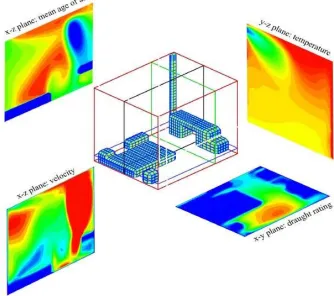
On the basis of the multi-variate outputs from a single integrated simulation, as depicted in figure 3, the spatial and temporal variation of indoor air quality and thermal discomfort may be assessed according to relevant standards (e.g. ASHRAE 62-1989, prEN 1752, ISO EN 7730 and ASHRAE 55-1992). Such assessments are typically based on relevant indicators, such as:
• the variation in vertical air temperature between floor and head height;
• the absolute temperature of the floor;
• radiant temperature asymmetry;
• unsatisfactory ventilation rate;
• unsatisfactory CO2 level;
• discomfort due to local draughts;
• additional air speed required to off-set an elevated temperature;
• thermal comfort assessment based on PMV, PPD and effective temperature;
• the local mean age of air.
Occupant modelling
The forgoing discussion has detailed how the physical aspects of the building can be modelled and how these can be related to perceived comfort levels. It is increasingly accepted that when possible occupants will alter their environment to maintain a comfortable condition according to an adaptive principal If a change occurs such as to produce discomfort, people react in ways which tend to restore their comfort
(Humphreys and Nicol 1998). To enable design decision support the control actions and the trigger events have to be understood and encoded into algorithms for inclusion in a predictive environment such as the one described above. At a personal level occupants can adjust posture or clothing to maintain comfort in the existing environment or they may use building elements such as blinds, windows or control settings to adjust the environment to suit their needs. The trigger for making these changes is thought to be related to a combination of comfort signals: thermal, visual and acoustical.
Variations also exist in the population. If we consider the comfort sensation of the occupants as an element in a control loop (Nicol and Humphreys 1973) of sensor, control law and actuator then each of these three aspects is defined separately for each occupant. For example for a given condition one person may feel comfortable and another uncomfortable, the uncomfortable person may then have several options for controlling their environment, say opening a window; but then how far do they open the window and would they do exactly the same given the same stimulus on another occasion? Given these natural uncertainties it is not possible to develop a single deterministic description of occupant behaviour, a probabilistic model is required (Nicol and Humphreys 2004). This approach has been adopted elsewhere, for example Hunt (1979). Recent work has focused on personality traits with the division of occupants into personality groupings of active and passive individuals (Love 1998), work which could be continued to look at how groups interact to achieve comfortable conditions. At this stage it is sufficient to say that the following probabilistic functions exist:
where P is the probability of the individual sensing discomfort. This then leads to a possibility of action:
P(action)=f(personality, social influences), (3)
the action adjusts either the response of the subject to the environment:
• posture (e.g. cross legs, fold arms) (Raja and Nicol 1997)
• location (e.g. move to another desk or turn round) (Newsham 1992)
• clothing (e.g. pull on jumper, roll up sleeves)
or the environment to suit the subject (Nicol and Humphreys 2004):
• blind position (e.g. move up/down, change slat angle) (Yannick 2006, Inoue et al 1988)
• operable window and doors (e.g. open/close window)
• artificial lighting (e.g. switch on/off task lighting) (Hunt 1979, Love 1998)
• local fans (e.g. desk or ceiling mounted fan)
• local plant (e.g. room heater or portable a/c unit)
• central plant (e.g. adjust room thermostat)
Not all of these options will be available to each individual. Also of note is that within each category of action there is the potential for many further options, for example if someone decides to open a window they may have the choice of several windows of varying size; a scenario which has been monitored in a field study (Herkel et al 2005).
Nicol and Humphreys (2004) have suggested that such changes are not precise but stochastic. Thus there is not a particular temperature at which windows are opened or fans switched on, but as the temperature inside and outside a building change the likelihood that the action has been taken with change. In the case of blinds and lights drivers other than temperature, such as the illuminance level, are likely to apply. In addition there will be restrictions (Humphreys and Nicol 1998) in the freedom of people to take adaptive actions. Thus a noisy road outside might inhibit the opening of windows.
Nicol and Humphreys (2004) suggested that the results of field surveys where the use of controls and clothing have been recorded can act as a source of information to specify an algorithm for the probabilities in equation (2) and (3) and/or to act as a test of the outcomes of the simulation based on other algorithms for these probabilities. They have observed the probability that a control is in use during a field survey can be described by the Logit model:
Log{p/(1-p)} = a + bx (4)
The values of a and b are determined by performing a probit regression for the Logit function using the results from a field survey where a the particular event has occurred (window opened, blind down etc) at different values of x. A weighted regression analysis of the Logit against the values of x then gives estimates of the values of the constants a and b. Once the values of the constants are known an algorithm can be constructed linking the index x and the probability of the particular event using equation 5 which is derived from equation 4 above
p = e(a+bx)/(1+e(a+bx)) (5)
A framework to handle this complexity has been developed (Bourgeois et al 2006) whereby occupants are modelled as individuals rather than the traditional approach of modelling using a diversity profile approach (i.e. a single group). This allows interactions and presence tests to be easily handled and the distributed effects of such actions to be coordinated for use in the ESP-r simulator.
Uncertainty
When implementing a stochastic algorithm in a deterministic solver there is an inherent uncertainty defined in the results. This is due to the randomness of the process which requires testing. The framework for assessing the effects of uncertainty in ESP-r is well suited for this purpose. Briefly the implementation in ESP-r allows limits to be placed on the possible values of a variable. The effect of changing this variable is then analysed either in isolation or in concert with other uncertain variables (Macdonald 2002). There are currently three analysis methods implemented in ESP-r:
• Differential analysis is used to calculate the effect of an uncertainty in a single uncertain input parameter in isolation.
• Factorial analysis is used to calculate both the individual and combined effect of uncertainties in multiple uncertain input parameters.
• Monte-Carlo analysis is used to calculate overall uncertainty in predictions for multiple uncertain input parameters.
Conclusions
This paper introduces a methodology by which the effects of controls and human behaviour can be incorporated into an existing simulation program using a combination of a nodal network and CFD modelling. Using such a combined approach it is possible to compute the range of environments in a building and to predict the comfort and discomfort of occupants and the actions which they will take to safeguard or to restore their comfort.
Using predictive algorithms it will be possible to model the internal environment in occupied buildings which are subject to the stochastic behaviour of occupants. This will enable modellers to predict the comfort of occupants and also the effects of occupants behaviour on the energy use of buildings.
Acknowledgment
The work described in this paper is part of a research project funded by the Engineering and Physical Sciences Research Council
References
ASHRAE Standard 55 (1992) Thermal environmental conditions for human occupancy
ASHRAE Standard 62 (1989) Ventilation for acceptable indoor air quality
Beausoleil-Morrison I (2000) The Adaptive Coupling of Heat and Air Flow Modelling within Dynamic Whole-Building Simulation, PhD Thesis (Glasgow: University of Strathclyde)
Beausoleil-Morrison I and Clarke J A (1998) The Implications of Using the Standard k-ε
Turbulence Model to Simulate Room Air Flows which are not Fully Turbulent Proc. ROOMVENT '98 99-106 (Stockholm)
Bourgeois D, Reinhart C and Macdonald I A (2006) Adding advanced behavioural models in whole building energy simulation: A study on the total energy impact of manual and automated lighting control Energy and Buildings In Press, Corrected Proof, Available online from 18 April 2006
Chen Q and Xu W (1998) A Zero-Equation Turbulence Model for Indoor Airflow Simulation, Energy and Buildings 28(2) 137-44
Clarke J A and Hensen J L M (1991) An Approach to the Simulation of Coupled Heat & Mass Flows in Buildings, Indoor Air 3 283-96
Clarke J A, Dempster W M and Negrao C (1995) The Implementation of a Computational Fluid Dynamics Algorithm within the ESP-r System, Proc. Building Simulation '95 166-75 (Madison)
Daly B J and Harlow F H (1970) The Generalized Gradient Diffusion Hypothesis Phys. Fluids 13, 2634
Denev J A (1995) Boundary conditions related to near-inlet regions and furniture in ventilated rooms Proc. Application of Mathematics in Engineering and Business 243-8 (Sofia: Technical University)
Herkel S, Knapp U and Pfafferott J (2005) A preliminary model of user behaviour regarding the manual control of windows in office buildings, Proc Building Simulation
‘05 (Montreal Canada)
Humphreys, M A and Nicol J F (1998) Understanding the Adaptive Approach to Thermal Comfort, ASHRAE Transactions104(1) pp 991-1004
Hunt D R G (1979) The use of artificial lighting in relation to daylight levels and occupancy, Building and Environment14 21-33
ISO EN 7730 (1994) Moderate thermal environments – Determination of the PMV and PPD indices and specification of the conditions for thermal comfort
Inoue T, Kawase T, Ibamoto T, Takakusa S and Matsua Y (1988) The development of an optimal control system for window shading devices based on investigations in office buildings, ASHRAE Transactions104 (1034-1049)
Launder B E and Spalding D B (1974) The Numerical Computation of Turbulent Flows
Computer Methods in Applied Mechanics and Engineering 3 269-89
Love J A (1998) Manual switching patterns observed in private offices, Lighting Research & Technology, 30 (1), 45-50
Macdonald I A (2002) Quantifying the effects of uncertainty in building simulation, PhD Thesis (Glasgow: University of Strathclyde)
Macdonald I A, McElroy L B, Hand J W and Clarke J A (2005) Transferring simulation from specialists into design practice, Proc Building Simulation ’05 (Montreal Canada)
Newsham, G (1992) Occupant movement and the thermal modelling of buildings, Energy and Buildings, 18 57-64
Nicol, J.F. and Humphreys, M.A. (1973) Thermal comfort as part of a self-regulating system, Building Research and Practice (J. CIB)6(3), pp 191-197
Nicol, J.F. and Humphreys, M.A. (2004) A Stochastic Approach to Thermal Comfort, Occupant Behaviour and Energy Use in Buildings, ASHRAE Transactions110(2) pp554-568
prEN 1752 (1998) Ventilation for buildings – Design criteria for the indoor environment
Raja, I.A. and Nicol, J.F. (1997) A technique for postural recording and analysis for thermal comfort research, Applied Ergonomics 27(3) pp. 221-225, Elsevier Science Ltd., London
Samuel A A, (2006) On the Conflation of Contaminant Behaviour Within Whole Building Performance Simulation, PhD Thesis (Glasgow: University of Strathclyde)
Sutter Y (2006) The use of shading systems in VDU tasks in offices, Energy and Buildings (in press)