Theses
Thesis/Dissertation Collections
7-15-1997
The Effectiveness of a pre-first grade program on
later academic achievement
Betsey Grossman
Follow this and additional works at:
http://scholarworks.rit.edu/theses
This Thesis is brought to you for free and open access by the Thesis/Dissertation Collections at RIT Scholar Works. It has been accepted for inclusion
in Theses by an authorized administrator of RIT Scholar Works. For more information, please contact
.
Recommended Citation
Master's Thesis
Submitted to the Faculty
Ofthe School Psychology Program
College of Liberal Arts
ROCHESTER INSTITUTE OF TECHNOLOGY
By
Betsey Grossman
In Partial Fulfillment of the Requirements
for the Degree of Master of Science
Rochester, New York
July 15, 1997
Approved:
[Names Illegible]
(committee chair)
(committee member)
-PERMISSION
GRANTED
Title of thesis
I
.
hereby grant p(Jrmlssion to the
Wallace Memorial Library of the Rochester Institute of Technology to reproduce my
thesis in whole or in part. Any reproduction will not be for commercial use or profit.
Date:
_
Signature of Author:
PERMISSION FROM AUTHOR REQUIRED
Title of thesis
_
I
prefer to be contacted each time a
...
request for reproduction is made. I can be reached at the following address:
PHONE:
_
Date: _ _
Signature of Author:
_
I
~Q~ G.o~
hereby deny permission to theWallace
Memorial Library of the Rochester Institute of Technology to reproduce my
thesis in whole or in part.
Running
head: EFFECTS OF
PRE-FIRST
The
Effectiveness
ofA Pre-First
Grade
Program
onLater
Academic
Achievement
Betsey
Grossman
Abstract
Extra-year
programs arewidely
usedto
help
students who aredeemed
"unready"
to
master
the
curriculum ofthe
next grade.This study investigated
the
academiceffectiveness of a pre-first gradeprogram
in
asuburban, predominantly
Caucasian,
uppermiddle class school system.
Twenty-five
matched pairsofchildrenwereselectedfor
the
study
based
on a readiness score onthe
Brigance
K
&
1
screening.Children
who spentanextra year
in
pre-first gradewerematchedwithyoungsters who proceededdirectly
to the
first
gradebased
ongender,
date
ofbirth,
andBrigance
score.While
no significantdifferences
werefound
between
the two
groups ofstudentsonthe
basis
ofIowa
achievement
test
scoresin
reading
andlanguage,
a significantdifference
wasfound
Effects
ofPre-First Grade Placement
onAcademic
Achievement
At
atime
when schooldistricts
areslashing
budgets,
eliminating
programs,
andlaying
offteachers,
one expensive program areais
booming: Extra
year programs.Schools
often statethat
they
implement
extra year programsin
orderto
reduce schoolfailures.
However
few
studies supportthis
idea
(Gredler, 1992;
May
&
Kundert,
1992;
Bell, 1972; Talmadge, 1981;
May
&
Welch,
1984;
Hagbord
etal,
1991; Johnson,
et aL1990; Kilby, 1982;
Shepard &
Smith, 1987; Ferguson, 1991; Shepard, 1989;
Buntaine
&
Costenbader,
1997).
Proponents
ofextrayearprograms such as programsfor
childrenbetween
kindergarten
andfirst
gradecommonly
called pre-firstbelieve
that
not allchildrenareready for
first
grade andthat the
extrayear willgivethe
child a chanceto
matureemotionally, socially,
andintellectually. The
premiseis
that
afterthe
extrayear, the
childwill
be
better
ableto
copewithacademictasks
(Gredler, 1992)
According
to
Harris
(1970)
transition
rooms were utilizedin many
large
city
schools
in
the
1940's. However
this
extrayearprogram wasnotwidely
implemented
untilseveral
decades
later
(Gredler,
1984).
There has
been
adramatic
increase
in
the
useofthe
transition
roomas an educationalplacementfor
atriskstudentswithinthe
last
thirty
years(Gredler,
1992).
Along
withtransitional rooms, the
use of retentionhas been
givenincreased
attentionExtra-year
programs arewidely
usedto
help
studentswho aredeemed
"unready"to
masterthe
curriculum ofthe
next grade.These
extra year programstake
on severalforms:
Pre-kindergarten
programstypically
consistofan extrayearofschooling
before
entering
kindergarten.
Transitional Class is
aterm
usedto
describe both
pre-kindergartenprogramsandpre-first grade programs.
The
commoncharacteristicofthese
classesis
that
they
provide an extra-year of school
between
two
traditionalgrades.Extra
year programs are expensiveto
operateprimarily
because
schoolstypically
try
to
limit
class sizeto
15
students.According
to
research conductedin 1992
by May
and
Kundert
(1992)
for
aschooldistrict
to
operatetwo transitional
classesfor
15
students each at
New York
State's
averageyearly
per-pupil allocation of$8,254
perchild,
the
district is
spending
$247,620
annually
onthese
programs.May
andKundert
(1992)
surveyed359
ofNew York
state's718
schooldistricts
to
determine how
prevalent school-readiness programs were.Of
the
260
schoolsthat
responded,
morethan
half
reportedhaving
sometype
of extra-yearprogram:57%
saidthat
they
had
a pre-first gradeprogram,
46%
saidthat
they
recommenddelaying
schoolentry
oneyear whenthe
child appearsunready
for
first
grade and83%
saidthat
they
had
adevelopmental/readiness kindergarten
(May
&
Kundert,
1992).
School
personnel who supportthe
use of extra year programs reasonthat
transitional
programs reduce schoolfailure
(Gredler,
1984). Advocates
of extra-yearprograms
believe
that
somechildrenneed moretime to
maturebefore
they
areready
for
the
demands
ofthe
classroom(Gesell
Institute
ofChild
Development,
1980).
Horm-Wingerd,
Carella
andWarford
(1993)
investigated
teachers'
perceptions of
the
effectivenessof
transitional
classes.The
investigators had
teachers
fill
outaquestionnaireassessing
the
perceivedeffectivenessoftransition
programs.The
results ofthe
study
indicated
that teachers
perceivedthe
transitional
program aseffectivein
facilitating
academic
achievement,
social-emotionaldevelopment
andimproved
attitudetoward
school
(Horm-Wingerd,
Carella
andWarford,
1993).
However,
most studies onpre-firstprograms show no educational advantages
(Gredler, 1984;
May
&
Welch,
1984;
Shepard
While
most ofthe
research onthe
effectivenessof extra year programs comparesfirst-grade
academic performance ofthe
retained child withthat
ofan at-riskpeer,
whoinstead
ofbeing
held
for
ayear,
wentdirectly
onto the
nextgrade,
some studiesinclude
additional comparison
groups,
and others compare academicperformance several years afterthe
early
school experience.Some
studieshave
found
that
when allowedto
progressnormally
through
the
grades,
a studentjudged
to
be
"at
risk"willperform
better
ongroup
achievementtests
than
a studentsimilarly
found
to
be "at
risk"who wasretained
in
atransitional
room.In
assessing
the
effectiveness ofthe transitional program,
Bell
(1972)
comparedthe
scores onthe
Stanford
Achievement
Test for
an"at-risk"population andfor
atransitionalgroup
atthe
end ofboth
first
and second grades andfound
that the
scores ofthe
"at
risk"group
were
higher
than
those
ofthe transition
roomgroup
both
years(Bell,
1972).
The
effects of extrayearprograms on studentsself-concepthas
alsobeen
investigated. Bell
(1972),
along
withassessing
academicachievement,
investigated
the
students'
self-concept.
The
results ofthe
self-concept measurementfound
that
afterboth
first
and secondgrades, the
atrisk
group's self-concept scoreincreased
slightly
but
the
transition
roomgroup's scoredropped significantly
(Bell,
1972).
Talmadge
(1981)
comparedthe
reading
achievement ofstudentsin
atransitional
program withthose
whowereidentified
as"at-risk"but
whoprogressednormally
though
the
grades.The
reading
achievement ofstudentsin
the transitional
roomwere nohigher
than the
"at-risk"students(Talmadge,
1981).
Gredler
(1984)
reviewedfive
studiesevaluating
pre-first-grade/transitional classes andfound
that
in four
ofthem,
the
childrenin
extra-year classes were nodifferent
in
achievement afterthe
extra yearthan
children considered"potential
first
gradefailures"who were placed
in
the
regularfirst
grade.In
the
onestudy
that
did
supportthe
use of atransitional class, the
results were"washed
out"
May
andWelch
(1984)
comparedthe
achievementtest
scores ofchildrenwhowereplaced
in
an extra-year program andotherhigh risk
children who wererecommended
for
the
programbut did
nottake
part.The
resultsindicated
that
there
wereno
differences
onachievementtest
data
nor on reported number of referrals orplacementsin
special services(May
&
Welch,
1984).
Kilby
(1982)
alsoinvestigated
the
long-term
effects ofapre-first program.No
significant
differences between
the
groupsonmeasuresof achievement atthe
end offirst,
second,
andfourth
gradeswerefound.
Furthermore,
children whohad
spent an extra yearin
a pre-first grade placement wereconsistently
behind in
achievement comparedto
agroup
oftypical
studentsin
gradesfour
through
eighth(Kilby,
1982)
.Buntaine
andCostenbader
(1997)
compared agroup
of childrenidentified
by
the
Gesell School
readinesstest
asbeing developmentally
immature
atthe time
ofthe
kindergarten
screening
and attended atransitional
prekindergarten
program,
withagroup
ofchildren who scored
similarly
onthe
Gesell
School Readiness
test
but
wereplacedin
aregular
kindergarten
program.Again,
no significantdifferences in
elementary
academic achievementbetween
the
two
groups wasfound.
The
impetus for
transitional
programs andfor
retention areidentical: To
givethe
child more
time
in
orderto
learn
the
curriculum.While
several studies of extra yearprograms
have
focused
on pre-firstplacements,
other researchhas looked
atthe
effects ofretention.
Hagbord,
Masella,
Palladino
andShepardson
(1991)
looked
athigh
schoolstudentswitha prior
history
ofgrade retention and comparedthem to
agroup
of nonretained students.
On
school-recorddata,
retained students weresignificantly
lower
on measures of academicachievement,
had
higher
ratesof absenteeismfrom
school,
and werelower
onthree
subscales of a self-esteem measure(Hagbord
etaL
1991).
In
their
reviewof research onretention, Jackson
(1985)
andCarstens
(1985)
both
found
that there
was noevidenceto
suggestthat
graderetentionwasany
morebeneficial
and
Smith
(1986)
concludedthat the
outcomes ofelementary
school graderetentionarenegative.
Johnson, Merrell,
andStover
(1990)
examinedthe
effects ofearly
graderetentionon
the
academicachievementoffourth-grade
students.The study
comparedfourth-grade
students who wereretainedat
the
kindergarten
orfirst
gradelevel
withboth
agroup
offourth
grade students who wererecommendedfor
retention atthe
kindergarten
orfirst
grade
level but
were notactually
retained andwithfourth-grade
studentswhohad
madenormal progress
through
the
grades.No
significantdifferences
in
academic achievementbetween
the
retainedand
recommendedfor
retentionbut
not retained groups werefound.
However,
both
groupsweresignificantly
lower
on severalacademic achievement measuresthan
werethe
comparisongroup
oftypical
youngsters(Johnson,
etal,
1990).
Given
the
recent cutbacksin
funding
for
educationandthe
emphasisofpolicy
makers on
the
early
identification
of children who arelikely
to
experiencelearning
difficulties
in
school,
it
is important
that
school administratorsbase
retentionandpromotion
decisions
on well executed evaluation studies.Unfortunately,
there
have been
relatively few
empirically
sound studiesto
guide educatorsin
these
decisions.
The
purposeofthe
presentstudy
wasto
give someinformation
aboutthe
academicachievement
level
of children who spent an extra yearin
a pre-first grade placement andto
compare
these
childrento
similarly
matched students who werepromotedto the
first
grade.
With
increased understanding
andbetter
ability
to
identify
students atrisk,
interventions
tailored to
preventand controlriskfactors
canbe designed
andimplemented.
Method
Subjects
The
original subject poolfor
this
study
wasallsixth,
seventh,
eighth,
and ninthdistrict
wasfairly
homogeneous
and consisted ofpredominately
Caucasian,
upper middleclasschildren.
The
cumulative recordfiles
ofapproximately 75
sixth, seventh, eighth,
and ninthgrade students were examined.
Children
wholeft
the
public schoolsystem,
as well asthose
who enteredthe
district
afterkindergarten
orfirst
grade wereexcluded.Subject
selection wasbased
on a"readiness" score onthe
Brigance
K
&
1 Screen
at
the
kindergarten
screening.In
the
spring
priorto
kindergarten
enrollment, the
Brigance
was
individually
administeredto
allchildren who were eligiblefor
schoolentry
the
following
year(age 5
by
December 1). All
subjects were enrolledin
a regularkindergarten
programin
the
district.
Following
kindergarten,
children were offeredplacement
in
the
pre-first grade program onthe
basis
ofkindergarten
teacher
recommendation,
readiness and social/emotionaldevelopment. Recommendations for
the
pre-first grade program were generated
by
a committeeconsisting
ofkindergarten
teachers,
pre-first gradeteachers,
the
schoolpsychologist,
and a school counselor.Placement
in
the
pre-first roomwasfinally
determined
by
parental approval.The
childrenin
the two
groups were matched onthree
variables:Sex,
date
ofbirth,
andBrigance K
&
1
readiness score.A
total
of25
pairs of children were obtainedthrough this
matching
procedure(N=50). In any
pair, total
Brigance
readiness scoresdiffered
no morethan
1
.5points.Matched
pairswere withinthree
months of each otherin
chronologicalage at
the
time
ofscreening.Measures
Brigance K& 1 Screenfor
Kindergarten
andFirst
grade(Brigance,
1 987). The
Brigance
K
& 1 Screen
for Kindergarten
andFirst
grade(Brigance K &
1)
is
acriterion-referenced
screening
instrument
which purportsto
measure severalbroad
key
skill areas:
Language,
motorability,
numberskills,
body
awareness,
andauditory
andvisual
discrimination.
Raw
scores onthe test
are recordedin
the
left
column ofthe
sectionstudent'sscore
for
eachassessment.The
total
scoreis
tallied
by
adding
the
numberin
the
studentsscore column.
Due
to
district
procedures, the
assessmentis
scored out of apossible score of
82.5
points.The
manualfor
the
Brigance
K &
1
providesnoreliability
or
validity
data.
Norms
usedin
preparing
the test
are not specified(Brigance,
1987).
Iowa Tests of
Basic Skills. The
Iowa
Tests
ofBasic
Skills
(Iowa)
is
agroup
administered,
norm-referenced achievementbattery.
The Iowa batteries
are wellknown,
widely
standardized achievement measurespurporting
to
assessthe
development
ofgeneralcognitive skills.
It
wasroutinely
givento
district
studentsin
the
Spring
ofsecond,
fourth,
and sixth grades.Percentiles
onthe
Iowa
(reading,
language,
andmathematics)
were obtained
for
both
the
experimentaland control groups.According
to
a reviewin
1992,
the
Iowa
wasdeveloped
on"..sound
measurement practices and meetshigh
standards oftechnicalqualities"
(Lane,
1992).
Procedure
The
cumulativerecordsof each ofthe
matched pairs were reviewed andthe
Brigance K
& 1
readinessscore,
chronologicalage, sex,
and score onthe
outcomemeasures were recorded.
Because
ofmissing
data in
schoolrecords,
studentsin
eighthand ninth grades were eliminated.
Outcome
measuresincluded: Iowa
percentile scoresin
reading,
language,
and mathematics(fourth
grade).To
ensurethe
confidentiality
ofthe
information,
alldata
were number coded.Treatment
The
treatment
in
the
currentstudy
was a pre-first grade program establishedin 198
.
The
pre-first program wasdesigned
to
meetthe
needs ofaspecificgroup
ofstudentswho were
determined
to
be
chronologically,
but
notdevelopmentally
"ready"for
a regularfirst
grade curriculum.Children
wereidentified
afterkindergarten
by
a committeeconsisting
ofkindergarten
teachers,
pre-firstteachers,
a schoolpsychologist,
and aschoolapproximately
half
the
size of atypical
first
grade classin
the
district.
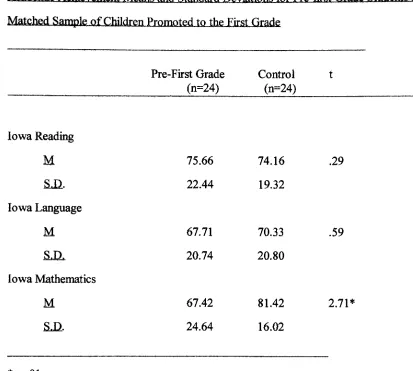
Results
A
dependent
t-test
was usedto
comparethe
performance ofthe two
groups ofchildren on
the
achievementmeasures.No
significantdifferences
between
the
pre-firstgroup
andthose
who wentdirectly
to
first
grade werefound in
Iowa
achievementtest
scores
in
reading,
1(23)
=.29,
p
=
.77.
Similarly,
no significantdifference in Iowa
achievement
test
scoresin language between
the two
groups werefound,
1(23)
=.59,
p
=
.56.
However,
asignificantdifference
in Iowa
achievementtest
scoresin
mathbetween
the two
groups wasfound,
1(23)
=2.71,
p
=.01.
Those
children who wentthrough
apre-first grade program
had
significantly lower Iowa
math percentiles as comparedto the
control group.
Achievement
scoresin
percentilesin
reading,
language,
and mathematicson
the
fourth
gradeIowa
are comparedin Table 1.
Discussion
All
childrenin
this
study
were compared atthe
fourth
gradelevel
of achievementas measured
through the
Iowa group
achievementtest.
While
this
study
finds
nosignificant
differences in
elementary
academic achievementin
the
areas ofReading
andLanguage
between
those
who wentthrough
a pre-first programandthose
who wentdirectly
onto the
first
grade,
a significantdifference
wasfound
in
the
area ofMathematics.
Reasons for
this
finding
may
be due
to the
emphasis ofthe treatment.
A variety
ofvariables
may
have
contributedto this
significantdifference. The
programmay
have
focused
onacquiring
reading
andlanguage
skills.Furthermore,
the
childrenidentified
asbenefiting
from
the
programmay
have been
ones whodemonstrated
perceptualorganizational
difficulties.
Finally,
this
group
couldhave just had
poorermathachievement as compared
to
other groups of students.Given
the
recent emphasis onpolicy
towards the
early
identification
of childrenwhoare
likely
to
experiencelearning
difficulties in
school,
it
is important
for
schoolstudies.
Unfortunately,
there
have been relatively few
well planned studiesto
guideeducators
in
these
decisions.
Additionally,
there
is
a greatdeal
ofdisagreement
onthe
academic andsocial/emotional effects of
both
transitional
programsandthe
retentionofstudents.
Therefore,
the
primary
purpose ofthe
presentstudy
wasto
provideinformation
about
the
academic achievement of children who were not promotedbut
spent an extrayear
in
a pre-first placement.The
study
wasdesigned
to
comparechildrenwho received ayear
in
pre-firstgradeto
amatched sample of children promotedto
the
first
grade.With
increased
understanding
andbetter
ability
to
identify
students atrisk,
interventions
tailored
to
prevent and control riskfactors
canbe
designed
andimplemented.
The
presentstudy
involved
ahomogeneous,
predominately
Caucasian,
uppermiddle class suburban
district.
Future
studiesmight expandthis
investigation
over variousgeographic regionsand/orsocioeconomicgroups.
Further
analysisto
determine
long-term
academiceffects ofthe
pre-first placementalong
with self-concept andattitudinal measureswould provide additional
information
onthe
impact
of extra yearReferences
Brigance,
A.
(1987).
Brigance K & 1 Screen For Kindergarten
And
First
Grade-North
Billerca: Curriculum Associates.
Buntaine,
R.
L.,
&
Costenbader,
V.
K.
(1997).
The
effectivenessof atransitional
prekindergartenprogram on
later
academic achievement.Psychology
in
theSchools.
24(1),
1-10.
Ferguson,
P. C.
(1991).
Longitudinal
outcomedifferences
among
promoted andtransitional
at-riskkindergarten
students.Psychology
in
the
Schools.
28. 139-146.
Gesell
Institute
ofHuman Development. A
gift oftime..
.Adevelopmental
point ofview.
New
Haven,
CT:
Author
Gredler,
G.
R. (1992).
School
readiness:Assessment
andeducationalissues.
Brandon,
VT:
Clinical
Psychology
Publishing
Company,
Inc.
Gredler,
G.
R. (1984). Transition
classes:A
viable alternativefor
the
at-riskchild?
Psychology
in
the
Schools.
21,
463-470.
Horm-Wingerd,
D.
M.,
Carella,
P.
C,
&
Warford,
S. D.
(1993).
Teachers'perceptions of
the
effectiveness oftransitional
classes.Early
Education
andDevelopment,
4(2),
130-138.
Jackson,
G. B. (1975). The
research evidence onthe
effects of grade retention.Review
ofEducational
Research.
41(4),
613-635.
Johnson,
E.
R,
Merrell
K.
W., Stover,
L. (1990). The
effects ofearly
graderetention on
the
academicachievementoffourth-grade
students.Psychology
in
theSchools,
22,
333-338.
Lane,
S.
(1992). A Review
ofthe
Iowa Tests
ofBasic
Skills.
In J.
Kramer
andJ.
Conoley
(Eds.),
Mental Measurements Yearbook:
1
1th
edition,(pp.
419-424). Lincoln:
University
ofNebraska Press.
May
D. C. &
Kundert,
D. K.
(1992).
Do
extra-year classespay
off?The
May,
D.
C.
&
Kundert,
D.
K. (1993).
Pre-first
placements:How
common andhow
informed?
Psychology
inthe
Schools.
30. 161-167.
Palladino,
P.
&
Shepardson,
J.
(1991). A
follow-up
study
ofhigh
school studentswith a
history
ofgraderetention.Psychology
in
the
Schools.
28,
3 1 0-3 1 7.
Shepard,
L. A. &
Smith,
M.
L. (1988).
Flunking
kindergarten:
Escalating
curriculum
leaves
many
behind.
American Educator.
34-38.
Shepard,
L. A. &
Smith,
M.
L. (1989).
Flunking
grades:Research
and policies onretention.
New York: The
Falmer
Press.
Shepard,
L. A.
&
Smith,
M.
L.
(1987). Effects
ofkindergarten
retentionatthe
end of
first
grade.Psychology
in
theSchools. 24. 346-357.
Thomas,
A M.
(1992).
Early
Retention: Are
there
long-term beneficial
effects?Psychology
in The Schools.
29.,
342-347.
Wortham,
S. C.
&
Patton,
M.
M.
(1992).
Retaining
childrenin
transitional
Table 1
Academic
Achievement
Means
andStandard Deviations for Pre-first
Grade
Students
andaMatched Sample
ofChildren
Promoted
to the
First Grade
Pre-First Grade
Control
t
(n=24)
(n=24)
Iowa
Reading
M
75.66
74.16
SJi.
22.44
19.32
Iowa Language
M
67.71
70.33
S.D.
20.74
20.80
Iowa
Mathematics
M
67.42
81.42
S.D.
24.64
16.02
.29
.59
2.71*