COMMISSION OF THE EUROPEAN COMMUNITIES
Brussels, 6.10.2008 SEC(2008) 2539/2
CORRIGENDUM
Annule et remplace le document SEC(2008)2539 du 1.10.2008 Référence ajoutée dans la footnote 16
COMMISSIO STAFF WORKIG DOCUMET
accompanying the
COMMUICATIO O REGIOAL ITEGRATIO FOR DEVELOPMET I ACP COUTRIES
TABLE OF COTETS
List of Acronyms... 4
1. The relevance of regional integration in a globalised world... 7
1.1. The global context... 7
1.1.1. The global economic context ... 7
1.1.2. Increasing attention to regional integration... 8
1.2. The increasing commitment of ACP countries to regional integration ... 10
2. The challenges facing regional integration in ACP countries... 12
2.1. The economic structure ... 12
2.1.1. Dual economies, weak export base and insufficient complementarity ... 12
2.1.2. Vulnerability to economic and financial shocks ... 14
2.2. The need for (more effective) regional policies beyond trade ... 14
2.3. Inefficient and/or incomplete infrastructure networks... 16
2.4. Weak regional governance... 17
3. Why does the EU care? ... 18
3.1. EU-ACP relations and regional integration: an ancient partnership... 18
3.2. More and better can be done ... 21
3.2.1. The need for a consolidated EU vision ... 21
3.2.2. Setting out the objectives ... 22
4. Three possible approaches for EU support ... 24
4.1. Elimination of barriers to trade ... 24
4.2. Policy co-ordination and co-operation for sustainable development... 26
4.2.1. Reducing physical barriers through infrastructure networks ... 27
4.2.2. Strengthening interdependence by action at macro-economic and micro-economic level ... 28
4.2.3. Management of common resources or challenges ... 30
4.3. Developing political co-operation for effective regional integration... 31
4.3.1. Regional cooperation for peace and stability:... 31
4.3.2. Good governance as a regional good ... 32
4.4. Comparing the approaches... 32
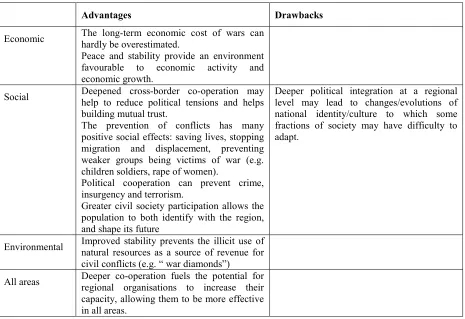
4.4.1. Overview of advantages and drawbacks ... 32
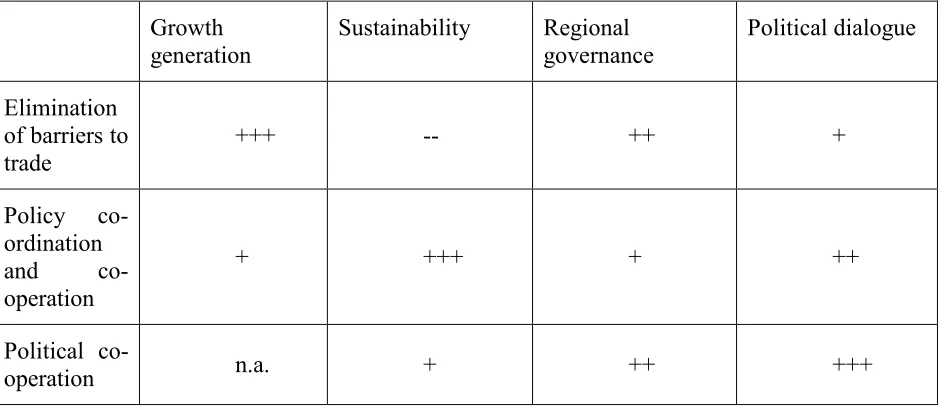
4.4.2. The contribution of different approaches to EU policy objectives ... 40
4.4.3. Finding the right mix... 41
5. EDF support to regional integration: a mix of approaches ... 42
5.1. The 9th EDF regional programmes... 42
5.2. The 10th EDF regional programmes... 44
5.3. Exploiting the synergies for inter-regional cooperation... 45
5.4. Design of regional integration and EU support ... 46
5.5. Risk factors ... 47
Annex 1: Overview of regional integration in ACP regions ... 50
Annex 2: Review of existing literature on regional integration in ACP ... 64
Annex 3: Stocktaking of EPAs and regional integration ... 67
Annex 4: EC financial support for regional integration... 70
Annex 5: Overview of 9th EDF regional programmes (2002-2007) ... 71
Annex 6: Evaluation of EDF Programmes... 74
LIST OF ACROYMS
ACP African, Caribbean and Pacific countries
APF African Peace Facility
APRM African Peer Review Mechanism ASEAN Association of South East Asian Nations
AU African Union
CACM Central American Common Market
CARICOM Caribbean Community and Common Market
CEMAC Communauté Économique et Monétaire de l'Afrique Centrale CEPGL Economic Community of the Great Lakes Countries
CET Common External Tariff
CFA Franc Communauté financière d'Afrique / Coopération financière en Afrique centrale Franc (currency)
COMESA Common Market for Eastern and Southern Africa CSME Caribbean Single Market Economy
CSP Country Strategy Paper
DRC Democratic Republic of Congo
EAC East African Community
EC European Community/ies
ECCAS Economic Community of Central African States ECOWAS Economic Community of West African States
EDF European Development Fund
EIB European Investment Bank
EPA Economic Partnership Agreement ERDF European Regional Development Fund FDI Foreign direct investment
IfS Instrument for Stability
IGAD Intergovernmental Authority on Development
IOC Indian Ocean Commission
IRCC Inter-Regional Coordinating Committee
MDG Millennium Development Goal
MERCOSUR Mercado Común del Sur MNC Multi-National Corporation
NAFTA North American Free Trade Association NEPAD New Partnership for Africa's Development NIP National Indicative Programme
OCT Overseas Countries and Territories OECS Organisation of East Caribbean States PICTA Pacific Islands Countries Trade Agreement
PIF Pacific Islands Forum
REC Regional Economic Community
RIP Regional Indicative Programme
RISP Regional Indicative Strategic Development Paper
RSP Regional Strategy Paper
SACU Southern African Customs Union
SADC Southern African Development Community
SME Small and Medium Enterprises
SOPAC South Pacific Applied Geosciences Commission SPBEA South Pacific Board of Educational Assessment SPC Secretariat for the Pacific Countries
SPREP South Pacific Regional Environmental Programme SPS Sanitary and Phytosanitary standards
TBT Tariff barriers to trade
UDEAC Union Douanière et Économique de l’Afrique Centrale UEMOA Union économique et monétaire ouest-africaine
1. THE RELEVACE OF REGIOAL ITEGRATIO I A GLOBALISED WORLD
1.1. The global context
1.1.1. The global economic context
Over the last decade, the globalisation process has gained further momentum, changing the global economic landscape and bringing the emergence of new economic powers such as China and India. Global trade and investment flows have grown much more rapidly than national economies, bringing about an unprecedented level of economic interdependence. In an increasingly complex web of economic and political relations, economic interdependence has grown much more rapidly and deeper than the political cobweb. Not all actors – governmental or commercial – have been able to adapt and take advantage of the new course. In this respect, larger and stronger players have a significant advantage as they have retained (or gained) the ability not only to adapt to, but to actually shape, globalisation. This explains why globalisation has tended to marginalise the smaller and weaker states and companies, thereby increasing inequalities – both within countries and between countries – between winners and losers. In this context, most ACP countries have not been in a position to harness globalisation to achieve their development objectives and, in particular, to accelerate poverty reduction. As shown in table 1 below, their share of world trade and investment has stagnated while developing countries at large have been reaping the benefits of globalisation.
Table 1: The position of developing countries and ACP countries in world trade and investment
Indicator 1990 2006
Developing countries' share of world trade
Sub Saharan African countries' share of world trade
23.2%
2.9%
34.7%
2.7 %
South-south share of world trade
Sub Saharan African intra-regional trade as a share of world trade
7.6%
0.1%
17.0%
0.2%
Developing countries' share of FDI flows
Sub Saharan African countries' share of FDI flows
17.8%
0.8%
29.1%
0.9%
Developing countries' share of FDI stock
Sub Saharan African countries' share of FDI stock
20.5%
2.0%
26.3%
1.7%
Source: UNCTAD
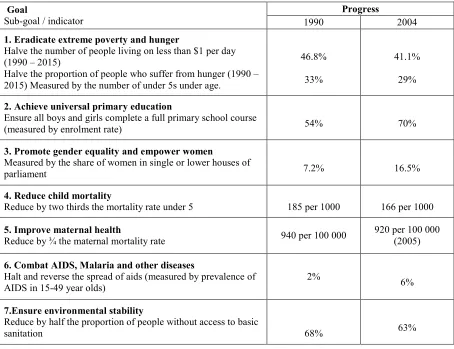
Table 2: The Millennium Development Goals and selected indicators for Sub-Saharan Africa.
Progress Goal
Sub-goal / indicator 1990 2004
1. Eradicate extreme poverty and hunger
Halve the number of people living on less than $1 per day (1990 – 2015)
Halve the proportion of people who suffer from hunger (1990 – 2015) Measured by the number of under 5s under age.
46.8%
33%
41.1%
29%
2. Achieve universal primary education
Ensure all boys and girls complete a full primary school course
(measured by enrolment rate) 54% 70%
3. Promote gender equality and empower women
Measured by the share of women in single or lower houses of
parliament 7.2% 16.5%
4. Reduce child mortality
Reduce by two thirds the mortality rate under 5 185 per 1000 166 per 1000
5. Improve maternal health
Reduce by ¾ the maternal mortality rate 940 per 100 000
920 per 100 000 (2005)
6. Combat AIDS, Malaria and other diseases
Halt and reverse the spread of aids (measured by prevalence of AIDS in 15-49 year olds)
2%
6%
7.Ensure environmental stability
Reduce by half the proportion of people without access to basic
sanitation 68% 63%
Source: United Nations
1.1.2. Increasing attention to regional integration
The recent proliferation in the number of regional integration projects and the focus on their importance can be attributed to the fact that regional integration provides a response to the challenges of globalisation. Smaller states find themselves in a weak position to attract global companies and to exert political influence an international level. Regional integration provides smaller states with recognition and weight and increases their ability to better harness the benefits and negative impacts of globalisation.
The EU itself is a prime example of this kind of response, where the internal market and common policies allow companies based in Europe to build up a strong regional economic base, while enabling Member States to pool their sovereignty to address common challenges in a cooperative manner.
Association), which joins developed countries (Canada and US) with a newly industrialised country (Mexico). Since the beginning of the 21st century, regional organisations have both expanded in membership and broadened co-operation areas.
ACP states did not stay out of this trend towards increased regionalisation. Across the ACP region, there are now some 20 regional integration arrangements and dozens of specialised regional cooperation organisations. Many of the ACP arrangements are focussing in the first place on achieving objectives relating to economic and trade aspects or cooperation
This attraction for regional integration can be easily understood and explained by the
outcomes it is expected to bring in at least three areas (see also annex 2 for a review of the literature on the benefits of regional integration):
– Through cooperation and institutionalisation of conflict prevention and the peaceful conflict resolution, regional cooperation helps stabilisation. Regional organisations play an increasingly important role in conflict management, peace-keeping and peace-building. They can play an important role in helping to tackle the root causes of conflicts as well as promoting and protecting human rights, building trust and thereby enhancing understanding among societies and cultures leading to reconciliation in post-conflicts situations. By deepening interdependence, regional integration provides disincentives for countries or groups to act aggressively against neighbouring countries and populations. – By building up larger markets, creating harmonised and effective frameworks for
economic operators, fostering the exchange of goods and resources, regional integration can foster economic development through economies of scale and stimulation of investment. From an EU perspective, regional integration is a step towards integration into the global trading system by allowing efficiency gains through enlarged markets and an open regional integration. It is, in particular, a means to foster south-south trade in a context where many developing countries trade more with developed countries than with their neighbours. By being essential for economic growth, regional integration is therefore a vehicle for accelerated poverty reduction.
Box 1: Regional integration and growth
Literature1 on regional integration and growth generally does not find a direct link between the two, but rather an indirect association, or so called "dynamic growth effects". Te Velde (2008) completed a study of regional integration and growth in ACP regions, and found positive effects on growth through regional integration in trade and investment. In particular, "regional integration is likely to increase aggregate growth through the growth effects of increased trade and investment, and one supporting piece of evidence is that exporting firms have higher productivity". Schiff and Wang (2003) similarly found that NAFTA imports raised Mexican productivity by between 6.5 and 7.5%.
– Regional cooperation is also the best way to provide or protect "regional public goods"
because it is more effective in addressing challenges with a trans-national dimension. Expected effects of regional cooperation are i) the provision of "regional governance public goods" such as international economic governance and regional institutional development; ii) the provision of "regional knowledge public goods" such as experience learning and information sharing; iii) overcoming "other market and coordination failures
1
For all references to literature in this document, see Annex 7 and
and coordinating activities with strong regional externalities" such as competitiveness challenges (ODI 2008). Typically, transmissible diseases and the fight against migratory pests, protection and management of natural resources (e.g. water, land) or migration are cross-border challenges that require cross-border cooperation if they are to be mitigated and if increased economic activity of a regional scale is to be sustainable.
Box 2: Regional public goods
Public goods should be provided at a regional rather than national level if either the underlying problem cannot be tackled at national level, or if regional level intervention is more efficient.2 Examples of potential regional public goods include: cross-border transport links, peace-keeping operations, fighting human trafficking, the fight against specific crimes (notably fraud and smuggling), infectious disease control, agricultural pests control and specific climate agricultural research (this could include food security).
A natural problem with regional public goods is their source of finance. Countries are less keen to take loans to finance regional public goods with larger spill-over effects to other countries in the region, and multi-country loans are hard to manage in practical terms (Ferroni, 2001).
1.2. The increasing commitment of ACP countries to regional integration
The vulnerability of most ACP economies, their fragmentation and the resulting lack of resources requires action going beyond national borders. This is felt by ACP countries themselves as all belong to at least one form of regional cooperation or organisation. They see this as a remedy to their inadequate economic size with regard to the globalizing economy and an opportunity to adopt a more strategic approach to their development and speed up their socio-economic transformation. It is also a powerful means to stabilize their geo-political environment through fostering peace, reconciliation and stability in their immediate environment.
The importance of regional political integration was exemplified in Africa by the establishment in 2002 of the African Union (AU). The AU includes all African countries (except Morocco) with the ultimate aim of forming a "United States of Africa". Currently, it is involved in a variety of chiefly political activities, such as conflict prevention and peace keeping (e.g. Darfur), but economic and monetary union is also part of its agenda and the African Regional Economic Communities (RECs) are regarded as stepping stones to this goal. In other regions as well, regional integration is seen as key. The Pacific region contains a number of organisations with specific fields of co-operation (e.g. SPBEA and USP for education). In the Caribbean, 12 of the 15 CARICOM members have progressed to a single market.
There have been long-standing efforts to harness regional integration for economic
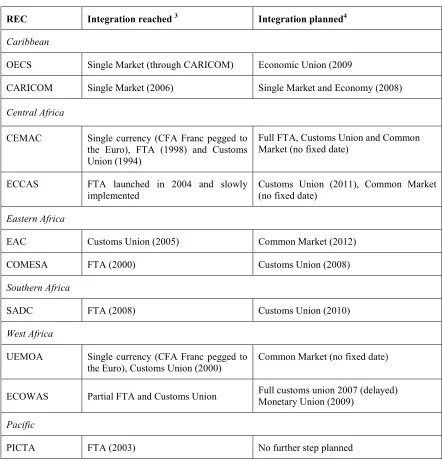
development. These efforts have been further stepped up in recent years, with many free-trade areas and customs unions under creation and a number of regions designing plans for ambitious common policies (see Table 3 below and Annex 1).
2
Table 3: Regional Economic Communities in the ACP: State of play of economic integration
REC Integration reached 3 Integration planned4
Caribbean
OECS Single Market (through CARICOM) Economic Union (2009
CARICOM Single Market (2006) Single Market and Economy (2008)
Central Africa
CEMAC Single currency (CFA Franc pegged to
the Euro), FTA (1998) and Customs Union (1994)
Full FTA, Customs Union and Common Market (no fixed date)
ECCAS FTA launched in 2004 and slowly
implemented
Customs Union (2011), Common Market (no fixed date)
Eastern Africa
EAC Customs Union (2005) Common Market (2012)
COMESA FTA (2000) Customs Union (2008)
Southern Africa
SADC FTA (2008) Customs Union (2010)
West Africa
UEMOA Single currency (CFA Franc pegged to
the Euro), Customs Union (2000)
Common Market (no fixed date)
ECOWAS Partial FTA and Customs Union Full customs union 2007 (delayed) Monetary Union (2009)
Pacific
PICTA FTA (2003) No further step planned
Beyond trade and economic integration, many initiatives aim at pooling efforts and resources of ACP states to tackle common problems.
In the Pacific, the Forum Fisheries Agency has developed an integrated approach in the management of fish, a vital economic resource for many countries. The Forum Fisheries Agency has provided state-of-the-art legal and economic advice for the conclusion of fishery agreements, surveillance of fishery activities in members' exclusive economic zones and for the development of a domestic tuna industry. Higher education has also traditionally been
3
Regional economic arrangements are often applied with distortions.
4
provided at the regional level in the Pacific as it was recognised as the most effective way for small countries to deliver university education to high standards, as demonstrated by the University of South Pacific (USP), the Fiji School of Medicine, or the University of Papua New Guinea (UPNG) – all with highly-evolved distance education facilities in the non-campus islands.
In Eastern and Southern Africa, the Nile Basin Initiative (NBI) was officially launched in 1998 by the ten riparian states. In a region that is characterised by severe poverty and instability and where the allocation and use of Nile waters have long been a source of serious tension, the participating states agreed on a shared vision to achieve sustained socio-economic development through the equitable utilisation of, and benefit from, the common Nile basin water resources. To convert this vision into action, multi-purpose infrastructure (for water supplies, hydro-electric power, irrigation systems) is being developed jointly to reduce vulnerability to droughts, to manage floods better, to ensure more water, more food and more electricity in a sustainable manner.
In the same region, the COMESA Free Trade Agreement (FTA) has proved beneficial to intra-COMESA trade, with trade growing at an annual average of 9% within COMESA and by 16% among FTA Member States between 2000 and 2007 – much more quickly than overall trade. A World Bank study concluded that the FTA has had a positive impact on growth in the members that joined the FTA, on cross-border investment flows and on the development of intra-industry linkages, with trade on semi-manufactured goods between FTA members overtaking trade of similar products with the rest of the world.
In the Caribbean, although tropical storms and hurricanes are frequent and have a large adverse impact on the fragile economies of the region, the present regional capacity to determine how severe a particular weather condition will be, and the likely effect in a localised area is very limited. CARICOM, the Caribbean Meteorological Organization and the national disaster agencies decided to pool resources in order to promote a reliable warning system and to obtain the advanced technologies that will provide the information needed to improve the preparedness of the authorities and the general public and thus help minimise loss of life and damage to property.
2. THE CHALLEGES FACIG REGIOAL ITEGRATIO I ACP COUTRIES
Despite real progress and clear commitment to enhance regional integration, a number of critical challenges remain if regional integration is to fulfil its development potential for ACP partners.
2.1. The economic structure
2.1.1. Dual economies, weak export base and insufficient complementarity
Firstly, this is an issue as medium-sized enterprises are essential for growth and competitiveness. Secondly, the dual economy causes ACP countries to have a weak export base as demonstrated by the ratios of sectoral import and exports between the ACP and EU shown in Table 4 below. While the ACP region runs a trade surplus with the EU, it clearly exports primary goods (78.8% of their exports) and imports manufactured goods (74% of their imports).
Table 4: EU / ACP trade by sector 2006 (excluding South Africa).
Sector (Sub-sectors) ACP Exports to EU ACP Imports from EU
Primary Products 78.8 23.9
Agriculture 25.4 13.1
Energy 43.5 9.1
Manufactured Products 20.4 74
Machinery 0.8 28.9
Transport 4.9 15.7
Chemicals 1.5 10.8
Source: European Commission
The combined effect of this duality and weak export base is a poor complementarity of national economies within a region, as economies find themselves producing and exporting a narrow range of similar products. As a result, trade integration is very limited in ACP regions and, as shown in Table 5 below, trade with the EU is generally larger than with regional neighbours. CEMAC countries, for instance, conduct 1% of their trade between themselves and about 45% with the EU. In a number of cases, however, significant trade barriers still persist and reduce the trade potential or trigger informal trade flows which do not appear in official statistics. Table 5: ACP regions import and export shares for 2004
Exports Imports
Region
Within
region Other ACP EU
Within
region Other ACP EU
ECOWAS 9.3% 1.2% 31.9% 10.5% 1.3% 37.0%
CEMAC 0.8% 3.2% 37.8% 1.4% 8.2% 53.5%
COMESA 9.2% 4.8% 29.9% 6.4% 2.7% 22.4%
SADC 2.1% 4.5% 32.6% 2.5% 4.3% 23.3%
Caribbean 8.9% 0.8% 20.0% 5.8% 1.4% 18.1%
Pacific 0.6% 0.5% 15.4% 1.3% 0.8% 8.8%
Where conditions for effective and credible integration are strengthened, trade stands a chance to take off. This is the case in EAC where Kenya's traditional exports to neighbouring countries exceed its traditionally dominant exports to Europe.
The lack of diversification and complementarity is not only due to the aforementioned factors, but also to the continued existence of many regulatory, administrative and physical trade obstacles between countries in the same region and to the narrowness of the national markets (itself an effect of limited purchasing power). As a consequence, contrary to developed economies, the potential gains and prospects of regional integration in ACP countries lie more in longer-term prospects than in the rationalisation of existing production structures.
2.1.2. Vulnerability to economic and financial shocks
ACP countries are vulnerable due trade shocks due to their reliance on a small group of products, exported to a limited number of export markets (as mentioned above). Fluctuations in commodity prices are a cause of instability for people's income, fiscal revenues and macroeconomic stability. One striking example occurred in Ethiopia between 1986 and 87. A fall in the world price of coffee caused a 40% decrease in Ethiopia's terms of trade, ultimately resulting in a 6% decline in Ethiopia's real income. Foreign capital inflows, most of which are short-term, make many ACP countries vulnerable to financial shocks5. As financial shocks can also affect exchange rates, they can also prove disruptive for regional trade.
2.2. The need for (more effective) regional policies beyond trade
From European experience, regional integration requires more than elimination of trade barriers to be effective and beneficial for all (business, consumers, workers, citizens). Regional integration should serve the objective of sustainable development and poverty reduction, and therefore be able to develop co-operation and address common challenges. These common challenges may include negative externalities, in particular the environmental and social impacts of increased regional economic flows. Such challenges can often be tackled at a regional level through the provision of appropriate regional public goods.
Agriculture is one example area; it remains the economic base for the majority of the poor in Africa and accounts for about a third of Africa’s GDP plus the bulk of its employment. In view of this, the AU and NEPAD have launched the Comprehensive Africa Agriculture Development Programme (CAADP) to foster agricultural development. In its communication "Advancing African agriculture", the European Commission, while recognising that the national level is where the most intense cooperation will continue to take place, expressed its view that in many areas (such as research, knowledge dissemination, trade facilitation, harmonisation of norm and standards, management of cross-border resources), action at continental and regional levels can contribute to agricultural development.
Regional integration can also make an important contribution to food security. Most ACP regions have put in place regional food security strategies to exploit the potential benefits of enhanced integration, notably in terms of trade (lowering the cost of inputs), infrastructure (sharing the costs of irrigation projects; improving road and lowering the cost of transport),
5
market management (stocks, improved market information, regional exchanges) and control of animal and pest diseases.
Migration is a further area which can be addressed with policies at regional level. Growing mobility and migration leads may have destabilizing effects in countries characterised by weak governance and lack of social safety nets; for example, more rapid spread of communicable diseases across borders or xenophobic reactions. This challenge can best be met by regional cooperation and cross-border actions in support of national responses.
Regional economic integration between poor and poorer countries may also lead to a
concentration of wealth in the lead economic area (regional power house) to the detriment of the poorest regions (Venables, 2000). In particular, integration will lead to increased FDI at a regional level, but this new investment may be focussed specifically within richer areas of the regional powerhouses, thus challenging the objective of poverty reduction for the region as a whole. This theory is backed up by empirical work on US and UK FDI in developing countries; it was found that countries with a larger market, or those countries closer to the larger market, received more FDI (ODI, 2006). Policies that aim to cushion potential losers are even more necessary in the case of "open" regional integration, where increased competitive pressure comes not only from the "powerhouse" in each region, but also from third parties.
A further area which can benefit from wider regional policies is that of industry competitiveness and the business climate. Well-functioning integrated regional markets benefiting from reduced transaction costs will increase trade, strengthen competition, encourage innovation and provide new and better quality goods and services to more people. This is particularly important for fledgling SMEs that need incentives to trade across borders. By contrast, the lack of business support services (inefficiency of financial markets, segmentation of services markets, etc) and of industrial strategies with a clear regional perspective are limitations to the creation of new businesses and the diversification of economic structures.
However, for SMEs to fully benefit, it is necessary to ensure that the relevant financing systems, which provide SMEs with access to borrowing, are in place. The improvement of regulatory framework and business climate will also contribute to attract foreign direct investments (FDI) in a context of local financial systems that fail to channel local savings to local investments. FDI is particularly valuable as/when it brings not only growth but also much-needed productive capacities (skills, technology, externalities, productivity). Furthermore, the need for increased R&D is being recognised by most leaders in developing countries as imperative for the diversification and upgrading of their economies. However, many of the results of R&D investment are only visible in the medium- to long-term while national budgets are hard-pressed to tackle other development urgencies. This makes the case for regional instruments in R&D particularly appealing.
coordination in these areas contributes to securing stability and the smooth economic adjustment needed for growth and poverty reduction.
Box 3: The challenges of monetary integration
There are four monetary unions in ACP, covering a) four of the five countries of the Southern African Customs Union (SACU); b) the two economic and monetary unions in West and Central Africa that tied their common currency, the CFA franc, to the euro; and c) the OECS in the Caribbean that tied their currency towards the US dollar (and previously the British pound). SADC, ECOWAS, EAC, COMESA and CARICOM also aim to establish monetary unions. All regions have agreed on programmes of macroeconomic policy coordination and convergence. In Africa, the overarching objective is to implement a monetary union and a single currency by 2021 as agreed by the AU. Regional integration agreements are regarded as stepping stones towards a common currency for the continent.
To date member countries have mixed results of macroeconomic convergence and therefore failed to reach their ambitious calendars for monetary integration. Incomplete trade integration, a weak business environment and underdeveloped financial sectors have remained problems. In ECOWAS, where the alignment of the UEMOA zone with the non-UEMOA members was originally envisaged by 2005, the heterogeneous economic structures of member states, notably of oil producer Nigeria as the biggest economy, and country-specific political and economic problems seriously constrained their ability to pursue consistent macro-economic policies. Another problem is the non-convertibility of currencies (except the CFA Franc) which hinders cross-border financial settlements (ODI, 2008).
2.3. Inefficient and/or incomplete infrastructure networks
The benefits of trade integration are hampered by weak trade facilitation infrastructure and systems, while natural handicaps (insular economies, landlocked countries) can be offset by regional cooperation.
In its Communication on the EU-Africa Partnership on Infrastructure6, the European Commission has explained the need to secure the interconnectivity of the African continent and its different regions. Despite slow improvement, transport costs remain high, much higher than in other developing regions, averaging 14% of the value of all exports compared with 8.6% for all developing countries, and higher still for many landlocked countries – Malawi (56%), Chad (52%) and Rwanda (48%). This imposes a huge burden on cross-border trade and economic development at large.
While the lack of energy remains a strong constraint on growth, there is a wide convergence that energy resources can be optimally exploited from a regional platform. Energy pooling and interconnectivity are addressing the problem of unreliable and costly services. Increased cross-border energy cooperation and trade is essential for improving reliability, affordability and access. The potential of regional integration and cooperation is particularly large when, as is the case in Africa, energy resources are substantial but require massive investment to be used.
6
2.4. Weak regional governance
There are three main causes of weak regional governance. Firstly, regional institutional capacities are not sufficient. The agendas for regional integration of most ACP regions are fairly ambitious and/or precise, but implementation is weak and hampered by the coordination ability of regional organisations and/or national governments. For example, the CEMAC Commission employs only 39 employees and 61 execution agents for, yet the ambitious integration agenda proposes to unite 35m people across 6 countries. While improving capacity should be a primary objective, it is also important that ACP states design the most appropriate regional integration agendas with a realistic degree of ambition that will work best in the specific regional ACP context.
Secondly, a wealth of regional organisations exists (see Annex 1). The RECs often have overlapping agendas, mandates and memberships and / or too weak structures and political weight. In Africa, a rationalisation exercise of the RECs is being undertaken by the African Union and NEPAD and the long-term aim is continental integration (e.g. a continental free-trade area in Africa).
However, the question remains as to how far this rationalisation process can actually go and what progress can be achieved in the short term given the differences in focus that sometimes exist between the AU formally recognised organisations and the actual capacities and mandates to deliver on an active economic and functional cooperation (see Table below).Table 6: Overview of African regional organisations
Focus EC-ACP co-operation
Eco. Fun. Pol. Eco. Fun. Pol.
AU recognised West Africa
UEMOA
(Benin, Burkina Faso, Cote d'Ivoire, Guinea-Bissau,
Mali, Niger Senegal, Togo)
X
O
ECOWAS
(UEMOA + Cape Verde, Gambia, Ghana, Guinea,
Liberia, Nigeria, Sierra Leone)
X
X
O O O
CILSS
(Burkina Faso, Cape Verde, Chad, Gambia, Guinea
Bissau, Mali, Mauritania, Niger, Senegal)
X
*
Central Africa
CEMAC
(Cameroon, Central African Republic, Gabon,
Equatorial Guinea, Rep. Congo, Chad)
X
X O
ECCAS
(CEMAC + Angola, Burundi, DCR, Sao Tome) X X
X
O * O OESA
IGAD
(Djibouti, Eritrea, Ethiopia, Kenya, Somalia, Sudan, Uganda)
X X O O
EAC
(Burundi, Kenya, Rwanda, Tanzania, Uganda)
X
X O Cap OIOC
(Comoros, La Reunion, Madagascar, Mauritius,
Seychelles)
X
Cap
COMESA
(EAC – Tanzania, IGAD – Somalia, IOC – La Reunion, + Angola, DCR, Egypt, Malawi, Swaziland, Zambia, Zimbabwe)
X
X O O OSouthern Africa
SACU
(Botswana, Lesotho, Namibia, RSA, Swaziland)
X
*SADC
(SACU + Angola, DCR, Madagascar, Mauritius, Malawi, Mozambique, Tanzania, Zambia, Zimbabwe)
X
X X O O O OAMU
(Algeria, Libya, Mauritania, Morocco, Tunisia)
X
OInter-regional
CENSAD
(Benin, Burkina Faso, Burkina Faso,
Central African Republic, Comoros, Côte d'Ivoire, Djibouti, Egypt, Eritrea, Gambia, Guinea, Guinea-Bissau, Ghana, Libya, Liberia, Mali, Morocco, Niger, Nigeria, Senegal, Sierra Leone, Somalia, Sudan, Chad, Togo, Tunisia)
X
O;otes:
Eco. : Economic integration
X
Key focal areaFun. : Functional cooperation X Minor focal area
Pol. : Political cooperation O Area of EC-ACP co-operation
Cap. : Co-operation in capacity building * Minimal EC-ACP co-operation
Finally, there is insufficient ownership and diversity of stakeholders. Putting in place trade liberalisation and integration policies, plus broader co-operation requires strong political commitment to regional integration, a strong institutional and legal system, the awareness of all stakeholders (e.g. business, trade unions, civil society) and the convergence of their views. These pre-conditions do not always exist in ACP countries. The processes rely too often on general declarations by national leaders, without in-depth ownership by a wide range of actors such as national politicians, administrations, parliaments, business and non-state actors. The results of the public consultation back up the idea that broader stakeholder participation is required.
3. WHY DOES THE EU CARE?
Progress and difficulties in ACP regional integration are of strong interest for the EU. One of the objectives of EU development policy is to help developing countries to integrate into the world economy, together with the sustainable economic and social development of developing countries and the fight against poverty (Article 177 EC Treaty). The EU sees regional integration as a vehicle for smooth integration into the global economy and therefore lends its support to regional integration in developing countries. This is a long standing feature7 of EU policy and that is particularly the case for ACP countries.
Conversely, the economic, social and environmental challenges facing ACP regional efforts may weaken efforts to reduce poverty and to foster sustainable development of ACP countries, and eventually counteract action supported by the EU.
3.1. EU-ACP relations and regional integration: an ancient partnership
Conceptually, there are several ways of conducting relations with third countries. These can be held principally in multilateral fora, on a bilateral basis with each individual country, or with regional groupings of countries arranged according to political, geographical or other interests. These levels are, of course, not mutually exclusive.
The EU-ACP relationship is, for historical reasons, not run primarily on a multilateral basis. A long-standing relationship, it formally began in March 1957 with the signature of the Treaty of Rome, which made special allowances for the then-called Overseas Countries and Territories (OCTs) of the European signatories of the Treaty. Since then, these countries
7
became independent, but provisions were made to preserve the special economic relationships inherited from the past and to promote their economic and social development. Hence a first generation of association agreements with largely francophone former colonies in the form of two "Yaoundé Conventions" (1963 and 1969), and later, following UK accession in 1973, a second generation of agreements, the "Lomé Conventions" (1975, 1980, 1985, 1990) extending this special relationship to former British colonies in Africa, the Caribbean and the Pacific.
Therefore, since the origins of the EC itself, a special relationship between Europe and the ACP countries as a group has been developed. It encompasses trade arrangements, economic and technical assistance, development assistance and, increasingly, political dialogue and the protection of fundamental rights. For a long period of time, these successive conventions, that gradually expanded into new areas, remained the most far-reaching, elaborate and complex North-South contractual agreement, and were held as the flagship of EU development policy and external relations.
This special relationship with a group of developing countries remains at the core of EU development policy. It is recognised as such by the EC Treaty itself (Article 178(3)). Even when the EU was critically looking at the experience of the past and exploring new ways for the future8, the multilateral option which would replace any bilateral arrangements with the ACP as a group or individually or regionally – i.e. going back on 40 years of special EU-ACP relations – was not contemplated.
EU relations with ACP countries have traditionally been conducted within a collective framework, the successive Lomé and Cotonou conventions, but in practice, mainly at the national level. This is the case for most Cotonou instruments: Political dialogue takes place mainly with national governments; development assistance has been mostly spent through National Indicative Programmes (NIPs) that respond to national Country Strategy Papers (CSPs); under Cotonou and until 31 December 2007, EU-ACP trade relations were governed by a unilateral EU trade regime towards ACP countries individually.
However, a purely bilateral relationship with each individual country is an option that has been discarded for a long time. Countries of the ACP group, and in particular of each of the sub-regions – Sub-Saharan Africa, Caribbean, Pacific – have common political, economic, social and geographic characteristics that make cooperation with them as regions or as a group more effective: general political undertakings shared by all; a single financial instrument (the European Development Fund) and the same financial procedures; and shared goal to reduce poverty and integrate into the world economy through a number of key policy areas (such as economic and financial cooperation, human and social development, improved governance).
This is why regional integration has been supported by the EU-ACP partnership agreements already since the second Lomé Convention (1979)9. The regional dimension of
8
Commission Green Paper on Relations between the European Union and ACP Countries on the eve of
the 21st century – Challenges and Options for a new Partnership, COM(1996)570 final, 20.11.1996
9
the EU-ACP cooperation is seen as a necessary complement to its national component. In effect, the general objectives of EU-ACP cooperation as set out in the Cotonou agreement
(Article 19) are poverty reduction, sustainable development and integration into the world economy as the overarching aims of the partnership. In order to achieve them, regional integration and cooperation is one of the fundamental areas of interest of the Cotonou agreement. Among the overall objectives of the partnership, "regional and sub-regional integration processes which foster the integration of the ACP countries into the world economy in terms of trade and private investment shall be encouraged and supported" (Article 1). To this effect, "cooperation support shall aim to:
(1) foster the gradual integration of the ACP States into the world economy;
(2) accelerate economic cooperation and development both within and between the regions of the ACP States;
(3) promote the free movement of persons, goods, services, capital, labour and technology among ACP countries;
(4) accelerate diversification of the economies of the ACP States; and coordination and harmonisation of regional and sub-regional cooperation policies; and
(5) promote and expand inter and intra-ACP trade and with third countries." (Article 28). In addition, protection of the environment and natural resources, as well as enhancing the role of non-state actors, are cross-cutting issues that should also be pursued at regional level (Article 32).
This makes the EU a unique partner of ACP as most other bilateral or multilateral actors of development policy have, until now, not placed the same emphasis on regional integration. Indeed, some have virtually no operations at regional level.
USAID has regional programmes in all areas of Sub-Saharan Africa plus the Caribbean, and works with a variety of partners including RECs such as EAC and ECOWAS across a range of areas relevant to regional integration. These regional programmes have been in existence for several years. Aid for regional projects in 2007 totalled $72m for West Africa, $30m for Southern Africa, $28m for East Africa, $15m for Central Africa, $316m for "Africa regional aid" and $15m for the Caribbean.
a) accelerate economic cooperation and development both within and between the regions of the
ACP States;
b) accelerate diversification of the economies of the ACP States;
c) reduce the economic dependence of the ACP States on imports by maximizing output of those
products for which the ACP States in question have real potential;
d) create sufficiently wide markets with the ACP States and neighbouring States by removing the
obstacles which hinder the development and integration of those markets;
e) promote and expand trade between the ACP States and with neighbouring third countries;
f) maximize the use of resources and services in the ACP States;
g) strengthen organizations set up by the ACP States to promote regional cooperation and
integration;
Canada has a "Pan African" programme which primarily supports institutions in building their capacity and structure. The support is limited to financial support and the organisations themselves must propose (and then implement) projects with a regional impact. CIDA quotes the African Union as a partner for this program. None of the RECs appear to be partners at present, and there is no direct focus on regional integration.
Japanese assistance to Africa is limited to a handful of countries, and does not include any clear regional development initiative. Assistance to the Pacific is more developed but still does not appear to contain any regional aspects.
The World Bank has recently adopted its "Regional Integration Assistance Strategy for Sub-Saharan Africa". On regional integration, the EU seems to be "leading by example" since the concepts and ideas developed in this document are very much in line with what the EU has been doing for long on regional integration.
Overall, the trend towards an increased focus on the regional level is now established as witnessed by the number of important development partners who are developing regional strategies This fact, in itself, confirms the need for further regional integration in the current global climate.
3.2. More and better can be done
While development co-operation is a shared competence between the EU and its Member States, the EU has a key role to play in supporting regional integration through its development policy. The EU's own experience with regional integration makes it a natural partner for regional organisations in ACP regions and it has developed significant experience and expertise in dealing with regional organisations and regional matters in developing countries. In addition, as in all areas of development cooperation, the EU has a key role to play in the co-ordination of Member States' efforts to increase aid effectiveness.
The EU has been very responsive to the trend towards enhanced regional integration in ACP countries. Many recent EU initiatives and policies seek to support this process, in particular: the regional strategies for Africa (October 2005), the Caribbean (March 2006) and the Pacific (May 2006), and the Joint EU-Africa Strategy of December 2007; the negotiation of region-to-region Economic Partnership Agreements (EPAs); the EU-Africa Infrastructure Partnership focused on network interconnectivity; the programming of the 10th European Development Fund (EDF) and the increase of Regional Indicative Programmes (RIPs) therein; the promotion of dialogue and cooperation with European outermost regions and overseas countries and territories (see Annex 7 for the full references of these documents).
3.2.1. The need for a consolidated EU vision
However, more can be done to make this partnership between the EU and ACP more effective. There is need for a consolidated vision, at EU level, of regional integration from a development point of view, as well as the necessity to better identify key challenges and tools in order to make EU policies in support of regional integration more effective. Three issues are critical in this regard.
on the most appropriate ways to fulfil the Cotonou objectives to cooperate in other areas of regional dimension, such as trade in services (including maritime transport and information and communication technologies), competition policy, intellectual property rights, standardisation and certification, customs legislation and procedures, and sanitary and phytosanitary standards.
Second, it is necessary to develop a more consistent and articulated EU vision of the role of policy cooperation in a number of areas which are essential to bring forward the concept of
sustainable regional integration and protection of regional public goods (agriculture, food security, environment and natural resources management, disaster risk management, health, higher education, research and development, rules aspects of business development). There is also a need to establish a better linkage with the key political ingredients for sustainable regional integration, notably peace and security. In all these areas, it is important to identify what needs to be done at which institutional level (continental, regional, national) and what is the role of the regional level.
Finally, it is appropriate to review the tools with a view to enhancing their complementarity and efficiency. Policy tools at EU level are diverse (development policy, trade policy, political dialogue), and the most appropriate policy mix needs to be developed to ensure its efficiency as well as its adequacy with varied regional realities. These tools need also to be complementary and coordinated with EU Member States and other donors' activities in support to regional integration, in order to develop the principles of aid effectiveness also in the context of regional interventions. The 10th EDF Regional Strategy Papers (RSPs) will provide the basis for the Commission and EU Member States to support regional integration in a coordinated fashion.
3.2.2. Setting out the objectives
A reinforced EU-ACP partnership in support of regional integration should pursue the following objectives:
– Reinforce the link between regional integration/cooperation and growth generation. The objective is to strengthen the impact of accelerated and deeper market integration (and of all forms of regional cooperation) on growth and poverty reduction.
– Reinforce the sustainability of the outcomes of increased economic integration. This means reinforcing cooperation with a view to protecting and delivering key regional public goods. This implies strengthening support for the integration agenda of the various regions and for their regional policies aiming to deliver these public goods.
– Strengthen the efficiency of regional governance, both at regional level and at national level. This requires a more streamlined organisation of regional agendas, increased
capacity building at regional and national level, and broader stakeholder participation
at regional and national level.
Enhanced efforts to achieve the above objectives should also pursue more operational objectives, notably:
– Maximise the efficiency of the new generation of the 10th European Development Fund (EDF) programmes, and in particular the regional programmes, with a view to better leveraging regional economic development through clearly identified priorities for regional intervention, based on the regions' own agendas and a review of past implementation methods an increased coordination of EDF programming;
– Identify key issues for supporting the implementation of a major element of the EU-ACP relationship, i.e. the Economic Partnership Agreements (EPAs). The EPAs are aimed at strengthening regional integration by building upon, supporting and fostering existing integration processes. There are challenges that need to be addressed as regards the capacity of ACP economies and structures to implement and adjust to the EPAs.
– Enhance the efficiency of EU assistance (including outside EDF) with increased coordination and complementarity of Community, Member States and other donors' support. Regional programmes (RIPs) will serve as a basis for this coordination. On the basis of the European Consensus for Development, improving coordination between EU donors is a key objective for EU development policy – and a key to its success.
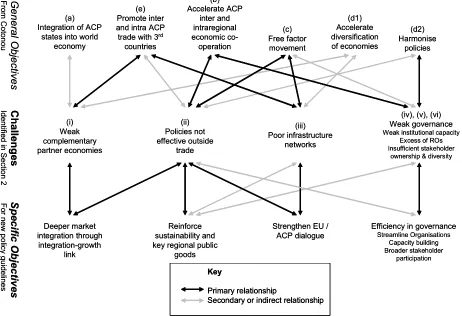
Figure 1: Problem tree linking general objectives, challenges and specific objectives
(a) Integration of ACP
states into world economy (b) Accelerate ACP inter and intraregional economic co-operation (c) Free factor movement (d1) Accelerate diversification of economies (e) Promote inter and intra ACP trade with 3rd
countries G e n e ra l O b je c tiv e s C h a lle n g e s S p e c if ic O b je c tiv e s F ro m C o to n o u Id e n tif ie d in S e c tio n 2 F o r n e w p o lic y g u id e lin e s
Efficiency in governance Streamline Organisations Capacity building Broader stakeholder participation (d2) Harmonise policies
Strengthen EU / ACP dialogue (i) Weak complementary partner economies Deeper market integration through integration-growth link
(iv), (v), (vi) Weak governance Weak institutional capacity
Excess of ROs Insufficient stakeholder
ownership & diversity (iii)
Poor infrastructure networks
Reinforce sustainability and key regional public
goods (ii) Policies not effective outside trade Key Primary relationship
Secondary or indirect relationship (a)
Integration of ACP states into world
economy (b) Accelerate ACP inter and intraregional economic co-operation (c) Free factor movement (d1) Accelerate diversification of economies (e) Promote inter and intra ACP trade with 3rd
countries G e n e ra l O b je c tiv e s C h a lle n g e s S p e c if ic O b je c tiv e s F ro m C o to n o u Id e n tif ie d in S e c tio n 2 F o r n e w p o lic y g u id e lin e s
Efficiency in governance Streamline Organisations Capacity building Broader stakeholder participation (d2) Harmonise policies
Strengthen EU / ACP dialogue (i) Weak complementary partner economies Deeper market integration through integration-growth link
(iv), (v), (vi) Weak governance Weak institutional capacity
Excess of ROs Insufficient stakeholder
ownership & diversity (iii)
Poor infrastructure networks
Reinforce sustainability and key regional public
goods (ii) Policies not effective outside trade Key Primary relationship
Secondary or indirect relationship Key
Primary relationship
[image:23.595.74.536.394.710.2]4. THREE POSSIBLE APPROACHES FOR EU SUPPORT
Considering that the regional integration agenda is set by the ACP countries themselves, EU support must aim specifically at supporting the regional integration process in ACP countries, i.e. helping ACP regions reach the goals they have set for themselves. Ownership is a central principle of the partnership between the EU and ACP countries and regions. The EU is therefore not in a position to make choices about regional integration in ACP countries. In a context of limited financial resources, it can, however, decide, among the choices made by ACP regions, which approach it will support as a priority in order to best achieve the objectives presented in Section 3.2.
Conceptually, three approaches for EU support to regional integration in ACP countries can be envisaged: elimination of barriers to trade; policy coordination to foster sustainable development; political cooperation to ensure the effectiveness of regional integration. They are presented here as separate concepts because each one has specific results that it is important to evaluate. In reality, policies are a complementary and mutually reinforcing mix of these three approaches, as shown in section 5. This mix is, and will remain, different in each region, as it depends on a region's own priorities.
4.1. Elimination of barriers to trade10
This approach is what has most often been referred to as "regional integration" and defined as the reduction of policy barriers to the movement of goods, services, capital and persons with the elimination of tariff and non-tariff barriers to trade, the removal of obstacles to investment from regional partners and the facilitation of payments at the centre. This approach was the main focus of the 1995 Commission Communication, and is reflected in Article 29 of Cotonou agreement on "regional economic integration"11. It heavily builds, although not exclusively, on trade policy and trade agreements between regional partners.
There is still plenty of scope for more effective trade integration in ACP countries. While regional agendas are ambitious (see Annex 1), implementation generally lags behind. There is, in particular, a potential for progress to be made in the following areas:
10
This approach is usually referred to in the academic literature as "negative integration". This is a neutral phrase that is used (often in an EU context, but not exclusively) to describe the form of integration based mainly on the reduction / abolition of barriers, as opposed to "positive integration", which implies the approximation or harmonisation of laws and standards. These expressions being descriptive, they do not convey any judgement on the merits of either form of integration.
11
"Cooperation shall, in the area of regional economic integration, support: a. developing and strengthening the capacities of:
- regional integration institutions and organisations set up by the ACP States to promote regional cooperation and integration, and
- national governments and parliaments in matters of regional integration;
b. fostering participation of Least Developed Countries (LDC) ACP States in the establishment of regional markets and sharing the benefits therefrom;
c. implementation of sectoral reform policies at regional level; d. liberalisation of trade and payments;
e. promoting cross-border investments both foreign and domestic, and other regional or sub-regional economic integration initiatives; and
– Effective implementation of all regional trade liberalisation commitments (FTAs, customs unions) at national level is essential for the benefits of regional integration. As highlighted in the public consultation, this is the prime area where regional integration can deliver benefits and help attain development objectives. Protectionism and concerns about national sovereignty need to be overcome for these benefits to accrue. Regional trade will spur local competition as cheaper imports from regional partners will lower the price of agricultural and industrial inputs, as well as of household products. As far as customs unions are concerned, the correct implementation of external regional duties is as important as the free circulation of goods as it allows the region to protect its industry and agriculture as appropriate, to collect public revenue (sometimes, as in UEMOA, for the benefit of regional organisation) and to maintain the delicate regional balance of costs and benefits from openness to the rest of the world.
– Services: most ACP regions have not advanced much in liberalising services between themselves. As a result, there are currently no real regional markets for services. Wherever regions engage in building up such regional markets, however, they are likely to draw very large benefits – if commitments are effectively implemented. Indeed, whereas services are essential to any economy, regardless of its level of development, the service sector remains underdeveloped in most ACP countries and the excessively high cost of services can sometimes increase the cost of industrial products by as much as 20%. Establishing more transparent, stable and liberal regional rules on sectors crucial to development could considerably reduce the excessive costs currently borne by both businesses and consumers. This is, in particular, the case for infrastructure service sectors such as telecommunications, transport, banking and insurance, which are vital to the competitiveness of all businesses. The importance of lowering obstacles to regional trade in financial services was highlighted in the public consultation as a crucial way of improving the business climate.
– Investment: investment is key to growth and development. Lowering or abolishing regional barriers to investment can strongly contribute to a more dynamic regional economy. Easier cross-border investment within a region acts as a multiplier of more open regional goods and services markets. Free capital movement within a region improves the allocation of capital and helps attracting FDI by offering improved security to investors, be they regional or outsiders. Solid and transparent regional rules are particularly important to rebalance economies and attract investment outside the traditional fields of mining and oil. – Customs and trade facilitation: Complex, diverse and inadequate customs procedures
represent an important obstacle to trade, especially to intra-regional trade, in developing countries. This is particularly true in relation to transit procedures. As result of delayed deliveries, African countries tend to increase their inventory holding. Firm surveys among 9 African countries found that firms hold, on average, the equivalent of three months of input needs, which imposes heavy and unnecessary costs on them. These reforms should be carried out at regional level but appropriate capacities are needed in national customs administrations to ensure a smooth implementation on the ground.
consumers. The adoption and effective implementation of regional technical rules and standards is thus an important step to increase regional trade flows.
Box 4: Sanitary and Phytosanitary Standards (SPS)
The experience of the EU shows how regional integration in SPS can be of assistance to development. Unharmonised SPS act as a significant trade barrier, as trade in food and livestock is subject to costly checks and certification at borders. Harmonisation therefore brings the benefits expected from trade integration including less price distortion, and higher quality through competition. Harmonised SPS can also have wider effects. They provide a mechanism for addressing food safety on a regional level. Plant and animal disease eradication is a potential regional public good as disease, by definition, cross borders. Naturally, to reach a high level of SPS integration requires not just harmonised policies, but also strong capacity at both regional and national level.
The Economic Partnership Agreements (EPAs) have to be seen under this approach as an important contribution in support of regional economic integration. They are an innovation as the previous trade instrument used (unilateral preferences granted by the EU) could not foster regional integration: the Cotonou trade regime was granted to ACP countries on a national basis for their imports to the EU. EPAs are different in that they are negotiated with ACP regions and trade not only between ACP and the EU but also within ACP regions.
To date (see Annex 3 for further details), the comprehensive EPA concluded with Cariforum has had a positive impact on regional integration in the Caribbean as the negotiating process itself has allowed the region to build common positions and to strengthen its own ambitions. The final text covers not only trade in goods, but also technical barriers to trade (TBT), sanitary and phytosanitary measures (SPS), investment, trade in services and e-commerce, competition, intellectual property and public procurement, thereby allowing the region to develop and strengthen its own rules in all these important trade-related areas.
In all other regions, the commitment to a comprehensive regional EPA has been renewed at the highest political level and negotiations are still going on. It has been noted, however, that the negotiations have had an accelerating effect on a number of regional projects – for instance the finalisation of the ECOWAS Common External Tariff (CET). Nevertheless, in order to exploit the regional potential of the EPAs, it remains a priority to conclude the negotiations.
4.2. Policy co-ordination and co-operation for sustainable development12
This approach focuses on what could be called the deeper policy aspects of regional integration. It is fully reflected in Article 30 of the Cotonou Agreement13 and builds on other
12
As far as laws, regulations and standards are concerned, this approach covers what is referred to in the academic literature as "positive integration" (see footnote 10).
13
"1. Cooperation shall, in the area of regional cooperation, support a wide variety of functional and thematic fields which specifically address common problems and take advantage of economies of scale, including:
a. infrastructure particularly transport and communications and safety thereof and services, including the development of regional opportunities in the area of Information and Communication Technologies (ICT);
types of cooperation often referred to as "functional cooperation", i.e. cooperation in policy areas which create the framework conditions for long-term development and sustainable interdependence of the economies. These address the physical barriers to intra-regional economic flows as well as supporting the interdependence of the economies managing
common resources or challenges.
ACP regions and countries are more and more eager to go in this direction. They have put, or are putting, in place a number of initiatives and policies which deserve to be supported but are still at varying stages of development.
4.2.1. Reducing physical barriers through infrastructure networks
Regional cooperation on infrastructure is essential to ensure the interconnection of national networks. Completing the "missing links" between national networks is vital for roads and telecommunications as they are preconditions for intra-regional trade (see Figure 2). This is also the case for border posts. There are also large benefits to be expected from interconnection of energy networks: larger electricity networks are more stable and more reliable and pooling resources allows conducting larger projects (e.g. dams) for the benefit of the whole region.
Most of key growth constraints have a regional dimension, and if they were overcome, growth would likely increase by 2-4 percentage points. There have been various studies examining the economic rates of return on infrastructure projects, concluding that these rates tend to be high – but a regional functional approach is often needed to materialize the gains. Some striking examples:
– There is at present a severe shortage of electricity-generating capacity in Uganda. This could have been overcome through the use of effective regional electricity grids.
– There are also regional constraints to rail. Uganda’s imports and exports make heavy use of the port in neighbouring Mombasa. The Uganda-Kenya railways operate under a private franchisee which needs more effective regional approaches towards safeguarding a stable investment environment in order to stimulate more investment. The rail link was broken at the time of conflict in Kenya with big effects for Uganda.
– In case of Mozambique, higher road user charges due to the country’s non-membership of COMESA have resulted in a reduced frequency of use of the Beira Corridor for Zambian transit goods. Due to non-implementation of the COMESA Yellow Card Insurance Scheme, transport costs in the Beira Corridor are 5-10% higher than in other corridors of the region.
Figure 2: Trans-African Road Transport Corridors
d. research and technological development;
e. regional initiatives for disaster preparedness and mitigation; and
•
4.2.2. Strengthening interdependence by action at macro-economic and micro-economic level