NIUE
EUROPEAN COMMISSION
Executive summary
Niue is an isolated single coral atoll with steep limestone cliffs to the sea and a central greenland plateau. It is located in the South Pacific, at 2,400 kilometres northeast of New Zealand, on the eastern side of the International Date Line. The GOP per capita in 2003 was € 5,650 with development aid as main contributor. Niue is a self-governing country "in free association" with New Zealand, and Niueans are New Zealand citizens.
Niue became one of the six ne" "Pacific ACP emmtiies" b:y signing the Cotonou Agreement in
2000. With a population of roughly 1700 (Census 2006), it is the least populated ACP country. Under a signed Financing Agreement in 2006, its 9'h EDF NIP of € 2 million (A-envelope) was allocated for the five-country-encompassing renewable energy programme which began implementation in 2006.
l 0% of the A-envelope (200, 000 euros) was allocated for the non focal sector component to implement the Niue Village Economy Development Programme (NVED). The NVED focused on income generating projects in areas such as eco tourism, coconut oil production and the re-construction of a heritage and traditionally built community hall.
The B envelope (€ 580,000) was used to assist the reconstruction of the hospital with the procurement of medical equipment (in cooperation with WHO) in co-financing with the New Zealand Government who funded the building project. The previous hospital was totally destroyed by Cyclone Heta, which devastated parts of Niue in 2004.
In October 2007, Niue and the European Union signed the EDF lO'h CSP NIP at the Pacific Leaders Meeting held in Tonga. Under the signed CSP/NIP of € 3 million A-envelope, € 2.55 million is allocated for the focal sector of renewable energy and € 450,000 (15% of the A envelope) for the Non State Actors (NSA). The B-envelope is allocated € 300,000 with flexibility for additional financial resources if more is needed to support any adverse situation or circumstances. The application of EDF lO'h financial resources for sustainable development programmes is directly linked to Niue's National Integrated Strategic Plan 2003-2008 and its succeeding plan from 2009-2014.
Update on the political, economic, social and environmental situation
Political Situation
In 1974 Niue became a self-governing state ·'in free association" with New Zealand and is the smallest self-governing country in the world. The government has full executive and legislative powers. Legislation is enacted by the unicameral Assembly, which consists of twenty members and a speaker. In the Niue general elections held in June 2008, Mr Toke Tufukia Talagi, a former Deputy Premier of Niue, was elected the Premier of Niue. Mr Talagi was subsequently appointed as Niue's sixth Premier and appointing a four member Cabinet to assist him in the new government. General elections are usually held every three years, with the next general elections scheduled for
2011.
During 2008, no progress has been made regarding ratification of the core UN human rights conventions. Niue has not ratified the International Covenant on Civil and Political Rights, the International Covenant on Economic, social and cultural Rights, the Convention against Torture and Other Cruel, Inhuman or Degrading Treatment or Punishment and the International convention on the Elimination of All forms of Racial Discrimination.
Update of the Economic Situation
Niue continues to face considerable development constraints, namely isolation, limited natural resources and exports trade opportunities, poor communications, an unpredictable climate (including drought and occasional hurricanes) and, most significantly, a shortage of skilled labour and outward migration, principally to New Zealand.
Substantial aid from New Zealand has historically supported a large public sector providing incomes and jobs for the people of Niue, while outward migration of large parts of the population has ensured a steady flow of remittance income into the country. However, remittance income has fallen and the level of aid provided by New Zealand has declined over the past decade resulting in considerable "downsizing" of the public sector.
The provision of offshore financial services has decreased in importance, notably in view of the need to implement legislation in line with Niue's commitment of II April 2002 towards the OECD to increase compliance with the principles of transparency and effective exchange of information for tax purposes. The offshore financial services operation was effectively closed in 2004.
The current financial crisis has not affected significantly Niue in 2008, although it is expected that Niue will bear adverse effect in the near future, in 2009 and 2010. Although Niue's small economy is to a large extent supported by New Zealand, Niue's vulnerability to the global and financial crisis may remain high and therefore may continue to face low rates of economic growth over 2009/200 I 0 due to its narrow economic base, dependence on tourism arrival from abroad, high food import bill, increasing fuel prices and decline in remittances from Niueans working in New Zealand.
Agriculture: is largely subsistence based, but its development is hindered by limited fertile land, lack of surface water and occasional drought and cyclones. The principal crops are coconuts, taro, yams and cassava, with taro as the most important export crop. There is a continuing increased focus on growing organic and commercial crops. Vanilla and noni (through joint venture with Reef Group) have been grown commercially since 2004 with modest exports success to date. Honey has also been exported in small quantities since 2003 and has undergone the organic certification process. The production and cultivation methods used in agriculture production are based on internationally accepted organic methods and practice. The agriculture sector continues to provide potential for employment creation and exports earnings capabilities.
Tourism While eco tourism continues to offer one of the best potential for long-term economic development for Niue, the industry is still highly dependent on improved air services frequency, and standards of tourism facilities and services available on the island. Whilst Niue offers pristine environment and excellent diving opportunities, it is still served by one airline (Air New Zealand) that provides one scheduled return flight per week from Auckland. The frequency of weekly air services can only increase if there is guaranteed availability of increased tourist accommodation in terms of the corresponding number of "beds" available for expected tourism arrivals. The GoN is still actively promoting and encouraging foreign direct investment (FOI) in the tourism sector in order to capitalise on these potential economic development opportunities. Four of the five projects under the Niue Village Economy Development Programme (NVED I) are tourism related projects, such as the building of two accommodation units at Hakupu, the development of sea tracks on a coastal heritage site, a canoe building and display shelter at Tamakautonga, and a small scale coconut oil production plant at Mutalau. All are very close to completion.
Trade/Economic Partnership Agreement (EPA): Niue is one of the Pacific ACP countries that are currently negotiating an economic partnership agreement (EPA) with the European Union through the Pacific ACP. Even though its exports potential is limited which in future may consists of only fish products, organically produced vanilla, noni and honey, Niue nevertheless has always shown considerable interests to become a signatory in the EPAs when concluded. The role of EDF is therefore crucial to remove some of the present infrastructure constraints faced by Niue and thereby making production for exports more commercially feasible in the future. Niue is not a member of the WTO and does not envisage joining in the immediate future.
Update of the Social situation
Niue's Human Development Index (HOI) of 0.87 ranks it third in the Pacific region, behind Palau and the Cook Islands. The high HOI reflects Niueans' high life expectancy of approximately 71 years (2004 data low infant mortality rate and universal rates of adult literacy recorded at I 00% (2004). There are no obvious signs of extreme poverty. Average household size (at 3.4 members per household) is low by Pacific standards, and most houses have access to running water and electricity.
The population have universal access to free public education and health provision. Widespread unemployment is averted by emigration to New Zealand. The New Zealand social welfare system provides a safety net for Niueans living in New Zealand, although the Niue Government also provides child benefit allowances and old-age pensions for residence on Niue. The solidarity at village level works rather well to support the community, and for those that face hardship situations, GoN provides financial assistance. There are no perceived differences in "poverty" levels according to age or gender.
indicators to improve the situation in this area, and continues to further improve performance in areas lagging behind, in particular, MDG 7 which aims to ensure sustainability by reducing the current proportion of population using solid fuels from 16.9 % to 10% by 2015. The EC's interventions in the focal sector (renewable energy) - under the 9'h and I o'h EDF - will assist to achieve these defined targets.
Women enjoy a high social status and play an important part in the economy. They have guaranteed access to a full range of health services, and are afforded equal opportunities in education and employment. Their participation in the workforce has increased significantly over the years as well as mcreased patllc!panon in the political and decision making-prceess. In the last eleetiens lleld in June last year, a total number of six women candidates stood in the elections, four (4) of whom were successful and one appointed to the four ( 4) member Cabinet. In terms of meeting its targets under MDG Goal 3 which seeks to promote equality and empowering women, Niue has achieved some progress by maintaining its overall target of 50% of women in wage employment (unti12015) and is on track in terms of the increased proportion of seats held by women in Parliament, the defined target being 50% by 2015.
Niue has a relatively high level of education services. Education is free with universal access for all children. The education system is based on the New Zealand Education Curriculum Standards and the Qualification Authority. Schools are reasonably well maintained, although there is a recognized lack of resource materials.
The estimated education budget for 2007/2008 was NZ$ 1,509,000, which is about 7.07% of total recurrent expenditure of NZD 21.36 million. NZAID provides approximately NZ$ 168,200 for study awards (scholarships) to enable Niue residents to undertake secondary and tertiary courses in New Zealand and the Pacific region. A fund of NZ$ 50,000 is available for vocational and short-term training. Australia also offers scholarships for tertiary studies primarily at the University of the South Pacific.
Niue h;!s relatively high levels of sanitation :!nd pubii.:: health services that are instrumental in controlling the level of communicable diseases in the country. However, with changing lifestyles and dietary patterns, the epidemiological picture is now dominated by non-communicable diseases (cardiovascular diseases, diabetes, obesity, cancer) that are creating new challenges for both public health and curative services. Medical care is free for all Niuean residents. During the fiscal year 2007/2008, 7.51 %of government's recurrent budget expenditure was allocated to health.
In spite ofGoN's efforts and some positive signals derived from these, the migratory balance is still negative in favour of NZ. The high turnover of skilled professional impacts significantly on much needed skills, expertise and human resources required in Government Departments.
Update of the Environmental situation
Niue is a Small Island Developing State (SIDS) with problems related to its geographical isolation. Strategic Objective 5 of the Niue Integrated Strategic Plan 2003-2008 aims to build sustainable management of Niue's natural resources through utilising the natural resources in a way that not only maximises the economic benefits but also ensures that future generations will be able to enjoy these in full. To achieve these, Niue has:
I. Enacted the Environment Act 2004, which is enforced and implemented by the Department of Environment;
3. Continued to partiCipate in UNCCD funded land rejuvenation programmes and education, national capacity self assessment and climate change adaptation;
4. Implemented the national waste disposal management plan, which prohibits the importation of consumer goods in glass bottles. Currently, a can recycling project is in place where each consumer pays l 0 cents for each aluminium can purchased. This environmental incentive is designed to encourage the exercise of care when disposing aluminium can waste within their communities and villages. In addition, the scrap metal waste component of Niue's Renewable Energy Programme (REP- 5) also targets the gradual phasing out of old electric ovens and cookers. A storage depot has been Identified and efforts me now undet way to establish a collection depot which will receive, sort and store the waste before disposing these to metal recyclers in New Zealand.
5. Niue also enforces organic cultivation methods for commercial and subsistence farming. It is currently engaged in an ongoing farm organic certification and auditing process through a registered international certifier. The first commercial farm was fully certified at the beginning of2007;
Niue continues to implement its National Energy Policy (NEP) and a National Energy Action Plan (NEAP), which addresses energy conservation and efficiency, and promotes the development of sustainable renewable sources of energy. Environmental vulnerability is quite important for Niue and the droughts and cyclones are not extraordinary events.
1. Overview of past and on-going co-operation
0 0 0 0
n/a n/a
for
0 0 0 0
0 0
**where relevant, split focal areas in main sub-areas of intervention; where sector budget support has been foreseen, please specify the effective implementation modalities and comment the possible discrepancy with the planned modalities in a comment to the table.
'y Reporting on the financial performance ofEDF resources
In the EDF 9th, the CSP allocated € 2 million under the A-envelope and € 0.6 million under the B-envelope. Of the A-envelope allocation, €1.8 million is foreseen for a renewable energy/energy efficiency programme that will comprise also four other new Pacific ACP countries. The remaining amount of 200, 000 Euros (IO'l'o or LflC ;.-~m~l:.:;;ej .. as .. tiliscd by ike Niue Village Economy
Development Programme (NVED 1) The Financing Agreement for the focal and non focal sector programmes was signed in 2006, with the service contract for the Programme Management Unit (PMU) based in Fiji. Implementation for projects under both the focal and non-focal sectors commenced in January 2006.
The disbursement of EDF resources is conducted through direct payment through an international tendering contract, and through the decentralised National Programme Estimates for locally managed activities. Due to the delayed start of foca! 5ector projects implementation and the importance of projects sequencing, the focal sector projects have gGre through two National Programme Estimates (NPE), of which 50% (NZD 200,200) of NPEl for NZD for 40~,400 was disbursed to Niue in December 2007. In June 2008, NPE2 for NZD 860,550 was agreed of which 50% (NZD 430, 275) of the budget was disbursed to Niue. In December 2008, a further NZD 191,970 was disbursed to replenish the NPE2 available funds to ensure scheduled project activities were progressed without any further delays.
The operation of non focal sector allocation is also through the National Programme estimates. The disbursement of the full allocation was completed in early 2008 enabling the complete utilisation of funds by June. Preparation of the project summary and expenditures report is ongoing during the last quarter of 2008.
Following Cyclone Heta, it was agreed to allocate the entire amount under the B-envelope (€ 0.6 million) for the procurement of medical equipment in co-financing approach with the New Zealand Government who funded the new hospital building project. The total allocation was channelled through WHO, who managed the procurement processes through its international tendering system. The new hospital was officially opened in April2006.
The delayed start of the focal sector projects has been an ongoing concern since the start of the actual delivery on the ground in June 2008 because of the remaining time frame to complete all activities by end of December 2009. However, significant progress was made in 2008 giving some confident that funds will be fully utilized and all activities concluded by the EDF 91h expiry date.
There is no Sector Budget Support for Niue,
,_ Projects and programmes in the focal and non focal areas
Focal Sector
and household hygiene capacity. After undergoing a thorough assessment of its institutional and technical components in 2007, the wind turbine component was considered not suitable for Niue. The wind turbine strategy was subsequently changed to solar PV grid connected system as a result of that assessment.
The solar PV grid connected system will make available 52.5kWp or I 0% of current power production to the national grid. The three locations for mounting the systems have been agreed and the supply and service contract concluded. Installation will take place in the second quarter of2009. thus the effect in the contribution to current power production will not be known until the evaluation and survey exercise is undertaken by the end of2009.
The installation for solar water heaters and LPG gas cooking appliances on domestic households has been underway since June 2008. In total, 234 solar water heaters ranging between 150-350 litres capacities are available of which 200 units were installed and commissioned by the end of December 2008. Installation of the LPG gas cooking appliances commenced later in early November 2008, of which 200 units were also completed and commissioned by December 2008. Each system was also supplied with a full gas bottle. The delivery of these components along with the LPG gas supply and retailing system is ongoing and will be fully completed by December 2009. The evaluation on these measures contribution to current power supply consumption and savings is expected to occur in 2009.
Utilisation of resonrces for NSAs
Five village based projects were selected under the Niue Village Economy Development Programme (NVEDl) for the non focal sector allocated 200, 000 euros (10% of the A envelope). These projects were implemented by the village councils and objective to strengthen their village economies through development of income generating activities. The Programme Estimate for NVED (PE I) ended in July 2008 and all five projects (with the exception of one) have been completed, with the project approaching the closure phase. An audit of the project is expected to be
launched before mid 2009 and an evaluation carried out before the project is closed.
Utilisation of the B-envelope
The €0.6 million of the B-envelope have been fully utilised to rehabilitate the destroyed hospital following Cyclone Heta in early 2004. The provision of equipment was completed in early 2006 and the hospital officially opened in April of that year. A project audit was undertaken in 2007 and followed by review in 2008.
Other cooperation
a) EDF regional/lntra-ACP programmes and Development Cooperation Instrument. The
regional allocation to the Pacific ACP under the 91h EDF amounts to € 39 million after three mid term reviews and includes three focal sectors "Economic Integration and Trade'', "Human Resources Development", "Fisheries" and a non-focal sector for extension of the 81h EDF programmes to the 6 new ACP countries. The 9'h EDF Pacific Regional Indicative Programme funded and extended a number of existing projects to the six new Pacific ACP countries, including Niue. These consisted of:
• Pacific ACP Regional Economic Integration Programme (PACREIP)
• Development of Sustainable Agriculture in the Pacific (DSAP)
• Pacific Regional and OCT Fisheries Programme (PROCFISH)
• Pacific Regional Initiatives for the Development of (basic) Education (PRIDE)
• Reducing Vulnerability in PACP States- SO PAC
• Development of Fisheries in the Pacific (DEVFISH)
• Pacific Environmental Information Network (PEIN)
In addition to the above Niue has benefited from training provided through the "TA to the RAO" Project, as well as from EPA-related technical assistance under an intra-ACP funded programme that is implemented through the Pacific Islands Forum Secretariat. Niue also participated in EPA negottatwns and Atd for I rade consultatiOns m 2008.
b) Debt relief and FLEX funding under the EDF B-envelope. Niue did not make a submission for FLEX funding.
c) Humanitarian or emergency assistance (funded from the EDF B-envelope and/or ECHO). Niue has benefited from EDF 9'h B-envelope funding through the provision of medical equipment for the new hospital. The new hospital is located away from the coastal area and further inland to reduce exposure wave actions during cyclonic weather conditions that previously may destroyed the old hospital.
d) EIB interventions (specifying possible payments arrears). The European Investtnent Bank (EIB) appraised in 2005 a global loan of up to € I million to the Niue Development Bank (NOB). This contribution, foreseen for funding under the Pacific Islands Finance Facility, was to assist the development bank in providing support to private sector companies which suffered from cyclone Heta in 2004, and also to enable the Niue Development Bank to provide support for housing loans for re-building or construction of homes essential for improving the standards of living and therefore an incentive to encourage Niueans to remain in Niue. Consultations between the EIB and the NOB continued in 2006, and the loan agreement was signed in early 2007. The EIB is continuing to assist NOB develop its lending policies on Niue so to bring it into line with its own lending policies to NOB. The instrument is most welcome to provide additional financial resources for the NOB's country development lending strategies.
e) Other Community interventions (European Instrument for Democratic and Human Rights, Instrument for Stability, fishery agreements etc.) None of the EU Member States has an important development cooperation programme with Niue, with the exception of France, which contributed € 530,000 for the construction of the new Niue government administration building completed in September 2008, and Italy and Germany which contributed to ongoing food security measures and small village projects. France and French Polynesia were also actively involved in the post-cyclone Heta rehabilitation efforts in 2004, in the context of which French Polynesia contributed 0.5 million NZD to Niue's recovery efforts.
~ Policy Coherence for Development (PCD)
The Niue National Integrated Strategic Plan is very much in the context of the Community's EDF agenda. EDF 9'h has opened the renewable energy sector on Niue. With continuing investment will result in real benefits in the reduction of power production costs for government and retail unit price for users, plus contributing to climate change responses on Niue.
of export taxes and infant industry measures, and delivery of Aid for Trade provisiOns will contribute significantly towards achieving the development strategies and the maintenance of MGD on Niue. Niue has a standstill fishing industry that could benefits from an FPA and inward investment supports.
Development of the village economy is a key priority for the Government of Niue. While most of the population on the island is spread out on the 14 villages, Niue still suffers from a chronic shortage of human resources due to high migration of Niueans mainly to New Zealand and Australia. Village development is critical to maintain the community livelihood and provide collective financial security. This, in tum can provide direct benefits to Niueans by improving the quality of life in the villages and act as an incentive for Niueans to remain and further develop other possible potential activities. It is with this intention that the GoN indicated that a similar type programme be continued under the non focal sector of the l O'h EDF.
SIGNATURES
National Authorising Officer
National Authorising Officer NIUE
Date: _ _ '
4-.:...._'_'7 _ _ _
""'_>)_-_
Head of Delegation
Wiepke VanDer Goot Ambassador I
Head of Delegation
ANNEX2
Table 1: "Country at a Glance"
Expenditure on education (2008) Expenditure on health (2008)
Source: Niue Government
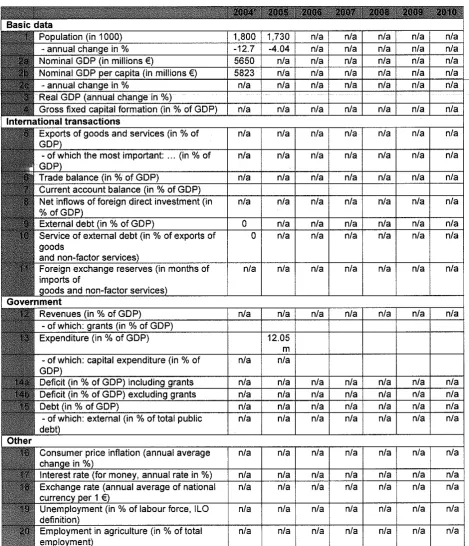
Economic data for 2000 to 2004
TABLE OF MACRO-ECONOMIC INDICATORS
MONITORING COUNTRY PERFORMANCE
3. Under 5 child mortality 0% 0% n/a n/a n/a
value
4. HIV prevalence rate of women aged 15-24
n/a 0% n/a n/a n/a n/a
reverse
ratio in primary
8. Ratio to boys in primary n/a n/a n/a n/a n/a n/a
and
9. Primary school completion rate n/a 100% n/a n/a n/a 100%
TA
10. Proportion with n/a 100% n/.a n/a 100%
sustainable access to an improved
TA
valuewater source
lines and mobile n/a n/a n/a n/a n/a n/a
1000 inhabitants 1
for n/a n/a n/a n/a n/a n/a n/a
start n/a n/a n/a n/a
n/a n/a
TA
Source: data on telephone lines and cellular subscribers are collected by the International Telecommunication Union (ITU). Data for telephone lines come from administrative records compiled by national regulatory authorities or telecommunication operators and tend to be timely and complete. A source of information for DEL could be Gov (national agencies annual report) or ITU consolidated report (the most recent for 2006).
Source: www .doingbusiness.org
There are two main approaches to measuring this indicator: (a) household surveys that include information about access to transport, and (b) mapping data to determine how many people live within the specified catchments of the road network. A possible source of information for DEL, alternative to Gov, would be the WB (limited to 31 IDA countries).
Explanation:
Compared to previous years, 6 new indicators have been added, providing additional information on the modernisation and economic growth process. These indicators are based on a set of indicators harmonised between the EC, The World Bank and the African Development Bank for measuring performance at the country level.
example financial donor matrix
planned donor disbursements in (country) for 2009
in Euro x 1 million
donor sector 1 sector 2 sector 3 GBS etc etc multi~ food aid sector
EC
member state 1 member state 2
etc etc
total EU
other bilateral 1 other bilateral 2
etc I IMF I UN systems
WB
others I total
othe~
total all dinars
Note: This matrix is an example of a donor matrix that can be drafted at country level to show
the planned donor disbursements in 2009 (indicative figures, entry into the table does not constitute an entitlement) Sectors may vary locally according to sectors defined in the country poverty strategy or similar strategy.
The example may be adapted for local use or a similar locally devised matrix may be used
examPle financial donor matrix
indicative planned donor disbursements in (country) for 2010
in Euro x 1 million
donor sector 1 sector 2 sector3 GBS etc etc multi- food aid sector
,.~
member state 1 member state 2
etc etc
total EU
other bilateral 1
other bilateral 2 etc I
IMF I
UN systems
WB I
others I total
othe~
total all d+ors
Note: This matrix is an example of a donor matrix that can be drafted at country level to show
the planned donor disbursements in 2010 (indicative figures, entry into the table does not constitute an entitlement) Sectors may vary locally according to sectors defined in the country poverty strategy or similar strategy.
The example may be adapted for local use or a similar locally devised matrix may be used
COMMITTED AND PLANNED AID PROGRAMMES (NIUE)- 2008
1.1 IVU, 000 0.00 100, 000 0.00 0.00 0.00 0.00 0.00
o.oo
IIo.oo
1.2 250,
---
0.00 250, 000 0.00 0.00 0.00 0.00 0.00 0.00 0.00250, 000
o.oo
I 70,ooo
1o.oo
1o.oo
1o.oo
0.00 0.00 0.00 0.0070, 000
250, 000 750, 000 0.00 0.00 0.00 0.00 0.00 0.00 0.00
750, 000
2.0m J 0.00 0.00 0.00 0.00 0.00 0.00 0.00 0.00 0.00
2.0m
1.0m I 0.00 1.0 0.00 0.00 0.00 0.00 0.00 0.00 0.00 1.0m
1.8
0.00 0.00 0.00 0.00 0.00 m 0.00 0.00 0.00 0.00
EUR 1.8mEUR
30,
0.00 0.00 0.00 0.00 0.00 0.00 0.00 0.00 0.00
000 30, 000
0.00 30, 000 0.00 0.00 0.00 0.00 0.00 0.00 0.00
0.00 0.00 0.00 0.00 0.00
0.00 0.00 0.00 0.00
II
0.00 I 0.0020 million
at a 6%
I
Currently,interest 875,000
0.00 0100 0.00 0.00 0.00 0.00 0.00 0.00 30m NZ after
AUS accumulating
6% annual interest since
2006
0.00
I
0.00 0.00 0.00 0.00 0.00 0.00 0.00 0.0030, OOONZ
1125,
ooo
I I I l lI