'Making a difference'
Science, action and
integrated environmental research
By
Lorrae van KerkhoffA thesis submitted for the degree of
Doctor of Philosophy of the Australian National University
School of Resources, Environment and Society Australian National University
Except where otherwise indicated, this thesis is entirely my own work.
Lorrae van K.erkhoff
I
Of the many people who contributed to the development of this thesis I would
particularly like to extend warm thanks to my supervisors, David Dumaresq,
Gabriele Bammer, Art Shulman and Bob Wasson. Their variously enthusiastic,
critical, and provoking com1nentaries each contributed not only to the final product,
this thesis, but also to three and a half years of tremendously rewarding intellectual
challenge. My thanks also go to my colleagues and friends in the Human Ecology
Forum for their constructive critiques, particularly Val Brown and Jacqui Russell for
reading earlier drafts of this thesis, and likewise to Roger Clark from the USDA
Forest Services for his time and co1nments.
I must also thank the many case study participants who made this research possible,
in particular Roger Shaw and Ian Noble for their support. The generosity of
everyone to contribute their time made these,
in
many respects, 'dream' cases. Their willingness to cover part of my expenses to attend their meetings is gratefullyacknowledged.
I would also like to acknowledge the support of Land and Water Australia, whose
generous scholarship enabled me to focus on the 'real work' of research. More
personally, my thanks also go to the staff of Land and \vater Australia for their
ongoing interest and enthusiasm.
Finally, of course, I must thank my family for their unfailing acceptance that I
would get there. Special thanks also to Aleta for her detailed proof-reading and, of
course, Rene for 1naking sure I kept one foot firmly within my social context.
This thesis is dedicated to my grandmother, Hazel Sheedy,
One of the great paradoxes of modern-day science is that the credibility it relies on
to gain authority is derived in part from its independence from decision-makers. Yet
that independence is also impotence: to make a difference in the world, scientists
must work with those who can bring about changes in action. In environmental and
natural resource management research there is growing awareness that distance
between science and society comes at a cost, as demand for scientific input into
decisions increases and public scepticism of science increases.
Consequently ne\,V models of science are emerging, many of which are based around
the concept of 'integration'. Integrated approaches include interdisciplinary
research, and research tl1at seeks to engage 'action takers'-government, industry,
and community-in the research process. The idea of integrated research has
brought the paradox bet\-veen independence and action to the forefront of
environmental research. Conflicting arguments for integration amid burgeoning
'integrated' research models, combined with the constraints of conventional
research, have fuelled ambiguity and uncertainty in attempts to negotiate the role of
science in this milieu. This study has sought to reduce the ambiguity and uncertainty
b y investigating how integrated environmental research is implemented in practice.
Using a novel methodology based on social communication and social practice, this
dissertation reports on two qualitative case studies of Australian environmental
Cooperative Research Centres. These Centres are quasi-virtual research
organisations, which are required to 'integrate' their research across disciplinary,
organisational and institutional boundaries. \Vhile dominant research methodologies
in science studies tend to focus on critique, the approach developed in this study
\Vas based on principles of appreciation and mutual learning between the
participants and researcher. Using in-depth interviews, participant observation and
document analysis over a period of 18 months, the study examined how researchers and non-research stakeholders understood and articulated integration, as a basis for
theoretical development of the concept.
The study showed that integrated research was predominantly categorised by
participants as a technical activity of combining and manipulating infonnation
of integrated research suggested that social and political factors were also crucial to
achieving change in action. These factors were often viewed as exogenous, but even
where participants recognised their centrality, they had few conceptual structures
they could use to articulate an alternative to the classic social-technical dichotomy.
Consequently, this study turned analytical attention to events where social and
technical factors were interwoven in practice. Synthesis across a range of events
suggested that participants made sense of their 'integrative' relationships by
negotiating the ways in which their work related to various future contexts of
action. Their understandings of how their research could make a difference in the
future formed the basis for their relationships in the present.
Despite its centrality as an integrating structure, the temporal aspect of integrated
research was often regarded by participants either as background or as a series of
largely disconnected external factors. Thus participants often saw themselves as
reacting to disparate forces beyond their control. To bring d1e temporal dimension
to the fore, and to provide a way of connecting the disparate factors, the concepts
of infrastructures and trajectories were introduced. As different partners have
different abilities to bring about change, anticipating tl1e future directions and
capacities of charige is thus an important, yet underestimated, dimension of
integrated research. Deliberate, strategic assessment of different partners' capacities
to implement change along future trajectories may help the planning, management
and practice of integrated environmental res earch.
Integrated research is often perceived to conflict with traditional science, especially
as socio-political factors 'impinge' on research. However, this study indicates that
such conflict is a legacy of the perceived dichotomy between the 'independence' of
technical scien tific activity and the 'action' of so cio-political context, a dichotomy
that dissolves when research is con sidered as a trajectory that shapes and is shaped
by vario u s future action contexts. To conclude, this thesis posits the concept of
four-dimensional research as an alternative way of understanding the relationship
between integrated research and conventional science that overcomes the paradox
between independence and action. Four-dimensional research builds on
conventional science, and emphasises dynamic relationships between research and
tl1e changing contexts in ·which it can influence action. The better that society as a
,vhole-including, of course, scientists-can articulate, understand and negotiate_
the dynamics of these relationships, the better equipped we "vill be to work out how
Acknowledgements
Abstract
Table of contents
List of Figures
List of Tables
Chapter 1: Making a difference-the challenge of integrated environmental research
What is integrated research? The environmental context This study
Chapter 2: The fractured landscape of integrated research
The knowledge democracy
The knowledge autocracy The knowledge economy
Integration: democratisation and com.modification
Chapter 3: Research as social communicative practice
Epis te1nological foundations
Analysing social communicative practice Consequences for this study
Methodology and research design In sum1nary
Chapter 4: Case studies-the context
Introducing Cooperative Research Centres
The CRC for Coastal Zone, Estuary and Waterway Management
The CRC for Greenhouse Accounting
111
IV
VI
VIII
IX
1
24
8
15
16
3235
44
Chapter 5: Case studies-methods and processes
Designing process
Research conversations: the pilot study Primary cases: contact and agreement Round 1: participant observation Round 1: in-depth interviews Round 2: research conversations
Research conversations: document content analysis From conversation to storytelling ...
Chapter 6: Talk of integration
From practice to presentation Model 1. Container
Model 2. Purchaser-provider Model 3. Jigsaw
Model 4. Silos
Model 5. Value adding Model 6. Extension
Discussion: some commonalities
Chapter 7: Experiences of integrating
From practice to presentation Working ·with others
Identity in social borderlands Seeking a new view
Chapter 8: Crossing the great divide: action contexts
From rational models to intuitive interaction to activity Frorn data to description
Beyo nd social/ technical boundaries
Synthesis: what do these stories mean for integrated research?
Chapter 9: A moving target: trajectories of change
From action contexts to infrastructures and trajectories Trajectories of action contexts
Is yo ur re search integrated?
0
YesO
No (please tick one)Chapter 10: 'Here be dragons': negotiating the future
Categorising science: four-dimensional research \Xlh y theorise science in four dimensions?
The trajectories of science: speculations on the future
List of references
Appendices
Appendix 1: CRCs in operation, 2001
Appendix 2: Excerpts from the K.yoto Protocol Appendix 3: Sampling structures
Appendix 4: Interview protocols Appendix 5: Email bulletins Appendix 6: Coding
Figure 2.1. The linear model of extension ... 17
Figure 2.2. Catalysts for change towards participatory research ... 19
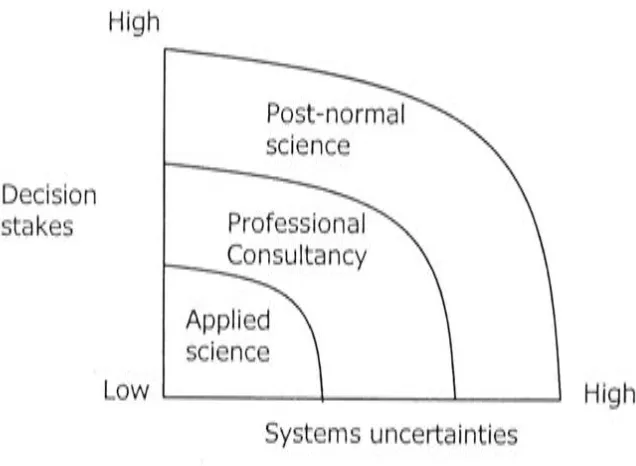
Figure 2.3. Post-normal science ... 23
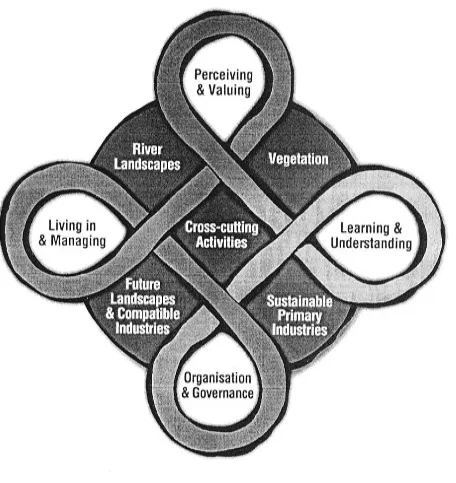
Figure 2.4. Integrating themes and issues ... 28
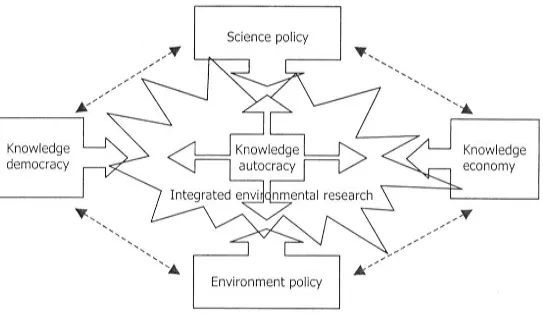
Figure 2.5. The 'technology push' model of the innovation process ... .... ... 35
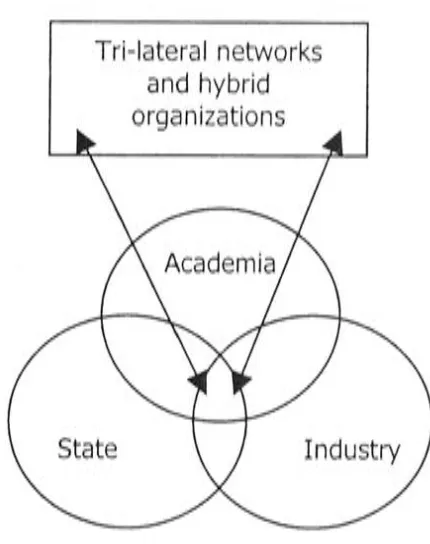
Figure 2.6. The triple helix model: university-industry-government relations . 41 Figure 2.7. Forces of integrated environmental research ... 46
Figure 3.1. Practice as situated activity ... ... ... 52
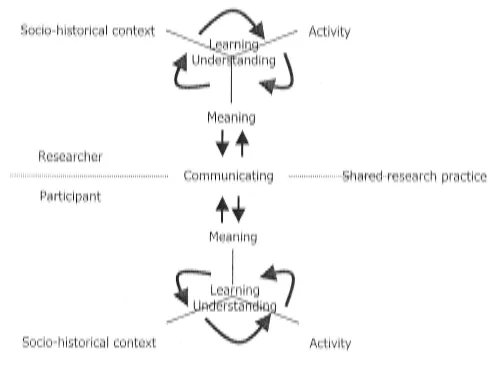
Figure 3.2. Learning and understanding in practice ... 54
Figure 3.3. Communication in research practice ... 58
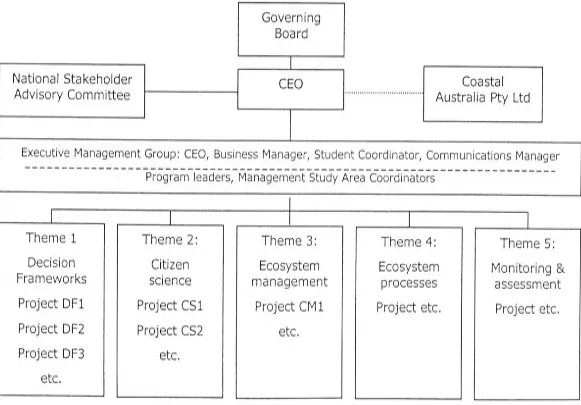
Figure 4.1. Organisational structure of the Coastal CRC ... 84
Figure 4.2. The "Shavian Triangle" ... 86
Figure 4.3. Location of Management Study Areas ... .... : .. 87
Figure 4.4. A matrix of The1nes and Management Study Areas ... 88
Figure 4.5. Organisational structure of the Greenhouse Accounting CRC ... 92
Figure 4.6. Research flows in the Greenhouse Accounting CRC ... 94
Figure 5.1. A sum1nary of 1ny research process ... 100
Figure 6.1. The container model of integration ... 122
Figure 6.2. The purchaser-provider model of integration ... 125
Figure 6.3. The jigsaw model of integration ... 130
Figure 6.4. The silos model of integration ... 133
Figure 6.5. Value adding model of integration .-... _ ... 137
Figure 6.6. Extension 1nodel of integration ... ... .. ... ... .... 140
Figure 7 .1. Layers of relationships over ti1ne ... 148
Figure 7 .2. Overlapping borders ... ... ... ... . 167
Figure 8.1. Pathways to change ... 190
Figure 9.1. Research trajectories ... 196
Figure 9.2. H ybrid research / manage1nent trajectories ... 200
Figure 9.3. Timetables and trajectories: the Coastal CRC ... ... 203
Figure 9.4. Trajectories under different potential scenarios .... ... .. ... ... ... .... 204
Figure 9.5. Zones of changeability ... ... .. ... . 218
Figure 10.1. Two-diinensional science ... 226
I
I
Table 2.1. Research approaches based on participatory methods ... ... 19
Table 2.2. Core questions of sustainability science ... ... ... 25
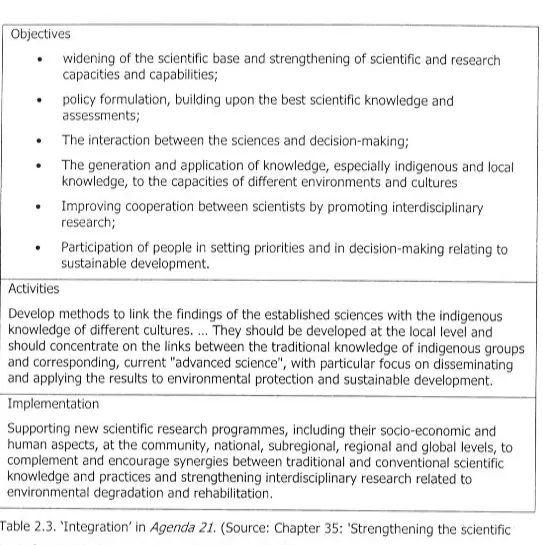
Table 2.3. 'Integration' in Agenda 21 ... ... .... ... 27
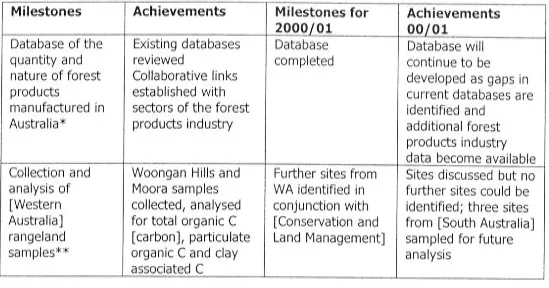
Table 4.1. A sample of CRC project milestones ... ... ... ... ... .. 78
Table 4.2. Core partners in the Coastal CRC ... ... ... ... ... ... ... 83
Making a difference: the challenge of
integrated environmental research
And making a difference. Yeah, that's it, can we make a difference in the coastal zone? That's a goal. That's all part of bringing people together into something that can make a difference.
Roger Shaw, CEO
CRC for Coastal Zone, Estuary and Waterway Management, 2000.
At the turn of the millennium, the role of science in the industrialised and
industrialising world is undergoing a curious change. On the one hand, it is widely
celebrated, as a source of economic wealth and prosperity, a source of
conveniences, security, culture and identity. Yet on the other, it is increasingly
questioned-this celebration has been accompanied by a growing awareness of the
fallibility of science, for example through the apparent 'failure' of science to solve
major environmental issues, such as global \-Vanning. Further, as iconic
achieve1nents such as Star Wars technology and, more recently, Dolly the sheep
have become headline news, the professed moral and ethical neutrality of science
has been challenged. Both the celebration and the caution can be seen as
consequences of a widespread realisation that the boundaries between science and
society, carefully nurtured over the last three centuries, are artificial. The scientific
ideal of the pursuit of knowledge independent of social constraints and concerns is
C H . 1 : M,\K I N G A D I F F ERENCE: TH E C I-L-\LLE NGE OF I N TE G RATED ENV I RON!\IENT·\L RESE i\RC H
While the consequences of these changes are varied, ongoing, and not yet w ell
understood (as I will argue in more detail in Chapter 2), a key theme has been
moven1ent away from research that is fragmented intellectually, isolated
organisationally and independent of social and economic interests, towards research
that is integrated across all these dimensions. The realisation of the artificial nature of
the boundaries between science and society has paved the way for new relationships
that cross the traditional divides. In particular, the belief that scientific credibility is
the product of independence and distance from the arenas of policy, economic
development, and social change is itself losing credibility. Through engaging in a
range of partnerships, researchers are increasingly taking up the challenge of
bringing about change, of directly making a difference in the world.
The significance of the shift toward integrated approaches to research for science as
a whole is starting to be realised. Taken individually, small concessions away from
the scientific ideal of independent, abstract, universal research can be explained
without compromising the core distinctiveness that scientists have traditionally
relied upon to justify their position in society. Taken collectively, these adaptations
represent a major shift- some say a paradigmatic shift-in the philosophy and
practice of science (Gibbons et al., 1994; OECD, 1999; Ziman, 2000,).
Understanding and participating in these shifts while maintaining a sense of what it
is to do science constitutes the challenge of integrated research.
While authors have recently begun to document and analyse these changes, to date
most analysts have tended to examine tl1e issues surrounding integrated research at
the level of the research sector as a whole. This study focuses on one area:
environ1nental and natural resource management research (referred to throughout
this thesis as 'environmental research'-this includes natural resource management
re search concerned with iss ues of conservation and ecological su stainability, but not
th os e co ncerned with a sole focus on pro duction). But fir st, some further
explanation of the general concept of integrated research will be offered.
What is integrated research?
In general terms integrated research can describe any research that actively cros ses
conventional boundaries ,vitlun and around science. It should be noted here that
throughout this thesis a distinction is dra,vn between science and research. 'Science'
refers to the formal, academic, discipline-based institution (including formalised
's ocial sciences'), whereas 'research' is a more open-ended yet sys tematic process of
( I-1. l: MA KI NG A DIFFERENCE : THE C H ALL ENGE OF IN T EG RJ\TE D ENV IRO N l'vlENT t\L RESEARCH
Integrated research commonly appears in two guises. First, there is the integration
of the sciences. Similar to (and often used interchangeably \vith) multi-, inter-, or
transdisciplinarity, although each of these terms vary in their usage as well,
integrated research in this context suggests overcoming the barriers created within
the sciences themselves. However, other significant barriers to integration of the sciences
take the form of organisations (the difficulties of working across different
universities and government-funded research agencies, for example), and even
within-discipline approaches, such as empirical research and modelling. Calls for
integration are often embedded in a recognition that science is fractured across
many different boundaries.
The second co1nmon use of the term integration goes beyond the institution of
science to integrate with what might be coarsely labelled as 'non-scientific'
institutions. ('Institutions' throughout this thesis refer to large-scale groups of
organisations, such as 'science', 'law', 'government', 'industry' and 'community'.) In
other words, researchers work actively with policy-makers, community groups,
business or industry in the design, conduct and application
of
the research. This represents asignificant shift away from the traditional, linear view that science is 'done' by
researchers, and then 'applied' by others towards interaction at each stage of the
process.
These two uses of the term 'integrated research' suggest activities that can cross any
or all of three main sets of boundaries: disciplines, organisations, and institutions.
This is not to suggest that such integration is necessarily new-it has been well
established in various literatures that science does not take place in a socio-political
vacuum, and that any notion of 'pure' science independent of these boundaries is, at
best, naive (Barnes and Edge, 1982; Chalmers, 1982; Latour, 1999; ICates et al., 2001). The newness, rather, is that the connections across these boundaries are being recognised as a legitimate area of scientific participation, rather than as
peripheral activity at best, or a design flaw at worst (Gibbons et al., 1994; Irwin, 1995).
Origins of integrated research
As Chapter 2 will elaborate, these changes can in large part be attributed to the dual
press ures of the commodification of knowledge (the perception that research is the
engine of economic growth), and social rejection of the ideology of iinpartial,
objective science (so that scientific knowledge becomes comparable to any other
( H . 1: MA KI NG A DIFFERENCE: T l-I E C H A LLENGE OF I N T EGRA T E D ENV IR ONMEN TJ\.L R ESEA R CH
social critique si.tnultaneously demolished, or at least substantially reduced, the
barriers between science and other 'knowledge producers'-that is, everyone else.
Nowotny et al. (2001) describe this new landscape as one in \vhich society is starting
to 'speak back' to science. Their analysis suggests that the prevalent model has been
for science to only 'speak to' society, and society has listened. In recent years,
society is learning to respond. While this characterisation may be appropriate in
s0111e parts of the scientific institution, other areas have been struggling to develop a
productive conversation with 'society' for far longer than N owotny and her
colleagues suggest. Environmental research is one of those areas.
The environmental context
The historical and contemporary context of environmental research is significantly
different from that of the sciences oriented towards enhancing the production of
commercial goods. As Bradshaw and Bekoff write: "The unprecedented impact of
humans on the land and water worldwide
will
continue to involve ecologists in conservation, decision and policy-making [sic]. Furthermore, the fact that mostenvironmental problems sti.tnulating current research are products of science and
the culture in which they are developed, means that scientists are already deeply
involved."(Bradshaw and Bekoff, 2001, p.460). In other words, environmental
research has emerged from social as well as scientific concerns, where science is as
111uch a part of the proble111 as it is part of the solution.
\Vhile this general level of connection between environmental research and society
is important, there are tb.ree more specific aspects of environmental management
that are significant with respect to integration. The first is the public good nature of
most environ111ental management; the second is its tendency to cross organisational
boundaries; and finally, being predominantly issue- or problem-focused, the
research that ai.tns to inform environmental management is commonly
interdisciplinary.
The 'public good' aspect of many environmental issues is significant in that the
relationships between environmental research and society tend to be mediated
through government and policy, rather than through markets. Commercialisation of
knowledge for unproved environmental management is perhaps faced with greater
opportunity than a decade ago, but is still highly limited. The majority of
environmental n1anagement, while it may be the responsibility of landholders or
private firn1s as well as govern111ent agencies, is still coordinated largely through
c:r-1.1 : I\ I A KI NG .•\ DI ITER EN(E: T II E Cl-f.'\ LI. E"iGE or l \!TEGR .ATE D r:.NV I ROJ'iME\: T t\L RESE :\ RC II
research together in their descriptions of integrated research, because both display
very similar characteristics and have been subject to similar pressures, the
differences ben-veen integration motivated by markets and integration motivated by
policy interests are yet to be fully explored.
Secondly, because environmental problems tend to be identified according to
biophysical characteristics (catchments, coasts, forests, and so on), they also tend to
cross managerial or jurisdictional boundaries. Consequently, environmental research
has a long history of operating and coordinating across different organisational
units-government agencies, land holders, research groups-to achieve improved
environmental management.
Finally, the complexity of environmental issues is commonly such that more than
one discipline is relevant to tl1e resolution of problems. As many authors have
noted (Klein, 1990; Board on Sustainable Development Policy Division National
Research Council, 1999) working across disciplines has been an ongoing challenge
for environmental research, not a new one.
Because of this history, one that is shared in significant parts of the health research
sector and other public research areas, ideas of integration are relatively familiar in
environmental research. Further, there is a practical and intellectual history within
environmental research of grappling \Vith integration under different guises and
in
different contexts. This suggests that the implementation and consequences of
integration in the area of environmental research are likely to be different from the
consequences that may be felt in private good research sectors.
The challenges of integrated environmental research
This history of environmental research has left a legacy of many approaches to what
is now being formalised as 'integration'. Some of these will be discussed in more
detail in Chapter 2; however, in a general sense there is no shortage of methods or
tools for doing research that involves non-researchers in some way, from
participatory methods to action research, from integrated catchment management
to adaptive management-and the list goes on. These have been developed and
used by researchers over the past three decades to structure their relationships with
the non-scientific world.
Yet the point of Nowotny et al.'s \-vork, and that of other commentators on
integrated research, is that the non-scientific world itself is changing. The larger
forces of integrated research are relevant here: the ever-increasing demand for
C H . 1 : MA KI NG A DIFF E R ENCE: Tl-I E C H A LL ENGE OF I NTE GR ATE D ENV IRO Niv! ENTAL RESEARC H
apply it. In other words, the need for science to n1aintain its credibility is escalating,
as is its capacity to be politicised and criticised by both scientists and non-scientists
alike. Further, as sources of 'untied' funding diminish and the shortfall is more often
being sought in private enterprise or 'interested' sectors of government, claims of
scientific impartiality are no longer tenable. As Holling aptly describes the present
situation:
Ecologists are just beginning to develop the range of experience needed to link science, policy and politics. Policy people are largely unfamiliar with ways to recognize the novel interactions now emerging between economic, social and ecological systems. Because the science is in transition, there are not only conflicting voices, there are conflicting modes of inquiry and conflicting criteria for establishing the credibility of a line of argument.
(Holling, 1998, p .1).
The large question of the impact of integrated research on the credibility and
reliability of scientific information when the old standards of objectivity, impartiality
and disinterestedness can no longer be assumed is being raised in all sectors of
research (see for example Huber, 1991; Davidoff et al., 2001; Nowotny et al., 2001). Decision-makers responsible for many forms of environmental
manage1nent-fanners, policy-makers, urban and rural community groups, business, industry, and
many 1nore-are de1nanding a say in the relationships between themselves and
researchers.
Consequently, the activity of integrated research does not begin with the
development or application of an integrative model, fran1ework or method. There is
a prior step: researchers need to negotiate with those decision-makers how the
relationship should unfold.
An awh.rward silence: negotiation, articulation and learning
The importance of negotiation as key to relationships between environmental
researchers and non-scientists is not new. In the context of scientists advising
environmental policy, for example,
J
asanoff (1990) wrote that processes of scientific advisory groups " ... are most effective in building consensus and guiding policywhen they foster negotiatio"n and compromise."
(p.
230). However, negotiating new and innovative relationships between researchers and resource managers around theconcept of integration is currently fraught with confusion. The breadth and
v ariation of the tenn, frorn overarching 'tnotherhood' descriptor to highly specific
technical models, suggest that the concept of integration is not yet a firm basis for·
negotiating these relationships.
C H. 1: i'vfA KI NG ;\ DI FFERENCE: T H E C H A LL ENGE OF I NTEGRA T E D ENV IR ONMENTAL RESEARC H
and the other plays rugby. Yet they both want to play a game together. How are
they going to gain agree1nent on the rules of the game? This demands two types of
action: articulation of the rules of the games with which they are familiar, and
negotiation as to how these rules can be adapted to create a mutually satisfying
game. This is analogous to the current situation of integrated environmental
research. A number of groups are coming together, seeking to work out compatible
rules of engagement that \vill lead to mutually beneficial and satisfying outcomes for
all involved. How do they articulate their histories and plans so that they make sense
and are relevant to the others? How can ways forward be negotiated?
There has been little research into these issues of articulation and negotiation in the
context of integrated research. Yet the quality of this step in the development of
relationships between science and the decision-making world is crucial for the
quality of the eventual actions that are taken. To return to the opening point of tl1is
chapter, science has become so heavily entwined in our decision making world and
our biological world that failure of the system that maintains scientific quality can
have dramatic consequences. The risks of taking decisions based on poor science
are often noted and discussed, but there are also the risks of taking the wrong action
based on poor relationships between science and the decision-making (and
action-taking) sectors.
There are indications that the 'awk\vard silence' tl1at can be imagined of the two
sports teams in the analogy above is sorely felt in environmental management. As
Davers and 1'v1obbs (1997) note: "Ecology, policy processes and people
(communities) have had few connections through which to communicate and work
together; they have had no common frameworks for ongoing interaction to move
beyond episodic interactions defined by conflict."
(p.
39). Bradshaw and Bekoffconcur-for example, in their description of the 'science-policy gap' they write:
"Such gaps are a type of conceptual no-man's-land, and their significance is
underappreciated. Transparency of process is achieved when science gazes upon
itself and the interfaces between science, society, humans and the environment are
critically examined."
(p.
462). This lack of 'transparency' is more than an intellectualcuriosity-as Cortner (2000) notes, environmental and natural resource policy is
undergoing "significant introspection"
(p.
22) as new approaches to therelationships between science and management are tried and tested. The concepts
that are available strongly shape what is seen through such processes of
introspection, and what can be learnt fro1n it. Those aspects of experience that
cannot be articulated remain hidden, obscure forces that are poorly understood and
( H . 1 : MA KI NG A DI FFE RENCE: TH E CH A L LENGE O F I N T EG R.AT ED ENV IR ONMENT i\L RESE:\RC H
As integrated environmental research is focused on bringing people from different
backgrounds together, having concepts that link the groups-and make sense to all
of them-is an important component of being able to negotiate how, and how well,
the connections between them are made. The absence of clear concepts has not
stopped integrated research from going ahead-people are grappling with these first
steps, and establishing good (and not so good) relationships. Ho'vvever, the lack of
transparency, lack of ways of abstracting from the immediacy of day-to-day events,
mean that these experiences are seldom a source of learning for those not
im1nediately involved.
As later chapters will illustrate, without a broader theoretical, or abstract conceptual
structure to give their experiences meaning, people involved in integrated research
commonly regard their experiences as irrelevant, too context-specific, too persona!,
to offer other researchers any useful insights. Alternatively, where they do believe
they h ave insights that would be useful to others, the problem of abstraction
remains. How much of the events they have participated in were due to the specific
context (individuals involved, exigencies of place, vagaries of political climate and
public support .. . ), and how much can be attributed to a broader, shared context of
integrated environmental research that is relevant to other people or other
situations? The desire for transparency, then, can also be understood as a desire to
learn from others, to avoid having to reinvent the wheel every time a new integrated
research endeavour is embarked upon. To achieve this, the 'conceptual
no-man's-land' needs to be claimed and populated with ideas and concepts. By articulating
some concepts, based on the sys tematic study of 'those who have been
there'-even if those concepts themselv es become hotly contested-the prospects for
future relatio nship s 'vv-ithin integrated environmental research are surely brighter.
This study
The science studies context
This study is located within the field of science studies. Science studies takes many
forms, and has become a popular proxy term for a wide range of sociological and
anthropological app roaches to research on science. However, this study differs from
the majority of science studies in two main ways.
First, it is n o t primari!J concern ed witl1 tho se aspects of scientific practice in which
scientists construct facts or engage with the objects of their research. This study,
( H . l : /vl.f\ KI NG A D I FFE R ENCE: TH E C H 1\ L L ENGE OF I NTEGRATE D ENV IR ONivfENTi\ L RESEARC H
aspects of scientific practice that are concerned with relationships among people,
and how they articulate their problems and achievements of integrated research.
Secondly, this study differs from the majority of counterparts in science studies in
that it is based on a methodology that seeks to fa cilitate the development of research
practice. This is a significant departure from science studies (and other social
research areas, such as sociology of science, or sociology of scientific knowledge)
that is primarily concerned with the evaluation and critique of scientific practice, or
with building theory of science that is relevant to science studies but does not seek
to engage scientific practice. As such, while the investigation and theoretical
development of integrated environmental research is the main theme of this thesis,
the methodology used to do that forms a second strand of theoretical development.
The second strand is concerned with the development of an approach to science
studies premised on engaging scientists in mutually beneficial research, as a practical
way of moving beyond what has now become widely known as 'the Science Wars'.
A legacy of war
The Science Wars will be discussed in more detail in Chapter 2, but in brief the term
encapsulates an ongoing series of exchanges between social studies of science
(including sociology and science studies) and biophysical scientists. These have, in
many instances, become quite acrimonious, and emphasised to the scientific
community at large the critical aspects of social studies of science.
Yet there is clearly potential for science studies to engage with scientists more
productively, and this can be to the mutual benefit of science studies and science
more broadly. As Jasanoff has noted: "To rebuild the connections between S&TS
[science and technology studies] and its potential audiences and allies, we \vill first
have to rediscover how to talk to practitioners of science, engineering and medicine
in ways that are seen as enlightening and fruitful r-ather than as dismissive or
demeaning." CT asarioff, 1998, p. 94) However, despite several calls for the
relationship between the warring parties to move on into more harmonious and
collaborativ e 1nodes of operation, as yet science studies has few methodological
approaches that are premised on mutual benefit or shared learning.
One of the key is sues here is that of the position of science studies researchers, and
their relationships with those they are working with. Science studies researchers
who study the relationships of others, with a goal of mutual benefit, must also be
significantly introspectiv e about the ways they construe their own relationships with
( H . 1: /1. lf\KI NG f\ DIFFERENCE: T H E C l-L-\ L L ENGE OF I TEGR ,-\T E D E · v 1R ONMENTf\L RESEARCH
Towards mutual appreciation and learning
Consequently this thesis will detail and implement a research methodology that
draws on an established science studies approach, that can be loosely clustered
around the title 'research as practice' ( Pickering, 1992; Chaiklin and Lave, 1993; Pickering, 1995; Lave, 1996; Wenger, 1998). Broadly speaking this is an
ethnographic approach that focuses attention on tl1e day-to-day activities of the
researchers engaged in integrated research . However, 'practice' is an extraordinarily
diverse concept. To narrow the diversity, and to provide a methodological
framework within which the researcher's relationships with the study participants
becomes central, the notion of 'practice' is interwoven with a similar, albeit largely
separate approach based on social approaches to communication (Sless, 1986; Leeds-Hurwitz, 1995; Stewart, 1996; Penman, 2000). While there are many
variations, in general social approaches to communication are based on a sense of
communication as a shared event or activity in which meaning is mutually
co-constructed. In the context of research, social communication approaches direct
attention to the relationship between researcher and participant as an ongoing
collaborative engagement, emphasising shared appreciation and learning. The
emphasis on social communication within a broader framework of practice led me
to title this approach 'social communicative practice'.
Social communicative practice offers one step on a path towards 'fruitful'
engagement between science studies and scientists . This study, along with its
primary aim of the development of the concept and theory of integrated
environmental research, also serves as a testing ground for this methodological
approach.
Aims
Given the broad
prob!ematique
of integrated research and the science studies context,this study had four aims.
The first was to develop an account of the practices of integrated environmental
research 'from the trenches', so to speak. How do people-not only researchers,
but all participants in integrated research-make sense of and articulate their
experiences of working together? How are joint decisions made? Ho\v are problems
negotiated? Creating a current account of integrated environmental research that
draws upon
the
way
people experience it
provides a basis for theoretical developmentthat is relevant to practice.
Cl i . l : \ 1. \ 1, 1:\C .\ Dll ' I.- ERENC[: T II E C: 11 .-\LLU--!G I~ OF I NTEGRATED Er-,;V IRO Ni\ l ENTAL RE SE ,<\RCH
and thereby contribute to how others can learn from them. The purpose of the se
tools is to help differentiate the systemic features (in the sense of those features that
are shared and related to each other) of integrated environmental research from the
idiosyncratic. How can new participants learn from the processes they or others
have engaged in?
Associated with that was a third aim: to contribute to the philosophical
understanding of integrated environmental research (and, perhaps, integrated
research more generally), and how it differs from conventional research. This was
less concerned with practical tools, but rather with taking steps to"\vards defining
ways of thinking about science that might help to relate the practice of integrated
research to conventional views of the practice of science. How is integrated research
different from conventional research? How is it the same? How do these
characteristics relate to each other? Given the conceptual no-man's-land noted in
the previous section, it would be hoped that this would also contribute to the
second aim.
Finally, as discussed in the previous section, the fourth aim of this study was to
develop and apply a methodology that combined research as practice and social
communication approaches as a basis for theory development that is relevant to
both science studies and science.
Overview of the study
This research consisted of two case studies, each Australian environment sector
Cooperative Research Centres (CRCs). CRCs are substantial research organisations,
1nost with around 50 full-time equivalent staff, and annual budgets in the order of
AU$8-12 million. They are funded jointly through the Australian Federal
Government and the research partners that make up the Centres: universities ,
government researchers, industry, and other government agencies. The first CRCs
b egan operations in 1991 , and in 2001 there were 64 Centres in operation in
Australia (CRC Progra1n, 2002). As will be discussed in Chapter 4, their funding
rules require that CRCs engage in-and demonstrate-'integrated research'.
Consequently they offer a wealth of experience of the joys and traumas of
integrated research practice tl1at is certainly unique vlithin Australia, and has few
parallels internationally.
The requirement tl1at integration be demonstrated, without many strictures on how
to do tl-1.at, has also created an environment where ne"\V CRCs have considerable
CH. 1: 1\,f A KI NG A DI FFE R ENCE: TH E C H A L LENGE OF I NTEGRATED ENV I RONMENTAL RESEARCH
general research structure, 'created' understandings of integrated research that suited
vastly different socio-political contexts. One Centre, the CRC for Greenhouse
Accounting, was operating within a volatile international and national political
context created by the I(yo to Protocol negotiations. The other, the CRC for Coastal
Zone, E stuary and Waterway Managen1ent, was working in a highly dispersed
political situation, with many different authorities responsible for coastal
management, as well as considerable comn1unity and industry interest. The potential
for these different contexts to influence the ways in which the Centres' research was
integrated created an ideal milieu within which to explore the negotiation and
articulation of the concept of integrated research.
The study was carried out with botl1 organisations over a period of approximately
18 months . While the methods used (primarily in-depth interviews, participant
observation and document analysis) were fairly typical of qualitative research, in this
study tl1ey were placed within a \vider methodological framework that characterised
engagement in research as participation in diverse, iterative, ongoing conversations.
These conversations, as interaction between m yself and tl1e study participants,
formed the basic unit of analysis within the structure of research as social
com1nun1cat1ve practice.
What this thesis will not do ...
There are, o f course, many areas this thesis will not cover in detail. In particular, as
tl1e notion o f integrated environmental research is concerned \,Vith the practices of
building and maintaining relationships among people, many other aspects of
organisational or scientific life appear only incidentally to these concerns .
Imp ortantly, this study was not directly concerned with conventional aspects of
scientific research, such as the relationships of researchers to the biophysical world,
scientific instruments or computing, or those individual aspects of scientific work,
such as in spiratio n or curiosity. It should be stressed here that this is not because
these aspects are perceived as unimportant or impossible figments of a socially
constructed imagination, a charge that is commonly levelled at those who choose to
study human relationships within science in preference to
human-biosphere or human-machine (see, for exa1nple, Pickering,
1995,
and Latour,1999,
especially Chapter1).
Rather, these aspects are regarded here as elements of thetraditio nal practices of research, and were bracketed aside to allow the 'integrative' ·
aspects to take centre stage.
( H . 1: MAK I NG A D I FFERENCE: T H E C H A LL ENGE OF I NTEG RAT E D ENV TR ONMENTAL R ESEARCH
aims of the study. These include (but are not limited to) issues of organisational
structure, power relations, organisational or institutional culture, and scientific
practice.
Each of these factors are weighty topics in their o,vn right, and do emerge at
different points. Ho,vever, the point of the focus on conversations is that such
topics emerge as the participants saw them, in dialogue with my own aims regarding
integrated research. Decisions as to which of the many substantive issues that were
raised deserved close attention and which were set aside were the product of that
ongoing dialogue, as will be detailed in later chapters .
Organisation of the thesis
The ten chapters of this thesis correspond roughly to three main sections. This
chapter and Chapter 2 give the background to the study. Chapter 2 gives an
overview of three different literatures that illustrate the unique history of the
concept of integration in environmental research, and highlight the tensions
generated by different, potentially conflicting forces of integration.
Chapters 3 through 5 are concerned with how the study was designed and
conducted. Chapter 3 details the methodology used in the thesis, bringing together
two mostly separate research constructs, social practice and social approaches to
co1nrnunication, to complement and strengtl-1en each other. Chapter 3 highlights the
importance of social and historical context, a theme that is taken up in Chapter 4.
Chapter 4 details the organisational and political background of the case studies.
The next chapter then draws on that background to show how the n1ethodology in
Chapter 3 was applied in these particular cases.
Chapters 6 through 10 build a theoretical conception of integrated environmental research, based on the case study material. The structure of the second half of tl1e
thesis builds a conceptual picture of integrated environmental research by starting
with themes that emerged from tl1e study, and using those as a base to progressively
build up more synthetic, theoretical ideas. It is through this process of theorising
from practice that new understandings of integrated environmental research are
proposed. Chapters 6 and 7 focus on the extent to which participants' understandings
of integrated research (reported in Chapter 6) captured their expen·ences of the activity
of integrated re search (given in Chapter 7). In Chapter 8 I explore ho,v people wer~
able to create and maintain relationships despite the gaps, tensions or conflicts
between understandings and practice. In Chapter 9 I draw out some of the key
( H . 1: 1\L\KI NG t\ DIF FE R E N CE: T l-I E C H t\LL ENGE OF IN T EGR 1\ TE D ENV IR ON[\[EN T A L R ESE i\ RC H
they may form a basis for articulation and negotia tion of integrated research.
Chapter 10 develops the theoretical implications of these differing views for the
relationship between integrated research and conventional science.
The se und erstandings are offered as a contribution towards the articulation and
n ego tiation of integrated research, and so may help generate research that is b etter
t
The fractured landscape of integrated
research
... it mu st be recognized that the relation ship between scientific research, education, technological innovation and practical benefits is much more diverse and complex today than in the past, and frequently involves many players other than researchers. The progress of science cannot be justified purely in terms of search for knowledge. In addition, it must be defended ... through its relevance and effectiveness in addressing the needs and
expectations of our societies.
UNESCO, 1999
In Chapter 1 it was argued that the idea of integrated research has emerged to
counter the fracture s and disjunctures among disciplines and organisations of
science, and between science and other institutions. These fractures are widely held
to inhibit the accessibility and usefulness of research to decision-makers and
action-takers. Yet the pressures for integration are not quite as straightforward as the aim
of increasing the relevance of research to users might suggest. The pressures for
integration are themselves fractured into at least two ideological camp s, with a third
ideology resisting integration. These ideologies represent different understandings
of knowledge, h ow it takes its 'value' in society, and its relation ship to action.
Consequently, it is not only that integration takes place against a fragmented
background of disciplines, organisations and institution that renders the idea of
integration complex and multi-faceted-it is also that the arguments for integration
C r-r . 2 : T r-r E FR /\ CT Li R E D LA N D S C A P E O F I :'l T E G R ,'\ T E D EN v lR O N j\,[ EN T t\ L R ES L\ RC H
One argument for integration, the knowledge economy, is a description in comn1on
u sage. I have labelled the other argu1nent for integration the 'knowledge
de1nocracy', and the argument against integration as the 'knowledge autocracy', in
an adaptation of
J
asanoffs(1990)
'democratic' and 'technocratic' paradigms of public p olicy decision-making. Of course, these are not the only arguments for oragain st integration, but do underlie much of the complexity and confusion
surrounding the idea of integration.
I have used these three categories to structure my description of the fractured
landscape of integrated research in this chapter. Within each section, the basis of
the argument for or against integration will be summarised. The summary will be
followed by an overview of academic literatures that draw on that argument, in
theoretical and practical 1nodels of integration. Each section will close with a brief
sample of policies that exemplify the ways the different arguments are used in
practlce.
While this allows me to draw connections between several largely disparate areas of
literature in a coarse-grained way, the cost of this strategy is, of course, detail. Some
parts of these literatures that are particularly relevant or indicative of the larger
themes will be featured and discussed in more detail, with a consequent sense of
':zoo1ning in' and 'zooming out'. \Vhile those aspects that are zoomed in on are
relevant in their own right, I acknowledge that they are not the only possible
candidates for detailed examination. Consequently readers will inevitably see
different aspects of their own areas of expertise or interest that could (or should,
perhap s) be included or covered more fully.
The knowledge democracy
The knowledge democracy is an argument for integration between researchers and
other 'publics'.
It
is based on the view that including lay citizens and dispersed interest groups is both ethical and practical as it will help to ensure that research istargeted towards the needs of the communities it affects. It is democratic in the sense
that it seeks to assert that the knowledge of participants from outside the scientific
institution is valuable and can be combined usefully with scientific knowledge. This
argument is prominent in environmental research, where it has emerged largely
fro1n reactions against agricultural and development situations where those involved
in managing the natural resources were excluded from research about those
resources, leading to inappropriate research that was often of little use or,
C 1-1 . 2 : T 11 E F R .-\ CT U R E D L :\ N D S C :\ P E O F I N T E G R i\ T E D E. 1 V I R O N M EN T :\ L R ES E .-\ R C H
Environmental context and theory: from extension to participation
The theoretical and practical developn1ents in integrated environmental research are
closely allied with developments in agricultural extension; indeed, to the extent that
agricultural management is concerned with the care and ste"\vardship of natural
resources, they merge (Buttel, 1992). Consequently, many of the ideas behind
agricultural extension can be seen to underpin much of the current thinking on
integrated environmental research.
Agriculture and science
The emergence of modern-day industrial agriculture has been closely allied with
science. Rossiter (1975), for example, describes in detail the development and use of
agricultural chemistry and soils science frorn the 1830s in the United States, stating
that " . .. few doubted in the 1830s and 1840s that chemistry could solve the
proble1ns of agriculture."
(p.
11). The relationship between scientists andlandholders was built further in the US, with the establishment of the Land Grant
Universities in 1862, under the clear mandate to broaden access to technical
knowledge (Brannon, 2002).
The knowledge democracy emerged in reaction against the traditional 'extension' or
'transfer of technology' model that underpinned the relationship s between
researchers and land managers. The transfer of technology model is essentially a .
linear research and application process, similar to the one depicted in Figure 2.1.
I
Problem1--..1
R e s e a r c h ! ~ Transfer Adoption (small-scale)Diffusion (large scale)
•
(Rejection)Figure 2.1. The linear model of extension. (Adapted from Ison and Russell, 2000)
Scientists set the research agenda, do the research, and then 'transfer' the results to
the farmers. The results then 'diffuse' through the farming community. As Scoones
and Tho1np so n (1994) write·:
The superiority of 'rational science' is assumed and the pursuit of change ( development) is derived almost exclusively from the findings of the research station and transmitted to the farmer through hierarchical, technically
oriented extension services. Farmers are seen as either 'adopters' or 'rejectors' of technologies, but not as originators of either technical knowledge or improved practice. (p. 18)
As such, the traditio nal extension model is positivistic, in that there is assumed to be
C H . 2 : TH E F R ACTU R E D L \ N D SC:\ PE OF I N TEG R i\ T ED ENV IR ONJ\ f ENL\ L R ESL\R C H
rational basis. It is perhaps unsurprising then that although this form of extension
was effective in the dissemination of new technologies for increased production, it
was far les s successful in convincing farmers to prevent or ameliorate land
degradation (Ison and Russell, 2000).
Also imp o rtant in the rise of the knowledge democracy were the perceptions that
vested interests were promoting research and its associated products (fertilizers,
pesticides, and so forth) that were not in the best interests either of the farmer or
for the maintenance of their land. This was particularly the case as so-called
'Western' technologies were heavily promoted in developing countries, ·where
farmers undertook massive debts to use the technologies being sold by companies
based in industrialised countries, and applied them in situations that were vastly
different from those they had been designed for (see Glaeser, 1987, for an
overview). The failure of the Green Revolution in many developing areas and the
social and economic impacts it had on poor communities-especially those who
were already marginalised, such as women or indigenous groups-led to a strong
critique of the transfer of technology model, from the point of vievv of human
rights and welfare as well as its impacts on production. However, these critiques
were not restricted to developing countries. In industrialised countries tl1e
dominance of production-based agricultural technologies at the expense of land
conservation was also questioned for its ecological, economic and social impacts ·
(for Australian examples, see Barr and Cary, 1992; Vanclay and Lawrence, 1995).
Thus a "'vvidespread rebellion against the transfer of technology extension model
emerged.
Alternative models
In the 1990s, participatory research became a popular alternative to 'top-down'
extension. Scoones and Thompson (1994) claim that participatory research
approaches in general:
... emphasize the rational nature and sophistication of rural people's knowledge and believe that their knowledge can be blended with or
incorporated into formal scientific knowledge systems. [I] f local knowledge and capacities are granted legitimacy within scientific and development communities, existing research and extension services will pay greater
attention to the priorities, needs and capacities of rural people and, in the end, achieve more effective and lasting results ... (p. 18).
A s such , participatory research asserted that different types of knowledge could and
should be cotnpatible and complementary and actively combined for improved
C 1-1 . 2: TH E FR ,-\ CT U R E D LA N D SC,'\ P E O F l /\: T E G R ,'\ T E D EN V I R O N i'vl E N T A L R ES E A R C H
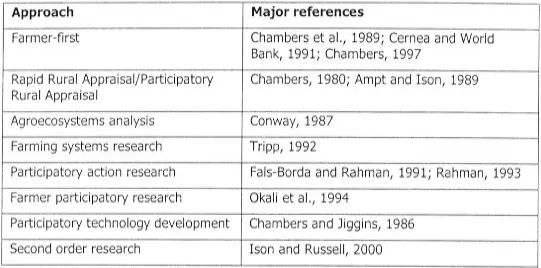
participatory meth o ds are listed in T able 2.1, although there are many more.
Approach Major references
Farmer-first Chambers et al., 1989; Cernea and World
Bank, 1991; Chambers, 1997
Rapid Rural Appraisal/Participatory Chambers, 1980; Ampt and Ison, 1989 Rural Appraisal
Agroecosystems analysis Conway, 1987
Farming systems research Tripp, 1992
Participatory action research Fals-Borda and Rahman, 1991; Rahman, 1993
Farmer participatory research Okali et al., 1994
Participatory technology development Chambers and Jiggins, 1986
Second order research Ison and Russell, 2000
Table 2.1. Research approaches based on participatory methods
Participatory approaches h ave become popular within agricultural extension,
particularly in the context of en gaging land managers in efforts to improve the
sustainabili ty of th eir operation s. K.een (1997) has u sefully summarised the main
catalysts for shifts towards participatory approaches in what she broadly terms 'land
management research', as illustrated in Figure 2.2.
Community catalysts
- Pressure from NGOs [non-government organisations] for community-based research
- Chang ing community expectations
Policy catalysts
- Sustainable development policy documents
- National science statements and reviews
Participatory land management
research
_ Academic catalysts
- Methodologies to increase community participation
- Chang ing theoretical paradigms
Figure 2.2. Catalysts for change towards participatory research.
(Source: Keen, 1997, p. 90)
Institutional catalysts
Chang ing req uirements fo r government funding - Increasing preference
for community-supported research
This diversity of pressures for change, fro m academic and community, as well as
[image:28.1195.152.693.142.410.2] [image:28.1195.140.694.608.958.2]( H . 2 : THE FR t\ CTURED L AND S CA P E OF l 1 TEGRATED ENV IR ONMEN T AL R ESEARC H
participatory approach. In theory, participatory research solved many of the
problems of the transfer of technology model. It reduced perceptions of
neo-colonialism in developing countries, it gave farmers and landholders input into
the definitions of problems, and therefore made solutions more viable in the
context within which they would be applied. Finally, it reduced the risks that
community groups or non-government organisations would reject decisions based
on research they had been a part of. (For a recent critique of participatory
approaches, see Cooke and I<othari, 2001.)
Participatory approaches were important in the development of the concept of
integrated research, as they asserted that integration of different knowledges and
interests between science and non-science sectors was both epistemologically
possible and morally desirable (Scoones and Thompson, 1994; Ison and Russell, 2000). They also highlighted the political nature of research in general, and argued that the distribution of power in conventional transfer of technology models was
distinctly masculine and hegemonic, and this was a source of its moral and practical
failings (see, for example, Chambers, 1980; Chambers, 1983; Pretty et al., 1993; Freire, 1996).
Hence participatory research can be regarded at a general level as the vanguard of
the knowledge democracy in research practice.
Models of 'knoivledge democracy' integration
\:vhile agricultural extension tnodels of participation tended to focus on involving
community groups and landholders in research, other 'democratic' models also
emerged that emphasised integrating research with government, or both.
Involving government: adaptive management
Other models of integration were concerned with integration bet\veen researchers
and policy-makers, rather than community. One of these was Adaptive
Environmental Assessment and Monitoring (Holling, 1978), an influential model that spawned several variations that can be more loosely grouped under the title
'adaptive management'. Adaptive management models and approaches drew on
systems theory to suggest that policy interventions, or environmental management
more broadly, should be regarded as experiments, with concomitant assessment and
monitoring as a basis for ongoing learning (Holling, 1978; Lee, 1993; Gunderson et al., 1995).
CH . 2 : TH E FRJ\CTUR E D L AN D SCA PE OF I N TE G R A TED ENV IR ONi'vl E N TAL RE SEA R C H
management approaches as "information is central, the focus is on integrating
natural sys tern and institutional/ social dimensions, and it is absolutely and inevitably
interdisciplinary." (p. 43). In comparison with participatory approaches, which
tended to focus on integration at the grassroots-com1nunity level, adaptive
1nanagement focused on integration between science and policy, thus bringing
government-level decision-making to the fore. This work was significant because it
insisted that researchers and managers could work together in productive, ongoing
relationships, in which the science and the management activities dovetailed and
strengthened each other. Later versions of adaptive management (for example, Lee,
1993), have productively combined the more quantitative dimensions of adaptive
management with social and organisational learning concepts, broadening the
integrative scope of the models to include social factors.
In their insistence on partnerships, adaptive management models have contributed
to the democratisation of knowledge in their acknowledgement that government
agencies also needed to be included as legitimate 'knowers'. In addition, by
including government mandates, adaptive management could also link science with
broader democratic processes.
Involving both: Integrated ... Management
Over a similar period of ti1ne as the emergence of participatory research and
adaptive management, there also emerged three 'integrated management'
approaches. While participatory approaches focused on community level
relationships between research and land managers, and adaptive management was
particularly appropriate for relation ships between researchers and govern1nent
managers, other 'integrative management' approaches aspired to do both.
Integrated Catchment Management (IC:tvi) emerged in Australia in the late 1970s.
By the mid-1990s the concept of ICM ( or close variations of it) had been
implemented in policy or legislation by every Australian State government (Bellamy
et al., 2002). ICM attempts to bring together all the relevant players with an interest
in managing a catchment (or watershed), including scientists, community groups,
landholders and government agencies at all levels, to develop a more holistic
management approach (Hinchcliffe et al., 1999).
This was a significant step in the development of the concept of integration in
environmental research and management for several reasons. First, it strongly
encouraged the integration of scientific research to address a w hole catchment. As
Bella1ny et al. (2002) note: "Researching and integrating scientific kno\,vledge has
C H . 2 : T H E FR 1\ C T U R E D Lt\ N D S C.'\ P E O F I N T I:: G R A T E D E N V l R O N M EN T ,-\ L R ES E :\ R C 1-l
also integrated the science with landholders-'integrated' meant explicitly including
the people who lived in the catchment, and their actions. In this way, ICJvI was
prob ably the mo st recognised fore-runn er of integrated research as it is applied in
environrnental research in Australia in the late 1990s.
Integrated Resource Management
(IRM)
was proposed as a broader alternative toICM in the mid-1980s (Mitchell, 1987) . IRM once again broadened and slightly
shifted the idea of integration, recognising that while ICM focused on water, similar,
more ab stract principles could be applied to other natural resources, such as forests
or coasts. There has been considerable enthusiasm-indeed, high
expectations-within Australia about what can be achieved through IRM, as Bellamy et al. (1999)
write: "The basic assumption that IRM approaches contribute effectively to the
better management of our land and water resources has not been systematically or
critically addressed."
(p.
338). A decade later Margerum and Born (1995) proposedthe concept of 'Integrated Environmental Management' as more inclusive again,
aiming to integrate all human activities in a defined environmental system.
As these examples illustrate, the formal use of the term 'integration' has an
important history in land management and environmental research. It has been used
in the sense of researchers needing to actively work outside their conventional
disciplines and in tenns of forging relationships with non-scientists. Moreover,
integration has strong associations witl1 the knowledge democracy through the
emp h asis of Integrated Resource Management and Integrated Catchment
1'-1anage1nent on community participation and government involvement in research.
This embed s the concept of integration firmly within an epistemological and moral
fra1nework that rejects the hegemony of science and scientific knowledge, and
supports the inclusion of different ways of knowing into environmental
decision-making an d land management.
H owever, these is sues are not restricted to environmental and agricultural sectors.
Authors such as Irwin argue that these areas are only the more visible symptoms of
a condition tl1at affects science as a whole. In his book Citizen science, Irwin (1995)
argues that there is a need for science more broadly to take the needs, concerns and
perspectives of society into account, as:
.. . the alternatives are either to argue that the current relation ship between science and citize ns is unproblematic and th erefore does n ot r equire