35
10
Years of C
AF
Re
po
rt
“10 Years of CAF”
More than 2000 CAF users
Patrick Staes,* Nick Thijs,** Ann Stoffels*** and Lena Heidler****
In 2000, the Innovative Public Services Group (IPSG) of the EUPAN (European Public Administration
Network) presented the Common Assessment Framework (CAF). After ten years of CAF in 2010 and
more than 2000 registered CAF users, it is time to look again at the state of affairs; what has been
achieved in these ten years and, maybe even more importantly, what do we want to achieve in the
next ten years? This article will look at the evolution of CAF since its beginning in 2000 and examine
where CAF stands in 2010 with more than 2010 registered CAF users in the EIPA CAF Resource
Centre database. The milestones and achievements of CAF and its users and promoters up to its
tenth birthday will be highlighted. Furthermore, the article will give an overview and a short analysis
of how CAF has grown in Europe; where it is applied and in which sectors. It will also describe the
development of its content and the shift in maturity that took place during these 10 years.
First steps towards the CAF
The launch of the CAF has to be placed in a context 10 years ago when, as is still the case today, public sector had to cope with a lot of challenges and had to respond to many new needs and demands in society. Due to these challenges and the pressure, the public sector has been the subject of large reforms. Especially in times of financial crises and severe cost-cuts in public administrations, the focus is on efficiency and effectiveness, attention to transparency and accountability, awareness for public service delivery.1 Together with the
principles of New Public Management (NPM), methods and techniques were constructed, focusing on one of these principles or trying to combine these principles. As such, one of these techniques, Total Quality Management, became a feature of the public sector from the late 1980s and particularly the early 1990s. In the late 1990s, many quality models and techniques (EFQM, ISO,) and subsequently the Common Assessment Framework (CAF) found their way into the public sector.2
Following years of informal consultations inside the EUPAN, there was an increasing need at the end of the ‘90s within the European Union for a more intensive and formal response in order to optimise cooperation with respect to the modernisation of government services in the Member
States and the preparation for the upcoming enlargement.3
36
10
Years of C
AF adapted to the public sector. This resulted in the year 2000
in the Common Assessment Framework – a self-assessment framework based on the principles of TQM and derived from the EFQM model and the German Speyer model. CAF was an easy to-use and free entry tool for self assessment in the public sector that could help public administrations across the EU to understand and employ modern management techniques. It has been launched at the first European
Quality Conference in Portugal in May 2000.4
An overview of 10 years CAF
Since the first launch many things have been achieved in the past 10 years. In the following part we give a brief overview.
The year 2001 saw further development around the CAF: the European CAF Resource Centre (CAF RC) was established at the European Institute of Public Administration in Maastricht, Netherlands. This EIPA CAF RC was created at the initiative of the director generals in charge of public service with the aim of being a European centre of expertise in CAF implementation that coordinated with the national quality hubs and also served as a training and consultancy centre. Furthermore, the CAF RC carried out research on the use of the model to further develop it and aimed to stimulate the European CAF network of national correspondents and be a source of inspiration to the European CAF community. Last but not least, the CAF RC was entrusted with the setting up of a database to register and collect European CAF users
with the aim of reaching 2000 registered CAF users by 2010.5
In 2002, the model was simplified and improved with the aim of adapting it even more to the public sector and launched at the second European Quality Conference in Denmark. The need to adapt the model in a way that was more tailored to the public sector became obvious to the network because of a European study on the use of CAF that
had been done in 2002.6
In 2004 the IPSG, during their meeting held in Vienna, took the decision to set up the CAF expert group for developing a draft CAF Action Plan. The CAF expert group is composed of the CAF national correspondents of the Member States, the EIPA CAF RC and EFQM representatives. The group is open to the participation of experts of CAF/TQM nominated by countries. It meets at least twice a year and its major tasks are:
• to improve and regularly update the CAF;
• to define in collaboration with EIPA the role of the European CAF Resource Centre (tasks, mandate, placement, financing);
• to develop in collaboration with EIPA CAF support tools (e.g. CAF website);
• to validate the different ways to adapt CAF for national or sectoral use;
• to assist and promote the exchange of good practices of operational managerial tools between European Member States;
• to organise the CAF users events (content papers and programmes);
• to report back to the IPSG at least twice a year.
The collaboration as such is very special, because the network operates in the spirit of consensus at European level to drive forward the development around and within the model, which is at times difficult due to distance, different public administration cultures, national agendas, funding, etc. However, the network has proven its capability to steer the CAF forward with its many initiatives and products, which also will become evident in this article.
Since the launch of CAF in 2000, it was clear that mutual understanding and bench learning among CAF users would be a strong impetus for the success of the model in Europe. European CAF users’ events are thus organised regularly with the aim of being an inspiring meeting point for CAF users and to further spread TQM in the public sector in Europe. In 2003 and 2005, CAF users from all over Europe met in Rome and Luxembourg at the first two European CAF users’ events. The Portuguese Presidency organised the 3rd European CAF Users’ Event in Lisbon in 2007. In 2010,
Romania hosted the 4th CAF Users’ Event in cooperation with
the network of CAF national correspondents and the EIPA
CAF Resource Centre. The 4th Event has a special focus on the
8 principles of excellence and the newly developed the CAF External Feedback as well as the tailor-made CAF version for the education sector.
In 2004 the tradition of the European Quality Conferences was continued in the Netherlands. At this quality conference a CAF master class took place. Subsequently in 2005, not only the second CAF users’ event took place, as mentioned above,
but also a second study on the use of CAF was conducted.7
Re
po
rt
10 years CAF timeline
CAF Master Class at the 3rd European Quality
Conference in The
Netherlands
"CAF Works" publication
Agreement on the construction of the Common Assessment Framework within the EUPAN network
1998 2000 2001 2002 2003 2004 2005 2006 2007 2008 2009 2010
Launch of theCAF
at the 1st European Quality Conference in
Portugal
Creation of the European CAF
Resource Center at EIPA -Maastricht
1st European study on the use of CAF Launch of the reviewed
CAF 2002 model at the 2nd European Quality Conference in Denmark
1st European CAF Users Event in Italy
2nd European CAF Users Event
in Luxembourg
3rd European CAF Users Event
in Portugal
4th European CAF Users Event inRomania
2nd European study on the use of CAF
Launch of the reviewed
CAF 2006 model at the 4th European Quality Conference in Finland
CAF movie
CAF Center at the 5th
European Quality
Conference in France
Launch of the CAF and Education version
Presentation of the Procedure on External Feedback
37
10
Years of C
AF
The study revealed that a number of areas in the CAF needed further improvement: increase the coherence and simplicity of the model, increase the user friendliness by improving the examples and the glossary, develop a more fine-tuned scoring system for certain users and broaden the quality approach with directives for the improvement action plans and guidelines for bench learning. Consequently the CAF was reviewed for the second time and in 2006 the CAF 2006 was launched at the fourth European Quality Conference in Finland. The result was a better definition of certain criteria and sub-criteria, an increase of the internal consistency of the criteria, the formulations and the way of evaluating and scoring.
Despite the fact that the procedure of adapting the model was highly technical and conceptual, there was a very strong participation of 15 countries during the process of the revision. Several countries prepared sub-topics in working parties which were supported substantively by EIPA and there was a strong contribution of the European Foundation for Quality Management (EFQM).
Additionally, on initiative from the Austrian presidency and with cooperation from the CAF RC the publication “CAF works” was put together in 2006. “CAF works”
presents 29 good practices from 15 countries and 8 different sectors, where the use of the CAF has led to improved results.8
Continuing the pattern of holding a CAF users’ event as mentioned above, Portugal hosted the third event in 2007 and furthermore developed together with the CAF RC a CAF movie; an attractive tool to promote CAF by showing the effectiveness of CAF in improving public sector organisations.9 In addition,
the movie clearly shows the European dimension of CAF: the collaboration between the different Member States, the advantages of a strong European network and community. It is the most appropriate tool to use for communication actions in an organisation, at quality conferences, etc. to demonstrate the process and results of working with the CAF model. The fifth European Quality Conference took place in Paris, France in September 2008 and
saw the second CAF Centre, a special place for CAF and the workshops and sessions about it, attract 800 of the 1100 participants at the conference; an undeniable signal that the interest for the tool was still growing.
As of today the CAF is translated into 20 languages and used in more than 2000 organisations (see infra).
Evolution in the development and use of the CAF Model.
In the past 10 years the CAF
itself (and its use) also became more mature. In this maturity process three different phases can be distinguished. A first phase focusing on the self-assessment, a second phase having more attention for the improvements after the self-assessment and a third phase drawing attention to the mature culture of excellence in an organisation.
In the first phase of the use of CAF, from 2000 until 2006, the emphasis was placed on the introduction of TQM principles and values in the public sector by using the CAF as a self-assessment tool. Public sector organisations were not used to looking at themselves, certainly not involving their own people. A lot had to be learned and most of the energy was put into spreading a sound methodology of
self-assessment.10
With the revision of 2006, much more attention was dedicated in a second phase to the follow up of the self-assessment; the implementation of the improvement actions that were the result of the discovery of many areas of improvement during the self assessment. The success of CAF was measured by the improved managerial practices that were installed and that led to better results in the results criteria of the model.11
But awareness grew in a third phase of the need to develop further the concept of excellence that had been at the basis of CAF, but was not explicitly formulated enough for the public sector. If further developed, these principles could become the leading principles for building up the organisation towards the level of excellence on the basis of a sound self-assessment and an effective improvement plan. This work was done in the context of the discussions on the
new Procedure for External Feedback.12
Most quality management tools have recognition schemes to evaluate assessments that have taken place in an organisation. Up until 2010, the CAF did not have such a system. Within the CAF expert group a number of volunteers - Belgium, Denmark, Italy, Slovenia, EFQM and the EIPA CAF Resource Centre - have crossed the Rubicon and paved the way for the implementation of CAF External Feedback. In relation to the nature of the needs and the kind of demands expressed by many CAF users in different Member States, the CAF External Feedback aims to achieve the following objectives:
1. support the quality of the CAF implementation and its impact on the organisation.
2. find out if the organisation is installing TQM values as the result of the CAF application.
3. support and renew enthusiasm in the organisation for continuous improvement.
Re
po
rt
Since the first launch,
many achievements have been
38
4. promote peer review and bench learning.
5. reward organisations that have started the journey towards continuous improvement to achieve excellence in an effective way, without judging their obtained level of excellence.
6. facilitate the participation of CAF users in the EFQM® Levels of Excellence.
Within the course of the CAF External Feedback external experts – the CAF External Feedback Actors - visit the organisation and gather evidence on how the institution has prepared, implemented and followed up the CAF self assessment process. After going through this process the organisation will or will not receive the label ECU, which stands for an Effective CAF User, for a period of 2 times. The procedure was launched in 2010. The Member States have to install the procedure in the field from now on.
In the meantime, the European CAF network has also started to tailor CAF to specific sectors in public administration: the first initiative of this kind began in 2008, when the CAF network created a European working group, consisting of national correspondents and experts from the field to develop a CAF version for the education sector. The result is the CAF and Education that was approved by the EUPAN network in June 2010 and is available via the CAF RC website.
Growing towards 2000 registered users in 2010
During these ten years the CAF has not only grown in terms of conceptual and content work, more importantly the number of CAF users has grown as well, since the target was set in 2005 by the British presidency to register 2000 CAF users by 2010.
In June 2010 this target was met and the Belgian High Council of Justice (CSJ) registered as the 2000th CAF user.
The CSJ is a constitutional body responsible for judicial selection and external audit of the judiciary. Composed of judges and law members, it plays an important role in the Belgian institutional landscape by organising the selection of judges, by exercising external control over the operation of the judicial system and by making recommendations and delivering opinions. It must serve as a bridge between the citizens, the magistrates and the political world in order to restore confidence in justice. “The CSJ opted for a CAF analysis, since this model is widely used in federal, regional and local Belgian administrations. The goal was to optimise
internal resources by opting for a method that was structured, participatory, bottom-up, and which involved the staff.” 13
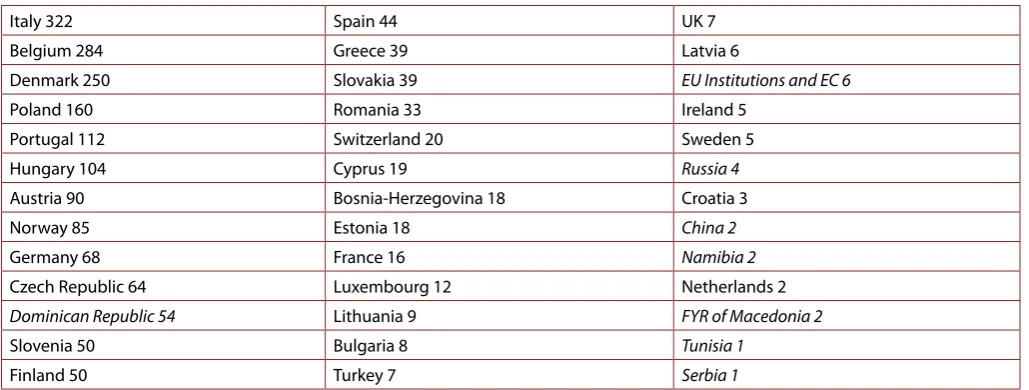
The 2000 and over users are widely spread in Europe and beyond Europe’s borders. If we take a closer look at the content of our CAF user database (see Table 1) we see that most of the European countries have CAF users.
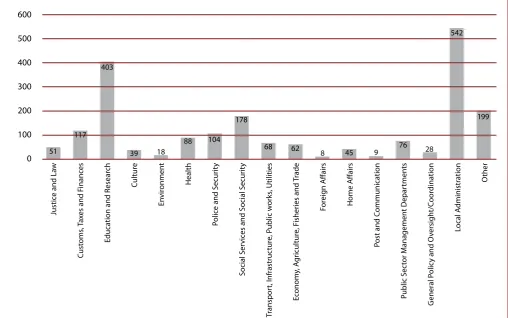
Furthermore there is no pattern anymore that would suggest a geographical reason as to where the most CAF users are located. At the top of the class are countries like Belgium, Italy, Denmark, Portugal, Poland and Austria. The fact that CAF does not know any continental borders can be seen by looking at the Dominican Republic and Tunisia which both have several CAF users; and even in China and Namibia we can find traces of CAF usage in our database. Also the supranational level has committed itself to quality management with CAF; several DGs in the European Commission, the Court of Auditors and Europol are only some of the European institutions that have successfully implemented the model. Looking at the spreading of CAF from this angle, prospects are that the reputation of CAF and therewith also its usage will further grow – in Europe, in the European institutions and beyond European borders. In Figure 1 we can see that CAF users come from all sectors of public administration. It has to be noted though that the two most prominent sectors according to the EIPA CAF database are education and research (403 users) and local administration (542 users). This is particularly interesting because, as it mentioned above, a tailor-made CAF version has been developed for the Education & Research sector already. As CAF spreads further – also in other sectors – it might be that in the future more of these specialized CAF-sector versions will be developed.
The future
Since the launch of the CAF model in 2000 at the first European quality conference, more than 2000 public sector organisations have applied the model. Over the past 10 years the CAF model has established its position among the many quality management tools. Thanks to the unique European collaboration and the efforts of many people, the model has proven to be successful. But the challenges of the future need to be prepared today. The CAF community will need to take the necessary steps to prepare for the future. In the previous chapters we described in general the origin and evolution of the Common Assessment Framework and
10
Years of C
AF
Re
po
[image:4.595.42.557.616.811.2]rt
Table 1: Situation August 26th 2010: 2035 registered CAF users in 38 countries and the European institutions
Italy 322 Spain 44 UK 7
Belgium 284 Greece 39 Latvia 6
Denmark 250 Slovakia 39 EU Institutions and EC 6
Poland 160 Romania 33 Ireland 5
Portugal 112 Switzerland 20 Sweden 5
Hungary 104 Cyprus 19 Russia 4
Austria 90 Bosnia-Herzegovina 18 Croatia 3
Norway 85 Estonia 18 China 2
Germany 68 France 16 Namibia 2
Czech Republic 64 Luxembourg 12 Netherlands 2
Dominican Republic 54 Lithuania 9 FYR of Macedonia 2
Slovenia 50 Bulgaria 8 Tunisia 1
39
its implementation, all the activities and instruments that were deployed in 10 years and how the model was spread. Most of the applications occurred since the launching of the latest review in 2006. This review was based upon a comprehensive study on the use of the CAF 2002 model until then, thanks to the amount of qualitative information that was gained by this study. In order to set up new steps in the development and spreading of the model, a new in-depth study seems to be necessary, this time related to the use of the CAF 2006 version. We
reached the quantitative target of 2000 registered users by 2010 and a new quantitative target might be set. But the time has come to do a qualitative evaluation of the use of CAF so that qualitative strategic objectives for the future can be defined.
This study will be undertaken in
2011. As in previous studies, questions about the content, the wording of the content and the process of implementation will have to be asked. The necessity or need to include new domains of public sector aspects like sustainability, integrity and ethics will be examined. Suggestions from national correspondents and users will be collected. More emphasis will be put on the impact of the action plans that were undertaken after the self assessment and to what extent they have led to a higher level of maturity in the organisation with reference to the 8 principles of excellence that are now worked out for the public sector.14 Information from the
implementation of the new procedure on external feed back will give a first indication of to what extent these principles of excellence have found their way into the European public sector. It must be clear that one of the action points for the future will be the further promotion and installation of the
whole procedure and that this will demand a lot of efforts from the Member States as well as from the CAF Resource Centre at EIPA.
The Procedure on External Feedback can be seen as the third step in the quality development of public sector organisations. In the first step, the organisation has to look at itself, discover areas of improvement and work them out in close cooperation between management and people of the organization. A lot of opportunities to improve the organisation can be found in the competences of its people as long as they are mobilized in an effective way. Much has been done to allow this to happen with the use of CAF but these efforts have to be maintained at European and national level and even to be increased in a number of MS that still have to be convinced of the added value of this TQM approach for their public sector.
But a great deal of inspiration can also be found outside the organisation in other local, regional or national levels. This is the second step for organisations in their development. During the course of 10 years, the exchange of good practices has been on the agenda of many international meetings such as the 5 European Quality Conferences and the 4 European CAF users events but also at many national and regional quality events. But more can be done. Efforts will have to undertaken to raise the effectiveness of the exchange of good practices on the level of all aspects that are treated in the 28 sub-criteria of CAF. As it is a holistic TQM model, all good practices on organizational development are at stake. New methods of exchange offered by the fast developing electronic providers have to be included.
10
Years of C
AF
Re
po
[image:5.595.44.553.58.376.2]rt
Figure 1: Spreading CAF users per sector
Justic
e and La
w
Cust
oms
, T
ax
es and F
inanc
es
Educa
tion and R
esear ch Cultur e En vir onmen t Health Polic
e and S
ecur
ity
Social S
er
vic
es and S
ocial S ecur ity Tr anspor t, I nfr astruc tur e, P ublic w or ks , U tilities Ec onom y, A gr icultur e, F isher ies and Tr ade For eig n A ffairs Home A ffairs
Post and C
ommunica tion Public S ec tor M anagemen t D epar tmen ts G ener al P olic
y and O
versigh t/C oor dina tion Local A dministr
ation Other
600 500 400 300 200 100 0 51 117 403 39 18 88 104 178 68 62 45 76 542 199 28 8 9
In these ten years the CAF has not
only grown in terms of
40
10
Years of C
AF
Re
po
rt
Efficiency is also becoming increasingly important in this field. In this way, we have to overcome the tendency that the first thing public sector organizations do in times of austerity is to stop meeting with colleagues from other countries. This will not only harm the growth of Europe but also the improvement of the capacity of the public sector in the MS. In the third step, public sector organisations seek to visit expert peers to discuss with them how the self assessment and better managerial practices were implemented and to discover to what extent this has risen the maturity level on TQM. In fact this is the final outcome of working with CAF: an excellent organization that reaches the maturity level at all 8 principles of Excellence. This ambition is now clearly defined and starters are now aware of the final outcome of their CAF journey. On all three steps efforts of promotion and support will have to be maintained and developed in the future but especially in the field of the maturity levels in the 8 principles of excellence a lot remains to be done. What do they mean in practice for an organisation? What lies behind the concepts? How can an organization shift from one level to another? Are these concepts the same in all countries or can we learn from each other?
Besides working on the further deepening of CAF, the question is often put forward as to if it is useful to develop a sector-oriented version of the model, respecting of course the overall structure of the model. CAF and Education has been finalised in 2010 but some countries have already developed a CAF for Justice, a CAF for Health Care or a CAF for local administrations. This question still has to be discussed by the CAF network but reality has already passed the outcome of this discussion.
Conclusion
We have probably overlooked a number of other opportunities for the CAF in the future but it must be clear that the model can play an even more effective role than it did in the past in terms of moving towards excellent public services in and outside Europe. One major condition for that is strong cooperation within the CAF network amongst the Member States and between the Member States and the CAF RC. Because it is important to constantly remember, that together everyone achieves more!
NOTES
* Patrick Staes, Seconded National Expert, European Institute of Public Administration, EIPA Maastricht.
** Nick Thijs, Lecturer, European Institute of Public Administration, EIPA Maastricht.
*** Ann Stoffels, Programme Organiser, European Institute of Public Administration, EIPA Maastricht.
**** Lena Heidler, Research Assistant, European Institute of Public Administration, EIPA Maastricht.
1 Pollitt, C. and Bouckaert, G., (1999) Public management Reform,
Oxford University Press.
2 Van Dooren, W., Thijs, N. and Bouckaert, G., (2004) Quality
management and management of quality in the European public administrations. In: Löffler, E., and Vintar, M. (Eds.). Improving the quality of East and Western European public services. Hampshire: Ashgate. pp. 91-106
3 Engel, C., (2003) Quality management tools in CEE candidate
countries. Maastricht: Eipa, p. 104
4 Engel, C., (2002) Common Assessment Framework : The state of
affairs, Eipascope, (1), pp. 35-39 5 all info on www.eipa.eu/CAF
6 EIPA (2003), Study for the Italian presidency on the use of
the common assessment framework in the European public administrations, Maastricht, p. 92
7 EIPA (2005), Study on the use of the Common Assessment Framework in European public services, Maastricht, p. 89 8 The “CAF works” publication can be downloaded from www.
eipa.eu/caf (publications section)
9 The “CAF movie” can be watched and downloaded from www.
eipa.eu/caf (see movie section)
10 Thijs, N. and Staes, P., (2005) Quality Management on the
European Agenda. Eipascope, 2005/1, pp. 33-41
11 Thijs, N. and Staes, P., (2005) The Common Assessment
Framework in European public administration: a state of affaires after five years. Eipascope 2005/3, pp. 41-49
12 Thijs, N. and Staes, P., (2010) From self-assessment to external
feedback, Eipascope 2010/1, pp. 9-14
13 Abstract taken from the interview with Mme. Roland, former
president of the Belgian High Council of Justice, during the 4th CAF User Event in Bucharest, 23-24 September 2010.
14 See the brochure on the CAF External Feedback Procedure on