This is a repository copy of Dynamic ion pair behavior stabilizes single alpha helices in
proteins..
White Rose Research Online URL for this paper:
http://eprints.whiterose.ac.uk/140833/
Version: Accepted Version
Article:
Batchelor, M orcid.org/0000-0001-6338-5698, Wolny, M, Baker, EG et al. (3 more authors)
(2019) Dynamic ion pair behavior stabilizes single alpha helices in proteins. Journal of
Biological Chemistry, 294 (9). pp. 3219-3234. ISSN 0021-9258
https://doi.org/10.1074/jbc.ra118.006752
© the Author(s). Published under license by The American Society for Biochemistry and
Molecular Biology, Inc. This is an author produced version of a paper published in Journal
of Biological Chemistry. Uploaded in accordance with the publisher's self-archiving policy.
[email protected] https://eprints.whiterose.ac.uk/ Reuse
Items deposited in White Rose Research Online are protected by copyright, with all rights reserved unless indicated otherwise. They may be downloaded and/or printed for private study, or other acts as permitted by national copyright laws. The publisher or other rights holders may allow further reproduction and re-use of the full text version. This is indicated by the licence information on the White Rose Research Online record for the item.
Takedown
If you consider content in White Rose Research Online to be in breach of UK law, please notify us by
Dynamic ion pair behavior stabilizes single alpha helices in proteins.
Matthew Batchelor,1 Marcin Wolny,1 Emily G. Baker,2 Emanuele Paci,1 Arnout P. Kalverda,1 Michelle Peckham.*1
From the 1School of Molecular and Cellular Biology and the Astbury Centre for Structural Molecular
Biology, University of Leeds, Leeds, LS2 9JT, UK; 2School of Chemistry, University of Bristol, Cantock's
Close, Bristol, BS8 1TS, UK
Running Title: Ion pair dynamics in helices
*To whom correspondence should be addressed: Michelle Peckham, School of Molecular and Cellular Biology, Faculty of Biological Sciences, University of Leeds, Leeds, UK, LS2 9JT, [email protected], Tel. 44 (0)1133434348; Fax. 44 (0)1133434228
Keywords: alpha helix, molecular dynamics, nuclear magnetic resonance, salt bridges
ABSTRACT
Ion pairs are key stabilizing interactions between oppositely charged amino acid side chains in proteins. They are often depicted as single conformer salt bridges (hydrogen-bonded ion pairs) in crystal structures, but it is unclear how dynamic they are in solution. Ion pairs are thought to be
particularly important in stabilizing single α-helix
(SAH) domains in solution. These highly stable domains are rich in charged residues (such as Arg, Lys, and Glu) with potential ion pairs across adjacent turns of the helix. They provide a good model system to investigate how ion pairs can contribute to protein stability. Using NMR spectroscopy, small-angle X-ray light scattering (SAXS), and molecular dynamics simulations, we provide here experimental evidence that ion pairs exist in a SAH in murine myosin 7a (residues 858Ð
935), but that they are not fixed or long lasting. In
silico modeling revealed that the ion pairs within
this α-helix exhibit dynamic behavior, rapidly
forming and breaking and alternating between different partner residues. The low-energy helical state was compatible with a great variety of ion pair combinations. Flexible ion pair formation utilizing a subset of those available at any one time avoided the entropic penalty of fixing side chain conformations, which likely contributed to helix stability overall. These results indicate the dynamic nature of ion pairs in SAHs. More broadly, thermodynamic stability in other proteins is likely to benefit from the dynamic behavior of multi-option solvent-exposed ion pairs.
Ion pairs are interactions formed between the negatively charged residue side chains in
aspartate (Asp) or glutamate (Glu) and positively charged residue side chains in arginine (Arg), histidine (His) or lysine (Lys). These interactions are thought to be important in stabilizing protein structure, and often occur at catalytically active sites. In structural models they are commonly depicted as fixed, despite the marginal energetic benefit they provide compared to individually solvated charged groups. Indeed, it is unclear how static or dynamic ion pairs are, as investigations into ion pair dynamics, especially when solvent exposed, are lacking.
Ion pairs can be classified into different forms depending on their geometry. A salt bridge is a hydrogen-bonded ion pair, and constitutes the most tightly constrained or static picture of an ion pairing. Contact ion pairs have no intervening (water) molecules between the charged groups but
do not necessarily fulfill the geometric
requirements to form a hydrogen bond. Longer-range ion pairs with weaker electrostatic interactions can form across water molecules.
Ion pairs are thought to be particularly
common in single α-helices (SAHs). These are
continuous α-helices that remain stable in the
absence of any tertiary structure (1,2). Their sequences are rich in Arg, Glu and Lys, and the remarkable stability of these structures is thought to arise from a dense network of ion pairs that form between oppositely charged side chains across neighboring turns of the helix (3,4). SAHs maintain their helicity over a wide range of salt and pH conditions and generally unfold in a non-cooperative manner (2,5-7). They are widespread, occurring in many different proteins (3,8-12).
The high potential for ion pair formation in
http://www.jbc.org/cgi/doi/10.1074/jbc.RA118.006752 The latest version is at
JBC Papers in Press. Published on December 28, 2018 as Manuscript RA118.006752
at UNIVERSITY OF LEEDS on January 9, 2019
http://www.jbc.org/
SAHs makes them a good model system to investigate how ion pairs contribute to protein stability. Molecular dynamics (MD) simulations of SAHs have suggested that the ion pairs exhibit dynamic behavior (4,5). The variability in rotamer conformations for GluÐArg and GluÐLys ion pairs, from an analysis of helix crystal structures in the PDB, also provide evidence of some dynamic behavior (5,7). Dynamic ion pairs, using multiple side chain rotamers and alternative pairings, are likely to lower the entropic cost compared to fixed ion pairs (or salt bridges), and this will contribute to their stabilizing properties in SAHs and other proteins. However, experimental evidence of the dynamic behavior of ion pair formation is very limited.
To determine the behavior of exposed ion pairs in solution, we analyzed the SAH from myosin 7a (M7A: mouse, residues 858Ð935) using a combination of approaches, including solution nuclear magnetic resonance (NMR) spectroscopy and molecular dynamics simulations. We selected the M7A SAH as its less repetitive sequence compared to that of other known SAHs was expected to facilitate a more complete assignment of the NMR spectra. A crystal structure recently obtained for mouse M7A (residues 866Ð935) (13) confirmed our original prediction that M7A contains a SAH between its lever and tail domains, in common with other myosin isoforms (2,14-16). That study also showed that, while 35 GluÐLys and GluÐArg helix-compatible ion pairs can potentially form, only 8 pairs of interactions were identified in their analysis (13) leaving the majority of Glu, Lys and Arg residues in the sequence without an ion pair partner. It is likely that only some of the potential ion pairs are captured in a single crystal structure. Thus, the possibility remains that a larger and more diverse set of ion pairs is present in solution. We set out to test this hypothesis by using solution nuclear magnetic resonance (NMR) spectroscopy. We also performed molecular dynamics (MD) simulations, to further explore ion pair behavior in this sequence. Our experimental data show that the ion pairs are not static but instead are dynamic and this is likely to be important for stabilizing this and other proteins.
Results
The full-length M7A SAH is highly helical, elongated, monomeric and stable
An initial characterization of the full length M7A SAH (Fig. S1) by circular dichroism (CD),
analytical ultracentrifugation (AUC), size
exclusion chromatography and small angle X-ray scattering (SAXS) demonstrated that our M7A SAH construct (residues 858Ð935) exhibited the properties of previously well-characterized SAHs in solution (2,6,10,16). M7A SAH was ~90%
helical at low temperature, melted
non-cooperatively, and remained highly helical over a wide range of pH and salt concentrations (Fig. S1AÐD). It was monomeric and had an elongated structure in solution as demonstrated by analytical
ultracentrifugation and size exclusion
chromatography, respectively (Fig. S1E, F). Additional data from small angle X-ray scattering (SAXS) was again consistent with a continuous (extended) helix structure for M7A SAH (Fig. S1G). The Kratky plot of the scattering data
((�∀�(�) as a function of �, where the momentum
transfer � = 4� sin � /� , � is the beam
wavelength, 2� is the scattering angle and � is the
scattering intensity) is not bell-shaped, as expected for a globular protein, but exhibits a plateau at high
�, consistent with an extended structure (17). Using
a collection of highly-helical model structures with
a range of radii of gyration (Rg), the data was best
fit (�∀ < 0.5, Fig. S2) by near-straight continuous
helix model structures (18), and Rg was estimated
to be 33.9 •. This value agreed well with an Rg of
34.5 ± 0.6 • (mean ± S.D.) estimated from molecular dynamics simulations (see below).
In NMR, the 2D 1HÐ15N TROSY
(transverse relaxation optimized spectroscopy) spectrum of M7A SAH showed a remarkable lack of dispersion (Fig. 1AÐB), more typical of a disordered protein than a globular protein of similar molecular mass. However, this is likely to result from the low complexity of the extended SAH, in which the chemical environment is diverse principally along only the helix axis rather than in all three dimensions as in a globular protein. Despite the lack of dispersion, we obtained a
virtually complete backbone assignment (1H
N, 15NH, 13
Cα, 13CÕ and 13Cβ based on standard
BEST-TROSY style triple resonance experiments (19-21)). A combination of several different NMR experiments was used (Table S1) to obtain
unambiguous assignment of shifts for Hα, Hβ and,
where possible, other side chain nuclei (Table S2).
As expected for an α-helical structure, all
secondary Cα shifts away from the N- and C-
termini (conservatively >10 residues from termini) were positive and typically fell within the range of 2Ð3 ppm (Fig. 1C) (22,23). Importantly, there were
at UNIVERSITY OF LEEDS on January 9, 2019
http://www.jbc.org/
no breaks in this trend across the length of the peptide showing that there are no persistent unfolded regions away from the termini. This is a key finding: there is some variation in the local density of potential salt bridge interactions over the sequence (see later) and yet the protein is fully helical throughout. A fuller calculation of secondary structure populations from all the
measured backbone chemical shifts (24)
corroborates this feature (Table S3). There is some fraying of the helix at the N- and C-terminal ends as might be expected, and the overall helicity (at 23.4 ¡C) is estimated to be 84%. CS-Rosetta based de novo structure generation, guided by chemical
shift assignments of 1HN, 1Hα, 13Cα, 13Cβ, 13CÕ and
15
N nuclei (25,26), showed that the lowest energy structures all exhibit extended helix conformations (Fig. 1D).
Next, we used heteronuclear NOE and relaxation experiments to interrogate the local and
global dynamics of M7A SAH. 1HÐ15N
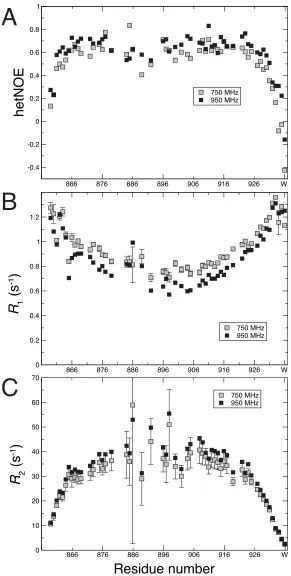
heteronuclear NOE values were high and positive for residues 866 to 926 (Fig. 2A) demonstrating that these backbone amides (away from the termini) are ordered on the ps to ns timescale and are thus stably folded. Relaxation NMR experiments showed that
15N backbone nuclei in the more disordered
residues at the N- and C-termini exhibited faster R1
rates and slower R2 rates compared to those from
the more ordered central residues in the helix (Fig.
2BÐC). Longitudinal relaxation rates (R1) of 15N
nuclei are sensitive to the fast (psÐns scale)
dynamics, whereas transverse relaxation rates (R2)
also include a contribution from slower dynamic processes.
The global/overall rotational correlation
time (τr) estimated using the R1 and R2 rates for the
structurally ordered residues (27,28), was high (13.8 ns at 950 MHz and 15.5 ns at 750 MHz) and would correspond to a mass in the range of 34Ð49 kDa for a model spherical protein (29). These data indicate that M7A SAH has a much slower rate of tumbling in solution compared to a globular protein of similar mass, consistent with the formation of a
long continuous α-helix. The reason for the large
apparent τr value is the highly anisotropic tumbling
of the helix in solution. Backbone NÐH bonds in a helix are oriented along the helical axis. Relaxation through reorientation of the NÐH bond vector will therefore depend on the less dynamic end-over-end rotation of the helix as opposed to faster axial rotation. The SAH combines the lack of chemical shift dispersion seen in low complexity intrinsically
disordered proteins with the unfavorable relaxation properties of a globular protein with much larger mass, explaining the challenging nature of NMR approaches applied to this system.
NMR shows the presence of ion pairs in M7A SAH
Analysis of the side chains in the SAH, which have low sequence diversity, is much more challenging than the backbone. Many side chain nuclei resonances, especially those of Glu, Arg and Lys side chains, are characterized by a significant degree of overlap. The level of degeneracy of resonance positions is illustrated for parts of the
13
C-HSQC spectrum (Fig. 3A), which displays tight clusters of peaks for different side chain positions.
The most extreme example of this is for the Lys HεÐ
Cε correlations, which appear effectively as a single
peak for eleven residues (22 protons). This effectively puts a NOE-based NMR structure determination, using ARIA (30-32) or similar, beyond reach.
However, our main focus was to evaluate the behavior of the Glu, Arg and Lys side chains and possible ion pairs between them. From studies on intrinsically disordered proteins it has been established that N and CO nuclei retain the largest degree of chemical shift dispersion and therefore experiments that relay magnetization to side chain (or backbone) N and CO hold the most promise in this regard (33,34). Glu residue interactions can be inferred from chemical shift measurements of the
side chain carbonyl carbon and nearby Hɣ nuclei.
Improved peak dispersion (over 13C-HSQC spectra)
was achieved for Glu Hɣ resonances by correlating
with the adjacent carbonyl carbon (Cδ) nuclei,
which are also the most relevant marker nuclei for ion pair interactions involving Glu (Fig. 3B).
Specific assignment for all Glu Cδ nuclei and
thereby a significant number of Glu Hɣ pairs was
achieved by linking Cδ shifts back to the backbone
(see Methods).
Two key findings are demonstrated by
these experiments. First, the measured Glu Cδ shifts
(>183.1 ppm) indicate that all Glu residues in M7A
SAH are in the deprotonated COOÐ form rather than
the protonated COOH form. For comparison, in a
random coil model peptide, deprotonated Glu Cδ
shifts were 183.8 ppm, whereas protonated Glu Cδ
had significantly lower chemical shifts (179.7 ppm)
(35). Second, most of the accurately assigned Hɣ
pairs from the central part of the protein displayed two distinct peaks that result from restricted
at UNIVERSITY OF LEEDS on January 9, 2019
http://www.jbc.org/
rotational motion between rotameric states. In
contrast, Hɣ pairs in residues near the protein
termini (Glu862 and Glu935) exhibited very small resolvable differences in chemical shift. This result indicates that side chains of the central Glu residues in M7A SAH are not able to freely rotate in the structure and are thus interacting with other residues in the protein.
The most appropriate nuclei to report on salt bridge formation from the positively charged residues (Lys and Arg) are the side chain nitrogens (36-42). Under our original conditions of pH 7.4 and 23.4 ¡C, the ionizable side chain HÐN correlations in Lys and Arg were not accessible; HSQC and HiSQC spectra (41) lack peaks for these groups due to rapid hydrogen exchange with water. However, reducing the pH to 5.5 and temperature to 10 ¡C slowed proton exchange and enabled us to
observe Lys HζÐNζ, Arg HƞÐNƞ and Arg HεÐNε
correlations for M7A SAH. The overall helicity changes little from the original conditions, supporting the assumption that the general structure and mode of stabilization is not affected (Fig. S1B,C).
At pH 5.5 and temperature of 10 ¡C, the
Lys HζÐNζ correlations in M7A SAH (from eleven
Lys residues) are visible, albeit as a single peak that is only resolved into two peaks at high resolution
(Fig. 4A). Poorly dispersed HƞÐNƞ correlations for
the fourteen Arg residues were observed with Hƞ
shifts only ranging from 6.7 to 7.1 ppm (Fig. 4B). In contrast, it was possible to independently
interrogate all Arg HεÐNε correlations, which
appear as sharper peaks across a broader range of
1
H chemical shifts (Fig. 4C). As the Arg HεÐNε
correlations are very well resolved we utilized NMR techniques to investigate their participation in ion pairs. We used existing protocols or designed new experiments to measure the chemical shifts,
dynamics (43,44), intra-residue 3JNεCβ couplings,
and long-range inter-residue 3JNεCÕ couplings
between Arg Nε and carbonyl carbons (C') for the
Glu side chains (Cδ). The HεÐNε correlations were
assigned to each Arg residue by linking back to the backbone (see Methods and Fig. S3).
The Arg HεÐNε correlations fall into
distinct groups that indicate their potential involvement in ion pairs (Fig. 4C). Peaks from Arg residues that can potentially make multiple
interactions are generally found on the far left (Hε
>7.6 ppm). These match the six Arg residues that form ion pairs in chain A of the crystal structure (13). Peaks from Arg residues close to the N- and
C-termini are found on the far right (Hε <7.3 ppm).
The peak for the central Arg residue, Arg900, which has no potential ion pair partners, appears close to the terminal Arg residues. Participation of an NH group in a hydrogen bond (or salt bridge) should be accompanied by a downfield shift of the
proton (45). Although the Hε shifts observed here
are good indicators of ion pair participation, more
significant chemical shift changes (Hε ~ 9 ppm)
have been previously seen in examples where Arg side chains participate in a hydrogen bond (43,46).
It is worth noting that the HƞÐNƞ correlations all
appear close together (Fig. 4B). There are no
downshifted Hƞ or Nƞ resonances that would
indicate salt bridge formation through these groups,
unlike the HƞÐNƞ correlations seen in spectra of
complexes formed through ArgÐcarboxylate (47) or ArgÐphosphotyrosine (43) interactions.
Further evidence points to the majority of central Arg residues being involved to some degree
in ion pair formation. The HεÐNε peaks for central
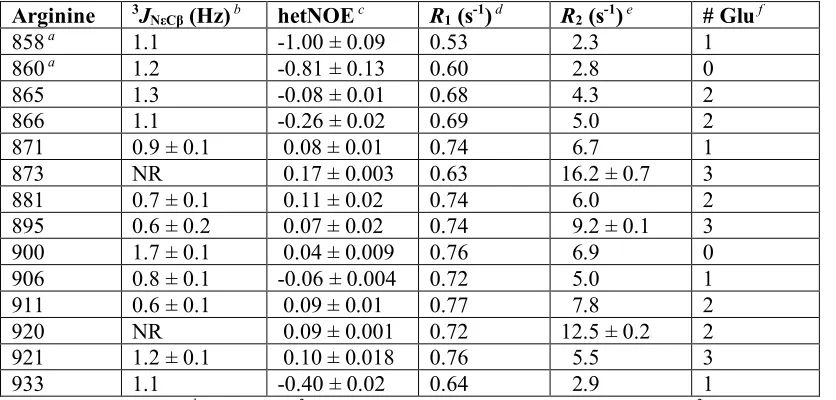
Arg residues show small positive heteronuclear NOEs (Fig. 4D, Table 1) consistent with the side chains being relatively ordered compared to those of the N- and C-termini. Those located close to the
N- or C-terminus have clear negative 1HÐ15N
heteronuclear NOEs. While, the comparatively high values of the NOEs indicate a restricted or slower timescale of local motion, the values do not approach those measured for the backbone
residues, nor those of Arg Nε involved in binding
to phosphotyrosine (43). R1 and R2 values for Arg
Nε show a broadly similar pattern to that of the
heteronuclear NOEs with higher values for the central residues compared to those at the termini (Table 1). This again is an indicator that central Arg side chains are more constrained than those at the
termini (43). R2 values are particularly high for
Arg873, Arg920 and Arg895 (those with the most
downshifted Hε) indicating that slower (>ns)
dynamic relaxation processes are also important for these residues.
NMR shows that ion pairs in M7A SAH are dynamic
The above data shows evidence for ion pair formation in M7A SAH. The next question was could we detect salt bridges (or hydrogen-bonded ion pairs)? Fixed and stable salt bridges should show through-hydrogen-bond couplings between the associated nitrogen and carbonyl carbon nuclei (48,49). Very weak coupling (~0.2 Hz) for mobile
hydrogen bonding interactions between Lys Nζ and
at UNIVERSITY OF LEEDS on January 9, 2019
http://www.jbc.org/
C' nuclei in ubiquitin has also been observed using this approach (42). In addition, there is an example of a weak coupling reported for a side chainÐside chain interaction (between Arg and Asp), although no value was reported (46). To this end, we adapted a spin-echo difference experiment (42) to measure
3
JNCÕ couplings between Arg Nε and Glu Cδ (see
Methods, Fig. S4).
First, measurements of small 3JNC
couplings within each Arg residue (i.e. 3JNεCβ) were
used to validate the spin-echo difference experiment and report on the Arg side chain conformational ensemble (42). The experiment
could readily measure 3JNεCβ coupling along the Arg
side chain, as shown by a drop in peak intensity between the two component spectra (Fig. 5A). The values ranged from 0.6 Hz for the downfield shifted
Arg895, to 1.7 Hz for Arg900 (Table 1). The 3JNεCβ
coupling constant reports on the distribution of �3
(NεÐCδÐCɣÐCβ) angles occupied by each Arg
residue. By analogy with other NÐCÐCÐC dihedrals
(42), larger 3JNεCβ values are indicative of larger
trans �3 contributions and smaller 3JNεCβ values
indicate larger gauche contributions (see Fig. S5A
for a qualitative description). Arg900, which has no potential ion pair Glu neighbors, spends more time
in the less sterically demanding trans conformation.
Arg895, on the other hand, favors gauche
conformations, presumably to more readily interact with one or more of its three potential Glu ion pair
neighbors. Intermediate 3JNεCβ values point towards
variation in the �3 dihedral angle, with side chains
occupying both trans and gauche rotamers.
The same spin-echo difference experiment was then used to examine through-hydrogen-bond
coupling (3J
NεCÕ) to Glu Cδ. As there was no drop in
peak intensity between the component spectra of
the experiment, values of 3JNεCÕ remained below the
detection limit (of ~0.2 Hz) for at least 12 of the 14 Arg residues (Fig. 5B). As peaks were not observed in the sub-spectra for Arg873 and Arg920, due to
their fast relaxation properties, estimation of 3JNεCÕ
was not possible for these residues. Very small coupling constants indicate limited orbital overlap
from Arg Nε to Glu Cδ.
Taken together the chemical shifts and
dynamics of the Arg Nε reflect the participation of
the central Arg side chains in ion pair interactions with neighboring groups, while the very small size or absence of through-hydrogen-bond couplings argues against specific salt bridges (50). These data either indicate that the SAH is composed of ion pairs in a dynamic network or that there is a
preference for weaker solvent-bridged ion pairs. Salt bridges and contact ion pairs, if they form, can only exhibit short lifetimes, perhaps as part of a dynamic ensemble of bonded, unbonded and solvent-bridged states.
Molecular dynamics simulation for M7A SAH indicates dynamic ion pair interactions between charged side chain residues.
The NMR data indicate that while the M7A SAH is helical, formation of salt bridges is transient
or looser ion pairs are formed (e.g. bridged by an
intervening water molecule). To explore this further, we ran equilibrium simulations of M7A
SAH using a perfect α-helix as a starting structure.
During the simulation, the structure flexes but remains a continuous single helix throughout, with an average overall helicity of 90Ð92%. As indicated
above, the average Rg of the protein from simulation
(34.5 •) matched the experimental value from SAXS (33.9 •).
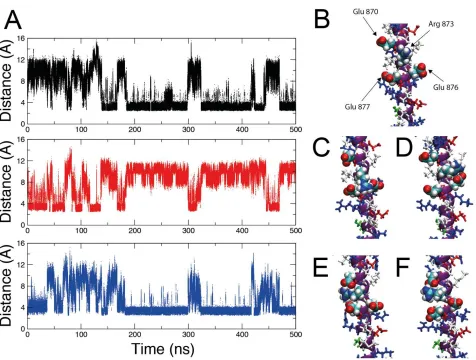
Simulations show the presence of ion pairs not observed in the crystal structure, and highlight transitions between different accessible ion pairings. Plots of the distance between charge centers in GluÐArg and GluÐLys pairs show many large and small-scale transitions (Fig. 6A). The ion pair occupancy (fraction of time that charged residues were close enough to form a ÔcontactÕ ion pair, calculated using a threshold distance of 4 • (5)) showed which ion pairs are most likely. All of the ion pairs compatible with an extended helical conformation were observed during the simulation, albeit with a wide range of occupancies (1Ð91%, Table S4). For example, the Glu892ÐArg895 ion pair is highly occupied, being observed for 61% of the time during the simulation. This pair was also found to be present in the crystal structure (13). Alternative ion pairs involving Glu892 (Glu892Ð Lys888 and Glu892ÐLys896) were also observed albeit for a lower fraction of the overall simulation time (9% and 4%, respectively). The pairing Arg895ÐGlu899 (35% occupancy) exemplifies one of many cases where ion pairs that were absent from the crystal structure were present in the simulation. On average, potential GluÐLys ion pairs were occupied for 18% of the simulation, while GluÐArg ion pairs were occupied for 37%. The total number of ion pairs observed at any one time was 11.8 ± 2.2 (mean ± S.D.); there are 41 potential helix-compatible ion pairs.
We also found that charged residues formed ion pairs simultaneously with two
at UNIVERSITY OF LEEDS on January 9, 2019
http://www.jbc.org/
neighboring partners without breaking the helix structure, in agreement with our earlier findings (5). For example, the ion pairs Arg873ÐGlu870 and Arg873ÐGlu877 were formed simultaneously for 45% of the simulation, whereas Arg873ÐGlu876 and Arg873ÐGlu877 were simultaneously occupied for 8% (see snapshot images in Fig. 6BÐE and Movie S1).
Contact ion pairs form and break on a rapid timescale. Estimates of the average ion pair lifetimes were position dependent, but overall the lifetimes were longer for GluÐLys (38 ps) than for GluÐArg (21 ps) in line with our previous simulations of SAHs (5). Additional simulations, which specifically used the starting conformations of one or other of the two chains in the unit cell from the crystal structure, showed similar dynamic behavior in terms of ion pair lifetimes and pairings that were absent from the crystal structure. Overall, the simulations of M7A SAH show a more complicated and dynamic picture of ion pair interactions than one of a small number of specific ion pairs implied by the crystal structure (13).
Analysis of the M7A866Ð935 crystal structure reveals evidence for variable and alternative ion pairs
Our experimental findings prompted us to reanalyze the ion pairs made within the deposited
crystal structure of M7A866Ð935 (PDB: 5WST).
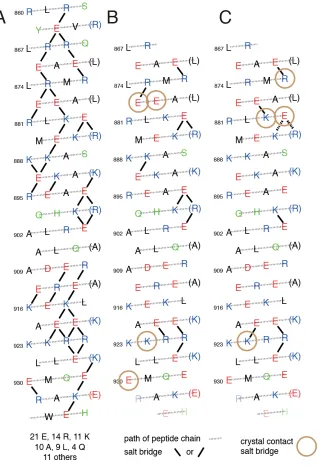
There are two SAH chains in the unit cell and the analysis is performed for both. The results of this new analysis are consistent with the potential dynamic behavior of ion pairs within it. A helical net plot demonstrates the large number of potential ion pairs that could form in M7A SAH (Fig. 7A).
Using a threshold distance of 4 • between one of the side chain N atoms (Lys or Arg) and a side chain O atom (Glu) to define a contact ion pair (5), 11 ion pairs were defined in chain A (Fig. 7B) and 8 in chain B (Fig. 7C), some of which were overlooked in the original paper, such as that between Lys882ÐGlu878. On the other hand, the ion pair reported to form between Glu907 and Arg911 is unlikely to do so as this exceeds the threshold distance (>4.7 •).
Specific ion pairs were observed in one of the two helices in the unit cell, but not in the other, suggesting that the ion pairs may be dynamic. For example, the shortest NÐO distance in the Arg895Ð Glu892 pair was 2.8 • in one chain but 7.3 • in the other. Explicit dynamic behavior is additionally shown by the placement of alternate side chain conformers into the electron density (51) for
Glu878 in chain B, displaying two side chain conformers that form an ion pair to either Arg881 or Lys882. In chain A, Glu878 occupies a single position where it forms an ion pair with both Arg881 and Lys882 simultaneously. In addition, side chains forming intermolecular (crystal contact) ion pairs in the crystal may instead form intramolecular bridges in the monomer in solution. This analysis demonstrated a higher variability in ion pairs than originally described (Fig. 7B, C), and yet the number of observed ion pairs was still small given the potential number of ion pairs that potentially could exist.
We estimated 3JNεCβ for Arg residues using
dihedral angles measured in the crystal structure (Fig. S5B, red lines), and compared them to
experimental 3J
NεCβ values (Fig. S5C). The
correlation between crystal structure and NMR values was poor, indicating substantial deviation from the crystal structure dihedral angles in
solution. Distributions of �3 dihedral angles were
also calculated for each Arg residue from the MD simulation (Fig. S5B, blue), and
ensemble-averaged 3JNεCβ values were estimated (Fig. S5D).
The correlation of simulation with experimental
3
JNεCβ values, albeit not perfect, was improved over
those of the crystal structure analysis. Some dihedral undersampling during the simulation may contribute to any differences observed. Variation of
the �3 dihedral, and with it the ability of Arg
residues to form ion pairs, is a feature described by both NMR and MD results. These analyses support our experimental findings that ion pairs exhibit dynamic behavior in solution for M7A SAH.
Discussion
Here we have addressed the question of whether the ion pairs formed between specific residues in the M7A SAH are strong and persistent, whether the ion pairs change, and if ion pairs are even important for stability at all, which has been questioned (52). Our combination of experimental data and simulations support the idea that the stability of SAHs is not driven by strong, hydrogen-bonded,
and persistent salt bridges, but via a network of
fluctuating ion pairs that continually form and break. This, together with the high thermodynamic stability and non-cooperative unfolding of these domains, supports the idea that the extended helical state has high conformational entropy. This agrees with and extends our recent molecular dynamics simulations on artificial SAH sequences that showed that the interplay between oppositely
at UNIVERSITY OF LEEDS on January 9, 2019
http://www.jbc.org/
charged residues is highly dynamic with salt-bridges being formed and broken on the 10 ps timescale in MD (5).
The NMR data shows that the M7A SAH
forms a long α-helical structure in solution.
However, specific (fixed or long lasting) ion pair interactions could not be identified. Together with the supporting data from MD simulations, we show this is because the charged residues have a choice of interactions and can exchange on a very rapid timescale. The NMR data indicate, by more indirect
measures, such as the chemical shifts of the Arg Hε
protons, and the dynamics of the Nε, and 3J
NεCβ
values, that most of the central Arg residues are forming ion pairs. The one exception, Arg900, is not expected to form an ion pair. Inspection of the helical net plot (Fig. 7A) shows it has no potential ion pair partners compatible with the helix structure (Fig. 7A). Correspondingly, it appears in the same part of the HiSQC spectrum as the terminal Arg
residues (Fig. 4C) and has a high 3J
NεCβ value. It
should be noted that some alternative experimental strategies exist to probe the presence of ionic interactions that would be complementary to our work (53,54).
While the data do not support the existence of specific long lifetime salt bridges, they are consistent with the dynamic behavior of ion pairs
observed in MD simulations. 3J
NCÕ values of 0.23
and 0.17 Hz were measured for mobile H-bonds in ubiquitin (42). Their simulated average lifetimes were 45 ps and 30 ps, and H-bond occupancies were 80% and 51%, respectively, using a salt bridge distance criterion of 3.5 •. If we apply this more stringent criterion to our simulations, the average ArgÐGlu (and LysÐGlu) lifetimes are much shorter
(<10 ps), and Hε-mitigated ion pairs average 25%
occupancy. Thus smaller coupling constants, below the level dictated by the noise, are in keeping with the MD results. The general consensus would appear to be that, if anything, MD simulations still over-stabilize salt bridges compared to experiment (55-57). We think that the continuous and rapid exchange of ion pairs is important for providing SAHs with their stability. The choice of multiple interactions together with their density is likely to give this system its remarkable properties.
Interestingly, despite the local variation in the density of potential ion pairs in M7A SAH (Fig. 7A), its behavior is consistent with that of a SAH along its entire length. This suggests that the density of interactions may not relate directly to the propensity of being helical. Both crystallography
and MD simulations indicate that the presence of around 10 ion pairs or 30% of the total possible number at any one time is enough to keep the system fully helical. The subtle balance of interactions allows for a reversible response to external pressures such as the mechanical stresses (6) encountered in the function of these proteins.
In summary, it has been unclear exactly how potential ion pair formation can contribute to the stability of SAHs. It has been speculated that their stability arises from the flexibility of the ion pair network, providing it with an entropic advantage (9,58). Our combined NMR data and MD simulations support this idea, suggesting that a rapidly fluctuating network of ion pairs is key to SAH stability. More broadly, it might be expected that solvent-exposed ion pairs in many other proteins are also likely to demonstrate this dynamic behavior in solution.
Experimental Procedures
Expression constructs
The DNA sequence for residues 858Ð935 from myosin 7a (mouse, Uniprot P97479, Fig. 7A) was synthesized (GeneArt; GenScript) and subcloned into the pET28a SUMO vector to introduce an N-terminal His-tag and SUMO fusion protein for increased expression and solubility as
described (6). To facilitate concentration
measurements of purified protein a single C-terminal Trp was also incorporated. The purified protein segment M7A SAH is 80 residues in length including the additional N-terminal Ser and C-terminal Trp residues.
Protein expression and purification
Protein expression was carried out in E.
coli BL21 Rosetta 2 (Novagen) and purification used a Ni-NTA affinity chromatography column. Expressed protein was dialyzed against 150 mM NaCl, 20 mM Tris, 1 mM DTT, pH 8.0 and proteolyzed for 2 h at room temperature, using ULP1 recombinant SUMO protease in a substrate to enzyme ratio 100:1. Cleavage of SUMO carries forward a single, N-terminal Ser residue into M7A SAH. M7A SAH was purified on a 5 ml SP sepharose column using an AKTA system. Buffers
used were: 20 mM Tris-HCl, pH 7.5, 0.03% NaN3
(Buffer A); 1 M NaCl, 20 mM Tris-HCl, pH 7.5,
0.03% NaN3 (Buffer B); salt gradient: 100Ð500
mM. The purest fractions were combined and concentrated resulting in a 2Ð10 mg/ml protein
at UNIVERSITY OF LEEDS on January 9, 2019
http://www.jbc.org/
solution. Purified protein was dialyzed against 100
mM NaCl, 10 mM sodium phosphate
(Na2HPO4/NaH2PO4), pH 7.4, and snap-frozen in
liquid nitrogen for long term storage at -80 ¡C. Protein concentration was measured by absorption at 280 nm. Absorption coefficients were obtained from ProtParam software.
Protein expression for NMR analysis was initially carried out in Terrific Broth (TB) medium
(4 x 400 ml). After reaching OD600 ~ 0.6 the
cultures were spun down, combined pellets were washed with 100Ð200 ml of minimal media (M9
salts, 2 mM MgSO4, 0.1 mM CaCl2, 10 ml of basal
vitamins) and resuspended in 250 ml of minimal media. After 45 min in 37 ¡C, 220 RPM the culture
was supplemented with isotopes (100 mM 15NH4Cl,
50 mM 13C D-glucose, Goss Scientific) and grown
in the same conditions for additional 35 min after which culture was induced with 0.5 mM IPTG and grown overnight at 21 ¡C, 180 RPM. Purification
was carried out as described above. Two 15NÐ13
C-labeled M7A SAH samples were prepared for the NMR experiments. The first was prepared in 100 mM NaCl, 10 mM sodium (hydrogen) phosphate, pH 7.4, at a concentration of ~4 mg/ml (0.4 mM). The second was prepared in 100 mM NaCl, 10 mM phosphate, at the lower pH of 5.5 and at a concentration of 10 mg/ml (1 mM). Between experiments samples were stored at 5 ¡C.
Mass spectrometry
Samples of M7A SAH (0.5 ml; 15Ð20 µM) were dialyzed (G-Biosciences dialyzers 1 kDa mwco) overnight against 50 mM ammonium acetate, pH 7.4 and analyzed by TOF MS analysis (The University of Leeds Mass Spectrometry Facility). The peptide masses from MS were as expected: 9.97 kDa for unlabeled and 10.54 kDa for
15
N-13C-labeled.
CD spectroscopy
CD measurements were performed on an
Applied Photo Physics Chirascan CD
spectropolarimeter with a 0.1 cm path length quartz
cuvette in buffers as specified in the Protein
expression and purification section. Protein concentrations used were in the range 10Ð20 µM. Data were collected every 1 nm with a scan rate of 120 nm/min, each measurement being presented as averaged from at least two separate measurements
of different protein preparations. Thermal
measurements were performed over a temperature range 10Ð85 ¡C with data acquisition every 1 ¡C
using a 0.7 ¡C/min heating rate. The sample cooling rate prior to measurement of refolded protein was ~ 2 ¡C/min. The mean residue molar ellipticity (MRE) of proteins was calculated as described (59). The helical content of proteins was calculated from
values of the amide nπ* transition at 222 nm
([MRE222]), as previously described (59).
Size exclusion chromatography
A GE Healthcare Tricorn 10/20 column was packed with Superdex 75 resin and calibrated using the GE Healthcare gel filtration calibration kit, which comprises albumin (75 kDa), ovalbumin
(43 kDa), carbonic anhydrase (29 kDa),
ribonuclease A (13.7 kDa) and aprotinin (6.5 kDa). The elution profile of M7A SAH was obtained by injecting 200 µl of protein sample (40 µM) in column buffer (150 mM NaCl, 10 mM sodium
phosphate, 0.02% NaN3, pH 7.4) onto the gel
filtration column at a flow rate of 0.5 ml/min, using an AKTA system.
Analytical ultracentrifugation
Analytical ultracentrifugation
sedimentation-equilibrium experiments were
performed in triplicate as described previously (5,7). A Beckman Optima XL-A analytical ultracentrifuge was used at a temperature of 20 ¡C with an AN50 8-place rotor, and cells comprising epon 6-channel centerpieces and quartz windows. A 1 mg/ml sample of M7A SAH was prepared in 100 mM NaCl, 10 mM sodium (di)hydrogen
phosphate, 0.03% NaN3, pH 7.4 (110 µL). The
reference channel contained sample buffer only
(120 µL). Samples were centrifuged at speeds of
18,000, 22,000, 26,000, 30,000, 34,000, 38,000, and 42,000 rpm. Absorbance data at radial distances of 5.8Ð7.3 cm were recorded after 8 h at each speed, and then again after a further 1 h before moving onto the next speed, to retrospectively confirm the sample had reached equilibrium.
Absorbance and residuals were plotted against R2 Ð
R02, where R is the radial distance from the center
of the rotor, and R0 is an arbitrary reference radius.
Data were fitted to a single ideal species using Ultrascan II (http://ultrascan2.uthscsa.edu/) (60), and 99% confidence limits determined by Monte Carlo analyses of the fits. Representative data for one channel are shown.
Small angle X-ray scattering
Experiments combining size exclusion chromatography with small-angle X-ray scattering
at UNIVERSITY OF LEEDS on January 9, 2019
http://www.jbc.org/
(SEC-SAXS) were performed at Diamond light source beamline B21. A 2.4 ml Superdex 200
Increase 3.2/300 column (GE Healthcare)
connected to an Agilent 1200 HPLC system was equilibrated at room temperature with 100 mM
NaCl, 10 mM sodium phosphate, pH 7.4. 45 µl of 2
mg/ml M7a SAH construct was loaded onto the column. The output flow from the HPLC was directed through a quartz capillary cell held in vacuum. The flow rate through the capillary cell was 0.075 ml/min. A fixed wavelength of 1.0 • (12.4 keV) was used with the X-ray detector (PILATUS 2M) placed at a distance of 4 m from the sample. Data were analyzed using Sc•tter
(v3.0a) (Robert P. Rambo,
http://www.bioisis.net/welcome). The Kratky plot
of the scattering data is �∀�(�)versus�, while the
Guinier plot is ln2�(�)3 versus �∀ . � is the
scattering intensity, � is the momentum transfer
(� = 4� sin � /�, where � is the beam wavelength
and 2� is the scattering angle). Scattering intensity
curves were generated for high-helicity model structures (generated from simulation or CS-Rosetta, see below) using CRYSOL (18), comparison with the experimental data was
evaluated using χ2 values.
Nuclear magnetic resonance spectroscopy
NMR spectra were recorded on 600 MHz and 750 MHz Bruker Avance spectrometers or a 950 MHz Bruker Aeon Ascend spectrometer, each equipped with a cryoprobe. After testing the pH 7.4
sample with 1HÐ15N TROSY spectra, a temperature
of 23.4 ¡C was initially used to balance maximum helical content (low temperature) with peak width
(high temperature). The 1HÐ15N TROSY was
repeated periodically to check for sample integrity; the sample remained stable in solution at 5 ¡C over a period of several months. A list of NMR experiments and details of their use is given (Table
S1). Spectra were processed using
NMRPipe/NMRDraw (61) and then peak
assignments carried out using CCPNmr Analysis (62).
The 1HÐ15N TROSY spectrum of M7A
SAH (pH 7.4) only resolves about 55 backbone amide peaks (out of a total of 79 backbone NH groups). Despite this, we were able to observe almost all backbone correlations in the 3D HNCO, allowing us to obtain an almost complete backbone assignment (96% of backbone NH correlations) through three pairs of standard BEST-TROSY style triple resonance experiments (19-21) (acquired at
750 MHz). Assignment was supported by linking (i,
i + 1) backbone amide peaks using a NOESY-15
N-HSQC spectrum (63,64). Further backbone and side chain shift assignments (Table S2) were carried out using a number of additional NMR experiments (Table S1). The chemical shifts have been deposited in the Biological Magnetic Resonance Bank (entry number 27626). Many assignments, particularly for the large numbers of Arg, Lys and Glu side chain nuclei, could only be made by relaying the magnetization back to the backbone amides (by means of 3D H(CCCO)NH and (H)C(CCO)NH experiments (65,66)).
The HG(CG)CD ÒHɣ(Cɣ)CδÓ experiment
(Fig. 3B), used to interrogate Glu side chains, was based on a modified HCACO experiment (67) with
the ÔCαÕ position shifted to 36 ppm, resulting in the
selective transfer of magnetization from Glu Hɣ via
Cɣ to Cδ (68). This spectrum also shows Gln
Hɣ(Cɣ)Cδ and Asp Hβ(Cβ)Cɣ correlations, which
act as useful shift markers to link with other spectra
(e.g. 13C-HSQC). Specific assignment for all Glu
Cδ nuclei and thereby a significant number of Glu
Hɣ pairs was achieved by linking Cδ shifts back to
the backbone using a 3D
(HɣCɣ)Cδ(CɣCβCαCO)NH experiment (69).
Assignment was assisted in some cases through
linking Glu Hɣ pairs using a NOESY-HG(CG)CD
experiment: an NOE transfer period was added prior to the pulse sequence for the HG(CG)CD experiment described above. For some correlations in the highly overlapped central region of the
Hɣ(Cɣ)Cδ spectrum, unambiguous Glu Hɣ
assignment was not possible by this method, so assignment relied on the much less well resolved
H(CCCO)NH spectrum, resulting in those Hɣ pairs
appearing to have degenerate shifts.
The backbone assignments were
transferred from the pH 7.4 sample to the pH 5.5 sample, by comparing HNCO/HN(CA)CO pairs of triple resonance experiments (recorded at 23.4 ¡C and 10 ¡C, pH 5.5), and supplemented by following peak movements in a set of TROSY spectra recorded at ~3 ¡C intervals (23.4 ¡C down to 10 ¡C).
It was then possible to assign each of the HεÐNε
correlations to specific Arg residues by matching
side chain proton resonances in TOCSY-Nε-HSQC
and TROSY H(CCCO)NH spectra at 23.4 ¡C (see Fig. S3). Additional support was given by links to
local distinctive proton resonances from an Nε
-NOESY-HSQC spectrum at 10 ¡C.
Secondary chemical shifts (i.e. the
difference between the measured Cα shift and a
at UNIVERSITY OF LEEDS on January 9, 2019
http://www.jbc.org/
reference Cα shift for that residue in a coil configuration) were calculated using reference
values from Schwarzinger et al. (70) as
implemented in the CCPNmr Analysis software.
Longitudinal (T1) and transverse (T2)
relaxation rates, R1 and R2, respectively, and
heteronuclear NOEs for backbone 15N nuclei were
measured using 750 and 950 MHz instruments.
Equivalent experiments for Arg Nε were carried out
using the 950 MHz instrument. The recycle delay
in T1 and T2 experiments was 2.5 s (one test T1
experiment using a recycle delay of 5.0 s gave no measurable difference in results from those using 2.5 s). The relaxation periods ranged from 20 ms to
1.6 s for T1 experiments, and from ~16 to 237 ms
for T2 experiments. Eight different relaxation
periods were used for each experiment, two of which were duplicated to enable error estimations. The heteronuclear NOE experiments used a recycle delay of 5 s. Measurements were limited to those residues exhibiting resolvable peaks in the HSQC spectrum; those broader peaks that often appear partially overlapped with sharper peaks were omitted (several examples between residue 876 and 896). Peak intensities were measured using NMRView (71). Analysis of relaxation rates was performed using in-house Python scripts, with Monte Carlo-based fitting and error estimation. Using a much-simplified isotropic tumbling model,
estimates of the rotational correlation time (τr) for
the protein were calculated from the average R2/R1
ratio for stably folded residues (NOE values > 0.6)
with R2 and R1 errors <10% (27,28).
The CS-Rosetta server (25,26) was used to generate an ensemble of structures from chemical
shift assignments of 1H
N, 1Hα, 13Cα, 13Cβ, 13CÕ and
15
N nuclei using the default method. Different runs yielding 3000, 10,000 or 30,000 structures each
gave the same result. Structures with Cα RMSDs >2
• away from the lowest energy structure all have noticeably higher energies.
The pulseprogram used for measuring 3JNC
coupling constants (Fig. S4) is based on the
experiment used by Zandarashvili et al. (42) The
carrier positions and pulses were altered to be
appropriate for Arg Nε rather than Lys Nε.
Dephasing, resulting from 1JNεCδ and 1JNεCζ, was
refocused by means of two pairs of shaped pulses.
Carrier positions were: 1H, the position of the water
resonance; Arg 15Nε, 84 ppm; Arg 13Cδ, 42 or 41
ppm; Arg 13Cβ, 28 ppm; Arg 13Cζ, 158 ppm and Glu
13
Cδ (CÕ), 181 ppm. IBURP-2 180¡ shaped pulses
were used (pulselengths for 950 MHz): Arg 13Cγ
(2.37 ms), Arg 13Cζ (2.37 ms), Arg 13Cβ (2.37 ms)
and Glu 13Cδ (1.185 ms). Two sub-spectra
(ÔreferenceÕ and ÔattenuatedÕ) were recorded for each experiment that differ only in the position of
the shaped pulses for Arg Cβ or Glu Cδ (see Fig.
S4). 3JNC coupling constants were calculated using
the expression � = 57869 arccos(>>?≅≅
ΑΒΧ) where Iatt and
Iref are the peak intensities in the attenuated and
reference sub-spectra (42). The net evolution time,
T, was 208 ms in the 3J
NεCβ experiment and 424 ms
in the 3J
NεCÕ experiment. Peak intensities were
measured using PINT (72,73).
Modeling
Simulations were performed using the CHARMM36 force field parameters with TIP3P water. The initial M7A SAH structure was built as
a perfect α helix (internal dihedrals Φ = -57¡ and Ψ
= -47¡). N-terminal Ser and C-terminal Trp residues were included, and the termini were uncapped. Structures were energy minimized for 1000 steepest decent steps in vacuum using CHARMM (74). Using VMD (75), a 1.5 nm surround of water
molecules (11,906 water molecules) and Na+ and
ClÐ ions were added to neutralize the peptide and
give a NaCl concentration of ~150 mM. A further minimization (10,000 steps), 0Ð300 K heating protocol and short pre-equilibration (100,000 steps) was performed using NAMD (76). Data are taken from a 500 ns simulation run using NAMD at 300 K (27 ¡C). The timestep used was 2 fs and trajectory frames were recorded every 500 steps. We also ran simulations starting from the two chains from the PDB structure 5WST (kindly supplied by Professor Mingjie ZhangÕs group). These structures contain residues 862Ð932 (chain A) or residues 863Ð932 (chain B). N- and C-termini were capped with acetyl and methyl amino groups, respectively. Structures were solvated, ions added and simulations initiated in the manner described above and ran for 200 ns.
Analysis of the simulation trajectories made extensive use of Wordom (77). The helicity (or average helical fraction) of the peptide was
calculated using the DSSPcont criteria (78). A Φ
-and Ψ-angle based method for the helicity
calculation was also used with similar results (79). For analysis of ion pairs, the distance between
lysine Nζ atoms and the centroid of glutamate Oε1
and Oε2 atoms was calculated for each potential EiÐ
Ki+3, KiÐEi+3, EiÐKi+4, and KiÐEi+4 pair; the distances
between each of the three arginine NH1/NH2/Nε
at UNIVERSITY OF LEEDS on January 9, 2019
http://www.jbc.org/
atoms and the centroid of glutamate Oε1 and Oε2
atoms were calculated for each potential EiÐRi+3,
RiÐEi+3, EiÐRi+4, and RiÐEi+4 pair. The definition of
a contact ion pair at any frame of the trajectory
required any of the resulting distances described to be less than 4 •. VMD was used to produce snap-shot images (75).
at UNIVERSITY OF LEEDS on January 9, 2019
http://www.jbc.org/
Acknowledgements
Chi Trinh and Sam Hickman (Leeds) collected SAXS data. Thanks to Derek N. Woolfson (Bristol) for facilitating AUC measurements and to Peter J. Knight (Leeds) for useful discussions on the paper. This work was undertaken on ARC2, part of the High Performance Computing facilities at the University of Leeds, UK. MB and MW were supported by BBSRC grant (BB/M009114/1 to MP and APK). The Wellcome Trust (WT094232) funded the CD spectropolarimeter. EGB was supported by a BBSRC/ERASynBio grant (BB/M005615/1). For access to the 950 MHz spectrometers we acknowledge the Astbury BioStructure Laboratory BioNMR Facility, which was funded by the University of Leeds, and the Francis Crick Institute through provision of access to the MRC Biomedical NMR Centre. The Francis Crick Institute receives its core funding from Cancer Research UK (FC001029), the UK Medical Research Council (FC001029) and the Wellcome Trust (FC001029).
Conflict of interest: The authors declare that they have no conflicts of interest with the contents of this article.
at UNIVERSITY OF LEEDS on January 9, 2019
http://www.jbc.org/
References
1. Swanson, C. J., and Sivaramakrishnan, S. (2014) Harnessing the Unique Structural Properties of
Isolated alpha-Helices. The Journal of biological chemistry289, 25460-25467
2. Knight, P. J., Thirumurugan, K., Xu, Y., Wang, F., Kalverda, A. P., Stafford, W. F., 3rd, Sellers,
J. R., and Peckham, M. (2005) The predicted coiled-coil domain of myosin 10 forms a novel
elongated domain that lengthens the head. The Journal of biological chemistry280, 34702-34708
3. Peckham, M., and Knight, P. J. (2009) When a predicted coiled coil is really a single α-helix, in
myosins and other proteins. Soft Matter5, 2493-2503
4. Sivaramakrishnan, S., Spink, B. J., Sim, A. Y., Doniach, S., and Spudich, J. A. (2008) Dynamic
charge interactions create surprising rigidity in the ER/K alpha-helical protein motif. Proceedings
of the National Academy of Sciences of the United States of America105, 13356-13361
5. Wolny, M., Batchelor, M., Bartlett, G. J., Baker, E. G., Kurzawa, M., Knight, P. J., Dougan, L.,
Woolfson, D. N., Paci, E., and Peckham, M. (2017) Characterization of long and stable de novo
single alpha-helix domains provides novel insight into their stability. Scientific reports7, 44341
6. Wolny, M., Batchelor, M., Knight, P. J., Paci, E., Dougan, L., and Peckham, M. (2014) Stable
Single alpha-Helices Are Constant Force Springs in Proteins. The Journal of biological chemistry
289, 27825-27835
7. Baker, E. G., Bartlett, G. J., Crump, M. P., Sessions, R. B., Linden, N., Faul, C. F., and
Woolfson, D. N. (2015) Local and macroscopic electrostatic interactions in single alpha-helices. Nat Chem Biol11, 221-228
8. Batchelor, M., Wolny, M., Dougan, L., Paci, E., Knight, P. J., and Peckham, M. (2015) Myosin
tails and single alpha-helical domains. Biochem Soc Trans43, 58-63
9. Suveges, D., Gaspari, Z., Toth, G., and Nyitray, L. (2009) Charged single alpha-helix: a versatile
protein structural motif. Proteins74, 905-916
10. Gaspari, Z., Suveges, D., Perczel, A., Nyitray, L., and Toth, G. (2012) Charged single
alpha-helices in proteomes revealed by a consensus prediction approach. Biochimica et biophysica acta
1824, 637-646
11. Simm, D., Hatje, K., and Kollmar, M. (2015) Waggawagga: comparative visualization of
coiled-coil predictions and detection of stable single alpha-helices (SAH domains). Bioinformatics31,
767-769
12. Simm, D., Hatje, K., and Kollmar, M. (2017) Distribution and evolution of stable single
alpha-helices (SAH domains) in myosin motor proteins. PLoS One12, e0174639
13. Li, J., Chen, Y., Deng, Y., Unarta, I. C., Lu, Q., Huang, X., and Zhang, M. (2017) Ca2+-Induced
Rigidity Change of the Myosin VIIa IQ Motif-Single alpha Helix Lever Arm Extension. Structure
25, 579-591 e574
14. Lu, Q., Ye, F., Wei, Z., Wen, Z., and Zhang, M. (2012) Antiparallel coiled-coil-mediated
dimerization of myosin X. Proceedings of the National Academy of Sciences of the United States
of America109, 17388-17393
15. Ropars, V., Yang, Z., Isabet, T., Blanc, F., Zhou, K., Lin, T., Liu, X., Hissier, P., Samazan, F.,
Amigues, B., Yang, E. D., Park, H., Pylypenko, O., Cecchini, M., Sindelar, C. V., Sweeney, H. L., and Houdusse, A. (2016) The myosin X motor is optimized for movement on actin bundles. Nat Commun7, 12456
16. Spink, B. J., Sivaramakrishnan, S., Lipfert, J., Doniach, S., and Spudich, J. A. (2008) Long single
alpha-helical tail domains bridge the gap between structure and function of myosin VI. Nature
structural & molecular biology15, 591-597
17. Putnam, C. D., Hammel, M., Hura, G. L., and Tainer, J. A. (2007) X-ray solution scattering
(SAXS) combined with crystallography and computation: defining accurate macromolecular
structures, conformations and assemblies in solution. Quarterly Reviews of Biophysics40,
191-285
18. Svergun, D., Barberato, C., and Koch, M. H. J. (1995) CRYSOL - a Program to Evaluate X-ray
Solution Scattering of Biological Macromolecules from Atomic Coordinates. Journal of Applied
Crystallography28, 768-773
at UNIVERSITY OF LEEDS on January 9, 2019
http://www.jbc.org/
19. Solyom, Z., Schwarten, M., Geist, L., Konrat, R., Willbold, D., and Brutscher, B. (2013) BEST-TROSY experiments for time-efficient sequential resonance assignment of large disordered
proteins. Journal of Biomolecular NMR55, 311-321
20. Lescop, E., Schanda, P., and Brutscher, B. (2007) A set of BEST triple-resonance experiments for
time-optimized protein resonance assignment. Journal of Magnetic Resonance187, 163-169
21. Favier, A., and Brutscher, B. (2011) Recovering lost magnetization: polarization enhancement in
biomolecular NMR. J Biomol NMR49, 9-15
22. Jie, J., Lohr, F., and Barbar, E. (2015) Interactions of Yeast Dynein with Dynein Light Chain and
Dynactin: General Implications for Intrinsically Disordered Duplex Scaffolds in Multiprotein
Assemblies. J. Biol. Chem.290, 23863-23874
23. Wishart, D. S., Sykes, B. D., and Richards, F. M. (1991) Relationship between nuclear magnetic
resonance chemical shift and protein secondary structure. Journal of molecular biology222,
311-333
24. Camilloni, C., De Simone, A., Vranken, W. F., and Vendruscolo, M. (2012) Determination of
Secondary Structure Populations in Disordered States of Proteins Using Nuclear Magnetic
Resonance Chemical Shifts. Biochemistry51, 2224-2231
25. Shen, Y., Lange, O., Delaglio, F., Rossi, P., Aramini, J. M., Liu, G., Eletsky, A., Wu, Y.,
Singarapu, K. K., Lemak, A., Ignatchenko, A., Arrowsmith, C. H., Szyperski, T., Montelione, G. T., Baker, D., and Bax, A. (2008) Consistent blind protein structure generation from NMR
chemical shift data. Proceedings of the National Academy of Sciences of the United States of
America105, 4685-4690
26. Shen, Y., Vernon, R., Baker, D., and Bax, A. (2009) De novo protein structure generation from
incomplete chemical shift assignments. J Biomol NMR43, 63-78
27. Worrall, J. A., Liu, Y., Crowley, P. B., Nocek, J. M., Hoffman, B. M., and Ubbink, M. (2002)
Myoglobin and cytochrome b5: a nuclear magnetic resonance study of a highly dynamic protein
complex. Biochemistry41, 11721-11730
28. Kay, L. E., Torchia, D. A., and Bax, A. (1989) Backbone dynamics of proteins as studied by 15N
inverse detected heteronuclear NMR spectroscopy: application to staphylococcal nuclease. Biochemistry28, 8972-8979
29. Cavanagh, J., Fairbrother, W. J., Palmer III, A. G., Rance, M., and Skelton, N. J. (2007) Protein
NMR spectroscopy: principles and practice, 2nd ed., Academic Press, Amsterdam ; Boston
30. Linge, J. P., Habeck, M., Rieping, W., and Nilges, M. (2003) ARIA: automated NOE assignment
and NMR structure calculation. Bioinformatics19, 315-316
31. Linge, J. P., O'Donoghue, S. I., and Nilges, M. (2001) Automated assignment of ambiguous
nuclear overhauser effects with ARIA. Methods in enzymology339, 71-90
32. Nilges, M., Macias, M. J., O'Donoghue, S. I., and Oschkinat, H. (1997) Automated NOESY
interpretation with ambiguous distance restraints: the refined NMR solution structure of the
pleckstrin homology domain from beta-spectrin. Journal of molecular biology269, 408-422
33. Bermel, W., Bertini, I., Felli, I. C., Lee, Y. M., Luchinat, C., and Pierattelli, R. (2006) Protonless
NMR experiments for sequence-specific assignment of backbone nuclei in unfolded proteins. J
Am Chem Soc128, 3918-3919
34. Bermel, W., Bruix, M., Felli, I. C., Kumar, M. V. V., Pierattelli, R., and Serrano, S. (2013)
Improving the chemical shift dispersion of multidimensional NMR spectra of intrinsically
disordered proteins. J Biomol NMR55, 231-237
35. Platzer, G., Okon, M., and McIntosh, L. P. (2014) pH-dependent random coil (1)H, (13)C, and
(15)N chemical shifts of the ionizable amino acids: a guide for protein pK a measurements. J
Biomol NMR60, 109-129
36. Gerecht, K., Figueiredo, A. M., and Hansen, D. F. (2017) Determining rotational dynamics of the
guanidino group of arginine side chains in proteins by carbon-detected NMR. Chem Commun
(Camb)53, 10062-10065
37. Mackenzie, H. W., and Hansen, D. F. (2017) A (13)C-detected (15)N double-quantum NMR
experiment to probe arginine side-chain guanidinium (15)N(eta) chemical shifts. J Biomol NMR
at UNIVERSITY OF LEEDS on January 9, 2019
http://www.jbc.org/
38. Nguyen, D., Hoffpauir, Z. A., and Iwahara, J. (2017) Internal Motions of Basic Side Chains of the
Antennapedia Homeodomain in the Free and DNA-Bound States. Biochemistry56, 5866-5869
39. Werbeck, N. D., Kirkpatrick, J., and Hansen, D. F. (2013) Probing arginine side-chains and their
dynamics with carbon-detected NMR spectroscopy: application to the 42 kDa human histone
deacetylase 8 at high pH. Angew Chem Int Ed Engl52, 3145-3147
40. Yoshimura, Y., Oktaviani, N. A., Yonezawa, K., Kamikubo, H., and Mulder, F. A. (2017)
Unambiguous Determination of Protein Arginine Ionization States in Solution by NMR
Spectroscopy. Angew Chem Int Ed Engl56, 239-242
41. Iwahara, J., Jung, Y. S., and Clore, G. M. (2007) Heteronuclear NMR spectroscopy for lysine
NH(3) groups in proteins: unique effect of water exchange on (15)N transverse relaxation. J Am
Chem Soc129, 2971-2980
42. Zandarashvili, L., Li, D. W., Wang, T., Bruschweiler, R., and Iwahara, J. (2011) Signature of
mobile hydrogen bonding of lysine side chains from long-range 15N-13C scalar J-couplings and
computation. J Am Chem Soc133, 9192-9195
43. Pascal, S. M., Yamazaki, T., Singer, A. U., Kay, L. E., and Forman-Kay, J. D. (1995) Structural
and dynamic characterization of the phosphotyrosine binding region of a Src homology 2 domain--phosphopeptide complex by NMR relaxation, proton exchange, and chemical shift
approaches. Biochemistry34, 11353-11362
44. Trbovic, N., Cho, J. H., Abel, R., Friesner, R. A., Rance, M., and Palmer, A. G., 3rd. (2009)
Protein side-chain dynamics and residual conformational entropy. J Am Chem Soc131, 615-622
45. Wagner, G., Pardi, A., and Wuethrich, K. (1983) Hydrogen bond length and proton NMR
chemical shifts in proteins. Journal of the American Chemical Society105, 5948-5949
46. Liu, A., Hu, W., Majumdar, A., Rosen, M. K., and Patel, D. J. (2000) NMR detection of side
chain-side chain hydrogen bonding interactions in 13C/15N-labeled proteins. J Biomol NMR17,
305-310
47. Birdsall, B., Polshakov, V. I., and Feeney, J. (2000) NMR studies of ligand carboxylate group
interactions with arginine residues in complexes of Lactobacillus casei dihydrofolate reductase
with substrates and substrate analogues. Biochemistry39, 9819-9825
48. Cordier, F., and Grzesiek, S. (1999) Direct Observation of Hydrogen Bonds in Proteins by
Interresidue 3hJNCÔ Scalar Couplings. Journal of the American Chemical Society121,
1601-1602
49. Cordier, F., Nisius, L., Dingley, A. J., and Grzesiek, S. (2008) Direct detection of N-H[...]O=C
hydrogen bonds in biomolecules by NMR spectroscopy. Nat Protoc3, 235-241
50. Zandarashvili, L., Esadze, A., Kemme, C. A., Chattopadhyay, A., Nguyen, D., and Iwahara, J.
(2016) Residence Times of Molecular Complexes in Solution from NMR Data of Intermolecular
Hydrogen-Bond Scalar Coupling. J Phys Chem Lett7, 820-824
51. Lang, P. T., Ng, H. L., Fraser, J. S., Corn, J. E., Echols, N., Sales, M., Holton, J. M., and Alber,
T. (2010) Automated electron-density sampling reveals widespread conformational
polymorphism in proteins. Protein science : a publication of the Protein Society19, 1420-1431
52. Ghosh, T., Garde, S., and Garcia, A. E. (2003) Role of backbone hydration and salt-bridge
formation in stability of alpha-helix in solution. Biophysical journal85, 3187-3193
53. Tomlinson, J. H., Ullah, S., Hansen, P. E., and Williamson, M. P. (2009) Characterization of salt
bridges to lysines in the protein G B1 domain. J Am Chem Soc131, 4674-4684
54. Williamson, M. P., Hounslow, A. M., Ford, J., Fowler, K., Hebditch, M., and Hansen, P. E.
(2013) Detection of salt bridges to lysines in solution in barnase. Chem Commun (Camb)49,
9824-9826
55. Ahmed, M. C., Papaleo, E., and Lindorff-Larsen, K. (2018) How well do force fields capture the
strength of salt bridges in proteins? PeerJ6, e4967
56. Debiec, K. T., Gronenborn, A. M., and Chong, L. T. (2014) Evaluating the strength of salt
bridges: a comparison of current biomolecular force fields. The journal of physical chemistry. B
118, 6561-6569
57. Piana, S., Lindorff-Larsen, K., and Shaw, D. E. (2011) How robust are protein folding
simulations with respect to force field parameterization? Biophysical journal100, L47-49
at UNIVERSITY OF LEEDS on January 9, 2019
http://www.jbc.org/