This paper was written within the framework of the InGRID project. Funded by the European Union’s 7th Framework Programme for Research, the InGRID project (Inclusive Growth Research Infrastructure Diffusion) involves 17 European partners, including CEPS. It aims to integrate and innovate existing, but distributed European social sciences research infrastructures on ‘Poverty and Living Conditions’ and ‘Working Conditions and Vulnerability’ by providing transnational data access, organising mutual knowledge exchange activities and improving methods and tools for comparative research.
ISBN 978-94-6138-540-6
Miroslav Beblavý is Associate Senior Research Fellow at CEPS and Mehtap Akgüc, Brian Fabo and Karolien Lenaerts are Researchers at CEPS. Financial support of the Eduworks Marie Curie Initial Training Network Project (PITN-GA-2013-608311) of the European Commission’s 7th Framework Programme is gratefully acknowledged.
All rights reserved. No part of this publication may be reproduced, stored in a retrieval system or transmitted in any form or by any means – electronic, mechanical, photocopying, recording or otherwise – without the prior permission of CEPS.
Available for free downloading from the CEPS website (www.ceps.eu) © Centre for European Policy Studies 2016
Centre for European Policy Studies ▪ Place du Congrès 1 ▪ B-1000 Brussels ▪ Tel: (32.2) 229.39.11 ▪ www.ceps.eu
Occupations Observatory -
Methodological Note
Miroslav Beblavý, Mehtap Akgüc, Brian Fabo
and Karolien Lenaerts
No. 144 / August 2016
Abstract
What is the Occupations Observatory and why do we introduce it? ... 1
How do we identify new occupations on the basis of web data? ... 2
Vacancies or meta-data? ... 2
Data collection and data cleaning ... 4
Data analysis ... 8
Occupation cards ... 11
Lessons from our pilot ... 13
Other approaches to identify new occupations ... 13
Some examples of our occupation cards ... 15
Online Marketing Coordinator ... 16
Technical-Commercial Advisor / Planner / Collaborator ... 29
Drug Safety Specialist ... 41
Spa Therapist ... 55
Graphic Designer ... 67
Biomedical engineer ... 78
OSS/BSS Specialist ... 88
Bibliography ... 95
List of Figures and Tables
Figure 1. Example of autocomplete functionality from job board reed.co.uk. The offered job tags are relevant for the searched string “res“ ... 3Figure 2. Tags associated with a real estate agent vacancy on the profesia.sk website. Tags were translated automatically via Google Translate... 3
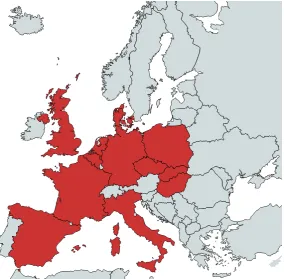
Figure 3. Countries covered ... 5
Figure 4. Example of a job tags repository from the Danish jobs site jobnet.dk... 5
Figure 5. Number of new occupation tags detected, excluding Belgium ... 11
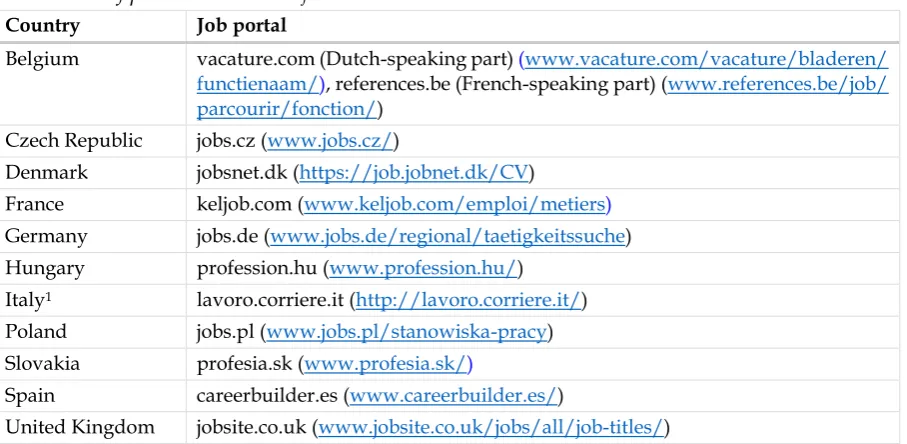
Table 1. List of pilot countries and job boards ... 6
Table 2. Benchmark and number of new tags identified per website ... 9
1
Occupations Observatory -
Methodological Note
Miroslav Beblavý, Mehtap Akgüc, Brian Fabo and
Karolien Lenaerts
CEPS Special Report No. 144 / August 2016
What is the Occupations Observatory and why do we introduce it?
For many years, technological progress and economic change have been associated with changes on the demand and supply sides of the labour market. As a result, new occupations have emerged while other occupations have become redundant and disappeared. Along with these new and emerging occupations, new skills have been introduced that can be developed through formal education, on-the-job training or learning-by-doing (or in some other way). Many policy-makers and researchers have therefore devoted attention to the rise of new occupations and skills and their implications for the economy as a whole, e.g. how does the education sector respond to these developments.
Nevertheless, the identification of new occupations and new skills is not a straightforward task. In fact, the identification of a new occupation often depends on an examination of whether it is already included in the latest occupational classification issued by the national government or an international institution, e.g. the UN’s ISCO classification. However, as these occupational classifications generally are not updated very regularly (in some cases, updates are done every 10 or even 20 years), one may wonder whether this approach is suitable. Other sources that are used are surveys, employer interviews, trade publications and job postings (see Crosby (2002) for more examples). Overall, the identification of new occupations seems to be based on data that are lagging behind real labour market dynamics. Nevertheless, having up-to-date information on new occupations is important for many economic agents. Educational institutes, for example, need current information on the occupations that are on the rise, in order to develop educational programmes of high quality and relevance.
We therefore propose the Occupations Observatory, with the objective of providing up-to-date information on what is happening in the labour market – reflected in the rise of new occupations and their corresponding skill changes – to policy-makers, researchers, educational institutes, job seekers and many other stakeholders (and how occupational dynamics feed into the occupational classification schemes). We do not only focus on new occupations that did not exist before but also on new occupations in terms of recognition, awareness and importance. As will be explained in more detail below, many occupations develop out of existing ones (as a result of specialisation, a recombination of existing occupations, and so on). To reach these objectives, we need recent data and a methodology that allows for quick and easy identification.
the growth of the Internet (European Commission & ECORYS, 2012). This is confirmed by Kuhn (2014) and Kuhn & Mansour (2014), who report that online tools are gaining importance in the matching process. Carnevale et al. (2014) find that labour market matching has become more efficient because search and matching frictions are reduced. The advantages and limitations of web data have been discussed in several recent contributions (for more information, we refer to Shapiro (2014) and Kureková et al. (2015), in addition to the papers listed above). In terms of online data sources, one can consider job portals, social network sites, Google Trends and other sources. We are especially interested in job portals, given their role in labour market matching.
As for the methodology, we experiment with a new identification method, which is explained in more detail in the following section of this note. In short, we propose to exploit the occupational classifications that job portals use to organise their job advertisements and explore whether new occupations can be identified on the basis of changes in these occupational structures.
The Occupations Observatory will comprise an overview of the new occupations that we can identify on the basis of this methodology and data from online job portals. More precisely, the Observatory will be supplied with occupation cards, one for each new occupation found, that provide details on the identification process, tasks and requirements of the occupation, prevalence of the occupation in other markets, link with occupational classifications and so on. The creation of these cards is explained in more depth below.
How do we identify new occupations on the basis of web data?
Vacancies or meta-data?
One way to assemble a dataset of new occupations is to use online job portals. Online job boards can be exploited for the identification of new occupations in several ways.
A first approach is to rely on the occupational classification that the job portals use to organise the tens of thousands of vacancies that they contain. Online job boards are typically structured in a way that allows job seekers to easily find positions similar to the one they are interested in. The reason for this is that job seekers are usually not looking for a single job opportunity, but instead want to find a range of opportunities to compare. In order to organise the high number of vacancies, job advertisements are typically assigned a variety of tags. These include, but are not limited to: the region where the job is offered, sector of employment, company name, required educational attainment, wage bracket, and so on. On some, but not all, job portals each vacancy is also assigned one or more occupation tags.
new occupations were added annually. About five of these new occupations appeared in the IT sector, while the remaining five were related to the commerce and finance sectors. This job board actually is an interesting example, as it shows the tags associated with specific vacancies (see Figure 2, which presents an example of a “real estate agent” vacancy offered through profesia.sk. The vacancy carries four occupation tags: “dealer”, “sales manager”, “sales representative” and “real estate broker”).
Figure 1. Example of autocomplete functionality from job board reed.co.uk. The offered job tags are relevant for the searched string “res“
Figure 2. Tags associated with a real estate agent vacancy on the profesia.sk website. Tags were translated automatically via Google Translate
Other job portals do not use a tag system but rather associate occupations purely on the basis of keywords that are used in the text, i.e. the job description, of the actual job advertisements. This approach, however, appears to be less reliable. For example, it could occur that a social worker position is offered to a job seeker looking for the keyword “finance”, because the word “finance” is mentioned in the job advertisement.
[image:5.595.124.473.222.412.2]A second approach for the identification of new occupations and new skills is based on the job advertisements posted on these online boards. Job advertisements generally are fairly detailed and have a clear structure. Vacancies commonly contain a job title, description (detailing the tasks and responsibilities), and structured requirements such as formal education, experience and skills (cognitive and non-cognitive). In many cases, other information is provided as well. For example, the salary, employer name and description, and offered benefits, e.g. company car or health insurance. Job advertisements can be assembled via a web crawling or ‘spidering’ technique (see Capiluppi & Baravalle, 2010; Kuhn & Shen, 2013; Carnevale et al., 2014). With a ‘spider’ or web bot that crawls the Internet, a large sample of advertisements can be obtained. In many cases, a set of carefully selected websites is crawled to ensure the representativeness and completeness of the dataset. This approach thus has the advantage of enabling researchers to gather a large and diverse sample of vacancies in a relatively fast and easy way. However, a clear limitation is that the next steps in the procedure, i.e. the data cleaning, processing, management, and so on, are relatively complicated. In their paper, Carnevale et al. (2014) explain that once the database of vacancies is assembled, data are extracted and parsed into smaller fragments which can be coded. The complexity of the parsing and coding are highly dependent on the structure and content of the job advertisement. A detailed taxonomy of variables and words is an extremely important tool in this process. Moreover, semantic analysis and text mining are often required to further support the coding process. Although making use of the actual job advertisements published on a portal could result in a very rich dataset, the issues indicated by Carnevale et al. (2014) are not so easy to address. Still, by gathering a sample of vacancies over a period of time and across countries, one can identify new job titles as they arise. Furthermore, the job description and requirements provide valuable information too, for instance on changes in the education and skill requirements, and on differences in the importance of skills across occupations, sectors and regions. Tijdens et al. (2012), however, do point out that linking job titles to an occupational structure is not straightforward, especially when they cover multiple countries and languages. There is some literature that uses vacancy data (obtained from vacancies published online or in newspapers) to study economic and social phenomena (see Kureková et al. (2015) for an overview of this literature; only a few studies focus on the identification of new occupations with vacancies). With these considerations in mind, we piloted an innovative approach based on the occupational classifications used in many online job boards, i.e. on the meta-data available on the job portals. Our objective is to discover whether this approach could be adopted to identify new occupations, and to further our understanding of the education, skills and other requirements that these new occupations bring with them. Compared to an approach based on a sample of advertisements obtained via web crawling, this approach has the advantage of being faster and simpler. It also results in smaller samples that are more manageable (in analytical work, database management, infrastructure) but that could nonetheless capture the same dynamics. Given the relatively small samples, results are available almost immediately and comparisons across countries and time are relatively straightforward.
Data collection and data cleaning
This resulted in the list of countries and portals presented in Figure 3 and Error! Reference source not found.. Given that this effort is a pilot, we did not try to gather a sample of tags from vacancy websites from all EU countries. Instead, we focused on exploring the feasibility of identifying new occupations across Europe. For that reason, we identified job boards in a subset of countries, covering different regions. The countries represent about 75% of the EU population.
Figure 3. Countries covered
Figure 4. Example of a job tags repository from the Danish jobs site jobnet.dk
Table 1. List of pilot countries and job boards
Country Job portal
Belgium vacature.com (Dutch-speaking part) (www.vacature.com/vacature/bladeren/ functienaam/), references.be (French-speaking part) (www.references.be/job/ parcourir/fonction/)
Czech Republic jobs.cz (www.jobs.cz/)
Denmark jobsnet.dk (https://job.jobnet.dk/CV)
France keljob.com (www.keljob.com/emploi/metiers)
Germany jobs.de (www.jobs.de/regional/taetigkeitssuche) Hungary profession.hu (www.profession.hu/)
Italy1 lavoro.corriere.it (http://lavoro.corriere.it/)
Poland jobs.pl (www.jobs.pl/stanowiska-pracy) Slovakia profesia.sk (www.profesia.sk/)
Spain careerbuilder.es (www.careerbuilder.es/)
United Kingdom jobsite.co.uk (www.jobsite.co.uk/jobs/all/job-titles/)
As a first step, on 30 June 2015, we extracted – either through querying the website’s autocomplete API or through web crawling the list of tags – the full occupational classification from the 11 online job portals (more precisely, we made a script to automatically extract the list of tags, which coincides with the list of occupations used by the portal). The occupational classification that we get is our benchmark. This occupational classification is further cleaned for errors such as faulty text encoding or duplicates. This is an important step, because not all tags are occupations, e.g. in some cases they can be keywords that refer to a specific sector, firm, etc. Nevertheless, as the cleaning process is fully automated some errors will not be caught. We are aware of this issue and therefore manually check the occupations that end up in the list. Because we focus on 11 countries, we decided to translate all occupational titles into English using Google Translate, as this facilitates cross-country comparisons and is easier for non-native speakers.
For example, for the case of Slovakia we obtained the list of tags from the job portal profesia.sk on the 30 June 2015. This list comprises 468 tags and constitutes our benchmark. The occupations or tags in the list were translated into English, to aid the non-native speakers in our research team. A visual inspection of the benchmark revealed that (i) not all occupations were translated into English properly, i.e. some words simply were not translated at all or their translations contained errors, thus these words/tags were translated by the native speaker of the team, and that (ii) all tags actually referred to occupations. No further cleaning was needed in that regard. For Slovakia, the list of tags simply is published online. We did not have to query the API or crawl the job portal to obtain the list of tags in this case.
The next step in the procedure then is to extract the occupational classification again from the portal at the beginning of every month (being early August, early September, and so on),
1 Note that for Italy, the portal provided a public list of tags, but this list did not show all jobs listed in
over a six month period.2 The classifications extracted at the beginning of each month are
organised in an array, which is compared with a benchmark array of occupations already present in the dataset: occupations that have no match in the benchmark classification are regarded as potentially new and saved in a database (by country and date). The remaining occupations, for which we do find a match, are dropped from the data, i.e. they are not included in the shortlist of potential new occupations. As for the benchmark, this process is automated and may not capture all errors that are present in the data. For this reason, we perform a manual data check at a later stage (for details, see below). Note that we are only concerned with potentially new occupations and not with occupations that disappear from the tag system. As before, the list of potentially new occupations is cleaned and translated into English. Some early results from the first two months of piloting reveal that for some countries no new occupations are found. This could be because no new occupations emerged during this time, because new occupations emerged but they were not picked up by the portal or because the job board is no longer active (this happened to the Dutch portal that we were experimenting with, so we removed the Netherlands from the pilot). With this procedure, we end up with two outputs: the benchmark and the list of new occupations on a specific date (by country). Before the data collection process is started again (in the next month), the list of new occupations is added to the benchmark. This prevents these occupations from being detected as ‘new’ on more than one occasion.
For the case of Slovakia, a new list of tags was obtained on 30 July (this step was done to test our code), 6 August, 2 September and 4 October (all in 2015). If new tags are found on any of these dates, this means that they are not yet included in our benchmark and hence potentially are new occupations. Alternatively, these tags may refer to occupations that have been around for a very long time but for which simply no vacancies were listed on the portal or for which no separate tag was used. Data collection on 30 July resulted in 21 new tags. These tags were translated into English and checked for whether they actually referred to new occupations. The list of tags was also checked for errors, but none were found. In the list of 21 tags, we find several that potentially refer to new occupations (examples are drug safety specialist, sound engineer, spa therapist, radio network planning specialist, development specialist health programmes, and development specialist switching network). We also find many tags for occupations that have been around for decades (such as soldier, wig-maker and police officer). Then, all 21 tags were added to the benchmark before new data were collected on 6 August, when three new tags were found (warder, forest engineer and photographer, of which especially the second could refer to a new occupation). The three new tags again were added to the benchmark and a new list of tags was extracted on 2 September. This again resulted in three new tags: geologist, revision pharmacist and specialist OSS/BSS. Particularly the last tag has the potential to be a new occupation. The data cleaning and processing were repeated and a new list of tags was obtained on 4 October. In this case, we identified three new tags: forester, forest technician and head of post. We used our list of candidates that potentially capture new occupations – such as spa therapist, drug safety specialist or OSS/BSS specialist in the above example – for a more in-depth analysis which is explained in further detail below.
As we are aware that Google Translate is unlikely to provide correct translations in all incidences, the translations are checked by native speakers and corrected when necessary. The importance of this step should not be underestimated. In fact, our first results suggest that there were some systematic errors in some of the translations. Moreover, several of the native
2 At the end of July, we ran a first test to see if our coding was operational. For some countries, this
speakers pointed out that occupations have their own terminology, which may not be fully captured in the translation process. These issues are not so problematic for individual country analyses, but could impede cross-country analyses. This is therefore definitely something to keep in mind for future research and it certainly is an area in which there is room for improvement in our work.
Data analysis
In the second part of the analysis, we continue by checking the list of potentially new occupations generated for each country. Not every occupation that appears on the list of candidates, is likely to be a new occupation. In fact, in some cases occupations that have already existed for many years and that are relatively common in the economy end up on the list because there were no vacancies available for this occupation when the benchmark was established (one could thus regard these occupations as missing from the benchmark). An example of this could be soldier, wig-maker or policeman (as the example for Slovakia shows), or, as the case of Belgium showed, the tag “furniture” (as touched on before, this results from the fact that not all tags refer to actual occupations, but most do). Occupations that obviously are not new but simply were missing are dropped from the shortlist of new occupations (our list of potential candidates), but they are still added to the benchmark for future reference. Furthermore, any mistakes that are due to the data collection or matching procedures are taken care of as well.
We then end up with a shortlist of potentially new occupations by country, for which a more in-depth study is done. The objective is to establish whether these occupations actually are new and, if so, whether they are new in the sector or in the full economy, in the country or globally, and so on. To this end, we create an occupation card for each potentially new occupation, which is then added to the Occupations Observatory. When an occupation is selected as a candidate, we refer to the job portal where the occupation was found. On the top of each occupational card, we mention the title of the occupation and the date.
Table 2 contains a quantitative indicator of our results. We see a very strong heterogeneity in the sample both in terms of the number (N) of detected initial tags, i.e. the benchmark, which ranges from 233 in Spain to 2,163 in Denmark, and the number of detected new occupations, ranging from zero in the Czech Republic, Germany, Denmark, Italy, the Netherlands and the United Kingdom to 714 in Belgium. Nonetheless, these numbers cannot be simply compared. Specifically, the Belgian portal often defines new occupation tags, which do not necessarily refer to actual occupations but rather are keywords to group vacancies according to some common trait. For example, one identified occupation tag is “hout” – the Dutch word for wood. On 9 March 2016, 42 job advertisements were assigned this task, covering different occupations such as “CNC machine operator in the wood processing industry” and “salesperson of wood products”. Consequently, we found that careful manual inspections of potential new occupation tags are crucial to preventing false positives.
Table 2. Benchmark and number of new tags identified per website
Country N of initial tags N of new tags Valid new tags False positives
Belgium 415 714
Czech Republic 424 0 0 0
Germany 1,507 0 0 0
Denmark 2,163 0 0 0
Spain 233 2 1 1
France 1,087 32 11 21
Hungary 369 91 11 80
Italy 962 0 0 0
Netherlands 812 0 0 0
Poland 795 15 7 8
Slovakia 468 30 16 14
United
Kingdom 6,063 0 0 0
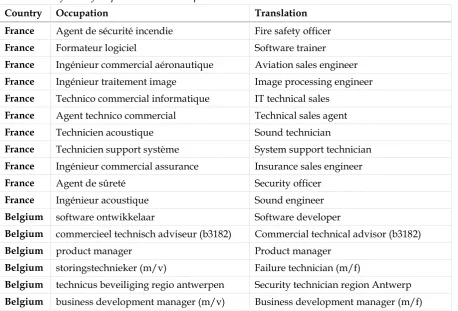
Table 3 presents the full list of identified potentially new occupations. Altogether, we identified 57 potential new occupations, but for six countries only: Belgium, France, Hungary, Poland, Slovakia and Spain.
Table 3. List of identified potential new occupations
Country Occupation Translation France Agent de sécurité incendie Fire safety officer
France Formateur logiciel Software trainer
France Ingénieur commercial aéronautique Aviation sales engineer
France Ingénieur traitement image Image processing engineer
France Technico commercial informatique IT technical sales
France Agent technico commercial Technical sales agent
France Technicien acoustique Sound technician
France Technicien support système System support technician
France Ingénieur commercial assurance Insurance sales engineer
France Agent de sûreté Security officer
France Ingénieur acoustique Sound engineer
Belgium software ontwikkelaar Software developer
Belgium commercieel technisch adviseur (b3182) Commercial technical advisor (b3182)
Belgium product manager Product manager
Belgium storingstechnieker (m/v) Failure technician (m/f)
Belgium technicus beveiliging regio antwerpen Security technician region Antwerp
[image:11.595.76.522.110.344.2] [image:11.595.72.531.420.731.2]Belgium customer technical support & quality
specialist
Customer technical support & quality specialist
Belgium chemical sales Chemical sales
Belgium technical designer Technical designer
Belgium Ultrasound Ultrasound
Belgium automation engineer - vaste job Automation engineer – fixed position
Belgium Embedded Embedded
Belgium software engineer Software engineer
Slovakia Choreograf Choreographer
Slovakia Ortopedický technik Orthopedic technician
Slovakia Zvukár Sound engineer
Slovakia Drug Safety Specialist Drug safety specialist
Slovakia Špecialista optimalizácie rádiovej siete Specialist radio network optimisation
Slovakia Špecialista vývoja programov zdravia Development specialist health programmes
Slovakia Špecialista plánovania rádiovej siete Radio network planning specialist
Slovakia Špecialista rozvoja spojovacej siete Development specialist switching network
Slovakia Klinický psychológ Clinical psychology
Slovakia Spa terapista Spa therapist
Slovakia Lesný inžinier Forest engineer
Slovakia Geológ Geologist
Slovakia Revízny farmaceut Revision pharmacist
Slovakia Špecialista OSS/BSS Specialist OSS/BSS
Slovakia Lesný technik Forest technician
Spain Refractory engineer Refractory engineer
Poland Animator Kultury Cultural animator
Poland Kierownik ds. Operacji Dokumentowych Manager. Documentary operations
Poland Inżynier ds. Testów Engineer. Testing
Poland Inżynier Biomedyczny Biomedical engineer
Poland Inżynier ds. Ciągłego Doskonalenia Engineer. Continuous improvement
Poland Inżynier Procesu Process engineer
Poland Opiekunka Środowiskowa Environmental supervisor
Poland Inżynier Biomedyczny Biomedical engineer
Hungary Nyomdász Typographer
Hungary Terméktervező Product designer
Hungary Gyógypedagógus Special education teacher
Hungary Telemarketinges Telemarketing
Hungary Gyártómérnök Manufacturing engineer
Hungary Dekoratőr Decorator
Hungary Webdesigner Web designer
Hungary szoftver tesztmérnök Software test engineer
Hungary data analyst Data analyst
Hungary Kertészmérnök Horticulturist
[image:13.595.71.466.275.486.2]Furthermore, these occupations were not distributed equally across the months. Figure 5 displays the number of tags detected over time in all countries, where new occupation tags were detected except for Belgium, which was left out due to a huge number of occupation tags detected every month. Most vacancies were detected in the first month. The reason is that the lists of tags often contain only those tags, which are currently used for at least one vacancy. Figure 5. Number of new occupation tags detected, excluding Belgium
Occupation cards
All this information is then used to produce an occupation card for each candidate. An occupation card has six main sections. Section A covers the identification of the occupation and consists of two parts that each have a dedicated table. The first table presents details on the job advertisement that is linked to the occupation/tag: when was the advertisement posted, on which portal/for which country, etc. The second table of Section A provides more information on the content of the vacancy. It includes the job description, profile and any tags that are attached to the vacancy on the job board. The goal of this section is to outline how we discovered the new occupation. This section is important, because the literature suggests that occupations have clear space and time dimensions. The rise of new occupations should thus be regarded within this context.
For example, for the case of Slovakia, Section A would mention that the tag for OSS/BSS specialist was found on profesia.sk on 2 September 2015. We would also go back to the advertisement that triggered the new tag and look at some of the information available in the vacancy (type of employer, industry). Section A would further provide details on the content of the vacancy (job description, profile, portal tags).
0 5 10 15 20 25 30 35 40
August September October November December January
Section B continues with the definition and the responsibilities and tasks of the occupation. It defines the occupation (what is it), relates it to existing occupations and evaluates its prevalence in the country where it was found. The section also discusses the tasks and responsibilities that the occupation entails. Importantly, the analysis in Section B is not only based on the original job advertisement; multiple job advertisements are also consulted (found via web search on other job boards covering the country). These vacancies only refer to the country for which the occupation was detected.
For example, for the case of Slovakia we would provide a definition of OSS/BSS (what is it – operations or business support system), explain whether this occupation is related to any existing occupations, and consider its prevalence in Slovakia (can we find similar vacancies on the same/other job portals or via a web search). Section B further comprises an overview of the tasks and responsibilities that an OSS/BSS specialist has, e.g. validate and write code, collaborate with other teams. Another example is the case of Belgium, for which we find an online marketing coordinator position, which is relatively new but strongly related to the more traditional marketing positions and connected with IT jobs as well.
Section C is based on the same sample of advertisements but looks at the requirements that are demanded. More specifically, it considers formal education, skills and experience. On the basis of these first three sections, we can already get an idea of the occupation and its novelty in the country where it was detected. These three sections can give some first answers to the questions of whether the occupation is completely new or emerging, new in a certain sector or in the economy as a whole, and so on.
For example, in Slovakia, an OSS/BSS specialist is expected to have certain skills such as a specific education level (tertiary education), previous experience with IT, JAVA, SQL, C++ and other programs, knowledge of telecommunications, communication skills, and so on. Many vacancies also list non-cognitive skills, such as detail-oriented, self-motivated, ambitious and other skills.
In Section D, the analysis is extended to other countries. First, we take the European perspective and try to find job advertisements for similar occupations on job portals in a variety of European countries. We also compare these vacancies in terms of tasks and requirements with those found in the country for which the analysis started. Second, we take a global perspective (concentrated mainly on the United States in this pilot, this is something we plan to expand in future work), for which the same analyses are performed. Finally, we use Google Trends to assess whether the term (occupation) is on the rise, and if so, in which countries.
For example, we would aim to discover whether the position of an OSS/BSS specialist is only new in Slovakia or also exists in other countries. For Belgium, on the basis of a search on Google and job portals, we find occupations similar to that of the online marketing coordinator in Europe and the US. We also consider whether the tasks and requirements are similar in these countries. For Belgium, we find that overall there are a lot of similarities in both areas. The Google Trends patterns across the countries are relatively similar as well.
international occupational classifications (ISCO and ESCO) and then continue with the national occupational classifications (for each of the countries discussed in Section D).
For example, for Belgium, we aimed to find the occupation of an online marketing coordinator in different occupational classifications. We could not find it in ISCO and ESCO, nor in the classification of many European countries. However, a similar occupation was found in the national classification of Italy, Poland and Germany, and the United States.
The last section of the occupational card, Section F, summarises our main conclusions. It aims to provide an answer to the questions whether the occupation is in fact new or emerging (does it have a future) and what its impact on training and skills will be. Again, this analysis is performed for the country where the occupation was found, the European level and the global level.
For Belgium, we conclude that online marketing coordinator is a new and emerging occupation that clearly has a bright future, and we illustrate the implications for the education sector and skill training (we find that universities and colleges should devote more attention to marketing online in their current marketing training programmes). We then extend this to other countries in Europe and the world.
Lessons from our pilot
Overall, our pilot is a successful proof-of-concept; it shows that it is feasible to identify potentially new occupations on the basis of the occupational structure or meta-data available on online job boards. Nonetheless, on the basis of the prototype, it does seem that monthly periodicity, as we had now, is too frequent, as the occupation tags are not updated so regularly. Better results could likely be obtained by crawling the websites in longer time intervals for a longer period of time. Additionally, we could scrape text from vacancies for occupations associated with the new tags to identify skills and tasks associated with them, i.e. to combine the two approaches. This can be achieved by applying standard machine learning and text mining techniques (Grus, 2015).
Other approaches to identify new occupations
The distinction between new, emerging and evolving occupations is also present in other studies (see Crosby (2002) for an overview). In some cases, these concepts are defined on the basis of the most recent occupational classification. In other cases, other measures are used. To identify new occupations, most papers rely on surveys, employer interviews, trade publications, job postings (and the corresponding job titles), in addition to the current occupational classification. Some examples are given below. The U.S. Bureau of Labor conducts a survey among employers to find new occupations. Employers are provided with a list of common occupations, and asked to add missing occupations to this list. Much attention is devoted to occupations that are absent but show high employment numbers, or that emerge because of technological progress. In addition, the U.S. Bureau of Labor also has a census, to which new job titles are added when detected in the coding process or at the request of experts. However, not all new job titles are added and not for every new title is a new occupation created in the census. In fact, job titles are organised into the existing occupations to a maximum extent possible. The Texas Career Development Resources office collects information via job postings, employer interviews, trade publications, among other sources. In their approach, traditional occupations included in the 1980 Standard Occupational Classification System (SOC) that have seen substantial changes in terms of knowledge or skills are labelled “evolving occupations”. “Emerging occupations”, on the other hand, are defined as occupations that are not identified in the 1980 SOC but are “new” (with new titles and new skill sets). The Minnesota Workforce Center also relies on employer surveys and on the 1980 SOC. It regards occupations as “new” when they are characterised by work activities, skills and knowledge that are so new that they cannot be classified under the existing system. Evolving occupations, on the other hand, are existing occupations with rapidly changing skill sets, requiring new knowledge. The Department of Labor of the State of New York regularly issues a newsletter in which new and emerging occupations are discussed.3 Recent examples
of such occupations are bioinformatics technicians, energy brokers, and digital forensics investigators and analysts. Other related work covers occupational and skill change in the past and is mainly based on case studies (see for example Chin, Juhn & Thompson (2006), who discuss the introduction of steam power in the merchant marine industry and the rise of the occupation of engineer). More recent studies have centred on skill-based technological change and job polarisation and a range of other potential explanations for why new occupations emerge. Few studies, however, really seem to tackle the question of what a new occupation is and how it can be identified.
Another interesting idea that has been put forward by Kea Tijdens and her research team is to identify new occupations using the WageIndicator online survey. In the WageIndicator survey, respondents are asked to enter their occupation. They can select their occupation from a list or find it via a search tree (respondents can start entering their occupation in a search box, the search term is then autocompleted). These occupations are linked to the most recent ISCO classification (at a fairly detailed level). However, when respondents are unable to find their occupation, they can indicate this and are asked to enter their occupation in a separate text box. The occupations that are not yet included in the databases used by WageIndicator potentially are new occupations and are interesting candidates for further investigation. In summary, new occupations develop out of existing occupations, or combinations thereof (at least to some extent), and their identification is largely dependent on the introduction of new tasks (with a matching skill set) and the most recent occupational classification. However,
even with an up-to-date list of occupations it remains difficult to predict which and how fast occupations will grow. Moreover, to identify a “new” occupation, one needs to have a benchmark to weigh it against, i.e. to understand what “new” really means. This raises the question whether the most recent occupational classification (from ISCO, ESCO or other institutions) actually is the most suitable benchmark.
The academic debate on new jobs and new skills has a policy counterpart, composed of many contributions from international organisations, the European Commission and national policy-makers. Overall, the focus of this work seems to be more on the skill dimension. For instance, the European Commission has done a lot of work on skill matching (to labour market needs) and skill upgrading (which is based on a careful assessment and anticipation of skill needs of employers and workers). The OECD’s strategy is based on three pillars: developing relevant skills, activating the skills supply and putting skills to effective use. The ILO focuses on qualitative education, a smooth transition from school to work, skill matching, life-long learning, the anticipation of the skills of the future, among other things. Starting from a global perspective, UNESCO proposes a 10-step approach towards a better future for young people, while the World Bank developed a STEP approach that consists of five interlinked steps. Many programmes of these international organisations also emphasise the importance of labour mobility, e.g. ERASMUS+. National policy-makers have stressed the role of skills in the new occupations debate as well.
Some examples of our occupation cards
Online Marketing Coordinator
Date: 30 September 2015
A.
Identification
The identification of new occupations, such as the Online Marketing Coordinator presented in the current document, is based on an innovative methodology that we are piloting here. This methodology is embedded in the rapidly growing strand of the literature that relies on web-based data sources to conduct labour market research (see Askitas & Zimmermann, 2015). The main idea behind our methodology is to identify new occupations via the occupational classification that online job portals use to guide job seekers on their website. Typically, such occupational classifications have – at their core – a tag system, i.e. a list of tags, that is used to assign vacancies to specific job categories. This list of tags can be published online or stored in a library accessed by an API search when a job seeker enters a word in the search box. Earlier research suggests that job portals tend to regularly update their list of tags to account for the emergence of new occupations and the disappearance of redundant ones.
In our pilot study, we focus on 11 countries for which we keep track of one of their main online job portals. For these countries, we created a benchmark, which is composed of their occupational classification (their list of tags) on 30 June 2015. Our goal is to determine whether this tag system could also be used to identify new occupations, by comparing the benchmark classification with the current occupational classification of the portal at regularly intervals, i.e. every month. The tags that are not yet included in the benchmark, i.e. missing from the list of tags when the benchmark and the new list of tags are compared, could point to new or emerging occupations. For more details on our methodology, we refer to the Methodological Note that is available on the website in the New Occupations Observatory.
In the beginning of August 2015, a new tag was added to the Belgian online job board in our pilot. This tag was picked up (either via the API or via a web crawling technique that extracts the list of tags – this depends on the portal) and stored in a database. We then searched for an actual vacancy for an online marketing coordinator on this portal (to discover what triggered the new tag). More details on this tag/vacancy can be found below; these details cover (i) the portal to which the tag was added and on which the vacancy was found, and (ii) the content of the sample vacancy that we study in more depth (to identify tasks and responsibilities – skills and other requirements).
Details on the tag and the job advertisement
When did the tag/vacancy appear online? July 2015
On which online job board was the tag/vacancy
published? vacature.com
Which country is covered by this job portal? Belgium (Flanders)
Sample job advertisement
Job description(responsibilities and tasks of the job)
responsible for (co-)planning, implementation, monitoring and online publication of online digital marketing communication
responsible for various online tools such as websites, e-mail, apps and social pages
detect the needs of sales force, come up with inspiring new ideas, present company’s message in a simple and attractive way
work smoothly together with colleagues and external partners
report to the senior marketing coordinator Job profile
(education, skills and other
requirements for the job)
at least a bachelor’s/master’s degree or equivalent by experience
digital native bitten by the online microbe; always following the latest trends
can use CMS systems and WordPress, understands the basics of HTML and has good knowledge of SEO, SEA, Google Analytics
has good writing skills (NL/EN) and communicates fluently
stress-resistant, result-oriented, enjoys working on many projects at once
Job portal tags (tags attached to the vacancy on the job board)
function group: web application developer, e- & database marketing
function: online marketing coordinator; marketing; online marketing; e-marketing; emarketing; marketer; emarketeer; digital marketing; digital marketer; online marketer; social media; social
sector: general industry
employment type: fixed position, working time 36-40 hours per week
education level: Professional Bachelor
experience: 1-2 years of experience
B.
Definition, responsibilities and tasks
1.
Definition
What is “Online Marketing”?
Some examples of related job titles: “online marketing experts/assistants”, “online marketers”, “e-marketing specialist”, “online marketing and sales support”
More information on the occupation can be found on the Wikipedia pages:
covering online advertising (https://en.wikipedia.org/wiki/Online_advertising)
covering digital marketing (https://en.wikipedia.org/wiki/Digital_marketing)
Is this position related to any existing occupations?
At first sight, the position of an online marketing coordinator appears to combine some of the tasks and responsibilities of other marketing, advertising, sales or communication occupations and those of occupations in the field of information and communication technologies.
Note that the concept of online marketing is closely related to that of digital marketing. Digital marketing is the “targeted, measureable and interactive marketing of products or services using digital technologies to reach and convert leads into customers. Its objective is to promote brands, build preference and increase sales through various digital marketing techniques, mainly using the Internet as a core promotional medium.” The term emerged in the 1990s, but the concept only started to grow in 2000-10. Digital marketing includes, but is not limited to, mail direct marketing, social media marketing, search engine optimisation or marketing, e-commerce marketing, content marketing/automation, influencer marketing, and mobile marketing. Online and digital marketing seem to overlap to some extent.
How prevalent is the occupation of an Online Marketing Coordinator in Belgium?
We looked for similar occupations on several job portals and did a Google search. Results of this exercise:
Job portals
vacature.com: offers 11 vacancies for “online marketing” and nine for “digital marketing”
jobat.be: offers about 30 job ads for “online marketing” and “digital marketing”
bloovi.be: offers about 35 related job advertisements
monster.be: offers about 16 job advertisements for “online marketer”
creativeskills.be: about five job advertisements published during the summer
careerjet.be: about 67 job advertisements for “digital marketing” Google Search (limited to .be websites):
“online marketing vacature”: about 110,000 results
“online marketing job”: about 165,000 results
“internet marketing vacature”: about 63,700 results
“internet marketing job”: about 189,000 results
“digital marketing vacature”: about 23,300 results
2.
What are the responsibilities and tasks of an online marketing
coordinator?
This information is obtained from a sample of job vacancies, extracted from job portals (for Belgium)
responsibilities and tasks are generally closely related to those of other marketing occupations, i.e. other marketing, advertising, sales or communication occupations, such as initiation and implementation of offline and online campaigns and initiatives, but there is a lot more emphasis on the “online” dimension here
some vacancies focus on “online marketing” and only include tasks and responsibilities related to marketing; other vacancies are looking for a broader profile and list tasks and responsibilities that are related to offline marketing, sales, web design, and other tasks
development of an online marketing, advertising and sales strategy, which involves online branding, marketing activities and campaigns, generate traffic to websites, sending out newsletters
implementation of applications (mobile, SMS), attract new followers, generate traffic to applications
development of a social media strategy, which involves online branding, advertising activities, attracting new followers, organic search optimisation (via creating content, communication strategy), running a blog
C.
Education, skills and other requirements
This information is obtained from a sample of job vacancies, extracted from job portals (for Belgium)
Formal education required
Is formal education required? Yes
Level of education tertiary education: bachelor’s or master’s degree
Field of education some vacancies require training in marketing, new media communications; other vacancies do not specify a field of education
Skills required
Communication skills writing and communication skills, language skills (e.g. Dutch, French, English, German), copywriting
Computer skills SEM, SEO, SEA, HTML, MS Office, Google Analytics, social media, web design, Web2.0, Photoshop, Dreamweaver, InDesign
Occupation-specific skills understanding online marketing (content, campaigns), knowledge of online customer behaviour, planning, conception and optimisation of campaigns, e-marketing techniques, communication strategy, interest in what is happening online
Experience required
Is experience required? this depends on the level of the position in the firm (executive, assistant, ...): e.g. 1-2 years, 3-5 years, 5+ years
Is job-related experience required? yes, in some vacancies:
- experience in online marketing activities and campaigns, sales-driven organisations, e-commerce - experience in the sector, e.g. tourism
D.
Geographical prevalence
1.
A European perspective
Results from job portals and Google search for countries in different parts of Europe: Some of the job portals consulted: Indeed, Monster, Stepstone…
Similar vacancies in
Western Europe
France Chargé de mission commercial et marketing, Un Chargé de Marketing Digital, Responsable Web-Marketing, E-marketeur
Germany Onlinemarketing-Manager/in, Mitarbeiter (m/w) im Onlinemarketing (SEA) für den Webshop, Junior Marketing Manager im Online-Bereich, Trainee Kreation Onlinemarketing (m/w, Vollzeit, E-Commerce)
The Netherlands Online Marketeer, Marketing Assistant, Digital Marketing & e-Commerce Consultant, Marketeer/SEO specialist
UK Digital Marketing Manager, Digital Marketing Analyst, Online Marketing Executive, Web and Digital Marketing Apprentice, Online Marketing Coordinator
Do these vacancies involve similar tasks and have similar requirements as the
Tasks/Responsibilities: developing and implementing a marketing or sales strategy, branding, web design, online
vacancies for
Belgium? YES and reports, keeping up-to-date with technological advancements, proofreading, target group identification, budget planning, graphic design
Requirements:
- bachelor’s degree, previous experience in similar roles
- knowledge of digital marketing, SEO, SEM, HTML, CSS, PHP, Adobe Photoshop or Illustrator, OM tools (Google Analytics, Adwords certificates required, Facebook), reporting results, able to develop a strategy, community management, written, verbal communication and presentation skills, English and other languages, data analysis, affinity with Internet/technology/IT - independent, dynamic, responsible, interested in the field, timeliness, creativity, enthusiastic, open-minded, focused, well-organised, commercial awareness, eager to learn, goal-oriented
Similar vacancies in
Southern Europe
Italy Responsabile Marketing e Web Marketing, Web Marketing Specialist, Online marketing manager, Impiegato web marketing, Addetto web marketing, Web Marketing Assistant
Spain Especialista en Marketing Digital / E-commerce, Digital Marketing & SEM Executive, e-Commerce Marketing Manager, Responsable de Marketing Digital, Digital Marketing & Communication Support Do these vacancies
involve similar tasks and have similar requirements as the vacancies for Belgium? YES
Tasks/Responsibilities: development and execution of marketing strategies, creation of advertising campaigns, branding, e-mail marketing, management of and content creation for website, social media, newsletters, creation of all business graphics and materials (also offline), attract traffic to platforms, data analysis and
reporting, copywriting, coordinate communication/sales strategy, Requirements:
- bachelor’s degree, experience in related field or position - knowledge of marketing, social media, database management and CRM, marketing tools, analytical skills, computer skills (including programming, SEO/SEM, PHP, HTML, Facebook, MS Office, Adobe Photoshop or Illustrator, GIMP, Adwords,
Retargeting, Premiere, Dreamweaver, Google Analytics), language skills, written and verbal communication skills, project
management, a driving license is needed
Similar vacancies in
Northern Europe
Denmark Online marketingspecialist, Social Media Marketing Manager, Online marketingkonsulent, Web og marketingkoordinator
Sweden Online Marketing Coordinator Global Media, Online marketing manager, Juniorkonsult Digital Markadsföring, Digital Marketing Specialist
Do these vacancies involve similar tasks and have similar requirements as the vacancies for Belgium? YES
Tasks/Responsibilities: development and implementation of online marketing strategy, e-mail marketing, branding, report preparation, data analysis, management and optimisation of campaigns, budget planning, set up a digital marketing toolbox, launch new campaigns via social media, monitoring, measurement and analysis of marketing plans
Requirements:
- tertiary education in a related field (bachelor’s, master’s), experience in a related position, field or company
- knowledge of online marketing, market analysis, web experience, experience with SEO, InDesign, Illustrator, Adobe Photoshop, Salesforce, Hubspot, Google Adwords, DoubleClick, social media (Facebook, LinkedIn, YouTube), a good understanding of online marketing and the web, web design skills, language skills, written and verbal communication skills
- committed, passionate, creativity, independent, responsible, team-working skills, interested, proactive, ambitious, well-organised, adaptable, analytical mindset
Similar vacancies in
Central and Eastern
Europe
Czech Republic E-Commerce Marketing Manager, Online Marketing Expert, Online marketing specialist, Online marketing manager
Hungary Online Marketing munkatárs, Értékesítési/Marketing asszisztens, Online marketing specialist, Online marketing manager, Online marketing és kommunikációs specialista
Poland Online Marketing Manager, Specjalista ds. marketingu online, E-Commerce Marketing Manager - branża sportowa
Do these vacancies involve similar tasks and have similar requirements as the
vacancies for
Belgium? YES strategies, newsletter, content creation, branding, web design, search engine marketing Requirements:
- high school education, vocational training, graduate professional degree, university degree, experience in similar role, firm, sector - knowledge of digital marketing, reporting, copywriting skills, MS Office, SEO/SEM, internet analytics and tools (Google Adwords, Display Ads, Mixpanel, Colibri, Crazy Egg, Brand24, Facebook-Ads), Photoshop, PPC, language skills, written and verbal communication skills, graphic skills, data analysis and reporting skills, market knowledge
- customer-oriented, creative, loyal, independent, proactive, team player, positive, self-motivated, passion for marketing, flexibility
2.
A global perspective
Results from job portals and Google search for countries in different parts of the world: we focus mainly on the United States, for which we find vacancies for Online Marketing Specialist, Online Marketing Consultant, Integrated Digital Marketing Manager, Web Marketing Manager. Some of the job portals consulted: Indeed, Monster, Stepstone…
Do these vacancies involve similar tasks and have similar requirements as the vacancies for Belgium? YES
Tasks/Responsibilities: are relatively similar to those for Belgium. Again, tasks commonly involve marketing (e.g. e-commerce, implementation of campaigns and strategies, promotions, content creation for websites, social media, e-mail marketing, paid advertising, branding, budget planning), sales and communications. In addition, some vacancies also refer to web design, copywriting and editing, as was the case for Belgium. Other tasks involve data analysis and database management, reporting on performance indicators, search for new technologies to use in daily tasks, continuous training and participation in workshops, conferences and industry events. These tasks seem to appear less in the Belgian vacancies (either not needed for position or assumed implicitly).
3.
A Google Trends Analysis
An analysis on the basis of Google Trends reveals the following patterns (see graphs, global): especially “digital marketing” is on the rise, Internet marketing has declined over time and online marketing has been popular during the last five years (with a peak in 2013). These findings indicate that the Internet has become so widespread that the term and concept are relatively common nowadays. Nevertheless, the interest in occupations related to web-based marketing appears to grow. These patterns are found in Belgium, many European countries (France, Germany, the Netherlands, the UK, Italy, Finland, Sweden, Hungary, and Poland, among others) and the United States. Some differences are detected for online marketing (after the peak in 2013, the interest appears to remain somewhat higher in Denmark and Romania, and there is a slight upward trend for Spain) and internet marketing (high peaks and then a drop to nearly zero for Poland and Sweden).
Google Trends: online marketing worldwide (30/09/2015)
Google Trends: digital marketing worldwide (30/09/2015)
E.
Occupational classification
1.
International classifications
ISCO 08: the term “online” does not appear in combination with “marketing”; nor do “digital” and “internet”; the term “internet” does appear in combination with “salesperson” (occupation 5244: service & sales workers => sales workers => other sales workers => contact centre sales persons).
Where could this occupation fit in the ISCO08 classification?
1221 “Sales and marketing managers”
1222 “Advertising and public relations managers”
2431 “Advertising and marketing professionals”
ESCO: it does not appear to exist at this point (‘marketing’ does exist) Where could this occupation fit in the ESCO classification?
579 “Advertising and marketing professionals”
563 “Sales, marketing and development managers”
361 “Other sales workers”
2.
National classifications
Belgium: based on ISCO (from 2011 onwards) In Europe:
France: PCS and PCS-ESE, but occupation is not included there (different translations were checked; it might be due to the fact that the last update was in 2003).
Germany: Klassifikation der Berufe (KB) (most recent version is 2010), occupation is included: 92113 Komplexe Spezialistentätigkeiten (includes Online-Marketingmanager/in) as part of the category Werbung, Marketing, kaufmännische und redaktionelle Medienberufe.
UK: SOC (most recent version is 2010), but occupation is not included there.
Italy: has the Classificazione delle professioni (CP, most recent version 2011, an update of CP2001 and adapted to ISCO08), in this classification there is an occupation named tecnici del marketing (code 3.3.3.5.0, in which an example job title is tecnico del web marketing), that is part of the professioni tecniche nell’organizzazione, amministrazione e nelle attività finanziarie e commerciali / tecnici dei rapporti con i mercati / tecnici del marketing.
Spain: has the Clasificación Nacional de Ocupaciones 2011 (CNO-11), includes marketing professionals (Profesionales de la publicidad y la comercialización) but it is not clear whether this covers online marketing professionals.
Denmark: DISCO, Danish national classification based on ISCO, most recent version is DISCO 2008, not found.
Sweden: has the Standard för svensk yrkesklassificering (SSYK) (most recent version is SSYK2012), based on ISCO08. Includes many marketing professions, but it does not seem to include online or web marketing.
Czech Republic: Klasifikace zaměstnání (CZ-ISCO), based on ISCO08. Few marketing occupations, few web-related professions (not found in the list).
Hungary: has HCSO/FEOR (edition 2008), but this does not include the occupation.
Poland: has the Klasyfikacja zawodów i specjalności (KZiS 2014), based on ISCO08 (but it is updated more recently, 2014). In an alphabetical list, a similar occupation was found: 122104 Kierownik do spraw marketingu internetowego (Director of Marketing online). This is likely the result of the recent update.
In the rest of the world (US):
US has SOC (last version is 2010), occupation is included: 11-2021 Marketing Managers lists “Internet Marketing Managers” as an example job title (part of 11-2000 Advertising, Marketing, Promotions, Public Relations, and Sales Managers).
US also has the O*NET classification: the occupation exists as part of “Online
Merchants” (13-1199.06 – Online Merchants www.onetonline.org/link/summary/13-1199.06).
This occupation is labelled as a “Bright Outlook” occupation (in the category “new and emerging”), i.e. occupations expected to grow rapidly in the next several years, will have large numbers of job openings, or are new and emerging occupations.
O*NET summary of online merchants: Conduct retail activities of businesses operating exclusively online; may perform duties such as preparing business strategies, buying merchandise, managing inventory, implementing marketing activities, fulfilling and shipping online orders, and balancing financial records. Examples of job titles: Marketing Director; Marketing Specialist; Online Marketing Manager; Online Services Manager; Social Media Director.
www.onetonline.org/link/summary/15-1199.10 Marketing Managers
www.onetonline.org/link/summary/11-2021.00 Market Research Analysts and Marketing Specialists www.onetonline.org/link/summary/13-1161.00
F.
Conclusions
Is Online Marketing
Coordinator a new or
emerging occupation?
In Belgium? Given its limited prevalence and the relative novelty of some of the tools and technologies that the worker has to use, the occupation is relatively new and emerging in Belgium. The tasks and duties that are involved in the job are highly specialised, but there still is a clear link with other existing jobs (among others, in marketing, sales, communication). The occupation seems to combine different aspects of these jobs (marketing, social media, IT). Its importance is likely to grow in the future, as the Internet is increasingly used in everyday life. In some industries and firms, the occupation is likely to be completely new, while in other industries and companies, it is emerging. Interestingly, one of the vacancies mentioned that the position is new within the organisation. Does this occupation have a future? Undoubtedly yes.
with technological changes and changes in the market. Similarly, for the workers that hold a marketing position, it could be interesting to engage in life-long-learning and to keep up to date with current developments (to keep their job or transfer to other positions).
In Europe? A similar conclusion is reached for Europe. In many countries, the classification is not present in the most recent national occupational classification. In some countries, i.e. Germany, Italy and Poland, the occupation is part of the most recent national occupational classification (there it could be regarded as emerging rather than new). There are a lot of vacancies for similar positions across Europe, especially in the west, north and south, less so in the east.
Given that the tasks and responsibilities and the requirements are comparable in other European countries, the conclusions formulated above apply here. Education should focus on new technologies, communication skills and data analysis.
Companies can benefit from providing on-the-job training to their staff, to keep up with recent developments. Marketing professionals should be aware of these developments and engage in training activities too.