Rochester Institute of Technology
RIT Scholar Works
Theses
Thesis/Dissertation Collections
2007
A Comparison of Three Well Known Behavior
Based Safety Programs: DuPont STOP Program,
Safety Performance Solutions and Behavioral
Science Technology
Herbert Byrd
Follow this and additional works at:
http://scholarworks.rit.edu/theses
This Thesis is brought to you for free and open access by the Thesis/Dissertation Collections at RIT Scholar Works. It has been accepted for inclusion
in Theses by an authorized administrator of RIT Scholar Works. For more information, please contact
.
Recommended Citation
Rochester Institute of Technology
Graduate Project: A Comparison of Three Well Known Behavior Based Safety
Programs:
DuPont STOP Program,
Safety Performance Solutions
and
Behavioral Science Technology
Herbert Byrd
September
17, 2007
Graduate Project submitted in partial fulfillment of the requirements for the degree
of Master of Science in Environmental, Health
&
Safety Management
Department of Civil Engineering Technology,
Environmental Management
&
Safety
Rochester Institute of Technology
Rochester,
NY
Approved
By:
Joseph M. Rosenbeck, Associate Professor, Project Advisor
Project Permissions Page
Print Reproduction Permission Denied
I,
Herbert
L.
Byrd Jr.
,hereby deny permission to the Wallace Library of the
Rochester Institute of Technology to reproduce my print thesis or dissertation in whole or
in part.
Signature of Author:
ACKNOWLEDGEMENTS
The
evolution and completionofthis
graduate project was a major milestonein
my
development
as asafety
professional.I
wasdoubtful
from
the
beginning
that
I
wouldbe
ableto
complete such adaunting
task:
however,
asI
reflect onthis experience,
I
realize
that,
the
maturation ofmy
graduateproject was not adifficult
task.
My
procrastination was
the
problem.I
enjoyedresearching
the
Behavior
Based
Safety
process.
I
will usethe
knowledge
gainedfor
many
yearsto
come.There
weremany
family
membersandfriends
that
kept
mefocused
and motivatedthrough
my
journey.
For
them,
I
amvery
grateful.My
wifeChrystal
wasmy biggest
supporter, and,
for that,
I
thank you,
and alwaysknow
that
I
love
you.I
would alsolike
to
thank
my
mom,
for
she played akey
rolein
my
selection ofEnvironmental Health
&
Safety
a career.I
wouldlike
to
thank
Professor
Rosenbeck,
my
advisor,
for
his
patience,
knowledge,
and well needed advicethroughout
this
project.I
would alsolike
to thank
the
representativesfrom
Safety
Performance
Solutions, DuPont,
andBehavioral Science
Table
ofContents
Permission
Page
Page ii
Acknowledgements
Page
iii
List
ofFigures
Page
viList
ofCharts
Page
viiAbstract
Page
ix
Chapter 1
:Introduction
1
.1 The
Topic Statement
1.2
Significance
ofthe
Topic
1
.3Reason
for
Interest
in
the
Topic
1
.4Definition
ofTerminology
Page 1
Page 1
Page 1
Page 2
Page
2
Chapter 2:
Background
Page 5
Chapter 3
:Literature Review
Page
6
3
.1 The
History
ofBehavior Based
Safety
Page 6
3.2 The
Popularity
ofBehavior Based
Safety
Programs
Page
8
3
.3The ABC
ofSafety
Improvement
Page 9
3
.4Key
Elements
to
aBBS Program
Page 1 0
3.5 Steps
in
Creating
aBBS Program
Page 12
3.6 The Outcomes
from
aWell-planned
andImplemented
BBS Program
Page 15
3.7 What BBS is Not
Page 17
3.8 Implementation Problems
withBBS
Page 1 8
3.9 DuPont STOP Program
Page 1
9
3.10
Safety
Performance Solutions
Page 20
3.11 Behavior
Safety
Technology
Page 22
3.12 Advantages
Page 23
3.13 Disadvantages
Page 24
3.14 Measurements
Page 26
3.15
Additional Information
Page
32
3.16
Tracking
Page 38
3
.1 7 BBS
andUnions
Page 47
3.18 Current
Trends/Issues
Page 49
3.19 Conclusion
Page 5 1
Chapter
4:
Methodology
Page 53
5.1
Program Comparison
Page
55
Chapter 6: Analysis &
Discussion
Page
58
Chapter 7:
Conclusions
Page
65
7.1
Opportunities
for
Future Research
Page
66
List
ofFigures
Figure-
1
ABC Model
(Myers,
www.qualitysafetyedge.com)
Page
9
Figure-2
Typical Steps in
Creating
the
Observation Process
(McSween, 1993)
Page 14
Figure-3
Cooper highlights
that
behavioral safety
is
NOT
(Cooper)
Page
1 7
Figure-4
SPS
Client
Improvements
(www.safetyperformancesolutions.com)
Page 22
List
ofCharts
Chart
Page
Chart-
1
Percent Implementation
(www.behavioral-safety.com)
33
Chart-2
2001
BBS Implementation
by Industry
(www.behavioral-safety.com)
34
Chart-3
Implementation
by Industry
(www.behavioral-safety.com)
34
Chart-4
Number
ofEmployees
by
Site
(www.behavioral-safety.com)
35
Chart-5
Number
ofYears
BBS
Has
Been Implemented
(www.behavioral-safety.com)
36
Chart-6
Site Implementation
(www.behavioral-safety.com)
37
Chart-7
Observations
perWeek
(www.behavioral-safety.com)
37
Chart-8
Observation Type
(www.behavioral-safety.com)
38
Chart-9
Tracking
System Implemented
(www.behavioral-safety.com)
39
Chart-
10
Is
Tracking
System Effective
(www.behavioral-safety.com)
40
Chart-
1 1
Have Accidents Reduced
(www.behavioral-safety.com)
40
Chart-
12
Incident Rate Improvement
(www.behavioral-safety.com)
40
Chart-
13
Employee Participation
(www.safetyperformancesolution.com)
41
Chart-
1 4
Average Recordable
Injury
Rate Reduction
For SPS Clients
Following
BBS Implementation
(www.behavioral-safety.com)
42
Chart-
1 5
Average Recordable
Inj
ury Rate Reduction
for
SPS Clients: Pre BBS Rate
of3.0
andBelow
(www.behavioral-safety.com)
43
Chart-
1
6
Average Recordable
Injury
Rate Reduction
for
SPS Clients: 3.1
to
10
(www.behavioral-safety.com)
43
SPS Clients:
10.1
orHigher
(www.behavioral-safety.com)
43
Chart-
1 8
Sample
Results
Comparing
Observation
vs.Recordable Rate
(www.behavioral-safety.com)
44
Chart-
1
9
Observation
and
Feedback Is Not Enough
(www.behavioral-safety.com)
44
Chart-20
BST Client Results
(www.bstsolutions.com)
45
Chart-2
1
BST
Baseline/Intervention
(www.bstsolutions.com)
46
Chart-22
DuPont
STOP Client
Results
(www.DuPont.com)
47
Chart-23
As
Expected,
asthe
Number
ofObservations
Increased,
Abstract
Behavior Based
Safety (BBS)
has become
animportant
partofthe
safety
management system.
More
companies areimplementing
BBS
to
help
improve
the
safety
performance
oftheir
companies.With many
consultant companiesclaiming
their
BBS
programs will provide
the
best
results,
it is difficult
to
determine
whichBBS
programis
right
for
yourcompany.
This
projectwillcompareandcontrastthree
well-known
BBS
programs.
The
three
programs areSafety
Performance
Solution,
DuPont
Stop,
andBehavior
Safety
Technology.
Among
the
areasthat
willbe
coveredin
this
project are:1)
The
stepsin
developing
andimplementing
aBBS
program,
2)
How
the
BBS
programsare alikeand
how
they
aredifferent,
and3)
The
expectedresultsfrom
using
aBBS
program.
I
hope
that
the
information
providedin
this
project willbe
a usefultool
in
Chapter
1:
Introduction
1.1
The Topic
Statement
The
objectives
ofthis
projectareto
(1)
identify
all ofthe
processesthat
are commonbetween
the
BBS
programs,
(2)
identify
allthe
processesthat
aredifferent between
the
BBS
programs,
(3)
determine if
the
BBS
programsimproved
the
safety
performancein
the
companies
that
implemented
the process,
and(4)
determine
whichBBS
programsproduced
the
highest
rateofimprovement
in safety
performance.DuPont'
s
STOP
program,
Behavior
Safety Technology
(BST),
andSafety
Performance Solutions
(SPS)
are
the three
uniqueBBS
programsthat
were reviewed.The
methodsusedin
this
study
included
(1)
researching
andanalyzing
literature
found
onthe
World Wide
Web,
(2)
a phoneinterview
with representativesfrom
DuPont,
Safety
Performance
Solutions,
andBehavior Science
Technology,
(3)
case studies ofcompanies
that
have
implemented
one ofthe three
BBS
programs.Once
all ofthe
information
wasgathered andreviewed,
a chart matrix wasdeveloped
comparing
andcontrasting
the
BBS
programs.1.2 Significance
ofthe
Topic
This
topic
is
significantbecause it
highlighted
whatthe
BBS
programshave in
commonand
thus
provides us withthe
necessary
componentsof aBBS
program.It
alsodelineates
the
unique components ofthe three
BBS
programs.In
the
past,
companieshave
tried
to
improve
their
safety
performanceby
focusing
onchanging
the
workenvironment
for
their
employees.Companies
have
seengreat successin
their
safety
performances
by
providing hazard-free
workenvironmentsandergonomically-friendly
(Johnson,
6).
Injuries
continueto
occurfor
primarily
two
reasons:1)
Human
errors,
people make
mistakes
and2)
At-risk
behaviors
are encouragedin
the
workplace(Cambridge
Center for Behavior Studies
1).
1.3
Reason for Interest
in
the
Topic
BBS
is
the
latest
trend
in
the
Environmental Health
&
Safety (EH&S) field,
andthere
are a
variety
of programs available.This
project comparesandcontraststhree
BBS
programs.
This
project pinpoints and outlinesthe
steps requiredin
developing
andimplementing
aBBS
program.Initial
researchhas
shownthat there
is
certainly
aneedto
clarify
whatis
requiredin
developing
andimplementing
aBBS
program.1.4 Definition
ofTerminology
ABC Model
-A
diagram
that
showshow behavior
modificationis
influenced
by
two
environmental contingencies:antecedents andconsequences
(Myers,
www.qualitysafetyedge.com).
Activators
-A
stimulusthat
initiates behaviors
(Myers,
www.qualitysafetyedge.com).Antecedent
-A
stimulus
(i.e.
a verbalcue, activity,
event orperson)
that
immediately
precedesa
behavior. This
stimulusmay
ormay
not serve asdiscriminative
for
aspecificbehavior;
the
stimulusthat
immediately
precedes a problembehavior
(Myers,
www.qualitysafetyedge.com).
At-Risk Behavior
-Actions
that
couldlead
to
anaccident orinjury
(McSween,
www.qualitysafetyedge.com).
Behavioral Accident Prevention Process
(BAPP)
-BAPP
Technology
consists ofinterventions designed
to
influence
the
behavior
ofemployees(Behavior
Science
Behaviorism
-An
approach
to the
study
ofpsychology that
concentratesexclusively
onobserving, measuring,
andmodifying behavior (Dennis 107-109).
Behavior Based
Safety (BBS)
-Behavioral
Safety
is
the
application ofbehavior
science
to
occupational
safety.The
goalofBehavioral
Safety
is
to
makethe
workenvironment
as safe as possible(Roman,
www.behavior.org/safety).Consequence
-A
stimulus
(i.e.
averbalresponse, the
acquisition of areinforcing item
oractivity)
that
contingently follows
abehavior
(Myers,
www.qualirysafetyedge.com).Feedback
-Comments
onobservedactions,
intended
to
provide usefulinformation for
future decisions
anddevelopment
(McSween,
www.qualitysafetyedge.com).Observation
-Watching
a person perform atask
withthe
intention
ofproviding
usefulfeedback
(McSween,
www.qualitysafetyedge.com).Observation Card
-A
card usedto
assist a person whileconducting
anobservation.It
will providea
list
ofbehaviors
that
areto
be
observed(McSween,
www.qualitysafetyedge.com).
Occupational
Safety
andHealth Administration
(OSHA)
-Created
by
Congress
under
the
Occupational
Safety
andHealth
Act,
whichwas signedby
President Richard
M. Nixon
onDecember
29,
1970.
OSHA's
missionis
to
prevent work-relatedinjuries,
illnesses,
anddeaths.
Operant
Conditioning
-An
associationbetween
abehavior
and aconsequence.
It
is
also calledresponse-stimulusor
RS conditioning
because
it
forms
an associationbetween
the
response[behavior]
andthe
stimulusthat
follows
[consequence]
(Myers,
Punishment
-A
consequent
stimulusthat
reducesthe
probability
abehavior
will occur(Myers,
www.qualitysafetyedge.com).
Reinforcement
-The
stateof
receiving
orpresenting
a reinforcer.A
stimulus,
that,
whenpresented
immediately, following
aresponse,
increases
the
probability
that the
responsewill occur again.
It
canbe
the
presentationof a reward or a removal ofsomething
unpleasant
(Myers
www.qualitysafetyedge.com).Total
Quality
Management
(TQM)
-The
art of managementfocusing
oninternal
processes;
anapproachto
managementthat
stressescontinuousimprovement
in
anorganization's
internal
processesas away
ofincreasing
customer satisfaction(McShane
98).
Total
Safety
Culture
-A
culture
in
whichindividuals hold safety
as avalue,
have
asense of
ownership
andarewilling
to
performat a requiredhigher safety level
orstandard.
It
is important
that
employeeshave
the
skills andtools
necessary
to
perform atlevel
(Krause 3).
Unsafe Behavior
-Actions
that
couldlead
to
an accident orinjury
(McSween,
Chapter
2:
Background
Three
projects
lead
to the
beginning
ofthe
Behavior Based
Safety
(BBS)
phenomena.
While
teaching
atGeorgia
Institute
ofTechnology
in
1978,
Judy
Komaki
was
working
on a projectfor
appliedbehavior
analysis.A
student suggestedthat
sheapply
her
theory
to
abakery
that
washaving
problems withits safety
performance.Dr.
Komaki
developed
abehavior
-basedmodelfor
safety
performanceimprovements.
Subsequently,
the
model showed someimprovement
in
the
bakery's
safety
performance.This
markedthe
beginning
ofBBS
(Komaki, J.; Barwick,
K.
D.;
andScott,
L. R).
In
1979,
whileworking
onasafety
projectto
reduceinjuries
atProctor
andGamble,
two
safety
professionals,
Gene
Earnest
andJim
Palmer,
coinedthe
phrase"Behavior
based
safety"(Krause 1). At
the
sametime,
Scott
Geller,
the
founder
ofSafety
Performance
Solutions
and aprofessor atVirginia Tech
University,
andDan
Peterson,
aformer
executivein
workers'
compensation
insurance
and a corporatesafety
managerin
manufacturing,
wereworking
onbehavior
science research.Scott
Geller's research wasin
how
to
increase
the
useof seatbelts(Krause 2). In
the
beginning,
behavior-based
safety
was
developed
for
the
purposeofbeing
driven
by
supervision.However,
astimes
changed, the
push movedfrom
supervisionbased
to
Total
Quality
Management
(TQM)
based
(Krause 2). Companies
have
realizedthe
benefits
ofusing
the
BBS,
so,
for it
to
Chapter
3:
Literature
Review
This
literature
reviewdiscusses
the
history
ofBehavior Based
Safety
(BBS). The
review
introduces
the
philosophy
ofBBS. It
alsodiscusses
the
stepsin
developing
aBBS
programand
the
currenttrends
andissues
in BBS.
3.1 The
History
ofBehavior Based
Safety
On-the-job
injuries
areenormously costly
to victims, their
families,
society,
andorganizations
ofallvarieties.Evidence
suggeststhat
many
such accidents couldhave
been
preventedif
personnelhad learned
consistently
to
perform safely.Horacio
Roman,
M.A,
co-editoroftheOrganizational
Behavior Network
writesthat:
Behavioral
Safety
is
the
application ofbehavior
scienceto
occupational safety.
The
goalofBehavioral
Safety
is
to
makethe
work environment as safe as possible.This
involves
constantassessments oftheconditionof our
tools
andphysicalspace,
ourknowledge
aboutthe
workto
be done
andworkprocesses(i.e.,
standardoperating
procedures), the
effectiveness of ourpersonalmotivation and
the
motivationalandmanagementstrategiesin
the organization,
the
strategiesthatmanagementemploy
to
showthe
value of eachindividual
to the organization,
etc.Behavioral
Safety
alsoinvolves
a set of principles andtechniques that
are usedto
improve safety
either atthe
level
ofindividuals
oratthe
level
ofthe
organization.According
to
Dennis,
behaviorism
originatedin
1913
from
theworkofJohn
B.
Watson,
anAmerican
psychologist.Watson
claimedthat
psychology
was not concernedwith
the
mindor withhuman
consciousness.Instead,
psychology
is
concernedonly
withbehavior (108). Dennis
also statesthat
"Watson
defined
behaviorism
asthe
school ofpsychology that
emphasizesthestudy
ofovert,
measurablebehavior
andbelieves
that
behavior is
largely
a product oflearning,
primarily
through reinforcementandpunishment"
(108).
Today,
we associatebehaviorism
withthe
name ofB.F.
Skinner,
whohim
to
rejectWatson's
almost exclusiveemphasis on reflexes and conditioning.People
respond
to
their environment,
he
argued,
but
they
also operate onthe
environmentto
produce certain
consequences.
Skinner developed
the
theory
of"operant
conditioning,"
the
idea
that
webehave
the
way
wedo because
this
kind
ofbehavior
has
had
certainconsequences
in
the
past(Dennis
107). Like
Watson, however,
Skinner
denied
that the
mindor
feelings
play
any
partin
determining
behavior.
Instead,
he felt
that
ourexperience of
reinforcements
determines
ourbehavior (Dennis 109). Behaviorism
originated
in
the
field
ofpsychology, but
it has had
a much widerinfluence. Its
conceptsand methods
have
extendedto the
workenvironment.BBS
is indeed
onemanifestationofbehaviorism.
Behaviorism
is
naturalistic.This
meansthat
thematerial worldis
the
ultimatereality,
andeverything
canbe
explainedin
terms
of naturallaws
(Dennis).
Humans have
no soulandno
mind,
only
abrain
that
respondsto
external stimuli.Behaviorism
teaches
that
humans
arenothing
morethan
a machinethat
respondsto
conditioning (Dennis).
Consistently,
behaviorism
teaches
that
we arenotresponsiblefor
ouractions.If
we aremere
machines,
withoutmindsorsouls,
reacting
to
stimuli andoperating
onourenvironment
to
attaincertainends,
then
anything
wedo is inevitable. Behaviorism is
manipulative
(Dennis). It
seeks notmerely
to
understandhuman
behavior,
but
to
predictand control
it. From
his theories,
Skinner
developed
the
idea
of"shaping."By
controlling
rewards and
punishments,
onecan shapethe
behavior
ofanother person(Dennis).
Skinner
is
quite clearthat
his
theories
shouldbe
usedto
guidebehavior. Skinner
wantedCompanies
usebehaviorism
as away
to
manipulatethe
employeesinto
reducing
injuries
by
using
the
Behavior
Based
Safety
program.In
1978,
psychologist
Judith Komaki
worked onaprojectthat
consistedofapplying
behavioral
psychology
to
asafety
problemin
abakery
(Dennis). As
partofKomaki'
s
project,
shedefined desired
safety-relatedbehaviors. She
assessed observedbehaviors
againstdesired behaviors. She
introduced
and calculated a"percent
safe"
for
the
behaviors
she observed.Feedback
was givento the
employees she observed(Dennis).
After
Komaki's
project,
othersrefinedher
techniques
and,
thus,
BBS
wasborn (Dennis).
3.2 The
Popularity
ofBehavior Based
Safety
Programs
Although
difficult
to control,
approximately 80
to
95
percentof all accidents aretriggered
by
unsafebehaviors
(Myers). This
tends to
interact
with other negativefeatures
inherent
in
workflow processes orfeatures
thatare presentin
the
working
environment.Behavior
based
safety
programs are attractiveto
union andmanagementrepresentativesfor
different
reasons.Often,
unionmembers andrepresentatives arelooking
to
energizeexisting safety
programs and are eagerfor
any
attentionfrom
management aboutsafety
(Myers). One
cannotfault
themfor
their
desire
to
improve. Consumed
with other unionbusiness,
they
may
be
unawareofthe
negativeconsequences associatedwithbehavior
based
programs(Myers).
While
some management representativesmay
sharethe
union'sinterest
in
improving
their
safety
program,
many
recognizethat
behavior based
safety
programsshift
the
responsibility for
a safe workplacefrom
managementto
workers.They
know
that
this
shift makestheirjobs
easierand costsless
than
identifying
andfixing
hazards.
know
that the
company
standsto
be looked
uponfavorably by
OSHA (The
Occupational
Safety
andHealth
Administration)
andwill resultin
lower
workers'
compensationrates
(all
injuries
covered
underworkers'
compensation must
be
reported)
(Myers).
3.3 The
ABC
ofSafety
Improvement
A
major aspectofbehavior based
approachesto
safety focuses
onsystematically
studying
the
effectsofvariousinterventions
ontarget
behaviors
by
first
defining
the
target
behavior in
adirectly
observable andrecordableway
andthen
observing
andrecording
occurrencesofthese
behaviors in
their
naturalsetting (Myers). Interventions
are
then
implemented
to
changethe
behavior in beneficial directions
once problemspotsare
identified.
Interventions
typically
involve
modifying
orchanging
theimportance
ofthe antecedentsand/orconsequencesof specifiedtarget
behavior(s)
(Myers). The
figure
below
depicts
this
arrangement andis
often calledthe
"ABC
model"of
behavior
change.Antecedents
Behavior
?Consequence
Figure 1 (Chart
by
Myers,
www.qualitysafetyedge.com)Antecedents
or activators such assafety
signs,
education/training,
rules andpolicies,
comebefore behavior
and are saidto
direct behavior.
That
is,
they
tell
apersonwhat
to
do.
Activators
are useful whenit
has been
determined
thatsafety
problemsare aresult of workers not
"knowing"
what
to
do. Activators
initiate
behaviors,
but
in
mostinstances,
are not sufficientto
maintainthis
behavior.
Consequences,
such asfeedback,
praise, rewards,
and penalties come afterbehavior
and aresaidto
motivatebehavior.
That
is,
peoplegenerally behave
to
receive pleasant consequences orto
avoid unpleasantconsequences.
Consequence interventions
arebest
when peopleknow
whatto
do,
but
do
experience.
People
willbehave consistently
with whattheir
past experienceshave
shownthem.
That
is, if,
in
the past,
they
have
received positiveconsequencesfor
abehavior,
they
willbehave.
On
the
otherhand,
if in
the past, that
behavior
has
produced negativeconsequences
(or
noconsequences)
they
will notbehave
(Myers).
Thus,
consequencesprovide
the
foundation
for durable
behavior
change.We
do have
the
powerto
arrangethe
work
environment
to
change people's experienceswith consequences.The
most effective
activators
arereliably
paired withthe
most effectiveconsequences,
those
that
arepositive,
immediate
and certain(PIC).
With
aBBS
program,
we can create suchanarrangement.
Once
onehas
implemented
thebehavior-focused
foundation,
one cancreate asystem of positive consequences
that
willincrease
occurrencesofsafety-relatedbehaviors (Myers).
In
otherwords,
behavior-based
observationandfeedback becomes
the
vehiclewith which wecannot
only
identify
areasin
needofimprovement,
but
we canalso
apply
positive consequenceseffectively,
so we canproducerealand measurablebehavior
change.3.4
Key
Elements
to
aBBS Program
In
aBBS
program,
employees notonly
feel
responsiblefor
their
ownsafety,
they
feel
responsiblefor
their
peers'safety,
andthe
organizational culturesupports
them
acting
on
that
responsibility.Individuals
have
the
necessary
tools
andmethods,
as wellasappropriateperson states
(e.g.,
self-esteem,
group
belonging,
personalcontrol)
to
actively
care
for
the
safety
of coworkers.Additionally,
the
organization'sformal
managementsystemsand
the
leaders'informal
managementpracticesfacilitate
activecaring
by
According
to
Jim
Spigener,
vicepresident ofBehavioral
Science
Technology,
Inc.
and
Rebecca
Fisher,
managing
editorofBehavior Science
Technology,
Inc.,
"In
orderto
accurately
measure
andintervene in
the
working
interface,
BBS
initiatives
rely
onfour
steps:
identifying
the
critical safebehaviors,
gathering
data,
ongoing
feedback,
andremoving
barriers"(BST,
www.bstsolutions.com).Spigener
andFisher
alsogivethe
following
definition
ofthe
four
steps:Identifying
criticalbehaviors
-In
this step,
asteering
team
reviewsarepresentative selectionofthesite's
incident
reportslooking
for
the
behaviors
criticalto
safeperformance.It's
commonfor
the team to
discover 20-35 behaviors
thatareimplicated
in 90-95%
of recent
incidents. Wage-roll
team members,
whoaremostfamiliar
with
the
daily
risksofthejob,
will sometimesidentify
additionalbehaviors
that
may
notbe implicated in incident
reportsbut
that
they
know
to
be
criticalto
workersafety.Committee
membersthen
define
eachof
the
identified behaviors
in
operationalterms
and categorizethem
for inclusion
in
adata
sheet.Operational
definitions
mightfocus
on areaslike
pinch-points,
line-of-fire,
eyes-on-path,
and3
-point-contactonladders
orstairs or
scaffolding (Fisher
andSpigener,
www.ecmweb.com).Gathering
data
-Trained
observersusethe
data
sheetto
measurethe
level
of exposureto
riskin
the
workplace.The
operationaldefinitions
not
only
provide an objective measure of safeperformance,
they
help
foster
a new commonvocabulary for
safety.While many
sitestrain
supervisors
in behavior-based
observationprocedures, the
observercorps at most sitesis
madeup primarily
of wage-rollpersonnelwho performregularobservations of
their peers,
after whichthey
provideperformancefeedback. (Fisher
andSpigener,
www.ecmweb.com)
Providing
ongoing feedback
-After gathering
data,
observershave
informal discussions
withtheir
co-workers aboutthe
safe and at-riskbehaviors
they
observed.The
observer points outthe
placeswherethe
employee was
performing
safely
providing
successfeedback
andtries to
discover
the
reasonsbehind any
observed at-riskbehaviors.
The
observer records co-workersuggestions
without
recording
the
employee'sname
andideas
aboutbarriers
to
safe work.Data
recordedin
the
observationis
thenanalyzedby
computer software.Posted
reports andchartsofworkgroup
performance provide additional
ongoing feedback (Fisher
andSpigener,
www.ecmweb.com).
Removing
barriers
-Perhaps
most criticalto
improving
the
working
interface,
barrier
removaluses observationdata
to target those
areasKeeping
in
mindthat the
pool of exposure comprisesthree
categories ofbehavior
enabled,
non-enabled,
anddifficult
the
BBS steering
team
cantailor
interventions
appropriately.In
the
caseofenabledbehaviors,
or
those that
areeasily
withinthe
control ofthe worker, the
team
may rely
on
ongoing
feedback
ortraining
sessionsto
increase
the
occurrenceof safebehavior.
In
the
caseofnon-enabledbehaviors,
orthose
that
areimpossible
for
the
workerto
perform,
anddifficult,
orthosethat
require extraeffort,
the
team
willworkwithmanagementto
removebarriers
in
systems or equipmentthat
are
exposing
workersto
risk(Fisher
andSpigener,
www.ecmweb.com).3.5
Steps
in
Creating
aBBS Program
Step
1
:Planning
the changestrategy
to
ensurethat the
BBS
programwill addvalue
to the
company.Planning
for
changerequiresthat
the
needsofthe
company
be
understood and confirmed.
Decisions
regarding
the
scope ofthe
improvement
initiative
must
be
made,
asthis
willaffectthe
numberof personnel required and other resources.It
is important
that
every
person atevery
level,
from
the
most seniorto
themostjunior,
be involved.
A
practical methodfor
determining
the
scopeis
to
conduct asurvey
ofthe
currentperceptions andattitudes
towards
health
andsafety,
also calledthe
safety
culture.
Mechanisms
to
establishthe
initiative
needto
be determined
as well.A
numberof alternatives are
available,
such as adedicated
two-person
team,
asingleplant-widesteering
committee,
or utilization ofthe
existing
Safety
Health &
Environmental
Committee.
According
to
Cooper,
in
mostcases, the
utilization ofthe
existing
mechanisms are seen
by
employeesas managementdriven
anddo
notcontributeto the
generation of employee
trust
andownership
ofthe
BBS
program.Step
2:
Identifying
the
problemanddetermining
the
extentofthe
problem.The identification
ofthe
unsafebehavior
associated withthe
majority
ofthe
as
operating procedures, incident
andnear miss
reports,
accidentreports,
etc.Once
these
incidents
areidentified,
they
are categorizedby
place of work andcause,
namely
into behavioral
orpathogenicelements(e.g.,
workflowprocesses,
plant,
andequipment)
ora combinationofboth.
At
this
stage,
specific unsafebehavior
becomes
themainfocus
ofattention.
The
frequency
with whichthe
unsafebehavior
appearsto
occur wouldthen
be
verifiedby
confidentialinterviewing
ofapproximately 15
percent ofthe
workforce
(Cooper). Interviews
notonly
provideanopportunity
to
identify
otherunsafe
behaviors,
they
also contributeto
involving
the
workforcein
the
initiative.
Once
the
frequency
andextentof unsafebehaviors have been
established,
safety
performance procedures aredeveloped
to
focus
onthemost criticalunsafebehaviors.
The
procedureswillbe
usedduring
subsequent phasesandduring
the
training
ofobservers.Step
3:
Measuring
the
extentofthe
problem.On
completionofthe
practice
period, the
observers conductdaily
observationsoftheir
peersfor
afour
to
six week periodto
establish asafety
performancebaseline. This
baseline
willsubsequently
be
usedto
assessthe
performanceand progressoftheprogram.Step
4:
Implementing
the
change strategy.Once
the
baseline
periodis
completed, the
projectteam
will calculate each workgroup'saveragesafety
percentage score.
Each workgroup
is
then
requiredto
conduct atarget
setting
session
to
set atough
but
achievabletarget.
These
targetswillthen
be
usedto
assess
the
progressof eachworkgroup.By
posting
these
targets
in
aconspicuousStep
5:
Evaluating
the
effectofchange.After
the target
setting
sessions,
the
observers continue
to
monitortheir
coworkers'safety
behavior
eachday
atwork
for
anadditional
three to
six monthperiod.Feedback
is
givento the
workgroups
viaweekly BBS
briefings
wheredetailed discussions
are conductedabout
the
workgroups'weekly safety behavior.
The
percentages achievedare posted on graphicalfeedback
chartsto
inform
the
workforce of progressandachievements.
The
participation
ofmanagement at alllevels
is
alsomeasured andreported.
Step
6:
Correcting
any
deviations
from
the
required changes.At
astrategiclevel,
the
observationdata is
analyzedby
the
projectteam to
ensurethat
the
program
is
running
smoothly.Data is
analyzedin
variouswaysto
identify
andaddress
deviations
andto
ensure continuousimprovement
ofthe
program.The
key
element ofthe
behavioral
safety
processis
anobservation procedureusing
achecklistto
collectdata
onemployee compliancewithsafety
practices.The
steps
in
the
implementation
ofthe
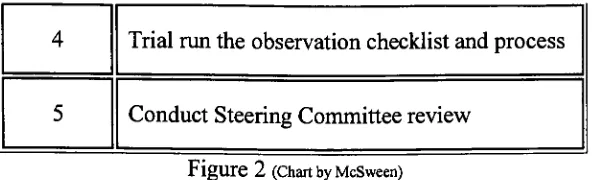
observation process are outlinedin
the
following
table:
Typical
stepsin creating
the
observation process.Figure-2
Task
Activity
1
Pinpoint
safe practices2
Draft
andrevise checklist4
Trial
runthe
observationchecklistandprocess5
Conduct
Steering
Committee
reviewFigure
2
(Chartby McSween)
3.6 The
outcomesfrom
awell-plannedandimplemented BBS Program:
According
to
Dr. Dominic
Cooper,
Chartered
Psychologist,
Associate Fellow
ofthe
British
Psychological
Society,
awell-developed andimplemented BBS
program shouldhave
the
following
results:1.
Lower
numbers of accidents orincidents,
near-missesand
property
damage: If
the
checklistsaretargeting
those
behaviors
that
have
traditionally
been
associated with a company'saccidents,
logic dictates
that
asthose
unsafebehaviors
arebought
under
control, there
shouldbe
acorresponding decrease in
the
accidents,
incidents,
and near-missestriggered
by
thoseunsafebehaviors.
2.
Improved levels
of quantifiedsafety
behaviors: If
the
workforcehas
'bought-in'to the
behavioral safety
system andis
actively
trying
to
improve
its
safety
performance,
logic
againdictates
that the
levels
of safe
behavior
willincrease. This improvement
should alsobe
visibleat
the
workface.For
example,
people arefollowing
procedures,
andpeople are
visibly engaging
in
safebehaviors.
3.
Reduced
accident costs:Logic
againdictates
that reductionsin
the
number of accident occurrences should alsodecrease
theassociatedcosts.
Cost
canbe
measured,
for
example,
by
insurance
claims,
reductionsin
penalties and sanctionsimposed
by
the
judiciary,
reductions
in
the
types
and numbers of actualinjuries,
reductionsin
insurance
premiums,
andless
time
spentin
investigating
andrecording
accidents or
incidents.
4.
Maintenance: This
outcomerefersto
how
wellthe
systemhas
embedded
in
the
company
concerned andhow
persistenttheworkforceis
in
maintaining the
behavioral safety
systemin
the
light
of setbacksorchanges made within or
to
the
organization'sstructures,
overextendedperiodsof
time.
Some implementations in
some companieshave
been
running
for
almost20
years.5.
Acceptance
ofthe
systemby
all concerned:How
wellpeople [image:25.527.101.397.53.143.2]is
run, the
quality
ofthe
observationsundertaken,
management'songoing
support,
andhow
remedial
actions are progressed and pursued untilcompletion.
How
oftenthe
company's senior managementteam
andsafety
committeetakes
aninterest
in
the
results andintegrates
the
behavioral
safety
system with all other aspects of
the
organizationsfunctioning
are otherimportant features
that
help
to
determine
people's acceptance.If
the
system
is
rejectedby
most,
it
willalmostcertainly
fail.
6.
General
ability:This
refersto
how
efficiently
the
behavioral safety
system
identifies
and addressesotherhealth & safety
challenges(e.g.
unsafeconditions,
managementsystemfaults,
andtechnological
defects).
7.
Regular
andrapidfollow-up: This
outcome refersto the
effectiveness
of
follow
up
proceduresfor
people'simprovement
suggestions andfor
the
completionof remedial actions.Indeed,
this
feature is probably
oneof
the
mostimportant
elementsfor
peopleto
continueto
engagein
the
process.No
follow
up
action willrapidly lead
to the
rejectionofthe
behavioral safety
systemby
the
workforce.8.
Increased
reportingofdefects,
nearmisses, accidents,
etc:The
increased
reporting
ofdefects
or unsafe conditionsis
aninevitable
outcome of a good
behavioral safety
system,
asthe
workplaceobservers will
be noting
these,
orthey
willbe
bought
to
their
attention
by
their
colleaguesduring
their
observationtours.
People
arealso more
likely
to
report accidents andnear misses asthey
learn
to
trust
the
system.However,
if
the
company
adopts or runs a'blame
the
victim'culture,
accidentsand near misses areunlikely
to
be
reportedas
they have
negative connotationsfor
those
whodo
reportthem.
9.
Increased
skillsin
positive reinforcement.Given
that
theconsequencesor rewards
for
behaving
unsafely
orotherwise exerta powerfulinfluence
on people'songoing safety
behavior,
it is
important
to
make surethatthey
consequences andrewards are managed correctly.This
requiresthat
everyone concernedis
awareofthe underlying
theory
ofbehavior
managementandthat
he
or she alsopossesses
the
practicalskills requiredto
managethese
consequences.As
the
behavioral safety
systemtakes
effect andmatures, the
useof positive consequences
becomes
morewidespread.Importantly,
this
outcome canbe
quantifiedto
providea metric with whichtheuseof positive reinforcement can
be
monitored.For
example,
feedback
is
a consequence.Thus,
the
numberoftimes
feedback
is
givento
individuals
or aworkgroup
could provide a numericalindex
that
3.7
What BBS
is
not:Cooper
notesthat
many
peopledo
notfully
understandBBS.
They
have
misconstrued
ideas
of whatBBS is
about.Cooper
highlights
that
behavioral
safety
is
NOT:
[image:27.527.78.481.128.681.2]Figure-3
Aversive
controlThe
useofthreats
has
no placein
abehavioral
safety
system,
asits
ethosis
primarily
predicated onpositive reinforcementor encouragement
for
engaging
in
safe
behavior.
Punishment
for
notadhering
to the
behaviors
onabehavioral
safety
checklist alsohas
no practicalvalue,
giventhat the
workforce would soon withdrawtheir co-operation.There
are also otherpracticaldifficulties.
Punishment
has
to
be
givenimmediately
andevery
singletime
an unsafebehavior
occursfor it
to
be
effective.This
is impractical in
most
organizations,
asline-managers
will not always seethese
asthey
occur.Thus
the
frequency
of rewards orpositiveconsequences obtained
by
the
individual for
behaving
unsafely
willtend to
outweighthe
infrequent
punishments received(depending
uponthe
severity
perhaps).
This
is
adifficult
issue,
but in
principle,
it
makessensenot
to
placemandatory
items
(e.g. wearing
hearing
protection
in
noisy areas)
onbehavioral
safety
checklistsif
the
company
wishesto
retainthe
right
to
punishparticularunsafe
behaviors.
Focusing
onincident
rateswithouta
focus
on
behavior
Behavioral safety
systemsdo
notsolely
focus
their
attentionon reduced accident rates.
Their
focus
is
onencouraging
safebehavior
acrossthe
board.
Providing
positive consequencesfor
safebehavior explicitly
links
the
desired behavior
withthe
reward.Reduced
accident ratesaremerely
anoutcome ofthisprocess.
If
acompany
is
solely
concernedwithmanipulating
accidentrates,
by
for
exampleencouraging
under-reporting,
it
couldbe
arguedthat
its
safety
managementsystem
is
not yet matureenoughto
considerthe
implementation
ofbehavioral
safety.Decisions
madeon
the
basis
ofdogma
orprejudice
Behavioral
Safety
decision-making
tends to
be
based
onthe
analyses of accident
records,
observation,
etc.In
otherwords,
it
is data driven. It
is
notbased
onpeople's personalprejudices
(e.g.,
if
wefocus
onpeople'sattitudes,
their
behavior
willchange)
or world-views(e.g.,
whenI
wasin
the
military,
we punished people untilthey
fell into line).
and commitment
to
the
behavioral safety
process, which,
in
turn,
willadversely
affectthe
outcomes.Disciplinary
actions
for
accidents
/
incidents
Behavioral
safety
is
based
on positive reinforcement orencouragement.
It
is
vital,
therefore,
that
organizationsdo
notadopta
policy
of'blame
the
victim'or
'shoot
the
messenger'when people report a near-miss
incident
oraccident,
if
the
company
wishesthese
to
be
reported.In
behavioral
safety
terms,
this
canbe
construed as a punisheror negativeconsequence.
In
practicalterms,
it
means peoplewill no
longer
wishto
report suchincidents,
whichcorrespondingly
reducesthe
opportunitiesfor
the
company
to
learn from
these
what?to
ensure similar eventsdo
nothappen
again.If
a'blame
the
victim'policy
is in
place,
it
indicates
that the
company
concernedis
not yetready
for
behavioral
safety
Top-down
implementation
Behavioral safety
systems arebased
on a consensusbetween
managementandthe workforce,
which reflects researchfrom
safety
cultureandsafety
climate.This
what?has
shown
that there
aretwo
equally
vitalaspectsofsafety
management:
Management's
commitmentto
safety
andthe
involvement
oftheworkforce.Management
alonecannotbring
safety
improvements
about.Likewise,
the
workforce alone cannotbring
about significantsafety
improvements.
Both
sideshave
to
be
brought
together
in
atrue
partnership
if
significant andlasting
improvements in
safety
areto
be
realized.
This
meansthat
thereis
noplacein
behavioral
safety
for
one side orthe
otherto
dictate
how
the systemis
[image:28.527.80.483.44.447.2]to
be implemented.
Figure 3
(Chartby Cooper)
3.8 Implementation Problems
withBBS
"Implementing
abehavioral safety
systemis
not aseasy
asit
seemsand canbe
plagued with
difficulties. Difficulties mainly
arisefrom
attemptsto
shortcutthe
process
due
to
perceivedtime
pressures,
attemptsto
minimizethe
resourcesrequired,
or
from
ineffective
advice receivedfrom
aninexperienced
behavioral
safety consulting
company.
In
reality,
such short cutsactually demonstrate
alack
ofcommitmentto
making
the
processwork"
According
to
Cooper,
introducing
abehavioral safety
systemhas
to
be
done
'right
the
first
time,'as
it is
rarefor
the
workforceto
let
acompany
have
a secondchance
(Cooper).
Cooper
identifies
severalpitfalls
that
mustbe
avoided whenimplementing
aBBS
program.
The
first is lack
of workforcebuy-in.
The
workforcehas
to
be
a part ofthe
decision
making
stage.They
mustbe informed
every
step
ofthe
way.If
theworkforcedoes
notbuy
into
the
BBS
program,
it
willbe difficult for
the
programto
succeed.Second,
Cooper
statesthat the
observationchecklistdoes
nottargetthe
accident-causing
behaviors.
Not analyzing
the
incident
rateproperly is
the
primary
reasonfor
thismistake.The
safety
data
mustbe
analyzedproperly
to
determine
whichbehaviors
and areasneedto
be
addressed.The
third
mistaketo
avoidis
notproperly
defining
the
unsafebehaviors.
Incident
reports should gointo detail
ofhow
an accident occurred sothe
correctunsafebehavior
canbe
identified. The
fourth
mistaketo
avoidis
including
names ofemployeesduring
the
observationprocess.Employees
areleery
ofprogramsthat
have
namesincluded in
negative results.There
must alsobe
a standardprocessfor conducting
observations,
feedback,
and communication updates.The
final
and most critical mistaketo
avoidis
to
nothave
the
support of management.If
managementdoes
notsupportthe
program
by dedicating
the
proper resourcesto
theprogram, then
theBBS
programwillnot succeed.
3.9 DuPont STOP Program
Safety
Training
Observation Program
(STOP)
developed
by
DuPont is
aseriesoftraining
programsthat
teaches
workplacesafety auditing
skillsfor
observing
peopleconditions
(DuPont).
The
STOP
programconsists of5
training
topics.
They
canbe
usedindividually, but,
for best
results,
all5
topics
shouldbe
used.They
are:1)
STOP
for
Supervision, 2)
Advanced
STOP,
3)
STOP
for
Employees,
4)
STOP
for
Each
Other,
and5)
STOP for
Ergonomics
(DuPont).
Their
STOP
program also entailsthree
phases neededin
orderto
decrease
the
injury
rate.The
first is
adependent
phase.This
is
wheresupervisors observe employees and
intervene
by
conducting
observations andgiving
feedback
to the
employees(DuPont). The
second phaseis
anindependent
phase.This
is
where employees are
trained to
focus
on personalsafety,
observesafety
hazards,
andaudit
themselves to
ensurethat
they
andtheir
peersworksafely (DuPont). The last
phaseis interdependent.
In
this phase,
BBS
techniques
andinjury
preventionskills are usedthroughout
theorganization,
creating
an"other's
keeper"
environment
(DuPont).
The STOP
programis
uniquebecause it focuses
onbehaviors
andthe
workplaceenvironment.
It
alsofocuses
onergonomics.Employees
aretrained
onthe
properway
to
perform
job
tasks.
Although
DuPont
does
not postthe
results oftheir program,
they
do
share some of
their
case studies.3.10
Safety
Performance Solutions
Safety
Performance Solutions
(SPS)
is
aninternationally
recognizedconsulting
firm
specializing in
the
application ofbehavior-and person-basedsafety
thatis led
by
Scott
Geller. As
afaculty
member ofVirginia Tech's Department
ofPsychology,
Scott
Geller has
taughtand conducted researchin
the
area ofdevelopment
andevaluationofbehavior-change interventions
to
improve quality
oflife
(Safety
Performance
Solutions).
Geller
formed
Make-A-Difference,
Inc.
(MAD)
in 1987. The company
has
assistedindustrial
safety
problems.
In
1995,
MAD
and agroup
of employeesfrom
Virginia Tech
merged
to
form
Safety
Performance
Solutions (SPS). SPS helps
companiesunderstandand
manage
human
dynamics
to
reducework-relatedinjuries
(Safety
Performance
Solutions).
SPS
believes
in
developing
aTotal
Safety
Culture.
According
to
SPS,
in
aTotal
Safety
Culture:
Employees
notonly
feel
responsiblefor
their
ownsafety,
they
feel
responsiblefor
their
peers'safety,
andthe
organizationalculturesupports
them
acting
onthat
responsibility.Individuals have
the
necessary
tools
andmethods,
as well asappropriatepersonstates
(e.g.,
self-esteem,
group
belonging,
personalcontrol)
to
actively
carefor
the
safety
of coworkers(www.safetyperformance.com).
SPS
believes
that
behaviors
canbe
alteredby
the
observation andfeedback
process.This
process
includes
managers, supervisors,
andhourly
employeesworking
together to
develop
alist
of safe and at-riskbehaviors. Then
employeesobserveco-workers whileperforming
job
tasks to
ensurethatthey
areusing
safebehaviors. Once
the
observationprocess
is
complete, the
observer willgivethe
observedworkerfeedback
ofthesafe andat-risk
behaviors
observed.The giving
offeedback
processhelps
to
changethe
behaviors
of workers
by
allowing
them
to
focus
onthe
at-riskbehaviors
that
needto
be
changed(Safety
Performance Solution). Observational data is
then
collectedandanalyzedto
identify
areasneeding
special attention.It
is
then
discussed in
workteams to
develop
relevant
intervention
strategies.A
work process called"DO
IT"
(define,
observe,
According
to
SPS,
clients
have
seenimprovements
in
the
following
areas:Increased:
Employee
ownership
ofsafety
Quality
ofsafety
communicationsQuantity
ofsafety
communicationsFeelings
of personal control oversafety
Peer
supportfor
safework practicesEmployee
responsibility
for
safety
Decreased:
Frequency
of at-riskpracticesFrequency
andseverity
ofinjuries
Worker's
compensationcosts"Us
vs.them"attitudes andbehaviors
Hiding
orunder-reporting
ofincidents
FigUTe-4
(Chartby
Safety
PerformanceSolutions)
According
to
SPS
data,
clientswillsee a22%
improvement
in
their
recordableinjury
rate withinthefirst
year afterimplementing
BBS
(www.safetyperformance.com).
After 5
years, there
is
a72%
improvement in
the recordableinjury
rate,
and after7
years,
there
is
a79%
improvement
(www.safetyperformance.com). SPS
data
also showsthat
asthe
number of observationsincrease,
the
incident
ratefor
acompany
decreases.
3.11 Behavior
Safety
Technology
(BST)
Thomas Krause
andJohn
Hidley
founded
BST
in 1979. BST
pioneeredthe
application of
behavioral
science methodsto
safety
withthe
Behavioral Advanced
Performance
Process
(BAPP)
technology
(Behavior
Science
Technology).
According
to
designed
to
intervene
effectively
andwithoutblame
whereincidents
occur:the
Working
Interface. BAPP
technology
createsanongoing safety
processthat
grows with anorganization
to
consistently
removetheactualbarriers
to
safe performance(Behavioral
Science
Technology).
According
to the
data,
mostsitesthat
have implemented
the
BAPP
technology
continue
to
useit.
The
technology
has
remained at sitesthat
have
seendownsizing,
changes
in
leadership,
ownership,
and otherdisruptive
events.Over
the
past13
years,
89%
of companiesthat
have implemented
the
BAPP
technology
continueto
usethe
technology
(Behavior Science
Technology).
One
ofthe
reasonsthat
the
BAPP
technology
is
so successfulis
that the
management atthe
siteshas
bought into
the
technology,
andthey
have
seengoodresults.Managers have
seen animprovement in
awareness,
culture,
and employeeinvolvement (Behavior Science Technology). This has
lead
to
improvements
in
communicationandteamwork
atthe
sites.The
numbers speakfor
themselves.
According
to
BST,
sitesthat
have
implemented
the
BAPP
technology
have
seen a25%
improvement
overthe
baseline in
the
first
year.By
the
5thyear, the
resultshave increased
by
55%
overthebaseline. The
results
for
the
top
25%
ofBAPP
users arebetter
than
45%
for
the
first
yearand72%
by
the
5thyear(Behavior Science Technology). These
resultsprovethat
thereis
adirect
relationship between
implementing
BAPP
technology
andimproved
safety
results.3.12
ADVANTAGES
OF BEHAVIOR BASED SAFETY
The BBS
processhas
several advantages overtraditional
safety
managementapproaches.
BBS identifies
system causes ofillness
andinjuries,
enhancestraditional
(Blair,
1999). The
processis
administeredto
individuals
with minimal professionaltraining;
it
reaches employees
atthe problem,
is
costeffective,
andintervention
is
easily
applied
by
personnel
monitoring
target
behaviors
(Geller, Boyce, Williams, Pettinger,
DePasquale,
andClarke,
).
The BBS
processfunctions
wellin
the
employeefeedback/communication
loop
needed
to
continually
improve
the
process.The
observationandfeedback
cyclereinforces
the
"relaxed
awareness"(optimal
state of safe andproductiveperformance)
ofemployees,
and,
perhaps,
mostimportantly,
keeps
veteran employeesfrom
going
on"automatic
pilot"with
the
increased
risk ofsuffering
anaccident(Dennis). As
notedearlier, traditional
thinking
statesthat
88%
ofaccidents are causedby
unsafeactsby
employees
(Heinrich,
et al).By
identifying
the
criticalbehaviors
andcontrolling
their
antecedents and
consequences, the
frequency
of at-riskbehaviors
andthe
potentialfor
accidentsarereduced.
In
addition, the
cooperative problemsolving
between
employeescreatesan atmosphere of
trust
among
employees andfosters
changesin
the
organizationalculture
(Dennis).
By identifying
subtle employeebehaviors
thatcauseaccidents, the
BBS
process
is
anopportunity
for
organizationswithexemplary safety
recordsto
moveto the
next
level
ofsafety
performance(Loafmann).
3.13
DISADVANTAGES
OF BEHAVIOR BAS