Int. J. Electrochem. Sci., 14 (2019) 1968 – 1985, doi: 10.20964/2019.02.46
International Journal of
ELECTROCHEMICAL
SCIENCE
www.electrochemsci.org
Study on corrosion and delamination behavior of X70 steel under
the coupling action of AC-DC interference and Stress
Xinhua Wang, Xuting Song, Yingchun Chen*, Zuquan Wang, Liuwei Zhang
College of Mechanical Engineering and Applied Electronics Technology, Beijing University of Technology, Beijing 100124, China
*E-mail: [email protected]
Received: 27 August 2018 / Accepted: 8 November 2018 / Published: 5 January 2019
The combined influences of AC-DC interference and stress on the corrosion and delamination behavior of X70 steel in the neutral environment was studied using COMSOL Multiphysics software, electrochemical tests, weight loss experiments, and surface analysis techniques. Results showed that, under the stress of 364 MPa, as the stray current density increased, the corrosion potential shifted towards the negative side, with no passive region on polarization curves, but only an active dissolution region. Under the influence of DC interference, the anodic polarization curves showed a significant inflection point, due to the accumulation of a large number of corrosion products on the surface of X70 steel, which hindered the anodic polarization. At the same time, the corrosion rate and the maximum depth of the corrosion pits increased with increase in DC density. The corrosion reaction followed Faraday's law of electrolysis. Under the influence of combined AC and DC interferences, the corrosion rate and the depth of the corrosion pits were in the following order: combined AC and DC interferences > DC interference > AC interference. The influence of AC interference on the delamination was less than that of DC interference. The delamination area of the anticorrosive coating under DC interference with a current density of 300 A/m2 was about 5 times that under AC interference. Also, under the combined influence of AC and DC interference, the delamination area of the coating was larger than that under the influence of either AC or DC interference. In this paper, a model for delamination process under the influence of stray current was proposed, in which, the corrosion reaction occurred first at the sample defects. When the amount of corrosion product accumulated to a certain extent, separate cathode and anode regions were formed on the sample surface, which resulted in delamination of the coating.
Keywords: AC-DC interference; stray current; stress; corrosion; delamination
1. INTRODUCTION
electrified railways laid, either parallel or intersecting. Concentration of these in a local area forms the “public corridor.” The corrosion of pipeline steel due to the interference of stray current becomes more significant as time passes [1-5]. Leakage in the pipeline causes substantial economic losses and is a potential safety hazard. Stray current interference can be AC, DC, or ground stray current depending on the source. Amongst these, corrosion problem due ground stray current is negligible [6-8], due to improvised insulation coatings of the modern buried pipelines. The stray current in the pipeline can be transmitted through long-distances and then flows out from the defects in the coating, due to damage and spalling, resulting in tremendous local corrosion rate. For example, after laying one X42 pipeline steel coated with fused epoxy powder (FBE) and high voltage (500 KV) AC power parallel transmission wires for one year, the corrosion rate was as high as 10 mm/a [9]. Usually the three-layer polyethylene (3PE) coating of pipeline undergoes delamination, due to stray current disturbances after the pipeline is operational. Once the bonding between the pipeline and coating is lost, the shielding effect of cathodic protection leads to a series of problems, such as pitting corrosion and stress corrosion, which seriously affect the safe operation of the pipelines [10].
Recently, some experts and scholars have carried out some researches to solve the problems of corrosion due to stray current and have achieved some success [11-15]. DC interference has a significant influence on the corrosion of buried steel pipelines, and its essence is the electrolytic effect of electrochemical corrosion [16]. Bertolini, Carsana, and Pedeferri [17] showed that corrosion could occur in the enhancement phase of the anode region only after the DC has been applied for a certain period. The corrosion amount was related to the current density of the anode, the chloride content in the concrete, and the action of DC. Wang and Tang [18] studied the corrosion behavior of X65 steel under the combined action of DC interference and stress. They found that an increase in the corrosion rate of X65 steel was proportional to the increase in DC density. According to Song, Kim, and Yong [19] the three main factors affecting AC corrosion are AC voltage, AC frequency, and AC density. Goidanich, Lazzari, and Ormellese [20] confirmed experimentally that at an AC density of 10 A/m2, corrosion rate of the electrode was twice than that without AC interference. Fu and Cheng [21] found that when the AC density was in the range of 0 ~ 20 A/m2, the impact of AC on corrosion of pipeline steel was negligible. They also found that, when the current density was between 20 ~ 100 A/m2, corrosion on the pipeline surface was uniform. However, in the range of 100 ~ 500 A/m2, the surface of pipeline steel showed characteristic pitting corrosion. Guo [22] studied the effect of AC corrosion on the high-strength pipeline steel by weight loss method. Results showed that the corrosion rate increased with increase in AC density, and decreased with increase in AC interference frequency. Wang [23] studied the effect of AC interference on the delamination behavior of anticorrosive epoxy coatings. Results showed that smaller the defect area of the anticorrosive layer, the larger is the delamination area of the coating when same AC density is applied. AC corrosion process is thus more complicated than DC corrosion process. There are many of corrosion mechanisms such as Faraday rectification [24,25], depolarization of the anode reaction [26], irreversibility of the anodic reaction [27], and oscillation effect of AC voltage at the metal/ dielectric interface [28,29]. However, the corrosion mechanisms of the AC corrosion phenomena have limitations.
steel pipe. Study and exploration of the corrosion problem of high strength steel under stress has become a new topic of research [30]. Under AC and DC interferences, the corrosion of high strength pipeline steel and the delamination behavior of the coating are complex, and the corrosion mechanism is not precise. Therefore, it is important to investigate the corrosion and coating detachment under the combined influence of AC-DC interference and stress.
In this paper, the combined influences of AC-DC interference and stress on corrosion and delamination behavior of X70 steel at the 3PE coating damaged site were studied through open circuit potential tests, polarization curve analysis, and three-dimensional volumetric microscope observation.
2. EXPERIMENTAL
2.1 Materials and test solution
[image:4.596.187.413.295.471.2]
Figure 1. Dimensions of the sample used in the study
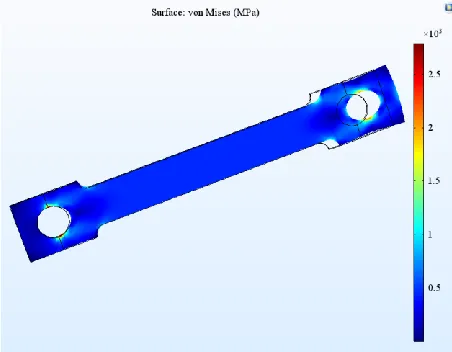
Figure 2. Von Mises stress distribution on the sample surface under the influence of 364 MPa stress
2.2 Electrochemical test method
[image:5.596.180.413.240.451.2]
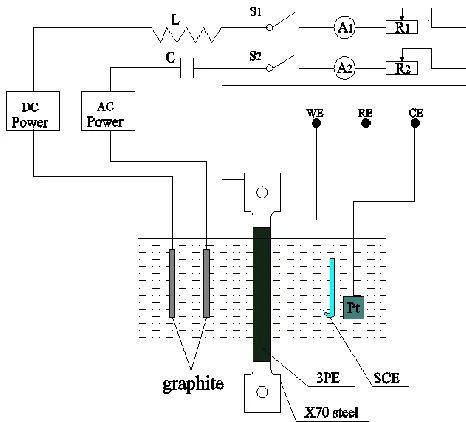
A/m2, 100 A/m2, and 300 A/m2) and DC signals of different densities (0 A/m2, 30 A/m2, 100 A/m2, and 300 A/m2) were generally applied to the circuit during the tests. The current density was calculated based on the damaged area of the coating. The RGM-6050 slow-stress stretcher was used for application of 364 MPa tensile stress. After 24 hours of experimentation, tests for open circuit potential and polarization curve began. It should be noted that when the open circuit potential was stable, test for potentiodynamic polarization curve was performed at room temperature at a scan rate of 0.5 mV/s, and the scanning potential range was from -0.7 V to 0.5 V(V, SCE). Finally, polarization curves were fitted using C-View software.
Figure 3. Experimental set-up for stray current corrosion electrochemical test
2.3 Corrosion morphology and measurement of corrosion rate
After the experiment ended, a photograph of the corrosion sample was captured using a digital camera. Then, the anticorrosive layer was scraped and the sample surface was cleaned with Clark's solution. The solution is composed of 1 L hydrochloric acid (specific gravity 1.19), 20 g antimony trioxide (chemical pure reagent), and 50 g stannous oxide (chemical pure reagent). Finally, the sample was rinsed with deionized water and dried using cold air. After the sample was dried in the drying oven, the weight of the sample before and after corrosion was recorded to an accuracy of 0.1 mg using an AB204-E analytical balance. All experiments were repeated twice. To reduce the experimental error, blank uncorroded test pieces of the same sample were treated under the same conditions of pickling. The weight loss method was used to test the corrosion rate, which was calculated using the following formula:
Where, ∆W is the average weight loss of the sample, g; W0 is the original weight of the sample, g; W1 is the mass of the sample after removal of the corrosion products, g; W2 is the mass loss of the blank sample in the rust removal process, g; t is the soaking time, h; and Vcorr is the average corrosion rate, mm/a.
The process for removal of rust after the immersion test was the same as that employed for the determination of corrosion rate. After the corrosion products were removed, the corrosion morphology of the X70 steel at the damaged portion of the corrosion layer was studied by three-dimensional microscopy (Keyence VHX-3000).
3. RESULTS AND DISCUSSION
3.1 Open circuit potential results and analysis
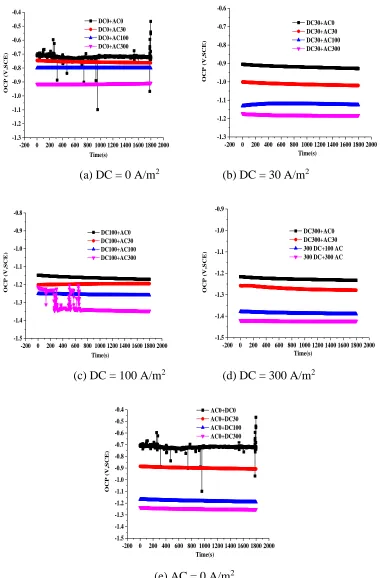
Self-corrosion potential is a thermodynamic measure of corrosion occurring in metals. More negative the potential, the more significant is the potential difference between the anode and cathode. In other words, the higher the thermodynamic tendency of the reaction, the higher is the possibility of metal corrosion. Fig. 4 shows the open circuit potentials of the samples measured after soaking for 24 h under the combined influence of AC-DC stray current and stress at 364 MPa. Firstly, as can be seen from Figs. 4(a)-(d), when the applied DC density was constant, the corrosion potential shifted to the negative side as the applied AC density increased. When only the AC interference was applied, the corrosion potential shifted to the negative side from -0.713 V at 0 A/m2 to -0.925 V at 300 A/m2, and its amplitude was 0.212 V. Secondly, as can be seen from Fig. 4(e), when only the DC interference was applied, as the DC density increased, the corrosion potential shifted negatively from −0.713 V at 0 A/m2 to -1.26 V at 300 A/m2, which was a shift of 0.547 V. Finally, comparison of Figs. 4(a) and (e) showed that the magnitude of negative shift of corrosion potential caused by DC interference at the same current density was larger than that caused by AC interference. Therefore, AC interference had a more significant influence on the self-corrosion potential of X70 steel, which affected the thermodynamic properties of X70 steel and made it more susceptible to corrosion. A mathematical model of this problem was established [31], which is as follows:
(2)
Where, Ecorr, AC, and Ecorr are corrosion potentials with and without AC interference, respectively, V; ba and bc are the Tafel slopes of the anode and the cathode, respectively; and Ep is the peak potential of the applied AC signal, V.
increases. According to thermodynamics, under the action of AC-DC stray current either alone or together, with an increase in current density, the corrosion potential of X70 steel shows negative shift. This is conducive for oxidation reaction and makes X70 steel more susceptible to corrosion, which is consistent with the conclusions drawn by Zhang [32].
-200 0 200 400 600 800 1000 1200 1400 1600 1800 2000 -1.3 -1.2 -1.1 -1.0 -0.9 -0.8 -0.7 -0.6 -0.5 -0.4 DC0+AC0 DC0+AC30 DC0+AC100 DC0+AC300 OCP ( V,SCE) Time(s)
-200 0 200 400 600 800 1000 1200 1400 1600 1800 2000 -1.3 -1.2 -1.1 -1.0 -0.9 -0.8 -0.7 -0.6 Time(s) OCP ( V,SCE) DC30+AC0 DC30+AC30 DC30+AC100 DC30+AC300
(a) DC = 0 A/m2 (b) DC = 30 A/m2
-200 0 200 400 600 800 1000 1200 1400 1600 1800 2000 -1.5 -1.4 -1.3 -1.2 -1.1 -1.0 -0.9 -0.8 DC100+AC0 DC100+AC30 DC100+AC100 DC100+AC300 Time(s) OCP ( V,SCE)
-200 0 200 400 600 800 1000 1200 1400 1600 1800 2000 -1.5 -1.4 -1.3 -1.2 -1.1 -1.0 -0.9 OCP ( V,SCE) Time(s) DC300+AC0 DC300+AC30 300 DC+100 AC 300 DC+300 AC
(c) DC = 100 A/m2 (d) DC = 300 A/m2
-200 0 200 400 600 800 1000 1200 1400 1600 1800 2000 -1.5 -1.4 -1.3 -1.2 -1.1 -1.0 -0.9 -0.8 -0.7 -0.6 -0.5 -0.4 OCP ( V,SCE) Time(s) AC0+DC0 AC0+DC30 AC0+DC100 AC0+DC300
[image:7.596.104.484.151.729.2](e) AC = 0 A/m2
3.2 Results and analysis of polarization curves
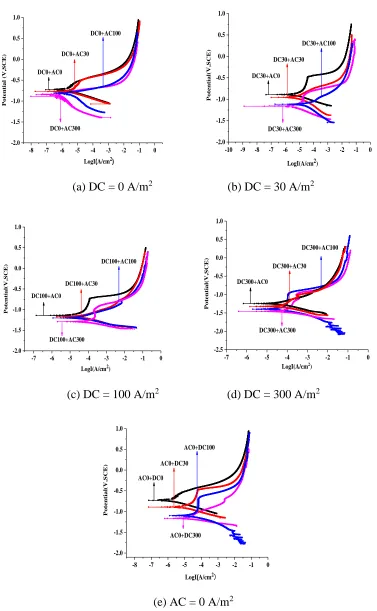
The polarization curves of the samples due to the combined action of 364 MPa stress and AC-DC stray current are shown in Fig. 5. It can be seen that the anodic polarization curve was smoother in presence of only AC interference. However, in presence of DC interference, the anodic polarization curve showed an obvious inflection point, which could be due to a large number of corrosion products that covered the defects of the coating layer and affected the anodic polarization process. With an increase in the anodic polarization potential, the anodic polarization curve became steeper and the corrosion current increased continuously. X70 steel was still in the active dissolution state without passivation. When the applied DC density was constant, as the AC density increased, the corrosion potential shifted to the negative side and the anode current density increased rapidly. Results from the polarization curve confirmed that the presence of stray currents affected the corrosion process of the X70 steel. The application of AC-DC interference was not conducive for the formation of a passive film on the surface of X70 steel. The result was that X70 steel showed no passivation tendency in the test system. Also, the higher the current density, the greater is the anode current density, and more is the dissolution tendency of X70 steel. The influence of the AC-DC stray current on the Tafel constant was significant. When stray current was applied, the Tafel constants of both the anode and cathode changed significantly, and the effect of AC-DC interference on the anodic polarization process of X70 steel was obviously greater than that on cathode polarization process.
of charge transfer as the Faraday current [33]. These results are consistent with the results of polarization curve fitting.
-8 -7 -6 -5 -4 -3 -2 -1 0 -2.0 -1.5 -1.0 -0.5 0.0 0.5 1.0 DC0+AC300 DC0+AC100 DC0+AC30 Pot ential (V,SCE)
LogI(A/cm2)
DC0+AC0
-10 -9 -8 -7 -6 -5 -4 -3 -2 -1 0 -2.0 -1.5 -1.0 -0.5 0.0 0.5 1.0 DC30+AC300 DC30+AC100 DC30+AC30 Pot ential (V,SCE)
LogI(A/cm2) DC30+AC0
(a) DC = 0 A/m2 (b) DC = 30 A/m2
-7 -6 -5 -4 -3 -2 -1 0
-2.0 -1.5 -1.0 -0.5 0.0 0.5 1.0 DC100+AC100 DC100+AC300 DC100+AC30 Pot ential (V,SCE)
LogI(A/cm2) DC100+AC0
-7 -6 -5 -4 -3 -2 -1 0 -2.5 -2.0 -1.5 -1.0 -0.5 0.0 0.5 1.0 Pot ential (V,SCE)
LogI(A/cm2) DC300+AC300
DC300+AC100
DC300+AC30
DC300+AC0
(c) DC = 100 A/m2 (d) DC = 300 A/m2
-8 -7 -6 -5 -4 -3 -2 -1 0 -2.0 -1.5 -1.0 -0.5 0.0 0.5 1.0 AC0+DC300 AC0+DC100 AC0+DC30
LogI(A/cm2)
Pot
ential
(V,SCE)
AC0+DC0
[image:9.596.105.482.112.723.2](e) AC = 0 A/m2
Figure 5. Polarization curves of the sample measured under the combined action of 364 MPa stress and
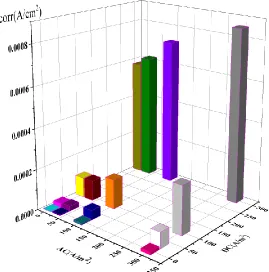
Figure 6. The corrosion current parameters fitted by the polarization curve under the combined action
of 364 MPa stress and AC-DC interference at different current densities: (a) 0 A/m2, (b) 30 A/m2, (c) 100 A/m2, and (d) 300 A/m2
Figure 7. Corrosion rate determined by the weight loss method under the combined action of 364 MPa
[image:10.596.152.410.449.694.2]
3.3 Corrosion morphological analysis
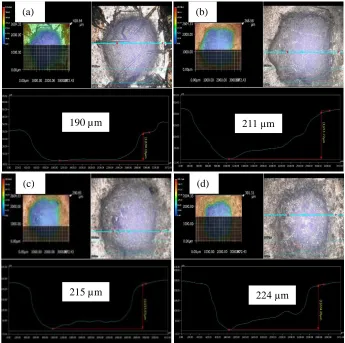
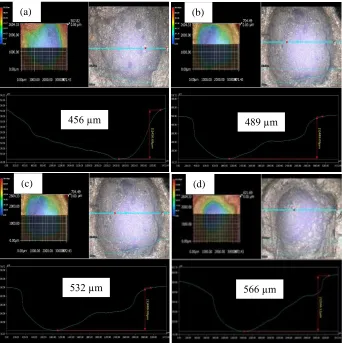
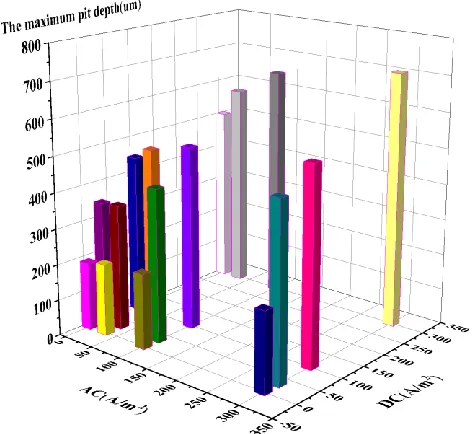
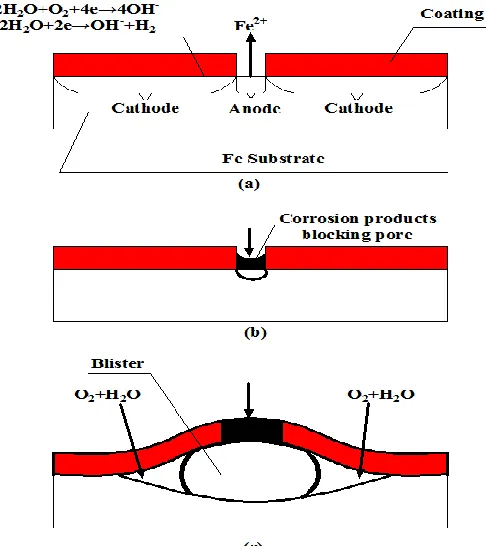
Figs. 8~11 show the corrosion morphologies of samples under the combined actions of 364 MPa stress and AC-DC interference at different densities. Fig. 12 shows the etch pit depths of the samples under the same conditions. From the figure, it was evident that at a constant applied DC density, the maximum corrosion pit depth on the X70 steel at the defect site of the coating increased gradually as the AC density increased. Additionally, when the applied AC density was constant, the maximum pit depth increased as the DC density increased. The depth of corrosion pit under the influence of AC-DC stray current was more than that under the individual actions of either AC or DC interference. The corrosion pit appeared shallow when only AC interference was applied, whereas it increased significantly when DC interference was applied. The corrosion pit depth under the inflence of DC interference was obviously more than that under the influence of AC interference at the same current density. The pit depth was 503 μm when DC interference of 300 A/m2 was applied individually, while it was 224 μm when AC interference of 300 A/m2 was applied individually. These results were similar to those obtained by the weight loss method. Also, a large number of small, colorless, and odorless bubbles were seen on the surface of the X70 steel samples in the later stages of corrosion under the influence of the AC-DC interference, indicating that a hydrogen reduction reaction occurred:
Anode reaction: 2Fe → 2Fe2+ + 4e- (3)
Cathode reaction: 2H2O + O2 + 4e- → 4OH- (First step)
2H2O + 2e-→ H2 + 2OH- (Second step) (4)
Fig. 13 shows the delamination areas of samples under the combined influence of both, 364 MPa stress and AC-DC interference, at different current densities. It could be seen that under the influence of AC interference alone, the delamination area of the coating increased from 1.2 mm2 at 0 A/m2 to 4.2 mm2 at 100 A/m2. Thereafter, as the AC density increased continuously up to 300 A/m2, the delamination area did not show any significant changes. This is due to the accumulation of corrosion products in the region where the coating was damaged. This caused blockage of the corrosion channel and the electron exchange between the cathode and the anode became relatively difficult. At the same time, due to decrease in oxygen content of the solution, the effect of AC interference on delamination was significantly weakened.
[image:12.596.128.473.250.593.2]
Figure 8. Corrosion morphologies of samples under the conditions of 364 MPa stress and different AC
densities: (a) 0 A/m2, (b) 30 A/m2, (c) 100 A/m2, and (d) 300 A/m2
In the presence of DC interference alone, the delamination area increased gradually with increase in current density. When the applied DC density was constant, the delamination area of the coating increased slightly with increase in the AC density. However, when the applied AC density was constant, it increased obviously with increase in AC density. The combined effects of AC-DC stray currents resulted in a larger delamination area compared to that caused by the action of AC or DC interference individually. The results of this study suggested that DC interference had greater impact on the
(c)
215 µm
(b)
211 µm (a)
190 µm
(d)
delamination compared to that of AC interference. Fig. 14 is a schematic view of the delamination process of an anti-corrosion layer under the combined influence of stray current and stress. It can be seen from the figure that the corroded film formed in the corrosion reaction prevented oxygen from penetrating into the defects below the corroded film, resulting in an oxygen-depleted region below the film at the center of the defect. However, oxygen could diffuse through the edge of the corroded film to the defective edge, which made the defective edge an oxygen-rich area and formed separate anode and cathode regions. Due to the low pH of the anode region, the dissolution of the metal at the anode was accelerated. The pH of cathode region was higher, which reduced the adhesiveness of the anti-corrosion layer due to the formation of OH- and H2. The coating lost its tackiness due to saponification reaction, which led to the cathodic delamination of the coating [37].
[image:13.596.123.469.252.601.2]
Figure 9. Corrosion morphologies of samples under the conditions of 364 MPa stress, DC density of 30
A/m2,and different AC densities: (a) 0 A/m2, (b) 30 A/m2, (c) 100 A/m2, and (d) 300 A/m2
(d)
483 µm (a)
366 µm
(b)
371 µm
(c)
Figure 10. Corrosion morphologies of samples under the conditions of 364 MPa stress, DC densities of
100 A/m2,and different AC densities: (a) 0 A/m2, (b) 30 A/m2, (c) 100 A/m2, and (d) 300 A/m2
(d)
566 µm (b)
489 µm (a)
456 µm
(c)
Figure 11. Corrosion morphologies of samples under 364 MPa stress, DC densities of 300 A/m2,and
different AC densities: (a) 0 A/m2, (b) 30 A/m2, (c) 100 A/m2, and (d) 300 A/m2
Figure 12. Maximum pit depths of samples under the conditions of 364 MPa stress and different
AC-DC densities: (a) 0 A/m2, (b) 30 A/m2, (c) 100 A/m2, and (d) 300 A/m2
(a) (b)
(c) (d)
503 µm 580 µm
[image:15.596.167.403.478.695.2][image:16.596.177.403.77.281.2]
Figure 13. Delamination areas of samples under the conditions of 364 MPa stress and different AC-DC
densities: (a) 0 A/m2, (b) 30 A/m2, (c) 100 A/m2, and (d) 300 A/m2
Figure 14. Schematic diagram of the delamination process at the site of coating defect under the
combined influence of stray current and stress
4. CONCLUSIONS
[image:16.596.178.421.350.623.2]
by DC was larger than that caused by AC. Polarization curves showed only active dissolution zones and no passivation zones. The anodic polarization curve gradually became steeper as the current density increased. Under the influence of DC interference, the anodic polarization curve showed a sharp inflection point, due to the accumulation of large number of corrosion products on the surface of X70 steel sample, which temporarily hindered the anodic polarization process.
(2) The corrosion rate measured by the weight loss method was consistent with the results of the polarization curve fitting. Accordingly, as the stray current density increased, the corrosion rate increased gradually, following Faraday’s law of electrolysis. Under the same conditions, the corrosion rates were in the following order: combined AC and DC interferences > DC interference > AC interference.
(3) Observation of the corrosion specimen under a three-dimensional bulk microscope showed that the depth of corrosion pit on the specimen surface increased as the current density increased. Under the same conditions, the depths of the corrosion pits were in the following order: combined AC and DC interferences > DC interference > AC interference.
(4) The effect of AC interference on the delamination was smaller than that of the DC interference. The delamination area under the influence of DC interference with a density of 300 A/m2 was approximately 5 times that under the influence of AC interference. The delamination area under the combined influence of AC-DC stray currents was greater than that under the influence of either AC or DC individually. The model of delamination process under the action of stray currents was proposed. According to it, corrosion at the coating defects occurred first. When the corrosion products accumulated to a certain extent, separate cathode and anode regions were formed on the surfaces of the samples at the defects, and this resulted in delamination.
ACKNOWLEDGEMENTS
This work was supported by National Natural Science Foundation of China (No. 51471011) and “Rixin Scientist” of Beijing University of Technology.
References
1. A. L. Cao, Q. J. Zhu, S. T. Zhang and B. R. Hou, Anti-Corros Method M., 57 (5) 234.
2. S. R. Allahkaram, M. Isakhani-Zakaria and M. Derakhshani, J. Nat. Gas Sci. Eng., 26 (2015) 453. 3. A. O. S. Solgaard, M. Carsana and M. R. Geiker, Corros. Sci., 74 (2013) 1.
4. Z. G. Chen, C. K. Qin, J. X. Tang and Y. Zhou, J. Nat. Gas Sci. Eng., 15 (2013) 76. 5. L. Sandrolini, Electr Pow Syst Res, 103 (2013) 248.
6. A. Dolara, F. Foiadelli and S. Leva, IEEE Trans. Power Deliv., 27 (2012) 2304.
7. C. A. Charalambous, I. Cotton, P. Aylott and N. D. Kokkinos, IEEE Trans. Power Deliv., 28 (2013) 1048.
8. R. Floyd, Testing and Mitigation of AC Corrosion on 8 Line: A Field Study, Proc. of Nace International Conference Corrosion, New Orleans, Louisiana, 2004, Page No.04210.
9. H. R. Hanson and J. Smart, AC Corrosion on a Pipeline Located in a HVAC Utility Corridor, NACE International Conference Corrosion, New Orleans, Louisiana, 2004, Page No.04209. 10.M. Yan, S. Yang and J. Xu, Acta Metall. Sin., 52 (2016) 1133.
12.G. X. Zhong, Q. Shi and Q. K. Zhao, Surf. Technol., 45 (2016) 106. 13.K. Huang, J. L. Wu and K. Quan, Surf. Technol., 47 (2018) 116. 14.Z. S. Li, Z. Y. Liu and C. W. Du, Surf. Technol., 45 (2016) 1. 15.X. Li, Q. J. Zhu and N. Zhu, Surf. Technol., 46 (2017) 206.
16.A. Ogunsola, A. Mariscotti and L. Sandrolini, IEEE Trans. Power Deliv., 27 (2012) 2238. 17.L. Bertolini, M. Carsana and P. Pedeferri, Corros. Sci., 49 (2007) 1056.
18.X. Wang, X. Tang and L. Wang, J. Nat. Gas Sci. Eng., 21 (2014) 474.
19.H Song, Y kim and P Yong, Competition of AC and DC Current in AC Corrosion Under Cathodic Protection, NACE International Conference Corrosion, Denver, Colorado, 2002, Page No.02117. 20.S. Goidanich, L. Lazzari and M. Ormellese, Corros. Sci., 52 (2010) 916.
21.A. Fu and Y. Cheng, Corros. Sci., 52 (2010) 612.
22.Y. B. Guo, T. Meng and D. G. Wang, Eng Fail Anal., 78 (2017) 87. 23.X. Wang, C. Xu and Q. Liu, Int. J. Electrochem. Sci., 12 (2017) 6520. 24.F. E. Kulman, Corrosion, 17 (1961) 34.
25.U. Bertocci, Corrosion, 35 (1979) 1281. 26.D. A. Jones, Corrosion, 34 (1978) 428.
27.L. Lazzari, S. Goidanich and M. Pedeferri and M. Ormellese, Influence of AC on corrosion kinetics for carbon steel, zinc and copper, Corrosion 2005, Paper No. 05189.
28.L. Nielsen and F. Galsgaard, Sensor Technology for On-Line Monitoring of AC Induced Corrosion Along Pipelines, Corrosion 2005, Houston, Texas, NACE, No: 05375.
29.Z. Panossian, S. Filho and N. D. Almedida, Effect of alternating current by high power lines voltage and electric transmission systems in pipelines corrosion, Corrosion 2009, Atlanta, NACE, No: 09541.
30.R. K. Ren, S. Zhang and X. L.Pang, Electrochim. Acta, 85 (2012) 283. 31.S. B. Lalvani and X. A. Lin, Corros. Sci., 36 (1994) 1039.
32.R. Zhang, P. R. Vairavanathan and S. B. Lalvani, Corros. Sci., 50 (2008) 1664. 33.T. J. Lennox and M. H. Peterson, Nav. Eng. J., 88 (2010) 45.
34.L. Y. Xu, X. Su, Z. X. Yin, Y. H. Tang and Y. F. Cheng, Corros. Sci., 61 (2012) 215. 35.J. F. Yu and M. Zhang, Mater. Prot., 48 (2015) 14.
36.C. Wen, J. Li, S. Wang and Y. Yang, J. Nat. Gas Sci. Eng., 27 (2015) 1555. 37.D. Weijde, E. Westing and J. Wit, Electrochim. Acta, 41 (1996) 1103.