The CISSP Prep Guide—Mastering the Ten Domains of
Computer Security
Ronald L. Krutz Russell Dean Vines Wiley Computer Publishing John Wiley & Sons, Inc. Publisher: Robert Ipsen Editor: Carol Long
Managing Editor: Micheline Frederick
Text Design & Composition: D&G Limited, LLC
Designations used by companies to distinguish their products are often claimed as trademarks. In all instances where John Wiley & Sons, Inc., is aware of a claim, the product names appear in initial capital or ALL CAPITAL LETTERS. Readers, however, should contact the appropriate companies for more complete information regarding trademarks and registration.
Copyright © 2001 by Ronald L. Krutz and Russell Dean Vines. All rights reserved. Published by John Wiley & Sons, Inc.
Published simultaneously in Canada.
No part of this publication may be reproduced, stored in a retrieval system or transmitted in any form or by any means, electronic, mechanical, photocopying, recording, scanning or otherwise, except as permitted under Sections 107 or 108 of the 1976 United States Copyright Act, without either the prior written permission of the Publisher, or authorization through payment of the appropriate per-copy fee to the Copyright Clearance Center, 222 Rosewood Drive, Danvers, MA 01923, (978) 750-8400, fax (978) 750-4744. Requests to the Publisher for permission should be addressed to the Permissions Department, John Wiley & Sons, Inc., 605 Third Avenue, New York, NY 10158-0012, (212) 850-6011, fax (212) 850-6008, E-Mail: PERMREQ @ WILEY.COM.
This publication is designed to provide accurate and authoritative information in regard to the subject matter covered. It is sold with the understanding that the publisher is not engaged in professional services. If professional advice or other expert assistance is required, the services of a competent professional person should be sought.
Library of Congress Cataloging-in-Publication Data:
Krutz, Ronald L., 1938–
The CISSP prep guide: mastering the ten domains of computer security/Ronald L. Krutz,
Russell Dean Vines. p. cm.
Includes bibliographical references and index. ISBN 0-471-41356-9 (pbk. : alk. paper)
1. Electronic data processing personnel—Certification. 2. Computer networks— Examinations—Study guides. I. Vines, Russell Dean, 1952–. II. Title.
QA76.3 K78 2001
005.8—dc21Printed in the United States of America. 10 9 8 7 6 5 4 3 2 1
—RLK
About the Authors
Ronald L. Krutz, Ph.D., P.E., CISSP. Dr. Krutz is a Senior Information Assurance Consultant with Corbett Technologies, Inc. He is the lead assessor for all Capability Maturity Model (CMM) engagements for Corbett Technologies and led the development of Corbett’s HIPAA-CMM assessment methodology. Dr. Krutz is also a lead instructor for the (ISC)2 CISSP Common Body of Knowledge review seminars. He has over forty years of experience in distributed computing systems, computer architectures, real-time systems, information assurance methodologies and information security training.
He has been an Information Security Consultant at Realtech Systems Corporation, an Associate Director of the Carnegie Mellon Research Institute (CMRI), and a Professor in the Carnegie Mellon University Department of Electrical and Computer Engineering. Dr. Krutz founded the CMRI Cybersecurity Center and was founder and Director of the CMRI Computer, Automation and Robotics Group. Prior to his 24 years at Carnegie Mellon University, Dr. Krutz was a Department Director in the Singer Corporate R&D Center and a Senior Engineer at Gulf Research and Development Company.
Dr. Krutz conducted and sponsored applied research and development in the areas of computer security, artificial intelligence, networking, modeling and simulation, robotics, and real-time computer applications. He is the author of three textbooks in the areas of microcomputer system design, computer interfacing, and computer architecture, and is the holder of seven patents in the area of digital systems. He also is an instructor in the University of Pittsburgh Computer Engineering Program where he teaches courses in information system security and computer organization. Dr. Krutz is a Certified Information Systems Security Professional (CISSP) and a Registered Professional Engineer (P.E.).
Russell Dean Vines, CISSP, CCNA, MCSE, MCNE. Mr. Vines is currently President and founder of the RDV Group, Inc. (www.rdvgroup.com), a New York City-based security consulting services firm, whose clients include government, finance, and new media organizations. Mr. Vines has been active in the prevention, detection, and remediation of security vulnerabilities for international corporations for many years. He is a frequent speaker on privacy, security awareness, and best practices in the information industry. He is also an instructor for the (ISC)2 CISSP Common Body of Knowledge review seminars.
Mr. Vines has been active in computer engineering for nearly 20 years. He has earned high level certifications in Cisco, 3Com, Ascend, Microsoft, and No vell technologies, and has been trained in the National Security Agency’s ISSO Information Assessment Methodology. He formerly directed the Security Consulting Services Group for Realtech Systems Corporation; designed, implemented, and managed large global information networks for CBS/Fox Video, Inc.; and was Director of MIS for the Children’s Aid Society in New York City.
After receiving a Downbeat magazine scholarship to Boston’s Berklee College of Music, Mr. Vines’s early professional years were illuminated not by the flicker of a computer monitor, but by the bright lights of Nevada nightclubs. He performed as a sideman for a variety of well-known entertainers, including George Benson, John Denver, Sammy Davis Jr., and Dean Martin. Mr. Vines composed and arranged hundreds of pieces of jazz and contemporary music that were recorded and performed by his own big band and others, founded and managed a scholastic music publishing company, and worked as an artist-in-residence in communities throughout the West. He still performs and teaches music in the New York City area, and is a member of Local #802, American Federation of Musicians.
I want to express my appreciation to my wife, Hilda, for her patience and support during the writing of this guide.
—RLK
I would like to take this opportunity to thank those who have either directly or indirectly helped me write this book: The astute and diligent editors at Wiley. My former co-workers at Realtech Systems Corporation: Bill Glennon, Diana Ng Yang, Cuong Vu, Robert Caputo and Justin Jones. My parents Marian MacKenzie and James Vines. Good friends: Virginia French Belanger, Richard Kelsey, Dean Calabrese, George Pettway, Bill Easterby, John Sabasteanski, Ken Brandt, Edward Stroz, and the greatest tuba player in the world, Howard Johnson.
Table of Contents
The CISSP Prep Guide—Mastering the Ten Domains of Computer Security
Foreword Introduction
Chapter 1 - Security Management Practices Chapter 2 - Access Control Systems
Chapter 3 - Telecommunications and Network Security Chapter 4 - Cryptography
Chapter 5 - Security Architecture and Models Chapter 6 - Operations Security
Chapter 7 - Applications and Systems Development
Chapter 8 - Business Continuity Planning and Disaster Recovery Planning
Chapter 9 - Law, Investigation, and Ethics Chapter 10 - Physical Security
Appendix A - Glossary of Terms and Acronyms
Appendix B - The RAINBOW Series—Minimum Security Requirements for Multi-user Operating Systems NISTIR 5153
Appendix C - Answers to Sample Questions
Appendix D - A Process Approach to HIPAA Compliance Through a HIPAA-CMM
Appendix E - The NSA InfoSec Assessment Methodology Appendix F - The Case for Ethical Hacking
Appendix G - The Common Criteria
Appendix H - References for Further Study Appendix I - British Standard 7799
Index
Foreword
One day last year, the CEO of a large media company received an alarming e-mail. The sender said that he had gained access to the computer system of the CEO’s company. If the CEO were willing to pay a large sum of money, the sender would reveal the weaknesses that he had found in the company’s computer system. Just to ensure that he was taken seriously, several sensitive files (including photographs) that could only have come from the company’s network were attached to the e-mail. This message was not a drill—this situation was reality.
As you might expect, this kind of problem goes straight to the top of the “to-do” list for the victimized company. The CEO needed many immediate answers and solutions: the true source of the e-mail, the accuracy of the claims made by the sender, the possible weaknesses that might have been used to break into the system, why the intrusion detection system was not triggered, the steps that could be taken to further tighten security, the legal actions that might be possible, and the best way to deal with an adversary who was living halfway around the world.
For several months, many people—including computer security professionals—worked to gather information and evidence, to secure the system, and to track down the source of the attack. Ultimately, undercover officers from New Scotland Yard and the FBI met the unsuspecting “cyber extortionists” at a designated location in London, where they were arrested. They are currently in jail, awaiting extradition to the United States.
For anyone who has information security experience, this case will bring many thoughts to mind about some of the tools of the trade: logging, packet sniffers, firewalls and their rule sets, and legal access rights to e-mail communications (concepts covered in this book). Also, this incident raises questions about how an adversary in a remote location can gain access to a computer network without detection.
As those of us who have been involved in this field for years know, information systems security is achieved through intelligent risk management, rather than through risk elimination. Computer information security professionals find themselves at the core of a collaborative decision-making process. They must be able to provide answers and explanations that are anchored in sound methodology.
Not all security issues that arise in the daily course of business will be as intense as the case study cited here, and many will be quite subtle. As many of the finest minds in technology focus more on the topic of security, there is a growing consensus that security is ensured through a process, rather than through a blind reliance on software or hardware products. No one in this field disputes that a computer security professional must be armed with training and experience in order to be effective.
As you read this book, keep in mind that those people who are closest to the business operations of an organization are in a great position to help notice anomalies. I often point out to clients that a violation of computer security might only be apparent to someone who is intimately familiar with the features of a given network and its file structure. It is not just what you see, but what you know.
intruder could disturb, yet would go unnoticed by everyone except an expert who is familiar with your system.
You must sometimes point out to clients that the most serious threat to information systems security comes from people, not machines. A person who is an insider and is given a user account on a computer system has an enormous advantage in targeting an attack on that system. Computer crime statistics consistently show that insiders, as opposed to outside hackers, do greater damage to systems. As brilliant as they might be, computer criminals are a poor choice as computer security professionals.
Think of the concept this way: While the fictional criminal Dr. Hannibal Lechter, in the movie “Silence of the Lambs,” was brilliant in many ways, I would not trust him with my family. I respect the knowledge that smart people possess, but when you bring one on the team you receive their knowledge and their ethics—a package deal.
As you study the depth of material provided in this book, keep in mind that the information systems security professional of today is just that: a professional. Professionals must abide by rigorous standards yet provide something that computers cannot: human judgment. As a result, the (ISC)2 requires strict adherence to its Code of Ethics before granting CISSP certifications.
If you are beginning your Certified Information System Security Professional (CISSP) certification, this book provides the framework to help you become a CISSP. If you are a harried IT manager for whom security is becoming an increasingly daily concern, this book will give you the fundamental concepts and a solid foundation to implement effective security controls. If you are already a CISSP or an active security practitioner, the “CISSP Prep Guide” will help you succeed in a field that has become crucial to the success of business and to the security of a nation’s economy.
Edward M. Stroz April 2001
Introduction
You hold in your hand a key, a key to unlocking the secrets of the world of information systems security. This world will present you with many new challenges and rewards, because information systems security is the latest frontier in man’s continuing search for effective communication. Communication has taken many forms over the centuries, the Internet and electronic communications being only our most recent attempt. But for effective communication to survive and prosper, it needs reliability, confidence, and security. It needs security professionals who can provide the secure foundation for the growth of this new communication. It needs professionals like you.
With the increasing use of the World Wide Web for e-business, transaction information must be protected from compromise. Threats to networks and information systems in general come from sources internal and external to the organization. These threats materialize in the form of stolen intellectual property, denial of service to customers, unauthorized use of critical resources, and malicious code that destroys or alters valuable data.
The need to protect information resources has produced a demand for information systems security professionals. Along with this demand came a need to ensure that these professionals possess the knowledge to perform the required job functions. To address this need, the Certified Information Systems Security Professional (CISSP) certification was developed. This certification guarantees to all parties that the certified individual meets standard criteria of knowledge and continues to upgrade that knowledge in the field of information systems security. The CISSP initiative also serves to enhance the recognition and reputation of the field of information security.
The (ISC)2 Organization
The CISSP certification is the result of cooperation among a number of North American professional societies in establishing the International Information Systems Security Certification Consortium [(ISC)2] in 1989. (ISC)2 is a nonprofit corporation whose sole function is to develop and administer the certification program. The organization has defined a common body of knowledge (CBK) that defines a common set of terms that information security professionals can use to communicate with each other and establish a dialogue in the field. This guide has been created based on the most recent CBK and skills as described by (ISC)2 for security professionals. At this time, the domains, in alphabetical order, are:
§ Access Control Systems and Methodology
§ Application and Systems Development Security
§ Business Continuity Planning and Disaster Recovery Planning
§ Cryptography
§ Law, Investigation, and Ethics
§ Operations Security
§ Physical Security
§ Security Architecture and Models
§ Security Management Practices
§ Telecommunications and Networking Security
examination questions are taken. The seminars are not intended to teach the examination.
The Examination
The examination questions are taken from the CBK and are aimed at the level of a 3-to-5-year practitioner in the field. It comprises 250 English-language questions of which 25 are not counted. The 25 are trial questions that may be used on future exams. The 25 are not identified, so there is no way to tell which questions they are. The questions are not ordered according to domain but are randomly arranged. There is no penalty for answering questions that are in doubt. Six hours are allotted for the examination.
The examination questions are multiple choice with four possible answers. No acronyms are used without being explained. It is important to read the questions carefully and thoroughly and to choose the best possible answer of the four. As with any conventional test-taking strategy, a good approach is to eliminate two of the four answers and then choose the best answer of the remaining two. The questions are not of exceptional difficulty for a knowledgeable person who has been practicing in the field. However, most professionals are not usually involved with all ten domains in their work. It is uncommon for an information security practitioner to work in all the diverse areas covered by the CBK. For example, specialists in physical security may not be required to work in depth in the areas of computer law or cryptography as part of their job descriptions. The examination questions, also, do not refer to any specific products or companies. Approximately 70% of the people taking the examination score a passing grade.
The Approach of This Book
Based on the experience of the authors who have both taken and passed the CISSP examination, there is a need for a single, high-quality, reference source that the candidate can use to prepare for the examination and use if the candidate is taking the (ISC)2 CISSP training seminar. Prior to this text, the candidate’s choices were as follows:
§Buy numerous expensive texts and use a small portion of each in order to cover the breadth of the ten domains.
§Purchase a so-called single-source book that focuses on areas in the domains not emphasized in the CBK or that leaves gaps in the coverage of the CBK.
One-stop, up-to-date preparation
Organization of the Book
The text is organized into the following chapters: Chapter 1—Security Management Practices Chapter 2—Access Control Systems
Chapter 3—Telecommunications and Network Security Chapter 4—Cryptography
Chapter 5—Security Architecture and Models Chapter 6—Operations Security
Chapter 7—Applications and Systems Development
Chapter 8—Business Continuity Planning and Disaster Recovery Planning Chapter 9—Law, Investigation and Ethics
Chapter 10—Physical Security
A—Glossary of Terms and Acronyms B—The RAINBOW Series
C—Answers to Sample Questions
D—A Process Approach to HIPAA Compliance through an HIPAA-CMM E—The NSA InfoSec Assessment Methodology
F—The Case for Ethical Hacking G—The Common Criteria
H—References for Further Study I—British Standard 7799
Each domain of the CBK is accompanied by a series of sample practice questions that are of the same format as those in the CISSP examination. Answers are provided to each question along with explanations of the answers.
The appendices include valuable reference material and advanced topics. For example, Appendix E summarizes the National Security Agency’s InfoSec Assessment Methodology (IAM). Appendix G provides an excellent overview of the Common Criteria, which is replacing a number of U.S. and international evaluation criteria guidelines, including the Trusted Computer System Evaluation Criteria (TCSEC). The Common Criteria is the result of the merging of a number of criteria in order to establish one e valuation guideline that is accepted and used by the international community.
Emerging process approaches to information systems security as well as their application to the recent Health Insurance Portability and Accountability Act (HIPAA) are covered in Appendix D. These methodologies include the Systems Security Engineering Capability Maturity Model (SSE-CMM) and a newly proposed HIPAA-CMM. A brief history of the CMM, culminating in the HIPAA-CMM, is given in this appendix.
Who Should Read This Book
There are three main categories of readers for this comprehensive guide:
the information needed without having to sort through numerous books covering portions of the CBK domains and then filtering their content to acquire the fundamental knowledge needed for the exam. The sample questions provided will acclimate the reader to the type of questions that will be encountered on the exam and the answers serve to cement and reinforce the candidate’s knowledge.
2. Students attending information system security certification programs offered in many of the major universities will find this text a valuable addition to their reference library. For the same reasons cited for the candidate preparing for the CISSP exam, this book is a single source repository of fundamental and emerging information security knowledge. It presents the information at the level of the experienced information security professional and, thus, is commensurate with the standards required by universities for their certificate offerings.
3. The material contained in this book will be of practical value to information security professionals in performing their job functions. The professional, certified or not, will refer to the text as a refresher for information security basics as well as a guide to the application of emerging methodologies.
Summary
The authors sincerely believe that this text will provide a more cost-effective and timesaving means of preparing for the CISSP certification examination. By using this reference, the candidate can focus on the fundamentals of the material instead of spending time deciding upon and acquiring numerous expensive texts that may turn out to be, on the whole, inapplicable to the desired domain. It also provides the breadth and depth of coverage to avoid gaps in the CBK that are present in other “single” references.
Chapter 1: Security Management Practices
Overview
In our first chapter we will enter the domain of Security Management. Throughout this book you will see that many Information Systems Security (InfoSec) domains have several elements and concepts that overlap. While all other security domains are clearly focused, this domain, for example, introduces concepts that are extensively touched upon in both the Operations Security (Chapter 6) and Physical Security (Chapter 10) domains. We will try to point out those occasions where the material is repetitive, but be aware that if a concept is described in several domains, you will need to understand it.
From the published (ISC)2 goals for the Certified Information Systems Security Professional candidate:
“The candidate will be expected to understand the planning, organization, and roles of individuals in identifying and securing an organization’s information assets; the development and use of policies stating management’s views and position on particular topics and the use of guidelines standards, and procedures to support the polices; security awareness training to make employees aware of the importance of information security, its significance, and the specific security-related requirements relative to their position; the importance of confidentiality, proprietary and private information; employment agreements; employee hiring and termination practices; and the risk management practices and tools to identify, rate, and reduce the risk to specific resources.”
A professional will be expected to know the following:
§Basic information about security management concepts
§The difference between policies, standards, guidelines, and procedures
§Security awareness concepts
§Risk management (RM) practices
§Basic information on classification levels
Our Goals
We will examine the InfoSec domain of Security Management using the following elements:
§Concepts of Information Security Management
§The Information Classification Process
§Security Policy Implementation
§The roles and responsibilities of Security Administration
§Risk Management Assessment Tools (including Valuation Rationale)
§Security Awareness Training
Domain Definition
Management Concepts
Under the heading of Information Security Management Concepts, we will discuss the following:
§The big three: Confidentiality, Integrity, and Availability
§The concepts of identification, authentication, accountability, authorization, and privacy
§The objective of security controls — to reduce the impact of threats and the likelihood of their occurrence
The Big Three
Throughout this book you will read about the three tenets of InfoSec: Confidentiality, Integrity, and Availability (C.I.A.), as shown in Figure 1.1. These concepts represent the three fundamental principles of information security. All of the information security controls and safeguards, and all of the threats, vulnerabilities, and security processes are subject to the C.I.A yardstick.
Figure 1.1: The C.I.A. triad.
Confidentiality. In InfoSec, the concept of confidentiality attempts to prevent the intentional or unintentional unauthorized disclosure of a message’s contents. Loss of confidentiality can occur in many ways, such as through the intentional release of private company information or through a misapplication of network rights.
Integrity. In InfoSec, the concept of integrity ensures that:
§ Modifications are not made to data by unauthorized personnel or processes
§ Unauthorized modifications are not made to data by authorized personnel or processes
§ The data are internally and externally consistent, i.e., that the internal information is consistent among all subentities and that the internal information is consistent with the real world, external situation.
Availability. In InfoSec, the concept of availability ensures the reliable and timely access to data or computing resources by the appropriate personnel. In other words, availability guarantees that the systems are up and running when they are needed. In addition, this concept guarantees that the security services needed by the security practitioner are in working order.
Note D.A.D. is the reverse of C.I.A.
Other Important Concepts
There are also several other important concepts and terms that a CISSP candidate must fully understand. These concepts include identification, authentication, accountability, authorization, and privacy.
Identification. The means in which users claim their identities to a system. Most commonly used for access control, identification is necessary for authentication and authorization.
Authentication. The testing or reconciliation of evidence of a user’s identity. It establishes the user’s identity and ensures that the users are who they say they are. Accountability. A system’s ability to determine the actions and behavior of a single individual within a system, and to identify that particular individual. Audit trails and logs support accountability.
Authorization. The rights and permissions granted to an individual (or process), which enable access to a computer resource. Once a user’s identity and authentication are established, authorization levels determine the extent of system rights that an operator can hold.
Privacy. The level of confidentiality and privacy protection that a user is given in a system. This is often an important component of security controls. Privacy not only guarantees the fundamental tenet of confidentiality of a company’s data, but also guarantees the data’s level of privacy, which is being used by the operator.
Objectives of Security Controls
The prime objective of security controls is to reduce the effects of security threats and vulnerabilities to a level that is tolerable by an organization. This entails determining the impact a threat may have on an organization, and the likelihood that the threat could occur. The process that analyzes the threat scenario and produces a representative value of the estimated potential loss is called Risk Analysis (RA).
A small matrix can be created using an x-y graph where the y-axis represents the level of impact of a realized threat, and the x-axis represents the likelihood of the threat being realized, both set from low to high. When the matrix is created, it produces the graph shown in Figure 1.2 . Remember the goal here is to reduce both the level of impact and the likelihood of a threat or disastrous event by implementing the security controls. A properly implemented control should move the plotted point from upper right — the threat value defined before the control was implemented — to the lower left (that is, toward 0,0), after the control was implemented. This concept is also very important when determining a control’s cost/benefit ratio.
Figure 1.2: Threat versus likelihood matrix.
designed controls, in the opposite direction) that it does not warrant the expense of implementation. In addition, the 0,0 point (no threat with no likelihood) is impossible to achieve because a very unlikely threat could still have a measurement of .000001. Thus, it would still exist and possibly have a measurable impact. For example, the possibility that a flaming pizza delivery van will crash into the operations center is extremely unlikely, however, this potentially dangerous situation could still occur and have a fairly serious impact on the availability of computing resources.
A matrix with more than four subdivisions can be used for more detailed categorization of threats and impacts, if desired.
Information Classification Process
The first major InfoSec process we examine in this chapter is the concept of Information Classification. The Information Classification Process is related to the domains of Business Continuity Planning and Disaster Recovery Planning because both focus on business risk and data valuation, yet, it is still a fundamental concept in its own right, and is one that a CISSP candidate must understand.
Information Classification Objectives
There are several good reasons to classify information. Not all data has the same value to an organization. Some data is more valuable to the people who are making strategic decisions because it aids them in making long-range or short-range business direction decisions. Some data, such as trade secrets, formulas, and new product information, is so valuable that its loss could create a significant problem for the enterprise in the marketplace by creating public embarrassment or by causing a lack of credibility.
For these reasons, it is obvious that information classification has a higher, enterprise- level benefit. Information can have an impact on a business globally, not just on the business unit or line operations levels. Its primary purpose is to enhance confidentiality, integrity, and availability, and to minimize the risks to the information. In addition, by focusing the protection mechanisms and controls on the information areas that need it the most, a more efficient cost-to-benefit ratio is achieved.
Information classification has the longest history in the government sector. Its value has been established, and it is a required component when securing trusted systems. In this sector, information classification is primarily used to prevent the unauthorized disclosure and the resultant failure of confidentiality.
Information classification may also be used to comply with privacy laws, or to enable regulatory compliance. A company may wish to employ classification to maintain a competitive edge in a tough marketplace. There may also be sound legal reasons for a company to employ information classification, such as to minimize liability or to protect valuable business information.
Information Classification Benefits
In addition to the reasons mentioned previously, employing information classification has several clear benefits to an organization. Some of these benefits are as follows:
§ Demonstrates an organization’s commitment to security protections
§ Supports the tenets of confidentiality, integrity, and availability as it pertains to data
§ Helps identify which protections apply to which information
§ May be required for regulatory, compliance, or legal reasons
Information Classification Concepts
The information produced or processed by an organization must be classified according to the organization’s sensitivity to its loss or disclosure. These data owners are responsible for defining the sensitivity level of the data. This approach enables the security controls to be properly implemented according to its classification scheme. Classification Terms
The following definitions describe several governmental data classification levels, ranging from the lowest level of sensitivity, to the highest:
1. Unclassified. Information that is designated as neither sensitive nor classified. The public release of this information does not violate confidentiality.
2. Sensitive but Unclassified (SBU). Information that has been
designated as a minor secret, but may not create serious damage if disclosed. Answers to tests are an example of this kind of information. Health care information is another example of SBU data.
3. Confidential. Information that is designated to be of a confidential
nature. The unauthorized disclosure of this information could cause some damage to the country’s national security. This level is used for documents labeled between SBU and Secret in sensitivity.
4. Secret. Information that is designated of a secret nature. The
unauthorized disclosure of this information could cause serious damage to the country’s national security.
5. Top Secret. The highest level of information classification (actually the President of the United States has a level only for him). The unauthorized disclosure of Top Secret information will cause exceptionally grave damage to the country’s national security.
In all of these categories, in addition to having the appropriate clearance to access the information, an individual or process must have a “need-to-know” the information. Thus, an individual cleared for Secret or below is not authorized to access Secret material that is not needed for him or her to perform their assigned job functions.
In addition, the following classification terms are also used in the private sector (see Table 1.1):
1. Public. Information that is similar to unclassified information; all of a company’s information that does not fit into any of the next categories can be considered public. This information should probably not be disclosed. However, if it is disclosed, it is not expected to seriously or adversely impact the company.
2. Sensitive. Information that requires a higher level of classification than normal data. This information is protected from a loss of confidentiality, as well as from a loss of integrity due to an unauthorized alteration.
3. Private. Information that is considered of a personal nature and is
4. Confidential. Information that is considered very sensitive and is intended for internal use only. This information is exempt from disclosure under the Freedom of Information Act. Its unauthorized disclosure could seriously and negatively impact a company. For example, information about new product development, trade secrets, and merger negotiations is considered confidential.
Table 1.1: A Simple Private/Commercial Sector Information Classification Scheme
Definition Description
Public Use Information that is safe to disclose publicly
Internal Use Only Information that is safe to disclose internally, but not externally
Company Confidential The most sensitive need-to-know information
Classification Criteria
Several criteria are used to determine the classification of an information object.
Value. Value is the number one commonly used criteria for classifying data in the private sector. If the information is valuable to an organization or its competitors, it needs to be classified.
Age. The classification of the information may be lowered if the information’s value decreases over time. In the Department of Defense, some classified documents are automatically declassified after a predetermined time period has passed.
Useful Life. If the information has been made obsolete due to new information, substantial changes in the company, or other reasons, the information can often be declassified.
Personal Association. If information is personally associated with specific individuals or is addressed by a privacy law, it may need to be classified. For example, investigative information that reveals informant names may need to remain classified. Information Classification Procedures
There are several steps in establishing a classification system. The following primary procedural steps are listed in priority order:
1. Identify the administrator/custodian.
2. Specify the criteria of how the information will be classified and labeled.
3. Classify the data by its owner, who is subject to review by a supervisor.
4. Specify and document any exceptions to the classification policy. 5. Specify the controls that will be applied to each classification level. 6. Specify the termination procedures for declassifying the information or
for transferring custody of the information to another entity.
Distribution of Classified Information
External distribution of classified information is often necessary, and the inherent security vulnerabilities will need to be addressed. Some of the instances when this distribution will be necessary are as follows:
§ Court order. Classified information may need to be disclosed to comply
with a court order.
§ Government contracts. Government contractors may need to disclose
classified information in accordance with (IAW) the procurement agreements that are related to a government project.
§ Senior-level approval. A senior-level executive may authorize the
release of classified information to external entities or organizations. This release may require the signing of a confidentiality agreement by the external party.
Information Classification Roles
The roles and responsibilities of all participants in the information classification program must be clearly defined. A key element of the classification scheme is the role the users, owners, or custodians of the data play in regard to the data. The roles that owner, custodian, and user play in information classification are described and are important to remember.
Owner
An information owner may be an executive or manager of an organization. This person
is responsible for the asset of information that must be protected. An owner is different from a custodian. The owner has the final corporate responsibility of data protection, and under the concept of due care, the owner may be liable for negligence because of the failure to protect this data. However, the actual day-to-day function of protecting the data belongs to a custodian.
The responsibilities of an information owner could include the following:
§ Making the original determination to decide what level of classification the information requires, which is based upon the business needs for the protection of the data.
§ Reviewing the classification assignments periodically and making alterations as the business needs change.
§ Delegating the responsibility of the data protection duties to the custodian.
Custodian
An information custodian is delegated the responsibility of protecting the information by its owner. This role is commonly executed by IT systems personnel. The duties of a custodian may include the following:
§ Running regular backups and routinely testing the validity of the backup data
§ Performing data restoration from the backups when necessary
§ Maintaining those retained records in accordance with (IAW) the established information classification policy
User
In the information classification scheme, an end user is considered to be anyone (such as an operator, employee or external party) that routinely uses the information as part of their job. They can also be considered a consumer of the data, who needs daily access to the information to execute their tasks. The following are a few important points to note about end users:
§ Users must follow the operating procedures that are defined in an organization’s security policy, and they must adhere to the published guidelines for its use.
§ Users must take “due care” to preserve the information’s security during their work (as outlined in the corporate information use policies). They must prevent “open view” from occurring (see sidebar).
§ Users must use company computing resources only for company purposes, and not for personal use.
Open View
The term “open view” refers to the act of leaving classified documents in the open where an unauthorized person can see them, thus violating the information’s confidentiality. Procedures to prevent “open view” should specify that information is to be stored in locked areas, or transported in properly sealed containers, for example.
Security Policy Implementation
Security Policies are the basis for a sound security implementation. Often organizations will implement technical security solutions without first creating a foundation of policies, standards, guidelines, and procedures, which results in unfocused and ineffective security controls.
The following questions are discussed in this section:
§What are polices, standards, guidelines, and procedures?
§Why do we use polices, standards, guidelines, and procedures?
§What are the common policy types?
Policies, Standards, Guidelines, and Procedures Policies
A policy is one of those terms that can mean several things in InfoSec. For example, there are security policies on firewalls, which refer to the access control and routing list information. Standards, procedures, and guidelines are also referred to as policies in the larger sense of a global Information Security Policy.
A good, well-written policy is more than an exercise that is created on white paper, it is an essential and fundamental element of sound security practice. A policy, for example, can literally be a life saver during a disaster, or it may be a requirement of a governmental or regulatory function. A policy can also provide protection from liability due to an employee’s actions, or can form a basis for the control of trade secrets.
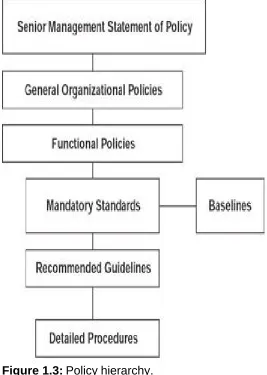
When we refer to specific polices, rather than a group “policy,” we are generally referring to those policies that are distinct from the standards, procedures, and guidelines. As you can see from the Policy Hierarchy chart shown in Figure 1.3, policies are considered the first and highest level of documentation, from which the lower level elements of standards, procedures, and guidelines flow. This order, however, does not mean that policies are more important than the lower elements. These higher level policies, which are the more general policies and statements, should be created first in the process for strategic reasons, and then the more tactical elements can follow.
Figure 1.3: Policy hierarchy.
Senior Management Statement of Policy. The first policy of any policy creation process is the Senior Management Statement of Policy. This is a general, high-level statement of a policy that contains the following elements:
§ An acknowledgment of the importance of the computing resources to the business model
§ A statement of support for information security throughout the enterprise
§ A commitment to authorize and manage the definition of the lower level standards, procedures, and guidelines
Senior Management Commitment
of the importance of security implementation to preserve the organization’s viability (and for their own “Due Care” protection), and must publicly support that process throughout the enterprise.
Regulatory. Regulatory policies are security policies that an organization is required to implement, due to compliance, regulation, or other legal requirements. These companies may be financial institutions, public utilities, or some other type of organization that operates in the public interest. These policies are usually very detailed and are specific to the industry in which the organization operates.
Regulatory polices commonly have two main purposes:
1. To ensure that an organization is following the standard procedures or base practices of operation in its specific industry.
2. To give an organization the confidence that they are following the standard and accepted industry policy.
Advisory. Advisory policies are security polices that are not mandated to be followed, but are strongly suggested, perhaps with serious consequences defined for failure to follow them (such as termination, a job action warning, and so forth). A company with such policies wants most employees to consider these policies mandatory. Most policies fall under this broad category.
These policies can have many exclusions or application levels. Thus, some employees can be more controlled by these policies than others, according to their roles and responsibilities within that organization. For example, a policy that requires a certain procedure for transaction processing may allow for an alternative procedure under certain, specified conditions.
Informative. Informative policies are policies that exist simply to inform the reader. There are no implied or specified requirements, and the audience for this information could be certain internal (within the organization) or external parties. This does not mean that the policies are authorized for public consumption, but that they are general enough to be distributed to external parties (vendors accessing an extranet, for example) without a loss of confidentiality.
However, penalties may be defined for the failure to follow a policy, such as the failure to follow a defined authorization procedure without stating what that policy is, and then referring the reader to another more detailed and confidential policy.
Standards, Guidelines, and Procedures
The next level down from policies is the three elements of policy implementation —
standards, guidelines, and procedures. These three elements contain the actual details of the policy, such as how they should be implemented, and what standards and procedures should be used. They are published throughout the organization via manuals, the intranet, handbooks, or awareness classes.
It is important to know that standards, guidelines, and procedures are separate, yet linked, documents from the general polices (especially the senior-level statement). Unfortunately, companies will often create one document that satisfies the needs of all of these elements; this is not good. There are a few good reasons why they should be kept separate:
§ Each one of these elements serves a different function, and focuses on a different audience. Also, physical distribution of the policies is easier.
investors, but the procedures for changing passwords should not be available to anyone that is not authorized to perform the task.
§ Updating and maintaining the policy is much more difficult when all the policies are combined into one voluminous document. Mergers, routine maintenance, and infrastructure changes all require that the policies be routinely updated. A modular approach to a policy document will keep the revision time and costs down.
Standards. Standards specify the use of specific technologies in a uniform way. This standardization of operating procedures can be a benefit to an organization by specifying the uniform methodologies to be used for the security controls. Standards are usually compulsory and are implemented throughout an organization for uniformity. Guidelines. Guidelines are similar to standards — they refer to the methodologies of securing systems, but they are recommended actions only, and are not compulsory. Guidelines are more flexible than standards, and take into consideration the varying nature of the information systems. Guidelines may be used to specify the way standards should be developed, for example, or to guarantee the adherence to general security principles. The Rainbow series, described in Appendix B, and the Common Criteria, discussed in Appendix G, are considered guidelines.
Procedures. Procedures embody the detailed steps that are followed to perform a specific task. Procedures are the detailed actions that personnel are required to follow. They are considered the lowest level in the policy chain. Their purpose is to provide the detailed steps for implementing the policies, standards, and guidelines, which were previously created. Practices is also a term that is frequently used in reference to procedures.
Baselines. We mention baselines here because they are similar to standards, yet are a little different. Once a consistent set of baselines has been created, the security architecture of an organization can be designed, and standards can then be developed. Baselines take into consideration the difference between various operating systems, for example, to assure that the security is being uniformly implemented throughout the enterprise. If adopted by the organization, baselines are compulsory.
Roles and Responsibilities
The phrase “roles and responsibilities” pops up quite frequently in InfoSec. InfoSec controls are often defined by the job or role an employee plays in an organization. Each of these roles has data security rights and responsibilities. Roles and responsibilities are central to the “separation of duties” concept — the concept that security is enhanced through the division of responsibilities in the production cycle. It is important that individual roles and responsibilities are clearly communicated and understood (see Table 1.2).
Table 1.2: Roles and Responsibilities
Role Description
Senior Manager Has the ultimate responsibility for security. InfoSec Officer Has the functional responsibility for security. Owner Determines the data classification.
Table 1.2: Roles and Responsibilities
Role Description
User/Operator Performs IAW the stated policies. Auditor Examines security.
All of the following concepts are fully defined in Chapter 6, “Operations Security,” but we discuss them briefly here:
Senior Management. Executive or senior-level management is assigned the overall responsibility for the security of information. Senior management may delegate the function of security, but they are viewed as the end of the food chain when liability is concerned.
Information Systems Security Professionals. Information systems security professionals are delegated the responsibility for implementing and maintaining security by the senior-level management. Their duties include the design, implementation, management, and review of the organization’s security policy, standards, guidelines, and procedures.
Data Owners. Previously discussed in the section titled “Information Classification Roles,” data owners are primarily responsible for determining the data’s sensitivity or classification levels. They can also be responsible for maintaining the information’s accuracy and integrity.
Users. Previously discussed in the section titled “Information Classification Roles,” users are responsible for following the procedures, which are set out in the organization’s security policy, during the course of their normal daily tasks.
Information Systems Auditors. Information systems auditors are responsible for providing reports to the senior management on the effectiveness of the security controls by conducting regular, independent audits. They also examine whether the security policies, standards, guidelines, and procedures are effectively complying with the company’s stated security objectives.
Risk Management
A major component of InfoSec is Risk Management (RM). Risk Management’s main function is to mitigate risk. Mitigating risk means to reduce the risk until it reaches a level that is acceptable to an organization. Risk Management can be defined as the identification, analysis, control, and minimization of loss that is associated with events. The identification of risk to an organization entails defining the four following basic elements:
§The actual threat
§The possible consequences of the realized threat
§The probable frequency of the occurrence of a threat
§The extent of how confident we are that the threat will happen
Risk Management tries as much as possible to see the future and to lower the possibility of threats impacting a company.
Note Mitigating Risk
It’s important to remember that the risk to an enterprise can never be totally eliminated — that would entail ceasing operations. Risk Mitigation means finding out what level of risk the enterprise can safely tolerate and still continue to function effectively.
Principles of Risk Management
The Risk Management task process has several elements, primarily including the following:
§ Performing a Risk Analysis, including the cost benefit analysis of protections
§ Implementing, reviewing, and maintaining protections
To enable this process, some properties of the various elements will need to be determined, such as the value of assets, threats, and vulnerabilities, and the likelihood of events. A primary part of the RM process is assigning values to threats, and estimating how often, or likely, that threat will occur. To do this, several formulas and terms have been developed, and the CISSP candidate must fully understand them. The terms and definitions listed in the following section are ranked in the order that they are defined during the Risk Analysis (RA).
The Purpose of Risk Analysis
The main purpose of performing a Risk Analysis is to quantify the impact of potential threats — to put a price or value on the cost of a lost business functionality. The two main results of a Risk Analysis — the identification of risks and the cost/benefit justification of the countermeasures — are vitally important to the creation of a risk mitigation strategy.
There are several benefits to performing a Risk Analysis. It creates a clear cost-to-value ratio for security protections. It also influences the decision-making process dealing with hardware configuration and software systems design. In addition, it also helps a company to focus its security resources where they are needed most. Furthermore, it can influence planning and construction decisions, such as site selection and building design.
Terms and Definitions
The following are RA terms that the CISSP candidate will need to know. Asset
An asset is a resource, process, product, computing infrastructure, and so forth that an organization has determined must be protected. The loss of the asset could affect C.I.A., confidentiality, integrity, availability, overall or it could have a discrete dollar value — it could be tangible or intangible. It could also affect the full ability of an organization to continue in business. The value of an asset is composed of all of the elements that are related to that asset — its creation, development, support, replacement, public credibility, considered costs, and ownership values.
Simply put, the presence of any potential event that causes an undesirable impact on the organization is called a threat. As we will discuss in the Operations Domain, a threat could be man-made or natural, and have a small or large effect on a company’s security or viability.
Vulnerability
The absence or weakness of a safeguard constitutes a vulnerability. A minor threat has the potential to become a greater threat, or a more frequent threat, because of a vulnerability. Think of a vulnerability as the threat that gets through a safeguard into the system.
Combined with the terms asset and threat, vulnerability is the third part of an element that is called a triple in risk management.
Safeguard
A safeguard is the control or countermeasure employed to reduce the risk associated
with a specific threat, or group of threats. Exposure Factor (EF)
The EF represents the percentage of loss a realized threat event would have on a specific asset. This value is necessary to compute the Single Loss Expectancy (SLE), which in turn is necessary to compute the Annualized Loss Expectancy (ALE). The EF can be a small percentage, such as the effect of a loss of some hardware, or a very large percentage, such as the catastrophic loss of all computing resources.
Single Loss Expectancy (SLE)
An SLE is the dollar figure that is assigned to a single event. It represents an organization’s loss from a single threat. It is derived from the following formula:
Asset Value ($) x Exposure Factor (EF) = SLE
For example, an asset valued at $100,000 that is subjected to an exposure factor of 30 percent would yield an SLE of $30,000. While this figure is primarily defined in order to create the Annualized Loss Expectancy (ALE), it is occasionally used by itself to describe a disastrous event for a Business Impact Assessment (BIA).
Annualized Rate of Occurrence (ARO)
The ARO is a number that represents the estimated frequency in which a threat is expected to occur. The range for this value can be from 0.0 (never) to a large number (for minor threats, such as misspellings of names in data entry). How this number is derived can be very complicated. It is usually created based upon the likelihood of the event and number of employees that could make that error occur. The loss inc urred by this event is not a concern here, only how often it does occur.
For example, a meteorite damaging the data center could be estimated to occur only once every 100,000 years, and will have an ARO of .00001. Whereas 100 data entry operators attempting an unauthorized access attempt could be estimated at six times a year per operator, and will have an ARO of 600.
Annualized Loss Expectancy (ALE)
The ALE, a dollar value, is derived from the following formula:
Single Loss Expectancy (SLE) x Annualized Rate of Occurrence (ARO) = ALE
derived from the asset value and the Exposure Factor (EF). Table 1.3 shows these formulas.
Table 1.3: Risk Analysis Formulas
Concept Derivation Formula
Exposure Factor (EF) % of asset loss caused by threat.
Single Loss Expectancy (SLE) Asset Value x Exposure Factor (EF).
Annualized Rate of Occurrence (ARO) Frequency of threat occurrence per year.
Annualized Loss Expectancy (ALE) Single Loss Expectancy (SLE) x Annualized Rate of Occurrence (ARO).
Overview of Risk Analysis
We will now discuss the four basic elements of the Risk Analysis process: 1. Quantitative Risk Analysis
2. Qualitative Risk Analysis 3. Asset Valuation Process 4. Safeguard Selection
Quantitative Risk Analysis
The difference between quantitative and qualitative RA is fairly simple: Quantitative RA attempts to assign independently objective numeric values (hard dollars, for example) to the components of the risk assessment and to the assessment of potential losses. Qualitative RA addresses more intangible values of a data loss, and focuses on the other issues, rather than the pure hard costs.
When all elements (asset value, impact, threat frequency, safeguard effectiveness, safeguard costs, uncertainty, and probability) are measured, rated, and assigned values, the process is considered to be fully quantitative. However, fully quantitative risk analysis is not possible because qualitative measures must be applied. Thus, the reader should be aware that just because the figures look hard on paper does not mean it is possible to foretell the future with any certainty.
A quantitative risk analysis process is a major project, and as such it requires a project or program manager to manage the main elements of the analysis. A major part of the initial planning for the quantitative RA is the estimation of the time required to perform the analysis. In addition, a detailed process plan must also be created, and roles must be assigned to the RA team.
Preliminary Security Examination (PSE). A PSE is often conducted before the actual quantitative RA. The PSE helps to gather the elements that will be needed when the actual RA takes place. A PSE also helps to focus an RA. Elements that are defined during this phase include asset costs and values, a listing of various threats to an organization (in terms of threats to both the personnel and the environment), and documentation of the existing security measures. The PSE is normally then subject to a review by an organization’s management before the RA begins.
There are several good automated risk analysis products on the market. The main objectives of these products is to minimize the manual effort that must be expended to create the risk analysis and to provide a company with the ability to forecast its expected losses quickly with different input variations. The creation of a database during an initial automated process enables the operator to rerun the analysis using different parameters—to create a what if scenario. These products enable the users to perform calculations quickly in order to estimate future expected losses, thereby determining the benefit of their implemented safeguards.
Risk Analysis Steps
The three primary steps in performing a risk analysis are similar to the steps in performing a Business Impact Assessment (see Chapter 6, “Operations Security”). However, a risk analysis is commonly much more comprehensive and is designed to be used to quantify complicated, multiple-risk scenarios.
The three primary steps are as follows:
1. Estimate the potential losses to assets by determining their value. 2. Analyze potential threats to the assets.
3. Define the Annualized Loss Expectancy (ALE). Estimate Potential Losses
To estimate the potential losses incurred during the realization of a threat, the assets must be valued by commonly using some sort of standard asset valuation process (this is described in more detail later). This results in an assignment of an asset’s financial value by performing the EF and the SLE calculations.
Analyze Potential Threats
Here we determine what the threats are, and how likely and often they are to occur. To define the threats, we must also understand the asset’s vulnerabilities and perform an ARO calculation for the threat and vulnerabilities.
All types of threats should be considered in this section, no matter if they seem likely or not. It is may be helpful to organize the threat listing into the types of threats by source, or by their expected magnitude. In fact, some organizations can provide statistics on the frequency of various threats that occur in your area. In addition, the other domains of InfoSec discussed in this book have several varied listings of the categories of threats.
Some of the following categories of threats could be included in this section.
Data Classification. Data aggregation or concentration that results in data inference, covert channel manipulation, a malicious code/virus/Trojan horse/worm/logic bomb, or a concentration of responsibilities (lack of separation of duties)
Information Warfare. Technology-oriented terrorism, malicious code or logic, or emanation interception for military or economic espionage
Personnel. Unauthorized or uncontrolled system access, the misuse of technology by authorized users, tampering by disgruntled employees, or falsified data input
Application/Operational. Ineffective security application that results in procedural errors or incorrect data entry
Criminal. Physical destruction or vandalism, the theft of assets or information, organized insider theft, armed robbery, or physical harm to personnel
Computer Infrastructure. Hardware/equipment failure, program errors, operating system flaws, or a communications system failure
Delayed Processing. Reduced productivity or a delayed funds collection that results in reduced income, increased expenses, or late charges
Define the Annualized Loss Expectancy (ALE)
Once the SLE and ARO have been determined, we can estimate the ALE using the formula we previously described.
Results
After performing the Risk Analysis, the final results should contain the following:
§ Valuations of the critical assets in hard costs
§ A detailed listing of significant threats
§ Each threat’s likelihood and its possible occurrence rate
§ Loss potential by a threat — the dollar impact the threat will have on an asset
§ Recommended remedial measures and safeguards or countermeasures Remedies
There are three generic remedies to risk, which may take the form of either one or a combination of the following three:
§ Risk Reduction. Taking measures to alter or improve the risk position of an asset throughout the company
§ Risk Transference. Assigning or transferring the potential cost of a loss to another party (like an insurance company)
§ Risk Acceptance. Accepting the level of loss that will occur, and
absorbing that loss
The remedy chosen will usually be the one that results in the greatest risk reduction, while retaining the lowest annual cost necessary to maintain a company.
Qualitative Risk Analysis
As we mentioned previously, a qualitative RA does not attempt to assign hard and fast costs to the elements of the loss. It is more scenario-oriented, and, as opposed to a quantitative RA, a purely qualitative risk analysis is possible. Threat frequency and impact data is required to do a qualitative RA, however.
In a qualitative risk assessment, the seriousness of threats and the relative sensitivity of the assets are given a ranking, or qualitative grading, by using a scenario approach, and creating an exposure rating scale for each scenario.
During a scenario description, we match various threats to identified assets. A scenario describes the type of threat and the potential loss to which assets, and selects the safeguards to mitigate the risk.
Qualitative Scenario Procedure
After the threat listing has been created, the assets for protection have been defined, and an exposure level rating is assigned, the qualitative risk assessment scenario begins. See Table 1.4 for a simple exposure rating scale.
Rating Level Exposure Percentage Blank or 0 No measurable loss
1 20% loss
2 40% loss
3 60% loss
4 80% loss
5 100% loss
The procedures in performing the scenario are as follows:
§ A scenario is written that addresses each major threat.
§ The scenario is reviewed by business unit managers for a reality check.
§ The RA team recommends and evaluates the various safeguards for each threat.
§ The RA team works through each finalized scenario using a threat, asset, and safeguard.
§ The team prepares their findings and submits them to management.
After the scenarios have all been played out and the findings are published, management must implement the safeguards that were selected as being acceptable, and begin to seek alternatives for the safeguards that did not work.
Asset Valuation Process
There are several elements of a process that determine the value of an asset. Both quantitative and qualitative RA (and Business Impact Assessment) procedures require a valuation made of the asset’s worth to the organization. This valuation is a fundamental step in all security auditing methodologies. A common universal mistake made by organizations is not accurately identifying the information’s value before implementing the security controls. This often results in a control that either is ill-suited for asset protection, not financially effective, or it protects the wrong asset. Table 1.5 discusses quantitative versus qualitative RA.
Table 1.5: Quantitative vs. Qualitative RA
Property Quantitative Qualitative
Cost/benefit analysis Yes No
Financial hard costs Yes No
Can be automated Yes No
Guesswork involved Low High
Complex calculations Yes No
Volume of information required High Low
Time/work involved High Low
Ease of communication High Low