COMPUTER SECURITY
AND CRYPTOGRAPHY
COMPUTER SECURITY
AND CRYPTOGRAPHY
In the fifteenth century, cryptography became more sophisticated and cryptographers proposed using multiple cipher alphabets, a process referred to aspolyalphabeticsubstitution. Blaise de Vigene`re’s bookA Treatise on
Secret Writingpublished in the sixteenth century contains the basicVigene`re tableux, specifying the ciphertext
in polyalphabetic substitution. Rotor machines introduced in the 20th-century provided mechanical means for implementing and speeding up polyalphabetic substitution.
The cover is amodifiedset of 17 cipher alphabets; the black background color is symbolic of the U.S. State Department’sBlack Chamberin which American cryptanalysis originated in the early part of the 20th-century. It is technically defective in several aspects (i) fewer than 26 letters in each row are displayed and (ii) repeated letters occur in the rows containing the wordCRYPTOGRAPHYand my name.
Nevertheless, the cover hopefully projects the message to readComputer Security and Cryptography.
Copyright#2007 by John Wiley & Sons, Inc. All rights reserved Published by John Wiley & Sons, Inc., Hoboken, New Jersey Published simultaneously in Canada
No part of this publication may be reproduced, stored in a retrieval system, or transmitted in any form or by any means, electronic, mechanical, photocopying, recording, scanning, or otherwise, except as permitted under Section 107 or 108 of the 1976 United States Copyright Act, without either the prior written permission of the Publisher, or authorization through payment of the appropriate per-copy fee to the Copyright Clearance Center, Inc., 222 Rosewood Drive, Danvers, MA 01923, (978) 750-8400, fax (978) 750-4470, or on the web at www.copyright.com. Requests to the Publisher for permission should be addressed to the Permissions Department, John Wiley & Sons, Inc., 111 River Street, Hoboken, NJ 07030, (201) 748-6011, fax (201) 748-6008, or online at http://www.wiley.com/go/permission.
Limit of Liability/Disclaimer of Warranty: While the publisher and author have used their best efforts in preparing this book, they make no representations or warranties with respect to the accuracy or completeness of the contents of this book and specifically disclaim any implied warranties of merchantability or fitness for a particular purpose. No warranty may be created or extended by sales representatives or written sales materials. The advice and strategies contained herein may not be suitable for your situation. You should consult with a professional where appropriate. Neither the publisher nor author shall be liable for any loss of profit or any other commercial damages, including but not limited to special, incidental, consequential, or other damages.
For general information on our other products and services or for technical support, please contact our Customer Care Department within the United States at (800) 762-2974, outside the United States at (317) 572-3993 or fax (317) 572-4002.
Wiley also publishes its books in a variety of electronic formats. Some content that appears in print may not be available in electronic formats. For more information about Wiley products, visit our web site at www.wiley.com.
Library of Congress Cataloging-in-Publication Data: Konheim, Alan G., 1934 –
Computer security & cryptography / by Alan G. Konheim. p. cm.
Includes bibliographical references and index. ISBN-13: 978-0-471-94783-7
ISBN-10: 0-471-94783-0
1. Computer security. 2. Cryptography. I. Title. QA76.9.A25K638 2007
005.8--dc22 2006049338
CONTENTS
FOREWORD ix
PREFACE xi
ABOUT THE AUTHOR xvii
CHAPTER 1 APERITIFS
1.1 The Lexicon of Cryptography 1 1.2 Cryptographic Systems 4 1.3 Cryptanalysis 4 1.4 Side Information 6 1.5 Thomas Jefferson and the M-94 6 1.6 Cryptography and History 7 1.7 Cryptography and Computers 8 1.8 The National Security Agency 9 1.9 The Giants 10 1.10 No Sex, Money, Crime or. . .Love 12 1.11 An Example of the Inference Process
in Cryptanalysis 13
1.12 Warning! 15
CHAPTER 2 COLUMNAR TRANSPOSITION
2.1 Shannon’s Classification of Secrecy
Transformations 18 2.2 The Rules of Columnar Transposition
Encipherment 18
2.3 Cribbing 21
2.4 Examples of Cribbing 25 2.5 Plaintext Language Models 30 2.6 Counting k-Grams 33 2.7 Deriving the Parameters of a Markov
Model from Sliding Window Counts 34 2.8 Markov Scoring 34 2.9 The ADFGVX Transposition System 47
2.10 CODA 49
2.11 Columnar Transposition Problems 50
CHAPTER 3 MONOALPHABETIC
SUBSTITUTION
3.1 Monoalphabetic Substitution 63 3.2 Caesar’s Cipher 65 3.3 Cribbing Using Isomorphs 66
3.4 Thex2-Test of a Hypothesis 67 3.5 Pruning from the Table of Isomorphs 68 3.6 Partial Maximum Likelihood Estimation
of a Monoalphabetic Substitution 73 3.7 The Hidden Markov Model (HMM) 78 3.8 Hill Encipherment of ASCIIN-Grams 90 3.9 Gaussian Elimination 102 3.10 Monoalphabetic Substitution Problems 111
CHAPTER 4 POLYALPHABETIC
SUBSTITUTION
4.1 Running Keys 116 4.2 Blaise de Vigene`re 117 4.3 Gilbert S. Vernam 117 4.4 The One-Time Pad 119 4.5 Finding the Key of Vernam – Vigene`re
Ciphertext with Known Period by
Correlation 120 4.6 Coincidence 124
4.7 Venona 127
4.8 Polyalphabetic Substitution
Problems 132
CHAPTER 5 STATISTICAL TESTS
5.1 Weaknesses in a Cryptosystem 136 5.2 The Kolmogorov – Smirnov Test 136 5.3 NIST’s Proposed Statistical Tests 138 5.4 Diagnosis 139 5.5 Statistical Tests Problems 143
CHAPTER 6 THE EMERGENCE OF CIPHER
MACHINES
6.1 The Rotor 150 6.2 Rotor Systems 152 6.3 Rotor Patents 153 6.4 A Characteristic Property of Conjugacy 155 6.5 Analysis of a 1-Rotor System:
Ciphertext Only 156 6.6 The Displacement Sequence of a
Permutation 158 6.7 Arthur Scherbius 160
6.8 Enigma Key Distribution Protocol 163 6.9 Cryptanalysis of the Enigma 166 6.10 Cribbing Enigma Ciphertext 167 6.11 The Lorenz Schlu¨sselzusatz 170 6.12 The SZ40 Pin Wheels 171 6.13 SZ40 Cryptanalysis Problems 175 6.14 Cribbing SZ40 Ciphertext 176
CHAPTER 7 THE JAPANESE CIPHER
MACHINES
7.1 Japanese Signaling Conventions 191 7.2 Half-Rotors 191 7.3 Components of the RED Machine 193 7.4 Cribbing RED Ciphertext 200 7.5 Generalized Vowels and Consonants 209 7.6 “Climb Mount Itaka” – War! 210 7.7 Components of the PURPLE Machine 211 7.8 The PURPLE Keys 217 7.9 Cribbing PURPLE: Finding the V-Stepper 219 7.10 Cribbing PURPLE: Finding the
C-Steppers 238
CHAPTER 8 STREAM CIPHERS
8.1 Stream Ciphers 244 8.2 Feedback Shift Registers 244 8.3 The Algebra of Polynomials overZZ2 247 8.4 The Characteristic Polynomial of a
Linear Feedback Shift Register 251 8.5 Properties of Maximal Length LFSR
Sequences 254
8.6 Linear Equivalence 258 8.7 Combining Multiple Linear Feedback
Shift Registers 259 8.8 Matrix Representation of the LFSR 260 8.9 Cribbing of Stream Enciphered ASCII
Plaintext 261
8.10 Nonlinear Feedback Shift Registers 271 8.11 Nonlinear Key Stream Generation 273 8.12 Irregular Clocking 275
8.13 RC4 278
8.14 Stream Encipherment Problems 281
CHAPTER 9 BLOCK-CIPHERS: LUCIFER,
DES, AND AES
9.1 LUCIFER 283
9.2 DES 288
9.3 The DES S-Boxes, P-Box, and Initial Permutation (IP) 289 9.4 DES Key Schedule 292 9.5 Sample DES Encipherment 294
9.6 Chaining 295
9.7 Is DES a Random Mapping? 297 9.8 DES in the Output-Feedback Mode (OFB) 299 9.9 Cryptanalysis of DES 300 9.10 Differential Cryptanalysis 302 9.11 The EFS DES-Cracker 308 9.12 What Now? 311 9.13 The Future Advanced Data Encryption
Standard 312
9.14 And the Winner Is! 312 9.15 The Rijndael Operations 314 9.16 The Rijndael Cipher 323 9.17 Rijndael’s Strength: Propagation of
Patterns 323
9.18 When is a Product Block-Cipher Secure? 326 9.19 Generating the Symmetric Group 327 9.20 A Class of Block Ciphers 329 9.21 The IDEA Block Cipher 332
CHAPTER 10 THE PARADIGM OF
PUBLIC KEY CRYPTOGRAPHY
10.1 In the Beginning. . . 334 10.2 Key Distribution 335 10.3 E-Commerce 336 10.4 Public-Key Cryptosystems:
Easy and Hard Computational Problems 337 10.5 Do PKCSSolve the Problem
of Key Distribution? 341
10.6 P.S. 342
CHAPTER 11 THE KNAPSACK
CRYPTOSYSTEM
11.1 Subset Sum and Knapsack Problems 344 11.2 Modular Arithmetic and
the Euclidean Algorithm 346 11.3 A Modular Arithmetic
Knapsack Problem 350 11.4 Trap-Door Knapsacks 350 11.5 Knapsack Encipherment and
Decipherment of ASCII-Plaintext 355 11.6 Cryptanalysis of the Merkle–Hellman
Knapsack System (Modular Mapping) 358 11.7 Diophantine Approximation 364 11.8 Short Vectors in a Lattice 368 11.9 Knapsack-Like Cryptosystems 371 11.10 Knapsack Cryptosystem Problems 371
CHAPTER 12 THE RSA CRYPTOSYSTEM
12.1 A Short Number-Theoretic Digression 376
12.2 RSA 378
12.3 The RSA Encipherment and
12.4 Attack on RSA 382 12.5 Williams Variation of RSA 383 12.6 Multiprecision Modular Arithmetic 387
CHAPTER 13 PRIME NUMBERS AND
FACTORIZATION
13.1 Number Theory and Cryptography 390 13.2 Prime Numbers and the Sieve of
Eratosthenes 390 13.3 Pollard’sp21 Method 391 13.4 Pollard’sr-Algorithm 394 13.5 Quadratic Residues 396 13.6 Random Factorization 401 13.7 The Quadratic Sieve (QS) 403 13.8 Testing if an Integer is a Prime 405 13.9 The RSA Challenge 407 13.10 Perfect Numbers and the
Mersenne Primes 408 13.11 Multiprecision Arithmetic 409 13.12 Prime Number Testing and
Factorization Problems 410
CHAPTER 14 THE DISCRETE LOGARITHM
PROBLEM
14.1 The Discrete Logarithm Problem
Modulop 414
14.2 Solution of the DLP ModulopGiven a Factorization ofp21 415 14.3 Adelman’s Subexponential Algorithm
for the Discrete Logarithm Problem 419 14.4 The Baby-Step, Giant-Step
Algorithm 420
14.5 The Index-Calculus Method 420 14.6 Pollard’sr-Algorithm 424 14.7 Extension Fields 426 14.8 The Current State of Discrete
Logarithm Research 428
CHAPTER 15 ELLIPTIC CURVE CRYPTOGRAPHY
15.1 Elliptic Curves 429 15.2 The Elliptic Group over the Reals 431 15.3 Lenstra’s Factorization Algorithm 432 15.4 The Elliptic Group overZp(p.3) 434
15.5 Elliptic Groups over the FieldZm,2 436
15.6 Computations in the Elliptic Group
EZm,2(a,b) 438
15.7 Supersingular Elliptic Curves 441 15.8 Diffie – Hellman Key Exchange Using
an Elliptic Curve 442 15.9 The Menezes – Vanstone Elliptic
Curve Cryptosystem 443
15.10 The Elliptic Curve Digital Signature
Algorithm 444
15.11 The Certicom Challenge 445 15.12 NSA and Elliptic Curve Cryptography 445
CHAPTER 16 KEY EXCHANGE IN A NETWORK
16.1 Key Distribution in a Network 447 16.2 U.S. Patent ’770 448
16.3 Spoofing 448
16.4 El Gamal’s Extension of
Diffie–Hellman 450 16.5 Shamir’s Autonomous Key Exchange 451 16.6 X9.17 Key Exchange Architecture 453 16.7 The Needham – Schroeder Key
Distribution Protocol 456
CHAPTER 17 DIGITAL SIGNATURES AND
AUTHENTICATION
17.1 The Need for Signatures 464 17.2 Threats to Network Transactions 465 17.3 Secrecy, Digital Signatures, and
Authentication 465 17.4 The Desiderata of a Digital
Signature 466
17.5 Public-Key Cryptography and
Signature Systems 467 17.6 Rabin’s Quadratic Residue
Signature Protocol 468 17.7 Hash Functions 470
17.8 MD5 471
17.9 The Secure Hash Algorithm 473 17.10 NIST’s Digital Signature
Algorithm 474
17.11 El Gamal’s Signature Protocol 475 17.12 The Fiat – Shamir Identification and
Signature Schema 476 17.13 The Oblivious Transfer 478
CHAPTER 18 APPLICATIONS OF
CRYPTOGRAPHY
18.1 UNIX Password Encipherment 480 18.2 Magnetic Stripe Technology 482 18.3 Protecting ATM Transactions 484 18.4 Keyed-Access Cards 491 18.5 Smart Cards 491 18.6 Who Can You Trust?: Kohnfelder’s
Certificates 495 18.7 X.509 Certificates 495 18.8 The Secure Socket Layer (SSL) 497 18.9 Making a Secure Credit Card
Payment on the Web 502
CHAPTER 19 CRYPTOGRAPHIC PATENTS
19.1 What is a Patent? 506 19.2 Patentability of Ideas 507 19.3 The Format of a Patent 507 19.4 Patentable versus Nonpatentable
Subjects 508
19.5 Infringement 509 19.6 The Role of Patents in
Cryptography 509
19.7 U.S. Patent 3,543,904 509 19.8 U.S. Patent 4,200,770 511 19.9 U.S. Patent 4,218,582 512 19.10 U.S. Patent 4,405,829 512 19.11 PKS/RSADSI Litigation 514 19.12 Leon Stambler 514
FOREWORD
I
t’s not easy being a writer on cryptology. Actually, it’s not easy being a writer. You have to think about what subjects you want to cover. Then you have to decide in what order you want to put them—not so simple, because the most logical progression isn’t always the best for teaching. Then comes the worst part: You actually have to cover a blank screen or sheet of paper with letters and figures that make sense.Alan Konheim has sweated through it many times. He has written a number of tech-nical articles, which demonstrates that he has mastered the techtech-nicalities of his subject. And he has passed through the fire of book authorship once before, in his acclaimed Cryp-tography: A Primer. In the years that followed, he has learned what worked in that book and what didn’t, and has applied those lessons in the present work. The result is a fine amalgam of scholarship and pedagogy.
But if the elements of writing—clarity and concision—have remained the same, cryptology has not. For centuries, it was axiomatic that both en- and decipherer had to have the same key, though used inversely. The invention of public-key cryptography abol-ished that axiom. It has transformed and energized the practical applications of crypto-graphy. Many of these remain grounded in the classical, or symmetric, systems of cryptography. And the enormous expansion of communications has driven its child, secret communications, into vast new fields. Once the exclusive domain of soldiers and dip-lomats and spies, cryptology has become almost ubiquitous. People use it without knowing that they are doing so. Every time a person uses an automatic teller machine, his or her trans-action is encrypted. So are online bank transtrans-actions. Whenever anyone sends his or her credit card number securely to, say, E-bay or Amazon, he or she is using cryptography.
And the field has emerged from the shadows, The National Security Agency, once so secret that it was referred to as “No Such Agency,” is now mentioned in movies and on the evening news almost without any identification, just as the CIA and FBI are. The post-9/ 11 flap over the Bush administration’s warrantless wiretapping has further brought crypto-logy, the NSA, and privacy into the open. The International Association for Cryptologic Research publishes itsJournal of Cryptologyfour times a year. The aura of mysticism that long enshrouded it has been dispelled by the cold logic of mathematics that now dominates it. Alan Konheim knows all about this because he worked for IBM when it was a leader in the field of cryptology and because he has kept up with new developments, as his many technical articles demonstrate. His experience in teaching tells him what questions students are likely to ask and what problems in understanding they are likely to encounter. His previous book has taught him how to explain complicated matters effectively. The result is this excellent book, which joins the permanent qualities of its writing to the immediacy of its coverage. Cryptologists—beginners and veterans alike—will welcome it. As do I.
Long Island, NewYork DAVIDKAHN
October 2006
PREFACE
NATIONAL SECURITY AND COMPUTER SECURITY
On September 11, 2001, the wordsecuritymoved into the foreground of our national con-sciousness, where it continues to reside today. The presidential election in 2004 was largely decided on the basis of which candidate was perceived to best manage security for the American people. Americans are puzzled about the hatred expressed by certain ideologies and foreign governments about our way of life and culture. The missions of the National Security Agency/Central Security Service (CSS) include both the protection of U.S. communications and the production of foreign intelligence. Although cryptography plays a role in both of these areas, this book is not about either.
This book is about the role of cryptography in our day-to-day lives. Today, there is no activity that does not depend on computers. When there is a power outage in Santa Barbara, I often cannot buy Twinkiesat the supermarket, to my dismay and that of the merchant, but to the delight of my endocrinologist. The use of traveler’s checks has declined because of the convenience and availability of ATM machines. Vast amounts of data are maintained by banks and credit card companies. Stories of their mismanaging customer data appear regularly in the news. Identity theft is well on its way to becoming a flourishing industry. Credit card companies now have the nerve to advertise identity theft insurance to protect the information that they are legally obliged to guard, but fail to do so.
Cryptography has a role to play in many areas. Like seat belts, it will not completely protect us. In the chapters that follow, I will develop the basic ideas about cryptography and then illustrate some of the ways it interacts with and protects us.
WHY STUDY CRYPTOGRAPHY?
There is a symbiotic relationship between cryptography and the development of high-performance computing systems. Modern-day computers were created at the behest of twentieth-century cryptanalysts. As the complexity of cryptographic systems progressed from mechanical to electronic systems, so did the need to develop more efficient methods to cryptanalyze them.
Every cryptosystem, which has a finite number of keys, can usually be analyzed by key trial, deciphering the ciphertext with all possible keys until some recognizable text appears. In many “classical” cryptographic systems, the testing of keys could be performed by hand. The stimulus for the development of computers was the need to be able to test large sets of possible keys to decipher coded traffic. Modern cryptosystems are such that the number of possible keys is generally so large as to make exhaustive key trial infeasible. Even computers are limited, and some analysis must precede key testing for the process to be successful.
The marriage of computing and cryptography provides a marvelous real-life application of mathematics, and develops the inference skills that are fundamental to engineering and science. When a student first views the ciphertext
To-drijohrunurmanpmlgchd-ehapuotp,te-nmabsno-nitioippmbo-a-a sTasm-h-op-ms-vye-m.ikndu-n-atscegnetoin-l-rs-v-e-u-ta-olati s-t-sccw——eorrgdhgngP.r-stenvercenhnerhchoie-nun-sr-tois-rma eaeeadadrssou-o-etat-iefeotifc-m-a——ergua-eiuo-oixeordalmyes
there may be confusion. Word fragments may be detected, but how can the text be recov-ered? After students learn to critically examine the ciphertext, they are often capable of deciphering it. Cryptography teaches students how clever they can be. Of course, instruc-tors should caution their students as the television commercials for ED advise; to wit, if their efforts in cryptanalyzing some ciphertext “last more than four hours, they should seek tutorial assistance.”
Although computer security is certainly a hot topic today, its public discussion is often accompanied by a great deal of hype. People are impressed by cryptosystems with large key spaces and the press releases make liberal use of the termunbreakable. The Kryha machine, a mechanical ciphering machine invented in 1924, had more than 4.571050keys, but it did not offer much secrecy protection. Invoking the lore of large numbers to “prove” the strength of an encipherment scheme often fails to measure the real strength.
This book will provide the tools for understanding the central issues in data security. It will provide an instructor with a wide range of topics to train students to evaluate critically the factors that affect the effectiveness of secrecy, authentication, and digital signature schema, sensitize a student to some of the factors that determine the strength of an algorithm and its protocol implementations, and provide hands-on experience to the student with cryptanalysis.
The book’s goal is to explain the nature of secrecy and the “practical” limitations of cryptography in providing secrecy and its derivatives (authentication and digital signatures).
MY PRIOR ART
Parts ofComputer Security and Cryptographyhave served as the text for CMPSC 178 (Introduction to Cryptography) at UCSB. It is an upper-division elective in the under-graduate program of the Computer Science Department of the University of California (Santa Barbara) from 1983 to 2005. CMPSC 178 is ten-week four-unit course, meeting 75 minutes twice weekly. Class lectures are supplemented by a Discussion Section conducted by a Teaching Assistant. CMPSC 178 is usually taken in the Junior or Senior year by students from the Departments of Computer Science, Electrical and Computer Engineering, and Mathematics. The prerequisites are CMPSC 10 (a Java programming language course), and PSTAT 120A or 121A (an entry-level course in probability and statistics).
A replica of the cover page of my CMPSC 178Readerappears above. One of my colleagues claimed that my New York humor would not be understood by California students. They would fail to grasp the cryptographic significance of the inverted cone. Perhaps, but many apparently watched television late at night and understood.
I dispensed with both an in-class Midterm and Final Examination in 1997 as there is no subject matter that can realistically be tested in class. In its place, I require a Term Paper; the topic is selected by the student and approved by me. The Term Paper is a short report (under 10 pages) on some cryptologic topic, based on related material from at least two related papers. The Term Paper need not contain a single equation nor deal only with theoretical issues. In fact, I encourage students to look for topics that are historical in nature, relate to applications or social issues. The Term Paper must include a summary of the Paper and the student’s evaluation of the Paper’s contributions. The Term Paper is due at the last class session. I provide a list of reference material, but the Web provides a more extensive source of topics and material.
Except for the introductory material, a solid mathematical background is needed, including probability theory and statistics. Much of modern cryptography depends on the fundamentals of number theory, but most engineering and computer science students do not enter with such preparation. If this material was imposed as a prerequisite, the potential audience would be reduced, so I develop the relevant mathematical topics in the course.
The Course Syllabus, distributed in class at the first lecture, is perhaps an exaggeration of the course’s scope.
1. Aperitifs – Overview of Cryptography 11. The Knapsack Cryptosystem 2. Columnar Transposition 12. The RSA Cryptosystem 3. Monoalphabetic Substitution 13. Primality and Factorization 4. Polyalphabetic Substitution 14. The Discrete Logarithm Problem 5. Statistical Tests 15. Elliptic Curve Cryptography 6. Rotor Encipherment 16. Key Exchange in a Network 7. The World War II Cipher Machines 17. Digital Signatures & Authentication
8. Stream Ciphers (LFSR, Cellphone) 18. Applications (ATM, Access Control, the Web) 9. The NIST Encryption Standards 19. Patents in Cryptography
10. The Paradigm of Public Key Cryptography
Computer Security and Cryptographyis an expanded version of the CMPSC 178Reader, modified to make it appropriate for a wider audience. The Instructor should choose the topics that match his/her interests and those of the class.
ORGANIZATION OF THE BOOK
There are three types of chapters in this book:
1. Those that develop technical details;
2. Those that describe a cryptosystem and possibly indicate method(s) of analysis; and
3. Those that describe a cryptosystem, indicate method(s) of analysis, and provide problems to test the students understanding; these are signalled withS.
Classical Cryptography
1. Aperitifs
2. Columnar TranspositionS
3. Monoalphabetic Substitution
(a) Cribbing and Scoring a Monoalphabetic SubstitutionS
(b) Hill SubstitutionS
(c) The Hidden Markov Model
4. Polyalphabetic SubstitutionS
5. Statistical TestsS
World War II Cryptography
6. Emergence of the Cipher Machine
(a) The German Enigma Machine
(b) The Lorenz Schlusselzusatz
7. The Japanese Cipher Machines
(a) The Japanese RED Machine
(b) The Japanese PURPLE Machine
Modern Cryptography
8. Stream CiphersS
9. The NIST Encryption Standards
(a) LUCIFER
(b) DES
(c) Rijndael (AES)
(d) Design of Block Ciphers
10. The Paradigm of Public Key Cryptography
11. The Knapsack CryptosystemS
13. Prime Numbers and Integer FactorizationS
14. The Discrete Logarithm Problem
15. Elliptic Curve Cryptography
16. Key Exchange in a NetworkS
17. Digital Signatures and Authentication
18. Applications of Cryptography
(a) Unix Password
(b) ATM Cards
(c) Secure Access and Smart Cards
(d) Protecting the Web (E-Commerce)
19. Patents in Cryptography
Solutions to Problems
ACKNOWLEDGMENTS
I am in debt to many people, who have helped and encouraged me in the writing of this book:
. My colleague and friend of 46 years, Dr. Roy L. Adler, recently retired from the
Mathematical Sciences Department of the IBM Thomas J. Watson Research Center (Yorktown Heights, New York), who read chapters and provided me with considerable material on the cryptographic work at IBM.
. My colleague and friend of 36 years, Dr. Raymond Pickholtz, Professor Emeritus at George Washington University, who visited UCSB several times, read all of the chapters and provided advice.
. Mr. I. Benjamin Blady and Mrs. Sara Beth Mitchell, who were kind enough to edit Chapter 19 on Patents in Cryptography.
. My son Keith, who helped me with graphics; together with my son Jay, he simplified
my transition from MAC to PC; and my son Seth, who read early chapters and wisely urged me to moderate my wit.
and
. Carol, my wife of nearly 50 years, who continues to amaze me by her wide-ranging talents. I could not have undertaken this book without her encouragement, assistance, and advice.
I have offered CMPSC 178 twenty-one times at UCSB and once each in Australia, Israel, and Hawaii. One benefits from the questions, advice, and criticisms of students. InPenses, Essais, Maximes et Correspondanee de J. Joubert, in 1842, the French philosopher Joseph Joubert wrote
To teach is to learn twice.
Santa Barbara, California ALANG. KONHEIM
April 2006
ABOUT THE AUTHOR
After completing graduate study in 1960, I became a Research Staff Member at the IBM Thomas J. Watson Research Center (Yorktown Heights, New York). During my 22 years in the Department of Mathematical Sciences at IBM, I researched the applications of mathematics in computer science problems.
Starting in the mid-1960s, I became the Manager of the Mathematical Sciences’ cryptography program; in particular, the evaluation of the Data Encryption Standard (DES).
Yearning for the sun, along with my wife Carol, I left IBM Research in 1982 and accepted a position as a professor in the Computer Science Department at the University of California (Santa Barbara). In my 24 years at UCSB, I taught courses in Assembly Language, Performance Evaluation, Computer Networks and Cryptography. I developed CMPSC 178 (Introduction to Cryptography) and offered this course 21 times at UCSB and three times at the Technion (Haifa, Israel), LaTrobe University (Melbourne, Australia) and at the University of Hawaii (Honolulu).
I retired from UCSB on July 1, 2005 to pursue a life of indolence.
Cryptography: A Primerwas published by John Wiley & Sons Inc., in 1981. It might yet be made into a movie.
I spent the summer of 1984 at the National Security Agency (Fort George G. Meade, Maryland), the following three summers at Communications Research Division at the Institute for Defense Analysis (Princeton, New Jersey) and was a consultant at the National Security Agency during the summers 1997 – 1999.
C H A P T E R
1
APERITIFS
“Yet it may be roundly asserted that human ingenuity cannot concoct a cipher that human ingenuity cannot resolve”
— The Gold Bug(Edgar Allan Poe) “It Ain’t Necessarily So”
— Song fromPorgy and Bess(George and Ira Gershwin)1 “Skipper” the sailor said to his captain as he saluted,
“A special message just came in for you from the admiral. I have it right here.” “Read it to me,” the captain ordered.
The sailor began reading nervously, “You are without a doubt the most idiotic, lame-brained officer ever to command a ship in the United States Navy.” “Have that communication decoded at once!,” The skipper responded — Pastor Tim’s Clean Laugh List
1.1 THE LEXICON OF CRYPTOGRAPHY
The word “cryptography” is derived from the Greek wordskryptos, meaning hidden, and gra-phien, meaning to write. Historians believe Egyptian hieroglyphics, which began about 1900 B.C.E., to be an early instance of encipherment. The key that unlocked the hieroglyphic secrets was the Rosetta Stone, discovered in 1799 in lower Egypt and now located in theBritish Museumin London. Franc¸ois Champollion, using the Rosetta Stone, deciphered the hieroglyphics in 1822. The books by David Kahn [1967, 1983] and Simon Singh [1999] provide extensive accounts of cryptography and its influence on history.
Every scientific discipline develops its own lexicon, and cryptography is no exception. We begin with a brief summary of the principal terms used in cryptography.
AnalphabetA ¼{a0,a1,. . .,am1} is a finite set ofletters; examples include
1. m¼2r: (0,1)-sequences of fixed lengthr
Zr,2¼{x¼(x0,x1,. . .,xr1):xi¼0, 1, 0i,r};
2. m¼27: the ASCII character alphabet;
3. m¼26: the alphabet consisting of upper-case Latin letters: {A,B,. . .,Z}
Textis formed by concatenating letters ofA; ann-gram (a0,a1;. . .;an1) is the concatenation ofn letters. We do not require that the text beunderstandablenor that it be grammatically correct relative to anatural language; thus
Good_Morning and vUI_9Uiing8
are both examples of ASCII text.
Computer Security and Cryptography. By Alan G. Konheim
Copyright#2007 John Wiley & Sons, Inc.
Enciphermentorencryptionis a transformation process (Fig. 1.1),Tenciphering the plaintext x¼(x0,x1,. . .,xn1) to theciphertext y¼(y0,y1,. . .,ym1Þ, where
T: Good_Morning!Kssh_Qsvrmrk
is an example of encipherment introduced nearly 2000 years ago by Julius Caesar during the Gallic Wars in order to communicate with his friend and lawyer Marcus Tullius Cicero. It is not necessary that
1. The plaintext and ciphertext alphabets be identical; nor that
2. Encipherment leaves the number of letters unchanged.
The only requirement onTis the obvious one; it must be possible to reverse the process of encipherment.
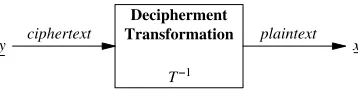
Decipherment, or decryption, is also a transformation, T21 (Fig. 1.2), which recovers the plaintextxfrom the ciphertexty.
T21:Kssh_Qsvrmrk!Good_Morning.
Additional properties are sometimes imposed onT, for example, that encipherment does not change the number of letters.
The three principal applications of cryptography are secrecy,authentication, and access control. Secrecy intends to deny information contained in text by disguising its form, for example,
1. In order to prevent aneavesdropperfrom learning the content of the communication when two users communicate over an open orinsecurenetwork; and
2. To hide information stored in a file system.
When two parties communicate over an open or insecure network, each needs to be certain of the identity of the other. Webster’s dictionary defines authentication as “a process by which each party to a communication verifies the identity of the other.” The term IFF, for identification, friend or foe, was an authentication protocol introduced during World War II to protect U.S. airspace from intrusion by enemy aircraft. The identity of a plane entering U.S. airspace was authenticated using a challenge – response pair; the correct response is determined by a cryptographic function of the challenge.
[image:23.504.92.273.64.112.2]Access to files and other facilities in an information processing system is still another area in which cryptographic ideas have found application. In Chapter 18, we
Figure 1.1 The encipherment transformation.
[image:23.504.93.272.601.646.2]describe the authentication process when a customer engages in an ATM (automated teller machine) transaction. Authentication requires the customer to have
1. Possession of a valid ATM card; and
2. Knowledge of the corresponding personal identification number (PIN).
A new class of security problems in the twentieth century arose from communication over public networks. The ubiquitous nature of computer networks has given rise to e-commerce, and in the process has enlarged the area in which cryptography is needed. Transactions over theWebhave changed the scale and environment in which the problems of secrecy and authentication exist. As discussed in Chapter 18, the principal security issues are:
1. Privacy. Users may insist that their data transmitted on the Web be hidden from any parties who monitor communications and the contents of their records in a file system be hidden.
2. Authentication: User Identity. As users communicating data over a network are not in physical proximity – for example, do not see or talk to one another – both need to be confident of the identity of the other.
3. Authentication: Message Integrity. When users communicate over a network, each wants to be certain that not other party has maliciously modified the transmitted data. Although it is not possible toprevent transaction data from being altered a scheme must be implemented that will belikelyto detect changes.
A transaction between two users involves one or more exchanges of data. Each transmission oftransaction datais suffixed by a message authentication code (MAC) or digital signature(SIG); the MAC/SIG authenticates both the (sender, receiver) pair and the content of the communication (Fig. 1.3). The MAC is a sequence of 0’s and 1’s functionally dependent on the transaction data and the identities of the corresponding parties.
1. If privacy is required, the concatenated Transaction Data and MAC must be enciphered.
2. The authenticity of participants in a transaction must be established.
3. To insure the integrity of the exchange of information, the MAC must depend on the transaction data in such a way that
(a) MAC-1, asecretelement is involved in the construction of the MAC;
(b) MAC-2,nouser canexpectto construct a valid MAC for the transaction data without knowledge of the secret element;
(c) MAC-3,anychange in the transaction data willlikelychange the MAC.
Web-based electronic transactions (Chapter 18) require a framework in which the purchaser and seller can be confident of the integrity of their transactions.
We shall show that each of these different applications of cryptography involves the same principles.
Figure 1.3 The message authentication MAC appended to transaction data.
1.2 CRYPTOGRAPHIC SYSTEMS
When a pair of users encipher the data they exchange over a network, the cryptographic transformation they use must be specific to the users. Acryptographic systemis a family T ¼ fTk:k[K} of cryptographic transformations. Akey kis an identifier specifying a transformation Tkin the familyT. Thekey space K is the totality of all key values. In
some way the sender and receiver agree on a particulark and encipher their data with the enciphering transformationTk.
Encipherment originally involved pen-and-pencil calculations. Mechanical devices were introduced to speed up encipherment in the eighteenth century, and they in turn were replaced by electromechanical devices a century later. Encipherment today is often implemented in software (Fig. 1.4); Tkis an algorithm whose input consists of plaintext
xand keykand with ciphertextyas output.
1.3 CRYPTANALYSIS
Will encipherment provide secrecy? Cryptography is a contest between two adversaries:
. Thedesignerof the system (algorithm, key space, protocol implementation), and
. Theopponent, who attempts to circumvent the effect of encipherment.
Can an opponent recover all or part of the plaintext xfrom the ciphertexty¼Tk0(x) and
knowledge of the cryptographic systemT but without the keyk0. Cryptanalysis encompasses
all of the techniques to recover the plaintext and/or key from the ciphertext.
The ground rules of this contest were set forth in the nineteenth century by Kerckhoffs1in his book “La Cryptographie militare.” Kerckhoffs formulated six attributes that a cryptographic system should enjoy in order for the designer to triumph in the struggle.
K1. The System Should be, if not Theoretically Unbreakable, Unbreakable in Practice.
The termunbreakableis colloquially used to mean thatnotechnique exists to deter-mine the keykor plaintextxfrom the ciphertexty¼Tk(x). It is possible to design
an unbreakable system, but it is impractical to use except in situations in which
Figure 1.4 The software encipherment/decipherment processes.
1
only a modest amount of traffic is exchanged and an alternative secure path for exchanging the key is available.
More relevant is the amount of computational effort – measured by time and memory – needed to producek and/orx. Claude Shannon’s paper [Shannon, 1949] developed a theory of secrecy systems and defined the work function, a quantitative measure (computational time/memory) of the strength of encipherment. The larger the work function, the more secrecy that results from encipherment. The minimum work function required is application-dependent. A patient’s medical records may require protection for years, military plans, a shorter time.
Alas, the work function is not generally computable. It may be possible to bound the work functionfrom aboveand thereby to often show that secrecy is not achieved. It is much more difficult to obtain a lower bound needed to con-clude that nomethods exist that willbreakthe system with an effort less than the lower bound.
K2. Compromise of the System Should not Inconvenience the Correspondents.
A cryptographic systemT has two types of information:
(a) Thepublic information, a description of the algorithms fTk:k[Kgand the
key spaceK.
(b) Theprivate information, the particular keykchosen by the correspondents.
If a cryptographic system T is commercially available, manuals need to exist to describe the encipherment algorithmn. Whatever secrecy results from encipher-ment must depend onkeeping the key secret.Bycompromise, Kerckhoff meant that knowledge of the public information should not adversely affect the secrecy achieved.
K3. The Method for Choosing the Particular Member (Key) of the Cryptographic System to be Used Should be Easy to Memorize and Change.
It is common for users to select namesAlan G. Konheim, dates11/26/37or phrasesNow is the time. . .to serve as a key. In some applications, part of the key will be recorded magnetically on a card and part will be memorized. Databases now exist containing phrases and names, so computer searches today make these choices risky. Although a key should ideally be selected randomly, users always balance the tradeoff between the danger of someone guessing their key and the perceived risk of forgetting the key.
K4. Ciphertext Should be Transmittable by Telegraph
Telegraphy was the dominant communication technology in the nineteenth century; this requirement is interpreted today to mean that text can be coded into a sequence as 0’s and 1’s suitable for transmission and storage. Excluded are the methods ofsteganography, which hide the very existence of text using invisible inks or by using a microdot.
K5. The Apparatus Should be Portable
The relatively bulky equipment of World War II has been replaced by micro-processors, which fulfill Kerckhoffs’ requirement.
K6. Use of the System Should not Require a Long List of Rules or Mental Strain.
The ease, cost, and performance impact (speed) on encipherment continue to be dominant issues today.
In assessing the strength of encipherment, it must be assumed that the cryptographic system T ¼fTk : k[Kg is known, but that the key k0 producing the ciphertext
Tk0:x!is not. Three environments in which cryptanalysis may be attempted are:
1. Ciphertext Only. The ciphertexty¼Tk0(x) is known by the opponent;xandk0are
unknown.
2. Corresponding Plain- and Ciphertext. The plaintextxand ciphertext y¼Tk0(x)
are both known by the opponent;k0is unknown.
3. Chosen Plaintext and the Corresponding Plain- and Ciphertext. The plaintext x and ciphertexty¼Tk0(x) are both known for some set ofchosenplaintextfxig;k0
is unknown.
1.4 SIDE INFORMATION
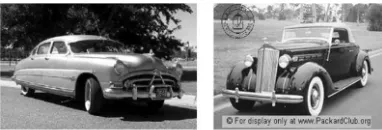
Side informationabout ciphertext is any information relating to the content of the plain-text. The following puzzle asks you to unravel each of the words, where the letters have been rearranged.
DFOR KIBUC TECRELOHV DONSHU KADCRAP GEDOD LADCLIAC NOCILLN
A solution to the puzzle is easy using the side information provided (Fig. 1.5), that the words are names of automobiles! Has anyone seen aHudsonSUV lately?
1.5 THOMAS JEFFERSON AND THE M-94
[image:27.504.92.283.65.130.2]The M-94, (Fig. 1.6) was adopted by the U.S. Army after World War I; the same device, now designated as the CSP-488, was adopted by the Navy. This encryption device was invented by Alberti in the fifteenth century; subsequently, Thomas Jefferson invented his Wheel Cipher, using the same idea. A good idea is not readily abandoned and the wheel cipher continued to be reinvented, in 1901 by the French Major Etienne Bazeries
Figure 1.5 Side information: Where’s theToyotaandHonda?
[image:27.504.92.233.592.643.2]and in 1914 by Colonel Parker Hitt, who was a member of the Army Signal Service and the author of theManual for the Solution of Military Ciphers(1915).
The M-94 had 25 wheels numbered 1, 2,. . ., 25; a different permutation of the letters A,B,. . ., Z is written around the circumference of each wheel. To encipher, the order of the wheels on the spindle is determined by sorting a repeated key word alpha-betically. For example, the keyCHINESEFOODis repeated to obtain 25 characters, which are numbered in sorted order. In the following array, the first row lists the wheel identifiers (numbers), the last row specifies the wheel positions on the spindle:
1 2 3 4 5 6 7 8 9 10 11 12 13 14 15 16 17 18 19 20 21 22 23 24 25 C H I N E S E F O O D C H I N E S E F O O D C H I 1 12 15 18 6 24 7 10 20 21 4 2 13 16 19 8 25 9 11 22 23 5 3 14 17
Wheel no. 1 is placed on the leftmost position of the spindle, wheel no. 12 next, wheel no. 23 next and finally wheel no. 17 on the right. Having placed the 25 disks on the common spindle in this order, the wheels are rotated so that the letters of the plaintext message are aligned with the top bar and the ciphertext read out from some specified adjacent row.
1.6
CRYPTOGRAPHY AND HISTORY
David Kahn’s recent biography [Kahn, 2004] about Herbert O. Yardley relates the begin-ning of American cryptologic activities. Although Secretary of State Henry Stimson’s famous statement “Gentlemen do not read other people’s mail” marked a temporary end of official U.S. codebreaking activities in 1929, the intelligence needs of America, however, led to the establishment of a nongovernmental cryptanalysis effort.
Cryptography has played a significant role in the history of the United States, often providing our country with crucial information.
1. The Zimmerman telegram in January 1917, from the German Foreign Minister Zimmerman to the German Minister von Eckhardt in Mexico, offered to return ter-ritory to Mexico – perhaps Arizona and California – in exchange for Mexico’s support against the United States. Even better than a California driver’s license! Mexico declined!! British cryptanalysts deciphered the telegram, revealing the perfidy of the Germans. The impact on the American public was immense, causing the United States Congress to declare war on Germany in 1917.
2. The cryptanalysis of the GermanEnigmamachine allowed the United States and Great Britain to read enciphered messages; the ability to read known messages led to victory in the Battle of the Atlantic against German U-boats.
3. The cryptanalysis of the Japanese PURPLE machine and its related “color” machines allowed the United States to prevail in the Battles of the Carol Sea and Midway. Deciphered Japanese messages gave the United States the route to be fol-lowed by Admiral Yamamoto Isoruku – the architect of the Japanese attack on Pearl Harbor – on a visit to his troops in the Pacific, leading to his death.
4. The cryptanalysis of the KGBone-timesystem, which provided the United States with insights into the espionage activities of the Soviet Union, revealed the Rosenbergs and Alger Hiss to be traitors.
1.7 CRYPTOGRAPHY AND COMPUTERS
There has been a symbiotic relationship between cryptography and the development of high-performance computing systems. As cryptographic systems increased in their sophis-tication, the need to develop more efficient methods to cryptanalyze them became the stimulus for the development of computers.
Chapter 6 describes two of the three cryptographic systems used by Germany during World War II.
1. Military communications by radio were enciphered by theEnigmarotor system.
2. The Geheimfernschreiber2or T52e manufactured by Siemens and Halske was a binary device in which plaintext was first converted into the 5-bitBaudot code.
3. The Lorenz Schlusselzusatz3 or SZ40/SZ42 also performed encipherment on plaintext converted into binary data.
The T52e and SZ40 devices were on-line devices connected to a teletypewriter. They were both used to protect high-level communications.
The Polish Cipher Bureau started to develop methods to analyze Enigma-enciphered traffic in 1932. The task was given to three recent university graduates – Marian Rejewski, Jerzy Ro´z˙ycki, and Henryk Zygalski, who developed the bombe,4a mechanical computer. When Poland was invaded by Germany, the Polish cipher bureau fled to southern France and then England. Their contributions were great, and although they shared their analysis with the British, they were not permitted to work on theUltraproject – the name of the Allied effort in cryptanalysis.
An excellent narrative of the breaking of the naval Enigma is given in David Kahn’s bookSeizing the Enigma[Kahn, 1991].
The United Kingdom’s cryptanalytic effort during World War II was located at the General Communications Headquarters (GCHQ) in Bletchley Park, a suburb of London. Alan Turing, regarded as the inventor of the stored program concept and the universal automation or Turing machine [Turing, 1936] participated in the Bletchley Park cryp-tanalysis effort. His achievements are described in the work of Hodges [1983] and Cave Brown [1975]. Turing, together with a group of engineers including Tommy Flowers, designed the machines to crytanalyze German ciphertext, first the primitive electromecha-nical bombes and later their successors (theColossi), the first programmable processors. Different operational procedures were used with the Enigma machine during World War II and when they were changed, the Polish bombe was no longer effective. Turing developed a new bombe to search the ciphertext for isomorphsof plaintext believed to occur in the message.
The development of theColossusmachine [Lavington, 1980; Randall, 1982] illus-trates the interplay of computers and cryptography. The need for testing many possible key settings to decipher ciphertext led to the invention of the computer.Heath Robinson, named after a famous British cartoonist, was the name of the first machine; it had teleprinter tape input and was used to attack the Schusselzusatz ciphertext. Professor
2Geheimis the German root for secret,schreiben, the verb to write, andfernindicates distance; that is, the Geheim
fernschreiber was used to communicate secretly between parties separated from one another.
3
Schlusselfor key andzusatzfor attachment; that is, the Schlusselzusatz was an attachment to a teletypewriter.
4
Bombeis the French word forbomb. There are two explanations for the term. Some authors claim the “ticking”
M. H. A. Newman and a team of engineers headed by Tom Flowers worked at the Post Office Research Station for the Government Code and Cipher School at Dollis Hill (London). It contained 15900 thermionic valves (electronic tubes); each character was coded with the 5-bit Baudot teleprinter code, read by an optical character reader and punched on a paper moving at a rate of 5000 characters per second. It began analyzing ciphertext at Bletchley Park in December 1943. Its successor,Colossus Mark II(1944), contained 2500 valves and allowed conditional branching but did not implement the internal program store central to the concept of a computer.
1.8
THE NATIONAL SECURITY AGENCY
The development of the computer in the United States was fostered in part by the National Security Agency (Fig. 1.7) [Bramford, 1982], which merged several separate cryptologic organizations when it came into being on November 4, 1952. The National Security Agency/Central Security Service (CSS) is responsible for the protection of U.S. communi-cations and the production of foreign intelligence. The Director of NSA (DIRNSA) is a mili-tary officer, currently Lieutenant General Keith B. Alexander, USA. The Deputy Dirrector of NSA (D/DIRNSA) is normally someone from within the organization, and is currently, Mr William B. Black Jr.
The NSA distinguishes between various types of communication intelligence activities:
. COMSEC (Communications Security). The protection resulting from any
measures taken to deny unauthorized persons information derived from the national-security-related telecommunications of the United States, or from any measure taken to ensure the authenticity of such telecommunications. (National Intelligence Reorganization and Reform Act of 1978.)
. COMINT (Communications Intelligence). The interception and processing of
foreign communications passed by radio, wire, or other electromagnetic means, and the processing of foreign encrypted communications, however transmitted. Interception comprises search, intercept, operator identification, signal analysis, traffic analysis, cryptanalysis, decryption, study of plaintext, the fusion of these processes, and the reporting of results. Excluded from this definition are the unen-crypted written communications, press and propaganda broadcasts. (National Security Council Intelligence Directive (NSCID) Number 6.)
. SIGINT (Signals Intelligence). Comprises communications intelligence
(COMINT), electronic intelligence (ELINT), foreign instrumentation signals
Figure 1.7 The NSA seal and a variant.
intelligence (technical and intelligence information derived from the collection and processing of foreign telemetry, beaconry, and associated signals), and information derived from the collection and processing of nonimagery, infrared, and coherent light signals. (National Intelligence Reorganization and Reform Act of 1978.)
Further information on NSA can be found at www.nsa.gov.
The role of NSA in computer development can be traced to theElectronic Numerical Integrator and Calculator(ENIAC) built in 1943 – 44 at the University of Pennsylvania’s Moore School of Electrical Engineering under the supervison of Drs J. W. Mauchly and J. P. Eckert. ENIAC was built for the U.S. Army’s Aberdeen proving ground and was intended to make artillery calculations. It contained 25,000 relays and 13,000 thermionic valves and occupied an area of 2030 ft. In spite of this size, it held only 20 numbers. ENIAC incorporated the concept of a stored program due to John von Neumann, although the idea is also implicit in Turing’s paper [Turing, 1936].
Once ENIAC was operational, its designers began to proselytize, to lecture about the great potential of computers. Attending one of the lectures was Lieutenant Commander James T. Prendergrass of the Naval Security Group (NSG), a part of the CSS that recog-nized the potential speedup in cryptanalysis. This led to the support provided by the cryp-tologic community in the advancement of the design of information processing technology. Some of the benchmarks are as follows.
. Engineering Research Associates (ERA), formed at the end of World War II, partici-pated with NSA in the development of leading-edge computer technology. Among the machines developed wasAtlas(1950), which had a memory of 16,384 words, a parallel architecture, and incorporated drum storage.
. Abnerwas developed by the Army Security Agency in 1952 and used a key-punch, paper tape, magnetic tape input/output, parallel printer, typewriter, and console.
. In response to the need for bigger and faster processors, Harvest (Project Lightning)
was started in June 1957. IBM developed twoStretchmachines which incorporated the “tractor,” a mechanical device capable of locating cartridges from a tape library.
. Seymour Cray, an alumnus of ERA, founded Cray Research. Cray designed and
producedLoadstoneand theCray-1(1976).
A history of the role played by the cryptologic organizations on the development of computers is contained in a paper by Snyder [Snyder, 1979].
1.9 THE GIANTS
[image:31.504.91.171.550.656.2]William Friedman (Fig. 1.8), who was born September 24, 1891, in Russia, emigrated to the United States in 1892 when his parents settled in Pittsburgh. Friedman studied farming at
the Michigan Agricultural College, because this program was tuition-free. When Friedman discovered that he was more interested in science, he enrolled in the genetics program at Cornell, which was also free as a land-grant college. While in Graduate School, Friedman met George Fabyan, who established the Riverbank Laboratories in Geneva, Illinois.
Fabyan, known as the “Colonel,” was interested in acoustics, chemistry, genetics, and cryptography. Friedman began to work at Riverbank in 1915. Fabyan had been con-vinced by Ms Elizabeth Wells Gallup, a librarian at the Riverbank Laboratories, that there existed a cipher embedded in the first editions of the works of Shakespeare and that it would prove Bacon wrote some of the works attributed to the bard of Stratford-upon-Avon.
Friedman became head of the Department of Codes and Ciphers at Riverbank and actively began the study of cryptography. Friedman developed the first true cryptographic competence in the United States, developing methods for the analysis of polyalphabetic systems (Chapter 4). They were published originally in a series of Riverbank Monographs and our now reprinted by Aegean Park Press.
Actually, Friedman became interested in both cryptology and Miss Smith, an assist-ant to Ms Gallup. Love and cryptography – an unbeatable combination. Friedman and Miss Smith were married in 1917.
Although Henry L. Stimson ended the official United States codebreaking activities in 1929, there remained a need to monitor foreign communications. George Fabyan offered the services of the Department of Codes and Ciphers to the U.S. Government with the start of World War I. The Congress of the United States declared war against Germany on April 6, 1917. At that time, a group of 125 Hindus operating in the United States were working for the independence of India; they were seeking to purchase arms on the West Coast. This group was supported by Germany, which believed their activities would distract the British. Friedman was presented with intercepted ciphertext messages. The encipherment method used a book cipher; some plaintext letters were enciphered by a triple of numbersa-b-c;agave the page number,bthe line, andcthe position of the letter on the line. Although Friedman did not know at the time, the book was Price Collier’s “Germany and the Germans”; he guessed some words – Sucio, revolution – and used the high-frequency letters in these words to guess others. Friedman submitted his solution and testified at the trials of this group, at which they were convicted.
Friedman’s greatest genius was assembling the nucleus of what has become the National Security Agency. In 1930, as a civilian employee in the Signals Intelligence Service, Friedman hired three mathematicians: Frank B. Rowlett, Dr Abraham Sinkov, and Dr Solomon Kullback.
[image:32.504.90.162.560.656.2]Frank B. Rowlett (1908 – 1998) (Fig. 1.9), born in Virginia, was hired as a junior cryptanalyst. He studied mathematics and chemistry. A lengthy period of training under Friedman followed his appointment at the SIS. Rowlett worked in both the design and cryptanalysis of cryptosystems. Together with Friedman, he designed the SIGABA
Figure 1.9 Frank B. Rowlett (Courtesy of NSA).
(Chapter 6), the most secure U.S. cryptosystem used during World War II. Congress awarded Rowlett $100,000 in 1964 for his work on the SIGABA.
Dr Abraham Sinkov (1907 – 1998) (Fig. 1.10), born in Philadelphia, was the son of immigrants and was a mathematics teacher in New York City. He studied mathematics at CCNY and received his Ph.D. (Mathematics) at George Washington University in 1933. Sinkov took the Civil Service Examination in 1930 and obtained a job with Friedman. After his retirement in 1962 from NSA, Sinkov moved to Arizona and began a second career as a Professor of Mathematics at the Arizona State University.
Dr Solomon Kullback (1903 – 1994) (Fig. 1.11) attended high school in Brooklyn, New York. He intended to teach at Boys High, but met his CCNY classmate Abraham Sinkov, from whom he learned about jobs as a “junior mathematician” at $2000/year. Along with Sinkov, he took the Civil Service Examination and was hired by Friedman. Kullback and Rowlett worked on the cryptanalysis of the Japanese RED messages, the predecessor of the PURPLE system used at the start of World War II. After his retirement in 1962 from NSA, he began a second career as a Professor at the George Washington University.
1.10 NO SEX, MONEY, CRIME OR
. . .
LOVE
Cryptanalysisrefers to the methods for the analysis of cryptographic systems, and in par-ticular, to recover the plaintext and/or key from ciphertext. Cryptanalysis makes use of
1. Knowledge of the structure of the cryptographic systemT,
2. Cribs – information believed to be contained in the plaintext, and
3. Characteristics of the underlying language of the plaintext.
[image:33.504.90.172.65.171.2]The frequencies of occurrence of letters constitute an elementary characteristic of a natural language. In English, the most frequent letters areE, T, A, O, N, R, I, S, andH. Roughly 13% of the letters in a large sample of English text should beE’s.
Figure 1.10 Dr Abraham Sinkov (Courtesy of NSA).
[image:33.504.90.163.201.298.2]In 1937, Ernest Vincent Wright published the novelGadsby[Wright, 1931] in which the most frequent letter in English,E, did not appear. It could not have been a very big seller – it could not mention sex, money, murder, greed, or tenure, but it is remarkably coherent. Gadsby begins
[image:34.504.91.320.64.305.2]Youth, throughout all history, had had a champion to stand up for it; to show a doubting world that a child can think; and, possibly, do it practically; you would constantly run across folks today who claim that ’a child don’t know anything’.
Figure 1.12 compares the letter frequencies ofA,B,. . .,Z(upper and lower case) in an early version of this chapter with standard letter probabilities in English and those in Wright’sGadsby.The success of cryptanalysis cannot depend on the striking agreement between the ciphertext statistics and the frequencies of the underlying language, as the above graph illustrates. On the other hand, it is unreasonable to assume that plaintext has been artificially created to mask the letter frequencies.
1.11 AN EXAMPLE OF THE INFERENCE PROCESS
IN CRYPTANALYSIS
Although statistical characteristics provide information to aid in cryptanalysis, more often internal constraints in the cryptographic system provide a great deal of information. We give an example in this section of theinferenceprocess.
A PUZZLE
Each of the nine symbolsDN M ~;S’†appearing in the array below stands for auniqueencoding of one of the digits 1 through 9. The rightmost column gives the sum
Figure 1.12 Letter frequencies in English andGadsby.
in each row; the bottom row gives the sum in each column. A question mark can stand for any one- or two-digit number and not necessarily the same number in each instance. Find the encoding of the digits 1 through 9!
Solution Therow 2andcolumn 3sums give the equations
(3 ~)þ;¼SS (1:1)
(2;)þ(2
/
)¼†† (1:2)As
(2;)þ(2
N
) is even,~,;,N, are distinct and each are9, and
(3 ~)þ;35, (2;)þ(2N)34,
it follows that††¼22 andSS¼11 or 33.
The only integer (diophantine) solution of Equations (1.1) and (1.2) consistent with the uniqueness of the symbols is†¼2 andS¼3 and
Thecolumn 4sum provides the equation
þ(2 ~)þ’¼†S
which requires
þ’¼5) ,’[{(1, 4), (2, 3), (3, 2), (1, 4)} (1:3)
AsS¼3, it follows that
,’[{(1, 4), (4, 1)}
are the only possible consistent values satisfying Equation (1.3). It follows therefore that D,M [ f7,8gby the uniqueness constraints.
We now test an assumption on the value of M when we impose the constraints on some of the remaining row and column sums and draw the consequences of the assumption:
A1. M ¼7
A1(a) D¼8;
A1(b) Row 4sum: ?4,1þ9þ6þ9¼27¼)?4,1¼3;
A1(c) Column 1sum: 8þ9þ?3,1þ?4,1¼29¼)?3,1¼9 from A1(b);
A1(d) Column 2sum: 8þ9þ?3,2þ9¼33¼)?3,2¼7;
A1(e) Row 3sum: ?3,1þ?3,2þ5þ’¼22¼)’¼1.
S † ~ ; 4
A2. M ¼8
A2(a) D¼7;
A2(b) Row 4sum: ?4,1þ24¼28¼)?4,1¼4;
A2(c) Column 1sum: 7þ9þ?3,1þ?4,1¼29¼)?3,1¼9 from A2(b);
A2(d) Column 2sum: 7þ9þ?3,2þ9¼33¼)?3,2¼5;
A2(e) Row 3sum: ?3,1þ?3,2þ5þ’¼22¼)’¼3, a contradiction!
The complete solution is
1.12 WARNING!
Several examples may illustrate this point.
1. The mechanical ciphering machine invented by Alexander von Kryha in 1924 received the Prize of the Prussian Ministry of the Interior at the 1926 Police Fair and a Diploma from the famous postwar Chancellor of Germany, Konrad Adenauer, at the International Press Exhibition in Cologne two year later. Von Kryha was not only an inventor, but also an astute entrepreneur. To promote his commercial venture Internationale Kryha Machinen Gesellschaft of Hamburg, Kryha turned to the famous mathematician Georg Hamel for an endorsement. Hamel calculated the size of the key space to be 4.571050and concluded that only immortals could cryptanalyze Kryha ciphertext. Not withstanding Hamel’s estimate, a cryptanalysis of the Kryha machine by Friedman did not require as much time and is described in the “2 Hours, 41 Minutes,” a chapter in Machine Cryptography and Modern Cryptanalysis[Devoirs and Ruth, 1985].
2. A U.S. patent [Merkle and Hellman, 1980] accompanied the publication Deavours and Kruh [1985] of the paper by Merkle and Hellman [1978] announcing the first public key cryptosystem (Chapter 10). The inventors wrote in the description of the preferred embodiment of the ’582 patent
But, the eavesdropper trapdoor knapsack problem can be made computationally infeasible to solve, thereby preventing the eavesdropper from recovering the plain-text messageX.
In spite of this pronouncement, Adi Shamir electrified the attendees at ‘CRYPTO’ 82 meetings5 with an analysis of the Merkle – Hellman cryptosystem [Shamir,
The Surgeon General has determined thatlargekey spaces may not truly protect you data!
5
‘CRYPTO’N is an annual workshop on Cryptography held each August since 1981 at UCSB.
1984] (Chapter 11). A program running on an Apple during his lecture illustrated the solution technique.
3. Martin Gardner’s article [Gardner, 1979] appeared a year before the publication of the paper that defined the RSA cryptosystem [Rivest et al., 1998] (Chapter 12). Gardner’s article contained the first of many factoring challenges; RSA-129 is a 129-digit integer, which is the product of two primes. RSA-129 was factored in eight months (April 1991) and did not, as Gardner’s article suggests, “. . .take millions of years. . .,” to factor, claiming the prize of $100 for the first solution.
4. Finally, Certicom markets products using an elliptic curve cryptosystem (Chaper 15). It is stated in one of Certicom’s whitepapers that
A comparison of the three hard mathematical problems on which the well-known public-key cryptosystems are based clearly highlights the fact that none of these are provably intractable. Years of intensive study has resulted in a widely held view that the ECDLP6is significantly more difficult than either the IFP7 or the DLP.8 The general conclusion of leading cryptographers is that the ECDLP in fact requires the full exponential time to solve. Based on this research and their own cryptographic expertise, industry leaders have accepted the Elliptic Curve Cryptosystem as a mature technology and are now implementing it for widespread deployment.
The point of these examples is not to ridicule the judgment of their makers, but to emphasize that
The history of cryptography is littered with encipherment systems thought to offer security, but which on careful reflection and study have failed to provide the advertised protection. Only one cryptographic system offers absolute security and when it was improperly used during World War II (Chapter 4), it failed to secret the transmitted messages.
Claude Shannon’s paper [1948] on the mathematical theory of communication gave birth to information theory. In the sequel [Shannon, 1949], he pointed out the common features of two problems:
. Recovering data transmitted over anoisychannel, and
. Secreting of transmitted information.
Shannon’s model relating communication and secrecy is formulated within a statistical model as follows:
1. The initialstatistical information of plaintext is represented by thea priori prob-ability of plaintextxnotationally PrPLAINfxg.
2. When the ciphertextyofxis observed, the statistical information about the plaintext changesto thea posterioriprobability of plaintext xgiven that encipherment has resulted in ciphertexty, notationally PrPLAIN/CIPHERfx/yg.
1. Weakness in a cryptosystem is demonstrated by providing a feasible cryptanalytic technique.
2. Proving the strength of a cryptosystem is generally more difficult to effect.
6
ECDLP elliptic curve discrete logarithm problem.
7
IFP, integer factorization problem.
8
Shannon defined an encipherment system as providingabsolute secrecyif knowledge of the ciphertext did not give any additional statistical information about the plaintext than was known before the ciphertext was observed; namely,
PrPLAIN=CIPHER{x=y}¼PrPLAIN{x}
whenever PrPLAINfxg.0 and PrCIPHERfyg.0. Shannon further proved that absolute
secrecy for all n-grams requires that there be as many keys as there are plaintext n-grams of positive probability. If the plaintext and ciphertext consist of all n-grams formed from the alphabet f0, 1g, to guarantee the absolute secrecy of plaintext requires one bit of key per plaintext bit. The one-time tape (or pad), a cryptographic system discussed in Chapter 4, is based upon this result from Shannon.
REFERENCES
J. BRAMFORD, The Puzzle Palace, Houghton Mifflin,
Boston, Massachusetts, 1982.
A. CAVE BROWN, Bodyguard of Lies, Harper & Row,
New York, NY, 1975.
A. HODGES,Alan Turing, Simon & Schuster, New York, NY, 1983.
D. KAHN,The Codebreakers, MacMillan, New York, NY,
1967.
D. KAHN,Kahn on Codes:Secrets of the New Cryptography,
MacMillan, New York, NY, 1983.
D. KAHN, The Reader of Gentlemen’s Mail: Herbert
O. Yardley and the Birth of American Codebreaking,
Yale University Press, New Haven, Connecticut, 2004.
D. KAHN, ‘Seizing the Enigma’: Race to Break the German
U-Boat Codes, 1939 – 43, Houghton Mifflin, Boston,
Massachusetts, 1991.
S. LAVINGTON, Early British Computers, Digital Press, Bedford, Massachusetts, 1980.
R. MERKLE AND M. HELLMAN, “Hiding Information and
Signatures in Trapdoor Knapsacks,”IEEE Transactions
on Information Theory,IT-24, 525 – 530, (1948).
B. RANDALL, The Origins of Digital Computers,
Brian Randall, (ed.), 3rd edn, Springer-Verlag, New York, 1982.
R. L. RIVEST, A. SHAMIR,ANDL. ADELMAN, “A Method for Obtaining Digital Signatures and Public-Key Crypto-systems,” Communications of the ACM, 21,120 – 126, (1978).
C.E. SHANNON, “Communication Theoryof Secrecy Systems,”
Bell Systems Technical Journal,28,656– 715, (1949).
C. E. SHANNON, “A Mathematical Theory of Communication,”
Bell Systems Technical Journal,27, 379–423, (1948).
S. S. SNYDER, “Influence of U.S. Cryptologic Organizations on the Digital Computer Industry,” The Journal of
Systems and Software,1, 87 – 102, (1979).
S. SINGH,The Code Book:The Science of Secrecy from Ancient
Egypt to Quantum Cryptography, Anchor Books, New
York, 1999.
A. M. TURING, “On Computable Numbers with an Application to the Entscheidungsprobem, Decision Problem,” Proceedings of the London Mathematical
Society,42, 230 – 267, (1936).
E. V. WRIGHT, Gadsby, Wetzel Publishing Company, Los Angeles, 1931.
R. MERKLE ANDM. HELLMAN, “Public Key Cryptographic Apparatus and Method,” U.S. Patent #4,218,582, filed October 6, 1977, granted August 19, 1980.
C. A. DEAVOURS ANDL. KRUH,Machine Cryptography and
Modern Cryptanalysis, Artech House, 1985.
A. SHAMIR, “A Polynomial Time Algorithm for Breaking the Basic Merkle-Hellman Cryptosystem,”IEEE
Trans-actions on Information Theory, IT-30, Number 5,
September, 699 – 704, (1984).
M. GARDNER, “A New Kind of Cipher That Would Take
Millions of Years to Break,” Scientific American,237, 120 – 124, August 1979.