http://wrap.warwick.ac.uk
Original citation:
Clarke, Aileen, 1955-, Pulikottil-Jacob, Ruth, Connock, Martin, Suri, G., Kandala,
Ngianga-Bakwin, Maheswaran, Hendramoorthy, Banner, R and Sutcliffe, Paul A.. (2014)
Cost-effectiveness of left ventricular assist devices (LVADs) for patients with advanced
heart failure : Analysis of the British NHS Bridge to Transplant (BTT) program.
International Journal of Cardiology . ISSN 0167-5273 (In Press)
Permanent WRAP url:
http://wrap.warwick.ac.uk/58818
Copyright and reuse:
The Warwick Research Archive Portal (WRAP) makes this work of researchers of the
University of Warwick available open access under the following conditions.
This article is made available under the Creative Commons
Attribution-NonCommercial-NoDerivs 3.0 (CC BY-NC-ND 3.0) license and may be reused according to the
conditions of the license. For more details see:
http://creativecommons.org/licenses/by-nc-nd/3.0/
A note on versions:
The version presented in WRAP is the published version, or, version of record, and may
be cited as it appears here.
Cost-effectiveness of left ventricular assist devices (LVADs) for patients
with advanced heart failure: Analysis of the British NHS bridge to
transplant (BTT) program
☆
Aileen Clarke
a,⁎
,1, Ruth Pulikottil-Jacob
a,1, Martin Connock
a,1, Gaurav Suri
a,1, Ngianga-Bakwin Kandala
a,1,
Hendramoorthy Maheswaran
a,1, Nicholas R. Banner
b,1, Paul Sutcliffe
a,1a
Division of Health Sciences, Warwick Medical School, University of Warwick, Coventry, CV4 7AL, United Kingdom
b
National Heart Lung Institute, Imperial College, London, United Kingdom
a b s t r a c t
a r t i c l e i n f o
Article history: Received 28 June 2013
Received in revised form 29 November 2013 Accepted 11 December 2013
Available online xxxx
Keywords:
Left ventricular assist device Heart failure
Comparative cost-effectiveness
Background:A previous cost-effectiveness analysis showed that bridge to transplant (BTT) with early design left ventricular assist devices (LVADs) for advanced heart failure was more expensive than medical management while appearing less beneficial.
Older LVADs were pulsatile, but current second and third generation LVADs are continuousflow pumps. This study aimed to estimate comparative cost-effectiveness of BTT with durable implantable continuousflow LVADs compared to medical management in the British NHS.
Methods and results:A semi-Markov multi-state economic model was built using NHS costs data and patient data in the British NHS Blood and Transplant Database (BTDB). Quality-adjusted life years (QALYs) and incremental costs per QALY were calculated for patients receiving LVADs compared to those receiving inotrope supported medical management. LVADs cost £80,569 ($127,887) at 2011 prices and delivered greater benefit than medical management. The estimated probabilistic incremental cost-effectiveness ratio (ICER) was £53,527 ($84,963)/ QALY (95%CI: £31,802–£94,853; $50,479–$150,560) (over a lifetime horizon). Estimates were sensitive to choice of comparator population, relative likelihood of receiving a heart transplant, time to transplant, and LVAD costs. Reducing the device cost by 15% decreased the ICER to £50,106 ($79,533)/QALY.
Conclusions:Durable implantable continuousflow LVADs deliver greater benefits at higher costs than medical management in Britain. At the current UK threshold of £20,000 to £30,000/QALY LVADs are not cost effective but the ICER now begins to approach that of an intervention for end of life care recently recommended by the British NHS. Cost-effectiveness estimates are hampered by the lack of randomized trials.
© 2013 The Authors. Published by Elsevier Ireland Ltd. All rights reserved.
1. Introduction
Heart transplant is the optimal treatment for patients with advanced heart failure, but this option is dependent on the supply of donor hearts. Individuals awaiting a donor organ may be managed with various med-ical interventions such as intravenous inotropes. An alternative treat-ment strategy, often termed bridge to transplant (BTT), is to surgically implant a left ventricular assist device (LVAD). An LVAD is a mechanical
pump used to support left ventricle function until a donor heart be-comes available[1]. The British NHS has had a BTT program for more than a decade but the assessment of the comparative costs and benefits of these procedures[2,3]is important in the context of an expanding candidate population, with increases in the numbers of people suffering heart failure[4], increasing health care costs[5]and a diminishing sup-ply of donor hearts[6].
The clinical and cost-effectiveness of BTT programs has been evalu-ated previously[7–11]. However, these analyses were based on pulsa-tilefirst generation LVADs. Currently nearly all implants used are second or third generation durable implantable continuousflow devices (HeartWare HLVAD, Thoratec HeartMate II, Jarvik 2000 FlowMaker, and Micromed HeartAssist) which are widely perceived to have superior performance compared to earlier devices[12]. In this paper, we investi-gate the cost-effectiveness of second and third generation ventricular assist devices (LVADs) as a bridge to transplant (BTT), compared to medical management with inotrope support in the British NHS bridge to heart transplant program.
International Journal of Cardiology xxx (2014) xxx–xxx
☆ This is an open-access article distributed under the terms of the Creative Commons Attribution-NonCommercial-No Derivative Works License, which permits non-commercial use, distribution, and reproduction in any medium, provided the original author and source are credited.
⁎ Corresponding author at: Division of Health Sciences, Warwick Medical School, University of Warwick, Coventry CV4 7AL, United Kingdom. Tel.: + 44 24761 50063; fax: +44 24765 28375.
E-mail address:[email protected](A. Clarke).
1
These authors take responsibility for all aspects of the reliability and freedom from bias of the data presented and their discussed interpretation.
0167-5273/$–see front matter © 2013 The Authors. Published by Elsevier Ireland Ltd. All rights reserved.
http://dx.doi.org/10.1016/j.ijcard.2013.12.015
Contents lists available atScienceDirect
International Journal of Cardiology
2. Methods
We adapted a previous economic model used to assess the British BTT program[13]. We used a semi-Markov multi-state model in which each patient exists in one of three mutually exclusive states: (1) alive on LVAD or medical management support; (2) alive after heart transplant; and (3) dead. The monthly transition probabilities between each state are represented by the quantitiesp12,p13 andp23. In the model, these transition probabilities are notfixed but may depend on time[13]. The NHS perspective was chosen, an annual discount rate of 3.5% was applied to both costs and health outcomes[14]. All costs are reported in 2011 British Pound Sterling. The model was run for time horizons of 3 years, 10 years, and 50 years to capture lifetime costs and consequences of the whole cohort. Model outputs included mean life years gained (LYG), mean quality-adjusted life years (QALYs) gained, mean costs, and mean incremental cost-effectiveness ratios (ICERs as £($)/LYG and £($)/QALY gained). The model was built using MS Excel.
2.1. Patient characteristics and survival estimates
We used the British Blood and Transplant Database (BTDB), overseen by the British Cardiothoracic Transplant Audit Group, to derive patient characteristics and survival esti-mates for the model. The BTDB holds data collected from the six designated British centers responsible for undertaking LVAD implantation and heart transplant. Most implants (95%) were undertaken at 3 centers (23%, 25% and 47%, respectively); there was no evidence from limited data that performance at centers with less experience was inferior. The data-base holds individual patient medical history and several data-baseline characteristics for three patient categories: (1) all advanced heart failure patients on the waiting list for heart transplant; (2) recipients of LVAD implants as BTT (LVAD patients); and (3) recipients of heart transplant. Major characteristics are summarized inTable 1. The LVAD group included all patients listed in the database receiving a second or third generation FDA-approved LVAD device between May 2002 and December 2011. Patients receiving afirst generation LVAD were excluded. The comparator population, the medical manage-ment group, was formed by selecting those patients on the waiting list who were receiving inotropes. In sensitivity analyses all medical management patients, not just those receiv-ing inotropes, constituted the comparator group.
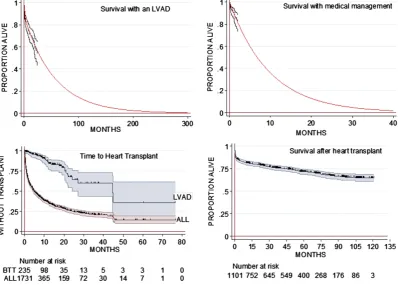
Transition probabilities between health states were modeled using Kaplan–Meier (K–M) time to event analyses (Fig. 1) with extrapolation beyond the observed data where necessary. Constant hazards for survival werefitted to thefirst phase of the K–M plots (to 3 months for LVAD, and post-heart transplant plots, and to 2 weeks for the medical management plot), and separately to the second phase of improved survival until 10% of patients were contributing data (at 23 months for LVAD patients) and to seven years for those post heart transplant (20% contributing data). This second constant hazard was used for extrapolation beyond the observed data. In the case of survival after heart transplant, an adjustment was made so that the hazard became that of the age-and gender-matched British population. For the medical management group, a single con-stant hazard wasfitted to the K–M function until 10% of patients remained at risk.
We applied the same probability of receiving a donor heart to both LVAD and compar-ator medical management groups; this was estimated from the observed time to transplant for LVAD patients. Expert clinical opinion indicated that the probability of receiving a donor heart beyond three and half years of being listed or of receiving an LVAD was extremely low; we therefore set this probability at zero after 42 months.
2.2. Health outcomes
In accordance with current British guidelines[14]health outcomes were measured in quality-adjusted life years (QALYs). We used New York Heart Association (NYHA) infor-mation for patients in the BTDB to determine EQ-5D utility scores, using the relationship between EQ-5D and NYHA for heart failure patients as reported by Gohler et al.[15]. For those who received an LVAD, NYHA class was recorded at initial registration and at 1 month follow-up. For medically managed patients, EQ-5D utility scores were deter-mined using the NYHA data recorded at registration. For those who received a heart trans-plant NYHA class recorded at the 3, 12 and 24 months outpatient visits was used. A weighted EQ-5D utility score was derived for each health state based on proportions of patients in each NYHA class. Health-related quality of life was assumed to remain constant during medical management, after implantation with a LVAD[16]and after a heart trans-plant[1].
2.3. Resource use and cost estimates
Monthly costs were included from date of LVAD implantation, from the date of entry to the transplant waiting list and from receipt of transplant based on a previous analysis
[13]. Costs were inflated to current prices by applying the projected Health Services Cost Index (HSCI)[17]. We obtained costs of second and third generation LVADs from the six designated British centers. A weighted mean for the cost of a LVAD was calculated based on the relative use of the different devices. We estimated LVAD implant procedure costs using detailed information on staffing and timings from one center. Base case model input values are summarized inTable 1.
2.4. Sensitivity analyses
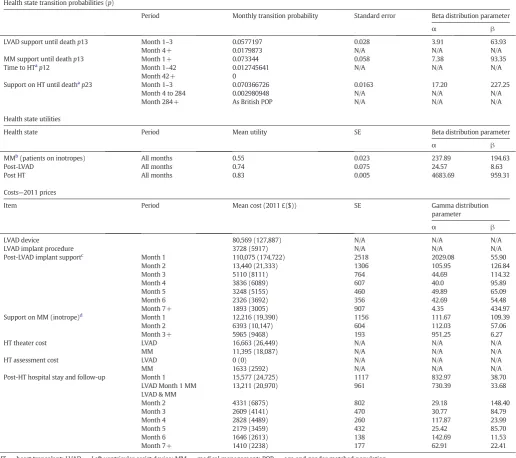
We undertook both probabilistic and univariate sensitivity analyses. Uncertainty in the base case input parameters was explored by running 1000 iterations using standard
distributions for each group of parameters[18], shown inTable 2. Univariate sensitivity analysis was used to explore the impact of increasing and decreasing base case input parameters by 30%. We also undertook a number of sensitivity analyses to explore the impact of differing survival estimates for the medical management patients using: 1) The British BTDB data for all medical management patients, not just those on inotropic support; 2) the Seattle Heart Failure Model (SHFM)[19]to predict survival based on data reported in two other studies[20,21]; 3) Data reported for two control groups in the REMATCH trial: the whole group (who had a median survival of 150 days (4.93 months);
[22]and 4) the inotrope dependent medical management patients in the REMATCH trial
[23]for whom a median survival of 120 days was reported. We also investigated changing the probability of heart transplant (p12): for medical management patients based on dif-ferent projections of time to transplant (a log normalfit for time to transplant for all listed patients and an exponentialfit for time to transplant for LVAD patients).
3. Results
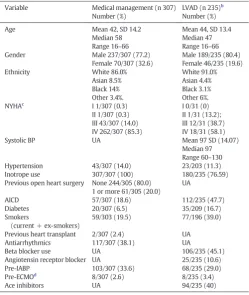
[image:3.595.303.553.76.372.2]There were 235 patients registered on the BTDB as having had a second or third generation LVAD implanted between May 2002 and December 2011. Amongst these, 125 received HeartWare HLVAD, 82 Thoratec HeartMate II, 23 Jarvik 2000 FlowMaker, and 5 Micromed HeartAssist devices, respectively. The mean cost of an LVAD device was estimated to be £80,569 ($127,887). Patients were mostly male (80.4%, 95% CI: 74.8–85.0), middle aged (mean age 44 years, 95% CI: 42.7–45.3) and white (89.7%, 95% CI: 81.8–90.9). Approximately 60% Table 1
Summary of patient baseline characteristics.a
Variable Medical management (n 307) Number (%)
LVAD (n 235)b
Number (%)
Age Mean 42, SD 14.2
Median 58 Range 16–66
Mean 44, SD 13.4 Median 47 Range 16–66
Gender Male 237/307 (77.2)
Female 70/307 (32.6)
Male 189/235 (80.4) Female 46/235 (19.6)
Ethnicity White 86.0%
Asian 8.5% Black 14% Other 3.4%. White 91.0% Asian 4.4% Black 3.1% Other 6%. NYHAc
I 1/307 (0.3) II 1/307 (0.3) III 43/307 (14.0) IV 262/307 (85.3)
I 0/31 (0) II 1/31 (13.2); III 12/31 (38.7) IV 18/31 (58.1)
Systolic BP UA Mean 97 SD (14.07)
Median 97 Range 60–130
Hypertension 43/307 (14.0) 23/203 (11.3)
Inotrope use 307/307 (100) 180/235 (76.59)
Previous open heart surgery None 244/305 (80.0) 1 or more 61/305 (20.0)
UA
AICD 57/307 (18.6) 112/235 (47.7)
Diabetes 20/307 (6.5) 35/209 (16.7)
Smokers
(current + ex-smokers)
59/303 (19.5) 77/196 (39.0)
Previous heart transplant 2/307 (2.4) UA
Antiarrhythmics 117/307 (38.1) UA
Beta blocker use UA 106/235 (45.1)
Angiotensin receptor blocker UA 25/235 (10.6)
Pre-IABP 103/307 (33.6) 68/235 (29.0)
Pre-ECMOd
8/307 (2.6) 8/235 (3.4)
Ace inhibitors UA 94/235 (40)
UA = data unavailable.
a
Baseline data for all patients for all characteristics was not always complete. Depending on how data were accrued patients may have discontinued beta blockers prior to receiving inotropes and some received both treatments.
b Specified indications are for patients with: Low cardiac output (Cardiac Index,
C.I.b2.2 l/min/m2) despite an adequate preload (Central Venous Pressure, CVPN 12 mm Hg or Pulmonary Capillary Wedge Pressure, PCWPN16 mm Hg) and who require inotropic and/or Intra-Aortic Balloon Pump (IABP) support for—symptomatic hy-potension (systolic BPb90 mm Hg) and secondary organ dysfunction (especially renal and hepatic); better haemodynamic status than mentioned above, but in a rapid rate of deterioration such that the patient is unlikely to survive until transplantation.
c New York Heart Association functional class. d Extracorporeal membrane oxygenation.
of patients had the most severe NYHA rating, Class IV (58.1%, 95% CI: 39.1–75.5).
Fig. 1 illustrates observed and modeled survival of medically managed and LVAD-supported BTDB patients. At 2 months, survival was apparently similar for patients receiving an LVAD compared to those receiving medical management with inotropes (LVAD: 89% vs. medical management: 83%). Survival was modeled on the observed data up to the time the proportion at risk was reduced to 10%. For the 307 patients on medical management with inotropes the modeled sur-vival at 12 months was 29%, while that for the 235 patients supported with an LVAD modeled survival at 12 months was 71%. Time to trans-plant also varied considerably. While 75% overall of patients on the transplant list had had a transplant by 24 months, only approximately 40% of LVAD patients had received a transplant by a similar time, although again there is uncertainty in the data. The delay to transplant for LVAD patients reflects a combination of their need to recover after device implant, the low availability of organs and the fact that upon re-covery after implant they are perceived to be at lower risk than urgent medical management patients. Survival with a transplant was good, with over 75% survival at 24 months.
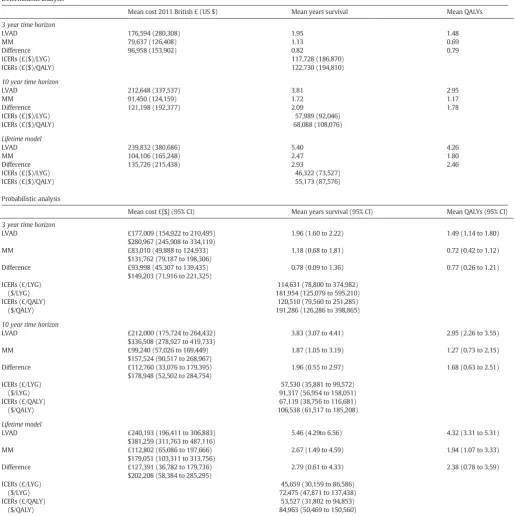
Table 2shows thefindings from the base case deterministic and probabilistic cost-effectiveness analysis for the 3 year, 10 year and life-time (50 years) time horizons. In the base case deterministic analy-sis, the ICERs for the 3 year, 10 year and life-time time horizons were £122,730 ($194,410)/QALY, £68,088 ($108,076)/QALY and £55,173 ($87,576)/QALY respectively. In the probabilistic analysis, the ICERs for the 3 year, 10 year and life-time time horizons were £120,510 ($191,286)/QALY (95% CI: £79,560 to 251,285; $126,286 to $398,865), £67,119 ($106,538) (95% CI: £38,756 to £116,681; $61,517 to $185,208) and £53,527 ($84,963)/QALY (95% CI: £31,802 to £94,853; $50,479 to $150,560) respectively.
Fig. 2illustrates the probabilistic results distributed on the cost effec-tiveness plane. Each of the 1000 iterations is represented by one data point. The mean incremental cost effectiveness of the intervention is indicated by the slope of the line passing through the scatter points. Fig. 2also shows the cost-effectiveness acceptability curves (CEAC) for 3 year, 10 year and lifetime horizons in which the probability of cost effectiveness is plotted against the health service provider's willingness to pay for increased benefit. According to the current UK threshold of £20,000 to £30,000/QALY recommended by NICE, LVADs cannot be considered to be cost effective. At a higher willingness to pay threshold of £50,000 ($79,365)/QALY, that might be considered appropriate ac-cording to end of life criteria[24], the probability that LVADs are cost-effective is 0%, 13.3% and 40.7%, over the 3 year, 10 year and life-time horizons respectively.
3.1. Sensitivity analyses
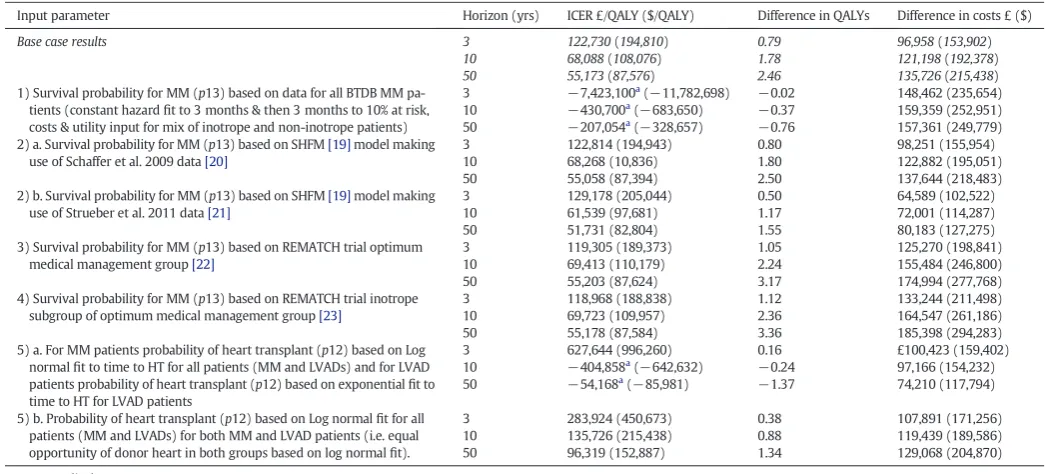
[image:4.595.104.503.55.340.2]from 3.9 to 16.4 months, the resulting ICERs were comparable to the base casefindings (Table 4). When the comparator population was con-stituted from the whole BTDB medical management population, LVAD was found to be more costly and less effective than medical manage-ment. However, unlike LVAD recipients of whom 77% were receiving inotropes, only 20% of these patients were receiving inotrope therapy. Clinical advice indicated that this population is much less ill than those given an LVAD. Similarly when a high probability of receiving a heart transplant was applied to both groups, or if those receiving med-ical management were allocated a high probability but those receiving LVADs a low probability as in a previous analysis, LVADs are dominated or the ICER becomes extremely large.
4. Discussion
4.1. Summary offindings
[image:5.595.36.553.81.539.2]We used individual patient data from the British BTDB to investigate the cost effectiveness of second and third generation LVADs in patients with advanced heart failure listed for heart transplant. Thefindings suggest that in comparison to medical management, with inotropic support, individuals implanted with a LVAD had higher mean costs and higher survival benefit, delivering a probabilistic ICER of £53,527 ($84,963)/QALY (95% CI: £31,802 to £94,853; $50,479–$150,560) and a similar deterministic ICER of £55,173 ($87,576)/QALY for a lifetime Table 2
Base case model inputs for the base case cost effectiveness analysis.
Health state transition probabilities (p)
Period Monthly transition probability Standard error Beta distribution parameter
α β
LVAD support until deathp13 Month 1–3 0.0577197 0.028 3.91 63.93
Month 4+ 0.0179873 N/A N/A N/A
MM support until deathp13 Month 1+ 0.073344 0.058 7.38 93.35
Time to HTa
p12 Month 1–42 0.012745641 N/A N/A N/A
Month 42+ 0
Support on HT until deathap23 Month 1–3 0.070366726 0.0163 17.20 227.25
Month 4 to 284 0.002980948 N/A N/A N/A
Month 284+ As British POP N/A N/A N/A
Health state utilities
Health state Period Mean utility SE Beta distribution parameter
α β
MMb
(patients on inotropes) All months 0.55 0.023 237.89 194.63
Post-LVAD All months 0.74 0.075 24.57 8.63
Post HT All months 0.83 0.005 4683.69 959.31
Costs—2011 prices
Item Period Mean cost (2011 £($)) SE Gamma distribution
parameter
α β
LVAD device 80,569 (127,887) N/A N/A N/A
LVAD implant procedure 3728 (5917) N/A N/A N/A
Post-LVAD implant supportc Month 1 110,075 (174,722) 2518 2029.08 55.90
Month 2 13,440 (21,333) 1306 105.95 126.84
Month 3 5110 (8111) 764 44.69 114.32
Month 4 3836 (6089) 607 40.0 95.89
Month 5 3248 (5155) 460 49.89 65.09
Month 6 2326 (3692) 356 42.69 54.48
Month 7+ 1893 (3005) 907 4.35 434.97
Support on MM (inotrope)d
Month 1 12,216 (19,390) 1156 111.67 109.39
Month 2 6393 (10,147) 604 112.03 57.06
Month 3+ 5965 (9468) 193 951.25 6.27
HT theater cost LVAD 16,663 (26,449) N/A N/A N/A
MM 11,395 (18,087) N/A N/A N/A
HT assessment cost LVAD 0 (0) N/A N/A N/A
MM 1633 (2592) N/A N/A N/A
Post-HT hospital stay and follow-up Month 1 15,577 (24,725) 1117 832.97 38.70
LVAD Month 1 MM 13,211 (20,970) 961 730.39 33.68
LVAD & MM
Month 2 4331 (6875) 802 29.18 148.40
Month 3 2609 (4141) 470 30.77 84.79
Month 4 2828 (4489) 260 117.87 23.99
Month 5 2179 (3459) 432 25.42 85.70
Month 6 1646 (2613) 138 142.69 11.53
Month 7+ 1410 (2238) 177 62.91 22.41
HT = heart transplant; LVAD = Left ventricular assist device; MM = medical management; POP = age and gender matched population.
aApplied for both BTT with LVAD and MM.
b In sensitivity analysis all medical management patients constituted the comparator group; utility for all MM patient was 0.62. c
Includes device and procedure.
d
In sensitivity analysis monthly costs for MM were Month 1—£4517 ($7170), Month 2—£1,672 ($2654), Month 3—£1,758 ($2790), Month 4—£328 ($521), Month 5—£220 ($349), Month 6—£244 ($387), Month 7—£287 ($456); these were based on the proportion of inotrope and non-inotrope patients amongst all MM patients and the costs for inotrope and non-inotrope MM support[9].
horizon. When the model was run for shorter time horizons, the ICER increased significantly.
In previous analyses the use offirst generation LVADs was not found to be cost-effective in relation to medical management[9–11,13]. The improving survival experience for individuals implanted with the newer second and third generation LVADs has reduced their incremen-tal cost per gain in QALY. In the only other published cost-effectiveness analysis of later generation LVADs for heart transplant patients HeartMate II was compared with medical management and generated an ICER of £219,705 ($348,738)/QALY for the base-case lifetime horizon [25]. This is likely to be higher than our result because the authors assumed in their model that all live patients at 6 months received a donor heart; at this time 82% and 76% of LVAD and MM patients remained alive generating only 6% more LVAD patients receiving a door heart than medical management patients. This does not allow the relative survival advantage from the LVAD to be fully taken into account in the model. The present model allows patients to receive a donor heart for up to four years thereby allowing the survival advantage in the LVAD population to be fully realized. Thus, the difference between MM and LVAD treatments in lifetime accumulated QALYs in our model was 2.38 (95% CI: 0.78 to 3.59) compared to 0.55 in the other model. In sensitivity analysis of the other model all live patients at 18 months (63% MM and 72% LVAD) received a transplant, providing 0.86 more
lifetime QALYs in the LVAD arm compared to the MM arm (56% more than the base case) and reducing the ICER to £133,660 ($212,158)/ QALY, about half the base case. To have more patients transplanted at 6 months than 18 months in the model is somewhat anomalous. That 82% of LVAD patients should receive a donor heart (base case) is rather unrealistic and does not correlate with the authors' source data[26]which reported a 56% transplant rate after 18 months.
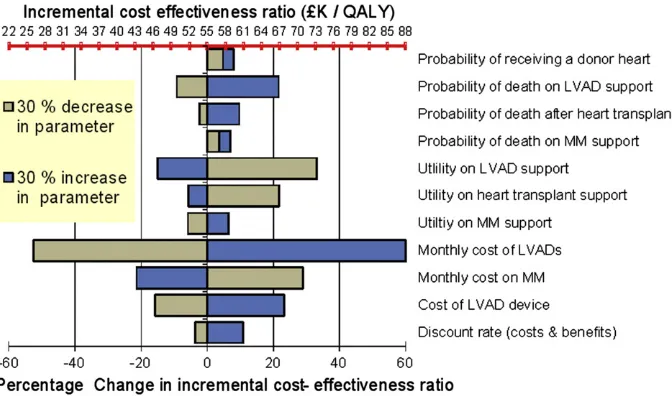
[image:6.595.130.475.55.219.2]The sensitivity analysis demonstrates that our estimates of the ICERs were reasonably robust to a 30% change in the base case input values. Reduction in the cost of LVADs, and in the subsequent management costs for individuals implanted with LVADs, together with improve-ments in the health related-quality of life of individuals implanted with LVADs all have the potential to make their use more cost-effective. Our estimates of ongoing monthly costs were based on those of Sharples et al.[13]whose analysis was undertaken at relatively early stage in de-velopment of the UK BTT program, with growing experience it is possible costs will have reduced.Fig. 3indicates that a very large reduction (30%) in this parameter reduces the ICER to £25,000/QALY, however such a substantial reduction in costs in the seven years since 2006 seems un-likely. Sensitivity analyses further revealed that the cost effectiveness es-timate was critically dependent on the choice of comparator population and the probability of receiving a heart transplant. Importantly however, under the base case scenario, the ICER was relatively insensitive to Fig. 2.A: Cost effectiveness plane; and B: cost-effectiveness acceptability curves (CEAC) for 3, 10 and lifetime horizons for the comparison of LVADs versus medical management with inotropes.
[image:6.595.134.470.521.719.2]changes in median survival for the medical management group ranging from 3.9 to 16.5 months.
We found that time to heart transplant exerted a considerable influence on the estimate of cost-effectiveness. The BTDB patients listed for heart transplant exhibited very different times to heart transplant depending on whether they were medically managed or had received a LVAD (Fig. 1). For the base case therefore, since these two manage-ment strategies are mutually exclusive, we assumed that the probability of receiving a donor heart was independent of whether individuals were medically managed or had received a LVAD.
4.2. Strengths and limitations
[image:7.595.38.554.85.602.2]This study used recognized economic modeling techniques and a large and comprehensive database of patients in Britain treated with both medical management and LVADs. We undertook a wide range of sensitivity analysis to investigate the robustness of ourfindings. For our base case analysis we selected BTDB patients who were medically managed and receiving inotrope medication. Our analysis of the BTDB indicates that 77% of patients who receive a LVAD are medically man-aged with inotropes prior to implantation and that the Seattle Heart Table 3
Base case deterministic and probabilistic results.
Deterministic analysis
Mean cost 2011 British £ (US $) Mean years survival Mean QALYs
3 year time horizon
LVAD 176,594 (280,308) 1.95 1.48
MM 79,637 (126,408) 1.13 0.69
Difference 96,958 (153,902) 0.82 0.79
ICERs (£($)/LYG) 117,728 (186,870)
ICERs (£($)/QALY) 122,730 (194,810)
10 year time horizon
LVAD 212,648 (337,537) 3.81 2.95
MM 91,450 (124,159) 1.72 1.17
Difference 121,198 (192,377) 2.09 1.78
ICERs (£($)/LYG) 57,989 (92,046)
ICERs (£($)/QALY) 68,088 (108,076)
Lifetime model
LVAD 239,832 (380,686) 5.40 4.26
MM 104,106 (165,248) 2.47 1.80
Difference 135,726 (215,438) 2.93 2.46
ICERs (£($)/LYG) 46,322 (73,527)
ICERs (£($)/QALY) 55,173 (87,576)
Probabilistic analysis
Mean cost £[$] (95% CI) Mean years survival (95% CI) Mean QALYs (95% CI)
3 year time horizon
LVAD £177,009 (154,922 to 210,495)
$280,967 (245,908 to 334,119)
1.96 (1.60 to 2.22) 1.49 (1.14 to 1.80)
MM £83,010 (49,888 to 124,933)
$131,762 (79,187 to 198,306)
1.18 (0.68 to 1.81) 0.72 (0.42 to 1.12)
Difference £93,998 (45,307 to 139,435)
$149,203 (71,916 to 221,325)
0.78 (0.09 to 1.36) 0.77 (0.26 to 1.21)
ICERs (£/LYG) ($/LYG)
114,631 (78,800 to 374,982) 181,954 (125,079 to 595,210) ICERs (£/QALY)
($/QALY)
120,510 (79,560 to 251,285) 191,286 (126,286 to 398,865)
10 year time horizon
LVAD £212,000 (175,724 to 264,432)
$336,508 (278,927 to 419,733)
3.83 (3.07 to 4.41) 2.95 (2.26 to 3.55)
MM £99,240 (57,026 to 169,449)
$157,524 (90,517 to 268,967)
1.87 (1.05 to 3.19) 1.27 (0.73 to 2.15)
Difference £112,760 (33,076 to 179,395)
$178,948 (52,502 to 284,754)
1.96 (0.55 to 2.97) 1.68 (0.63 to 2.51)
ICERs (£/LYG) ($/LYG)
57,530 (35,881 to 99,572) 91,317 (56,954 to 158,051) ICERs (£/QALY)
($/QALY)
67,119 (38,756 to 116,681) 106,538 (61,517 to 185,208)
Lifetime model
LVAD £240,193 (196,411 to 306,883)
$381,259 (311,763 to 487,116)
5.46 (4.29to 6.56) 4.32 (3.31 to 5.31)
MM £112,802 (65,086 to 197,666)
$179,051 (103,311 to 313,756)
2.67 (1.49 to 4.59) 1.94 (1.07 to 3.33)
Difference £127,391 (36,782 to 179,736)
$202,208 (58,384 to 285,295)
2.79 (0.61 to 4.33) 2.38 (0.78 to 3.59)
ICERs (£/LYG) ($/LYG)
45,659 (30,159 to 86,586) 72,475 (47,871 to 137,438) ICERs (£/QALY)
($/QALY)
53,527 (31,802 to 94,853) 84,963 (50,469 to 150,560)
MM = medical management.
Failure Model[19]scores for LVADs patients taken from the published literature predicted survival consistent with that observed for the “inotrope”BTDB patients on medical management.
Estimating survival for the medical management group required censoring after receipt of a heart transplant. These time-to-event analyses are probably not free of bias as censored patients are unlikely to be iden-tical to the starting populations and such censoring may result in overes-timation of survival. For this reason, in addition to investigating“virtual” controls based on Seattle Heart Failure Model[19]scores, we also ex-plored using the medical management group from the REMATCH trial in a sensitivity analysis[22]. It should be noted that unlike BTDB patients, participants in REMATCH were deemed too unwell for heart transplant mainly due to older age or disease severity. However for this control group, data were mature (54 deaths amongst 61 patients), there was very little censoring, and most (72%) were treated with inotropes. Median survival of the REMATCH controls was nearly half that modeled for the BTDB inotrope control group (4.9 vs. 9.1 months); despite this, the ICER barely differed from the base case. We consider that this relatively stable ICER across the range of medical management group survival values is a result of costs decreasing in line with survival and QALYs. (As survival decreases, unfortunately fewer medical management patients are alive to incur the considerable cost of inotrope support and subsequent heart transplantation).
We derived EQ-5D utility scores using the NYHA data recorded in the BTDB, as has been done previously in the literature[15]. There is inherent uncertainty here associated both with designating an NYHA class to the patient and with the algorithm used to derive utilities. Also it may be argued that the NYHA classification does not fully capture individuals' health-related quality of life and that a disease specific in-strument such as the Minnesota Living with Heart Failure Questionnaire or the Kansas City Cardiomyopathy Questionnaire should be used, how-ever data for these was not recorded in the BTDB. Our sensitivity analy-sis did not reveal a significant impact of EQ-5D utility scores on the ICER. As in previous economic evaluations ourfindings are limited by the lack of head-to-head randomized controlled trials comparing alternative treatment strategies, we strongly recommend the undertaking of a pro-spective randomized trial that would yield real world results. However
in the absence of such data it is appropriate to use individual patient data from a British population to derive transition probabilities and util-ity data[9,11].
5. Conclusions
We investigated LVADS used as a bridge to transplant (BTT) in pa-tients in Britain who were eligible for heart transplant. We found that when compared to medical management LVADs yielded ICERs of: £120,510/QALY (95% CI: 79,560 to 251,285) ($191,286/QALY (95% CI: 126,286 to 398,865)) over 3 years; £67,119/QALY (95% CI: 38,756 to 116,681) ($106,538 (95% CI: 61,517 to 185,208)) over 10 years; and £53,527/QALY (95% CI: 31,802 to 94,853) ($84,963 (95% CI: 50,469 to 150,560)), over a lifetime horizon. Reimburse-ment decisions vary through time and by country according to the weight given to economic considerations and to the innovativeness of the technology. The LVAD base case lifetime ICER begins to ap-proach that for at least one intervention recently recommended in the UK by NICE as an end of life treatment for advanced prostate can-cer at a cost per QALY of between £46,000 ($73,016) and £50,000 ($79,365)[24]. If the costs of LVADs were reduced by 15% then the technology might be eligible under this consideration by NICE. This finding is complex for the policy arena and will need to be considered carefully in the light of the burden of disease, available funding, and future supply of donor hearts.
Funding sources
National Institute for Health Research HTA Program, Great Britain. Project number 12/02/01.
Rider on responsibility
[image:8.595.40.563.76.313.2]The views expressed in this paper are those of the authors and not necessarily those of the NIHR HTA Program. This report was commis-sioned by the NIHR HTA Program as project number 12/02/01. Any errors are the responsibility of the authors.
Table 4
Summary of results of univariate sensitivity analyses using alternative input sources.
Input parameter Horizon (yrs) ICER £/QALY ($/QALY) Difference in QALYs Difference in costs £ ($)
Base case results 3 122,730(194,810) 0.79 96,958(153,902)
10 68,088(108,076) 1.78 121,198(192,378)
50 55,173(87,576) 2.46 135,726(215,438)
1) Survival probability for MM (p13) based on data for all BTDB MM pa-tients (constant hazardfit to 3 months & then 3 months to 10% at risk, costs & utility input for mix of inotrope and non-inotrope patients)
3 −7,423,100a
(−11,782,698) −0.02 148,462 (235,654)
10 −430,700a(−683,650) −0.37 159,359 (252,951)
50 −207,054a
(−328,657) −0.76 157,361 (249,779) 2) a. Survival probability for MM (p13) based on SHFM[19]model making
use of Schaffer et al. 2009 data[20]
3 122,814 (194,943) 0.80 98,251 (155,954)
10 68,268 (10,836) 1.80 122,882 (195,051)
50 55,058 (87,394) 2.50 137,644 (218,483)
2) b. Survival probability for MM (p13) based on SHFM[19]model making use of Strueber et al. 2011 data[21]
3 129,178 (205,044) 0.50 64,589 (102,522)
10 61,539 (97,681) 1.17 72,001 (114,287)
50 51,731 (82,804) 1.55 80,183 (127,275)
3) Survival probability for MM (p13) based on REMATCH trial optimum medical management group[22]
3 119,305 (189,373) 1.05 125,270 (198,841)
10 69,413 (110,179) 2.24 155,484 (246,800)
50 55,203 (87,624) 3.17 174,994 (277,768)
4) Survival probability for MM (p13) based on REMATCH trial inotrope subgroup of optimum medical management group[23]
3 118,968 (188,838) 1.12 133,244 (211,498)
10 69,723 (109,957) 2.36 164,547 (261,186)
50 55,178 (87,584) 3.36 185,398 (294,283)
5) a. For MM patients probability of heart transplant (p12) based on Log normalfit to time to HT for all patients (MM and LVADs) and for LVAD patients probability of heart transplant (p12) based on exponentialfit to time to HT for LVAD patients
3 627,644 (996,260) 0.16 £100,423 (159,402)
10 −404,858a
(−642,632) −0.24 97,166 (154,232)
50 −54,168a
(−85,981) −1.37 74,210 (117,794)
5) b. Probability of heart transplant (p12) based on Log normalfit for all patients (MM and LVADs) for both MM and LVAD patients (i.e. equal opportunity of donor heart in both groups based on log normalfit).
3 283,924 (450,673) 0.38 107,891 (171,256)
10 135,726 (215,438) 0.88 119,439 (189,586)
50 96,319 (152,887) 1.34 129,068 (204,870)
MM = medical management.
a
Acknowledgments
The authors would like to acknowledge the following for their advice and expert contributions.
Dr. Mark Petrie, Consultant Cardiologist, Golden Jubilee National Hospital, Glasgow and Director of the Scottish National Advanced Heart Failure Service; Dr. Jayan Parameshwar, Consultant Cardiologist, Transplant Physician, Papworth Hospital NHS Foundation Trust; Dr. Guy MacGowan, Consultant Cardiologist, Freeman Hospital, The Newcastle Upon Tyne Hospitals NHS Foundation Trust; Mr. Steven Tsui, Clinical Director of Transplant Services, Papworth Hospital NHS Foundations Trust; Mr. Saleem Haj-Yahia, Consultant Transplant Surgeon and Deputy Director of the Scottish National Advanced Heart Failure Service; Professor Stephen Schueler, Consultant Cardiac Surgeon, The Newcastle Upon Tyne Hospitals NHS Foundation Trust; Professor John Wallwork, Retired Transplant Surgeon; Professor Martin Buxton, Professor of Health Economics, Health Economics Research Group, Brunel University; Dr. Linda Sharples, Program Leader, MRC Biostatistics Unit, Institute of Public Health, University of Cambridge; Dr. Ewen Cummings, McMDC Consulting, Glasgow; Mr. Duncan Ambrose, Senior Commissioning Manager at NHS National Specialised Commissioning Team. We are extremely grateful to NHS Blood and Transplant staff for continuing advice and support and advice on the Blood and Transplant Database (BTDB), Dr. S. Moreno (Fundacio Clinic, Barcelona) for constructive discussion of the economic model and generous sharing of data.
Author contributions
AC coordinated the project, advised on all aspects, co-wrote thefinal draft and is the guarantor; RP-J constructed and implemented the eco-nomic model and co-wrote thefirst draft; MC performed time to event analyses and co-wrote thefirst draft; GS cleaned and extracted data from the BTDB; N-BK advised on all statistical aspects; PS wrote the protocol and helped coordinate the project; N-BK and HM estimated health state utility values; all authors contributed to editing the manu-script; NB advised on the UKCTA/NHSBT database and facilitated access to the BTDB, advised on methods and contributed to thefirst andfinal drafts of the manuscript.
References
[1]Aaronson KD, Patel H, Pagani FD. Patient selection for left ventricular assist device therapy. Ann Thorac Surg 2003;75(6:Suppl.) [Suppl.-35].
[2]Garber AM. A menu without prices. Ann Intern Med 2008;148(12):964–6.
[3]Weinstein MC, Skinner JA. Comparative effectiveness and health care spending—
implications for reform. N Engl J Med 2010;362(5):460–5.
[4]Slaughter MS, Rogers JG. Editorial commentary: determining the cost-effectiveness of mechanical circulatory support. J Heart Lung Transplant 2012;31(5):448–9.
[5]Temple Norman J, Thompson Andrew. Excessive medical spending: facing the challenge. 1st ed. Oxford, United Kingdom: Radcliffe Publishing; 2007, ISBN-10 1 84619168 8.
[6]MacGowan G, Schueler S, Parry G. The decline in heart transplantation in the UK. BMJ 2011;342(d28483).
[7]Clegg AJ, Scott DA, Loveman E, et al. The clinical and cost-effectiveness of left ventricular assist devices for end-stage heart failure: a systematic review and economic evaluation. Health Technol Assess 2005;9(45):1–132 [Winchester, England].
[8]Clegg AJ, Scott DA, Loveman E, Colquitt JL, Royle P, Bryant J. Clinical and cost-effectiveness of left ventricular assist devices as a bridge to heart transplantation for people with end-stage heart failure: a systematic review and economic evalua-tion. Eur Heart J 2006;27(24):2929–38.
[9]Sharples LD, Dyer M, Cafferty F, et al. Cost-effectiveness of ventricular assist device use in the United Kingdom: results from the evaluation of ventricular assist device program in the UK (EVAD-UK). J Heart Lung Transplant 2006;25(11):1336–43.
[10]Sharples LD, Buxton MJ, Caine N. Evaluation of the ventricular assist device program in the United Kingdom. J Heart Lung Transplant 2006;25(2):S80–1.
[11]Sharples LD, Cafferty F, Demitis N, et al. Evaluation of the clinical effectiveness of the Ventricular Assist Device Program in the United Kingdom (EVAD UK). J Heart Lung Transplant 2007;26(1):9–15.
[12]Slaughter MS, Singh R. The role of ventricular assist devices in advanced heart failure. Rev Esp Cardiol 2012;65(11):982–5.
[13]Sharples LD, Buxton M, Caine N, et al. Evaluation of the ventricular assist device pro-gram in the UK. Health Technol Assess 2006;10(48):iii-108.
[14] National Institute for Health and Clinical Excellence. Guide to the methods of tech-nology appraisal. [cited 2012 May 29]; Available fromhttp://www.nice.org.uk/ media/B52/A7/TAMethodsGuideUpdatedJune2008.pdf; 2008.
[15]Gohler A, Geisler BP, Manne JM, et al. Utility estimates for decision-analytic model-ing in chronic heart failure—health states based on New York Heart Association clas-ses and number of rehospitalizations. Value Health 2009;12(1):185–7.
[16]Rogers JG, Bostic RR, Tong KB, Adamson R, Russo M, Slaughter MS. Cost-effectiveness analysis of continuous-flow left ventricular assist devices as destination therapy. Circ Heart Fail 2012;5(1):10–6.
[17] Personal social services research unit. Unit costs of health & social care. [cited 2012 June 18]; Available fromhttps://www.education.gov.uk/publications/eOrderingDownload/ PSSRU-1368-230X.pdf; 2010.
[18]Briggs A, Sculpher M, Claxton K. Decision modelling for health economic evaluation. 1st ed. Oxford University Press; 2006.
[19]Levy WC, Mozaffarian D, Linker DT, et al. The Seattle Heart Failure Model: prediction of survival in heart failure. Circulation 2006;113(11):1424–33.
[20]Schaffer JM, Allen JG, Weiss ES, et al. Evaluation of risk indices in continuous-flow left ventricular assist device patients. Ann Thorac Surg 2009;88(6):1889–96.
[21]Strueber M, O'Driscoll G, Jansz P, Khaghani A, Levy WC, Wieselthaler GM. Multicen-ter evaluation of an intrapericardial left ventricular assist system. J Am Coll Cardiol 2011;57(12):1375–82.
[22]Rose EA, Gelijns AC, Moskowitz AJ, et al. Long-term use of a left ventricular assist de-vice for end-stage heart failure. N Engl J Med 2001;345(20):1435–43.
[23]Stevenson LW, Miller LW, Desvigne-Nickens P, et al. Left ventricular assist device as destination for patients undergoing intravenous inotropic therapy: a subset analysis from REMATCH (Randomized Evaluation of Mechanical Assistance in Treatment of Chronic Heart Failure). Circulation 2004;110(8):975–81.
[24] National Institute for Health and Clinical Excellence. Abiraterone for castration-resistant metastatic prostate cancer previously treated with a docetaxel-containing regimen. Technol Apprais Guid, 259; 2012 [cited 2013 Jan. 23]; Available from: URL:http://guidance.nice.org.uk/TA259.
[25]Moreno SG, Novielli N, Cooper NJ. Cost-effectiveness of the implantable HeartMate II left ventricular assist device for patients awaiting heart transplantation. J Heart Lung Transplant 2012;31(5):450–8.
[26]Pagani FD, Miller LW, Russell SD, et al. Extended mechanical circulatory support with a continuous-flow rotary left ventricular assist device. J Am Coll Cardiol 2009;54:312–21.