Dropping Networks For Transfer Learning
James O’ Neill and Danushka Bollegala
Department of Computer Science, University of LiverpoolLiverpool, L69 3BX England
{james.o-neill, danushka.bollegala}@liverpool.ac.uk
Abstract
Many tasks in natural language understanding require learning relationships between two sequences for various tasks such as natural language inference, paraphrasing and entailment. These aforementioned tasks are similar in nature, yet they are often modeled individually. Knowledge transfer can be effective for closely related tasks. However, transferring all knowledge, some of which irrelevant for a target task, can lead to sub-optimal results due tonegativetransfer. Hence, this paper focuses on the transferability of both instances and parameters across natural language understanding tasks by proposing an ensemble-based transfer learning method. The primary contribution of this paper is the combination of bothDropoutandBaggingfor improved transferability in neu-ral networks, referred to asDroppingherein. We present a straightforward yet novel approach for incorporating source DroppingNetworks to a target task for few-shot learning that mitigatesnegativetransfer. This is achieved by using a de-caying parameter chosen according to the slope changes of a smoothed spline error curve at sub-intervals during training. We compare the proposed approach against hard parameter sharing and soft parameter sharing transfer methods in the few-shot learning case. We also compare against models that are fully trained on the target task in the standard supervised learning setup. The aforementioned adjustment leads to im-proved transfer learning performance and comparable results to the current state of the art only using a fraction of the data from the target task.
Introduction
Learning relationships between sentences is a fundamental task in natural language understanding (NLU). Given that there is gradience between words alone, the task of scoring or categorizing sentence pairs is made even more challenging, particularly when either sentence is less grounded and more conceptually abstract e.g sentence-level semantic textual sim-ilarity and textual inference.
The area of pairwise-based sentence classifica-tion/regression has been active since research on dis-tributional compositional semantics that use distributed word representations (word or sub-word vectors) coupled with neural networks for supervised learning e.g pairwise neural networks for textual entailment, paraphrasing and relatedness scoring (Mueller and Thyagarajan 2016).
Many of these tasks are closely related and can benefit from transferred knowledge. However, for tasks that are less
similar in nature, the likelihood of negative transfer is in-creased and therefore hinders the predictive capability of a model on the target task. However, challenges associated with transfer learning, such as negative transfer, are relatively less explored explored with few exceptions (Rosenstein et al. 2005; Eaton, Lane, and others 2008)and even fewer in the context of natural language tasks (Pan, Zhong, and Yang 2012). More specifically, there is only few methods for ad-dressing negative transfer in deep neural networks (Long et al. 2017).
Therefore, we propose a transfer learning method to ad-dress negative transfer and describe a simple way to transfer models learned from subsets of data from a source task (or set of source tasks) to a target task. The relevance of each subset per task is weighted based on the respective models validation performance on the target task. Hence, models within the ensemble trained on subsets of a source task which are irrelevant to the target task are assigned a lower weight in the overall ensemble prediction on the target task. We gradu-ally transition from using the source task ensemble models for prediction on the target task to making predictions solely using the single model trained on few examples from the tar-get task. The transition is made using a decaying parameter chosen according to the slope changes of a smoothed spline error curve at sub-intervals during training. The idea is that early in training the target task benefits more from knowl-edge learned from other tasks than later in training and hence the influence of past knowledge is annealed. We refer to our method asDroppingNetworks as the approach involves using a combination of Dropout and Bagging in neural networks for effective regularization in neural networks, combined with a way to weight the models within the ensembles.
For our experiments we focus on two Natural Language In-ference (NLI) tasks and one Question Matching (QM) dataset. NLI deals with inferring whether a hypothesis is true given a premise. Such examples are seen in entailment and con-tradiction. QM is a relatively new pairwise learning task in NLU for semantic relatedness that aims to identify pairs of questions that have the same intent. We purposefully restrict the analysis to no more than three datasets as the number of combinations of transfer grows combinatorially. Moreover, this allows us to analyze how the method performs when transferring between two closely related tasks (two NLI tasks where negative transfer is less apparent) to less related tasks
(between NLI and QM). We show the model averaging prop-erties of Dropping networks show significant benefits over Bagging neural networks or a single neural network with Dropout, particularly when dropout is high (p=0.5). Addi-tionally, we find that distant tasks that have some knowledge transfer can be overlooked if possible effects of negative transfer are not addressed. The proposed weighting scheme takes this issue into account, improving over alternative ap-proaches as we will discuss.
Related Work
Neural Network Transfer Learning
In transfer learning we aim to transfer knowledge from a one or more source taskTsin the form of instances, parameters and/or external resources to improve performance on a target taskTt. This work is concerned about improving results in this manner, but also not to degrade the original performance ofTs, referred to as Sequential Learning. In the past few decades, research on transfer learning in neural networks has predominantly been parameter based transfer. Yosinski et al. (2014) have found lower-level representations to be more transferable than upper-layer representations since they are more general and less specific to the task, hence nega-tive transfer is less severe. We will later describe a method for overcoming this using an ensembling-based method, but before we note the most relevant work on transferability in neural networks.
Pratt et al. (1991) introduced the notion of parameter trans-fer in neural networks, also showing the benefits of transtrans-fer in structured tasks, where transfer is applied on an upstream task from its sub-tasks. Further to this (Pratt 1993), a hyper-plane utility measure as defined byθsfromTtwhich then rescales the weight magnitudes was shown to perform well, showing faster convergence when transferred toTt.
Raina et al. (2006) focused on constructing a covariance matrix for informative Gaussian priors transferred from re-lated tasks on binary text classification. The purpose was to overcome poor generalization from weakly informative priors due to sparse text data for training. The off-diagonals ofPrepresent the parameter dependencies, therefore being
able to infer word relationships to outputs even if a word is unseen on the test data since the relationship to observed words is known. More recently, transfer learning (TL) in neu-ral networks has been predominantly studied in Computer Vision (CV). Models such as AlexNet allow features to ap-pend to existing networks for further fine tuning on new tasks . They quantify the degree of generalization each layer pro-vides in transfer and also evaluate how multiple CNN weights are used to be of benefit in TL. This also reinforces to the motivation behind using ensembles in this paper.
Transferability in Natural Language (Mou et al. 2016) describe the transferability of parameters in neural networks for NLP tasks. Questions posed included the transferability between varying degrees of “similar” tasks, the transferability of different hidden layers, the effectiveness of hard param-eter transfer and the use of multi-task learning as opposed to sequential based TL. They focus on transfer using hard parameter transfer, most relevantly, between SNLI (Bowman
et al. 2015) and SICK (Marelli et al. 2014). They too find that lower level features are more general, therefore more useful to transfer to other similar task, whereas the output layer is more task specific. Another important point raised in their paper was that a large learning rate can result in the transferred parameters being changed far from their original transferred state. As we will discuss, the method proposed here will inadvertently address this issue since the learning rates are kept intact within the ensembled models, a param-eter adjustment is only made to their respective weight in a vote.
Howard et al. (2018) have recently popularized transfer learning by transferring domain agnostic neural language models (AWD-LSTM (Merity, Keskar, and Socher 2017)). Similarly, lexical word definitions have also been recently used for transfer learning (O’ Neill and Buitelaar 2018), which too provide a model that is learned independent of a domain. This mean the sample complexity for a specific task greatly reduces and we only require enough labels to do label fitting which requires fine-tuning of layers nearer to the output (Shwartz-Ziv and Tishby 2017).
Dropout and Bagging Connection
Here we briefly describe past work that describe the connec-tions between both Dropout (parameter-based) and Bagging (instance-based) model averaging techniques.
Most notably, Baldi and Sadowski (2014; 2013) study the model averaging properties of dropout in neural networks with logistic and ReLU units, the dropout rate, dropping acti-vation units and/or weights, convergence of dropout and the type of model averaging that is being achieved using dropout. They point out that dropout is performing stochastic gradient descent over the global ensemble error from subnetworks online instead of over the instances.
Warde et al. (2013) provide empirical results on the per-formance of dropout in ANN’s that use ReLU activation functions and compare the geometric mean used in dropout to the arithmetic mean used in ensembles (such as Bagging). Gal and Ghahramani (2016) give a Bayesian perspective on dropout, casting dropout as approximate Bayesian infer-ence in deep Gaussian Processes, interpreting dropout as accounting for model uncertainty.
Concretely, dropout is a model averaging technique for ANN’s that uses the geometric mean instead of arithmetic mean that is used for Bagging. In dropout, the weights are shared in a single global model, whereas in ensembles the parameters are different for each model. Combining both is particularly suitable for avoiding negative transfer as models within the ensemble that perform well betweenTsandTtcan be given a higher weightαthan those that produce higher accuracy onTt.
Pairwise Model Architectures
Before discussing the methodology we describe the current SoTA for pairwise learning in NLU.
Wang et al. (2017) describe a Bilateral Multi-Perspective Matching model that proposes to overcome limitations in encoding of sentence representations by considering inter-dependent interactions between sentence pairs, likewise, we too offer a co-attention mechanism between hidden layers to address this. Their work attempts this by first encoding both sentences separately with a Bi-LSTM (bidirectional) and then match the two encoded sentences in two directions, at each timestep, a sentence is matched against all time-steps of the other sentence from multiple perspectives. Then, another Bi-LSTM layer is utilized to aggregate the matching results into a fixed-length matching vector, a prediction is then made through a fully connected layer. This was demonstrated on NLI, Answer Selection and Paraphrase Identification.
(Shen et al. 2017) use a Word Embedding Correla-tion (WEC) model to score co-occurrence probabilities for Question-Answer sentence pairs on Yahoo! Answers dataset and Baidu Zhidao Q&A pairs using both a translation model and word embedding correlations. The objective of the pa-per was to find a correlation scoring function where a word vector is given while modelling word co-occurrence given as C(qi, αj) = (vTqi/||vqi||)×(Mvaj/M||vaj||), whereM is
a correlation matrix,vq a word vector from a question and a word vectorvafrom an answer. The scoring function was then expanded to sentences by taking the maximum corre-lated word in answer in a question divided by the answer length.
(Parikh et al. 2016) present a decomposable attention model for soft alignments between all pairs of words, phrases and aggregations of both these local substructures. The model requires far less parameters compared to attention with LSTMs or GRUs. This paper uses attention in an SN by proposing attention across hidden layer representations of sentences, in an attempt to mimic how humans compare sentences. Weights are often tied in networks, according to the symmetric property(S1
i,Si2).
Yang et al. (2017) have described a character-based in-tra attention network for NLI on the SNLI corpus, showing an improvement over the 5-hidden layer Bi-LSTM network introduced by (Nangia et al. 2017) used on the MultiNLI cor-pus. Here, the architecture also looks to solve to use attention to produce interactions to influence the sentence encoding pairs. Originally, this idea was introduced for pairwise learn-ing by uslearn-ing three Attention-based Convolutional Neural Networks (Yin et al. 2015) that use attention at different hidden layers and not only on the word level. Although, this approach shows good results, word ordering is partially lost in the sentence encoded interdependent representations in CNNs, particularly when max or average pooling is applied on layers upstream.
Chen et al. (2017a) is the current on SNLI, by incor-porating external knowledge from WordNet (Miller 1995) and Freebase (Bollacker et al. 2008) in the co-attention mechanism. This accounts for local information between sentences, instead of encoding fixed representations of each sentence separately. They demonstrated that attention aided
by external resources can improve the local interdependent interactions between sentences. They also use a knowledge-enriched inference collection which refers to comparing the normalized attention weight matrices both row-wise and column-wise to model local inference between word pair alignments “where a heuristic matching trick with difference and element-wise product” (Mou et al. 2015; Chen et al. 2017b) is used. In fact, in Mou et al.’s (2015) work, they somewhat address the word ordering problem with a standard CNN for NLI by using a tree-based CNN that attempts to keep the compositional local order of words intact.
Methodology
In this section we start by describing a co-attention GRU network that is used as one of the baselines when comparing ensembled GRU networks in performing standard pairwise learning. We then describe the proposed transfer learning method, namely Dropping Networks.
Co-Attention GRU
Encoded representations for paired sentences are obtained from ~h(Tl)
1, ~h (l) T2
where~h(l)represents the last hidden layer representation in a recurrent neural network. Since longer dependencies are difficult to encode, only using the last hid-den state as the context vectorctcan lead to words at the beginning of a sentence have diminishing effect on the over-all representation. Furthermore, it ignores interdependencies between pairs of sentences which is the case for pairwise learning. Hence, in the single task learning case we consider using a cross-attention network as a baseline which accounts for interdependencies by placing more weight on words that are more salient to the opposite sentence when forming the hidden representation, using the attention mechanism (Bah-danau, Cho, and Bengio 2014). Thesoftmaxfunction pro-duces the attention weightsαby passing all outputs of the source RNN,hS to the softmax conditioned on the target word of the opposite sentenceht. A context vectorctis com-puted as the sum of the attention weighted outputs by¯hs. This results in a matrixA∈R|S|×|T|where|S|and|T|are the respective sentence lengths (the max length of a given batch). The final attention vectorαtis used as a weighted input of the context vectorctand the hidden state outputht parameterized by a xavier uniform initialized weight vector Wcto a hyperbolic tangent unit.
Learning To Transfer
Here we describe the two approaches that are considered for accelerating learning and avoiding negative transfer onTt given the voting parameters of a learned model fromTs.
Figure 1:Cross-Attention GRU-Siamese Network
DroppingTransfer Both dropout and bagging are mon approaches for regularizing models, the former is com-monly used in neural networks. Dropout trains a number of subnetworks by dropping parameters and/or input features during training while also have less parameter updates per epoch. Bagging trains multiple models by sampling instances ~
xk∈Rdfrom a distributionp(~x)(e.g uniform distribution) prior to training. Herein, we refer to using both in conjunction asDropping.
Dropping Networks are similar to Adaptive Boosting (Ad-aBoost) in that there is a weight assigned based on perfor-mance during training. However, Dropping Networks weights are assigned based on the performance of each batch after Bagging, instead of each data sample. Furthermore, the use of Dropout promotes sparsity, combining both arithmetic mean and geometric mean model averaging. Avoiding nega-tive transfer with standard AdaBoost is too costly in practice too use on large datasets and is prone to overfitting in the presence of noise (Mason et al. 2000).
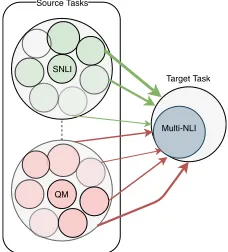
A fundamental concern in TL is that we do not want to transfer irrelevant knowledge which leads to slower conver-gence and/or sub-optimal performance. Therefore, dropping allows to place soft attention based on the performance of each model fromTs→ Ttusing asoftmaxas a weighted vote. Once a target modelftis learned from only few exam-ples onTt(referred to as few-shot learning), the weighted
Source Tasks
Target Task SNLI
QM
Multi-NLI
Figure 2: Nodes = Models within an ensemble for a given task. Link size= Model weight in target task ensemble prediction.
ensembled models fromTscan be transferred and merged with theTtmodel. Equation 1 shows the simple weighted vote between models whereNis the number of ensembled mod-els each of which have batch sizeS,φdenotes thesoftmax function,zl
si= exp(−|h
l T1−h
l
T2|)and¯a l
sdenotes weighted average output from the ensembles trained on subsets ofTs.
¯
als=
N
X
i=1 αi
1
S S
X
s=1 φ(zls
i)
s.t, N
X
i=1
αi= 1 (1)
Equation 2 then shows a straightforward update rule that decays the importance ofTsDroppingnetworks as theTt neural network begins to learn from only few examples. The prediction from few samplesaltis the single output fromTl t andγis the slope of the error curve that is updated at regular intervals during training.
We expect this approach to lead to faster convergence and more general features as the regularization is in the form of a decaying constraint from a related task. The rate of the shift towards theTtmodel is proportional to the gradient of the error∇x˜sfor a set of mini-batchesx˜s. In our experiments, we
have set the update of the slope to occur every 100 iterations.
ˆ
yt=γa¯ls+ (1−γ)a l
t s.t, γ=e
−δ (2)
The assumption is that in the initial stages of learning, in-corporating past knowledge is more important. As the model specializes on the target task we then rely less on incorporat-ing prior knowledge over time. In its simplest form, this can be represented as a moving average over the development set error curve so to chooseδas shown in Equation 3, wherekis the size of the sliding window. In some cases an average over time is not suitable when the training error is volatile between slope estimations. Hence, alternative smoothing approaches would include kernel and spline models (Eubank 1999) for fitting noisy, or volatile error curves.
δt=E[∇[t,t+k]] (3)
A kernelψcan be used to smooth over the error curve, which takes the form of a Gaussian kernel ψ(ˆx, xi) =
exp −(ˆx−xi)2/2b2
. Another approach is to use Lo-cal Weighted Scatterplot Smoothing (LOWESS) (Cleveland 1979; Cleveland and Devlin 1988) which is a non-parametric regression technique that is more robust against outliers in comparison to standard least square regression by adding a penalty term.
[image:4.612.116.230.538.664.2]ˆ
δ[t] = arg min θ
k
X
i=1
yi− J
X
j=1
θjψj(xi)
2
+λ J
X
j=1 θ2j (4)
Classification is then carried out using standard Cross-Entropy (CE) loss as shown in Equation 5.
L=−1 N
N
X
i=1 M
X
c=1
yi,clog(ˆyi,c) (5)
This approach is relatively straightforward and on aver-age across all three datasets,58%more computational time for training 10 smaller ensembles for each single-task was needed, in comparison to a larger global model on a single NVIDIA Quadro M2000 Graphic Processing Unit.
Some benefits of the proposed method can be noted at this point. Firstly, the distance measure to related tasks is directly proportional to the online error of the target task. In contrast, hard parameter sharing does not address such issues, nor does recent approaches that use Gaussian Kernel Density estimates as parameter contraints on the target task (O’ Neill and Buitelaar 2018). Secondly, although not the focus of this work, theTtmodel can be trained on a new task with more or less classes by adding or discarding con-nections on the last softmax layer. Lastly, by weighting the models within the ensemble that perform better onTtwe mit-igatenegative transferproblems. We now discuss some of the main results of the proposedDroppingNetwork transfer.
Experimental Setup
Dataset Description
NLI deals with inferring whether a hypothesis is true given a premise. Such examples are seen in entailment and con-tradiction. The SNLI dataset (Bowman et al. 2015) pro-vides the first large scale corpus with a total of 570K an-notated sentence pairs (much larger than previous semantic matching datasets such as the SICK (Marelli et al. 2014) dataset that consisted of 9927 sentence pairs). As described in the opening statement of McCartney’s thesis (MacCart-ney 2009), “the emphasis is on informal reasoning, lexical semantic knowledge, and variability of linguistic expression.” The SNLI corpus addresses issues with previous manual and semi-automatically annotated datasets of its kind which suffer in quality, scale and entity co-referencing that leads to am-biguous and ill-defined labeling. They do this by grounding the instances with a given scenario which leaves a precedent for comparing the contradiction, entailment and neutrality between premise and hypothesis sentences.
Since the introduction of this large annotated corpus, fur-ther resources forMulti-Genre NLI(MultiNLI) have recently been made available as apart of a Shared RepEval task (Nangia et al. 2017; Williams, Nangia, and Bowman 2017). MultiNLI extends a 433k instance dataset to provide a wider coverage containing 10 distinct genres of both written and spoken English, leading to a more detailed analysis of where machine learning models perform well or not, unlike the orig-inal SNLI corpus that only relies only on image captions. As
authors describe, “temporal reasoning, belief, and modality become irrelevant to task performance” are not addressed by the original SNLI corpus. Another motivation for curating the dataset is particularly relevant to this problem, that is the evaluation of transfer learning across domains, hence the inclusion of these datasets in the analysis. These two NLI datasets allow us to analyze the transferability for two closely related datasets.
Question Matching(QM) is a relatively new pairwise learn-ing task in NLU for semantic relatedness, first introduced by the Quora team in the form of a Kaggle competition1. The task has implications for Question-Answering (QA) systems and more generally, machine comprehension. A known diffi-culty in QA is the problem of responding to a question with the most relevant answers. In order to respond appropriately, grouping and relating similar questions can greatly reduce the possible set of correct answers.
The Quora challenge has a few characteristics that are worth pointing out from the onset. The dataset is created so that a unique question, or questions identical in intent, are not paired more than once. This ensures that a classifier does not require many pairings of the same questions to learn as in practice the likelihood of the exact same question being asked is relatively low. However, questions can appear in more than one instance pair(S1
i,Si2). In this work we ensure duplicates are not tested upon if at least one pair of the duplicate is used for single-task learning.
Data Augmentation For both SNLI and Multi-NLI (MNLI) the class distribution is almost even therefore no re-weighting or sampling is required in these cases. However, due to the slight imbalance in the Quora dataset (36% match-ing questions and the remainmatch-ing non-matchmatch-ing questions) a weighted Negative Log-Likelihood (NLL) loss function is used to account for the slight disproportion in classes. An-other strategy is to upsample by reorderingS1 andS2 to improve generalization, this is allowed because the semantics should be symmetric in comparison.
Training Details
For single-task learning, the baseline proposed for evaluat-ing the co-attention model and the ensemble-based model consists of a standard GRU network with varying architec-ture settings for all three datasets. During experiments we tested different combinations of hyperparameter settings. All models are trained for 30,000 epochs, using a dropout rate p= 0.5with Adaptive Momentum (ADAM) gradient based optimization (Kingma and Ba 2014) in a 2-hidden layer network with an initial learning rateη= 0.001and a batch sizebT = 128. As a baseline for TL we use hard parameter transfer with fine tuning on 50% ofX ∈ Tsof upper layers. For comparison to other transfer approaches we note previ-ous findings by (Yosinski et al. 2014) which show that lower level features are more generalizable. Hence, it is common that lower level features are transferred and fixed forTtwhile the upper layers are fine tuned for the task, as described in Section . Therefore, the baseline comparison simply transfers
1
MNLI SNLI QM
Train Test Train Test Train Test
Acc. / % LL Acc. / % LL Acc. / % LL Acc. / % LL Acc. / % LL Acc. / % LL
GRU-1h 91.927 0.230 68.420 1.112 89.495 0.233 77.347 0.755 84.577 0.214 78.898 0.389
GRU-2h 90.439 0.243 68.277 1.121 89.464 0.224 79.628 0.626 86.308 0.096 77.059 0.092
Bi-GRU-2h 90.181 0.253 68.716 1.065 89.703 0.226 80.594 0.636 88.011 0.108 77.522 0.267
Co-Attention GRU-2h 94.341 0.183 70.692 0.872 91.338 0.211 82.513 0.583 89.690 0.088 81.550 0.218
[image:6.612.53.562.55.139.2]Ensemble Bi-GRU-2h 91.767 0.260 70.748 0.829 90.091 0.218 81.650 0.492 88.481 0.177 83.820 0.194
Table 1: Single Task Compositional Similarity Learning Results (shaded values represent best performing models)
all weights fromθs → θtfrom a global model instead of ensembles and these parameters as initialization before train-ing on few examples onTt. Although, negative transfer can occur if the more generalizable lower level representations include redundant or irrelevant examples for theTt. Instead, here we are allowing theTtto guide the lower level feature representations based on a weighted vote in the context of a decaying ensemble-based regularizer.
Results
The evaluation is carried out on both the rate of convergence and optimal performance. Hence, we particularly analyze the speedup obtained in the early stages of learning. Table 1 shows the results on all three datasets for single-task learning, the purpose of which is to clarify the potential performance if learned from most of the available training data (between 70%-80% of the overall dataset for the three datasets).
The ensemble model slightly outperforms other networks proposed, while the co-attention network produces similar performance with a similar architecture to the ensemble mod-els except for the use of local attention over hidden layers shared across both sentences. The improvements are most notable on MNLI, reaching competitive performance in com-parison to state of the art (SoTA) on the RepEval task2, held by Chen et al. (2017c) which similarly uses a Gated At-tention Network. These SoTA results are considered as an upper bound to the potential performance when evaluating theDroppingbased TL strategy for few shot learning.
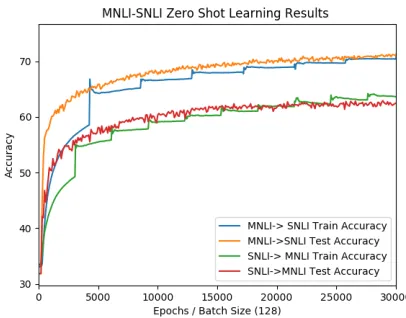
Figure 3 demonstrates the performance of the zero-shot learning results of the ensemble network which averages the probability estimates from each models prediction on the Tttest set (few-shotTttraining set or development set not included). As the ensembles learn onTsit is evident that most of the learning has already been carried out by 5,000-10,000 epochs.
Producing entailment and contradiction predictions for multi-genre sources is significantly more difficult, demon-strated by lower test accuracy when transferring SNLI→ MNLI, in comparison to MNLI→SNLI that performs better relative to recent SoTA on SNLI. Table 2 shows best perfor-mance of this hard parameter transfer fromTs → Tt. The QM dataset is not as “similar” in nature and in the zero-shot learning setting the model’s weightsaS andaQare normal-ized to 1 (however, this could have been weighted based on a prior belief of how “similar” the tasks are). Hence, it is
un-2
https://repeval2017.github.io/shared/
Zero-ShotHard Parameter Transfer
Train Test
Acc. / % LL Acc. / % LL
S→M 60.439 0.243 61.277 1.421
S+Q→M 62.317 0.208 62.403 1.392
M→S 74.609 0.611 71.662 0.844
M+Q→S 74.911 0.603 68.006 0.924
Table 2:Zero-ShotHard Parameter Transfer
surprising that the QM dataset has reduced the test accuracy given that it is further toTtthanSis.
Figure 3:Zero-Shot Learning Between NLU Tasks
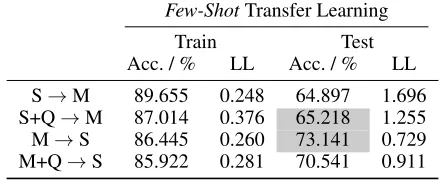
The second approach shown in Table 3 displays the base-line few-shot learning performance with fixed parameter transferred fromTton the lower layer with fine-tuning of the
2ndlayer. Here, we ensure that instances from each genre within MNLI are sampled at least 100 times and that the batch of 3% the original size of the corpus is used (14,000 instances).
Since SNLI and QM are created from a single source, we did not to impose such a constraint, also using a 3%
[image:6.612.333.536.360.519.2]Few-ShotTransfer Learning
Train Test
Acc. / % LL Acc. / % LL
S→M 89.655 0.248 64.897 1.696
S+Q→M 87.014 0.376 65.218 1.255
M→S 86.445 0.260 73.141 0.729
M+Q→S 85.922 0.281 70.541 0.911
Table 3: Few-Shot Transfer Learning with Fixed Lower Hidden GRU-Layer Parameter Transfer FromTsand
Fine-Tuned Upper Layer Trained OnTt
Dropping-GRU CSES
Train Test
Acc. / % LL Acc. / % LL
S→M 90.439 0.243 66.207 1.721
S+Q→M 86.649 0.317 70.703 0.576
M→S 90.181 0.253 72.716 0.615
[image:7.612.62.283.57.148.2]M+Q→S 91.783 0.228 77.926 0.598
Table 4: Transfer Learning viaDroppingGRU Between Ts→ TtUsing Cubic Spline Error Curve Smoothing
tuning on the smallTtbatch that are made, particularly on MNLI with a 2.815 percentage point increase in test accuracy. For both SNLI+QM→MNLI and MNLI+QM→SNLI cases final predictions are made by averaging over the class probability estimates before using CE loss.
Table 4 shows the results from transferring parameters from theDroppingnetwork trained with the output shown in Equation 2 using a spline smoother with piecewise poly-nomials (as described in Equation 4). This approach finds the slope of the online error curve between sub-intervals so to chooseγ i.e the balance between the source ensemble and target model trained on few examples. In the case with SNLI+QM (ie. SNLI + Question Matching) and MNLI+
QM, 20 ensembles are transferred, 10 from each model with a dropout ratepd = 0.5. We note that unlike the previous two baselines methods shown in Table 2 and 3, the perfor-mance does not decrease by transferring the QM models to both SNLI and MultiNLI. This is explained by the use of the weighting scheme proposed with spline smoothing of the error curve i.eγdecreases at a faster rate forTtdue to the ineffectiveness of the ensembles created on the QM dataset.
In summary, we find transfer of MNLI+QM→SNLI and SNLI+QM→MNLI showing most improvement using the proposed transfer method, in comparison to standard hard and soft parameter transfer. This is reflected in the fact that the proposed method is the only one which improved on SNLI while still transferring the more distant QM dataset.
Conclusion
DroppingNetworks are based on a straightforward combina-tion of two common meta-learning model averaging methods:
BaggingandDropout. The combination of both can be of particular benefit to overcome limitations in transfer learn-ing such as learnlearn-ing from more distant tasks and mitigatlearn-ing
negative transfer, most interestingly, in the few-shot learn-ing settlearn-ing. This paper has empirically demonstrated this for learning complex semantic relationships between sentence pairs. Additionally, We find the co-attention network and the ensemble GRU network to perform comparably for single-task learning. Below we summarize the main findings:
• The method for transfer only relies on one additional pa-rameterγ. We find that in practice using a higher decay rateγ(0.9-0.95) is more suitable for closely related tasks.
• Decreasingγin proportion to the slope of a smooth spline fitted to the online error curve performs better than arbi-trary step changes or a fixed rate forγ(equivalent to static hard parameter ensemble transfer).
• If a distant tasks has some knowledge transfer they can be overlooked if possible effects of negative transfer are not addressed. The proposed weighting scheme takes this into account, which is reflected in Table 4, showing M + Q→S and S + Q→M show most improvement, in comparison to alternative approaches posed in Table 2 where transferring M + Q→S performed worse than M→S.
Finally, the proposed transfer procedures usingDropping
networks has been demonstrated in the context of natural language, although the method is applicable to any standard, spatial or recurrent-based neural network.
References
[2014] Bahdanau, D.; Cho, K.; and Bengio, Y. 2014. Neural machine translation by jointly learning to align and translate.
arXiv preprint arXiv:1409.0473.
[2013] Baldi, P., and Sadowski, P. J. 2013. Understanding dropout. InAdvances in neural information processing sys-tems, 2814–2822.
[2014] Baldi, P., and Sadowski, P. 2014. The dropout learning algorithm.Artificial intelligence210:78–122.
[2008] Bollacker, K.; Evans, C.; Paritosh, P.; Sturge, T.; and Taylor, J. 2008. Freebase: a collaboratively created graph database for structuring human knowledge. InProceedings of the 2008 ACM SIGMOD international conference on Man-agement of data, 1247–1250. AcM.
[2015] Bowman, S. R.; Angeli, G.; Potts, C.; and Manning, C. D. 2015. A large annotated corpus for learning natural language inference. arXiv preprint arXiv:1508.05326. [2017a] Chen, Q.; Zhu, X.; Ling, Z.-H.; and Inkpen, D. 2017a.
Natural language inference with external knowledge. arXiv preprint arXiv:1711.04289.
[2017b] Chen, Q.; Zhu, X.; Ling, Z.-H.; Wei, S.; Jiang, H.; and Inkpen, D. 2017b. Enhanced lstm for natural language inference. InProc. ACL.
[1988] Cleveland, W. S., and Devlin, S. J. 1988. Locally weighted regression: an approach to regression analysis by local fitting. Journal of the American statistical association
83(403):596–610.
[1979] Cleveland, W. S. 1979. Robust locally weighted re-gression and smoothing scatterplots.Journal of the American statistical association74(368):829–836.
[2008] Eaton, E.; Lane, T.; et al. 2008. Modeling transfer relationships between learning tasks for improved inductive transfer. InJoint European Conference on Machine Learning and Knowledge Discovery in Databases, 317–332. Springer. [1999] Eubank, R. L. 1999.Nonparametric regression and
spline smoothing. CRC press.
[2016] Gal, Y., and Ghahramani, Z. 2016. Dropout as a bayesian approximation: Representing model uncertainty in deep learning. Ininternational conference on machine learn-ing, 1050–1059.
[2018] Howard, J., and Ruder, S. 2018. Universal language model fine-tuning for text classification. InProceedings of the 56th Annual Meeting of the Association for Computational Linguistics (Volume 1: Long Papers), volume 1, 328–339. [2014] Kingma, D. P., and Ba, J. 2014. Adam: A method for
stochastic optimization.arXiv preprint arXiv:1412.6980. [2017] Long, M.; Cao, Z.; Wang, J.; and Philip, S. Y. 2017.
Learning multiple tasks with multilinear relationship net-works. InAdvances in Neural Information Processing Sys-tems, 1594–1603.
[2009] MacCartney, B. 2009. Natural language inference. Stanford University.
[2014] Marelli, M.; Bentivogli, L.; Baroni, M.; Bernardi, R.; Menini, S.; and Zamparelli, R. 2014. Semeval-2014 task 1: Evaluation of compositional distributional semantic models on full sentences through semantic relatedness and textual entailment. InProceedings of the 8th international workshop on semantic evaluation (SemEval 2014), 1–8.
[2000] Mason, L.; Baxter, J.; Bartlett, P. L.; and Frean, M. R. 2000. Boosting algorithms as gradient descent. InAdvances in neural information processing systems, 512–518.
[2017] Merity, S.; Keskar, N. S.; and Socher, R. 2017. Regu-larizing and optimizing lstm language models.arXiv preprint arXiv:1708.02182.
[1995] Miller, G. A. 1995. Wordnet: a lexical database for english.Communications of the ACM38(11):39–41. [2015] Mou, L.; Men, R.; Li, G.; Xu, Y.; Zhang, L.; Yan,
R.; and Jin, Z. 2015. Natural language inference by tree-based convolution and heuristic matching. arXiv preprint arXiv:1512.08422.
[2016] Mou, L.; Meng, Z.; Yan, R.; Li, G.; Xu, Y.; Zhang, L.; and Jin, Z. 2016. How transferable are neural networks in nlp applications?arXiv preprint arXiv:1603.06111.
[2016] Mueller, J., and Thyagarajan, A. 2016. Siamese recur-rent architectures for learning sentence similarity. InAAAI, 2786–2792.
[2017] Nangia, N.; Williams, A.; Lazaridou, A.; and Bowman, S. R. 2017. The repeval 2017 shared task: Multi-genre natural
language inference with sentence representations. arXiv preprint arXiv:1707.08172.
[2018] O’ Neill, J., and Buitelaar, P. 2018. Few shot transfer learning between term relatedness and similarity tasks using a gated recurrent siamese network. InAAAI.
[2012] Pan, W.; Zhong, E.; and Yang, Q. 2012. Transfer learning for text mining. In Mining Text Data. Springer. 223–257.
[2016] Parikh, A. P.; T¨ackstr¨om, O.; Das, D.; and Uszkoreit, J. 2016. A decomposable attention model for natural language inference. arXiv preprint arXiv:1606.01933.
[1991] Pratt, L. Y.; Mostow, J.; Kamm, C. A.; and Kamm, A. A. 1991. Direct transfer of learned information among neural networks. InAAAI, volume 91, 584–589.
[1993] Pratt, L. Y. 1993. Discriminability-based transfer between neural networks. InAdvances in neural information processing systems, 204–211.
[2006] Raina, R.; Ng, A. Y.; and Koller, D. 2006. Construct-ing informative priors usConstruct-ing transfer learnConstruct-ing. InProceedings of the 23rd international conference on Machine learning, 713–720. ACM.
[2005] Rosenstein, M. T.; Marx, Z.; Kaelbling, L. P.; and Dietterich, T. G. 2005. To transfer or not to transfer. InNIPS 2005 workshop on transfer learning, volume 898, 1–4. [2017] Shen, Y.; Rong, W.; Jiang, N.; Peng, B.; Tang, J.; and
Xiong, Z. 2017. Word embedding based correlation model for question/answer matching. InAAAI, 3511–3517. [2017] Shwartz-Ziv, R., and Tishby, N. 2017. Opening the
black box of deep neural networks via information. arXiv preprint arXiv:1703.00810.
[2017] Wang, Z.; Hamza, W.; and Florian, R. 2017. Bilateral multi-perspective matching for natural language sentences.
arXiv preprint arXiv:1702.03814.
[2013] Warde-Farley, D.; Goodfellow, I. J.; Courville, A.; and Bengio, Y. 2013. An empirical analysis of dropout in piecewise linear networks. arXiv preprint arXiv:1312.6197. [2017] Williams, A.; Nangia, N.; and Bowman, S. R. 2017. A broad-coverage challenge corpus for sentence understanding through inference.arXiv preprint arXiv:1704.05426. [2017] Yang, H.; Costa-juss`a, M. R.; and Fonollosa, J. A.
2017. Character-level intra attention network for natural language inference. arXiv preprint arXiv:1707.07469. [2015] Yin, W.; Sch¨utze, H.; Xiang, B.; and Zhou, B. 2015.
Abcnn: Attention-based convolutional neural network for modeling sentence pairs. arXiv preprint arXiv:1512.05193. [2014] Yosinski, J.; Clune, J.; Bengio, Y.; and Lipson, H.